



Abstract
This article examines how new venture teams (NVTs) develop transactive memory systems (TMSs) to integrate and coordinate their member’s collective expertise. Applying a longitudinal case study of five Norwegian NVTs in their first year, we find that the development of TMSs in NVTs unfolds in three stages. At the pre-formation stage, NVTs undergo a TMS enabling process that includes member motivation, self-declaration and member expectations, which lead to initial specialisation in NVTs. Subsequently, at the formation and collaboration stages, NVTs proceed with TMS processes of encoding, storage and retrieval that encompass self-assessment, assessment of co-members, shared understanding, role formalisation, decision-making and task performance, which enhance specialisation and result in the gradual development of credibility and coordination in NVTs. Furthermore – through member motivation, trust and shared ownership – NVTs engage in a TMS-reinforcing process that helps NVTs to strengthen their TMSs over time, enabling them to increase their ability to integrate and coordinate NVT collective expertise.
Introduction
Entrepreneurship research shows increased interest in the formation and performance of new venture teams (NVTs), as approximately 80% of all new ventures are team based (Kollmann et al., 2016; Lechler, 2001). NVTs are described as a ‘group of individuals that is chiefly responsible for the strategic decision-making and ongoing operations of a new venture’ (Klotz et al., 2014, p. 227). The strength of an NVT lies in the immediate access to a broader and deeper set of knowledge and skills (henceforth expertise) that NVT members possess, which are utilised to found, develop and lead the new ventures (Shane, 2000; West, 2007). Particularly in the initial phase, the expertise resides within NVT members and not within the ventures themselves (Brush et al., 2001). Hence, the successful exploitation of entrepreneurial opportunities requires the integration and coordination of the complementary expertise of NVT members (Colombo and Grilli, 2005).
Prior research has identified transactive memory systems (TMSs) as the mechanisms that help to integrate and coordinate the expertise NVT members collectively possess (Dai et al., 2017; Lazar et al., 2022; Zheng, 2012). Described as systems for shared cognitive division of labour in teams (Wegner, 1987), TMSs emerge as team members learn about ‘who knows what’ in the team and begin to rely on each other’s expertise in various complementary domains (Lee et al., 2014). By helping team members understand, trust and use each other’s expertise, TMSs are found to improve a team’s overall coordination (Ilgen et al., 2005), reduce cognitive load of redundant knowledge (Peltokorpi, 2008), enhance adaptation to novel tasks (Lewis et al., 2005) and advance the team’s ability to perform complex tasks (Ren and Argote, 2011). Furthermore, prior research on TMSs in NVTs reveals that TMSs enable the effective integration of NVT member expertise (Zheng, 2012) and allow NVTs to respond better to unexpected events (Zheng and Mai, 2013). TMSs are also found to enhance new venture entrepreneurial orientation (Dai et al., 2016; Kollmann et al., 2020), improve ambidexterity (Dai et al., 2017), facilitate learning in NVTs and thus, lead to better entrepreneurial outcomes (El-Awad, 2019; Lazar et al., 2022).
Hence, from prior – mostly quantitative – research, we can identify the outcomes of teams that have developed TMSs, but we have a scarce understanding of how TMSs were actually developed. In fact, as far as we know, only Schmickl and Kieser (2008), Peltokorpi (2014) and El-Awad (2019) have taken a qualitative approach to examine TMSs, in which they applied single case studies. Consequently, there are limited insights into TMS processes and dynamics that lead to TMS outcomes as well as the processes that can promote the development of TMSs, especially in self-organising teams (Lewis and Herndon, 2011; Ren and Argote, 2011). Furthermore, most of the prior research has examined the effect of TMSs on more mature work teams (Lewis et al., 2005; Mell et al., 2014) and top management teams (Heavey and Simsek, 2015; 2017), inducing a need to explore the development of TMSs in newly formed teams that perform complex tasks (Peltokorpi, 2008; Ren and Argote, 2011).
The purpose of this article is to address these gaps through a qualitative, longitudinal case study of five technology-based NVTs established in a venture creation programme (VCP) at a Norwegian University, guided by the research question: How are transactive memory systems developed in new venture teams? We followed the NVTs for approximately one year, starting from the point of their formation. This unique setting provided us with insights into how TMSs emerge and evolve over time (Lewis and Herndon, 2011; Ren and Argote, 2011), revealing the processes through which TMSs are manifested in NVTs. Hence, our findings provide detailed evidence of the dynamic development of TMSs in NVTs, enhancing our understanding of how NVTs integrate and coordinate members’ collective expertise. This article proceeds as follows. Section 2 contains the theoretical background that informs this study. Section 3 outlines the methodological approach used in the study while Section 4 describes the findings. Finally, we conclude this paper with a discussion of its contributions to the NVT and TMS literatures.
Theoretical background
Utilisation of collective expertise in NVTs
There are several terms to describe teams that establish new ventures, such as entrepreneurial teams, founding teams, start-up teams and NVTs (Vyakarnam et al., 1999; Watson et al., 1995). NVTs can be understood as ‘groups of individuals that are chiefly responsible for the strategic decision-making and ongoing operations of the new ventures’ (Klotz et al., 2014, p. 227). Being responsible for founding, developing and leading new ventures (Beckman et al., 2007), NVTs have a significant impact on their performance (Bolzani et al., 2019). Furthermore, NVTs often play a critical role in investor decisions and in the growth development of new ventures (Agarwal et al., 2016). As a result, NVTs tend to outperform solo entrepreneurs (Lechler, 2001; Stockley and Birley, 2000) due to their deeper and broader pool of expertise (Shane, 2000). Because NVT members are the main providers of a new venture’s initial resources (Brush et al., 2001), the appropriate use of NVT member expertise is one of the determinants of effective performance by new ventures (Jin et al., 2017). However, a larger pool of expertise does not necessarily lead NVTs to a better performance, as a fruitful exploitation of entrepreneurial opportunities is highly dependent on the integration and coordination of complementary knowledge and skills (i.e. technological, marketing and managerial) distributed among different NVT members (Colombo and Grilli, 2005; Kollmann et al., 2020).
Indeed, an NVT’s collective expertise can be less than the sum of individual expertise (Lam, 2000). For instance, teams are typically associated with better decision-making compared to decisions each team member would make individually (Hollingshead, 2001). Nevertheless, decisions made by teams are often worse than one would expect considering the sum of the individual knowledge and abilities of all members (Laughlin and Hollingshead, 1995). Unlike the performance of teams in large and mature firms, the performance of relatively small and new teams – like NVTs – is more directly linked to team member characteristics and interactions (Jin et al., 2017). This is especially true for technology-based new ventures (Ensley and Hmieleski, 2005) that exhibit a strong reliance on NVT member expertise, as technology-based new ventures are typically characterised by complex tasks that require the ability to rapidly manage a large amount of information (Zheng, 2012). Hence, such NVTs depend on the successful integration and coordination of the expertise that NVT members collectively possess (Bechky, 2006). This, in turn, requires the development of supportive coordination mechanisms (Brush et al., 2001) that can help members identify each other’s expertise and assign tasks to the expert who will perform them best (Huang and Chen, 2018). However, creating such coordination mechanisms is not straightforward. All the above advocate the crucial role TMSs can play in the integration, coordination and – subsequently – utilisation of collective expertise in NVTs (Dai et al., 2017; Zheng, 2012).
Transactive memory systems
TMSs have received increased attention in research on teams and their performance (Peltokorpi, 2008; Ren and Argote, 2011). A widely used definition of TMSs describes them as shared systems that people in close relationships develop for encoding, storage and retrieval of knowledge about different substantive domains (Hollingshead, 1998; Wegner, 1987). Based on Wegner et al. (1985) notion that people may serve as external memory support to each other, TMSs emerge as individuals – motivated by problems that they cannot solve alone – search for help by contacting others and remember these contacts as well as their contributions in order to use them as possible sources in the future (Nebus, 2006). This way, TMSs enable team members to effectively use each other’s unique expertise. The primary preconditions for TMS development are the cognitive interdependence (Hollingshead, 2001) and face-to-face interactions (Lewis, 2004) of team members. Incorporating knowledge into team member interactions enables teams to transfer knowledge internally while hindering external knowledge transfer to competitors (Argote and Ingram, 2000). Indeed, TMSs do not reside within any individual but rather constitute a property of the team (Gibson, 2001). With interdependence and interactions as building blocks, TMSs are formed when team members accept responsibility for the encoding, storage and retrieval of knowledge related to their domain of expertise (Peltokorpi, 2008).
Consequently, TMSs are found to function through three ‘transactive’ processes: encoding, storage and retrieval (Wegner, 1987). (i) Encoding refers to the creation of a shared cognitive directory based on team members’ awareness of ‘who knows what’ in the team. (ii) Storage refers to the allocation of knowledge to a team member based on the team member’s awareness of his or her willingness and ability to store it. (iii) Retrieval refers to a team member’s understanding of the location, accessibility, and value of knowledge and skills that another team member possesses (Borgatti and Cross, 2003). The use of the term ‘transactive’ during the description of these three processes underlines the interactive and dynamic nature of these systems.
To trace the presence of TMSs in teams, Lewis (2003) advocates that one should search for three specific elements that characterise well-developed TMSs: (i) specialisation (i.e. differentiated knowledge structures), (ii) credibility (i.e. team member perceptions regarding reliability of knowledge and skills that the other team members possess) and (iii) coordination (i.e. efficient use of team member knowledge and skills during the performance of tasks). Effective TMSs are associated with high levels of specialisation, credibility and coordination (Lewis, 2003) – and consequently – better utilisation of expertise among team members (Ren and Argote, 2011). As team members interact to perform various tasks (e.g. decision-making and problem-solving), they get the opportunity to validate each other’s expertise, increasing the accuracy and consensus regarding ‘who knows what’ in the team (Austin, 2003). This leads team members to develop a more accurate and shared (similar) understanding of each other’s expertise and its value (Lewis and Herndon, 2011), rendering expertise utilisation in teams more effective. Considering the benefits that scholars ascribe to TMSs, they might be particularly valuable to knowledge-intensive teams, like NVTs that aim at commercialising new technology. However, despite the potential importance of TMS theorising in a better understanding of expertise utilisation and the suggested benefits of conducting TMS research in NVTs (Ren and Argote, 2011), very few studies have examined TMSs in the context of NVTs.
Role of TMSs in the utilisation of expertise in NVTs
After forming the team, NVT members strive to overcome the lack of an accurate understanding of each other’s expertise as well as their actual contribution to the new venture’s performance. Through a better understanding of each other’s expertise, NVT members can reduce overlaps in their expertise, providing NVTs with a greater diversity of task-related knowledge (Peltokorpi, 2008). However, since the relevant expertise held by each NVT member, as well as fit to the tasks, may not be directly observable, the members depend on any available characteristics to initiate the allocation of roles and responsibilities in NVTs (Jung et al., 2017). Such role allocation can lead to a poor use of each NVT member’s expertise – both current and future – considering the imprinting effect that the initial allocation of roles can have on the new venture’s subsequent design (Bryant, 2014). As such, TMSs enable a more accurate delegation of tasks in NVTs, aligning NVT member competences or expertise with the appropriate roles and responsibilities and thus, increase overall efficiency (Zheng, 2012).
Moreover, TMSs are particularly relevant to NVTs, as these teams tend to perform complex tasks that involve the integration and coordination of a considerably large amount of information (Dai et al., 2017; Zheng, 2012). By developing a shared awareness of expertise, TMSs decrease the cognitive load and redundant knowledge in teams (Peltokorpi, 2008). Ren et al. (2006) demonstrated that TMSs are more beneficial in teams with dynamic environments that are characterised by rapid data changes, where knowledge quickly becomes obsolete. Furthermore, TMSs have been shown to improve a team’s adaptation to new tasks (Lewis et al., 2005) and foster the creation of new knowledge in teams (Mitchell and Nicholas, 2006). As a result, TMSs facilitate the utilisation of collective expertise of team members providing teams with a broader and deeper knowledge pool.
Another reason TMSs are important to the utilisation of expertise in NVTs is their ability to discourage the acquisition of external knowledge while fostering improvisation in response to unexpected events and negative surprises (Zheng and Mai, 2013) that NVTs often encounter. In addition, research shows that TMSs can increase a new venture’s entrepreneurial orientation (Dai et al., 2016; Kollmann et al., 2020) and enhance ambidexterity (Dai et al., 2017), supporting NVTs during the discovery, evaluation and exploitation of entrepreneurial opportunities (Kollmann et al., 2020). Finally, TMSs help NVTs develop learning systems that can result in superior performance (El-Awad, 2019; Lazar et al., 2022). More precisely, El-Awad (2019) demonstrates how TMSs enable individual experience to become gradually embedded in organisational routines, fostering multilevel entrepreneurial learning in new ventures. Moreover, Lazar et al. (2022) suggest that by promoting coordination among NVT members with diverse expertise, TMSs facilitate the development of effective learning repertoires and thus, lead to better performance at an early stage. All these studies indicate that well-established TMSs may become the mechanisms that NVTs employ to enact optimal use of each NVT member’s unique expertise and – subsequently – achieve better entrepreneurial outcomes. However, as the exact processes that guide the development of TMSs in newly formed teams that perform complex tasks (such as NVTs) remain poorly understood (Peltokorpi, 2008; Ren and Argote, 2011), we present the main insights from prior TMS literature regarding the antecedents and the development of TMSs in other types of teams (primarily work teams).
Antecedents and development of TMSs
According to the TMS literature, the development of TMSs starts when team members gain some knowledge about the expertise of their co-members (Lewis and Herndon, 2011). This is mainly achieved through communication over time and allows team members to evaluate the quality, value and accessibility of knowledge and skills of their co-members (Hollingshead and Brandon, 2003; Kanawattanachai and Yoo, 2007; Lewis, 2004; Su, 2012). Communication is recognised as a critical part of the encoding, storage and retrieval of knowledge in TMSs, especially as new knowledge emerges and areas of expertise are reassigned (Tang et al., 2015). Indeed, communication sets the stage for the establishment of an accurate and shared understanding of each member’s expertise, facilitating the development of TMSs (Peltokorpi and Hood, 2019). Several studies (Lewis, 2004; Liang et al., 1995; Moreland and Myaskovsky, 2000; Moreland et al., 1996) focus specifically on face-to-face communication, highlighting the fact that apart from facilitating the development of TMSs, face-to-face communication enhances subsequent knowledge retrieval.
In addition to communication, scholars have identified other aspects that can promote the development of TMSs in teams. Prichard and Ashleigh (2007) show that training in problem-solving, interpersonal relationships, goal-setting and role allocation – provided by team leaders or managers – helps teams develop TMSs. Training allows members to form more accurate perceptions of a team’s collective expertise, leading to more effective TMSs (Moreland et al., 1998). Other studies have indicated that team member familiarity and interpersonal trust are positively related to the development of TMSs (Akgün et al., 2005; Lewis, 2004). Furthermore, team characteristics such as task interdependence, cooperative goal interdependence and support for innovation are also associated with strong presence of TMSs in teams (Zhang et al., 2007).
Overall, prior TMS literature indicates that TMSs can emerge in any team where members have some knowledge about each other’s expertise. This knowledge can be based on prior shared teamwork experience (if any), perceptions, expectations or the available explicit information (Ren and Argote, 2011). Perceptions and expectations are typically reflected in role identification behaviours (i.e. team members request information about a co-member’s role or responsibilities and provide information about their own roles or responsibilities) that can promote the initial development of TMSs (Pearsall et al., 2010). However, such initial TMSs can be inaccurate, leading team members to gradual refinements based on ongoing communication and performance feedback (Brandon and Hollingshead, 2004). Indeed, teams that are characterised by trivial interactions and weak interdependence among their members are likely to develop less accurate and less shared (similar) understanding of each other’s expertise – and thus – less effective TMSs (Barnier et al., 2018). As a result, the development of TMSs seems to depend on the quality and quantity of member interactions, which are likely to change over time. Furthermore, as Rico, Sánchez-Manzanares et al. (2008) note, TMSs do not solely reflect the static distributed knowledge about each member’s expertise but also incorporate processes like directory update and knowledge retrieval. All the above advocate the dynamic development of TMSs in teams (Brandon and Hollingshead, 2004; Lewis and Herndon, 2011; Ren and Argote, 2011).
In summary, our review illustrates that NVTs are highly dependent on the integration and coordination of the expertise that their members collectively possess. TMSs, in turn, can facilitate the integration and coordination of collective expertise, leading to its utilisation. However, the TMS literature has mainly touched upon the antecedents of TMSs and their development in more mature work teams. As a result, there is still a lack of in-depth understanding of the emergence of TMSs in newly formed teams that perform complex tasks as well as their dynamic development over time (Lewis and Herndon, 2011; Ren and Argote, 2011), especially since most of the existing TMS studies have been conducted in controlled settings (Peltokorpi, 2008). To address these calls, we pursued a longitudinal multiple case study to explore how NVTs develop TMSs to utilise the collective expertise of NVT members.
Methodology
Research design
To examine the development of TMSs in NVTs, we applied an inductive, qualitative case study approach, tracing five NVTs for approximately one year. This research design was selected to provide an in-depth understanding of the rather unexplored phenomenon (Yin, 2013) of TMSs in NVTs, given that – to the best of our knowledge – few qualitative studies have been conducted on TMSs in general (notable exceptions are Schmickl and Kieser (2008), Peltokorpi (2014) and El-Awad (2019)). The longitudinal design was applied to obtain nuance regarding the dynamic and processual development of TMSs (Lewis and Herndon, 2011; Ren and Argote, 2011), as fine-grained qualitative process data are particularly important for demonstrating how and why phenomena emerge, evolve or terminate over time (Langley, 1999). To utilise this research design, we focused on the passage of time and its effects on TMS development, as we observed the sequence of events and activities that unfolded in the NVTs throughout the period of their first year.
Research setting and case selection
To build a theory on TMSs, we used theoretical sampling in the case selection process (Eisenhardt and Graebner, 2007). This implies that the cases were selected based on their theoretical appropriateness for this study, which is to extend the theoretical concept (Eisenhardt, 1989) of TMS. The cases (i.e. NVTs) were selected from the School of Entrepreneurship organised by the Norwegian University of Science and Technology (NTNU), an ambitious two-year VCP at the master level, in which students start new ventures as a part of their education (Entreprenorskolen, 2022; Sørheim et al., 2021). The VCP is located in Trondheim, Norway, with the vision of educating the best business developers in the world; the slogan is ‘Not because it is easy’ (Entreprenorskolen, 2022). The programme is highly competitive and receives hundreds of applicants, only accepting around 35 students yearly (30–40% females), based on academic results, work experience and interviews regarding their motivation to join the VCP. The background of the VCP participants is approximately 50% from engineering, 35% from social sciences and the remaining from other subject areas in the sciences (Sørheim et al., 2021). This renders the programme particularly suitable for studying the development of TMSs in NVTs formed by members with diverse expertise.
Similar to an early-stage incubator, the programme provides its participants with access to critical infrastructure and resources, such as its own pre-incubator (Sørheim et al., 2021). We chose this VCP because of the possibility of studying the teams from the point of their formation as well as the emphasis on the development of real ventures. In fact, 82 ventures that were created in the time span between 2005 and 2017 had a collective revenue of approximately $60 million in 2017. Furthermore, around 50% of the students work in their own ventures after their graduation (Sørheim et al., 2021). Another important criterion for selecting the programme was the faculty’s lack of intervention during NVT formation and their subsequent teamwork, as the faculty writes: NSE [NTNU School of Entrepreneurship] students spend the first semester searching for and evaluating [five] business opportunities and ideas. At the end of the first semester, students self-group into teams and develop a new venture based on one of the ideas they have evaluated (Sørheim et al., 2021, p. 273).
It is also possible for the participants to develop their business ideas as solo entrepreneurs. Moreover, both participants and faculty members of the programme stated in interviews that, whenever participants requested it, the faculty provided informal advice that resembled the advice founders receive from mentorship programmes and business incubators during the process of venture creation. Selecting the cases from this programme offered us the particularly rare – yet valuable in process studies – opportunity to follow NVTs from the precise moment of their formation (Davidsson and Gruenhagen, 2020).
In a particular year between 2016 and 2020, we asked permission to study the 10 newly formed NVTs in this VCP. Because none of the authors were faculty members, the teams could decide freely if they wanted to participate, mitigating potentially biased answers. Five teams granted us access and agreed that we would follow them over time. Although there is no ideal number of cases, five is deemed to be within the range that works well in building theory from multiple cases (Eisenhardt, 1989). Table 1 contains information about the five NVTs and their members’ characteristics.
NVTs and member characteristics.
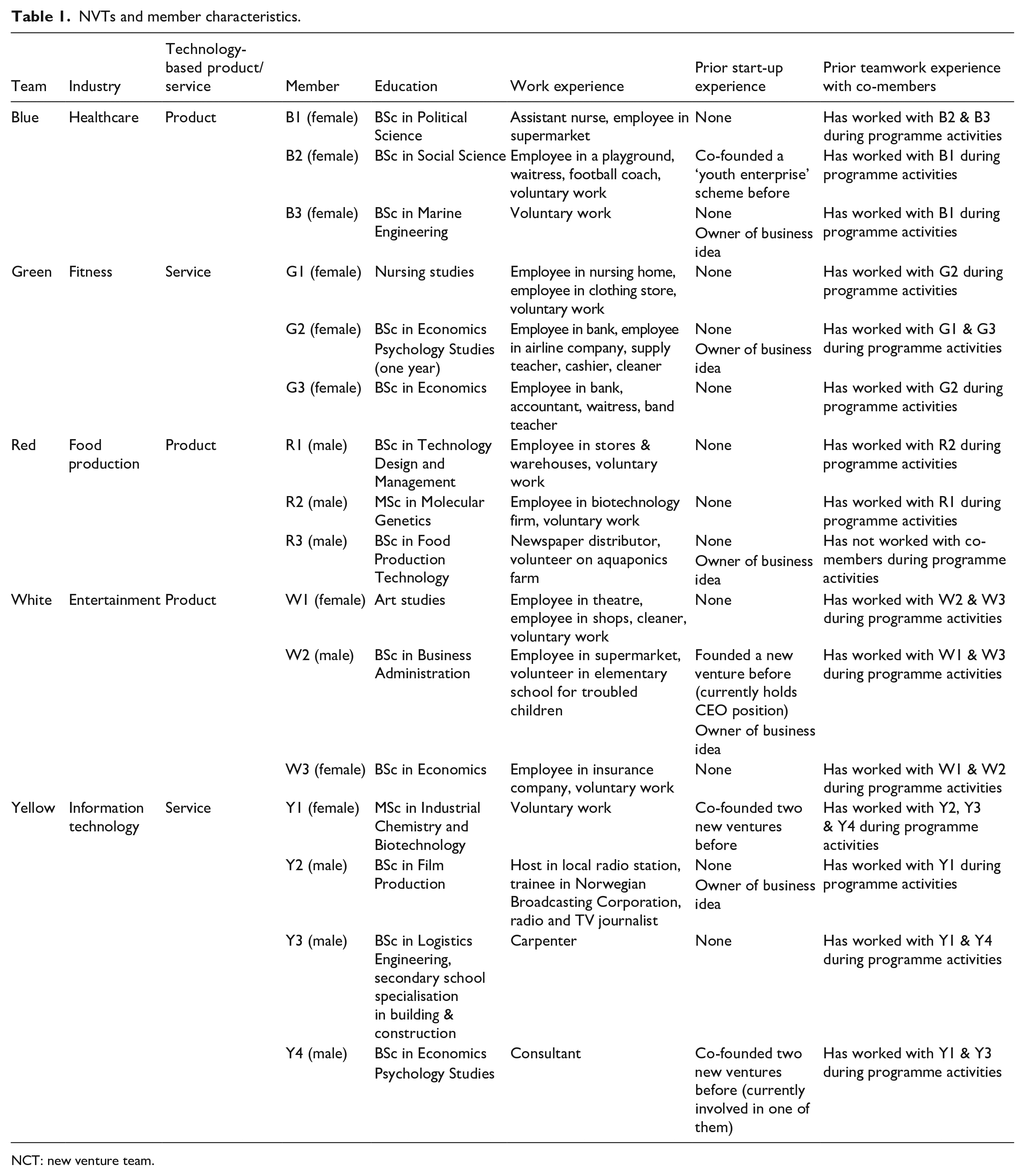
NCT: new venture team.
Data collection
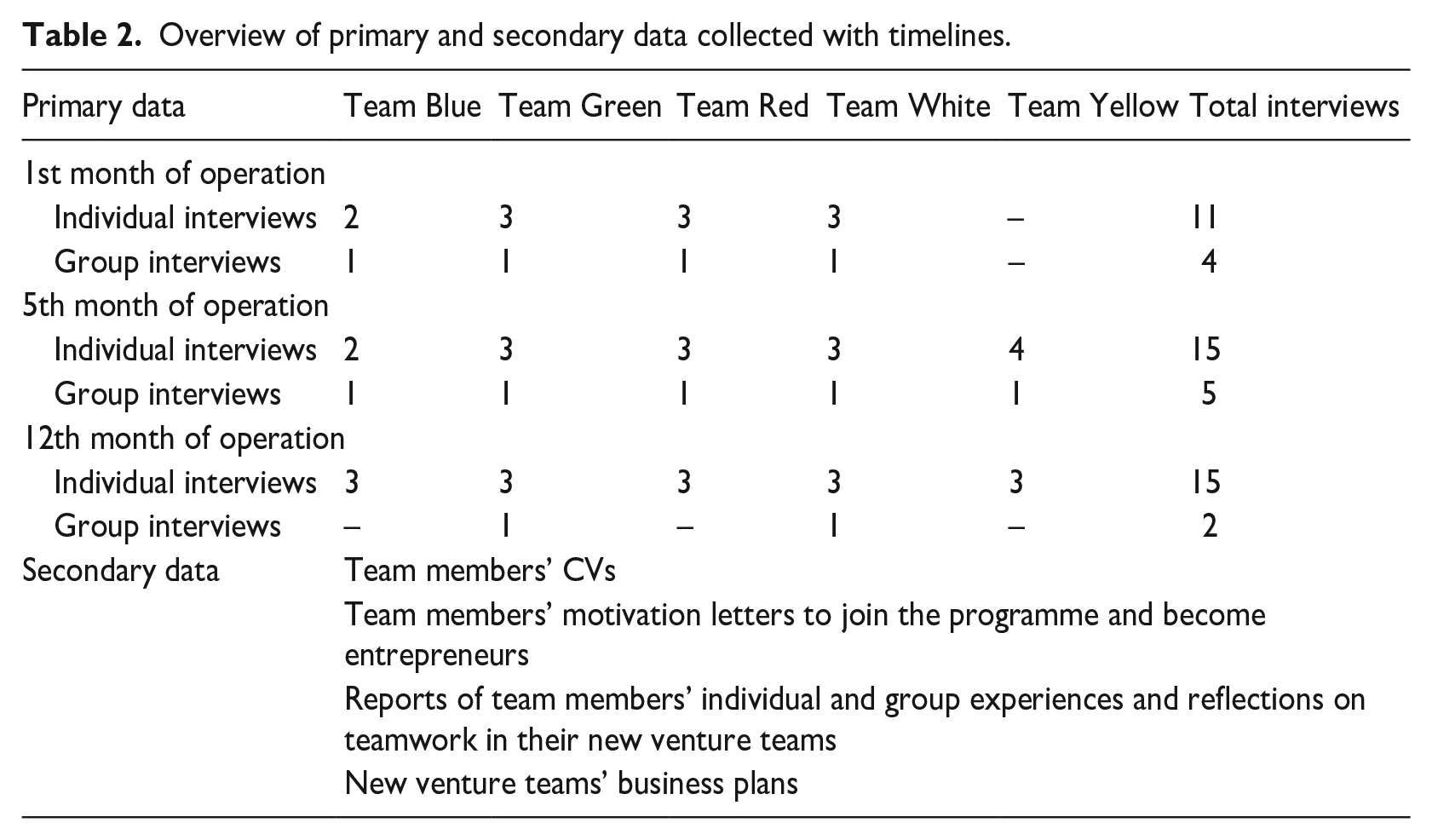
In line with qualitative inquiries, we relied on semi-structured interviews as the main source of data. Following the suggestion of Ren and Argote (2011), we started collecting data from the moment NVTs were formed in order to trace the process of TMS development in newly formed teams. The primary data source consists of 52 in-depth – individual and group – interviews conducted with members of five NVTs over three data collection rounds, which took place during the NVTs’ first year of operation (see Table 2). In addition, secondary data were collected, which consisted of the curricula vitae (CVs) of the NVT members, their motivation letters, reports of an NVT member’s individual and group experiences and reflections on teamwork in their NVTs, and new venture business plans.
Overview of primary and secondary data collected with timelines.
The first data collection round took place immediately after the participants had selected co-members and formed the NVTs, shedding light on co-members’ expectations of each other’s contributions and their first joint activities. The interview template started with questions about the participant’s background (e.g. educational and functional background, prior start-up experience). Next, we asked the participants to describe the concept of their business idea and explain the reasons they decided to commercialise this business idea with the specific team members. The main focus at this point was to uncover the participants’ expectations and perceptions. 1
The second and third data collection rounds took place 5 and 12 months after the formation of the NVTs, respectively. The interviews covered the same themes to enable us to trace changes in the content of the processes of NVT members, revealing potential nuances. The interview protocol focused on the experiences, thoughts and feelings generated by the co-members in their attempt to develop their business idea. The participants described how they experienced communication, decision-making, role division and coordination in their team. They were also asked whether they had faced any challenges, disagreements or conflicts in relation to task performance or collaboration with their co-members and how they were handled. Furthermore, they were asked to identify and explain the current strengths and weaknesses of their NVT and to describe its present and future activities.
Data analysis
When analysing the collected data, we combined an inductive approach and a temporal bracketing strategy to achieve deeper and more accurate results in this process study (Langley, 1999). Due to a lack of prior studies on TMS development in NVTs, we relied on an inductive approach to develop theory based on deep and rich descriptions of the five NVTs (Gioia et al., 2013). Temporal bracketing, on the other hand, enabled us to capture the essence of the timely processes by which TMSs unfold in NVTs (Langley, 1999). Using both approaches in the same study allowed us to increase the strength that the combination of inductive data analysis and temporal bracketing can introduce to the longitudinal exploration of process-oriented phenomenon (Langley, 1999) of TMSs’ development processes, which are explained in more detail in the next two sections.
Inductive approach to coding the data
First, we studied the transcribed individual and group interviews as well as the notes we made during data collection. Afterwards, we reviewed and organised the obtained secondary data. Next, following Langley (1999), who advocates the use of rich descriptions to identify distinct processes that can be analysed and compared in depth, we constructed summaries of the five cases. These narrative accounts enabled a systematic comparison of these five cases regarding the processes that informed the development of TMSs in NVTs.
During this process, we paid particular attention to the passage of time and the changes it introduced to the development of TMSs. The examination of these summaries revealed the presence of specific features as well as the enactment of the processes that facilitate the emergence and subsequent evolution of TMSs in NVTs. Despite the differences in the content, we noticed that all cases undergo the same processes while developing TMSs, namely self-declaration, self-assessment, assessment of co-members, role formalisation, decision-making and task performance. Furthermore, we observed that some features (members’ motivation, trust and shared ownership) – developed during NVT members’ interaction over time – can reinforce the development of TMSs in NVTs.
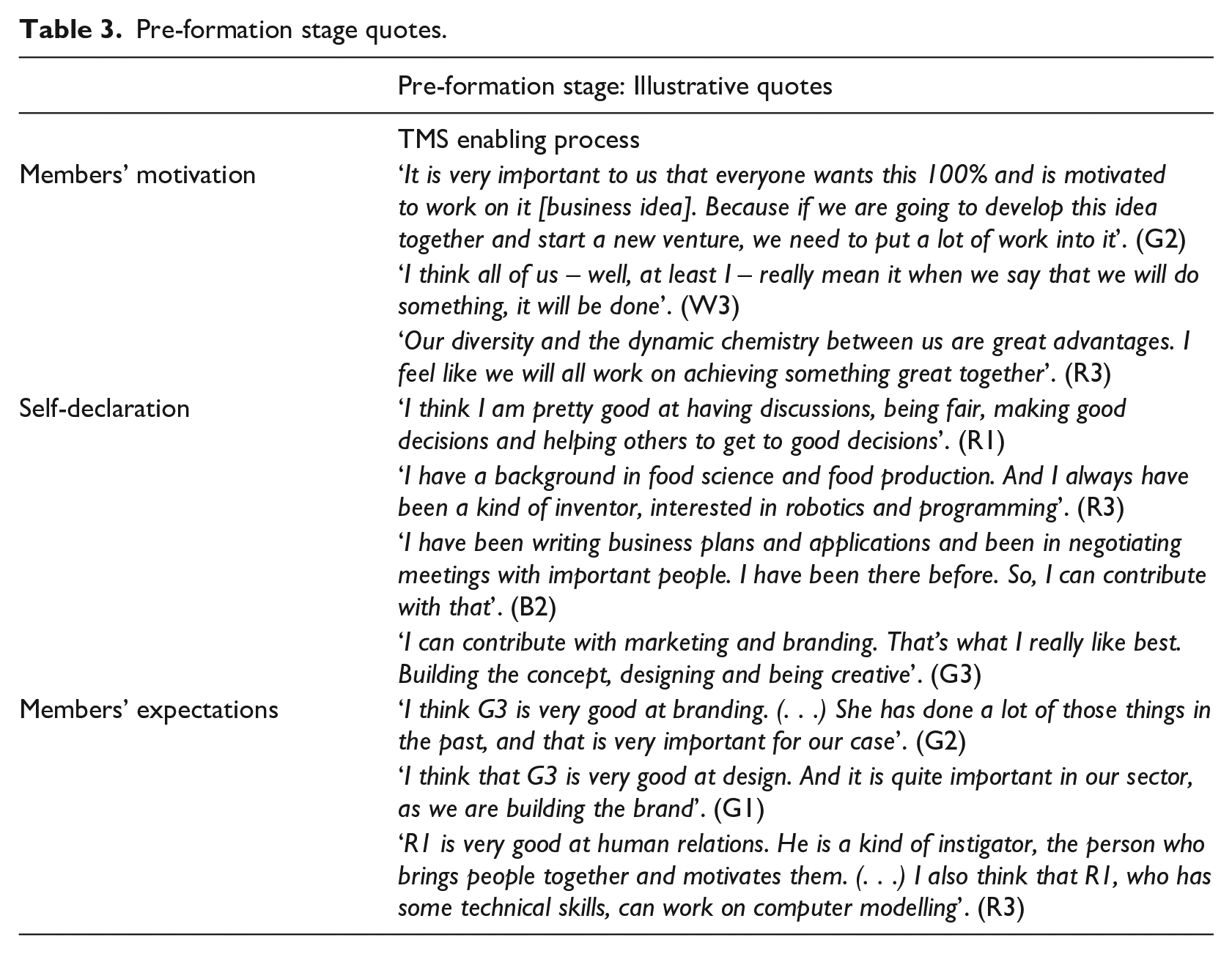
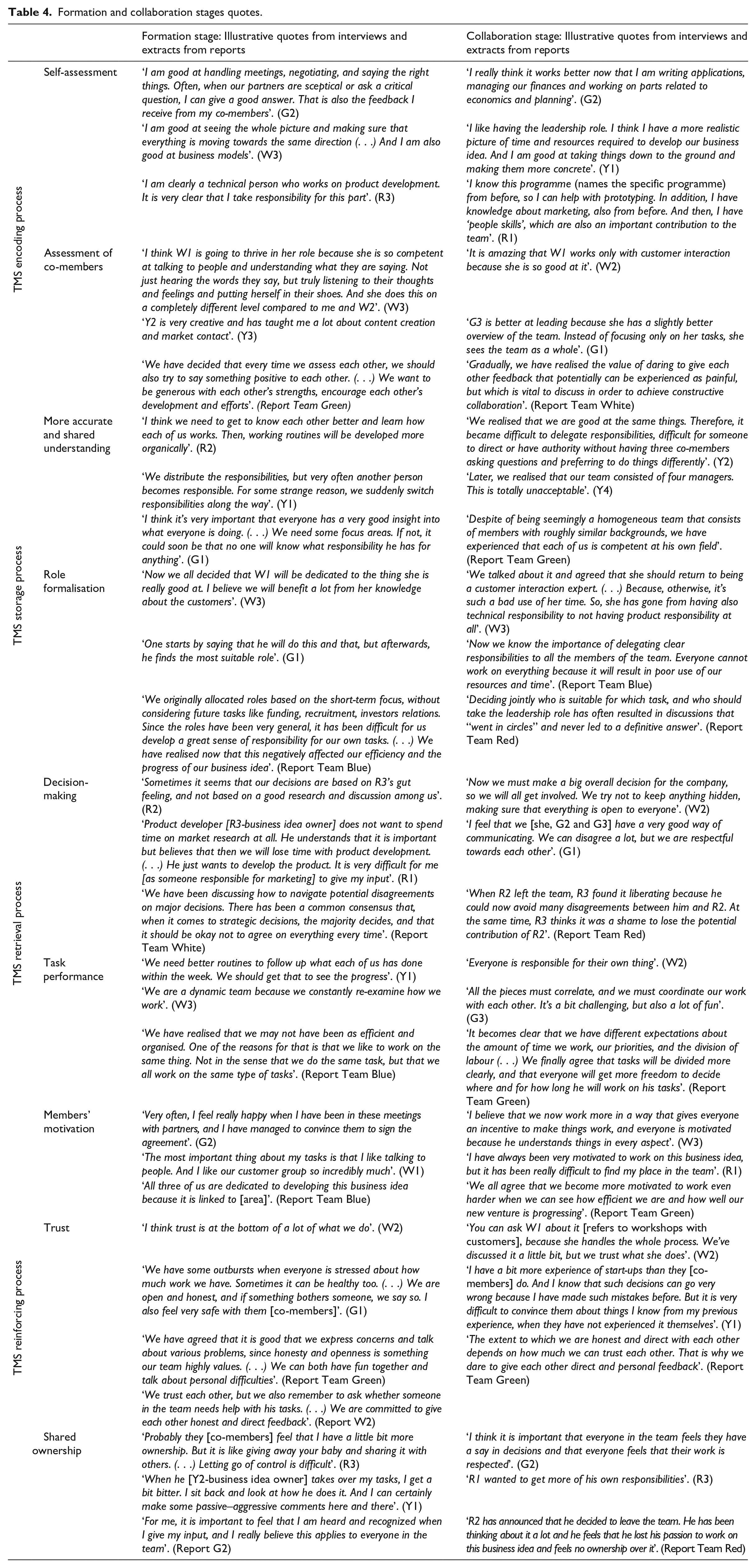
Considering the richness of data, the qualitative analysis software NVivo 12 was applied to facilitate the coding process. We coded all the concepts that emerged, using labels that expressed the participants’ own words as accurately as possible (Gioia et al., 2013). Grouping participant quotes (see Tables 3 and 4), we created first-order codes. Next, we categorised and labelled these codes to develop second-order themes, which uncovered various NVT member activities (e.g. assessment of co-member’s expertise, decision-making). Finally, we merged second-order themes to arrive at aggregate dimensions. At this stage, the connection between our aggregate dimensions and TMS processes (e.g. TMS encoding, TMS storage) emerged.
Pre-formation stage quotes.
Formation and collaboration stages quotes.
We paid specific attention to the sequence in which processes emerged, as well as the differentiation in their content, not only across cases but also across different periods of time (Langley, 1999). This way, we tried to incorporate the passage of time into the study. At this point, we focused on integrating our own interpretations of the findings with the terms that exist in TMS and team literatures, connecting them to prior TMS and team research. The identified processes as well as the observed across cases and time content differences were organised into a meaningful – generated from the data – whole, presented in our process model (Figure 1). To organise and illustrate the longitudinal findings in a more comprehensive manner, we combined the inductive approach with temporal bracketing, which is discussed below.
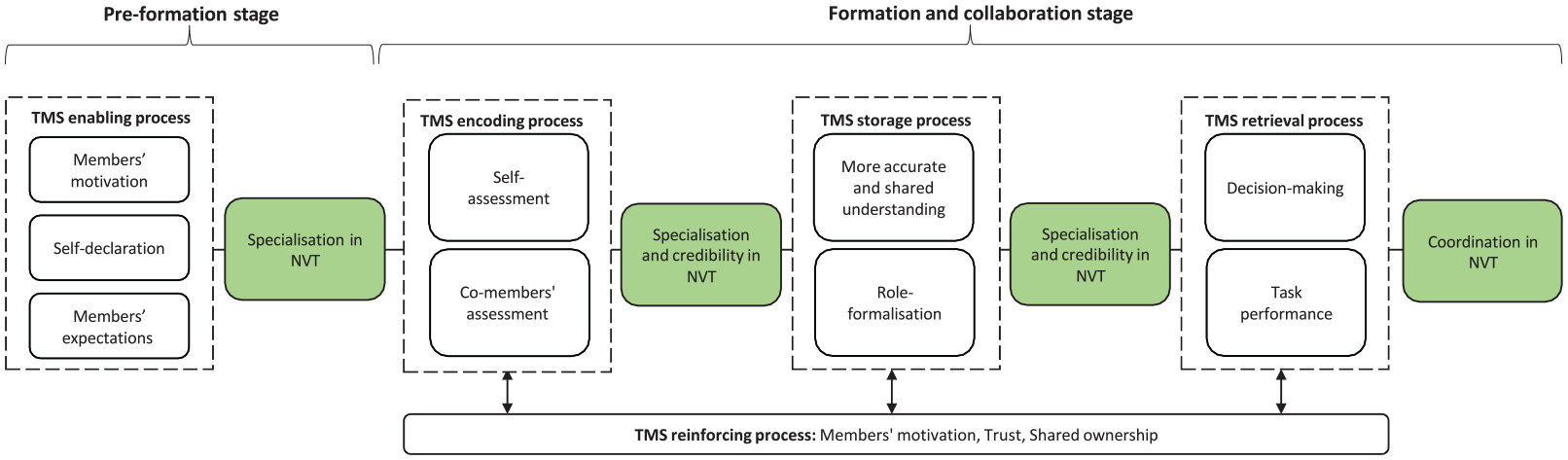
Process model on the development of TMSs in new venture teams.
Temporal bracketing approach to exploring changes over time
Despite the need to study TMSs throughout the life cycle of teamwork (Lewis and Herndon, 2011), TMS literature is still characterised by a lack of process studies (Ren and Argote, 2011), overlooking the importance of temporality in the development of TMSs. Addressing the need to approach TMSs as dynamic systems that can change significantly over time, we applied temporal bracketing to make sense of the coded data. Our first step was to organise the large amount of data into distinct – while at the same time – closely related chunks of data. We decomposed the data into three time periods, which corresponded to three rounds of data collection. This enabled us to monitor more accurately how the five NVTs developed TMSs throughout the period of one year by arranging the rich descriptions of processes, events and participant experiences in a more systematic way. Finally, the construction of three distinct timelines enabled the creation of comparative units of analysis, which enhanced the exploration and replication of the generated insights (Langley, 1999). Thus, temporal bracketing helped us make better sense of the detailed longitudinal data, demonstrating the changes – across cases and time – in the content of the identified processes and showing the extent of TMS dynamics.
Findings
Our findings reveal patterns of how NVTs develop TMSs over time, which, in turn, leads to the integration and coordination of NVT members’ collective expertise. First, our data confirm that to efficiently use each other’s expertise, NVT members engage in transactive processes that involve encoding, storage and retrieval of knowledge related to member expertise (Borgatti and Cross, 2003; Wegner, 1987). Second, and more importantly, we demonstrate how these TMS processes unfold in NVTs – and subsequently – how NVTs develop TMS indicators of specialisation, credibility and coordination (Lewis, 2003) during three stages: (i) pre-formation stage (when NVTs are just formed), (ii) formation stage (when NVTs begin to develop their business idea) and (iii) collaboration stage (when NVTs further advance their business idea). Our findings are outlined in Figure 1 and presented in more detail below.
Pre-formation stage – TMS enabling process
Immediately after the formation of the NVT (see Figure 1), members introduce each other to their expertise, initiating the development of TMSs and thus, laying the foundation for expertise utilisation in NVTs. At this stage of TMS pre-formation, NVT members declare their own expertise motivated by their desire to contribute to the development of NVT’s business idea. Lacking an accurate understanding of each other’s expertise and how this expertise can contribute to the development of a vague – at this point – business idea, NVT members rely on their expectations regarding each member’s expertise and its contribution. Thus, at the pre-formation stage, we observe the emergence of initial specialisation (one of the TMS indicators, according to Lewis (2003)). However, this specialisation is based on NVT member expectations rather than knowledge about each member’s expertise and its role in the development of NVT’s business idea (see Table 3).
Member motivation to contribute to business idea development
The analysis of NVT member interviews and motivation letters indicates that – at the pre-formation stage – motivation guides the process of self-declaration in NVTs. Driven by a strong desire to develop their business idea and establish a successful new venture, NVT members eagerly discuss their expertise and its potential contribution. Furthermore, NVT members often choose to extend their contribution beyond what is traditionally regarded as professional expertise. B1 notes: ‘I am a person who likes to have things in order. This can be important to our business idea, as we are in an industry [healthcare] that requires a lot of documentation. So, I think I am going to get many of the administrative tasks’. As a result, NVT members declare their own expertise and undertake an initial specialisation – based at this stage on their expectations – creating a collaborative atmosphere and building the foundation for the development of TMSs in NVTs: ‘I feel we are honest about our expertise. We have faith that each of us will put the effort and knowledge that is required to make this business idea work’. (B3)
Self-declaration of expertise
We find that self-declaration enables the emergence of TMSs in NVTs, allowing NVT members to develop initial specialisation at the pre-formation stage. R2 states: ‘I have a very strong technical background. Now at the start, I will probably contribute most with technical aspects’. Interestingly, the analysis of NVT members’ interviews and CVs shows that NVT members are willing to mobilise any of their skills or personality traits that may help in the development of NVT’s business idea. In other words, NVT member specialisation does not rely strictly on their professional knowledge and skills: ‘Our business idea is very like that “go to market” so we will have to talk a lot with customers and users from the beginning. (. . .) I think my biggest contribution is that I am very happy to talk to people’. (G1) Thus, our findings identify self-declaration as the process that initiates the formation of distinct areas of expertise among NVT members, enabling the emergence of TMSs in NVTs.
Member’s expectations of expertise
One of the first issues that NVT members discuss immediately after NVT’s formation is the use of each member’s expertise, unfolding the expectations regarding their own as well as a co-member’s contribution to NVT’s business idea development. Lacking prior shared teamwork experience related to the development of NVT’s business idea, the statements of each NVT member seem to be the most solid criterion for judging ‘who is an expert on what’. As stated by B3: ‘I have technical background, so I am looking forward to start working on the technical part. (. . .) It is nice to get that freedom from your co-members. They see the importance of what I do’. Hence, prior to obtaining personal observations of a member’s competence, NVT members tend to rely on each other’s statements about one’s own expertise – supported by education and prior work experience – as well as the motivation to succeed as entrepreneurs. In sum, at the pre-formation stage, NVT members declare their own expertise to each other and obtain an initial expectation-based specialisation, which enables the development of TMSs in NVTs (see Figure 1).
Formation and collaboration stages – TMS processes of encoding, storage and retrieval
After developing the initial specialisation at the pre-formation stage, the NVTs enter the stages of formation (approximately five months after NVT formation), where they begin to develop their business ideas – and subsequently – collaboration (approximately 12 months after the NVT’s formation), where they further advance their business ideas. As NVT members collectively work on the development of their business idea, the TMS processes of encoding, storage and retrieval (Borgatti and Cross, 2003; Wegner, 1987) gradually unfold.
At the formation stage, we observe that the self-assessment and assessment of co-members by NVT members replaces self-declaration. Working together on the development of NVT’s business idea allows members to form a better understanding and recognition of each other’s expertise, triggering TMS encoding. At this point, NVT members re-examine and – whenever necessary – readjust the initial specialisation, establishing specialisation that relies on performance rather than expectations. Moreover, the formation stage introduces the gradual development of credibility in each other’s expertise. 2 As NVT members form a more accurate and shared understanding and recognition of each other’s expertise, their knowledge regarding ‘who is an expert on what’ in NVT is gradually incorporated into NVT’s role structure through the process of role formalisation. Role formalisation enables NVT members to allocate knowledge related to each other’s expertise more efficiently and, as such, reflects TMS storage. Finally, TMS retrieval is manifested in decision-making and task performance, as these processes allow NVT members to use their unique expertise during NVT’s business idea development. At this point, NVTs improve significantly their coordination. In sum, at the formation stage, NVTs engage in TMS encoding, storage and retrieval (Borgatti and Cross, 2003; Wegner, 1987) and begin to develop TMSs, exhibiting considerable levels of specialisation, credibility and coordination (Lewis, 2003).
Subsequently, the NVTs enter the collaboration stage. At this stage, TMS encoding, storage and retrieval are manifested in the same processes: self-assessment, assessment of co-members, role formalisation, decision-making and task performance. Nevertheless, the collaboration stage is characterised by a further improvement of NVT understanding of each other’s expertise – and therefore – its better utilisation. As a result, specialisation and credibility become stronger, while coordination is more evident at the collaboration stage. Furthermore, our data indicate that motivation, trust and shared ownership facilitate the development of TMSs in NVTs (see Figure 1 and Table 4).
TMS encoding process through self-assessment and assessment of co-members
We observe that NVTs begin to engage in TMS encoding at the stage of formation and continue at the stage of collaboration. TMS encoding is reflected in NVTs through self-assessment and assessment of co-members, whereby NVT members develop a better understanding of ‘who is an expert on what’ in the NVT. This, in turn, leads to the refinement of the initial specialisation (developed at the pre-formation stage) as well as the gradual emergence of credibility in NVTs.
Self-assessment of expertise
After having exercised their actual expertise for some time, NVT members re-examine their own competence, aligning their expertise with NVT’s needs. At the formation stage, expertise is no longer based on expectations but rather on observations and reflections about the value of their expertise: ‘When it comes to interaction with customers, I believe I am the right person. When W2 and W3 try to contact our customers, they usually do not get any replies, while I get them almost straight away’. (W1) In some NVTs, even during the stage of collaboration, the members continuously re-evaluate whether their professional knowledge, social skills, or personality traits are sufficient to accomplish the undertaken tasks or whether they should alter their specialisation: ‘I realised that my strength is neither at the finances nor at the technology side. My strength is at interacting with our customers and getting feedback from them’. (W1)
Assessment of co-member expertise
Having worked together on the development of NVT’s business idea for several months, NVT members gradually gain a better understanding of each other’s expertise, forming their own judgement about ‘who is an expert on what’ instead of relying on the statements of the member himself: ‘I trust my co-members’ expertise more and more. It was more difficult at the beginning. Now we are more certain about what each of us is good at’. (R2) At the collaboration stage, in some NVTs, NVT members continue re-examining whether each NVT member’s expertise is properly utilised. W3 states: ‘W1 had to learn a lot of technical stuff, when she is so good at customer interaction. None of us saw that she was so incorrectly used, but then it became clear’. Therefore, our findings indicate that the processes of self-assessment and assessment of co-members refine the initial specialisation (developed at the pre-formation stage) and enable the gradual development of credibility in NVTs.
TMS storage process through role formalisation
Furthermore, our findings show that, in NVTs, TMS storage manifests in role formalisation. Guided by a more accurate and shared understanding and recognition of each other’s expertise, NVT members initiate role formalisation that incorporates this improved understanding of ‘who is an expert on what’ in the NVT.
More accurate and shared understanding of each other’s expertise
Jointly working on the development of NVT’s business idea, NVT members continuously improve their understanding of each other’s expertise. In fact, our findings indicate that, at the stage of formation, NVT members are able to evaluate each other’s expertise and use it to develop NVT’s business idea. R1 notes: ‘We are figuring out what is the best way to organise our work by making to-do lists and separating our tasks based on what we all know that we are good at’. Subsequently, at the stage of collaboration, we observe that NVT members further enhance their understanding and recognition of each other’s expertise, which – in turn – facilitates role formalisation and expertise utilisation in NVTs: ‘W1’s role has changed a bit. When we started, she was supposed to work with the customer, that was the idea. Then, it slipped a little bit over the product development, on which she spent a lot of time. But we have found that it is very poor use of her expertise’. (W3)
Role formalisation
According to our findings, NVT members’ improved understanding of each other’s expertise is gradually incorporated into NVT’s role structure through role formalisation process. As R2 states: ‘We managed to divide roles according to the strengths of each member and we rely on each other a lot. There was less of this feeling in the beginning. (. . .) Roles become clearer and clearer. I think we are on our way to find our natural roles’. Thus, we observe an increasing consensus regarding ‘who is an expert on what’ in the NVT. Furthermore, our findings indicate that some NVTs frequently re-evaluate their formalised roles throughout the stages of formation and collaboration. This results in the development of a clear – yet flexible – specialisation that responds to NVT’s current needs. In these NVTs, members jointly define the domain in which each member can thrive, enabling the coordination of the collective expertise of NVT members: ‘We have redefined some “who does what” in the team. We have gained important focus areas, so there has been a lot of independent work. But everyone knows what each of us is doing and that is very good’. (W3)
TMS retrieval process through decision-making and task performance
The analysis of our data shows that TMS retrieval emerges at the formation stage and is further developed at the collaboration stage through the processes of decision-making and task performance. By making decisions and performing tasks related to their area of expertise, NVT members enact their expertise and its contribution. As a result, during TMS retrieval, the unique expertise of each NVT member – an expertise assessed and formalised during TMS encoding and storage – is utilised to advance NVT’s business idea, strengthening the specialisation and credibility, and improving the coordination in NVTs.
Decision-making
The process of TMS retrieval is reflected in NVT’s decision- making, as NVT members learn to rely on each other’s expertise to make decisions under the time pressure and uncertainty that often surround NVTs. G1 states: ‘We make many decisions. It does not mean that everyone should be involved in absolutely everything, because it takes awfully a lot of time’. Over time, some NVTs extend the understanding and recognition of each NVT member’s unique expertise to the point of allowing members to make independent decisions related to their domain. These NVTs employ expertise-based allocation of decision-making authority – except for important strategic decisions – to increase the speed of decision-making, while maintaining its quality, as reflected by W2:
When it comes to strategic things, we make the decision all together. But on an everyday basis, we have divided decision-making responsibilities into financing and administration, marketing, product and customer. But I think we can become even better at taking some decisions by ourselves.
Therefore, decision-making – especially at the collaboration stage – demonstrates a greater utilisation of each NVT member’s unique expertise. Nevertheless, in some NVTs, the knowledge and information brought by an NVT member – assigned as an expert in this area – can be overlooked during NVT’s decision-making. For instance, R3 admits: ‘I know that the other two (co-members) feel a little bit ignored sometimes. I have opinions that I do not want to let go of. I understand that, but I still cannot let go of it’.
Task performance
Another NVT process that reflects TMS retrieval is task performance. During the formation stage, NVT members begin to apply their expertise to perform the entrepreneurial tasks associated with their specialisation. The value of diverse expertise lies in increased autonomy, which gradually leads NVT members to more coordinated efforts: ‘Autonomy is important. The fact that my co-members can complete their tasks. That they can understand how to solve the problem, and actually solve it. (. . .) People should be able to contribute to the team in such way’. (Y2) Furthermore, task performance allows NVT members to observe the actual contribution of each other’s expertise, clarifying the boundaries of each member’s domain. W3 and W2 note:
Had it been someone else than W1 running that workshop, it would have been harder to stay away. (. . .) W1 does not get any fuss from either me or W2 before the workshop about whether it should be like this or that. (W3) She (W1) has full freedom to run these workshops with our customers. (W2)
Hence, our findings indicate that through task performance, NVT members exercise specialisation, demonstrate credibility in each other’s expertise and enhance their coordination. At the collaboration stage, task performance is further aligned with each NVT member’s expertise, as NVT members obtain a deeper understanding of ‘who is an expert on what’ in the NVT and use this understanding to synchronise their collective efforts which, in turn, improves NVT’s coordination.
Likewise decision-making, the process of task performance reveals differences among the five NVTs. In some NVTs, the members struggle to appreciate and enact each other’s knowledge and skills, resulting in unexploited expertise: ‘It’s hard to be trusted. Although I have got feedback from my co-members that I have a lot of good input, it doesn’t really work like that in practice. (. . .) I really do not feel that I have fully utilized my assets. I have not really used what I am good at’. (Y1) Therefore, in some NVTs, we observe a less efficient integration and coordination of NVT members’ expertise. Next, we present the findings related to the TMS reinforcing process and the features that facilitate the development of TMSs in NVTs.
TMS reinforcing process through motivation, trust and shared ownership
From the moment NVTs engage in TMS encoding, storage and retrieval and begin to develop TMSs, a reinforcing process takes place. This evolution occurs at the formation and collaboration stages and, though unfolded differently in our five NVTs, is driven by the same features: NVT member motivation as well as trust and shared ownership developed among NVT members. These features update and reinforce self-assessment and assessment of co-members – gradually leading to a more accurate and shared understanding of each other’s expertise – and enhance role formalisation, decision-making and task performance. Thus, through members’ motivation, trust and shared ownership, NVTs refine TMS encoding, storage and retrieval, facilitating the development of stronger specialisation, credibility and coordination.
Member motivation
To mobilise any of their professional or social skills or personality traits in order to contribute to NVT’s business idea development is the first observed reinforcing feature. Thus, the motivation that enables the development of the initial expectations-based specialisation (at the pre-formation stage) also sets the stage for the creation of a collaborative atmosphere in NVTs, which – in turn – fosters the development of TMSs in NVTs throughout the stages of formation and collaboration. Y2 states: ‘I feel confident about the knowledge of my co-members in their field. (. . .) I am very happy with the composition of our team because they (co-members) are extremely resourceful, hardworking, and independent people’. Furthermore, motivation inspires NVT members to alter or extend their expertise whenever it serves the needs of their NVT and its business idea. Y4 notes: ‘My responsibilities are related to the user side. But I have also been ‘all hands-on deck’ person, whenever it was needed, taking on some meetings and some administrative tasks’. As a result, highly motivated NVT members strive to use their expertise in a way that benefits the development of NVT’s business idea. As W2 declares: ‘Now we all have prioritised the new venture over everything else’.
However, in some NVTs, member motivation is gradually reduced as they begin to feel that their expertise is not utilised properly and – thus – does not really contribute to the development of NVT’s business idea. R1 states: ‘I was always very motivated to work on this business idea, but it has been very difficult to find my own place in the team’. Considering that TMS literature (Peltokorpi, 2008; Ren and Argote, 2011) and our data identify motivation as an antecedent of TMSs, this finding indicates that – subsequently – TMSs can affect member motivation, suggesting a reciprocal relationship between motivation and TMSs. This is illustrated in the quote of the same participant (R1): ‘It is important to me to be able to contribute with something I am good at, and that this contribution is respected and my opinion is heard’.
Trust
Trust, gradually formed among NVT members, also seems to enhance TMSs in NVTs. Having worked together for some time, NVT members begin to exhibit signs of trust, which strengthens member confidence in their own competence in the domain they have undertaken: ‘I had no faith in myself, but my co-members had faith in me. They trusted me to do it because they believed in me. This helps a lot’. (W1) In addition, the presence of trust improves the recognition of each other’s expertise and its contribution, encouraging NVT members to use their expertise more actively. This, in turn, significantly advances the development of TMSs. As W3 declares: I am completely confident that W1 does her work in the best possible way. It feels great knowing that I can trust her. It is only natural that W1 runs a workshop by herself, and I have full confidence that it will be good. There is no stress or worry about how it is going. I know it’s going well, and I could not have done it better myself .
However, not all NVTs are characterised by the same level of trust. In fact, we observe a differentiation among the five NVTs regarding the development of trust and – consequently – its role in the reinforcement of TMSs in NVTs. Y1 notes: ‘There was extremely low trust in the team. Especially when Y4 and I had found something together, we were very sure of what we had found, it was completely rejected and not believed in. One could not continue like that because it did not work’. The effect of trust on the development of TMSs and the utilisation of NVT member expertise is illustrated by the quote of G3: ‘I do not exactly trust my co-members. I wish I could trust that what we plan will be completed. Unfortunately, sometimes they do not finish their tasks within the agreed deadline’.
Shared ownership
Among NVT members, representing NVT members’ perception that NVT’s business idea belongs equally to all members, can also foster the development of TMSs in NVTs. Indeed, our findings indicate that shared ownership further stimulates an NVT member’s desire to contribute to the development of NVT’s business idea: ‘In order to contribute, people must be motivated. And having the same ownership over our business idea works pretty well as motivation’. (G1) Shared ownership also allows NVT members to actively use their expertise during decision-making and task performance. This is supported by the reports of the same team: ‘Everyone in the team feels that there is room to share their input and express their opinion. It is important for the team to provide equal space to everyone to express their thoughts’. (Report Team Green)
However, similarly to motivation and trust, shared ownership is not developed in the same way across the five NVTs. We observe that in NVTs that do not exhibit a considerable degree of shared ownership, some NVT members struggle to exercise their expertise – especially during decision-making – leaving it unexploited. For example, R3 (business idea owner) states: ‘If I have an opinion of which I am convinced, then I am determined to do it, even though we are a team and we should be basically equal, making decisions together. So then, R1 and R2 do not feel that we make decisions together’. As such, a reduced degree of shared ownership can restrict a member’s substantial participation in the development of NVT’s business idea: ‘Y2 had already entered my territory. I asked, “Is it you who takes over the job now?” He said, “Yes.” And that’s probably because, as business idea owner, he has a lot of ideas about what is best to do and how to do things’. (Y1)
In sum, increased levels of motivation, trust and shared ownership update TMS processes of encoding, storage and retrieval and further reinforce the development of TMSs in NVTs throughout the stages of formation and collaboration (see Figure 1).
Discussion
This article provides detailed evidence of the dynamic development of TMSs (Lewis and Herndon, 2011; Ren and Argote, 2011) in NVTs, extending our understanding of how TMSs enable the integration and coordination of the collective expertise of NVT member during the development of the business idea (Dai et al., 2017; El-Awad, 2019; Kollmann et al., 2020; Lazar et al., 2022). Moreover, this study addresses the call to examine TMS processes at both the individual (self- assessment and assessment of co-members) and collective (role formalisation, decision-making) levels (Yuan et al., 2010; Lewis and Herndon, 2011), extending the work of Michinov and Juhel (2018) – who examined TMSs from a multilevel perspective – by applying a multilevel perspective to the context of newly formed self-organising teams (NVTs).
Our findings illustrate how TMS processes of encoding, storage and retrieval (Borgatti and Cross, 2003; Wegner, 1987) unfold in NVTs at three stages and how these TMS processes gradually result in the development of specialisation, credibility and coordination, indicating the establishment of TMSs in NVTs (Lewis, 2003). Overall, our findings offer a twofold contribution: (i) describing the underlying dynamics leading to TMS encoding, storage and retrieval in NVTs as well as identifying two new critical TMS processes: TMS enabling process and TMS reinforcing process (emerged from our data) and (ii) developing theoretical insights into TMS indicators of specialisation, credibility and coordination in NVTs as well as their role in the integration and coordination of collective expertise. This process is visualised in Figure 1.
First, our findings indicate a TMS enabling process. Reflecting prior research, TMS emerges early and continues to develop through member interactions over time (Hollingshead, 2001; Hollingshead and Fraidin, 2003). We nuance these findings, showing that the TMS enabling process occurs at the pre-formation stage and involves the NVT member’s motivation to contribute to NVT’s business idea development, their self-declaration of expertise and expectations regarding the expertise of each NVT member. TMS enabling process leads to the development of an initial – expectations-based – specialisation, which is one of TMS indicators (Lewis, 2003). Hence, we extend prior literature on initial TMS development (Pearsall et al., 2010) by including an enabling process of TMS that lays the ground for the TMS processes of encoding, storage and retrieval.
Second, at the formation and collaboration stages, our process model describes the underlying dynamics on how TMS processes of encoding, storage and retrieval (Borgatti and Cross, 2003; Wegner, 1987) unfold through specific NVT processes, informing the development of TMSs in NVTs. Furthermore, our process model identifies an additional TMS process – reinforcing process – which helps NVTs strengthen their TMSs over time. These four TMS processes are discussed below.
TMS encoding process is manifested in self-assessment and assessment of co-members regarding the expertise that each NVT member possesses. Having worked jointly on the development of their business idea over several months (formation and collaboration stages), NVT members can validate the expectations they formed at the pre-formation stage regarding each member’s expertise and its contribution. As a result, TMS encoding process strengthens specialisation in NVTs. Our findings align with Brandon and Hollingshead (2004), who suggest that initial specialisation can be inaccurate, and therefore, may require gradual refinements obtained from members’ continuous interaction and performance feedback. Moreover, by incorporating the assessment of each other’s expertise, TMS encoding enables the emergence of credibility in NVTs.
TMS storage process in NVTs is manifested in role formalisation. Developing a more accurate and shared understanding and recognition of each other’s expertise over time, NVT members’ knowledge about ‘who is an expert on what’ in the NVT becomes more crystallised and incorporated into NVT’s formalised roles. Formalised roles enable NVT members to allocate knowledge related to the expertise of each NVT member more efficiently. Consequently, role formalisation allows NVT members to validate each other’s expertise and link it to the specific – business idea related – tasks. Therefore, through role formalisation, TMS storage strengthens specialisation and credibility – which indicates stronger TMSs (Lewis and Herndon, 2011) – and enables the emergence of coordination in NVTs. Hence, we show how role formalisation, supported by a better understanding and recognition of each member’s expertise, contributes to the further development of TMSs in NVTs.
TMS retrieval process is manifested in the NVT’s decision-making and performance of tasks related to entrepreneurial activities. Prior research has shown the importance of TMSs in participative decision-making (Kollmann et al., 2020). Our findings nuance this relationship by demonstrating the role of decision-making in TMS retrieval process, and subsequently, the development of TMSs in NVTs. Over time, decision-making and task performance become more autonomous and efficient, demonstrating an improved use of each NVT member’s expertise. As a result, NVTs gradually exhibit coordination – the third element that indicates the presence of TMS (Lewis, 2003) – with NVT members taking independent decisions and actions related to their area of expertise. This way, NVTs enhance the utilisation of the expertise that NVT members collectively possess. Once NVTs have engaged in the TMS processes of encoding, storage and retrieval (Borgatti and Cross, 2003; Wegner, 1987), the presence of the three TMS indicators (i.e. specialisation, credibility and coordination (Lewis, 2003)) is apparent. However, we observe the existence of an additional process – TMS reinforcing process – that occurs over time and allows NVTs to further enhance TMSs, improving the utilisation NVT members’ collective expertise.
TMS reinforcing process is enacted throughout the stages of formation and collaboration, through member motivation, trust and shared ownership, enabling NVTs to proceed in a subsequent loop of TMS encoding, storage and retrieval processes. Accordingly, the motivation of NVT members to contribute to business idea development as well as trust and shared ownership among such members, reinforce TMSs in NVTs. Hence, we confirm that TMS processes are updated and refined via task performance (Lewis et al., 2005; Lewis and Herndon, 2011). In addition, we demonstrate that, in the context of NVTs, retrieval also includes decision-making. Furthermore, we show under which conditions (i.e. member motivation, trust and shared ownership) task performance strengthens TMSs in NVTs.
Consequently, our findings reveal that motivation, trust and shared ownership foster the development of TMSs in NVTs, rendering specialisation, credibility and coordination stronger and more effective over time. Moreover, our findings indicate that in NVTs that exhibit strong specialisation, credibility and coordination – and thus strong TMSs (Lewis, 2003) – NVT members are likely to become more motivated to further contribute to the development of NVT’s business idea, as they experience increased trust in their own expertise and increased recognition by other co-members of its contribution. Thus, we confirm motivation as a TMS antecedent (Peltokorpi, 2008; Ren and Argote, 2011), while we also suggest that NVT member motivation can be further enhanced by the presence of strong TMSs in NVTs. Conversely, our findings demonstrate that member motivation does not necessarily increase in teams over time (Peltokorpi, 2008). Thus, we provide evidence on how decreased motivation can influence the development of TMSs in NVTs, proposing a reciprocal relationship between motivation and TMSs (i.e. motivation affects but is also affected by TMSs). Furthermore, confirming the findings of Akgün et al. (2005) as well as Liao et al. (2015) – who showed the beneficial role of trust and team identification in TMSs of multidisciplinary teams, respectively – we extend their work by suggesting that, in NVTs, shared ownership can play a similar role.
Supported by the presence of motivation, trust and shared ownership, the processes of self-assessment and assessment of co-members continue to guide TMS encoding (Borgatti and Cross, 2003; Wegner, 1987) in NVTs. Indeed, driven by motivation, trust and shared ownership, NVT members can undertake new or additional responsibilities, altering or extending their expertise and thus updating TMS encoding. Notably, over time, assessment of co-members becomes a crucial element in TMS encoding, as co-members form a considerably deeper understanding of each other’s expertise. Similarly, role formalisation continues to inform the process of TMS storage (Borgatti and Cross, 2003; Wegner, 1987), incorporating updated awareness by members of ‘who is an expert on what’. Finally, decision-making and task performance continue to drive TMS retrieval (Borgatti and Cross, 2003; Wegner, 1987) in NVTs, demonstrating the actual use of each NVT member’s expertise and its current value in the development of NVT’s business idea. Subsequently, we observe a greater shift towards autonomy in decision-making and task performance over time. Therefore, TMS reinforcing process addresses the need for a frequent refinement of TMS encoding, storage and retrieval (Lewis and Herndon, 2011; Ren and Argote, 2011), leading to an even more accurate and shared understanding of each NVT member’s expertise (Austin, 2003) and thus, further enhancing specialisation, credibility and coordination (Lewis, 2003) in NVTs.
Practical implications
Our findings offer implications to self-organising teams seeking to benefit from the diverse expertise of team member. The insights from the study can facilitate the development of practices that foster TMSs, and thus, the integration and coordination of knowledge and skills that team members collectively possess. First, our findings suggest that – unlike typical work teams, where building effective TMSs is primarily a manager’s responsibility (Peltokorpi, 2008; Ren and Argote, 2011) – the development of effective TMSs in self-organising teams (like NVTs) requires an effort from all the team members, as it may not occur spontaneously. Second, our findings show the importance of features like motivation, trust and shared ownership in the utilisation of the diverse expertise of team members, suggesting that their cultivation may reinforce TMSs in self-organising teams. Third, our study acknowledges TMSs as dynamic systems, emphasising the need for team members to continuously update and refine TMSs to render them more effective.
Limitations and future research
The main limitation of the study concerns the selection of cases from an entrepreneurship programme organised by a Norwegian University. The informants were participants of a programme that applied action-based education (Rasmussen and Sørheim, 2006) and – at the same time – members of NVTs that aimed at developing technology-based business ideas and creating new ventures. This renders the findings less generalisable. However, the importance of this limitation might be outweighed by the fact that the confirmed goal of this programme was the development of real new ventures (Sørheim et al., 2021). Furthermore, the specific programme did not interfere with NVT formation and teamwork. In fact, the participants viewed the programme as a supportive mechanism during venture creation, not as an educational programme. On the other hand, using this programme as a research setting allowed us to select all the cases from the same environment and – more importantly – follow them from the point of NVT formation and throughout the period of one year, providing us with crucial to process studies real-time longitudinal data.
The above limitation provides suggestions for future research on the development of TMSs in NVTs. To increase their generalisability, the findings obtained from the five cases should be examined in a richer number of NVTs selected from a different research setting, of which it would be interesting to compare dyadic teams with larger teams. Another suggestion is to apply quantitative tools to test the extension of the presented findings to the population at large. When it comes to TMS literature, we believe that future research could benefit from the examination of TMS development in different types of newly formed self-organising teams, paying particular attention to the nature of team tasks and stages. In this study, we suggest that simply borrowing concepts from other fields (e.g. psychology, organisation studies and sociology) is not the best approach, as one risks missing important nuances that could increase the value of TMSs in a specific context. Therefore, we call for more explorative studies on the development of the widely acknowledged concept of TMS in newly formed self-organising teams, such as NVTs.
Conclusion
To explore how TMSs are developed in NVTs, we conducted an inductive, qualitative case study, following five NVTs from a Norwegian VCP throughout the first year of their formation. While previous studies have focused on TMS outcomes, we examined the dynamic development of TMSs in NVTs (Lewis and Herndon, 2011; Ren and Argote, 2011), and thus provide detailed insights into how NVTs integrate and coordinate collective expertise over time. First, at the pre-formation stage, our findings show that a TMS enabling process sets the ground for the development of TMSs through motivation, self-declaration and member expectations, resulting in the emergence of initial specialisation (Lewis, 2003) in NVTs. Second, at the formation and collaboration stages, NVTs engage in the TMS processes of encoding, storage and retrieval (Borgatti and Cross, 2003; Wegner, 1987), which encompass self-assessment, assessment of co-members, shared understanding, role formalisation, decision-making and task performance. These processes, in turn, refine and enhance the initial specialisation, leading to the gradual development of credibility and coordination in NVTs. Throughout the stages of formation and collaboration – relying on the member’s motivation, trust and shared ownership – NVTs engage in a reinforcing process that helps them to strengthen their TMSs over time, enabling NVTs to increase their ability to integrate and coordinate NVT collective expertise.
Footnotes
Funding
The author(s) received no financial support for the research, authorship, and/or publication of this article.
