




Abstract
This is an introductory article to the special issue In Search of the Next Growth Episode: How Firms Catalyse and Sustain Periods of High Growth. The article reviews alternative streams of research on firm growth, including ‘random growth’, ‘responsive growth’ and ‘resourceful growth’. The themes of, and contributions to, the Special Issue are presented. Finally, we identify a number of directions for future research, including the importance of unpacking the drivers and causes of high growth episodes (HGEs), amplifying the role of the leader in research on firm growth, while questioning the desired outcomes and consequences of growth. We assert that there is still much to learn about firm growth. Our hope is that this special issue inspires new approaches and an enlarged understanding in this domain.
‘Ambition is the path to success. Persistence is the vehicle you arrive in’
Bill Bradley
Introduction
HGF stylized facts
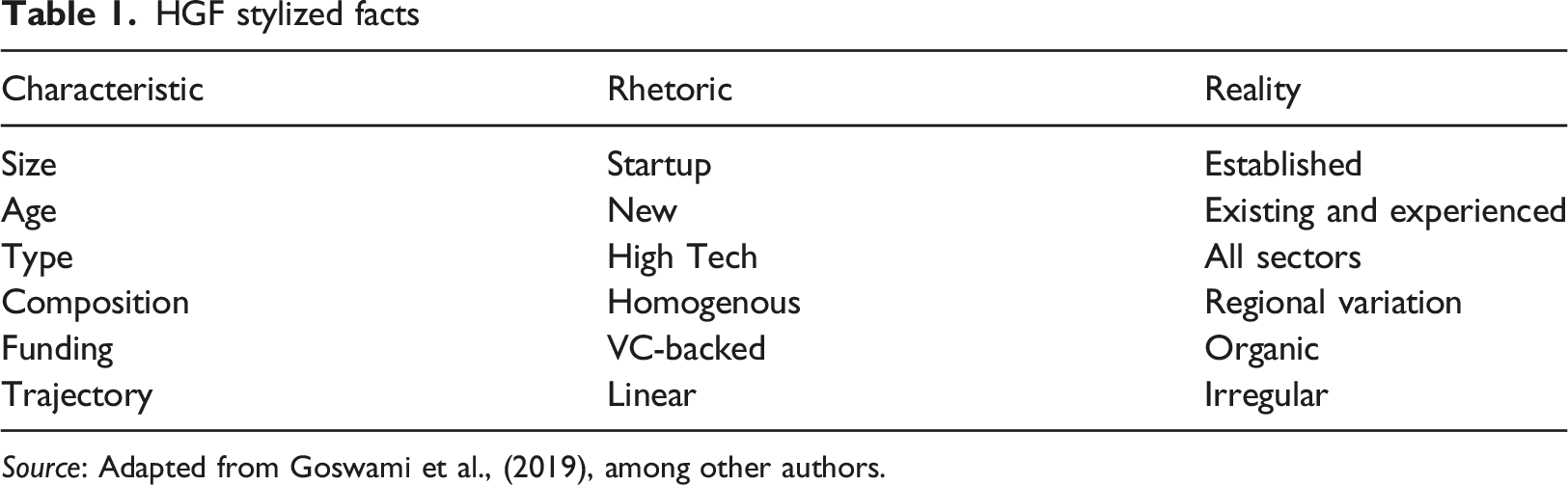
Source: Adapted from Goswami et al., (2019), among other authors.
Firms encountering growth cannot, and should not, be equated to ‘high tech’ firms, with high growth outcomes achieved by firms across a diversity of sectors and contexts (Goswami et al., 2019). In their article on entrepreneurship in the US, Aldrich and Ruef (2018) lament the myopic focus on unicorns and gazelles, pointing to the ‘infinitesimally small’ chance that any entrepreneurial venture starts life with a significant amount of venture backed financing. Rather than focus on the ‘black swans’ of the entrepreneurial world, the authors recommend a more representative and inclusive approach. The reality is that firm growth is not linear or deterministic as many of the early models would have us believe. Firms ‘bounce’ in and out of the OECD high growth classification (Capasso et al., 2013). This is to say, growth is not persistent or sustainable (Coad et al., 2017), but occurs in episodes (Garnsey et al., 2006; Hart et al., 2021), which existing definitions do not adequately capture (Anyadike-Danes et al., 2015). Most growth episodes are ‘one hit wonders’, with only 10–15% of firms achieving a second growth episode (Erhardt, 2019; Goswami et al., 2019). To survive, however, firms need to continue to find ways to catalyse new episodes of growth (Hart et al., 2021).
Since Wright & Stigliani’s annual review article titled ‘Entrepreneurship & Growth’ the International Small Business Journal has provided an important platform to progress the collective conversation on firm growth. Our optimistic view in this article is that we actually know quite a lot about growth and our collective work continues to uncover new important insights. Indeed, we assert that we are far from being at a dead end, but rather at a new prosperous juncture. Although growth is evidently not predictable, we conjecture that the probability of a firm catalysing and sustaining a period of high growth can be increased. To date, understanding has been limited by privileging growth and growth ambition as the end rather than the beginning of analysis. Contemporary research reveals specific types of fast-growing firms that are worthy of further inquiry. For example, Anyadike-Danes et al. (2015) identify a group of persistent outperformers or ‘extraordinary prolific job creators’ (EPJCs) that provide an oversized contribution to growth. Studies on hyper growth firms (Minola et al., 2017), fast growth firms (Du and Bonner, 2017) and scale-ups (Piaskowska et al., 2021) are also yielding new important insights. Scholars have also begun to point to the ordering of events, with profits playing a foundational platform for future growth episodes (Ben-Hafaïedh and Hamelin, 2022; Coad et al., 2017). Equally there have been calls for greater incorporation of the human side of growth and its consequences, including an acknowledgement of the tensions, trade-offs and challenges that are inherent to growth, not just for top management but for all those employees and stakeholders also invested in growth.
Perspectives on growth
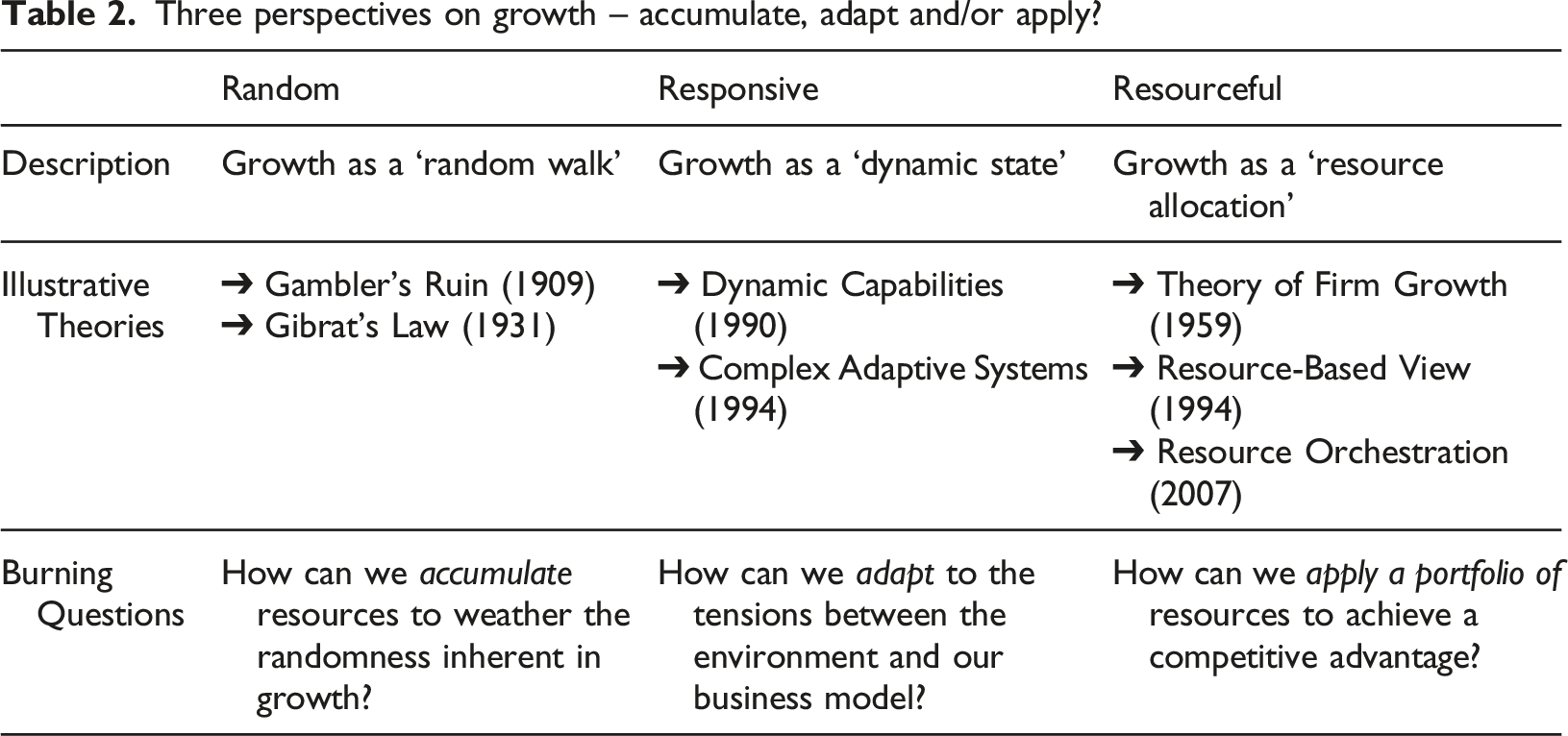
Three perspectives on growth – accumulate, adapt and/or apply?
Random growth – The gambler
A stream of research, founded on Gibrat’s Law, positions growth as a random shock. Firm growth rates are independent of size at the start of a period. The analogy of the entrepreneur as a gambler is presented in the literature, with winning seen as a largely random process (Coad et al., 2013, 2014). Coad et al. concede ‘Gambler’s Ruin’ is a first step: ‘which applies most clearly to the newest and smallest firms’ (2013: 628). Survival and growth are dependent on the stock of resources present at start-up or accumulated through wins. Chance plays a large role (Storey, 2011). In this sense, growth is not about strategy per se, so much as having the resources to sustain one’s operations until the next growth opportunity presents itself. Sustained growth, akin to achieving four heads in a consecutive coin toss, is very much the exception rather than the rule. This approach is not without its criticism. Indeed, it is the contention of Anyadike-Danes and Hart (2015) that a random walk is rather too limiting as an account of even the early years of firm growth, and that a rather ‘richer’ stochastic process may better account for the substantial heterogeneity in firm performance. They propose as an alternative starting point a non-stationary first order Markov chain with size-band dependent transitions. Although the complexity of models continues to incorporate a greater number of factors, the extent to which the data and methods can deliver the necessary explanatory power appears compromised (e.g. see conversation: Derbyshire and Garnsey, 2014; Coad et al., 2015). The views of both parties would appear, without either using the term, to accept that firm growth is describable as a stochastic process. Apparently, the difference between them lies in the description of the ‘mechanism’ producing randomness. Presenting growth as a random process suggests there being an absence of cause and agency (Derbyshire and Garnsey, 2014). This perspective is the antithesis of growth as a strategic pursuit under a degree of control by the entrepreneur. However, the plausible reality is that the process of growth is not an either/or; it is beset with chance and strategy (Stam, 2010).
Responsive growth – the revolutionary
An alternative prospect is that firms are chaotic systems that experience long periods of stability, or stasis, until a change occurs. (Derbyshire and Garnsey, 2014). These changes, or ‘shocks’, catalyse firm evolution (Greiner, 1972; Tushman and Romanelli, 1985, 1994). The challenge with operationalising research in this stream comes from the ability to identify a firm’s unique starting position, including the resources it has access to, and the environment in which it competes. The inconvenient truth: each firm experiences path dependency. The notion that firms are on different tracks competes with the intuitive appeal that firms experience a set of predictable and definable development stages (Levie and Lichtenstein, 2010).
In their review, Levie and Lichtenstein (2010) signal a death knell for stage of growth models and aim to reframe the debate by introducing the notion of ‘dynamic states’. A dynamic state is the matching achieved between a firm’s business model and its customer base, with resources configured to take advantage of a particular state. However, as a firm’s environment changes, the leaders of the firm have agency to decide how they respond. These scholars posit that viewing firms as open, complex adaptive systems (Derbyshire and Garnsey, 2014; Levie and Lichtenstein, 2010) offers potential for the development of research with greater explanatory power. This line of inquiry raises the stakes for developing research methods that could help unpack the initial starting points for firms, and the way large change events, whether internally or externally oriented, become meaningful and influence their growth path. It also opens up discussion about opportunity identification and the nature of the structure-agency dynamic.
Resourceful growth – the resource orchestrator
Although Levie and Lichtenstein (2010) did not reach consensus on stages that firms experience, they did identify a number of internal reorientations that firm’s fashion in response to growth, such as leadership and management, structure, strategy and systems. It was Penrose (1959) who first drew attention to the role of firm-level capabilities; their combination and orientation being essential to taking advantage of market opportunities. In this sense, managers in firms have agency and versatility in how they internally orient resources in the firm, and which opportunities they pursue (Nason and Wiklund, 2008). This is to say that firms not only start from different places, operate in different environments, they can also adopt different strategies (Wright and Stigliani, 2013). Although early work centred on the characteristics of entrepreneurs, the emphasis has moved to resource orchestration and the dynamics of experience. A range of resources have since been identified as influencing firm growth trajectories.
Leaders can also choose to sustain a particular size, as we see in lifestyle businesses, or drive firm growth. This line of research refers to the motivations, intentions, attitudes and ambitions of owner-managers and key decision-makers in small firms (LeBrassuer et al., 2003; Wiklund et al., 2003; Raby et al., 2018) that can serve as enablers and barriers to growth (Doern, 2009; Hansen and Hamilton, 2011). For example, owner-manager attitudes and beliefs can influence the form of outcomes sought (Wiklund et al., 2003). The capabilities of managers and the orientation of their work role (O’Gorman et al., 2005) have also been found to support or undermine firm growth. Managerial capabilities have been found to vary with growth intensitivity (Barbero et al., 2011), the volatility of a firm’s environment (Bamiatzi and Kirchmaier, 2014; Battisti and Deakins, 2017; Hilmerson, 2014) and the ability to balance the dualities of strategy and tactics (Volery et al., 2015). There is also evidence that the way in which people are organised, for example, through the adoption of people management practices, can support and influence growth outcomes (Gilman et al., 2015; Gilman and Raby, 2013; Lai et al., 2017). Beyond ambition and the management of human capital, a firm can attain growth via a number of alternative drivers or routes to growth (Senderovitz et al., 2016), including the positioning in the marketplace (Hewitt-Dundas et al., 1997; O’Gorman, 2001; Senderovitz et al., 2016), the pursuit of internationalisation (Chetty and Campbell-Hunt, 2003; Hilmerson, 2014) combined with innovation (Ardito et al., 2021; Love and Roper, 2015), external financing (Fraser et al., 2015) and accessing business advice (Gregson et al., 2018). Although important ground has been covered by these studies, we still lack definitive answers on the relative importance of each strategy, with research often focusing on individual drivers rather than their interplay (Demir et al., 2017). This is akin to flying a plane by only looking at the fuel gauge.
Introducing the special issue articles
It has now been 30 years since Gibb and Davies (1990) lamented that there was ‘no comprehensive theory of small and medium enterprise development’ (pp. 26). Although progress has been made, we assert that a renewed focus is required. To be frank the theory of firm growth is in a rather unsatisfactory state and has reached somewhat of an impasse. As noted earlier, one view is that firm growth, certainly in a firm’s early years, can be regarded as essentially ‘random’. The alternative view is that a firm’s characteristics and its strategic choices can have a systematic effect on its growth. Navigating a pathway between such competing perspectives, to better embrace the realities of growth episodes, is a sine qua non for progress. This Special Issue sought to address this impasse and encourage scholars to continue their shift in emphasis from which firms grow, to who grows them and how they grow (Wright and Stigliani, 2013). This called for a broad palette of contexts and understandings. We invited scholars to submit high quality articles that advanced theoretical knowledge and empirical evidence on the mechanisms and processes that catalyse and sustain growth. We particularly encouraged approaches that delivered greater explanatory power including, yet not limited to, longitudinal, qualitative, ethnographic, contextually-sensitive and in-depth explorations of the micro processes of growth. In so doing, this issue builds upon a rich and active conversation in the International Small Business Journal on small firm growth, building on a previous Special Issue on SME growth (Wright et al., 2015) and the recent Annual Review Article (Hart et al., 2021).
The following questions were used to encourage submissions for this Special Issue, drawing attention to who, how, where and when growth occurs: How should we define ‘growth’, ‘scaling’ and how do they differ? (Piaskowska et al., 2021) What are the orientations, mechanisms and strategies that lead a firm to catalyse and sustain growth episodes? (Dosi et al., 2020; Esteve-Pérez et al., 2020) How can we deal with the duality of randomness and strategy to explain firm growth (Stam, 2010)? How do we take account of a wider array of factors that influence growth (Wright and Stigliani, 2013)? How do we account for the diversity in trajectories firms take as they grow? (Anyadike-Dane et al., 2015; McKelvie and Wiklund, 2010) How do entrepreneurs’ cognitive processes shape growth (Wright and Stigliani, 2013) including the psychological dimension (e.g. the influence and interplay of confidence and failure) and the process by which managers help firms develop dynamic capabilities (Koyak et al., 2015)? How do entrepreneurs undertake resource orchestration to access and configure resources to achieve growth (Wright and Stigliani, 2013)? How do support infrastructures and ecosystems enable and facilitate growth? (Goswami et al., 2019)
Special issue articles.
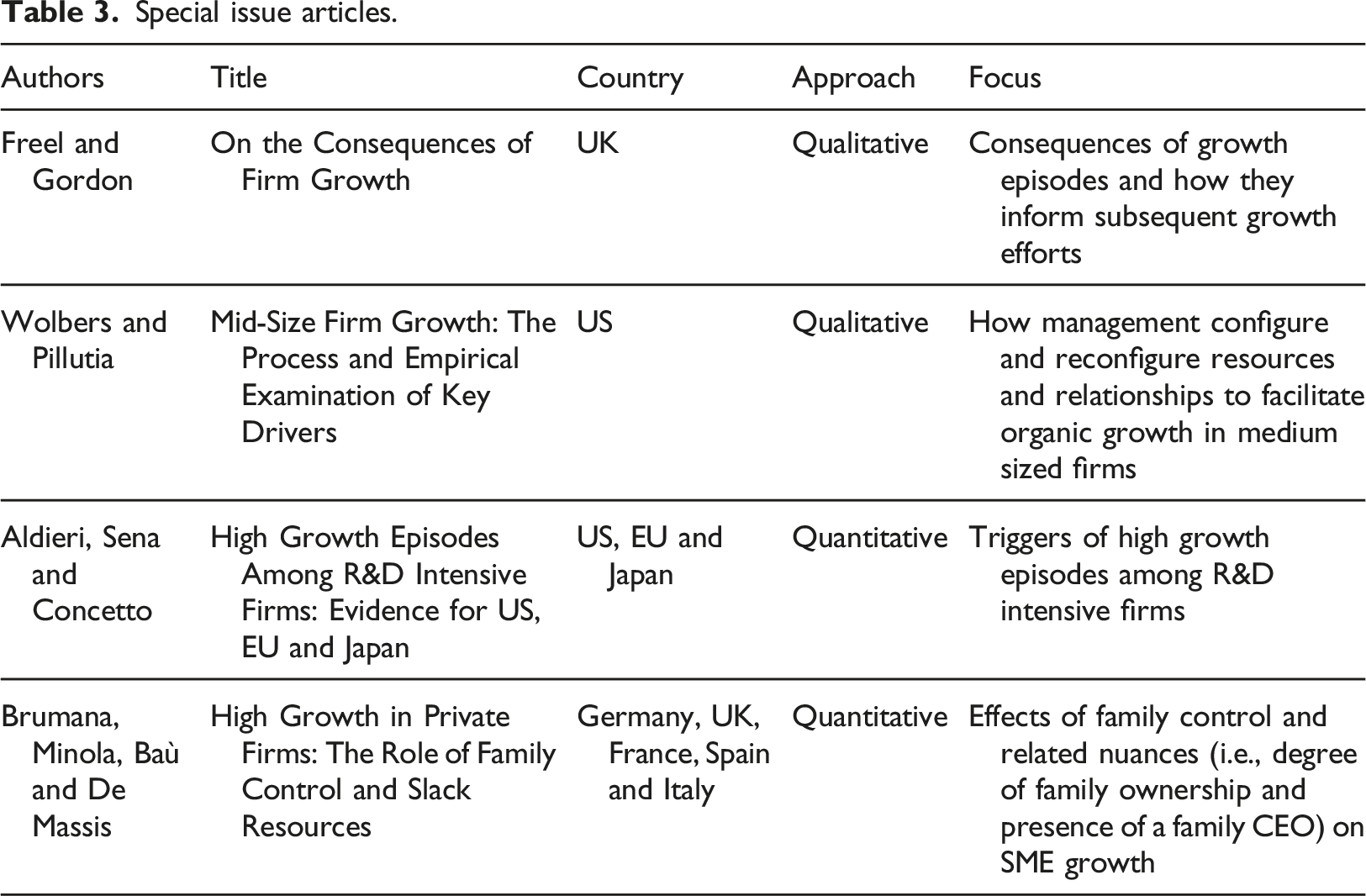
The first paper Consequences of growth by Freel and Gordon is motivated by reflections on the episodic nature of growth. In order to examine the limited evidence of ‘growth persistence’, the authors unpack the consequences of growth episodes and how they inform subsequent growth efforts. Understanding is framed using a micro-foundational and behavioural lens which draws attention to the individual behaviours and the experience of entrepreneurs. Drawing on qualitative data from a larger mixed-method project, the authors explore insights on growth consequences from six purposeful case studies representing a diverse range of sectors. Each company was identified as having experienced high growth episodes following their participation in a growth-oriented leadership development programme. Although all the case study firms had persistent growth aspirations, they enjoyed mixed fortunes since their initial high growth episode, but nonetheless continued to trade profitably. In-depth case interviews are complemented by archival data (including development plan workbooks, third party observations of board meetings, and management accounts), as well as sales and profit metrics over time, thereby providing a holistic overview of the consequences of growth for each firm. Focusing on ‘revealed patterns’ emerging from the data, the analysis highlights the relative nature of growth and growth intent, and that the challenge of growth should be understood in the service of income satisfaction versus income or growth maximisation. This is in turn framed by entrepreneurial aspirational level, itself set through an iterative process of social comparison. A behavioural focus also identifies experiences of the growth challenges associated with rapid growth as having a powerful effect on entrepreneurs’ subsequent desires for future growth. Allied with this is an appreciation of the changing skills and strategies which determined the ability and motivation of entrepreneurs to seek out opportunity and to structure their organisations accordingly. This involves a more dynamic appreciation of changing human resource requirements as a consequence of growth. Overall, the paper positions a call for a more balanced focus on the consequences rather than the causes of growth.
The second paper Mid-Size Firm Growth: The Process and Empirical Examination of Key Drivers by Wolbers and Pillutia explores the neglected category of medium sized firms. In examining growth as a process, the authors draw on resource orchestration bringing together theories of venture growth, social and human capital and their interaction. Specifically, they outline how management configures and reconfigures various ‘intensities’ of resources (namely human capital, routine capabilities and dynamic capabilities) and relationships (social, relational and network) to facilitate organic growth. Case studies were selected by means of purposeful sampling of US manufacturing firms. The first stage used commercial banking categories as a proxy for the level of complexity and episodes of organic growth faced by mid-sized firms within various growth revenue bands. The second stage involved qualitative interviews with the CEOs of 12 privately held manufacturing firms sustained by several Fortune 500 original equipment manufacturers (OEMs), with four firms representing each of three revenue categories. Interviews were open ended allowing respondents to self-select substantive points related to growth and resources. The findings offer detailed descriptions related to the growth and transition of mid-size firms across a number of states. Propositions are presented based on the case insights, including the finding that medium-sized firms will exhibit distinguishable configurations of resources and relationships across growth states and that the reconfiguration of relationships and resources will precede the transition of firms from one growth state to the next. The results also reveal important ‘reactive variables’, that is, those that change in response to growth. Overall, the resource and relationship model serves to capture distinct configurations of resource and relationships across the growth states for mid-sized enterprises, and thereby offers pragmatic validity as a tool for further exploring growth.
The third paper High growth episodes among R&D intensive firms: Evidence for Europe, US and Japan by Aldieri, Sena and Vinci explores the triggers of high growth episodes among R&D intensive firms. The paper examines whether inter-industry R&D spillovers are positive contributors to the likelihood of high growth episodes, and whether this relationship is contingent on the absorptive capacity of firms. Adding a geo-spatial consideration, the paper also explores whether the acquisition of foreign patents triggers high growth episodes among a subset of R&D intensive firms. The authors tests key hypotheses via a dataset sourced from the EU R&D investment scoreboards of R&D intensive manufacturing firms reporting data between 2002 and 2017. The scoreboards contain data on net sales, annual R&D expenditure, number of employees and annual capital expenditure. Firms were located in three geographical areas, namely Europe, US and Japan. Data on patents registered by firms included in the scoreboards was sourced from the database of patents compiled by the OECD between 2002 and 2017. The paper follows a recognised procedure to identify high growth episodes, leaving a dataset covering 238 high growth episodes, over 825 firms, across the three regions. The analysis reveals that high-tech R&D intensive firms can experience high growth episodes through inbound open innovation. Importantly, firm level absorptive capacity conditions the relationship between R&D spillover and the likelihood of high growth episodes. Opening up insights into temporal effects, external knowledge acquisition, as proxied by the relative share of foreign patents, is shown to trigger short high growth episodes, as opposed to R&D spillovers which trigger more extended high growth episodes. Overall, the paper moves understanding beyond the firm level unit of analysis to consider knowledge spillovers and network effects on firm growth.
The fourth paper by Brumana, Minola, Baù and De Massis takes a behavioural perspective to examine Under which circumstances do family SMEs achieve high growth? The authors argue that overlooking the nuances of family control has constrained understanding of high-growth trajectories, ignoring the heterogeneous nature of family SMEs. To redress this deficiency, the paper adopts a behavioural agency model (BAM) to explore key decision makers point of reference, specifically the extent to which the growth preferences are affected by family-related motives and interests, including socio-economic wealth. Hypotheses elaborate on the distinctive elements of family SMEs to explore the direct effect of family involvement on family SMEs’ high growth, while also examining the impact of governance dynamics, including the degree of family ownership and presence of a family CEO. The final hypothesis explores further nuance in the form of slack resources as an organisational contingency informing growth. The sample consists of cross-sectoral, independent privately-held SMEs located in the five largest European economies: Germany, Great Britain, France, Spain and Italy. An extensive, longitudinal dataset was created including financial information for the years 2004–2019 using the Orbis database yielding a sample of 39,631 firms (278,013 year-observations). Hypotheses were tested by means of pooled rare event logistic regression (RELR). The findings reveal that being a family SME negatively affects the likelihood of experiencing high growth relative to non-family SMEs. Interestingly, while the presence of a family CEO reduces the probability of growth, the opposite is true with respect to familial control. Explanation comes in the form of the likely desire for greater intergenerational transfer and sustainability in the context of more extensive familial control. Highlighting the merit of exploring further contingency variables, the availability of high- and low-discretion slack resources moderates these relationships. Overall, this paper highlights the significance of governance configurations on high growth, showing that different nuances of family control and the availability and type of excess resources matter for the high growth of family SMEs.
The next growth episode: Future research directions
Overall, the papers in this special issue provide an enlarged understanding of growth episodes, moving beyond the traditional contexts of young or high-tech firms. Contributions drew on a diversity of sectors (manufacturing, R&D) and contexts (family firm, SMEs) represented with useful evidence of purposeful and logical sampling. The articles demonstrate the merits of various methodologies including approaches which are pragmatic and phenomenon driven, through to those engaging with extensive database and a priori categorisations. What emerges across the papers is a multi-faceted and relative appreciation of growth, not least one which suggests growth as the beginning versus the end of analysis. This opens up a pathway to explore growth consequences, path dependencies, dynamic decision making, management processes, failures and challenges, in contrast to linear modelling and normative truisms. The papers also point to theoretical lenses likely to further shape understanding, enabling better incorporation of the process and actors informing growth episodes. This includes behavioural perspectives, human resource management, absorptive capacity and resource orchestration. Important also is further representation beyond ‘traditional’ country contexts, with greater scope for institutional comparisons, direct exploration of key events, specific policy interventions and holistic assessments of firm responses. As any Special Issue should, the papers also prompt some critical questions and guidance for further research.
First, we assert that scholars double down on their efforts to unpack high growth episodes (Hart et al., 2021). These transitory rare ‘narrow windows’ can provide researchers with a unique opportunity to unpack the factors that cause and sustain high growth episodes (Aldrich and Ruef, 2018). Research methods need to be capable of unpacking the drivers and causes of growth episodes, such that they can discover new theories (Demir et al., 2017). The ability to predict when a firm will grow continues to be a grand challenge, characterised by a complex relationship between firm-level capabilities, growth outcomes and the performance of an economy (Coad et al., 2014). Critical incident approaches such as Event Systems Theory (Morgeson et al., 2015) may hold merit, while appreciating the paradoxical tensions and vicious cycles (Es-Sajjade et al., 2021) inherent in growth will also be important.
Second, growth is pursued by the leader, not the firm in isolation. It is not possible, or warranted to discard or reduce the role of the leader in entrepreneurship and growth research. There is value in distinguishing between the different types of entrepreneurs who lead different types of ventures (Anyadike-Danes et al., 2015; Welter et al., 2017) the capabilities they possess (Koyak et al., 2015) and the paradoxical tensions that require resolution to embrace a high growth trajectory (Es-Sajjade et al., 2021). Critical also are the broader dynamics of human capital and social relations within and across firms, including critical decisions relating to hiring, delegation, diversification, building and accessing appropriate talent.
Third, we are all responding, in our own ways, to crises like the coronavirus Pandemic (Turner and Akinremi, 2020) and the effects of climate change (Kesidou and Ri, 2021). The world in which we live is inherently unpredictable, which means growth is inextricably affected by context (Greene and Rosiello, 2020) and crisis (Doern et al., 2019, 2021). Entrepreneurial ventures can provide an important milieu to inform how we can shift tracks from our current unsustainable global growth trajectory. How is it that some SMEs and entrepreneurs manage low growing or no growing companies? How do SMEs remain resilient while creating and sustaining value? (Wishart, 2018) How do leaders enhance productivity through mental health and wellbeing in the workplace? (Wishart et al., 2021) What does sustainable growth and frugal innovation look like? Addressing such questions could lay a path to a more prosperous, sustainable world.
Returning to the opening quotation, ambition may well be the path to success, but both ambition and success are variable and contingent. We still have much to learn about the requirements, foundations and conditions of possibility informing persistence, resistance and resilience as firms, managers and employees navigate the causes, contingencies and consequences of high growth. We hope this special issue inspires new approaches and an enlarged understanding in a domain often hindered by superficial commentary and the dangerous allure of bright shiny objects and mythical status.
Footnotes
Acknowledgements
The authors are listed in reverse alphabetical order. All authors contributed equally to this article and to editing the Special Issue. Thanks to Susan Marlow for her generous feedback on an earlier version of this editorial, to Valerie Thorne for her exemplary assistance and to all the authors and reviewers without whom this Special Issue would not have been possible.
Funding
The author(s) received no financial support for the research, authorship, and/or publication of this article.
