




Abstract
This article examines the interrelationship between legitimacy building efforts – the different ways in which social enterprises (SEs) conform to stakeholder expectations – and types of innovation – the different approaches by which they create social and economic value through product, process and business model innovation. Using a multi-case study research design of twenty SEs in Scotland and Romania, we find that the SEs adjusted their approach to legitimacy building depending upon the types of innovation and stakeholder involved. Also, while all SEs pursued pragmatic and moral legitimacy through conforming with their stakeholders’ expectations, the type of innovation shaped the way in which they prioritised one form of legitimacy over another to deal with the tensions involved in pursuing legitimacy with heterogeneous stakeholders. This finding emphasises the importance of innovation type when explaining how SEs balance the tensions involved in trying to conform to a wide range of heterogeneous stakeholders with different expectations.
Introduction
In this article, we focus on social enterprises (SEs), that is, socially driven businesses (Luke and Chu, 2013); they offer important contributions to the economy in at least three ways: creating jobs and new opportunities, supporting the most vulnerable in society and delivering high-quality public services (Social Enterprise UK, 2019). Serving a social purpose, they are an important vehicle that governments use to support social innovation and resilience (EC, 2021); they also generate revenue through selling products and services to customers while also producing social value by targeting underserved and often resource poor communities (Di Domenico et al., 2010; Haugh, 2006). Pursuing both social objectives and financial sustainability (Di Domenico et al., 2010) increases the pressure upon SEs to secure resources (Chell, 2007; Ramus and Vaccaro, 2017) and the range of stakeholders upon which they rely (Phillips et al., 2019). This dual mission means that SEs do not fit neatly into the conventional categories of private, public or non-profit organisations, which creates space for theory development to explain their emergence, management and performance (Doherty et al., 2014). To gain legitimacy to access resources, SEs have to reassure stakeholders that their activities fit with stakeholder expectations: for example, that the SE has a positive societal impact (Jayawarna et al., 2020). At the same time, to create social value, SEs have to innovate (Zahra et al., 2009). Social innovativeness is what distinguishes social entrepreneurship from other social and third sector business activities (Nicholls, 2010). Entrepreneurs experience tensions when seeking resources for innovation as they need to demonstrate to stakeholders that their venture both ‘fits in’, by conforming to current norms and expectations, and ‘stands out’, by creating something novel and sufficiently distinctive to show innovative added value (De Clercq and Vornov, 2009).
Existing research explores entrepreneurial strategies for coping with this tension between pursuing conformity (fitting in) and innovation (standing out) to build legitimacy with stakeholders. Early research highlighted strategies such as impression management (De Clercq and Voronov, 2009), while more recent work has suggested building legitimacy ‘profiles’ (Smith and Marti, 2017) to cope with this tension. However, the coping strategies for dealing with tensions in legitimacy building remain largely underexplored (Kimmitt and Munoz (2018). To help address this gap, we draw on research that considers legitimacy and innovation as two distinct concepts (Bunduchi, 2017; Kuratko et al., 2017). We examine the relationship between legitimacy – the ways by which SEs align with multiple stakeholder expectations – and innovation – the approaches by which SEs create value by pursuing novelty in their products, processes and business models. Our research question asks: How do the types of innovation pursued by SEs shape their legitimacy building efforts with multiple stakeholders when seeking to acquire the resources required to support their activities? We examine twenty case studies of European SEs delivering product, process and business model innovations. We find that while all SEs pursued similar forms of legitimacy, both pragmatic and moral, in similar ways through conforming to stakeholder expectations, the type of innovation shaped how they coped with the tensions involved in pursuing multiple forms of legitimacy with heterogeneous stakeholders. This finding contributes to the emerging research linking legitimacy strategies and types of innovation (Kuratko et al., 2017) by demonstrating empirically the importance of the type of innovation content when explaining how SEs prioritise different forms of legitimacy with their stakeholders.
Our article is organised as follows. First, we review the relevant literature on SEs, social innovation and legitimacy and introduce our theoretical framework, following which we discuss the research approach which we adopted in our study. In the final sections, we discuss our research findings and then present our conclusions for theory, policy and practice.
Literature review
SEs and types of innovation
Social entrepreneurs can enhance social wealth either by creating entirely new organisations or by managing existing organisations in innovative ways (Zahra et al., 2009). To create social value and contribute to society through addressing social challenges, SEs have to innovate (De Bruin and Shaw, 2011). Innovation is often associated with entrepreneurship in general, where it is seen as the means by which entrepreneurs exploit change as an opportunity to create something different (Drucker, 1995). Thus, SEs need to ‘stand out’, and innovation is a key enabler in convincing stakeholders that an opportunity ‘stands out’ by being novel and distinctive (Taeuscher et al., 2020).
Innovation refers to the ‘process whereby organizations transform ideas into new/improved products, services or processes, to advance, compete and differentiate themselves in their marketplace’ (Baregheh et al., 2009, pg. 1334). Innovations can be categorised according to (i) the level of novelty involved, radical versus incremental; (ii) the dimension affected, technological or market (Garcia and Calantone, 2002) and (iii) the content associated with the transformation. Researchers have differentiated between three types of innovation content: the products/services an organisation commercialises; internal organisational processes through which products/services are developed or commercialised and the business model underpinning the activities of an organisation (Tidd and Bessant, 2021). The social innovations which SEs pursue can thus range from incremental new products, that better address existing social needs, to radical business model innovations that create entirely new forms of social value (Nicholls and Murdock, 2012). Distinguishing between types of innovations is important because they may require different resources and competencies and may call for the use of different organisational practices (Garcia and Calantone, 2002; Tidd and Bessant, 2021) and legitimation strategies to engage with key stakeholders (Kuratko et al., 2017).
The norm for an SE is for its first innovation to be incremental, in terms of novelty, and modest, in terms of scope and scale: indeed, many SEs start with a formal or informal experiment or pilot to test the market (Lee et al., 2019). Their products are rarely new to the world whilst process innovations are focused on optimisation rather than major change. We focus here on these incremental social innovations, which involve the development of novel outputs to meet existing social needs (Nicholls and Murdock, 2012; Maclean et al., 2013). The development and commercialisation of incremental innovations is associated with lower levels of uncertainty than for radical innovations (Tidd and Besant, 2021). Product innovation refers to a new or modified offering to a market. It may involve the replacement of existing goods and services, or a new addition to the SE’s product portfolio. Product innovation may also involve minor changes to existing processes or require totally new processes, but the key transformation is in the output for the customer (Tidd and Besant, 2021). Process innovation is concerned with changes in the operational means by which an organisation manufactures, delivers and commercialises its goods and/or services. It may involve new technologies, using technologies differently or organising tasks in new ways. Process innovation may take place independently of, or concurrently with, product innovation (Tidd and Bessant, 2021). Business model innovation refers to changes in how the SE creates and delivers social value to its customer (e.g. customisation and servitisation) and how it captures some of that value for the venture. For example, changes in monetisation strategy could include subscription services, advertising or bundling of products (Tykkylainen and Ritala, 2021). Business model innovation may involve the development of new products and/or processes as part of the activities, but it is more extensive in its scope as it relies upon changes to an organisation’s strategic direction to create new or greater value for customers (Cosenz and Bivona 2021).
Legitimacy and social enterprises
To acquire resources, any organisation, including SEs, have to convince stakeholders of their legitimacy (Deephouse et al., 2017) regarding the perception or assumption that its actions are appropriate, desirable or proper (Suchman, 1995). Legitimacy is critical to convince stakeholders of viability and thus to provide the resources necessary for survival (Deephouse et al., 2017). Research has distinguished between three different forms of legitimacy (Suchman, 1995). Pragmatic legitimacy requires stakeholders to evaluate the extent to which an organisation and its outputs align with their own economic interest. Moral legitimacy involves stakeholders evaluating whether an organisation’s actions/products align with their expectations about ‘the right thing to do’. Cognitive legitimacy involves stakeholders assessing whether an organisation is comprehensible. The most common strategy used to acquire legitimacy involves conforming to stakeholder norms and expectations of the status quo (Suchman, 1995). Other strategies associated with increasing degrees of strategic effort (Kuratko et al., 2017), include selecting a stakeholder group with a similar mindset who will be more likely to confer legitimacy, manipulating the environment by acting to change a stakeholder’s mindset (Suchman, 1995) and creating a new supportive environment with new rules, practices and norms (Zimmerman and Zeitz, 2002).
Research has considered the legitimation of new ventures (Uberbacher, 2014) and examined the variety of forms of legitimacy and strategies which entrepreneurs employ to overcome their liability of newness and persuade stakeholders to commit the necessary resources to pursue entrepreneurial opportunities (Zimmerman and Zeitz, 2002). In the context of SEs, legitimacy research has focused less on their newness, including their lack of operating history (Fisher et al., 2016), and more on their hybrid nature and dual purpose, which requires SEs to appeal to stakeholders with widely differing expectations and views regarding legitimacy (Pache and Santos, 2013). SEs are required to balance the pursuit of social objectives, which are often framed in moral terms associated with caring for society in general or specific communities in particular, and economic objectives which are defined in commercial terms through market performance and profit seeking (Di Domenico et al., 2010; Ramus and Vaccaro, 2017). These objectives are associated with different institutional logics (Tykkylainen and Ritala, 2021); these may range from a social welfare or development logic on the one hand to a commercial market logic on the other (Pache and Santos, 2013).
Building legitimacy in environments with competing logics is challenging for SEs as they must resolve the tensions associated with addressing the demands of stakeholders whose legitimacy criteria differ (Uberbacher, 2014). The dual purpose of SEs creates tensions when they seek to serve multiple stakeholders with potentially conflicting goals (Ramus and Vaccaro, 2017). Gaining legitimacy is arguably more critical for SEs than it is for commercial ventures because SEs focus on underserved communities where resource scarcity tends to be more prevalent (Di Domenico et al., 2010), and thus, they are more reliant on external stakeholders to access essential resources. Consequently, research on SE legitimacy tends to emphasise moral legitimacy as a way of acquiring resources (Jayawarna et al., 2020) and highlights the efforts of SEs to manage tensions by engaging in hybrid or combination strategies which address multiple expectations concurrently (Bruneel et al., 2016; Pache and Santos, 2013). The outcome of these strategies being that SEs often incorporate multiple logics in their organisational practices and structures, including their business models (Tykkylainen and Ritaala, 2021); this helps them to build legitimacy with multiple stakeholders whose values, norms and expectations differ. By contrast, defiance (Oliver, 1991) and dismissing (Battilana and Lee, 2014) strategies which involve the rejection of one logic/set of expectations have been explored less frequently as valid legitimation strategies, both in general and in the context of SEs.
In the context of SEs, strategies that prioritise one logic that limit the ability to seek legitimacy against only one set of norms and expectations have generally been found to have negative consequences. Ignoring social logics has been identified as leading to mission drift, loss of legitimacy and stakeholder disengagement (Ramus and Vaccaro, 2017); rejecting commercial logics has been found to hamper the ability of SEs to remain solvent (Bruneel et al., 2016). We identified only one study where defiance was portrayed as a valid legitimation strategy in hybrid organisations – Quirke’s (2013) study of rogue schools – where prioritising one logic, at the expense of another, was a successful strategy for organisations located on the periphery of their institutional field. There are calls within entrepreneurship research for studies which examine the strategies which hybrid ventures adopt to prioritise those expectations to which they conform, including SEs located in multiple fields with divergent norms and stakeholder expectations (Pret and Carter, 2017). Evidence also indicates a range of trade-off decisions that SEs are required to make to address commercial and social expectations; this calls into question the assumption that SEs have to address all of these divergent expectations simultaneously in order to be seen as legitimate and sustainable (Munoz and Kimmitt, 2019; Siegner et al., 2018). Thus, how SEs pursue defiance strategies and choose to make trade-offs between different forms of legitimacy is an important avenue to clarify how SEs pursue legitimation and acquire resources.
Legitimacy and innovation
To examine the relationship between legitimation efforts and the innovations pursued by SEs, we draw from research on innovation and legitimation which has found that, depending on the degree of novelty, different innovations are generally associated with different ways of building legitimacy. Conceptually, Kuratko et al. (2017) have argued that the different degrees and dimensions of innovation pursued by new ventures (radical and incremental, technological and market) are more likely to be associated with the use of different legitimation strategies (conforming, selection, manipulation and creation). Their argument is based on the degree of disruption associated with the type of innovation pursued. Incremental innovations are more aligned with existing practices, processes and systems compared with radical innovations (Tidd and Bessant, 2021), meaning that entrepreneurs pursuing incremental innovations have to invest less effort to demonstrate that the new venture is aligned with the expectations of its stakeholders compared with those pursuing radical innovation. The different levels of effort are reflected in the different types of legitimation strategies which entrepreneurs utilise (cf. Suchman, 1995). Kuratko et al.’s conceptual model does have some support in existing empirical research. For example, work within established organisations suggests that different approaches are used to build legitimacy for radical product innovation and incremental innovation, depending on the nature of the institutional context in which innovation happens (Van Dijk et al., 2011). Research on non-profit service organisations supports these findings, suggesting that the legitimation strategies deployed (although not the form of legitimacy sought) change, depending upon the degree of innovation. For example, incremental service innovators focus on reproducing and preserving existing norms (conforming), while disruptive service innovators focus their legitimation efforts upon advocacy and representing the interests of social groups (manipulation and selection) (Coule and Patmore, 2013). Thus, there appears to be evidence to support the connection between the degree of innovation novelty and forms of legitimacy building efforts used (Kuratko et al., 2017).
By contrast, there has been much less attention focused upon legitimacy building efforts based on the type of content of the innovation (i.e. product, process or business model), rather than the degree of novelty associated with an innovation (i.e. incremental or radical). This is despite the fact that the stakeholders involved in the development of product, process and business model innovations are generally different. For example, product innovation involves efforts to prepare the market and engage with channel partners (Aarikka-Stenroos and Sandberg, 2012). Process innovation is often associated with organisational change and its adoption relies upon building legitimacy with key staff who use the innovations (Bunduchi et al., 2015). Business model innovation involves a firm gaining legitimacy from both its clients and other key partners within the sector (Laifi and Josserand, 2016). There have been some assumptions that the different categories of stakeholders share legitimacy judgements (Uberbacher, 2014); however, a growing number of empirical studies suggest that, typically, this is not the case. Different categories of stakeholders follow different institutional logics and therefore, use different evaluative criteria to grant legitimacy (Fisher et al., 2016). Accordingly, entrepreneurs engage in different legitimacy seeking mechanisms with different stakeholders to match their distinctive expectations (Fisher et al., 2017). Thus, reliance on different categories of stakeholders suggests that SEs which engage in product, process and business model innovation may rely on different approaches when it comes to building legitimacy. This relationship between innovation, stakeholders and legitimacy building is depicted in Figure 1 and informs our research question: how do the types of innovation pursued by SEs shape their legitimacy building efforts with multiple stakeholders when seeking to acquire the resources required to support their activities? Innovation and legitimacy building – framework.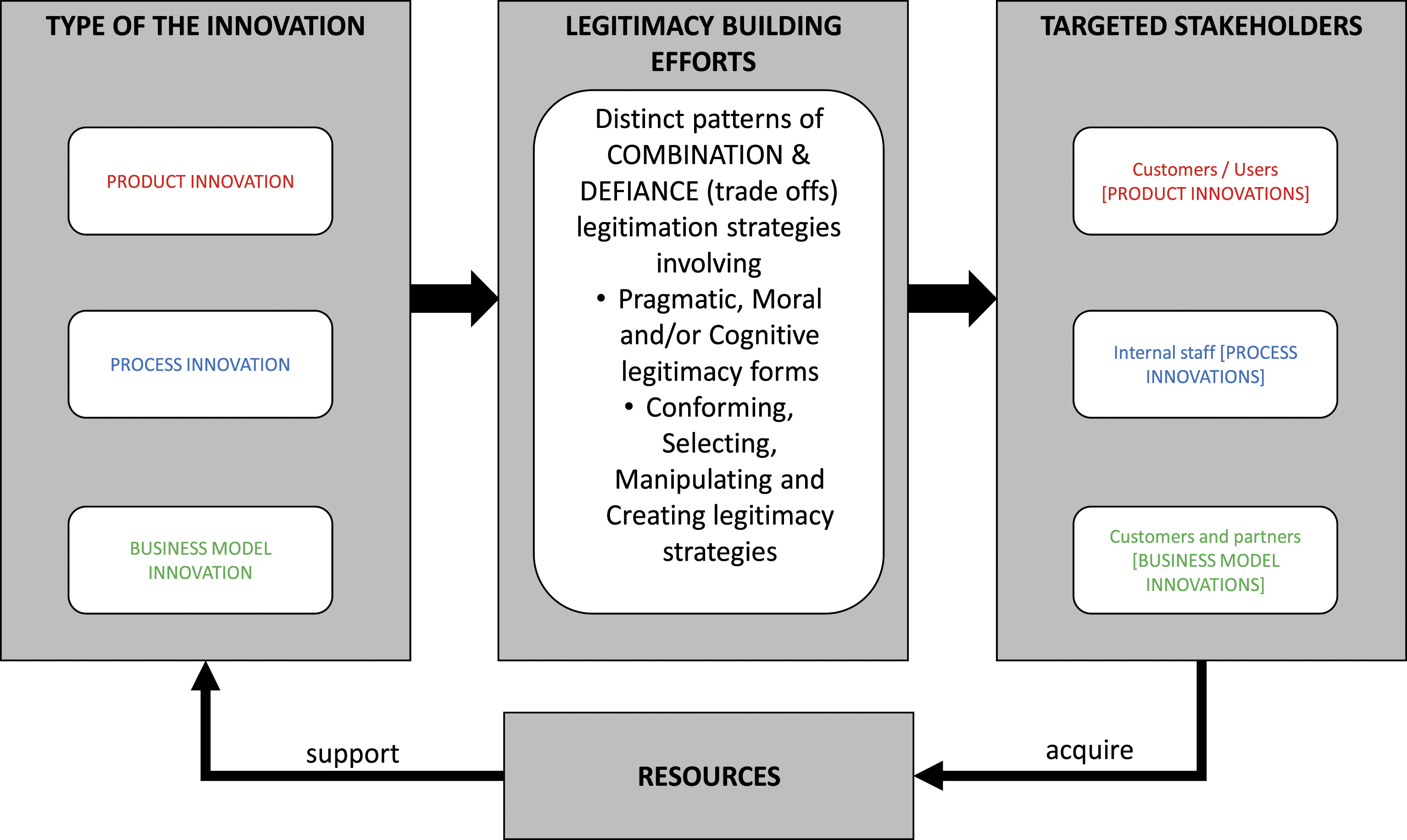
In examining legitimacy building efforts in SEs and drawing from our review of research on legitimacy and SEs, we consider the form of legitimacy which the SEs pursue (pragmatic, moral or cognitive) and the trade-offs in which they engage between different forms of legitimacy.
Research design
To investigate how the type of innovation shapes legitimacy building we employed a qualitative approach, using a multi-case study research design involving twenty SEs in Scotland and Romania. The two countries offered the possibility to study the legitimacy seeking behaviour of SEs within a broadly similar framework of what an SE is, and how it operates while comparing two distinct contexts in terms of the levels of institutional support available and degree of SE ecosystem maturity (EC, 2020). This approach allowed us to explore whether the pattern of relationships between legitimacy and innovation holds within varying configurations of institutional support.
At the time of data collection (2019) both countries were members of the European Union (EU). Since 2010, the EU has provided funding (e.g. the 2013 Social Investment Package) and disseminated best practice (e.g. the Social Business Initiative) to enhance institutional support for social innovation within member countries. Therefore, we expected that SEs within both countries would share an understanding of best practice while also offering a rich environment within which to examine social innovation. Within this broad EU context, the two countries are different in terms of the level of institutional support available and degree of SE ecosystem maturity. The UK is characterised by a strong SE ecosystem, with SEs outperforming mainstream small and medium-sized enterprises in almost every area of business – turnover growth, job creation, innovation, and start-up rates (Social Enterprise UK, 2019). The UK has recorded the third-highest level of SE activity in the world (Thomson Reuters Foundation, 2016) with over 30,000 SEs registered between 2007 and 2017, employing more than 353,000 people (EC, 2020). It has around 464 SEs per million inhabitants, reflecting a very high level of underlying engagement with and institutional support for SEs (EC, 2020). For example, strong institutional support is provided for SEs in Scotland through formal (dedicated governmental organisations, policy frameworks and special legal status) and less formal mechanisms (dedicated SE networks), and widespread societal engagement: by way of illustration, the concept of SE is taught in Scottish schools (EC, 2020).
By contrast, Romania’s SE ecosystem is much less well developed. By 2017, there were only approximately 6300 SEs registered, employing approximately 17,000 people. The number of SEs per million inhabitants is around 323, reflecting a lower level of engagement with SEs and weaker institutional support for SEs (EC, 2020). A key difference between the two countries is that in Romania there are no dedicated formal governmental support organisations, policy frameworks or special legal status for SEs and there is limited popular acceptance of SE. This is linked to the legacy of communism which eroded solidarity and collectivistic values (EC, 2020). A consequence being that Romanian SEs generally access resources from, and share knowledge through, international organisations, EU funded-projects and participation in international networks (e.g. Ashoka), while those in the UK rely more heavily on support primarily from local private stakeholders, foundations and other organisations (EC, 2020).
The selection of our SEs from across the two countries was informed by two criteria: (i) that organisations were perceived as being innovative within the SE arena by their peers and (ii) that they operated as an SE, as defined by the founder. To identify these innovative organisations, in the first instance we approached central players in the local SE ecosystem in each of the countries and asked them to suggest exemplary innovative SEs for inclusion in our study. These players include Ashoka in Romania, and FirstPort, Business Gateway and local SE networks in Scotland. In addition, we also drew on our local knowledge and networks, such as SE owners and SE researchers, to recommend innovative SE organisations within the two countries. Local knowledge of the two contexts was important both in informing and supporting selection of relevant cases and in building rapport with the respondents to enable gathering of in-depth data.
Cases.
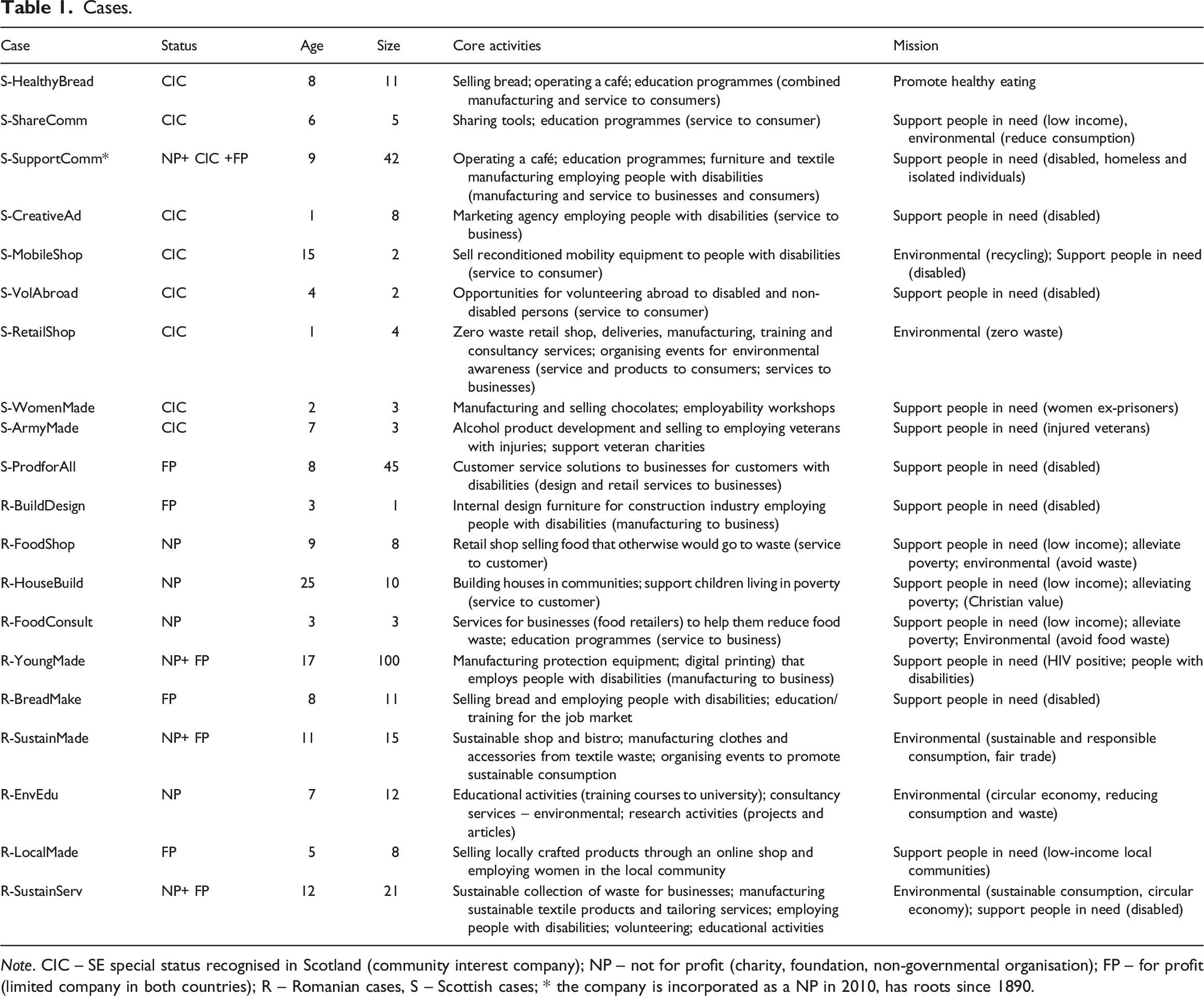
Note. CIC – SE special status recognised in Scotland (community interest company); NP – not for profit (charity, foundation, non-governmental organisation); FP – for profit (limited company in both countries); R – Romanian cases, S – Scottish cases; * the company is incorporated as a NP in 2010, has roots since 1890.
Data collection was undertaken via interviews with the founders or senior managers of these SEs. Interview questions addressed the SE activities, resource requirements and target stakeholders, and the strategies which they deployed to engage with stakeholders and acquire resources. Interviews were recorded digitally and then transcribed. When analysing the data, we followed Miles and Huberman’s (1998) iterative process of moving between coding, narratives and literature review, and Dubois and Gadde’s (2002) systematic combining approach, which involved going back and forth between theory, framework, empirical observation and cases. Coding was abductive, and involved a combination of deductive coding based on an a priori list of codes, developed through the literature review, which informed the development of our framework, and inductive coding which emerged gradually as the analysis progressed, to allow for new meanings to emerge from the data (Miles and Huberman, 1998). The initial list of codes included form of legitimacy, legitimacy strategies, resources sought, stakeholders targeted and types of social innovation. The new codes which were added to the data included trade-offs between legitimacy types and types of moral legitimacy. These new codes were checked against the theory and helped us to refine our framework. The transcripts were coded by two members of the research team and a third member checked the consistency of the coding. The emergence of new codes, as well as differences of opinion regarding codes, was discussed by the team to ensure a consistent approach. Data displays (for example, mapping the forms of trade-offs and criteria based upon which trade-offs were made) and narratives (such as on the roles of trade-offs) were developed to aid the identification of patterns within the data (Miles and Huberman, 1998). These were used iteratively to refine the emerging conceptual framework.
Findings
Our sample (see Table 1) included 10 SEs in each country, of widely differing sizes (1–100 employees) and ages (1–25 years). In the context of our firms, however, age was not a clear indicator of the level of legitimacy which the firm might possess. Some of the SEs were newly established by actors who were new to the SE sector. Others had been founded recently as private companies but were established by founders who were highly experienced within the SE sector, having worked previously for public sector agencies or private sector ventures. With liberalisation in Romania, some new ventures had been created by those who had worked on EU-funded initiatives or for international charities which used to operate within the same domain but had recently withdrawn from the country. These actors learned the art of legitimacy building whilst employed by others and brought this experience to the enterprises within this study. This could in part account for the lack of national distinctiveness apparent by age. The value brought through prior human and social capital to ventures in the SE sector should not be underestimated: acquired management skills can enhance the ability of firms to access resources and therefore, make them better placed to compete in a market.
All but one of the Scottish SE were launched by UK-based social entrepreneurs as their first SE venture (the exception had operated in the same location for more than 100 years) and were developed using primarily UK-based funding. By contrast, the majority of Romanian SEs had their origins outside Romania. Some resulted from the international expansion of foreign SEs (Western European and US) into Romania, which then withdrew leaving former employees to set up offshoots of the original organisations, while others were the result of international grant funding, which enabled local SEs to copy models developed elsewhere and apply them in the Romanian context. All of the Romanian cases demonstrated adherence to internationally defined guidelines for their operations and practices. Moreover, although all the Romanian SEs served mostly local beneficiaries and interacted with local partners, nine were strongly embedded in international SE network organisations, mostly from Western Europe and the US. These networks offered specialist support, financial resources and opportunities for international networking, which facilitated the diffusion/acquisition of international best practice. Thus, the difference between the two countries lies not only in the varying degree of institutional support for SEs but also in the source of their knowledge and expertise in managing SEs in general, and engaging in legitimacy building behaviour in particular.
Given our focus on examining the relationship between innovation type and legitimacy, when analysing the data, we first considered the types of innovations which the SEs pursued and the range of stakeholders from which they sought legitimacy in order to acquire the resources to support delivery of these innovations. Drawing upon findings from our literature review, we differentiated between three types of innovation based upon their content. We identified stakeholder categories inductively, based upon how respondents distinguished between the categories of resource holders. This process revealed users/beneficiaries, customers, society (specific communities of beneficiaries or society in general), the SE community (other SEs, NGOs or communities that shared a similar ethos), suppliers, governmental agencies (local authorities and governmental bodies such as councils and the Charity Commission) and internal audiences (volunteers, employees, board members and other SEs founders). These categories contained some overlaps; for example, beneficiaries, who were primary SE targets, may also have been customers (R-FoodConsult), or staff, including volunteers (S-SupportComm) or employees (R-BuildDesign). We classified individual stakeholders across different categories depending upon their role played in relation to the innovation. For example, we distinguished the targeted individuals as (i) users/beneficiaries of the SE’s new product/services, processes or business models; (ii) employees or volunteers providing labour to deliver these innovations or as (iii) customers providing income to the SE through purchasing these outputs (e.g. novel services developed through novel processes or business models). Drawing from existing research, we then examined the forms of legitimacy sought, and the defiance and combination strategies which SEs deployed to address the multiplicity of types of legitimacy (as depicted in our conceptual model, Figure 1). Finally, we examined the patterns relating to the types of innovation pursued and the approaches adopted to seek legitimacy.
Types of innovation
We identified six SEs which focused on the development of a novel product (see Table 2), either a new or modified good (e.g. healthier bread, technology solutions for an underserved category of customers) or service (e.g. environmental training, disability employment consultancy). Novelty was relative either to the country in which the SE operated, or to the social sector, and was achieved either through a combination of established product concepts (e.g. self-sustaining community organisation and sourdough bakery in the case of S-HealthBread) or by expanding existing concepts to new areas (e.g. R-EnvEdu expanded training, research and consultancy services to environmental areas). Product innovators primarily targeted two sets of stakeholders – customers and internal audiences – and barely mentioned the SE community and governmental bodies. They concentrated their legitimation building efforts on customers who evaluated their products, in order to access the resources required to support their innovations, and on internal stakeholders who provided the skills required to develop the product: ‘Scotland has an ageing population of something like two million people, out of five, that are over 65. And on top of that, we’ve got half a million disabled people.
1
It’s quite a lot, in terms of people needing access to equipment. We’re finding that there are mobility companies growing all around us, but they’re all mainly fairly new. No-one sells … reconditioned … [and they] don’t do repairs’ (S-MobileShop). Type of innovation and stakeholders targeted.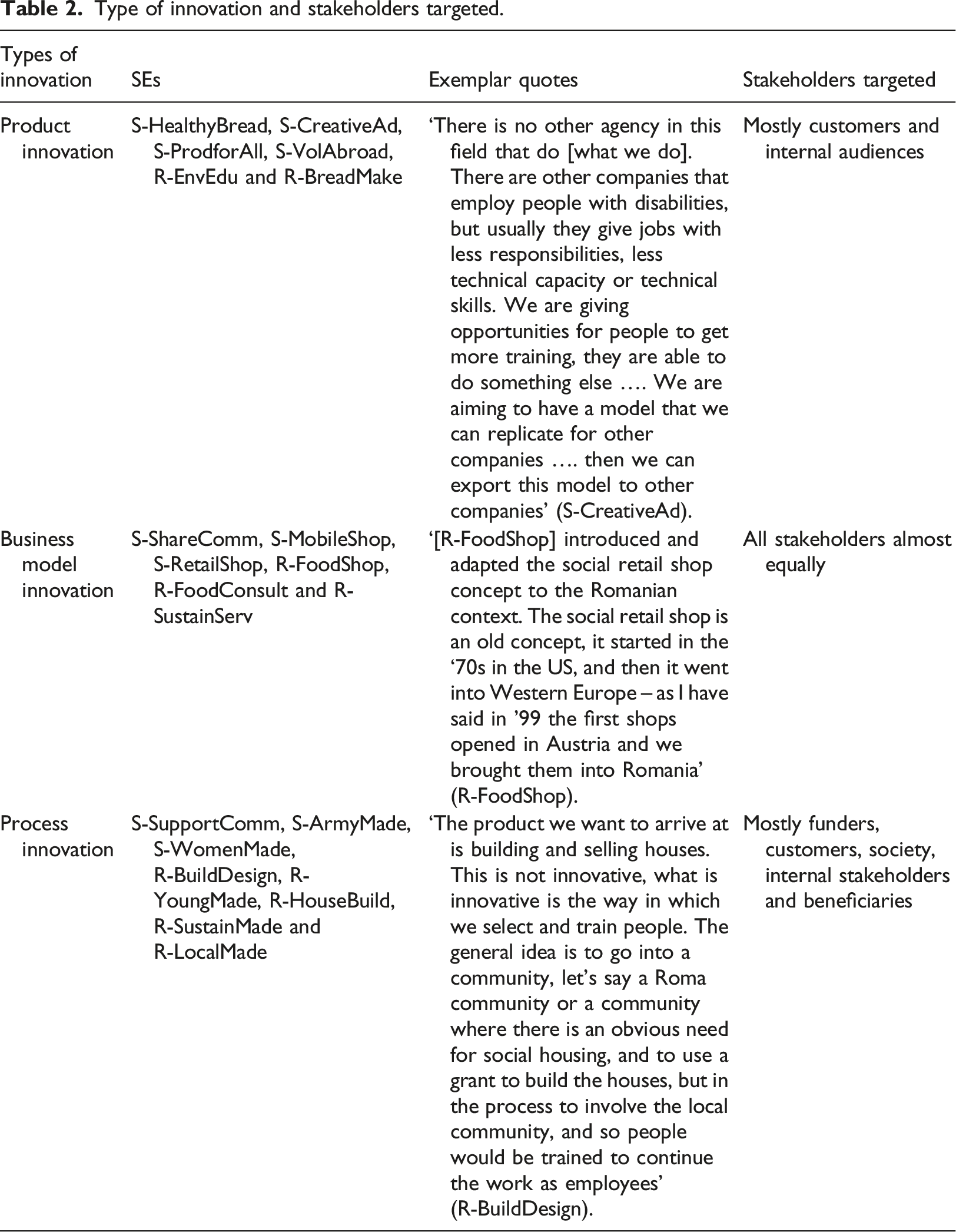
Six SEs addressed a social need by developing novel business models. Novel business models resulted from the ways in which SEs changed how value was created for customers, either in relation to how they manufactured products (e.g. by relying on recycling materials to reduce costs and increase environmental value for customers in the case of S-MobileShop) or how they delivered services (e.g. by moving beyond offering food waste management services to delivering customised training to help businesses reduce food waste in the cases of R-FoodConsult and S-ShareComm). Novelty was relative, sometimes in relation to the SE’s arena but more often to the country in which the SE operated, as in most cases the business model was based on similar initiatives in other countries (e.g. R-RetailShop and S-ShareComm both started as foreign business models implemented in a local context). All of the business model social innovators engaged with all categories of stakeholder and did not have a strong preference for any particular group. This is unsurprising given that this type of innovation affects several components in the business architecture and multiple associated stakeholders, as exemplified by R-FoodShop: ‘…. whether in the NGO space through specific collaboration, or in the private space through identifying companies that can support our ideas, this network is very important. …. social capital is super important because if you do not have people who are interested in sustainability, or people who respect food or are oriented towards civic action you cannot fulfil any project’ (R-FoodShop).
The remaining eight SEs innovated through translating commercial products and services into a social context, so that the innovation involved transformation in the operations to manufacture or deliver these products and services. These innovations included significant changes to the existing practices involved in manufacturing existing products (such as furniture, textiles, construction equipment, digital printing and food and drink) and delivering existing services (such as cafes and language training). Novelty for organisational process innovation thus resided in how SEs worked with their users/beneficiaries, for example, hiring people from disadvantaged communities to offer a source of income (S-ArmyMade and R-LocalMade), training them for future employment (S-WomenMade and R-HouseBuild), and directly involving them in the operation and management of the organisation (S-SupportComm). SEs that introduced novel processes engaged with a wider range of stakeholders than did the product innovators, but with a narrower range compared with the business model innovators. Process innovators focused on funders, customers, society, internal stakeholders and beneficiaries and rarely mentioned the SE community and government. Process innovators sought to change existing service provision by focusing on the specific aspects of operating an SE, most notably leveraging community and individual beneficiaries to attract funds (R-HouseBuild), or to deliver services to paying customers (e.g. S-SupportComm, R-BuildDesign and R-YoundMade): ‘One of the things that differentiates us [as an SE] is that we want to treat every person as if they are the most important … We are attracted not necessarily by those who have social needs, but we are interested to have an impact on society, and on the values that guide how we live. ….. This is why we are different: we do not focus only on those with needs’ (R-HouseBuild).
Forms of legitimacy and combination strategy
We found no difference between the two countries in the terms of the forms of legitimacy pursued, nor the kinds of strategy in which the SEs engaged. While there were minor variations in emphasis between categories of stakeholders, all SEs sought both pragmatic and moral legitimacy, often at the same time and with the same stakeholders. This suggested that appealing to stakeholder self-interest was as important for resourcing strategies as was framing activities in moral terms to align with stakeholder expectations. Only rarely did we observe efforts to seek cognitive legitimacy, the least emphasised form across all our cases (see Table 3). R-HouseBuild exemplified the combination strategy which involved seeking multiple forms of legitimacy to address stakeholder expectations: ‘For the children living in poverty, we offer lessons once a week ... to write, read, socialise and learn hygiene, all these things from a social point of view (moral). ... We have English camps...because parents have asked for a safe environment where children can come and learn English (pragmatic). ... The 90s were very difficult financially, and Romanians thought that ... foreigners have to come and help us. ... We took Romanians outside Romania to less-developed countries to say: let’s go and see that it can be much worse and let’s do something with what we have now, rather than wait for somebody else to come and help us (cognitive)’ (R-HouseBuild). Type of legitimacy sought.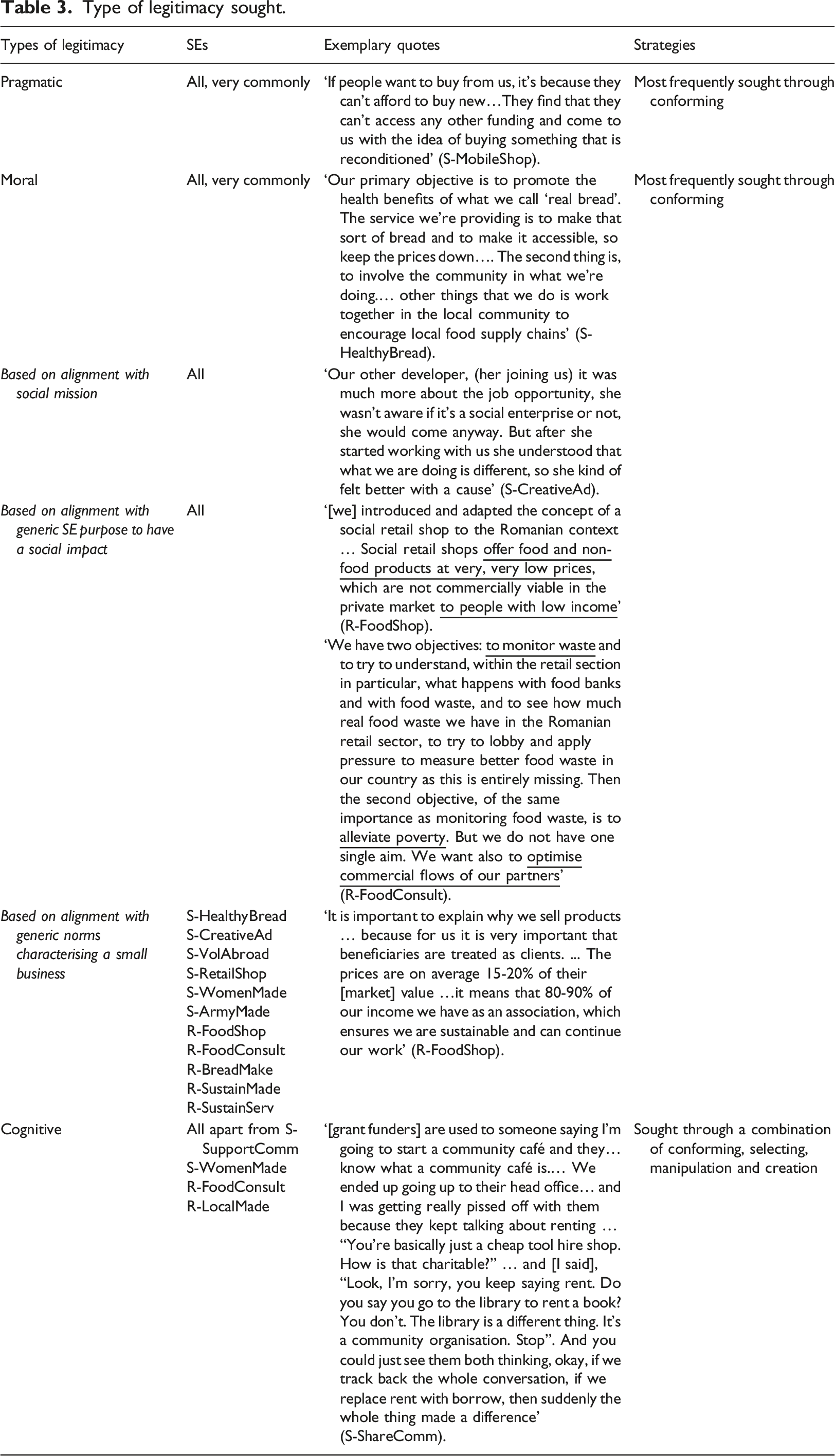
When examining moral legitimacy, we identified three categories of norms that underpinned how stakeholders evaluated the products and services that SEs offered to bestow moral legitimacy: (i) the SE’s particular social mission (alleviating poverty); and/or (ii) the reason for being an SE (having a social impact) and/or (iii) being a typical small business (responding to market conditions). This combination of norms with which SEs sought to align themselves was exemplified by S-HealthyBread, whose promotion of healthy bread (specific mission) and support for the local community (generic mission) were combined with the need to set prices which were appropriate for the market (business operations) (see Table 3).
The first two moral legitimacy norms – that is, (i) norms associated with the SE’s social mission and (ii) the reason for being an SE were the most common in our data. All social innovators sought different forms of moral legitimacy depending upon their chosen mission, which affected the types of stakeholder they targeted and the kinds of innovative activities in which they engaged. The nuances in how SEs leveraged moral legitimacy, based on the specific mission they pursued, were exemplified by R-FoodShop and R-FoodConsult. Both organisations collected and redistributed surplus food to users/beneficiaries, but followed distinctive approaches: while R-FoodShop focused on alleviating poverty by targeting people on low incomes, R-FoodConsult promoted environmental sustainability by targeting the retail sector to encourage food sustainability and reduce food waste, while simultaneously pursuing poverty alleviation (see Table 3). Often we noted combinations of such normative aims, as in the case of R-FoodConsult. Occasionally, SEs had to make a trade-off regarding with which normative mission they would align: for example, to support sustainability, S-ShareComm emphasised reducing consumption rather than encouraging recycling.
All SEs also demonstrated legitimacy by emphasising their alignment with the generic expectations associated with operating as an SE, by having social impact, engaging with the local community and by undertaking civic action. By contrast, only eleven SEs sought moral legitimacy through portraying themselves as a commercial business. Alignment with commercial business norms involved emphasising the need to generate revenue from paying customers (given the importance of self-funding), competition with other commercial operators, bureaucratisation associated with managing a growing business and applying for funding to support growth. R-FoodShop exemplified this commercial, moral legitimacy in the way in which it targeted users who were also paying customers (see Table 3).
We also examined the strategies that SEs employed to seek individual forms of legitimacy, which supported their wider combination strategy. To achieve both moral and pragmatic legitimacy, conforming was by far the most common approach. A typical example involved efforts to attract customers and employees by emphasising pragmatic legitimacy: S-SupportComm attracted paying customers – by offering well-priced, quality goods – and skilled employees – by offering higher pay than the charity sector and better working conditions than the commercial sector: ‘Most [customers] are not buying [our product] because it's social. They just want a drink or want a coffee, or tea, or cake’ and ‘It's, an interesting skills mix unique to this type of organisation. … [we] look after [our employees] because they could go and work elsewhere …. We do pay people well. We also take people's mental health and wellbeing really seriously, so we have some perks’ (S-SupportComm).
We found that selecting and creating strategies were not commonly used and were most often associated with moral rather than pragmatic legitimacy to complement conforming strategies, and we encountered only a few instances of manipulation targeting moral or pragmatic legitimacy. Selecting involved focusing on particular stakeholders whose moral values were closely aligned (SE funders). Creating often involved education, such as SEs delivering workshops and training sessions to demonstrate an alternative way of operating to support either the SE’s own specific mission or the SE sector more generally. Occasionally it involved institutional change efforts, such as altering the legal regulatory environment or funding structure: ‘We are a promoter of the Social Economy Law in Romania …. we are getting involved in all kinds of public politics, reports and consultations in order to transfer our practical experience to a systemic level that can help the entire sector … We worked [with local government] to develop funding rules for NGOs, to have a more coherent and easy to navigate context for NGOs to access funding’ (R-YoungMade).
In the few cases where SEs sought cognitive legitimacy, we identified the use of all four strategies. S-ShareComm’s efforts to explain its innovation to regulators exemplified strategies to gain cognitive legitimacy, involving both conforming (e.g. adapting the language from ‘renting tools’ to ‘borrowing tools’ to match regulator expectations) and manipulation (e.g. reframing a radical model as familiar) (see Table 3).
Trade-offs between forms of legitimacy and defiance strategies
Legitimacy trade-offs.
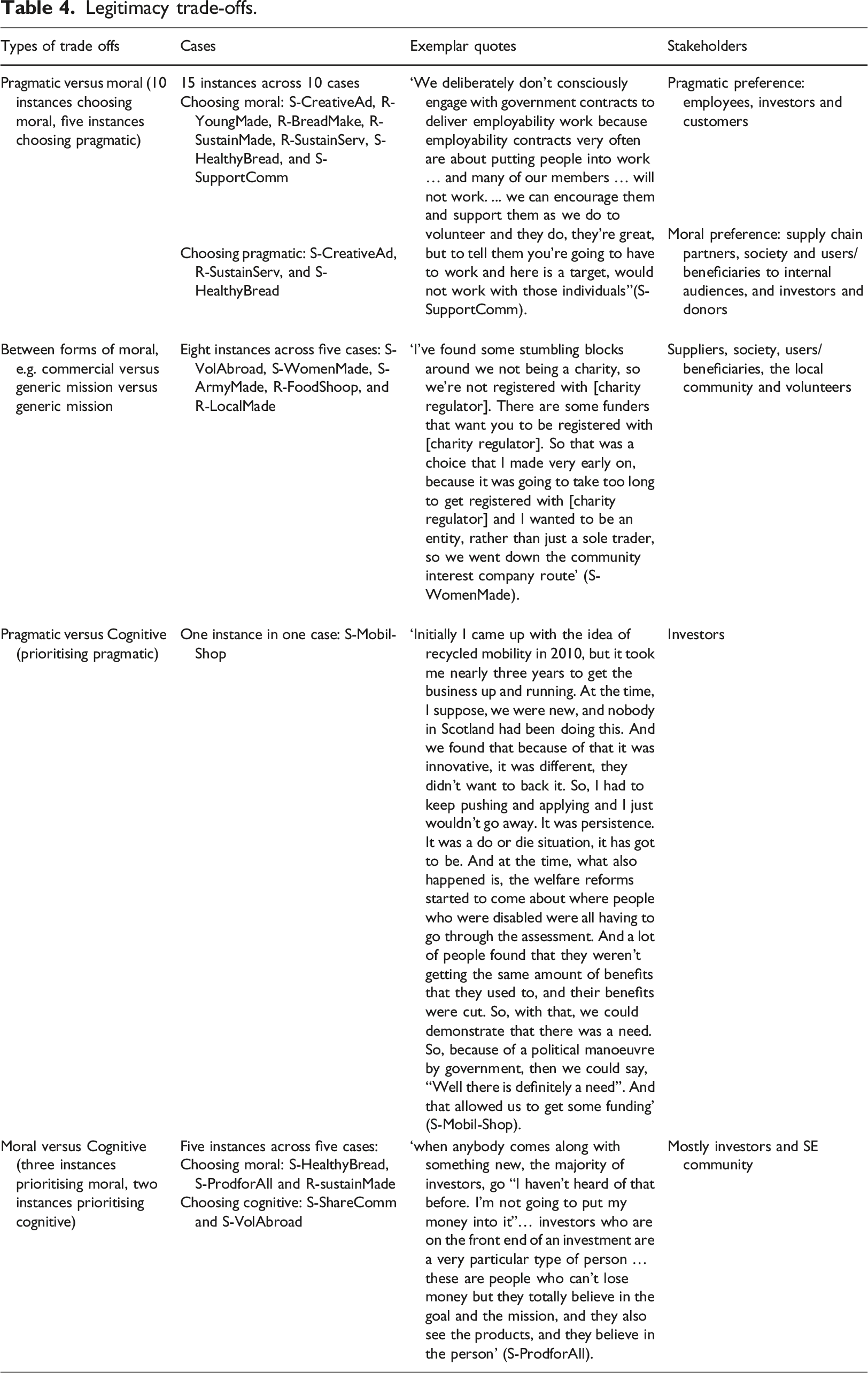
The majority of these trade-offs involved choosing between pragmatic and moral legitimacy, with most of these situations resulting in the selection of moral legitimacy as SEs wanted stakeholders to evaluate their services based upon their alignment with moral values, rather than on pragmatic self-interest. For example, to support the delivery of its services, S-SupportComm chose to forego targeting government audiences, who would have required it to demonstrate alignment with employability targets, and instead targeted beneficiaries through its emphasis on people in need. Less common trade-offs involved prioritising pragmatic versus cognitive, and moral versus cognitive legitimacy. For example, S-ProdforAll emphasised alignment with the moral expectations of selected investors to compensate for their lack of understanding of what an SE model entailed. The fourth type of trade-off identified involved moral versus moral where tensions existed between types of normative expectations with which SEs had to align. The most common tensions were between social and commercial norms, that is, behaving as an SE versus taking a more ‘business-like’ stance, but we also encountered tensions between pursuing a specific social mission and the norms associated with operating as a social or business enterprise (see Table 4).
In the 16 cases where trade-offs were observed, six cases involved more than one trade-off, and in only one of these six cases did we see a consistent preference exhibited for one form of legitimacy over another (moral versus pragmatic in the case of R-BreadMake). In the other five cases, different trade-offs were made with different audiences or with the same audience at different times. This suggests that SEs do not prioritise systematically one form of legitimacy over another, but make selective trade-offs on a case-by-case basis. S-HealthyBread prioritised pragmatic over moral legitimacy to attract investors (first example below), but maintained moral over pragmatic legitimacy with business customers (second example) by engaging with those who aligned with its social values rather than changing its product to suit customers’ commercial interests: ‘I came out of the first meeting with a private investor and said I don’t want his money basically because he doesn’t understand what we’re trying to do, he’s doing this for different reasons, but I took his money anyway. You have to be pragmatic’.
and ‘[some customers] don’t really believe in our products so they think it’s cool to go into partnership with a social enterprise but when it comes to the crunch, they don’t care that it’s organic and they don’t care that it’s healthy and they don’t care that’s it’s slow fermented, they just go, “Oh, we want this,” and … then we say, “No, we’re not going to do that and this is what you get,” and then they move on and they get their stuff from Asda again’ (S-HealthyBread).
Types of trade-off and criteria.
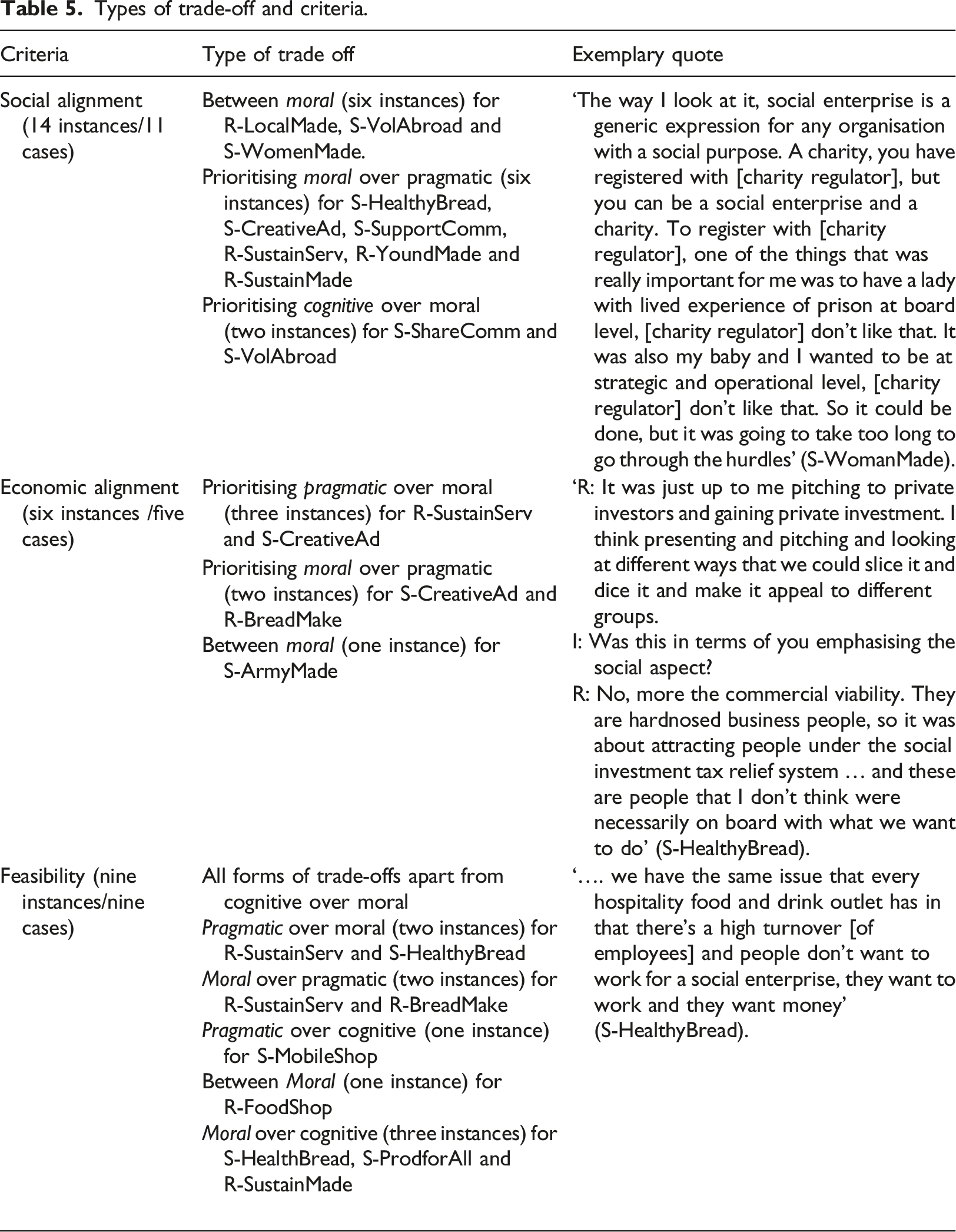
Social alignment was the most common criterion used, explaining in most cases SEs decision making when trade-offs favoured moral rather than pragmatic legitimacy (six out of ten instances), or when they were required to choose between forms of moral legitimacy (six out of eight). For example, S-WomenMade chose to operate as an SE rather than as a charity in order to align with its social objective of involving beneficiaries directly in the running of the organisation (see Table 5). Counterintuitively, social alignment also explained both instances where cognitive legitimacy was prioritised above moral legitimacy. A possible explanation is that by aligning with a social mission, SEs chose to target their cognitive legitimacy building efforts at stakeholders who were embedded within the SE environment, and who possessed a deep understanding of what an SE is supposed to do. In these cases cognitive legitimacy was based on a shared understanding of what constituted a social innovation (hence the choice for cognitive legitimacy based on social alignment), rather than alignment with, for example, expectations of how to run a business, as illustrated by S-VolAbroad: ‘I think there’s a groundswell of people that are not so profit orientated and that they want to see the world in a better place [… ] through meeting the guys at [SE accelerator] some of those young people were phenomenal in what they were doing. For me personally I want to say to people, ‘Okay, so I went to university as a mature student, I eventually got a job, why can’t I start a business at my age, what’s wrong with doing that?’ So, it may not go on for ten years, if it goes on for five years, six years that’s okay, that’s fine, it doesn’t need to end up being some huge Apple organisation, I can do what I can do, it’s enough’ (S-VolAbroad).
Economic alignment was associated with the prioritisation of pragmatic legitimacy over moral legitimacy in three of the five instances and also in a few cases where surprisingly, the choice was between moral over pragmatic (two instances) or between moral and moral legitimacies (one instance). In all of these cases, pursuing pragmatic or moral legitimacy was seen to involve less effort and yielded faster results with a particular audience. For example, S-HealthyBread and R-SustainServ considered that selecting customers or partners with aligned expectations or manipulating them to appeal to their normative expectations would have involved more effort, and implicitly have taken too long, compared with appealing to their self-interest (see Table 5). By contrast, to attract volunteers, R-BreadMake emphasised fit with its social objectives, which was seen as much easier to achieve than attempting to consider ways in which it could change its processes and develop an approach to align itself with volunteers’ self-interest, for example, work flexibility or re-training.
Finally, feasibility was a common criterion in explaining all of the forms of trade-offs which we encountered, with the exception of cognitive over moral. SEs chose to prioritise one form of legitimacy – always pragmatic or moral – due to their expectation that other forms of legitimacy were weak and, therefore, would not have been effective in the context. The case of R-SustainServ illustrates its reliance on feasibility criteria when choosing to seek pragmatic legitimacy with customers because normative expectations that aligned with the social objectives of SEs within its particular context were absent: ‘The social part of a business doesn’t account almost at all to shape the purchase decision. If you do not have a good quality product at a good price comparing with the competition, you cannot survive. There is simply not this kind of education in Romania’ (R-SustainServ).
The relationship between innovation and legitimacy
Despite targeting different stakeholders, we found that SEs pursuing all types of innovation exhibited the same preference for employing combination strategies through seeking moral and pragmatic legitimacy, mostly through conforming. We noted a discernible difference in the types of moral legitimacy that SEs built: process innovators emphasised norms reflecting generic SE operations more often than other types of innovators. Process innovators sought to create social value by developing novel ways of organising their operations, with an emphasis on generic SE approaches rather than on the social mission pursued: ‘I realised that it is important to offer alternatives, not only to talk about sustainable consumption, but also to build projects that last in this direction. So the social economy initiatives emerged … because we wanted to demonstrate that these kinds of economic relationships and economic activities can happen’ (R-SustainMade).
We noted differences in the defiance strategies which SEs utilised, depending on the type of innovation pursued. First, while we identified the presence of trade-offs across all types of innovation, four of the six SEs which exhibited more than one instance of employing trade-offs were product innovators. This finding suggests that product innovators face greater tensions between seeking different forms of legitimacy from their stakeholders when compared with other forms of social innovators so that they were required more often to resort to prioritising one form over another in order to engage a particular stakeholder. The case of S-MobileShop illustrates the use of these multiple defiance strategies, as it prioritised pragmatic over moral legitimacy to attract employees, but then employed moral over pragmatic legitimacy to retain them: ‘We had a position open since last year […] it doesn’t matter if we are a social enterprise or not, if you offer a good salary. But of course, the retaining is important because after they start work, people will start seeing differently and saying, ‘No, that’s something good, that’s something nice, I don’t want to go back to the market and work for another…even receiving more [money]’ (S-MobileShop).
This higher prevalence of having to deal with tensions in legitimacy building efforts may also explain why product innovators focused on fewer stakeholders (customers and volunteers/employees) to seek resources, compared to other types of social innovator, in order to minimise the incidences of conflict with which they had to deal.
Second, we found that all of the trade-offs observed in the case of process innovators involved the prioritisation of moral legitimacy: process innovators selected moral legitimacy over pragmatic, moral over cognitive and even moral over other forms of moral legitimacy. The moral over moral trade-off mostly involved emphasising norms of SE operations versus norms of business or even charity operations. Process innovators thus clearly aligned themselves with normative expectations of SEs (there was one exception, where the choice was in favour of business operations to attract funding from investors). This pattern was in stark contrast with the other types of innovation where there was no clear preference for one form of legitimacy. This suggested that although process social innovators were seeking both pragmatic and moral legitimacy to the same extent as other innovators, when tensions emerged between forms of legitimacy, they consistently prioritised moral legitimacy. This focus on moral legitimacy, and on SE norms over business norms, aligned with the approach of process innovators who positioned their innovation as translating processes, products or business models from the commercial world into the social context. This alignment with the social objectives – and efforts to frame their activities as aligned with the norms of this social context – were important for gaining acceptance for their innovations.
The preference among process innovators for moral over other forms of legitimacy was also reflected in the fact that process innovators exhibited a preference for making these trade-offs based on alignment with their social norms. This was consistent with their preference for moral legitimacy as, amongst process innovators, five of the seven trade-offs identified involved social alignment. By contrast, business model innovators preferred alignment through feasibility (four instances) followed by social alignment (two instances), while product innovators relied on all three criteria – economic alignment (five instances), social alignment (seven instances) and feasibility (four instances) – to inform their trade-offs (as illustrated by the earlier example of S-HealthyBread). These findings indicate that different types of innovators engaged in a different range of defiance strategies. At one extreme product innovators engaged in the broadest range of defiance strategies, while also experiencing the highest number of tensions amongst our innovators. At the other extreme, process innovators relied almost exclusively on the approach of social alignment, while business model innovators were in between.
Discussion and conclusions
Recognising that hybrid organisations such as SEs face particular challenges in satisfying the heterogeneous legitimacy criteria of their stakeholders (Uberbacher, 2014), we set out to examine how the type of innovation that SEs pursue shapes their legitimation building efforts with different stakeholders. We found that, for much of the time, all SEs pursued multiple forms of legitimacy simultaneously with multiple stakeholders (combination strategies, cf. Pache and Santos, 2013). When the type of innovation pursued was considered, SEs pursuing different types first targeted stakeholders differentially and second engaged differently in defiance strategies when tensions emerged, prioritising one form of legitimacy over another. Our analysis found that there was a connection between the type of innovation which SEs pursued, the range of stakeholders they targeted, and the approach they adopted to balance the conflicting legitimacy expectations of their stakeholders (see Figure 2, which extends Figure 1). Innovation and legitimacy building – findings.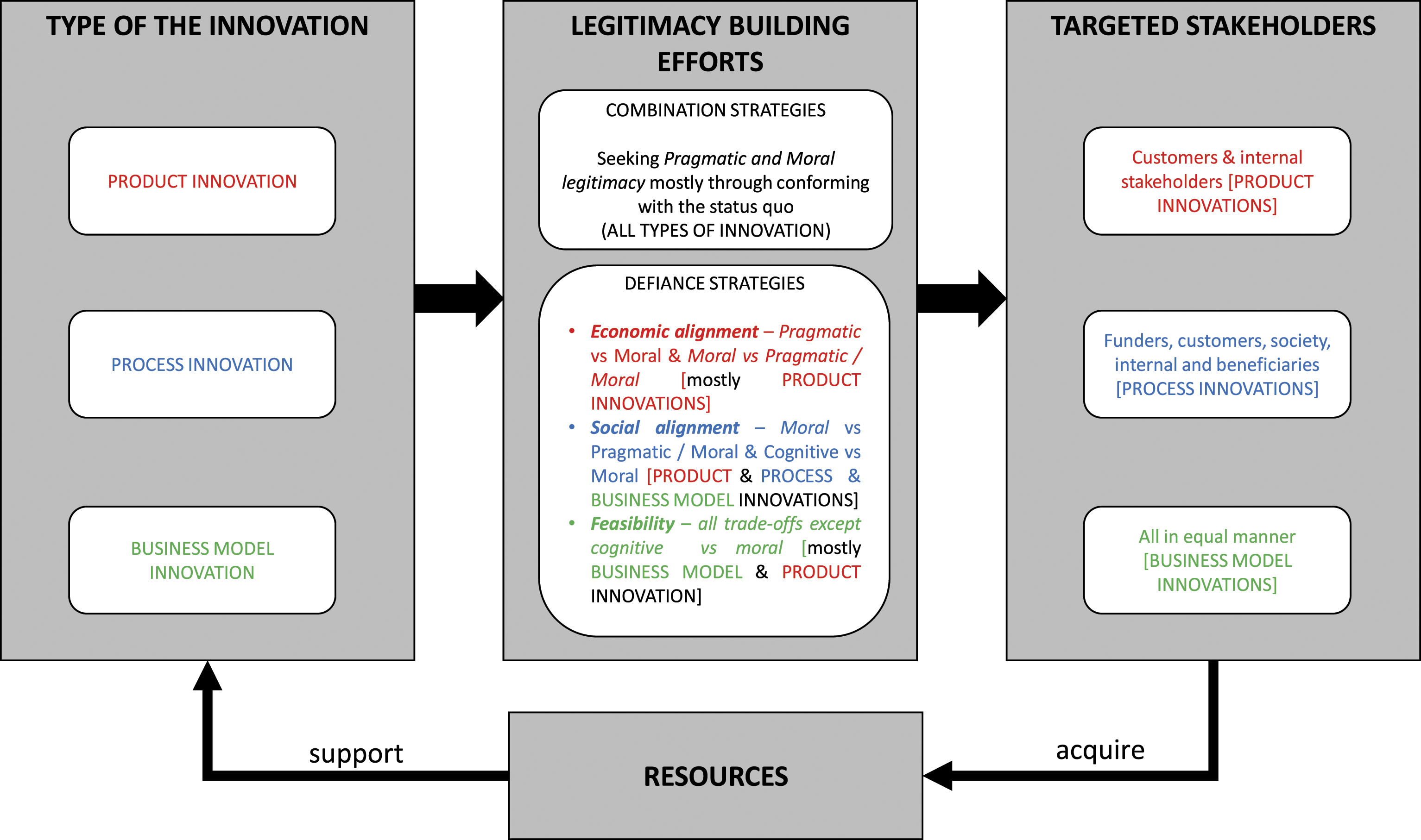
First, we have demonstrated empirically the relationship between the types of innovation pursued and the range of stakeholders targeted. We find that while product innovators focus on a narrow range, targeting mostly customers and internal stakeholders, process innovators utilise a moderate range, including funders, customers, society, internal and beneficiaries, and business model innovators target all categories of stakeholders in equal measure. This is important because it underpins our next argument that links the efforts to seek legitimacy with the type of innovation (Fisher et al., 2017; Kuratko et al., 2017). Second, we revealed three types of criteria that SEs use to evaluate their legitimacy options and trigger the defiance strategies: (1) alignment with their social mission (social alignment), (2) efficiency in acquiring desired resources (economic alignment) and (3) likelihood of success (feasibility). We found that these criteria vary depending on the type of innovation SEs pursue. Product innovators faced greater tensions between forms of legitimacy, so they chose to rely on defiance strategies more often than other types of social innovators. This may be because product innovators targeted a narrower range of stakeholders, mostly customers and internal audiences, where the tensions between their commercial and social missions were most marked. We noted how SEs often struggled to reconcile the need to satisfy the interests of and align with the moral normative expectations of their customers – in the form of low prices or high quality – and of their staff – in the form of paying an appropriate sector-level salary. To address these tensions, product innovators had to engage in trade-offs that involved all forms of legitimacy and relied on all three criteria. By contrast, process innovators pursued a wider range of stakeholders than product innovators, including funders, customers, society, internal stakeholders and beneficiaries. When engaging in defiance strategies, they nearly always relied on social alignment criteria and prioritised moral legitimacy, and the norms associated with operating as an SE, over other forms of moral legitimacy. Business model innovators targeted all stakeholders almost equally and engaged in a wide variety of trade-offs, mostly employing feasibility and, to a lesser extent, social alignment criteria.
Finally, counterintuitively, we also found that the national context makes little difference to the legitimation behaviour which SEs exhibit. When targeting stakeholders to acquire resources, both Romanian and Scottish SEs engaged in combination strategies, which emphasised alignment with their self-interest (pragmatic) and with their normative expectations (moral), and they exhibited a strong preference for conforming with stakeholder expectations. Dissimilarity in SEs between countries is generally related to their context and connections with their specific socioeconomic conditions (Kerlin, 2012). We observed that in the absence of strong institutional support in Romania, SEs relied largely on borrowing practices from the international context within which they were embedded, and they were much less dependent upon their national context. This heightened exposure to and reliance of Romanian SEs on Western practices (i.e. similar to those in Scotland) may explain why, despite the differences in local context, we observed no significant difference between the two countries in how SEs seek legitimacy.
Limitations
We studied twenty SEs involved in incremental social innovation, all of which were perceived as being exemplars of successful innovative SEs: however, we do not have data on their performance. Had we been able to compare innovative SEs exhibiting different degrees of success we could have investigated whether ambidextrous SEs, which balance the tensions between multiple forms of legitimacy through trade-offs, are more successful than those that engage solely in combination strategies. We also examined the legitimation efforts of SEs at one point in time. We noted from our interviews that reported differences in legitimation behaviour – for example, in the types of trade-offs made – appeared to vary over time. A longitudinal research design which engages social innovators as they start and then develop and expand their SE, would provide the opportunity to examine changes in the stakeholders targeted and legitimation seeking behaviour pursued over time. This is particularly important given that how firms seek legitimacy and seek to fit in depends on the relative maturity of the field in which they operate (Stringfellow et al., 2014) and insights into the effective use of different strategies over time would be of value to agencies supporting the development and growth the SE sector. Finally, the reliance on international models and systems that we observed in the Romanian context would benefit from further investigation given its potential to explain why we observed so little difference between legitimation strategies utilised by the SEs. It may be that the apparent mismatch between the Western European-style practices and Eastern European context in the case of Romanian SEs has a bearing on the success of legitimation strategies – which is not something that we investigated here – and this situation may also change over time, as the institutional context and the practices employed by SEs across different parts of Europe evolve and adapt. We suggest that the lack of variation in findings between the countries may be a consequence of the similarities between the SEs involved from each country. Romanian SEs were recommended by Ashoka Romania based upon their good practice in social entrepreneurship. Ashoka is an international network whose mission is to find and cultivate social entrepreneurs around the world. This meant that the selected Romanian SEs had been shaped by the norms of international founders/organisations and EU grants, which may have resulted in them adopting practices aligned more closely with those of Scottish SEs to a greater extent than we had anticipated. Given this finding regarding the Romanian SEs, which indicates that their practices do not seem to align with the particularities of their context, we suggest that there would be merit in exploring the implications of their lack of formal legal status, their key sources of knowledge and learning about what it means to be and how to function as an SE, and the impact of international best practice on their activities. This would provide an opportunity for theory development to help explain SE emergence and development in what, on the face of it, would appear to be an unconducive environment.
Contributions to theory
The model that we developed to explain the relationships identified between the types of innovation pursued by SEs, the nature of their legitimacy building efforts and the categories of stakeholders that they targeted makes two contributions to entrepreneurship research (see Figure 2). First, our model sheds light on one of the key processes underpinning the development and implementation of innovations in SEs: building legitimacy with stakeholders. While the effort of SEs to engage with a diverse set of stakeholders has been identified as one of the key processes in social innovation (Phillips et al., 2019), existing research has highlighted building moral legitimacy as the main resourcing strategy employed by SEs (Jayawarna et al., 2020). Instead, reflecting the efforts of SEs to balance their economic and social missions (Doherty et al., 2014), our model brings to the fore the importance of considering multiple forms of legitimacy, as they appeal to different categories of stakeholders that SEs target to acquire resources for their survival. Our analysis reveals that SEs combine moral legitimacy with efforts to appeal to stakeholder self-interest (i.e. pragmatic legitimacy), almost to the same extent and across all stakeholder groups. Our key contribution here is to draw attention to the importance of complementing such combination strategies to pursue moral and pragmatic legitimacy, with defiance strategies, where demands to pursue different forms of legitimacy are prioritised selectively, one against another. This allows SEs to engage with their diverse stakeholders to access resources, in order to balance their economic and social objectives. In contrast with the findings of prior research on SEs and their stakeholders (Bruneel et al., 2016; Ramus and Vaccaro, 2017), we identified that when targeting different stakeholders, and selectively prioritising one form of legitimacy over another – that is, moral legitimacy to pursue social objectives or pragmatic legitimacy to pursue economic self-interest – it was necessary for SEs to deal with the tensions inherent in the context within which they were operating and seeking resources. Our model draws attention to the fact that the trade-offs involved in these defiance strategies are a key mechanism upon which SEs rely to acquire resources from their stakeholders. Our findings provide evidence that defiance strategies, where one set of demands is rejected in favour of another (Battilana and Lee, 2014; Oliver, 1991), can be pursued successfully, not as a permanent trade-off (Quirke, 2013), but rather as a tool to re-adjust dynamically how SEs build legitimacy across their diverse stakeholders to access resources.
Second, expanding on the work of Kuratko et al. (2017) and Fisher and colleagues (2016, 2017), our model links the type of innovation that SEs pursue with their legitimacy building efforts. Our findings show that the type of innovation that an SE pursues is important in determining its behaviour when engaging with stakeholders, particularly in relation to dealing with the tensions inherent when seeking different types of legitimacy. Our model proposes that where SEs pursue multiple forms of legitimacy, product, process and business model innovators exhibit different levels of tension between forms of legitimacy and follow different approaches to address these tensions, often adopting defiance strategies. Our findings indicate that the conflict between the need to be legitimate and innovative leads to the use of different trade-offs for different innovators, depending upon the range of stakeholders to which they appeal. By developing this model, we address calls for research to investigate how entrepreneurs located across multiple fields (e.g. social and commercial) prioritise the conventions with which to align (Pret and Carter, 2017), by revealing the mechanisms employed by SEs. They adjust their legitimacy building efforts to target different stakeholders and pursue different trade-offs relative to the type of innovation developed: business model, product or process.
Contributions to practice
There is a significant need to support SEs to engage in social innovation by enhancing their engagement with stakeholders in order to leverage their resources (Shaw and De Bruin, 2013). Our research highlights the strategies that successful social innovators deploy to engage with stakeholders and elucidates effective paths that SEs can take to do so, depending upon the type of innovation they pursue. We find, for example, that the product innovator’s journey is more arduous as it involves a sizeable number of legitimacy trade-offs. We also spotlight the importance of prioritising moral legitimacy for process innovators in order to engage their stakeholders. More generally, we recommend that SEs combine their efforts to build moral legitimacy with an appeal to stakeholder self-interest, while paying attention to the inherent tensions that may emerge between appealing to stakeholder self-interest and to their normative expectations. We highlight the importance of developing strategies to manage these tensions, and in particular the need to adjust the trade-offs on a case-by-case basis. Our findings demonstrate the importance of purposive decision-making by resource-constrained SEs to target resource providers who reflect the SEs’ own values, and their willingness to trade-off different forms of legitimacy. SEs need to understand the extent to which they are willing to trade-off different forms of legitimacy to secure resources (their ‘red lines’) and also understand that trade-offs are a flexible strategy that may change depending upon the resources being sought. A legitimacy type that works with a customer might not be appropriate for attracting employees and may also have to be adjusted over time.
Our findings also suggest that policymakers need to be cognisant that there is no ‘one size fits all’ approach for SEs seeking resources. Instead, to enable the development of a robust SE innovation system to advance social change, there needs to be flexibility in resource provision and SEs require to have the skills to be able to access resources through legitimacy building. Moreover, our findings enable policymakers to understand better how innovation (product, process and business model) can be pursued and how key stakeholders might better support SEs, to scale-up the practical implementation of social change through social policies. This is important as it allows policymakers and enterprise support agencies to devise more effective training programmes targeting different kinds of innovators emphasising the range of stakeholders with which they need to engage effectively as legitimate enterprises, and the best approaches to utilise in order to deliver capacity building to foster development of a dynamic, robust and sustainable SE sector.
Footnotes
Declaration of conflicting interests
The author(s) declared no potential conflicts of interest with respect to the research, authorship, and/or publication of this article.
Funding
The author(s) received no financial support for the research, authorship, and/or publication of this article.

Note
Author biographies