




Abstract
Crisis management research is strongly influenced by the behaviour of large multinationals with few insights into how small and medium sized enterprises (SMEs) mitigate the negative effects of exogenous shocks such as the Covid-19 pandemic. Inspired by the capability-based view on crisis management, we postulate that management openness and degree of interactivity determine SME crisis response. We test our theoretical model with an original dataset of 902 Swedish SMEs compiled from a telephone-based survey conducted in June 2020. We find that formalised procedures for crisis management and openness to input from others, particularly external actors, enhances an organisation’s ability to make a decisive rapid response. We discuss our findings and suggest that formalised procedures and openness are important components of an SME’s rapid response capability.
Keywords
Introduction
The Covid-19 pandemic 1 has put crisis management at the top of the agenda for many small- and medium-sized enterprises (SMEs 2 ), and their ability to manage the critical situation that arose during 2020 and 2021 is of concern not only for individual firms but also for regional economies and the welfare of nations (Brown and Cowling, 2021; Doern, 2021). To date, the behaviour of large multinationals has strongly influenced research on the crisis management of firms (Doern et al., 2019; Linnenluecke, 2017). Existing insights are also limited to studies of how firms are organising to prepare for future crises and to retrospective studies of post-crisis responses (Doern, 2016; Runyan, 2006); less is known about behaviour in real time (Doern, 2021). Consequently, the literature offers limited understanding of how SMEs can mitigate the negative effects of exogenous shocks influencing business activities as drastically as we have experienced in 2020 and 2021 (Doern, 2021; Herbane, 2013). This limitation is problematic in light of the vulnerability of SMEs to the economic consequences of Covid-19 (Cowling et al., 2020; Kuckertz et al., 2020; Thorgren and Williams, 2020); the Organisation for Economic Co-operation and Development (OECD, 2020) estimated that more than half of all SMEs have been exposed to serious revenue losses due to the pandemic.
In our attempt to address the shortcomings outlined above, we seek to examine the determinants of SMEs response to Covid-19. In line with Miklian and Hoelscher (2021, 3), we view the pandemic as an exogenous shock and use the term ‘crisis’ to encapsulate ‘the stress that the shock places upon a given business ecosystem, broadly considering the shock to be the acute event and the crisis to incorporate the more chronic-leaning consequences that smaller firms attempt to overcome’. We turn to earlier crisis management research identifying two aspects as critical: an early or rapid response (Bourgeois and Eisenhardt, 1988; Vargo and Seville, 2011) and a decisive response (Hong et al., 2012; Smallbone et al., 2012). Consequently, we seek to examine the variation in SME responses to the shock by addressing how decisively and rapidly firms implemented mitigating actions. Since we expect firms to respond heterogeneously to the shock, we believe that those who behave decisively will respond by implementing more countermeasures. Hence, decisiveness is reflected in the magnitude of rapid responses implemented by firms.
Drawing on previous studies, we expect that a decisive rapid response is a consequence of the social context in which the activities are undertaken (Bogenrieder, 2002; Lave and Wenger, 1991); we seek to explain why some firms show a more decisive rapid response than others by turning to the literature on the role of the social context of business action. This literature suggests that the interaction and reflection of the actors involved influence how they perceive and form an understanding of a situation (Jarzabkowski, 2004; Jarzabkowski et al., 2007). To explain the variation in responses among SMEs we first, consult the literature on the degree of management openness to external influences (Gegenhuber and Dobusch, 2017; Luedicke et al., 2017) and second, the literature on the degree of formalisation of working routines (Jarzabkowski, 2004) to develop our theoretical model. Our first hypothesis postulates that those operating in a social context characterised by internal and external openness (including exchanges among employees and with external actors) show a more decisive rapid response than those operating in a social context characterised by closedness. Our second hypothesis builds on the argument that routines, and their degree of formalisation, influence the response so, we postulate that SMEs working with informal and interactive approaches in a crisis show a more decisive rapid response than those following formal procedures.
We test our model with an original dataset of 902 Swedish SMEs 3 compiled from a telephone-based survey conducted in 2020. Our analysis shows that externally open SMEs, and those that are simultaneously externally and internally open, show a more decisive rapid response than closed SMEs. This indicates that being open to external influences is important in enabling a decisive rapid response. However, firms that are internally open do not show a more decisive rapid response: instead, internal openness needs to be combined with external openness. In addition, in contrast to our hypothesis, we find that formal procedures for dealing with a crisis lead to a more decisive rapid response. Consequently, we suggest that when exposed to an exogenous shock, such as a global pandemic, SMEs need to have formal procedures in place to respond decisively and rapidly.
Our study makes three contributions to the literature. First, we provide insights to the literature on crisis management in SMEs (Doern, 2016, 2021; Herbane, 2010, 2013; Runyan, 2006). Earlier research has mainly studied the behaviour of large, often multinational, firms and how they respond to shocks and behave during crises. Second, by showing that the variation in SME crisis response can be explained by the social context, we underline two important determinants of the decisiveness of a rapid response to shocks – the degree of openness and the degree of formalisation of working routines. Since these factors shape the SME response, we suggest that they are the foundation of the dynamic capability required to respond to shocks. Thus, our third contribution is to develop the concept of rapid response capability (RRC). This reflects recent literature (Clampit et al., 2021; Kuckertz et al., 2020; Williams et al., 2017) advocating for a capability-based view on crisis management. We develop the concept of RRC, with inspiration from Fine et al. (2002), and suggest that RRC is shaped by the degree of firm openness and routine formalisation. These insights follow the suggestions by Eggers (2020) and contribute knowledge to the role of capabilities and the temporal aspects of SME response to shocks. In contrast to earlier research suggesting that improvisation and a low degree of formalisation is important in times of crises, we show that such factors can have destructive effects. If procedures are weak or unclear, there is a risk that firms are unable to implement measures needed to deal with the shock. These findings shed new light on the SME crisis management literature whilst our development of the RRC construct offers some refinement to the temporal dimension of the dynamic capability construct in the SME literature. We find this a highly interesting and important area for further investigation.
The remainder of this article is structured as follows. First, we describe the theoretical background to our study and develop our hypotheses. Second, we set out the method and the results of our hypothesis testing. Third, we discuss the results, draw conclusions, and provide our recommendations for practitioners. Fourth, we conclude with a reflection on the limitations of the study and our suggestions for further research.
Theoretical framework and hypotheses
A capability-based view on crisis management
An ability highlighted as a success factor in today’s dynamic world is being able to act quickly based on changing conditions (Bourgeois and Eisenhardt, 1988; De Vries and Hamilton, 2021; Vargo and Seville, 2011). How an organisation responds to a shock can dramatically affect its financial performance and even, survival (Coombs and Holladay, 2002). Smallbone et al. (2012) described the recession-related responses of SMEs and concluded that crises can have different effects on businesses and industries, but that ultimately it is a firm’s adaptability that affects its results. However, decisions in relation to adaptability can be complicated, as they often involve tensions, such as accuracy versus speed (Bourgeois and Eisenhardt, 1988; Vargo and Seville, 2011), and dilemmas, such as balancing long-term results against short-term effects (Smallbone et al., 2012). Survival through cost reductions in the short term may hamper prospects for long-term value creation. Thus, making quick and rigorous decisions under pressure is a success factor for purposeful crisis management; as such, organisations need to develop a capability to respond to shocks.
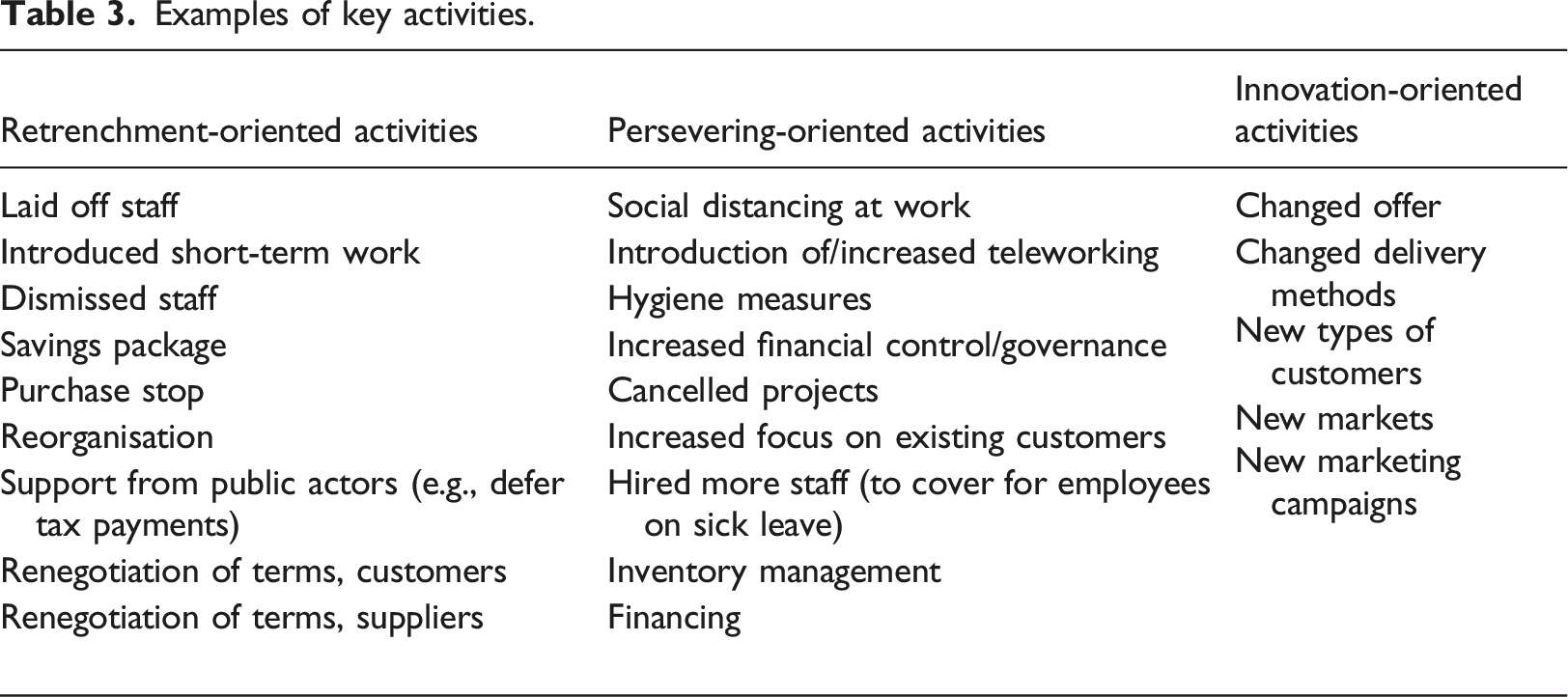
An organisational capability refers to a collection of routines that enable an organisation to perform particular actions by utilising its resources (Amit and Schoemaker, 1993; Helfat and Peteraf, 2003). Hence, an organisational capability can be regarded as the link between the firm’s resources and a particular output (Dutta et al., 2005) and, thereby, what enables the firm to ‘transform inputs to outputs’ (Collis, 1994, 145). The capability output from the utilisation of input factors is materialised into actions (Iansiti and Clark, 1994). Crisis-management-related capabilities are the capabilities performed in rapid response to shocks. Following this reasoning, we argue that a firm’s rapid response captures both the ability to react in a timely manner to crises triggers and the ability to implement different activities to manage the situation. Decisive action is required to facilitate the measures adopted in response to the shock. The decisiveness of the rapid response can be assumed to differ between firms and the larger the number of activities the firm is able to implement, the more decisive the rapid response.
Related to the decisive rapid response of an SME is the ability to make sound decisions under pressure. These can be complicated, and one problem, according to Wooten and James (2008), is that during crises decision-makers are more likely to limit the extent of organisational activity and rely heavily on familiar or common behaviour. This can be explained by the negative emotions often evoked during crises, such as fear and anxiety; this encourages business leaders to avoid risks by adhering to familiar routines. Therefore, in times of crisis, it is challenging to engage in activities sufficiently bold to address the situation. According to Hong et al. (2012), it is important to draw upon multiple activities; the successful firms in their study combined cost reduction with target market switching and innovation to navigate through the crisis. In contrast, the firms that suffered more from the crisis relied on simpler activities, such as focusing either on communicating with their customers or reducing costs. The authors therefore, concluded that the adoption of multiple crisis management practices facilitates crisis management in SMEs. Smallbone et al. (2012) confirmed the importance of flexibility and adaptability in crisis management through a wide variety of practices related to changes in marketing, employment, business organisation, finance, product/service and owner–manager behaviour. They also noted that there is no single set of responses suitable for all situations. For example, responses that were successful once may not be so subsequently and those effective for one firm may not be so for another. Moreover, some responses may be effective only in combination with others; therefore, employing a wide range of responses simultaneously can increase the chance of successfully dealing with a crisis.
From the extant literature we find that central inputs to the capability-related processes in crises are the openness and interactivity in the crisis management of the firm. The following sections discuss these two factors of an organisation, and the relation to decisive rapid response in crises.
Openness in crisis management
What actions are under taken, how many and how rapidly these are instigated to mitigate the effects of the shock depends on how the actors involved perceive the situation. Managerial understanding, in turn, is based on the social context in which work occurs (Bogenrieder, 2002; Lave and Wenger, 1991). Actors develop their understanding in a social context where thoughts, feelings and behaviours are influenced by others (Berger and Luckmann, 1966; Weick, 1995). This means that an individual’s understanding is not universal; rather, it is always linked to the social context used in their crisis work; thus, that to understand crisis management and what affects responses we need to understand the social context in which the work occurs.
One aspect of the social context associated with crisis management is whether management involves a few, or many internal or external actors to develop their understanding of the business situation and define what measures are appropriate. This is captured by the concept of openness in the management of the firm (Gegenhuber and Dobusch, 2017; Whittington et al., 2011). Traditionally, strategic work is perceived as a domain for an exclusive group in an organisation’s upper echelons (Gegenhuber and Dobusch, 2017; Whittington et al., 2011), but in recent years we can observe an increased openness in strategic methods aiming to include larger numbers and a variety of actors (Birkinshaw, 2017; Hautz et al., 2017; Whittington et al., 2011). Concepts such as open strategy (Whittington et al., 2011), co-creating strategy (Rapp et al., 2016), and democratic strategy (Stieger et al., 2012) have been introduced to the strategy field thus, a new way of describing strategic work has been developed based on a spectrum from closed, where information and decision-making is limited to top management, to open, where both employees and external actors are included (Chesbrough and Appleyard, 2007; Whittington et al., 2011). This is part of a broader management literature investigating how openness affects organisations (Chesbrough and Appleyard, 2007; Luedicke et al., 2017).
Two important dimensions of openness in strategy-making, as Whittington et al. (2011) observed, are the level of transparency and the inclusiveness of the process. Transparency is the visibility of information, both during the strategic work and when the strategy is presented. Inclusion is the range of people participating in strategic conversations by exchanging information, views and proposals intended to shape the strategy, including both internal and external actors. In this study, we focus on openness through the inclusion of actors in the crisis management process: namely (1) openness in relation to external actors, that is, how and which external actors are involved in the crisis management; and (2) openness in relation to employees, that is, if and how employees in the firm are involved in the crisis work. Using the two dimensions of internal and external openness, we expect four different types of firms: (A) the closed firm, where strategic work is undertaken as an exclusive activity for the top management team; (B) the internally oriented firm, where employees are able to engage in the strategic conversation but external actors are excluded; (C) the externally oriented firm, where actors external to the organisation, such as customers, scientists, students, or consultants are included in the strategy work but employees in the company are not; and (D) the open firm, which is characterised by a wide inclusiveness involving both internal and external actors in the strategy work. Figure 1 shows this typology of openness in crisis management. Typology of openness in crisis management.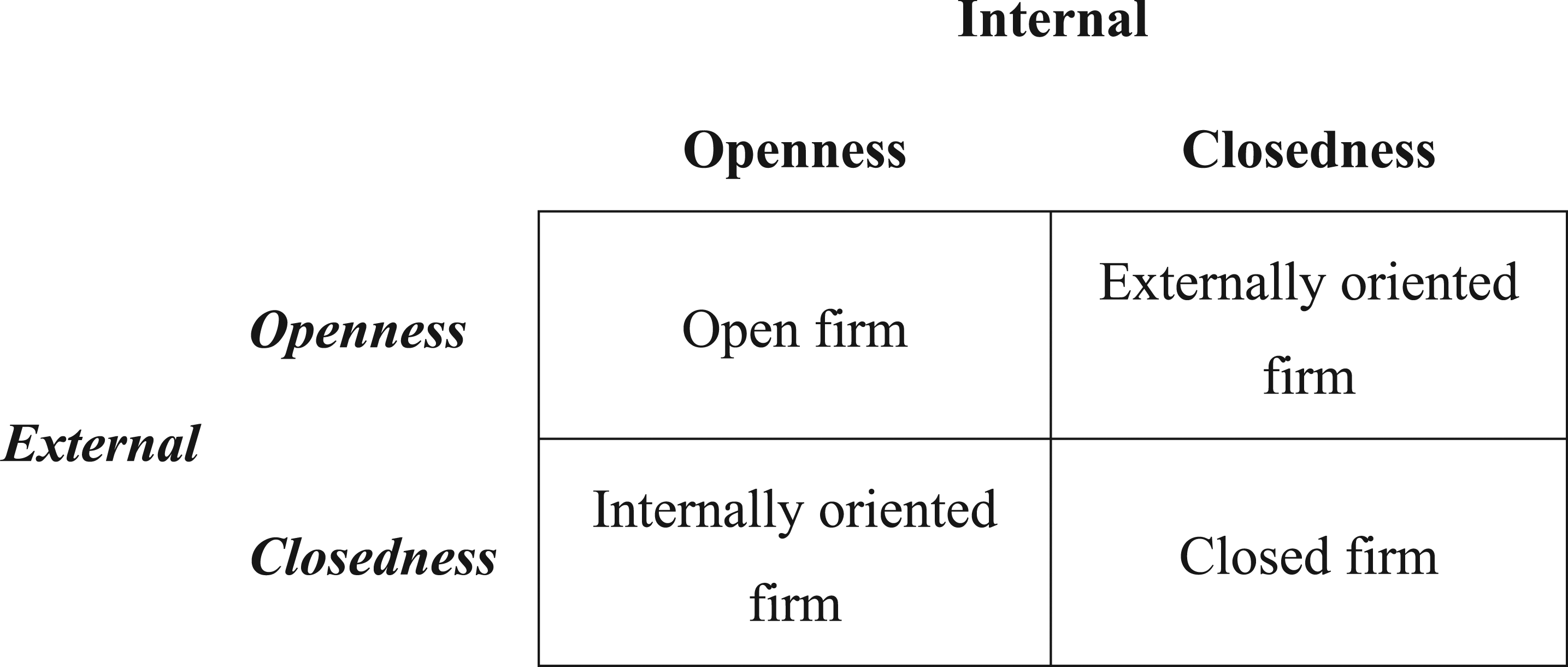
However, an organisation’s decision to be more open or closed varies with the situation (Appleyard and Chesbrough, 2017). Hautz et al. (2017) argued that the effectiveness of being open depends on contingencies such as organisational structures, the phase in the organisational life cycle and characteristics of the environment. Thus, openness is not simply the product of a general development, but is sensitive to varying contingencies facing an organisation. In this study, we focus on openness in firms when dealing with the crisis caused by Covid-19.
Interactivity in crisis management
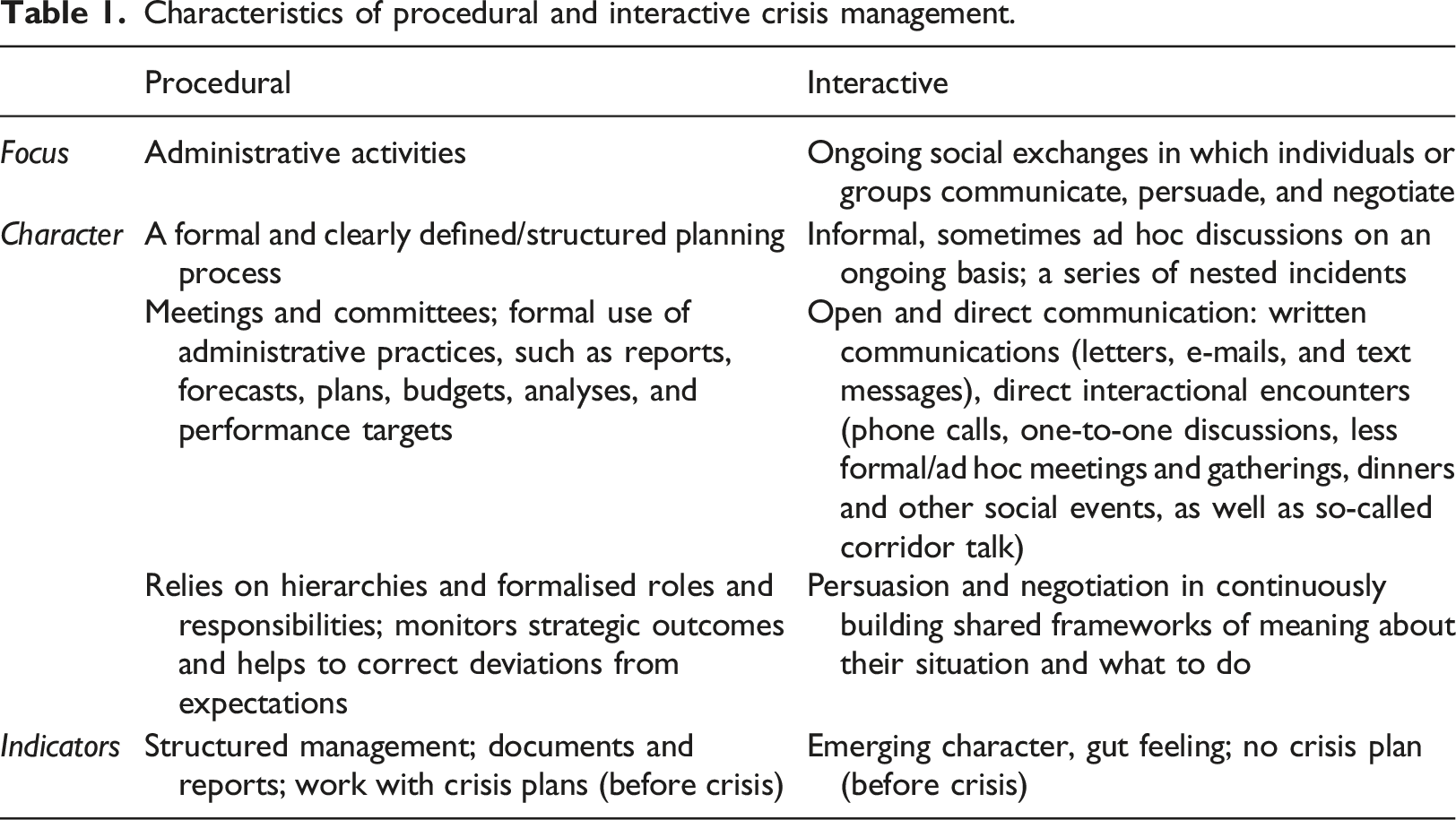
Jarzabkowski et al. (2007) argued that an important aspect of the social context is the working methods that underpin of the firm’s situation and chosen measures through the vocabulary and concepts they add. The working methods used and the interactions they shape affect how the actors involved perceive a specific situation (Jarzabkowski, 2004; Jarzabkowski et al., 2007). In the procedural form of work, identified by Jarzabkowski (2005) when studying the strategising of practitioners, there is a focus on administrative activities and the work is characterised by formal, clearly defined and structured planning processes. This work occurs primarily in meetings and committees whose essential elements are formal administrative practices including reports, forecasts, plans, budgets, analyses and performance targets. Procedural work also relies on hierarchies and formalised roles and responsibilities for undertaking out these administrative activities. Within this formalised approach, procedural work focuses on a set of performance indicators to monitor outcomes and help to correct deviations from plans and expectations.
Jarzabkowski (2005) also identified interactive forms of work that contain ongoing social exchanges in which individuals or groups communicate, persuade and negotiate to build shared frameworks of meaning about their situation and what measures are required. In such cases, this work is characterised by informal, sometimes ad hoc discussions on an ongoing basis, forming a series of nested incidents. Key activities are written communications (letters, e-mails and text messages) and direct interactional encounters (such as phone calls, one-to-one discussions, ad hoc meetings and gatherings, social events and so-called corridor talk).
Characteristics of procedural and interactive crisis management.
Hypothesis development
Openness and small- and medium-sized enterprises crisis response
There is evidence that all firms are attracted to the application of openness, involving both internal and external stakeholders in strategy-making in order to access more diverse sources of information that can result in better overall decision quality (Birkinshaw, 2017; Hautz et al., 2017; Whittington et al., 2011). Since Chesbrough (2003) defined the concept of open innovation, evidence suggests that openness has a positive impact on long-term results by providing benefits such as access to necessary complementary assets, acceleration of innovation processes, and attracting new customers (Dahlander and Gann, 2010; Savitskaya et al., 2010; West and Gallagher, 2006). However, it is difficult to predict whether firms are willing to remain open during a crisis. On the one hand, limited resources, limited time to act and a high degree of uncertainty can make it difficult for firms to engage in external contact; on the other hand, external contact can provide the help and support required to deal with the situation. In fact, external openness can be the source of a firm’s dynamic capability (Teece, 2007) essential to adapt to crises (Elliott et al., 2010; Sauser et al., 2018; Torres et al., 2019). The adoption of an externally open approach is suggested as a way of coping with strong external disturbances. For example, Chesbrough and Garman (2009) stated that increased external openness can be an effective approach for dealing with a crisis as firms that actively interact with external actors show increased organisational flexibility while preserving opportunities for future growth; this, according to Chesbrough and Appleyard (2007), differs from traditional business strategy which emphasises the importance of constructing barriers to the competition of external actors, rather than promoting openness. As a consequence, keeping internal closedness constant, we expect that firms with external openness exhibit a more decisive rapid response than firms that remain closed. Hence, we postulate that:
Hypothesis 1a: In times of crisis, externally oriented SMEs will show a more decisive rapid response than closed SMEs.
In terms of internal openness, previous studies have shown that employee involvement leads to increased learning (Luedicke et al., 2017), better understanding of business situations (Gegenhuber and Dobusch, 2017), more creativity (Hautz, 2017; Luedicke et al., 2017), and a higher degree of innovativeness (Donate et al., 2015; Jiang et al., 2012). There are indications that new knowledge structures develop primarily at the periphery where employees interact, while managers, who are at a distance from everyday life, tend to use exploitative strategies within existing knowledge structures (Regnér, 2003). Therefore, when a crisis arises and change becomes a prerequisite for survival, involvement of employees in the crisis management processes should enable rapid access to solutions learned at the periphery enabling a more decisive rapid response to shocks. On this basis, and keeping external closedness constant, we expect that firms with internal openness (where employees are involved in decision-making and information-sharing) will show a more decisive rapid response than those that are closed. Hence, we postulate that:
Hypothesis 1b: In times of crisis, internally oriented SMEs will show a more decisive rapid response than closed SMEs.
Seeking and integrating both external and internal knowledge is said to be one of the main ways to develop dynamic capability (Nonaka and Takeuchi, 1995; Teece, 2007). As such, a high level of dyadic openness can improve dynamic capabilities, thereby enabling the firm to cope with turbulent environments. The mechanism behind this reasoning being that an open approach increases management flexibility and provides new opportunities by expanding knowledge (Chesbrough et al., 2006; Luedicke et al., 2017; Whittington et al., 2011). On this basis, we can expect firms that show openness, both externally and internally, to find it easier to identify and take appropriate action. In other words, openness in both dimensions can be assumed to lead to a more decisive rapid response. Hence, we postulate that:
Hypothesis 1c: In times of crisis, open SMEs will show a more decisive rapid response than closed SMEs.
Interactivity and small- and medium-sized enterprises crisis response
Under stable conditions, formalised organisational procedures create a streamlined decision structure, but under the unstable conditions that prevail in a crisis, procedural management may lead to a reduction in the organisational ability for rapid decision making that underpins quick action (Bourgeois and Eisenhardt, 1988). When environmental uncertainty increases, procedural management is less suitable and inhibits the quick and bold actions that enable positive crisis performance (Vargo and Seville, 2011). Hence, with a low degree of interactivity, represented by procedural crisis management, the firm follows pre-developed routines likely to lead to late and less decisive responses. This creates an organisational rigidity that hampers flexibility and adaptability. Accordingly, we can expect firms using a low degree of interactivity, where reports and forecasts are essential elements in building an understanding of the situation, to have relatively few response activities. This procedural manner of working primarily supports existing strategies and is likely to require more time for the decision-making process.
Expecting procedural management to be less suitable when the environment is difficult to predict and decisions need to be taken swiftly resonates with evidence from Smallbone et al. (2012), who showed that flexibility and adaptability are key ingredients in the successful crisis management of SMEs. In earlier research, Drabek (1985) and Stallings and Quarantelli (1985) pointed out that effective crisis management includes ad hoc abilities such as improvised decision-making. In stable environments, routines and procedures for change can help to facilitate change, but in crises these routines may not fit and may inflict pedantic decision procedures that restrict change. A low degree of interactivity however, serves to embed and maintain strategies once they are introduced whereas a high degree of interactivity introduces new strategies or reinterprets existing ones. Consequently, we can expect a highly interactive approach to enable a faster decision-making process providing a basis for new strategies whilst allowing adaptation to what is required in the current situation rather than following formalised structures. This flexibility and adaptability are likely to have a positive impact on the development of new and situational strategies, supporting change and offering an ability to respond rapidly to shocks.
The above reasoning leads us to believe that the lower the degree of interactivity in a firm, the less likely it is that the firm will show a decisive rapid response. Hence, we postulate that:
Hypothesis 2: In times of crisis, the more interactive an SME’s crisis management, the more decisive the rapid response.
Method
Survey design and data collection
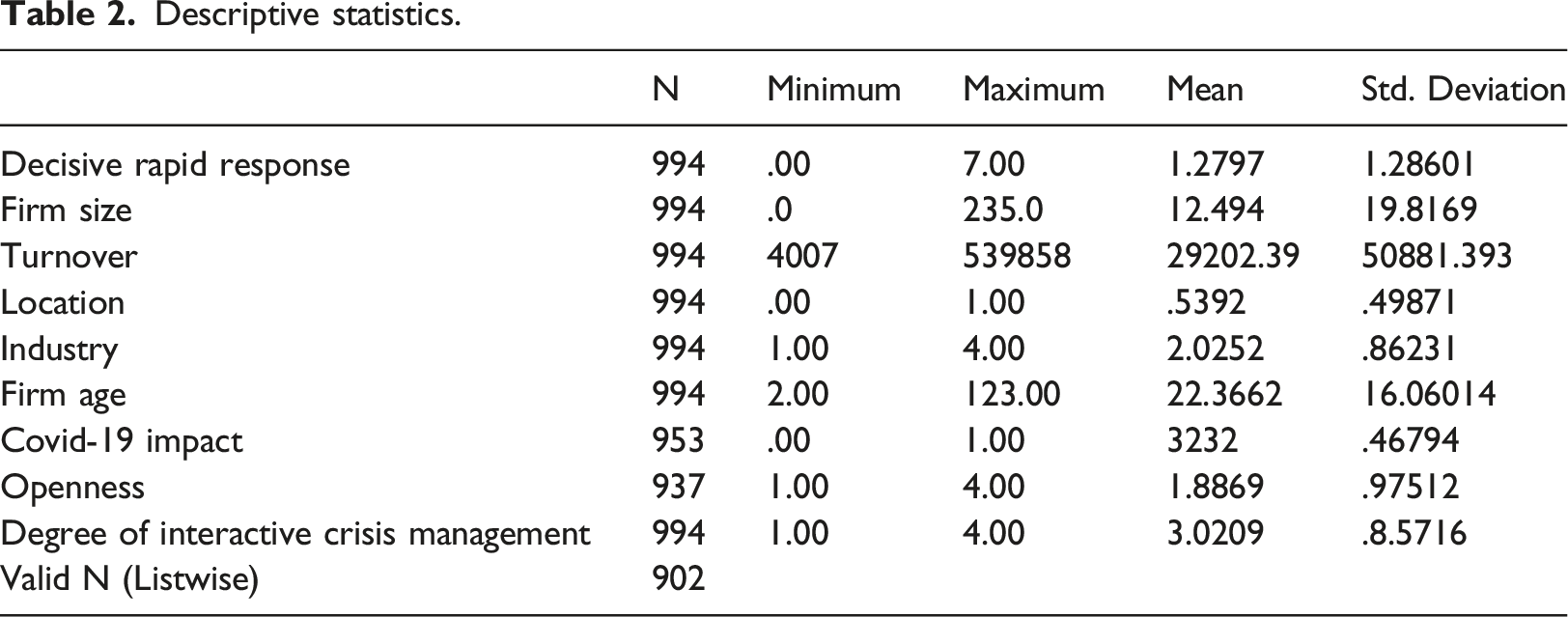
We collected our data via telephone interviews in June 2020. To collect the data, we engaged a professional survey organisation (Origo Group) and followed a systematic interview guide designed by the research team and based on the literature on crisis management in SMEs (specifically: Doern, 2016; Herbane, 2010, 2013; Runyan, 2006; Smallbone et al., 2012). We designed the survey in collaboration with ALMI Invest, a government-owned venture capital start-up investor. Representatives from ALMI Invest cross-checked the survey and assisted with the design of the questions related to support mechanisms for SMEs, an area in which they have specific expertise. In total, we interviewed 1000 firms. After screening of the responding cases, we have a dataset consisting of 902 useable cases representative of the population. For the size variable 29 cases had missing values, and for the degree of interactive crisis management 45 cases had missing values. These missing values were replaced by the series mean. However, 41 respondents did not know the impact of Covid-19 on the firm’s revenue and 57 did not provide an answer for their openness in crisis management, leaving 902 complete cases in the dataset.
Prior to launching the main study, we performed a pilot in May 2020, consisting of 26 semi-structured interviews with business leaders in SMEs. The pilot was useful in several ways. First, it gave us a sense of the current status of SMEs with respect to the effects of the restrictions and state support following the first months of Covid-19. A striking feature of the responses was the wide variation in sense of urgency and in responses to the situation among the interviewees a finding confirmed by the results of the main study. Second, based on the pilot, we adjusted the semantics of the survey to better align with those used by the SMEs. Third, as a direct result of the pilot, we removed a small number of questions that the interviewees considered irrelevant (including more general questions about Covid-19, questions on customer demand fluctuation, and some respondent-oriented questions). Fourth, the pilot allowed us to form a better understanding of what answers to expect, complementing the list of expected answers that we designed based on previous literature.
After we tested and refined the survey instrument, one of the authors underwent a full-day training session (including test calls and observation of live calls) with survey agents from Origo Group to ensure that the interviewers understood the questions and answers. Of the initial 1000 firms, almost 900 agreed to participate in a potential follow-up survey, indicating that they perceived the survey questions as relevant to their current situation.
Sample characteristics
Descriptive statistics.
Dependent variable
Examples of key activities.
Independent variables
Inspired by Jarzabkowski (2005), we capture the interactivity in crisis management on a scale ranging from 1 to 4, where value 1 represents a fully procedural approach where work is was based on reports, forecasts, and a structured handling of the situation; value 2 represents the dominance of procedural crisis management, with reports and set structures, but where there were also elements of interactive indicators such as gut feeling or an emerging approach; value 3 represents the dominance of interactive crisis management based on gut feeling with an emerging character, but where there were also elements of reports and structure; value 4 represents a fully interactive approach, that is, work based on gut feeling and an emerging character. Hence, the higher the value on the scale, the greater the degree of interactivity in crisis management. The more interactivity, the more the behaviour is characterised by informal procedures and internal working practices that build on gut feeling and emerging situational work forms. The lower the value, the more the focus is on the use of formal documents, reports, prognoses and predetermined crisis plans as practices for crisis management.
We captured openness in crisis management by asking the respondent about the degree and type of actor inclusion in the crisis management. The respondents were asked to indicate with whom they had discussed how to deal with the situation caused by Covid-19. We classified firms where the decision-making was undertaken only by the respondent or by the management team, as internally closed. Firms that involved employees in decision-making were classified as internally open; those that involved external actors, such as customers, consultants and trade associations, were classified as externally open. These two dimensions correspond to the typology of openness shown in Figure 1. From the patterns of actor inclusion, we derived four dummy variables that each represent one type: internal and external closedness, internal closedness and external openness, internal openness and external closedness, and internal and external openness. The types are mutually exclusive, and dummy variables were created where all firms corresponding to the type were given the value 1 and the others, the value 0.
Control variables
When testing the hypotheses, we controlled for five factors. First, firm size– measured as the number of employees. Second, location– based on the county code for each firm, as registered in Swedish official statistics, transformed into a dummy variable representing any of the three biggest city regions (coded as 1) or rural areas (coded as 0). Hence, the location variable captures whether the firm is located in the vicinity of any of the three biggest city regions. Third, we controlled for industry measured using the firm’s reported industry based on the codes in the Swedish Standard Industrial (SNI) Classification 2007, a system to classify activities performed at the firm or business unit. The SNI classification system is based on the EU NACE Rev. 2 classification of economic activity (SCB, 2022). The SNI classification aggregates sections into four main industry categories: (1) agriculture, natural resources, manufacturing and construction; (2) wholesale and retail trade; (3) services; and (4) other industries. Dummy variables, one for each industry, were used to capture the relevant industry. Each firm had the value 1 for the industry variable to which it belonged and 0 for other industry variables. Fourth, we controlled for firm age measured as the number of years since establishment. Last, we controlled for the impact of Covid-19 on the business. The Covid-19 impact variable was measured by asking respondents to indicate the impact of Covid-19 on the firm’s revenue. The answer format contained fixed alternatives representing increased revenue, unchanged revenue, a revenue decrease of <20%, a revenue decrease of 20–50%, a revenue decrease of 51–75%, or a revenue decrease of 76–100%. We used a revenue reduction of 20% as the threshold for distinguishing between firms experiencing a substantial negative impact of Covid-19 (coded as 1) from those experiencing a marginal negative effect or even an increase in revenue (coded as 0). By controlling for the impact of Covid-19 on revenue, we expected the results to better reflect the role of crisis management in response to an external crisis.
Data analysis
Since the dependent variable captures the extent to which the SME decisively and rapidly responded to the Covid-19 situation measured as the number of actions taken during a given period of time, the observations can only take the form of non-negative integers. The fact that the dependent variable is a count variable suggests that a Poisson distribution is likely in the dataset. We tested the distribution in the dataset with a one-sample Kolmogorov–Smirnov test, which revealed a Poisson distribution (p > 0.05), motivating the use of Poisson regression to test the hypotheses. Since the dataset consists of a substantial number of natural zeros in the dependent variable, as some firms did not take any action in response to Covid-19, we compared the output of the Poisson regression with that of a negative binomial regression. In this step we used both the Akaike information criteria (AIC) and the Bayesian information criteria (BIC) (Burnham and Anderson, 2004). The comparison of AIC and BIC between the analyses exhibited lower values for the Poisson regression, both for AIC and BIC, indicating that the Poisson regression would generate the most stable results.
When using Poisson regression, overdispersion is a frequently encountered issue. To test for this, we compared the values for the mean and the variance, which showed roughly the same values (1.2820 and 1.648, respectively), indicating only minor overdispersion. Overdispersion can be further assessed by dividing the chi-square value with the degrees of freedom, where the value of 1 indicates equidispersion and a value above 1 indicates overdispersion. Hutchinson and Holtman (2005) pointed to the absolute value of 2 as the cut-off ratio for deciding whether overdispersion is present in the data or not. For this dataset the value is 1.085, which is slightly above 1 but still far from 2. Since Cox (1983) argued for full efficiency of the model also in situations of a small overdispersion, we do not expect any substantial issues from overdispersion in the present dataset.
Results
Correlations.
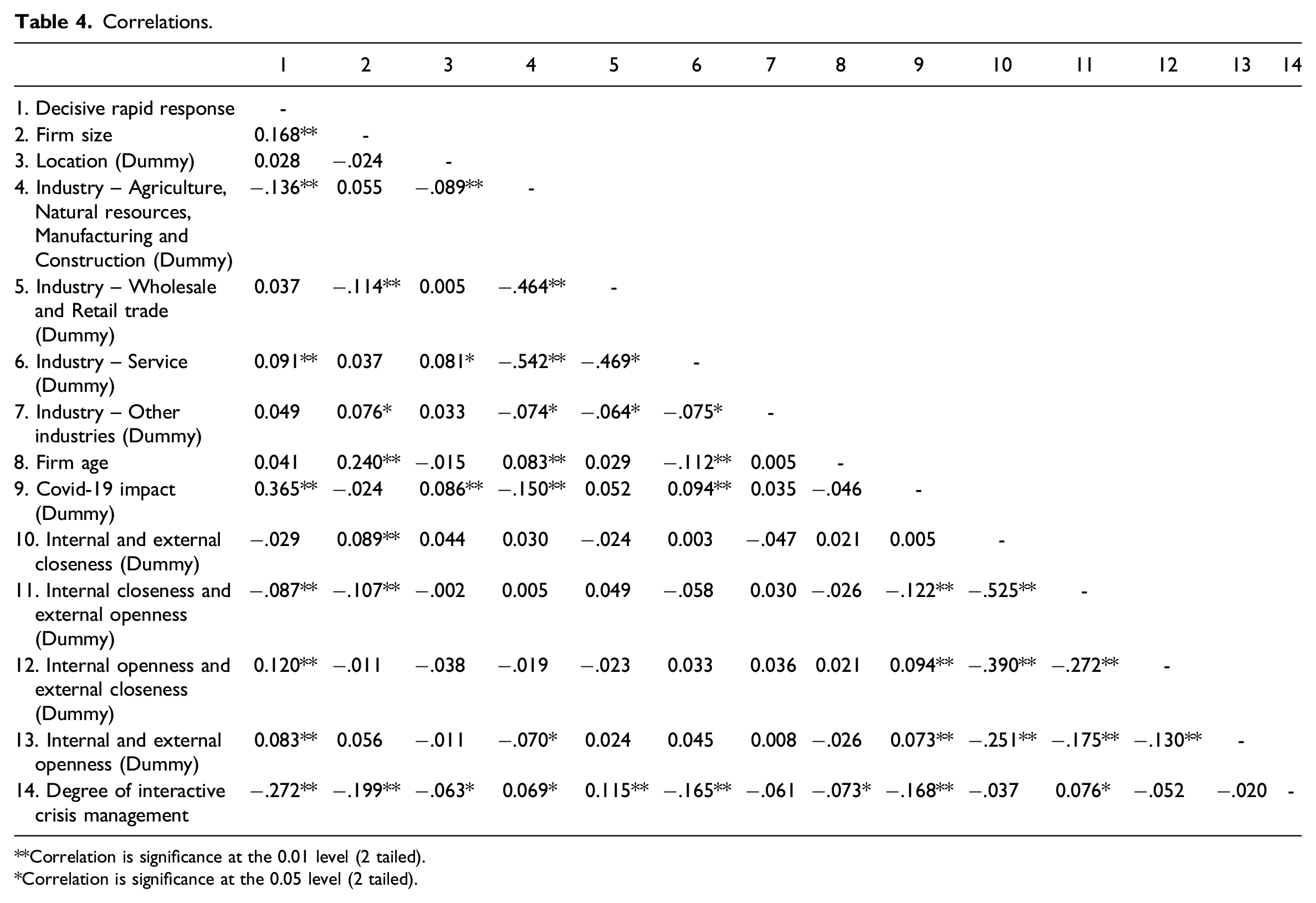
**Correlation is significance at the 0.01 level (2 tailed).
*Correlation is significance at the 0.05 level (2 tailed).
With promising correlation and few signs of multicollinearity, we turned to the Poisson regression to test our hypotheses. The result of the Poisson regression suggests that the hypothesised model offers a significant improvement in model fit over an intercept-only model and that both openness and interactivity in crisis management bring significant overall effects on the dependent variable. Among the control variables, we found significant effects from two of our controls in the omnibus test. First, we find that firms that are strongly affected by Covid-19 show a more decisive rapid response. Second, we note that the size of the firm has a positive effect on the decisive rapid response. We find no significant results for industry, location or firm age.
Determinants of descriptive rapid response.
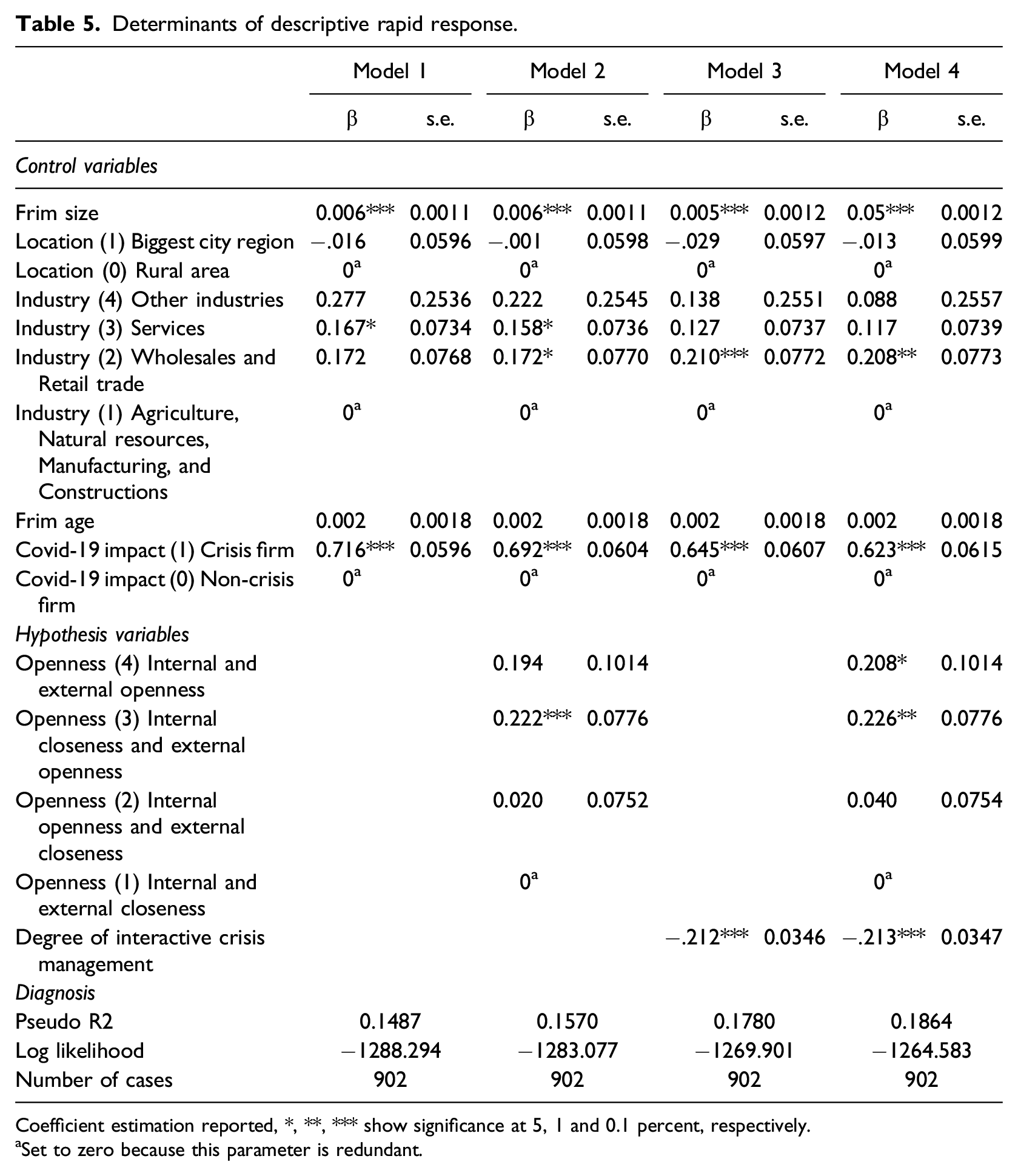
Coefficient estimation reported, *, **, *** show significance at 5, 1 and 0.1 percent, respectively.
aSet to zero because this parameter is redundant.
Hypothesis 1a proposed that externally oriented SMEs would show a more decisive rapid response than closed SMEs; Hypothesis 1b proposed that internally oriented SMEs would show a more decisive rapid response than closed SMEs; Hypothesis 1c proposed that open SMEs would show a more decisive rapid response than closed SMEs. To test these hypotheses, we thus used the group of firms that are internally and externally closed as our reference group, and the coefficients reveal how the characteristics of the alternative three groups change the decisiveness of the rapid response. In Model 4 we first see that internal closedness and external openness (representing the externally oriented SMEs) has a coefficient that is positive and significant (0.226, p < 0.01) confirming that these firms have a more decisive rapid response compared to the reference group and supporting Hypothesis 1a. Second, we see that the group characterised by internal openness and external closedness yields nonsignificant results (0.040, p > 0.05); this does not give statistical support for Hypothesis 1b, which postulated a positive effect. Third, we see that the group characterised by internal and external openness has a positive and significant coefficient (0.208, p < 0.05) which gives support for Hypothesis 1c. Thus, when keeping internal closedness constant, being externally oriented is positively and significantly associated with a decisive rapid response, which leads us to accept Hypothesis 1a. The results also show that, keeping external closedness constant, being internally open is not associated with a decisive rapid response. Hypothesis 1b is therefore, rejected. However, the positive and significant difference between internal and external openness and internal and external closedness provides support for Hypothesis 1c, that open SMEs have a more decisive rapid response than closed SMEs.
Hypothesis 2 postulated that in times of crisis, the more interactive an SME’s crisis management, the more decisive the rapid response. However, in contrast to the hypothesised effect, the analysis returned with a negative and significant coefficient (−.213 p < 0.001). This effect means that, in contrast to what we expected from earlier research, an interactive approach to crisis management leads to a less decisive rapid response to the crisis. We therefore, reject Hypothesis 2 yet the significant results of the analysis offer novel insights into SME crisis management discussed in the next section.
Discussion
Determinants of a decisive rapid response
The literature on Covid-19 is growing quickly and has yielded important insights into how SMEs deal with shocks and crises, but as noted by Clampit et al. (2021), we still have much to learn about the effectiveness of managerial action during Covid-19. Based on previous work (cf. Chesbrough and Brunswicker, 2013; Donate et al., 2015; Jiang et al., 2012), we hypothesised that openness leads to a decisive rapid response among SMEs. Our findings support this claim but with an interesting caveat. Prior research suggests that building relationships between people, both within and outside the firm, is critical for managing crises (Chesbrough and Garman, 2009; Elliott et al., 2010; Sauser et al., 2018; Torres et al., 2019). Our findings show that external openness leads to a decisive rapid response; internal openness, however, does not. Several explanations may account for this finding, such as: the need to break with existing habits through interactions outside familiar patterns, better understanding of ongoing market changes through external openness that cannot be achieved through internal openness, collaboration with external actors that may provide access to additional resources enabling activities and that would be out of reach if the SME was only reliant on the firms own resources, and that internal communication consumes more time and resources that slows down the decision-making process. So unlike, for example, Clampit et al. (2021), who highlighted the benefits for SMEs in having direct access to information from employees when dealing with crises, our study suggests that SMEs should be careful in involving too many employees and other internal stakeholders in the crisis management process because it an hinder a decisive rapid response.
Referring to the findings in the crisis management literature (Drabek, 1985; Vargo and Seville, 2011), we hypothesised that a high degree of interactivity in crisis management leads to a more decisive rapid response. Interestingly, our findings show that an interactive way of working has a negative effect on the decisiveness of the rapid response, whereas the use of procedural crisis management leads to a more decisive rapid response. One potential explanation for this is the short time frame for action. Covid-19 caused persistent turmoil that was difficult, if not impossible, to predict (Cortez and Johnston, 2020). In particular, constantly changing conditions can be expected to have a significant role in how firms managed the crisis. Where there is a narrow time frame, there is value in formalised procedures. A structured work form involves knowing how to act using existing knowledge and routines. This can be understood as the development of a dynamic capability that utilises routines for change (Winter, 2003), enabling a firm to respond more quickly and decisively to shocks. Seemingly, procedural crisis management does not have to lead to longer processes; on the contrary, following established structures saves time. Our results provide some nuance to studies that highlight the importance of being spontaneous and emergent to better handle the Covid-19 societal crisis (see Clampit et al., 2021), and the more general notion that dynamic capabilities in high-velocity markets (a description that fits the unpredictable Covid-19 societal crisis) are simple, experiential, iterative and situational (Eisenhardt and Martin, 2000).
As our results show that procedural crisis management, which reflects more stable dynamic capabilities, enables a firm to respond more quickly and more decisively, we suggest that stable dynamic capabilities are not only relevant in stable market change; they could also facilitate a decisive rapid response in environments where change is unpredictable. In a crisis, procedurally based dynamic capabilities seem to have a temporal advantage over interactive, ad hoc problem-solving. From a managerial perspective, procedural work has advantages beyond the capability to decisive rapid response because the systematic approach can also create a sense of security in, and control over, decision-making. It may also involve fewer actors, thereby shortening the time to execution. Interactive work forms, however, are likely to involve more people and require the development of situational knowledge. Thus, in addition to explaining the positive relation between procedural work and a decisive rapid response, our results emphasise that a decisive rapid response can be seen as a dynamic capability, which is now discussed.
A rapid response capability?
Along with the suggestions by Kuckertz et al. (2020) and Williams et al. (2017), our results add to a capability-based view on crisis management. The decisive rapid response to an exogenous shock, such as Covid-19 and the restrictions implemented to reduce the spread of the virus, is dependent on the capability of the firm to respond rapidly and decisively to the negative consequences experienced. Based on our findings, we suggest that an RRC of the firm drives decisive rapid response. The RRC reflects the internal processes that turns openness and procedural work into implemented activities. Earlier research (Fine et al., 2002) notes that the capability to respond rapidly enables firms to adapt their operations decisively and to mitigate the negative effects during crises. In our study, we have shown that the management practices of openness and procedural work are essential when the firm develops such capabilities. We argue that the RRC can help us to expand knowledge related to why some SMEs are more flexible and adaptable in crises (Smallbone et al., 2012); this is a potential underlying reason why some SMEs are quicker and more agile in changing in times of crises (De Vries and Hamilton, 2021). Being capable of acting early and decisively seems critical (Doern, 2021; Clampit et al., 2021), emphasising the role of an RRC when shocks occur.
An RRC, we argue, refers to the capability to alter business activities in response to a shock. Our results indicate that some firms are better at making a decisive and rapid adjustment in response to Covid-19, which points at heterogeneity in the development of RRCs among SMEs. The notion of RRC may therefore, be fruitful to discuss the prerequisites for crisis management capabilities. Moreover, considering RRC as a driver of change in business activities suggests that it can be regarded as a form of dynamic capability. Dynamic capabilities enable the alteration of functional capabilities (Winter, 2003). Adjusting business activities is an organisational adjustment that reflects the ideas of Fine et al. (2002), who outlined how firms need to be constantly prepared to adapt their value chains to changing contexts. External environments are volatile (Eisenhardt and Martin, 2000), hence, dynamism is needed and firms must work continuously to sustain competitive advantage by dissolving and integrating structural, technical, financial and human assets. Capabilities can lose value overnight, and sudden changes in the larger economy can accelerate this transition. Therefore, Fine et al. (2002) argued that a firm’s real core function – the only sustainable one – is its ability to design and reshape its business quickly. As soon as disruptions occur, firms must assess which parts of the business are vulnerable and take action.
We argue that decisiveness and rapidity are two critical aspects of an RRC as they capture the dynamism of a firm both in terms of the temporal dimension of reacting rapidly to exogenous shocks and in terms of the decisiveness to implement actions for crisis management purposes. In our study, we have shown that procedural work and external openness are core elements to enable an organisation to activate RRC. There may, however, be additional elements involved in developing an RRC, which is why further studies may contribute by adding knowledge related to this multifaceted concept.
Limitations and suggestions for further research
This article comes with some limitations that open up new research ideas. First, to develop an understanding of openness, working methods, and their impact on a firm’s decisive rapid response, it is desirable to explore whether the social context of business leaders in different institutional contexts has an impact on these relationships. Our study is limited to the institutional context of the Swedish market. Second, it would be of value to compare our results with results obtained in countries which used a different Covid-19 suppression strategy, for example, higher degrees of restrictions, including social distancing among all age groups, quarantining households, and shutting down large parts of society (Kraus et al., 2020). Third, other types of crises may create different prerequisites for firms, and studying how they are handled will provide an opportunity to develop our understanding of a decisive rapid response. Fourth, we have argued for a capability-based view on crisis management where we suggest that the RRC developed by the firm is instrumental in understanding how the firm responds decisively and early to critical external events such as a crisis. However, we have not empirically studied the capability per se; instead, we have studied its outcome – a decisive rapid response. We have shown that the degree of openness and interactivity are important determinants of this response. We believe that future studies, preferably qualitative and longitudinal, could seek to further explore how RRCs are developed. We believe that such studies would benefit from drawing on the growing literature on dynamic capabilities, and we believe that studying SMEs here offers an excellent opportunity for theoretical development, as studies of management practices in themselves are of a complex nature, therefore, studies of smaller management groups and fewer organisational levels seem to be a good start in exploring the development of this critical capability.
Conclusions
This article offers insights into how SMEs, important for the welfare of nations but particularly vulnerable to the impact of Covid-19, can mitigate the negative effects of external events that influence their business activities. Although it is still too early to determine the most effective activities in response to Covid-19, being passive is unlikely to be the best option. Therefore, emphasising the role of capabilities in crisis response (Kuckertz et al., 2020; Williams et al., 2017; Clampit et al., 2021) we have analysed why some SMEs are able to have a more decisive rapid response than others.
First, we address the degree of management openness to influences from other actors in strategic conversations and information-sharing for the purpose of shaping the firm’s responses. Interaction with internal and external actors opens a firm up to suggestions for responses that are outside its ordinary pattern of activities. Such influences may be pertinent for addressing a situation where most firms do not have previous experience. This study shows that a decisive rapid response is primarily an outcome of external openness. Internal openness, where employees are involved in decision-making and information-sharing, is not associated with a decisive rapid response, except when combined with external openness. Thus, we find that being externally oriented or open to both internal and external actors is a determinant of a firm’s decisive rapid response.
Second, we address the degree of formalisation of the working methods that organise the interaction and reflection of the actors involved. Contrary to our expectations, we find that procedural crisis management is positively associated with a firm’s decisive rapid response, whereas interactive crisis management is negatively associated. Thus, decisive and rapid action in a crisis is favoured by formal planning that is clearly defined and structured. Consequently, we suggest that in times of external crisis, such as an unpredictable pandemic on a global scale, firms need to have formal procedures in place and remain open to external influences to be able to respond.
Based on these conclusions, we argue that a decisive rapid response of SMEs in times of crisis builds on the ability of the firm to be open to new ideas and insights from the external environment in combination with the ability of the firm to develop an organisation and formalised organisational routines so that the firm can take actions to reduce the negative effects generated by the crisis. It is therefore, likely that firms able to find an appropriate balance between the degree of external openness and that of routine formalisation are more able to ride out crises, such as those caused by Covid-19 and the restrictions implemented to reduce the spread of the virus. We suggest such a balance is the foundation of an RRC.
Footnotes
Declaration of conflicting interests
The author(s) declared no potential conflicts of interest with respect to the research, authorship, and/or publication of this article.
Funding
The author(s) received no financial support for the research, authorship, and/or publication of this article.
