



Abstract
The literature emphasises that technological advances have enabled firms to expand internationally at accelerated speed. Yet, technological advances are treated as a contextual variable and little is known about how firm-level technological innovations influence the internationalisation speed of small and medium-sized enterprises (SMEs). To address this shortcoming, we draw on insights based on capability development theory to establish the effects of innovation timing and pace on SME international expansion speed. We test our conceptual model using a sample of 180 Swedish SMEs and show that the faster the innovation pace, the faster the internationalisation. We then address the boundary conditions of this relationship to show that the elapsed time between a firm’s founding and first innovation negatively moderates the positive effects of its innovation pace. Our findings have theoretical, managerial and policy implications.
Keywords
Introduction
The time, temporality and speed of firm internationalisation are central constructs in recent internationalisation research on small and medium-sized enterprises (SMEs), given the accelerating internationalisation occurring among born-global firms and international new ventures (Cavusgil and Knight, 2015; Guo and Wang, 2020; Puig et al., 2018). The prevailing literature addresses alternative firm-specific antecedents to the speed of SME internationalisation, including the diversity of firm operations (Casillas and Moreno-Menendez, 2014; Schu et al., 2016), intangible assets of experience and international spread (Chetty and Campbell-Hunt, 2004; Mohr and Batsakis, 2014), knowledge acquisition strategies and speed of capability development (Hilmersson and Johanson, 2020) and prior profitability (Powell, 2014). There is also evidence that SME ownership (Lin, 2012), networks and managers (Musteen et al., 2010), and strategies (Pla-Barber and Escriba-Esteve, 2006) influence their internationalisation speed. Recent contributions further suggest that in a digitalising economy, scalable business models (Reuber et al., 2021) and the fact that some firms are born as digital companies (Monaghan et al., 2019) challenge earlier insights. Furthermore, understanding the multidimensional construct of internationalisation speed is important (Casillas and Acedo, 2013; Mohr and Batsakis, 2017), as speed has performance consequences (Meschi et al., 2017; Sadeghi et al., 2018).
The literature consensus is that the main catalyst of accelerated internationalisation among SMEs is rapid technological advance (Hennart, 2014; Shrader et al., 2000; Zucchella et al., 2007); the export literature has revealed the role of technological innovations in export performance (Filipescu et al., 2013; Leonidou and Katsikeas, 1996; Sui and Baum, 2014). Indeed, Saarenketo et al. (2008) argued that investment in technology shortens the time to internationalisation. Another emerging stream of literature, including Denicolai et al.’s (2015) study of innovation and SME internationalisation and Child et al.’s (2017) study on the role of context and experience, suggests that business model innovation influences SME internationalisation. While these scholars explain how innovation leads to internationalisation, there is little explicit examination of the effects of product and process innovation on the internationalisation speed of individual firms. Instead, research has treated technological innovation as a contextual variable explaining the existence and behaviour of born globals and why we observe accelerated internationalisation processes (Hilmersson et al. 2017).
For example, Ramos et al. (2011) showed that the technological intensity of an industry influences firm internationalisation speed. In addition, Child et al. (2017) emphasised that the industry context plays a prominent role when differentiating between the innovation-based business models of internationalising SMEs. Their reasoning is that internationalising SMEs in different industries will have varying levels of technological skills, types of innovation and competitiveness that shape their business models. The current implicit assumption in the literature is that innovations affect firms equally. However, few studies have addressed innovations of the individual firm and their influence on the internationalisation speed of that firm.
When considering the dominant role of innovation in explaining the idiosyncratic behaviour of born globals (Efrat et al., 2017; Hennart, 2014; Knight and Liesch, 2016; Zucchella et al., 2007), we argue that the lack of studies on the interplay between firm-level innovations and internationalisation speed, is a surprising shortcoming in the literature. Decisions to invest in the innovation effort of new product development and to seek new markets in which to sell the newly developed product(s) are clearly strategic and important for any resource-constrained SME (Henley and Song, 2020). To alleviate this gap in the literature, we examine whether the pace and timing of an SME’s innovation can explain its internationalisation speed.
We develop a conceptual model applying internationalisation process theory (Johanson and Vahlne, 1977, 2009) to explain how the pace and timing of SME innovation influences the speed of the internationalisation process. To explain the mechanisms underlying these relationships, we draw on capability development theory and insights into the role of the learning advantage of newness (Autio et al., 2000) and time compression diseconomies (TCDs) (Dierickx and Cool, 1989). This approach is in line with earlier research seeking to extend our knowledge of the temporal aspects of firm internationalisation (Hilmersson and Johanson, 2016; Jiang et al., 2014). The underlying assumption of the revised internationalisation process model (Johanson and Vahlne, 2009) is that firms gain market knowledge from their business networks, making it important for SMEs to become network insiders in appropriate networks in foreign markets.
While it takes time and resources to build trust and commitment in a business network (Johanson and Vahlne, 2009), the speed of entry into a network is crucial for successful internationalisation (Johanson and Johanson, 2021). The rationale for the learning advantage of newness is that newness offers flexibility: new firms can learn quickly because they are open to new possibilities and not hindered by old ways of thinking (Autio et al., 2000). Firms that benefit from this advantage do not have to unlearn old methods before absorbing new knowledge. The rationale for TCDs is that when firms undertake too many activities within a limited time, they may suffer new inefficiencies because their limited resources are overextended (Dierickx and Cool, 1989).
This conceptual framework enables us to address the following research question: How do the pace and timing of an SME’s product and process innovations influence the continuous speed of international expansion? We build on Casillas and Acedo’s (2013) work to define the speed of international expansion as the average speed of increase in the breadth of international sales activities over time and the average number of new markets entered per year since firm inception.
Our analysis of a sample of 180 Swedish SMEs shows that a fast pace of innovation leads to rapid internationalisation. We argue that SMEs that innovate at a fast pace are not constrained by institutionalised routines and learn quickly. Furthermore, the positive relationship between pace of innovation and speed of internationalisation is negatively moderated by the elapsed time between a firm’s foundation and first innovation. This liability of innovative lateness has not yet been explored in the literature but can be understood through the TCD lens. Our findings thus contribute to research into SME internationalisation and innovation by highlighting two crucial capabilities of SMEs in today’s business environment, that is, the capabilities to start innovating early and remain innovative over time, both of which have intriguing implications for speed of international expansion.
We contribute further to the general literature on internationalisation, which argues that firms experience uncertainty when they expand into unfamiliar countries (Johanson and Vahlne, 1977). Earlier literature on the internationalisation process noted that the liability of foreignness (Zaheer, 1995) and increased psychic distance between the home and host countries create uncertainty in foreign markets (Johanson and Vahlne, 1977). According to Johanson and Vahlne’s (2009) revised internationalisation process model, the main liability accrues from being outside the relevant network in a foreign market as that outsider status creates uncertainty for the firm. The authors argued that when firms are outsiders, this hinders their attainment of essential new knowledge from the foreign business network that would allow them to recognise and leverage new opportunities.
Building on this theoretical assumption, we argue that a firm with a fast pace of innovation will develop flexible routines allowing for faster internationalisation. Flexible routines enable firms to engage with different foreign local business networks, making it easier to develop insidership positions (Johanson and Johanson, 2021). If the start of innovation is delayed, we postulate that the positive effects of a fast innovation pace on internationalisation speed will be moderated, since late innovators risk suffering from TCDs. This in turn will reduce the speed at which they develop insidership positions in foreign networks, so these firms are likely to suffer from the liability of innovation lateness in their internationalisation process.
The remainder of this article is structured as follows. First, we present the prevailing literature on speed of internationalisation and on the role of innovation in internationalisation. Since temporality is important, we draw on insights from studies of the learning advantage of newness (Autio et al., 2000) and TCDs (Dierickx and Cool, 1989) to generate our hypotheses. Next, the methodology is presented, followed by data analysis. Thereafter, we discuss the results of the hypothesis tests and present their conclusions. Finally, we discuss theoretical contributions, implications for future research opportunities and the managerial relevance of the study.
Theoretical background
Speed of international expansion
In the literature on SME internationalisation, the two dominant streams are those of internationalisation process theory (Johanson and Vahlne, 1977) and the born-global approach (Cavusgil and Knight, 2015; Knight and Liesch, 2016; Oviatt and McDougall, 1994, 2005). Both streams consider internationalisation to be a process that occurs over time. While advocates of internationalisation process theory describe internationalisation as occurring slowly and incrementally, the born-global literature argues that many newly founded businesses internationalise soon after inception. A main argument for the latter view is that these firms have unique and innovative products that propel them to internationalise (Madsen and Servais, 1997; Nordman and Tolstoy, 2014; Oviatt and McDougall, 1994; Zucchella et al., 2007). In particular, firms with small domestic markets must internationalise early to grow and to benefit from economies of scale (Hennart, 2014; Puig et al., 2018). Firms from small open economies in Europe, such as Sweden, have easier access to foreign markets that are familiar and geographically nearby and can thus internationalise at an earlier stage of development (Zander, McDougall-Covin and Rose, 2015). Furthermore, SMEs benefit from the low cost of information, transport and adaptation (Hennart, 2014; Knight and Liesch, 2016).
While firms that internationalise rapidly tend to be in the high-technology sectors (Andersson et al., 2014), recent studies demonstrate that rapid internationalisation is also increasing in more traditional manufacturing industries (Puig et al., 2018; Singh, 2017). The Internet facilitates rapid internationalisation since it is a time-saving means for industrial buyers in particular to find sellers (Deng et al., 2022), especially those offering highly specialised products (Hennart, 2014). Regarding the role of digital solutions, recent research has suggested that scalable business models (Reuber et al., 2021) and born-digital firms (Monaghan et al., 2019) are additional explanations for early and accelerated internationalisation among SMEs. Instead of highlighting the earliness of an SME’s first entry into foreign markets, we build on more recent studies of the continuous speed of international expansion (Casillas and Moreno-Menendez, 2014; Chetty et al., 2014; Hilmersson and Johanson, 2016; Prashantham and Young, 2011). For example, Hilmersson and Johanson (2016) defined internationalisation speed as the average number of new country markets entered per year since firm inception.
Thus, our aim in this paper is to contribute to the speed of internationalisation literature and the innovation literature, by highlighting the relationship between the pace of innovation and the continuous speed of internationalisation. More specifically, we focus on SME pace of innovation and the underlying theoretical mechanisms that explain the relationship between it and the speed of international expansion. In the following section, we examine the literature on innovation, capability development and internationalisation.
Innovation and internationalisation
There is compelling evidence that innovation capability has a positive impact on the international expansion of SMEs (Efrat et al., 2017; Nordman and Tolstoy, 2016; Tolstoy and Agndal, 2010). Unsurprisingly, the relevant literature displays an increasing interest in SME innovation activities and how they influence a firm’s international activities (Filipescu et al., 2013; Golovko and Valentini, 2011; Knight and Cavusgil, 2004). Hitherto, research has focused on the earliness of entry into a foreign market. For example, the literature on born globals argues that SMEs with innovative products internationalise soon after their inception to benefit from opportunities emerging before competitors enter the same markets (Knight and Liesch, 2016; McDougall and Oviatt, 2000; Zucchella et al., 2007). SMEs with a greater propensity to innovate by introducing new products and processes tend to internationalise in a wider range of foreign markets (Autio et al., 2000; Ramos et al., 2011). This extensive internationalisation in turn, allows these firms to gain new insights from diverse foreign markets, in turn improving their technological learning and innovation capabilities (Filipescu et al., 2013; Hitt et al., 1997; Zahra et al., 2000). An SME’s investments in innovation, such as new product development or product adaptation, increase its propensity to internationalise early. As it internationalises, it is also likely to generate experience that facilitates its ongoing development of innovation capability (Baden-Fuller and Haefliger, 2013; Nordman and Tolstoy, 2016; Ramos et al., 2011). Consequently, international expansion can allow an SME to exploit its innovations while exploring new opportunities in foreign markets. However, internationalisation in the early phases of expansion is mainly about market-seeking exploitation (Zhou et al., 2007).
A generic explanation for this situation is that SMEs, especially those with small domestic markets and that internationalise early, will develop capabilities (Aspelund et al., 2007) to compensate for their lack of resources (Autio et al., 2011). Chetty and Campbell-Hunt (2004) confirmed that small firms have the capability to be flexible and reconfigure their resources for successful product adaptations and innovations. There is also increasing evidence that internationalising SMEs learn from multiple idiosyncratic foreign markets that result in new knowledge and experience (García-García et al., 2017; Hohenthal et al., 2014; Zahra et al., 2018). This new knowledge, in turn, requires that the firm adeptly combines various processes in the interest of strong capability development (Autio et al., 2011; Efrat et al., 2017), instead of simply developing a set of institutionalised routines (Coad et al., 2018; Nelson and Winter, 2002).
Conceptual model
Our hypotheses are based on the theoretical reasoning presented above. To explain how and why the pace and timing of innovation can influence the speed of internationalisation, we apply capability development theory to argue that the learning advantage of newness (Autio et al., 2000) and TCDs (Dierickx and Cool, 1989) are the underlying mechanisms of the theoretical relationships shown in our conceptual model (see Figure 1). Along with the suggestions of Thomas et al. (2011), we let the theoretical constructs be the boxes of our conceptual model, with its underlying theoretical mechanisms – that is, the learning advantage of newness and TCDs – represented as arrows. In the section below, we develop our discussion of these underlying theoretical mechanisms. Conceptual model.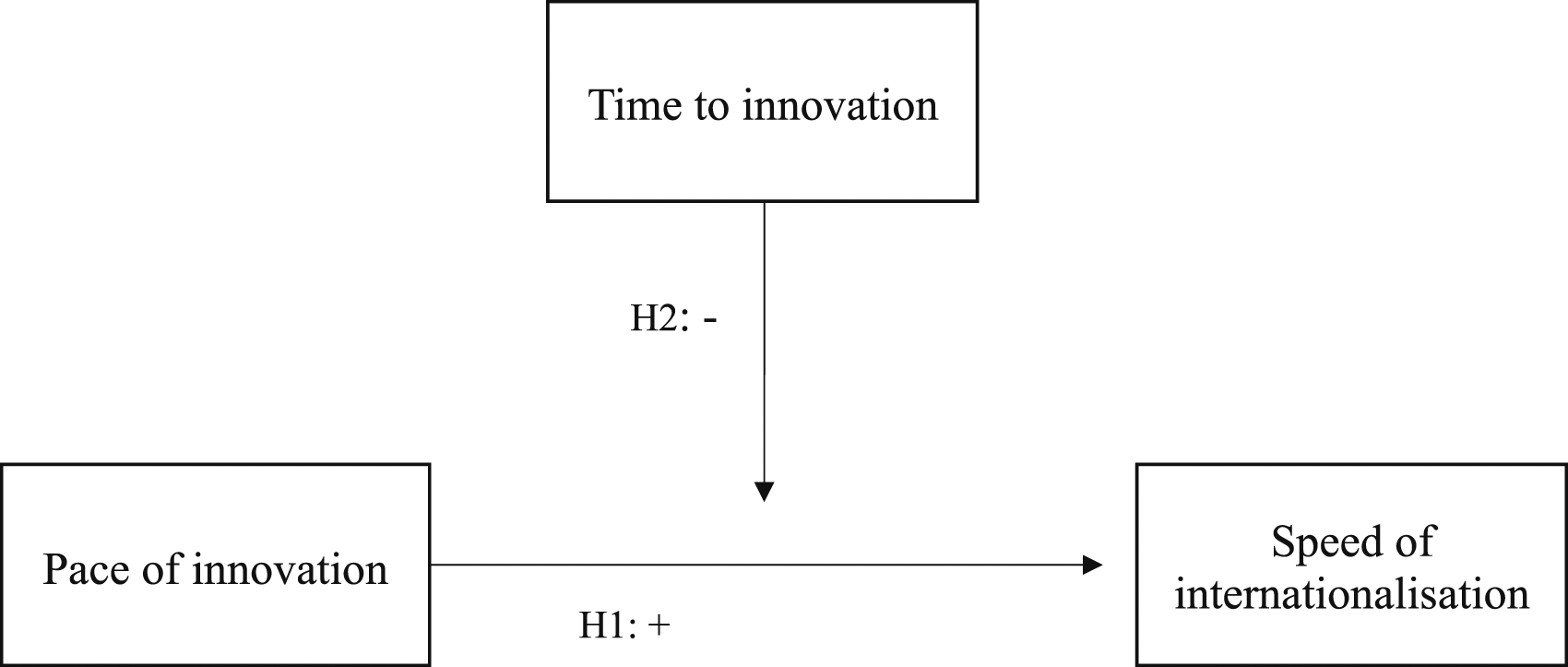
Hypothesis development
Pace of innovation and the speed of internationalisation
Rapidly internationalising firms tend to use exports when doing business in foreign markets (Laufs and Schwens, 2014). While there are many reasons why firms use exports, earlier research has suggested that the main reason is the liability of newness (Bruderl and Schussler, 1990; Burgel and Murray, 2000; Zhou et al., 2007). Although newness limits the strategic options available to internationalising SMEs, a contrasting perspective says that such firms can benefit from having a learning advantage of newness (Autio et al., 2000; Sapienza et al., 2006). The logic here is that they are more flexible and learn faster at a lower cost than do mature firms, which suffer from inertia and outdated routines (Autio et al., 2000; Zahra et al., 2018). This view is also in line with the reasoning of Hilmersson et al. (2017), who found that due to increasingly homogenous international markets and technological developments, newness is no longer a liability but an advantage. The rationale is that young SMEs do not have to unlearn old methods in order to learn and use new ones effectively.
Routines and capabilities are sometimes reconfigured swiftly and appropriately (Puig et al., 2018) to develop the initial foreign markets; they are also applicable in the multiple homogenous foreign markets that SMEs enter subsequently. It appears to be less costly and time consuming to develop capabilities and routines now than in the past, when foreign markets were more heterogeneous, and firms were more dependent on location-bound, firm-specific advantages and business models that were not globally scalable. Clarke, Tamaschke and Liesch (2013) considered international experience to be the foundation of firm-specific advantages. They emphasised the location-bound nature of international experience by differentiating between location- and non-location-bound firm-specific advantages. Location-bound international experience is connected to a specific country, while non-location-bound international experience is not and can be transferred to multiple markets. This view is in line with those of Hilmersson and Johanson (2020), who showed how internationalisation capabilities are developed and how non-location-bound capabilities influence internationalisation behaviour. In addition, Reuber et al. (2021) argued that a scalable global business model based on firm-specific advantages that are not location bound can be replicated across multiple markets and increase a firm’s speed of international expansion.
Consequently, research has shown that firms that internationalise early will benefit from having a learning advantage of newness; they will develop flexible routines and be more open to new ideas and opportunities (Autio et al., 2000; Hilmersson et al., 2017; Knight and Cavusgil, 1996). Inspired by Pourmand Hilmersson and Hilmersson (2021), we argue that a similar situation emerges from the innovative behaviour of an SME. If its innovative efforts are intensive, and if it implements several innovations within a limited time, then the firm will develop flexible routines and be less locked into past behaviour. An SME that, early in its development, learns how to adapt its innovations to various foreign markets, learns and gains experience from these markets, and develops ongoing routines for innovations (Autio et al., 2000; Nordman and Tolstoy, 2016), will then internationalise at a higher speed. The underlying reason is that firms that develop flexible routines and capabilities encounter lower conversion costs when moving from the domestic to the international market and when moving from one innovation to another. Since conversion costs remain low, a higher internationalisation speed is more easily attained. When expanding internationally at a high speed, a firm will have the opportunity to learn from multiple foreign markets and expand its existing knowledge base (Johanson and Martín Martín, 2015; Johanson and Vahlne, 1977; Tuomisalo and Leppäaho, 2019) before that knowledge becomes obsolete (Zahra et al., 2018).
The literature shows that firms suffer less from the liability of foreignness when they engage in multiple foreign markets and gain credibility by becoming insiders in the related networks (Johanson and Vahlne, 2009). As firms interact with their partners in the host country, they learn about their partner’s strengths and weaknesses and identify new opportunities by integrating their own knowledge with that of the partners (Johanson and Vahlne, 2009). They also acquire the experiential knowledge needed to develop flexible routines and structures (Nelson and Winter, 1982) and identify key opportunities for exploiting the new knowledge they have acquired in foreign markets (Eriksson et al. 1997).
Previous research also shows that innovations influence internationalisation (Henley and Song, 2020). Since both innovations and internationalisation depend on the capabilities and routines developed by the SME (Hilmersson and Johanson, 2020), we argue that those with a rapid innovative pace will develop more flexible capabilities and routines, encounter lower conversion costs and exploit international market opportunities more quickly. Consequently, we hypothesise that:
The more rapid the innovative pace of the SME, the higher will be its speed of international expansion.
Early innovation and the speed of international expansion
There is increasing evidence that growth that is too fast leads to inefficiencies in organisational processes, that is, TCDs emerge (Jiang et al., 2014). These diseconomies are the underlying reason for the inverted u-shaped relationship between internationalisation speed and firm performance established in the literature (Hilmersson and Johanson, 2016; Jiang et al., 2014). Researchers who apply the concept of TCDs rationalise that if the capability- and resource-development process accelerates, then inefficiencies will arise and development costs will increase disproportionally (Dierickx and Cool, 1989). When subjected to time constraints, the rationale is that individuals and organisations will suffer from diminishing rates of return. The literature also confirms that when all input to a process remains constant except for time, then the output will be weaker (Jiang et al., 2014).
There is indeed evidence that rapid internationalisation puts increased pressure on already constrained resources (Coad and Kato, 2020; Sadeghi et al., 2018) and that firms experiencing rapid internationalisation can overextend their resources (Jiang et al., 2014). As discussed earlier, if SMEs are agile at combining their resources for new uses, then that skill increases their development of new capabilities (Autio et al., 2011). By constantly experiencing different uncertainties in diverse institutional contexts, SMEs become skilful at reconfiguring their resources and capabilities to enter new foreign markets (McGrath et al., 1995).
The productive relationship between the fast pace of innovation and internationalisation (see the discussion introducing Hypothesis 1) is mirrored in an inverse way. We argue that SMEs that wait longer between inception and their first innovation will face TCDs; they will not have gained flexibility from the learning advantage of newness. Consequently, time-compressed innovation processes caused by late first innovation will produce inefficiencies in the actual exploitation of the innovations once internationalisation has begun. SMEs that start to innovate late will have limited time for subsequent innovations, they risk getting into a situation in which there is excess resource accumulation and resource exploitation within the firm. Therefore, we hypothesise that:
The time that elapses between the foundation of the SME and its first innovation negatively moderates the positive relationship between that SME’s pace of innovation and its international expansion speed.
Method
Sample and data collection
We tested our theoretical model using a sample of manufacturing SMEs from Sweden. Our data were generated from multiple sources to avoid common method biases often found in survey research (Podsakoff et al., 2003). We combined data from an on-site survey with data collected from patent registers and annual reports from the sample firms. To collect this data, we ordered a list of SMEs from Statistics Sweden and decided on three sampling criteria. First, given our interest in product and process innovation, we focused on an industry for which registered data on such innovations are easily available. Thus, our study was limited to the manufacturing industry. Second, to explain the effects of product and process innovations on the internationalisation speed of SMEs, we set a lower threshold for actual international activities. After a round of pilot interviews, we determined that a realistic threshold level was having an annual export turnover exceeding EUR 1 million.
During the pilot interviews, we realised that it was important to exclude firms with only sporadic export orders and firms returning products ordered from abroad to foreign suppliers. Since the original database was based on customs data, we noticed that the latter was common. Third, we used the EU definition of SMEs (i.e., 249 or fewer employees), 1 resulting in a sample of 692 firms. To exclude firms not belonging to that population, we manually screened the Statistics Sweden lists and made phone calls to the firms remaining on that list, resulting in 277 firms as a representative sample. As we used an export turnover of over EUR 1 million, both newly formed and micro firms were underrepresented in our sample. After identifying the final sample, we applied an on-site design as the first step of data collection, allowing us to ensure acceptable data quality. The approach had three advantages: (1) minimising the number of missing values in the dataset; (2) ensuring that experienced and well-informed respondents responded with full attention and (3) achieving a high response rate of 73%. We visited 203 of the 277 SMEs in the sample to conduct on-site interviews. The remaining 74 non-responding firms either reported having policies of not participating in research projects and would not invite us for a visit or were unreachable after four phone call attempts.
The SME respondents were identified using an intra-firm snowball technique during an initial phone call. We asked to speak to persons with the greatest insights into the international activities of each firm, resulting in 55% of the respondents being CEOs, 17% being marketing/sales managers, 8% being sales/marketing managers and the remaining 20% holding positions in business development, key accounts and product management. We booked meetings with these knowledgeable persons. Each meeting took around 90 min and included a semi-structured interview about the international operations of the firm and completion of our structured questionnaire.
We compiled the data and proceeded to the second step of data collection by retrieving innovation data and annual report data from public registers in Sweden. Consistent with earlier studies of the interplay between innovation activities and internationalisation (Blomkvist et al., 2017), patent data were used as a proxy for innovation. Accordingly, patent data for each firm in the sample were downloaded from the Swedish patent register. Using patents as an indicator of innovation has been discussed intensively in the literature (Gimenez-Fernandez et al., 2021). Such data offer objective measures that are publicly available, reliable, replicable, comparable over time and highly correlated to alternative innovation performance measures. For example, Hagedoorn and Cloodt (2003) found no major systematic disparity between research and development inputs, patent counts, patent citations and new product announcements. They concluded that these indicators of firm-level innovation performance could be used interchangeably in future studies. Our use of objective patent data also allowed us to mitigate potential sources of method biases related to individual respondents in the survey.
It is well known that when studying SMEs, researchers often have the problem of too few respondents per firm with the relevant experience, so there is a risk that single-rater biases could influence findings (Podsakoff et al., 2003). We avoided these effects by using different data sources for our independent and dependent variables, to establish a dataset that integrated firm-level objective measures of innovations with firm-level survey data on internationalisation. Our strategy was deliberate and in line with the remedies suggested by Podsakoff et al. (2003). Since detailed internationalisation data on SMEs are rarely available in official registers, we also collected primary data. By downloading innovation data from these official registers, we created a final dataset of 180 usable cases with no missing values for any of our variables.
Of the 23 cases excluded from the on-site survey, 14 had missing values, four had merged or been acquired during the observation window and five were considered outliers. While collecting patent data, we noted that one industry stood out significantly. Whereas the average firm in the sample held around five patents, firms registered under ‘Manufacturing of medical precision, optical instruments, watches and clocks’ had an average of over 60 patents. As these firms were not significantly older or more internationalised than the others, we considered them outliers and excluded them from the subsequent analysis, since we believed they would bias the final results.
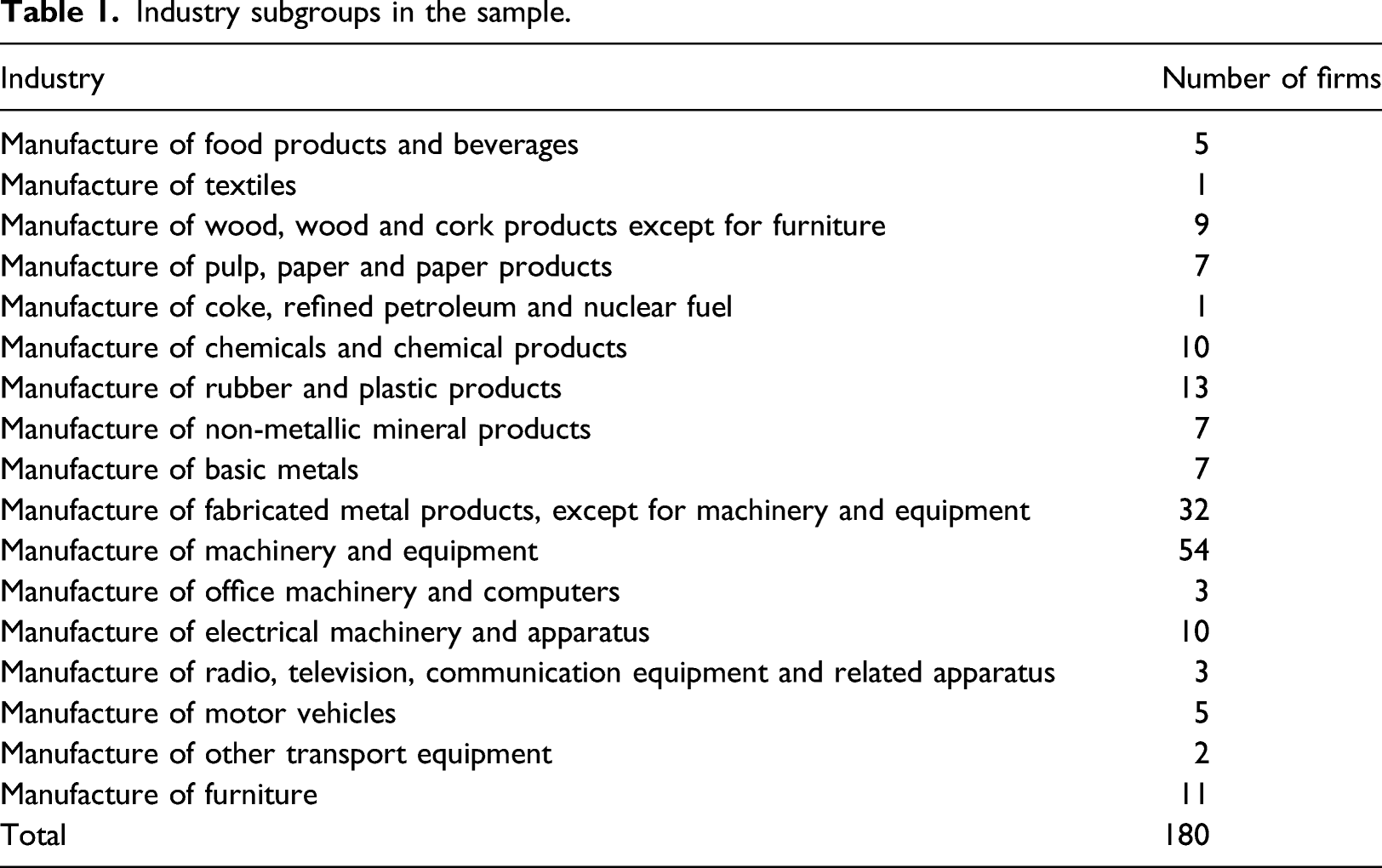
In total, we compiled a dataset of 180 usable cases, corresponding to 65% of the original sample and 87% of the firms visited on site. For the non-responding SMEs and those for which complete data were unavailable, there were no systematic biases. After data collection, we tested for biases by comparing the size, profitability, age, turnover and export share of the visited firms with those factors in the non-responding group. We found no significant difference between the responding and non-responding firms, indicating no systematic biases in the sample. In our sample, the average firm is 51 years old and there are 114 medium-sized firms, 61 small firms and five micro firms, based on the EU definition. Figure 2 provides a more nuanced presentation of the size bands of the sample firms. Table 1 provides information about the manufacturing industry sub-sectors of the studied firms. Size bands of sampled firms. Industry subgroups in the sample.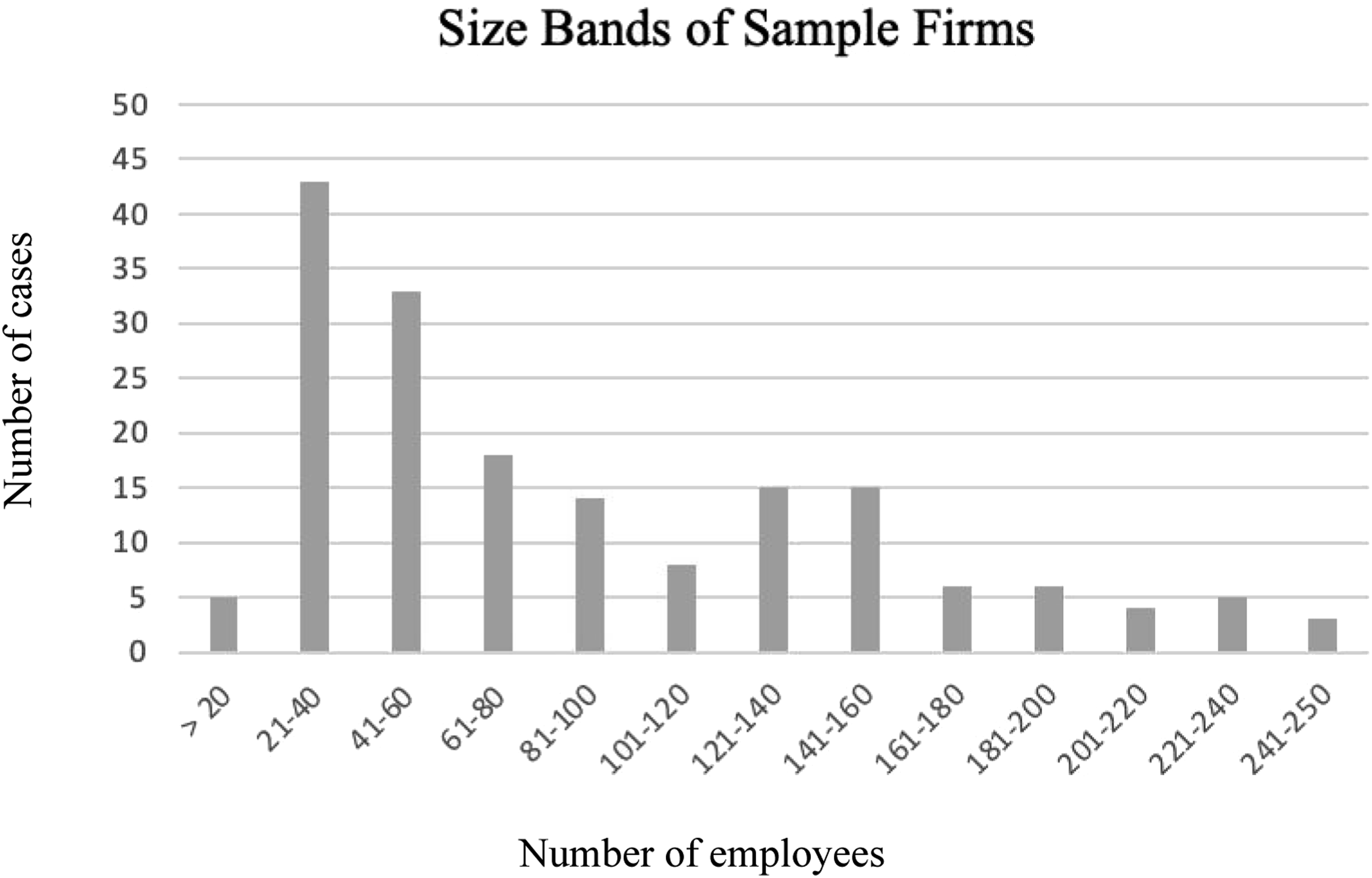
Measures and control variables
The dependent variable – that is, speed of international expansion – was measured using the already established measures of the construct (Casillas and Acedo, 2013). Accordingly, we asked each respondent about their firm’s number of export markets and divided that number by the age of the firm. With these values, we could capture the average speed of increase in the breadth of international sales over time. The average speed of internationalisation in our sample is 0.92 new markets entered per year.
We measured the independent variables as follows. First, to capture a firm’s pace of innovation, we used the measures developed by Pourmand Hilmersson and Hilmersson (2021), who found inspiration in the evolving internationalisation speed literature and replaced the number of markets exported to with the number of patents controlled by the firm. We accordingly measured innovation pace by dividing the number of Swedish patents registered by a firm by the firm’s age. By registering the average number of patents registered per year since firm inception, we captured innovative intensity, referred to as pace of innovation. Our use of patents as an indicator of innovation was inspired by Hagedoorn and Cloodt (2003), who showed that no systematic or significant biases occurred when patent data were used to measure innovations at the aggregate level. We determined that the benefits of accessing actual objective registered data were more important than the risk of using only potentially biased survey data in our research design. Second, to capture the time-to-innovation variable hypothesised as a moderator, we subtracted the firm registration year from the year the firm registered its first patent, in order to capture the number of years from firm inception to first patent registration.
In testing our hypotheses, we controlled for six variables. First, we created a dummy variable separating family-owned firms from firms with other types of ownership, as earlier research by George et al. (2005) suggested that family-owned firms expand internationally more slowly. Second, we controlled for the year of first international sales. Cavusgil and Knight (2015) suggested that internationalisation speed is accelerating, and those firms starting to internationalise today will have higher internationalisation speeds than those starting to internationalise a few decades ago. Third, we controlled for the share of assets the firm has abroad versus in its home market. This variable is important because investment-driven internationalisation requires more time and resources and thus reduces the speed of internationalisation.
Fourth, we controlled for the knowledge acquisition strategy of the firm. As shown by Hilmersson and Johanson (2020), the knowledge acquisition strategy influences the speed of development of internationalisation capabilities. In controlling for this strategy, we formulated the following statement: ‘In our firm, we acquire knowledge of doing international business and how to organise international business activities by generating our own experience’. We measured this variable using a Likert scale ranging from 1 (‘Do not agree at all’) to 7 (‘Fully agree’).
Fifth, as Johanson and Johanson (2021) suggested that firms can accelerate their internationalisation processes by accessing network resources, we controlled for firm networking behaviour. We included a dummy variable that captured whether the firm was actively seeking to access knowledge and information by being active in industry organisations and networking communities. Data for this variable were accessed from the membership records of the Swedish Chambers of Commerce. A dummy variable was created wherein active members were given a value of 1 and non-members a value of 0. The Swedish Chambers of Commerce have regional chapters in all Swedish counties where they are active. They strive to improve business conditions for their members and offer networking opportunities to stimulate knowledge exchange. Sixth, we expected that larger firms would have access to more resources than would small firms, so we controlled for firm size by including a variable that captured the number of employees.
Data analysis
Correlations and descriptive data.
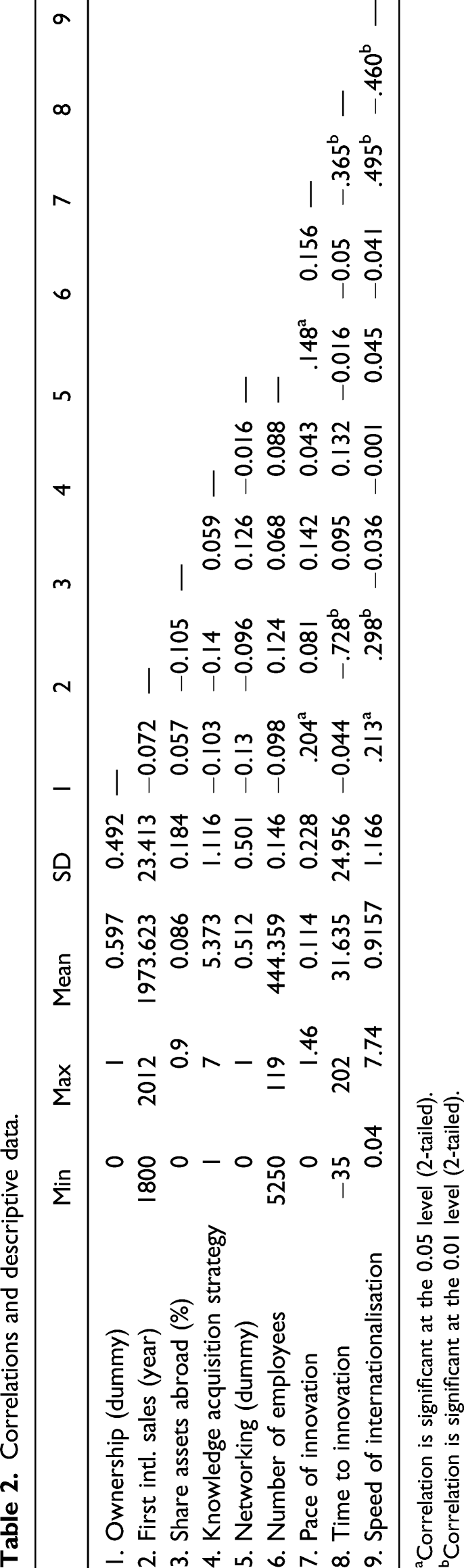
aCorrelation is significant at the 0.05 level (2-tailed).
bCorrelation is significant at the 0.01 level (2-tailed).
When subsequently running an ordinary least squares (OLS) regression, we inspected for any potential multicollinearity biases by controlling the variance inflation factor for the independent variables. These values were all below 1.2, indicating that multicollinearity should not disturb the results.
Hypothesis testing.
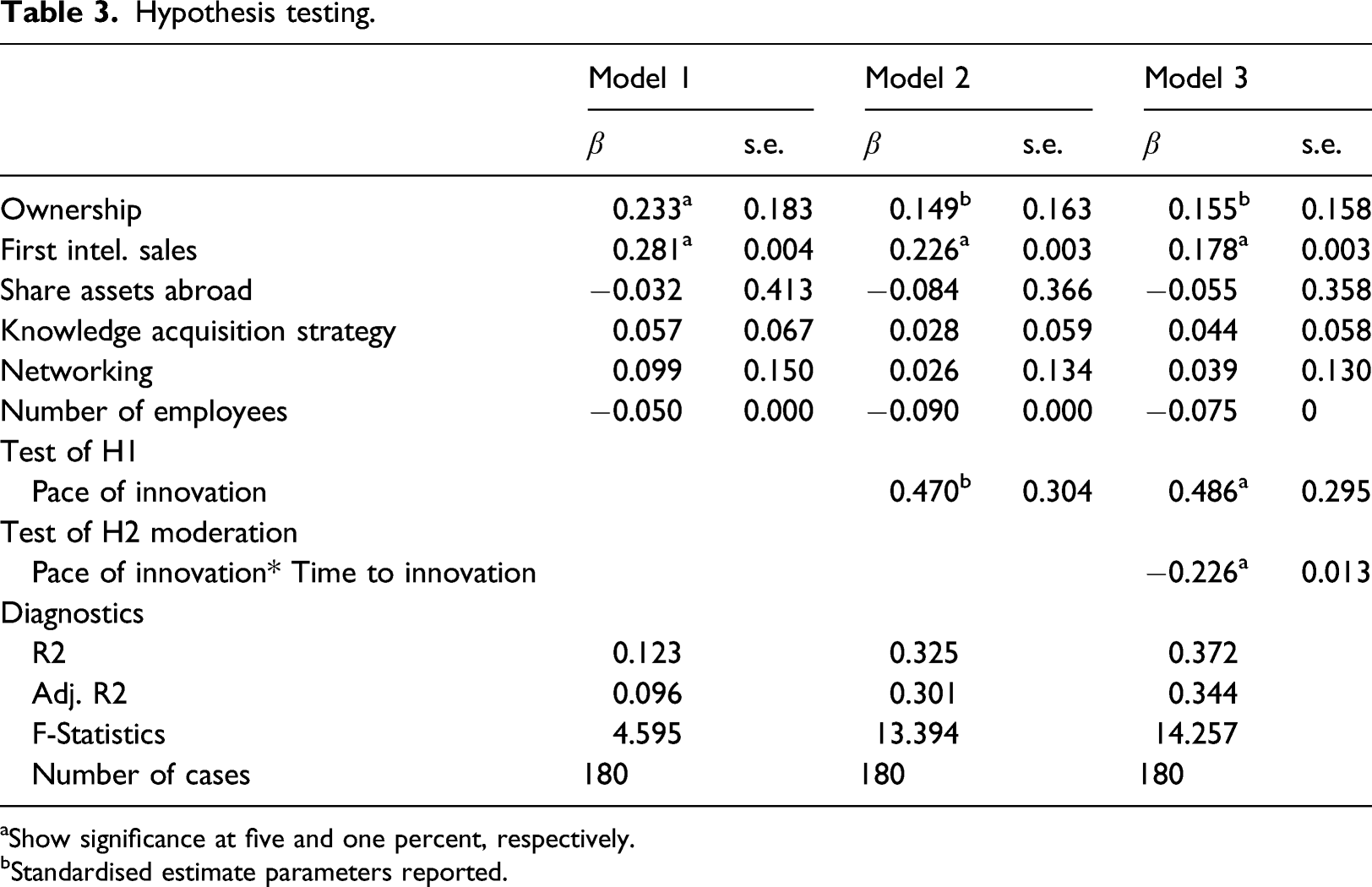
aShow significance at five and one percent, respectively.
bStandardised estimate parameters reported.
In Model 2, we tested our baseline relationship by including the independent variable in our equation to reveal that the innovation pace significantly increases the speed of international expansion, as suggested in Hypothesis 1. The pace of innovation had a significant (p = 0.000) and positive (β = 0.470) effect on international expansion speed. As for the predictive power of the model, we noted that the adjusted R-squared values increased from 9.6% to 30% when pace of innovation was included in the equation.
In Model 3, we tested Hypothesis 2 by adding the moderating variable to the equation to evaluate the boundary conditions of the baseline relationship. By adding time to innovation to the equation, we could show that the positive relationship between pace of innovation and speed of international expansion was weakened by the elapsed time between the founding of the firm and its first innovation, thereby supporting Hypothesis 2. Indeed, the longer the elapsed time between SME foundation and first innovation, the weaker the positive effect of pace of innovation on the speed of internationalisation. Table 3 shows the significant (p = 0.000) and negative (β = −0.226) effect of that moderating variable. We further observed that the predictive power of the model increased from 30% to 34.4% when the moderator variable was included in the equation. Thus, the positive effect of innovation pace on the speed of internationalisation weakened if a relatively longer time elapsed between a firm’s founding and its first innovation.
To aid interpretation and add further details about how the moderator changed the baseline relationship, we performed a post hoc simple slope analysis. This allowed us to track changes in the nature and strength of the relationship between pace of innovation and speed of internationalisation across varying points of time between firm foundation and first innovation. We split our sample into two groups based on the moderator variable and the moderating effects calculated based on a longer (one standard deviation below the mean) and shorter (one standard deviation above the mean) elapsed time between firm founding and first innovation. This simple slope analysis revealed that the relationship between pace of innovation and speed of internationalisation changed in strength and nature depending on the elapsed time between firm foundation and first innovation. Figure 3 shows that these moderating and negative effects are significant when a longer time has elapsed between firm foundation and first innovation, resulting in a negative Beta value (β = −0.509) and significant relationship (p = 0.049). However, given a shorter elapsed time between firm foundation and first innovation, that relationship changes in nature, and the effect is positive. The Beta value changes to positive (β = 0.577) and the relationship becomes significant (p = 0.004). Thus, when there is a medium-duration or long time between a firm’s foundation and its first innovation, the relationship is weakened; conversely, when there is a short elapsed time, the relationship is strengthened rather than weakened. These findings indicate that firms requiring a longer start-up period before their first innovation suffer from TCDs relatively more than do those with a shorter start-up period, indicating that innovation lateness is a liability for this relationship. Simple slope analysis of the moderation.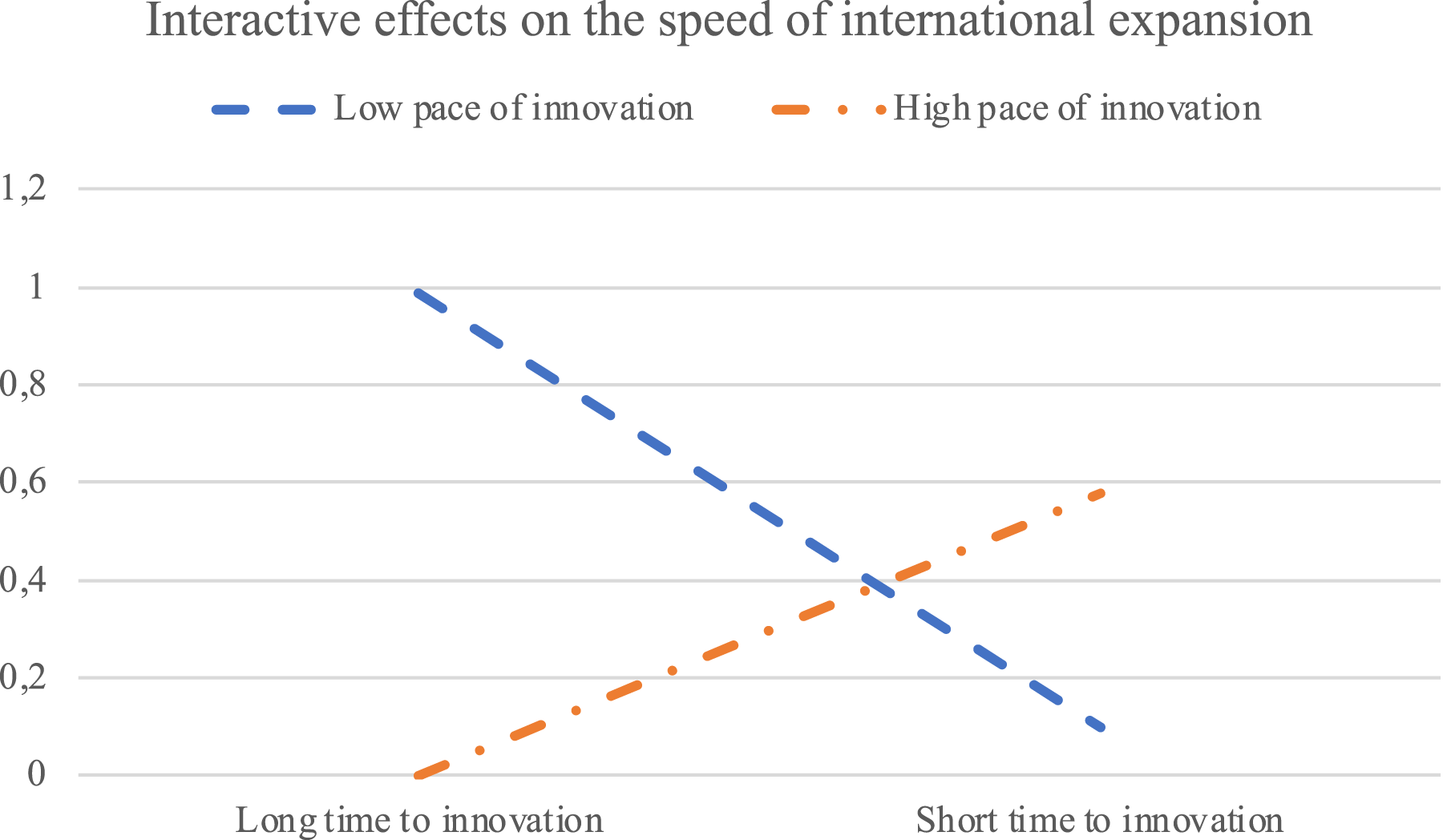
Discussion
There is consensus in the international entrepreneurship literature that technological advancement accelerates the speed at which firms are internationalising. Yet, technological advance is mainly treated as a contextual variable in the literature. Earlier research (Booltink and Saaka-Helmhout, 2018) has shown that individual SMEs can exploit research and development investments more effectively by expanding internationally. Despite this research, surprisingly few studies have addressed the strategic trade-off between investments in product and process innovations and their internationalisation consequences. To our knowledge, no studies have yet addressed the dynamics and temporality involved in this particular trade-off at the individual firm level; instead, technological advancement is treated in prior research as a context in which internationalisation speed is generally accelerating.
Our analysis shows that SMEs with a fast pace of innovation also internationalise at a high speed. We explain this relationship by drawing on the underlying theoretical mechanism, namely, the learning advantage of newness (Autio et al., 2000; Sapienza et al., 2006). Using this logic, we infer that the ability to learn rapidly due to the advantage of being new or by introducing new innovations makes a firm more flexible and less locked into old routines, enabling accelerated internationalisation (Autio et al., 2000; Zahra et al., 2018). Newness is not a liability, but an advantage that drives and accelerates internationalisation in these firms. In addition, we found that the time elapsed between an SME’s inception and first innovation negatively moderates the positive relationship between pace of innovation and speed of international expansion. This boundary condition helps us understand that firms that need a longer time to develop their first innovation, tend to internationalise more slowly once internationalisation starts. One explanation is that such late innovators will not benefit from the learning advantage of newness (Autio et al., 2000; Sapienza et al., 2006), but instead will face the challenges of TCDs (Dierickx and Cool, 1989; Jiang et al., 2014). SMEs that innovate early, and also introduce their innovations in foreign markets early, will benefit from the learning advantage of newness. In contrast, late innovators, by the same logic, will first need to unlearn established routines – such as adapting an existing product to suit the requirements of a new foreign market – to leverage a recently discovered opportunity more effectively.
An illustrative example is that of one of our cases, the ‘Bearing Company’. The firm was originally a traditional metal fabricator and remained a general fabricator for a significant period before becoming a specialised supplier of piston rings for Volvo engines. After over 50 years of producing only custom-made products, their piston rings became the product line of the firm and the first product produced in larger batches. A unique piston ring was the first innovation it protected with patents. When moving from being a general fabricator to a specialised producer of piston rings, old routines had to change and the firm had to develop new capabilities. A new sales organisation was also needed. This unlearning of routines and development of new capabilities was both costly and time consuming, hampering the firm’s speed of internationalisation. Their resources became overextended as the organisation had to learn about several foreign market environments within a limited period to succeed. Based on these results, we suggest that any unlearning of routines needs to be swift for SMEs to leverage their international opportunities fully and quickly, a situation that can lead to TCDs. Late innovators will experience increased pressure on their already constrained resources (Jiang et al., 2014; Sadeghi et al., 2018) and face challenges in sustaining their capability development, as they spread into new foreign markets.
In sum, we argue that time-compressed innovation processes caused by late first innovation result in inefficiencies in the exploitation phase. SMEs that start to innovate late have only a limited time for subsequent innovations. This circumstance produces excess resource accumulation in that firm and subsequently a slower speed of internationalisation. This finding indicates that innovation lateness is a liability for successful internationalisation.
Contribution to theory
One of our main contributions to the internationalisation speed literature (Casillas and Acedo, 2013; Chetty et al., 2014; Hilmersson et al., 2017) is to show that timing is crucial. We found that SMEs with a fast pace of innovation also internationalise rapidly. In contrast, those taking longer to realise their first innovation internationalise more slowly. We further highlight that the time elapsed between a firm’s foundation and its first innovation negatively moderates the positive relationship between its pace of innovation and speed of internationalisation. This moderation suggests that since late innovators have fixed routines mainly designed for their domestic markets, they will have to unlearn old routines and learn new ones when they expand internationally. This finding is consistent with Barkema and Vermeulen (1998), who argued that firms that internationalise must unlearn earlier routines before new routines can be developed. In addition, since firms need different knowledge sources, they will also need different knowledge acquisition processes and routines (Hilmersson and Johanson, 2020; Weerawardena et al., 2007). These processes and routines allow the firm to acquire the capabilities to understand international markets fully, and thereby develop leading-edge innovative products and services for their various markets. It is important to note that late innovators are also at a disadvantage because they need to internationalise quickly to catch up with competitors who have already established themselves as insiders in foreign business networks. Consequently, these SMEs must spread their resources thinly because they must simultaneously adapt their products and diversify their foreign markets. Since this happens within a limited period, there is the risk of inefficiencies.
Our research also contributes to the general literature on firm internationalisation by introducing the concept of ‘liability of innovation lateness’. This refers to innovation that impedes a firm’s ability to overcome the liability of outsidership (Johanson and Vahlne, 2009). We contribute to the innovation literature by identifying and closely examining the inefficiencies that occur because of innovation lateness. One potential explanation for the slow internationalisation of late innovators is the obstacles to becoming insiders in other business networks that arise because of their slow innovation processes. In contrast, firms with rapid innovation and internationalisation must cope with idiosyncratic foreign business networks in various host countries and thus will rapidly adapt their innovations. All these insights clearly suggest that rapid innovation and internationalisation can indeed facilitate a firm’s efforts to overcome the liability of outsidership (Johanson and Vahlne, 2009).
Limitations and implications for future research
As our study used patent data as a proxy for innovation, we suggest that future studies apply other data to measure innovation and its pace in order to validate our findings, but to do so without falling into the single-rater bias trap (Podsakoff et al., 2003). There may be an opportunity to distinguish between radical and incremental innovations and determine their relationship to the speed of internationalisation, thereby moving beyond the average measures used here. Recent research insights have shown that digitalisation changes the prerequisites for internationalisation, because certain firms are now born on the Internet (Monaghan et al., 2019), while others may use digital advantages to develop internationally scalable business models (Reuber et al., 2021). Since we studied traditional manufacturing firms, our study focuses on product and process innovations in which most patents relate to products. Future researchers could build on our research and consider process innovations in other industries, for example, in the service and digital sectors.
Future research could also study a variety of other samples and country contexts. First, it would be interesting to test our model in the context of emerging markets, large developed countries and developing countries. Second, newly started firms and micro firms are underrepresented in our sample, offering an opportunity to extend our insights to the very early phases of firm development and test the size-related boundary conditions of our model. In addition, future research could deepen our understanding of the link between pace of innovation and speed of international expansion by conducting longitudinal process studies of this relationship. This would be valuable, deepening our understanding of the interplay between innovation and internationalisation efforts and of the dynamics involved in this interplay. Our explanation of the moderator between innovation pace and internationalisation speed, as related to late innovators having to unlearn fixed routines before learning new ones, also creates an opportunity for further exploration using qualitative methods.
Managerial relevance
Our results offer novel managerial insights into innovation by demonstrating that the pace of innovation drives the speed of international expansion. This finding implies that if SMEs are slow to innovate, then their overall speed of international expansion will likewise be slow. Thus, it is best for SMEs that want to internationalise rapidly to innovate quickly after inception and exploit their innovations through rapid international expansion. Managers need to learn quickly from their diverse foreign markets and business networks how to create new innovations and drive their expansion successfully. The momentum a firm has gained for innovation and internationalisation must be sustainable, because if it slows or stops its innovation and loses momentum, it may take longer to regain it. By managing the pace of innovation and speed of international expansion effectively, firms will earn a better return on their investment before having to face new pressure on their constrained resources.
Current government policy worldwide is to encourage SMEs to innovate and internationalise to grow economies. One clear implication of our findings is that managers and policy-makers need to be strategic when linking the pace of innovation to the speed of international expansion. Their decision-making must consider the advantages of being a new firm and of internationalising rapidly. Our analysis offers further new insights into the liability of innovation lateness, which ultimately slows the speed of international expansion. Policy-makers may want to direct attention to these insights by providing viable incentives that boost innovation and motivate firms with unique innovations to internationalise faster. Furthermore, policy-makers should consider SME innovation and internationalisation holistically when developing policies for funding and supporting infrastructures that encourage innovation and international expansion; this supportive infrastructure should not be consigned to disparate policy-making organisations that may have different or even competing interests. In such situations, one of these supporting organisations may target innovation while the other targets internationalisation, without considering the clearly needed connections between the two activities that would benefit SMEs.
One reviewer of this article described how this process is organised in Finland, which provides a benchmark for good practice in combining innovation and internationalisation support services. Business Finland was formed a few years ago by merging the innovation development agency (TEKES) and the internationalisation assistance provider (FINPRO) to offer integrated support services from a single organisation. This process differs from what happens in Sweden, where the supporting infrastructure tends to organise innovation support and internationalisation support in two separate silos.
Conclusion
This article has focused on the pace and timing of innovation and its effects on the continuous speed of internationalisation, which we identified as a neglected area of research. Theoretically, we turned to the insights gained from the learning advantage of newness and TCD concepts to explain the relationship between pace and time of innovation and speed of internationalisation. We contribute to research on SME internationalisation by connecting earliness of innovation, pace of innovation and speed of international expansion. Our analysis emphasises that timing is important, as there are numerous advantages to being early with the first innovation and continuing that process by sustaining a high pace of innovation, as doing so will enable more rapid internationalisation. We conclude that innovation lateness is a liability that influences the internationalisation of firms, an issue neglected by earlier literature which has instead tended to treat technological innovations as a contextual variable.
Footnotes
Funding
The author(s) received no financial support for the research, authorship, and/or publication of this article.
