



Abstract
The mixed embeddedness (ME) perspective offers a holistic approach to understanding entrepreneurship as embedded in a myriad of contexts. Alone, however, it is not capable of explaining the dynamic interrelations between entrepreneurship and opportunity structures beyond venture start-up. We offer a synthesis between ME and the dynamic states approach, using the concept of opportunity tension to explore the recursive interplay between entrepreneurial agency and opportunity structures. The integrated approach is applied to, and developed by drawing upon, the case of ethnic minority entrepreneurship in the changing Swedish welfare state following customer choice reform. We explore opportunity tensions that arise during start-up, growth and exit for two firms that provide care for the elderly in public quasi-markets. We develop concepts that account for different patterns of embeddedness and opportunity tensions as well as bottom-up effects of entrepreneurship in terms of reregulation and conclude that the interplay amounts to a paradox of ethnicity.
Introduction
The mixed embeddedness (ME) perspective (Kloosterman et al., 1999; Kloosterman, 2010; Kloosterman and Rath, 2018) was developed as a critique of the preoccupation with cultural issues and ‘absence of context’ (Ram and Jones, 2008: 354) in research on ethnic minority business (EMB) and immigrant entrepreneurship (IE). ME offers an approach to entrepreneurship that sees it as embedded in a myriad of contexts; it has become established as the dominant approach in contemporary research on EMB and IE (Ram et al., 2017). Yet, while ME alerts us to ‘the powerful ways in which the institutional context shapes the entrepreneurial activities of migrants’ (Ram et al., 2017: 10), the agency of entrepreneurs, and indeed the entrepreneurial process itself, has become neglected when this perspective is applied. Based on a comprehensive review of ME research, Barberis and Solano (2018: 10) conclude that the popularised version of ME ‘seems to focus mostly on opportunity structure and institutional embeddedness’, which motivates a renewed focus on agency. Barberis and Solano (2018) suggest that an approach which accounts for how entrepreneurs ‘steer, and change (or, plainly, take into account) the opportunity structure itself with their agency (and under which conditions this may happen) may be a promising theoretical advancement’ (Barberis and Solano, 2018: 10). The ambition of ME to comprehend the match between a range of opportunity structures and entrepreneurial opportunities (Kloosterman, 2010) means that it has been specifically developed to target the preconditions for start-up in various sectors and markets. Although some development have occurred in terms of explicitly addressing opportunity generation among immigrant entrepreneurs using a process approach (Evansluong, 2016), more is needed concerning the interplay between opportunity generation and multiple layers of context beyond firm establishment, as well as the bottom-up effects of entrepreneur actions.
Ethnic minority business and IE attract interest from different policy domains, including labour-market policy for the inclusion and integration of immigrants, and welfare policy targeting supplier diversity and providing care for an increasingly diverse population (Jones et al., 2019; Kazlou and Klinthall, 2019). The authorities actively intervene in public market prerequisites, by means of different tools depending on the purpose. Deregulation is used to stimulate entrepreneurship, and regulation or reregulation is employed to hamper unwanted behaviour. This means that the opportunity structures faced by entrepreneurs change over time and in relation to the actors on the market. However, opportunity structures can also be affected by the actions of entrepreneurs. The notion of entrepreneurship as the cause of change and of disruption to structures is a legacy of the work of Schumpeter has been highly influential on both entrepreneurship theory and public perceptions of the phenomenon (Landström, 2020). However, in EMB and IE research entrepreneurship and agency of this kind are typically not the focus largely due to the dominant research agenda highlighting the structural disadvantages faced by entrepreneurs of ethnic minority or migrant background. This does not mean, however, that there is no reason to look to the agency of minority entrepreneurs – rather the opposite. The interplay between agency and structure as experienced by immigrant and ethnic minority entrepreneurs is a relevant factor that needs to be taken into account if we wish to increase our understanding of their prerequisites for firm establishment, growth and survival as well as the consequences their actions have on opportunity structures, including the reregulation of public markets.
The objective of this article is to develop an approach to mixed embeddedness that acknowledges entrepreneurship as a process of becoming. We do this by addressing the entrepreneurial process beyond new venture creation (Davidsson, 2015) and by combining ME with the dynamic states approach and the concept of opportunity tension (Lichtenstein, 2009) as a lens for exploring the interplay between entrepreneurship and context. In doing so, we attend to contemporary calls for studies that contextualise entrepreneurial phenomena in a way that includes how context can be provoked, shaped and disrupted by entrepreneurial actions (Zahra et al., 2014), targeting the dynamics of embeddedness (Wigren-Kristofersen et al., 2019). Our approach also contributes to improving understanding of the role of embeddedness in opportunity tension by explaining how, when and where dynamic states change or are sustained (see Levie and Lichtenstein, 2010). Hence, not only entrepreneurship but also embeddedness is a process of becoming.
Instead of targeting a particular ethnic community, this study focuses on entrepreneurship in relation to changing opportunity structures. Mixed embeddedness positions entrepreneurship and entrepreneurial opportunities within the wider socio-cultural, institutional and regulatory contexts of a nation, and Kloosterman and Rath (2018) note that the organisation of provisions for elderly care is a particularly illustrative example of opportunity structures at play. We develop a dynamic approach to ME in relation to the case of ethnic minority entrepreneurship following the ‘customer choice’ market reform in Sweden. Enacted in 2009, the national reform ‘LOV’ (short for Lag om valfrihet in Swedish, translated to the Law of freedom of choice) provided a vision of supplier diversity and small firms providing care to an increasingly diverse population of elderly in need of ‘culturally competent care’. We trace embedded cases of entrepreneurship in two local markets to learn about the interplay between the changing opportunity structures and entrepreneurs. It is an extreme case in that the Swedish public sector is extensively regulated; customer choice markets represent quasi markets within which the municipal authority purchasing a service must simultaneously decide on the many prerequisites for entrepreneurs in that market. In ME terms, the shift in provision of welfare services from state to market represents a change in opportunity structures (Kloosterman and Rath, 2018: 108). The entrepreneur’s response to changes in the opportunity structure, as well as attempts to influence their circumstances, forms an appropriate case for us to analyse the recursive interplay between entrepreneurship and the multiple embedding layers of context over time. The following research questions are posed: How are entrepreneurship and mixed embeddedness related to one another in reregulated markets following the LOV reform? What patterns of embeddedness can be identified in the entrepreneurship process beyond venture start-up? What role does ethnicity play in the process?
The article is structured as follows. We commence by introducing the theoretical framework, after which we describe the methodology of the study, including the wider context of the welfare sector and the reform. To offer a process view of the interplay between entrepreneurship and mixed embeddedness through start-up, growth and exit, the two embedded cases are presented, first, in a narrative structure targeting key events, and second in a structured analysis presented in tables. The discussion that follows offers a comparison between the embedded cases and an elaboration of the mixed embeddedness and the dynamics involved in the interplay between entrepreneurship and context. The article ends with our conclusions.
Theory
In the following section, we acknowledge the key dimensions in our dynamic approach to mixed embeddedness, including opportunity structures, which inform our understanding of the exogenous influences on entrepreneurship, and endogenous dimensions, including forms of capital. To address the continuous interplay between entrepreneurship and context beyond firm establishment, we draw upon the dynamic states approach and the concept of opportunity tension.
Mixed embeddedness and multiple opportunity structures
Mixed embeddedness was originally conceptualised by Kloosterman et al. (1999), who brought together four theoretical streams. The interactionist model (Waldinger et al., 1990) emphasises the need to appreciate both the agent, in particular cultural capital and structure. Granovetter’s (1985) notion of embeddedness targets social, relational and structural embeddedness. Institutional frameworks, as conceptualised by Esping-Andersen (Esping-Andersen, 1990), account for different types of welfare regimes. Finally, Sassen’s (1991) view on the processes of post-industrial transition reiterates the importance of macro-level opportunity structures and the intricacies of market dynamics.
The ME perspective contributes by directing theoretical attention towards the contexts in which entrepreneurship is embedded. This means that entrepreneurs are embedded in ‘the surrounding structural context of markets, competition, and crucially the state regulatory regime’ (Ram et al., 2008: 428). The concept of opportunity structure captures the myriad structures in which entrepreneurship is embedded and offers a systematic approach to applying ME. Opportunity structures include the broader context of the market and the politico-institutional context (Barberis and Solano, 2018; Ram et al., 2017), as well as their interactions at national, regional and local levels (Dheer, 2018; Kloosterman and Rath, 2001). The market is the arena in which entrepreneurs (ethnic minority and majority alike) must compete for customers (Ram et al., 2017). Kloosterman (2010) depicts market openings as pivotal for an understanding of entrepreneurship, punctuating the demand (or lack of it) for a product or service and emphasising the relative accessibility of the market in terms of who can participate and under what terms (Kloosterman and Rath, 2001). Kloosterman’s (2010) market typology offers insights into a hierarchy of market openings, each with their own intrinsic characteristics, which means that not all market openings are open and/or attractive to everyone. Accessibility here is dependent on human capital. Institutional frameworks both enable and hinder openings (Kloosterman and Rath, 2003), determine their size and shape (Engelen, 2001) and dictate what kinds of enterprise can exist (Barrett et al., 2002). Paraphrasing Esping-Andersen, Kloosterman and Rath (2003: 8) argue that ‘various institutional frameworks also bring about divergent post-industrial self-employment trajectories and hence different opportunity structures for entrepreneurs’. Due to the complexity of these relationships, a comprehensive model is beyond our scope; we concentrate on dimensions relevant to our analysis.
Welfare regimes vary in terms of the size of public and private sectors, and their ways of providing for citizens thereby creating, or blocking, market openings. For instance, the commodification of welfare services can be directed towards creating more room for entrepreneurship (Kloosterman and Rath, 2010), as in the case of public versus private providers of elderly care. Institutional frameworks also differ in terms of their relative thickness with respect to rules, regulations and policy interventions, which repress, constrain and/or enable entrepreneurship (Kloosterman and Rath, 2003). This determines thresholds for market entry including deterring firm registration, or setting thresholds for specific qualifications to set up a firm in a particular sector (Kloosterman and Rath, 2001). Ram et al. (2008: 428) demonstrate that the force of a regulatory regime cannot be dismissed as ‘some sort of inert backcloth’, but is an active system that imposes parameters upon what is possible. Kloosterman and Rath (2010) classify regulatory frameworks as persuasion by legislation, incentives or disincentives (‘sticks’, ‘carrots’ and ‘sermons’). A multitude of individuals are involved in regulation processes, including local, regional and national government, unions, non-profit organisations and everything in between (Kloosterman, 2010). Regulatory processes are thus, both multifaceted and wide ranging and can enable as well as constrain entrepreneurial activities; hence, they are key to understanding EMB prerequisites (Ram et al., 2017, 2020). The opportunity structures aspect of our approach enables us to position entrepreneurship as embedded within a wide range of contexts. To explore the networks and resource dimensions of the framework, we now turn to the question of entrepreneurial capital.
Forms of capital beyond culture
Mixed embeddedness was initially presented as an antidote to the over-emphasis on culturally deterministic approaches to EMB. These targeted the over-representation in self-employment of some ethnic groups, seeking explanations in the cultural capital and ethnic resources of these groups (Light and Bonacich, 1988; Waldinger, 1986). Important steps were taken by integrating Granovetter’s (1985) work on social and structural embeddedness, in which concrete networks of social relations with other actors, including customers, suppliers, competitors, law enforcers and banks are acknowledged (Kloosterman and Rath, 2018). When applied, however, ME typically maintains a focus on social embeddedness that targets co-ethnic-specific social capital and resources that ‘lubricate economic interaction’ (Waldinger, 1995: 557). We therefore, reiterate that cultural capital ought to be considered in concrete terms beyond close social ties and that other forms of cultural capital need to be considered too. We understand EMBs as being, to varying extents, infused with different types of ethnic/cultural elements, permeating the firms in terms of what they sell, how they are managed, their staff, or how they interact with other firms (Rezaei, 2007).
Mixed embeddedness research does acknowledge entrepreneurial resources other than ethnicity and culture. We recognise this ambition in Kloosterman’s (2010) framework, but note that it mainly targets human capital in terms of formal educational qualifications viewed as the prerequisite for entry into some sectors. This was Ram et al.’s (2008) first point of departure in their effort to move beyond co-ethnic resources and ethnic social embeddedness and integrate other forms of capital into ME. Ram et al. (2008) present a novel synthesis of ME and the ‘forms of capital’ model (Nee and Sanders, 2001), which proposes that social, financial and human/cultural capital are necessary for understanding how immigrants are incorporated into their host country. In this model, human/cultural capital is composed of: human capital, which pertains to formal and informal education, experience and skills, and cultural capital, which ‘emphasizes competence in cultural practices’ (Nee and Sanders, 2001: 392). It is a two sided model as it refers to familiarity with the customs and language of both the receiving or host society and the ethnic/migrant community. Nee and Sanders (2001) combine the concepts of human and cultural capital as they argue that human capital alone cannot capture cultural elements. We adopt these forms of capital to enhance the endogenous dimensions in our approach to ME.
Opportunity tension and dynamic states beyond new venture creation
The dynamic states approach (Levie and Lichtenstein, 2010) offers a view of entrepreneurship as dynamic in the sense of constantly ‘becoming’ (Lichtenstein, 2014; Tsoukas and Chia, 2002). A dynamic state is comprised of three elements: opportunity tension, an organising model and value creation (Lichtenstein, 2014). Opportunity tension represents an entrepreneur’s intentions and perceptions of an ‘untapped market potential and the commitment to act on that potential by creating value’ (Levie and Lichtenstein, 2010: 333). The tension builds when the entrepreneur begins to identify and accumulate a pool of potential resources they can use to construct a method to exploit the perceived opportunity. This opportunity in itself is continuously developed as the entrepreneur manoeuvres through it and constructs viable methods of value creation, value delivery and/or value capture (Richardson, 2008). In this sense, opportunity tension acts as the catalyst for the organising process of emergence, as this tension is acted upon in terms of time, effort, action and intentions. These actions, and the time spent, in turn act to solidify the entrepreneur’s commitment to the opportunity at hand. This level of commitment is also influenced by the entrepreneur’s perception of the market potential of the opportunity. In simple terms, opportunity tension is the entrepreneur’s ‘felt belief that the emerging opportunity is worthy of pursuing’ (Lichtenstein, 2009: 20). When an opportunity tension arises, it will continue until the entrepreneur achieves the objectives connected to the perceived opportunity by addressing the tension and thus, relieving it.
Opportunity tension should not be considered a static or singular occurrence, but rather a process, which occurs in waves or pulses (Lichtenstein, 2009). As stated by Lichtenstein (2009: 21), ‘entrepreneurial action forms around one opportunity; this may be followed by another opportunity, and so on; each of these cycles represents a distinct phase of activity, initiated by the combination of exogenous forces of change and endogenous forces of creative expression’. These subsequent pulses of opportunity tension still rely upon the entrepreneur’s belief that the opportunity is worth pursuing (Lichtenstein, 2009), although the tension now represents the belief that an opportunity is viable in terms of firm growth, development or continued emergence. This implies that, while entrepreneurial intention, action and commitment centre around the tension created by one perceived opportunity, this may be followed and/or joined by an infinite number of other opportunities, each igniting a new cycle of opportunity tension.
With Levie and Lichtenstein (2010), an entrepreneur’s belief in the degree of opportunity tension is related to the personal desire and capability they perceive within themselves. The imagined outcomes – and the related degree of opportunity tension – are corroborated, contradicted and/or refuted during the process of recursive testing. This confirms or negates the existence of the opportunity, while at the same time amplifying or weakening the entrepreneur’s commitment. Continued tension and a strong belief that the projection is correct, results in relief of that tension. This relief is not incidental but intentional (Lichtenstein, 2016; Sternad and Mödritscher, 2020) and is achieved by means of the entrepreneur acting on the opportunity. Each phase of opportunity tension, if relieved or acted upon, leads to the generation of value in the form of new products, diversification, a new or modified business model, growth and/or a continued means of survival and thus a new dynamic state.
Overall, a dynamic state represents the match between market potential and a firm’s business model and relies upon the relationship between the entrepreneur, the firm and the context. This means that the dynamic states approach can explain not only growth and expansion, but also contraction and shrinking and, ultimately, closure or exit. In order to advance the theoretical development of dynamic states, and with it opportunity tension, Levie and Lichtenstein (2010) highlight the need to understand when and where dynamic states change, how they are sustained, and the role played by context. This point creates an important bridge to the ME perspective and our ambition to integrate the dynamic states approach with an awareness of the relationship between the entrepreneurial process and context. Levie and Lichtenstein’s (2010: 333) description of a dynamic state as a ‘network of beliefs, relationships, systems, and structures that convert opportunity tension into tangible value for an organisation’s customers or clients, generating new resources that maintain that dynamic state’ corresponds significantly with the role played by social, structural and relational embeddedness within the ME perspective (Kloosterman, 2010). Kloosterman and Rath (2018: 108) specifically cite the heritage of Granovetter’s (1985) structural and social embeddedness to acknowledge that ME is ‘not only about structures and opportunities but also about agency and actors and how they are embedded in larger social structures’. By means of the dynamic states approach, we see an opportunity to refocus what mixed embeddedness means in terms of agency and structure for entrepreneurs, and their opportunities, from a process perspective (Jack and Anderson, 2002), when interacting with other actors in the sector, market and institutional environment in which they are embedded. With this combined framework, we can make sense of, and explain, changes in dynamic states as well as the entrepreneur’s perception of an opportunity in relation to the mix of embedding structures and the forms of capital available to them. The dynamic states approach enables a process view of entrepreneurship that sees it as both influenced by, and influencing, the combination of opportunity structures; this is sometimes to the benefit, and sometimes to the detriment, of entrepreneurial aspirations.
Methodology and method
Our ontological stance is one in which entrepreneurship is viewed as a contextually embedded recursive process of ‘becoming’ (Tsoukas and Chia, 2002; Steyaert, 2007). This means that not only is entrepreneurship in a state of constant change but so is the context (Chia, 1999; Fletcher and Selden, 2016). Our ambition to explore EMB beyond new venture creation, viewing it as embedded in and interacting with multiple dimensions of context, suggests a qualitative methodology. This means that we are following in the footsteps of prominent process researchers (Pettigrew, 1990), acknowledging that this aim requires a research design that encompasses entrepreneurial forms of capital (content), as well as the sequencing of events and the strategic actions of entrepreneurs undertaken over time (process), in relation to opportunity structures at multiple levels (context). Our empirical study was given a longitudinal design to enable such a process perspective, in order to capture sequences of key events over time and to be able to see them as embedded in multiple and changing contexts.
The Swedish welfare state is typically considered to be organised according to the Social Democratic type of welfare regime (Esping-Andersen 1990), in which the public sector both finances and provides welfare services for its citizens. The era of New Public Management saw an increasing number of welfare services become subject to the privatisation of welfare production and marketisation reforms. Some municipalities experimented with local markets for social services, including elderly care (Kastberg, 2005). In 2009, the Act on System of Choice in the Public Sector (‘LOV’; Lag 2008:962 om valfrihetssystem) came into effect, meaning that municipalities were encouraged, but not obliged, to offer customer choice markets without having to utilise public procurement procedures as a means of competitive tendering. Previous outsourcing legislation had benefited large firms that possessed the substantial resources needed to win the contracts (Erlandsson et al., 2013; Sundin and Tillmar, 2010). With the LOV reform, politicians both at the national level and locally hoped to see an increase in supplier diversity. Diversity in this case relates to organisational size and form, with small local firms as particular targets. People already employed in the sector, to a large extent women and individuals of immigrant background, were assumed to be interested in starting their own businesses and introducing more diversified services to the sector. Customer choice markets, or ‘quasi markets’ (Le Grand, 2009), seek to combine the supposed efficiency gains of the market with public financing and governance. LOV stipulates that any legally recognised organisation that meets the criteria must gain authorisation to participate. The government bill introducing the LOV reform made it explicit that, in order to avoid deterring suppliers or being anti-competitive, the local requirements should not be set too high (Erlandsson et al., 2013).
Municipalities are obliged by law to provide care for the elderly, but the principle of local autonomy gives each municipality the right to decide on the organisation for providing the care. Outsourcing to private providers by means of customer choice systems is just one of several means of provision. Today, customer choice markets are in place in 160 of Sweden’s 290 municipalities, with homecare being the most common service (SKR, 2021). The municipalities enact their own rules for all participating providers within their local market, including themselves. This means that the prerequisites for entrepreneurship in these markets can vary a great deal from one municipality to another. The number of providers varies depending on market attractiveness. In larger cities, some markets include over 200 providers, whereas many rural areas have problems attracting providers (SKR, 2021).
The Swedish customer choice reform was chosen because it represents a profound change in the institutional framework and regulatory regime at several levels, nationally and locally, and because it enables an analysis of the interplay between structure and agency. The empirical study comprises the establishment of two local homecare markets (‘East Town’ and ‘Lake Town’) and within each of these it focuses on an embedded case of entrepreneurship (Azad, who developed ‘Azad Care’, and Emanuel, who founded ‘Care Company’). Each embedded case of entrepreneurship was tracked for several years, from conception through establishment and subsequent growth, including obstacles such as reregulation, and ends as the entrepreneur makes an exit.
To compare relevant aspects of the processes and the interaction between agency and structure (Jack and Anderson, 2002), we chose to compare two cases based on similarities in some opportunity structures and differences in others. East Town and Lake Town municipalities were among the first to establish public markets for homecare provision. Dissimilarities between the two municipalities include previous market arrangements and specific elements of local regulation, which are explained further in the results section. To enable a focused analysis, both rich in detail and extended over a period of several years, we focused on two entrepreneurial ventures instead of several firms in each municipality. Out of several interviewed entrepreneurs in each local market, two entrepreneurs/firms were selected based on the criteria that: first, they had managed to establish a business and gain customers in the market; second, they identified as ethnic minority and as providers of care within an ethnic niche and third, their actions could be directly related to the opportunity structures. Other entrepreneurs interviewed for the study are positioned as competitors with the focal firms in our analysis and hence, are part of the context in with the entrepreneurs interact.
For each embedded case, an intensive design was used to generate qualitative data in three areas. First, the contextual elements suggested in our framework, including the market prerequisites (operationalised as conditions of the customer choice market and demand from clients), institutional frameworks (national and local level regulations), policy interventions (changes in regulations, support efforts) and attractiveness of market openings (perceived attractiveness of market opening). Second, the entrepreneurs and their resources: this included human/cultural, financial and social capital; and third, the opportunity tensions experienced by the entrepreneurs in establishing, developing and eventually exiting their firms in continuous interaction with the opportunity structures.
The timespan is several years for each case: from 2011 to 2019 in the case of East Town and from 2014 to 2019 in the case of Lake Town. The East Town study was initiated first and stemmed from an interest in the consequences of the marketisation of the public sector. Issues of ethnicity and EMB were a result of developments in the market rather than an a priori sampling. When trying to apply the ME approach to the case, the authors realised that there was a misalignment between theoretical models and practice and began to develop a framework that could better capture the identified patterns. To be able to contrast the findings and learn what was unique or commonplace, a second case study was designed and conducted in Lake Town, in parallel with the continued study in East Town.
Data overview.
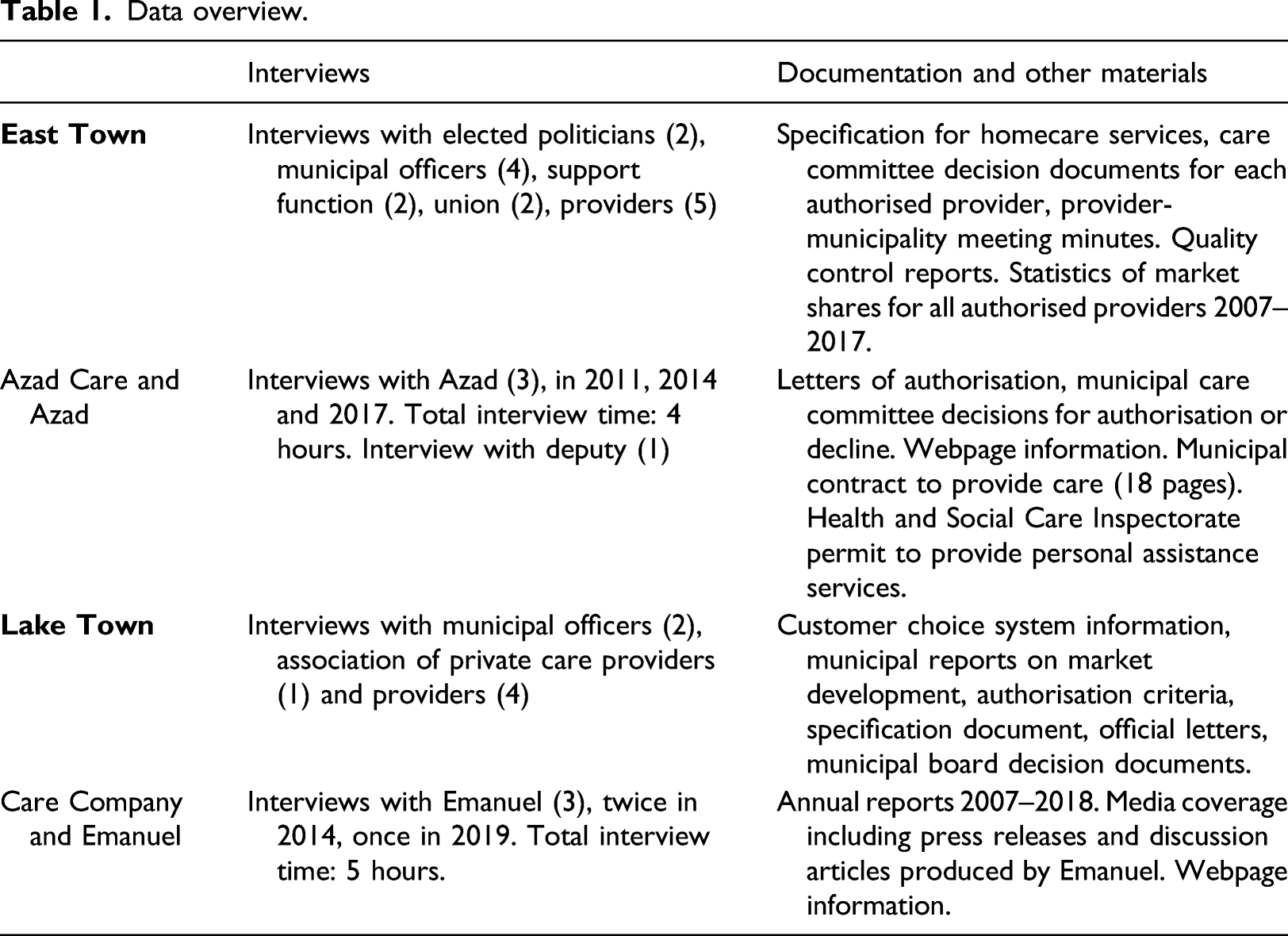
The interviews with entrepreneurs utilised a narrative approach to the life stories of the firms in order to elicit a rich picture of their perceptions of the entrepreneurial process and their interactions with others, including the prerequisites of the market for establishing and developing the business. More specifically, we asked the entrepreneurs to describe their experiences of acting as providers on the local homecare market. To support the production of case narratives, where content and process are situated in context, questions pertaining to the specificity of the context were posed. With the municipal officers in East Town and Lake Town, the focus of the interviews was their experiences of interacting with the entrepreneurs in their role as market organisers. We asked them to describe the objectives and means of organising as well as any dilemmas involved in interacting with entrepreneurs in the local customer choice market. Such dilemmas included the level and forms of regulation, in combination with the ambition to ensure supplier diversity, given that the principle of local autonomy means that municipalities have a certain mandate, within legal frameworks, to ensure proper regulation, including criteria for authorisation.
Data analysis and conceptual development
The analysis and theoretical framework presented in this article were developed through an iterative process. The empirical material was analysed using several methods, including processual, narrative and comparative analyses. Given that an understanding of how change occurs ‘requires a story that narrates the sequence of events that unfolds as a strategy changes over time’ (Van de Ven, 1992: 170), the material was sorted into a chronological sequence for each case. The narrative analysis targeted specific events (Steyaert, 1997; Van de Ven, 2007) highlighting the interaction between entrepreneur actions and the local opportunity structures as well as changes. Based on this grounded understanding of the process, the combined framework was constructed; then the dynamic states approach was added to enhance the agency dimensions of the analysis. The events were then coded in the language of a combination of theoretical concepts derived from the ME perspective and dynamic states framework, focusing on opportunity tension throughout the processes of each embedded case of entrepreneurship. The dimensions of events that could not be coded based on existing concepts were conceptualised using a complementary terminology to help make sense of the results, as an elaboration extending beyond the established concepts. As such, each story pays attention to both empirical events and theoretical concepts, in order to capture the interplay between mixed embeddedness and the entrepreneurial process of each case. A subsequent comparative analysis of the two cases serves to identify differences and similarities between the two processes (Miles and Huberman, 1994), to enable abstraction.
Results
Chronology of key events in the cases of Azad Care and Care Company.
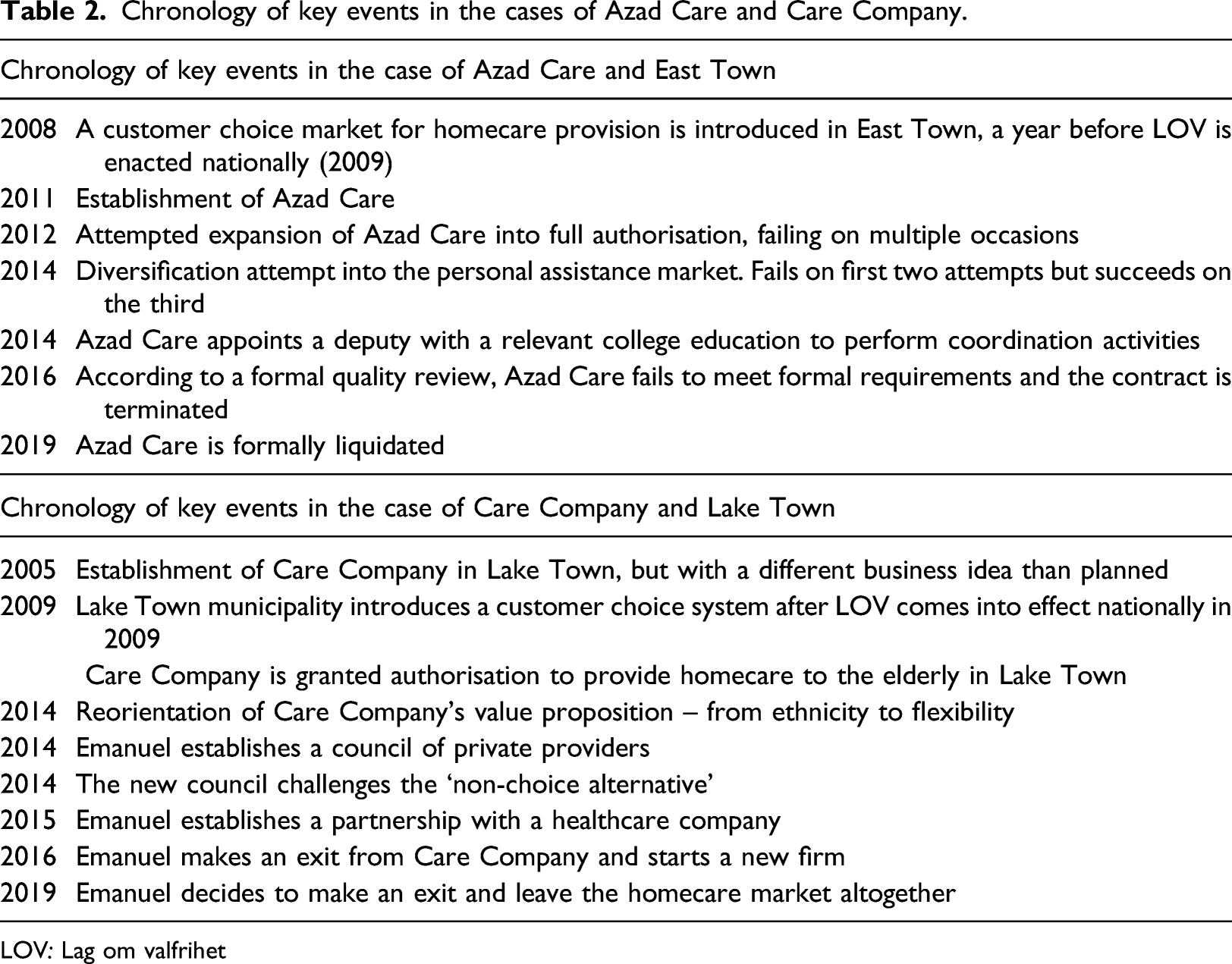
LOV: Lag om valfrihet
East Town and Azad Care
In East Town, some 3500 citizens are entitled to homecare. By means of the local customer choice market for homecare provision, local politicians developed a vision of supplier diversity, offering a diverse set of services for the elderly to choose from. It was assumed that this would empower the clients, drive quality and reduce costs. East Town entertains an image of being a modern municipality, keen to introduce innovative solutions and new ways of organising its responsibilities. Due to previously established public procurement arrangements in elderly care, large multinational firms were already present in the market when the customer choice market for homecare was introduced. To facilitate entry for small firms, the market was organised into segments such as cleaning, shopping and personal care, and geographical areas.
In a customer choice market, the customer (service user) chooses their provider from among those authorised by the municipality, but it is the municipality that pays providers for the service, not the user. A provider cannot turn a client down. In cases where the user does not choose a provider, there must be a non-choice alternative. This is not regulated by LOV and is hence organised differently in the municipalities, which has vast consequences for providers (Sundin and Tillmar, 2010). The non-choice alternative in East Town was organised according to the principle that the provider running the local nursing home was mandated to tend to all the elderly who did not actively choose a provider in that neighbourhood. This solution was attractive to already-established organisations that could compete for the tenders to run nursing homes but worked as a hindrance for newcomers to the homecare market. Together with the municipality’s own provider, large, listed firms came to dominate the market, with a market share of 99% within 2 years of the model being introduced (57% for large, listed firms, 42% for the municipality and 1% for small and medium-sized enterprises). Since its inception, 41 providers have been authorised to provide care in East Town; there were 21 providers in the first 3 years. Many of them did not survive for more than a few years.
Many articulated an interest in starting businesses and indeed, some did. Several new small firms were authorised to provide homecare but most failed to establish a client base and had to withdraw. Despite the gloomy outlook, the municipality retained the objective of increasing the number of small local firms. In 2011, the first new local firm targeting the segment of elderly people who wanted care provided in languages other than Swedish was established, Azad Care. In his authorisation letter, Azad explained his vision of providing care to the elderly based on his competencies in several different languages and cultures. He identified himself as ‘a Swedish Kurd’, having migrated to Sweden from Iraq with his family in the late 1990s at the age of 16. His primary aim was to target a segment that included foreign-born elderly people who did not receive sufficient help from the current establishments, but also elderly Swedes. He had prior experience of working in eldercare, both for the municipality and for large, listed companies and argued that they had both failed to provide culturally competent care. Based on Azad’s high-school education as an assistant nurse and previous experience of working in the care sector, Azad Care was authorised to provide care and services, but not assistance assessment for which he did not have the formal qualifications required by the authorities. It was thus, only a partial authorisation and the number of hours he was eligible to provide was restricted by the firm’s initial capacity. The start-up phase was frustrating for Azad because he felt limited by the municipal authorities in pursuing his vision. They were a bit cautious at first, even though I had good references. I had even been employed by the municipality … And they gave me good references. … It was like war between me and them, because I wanted to increase the number of hours that I could provide. They increased the level from 160 to something like 500. But I wanted to develop more. (Azad, interviewed in 2012, our translation)
Azad’s financial support consisted of an unemployment-based activity grant for the first 6 months of operations. Family members helped once the firm had engaged its first few clients. Despite Azad’s prior entrepreneurial experience in a pizza restaurant, training as an assistant nurse and work experience in elderly care, the municipal authority was reluctant to grant him the volume of operations that he requested, arguing that he did not follow the regulations properly. Azad considered this treatment to be unfair. He felt discriminated against based on prejudice due to his status as an ‘immigrant’ with a ‘strange name’. He wanted to prove himself capable of developing the company into a successful business and demonstrate that ‘not all immigrants are bad’. I’m not saying I’m a perfect person. No one is. I probably have lots of flaws, but I am trying not to make mistakes. I try to be good. I try to develop. I want to show that I’m doing well, I want to show that not everyone is bad. There’s a lot of talk about immigrants. That ‘they’re bad’ and ‘they don’t want to work’, and stuff like that. But there are no jobs. We can help, we can get jobs, we can do it! (Azad, interviewed in 2012, our translation)
Azad dreamed of developing a firm that would include all elderly people, grow to encompass new markets and sectors and become a large company that would earn him recognition. The regulations enacted by the municipality were his main hindrance. The municipality makes all the decisions. The municipality could come tomorrow and say: ‘We’re terminating the contract’, even if I did nothing wrong. What are we to do? Should we go to war against them? I don’t think we’ll succeed with that. We don’t have the power, we don’t have the money. We’re just a small company. They won’t believe in us. (Azad, interviewed in 2012, our translation)
Despite the regulations, and over time, Azad was able to develop his business and gain legitimacy when he was chosen by elderly people as their homecare provider. Satisfied clients spread the word and gradually the municipality authorised him to provide more hours across larger geographical areas. Having personal experience of being unemployed and suffering difficulties in the labour market, Azad sought to employ people in a similar situation. He engaged individuals who were competent in the languages and cultures of his clients. By the end of 2014, Azad Care held a market share of 4%. The 31 employees tended to the needs of 40 homecare clients. By this time, additional small local firms had been established, several serving the same segment. Subsequently, Azad Care sought to enter the personal assistance sector with the same business idea and staff. However, the application for authorisation was declined by the municipality, which asked for additional specifications and further training. Azad found this treatment suspect, and he turned to a lawyer for help. ‘It must be due to my background, you know, or the name’, Azad argued. At the third attempt, the firm was finally authorised to provide personal assistance.
The new small firms entering the market created a dilemma for the municipal officers responsible for ensuring that the market was functioning according to both legislation and political directives. The new providers met the formal level necessary for authorisation but did not behave as expected. Lack of experience was identified regarding the provision of care as well as in running a business. Due to the political objective to increase diversity among providers, the municipal officers developed a support function providing education and information to help the new providers develop their competencies. The dilemma was also perceived as a problem of regulation, dealt with by adding further competence requirements to the contract agreements, including a requirement that the acting manager hold a college degree.
Continuing growth meant that the municipal officers expected Azad to act more professionally. Azad hired a deputy with a relevant college education to perform coordination activities. Despite this, the municipality declined to authorise Azad Care to perform assistance assessment due to Azad’s lack of formal qualifications, arguing that he was still the acting manager. His experience of running Azad Care for a few years was not considered enough to compensate for his lack of a college education. Azad considered this treatment to be very unfair, and he had little faith in East Town Municipality. I have a lot of ideas, things that could develop personal care for the elderly, but I don’t get the opportunity to realise them. Politicians in charge don’t seem to have very good experience of the homecare sector. They focus on reducing costs but have no idea how to do that. … I won’t surrender but will keep on fighting this. (Azad, interviewed in 2014, our translation)
Azad established a limited liability company to try to win a tender for the local nursing home, but the bid was turned down due to the firm’s small size and his lack of formal qualifications. Azad took the case to court but lost. In 2015, when the municipality increased its efforts to control the homecare operations of all care providers, Azad Care faced critique on several points, including the implementation of its internal quality management system. Despite working with consultants who had formal expertise and long experience in the sector to ensure that the operations were run in accordance with requirements, Azad Care failed to meet the criteria stipulated in the quality controls, as well as the subsequent follow-up, and the municipality terminated the contract in 2017, along with those of six other providers of homecare. With 38 employees to consider, Azad refused to terminate the business and resisted closure with the help of lawyers and consultants, but he failed to regain the contract. Azad perceived this as a question of lack of trust in private firms in general and in particular because of his immigrant status. They [the municipality] don’t wish to see an immigrant develop and succeed. (Azad, interviewed in 2017, our translation)
In 2019, the company was formally liquidated. The customer choice market is still in place in East Town but problems related to small private providers caused the municipality to investigate alternatives to a customer choice market for providing homecare.
Lake Town, Care Company and Emanuel
While enrolled in a college nursing programme, Emanuel heard a teacher argue that all citizens in Sweden have equal access to care. Having migrated to Sweden himself, Emanuel had a social network that offered him insight into the situation of many elderly people born outside of Sweden and he knew that elderly people who had migrated to Sweden were often cared for by relatives rather than by municipal services. This gave him the idea for a firm that would provide culturally competent homecare for the elderly in their native language. A survey supported his assumption that elderly people born outside of Sweden were not part of public homecare to the same extent as those born in Sweden. At the time, there were people trained in care work, with the right language skills, available to employ in Lake Town and so, there was an opportunity to combine clients and care providers. In management student Markus, Emanuel found a complementary business partner and together with a silent business partner who provided some financial capital, they started Care Company in 2005. Situated in a science park, they developed skills and networks that would later enable them to access additional resources.
In 2006, Emanuel and Markus submitted a proposal to Lake Town Municipal Council to be private providers of homecare. Simultaneously, they circulated a press release that caught the media’s attention, telling Lake Town that they wanted to offer ‘homecare to immigrants’. However, at this time, neither the political agenda nor the legislation was working in their favour and they were rejected. Instead, Emanuel and Markus provided tax deducted household services according to ‘RUT’ (a 2007 national tax reform and an acronym for ‘rengöring, underhåll, tvätt’ – cleaning, maintenance and laundry services), hoping that eventually, they could realise their ideas. In an attempt to influence circumstances, Emanuel took the initiative and spoke to local politicians in his network about his ideas relating to the benefits of involving private firms in the provision of care to elderly people who had migrated to Sweden. One of these Lake Town politicians was influential in the LOV reform and Emanuel’s initiatives were later acknowledged when he was invited to serve as a member of the national Welfare Development Council, appointed by the Government.
In 2008, Lake Town Municipality decided to introduce the customer choice system, which would enable Care Company to undertake its mission. The customer choice market was launched in January 2009, at the same time as LOV was enacted nationally, making Lake Town the first municipality to enact LOV locally after the national reform. Freedom of choice for the elderly was the primary political purpose. The municipality wanted small local firms to offer homecare services to the area’s 1800 users of homecare thereby, complementing the municipal provider. To accomplish the political vision of increasing freedom of choice, the municipal officers invested much effort in facilitating small local businesses to establish themselves, such as providing education when needed.
Like East Town, the private providers could choose among different service offerings when applying for authorisation, enabling them to start small and develop gradually. Furthermore, the municipality actively chose to keep the formal competency requirements for authorisation low, which was made possible by separating assistance assessment and production. The guidelines for private providers were in line with criteria for managers in the municipal eldercare units and therefore, did not require a college education. The non-choice alternative in Lake Town was organised differently from that in East Town. Here, the municipality tended to all clients who did not make an active choice of provider. According to municipal officers, private firms had a poor reputation among some municipal representatives, who assumed them to be ‘profit-maximisers who are only in it for the money’. During the first year, 13 providers were authorised to provide homecare. At present, a total of 37 care providers have been authorised in Lake Town, Care Company is among three firms still active. Among those that have left the market, the average time in business was 3.4 years (Lake Town Municipality official letter, 2019). In 2020, Lake Town had 16 authorised providers of homecare.
When the decision to implement LOV in Lake Town was formalised, Care Company applied for, and was granted, authorisation. However, reaching clients and informing them about the opportunity to choose a provider turned out to be difficult. To promote the company to potential clients, Emanuel met with a diverse set of organisations, including religious communities, to inform them about the business idea. The business started out small but grew quickly. Initially, Care Company targeted the most common languages spoken in Lake Town but had the ambition to diversify according to client needs. However, the language profile is only part of the success story. Care Company’s services were sought by a wider clientele than targeted, that is, beyond those asking for care in a specific language. This was justified by Emanuel as due to the firm’s reputation as an established local firm providing flexibility in terms of the services offered. Its prior establishment as a cleaning company and the media attention received supported this notion. We had some difficulties in enacting the niche that the company was aiming for. I thought it would be easy, but it wasn’t. At the beginning, some 90 percent were ethnic Swedes. Only a few spoke other languages. But our niche was ‘Homecare on your terms’. This attracted others as well. When we started out, we were the only locally established company. (Emanuel, interviewed in 2014, our translation)
Elderly Swedes with a non-immigrant background found Care Company’s services attractive and, according to Emanuel, they ‘didn’t think of us as providing care only to immigrants’. Positive word-of-mouth recommendations meant that, with time, the company grew and also attracted clients asking for services in a specific language and with a specific cultural background. With time, Care Company developed its offer in eight different languages and cultures by matching client demands and staff competences. Net sales increased by 1540% between 2008 and 2009 and by an additional 220% between 2009 and 2010.
The homecare market attracted other firms, and several established themselves in the foreign-language niche. Emanuel suspected that some were acting opportunistically in relation to municipal regulations. For instance, through his networks, he learned about firms that hired relatives of clients and charged for services that were not performed. This development, coupled with a nationally recognised scandal in the homecare market within another municipality, where companies had been found guilty of exploiting the customer choice system for personal gain, led Emanuel to fear a similar scandal in Lake Town. Given that he had been a proponent and initiator of the customer choice system, he was concerned for his own reputation as well as the company’s and worried that the municipality might resolve the problem by introducing a procurement solution that would invite large firms to take over the market entirely. The competition is not on equal terms. We had a meeting with the municipality a few weeks ago, on our initiative, pointing out that ‘We know there is cheating going on’. The last thing that we want is another scandal … The one that happened in [another municipality] is enough, it infected the whole sector. (Emanuel, interviewed in 2014, our translation)
This development led Emanuel and Markus to rethink their business idea. Instead of focusing solely on ethnicity, flexibility in terms of how the care was to be performed was made the new profile. Now we’re going to change our profile, and the way we market ourselves, in order not to be associated with the shady ones. So, we intend to remove the language profile as much as possible. (Emanuel, interviewed in 2014, our translation)
Emanuel felt that the municipality did not engage in dialogue with the established providers and were not interested in listening to their experiences. This included a lack of interest in learning about their insights into the opportunistic behaviour of some of the ‘shady’ providers. Thus, Emanuel took action to establish a committee where private providers could work together to influence the municipality. Only those few firms that he considered to be ‘committed to developing the sector’ took part in the meeting however, and his frustration with the less reputable firms continued.
Emanuel identifies himself as Assyrian. He came to Sweden as a refugee at the age of 14, unaccompanied by his family; he was in his 40s as the time of the study and so, had lived in Sweden for more than half his life. Yet, every day he is reminded of being ‘different’, due to his name and background. His idea of ethnicity is ambivalent. On the one hand, ethnicity is something that legitimises his firm’s intended niche; he speaks of himself as Assyrian, living in an Assyrian community. This position is ambivalent because it offers both a network and an understanding of client needs, but also insights into other firms and their ways of working. Like Azad, he is keen to demonstrate the positive values that people born outside Sweden can bring to Swedish society while keeping Swedish culture and traditions intact, advocating an assimilation strategy for ‘immigrants’. He has strong political views and is engaged as an elected representative for a liberal-conservative party on the City Council – a commitment that he considers offers him at least some respite from the disadvantages of being categorised as different.
One of the issues that the committee of private providers joined forces to influence concerned instances of unequal treatment of public and private providers. The ‘non-choice alternative’ is such an example. When LOV was implemented in Lake Town, the municipal provider was given the task of providing care for everyone who did not make an active choice. The private providers viewed this as an inhibition of competition and so, a violation of both Swedish law and EU legislation. In 2013, the municipal officers heeded this call and provided an official letter proposing a new model in which all providers would take turns to care for new care clients who entered the homecare system without making an active choice. Initially, this proposal was declined but when it re-emerged in 2016, it was approved and implemented as part of a revised set of contract documents. Emanuel saw this as an example of some improvement in the dialogue between the municipality and private providers.
By 2014, Care Company employed 55 people, amounting to 27 full-time positions, including employees who worked mainly with household services; there were 90 homecare clients at that time. Turnover was almost 12.5 million SEK but according to Emanuel, the firm was still dependent on providing subsidised household services to maintain profitability. By this time, some 15 providers of homecare had been authorised and were offering homecare to the elderly in Lake Town. Four of the firms that had been present from the beginning had grown substantially. Taken together, the private providers tended to 20% of the town’s elderly clients and provided some 25% of the total hours. The rest of the market share was held by the municipality’s own provider. Large, listed firms that entered the market had difficulties in meeting their targets and later left the market. In 2015, Markus left Care Company to focus solely on his tasks as CEO of a new firm developing planning software for the care sector. The idea for this venture grew from frustration with the administrative tasks that has to be undertaken as providers of homecare and because of network connections Markus and Emanuel had made in the science park.
At the same time, Emanuel was poised to act on yet another of his ideas to achieve Care Company’s mission. This time, long-term collaboration with a health centre was established to provide continuity for Care Company’s elderly clients in terms of both healthcare and homecare. The owner of the health centre company was committed to the joint venture and took action to buy into Care Company. By purchasing the shares of Emanuel's silent partner, the health centre company owner managed to gain a position on the board. At the very first board meeting, problems arose when the new co-owner made demands that Emanuel found inappropriate. Eventually, the new owner took control of Care Company and within a year, had forced Emanuel to leave his position as head of the company. I was summoned by the company’s lawyer, who said that I could choose between taking up work as a janitor in the company or make an exit. (Emanuel, interviewed in 2019, our translation)
Emanuel feared for his reputation and decided to leave the company. He made sure to keep the municipality informed of this development. As he made his exit as CEO of Care Company, he had already begun the process of setting up a new firm established and authorised in 2016. Both employees and clients followed Emanuel to the new firm; by late 2017 he had 14 employees and tended to approximately 30 clients. This could be regarded as yet another success but the situation in which Emanuel found himself and the new firm was quite different from when he had established Care Company a decade earlier. Due to the many care providers and a shortage of assistant nurses, the market had become one in which employees had greater power and tended to negotiate better terms when seeking employment so raising salary levels. In order to cope, I had to deviate from my own key principles of continuity and safety. It didn’t feel like my own company anymore when I was only putting out fires. I wanted to establish collaboration with nursing schools and develop remote training, but it wasn’t possible to implement this. After trying everything, I realised that it wasn’t possible to keep operations up given the conditions. (Emanuel, interviewed in 2019, our translation)
Instead of running a business in which the client was the focus, Emanuel realised that he was spending more time dealing with staffing issues. He was not prepared to engage in the unethical behaviours he saw others doing to be able to remain competitive. In early 2019, he decided to leave the homecare market altogether as he saw no future for the business.
The customer choice market is still in place in Lake Town, but municipal investigations are underway to address the dilemmas that have arisen. A lack of qualified nurses and collaboration issues are hindrances to development in the sector and the municipality is considering alternative ways of organising the provision of homecare to the elderly. The investigation has concluded that elderly people born outside of Europe are now overrepresented as homecare users. This is explained partially by health concerns within this group and partially by the development of the customer choice market and its prerequisites.
Discussion
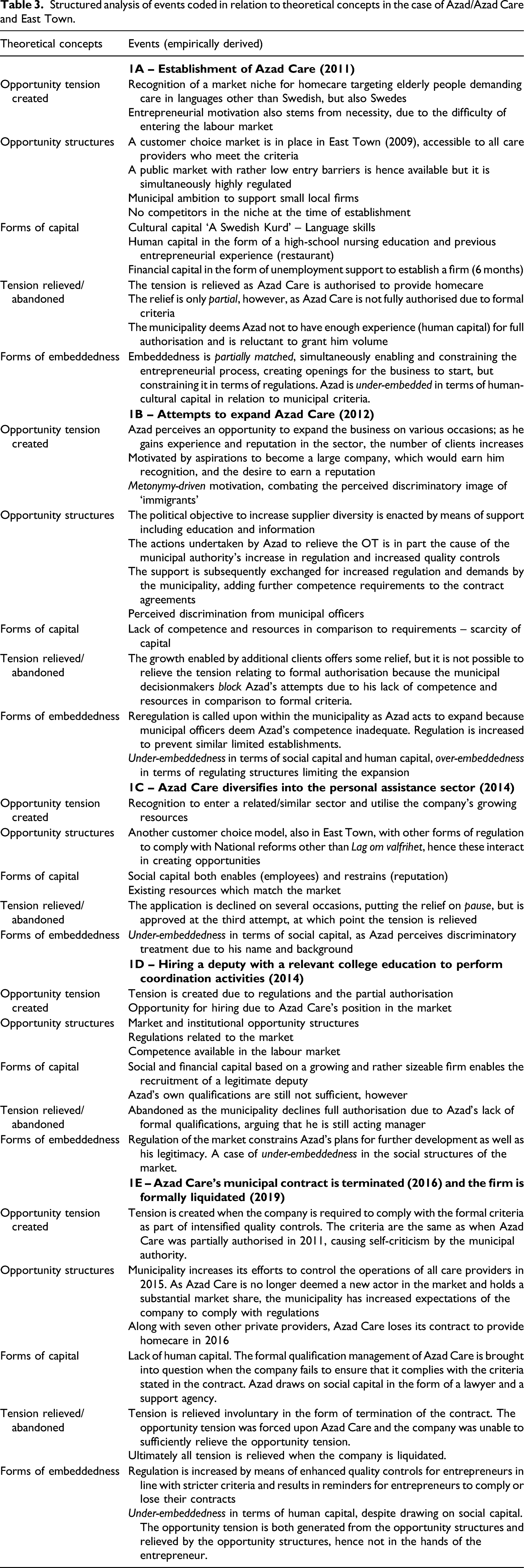
Structured analysis of events coded in relation to theoretical concepts in the case of Azad/Azad Care and East Town.
Structured analysis of events coded in relation to theoretical concepts in the case of Emanuel/Care Company and Lake Town.
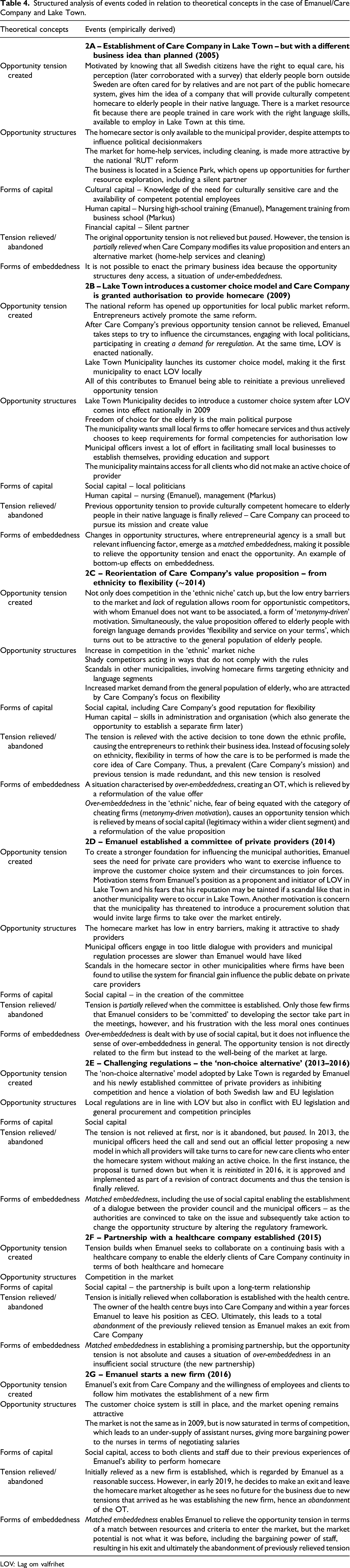
LOV: Lag om valfrihet
In the following discussion of the results, we draw on these coded events and reference the codes presented in Tables 3 and 4 in order to present the overall pattern of interactions between agency and structure in the mixed embedded entrepreneurial process. Intertwined with this discussion, we present additional concepts to improve our understanding of the phenomenon. The notation (1A; 2B; etc.) refers to the coding of events in each longitudinal timeline of Tables 3 and 4.
Opportunity tensions are not only relieved
Opportunity tension builds up due to an entrepreneur’s ‘felt belief that the emerging opportunity is worthy of pursuing’ (Lichtenstein, 2009: 20). This felt belief and the emerging opportunity are simultaneously shaped by, and matched to, both the opportunity structures in which the entrepreneurs are embedded and the forms of capital to which they have access. In the analysis, this match proves true in some of the events analysed, including 2B, where Emanuel and Care Company are authorised to provide homecare after the enactment of a local homecare market in Lake Town. Here, several forms of capital make it possible for the entrepreneurs to relieve the opportunity tension. In contrast, in cases such as 2A and the first attempt by Emanuel and Markus to establish a homecare business, the opportunity structures did not match because the market was not open to private entrepreneurs and, thus, the tension remained unrelieved. As described in the case narratives, opportunity tension is not a singular event but rather presents itself in waves or pulses (Levie and Lichtenstein, 2010). The events demonstrate the continued efforts made by Azad and Emanuel to relieve the opportunity tensions that arose after firm establishment. Several of the analysed events reveal situations where opportunity tensions were not just relieved (2B; 2C) or abandoned (2F; 2G), as suggested by the theoretical framework (Lichtenstein, 2009), but also partially relieved (1A; 2A; 2D), blocked (1B), paused (1C; 2A; 2E) and/or reinitiated (2E). This development of the notion of opportunity tension takes the concept beyond a binary discussion of relief or abandonment to demonstrate how opportunity tensions interact with opportunity structures to take on new forms.
Analytically, the opportunity tension of each event can be categorised as primarily generated either by (changes in) opportunity structures (1A; 2B; 2C; 2G) or by entrepreneurial intentions (2A; 2F). Most often however, it is the interaction between opportunity structures and entrepreneurial intentions that generate the tension. Hence, disentangling agency and structure in this process is relevant from an analytical point of view. This is evident in several of the events, including 2C, when Care Company found itself tending to Sweden-born elderly people rather than the intended niche, which turned out to be a solution to relieving the tension caused by fear of discrimination. Another example is 2D, where Emanuel sought stronger ground to influence the municipal authorities by establishing a provider council. The motivation stemmed from both endogenous sources (an improved position in relation to the municipality) and exogeneous sources (fear of scandals and municipal reregulation).
Reregulation stemming from entrepreneur actions
The actions of entrepreneurs have bottom-up effects (Johns, 2006) on local opportunity structures. Examples include 1B and 1C in the case of Azad, as his continued efforts to seek expansion and full authorisation despite insufficient human/cultural capital led the municipal authority to respond with support efforts in the first instance (1B), including regulatory persuasion by means of ‘carrots’ and ‘sermons’ (Kloosterman and Rath, 2010). In a subsequent event (1D), however, the bottom-up effects were new control efforts and reregulation attempts that Azad failed to live up to (1E). As a result, he was relieved of his contract, and all tension ceased.
Reregulation, we argue, is triggered when municipal officers realise that there are imperfections in the market that need to be acted upon by means of new or different regulations. Municipal officers engage in a reregulation effort and act to gain the political mandate for such a decision. The new state of regulation is achieved when there is a political decision and subsequent enforcement of said regulation. In our two cases, reregulation was caused by entrepreneur actions in several identified events (1B; 1E; 2B; 2E). In the case of Azad, his establishment was accompanied by only a partial authorisation (1A), which led the local authority to realise that it had set the regulatory bar too low; hence, over time, this bar was raised. In the case of Emanuel, the non-choice alternative was actively targeted by the provider council (2E) and over time municipal officers became persuaded to take on the issue and reregulate that market condition. The result may be either favourable or detrimental to entrepreneurial aspirations.
Patterns of embeddedness
The reregulation activities of the municipality and the opportunity tensions acted upon by entrepreneurs are intrinsically intertwined, changing the landscape and prerequisites of opportunity structures over time. In the case of East Town, we identified a spiral of increasing regulation, or over time ‘thicker’ forms of regulation (Kloosterman and Rath, 2010). In the case of Lake Town, the development was more varied. Some regulation efforts resulted in a ‘thinner’ form of regulation, as when the provider committee managed to influence the regulation of the non-choice alternative (2E). As in East Town, over time the regulating authority learned which criteria were relevant to ensure the provision of homecare; thus, the specifications were altered. Emanuel even considered that some entry barriers were too low, as they allowed ‘shady’ businesses and unfair competition.
Taking a more distanced view of these events, we see that different patterns emerge. When there is a match between the opportunity structure and the aspirations of the entrepreneur aiming to relieve an opportunity tension (2B; 2E; 2F; 2G), the tension can be relieved. There are also examples of a partial match, as in 1A, where Azad Care is only partially authorised. In some situations, however, the embeddedness restricts entrepreneurs from relieving the opportunity tension, due either to under-embeddedness or over-embeddedness. Under-embeddedness refers to a situation in which an entrepreneur finds themselves lacking the capital or supportive structures that would enable the opportunity tension to be relieved (1B; 1C; 1D; 1E; 2A). Over-embeddedness refers to situations in which opportunity structures restrict the relief of an opportunity tension (1B; 2C; 2D; 2F).
The patterns of matched, over- and under-embeddedness highlight the differences between the cases of Azad and Emanuel. Despite similar value propositions and local opportunity structures, their experiences of interacting with their respective opportunity structures were quite different. This can be explained by the forms of capital accessible to or accumulated by the two entrepreneurs (primarily Emanuel’s ability to generate and enact social capital, as in events 2B, 2C, 2D, 2E, 2F and 2G), and what this meant for their respective ability to interact with the opportunity structures, in the shape of municipal officers, local politicians, clients and others. In terms of the opportunity structures in which they were embedded, some elements were similar. Initially, both East Town and Lake Town Municipalities set low formal requirements for competencies among those applying for authorisation to enter the sector. In terms of the accessibility of opportunity structures (Kloosterman, 2010), the initial level created a double-edged sword for new entrants. On one hand, the formal process of authorisation was a barrier, but on the other, these openings were relatively free from formal qualifications. This accessibility subsequently drove reregulation as municipal officers started to question the performance of new entrants, including Azad but not Emanuel. With time, the bars were raised to ensure that all providers were meeting the standard required (1E). We learn that the market was never fully open to Azad, because the municipal officers in East Town were not satisfied with his human/cultural capital, and thus actively restricted his access to the full potential of the market. As such, accessibility, and to some extent market attractiveness (Kloosterman, 2010), is constantly negotiated, and the intended strategies of the firms are constantly played off against the demands of the gatekeepers.
A common stream of literature within EMB highlights discrimination as a deep-rooted and prevalent part of ethnic minority business and immigrant entrepreneurship (Bonacich, 1973; Carter et al., 2015; Ram, 1994). Labour-market discrimination is often viewed as a major motivation, driving nascent EMBs into self-employment. However, processes of discrimination can also take place post start-up in EMBs. The case of Azad indicates that perceived discrimination can recur throughout the process of entrepreneurship (1B; 1C). Azad perceived the blockage that he experienced from the municipality to be based on his foreign name and immigrant status. The perspective of the municipal officers differed, as they claimed to be doing what they could to support new and small firms and to uphold the municipal vision of diversity. In their view, the criteria were equal for all, regardless of background or status. The dilemma they faced was one of safeguarding the quality of services by means of setting high standards for service provision whilst facilitating supplier diversity. The differences in points of view are, of course, a difficult thing to come to terms with, and for the purposes of this article, we merely offer the two perspectives.
A paradox of ethnicity and metonymy-driven opportunity tensions
The varying experiences of these entrepreneurs amount to a paradox of ethnicity, in that ethnicity can be both a resource and a potential liability; and this ambiguity also poses a difficult balancing act for the actors involved in regulating the opportunity structures. Our comparison of Azad’s and Emanuel’s experiences demonstrate that ethnicity permeates the businesses of ethnic minority entrepreneurs in complex ways (Rezaei, 2007). In the case of Azad, ethnic and cultural capital were the basis for legitimacy in establishing Azad Care and the language niche. But ethnicity was also Azad’s explanation for why he was marginalised on the labour market. For Emanuel, access to the labour market was not an issue. He had both human/cultural and social capital, enabling acknowledgement far beyond that of Azad. For Emanuel, the idea of providing better care than others, particularly involving a group of (foreign-born) elderly people who were insufficiently tended to by public services, was the main driving force. During the phase of establishing Care Company (2B), Emanuel’s identity as an immigrant and an Assyrian served to legitimise the firm’s diversity profile. Simultaneously, he expressed a dislike for being treated as different and feared being associated with businesses that were using the system for unethical purposes.
We coin the term ‘metonymy-driven’ for entrepreneurial actions undertaken due to a fear of being equated with ‘shady’ businesses relating to scandals or, in the case of Azad, with perceived discriminatory images of ‘immigrants’. Metonymy refers to categorisation and labels, such as ‘immigrant’ or ‘elderly’, that, once attached to a person, make that person synonymous with both the category and the stereotypical traits attributed to that category (Högberg et al., 2016; Pred, 2000). In our analysis, we highlight several metonymy-driven opportunity tensions, which served as a strong motivation to act, either to avoid the negative association or to change its meaning, as in the case of Azad. In Emanuel’s case, his fear of being associated with ‘shady’ providers motivated him to reorient his firm’s value proposition away from culturally sensitive care to a focus on flexibility. And matters did not stop there for Emanuel; his constant mission to distance himself from potential scandals led to his initiation of the committee of providers (2D). Furthermore, his partnership with a healthcare company (2F), initiated to enable the quality and continuity of care for his clients, can also be considered part of his efforts to avoid metonymy by improving the quality of the services provided. But instead of differentiation, the strategy created a trap of social capital in which the ‘shady’ behaviour became included in Emanuel’s own firm and yet another opportunity tension began to build, based on metonymy-driven motivation, and was only relieved when he made an exit and started a new firm (2G).
Given the research design and choice of cases, this research has some obvious limitations. As previously described, the Swedish public sector and its quasi-markets for homecare constitutes something of an extreme case regarding regulation. The benefit is that this enables a close examination of changing opportunity structures in relation to entrepreneurial actions, and vice versa. While we acknowledge the limited generalisability beyond the empirical context of a case study, we argue that the understanding of prerequisites for EMB under such circumstances is still relevant. The paradox of ethnicity is arguably not limited to the experiences of the two entrepreneurs included in this analysis. The theoretical approach developed to enable an analysis of mixed embeddedness beyond new venture creation is not limited to this context but offers an approach to mixed embeddedness as a dynamic interaction between agency and structure.
Finally, we highlight some implications for policy. In a public quasi-market context, awareness of both opportunity tensions and reregulation may be balanced if there is an opportunity to establish dialogue between the public authorities and entrepreneurs. Given the paradox of ethnicity highlighted here, it makes sense for public officers to pay additional attention to the establishment of dialogues about opportunity tensions and structures in markets enacted with the very purpose of increasing diversity. For entrepreneurs, the thick forms of regulation that pertain in public markets can seem overwhelming. We shed some light on the forms of capital and entrepreneurial strategies that seem most promising as a basis for relieving such opportunity tensions.
Conclusion
In this article, we develop a dynamic approach to mixed embeddedness which acknowledges entrepreneurship as a process of becoming. To this end, we brought together the mixed embeddedness perspective and the dynamic states approach in a framework that is suitable to analyse the process of entrepreneurship beyond new venture creation as embedded in and interacting with multiple and changing contexts. By using the concept of opportunity tension as a lens for exploring the dynamic and recursive interplay of embedded processes, the analysis of entrepreneurship embedded in reregulated quasi-markets for homecare demonstrates how different patterns of embeddedness – over-, under- or matched embeddedness – form in relation to emerging opportunities, influencing an entrepreneur’s ability to relieve the opportunity tension and so, their ability to create, deliver or capture value. This approach to opportunity tension extends beyond a binary discussion of relief or abandonment to demonstrate how opportunity tensions can also be paused, blocked, partially relieved and reinitiated. In so doing, we also contribute to a more developed understanding of opportunity tension. The agency of entrepreneurs disrupts and distorts the embedding opportunity structures, intentionally and unintentionally, sometimes stimulating further regulation. Opportunity structures are not static and approaches to regulation are not fixed but adapt in relation to the entrepreneurial opportunity tensions and actions. As such, the market can be partially open, or closed to entrepreneurs, due to increased or decreased regulation altering the threshold for both access and attractiveness (Kloosterman, 2010).
The entrepreneurial life stories situated within the reregulated quasi-markets for homecare presented here offer insights into a paradox of ethnicity, whereby ethnicity presents itself both as a potential resource and a potential liability. This creates a delicate balancing act for the entrepreneurs and those with a responsibility to ensure the proper regulation of customer choice markets. The concept of metonymy-driven opportunity tension is useful to describe how entrepreneurs disassociated themselves from the negative connotations connected to ethnic identity as they attempted to disengage from that structure. This matters for entrepreneurship research in a wider context by offering an alternative story of entrepreneurship, beyond the mainstream narratives of emancipation and salvation (Brattström and Wennberg, 2021), including the hardships, overcoming of obstacles and facing of new opportunities through recurring opportunity tensions.
By applying the dynamic mixed embeddedness approach to the case of entrepreneurship embedded in reregulated public markets for homecare, we offer an empirical contribution to the ME perspective as urged by previous research (Kloosterman and Rath, 2003; Razin, 2002). By directing theoretical attention to process and agency, dimensions of entrepreneurship that have arguably been lost in the popularised version of ME (Barberis and Solano, 2018), we add to an understanding of EMB and IE as dynamic and embedded in multiple contexts that coevolve with entrepreneurial aspirations beyond venture start-up.
Footnotes
Funding
The author(s) disclosed receipt of the following financial support for the research, authorship, and/or publication of this article: This work was supported by Knut and Alice Wallenberg Foundation; Vinnova under Grant 2014-03143; and FORTE under Grant 2006-1524.
