



Abstract
This article employs Stones’ (2005) Strong Structuration Theory (SST) to contextualise rural entrepreneurship. Through shadowing a single case study of a woman entrepreneur from rural Sweden, we propose gendered-local agency as operationalisation of active agency in practice. While SST positions active agency as a property of agents, we demonstrate it is as a property that is intertwined with both agents and structure. Simultaneously enabled and constrained, gendered-local agency itself becomes contextualised within gender-related and locality-related rural-specific interplay that modifies, preserves and challenges rural structures. The article contributes to the literature on contextualising entrepreneurship through a structuration lens by signifying gendered-local agency as a manifestation of rural-specific interplay between contexts as environments (out there) and context as constructed (through entrepreneurs). This conceptualisation proposes everyday entrepreneurship as a demonstration of agency in action, thus setting a foundation for exploring entrepreneurship through the context-specific agent-structure interplay in the rural context and others.
Keywords
Introduction
Contextualising entrepreneurship and exploring its multi-faceted nature are areas of growing importance in the field (Boxer et al., 2016; Korsgaard et al., 2015b; Zahra et al., 2014). This is reflected in research that signifies the value of contexts in shaping entrepreneurial processes through, for example, political and legal contexts that dictate particular laws, norms and tax regulations (Welter and Smallbone, 2011) and shape the way in which the entrepreneurial identities of refugees emerge (Refai et al. 2018). This importance is also evident in the notion of time and entrepreneurial legacy, and how these influence the success of trans-generational entrepreneurship in family firms (McKeever et al. 2015), as well as ethnicity and gender that shape entrepreneurial identities legitimacy (Ozkazanc-Pan, 2014). Contextualisation research has made valuable contributions to related research questions involving tangled social, economic, political, organisational, spatial and temporal factors (Welter 2011; Zahra et al. 2014). These factors are often tacit (Welter 2011), but are valuable for enriching entrepreneurship research (Johns 2006) through various contingent and contextual meanings (Korsgaard et al. 2015b) that evolve continuously through a dynamic interactive process (De Clercq and Voronov 2009). Acknowledging these contextual factors is easier to advocate than to apply, as several challenges arise when considering simultaneous effects of context on individuals, and vice versa (Zahra and Wright, 2011). Such challenges are likely to become more evident in research designs that focus on postal surveys and cross-sectional data that overlook important contextual elements (Zahra and Wright, 2011). These designs also give rise to criticisms around ‘methodological individualism’ (Steyaert 2007) that gives higher ontological priority to the person (the entrepreneur) and overlooks the manner in which actions are formed within culturally embedded contexts.
In this article, we position entrepreneurship as a contextualised phenomenon and add to current conversations and debates on contextualisation by drawing attention to the multi-faceted nature of entrepreneurship within the rural context. We adopt a qualitative approach drawing on shadowing a single case study of a woman entrepreneur in rural Sweden. We advocate theories that show the recursive links between agents (here entrepreneurs) and structures (Welter, 2011), and thus, employ Stones’ (2005) Quadripartite Framework in which he theorises Strong Structuration Theory (SST) (Stones, 2005). By focussing on the rural context in our exploration, we aim to utilise this perspective to understand how the rural-specific contextual factors influence the agent-structure interactions of entrepreneurship in the rural. SST builds on Gidden’s (1984) structuration theory and has, thus far, received little attention in entrepreneurship research (Zahra and Wright, 2016). The appropriateness of SST to this research is observed through its core focus on the duality of structure and agency that supports our focus on contextualisation. For Giddens (1984), ‘duality’ is the key mechanism that explains how agency and structure are intertwined and so, cannot be separated. The actions of agents cannot be understood separately from their structures, nor can structures be understood apart from the purposeful actions of agents. Giddens (1991, 204) clarifies: Structuration Theory offers a conceptual scheme that allows one to understand how actors are at the same time the creators of social systems, yet created by them… it is an attempt to provide the conceptual means of analysing the often delicate and subtle interacting of reflexively organized action and institutional constraint.
Structuration views agents and structure as two sides of the same coin. As shown in Figure 1, agents (here, a woman entrepreneur) are creators of social systems yet, are created by them (Sarason et al. 2006). These social systems become embedded in agent actions; they are ‘both medium and outcome of the practices they recursively organise’ (Giddens, 1984, 374). Stones (2005), and Giddens (1984) before him, argue that social systems are organised through structural properties including formal and informal rules and resources embedded in agent actions. This view presumes upon social life as a process, rather than a product, through which social systems are produced and reproduced (Giddens, 1984; Stones, 2005). Feeney and Pierce (2016) add further clarity to the production and reproduction of social systems by highlighting how agents utilise the institutions and resources in their structure to act in ways that preserve, modify or challenge those structures (Feeney and Pierce, 2016). In this article, we employ the latter conception of preserving, modifying or challenging institutions to explore structuration, as a process, with more clarity. Reciprocal interaction between agent and structure. Adapted from Giddens (1979, 1984).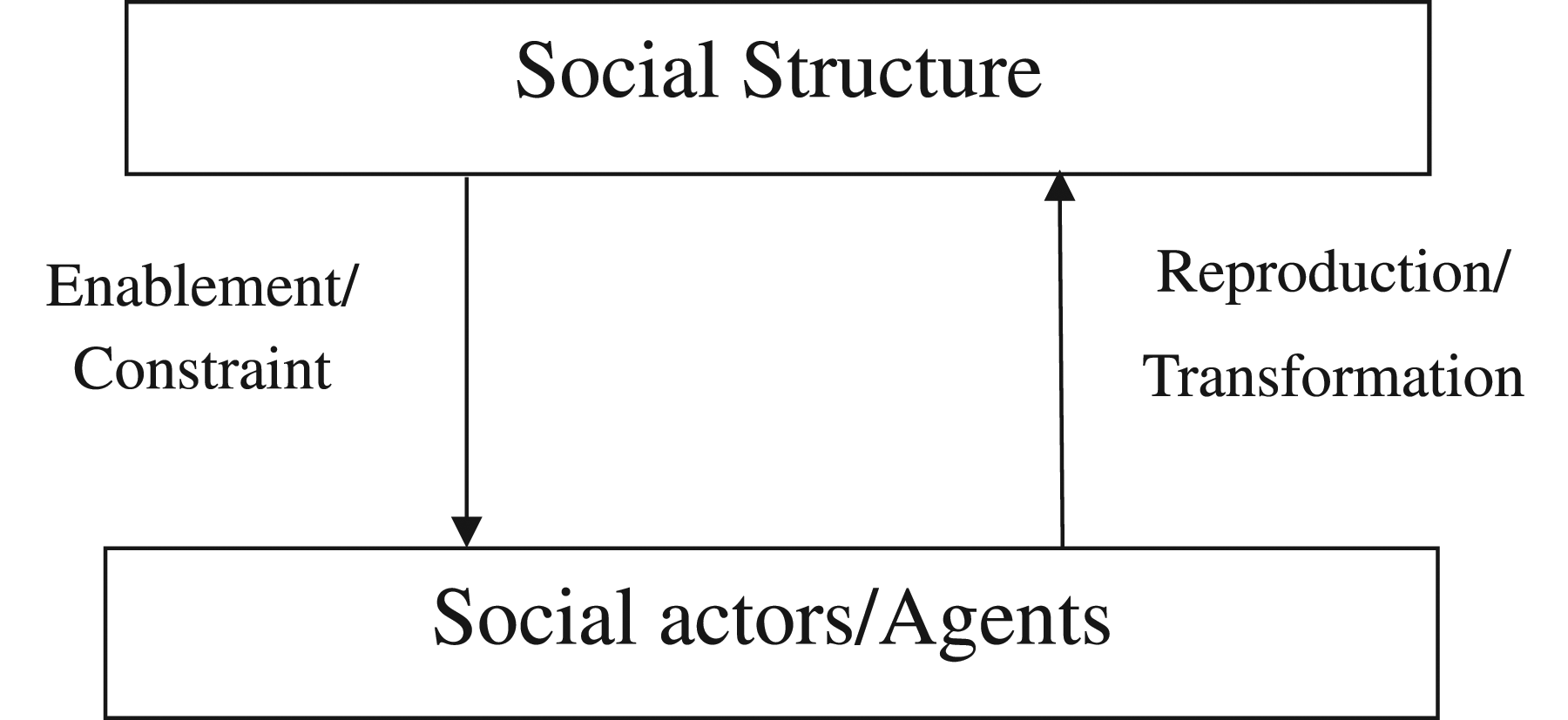
Stones (2005), holding the core notion of Giddens’ ‘duality’, proposes the Quadripartite Framework to simplify the level of abstraction for which structuration theory is often criticised. He argues that ‘duality’ can be best described and operationalised through the analysis of this framework, in which he theorises SST through four interrelated components: external structures, internal structures, active agency and outcomes (Coad et al., 2016). Stones’ (2005) perspective on structures aligns with the view that structures are patterns of social arrangements that determine how individuals in a society act, yet similarly emerge from the acts of those individuals (Deji, 2011). As such, Stones does not confine structures to external social structures, but argues they also involve internal structures of knowledge and dispositions of agents. Through the Quadripartite Framework, SST has contributed towards reducing the tension between the two opposing perspectives dominating most rural entrepreneurship literature – that is, focussing on either the macro or the micro level – by introducing a meso level that supports exploring the specific socio-spatial features in rural areas (Muñoz and Kimmitt, 2019).
Through employing SST in this study, a distinct emphasis on agency in the rural context is enabled. Agency in Stones’ (2005) Quadripartite Framework is denoted as ‘active agency’, reflecting Giddens’ definition of agency (1984). Active agency refers to knowledgeable agents who are capable of purposefully engaging in actions (knowing what they are doing and why) (Feeney and Pierce 2016). They thus, utilise the institutions and resources in their structure to act in ways that preserve, modify or challenge internal and external structures and achieve both intended and unintended outcomes (Feeney and Pierce, 2016). Given our emphasis on agency, we contributes to discussions on contextualisation of entrepreneurship by showing how agency itself becomes contextualised and becomes the manifestation of duality and recursive links between agents and structure at the core of SST (Phipp, 2001). Unlike Stones’ (2005) theorising of active agency as a property of the agent, we propose it is a property that is intertwined with both the internal structure of agents and the external structure of norms and resources in a context, as will be demonstrated in our discussion. This proposal contributes to current debates on entrepreneurial agency (McMullen et al., 2020; Meliou and Edwards, 2017; Refai and McElwee, 2021). This demonstration also responds to calls for empirical evidence highlighting the dynamic interplay between agency and structure in ways that signify an agent’s power of ‘transformative capacity’ (Giddens, 1979, 1984; McMullen et al., 2020; Refai and McElwee, 2021).
The relevance and ingenuity of our emphasis on agency is evident through the focus on a woman entrepreneur in the rural context, whereby active agency is distinctively proposed as gendered-local agency. Gendered-local agency refers to agents who utilise their internal knowledge, dispositions and skills, alongside external social norms and resources to engage in actions. As such, these actions are both enabled and constrained by gender-related and locality-related agent-structure interactions specific to the rural context. Through this agency, entrepreneurs preserve, modify and/or sometimes challenge the often-irresistible structures, which agents feel unable/unwilling to influence, to achieve both intended and unintended outcomes. Gendered-local agency demonstrates the significance of context-specific (here, rural-specific) structures and resources to both gender and locality as core aspects for conceptualising the agency of rural women entrepreneurs. To elaborate, our case of a rural woman entrepreneur adds depth to the contextualisation of women’s entrepreneurship in this context. This depth is generated by uncovering how gendered-local agency is both enabled and constrained through distinct relational gendered interplay (Meliou and Edwards, 2017) on the one hand, and specific locality aspects of rural contexts (Berglund et al., 2016) on the other. The importance of gendered-local agency in contextualising entrepreneurship responds to calls for researching entrepreneurial agency (McMullen et al., 2020; Refai and McElwee, 2021), alongside calls for in-depth exploration of how context supports and fosters the entrepreneurial potential of rural people generally, and women in particular (Saxena 2012). Furthermore, such theorising addresses calls by Brush et al. (2009) for research investigating both the embeddedness and context-specificity of entrepreneur actions that largely remain overlooked in most analyses of women, gender and entrepreneurship. Moreover, they call for applying theoretical concepts (here, SST) in research on gender, women and entrepreneurship in ways that reflect the specificity of the phenomenon and acknowledge its embedded nature.
In the following section, we present a detailed discussion of rural entrepreneurship as a contextualised phenomenon, where we highlight important aspects related to locality and gender in the rural context. This is followed by a critical explanation of the structuration perspective and Stones’ (2005) Quadripartite Framework. Next, the article elaborates the methodological approach of the study, followed by a discussion of findings. The article concludes by highlighting its value and contribution, alongside recommendations for future research.
Entrepreneurship in the rural context
Entrepreneurship is widely viewed as a key catalyst for rural growth. Development agencies view rural entrepreneurship as having potential to generate employment; politicians see it as a strategy to avoid rural unrest; farmers consider it a way to raise their income; and women observe it as a flexible way of providing autonomy, independence and income (North and Smallbone 2006; Saxena, 2012). Yet, like most environments, the rural context can enable or constrain entrepreneurship (Welter, 2011), offering ‘an innovative and entrepreneurial milieu in which rural enterprises may flourish and prosper or become inhibited’ (Stathopoulou et al., 2004: 406). Rural areas are seen as distinct contexts for entrepreneurship (Korsgaard et al., 2015b), or microstructures with particular structural factors, which impose specific drivers and barriers (Steinerowski and Izabella, 2012).
Business ventures in rural contexts can benefit from certain privileges such as relatively lower land prices, stable labour and a variety of local facilities (Korsgaard et al., 2015a). The rural context also offers the advantage of transparent social influences that can be readily observed and hence, support entrepreneurial ventures (Jack and Anderson, 2002). Nonetheless, rural contexts also present certain barriers to entrepreneurship, often demanding extra effort to develop novel products and explore new markets (Steinerowski and Izabella 2012). Müller and Korsgaard (2018) argue that variation in economic development, a low population density and poor economic resources are among the key challenges facing most rural areas. However, what can appear to be barriers to entrepreneurship can yield positive results in the rural context. For example, the remoteness of rural areas can be considered as a barrier to movement of entrepreneurs and their access to large urban markets (Vukosi and Thembie, 2018), but can equally mean the availability of natural resources, climate and landscapes that provide entrepreneurs with particular advantages (Korsgaard et al., 2015a).
One of the key contextual phenomena closely related to the contextualisation of rural entrepreneurship is the notion of ‘local embeddedness’ (Jack and Anderson, 2002) or ‘localisation’ (Kalantaridis and Bika, 2006). Localisation stresses interrelated relationships between entrepreneurs and their context, and the importance of context in shaping the endeavours of rural entrepreneurs through, for example, reliance on local resources, and greater dependence on personal business advice, limited local networks and avoiding borrowing from formal financial institutions (Kalantaridis and Bika, 2006). Such locality is viewed to determine the entrepreneurial propensity of rural entrepreneurs (Berglund et al. 2016). For example, rural contexts can create entrepreneurial opportunities when entrepreneurs utilise their local resources first, then seek other strategic resources beyond their local context, thus, benefiting from the ‘best of the two worlds’ (Korsgaard et al., 2015a). Similarly, Müller and Korsgaard, (2018) assert the importance of spatial context through exploring space-specific entrepreneurial practices at a micro-level to understand how spatial context can enable or hinder rural entrepreneurship processes and results.
While gender has not been extensively explored in the rural context, Alsos et al. (2014) highlight it as a critical element of the household that intertwines with the rural context. As such, analysing this relationship is necessary for revealing how entrepreneurship unfolds in a specific place. The entrepreneurship context has, in the past, been viewed as either gender neutral or patriarchal; both perspectives under estimate the special circumstances and responsibilities attached to women’s roles and their ability to work as active agents within their context (Hughes et al., 2012). Investigating women entrepreneurs in rural contexts offers a differentiated angle for understanding a less researched phenomenon; how rurality intersects with gender and entrepreneurship (McElwee, 2006; Brush et al. 2009). Therefore, we focus upon the entrepreneur’s agency (Müller and Korsgaard, 2018), particularly in the case of women (Meliou and Edwards, 2017). Women’s agency has the potential to add scope to their entrepreneurial actions to counter the various gendered barriers many encounter; it offers them power to draw upon specific practices they deem appropriate (Meliou and Edwards, 2017). This perspective challenges views of women as being disadvantaged (Marlow and Carter, 2004), less capable or facing different (sometimes higher) barriers than their male counterparts (Goyal and Yadav, 2014). While these notions have been criticised (Ahl 2006; Duberley and Carrigan, 2013), such arguments position women as active agents who can adapt their work and family duties in line with their needs and interests (Spivack and Desai, 2016).
Hence, in this article we advocate the view of doing and undoing gender (West and Zimmerman, 1987), viewing gender as a recurrent social construct (see Ahl 2006 for a comprehensive overview of different perspectives on gender and entrepreneurship). We concur with West and Zimmerman’s (1987, 140) view on gender as ‘not simply an aspect of what one is, it is something that one does, and does recurrently in interaction with others’. Our discussion moves away from focussing on ‘women as opposed to men’ (Marlow and McAdam, 2013), to a more comprehensive perspective that views gender as a socially embedded phenomenon, taking its final shape through interacting with its wider context across time (Ahl, 2006). We highlight how gender is done through routine behaviour in everyday practices (West and Zimmerman, 1987), where agency becomes a crucial part of understanding how these practices and interactions occur (Meliou and Edwards, 2017), and how we in turn can potentially undo gender (Deutsch, 2007). We now introduce the structuration perspective in detail to underpin our understanding of the recursive agent-structure interaction.
Strong structuration theory
SST builds on Giddens’ (1984) Structuration Theory, which has advanced our understanding of entrepreneurship and its contextualised nature through duality (see, for example, Jack and Anderson, 2002; Chiasson and Saunders, 2005; White, 2018). Nevertheless, Giddens’ view on structuration faces various criticisms, including vagueness in showing how actions maintain or change institutions over time (Jarzabkowski, 2008), and lack of clarity in addressing certain aspects such as the relationships between agents and the effects of external pressures on those agents (Coad and Herbert, 2009). Furthermore, due to its high level of abstraction, structuration theory is viewed as having inadequate methodological and ontological positions (Jack and Kholief, 2007) by being inefficient in capturing a specific phenomenon at a specific time and place (Coad and Herbert, 2009; Jack, 2017). These criticisms are the main building blocks for Stones’ (2005) developed version, SST. While both Structuration Theory and SST sustain the core premise of duality, Stones, (2005) was able to show how this duality can be empirically applied through his Quadripartite Framework (Figure 2). He highlights dynamic interactive relations between four main elements that consider macro, meso and micro levels of analysis: External Structures, Internal Structures, Active Agency and Outcomes. The Quadripartite Framework of structuration. Source: Stones (2005, 85).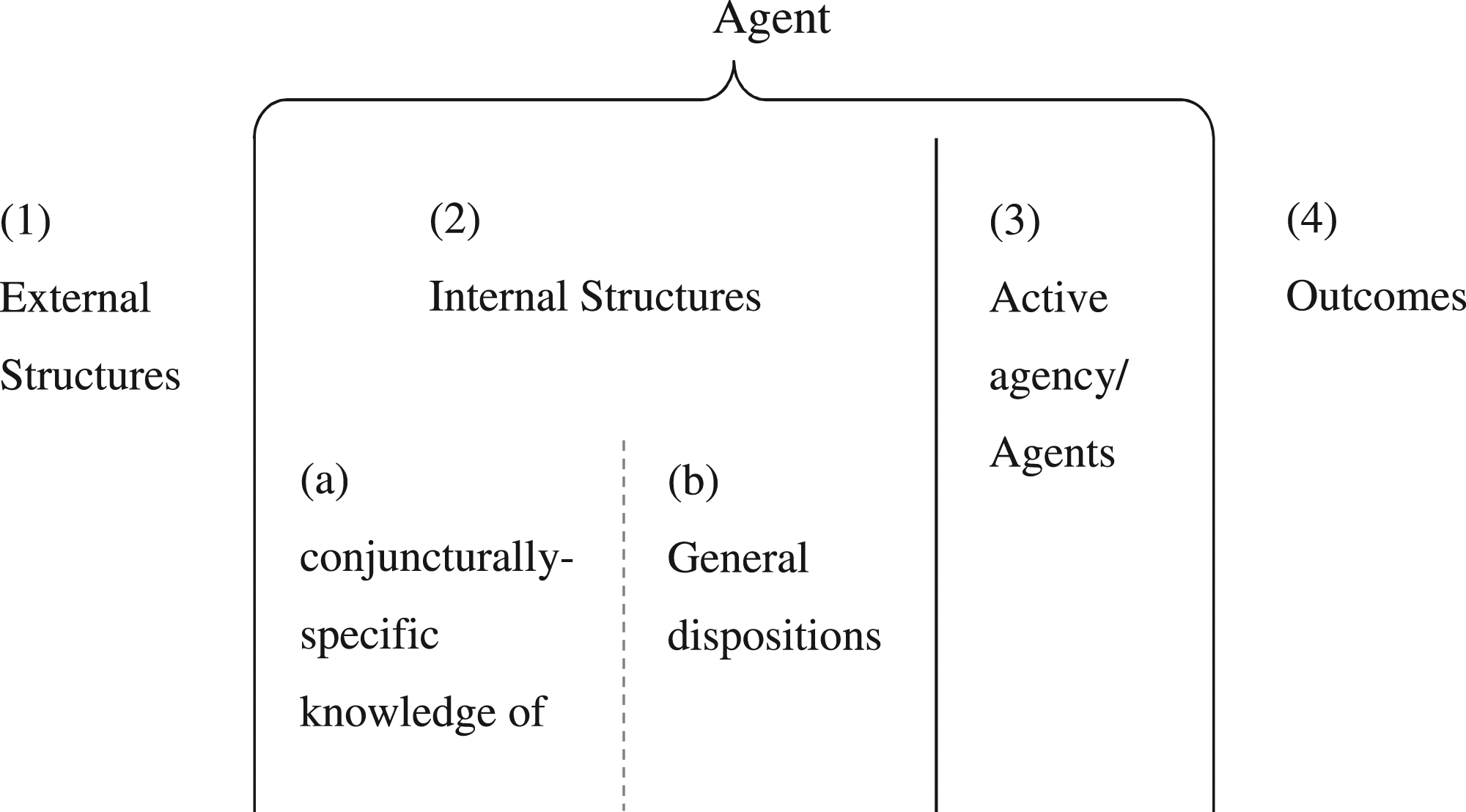
According to Stones. (2005), external structures represent conditions that are outside an agent’s control, including: (1) independent causal influences, which are totally independent from an agent’s desires or capacities, such as general economic conditions or political regulations; and (2) irresistible causal influences, upon which agents might have some influence, but may feel unable or unwilling to influence. Internal structures include general dispositional (habitus) and conjuncturally-specific internal structures, which are ‘virtual and exist only in memory traces, whereas key aspects of individual social positions and collective social systems are empirically observable’ (Coad et al., 2015: 157). The dispositional habitus includes experiences, values and beliefs about life, which can unconsciously guide people’s choices and decisions, while conjuncturally-specific structures stem from specific knowledge that agents retain in their context through their ‘knowledge of interpretative schemes, power capacities and normative expectations and principles of the agents within context’ (Stones. 2005: 9).
Notwithstanding that structures are often viewed merely as external structures that determine social interactions and norms in a society, Stones’ (2005) view on agent-structure interactions in his Quadripartite Framework emphasises both internal and external structures. Stones (2005) does not view external structures in isolation, but rather sees them as co-existing with internal structures; they both determine, and are determined by, acts of individuals who are embedded within a society. Links between internal and external structures in SST have added clarity as to how individual actions modify, challenge or preserve institutions over time (Jarzabkowski, 2008). These links have further supported SST in overcoming the various methodological and ontological challenges of Structuration Theory. Methodologically, through structuration theory, Giddens (1984) proposes strategic conduct analysis (i.e., agent interpretations of their structure) and institutional analysis as keys to methodological bracketing (Harris et al., 2016). This entails the downside of focussing on either conduct or institutional analysis in isolation (Jack, 2017). Alternatively, Stones (2005) proposes the use of the agent’s conduct and context analysis, where agents and their perceptions are positioned at the centre of potential actions that may preserve, challenge or modify structures (Jack and Kholeif, 2008).
Ontologically, unlike structuration theory, which directs attention towards ontology in general at the abstract level, SST emphasises ontology in situ (or at the ontic level) that focuses on social processes at specific places and times (Stones, 2005). ‘Structure and action are not contemplated in abstract, but observed in concrete situations, through the why, where and what of everyday occurrence, and through understanding the dispositions and practices of agents’ (Jack and Kholeif, 2007: 211). Succinctly, ontology in situ observes how agents experience the structuration process within a specific setting at a specific time (Makrygiannakis and Jack, 2016). This added clarity to the role of time and space in structuration is highlighted in the position-practice notion (Jack and Kholeif, 2007), which entails that ‘understanding a specific phenomenon in a particular time and place requires a move to ontology in-situ, where entities and actions exist in their original place of occurrence and human agents are linked together by position-practice dynamic relations’ (Stones, 2005, 8). In line with position-practice, each person has a specific position(s) with some attached rights and responsibilities that determine to a large extent the social behaviour of the person holding this position at a specific time and place (Cohen, 1989; Stones, 2005; Coad and Glyptis, 2014; Coad et al., 2015). This is relevant to our case of a woman who can be positioned as a wife, mother, entrepreneur and/or active local member, who operates within the discrete structure of a rural context.
Active agency refers to knowledgeable agents who act independently and make free choices through which they preserve, modify or challenge internal and external structures, and achieve both intended and unintended outcomes (Feeney and Pierce, 2016). These outcomes are the results of actions that can modify, challenge or preserve structures. As such, active agency reflects the active, dynamic moment of structuration; this can be seen, for instance, when women entrepreneurs engage in locally anchored networks to overcome gender inequalities in entrepreneurship and enable social change (Roos, 2019).
Research methodology
We present the case of a woman entrepreneur, Brooke (a pseudonym), who runs a successful enterprise in rural Sweden despite being confronted with many challenges. Business owners in rural Sweden comprise 10 percent of the working population (Företagarna, 2018), which is equivalent to the national average of all business owners in Sweden (Carlgren, 2019). In this context, 30 percent of businesses are run by women (Swedish Agency for Economic and Regional Growth, 2019). Rural Sweden is characterised by historical patriarchal norms still lingering today (Roos, 2021); this, albeit that Sweden is considered one of the most gender equal countries in the world, makes rural Sweden an interesting context to dissect our case of a rural woman entrepreneur.
Theoretical sampling (Neergaard, 2007) was employed to identify this case which illustrated the agent-structure relationships. The second author conducted the fieldwork over two years. Data collection followed a multi-method approach to stimulate new ideas and perspectives and overcome the limitations inherent in using just one approach; this enabled probing, interactive conversations and informal relationships with participants, and a comprehensive understanding of their context (Lincoln and Guba, 1985). As such, we gained more comprehensive reflections of the experiences and opinions of Brooke, rather than biases, motivations and viewpoints of the researcher (Lincoln and Guba, 2003).
Overview of data collection methods.
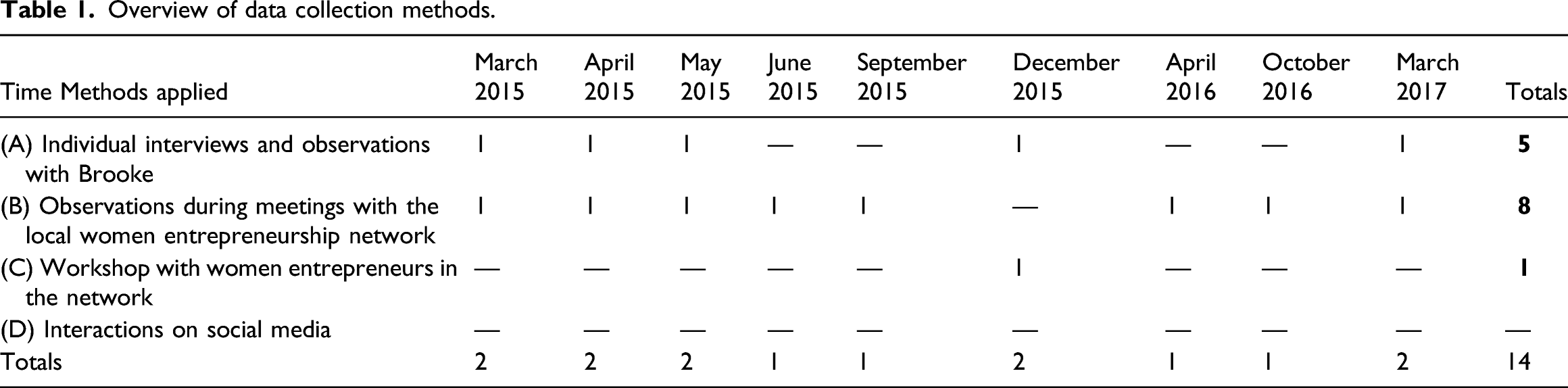
When analysing Brooke’s case, we gathered all transcribed quotations and written field notes and wrote up stories (Czarniawska, 1998) based on how they relate to theoretical understanding. While the second author conducted the fieldwork, all authors participated in the analysis. This occurred simultaneously as constructing the theoretical section enabled iteration and reiteration between theoretical and empirical levels (Alvesson and Sköldberg, 2000; Glaser and Strauss, 1967). The analysis considered the data as a whole, rather than focussing on quotations selected to suit the case. The multiple methods and prolonged engagements helped in determining which emergent themes were key, although less prevalent codes across data sets did not necessarily reflect lesser importance (Braun and Clarke, 2006). We now present our findings.
The duality of agent and structure: An illustrative case
Brooke is in her fifties and her business is located in central Sweden. She runs several equine related ventures that ensure multiple income streams. First, she works as a farrier employing a modern hoof-care technique that replaces traditional metal horseshoes. This involves trimming hooves then fitting a hoof boot to minimise hoof damage from the terrain. Second, she runs an education centre, one of only two in Scandinavia, teaching her hoof technique. Third, she owns an online shop selling products for horses and riders. Finally, she sells a medical instrument to increase blood flow in both humans and animals to prevent illness and accelerate recovery. The picture presented here suggests links with the concept of pluriactivity, referring to multiple activities within the farm gate, within the farm business and beyond the farm gate (Fuguitt, 1961; Loughrey et al., 2013). Pluriactivity is often experienced in rural areas due to, for example, policy changes (De Rosa et al., 2019) or the need to extend current businesses to gain more income (Carter, 1998). While pluriactivity has mainly been observed in men (Eikeland, 1999), the case of Brooke in this research is a precursor of future patterns.
Next, we elaborate upon on our findings in ways that stress our entrepreneur’s actions within structural enablers and barriers in the rural context, and add clarity to the application of SST in rural entrepreneurship. While it is recommended to start SST analysis with an agent’s internal structure (conduct analysis) and its related dispositions/habitus and conjuncturally-specific knowledge (Stones, 2005), our findings draw interesting links that stress the active agency element of the Quadripartite Framework. Therefore, we start the analysis with two emergent overarching themes: first, locality in the agent, and locality out there – constraining and enabling actions; and second, gender in the agent, and gender out there – constraining and enabling actions. Through these themes, we position active agency as a property that is intertwined with both the internal structure of agents and the external structure of norms and resources in the rural context. Thus, we extend Stones’ (2005) positioning of agency as part of agents by viewing agency as being contextualised itself within gender-related and locality-related rural-specific interplay. Our findings develop these two themes, showing how they reflect moments of action when women entrepreneurs in the rural context are able to act and influence their environment (Coad and Herbert, 2009).
Locality in the agent, and locality out there – constraining and enabling actions
Brooke is strongly influenced by various factors related to her rural locality, which both enable and constrain her entrepreneurial activities and how she enacts change. Some factors emerged from internal feelings towards the local context and others to resources and structures out there in the rural environment. The local community gives Brooke a place to belong, and the norms and social structure are important resources; She feels the care and interest of the village: ‘They greet me from the heart and when we, for example, do something to our house they approach us and initiate a conversation’. She compares this to her previous city life: ‘No one came out and asked what I was doing. They just stood behind the curtains and lurked’. This belonging is especially important to Brooke because she had no link to the village before she moved there. ‘We were no one, no one. We weren’t somebody’s cousin. But everyone was so welcoming when we moved here. That warmth we experienced, we immediately felt that we were home’. These social bonds created a hospitable environment for Brooke to continue her business.
Brooke’s feelings of belonging are reflected in her business location, which stemmed from her desire to live in the countryside, rather than it being a strategic business choice. Her education centre is located on the outskirts of a small village of some 400 people. Brooke and her family live two kilometers outside the village, where they have a small farm surrounded by forest. Distance between farms meant that when Brooke worked as a farrier she had to travel throughout Sweden visiting her clients and their horses; however, this distance was not seen as problematic. Indeed, her passion for the rural environment was apparent throughout the research; when responding to a question on how her business is linked to the local community she said, ‘It is not linked, but I live here. I could move the business, get a centre somewhere else, but I don’t want to’.
Besides her passion and belonging, the rural location is another resource for Brooke’s business, enabling her to maintain comparatively low running costs. ‘Sure, I could let go of this [centre], but it only costs me electricity, water, for the entire centre. It is such a small sum for this entire centre’. This rural location, characterised by physical closeness, has also enabled Brooke to operate her business without stocking supplies: ‘My suppliers live so close, so if I sell something, then I just go over there and pick it up from her. We don’t need a stock in that sense’. The rural location has further fuelled its social closeness and bonding, providing a sense of security even if Brooke should feel the business was at risk. In one lecture, Brooke told her students that whenever her business seemed rough, she would consider taking a job at the local grocery store instead. Her belief that the local store would give her a job has become a safety net.
Nevertheless, this social closeness can sometimes restrict Brooke. For example, when one of her suppliers kept urging her to take her business to the next level by starting her own network of sellers, her passion to preserve her rural networks and sustain the rural environment prevailed: My supplier, she thinks I should be all in on this thing. But actually I am not interested. I am only interested in selling and spreading a thing that I believe is a really good product. I do not have an interest in having more people to coach or have responsibility over. It is just too much work to have a network like that, and not at all what I am passionate about.
An interesting aspect of social closeness in the rural context was its prevalence not only at the community and business levels, but also at the family level. While Brooke runs her business and the different income streams by herself, with no employees, her husband supports her in running the online shop and taking care of the students at the education centre, as well as baking bread for breakfast and preparing food during educational events. I’m not working with the web shop at all. I take all the help I can get. I’m overwhelmed with work so I’m happy with everything my husband takes.
Social proximity at community, business and family levels, alongside taking care of her own horses, helps Brooke through the struggles in her business. She can risk standing against the norm and working extra hours knowing that she has the social bonds of the village, as well as the family, to count on if she fails. This bonding, alongside the benefits from the particular resources of physical proximity and a willingness to support her, stresses the interrelated relationships rural entrepreneurs have with their context. It confirms the concept that Kalantaridis and Bika (2006) describe as localisation through dependence on local rural resources and strong rural attachment. This adds clarity to the structuration view on external resources, which include norms, but also resources such as physical proximity, human resources and networks that are essential for sustaining any entrepreneurial activity, and empowering women to act and achieve as entrepreneurs.
Gender in the agent, and gender out there – constraining and enabling actions
Similar to locality, various enabling and constraining gender-related factors influence the way Brooke operates her business in the rural context. Some factors stem from her values and beliefs about the role of women in general, and women entrepreneurs in particular. Others emerge from gender-related norms in the surrounding community that influence general perceptions of what a woman can/should or cannot/should not do. Brooke labels farriery as ‘traditionally masculine’. This relates to both the heavy work required when forging the iron, and the historical domination of men in the profession (Bonow et al., 2017). As a result, the farrier is considered an expert with high status (Dashper. 2016). Nevertheless, Brooke challenges this culture. When asked about her passion she immediately and happily answered, ‘Yes! Yes, that is easy, it is given. My passion is horses! And to help people and then to spread the knowledge, sort of butting in on a very masculine profession’. She elaborated that tradition is very strong within the sector, ‘We have always done it this way’, implying that there is resistance towards the kind of change for which she is working.
Brooke has not surrendered to the patriarchal norms in her community; she works to engage other local women in business through talks and debates. The social proximity of the rural context enabled her to engage in a local women’s entrepreneurship network, where they meet to share business ideas, build relationships and promote women’s entrepreneurship in the local community. To her, familiarity with the community manifests through feelings of fellowship with like-minded people. ‘When [the network] first met we were all equals. It didn’t matter that my business revolved around horses, I was seen with open eyes’. Brooke further engages with the network and undertakes a shared leadership role through meetings that involve listening to other women’s needs. This latter role developed into a more active engagement involving resolving issues, addressing needs and taking part in social and local matters related to entrepreneurship. This view emphasises a gendered relational dimension that enables entrepreneurs to understand other actors in their context, particularly women, as well as their needs and actions (Meliou and Edwards, 2017). Here, entrepreneurs play an active role in changing the local gender norms (Roos. 2019), whereby entrepreneurship facilitates empowerment and emancipation (Baker and Welter, 2017).
While Brooke presented as a passionate entrepreneur, she also presented as a passionate member of her family. Initially, she moved to the village with her husband and new-born, as they considered the rural area a calm and safe place to start a family. ‘I feel at home here now’, she said. ‘… I like where we live, close to the countryside and to the farmhouse’. Similarly, a sense of passion and belonging in the rural context empowered Brooke to act, even though this was not a simple task. This supports the notion that women’s entrepreneurial engagements are often shaped and influenced by their gendered stereotypical roles as mothers and wives primarily, and entrepreneurs thereafter (Jamali, 2009; Kodagoda, 2014; Meliou and Edwards, 2017; West and Zimmerman, 1987). These roles are interlinked with the concept of mumpreneurs (Duberley and Carrigan., 2013), which shows how women entrepreneurs seek opportunities that can best satisfy both their motherhood and work needs (Ekinsmyth, 2011). Commitment to her role as a mother also prevails through the peace of mind that Brooke attained when her husband undertook domestic household tasks during her long working hours, ensuring the children were safe and well. Therefore, any actions undertaken by Brooke were an attempt to preserve the balance between her family responsibilities and her career. This differentiates her from most male entrepreneurs, who are generally assumed to prioritise economic returns and business growth as their main goals (Brush and Cooper, 2012; Gidarakou, 2015).
Brooke’s ability to contemplate her internal beliefs around women’s entrepreneurship alongside external resources and norms resulted in her becoming an animator to other women in her social context. This is conceptualised by McElwee et al. (2018, 174) as a process of ‘inspiring others to take entrepreneurial initiatives and action’. Brooke’s views on entrepreneurship influenced people around her, including those who attended her education programmes with the intention of starting their own business. Considering the lack of business start-ups by women in the rural, those attending her educational programmes found inspiration and motivation in Brooke. She elaborated, ‘Right now I have around 50 students that after graduation will start their own businesses’. As most of her students are women, Brooke is considered an enabler for developing more women-owned businesses in Sweden. Frequently, during the researcher’s visits, Brooke would receive phone calls or e-mails from women asking about hoof-care issues or running businesses. Through her work, Brooke has built up a strong informal network of women entrepreneurs in the masculine sector in which they all work. As she inspires and empowers others, she simultaneously challenges the constraining rural context, while achieving outcomes that add value. This representation signifies how the rural area becomes more than just a physical place; it goes beyond that to encompass various meanings, emotional attachments and representations that consequently affect most rural entrepreneurial ventures (Müller and Korsgaard, 2018) and their surrounding communities.
Brooke’s story shows that she has utilised her entrepreneurial career as a tool to pursue her inspiration, not as a goal in itself. This is evident in conversations with her, in which she admits that her dream was not to run a business per se, although she saw no other route to pursuing her passion for the hoof-care technique. Her inspiration is largely around removing tensions generated from patriarchal norms in the rural context, inspiring the use of the hoof-care technique and motivating entrepreneurial intentions. This inspiration encourages people to make choices around what they want, and how they prefer things to be done. Through this inspiration, we see a legacy of Brooke’s entrepreneurial activity. When asked what her goals from entrepreneurship are, she answered: My goal is to change the situation. My final goal, or whatever, is that the authorities can say that there are schools to go to if you want to work with hooves, one is with iron and the other is without. And it should not be any tension to it, but a question of whether you want iron or not. There should be no tension; the horse owner should be able to decide. That is my goal.
Next, we add depth to our findings through conceptualising gendered-local agency.
Conceptualising gendered-local agency
In this article, we set out to utilise the strong structuration perspective to understand how the rural-specific contextual factors influence the agent-structure interactions of entrepreneurship in the rural. Our findings highlight that SST enables a more comprehensive understanding of entrepreneurship and the role of entrepreneurs in rural areas. We demonstrate this understanding in Figure 3, building on Stones’ (2005) Quadripartite Framework (Figure 2), and thus, offering evidence of operationalising SST in rural entrepreneurship. Through this conceptualisation, we indicate that the actions of women entrepreneurs are enabled through what we refer to as gendered-local agency, which emphasises SST’s ontology in situ, whereby actions are positioned at specific places and times (Stones, 2005), in ways that emphasise gender and locality. Our illustrative case presented through the Quadripartite Framework.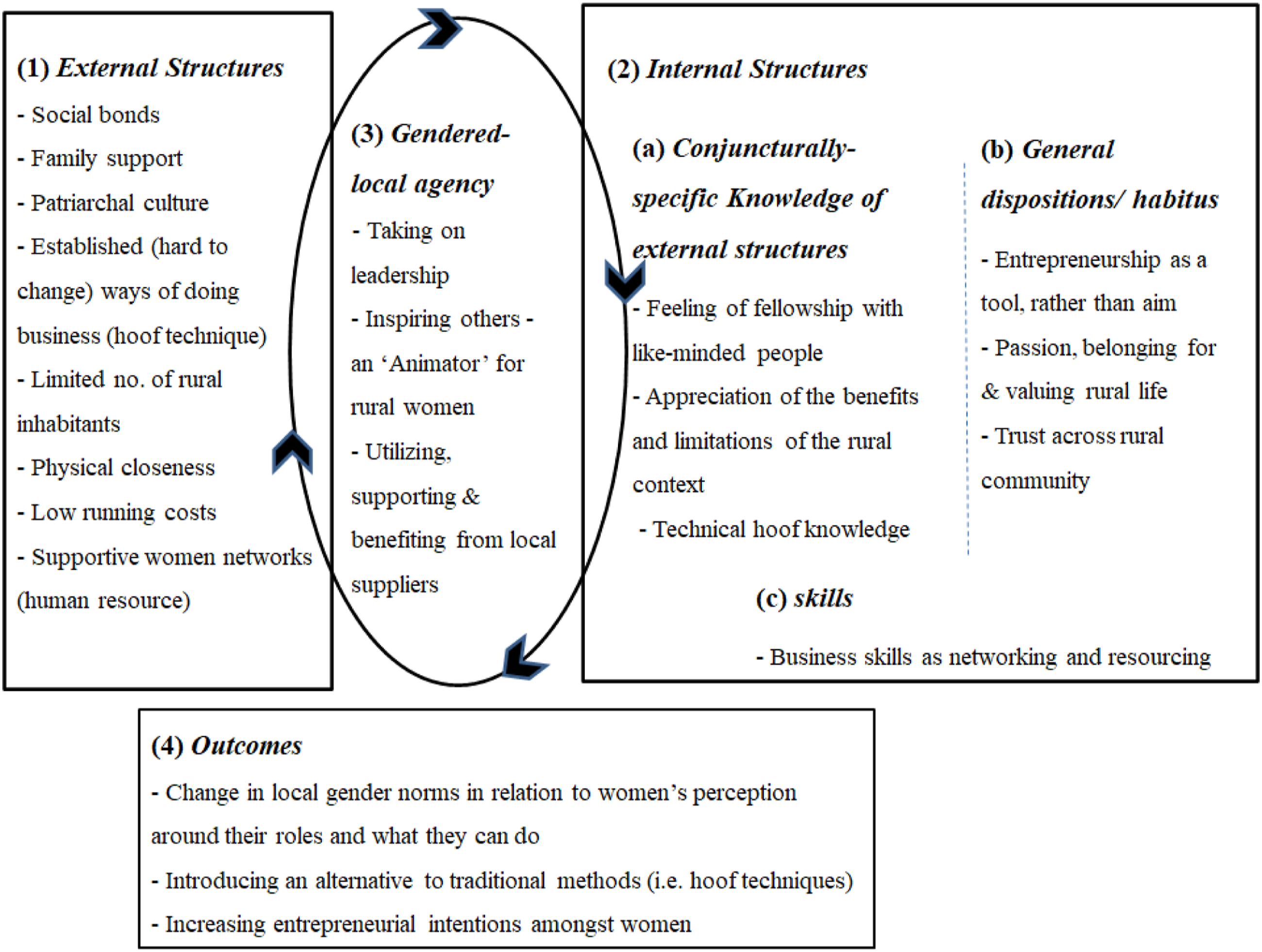
The two overarching themes that emerged from the data analysis highlight gender-related and locality-related agent-structure interplay that is specific to the rural context. Both enabled and constrained, this interplay is manifest as gendered-local agency. It alerts entrepreneurs to the knowledge and skills that specifically serve the rural context, which is a missing element in structuration theory (Feeney and Pierce, 2016). It also alerts them to dispositions of passion, belonging and connectedness, as well as the various rural resources from which they can benefit. Interplay between knowledge, skills, dispositions, resources and norms serves not only to benefit the rural context, but also to add credibility and confidence to rural entrepreneurs in ways that empower their gendered-local agency and enable future actions. Through such interplay, entrepreneurs are able to navigate agent-structure interactions that are specific to the rural context, with its enabling and constraining structures and resources, rendering gendered-local agency the means to enable preserving, modifying and challenging internal and external structures (Feeney and Pierce, 2016).
Preserving structures is evident in this study through the context-specific interplay between internal and external structures. Internal structures are evident in dispositions of passion and belonging, trust in local rural suppliers, feelings of fellowship with like-minded people, appreciation of the benefits of the rural context, as well as the business skills necessary to create and lead business ventures. These internal structures interact with external structures that comprise of social bonding norms as well as resources from proximity and lower business operating costs. The interplay between these internal and external structures made it possible to preserve rural structures through, for example, dependence on, and support of, local suppliers, rather than maintaining a full stock. Structure is further preserved as this interplay affords entrepreneurs more confidence and security in taking risks when contributing to rural development through their ventures. They are aware they can rely on the rural community to support the business if and when there are demand pressures or problems. These views on preserving structures support those of Korsgaard et al. (2015a), who highlight the significance of specific rural bonding and proximity of rural resources.
The modification of structure is reflected in our findings when Brooke emerges as an animator (McElwee et al., 2018) for other women, motivating them to start and develop their own businesses. There is interplay between the internal structure of the women’s passion for rural life, personal views on entrepreneurship as a tool, and networking skills and the external structure that signifies patriarchal norms around the roles of women, but also offers the human resource element of family and friends who are willing to support businesses and each other. Through this interplay, rural women find inspiration and hope in entrepreneurship to modify restrictive patriarchal norms that define and limit their roles.
Challenging structures is also observed in interplay between internal and external structures. Internal structures comprise, for instance, specific technical knowledge of the hoof technique, dispositions of passion for horses and the rural life, and business skills (as networking and resourcing). Such internal structures interact with external structures as patriarchal norms that specify farriery as a male-dominated career that should be performed in a specific traditional way. The low population density of rural areas is potentially a constraint; however, supportive social bonds and local network activities encourage undertaking potentially risky and time-consuming ventures. Through interplay between these internal and external structures, existing structures are challenged by an alternative to traditional hoof-care techniques, alongside women’s involvement in network activities that dissent from prevailing rural norms and gender stereotypes.
As such, while gendered-local agency becomes the means of doing and achieving objectives, it is simultaneously enabled and constrained in interactions that are as influential as rural structures. The preservation, modification and challenging of structures cannot be observed without the rural-specific agent-structure relational interplay that manifests in gendered-local agency. This agency enables women entrepreneurs to preserve, modify, and sometimes challenge, irresistible causal influences that agents feel unable/unwilling to influence (Stones, 2005). It becomes clear that gendered-local agency is not free floating, but rather a property that is intertwined with both agents and structure, as shown in Figure 3.
Limitations and future research
We acknowledge that our single case study reflects particular gendered-local agency interactions that are likely to be different if other agents and/or contexts such as refugees, ethnic minorities, or immigrants are explored through the SST lens. While this can be a limitation, it also reflects the beauty of entrepreneurship as a dynamic agent-structure interaction; a phenomenon that cannot be explored by isolating one from another, whereby gendered-local agency adds to its novelty. Furthermore, choosing the rural context in Sweden as our main context highlights the nature and specific characteristics of rural entrepreneurship in a country considered among the more developed ones with regards to gender equality and economic stability. This context differs substantially from others in developing countries/contexts. Comparative research can add value by showing how the level of national development affects women’s entrepreneurship in the rural environment, where SST with its Quadripartite Framework (Stones, 2005) can offer an attractive approach to further enhance this research.
Conclusion
This article presents a critical analysis of the contextualisation of rural entrepreneurship based on SST. Our theorising stresses the distinctiveness of entrepreneurial contexts (Korsgaard et al., 2015b) through the emphasis on gendered-local agency. Through gendered-local agency, entrepreneur actions become both enabled and constrained by gender-related and locality-related agent-structure interplay that is specific to the rural context. We observe gendered-local agency as the manifestation of this context-specific recursive agent-structure interplay in ways that intertwine internal and external structures. This manifestation is at the core of SST (Phipps, 2001), and is represented in Figure 3, building on the Quadripartite Framework. Thus, Figure 3 offers a methodological contribution responding to Jack and Kholeif’s (2007) call for employing SST in entrepreneurship research. We propose SST as an appropriate theory for contextualising rural entrepreneurship by signifying gendered-local agency as a critical aspect that underlies duality in entrepreneurship through its recursive interplay between contexts as environments (out there) and contexts as constructed (through entrepreneurs). Gendered-local agency is, therefore, a property of both agents and structure and is itself contextualised. Gendered-local agency becomes a proxy for (or represents) the rural context by demonstrating how women entrepreneurs are active agents, engaged with their structure and consequently, responding to, and acting upon, the changes surrounding their ventures. This contextualisation extends discussions of how context both shapes entrepreneurship (Welter, 2011; Zahra and Wright, 2011; Zahra et al. 2014) and is shaped by entrepreneurship through the activities of entrepreneurs (Muñoz and Kimmitt, 2019).
Through gendered-local agency, the role of entrepreneurship in ‘undoing gender’ (Deutsch 2007) is made clearer as gender becomes part of both the agent and the structure, rather than a separate construct. In other words, how women entrepreneurs influence, and are influenced by, their rural context justifies the influential role of context in shaping the decisions, activities and choices of these women. Women entrepreneurs aspire and act to achieve rural development, and inspire entrepreneurs to find and exploit various opportunities, through preserving, modifying and challenging their rural structure. Through entrepreneurship, these women emerge not only as women, but also as entrepreneurs, mumpreneurs (Duberley and Carrigan, 2013), animators (McElwee et al., 2018) and active members of the rural community to which they belong. Such roles add to the empirical evidence of the position-practice relations of SST (Coad and Glyptis, 2014; Coad et al., 2015; Cohen, 1989; Stones, 2005) by highlighting the different responsibilities of women entrepreneurs, which determine to a large extent their social behaviour at specific times and places.
A local underpinning of this gendered-local agency also becomes evident, stressing its role in ‘doing context’ (Baker and Welter, 2017). Agency is not seen as a reaction to an entrepreneur’s temporal need, but rather is intertwined within contextual factors through which success is confirmed and structure is not only sustained, but also developed and changed. These factors produce contextual meanings (Korsgaard et al., 2015a; Müller and Korsgaard, 2018) that become the places within which agency manifests around interplay enabled through, and because of, distinctive context-specific interplay. This aligns with Jack and Anderson’s (2002) views on local embeddedness, where we emphasise the interplay of rural location and culture, which inform the agency of the entrepreneur. This interplay also signifies the particular relevance of rural resources in the structuration process including, for example, low running costs, skills, physical proximity, supportive human resources and networks, which are essential for running entrepreneurial activities. This analysis of resources extends our understanding of Stones (2005) interpretation of external structures, which we view as comprising of not only the formal and informal institutions and resources embedded within agents, but also the material resources required to implement entrepreneurial practices including financial and human resources. So, this view of resources contributes to understanding the role of internal structures, where we highlight the relevance of agent skills in enabling action, alongside conjuncturally-specific knowledge and general dispositions of the entrepreneur (as highlighted in Figure 3). Our arguments add to debate by Korsgaard et al. (2015a) of context as a pool of resources, which can only be understood by adequately investigating the links between the actions and practices of entrepreneurs and their context.
The context-specific agent-structure interplay we highlight demonstrates that the rural context filters agency, whereby outcomes are enabled not only through, but also because of, context-specific interplay. When context filters gendered-local agency, it becomes clearer how the manifestation of this agency can be intentional (undertaking leadership roles) or unintentional (becoming an animator) (Roos, 2019). This renders agency the driving force for entrepreneurs to enjoy their entrepreneurial activities, rather than focussing on setting achievement aims (Roos, 2019). In other words, filtering agency renders everyday entrepreneurship as a form of agency, or more particularly everyday rural entrepreneurship as a form of gendered-local agency. This everyday entrepreneurship becomes the operationalisation of Stones’ (2005) active agency as a practice, whereby the actions of rural entrepreneurs become a demonstration of agency in action.
Accordingly, while arguments around agency are based on an agent’s ability to get things done, we stress that this is certainly not a reflection of free-acting completely autonomous entrepreneurs. Agency is not operationalised in vacuum and is, itself, contextualised within constraints and enablers that entrepreneurs contemplate to empower their agency further. This contextualised view of agency emphasises the importance of research identifying differences in contextual elements, rather than focussing on similar aspects of entrepreneurs (Morrison, 2000). This is evident in this study in both the rural context (with its enabling and constraining structures) and the women entrepreneurs operating within it. Our standpoint on context filtering agency proposes that agency is not a ubiquitous characteristic of individuals. This view offers a precursor for further research investigating the ways through which different contexts filter agency in distinctive ways that are relevant to a specific context. Gendered-local agency offers a critical and practical perspective on how entrepreneurship evolves, from a start-up, to a process of preserving, modifying and challenging structures, and to a social ideology that can potentially transform the present and future of the rural context through the legacy of its entrepreneurs (Baker and Welter, 2017).
Footnotes
Acknowledgements
The authors are very grateful for the feedback and comments received on our earlier draft presented at the ECSB/GENSIG Confreat conference in Aarhus, July 2018. A version of this paper was also presented at the ISBE conference in Birmingham in October 2018, where we received valuable remarks. We would also like to thank the Editor of ISBJ and the two anonymous reviewers for their helpful and developmental comments.
Declaration of conflicting interests
The author(s) declared no potential conflicts of interest with respect to the research, authorship, and/or publication of this article.
Funding
The author(s) received no financial support for the research, authorship, and/or publication of this article.
