




Abstract
While entrepreneurial behaviour is generally seen to arise from a reasoned, judgement-then-action pathway, evidence of an alternative is emerging. Yet, this alternative – an unreasoned, impulse-driven pathway remains to be empirically explored. We develop a novel measure to capture this unreasoned pathway and test a mediation model explaining how multidimensional trait impulsivity impacts entrepreneurial behaviour via this pathway. Employing structural equation modelling with longitudinal survey data from owner-managers and several robustness tests, we find compelling support for our model. We demonstrate a lack of reasoning, exhibited through placing more salience on an entrepreneurial opportunity’s desirability than feasibility, as a critical pathway explaining how impulsivity encourages entrepreneurial behaviour and overcomes the inhibitory effects of uncertainty in entrepreneurial pursuits. These results advance a rapidly unfolding scholarly debate regarding whether all entrepreneurial behaviour ought to be ascribed a reasoned, intendedly rational role, the implications of which extend to theories of entrepreneurial behaviour and the inclusion of an unreasoned pathway within them.
Keywords
Introduction
Without the pursuit of entrepreneurial opportunities, new economic ventures would simply not emerge (Townsend et al., 2018). Thus, a key question for entrepreneurship scholars is why some individuals act decisively, vigorously and often, repeatedly towards entrepreneurial opportunities, while others are hesitant and suffer from inaction in the face of uncertainty. With few exceptions, models aimed at explaining this phenomenon implicitly assume a rational, judgement-then-action pathway, where some form of evaluative, ‘cost–benefit calculus’ of both opportunity desirability and feasibility undergirds entrepreneurial behaviour (McMullen and Shepherd, 2006; Schlaegel and Koenig, 2014). Yet, recent work poses an interesting counterpoint to this extensive research by suggesting that while a large portion of entrepreneurial behaviour indeed occurs through intendedly rational pathways, a substantive portion may also occur without ex-ante reasoning (Kautonen et al., 2015).
Perhaps the most prominent development in this regard is emerging research linking attention deficit/hyperactivity disorder (ADHD) to higher entrepreneurial intention (EI) (Verheul et al., 2015), entrepreneurial orientation (Wismans et al., 2020) and nascent venturing (Lerner et al., 2019; Stappers and Andries, 2021), where impulsivity appears to be the underlying trait driving these results (Antshel, 2018; Wiklund et al., 2017). Impulsivity is a multidimensional construct encompassing four distinct impulsigenic traits, which predispose individuals to impulsive behaviours (Whiteside and Lynam, 2001). These impulsive behaviours reflect rapid reactions to internal or external stimuli without forethought, reasoning or deliberation of the consequences of those reactions (Moeller et al., 2001). Hence, scholars have suggested that research positively linking impulsivity to EI and entrepreneurial behaviour indicates an unreasoned pathway (Hunt and Lerner, 2018; Wiklund, 2019), which begins to support a broader spectrum view of entrepreneurial behaviour propounded by Lerner et al. (2018b). This view acknowledges the indisputable role of the judgement-then-action pathway, yet also recognises the presence of an unreasoned pathway.
However, this emerging empirical work fails to account for how impulsivity may impel entrepreneurial behaviour from an unreasoned perspective. In fact, this research simply shows that impulsivity – which represents a predisposition towards impulsive behaviours that may or may not manifest, depending on the context (Berg et al., 2015) – is related to EI and entrepreneurial behaviour. We suggest that this is a crucial limitation that has fostered alternative, fully rational explanations for the impulsivity-entrepreneurial behaviour link, and in so doing, has encouraged critiques that impulsivity and unreasoned entrepreneurial behaviour ought to be subsumed within the judgement-then-action perspective (Brown et al., 2018). For example, a trait impulsivity-entrepreneurship relationship could be explained through the rational formation of conscious vocational plans (EI) towards an entrepreneurial career based on personality-environment fit analyses (Antshel, 2018). Yet, advances in psychology (Deutsch and Strack, 2010), neuroscience (De Holan, 2014) and entrepreneurship (Lerner et al., 2021) suggest that such an explanation is overly restrictive: not all human behaviour is reasoned, and some behaviours can, and do, emerge from less reasoned precursors. From a scholarly perspective, these advances indicate that unreasoned behavioural pathways should be explored to avoid circumscribing entrepreneurship theory to a deliberate, judgement-then-action perspective that may dissociate it from reality (Kitching and Rouse, 2020; Lerner et al., 2018b).
We thus, examine an unreasoned pathway by theorising and testing a model exploring the salience placed on the desirability, versus the feasibility, of an entrepreneurial opportunity as a mediator of the trait impulsivity-entrepreneurial behaviour relationship. According to Prospect Theory (PT; Tversky and Kahneman, 1974), a lack of reasoning directly deviates from judgement-then-action models and is reflected in individuals inadequately accounting for the feasibility of their conduct prior to acting. Rather than being driven by slow, effortful and consciously controlled forethought, this unreasoned pathway is driven by the more rapid, automatic and implicit reactions to rewarding versus threatening stimuli underlying trait impulsivity (Carver, 2005; Evans, 2008). Hence, we posit that this relatively newly explored construct is a key mechanism explaining how impulsivity drives unreasoned entrepreneurial behaviour. We tested our model using entrepreneurial behaviour expectations (EBE) as a behavioural predictor, which avoids assumptions of reasoned-intentionality inherent to the concept of EI (Lerner et al., 2018b). While EI reflects a consciously formulated plan to perform a given behaviour (Ajzen, 2011), EBE reflects a self-predicted behavioural likelihood that can be determined regardless of one’s deliberately reasoned intent (Warshaw and Davis, 1985). Accordingly, expectations have been shown to more accurately predict unreasoned behaviours (Gibbons et al., 2006; Warshaw and Davis, 1985). We specifically operationalise EBE as an expectation regarding the future exploitation of an entrepreneurial opportunity – employing Shane and Venkataraman’s (2000) definition of opportunities as ‘situations in which new goods, services, raw materials, and organising processes can be introduced and sold at greater than their cost of production’.
To examine our model, we utilise two waves of survey data from owner-managers – a sample that limits the risk of any observed effects being an artefact of more impulsive individuals being pushed out of traditional employment and into entrepreneurship. The first wave (n = 807) tested our theorised model. The second wave (n = 221), administered 12 months later, assessed the predictive validity of our model in terms of actual entrepreneurial behaviour undertaken. Drawing on the combined insights of the Reinforcement Sensitivity Theory (RST; Gray, 1994) and PT (Tversky and Kahneman, 1992) to develop our model, we advance three noteworthy contributions. First, previous work positively associating impulsivity with EI has been questioned as simply reflecting desire and not true behavioural likelihood (Antshel, 2018), particularly due to the poor conceptual overlap between impulsivity and the deliberate, reasoned-intentionality of EI (Ajzen, 2011; Lerner et al., 2018b). We shift the focus from EI to EBE and demonstrate the validity of EBE in terms of predicting actual entrepreneurial behaviour 12 months later. In doing so, we offer compelling evidence that impulsivity has an important impact on the early stages of the entrepreneurial process, extending beyond superficial desires to elicit a differential behavioural response under uncertainty.
Second, we reveal an underlying mechanism explaining how impulsivity impels entrepreneurial behaviour via a less reasoned pathway. While not eschewing the mainstream judgement-then-action view that has garnered widespread empirical support (Kautonen et al., 2015), this article suggests a less reasoned pathway can also occur, supporting a spectrum of behaviour, from unreasoned to intendedly rational (Lerner et al., 2018b). By uncovering this pathway and demonstrating how a lack of reasoning deviates from the incumbent judgement-then-action theories of entrepreneurial behaviour (McMullen and Shepherd, 2006), we infuse much-needed empirical weight into an important debate regarding whether all entrepreneurial behaviour ought to be ascribed an intendedly rational role (Brown et al., 2018; Hunt and Lerner, 2018; Van Lent et al., 2020; Wiklund, 2019). Finally, although empirically elusive (Lerner et al., 2018b), we develop and validate a measure in an attempt to capture unreasoned entrepreneurial behaviour. By grounding this measure in understanding how, specifically, unreasoned behaviour deviates from current judgement-then-action theorising (Tversky and Kahneman, 1974), we present a promising attempt at directly incorporating an unreasoned pathway in empirical work on entrepreneurial behaviour, which may further assist in paving the way towards empirical explorations of a variety of unreasoned precursors to entrepreneurial behaviour beyond trait impulsivity.
Theoretical foundation
Impulsivity within the entrepreneurial action literature
In their seminal work, McMullen and Shepherd (2006) define entrepreneurial action as ‘behavior in
While scholars have attempted to subsume unreasoned entrepreneurial behaviour within the judgement view by proposing that the behaviour is actually embedded within some rationally derived intent (Brown et al., 2018; Wood et al., 2021), PT suggests that whether intended or not, unreasoned behaviour is ultimately observed through a disregard for the feasibility of a decision prior to acting (Evans, 2008). We thus adopt the view that while unreasoned entrepreneurial behaviour can arise from some impulsive purpose (e.g. attraction to a desirable opportunity stimulus) (Hofmann et al., 2009; Lerner et al., 2018b) an individual is less likely to consciously plan to act (i.e. form EI) while disregarding the consequences (Warshaw and Davis, 1985). Rather, such unreasoned behaviour tends to be more unconscious and non-volitional in the sense that the behaviour is not governed by effortful deliberation that taxes executive functions and requires the explicit endorsement of a goal and the means for achieving it (Evans, 2008; Hofmann et al., 2009).
To overcome these predictive limitations of EI as a reasoned plan, we employ EBE as a behavioural prediction. While cognitively similar, expectations are formed based on additional personal (e.g. impulsive tendencies) and environmental (e.g. the possibility of being exposed to a novel opportunity stimulus), determinants of behaviour that are not under full volitional control (Warshaw and Davis, 1985). By incorporating these determinants, expectations allow one to consider their limitations in impulse-control, leading to more accurate prediction of unreasoned behaviours (Carrera et al., 2012; Gibbons et al., 2006). For example, impulsive individuals may not deliberately intend to engage in entrepreneurial behaviour especially when unreasoned and impractical; yet, nonetheless may recognise their likelihood of doing so, given prior experience and environmental cues. As illustrated in Figure 1, we thus, theorise an unreasoned pathway that deviates from the desirability/feasibility calculus of incumbent models by less heavily weighting (i.e. discounting) the feasibility of an opportunity stimulus prior to forming EBE and engaging in entrepreneurial behaviour.
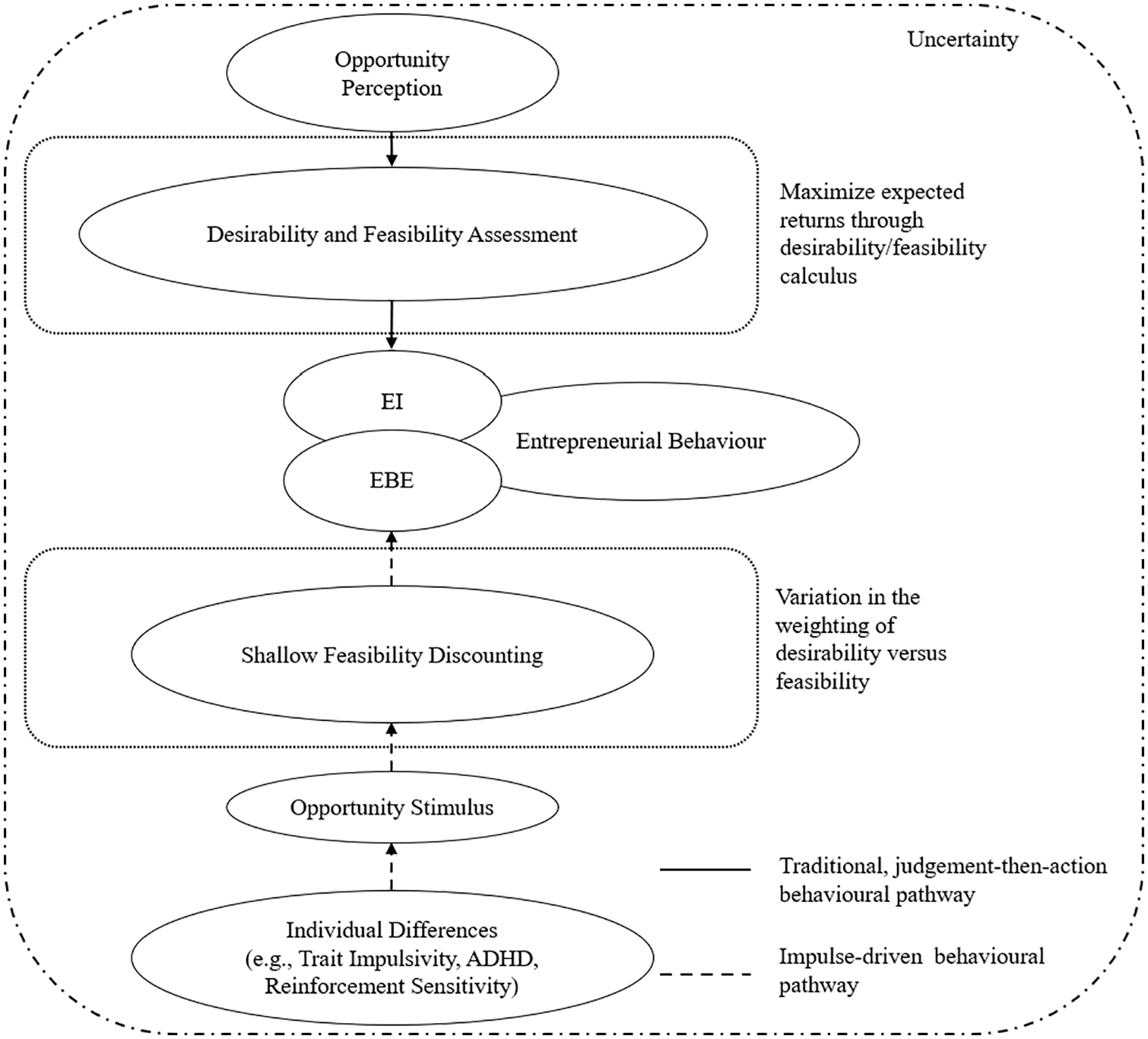
Theorised reasoned versus unreasoned pathways to entrepreneurial behaviour.
Not only does the notion of shallow feasibility discounting in PT provide a formal and robust basis for illustrating a deviation from rationality (Sanfey et al., 2006), it also aligns with what is, at its core, considered impulsive behaviour in the psychology literature: action based on desires as opposed to the feasibility of one’s conduct (Hofmann et al., 2009). We employ among the most widely supported (Berg et al., 2015; Sharma et al., 2014), multidimensional conceptualisations of trait impulsivity; Whiteside and Lynam’s (2001) four-factor model. This model identifies four heterogeneous aetiologies of ‘impulsive-like behaviours’, including, sensation seeking, lack of premeditation, lack of perseverance and urgency. (1) Sensation seeking is a proclivity for enjoying, being attracted to, and pursuing exciting, new and potentially risky experiences; (2) lack of premeditation entails limited deliberation and a disregard for the consequences of one’s actions; (3) lack of perseverance is an inability to ignore distracting stimuli and concentrate on uninteresting or tedious activities; and (4) urgency is a proclivity for experiencing intense negative affect (e.g. anxiety, fear) and acting to relieve that affect, despite the possible consequences (Whiteside and Lynam, 2001).
Thus, trait impulsivity is an ‘umbrella concept’ that rather than generating a unified theory of impulsive behaviour, seeks to explain the diversity of contextually dependent 1 pathways to these behaviours (Antshel, 2018; Berg et al., 2015). Nevertheless, according to Gray’s (1994) RST, a large portion of impulsive behaviour emerging from trait impulsivity can be ascribed to basic, bottom-up neurological differences in sensitivity to reward versus threat (Carver, 2005; Sharma et al., 2014). RST thus, offers a parsimonious lens for theorising how trait impulsivity affects behaviour through basic neurological reactions (i.e. unconsciously rather than through higher order goals), while also closely overlapping with the desirability/feasibility weighting of PT (Hall et al., 2011; Sanfey et al., 2006). At this ‘neuroeconomic’ intersection (Sanfey et al., 2006) we expand on our core hypotheses – how basic differences in neurological reactivity to threat and reward among the impulsivity dimensions drive unreasoned behaviour through shallow feasibility discounting. However, we commence the development of our model by first expanding on the direct impulsivity-EBE link through opportunity uncertainty as a stimulus.
Hypothesis development
Uncertainty, impulsivity and EBE
When forming EBE, immediate affective reactions such as fear, doubt and aversion are elicited (Carrera et al., 2012). In addition, uncertainty regarding when, how and whether to engage in entrepreneurial behaviour becomes an important decision input that typically inhibits behaviour (Van Gelderen et al., 2015). However, PT suggests this may differ for individuals higher on certain impulsivity traits (Tversky and Kahneman, 1974). While the entrepreneurial action literature holds the inhibitory assumption constant between individuals (McMullen and Shepherd, 2006), PT suggests that individuals vary directly in how they frame a decision problem, with some framing novel and uncertain prospects as attractive and exciting (thereby increasing action-likelihood) rather than dangerous and anxiety-provoking (Trepel et al., 2005). Impulsive individuals, in particular, may be attracted to uncertainty, actually forging ahead and being more decisive in these contexts (Hofmann et al., 2009). Indeed, research suggests that far from being an obstacle, uncertainty can be a major stimulus driving risky behaviour engagement among impulsive individuals (Leland et al., 2006), such as engagement in entrepreneurial pursuits (Wiklund et al., 2017).
Considering the distinct impulsivity dimensions, entrepreneurship research has shown particular interest in sensation seeking, since it directly reflects an attraction to engaging in uncertain and novel activities (Wiklund et al., 2018). This research has linked the trait to greater engagement in entrepreneurship (Nicolaou et al., 2008), particularly in unstructured, informal and legally uncertain contexts (Lerner and Hunt, 2012). However, we hypothesise that this effect will also extend to lack of premeditation. Wiklund et al. (2017) found that both sensation seekers and those lacking premeditation are drawn to more uncertain entrepreneurial contexts and form higher entrepreneurial preferences. Like sensation seekers, those lacking premeditation have a high tolerance for uncertain situations (Whiteside and Lynam, 2001), and probably frame them as a source of positive experience rather than fear or danger (Berg et al., 2015), which should raise EBE (Tversky and Kahneman, 1974). We, therefore, hypothesise as follows:
H1a: Sensation seeking is positively related to EBE.
H1b: Lack of premeditation is positively related to EBE.
The opposite probably applies to those high on urgency or lacking perseverance. Wiklund et al. (2017) found that individuals high in urgency avoid uncertainty and form lower entrepreneurial preferences, since they exhibit poor tolerance for distress and risk (Kaiser et al., 2012), and typically frame uncertainty as a source of negative affective experience, which should be avoided (Loewenstein et al., 2001). In addition, as individuals lacking perseverance struggle to remain focused on relevant information and resist distractions (Whiteside and Lynam, 2001), they tend to experience anxiety regarding whether they can correctly assess uncertain and challenging contexts (Zermatten and Van Der Linden, 2008), which similarly makes them aversive against such situations (Leland et al., 2006). We thus hypothesise as follows:
H1c: Lack of perseverance is negatively related to EBE.
H1d: Urgency is negatively related to EBE.
Probability discounting: a deviation from reasoned entrepreneurial behaviour
While attraction to the uncertainty of an opportunity partly accounts for the impulsivity-EBE relationship, it does not adequately account for how impulsivity impels entrepreneurial behaviour through an unreasoned pathway. As such, it remains necessary to theorise how an impulse-driven pathway deviates from the highly reasoned pathway of incumbent judgement-then-action models. Whether one considers entrepreneurial action through the lens of McMullen and Shepherd’s (2006) Entrepreneurial Action Model, the Entrepreneurial Event Model (Krueger, 1993), or the Theories of Planned Behaviour and Reasoned Action (Ajzen, 2011), all rely on the common underlying rationality assumption inherited from classical Expected Utility Theory (Von Neumann and Morgenstern, 1947). The assumption holds that in choosing among alternative courses of action, an individual conducts a ‘cost-benefit calculus’ of the feasibility (expectancy) and desirability (utility) of an opportunity and only engages in entrepreneurial behaviour if this evaluative process indicates the opportunity will maximise their expected returns (McMullen and Shepherd, 2006; Miller, 2007). However, in deviating from this deeply rooted rationality assumption (Miller, 2007), PT explicitly acknowledges that reasoning varies between individuals as a function of how they weight the desirability versus feasibility of a choice (Trepel et al., 2005; Tversky and Kahneman, 1992). In particular, individuals high in certain impulsivity traits are likely to follow an unreasoned pathway, reflected in a tendency to act based on their desires, while disregarding the feasibility of their conduct (termed shallow probability discounting) (Green and Myerson, 2013; Hofmann et al., 2009; Sharma et al., 2014). As illustrated in Figure 1, we posit that shallow probability discounting is a key mechanism explaining the impulsivity-entrepreneurial behaviour link. Rather than the typical case of feasibility perceptions hindering entrepreneurial behaviour, impulsive individuals may form intense EBE based on opportunity desirability, with limited evaluation of the associated challenges, such as resources impediments, uncertainty or poor practicability (Wiklund et al., 2018).
The mediating effect of the salience placed on desirability relative to feasibility
PT suggests that deviations in behaviour related to an opportunity (prospect) are linked to individual differences in attention towards the desirability versus feasibility of the opportunity (Tversky and Kahneman, 1974). Rational processing leads to more reasoned economic behaviour by encouraging systematic calculations of outcome desirability discounted against the subjective probability of occurrence (i.e. feasibility) (Tversky and Kahneman, 1992). As a result, rational analysis leads to the avoidance of uncertainty through behavioural inhibition (Green and Myerson, 2013). Alternatively, unreasoned processing systematically deviates from this more reasoned approach of avoiding uncertainty (Tversky and Kahneman, 1992) by less steeply discounting the value of uncertain, or low probability opportunities (Green and Myerson, 2013). As a result, a lack of reasoning likely increases action on uncertain opportunities (Trepel et al., 2005).
While the multiple dimensions of trait impulsivity reflect heterogeneous, contextually dependent pathways to impulsive behaviour (Whiteside and Lynam, 2001), RST suggests that at a basic neurological level, such impulses can broadly be ascribed to variations in sensitivity towards potentially rewarding versus threatening stimuli (Carver, 2005; Gray, 1994). Accordingly, recent entrepreneurship research has pointed to RST as a lens for integrating heterogeneous psychological constructs to predict less reasoned behaviour (Lerner et al., 2018a; Leung et al., 2020). Reward sensitivity encourages impulsive processing due to a sensitivity and response to potential incentive cues, such as excitement, novelty and the achievement of desires (Corr, 2004). In contrast, threat sensitivity encourages reflection due to a sensitivity and response to potential dangers, such as uncertainty and obstacles (Gray and McNaughton, 2000). Reward and threat sensitivity – which form the crux of RST (Corr, 2004; Gray, 1994) – thus closely overlap (both conceptually and in terms of mapping on similar brain regions), with the attentional bias towards the desirability/feasibility of an opportunity (Hall et al., 2011; Sanfey et al., 2006; Trepel et al., 2005). This enables us to parse the heterogeneous effects of the impulsivity dimensions on our hypothesised mediating construct.
Since sensation seekers focus on rewards with limited consideration of the challenges and prudence of their actions (Whiteside and Lynam, 2001), the trait is linked to high reward and low threat sensitivity in uncertain contexts (Berg et al., 2015). Furthermore, since insufficient premeditation involves acting without prior deliberation (Whiteside and Lynam, 2001), or assessment of one’s capability to successfully perform an activity (Wiklund et al., 2017) the trait is linked to low threat sensitivity in uncertain contexts (Berg et al., 2015; Zermatten and Van Der Linden, 2008). As high reward sensitivity encourages a focus on potential desires and low threat sensitivity decreases a focus on potential consequences (Carver, 2005; Gray, 1994), both sensation seeking and lack of premeditation likely enhance the salience placed on the desirability of exploiting an opportunity, rather than any concrete evaluation of success probabilities or feasibility of that opportunity. In the inherently uncertain entrepreneurial context (Townsend et al., 2018), this unreasoned, shallow probability discounting pathway should enhance EBE (Tversky and Kahneman, 1992). Indeed, research has begun to empirically link high reward/low threat sensitivity to greater engagement in the entrepreneurial context, in essence, by theorising that more impulse-driven attention towards the possible rewards, rather than challenges, of entrepreneurial endeavours drives engagement (Geenen et al., 2016; Lerner et al., 2018c). We thus hypothesise as follows:
H2a: The salience placed on desirability relative to feasibility partially mediates the positive effect of sensation seeking on EBE.
H2b: The salience placed on desirability relative to feasibility partially mediates the positive effect of lack of premeditation on EBE.
In contrast, since urgency is related to a bias towards focusing on, and being sensitive to, negative and threatening information (Zermatten et al., 2005), the trait is associated with high threat sensitivity (Berg et al., 2015). Thus, since high threat sensitivity heightens the tendency to focus on and analyse potential obstacles (Carver, 2005), urgency likely encourages highly rational processing of the feasibility and challenges of an opportunity. Interestingly, lack of perseverance has specifically been associated with a lack of inner resolution or will to deal with adversity or challenge, a lack of desire to excel (Sharma et al., 2014) and an avoidance of risk-taking behaviours (Romer et al., 2016), such as exploiting an entrepreneurial opportunity. Consequently, lack of perseverance is associated with low stimuli sensitivity, particularly reward sensitivity (Berg et al., 2015). This lack of reward sensitivity, often reflected in feelings of depression and lethargy (Carver and Johnson, 2018), likely elicits a greater focus on, and discounting of the ‘reality issues’ of opportunity feasibility, as the individual is unwilling to excel based on reward but rather aims to pursue activities which they can feasibly undertake, given their lack of desire and volition (Berg et al., 2015). Therefore, both urgency and lack of perseverance likely enhance rational processing, resulting in a greater discounting of the value of high uncertainty or low feasibility outcomes, an associated increase in behavioural inhibition (Tversky and Kahneman, 1992), and lower EBE. We, hence, hypothesise the following:
H2c: The salience placed on desirability relative to feasibility partially mediates the negative effect of lack of perseverance on EBE.
H2d: The salience placed on desirability relative to feasibility partially mediates the negative effect of urgency on EBE.
Method
Sample and procedure
We collected two waves of survey data from individuals who currently own, and have a substantial role in operating, a business venture in South Africa. It remains unclear whether push (i.e. through poor fit in traditional workplace contexts) or pull (i.e. through attraction to acting entrepreneurially) factors encourage entrepreneurial behaviour among impulsive individuals (Antshel, 2018; Lerner et al., 2019). However, by virtue of being self-employed, any subsequent entrepreneurial behaviour undertaken by owner-managers cannot be an artefact of their impulsivity (or less reasoned judgement) pushing them out of traditional employment and into entrepreneurship. Therefore, relative to a sample of potential entrepreneurs, this sample allowed us to ensure that the observed results do not emerge out of necessity due to poor impulsivity-traditional employment fit, but rather reflect one’s desires, which pull them towards entrepreneurial behaviour.
A national stratified random sampling frame of 20,000 owner-managers was obtained from a local market research firm. The sample was stratified based on industry, provincial location (Bureau for Economic Research, 2016) and gender (Herrington et al., 2017) proportions of owner-managers in the South African formal business sector. Data were collected using an online survey distributed via email with two bi-weekly follow-up emails. In total, 842 responses were collected for the first-wave, and 807 completed questionnaires were retained for a response rate of 4.21%. 2 In addition, as a robustness test of the predictive validity of our theorised model, we collected the second wave of survey data from the sample of 807 first-wave respondents, which captured their entrepreneurial action 12 months later (n = 221, response rate = 27.4%). The full sample (n = 807) consisted of 36.1% female and 63.4% male respondents. The mean age was 50.4 years (SD = 12.34), with 25% of respondents below 43, and 25% above 59 years of age. 3 The duration of business ownership experience of respondents ranged from a few months to 50 years, while the mean was 14.3 years (SD = 9.74). The education level ranged from high school (13.1%), vocational training (22.2%), bachelors (19.3%), to a postgraduate degree (43.1%). The sample was reasonably representative of the larger target population in terms of industry, provincial location (Bureau for Economic Research, 2016), ownership duration (Small Enterprise Development Agency (SEDA), 2019) and gender (Herrington et al., 2017).
Although appearing consistent with the population from which it was sampled, we further assessed the potential for non-response bias in our sample, following Armstrong and Overton (1977). Assuming late responses are more analogous to non-responses, we compared early and late respondents on various demographics (gender, age, industry, ownership duration and education level), as well as substantive constructs in our model. No significant differences between the two groups were found (p > 0.05). In addition, we compared our sample to a random sample of 200 owner-managers from our sampling frame who did not return the survey, with no significant differences found between the two regarding industry dispersion, gender and location (p > 0.05).
Measures
Multidimensional impulsivity (Wave 1)
The extensively validated (Whiteside et al., 2005) 4-point Likert-type UPPS Impulsive Behaviour scale, developed by Whiteside and Lynam (2001), was used to measure the four distinct impulsivity dimensions. Each dimension is captured with 10–12 items for a total of 45 items.
Salience placed on desirability relative to feasibility (Wave 1)
Despite its recognised importance (Schlaegel and Koenig, 2014), the salience placed on desirability relative to feasibility remains under-researched. Thus, we employed established procedures to develop a new measure (MacKenzie et al., 2011; Podsakoff et al., 2016). First, following our theoretical foundation, we defined the construct as a pattern of cognition resulting in an attentional bias towards the attractiveness, rather than the practicability of an entrepreneurial opportunity – where bias refers to a systematic deviation from the rational economic approach of evaluating outcome desirability and weighing it against feasibility (Tversky and Kahneman, 1974). Based on this definition, we operationalised the salience placed on desirability relative to feasibility as an unidimensional, reflective construct that is relatively stable (i.e. demonstrates a pattern) over time in the entrepreneurial context. Second, we generated items via a deductive process, relying on (1) our construct conceptualisation, (2) reviews of the impulsivity (Hofmann et al., 2009) and entrepreneurial cognition (McMullen and Shepherd, 2006) literatures and (3) examination of related measures (Liberman and Trope, 1998; Tumasjan et al., 2013). Third, we assessed the content and face validity of the resulting six items by submitting them, along with the construct definition, to two subject-matter experts – professors in the field of entrepreneurial cognition. Furthermore, we piloted the measure on 12 owner-managers by discussing the scale with them individually and gauging understanding of the construct. These assessments indicated the measure was reasonably understandable for the target population, required no rewording and adequately captured the intended meaning of the construct.
The resulting six-item, 11-point scale juxtaposed bipolar 1 = low desirability/high feasibility versus 11 = high desirability/low feasibility opportunity characteristics. Following probability discounting (Green and Myerson, 2013) and entrepreneurship (Tumasjan et al., 2013) research, we specifically juxtaposed low-high versus high-low desirability/feasibility characteristics as it enabled examination of how entrepreneurs weight desirability/feasibility trade-offs. Notwithstanding the fact that the alternatives (i.e. high/high, low/low desirability/feasibility characteristics) would not capture variance in this weighting function, the close interdependence between desirability/feasibility trade-offs is well recognised in the entrepreneurial action literature and is the more probable scenario faced by entrepreneurs (McMullen and Shepherd, 2006; Miller, 2007). For example, a highly attractive and novel product idea (highly desirable opportunity) typically carries with it increased uncertainty and investment requirements (lower feasibility). Opportunity desirability and feasibility were each denoted by two different characteristics. Perceived desirability reflects the degree of appeal assigned to the pursuit of an opportunity, signifying the value of the action’s end (Wiklund et al., 2017). Thus, following Tumasjan et al. (2013), two ends-related characteristics were used: (1) profit potential (high versus low) and (2) attractiveness of the product offering to consumers (high versus low) denoted high or low desirability characteristics, respectively. Feasibility reflects the perceived probability that an individual could successfully exploit an opportunity, signifying the degree of difficulty and practicability associated with the opportunity (Schlaegel and Koenig, 2014). Thus, consistent with Tumasjan et al. (2013), two means-related opportunity characteristics were used to denote high versus low feasibility: (1) competitiveness of the market the opportunity is placed in (very uncompetitive versus very competitive) and (2) the amount of personal capital investment required (low versus high). Consistent with a general perception of opportunity characteristics (as opposed to specifics, such as perceptions of the financial model) (Tumasjan et al., 2013), respondents rated the degree to which the opportunity characteristics were (1) positive, (2) promising and (3) a realistic alternative to wage employment. A high (low) score indicates that an individual engages in less (more) steep probability discounting – placing greater salience on the desirability (feasibility) relative to feasibility (desirability) of an opportunity.
EBE (Wave 1)
We captured EBE by adapting the single-item, 7-point scale by Kolvereid and Isaksen (2006). 4 Drawing from research aiming to predict more risky, unreasoned behaviours using behavioural expectations (Carrera et al., 2012; Gibbons et al., 2006), this EBE measure captures the self-predicted likelihood of engaging in entrepreneurial behaviour. Following Shane and Venkataraman’s (2000) operationalisation of opportunity, respondents rated the likelihood (1 = very unlikely to 7 = very likely) that in the next 12 months, they would commence full-scale operations on a new product or service arising from a new opportunity they had recognised. Full-scale operations were defined as the scale required to produce and sell products and/or services to customers (Schoonhoven et al., 1990), and thus, represents the likelihood of engaging in behaviour to exploit an opportunity rather than simply testing the market (Choi and Shepherd, 2004). Consistent with Kautonen et al. (2015), a 12-month time frame was employed as it offered a suitable balance between capturing the immediacy and uncertainty of action (Van Gelderen et al., 2015), while simultaneously allowing sufficient time to capture the practicalities 5 of exploiting an opportunity and the tendency for this exploitation to unfold over time (Wood et al., 2021).
Entrepreneurial action (Wave 2)
To longitudinally validate our theorised model in terms of predicting actual entrepreneurial action, we combined the scales of Kautonen et al. (2015) and Van Gelderen et al. (2015). Consistent with the timeframe for our EBE measure, this five-item, 5-point Likert-type scale captured entrepreneurial action in terms of the magnitude of effort and progress made towards exploiting an opportunity in the 12 months following the Wave 1 survey.
Analysis
Covariance-based structural equation modelling (SEM) was employed using the lavaan package (version 0.6-5) (Rosseel, 2012), in R with maximum likelihood estimation. We employed the SEM approach (c.f. MacKinnon et al., 2002) to test our model as it yields a suitable balance between type I error rates and statistical power while also allowing nested model comparison for theory testing. SEM was conducted in three steps: (1) evaluation of the measurement model, (2) evaluation of structural model fit, the risk of endogeneity, and hypothesised structural paths and (3) bootstrapped indirect effect estimation for statistical inference (MacKinnon et al., 2002).
Results
Measurement model
Exploratory (EFA) and confirmatory factor analyses (CFA) were employed to evaluate measurement model dimensionality, reliability and validity. As a preliminary analysis, we utilised EFA with principal axis factoring extraction and Promax rotation to explore the factor structure of our novel mediating construct (Kline, 2016). EFA, based on Kaiser’s (1974) criterion to retain factors with eigenvalues exceeding 1 and Parallel Analysis (6 variables × 797 respondents) (Montanelli and Humphreys, 1976) revealed a single latent factor with all items exhibiting strong factor loadings (>0.6). We next conducted CFA by inputting all items and the corresponding five factors into the analysis and allowing factor covariance. As CFA constrains cross-item loadings to zero (Kline, 2016), we specifically included our mediating construct in the CFA to conduct a more rigorous test of dimensionality and validity than EFA. The results indicated misspecification of the model due to several factor loadings (lambda (λ) below the recommended 0.6 threshold on the impulsivity dimensions and two substantive measurement error covariances between items of our mediating construct (CFI = 0.805, TLI = 0.796, IFI = 0.806 and RMSEA = 0.058). We subsequently deleted 13 items loading below 0.6 on their relevant impulsivity factors (Kline, 2016), resulting in 8, 8, 9 and 7 items for premeditation, urgency, sensation seeking and perseverance, respectively.
While SEM generally assumes no residual covariances between error terms, it can be appropriate to allow this when a new measure is being developed, and conceptual coverage is more important than model parsimony (Little et al., 1999). Thus, we freed the error covariances between items DVSF1 and DVSF6, as well as DVSF2 and DVSF5, for our mediating construct (refer to items, loadings and reliabilities in Appendix 1). The final retained model showed acceptable fit (CFI = 0.918, TLI = 0.0.911, IFI = 0.919 and RMSEA = 0.044). Table 1 reports descriptive statistics, square roots of the average variance extracted (AVE) and correlations for the relevant factors in our model. Cronbach’s alphas and CRs of all factors exceeded the suggested minimum of 0.70, indicating acceptable reliability (Nunnally, 1978). The square root of each construct’s AVE exceeded its correlations with the other measurement model factors, indicating good discriminant validity (Fornell and Larcker, 1981).
Descriptive statistics, correlations and discriminant validity index.

n = 807; M: mean; SD: standard deviation; DVSF: salience placed on desirability versus feasibility; EBE: entrepreneurial behaviour expectations; EA: entrepreneurial action captured in wave 2; AVE: average variance extracted.
The diagonal values (italicised) are the square root of the AVE.
p < 0.05; **p < 0.01; ***p<0.005 (2-tailed).
Hypothesised model results
Our hypothesised partial mediation model was examined and demonstrated a good fit to the data (CMIN/DF = 2.543, CFI = 0.918, IFI = 0.919, RMSEA = 0.044, SRMR = 0.048), allowing us to investigate the hypothesised paths. According to H1 (a) sensation seeking and (b) lack of premeditation are positively related, while (c) lack of perseverance and (d) urgency are negatively related to EBE. The results indicate that the standardised direct effects of sensation seeking (β = 0.164, p < 0.001), lack of premeditation (β = 0.133, p < 0.01), lack of perseverance (β = −0.126, p < 0.01) and urgency (β = −0.098, p < 0.01), on EBE were all significant and in the direction hypothesised. Thus, support is found for H1a–d.
According to H2, the salience placed on desirability relative to feasibility partially mediates the effect of multidimensional impulsivity on EBE. We examined these indirect effects, employing bootstrapping to generate more robust inferences (MacKinnon et al., 2002). The results (refer to Table 2) based on 5000 bootstrap samples and a 95% bias-corrected confidence interval showed that the salience placed on desirability relative to feasibility significantly mediated the relationship between: (1) lack of premeditation and EBE (β = 0.009, p < 0.01, CI = 0.009 to 0.058), (2) lack of perseverance and EBE (β = −0.014, p < 0.001, CI = −0.140 to −0.022) as well as (3) urgency and EBE (β = −0.012, p < 0.001, CI = −0.113 to −0.016). However, while the direct-effect of sensation seeking on EBE was significant, the indirect effect was not (β = 0.005, p = 0.119). These findings thus provide evidence for our partial mediation model and support H2b, c and d, but not a.
Bootstrapped total, direct and indirect effect estimates.

SE: standard error; LLCI: lower level confidence interval; ULCI: upper level confidence interval; DVSF: salience placed on desirability versus feasibility; EBE: entrepreneurial behaviour expectations.
Results are based on two-tailed tests. Effects are reported in standardised form.
p < 0.01.
p < 0.005.
Robustness analyses
To further assess the robustness of our results, we conduct five additional analyses. First, following Kline (2016), we compared the fit of several alternative nested models (refer to Table 3). We compared our partial mediation model with a full mediation model, a direct-effect model with the hypothesised mediator excluded (Model 3) and a model (Model 4) which reverses the mediator and outcome (i.e. rather than X → M → Y, we assessed X → Y → M). The alternatives did not produce a better fit according to the chi-square difference test, as well as a comparison of Akaike information criterion (AIC) values and alternative fit indicators, suggesting that the theorised partial mediation model explains the data better (Kline, 2016). Figure 2 illustrates these structural model results.
Model comparison of fit indices.

IFI: incremental fit index; CFI: comparative fit index; RMSEA: root mean square error of approximation; AIC: Akaike information criterion.
p<0.005.
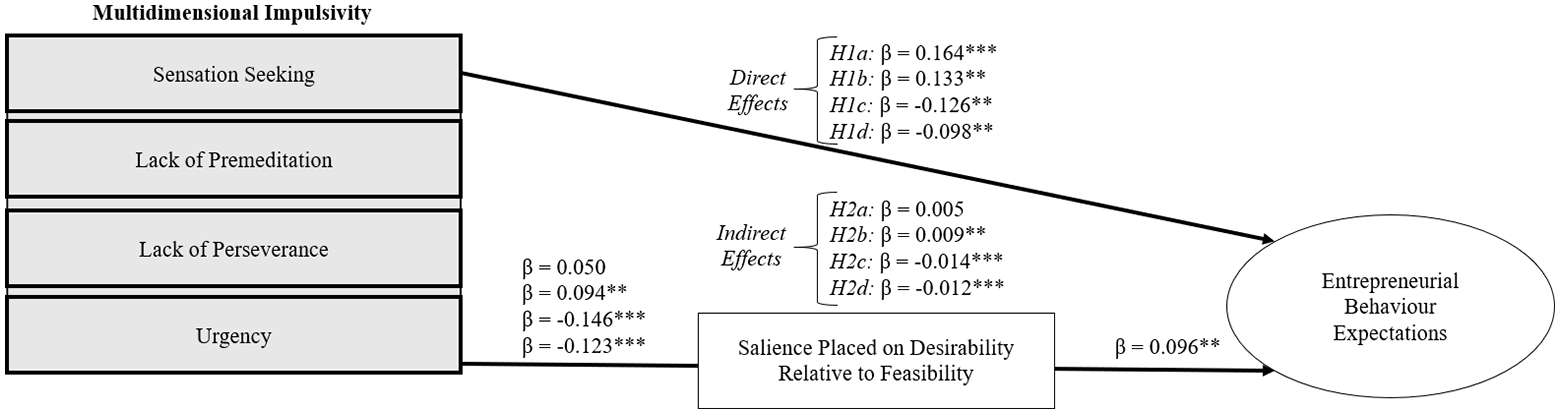
Impulsivity-entrepreneurial behaviour mediation model results.
Second, we employed the instrumental variable (IV) approach by Antonakis et al. (2010) to address the possibility of endogeneity. For impulsivity, we included four IVs, two demographic IVs (age and gender) as well as two 5-point Likert-type IVs capturing the extent to which an individual feels ‘excited’ and ‘distressed’. For the salience placed on desirability relative to feasibility, we employed four IVs: (1) two 7-point Likert-type IVs capturing the preference for entrepreneurship over alternative careers (Krueger, 1993) and (2) two 7-point Likert-type IVs capturing learning (Anderson et al., 2009). All IVs met the theoretical 6 and statistical 7 conditions for effective IVs – highly correlated with the predictor (relevance) and uncorrelated with the error term (exogeneity). With both conditions being met, we conducted a series of Hausman (chi-square difference) tests to assess each possible endogenous path. Each test was nonsignificant, thus indicating that endogeneity is not problematic for our model (p values for rejecting the null of exogeneity >0.174) and that our results are relatively robust to endogeneity-related biases (e.g. reverse causality, omitted variables and common method bias (CMB)).
Third, we also specifically tested for CMB using the CFA marker technique by Williams et al. (2010). We compared a series of five nested models that included a theoretically unrelated marker variable: a measure of the hostile attitude of respondents towards others (three-item Likert-type scale: 1 = not at all hostile and 5 = extremely hostile; Watson and Clark, 1994). This test indicated that the marker variable did not significantly bias the estimates of substantive factor correlations (Method-U vs Method-R model; ∆χ2
Fourth, we tested for the possibility that a portion of the mediating effects on EBE could be ascribed to antecedent-mediator interaction effects using PROCESS in SPSS (Preacher and Hayes, 2008). Testing each interactive effect piecewise revealed no significant interactions across the impulsivity dimensions (p > 0.1), suggesting that our probability discounting construct mediates the effect of impulsivity on EBE rather than interacts with impulsivity to impact EBE.
Finally, we assessed the robustness of our model for predicting entrepreneurial action 12 months after the expression of EBE (n = 221). Our measure demonstrated acceptable reliability (alpha > 0.70) as well as validity (refer to Table 1), and including it as the ultimate explanandum in our SEM model resulted in acceptable model fit (CFI = 0.901, IFI = 0.902 and RMSEA = 0.046). This allowed us to assess individual paths of the model. EBE was a positive predictor of action (β = 0.327, p < 0.001). Furthermore, employing the bootstrapping procedure outlined previously, the salience placed on desirability relative to feasibility had a significantly positive effect on action through EBE (β = 0.049, p < 0.04, CI = 0.004–0.042), with all the paths of our original model (refer to Figure 2) remaining substantively similar. These results begin to demonstrate the robustness of our model in terms of predicting actual entrepreneurial action.
Post hoc multi-group sensitivity analysis
As a further robustness check, we explored the influence of various potential moderating variables on the model, as suggested by previous literature (Antshel, 2018; Wiklund et al., 2018). We separated the sample into two, reasonably equally proportioned, groups and conducted multi-group analyses according to (1) age and (2) duration of ownership experience – both split at the mean; 8 (3) education status – split at postgraduate degree level; (4) gender and (5) industry background – split between more dynamic versus less dynamic industries based on how technology-intensive and how new (vs mature) the industry is, as typical indicators of dynamism and uncertainty (Wiklund et al., 2018). Following the thresholds recommended by Chen (2007) (∆ CFI < 0.01 and ∆ RMSEA < 0.015), all models passed tests for configural, metric and scalar invariance, allowing us to constrain the intercepts and factor loadings to equality between groups and assess specific path differences using chi-square difference tests.
Only four significant path differences were found (refer to Table 4). First, the lack of perseverance-EBE path is negative and significant for individuals with less than 14 years of ownership experience (β = −0.242; p < 0.005), while nonsignificant for those with more than 14 years (β = −0.038; p = 0.483). Second, the lack of premeditation-salience placed on desirability relative to feasibility path is significant for the group with more ownership experience (β = 0.173; p < 0.005), in contrast to their less experienced counterparts (β = −0.013; p = 0.832). Third, while the sensation seeking-salience placed on desirability relative to feasibility path is nonsignificant for the older group (β = 0.017; p = 0.729), it becomes significant for the group below 50.4 years of age (β = 0.130; p < 0.05), resulting in a significant indirect effect on EBE (β = 0.020, SE = 0.039, p < 0.05). Finally, while the salience placed on desirability relative to feasibility-EBE path is nonsignificant for owner-managers operating in less dynamic industries (β = −0.038, p = 0.562), the path is significant in more dynamic industries (β = 0.159, p = 0.007), resulting in significant indirect effects for the more dynamic industry group (lack of premeditation: β = 0.025, SE = 0.063, p < 0.05; lack of perseverance: β = −0.033, SE = 0.092, p < 0.01; urgency: β = −0.025, SE = 0.060, p < 0.01), but not the less dynamic group.
Model-group comparisons.

DVSF: salience placed on desirability versus feasibility; EBE: entrepreneurial behaviour expectations.Chi-square difference values presented.
Results from splitting the groups at the mean are presented. Upper and lower quartile splits yielded the same substantive results.
p < 0.05.
Discussion
Theoretical implications
Despite impulsivity-entrepreneurship research suggesting limitations to the incumbent judgement-then-action perspective (Wiklund et al., 2017), until now, it has remained unclear how impulsivity may impel unreasoned entrepreneurial behaviour. We developed and tested a model exploring an unreasoned pathway, and in doing so, offer several novel theoretical insights. First, we found support for our direct-effect hypotheses that sensation seeking and lack of premeditation positively, while lack of perseverance and urgency negatively impact EBE. Incumbent entrepreneurial action models assume that individuals uniformly frame uncertainty as aversive, as something some could, at best, ‘bear’ (McMullen and Shepherd, 2006). Yet, our findings suggest sensation seekers, and those lacking deliberation may frame uncertain entrepreneurial opportunities as attractive, thereby increasing EBE (Tversky and Kahneman, 1974). Conversely, individuals high in urgency or low in perseverance appear to follow the predictions of incumbent models, framing uncertain opportunities as a source of negative affect, thereby lowering EBE. Prior work positively linking impulsivity with EI has been questioned as simply reflecting desire and not true behavioural likelihood (Antshel, 2018), particularly due to the poor conceptual overlap between impulsivity and reasoned-intentionality (Ajzen, 2011). However, our findings link impulsivity with EBE – a construct more strongly determined by feasibility considerations and non-volitional factors, such as uncertainty (Warshaw and Davis, 1985; Wood et al., 2016). Furthermore, EBE significantly predicted actual entrepreneurial behaviour 12 months later. Our findings thus provide compelling evidence that impulsivity exerts an important impact on the entrepreneurial process, which extends beyond superficial desires to elicit a differential behavioural response to uncertainty.
Second, we reveal a mechanism driving the impulsivity-entrepreneurial behaviour link. Specifically, we predicted and found that individuals high (low) on lack of deliberation, but low (high) on urgency or lack of perseverance, place greater (less) salience on the desirability versus the feasibility of an opportunity, and this pathway results in higher (lower) EBE. We thus advance the impulsivity-entrepreneurship literature beyond a focus on impulsivity and other disinhibiting traits, which simply predispose individuals to unreasoned behaviours (Berg et al., 2015), to which of, and how, these traits may encourage entrepreneurial behaviour from an unreasoned perspective.
Drawing from RST (Gray, 1994), we show which of the heterogeneous impulsivity dimensions decrease probability discounting as a function of basic, neurological variations in reactivity to threat versus reward (i.e. unconsciously rather than through higher order goals). While the sensation seeking-EBE indirect effect was nonsignificant, this may reflect our relatively older sample. Research indicates that impulsive behaviours resulting from sensation seeking decline with age (Duckworth and Kern, 2011), and our multi-group analysis indeed revealed that the sensation seeking-EBE indirect effect was significant for individuals below 50.4 years of age. Accordingly, our findings indicate that sensation seeking (at least for those below middle age) and lack of deliberation, traits associated with high reward and low threat sensitivity (Berg et al., 2015), encourage unreasoned behaviour based on shallow probability discounting. Alternatively, urgency and lack of perseverance, traits associated with low reward and high threat sensitivity (Berg et al., 2015), encourage one to pause and engage in more rational analysis and steep probability discounting. As such, we provide a unifying lens for understanding which of the heterogeneous impulsivity dimensions encourage unreasoned entrepreneurial behaviour.
In addition, by demonstrating how impulsivity impels unreasoned behaviour, we contribute to a lively and rapidly emerging scholarly debate regarding whether all entrepreneurial behaviour ought to be ascribed an intentionally rational role. While research observing an impulsivity-entrepreneurship link suggests the presence of unreasoned pathways to entrepreneurial behaviour (Hunt and Lerner, 2018; Wiklund, 2019), the lack of mechanisms demonstrating this pathway has also encouraged attempts to subsume impulsivity within the judgement view by proposing the trait drives behaviour through higher order, rationally derived intentions (Brown et al., 2018; Wood et al., 2021). Moving beyond general psychological explanations for the impulsivity-entrepreneurship link (e.g. personality-environment fit), we draw from the more formal and robust models of reasoning provided by behavioural economics (PT; Sanfey et al., 2006; Tversky and Kahneman, 1992) to offer a specific, theoretically grounded mechanism demonstrating unreasoned behaviour. That is, we specifically demonstrate how the deeply held rationality assumption in incumbent entrepreneurial action models – that entrepreneurs are rational actors who seek to maximise returns by evaluating opportunity desirability and weighing it against feasibility (McMullen and Shepherd, 2006) – does not hold for unreasoned behaviour. Rather, unreasoned entrepreneurial behaviour is a distinct and empirically observable phenomenon, observed through a systematic decrease in the discounting of uncertain, low feasibility opportunities (Tversky and Kahneman, 1992). This is an important contribution, as it shows that attempts to subsume impulsivity within the judgement view (Brown et al., 2018; Wood et al., 2021) are untenable, since behaviour driven by rationally derived intentions would invariably give rise to steeper discounting of low feasibility opportunities (Trepel et al., 2005). Overall, from both a basic neurological reactivity (Gray, 1994; Whiteside and Lynam, 2001) and behavioural economics (Tversky and Kahneman, 1992) perspective, our results support the existence of an unreasoned pathway. In so doing, we lend empirical weight to the emerging conviction that unreasoned pathways ought to have a distinct place alongside judgement-then-action theories of entrepreneurial behaviour (Lerner et al., 2018b; Wiklund, 2019).
This broadened view of the precursors to entrepreneurial behaviour further indicates a need to expand our understanding of what is considered theoretically relevant entrepreneurial behaviour – behaviour leading to opportunity exploitation – in the first place (Lerner et al., 2018b). While scholars have generally relied on EI to mark commencement of the entrepreneurial process and distinguish entrepreneurial, from other behaviour (Brown et al., 2018; McMullen and Shepherd, 2006; Wood et al., 2021); our work offers some headway towards a broader view called for by Van Lent et al. (2020). We show that through EBE, a lack of reasoning can predict a meaningful portion of actual entrepreneurial behaviour 12 months later. Thus, by providing space for the possibility that behaviour can precede deliberate reasoning and may not be under full volitional control (Gibbons et al., 2006), EBE may begin to facilitate this broader understanding. For example, rather than entrepreneurial behaviour being identified by a concrete belief that one’s behaviour is a preferred means to a goal (EI), perhaps all that is required is a perceived likelihood (EBE), whether intentional or not, that this behaviour could possibly result in exploitation of an opportunity. This broader perspective may not only better facilitate capturing unreasoned, early stage entrepreneurial behaviours (Lerner et al., 2018b), but may also eschew reliance on views of the entrepreneur as some prescient progenitor who follows a linear entrepreneurial path, unaffected by personal impulses or factors out of their volitional control (Dimov, 2011).
Third, while post hoc tests of moderating effects indicated that our theoretical model remained robust to (even relatively extreme) demographic variations, we did find two noteworthy effects. First, the lack of premeditation-salience placed on desirability relative to feasibility path was positively moderated by entrepreneurial experience. This finding reinforces the distinctiveness of impulse-driven entrepreneurial behaviour as a behavioural logic. Entrepreneurial experience is generally associated with increased domain knowledge (McMullen and Shepherd, 2006). Research shows this knowledge enhances awareness of, and a focus on, opportunity feasibility (Baron and Ensley, 2006), even encouraging one to place more importance on their means and what they can feasibly enact, rather than desirability and potential returns (Dew et al., 2009). Yet this is not the case for those lacking deliberation. The insensitivity to threat and negative experiences (Zermatten et al., 2005), and likely bias regarding the upside of entrepreneurial experiences (Wiklund et al., 2018), of these individuals appears to only intensify their urge to act on opportunities, while disregarding the feasibility. Despite their becoming increasingly aware of the consequences, lack of deliberation encourages shallow probability discounting, reinforcing the view that impulsivity can drive unreasoned entrepreneurial behaviour despite, rather than simply due to a lack of, awareness of the consequences (Hofmann et al., 2009; Lerner et al., 2018b). Second, the mediated effect of multidimensional impulsivity on EBE was positively moderated by uncertainty. PT suggests that individuals engaging in shallow probability discounting will be encouraged to act regardless of the uncertainty and consequences, while behaviour will be strongly inhibited by uncertainty for more rational individuals (Tversky and Kahneman, 1992). We find empirical support for this notion. This highlights the centrality of uncertainty to the explanatory logic in our model: a lack of reasoning encourages entrepreneurial behaviour by overcoming the inhibitory effects of uncertainty (Van Gelderen et al., 2015).
Finally, we begin to advance a probability discounting mechanism and measure which can enrich understanding of this unreasoned pathway. The measure was developed and tested through a range of content, convergent, discriminant, and nomological validity tests and presents a promising preliminary attempt at empirically capturing an unreasoned pathway to entrepreneurial behaviour. Our theorised model behaved as predicted through a range of direct, indirect, invariance, moderation, validity and endogeneity, tests. This gives us confidence that the measure is a valid indicator of the focal construct (MacKenzie et al., 2011; Podsakoff et al., 2016) that can contribute to future investigations aiming to incorporate impulse-driven precursors of entrepreneurial behaviour. Moreover, our theorising that unreasoned behaviour is a function of basic, neurological variations in reward and threat sensitivity (Gray, 1994) suggests broader applicability of our discounting measure as a unifying lens for understanding a range of personality, psychopathological and biological factors which may increase unreasoned entrepreneurial behaviour. For example, entrepreneurship scholars have shown interest in various possible unreasoned precursors to entrepreneurial behaviour, such as ADHD, narcissism and hypomania (Leung et al., 2020), addiction (Spivack and McKelvie, 2018), and a lack of sleep (Gunia et al., 2021); all of whom appear to rely on the variations in reward and threat sensitivity rooted in these precursors (Bijttebier et al., 2009), as explanations for heightened unreasoned behaviour.
Practical implications
From a practical standpoint, the results of this article may prove useful to entrepreneurship pedagogy, practice and policy which are concerned with facilitating entrepreneurial behaviour, particularly under uncertainty (Townsend et al., 2018). While judgement-then-action models suggest the importance of gaining knowledge to overcome uncertainty and engage in entrepreneurial behaviour (McMullen and Shepherd, 2006), our results suggest some merit to an unreasoned approach that disregards uncertainty, probabilities and issues of feasibility. We thus begin to offer an alternative prescriptive lever to enhance entrepreneurial behaviour under uncertainty.
In addition, individuals should be aware of their impulsive predispositions towards unreasoned versus reasoned processing due to its effect on entrepreneurial behaviour. While seen as a limitation in more traditional careers (Antshel, 2018), our results suggest that impulsive individuals could benefit from leveraging the trait to pursue entrepreneurial opportunities. However, while this unreasoned pathway may encourage entrepreneurial behaviour, care should be taken since a disregard for feasibility will also probably entrench fatal flaws within the pursuit (Lerner et al., 2018c). We thus offer a promising, yet cautionary note for those seeking to manage the effects of impulsivity in entrepreneurship. In terms of managing these effects, our research indicates that context matters. A tendency towards unreasoned processing only appears to enhance EBE in more uncertain and dynamic contexts. Since potential outcomes are unknown and unknowable in uncertain contexts (Townsend et al., 2018), ex-ante information is of little value anyway, and fast, active experimentation is probably rewarded (Wiklund et al., 2018). We suggest that impulsive individuals pursue these contexts, as the action-orientation of impulsivity is rewarded while the costs of limited reasoning are mitigated. Moreover, while trait impulsivity is considered relatively stable (Whiteside and Lynam, 2001), there are tools to influence one’s receptivity to various opportunity stimuli (c.f. Wiesenfeld et al., 2017). While beyond the scope of this text, these tools may assist in managing impulsive outcomes depending on the levels of uncertainty in the venturing context. For example, in highly uncertain contexts, our research indicates that individuals high on urgency or lacking perseverance should seek tools to limit their focus on potential threats and uncertainty, due to its inhibitory effects.
Finally, these implications extend to traditional policy and pedagogical approaches, which may currently be overly circumscribed. These approaches often focus on the inculcation of tools such as business planning, which seek to enhance a focus on feasibility (Brush and Noyes, 2012), based on the judgement-then-action assumption. Our research suggests that these approaches should also include less reasoned perspectives as they offer valuable insight into entrepreneurial behaviour and, in contexts characterised by dynamism and uncertainty, can be leveraged to circumvent behavioural inhibition.
Limitations and future research recommendations
Although our findings offer valuable insight into the impulsivity-entrepreneurship relationship, a few limitations should be noted. First, we emphasise that entrepreneurial behaviour is not synonymous with performance. While we show how impulsivity encourages unreasoned behaviour, future research could benefit from an assessment of the performance implications. Second, we tested our model among owner-managers, who likely have differing perceptions of entrepreneurial opportunities relative to potential entrepreneurs. Research suggests that a degree of familiarity with a behaviour may encourage impulsivity (Evans, 2008), and it is plausible that potential entrepreneurs who are entirely new to entrepreneurship are less likely to follow an unreasoned pathway. While our model remained robust to relatively extreme variations in entrepreneurial experience, we still cannot directly comment on the presence of an unreasoned pathway for potential entrepreneurs. Future research could fruitfully assess if our model extends to this group.
Third, we note that while the path from our mediator to EBE was significant, the effect size was relatively small (although post hoc analyses revealed a substantial increase in more dynamic contexts). We embrace the modern view that human behaviour is a function of dual pathways, where both reasoning and a lack thereof contribute to explaining behaviour (Deutsch and Strack, 2010), particularly throughout the complex entrepreneurial process. Furthermore, it is well-acknowledged that empirically capturing less reasoned entrepreneurial behaviours is elusive, and research from this perspective is nascent (Hunt and Lerner, 2018; Lerner et al., 2018b). Therefore, our goal with the development of the mediating construct in this article is to stimulate future research aimed at empirically capturing this less reasoned pathway and outcomes associated with it.
Finally, while we used a unidimensional measure for our mediating construct to facilitate examination of how entrepreneurs weight desirability/feasibility trade-offs, this precluded us from developing more fine-grained understanding of their probability discounting functions. Future research could benefit from more fine-grained investigations, perhaps by employing conjoint designs that present many alternative manipulations of desirability/feasibility characteristics to more precisely capture differences in probability discounting. Nevertheless, concerns over opportunity feasibility have always been a central issue inhibiting entrepreneurial behaviour (McMullen and Shepherd, 2006). So, by showing that impulsive individuals less steeply discount the value of low feasibility opportunities, we provide evidence that an impulse-driven pathway will increase action-likelihood throughout the various desirability/feasibility combinations relative to a reasoned approach which more steeply discounts feasibility.
Conclusion
Although offering substantial potential to expand scholarly insight, investigations of unreasoned precursors to entrepreneurial behaviour are empirically elusive and problematic for the deeply held rationality assumption in theories of the entrepreneur. This article sought to address these challenges by theorising and testing how impulsivity impels unreasoned entrepreneurial behaviour. By illustrating how an unreasoned pathway deviates from the incumbent judgement-then-action perspective, we offer valuable insights into how this pathway can begin to be productively captured and incorporated in theories of entrepreneurial behaviour. As pointed out by Lerner et al. (2018b), the incorporation of an unreasoned perspective in theories of entrepreneurial behaviour has the potential to significantly advance the field, bringing it closer to the reality it seeks to explain. This article aims to offer an empirically grounded foundation as scholars strive to move ever closer to capturing this reality.
Footnotes
Appendix 1
Funding
The authors disclosed receipt of the following financial support for the research, authorship, and/or publication of this article: The authors would like to thank the Department of Business Management, University of Pretoria for funding the open access publication of this article.
