




Abstract
This article advances knowledge on the diversity and heterogeneity of women-led small and medium-sized enterprises (SMEs) in the United Kingdom by analysing how gender intersects with ethnicity and place to influence their engagement in innovation. We adopt an intersectional perspective, and base our analyses on the Longitudinal Small Business Survey (LSBS) data of 29,257 SMEs over the period 2015–2018. Our findings suggest that despite their limited number, as well as firm size and industry sector constraints, women-led SMEs are actively engaged in innovation activities. In addition, our results on the effects of intersecting categories of gender, ethnicity and place on innovation, further emphasise the heterogeneity of women-led SMEs, both with regard to their likelihood to engage in innovation, as well as the place where innovation is most likely to occur. Implications for policy and practice are highlighted.
Introduction
During the last two decades, innovation has gained importance with regard to its role in economic recovery and sustainable growth (Pettersson and Lindberg, 2013). However, until recently, this focus has been on technological product development among large firms within sectors primarily dominated by men, such as technology and manufacturing (Lindberg et al., 2015). Accordingly, the role of women-led (WLED) small and medium-sized enterprises (SMEs) as mechanisms for societal well-being and economic development is not widely recognised within innovation research (Filculescu, 2016; Orser et al., 2012). Furthermore, many policies and initiatives still adopt a gender blind perspective that assumes equal outcomes in science and technology (Lee and Pollitzer, 2016; Pecis, 2016). Thus, despite growing evidence of the positive impact of gender diversity on innovation (Bouncken, 2004; Dai et al., 2019; Díaz-García et al., 2013), research adopting a gender perspective to understanding innovation processes, systems, policies and support schemes is scarce (Alsos et al., 2013; Coleman et al., 2019; Kvidal and Ljunggren, 2014).
The current understanding of the diversity and heterogeneity of women entrepreneurs within the innovation context is equally limited. Diversity can be viewed as comprising different dimensions of observable and non-observable traits used to differentiate one individual from the other (Roberson, 2006). While studies increasingly highlight the importance of recognising the heterogeneity (i.e. within-group differences) of social groups as a result of these diverse traits, most research on minority groups tends to focus on specific dimensions of disadvantage such as age, gender, race and ability status; hence, assuming within-group homogeneity while underestimating the impact of intersecting socio-demographic categories (Knight, 2016; Martinez Dy, 2020).
Our study advances knowledge on the diversity and heterogeneity of WLED SMEs in the United Kingdom (UK) by analysing how gender intersects with ethnicity and place to influence their engagement in innovation activities. The heterogeneity of women entrepreneurs is particularly important as research indicates that the entrepreneurial process is influenced by the privileges and disadvantages created by intersecting socio-demographic categories (Gorbacheva et al., 2019; Martinez Dy, 2019; Wingfield and Taylor, 2016). As the current COVID-19 pandemic has shown, the impact of intersecting categories can be exacerbated during times of crises. Socio-demographic categories such as gender, age, ethnicity, class and disability are heightening detrimental outcomes and creating glaring inequalities, especially for those at the intersections of these categories (Martinez Dy and Jayawarna, 2020; Roberts et al., 2020).
The importance of place (location) to economic development has long been established within fields such as economic geography (Briggs et al., 2008). The resources available within a geographical location influence the decision-making processes of firms at various stages of the entrepreneurial process. Silicon Valley in the United States, the Midlands and City of London in England, are examples of places which, through the effects of agglomeration, are critical to the operational models of firms and industries located there (Nyanzu, 2019). Furthermore, there is substantial literature engaged in the North-South divide discourse in the UK (Dorling, 2010; Hacking et al., 2011), which highlights the structural socioeconomic differences between regions – especially in England – and the relative impact of de-industrialisation on these areas. However, the importance of place to science and innovation, while gaining recognition is still not fully understood (Autio et al., 2014; Blake and Hanson, 2005). Understanding WLED SME engagement in innovation therefore, requires a holistic approach that analyses both the individual experience and structural factors influencing access to opportunities, resources and markets (Botella et al., 2019; Brush et al., 2019; Foss et al., 2019; Welter et al., 2017).
Our study contributes to this knowledge gap by adopting an intersectional perspective that allows us to emphasise both the agentic processes and structural forces influencing women’s entrepreneurship, while challenging assumptions of within-group homogeneity (Atewologun, 2018; Romero and Valdez, 2016). Specifically, we map the diversity of WLED SMEs in the UK by analysing how gender intersects with ethnicity and place to influence their engagement in innovation. While intersectionality has primarily been associated with qualitative studies, it is becoming evident within quantitative studies analysing social inequalities (Codiroli Mcmaster and Cook, 2019). We address the following research question: (1) does gender, ethnicity and place influence SME engagement in innovation activities? In addition, given the key role of science, engineering, technology and mathematics (STEM) fields to innovation-driven economies (Walters and McNeely, 2010), we also analyse potential variations between SMEs in the technology sector and those in all other sectors. We ask the following questions: (2a) does gender, ethnicity and place influence technology SMEs engagement in innovation activities? (2b) does the level of engagement in innovation differ between WLED technology SMEs and WLED SMEs in other sectors? We base our analyses on the Longitudinal Small Business Survey (LSBS) data of 29,257 SMEs over the period 2015–2018.
This article highlights the effects of both individual and intersecting categories of gender, ethnicity and place on innovation, and makes the following contributions. First, our results suggest that despite their limited number, and constraints faced in terms of firm size and industry sector, WLED SMEs are actively engaged in innovation activities (i.e. process innovation, product innovation, investment in research and development). Second, our analysis of the interaction effects between gender and ethnicity enables us to draw attention to the heterogeneity of WLED SME engagement in innovation. Third, we emphasise the significance of place for innovation by highlighting the variation in regional distribution of WLED SMEs and identifying places where innovation is most likely to occur. Fourth, we provide insights for future research on the diversity and heterogeneity of women’s entrepreneurship. There is a need for comprehensive national level studies that allow for more fine-grained analyses of intersecting socio-demographic categories influencing women’s entrepreneurial activity. A better understanding of the long-term effects of structural factors, as well as the systemic inequalities and barriers faced by women business owners seeking to access resources, would also make valuable contributions to current knowledge. Overall, our results encourage a holistic approach towards inclusive innovation policymaking that goes beyond the prevalent reductionism of existing support initiatives focused on gender variable characteristics, to include interventions in areas where intersectional factors (such as ethnicity and place) create particular barriers.
The remainder of the article is organised as follows. In the next section, we outline the theoretical framework underpinning this study, followed by a description of the research methodology. We then present our empirical results and discussion in the following sections. The final section concludes the study and highlights implications for policy and practice.
Gender diversity and innovation
The continued focus of innovation research and policy on innovation products, processes and systems within male-dominated sectors has rendered the ‘innovator’ invisible (Alsos et al., 2013), while obscuring the gendered nature of the innovation process (Pecis, 2016). The gendered aspects of the innovation phenomenon (i.e. where innovation takes place, how it is measured and who it involves), therefore, remains relatively under-explored (Alsos et al., 2013; Lindberg et al., 2015). A comprehensive understanding of the gender hierarchy that associates the ‘masculine’ to technology and innovation, while subordinating and excluding the ‘feminine’ from such contexts is also needed (Marlow and McAdam, 2012). Gender differences in accessing and utilising resources for power (Ragins and Sundstrom, 1989) is evident within contemporary innovation-driven economies. The unequal access to resources that women in STEM experience, despite comparability with their male colleagues in terms of qualifications and accomplishments, perpetuates this continued marginalisation (Walters and McNeely, 2010). As STEM fields play a crucial role in innovation, the following sub-sections focus on prior literature analysing gender influences, intersectional perspectives, as well as policy initiatives on STEM and innovation.
Gender influences on STEM and innovation
Women’s under-representation in STEM and innovation arises from gender biases and systemic inequalities in social structures (Kuschel et al., 2020). Challenges arising from issues such as negative stereotypes, societal expectations, lack or role models, organisation culture have resulted in a steady decline over the past 20 years of the enrolment of women students in STEM disciplines and their professional participation in the technological sector (Botella et al., 2019; Gorbacheva et al., 2019; Vitores and Gil-Juárez, 2016). Stereotypes and perceptions play an important role in influencing future career aspirations; Kang et al. (2019) find that the portrayal of STEM careers as object-oriented, offering limited personal time and antithetical to communal goals, has a detrimental effect on women student’s interest in science. Similarly, Stout et al. (2016) find that highlighting the communal nature of STEM fields (i.e. betterment of others) attracts more women college students to these fields, while highlighting the agentic nature of behavioural sciences (i.e. self-direction and self-promotion) attracts men to subjects such as psychology or sociology. However, there is a need to acknowledge gender as a cross-cutting theme, especially in highly gender segregated sectors such as STEM and innovation (Berman and Bourne, 2015; Herman, 2015). For example, while women students in science, engineering and technology (SET) fields might demonstrate resistance to cultural norms at an individual level (e.g. by finding pleasure in the challenges of working in male-dominated fields), this capacity is limited by structural inequalities that portray SET fields as unsuitable careers for them (Powell et al., 2012).
Greater attention needs to be paid to the structural factors influencing women’s participation in STEM and innovation. Societal expectations regarding work-family balance, divisions of domestic labour and child care, play a role in influencing women’s careers in STEM fields (Forson and Özbilgin, 2003; Herman, 2015; Wynarczyk and Renner, 2006). The organisational culture in many STEM fields is strongly gendered and geared towards maintaining male hierarchies. This results in the side-lining of women regarding access to mentors and networks, opportunities for advancement and salary levels (Ahuja, 2002; Herman, 2015; Orser et al., 2012). In addition, the role of labour-market conditions and location of STEM industries in constraining choices about work options has been highlighted (Herman, 2015). A longitudinal study of women leaders in tech cities – that is, specific geographical areas where technology companies are clustered – highlights the pervasiveness of a masculinised culture, and the cultural boundaries such women regularly have to cross to legitimise their knowledge and expertise (Hardey, 2019). Even within business incubators, stereotypical gendered expectations reproduce masculine norms that female technology entrepreneurs need to ‘fit’ (Marlow and McAdam, 2012). Developing policies and initiatives that encourage gender diversity in STEM and innovation therefore, necessitates attention to the relationships between place, space and professional practices (Hardey, 2019). The heterogeneity of women entrepreneurs within the innovation context also requires greater consideration (Griffiths et al., 2007; Kelley et al., 2017).
Intersectional perspectives on STEM and innovation
Most studies on under-represented groups tend to focus on specific dimensions of disadvantage, such as age, gender, race, ability status and so on, underestimating the impact of intersecting socio-demographic categories (Knight, 2016; Martinez Dy, 2020). Research on ethnic entrepreneurship for example, tends to overlook experiences of racialised women, while studies on women’s entrepreneurship tend to homogenise women’s experiences (Knight, 2016). As a result, critical perspectives on innovation that acknowledge the impact of power-laden categories such as race, class, ethnicity and their intersections with gender are limited (Pettersson and Lindberg, 2013).
The Black feminist concept of ‘intersectionality’ provides a critical framework with which to examine the interconnections and interdependences between socio-demographic categories and systems (Atewologun, 2018). Although originally coined by Crenshaw in 1989, the concept of intersectionality was developed by women of colour in the 1960/1970s (Carastathis, 2014). Intersectionality focuses on the interactions between socio-demographic categories of difference in individual lives, social practices, cultural ideologies and institutional arrangements, as well as the subsequent outcomes of these interactions in terms of power (Davis, 2008; Samuels and Ross-Sheriff, 2008). It further examines how both agentic processes and structural forces influence the ability to access and/or mobilise resources (Romero and Valdez, 2016).
Individuals occupy multiple social positions of privilege and oppression simultaneously. Socio-demographic categories such as gender, race and ethnicity have been shown to intersect with class to shape the entrepreneurial process for Latino (Agius Vallejo and Canizales, 2016), Mexican (Valdez, 2016), Black American (Gold, 2016; Harvey, 2005; Wingfield and Taylor, 2016) and African-Caribbean (Knight, 2016) entrepreneurs by influencing access to financial and social capital. Even within the digital environment, women’s access to entrepreneurial resources is influenced by privileges and disadvantages created by intersecting categories of gender, ethnicity, race and class status (Martinez Dy, 2019; Martinez Dy and Jayawarna, 2020). Nevertheless, studies also highlight the agency of women entrepreneurs in utilising their intersectional social positions to subvert oppression and exclusion experienced and sustain their enterprises (Essers and Benschop, 2007; Essers et al., 2010).
While intersectionality has primarily been associated with qualitative studies, it is emerging within quantitative research on social inequalities (Atewologun, 2018). Within the field of education, adopting an intersectional perspective on inequality recognises the need to focus on the multiple intersecting inequalities between socio-demographic categories, and how these combine to produce ‘complex inequality’ (Codiroli Mcmaster and Cook, 2019; McCall, 2005). Studies analysing the interactions between gender and ethnicity among A-level students in England find an association between social background and subject choice (Codiroli Mcmaster, 2017). Less advantaged women students are more likely to study social science, law and business – instead of STEM – than their more advantaged peers (Codiroli Mcmaster, 2017). Similarly, Van de Werfhorst (2017) finds that students with higher socioeconomic status experience lower levels of gender-segregation, that is, women students are more likely to enrol in STEM, and men in health. In contrast, students from less advantaged backgrounds are more likely to choose ‘gender typical’ subjects (Van de Werfhorst, 2017).
Despite the benefits of using an intersectional lens to understand inequalities, there are some methodological challenges in adopting such an approach. For example, the categorisation of individuals into pre-defined groups can obscure the true relationship between individuals and power structures in society (McCall, 2005). The lack of adequate disaggregated data can also result in important aspects of inequality being overlooked (Codiroli Mcmaster and Cook, 2019). Moreover, the statistical methods used to identify intersectional inequalities are not always straightforward. As such, researchers need to be explicit about what can, and cannot, be inferred from their findings, based on the methodological approach utilised (Codiroli Mcmaster and Cook, 2019). Whereas, the benefits of diversity for innovation are acknowledged, an understanding of the complex issues involved in developing appropriate support systems for innovators is still lacking (Gorbacheva et al., 2019).
Policy initiatives on STEM and innovation
Policy focus on innovation is driven by the belief that it revitalises and promotes economic growth (Pettersson and Lindberg, 2013), with support being provided to SMEs to increase their levels of R&D and innovation activities (Higón, 2012; Higón and Driffield, 2011). Innovation as defined in the UK includes the following: the introduction of new or significantly improved product (good or service) or process; investment activities in R&D; as well as new and significantly improved forms of organisation, business structures or practices (Department for Business Energy and Industrial Strategy (BEIS), 2018). Furthermore, as noted in the 2010 OECD Innovation Strategy, and echoing a wide body of literature, innovation is viewed as a broad concept that involves all actors and regions in the innovation cycle (Galindo-Rueda and Verger, 2016; Lindberg et al., 2015). However, many innovation policies still adopt a gender blind perspective that assumes equal outcomes in science and technology (Lee and Pollitzer, 2016). The role of place in influencing the distribution of capital, access to networks and identification/creation of innovation opportunities is also under-explored (Autio et al., 2014; Blake and Hanson, 2005).
In the UK, there is growing recognition of the importance of place to science and innovation. The UK economy is notably clustered, with most economic activities concentrated within 63 large cities and towns. Structural socioeconomic differences between regions of England, and the impacts of de-industrialisation on these areas, are outlined in the literature analysing the ‘North-South divide’ discourse (Dorling, 2010; Hacking et al., 2011; Morgan, 2006; Wales, 2000). Most of the productive and prosperous places are in the South East region with such firms performing better across most business indicators (Centre for Cities, 2020). On the contrary, most towns and cities in the North and the Midlands regions significantly lag behind (Centre for Cities, 2020). In addition, certain places are more successful in taking advantage of technological developments to transform the innovation landscape and reshape local markets (Ciarli et al., 2018; Tregenna, 2015).
Various policies have been implemented over the last few decades to address spatial inequality in the UK with varying degrees of success (Roberts and Sykes, 1999). Some have resulted in the creation of organisations such as Regional Development Agencies (RDAs) – replaced by Local Enterprise Partnerships (LEPs) in 2010 – to work with Local Authorities to enhance infrastructure and business growth (Ward, 2019). According to the Community Innovation Survey (2008–2010), LEP areas in East of England, the Midlands and the South East, had the highest proportions of firms engaged in product and process innovation (10% higher than LEP average) (Department for Business Innovation and Skills (BIS), 2015). Ethnic minority-led firms were also found to be more engaged in innovation activities (11 percentage points higher) than ethnic majority-led firms (Roberts et al., 2020). More recently, the government has placed significant emphasis on ‘levelling up’ underperforming places in the UK, through investment in infrastructure, education, scientific and technological R&D, in order to harness the potential of these areas (Centre for Cities, 2020).
Initiatives aimed at addressing the under-representation of women in STEM and innovation have had limited success (Powell et al., 2011; Wright et al., 2015). In the UK, it is estimated that in 2018, WLED SMEs (17% of total SMEs) contributed about £85 billion to the economic output (Rhodes, 2019). Nevertheless, the reality is that women typically start with lower resources and perceive higher barriers in accessing finance (Wright et al., 2015). There is also a growing awareness that gender blind business support measures do not support women entrepreneurs to the same extent as their male counterparts (Aidis and Weeks, 2016). Moreover, women are socially located within places differently from men (Blake and Hanson, 2005), and the constraining influence of socio-economic factors often position women’s firms in gendered spaces (Carter et al., 2015). For example, WLED SMEs in the UK are most likely to be located in the health (37%), education (31%), other services (27%), accommodation and food service (22%), and administration and support (21%) sectors (Office for National Statistics, 2018). Policy and support initiatives thus, need to consider both the individual experiences and structural factors influencing the engagement of women entrepreneurs in innovation (Brush et al., 2019; Carter et al., 2015; Foss et al., 2019).
While intersectionality has emerged as a major paradigm in social research, it has received less attention within small business research and SME policy (Wright et al., 2015). Our study builds on this limited knowledge by examining how gender, ethnicity and place intersect to influence SME engagement in innovation. We adopt an intersectional perspective that allows for more nuanced and complex within-group comparisons, while challenging assumptions of within-group homogeneity (Atewologun, 2018).
Research methodology
Sample data
We use LSBS data produced by the BEIS. This is an annual survey of businesses with fewer than 250 employees that was undertaken by BEIS during the period of 2015–2018. The survey is not compulsory or incentivised; responses are collected by Computer Assisted Telephone Interviews, conducted by BMG Research Ltd. The sampling frame is a combination of the Inter-Departmental Business Register (IDBR) for employers/value-added tax (VAT)-registered businesses, and the Dun & Bradstreet database of businesses for the remainder. Over the four years, 29,292 businesses have contributed at least once, with 2757 businesses taking part in all four years.
The questionnaire consists of 80% core questions which have remained the same during the four-year period. The remaining 20% are regularly changed to reflect policy requirements and government priorities during the given year. For the purpose of this study, we focus on questions relating to: (a) gender and ethnicity of business owners and directors; (b) product innovation, that is, the introduction of new or significant improvement in some or all goods and services; (c) process innovation, that is, the introduction of new or significantly improved processes for producing or supplying goods or services; and (d) investment in R&D during the previous three years for the 2018 cohort. We use the OECD definition of SMEs, that is businesses with fewer than 250 employees and comprising micro (fewer than 10 employees), small (10–49 employees) and medium (50–249 employees) firms (OECD, 2017).
Given the focus on SMEs, a total of 35 large firms with over 250 employees were removed from the dataset. A further five firms were removed due to significant incomplete responses. The final sample of 29,257 firms forms the core dataset used in our study. WLED SMEs are defined as SMEs led by either a sole business owner/director who identifies as female, or where over 50% of the firm’s directors identify as female. Similarly, ethnic minority-led (MLED) SMEs are defined as SMEs that are led by either a sole business owner/director who identifies as being from an ethnic minority origin, or where over 50% of the firm’s directors identify as ethnic minorities. Table 1 presents a summary of women-led SMEs in the dataset according to firm size (based on the number of employees) and ethnicity of the founders/directors. Approximately, 17% of the sample identified as WLED SMEs, while less than 1% identified as ethnic minority women-led (WMLED). In terms of firm size, roughly 59% of all SMEs are micro-firms. Similarly, the majority of WLED SMEs (62%) are classified as micro-firms.
The summary of SMEs dataset (2015–2018).
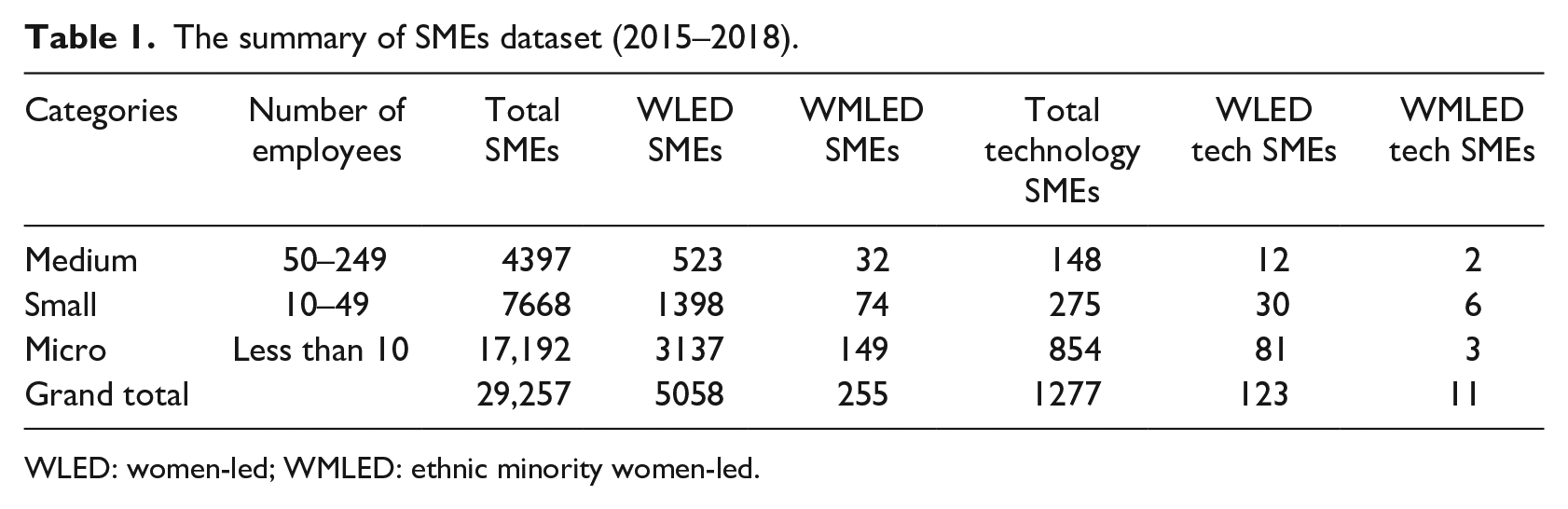
WLED: women-led; WMLED: ethnic minority women-led.
In addition, given the key role of STEM fields to innovation-driven economies, we also identified SMEs in the technology sector. Conceptually, definitions of technology firms tend to rely on the following three main attributes: the nature of goods and services produced by the business, the processes or modes of delivering products and the share of total employment focused on R&D (Hart and Acs, 2011). All the same, there is no single acceptable definition of technology sector firms, as such attempts are generally plagued with conceptual and methodological difficulties (Ganotakis, 2012; Jones-Evans and Westhead, 1996; Rooney, 1997). In this study, we adopt the Tech Nation definition of technology businesses, that is, ‘a company that provides a digital technical service/product (including hardware and platforms) as its primary revenue source OR provides a product/service that is reliant on digital technology as its primary revenue source’ (Tech Nation, 2017: 113). Consequently, technology SMEs are defined as firms classified in any one of the 2007 Standard Industrial Classification (SIC) codes listed in Supplemental Appendix 1. These firms were extracted from the SME dataset and used as subset data for all analyses relating to the technology sector. A summary of the WLED technology SMEs in the dataset is shown in Table 1.
Spatial unit of analysis
The UK has several internal spatial boundaries that divide the country into sub-groups for administrative and other purposes. Different boundaries are used for measurement of economic outputs, population census, local authority administration and so on. This makes it difficult to identify the most appropriate boundaries or spatial units for analysis. Research, however, suggests that for effective spatial analysis with significant explanatory powers, the unit of analysis must: have geographical logic (Rae, 2009), be of an appropriate size to avoid the negative impacts of aggregation or disaggregation (Clark and Avery, 1976), be relevant to the outcome of interest (Harris and Johnston, 2003) and reduce the effect of the modifiable areal unit problem, that is, the sensitivity of spatial analysis to variations in the zoning systems used to collect data and the scales at which they are reported (Fotheringham and Wong, 1991; Openshaw, 1984; Stewart Fotheringham and Rogerson, 1993). We adopted these four principles in deciding on the most appropriate spatial units for our analyses.
There is a strong attraction to use boundaries such as Local Authority Districts (LAD), Travel to Work Areas (TTWA) or Primary Urban Areas (PUA), that are traditionally used to measure economic outputs because of the relative ease to which policy context of outcomes can be discussed. However, in order to examine the relevance of place and its socioeconomic and institutional characteristics to the innovation activities of SMEs, we had to focus on spatial units that divide the country into spaces that share similar characteristics, while being distinct from other places. In this regard, we opted to use the Nomenclature of Territorial Units for Statistics level 1 (NUTS 1) and level 2 (NUTS 2) for the UK.
NUTS are hierarchical classifications of administrative areas used for statistical purposes across the European Union. In the UK, there are 12 NUTS 1 areas comprising the nine English regions in addition to Wales, Scotland and Northern Ireland. The 40 NUTS 2 areas however, are relatively smaller bounded areas with homogeneous internal socioeconomic characteristics, yet heterogeneous to other NUTS 2 areas. In fact, the EU regional policy on economic growth, competitiveness, job creation and sustainable development uses NUTS 2 boundaries for its analyses. NUTS 2 areas can also be easily related to LEPs. An overview of NUTS 2 areas matched to LEPs and regions in the UK is presented in Supplemental Appendix 2.
Analytical strategy
Our study focuses on analysing the potential impact(s) of gender, ethnicity and place on a firm’s likelihood to engage in innovation activities. A firm is considered to be engaged in innovation if it indicates involvement in either product innovation, process innovation or has invested in R&D in the three years prior to the survey. We first present descriptive statistics, such as the proportions of firms engaged in innovation based on the socio-demographic characteristics of founders/directors, and the regional distribution of these firms. We then undertake similar analyses on the subset of technology SMEs and compare the results to that of the entire dataset. We use logistic regression models to examine the extent to which a category, or combination of categories, is important to a firm’s propensity to engage in innovation (Codiroli Mcmaster, 2017). We begin by examining the predictability of an SME’s likelihood to engage in innovation based on the individual categories, that is, gender of the firm’s owner/director(s); ethnic origin of the firm’s owner/director(s), and firm location (i.e. place). As it is also important to understand the extent to which outcomes are influenced by interactions between categories, in the second stage of the regression analyses, we examine the potential impact(s) of intersecting categories on the likelihood of firms to engage in innovation. The models at this stage are based on a combination of intersecting categories such as gender and ethnicity; gender and place; ethnicity and place; as well as gender, ethnicity and place.
Results and analysis
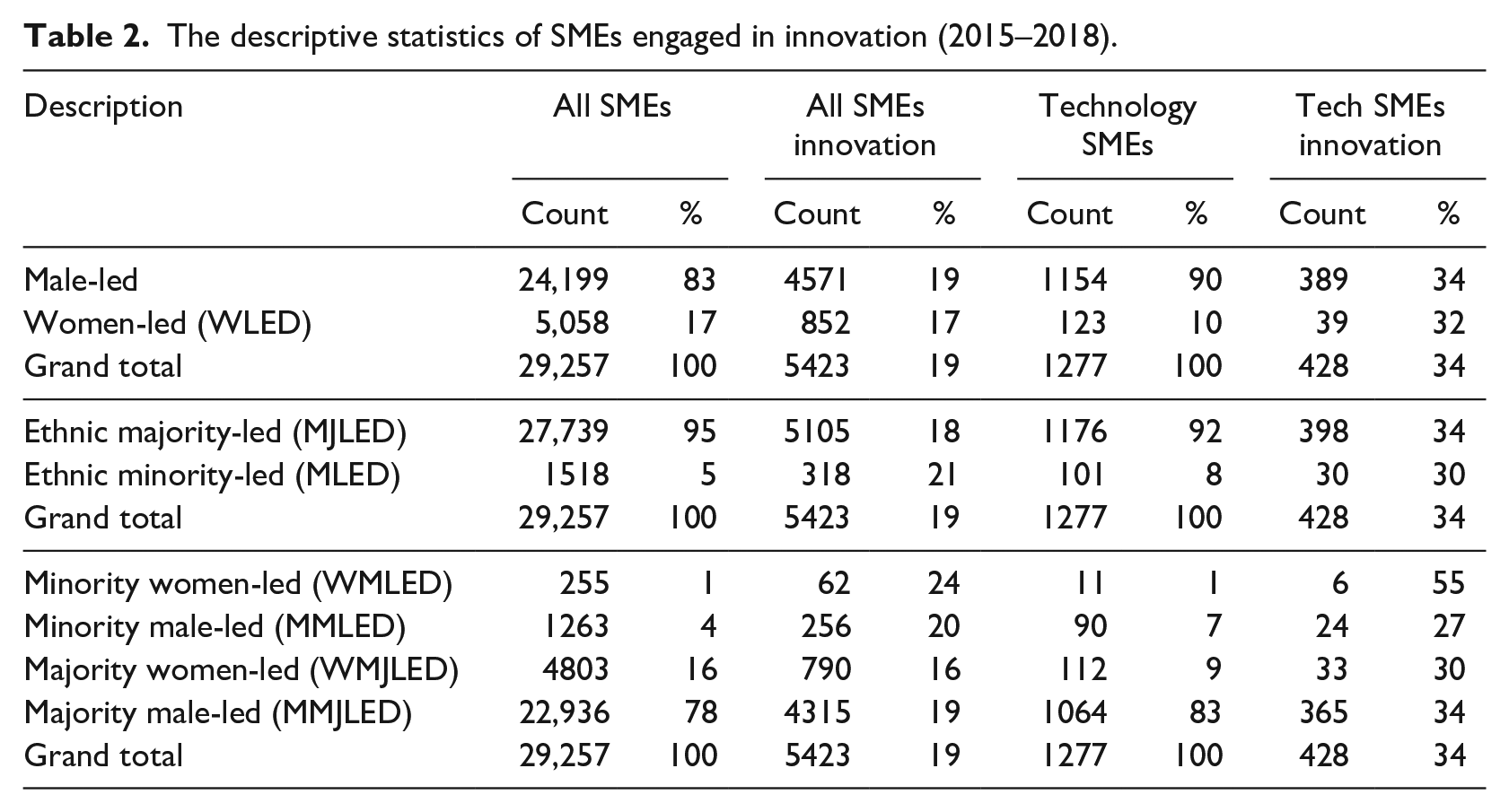
First, we present raw descriptive statistics to identify patterns within the data that highlight the proportion of all SMEs, and subset of technology SMEs, engaged in innovation based on the gender and ethnicity of founders/directors (see Table 2). While the number of WLED SMEs is significantly low (17% of all SMEs), the gap between the proportions of male-led and WLED SMEs engaged in innovation activities is relatively small, that is, 19% compared to 17%, respectively. Looking at the ethnicity of founders/directors, we find that while only 5% of all SMEs are MLED, a greater proportion of these firms is engaged in innovation compared to ethnic majority-led (MJLED) firms (21% and 18%, respectively). Furthermore, a proportionally higher number of WMLED SMEs (24%) engage with innovation than ethnic majority women-led (WMJLED) SMEs (16%).
The descriptive statistics of SMEs engaged in innovation (2015–2018).
Mapping of women-led SMEs in the UK
In terms of spatial distribution, we find that even though regional variations of WLED SMEs engaged in innovation are minimal, a relatively higher proportion of these firms are located in NUTS 2 areas within London, North West, East Midlands, South East and Wales. However, there is considerable variation in the spatial distribution of WMLED SMEs engaged in innovation, with NUTS 2 areas in London, South East, East England and East Midlands having the highest proportions of these firms (see Table 3).
The regional distribution of women-led SMEs engaged in innovation (2015–2018).
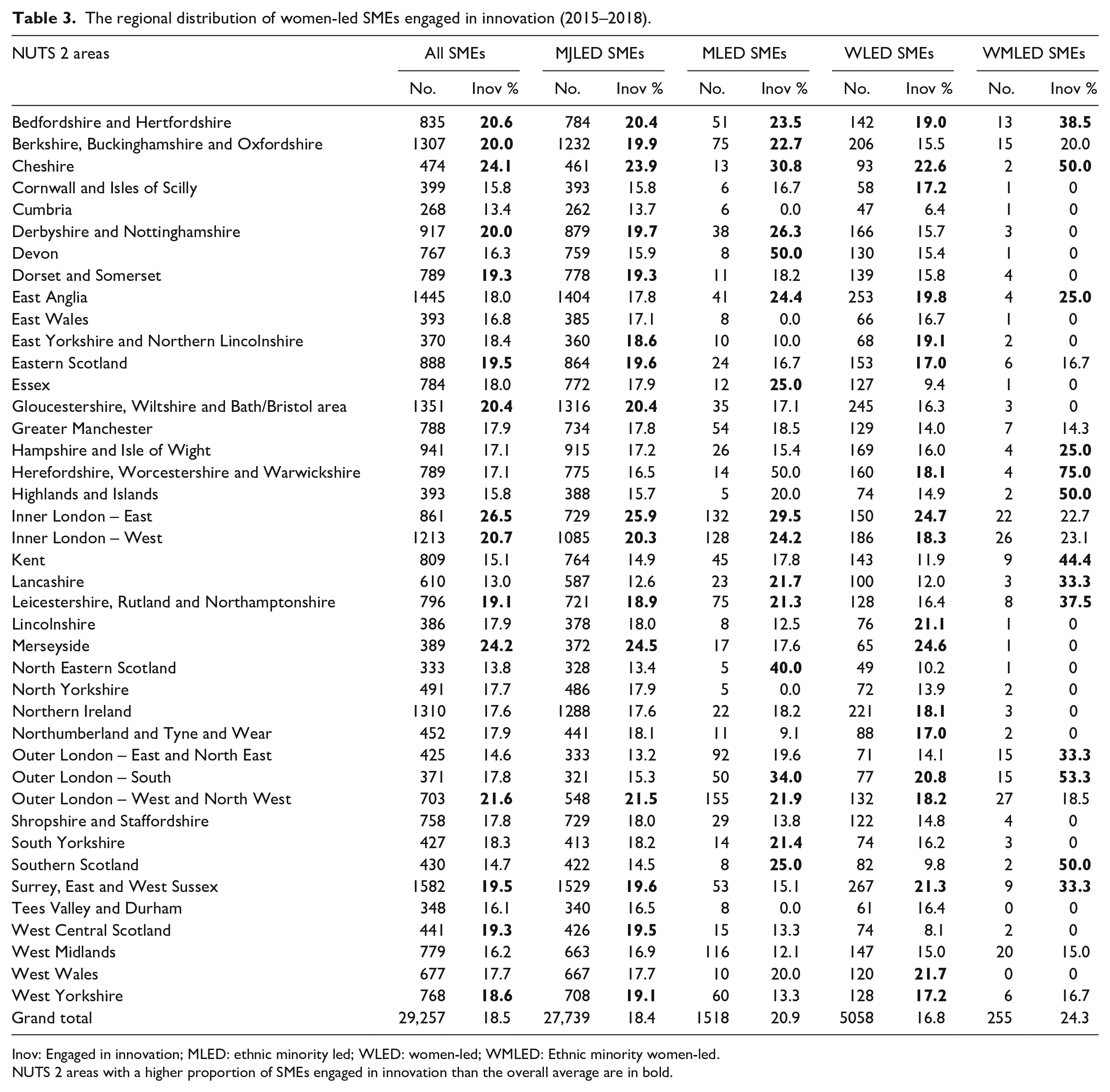
Inov: Engaged in innovation; MLED: ethnic minority led; WLED: women-led; WMLED: Ethnic minority women-led.
NUTS 2 areas with a higher proportion of SMEs engaged in innovation than the overall average are in bold.
Specifically, NUTS 2 areas in London (Outer London South – 20.8%; Inner London East – 24.7%), North West (Cheshire – 22.6%, Merseyside – 24.6%), East Midlands (Lincolnshire – 21.1%), South East (Surrey – 21.3%) and Wales (West Wales – 21.7%) regions have the highest proportions of WLED SMEs engaged in innovation, while NUTS 2 areas in Scotland (West Central Scotland – 8.1%, South Scotland – 9.8%), North West (Cumbria – 6.4%) and the South East (Essex – 9.4%) regions have the lowest proportions. The highest proportions of WMLED SMEs engaged in innovation are in London (Outer London South – 53.3%, Outer London East and North East – 33.3%), South East (Kent – 44.4%, Surrey – 33.3%), East England (Bedfordshire and Hertfordshire – 38.5%) and East Midlands (Leicestershire, Rutland and Northamptonshire – 37.5%) regions. The proportion of WMLED SMEs in the remaining areas either falls below the overall average (24%), or have limited samples (fewer than five firms) included in the survey. Figure 1 below presents a map of WLED SMEs engaged in innovation in the UK.
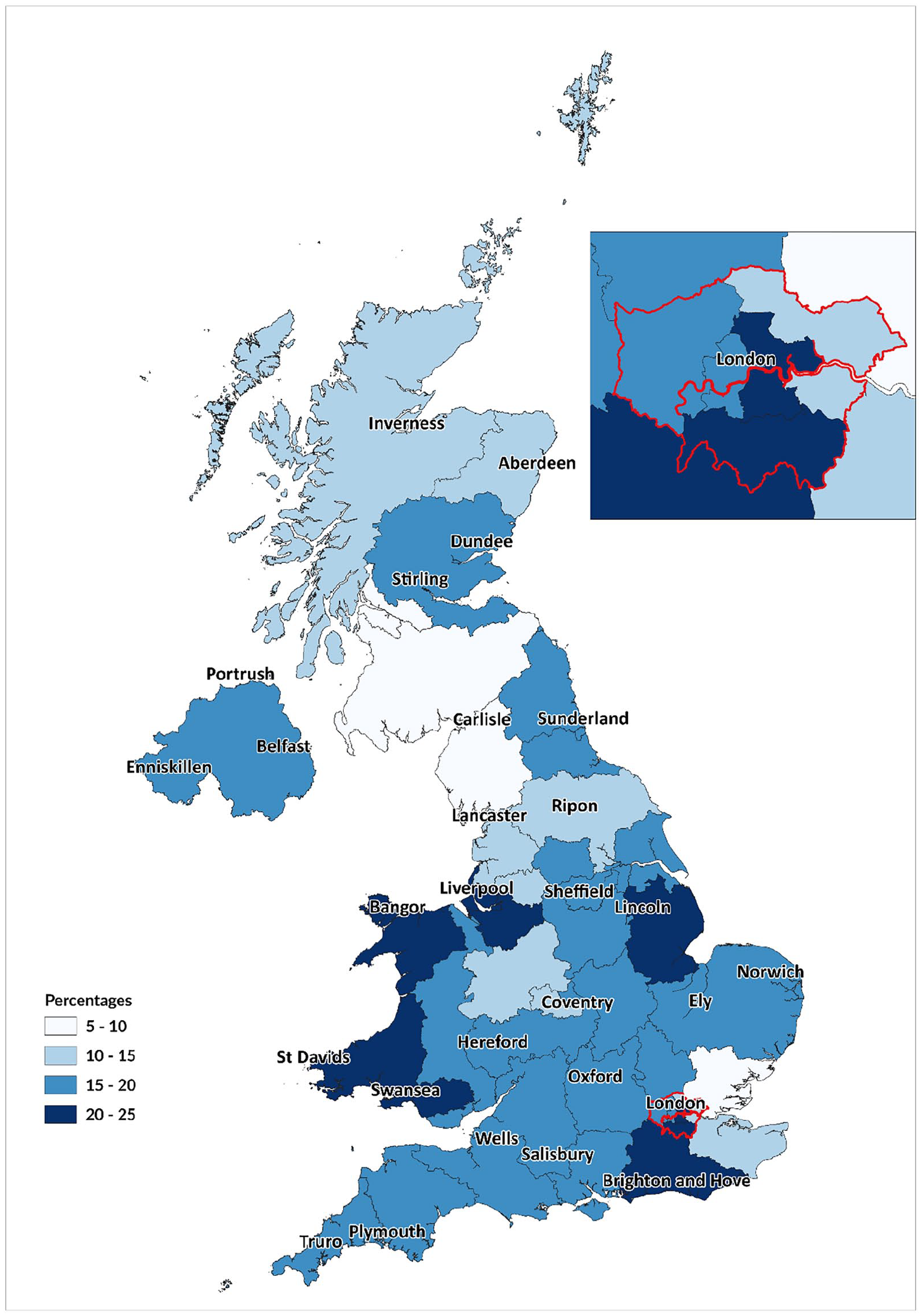
Regional distribution of women-led SMEs engaged in innovation (in %) in NUTS 2 areas in the UK (2015–2018).
Whereas, the descriptive analyses provide useful insights on the potential impacts of gender, ethnicity and place on the likelihood of SMEs to innovate, in order to examine the statistical significance of these impacts, we performed logistic regression analyses and the results are now presented.
Regression models of SME innovation
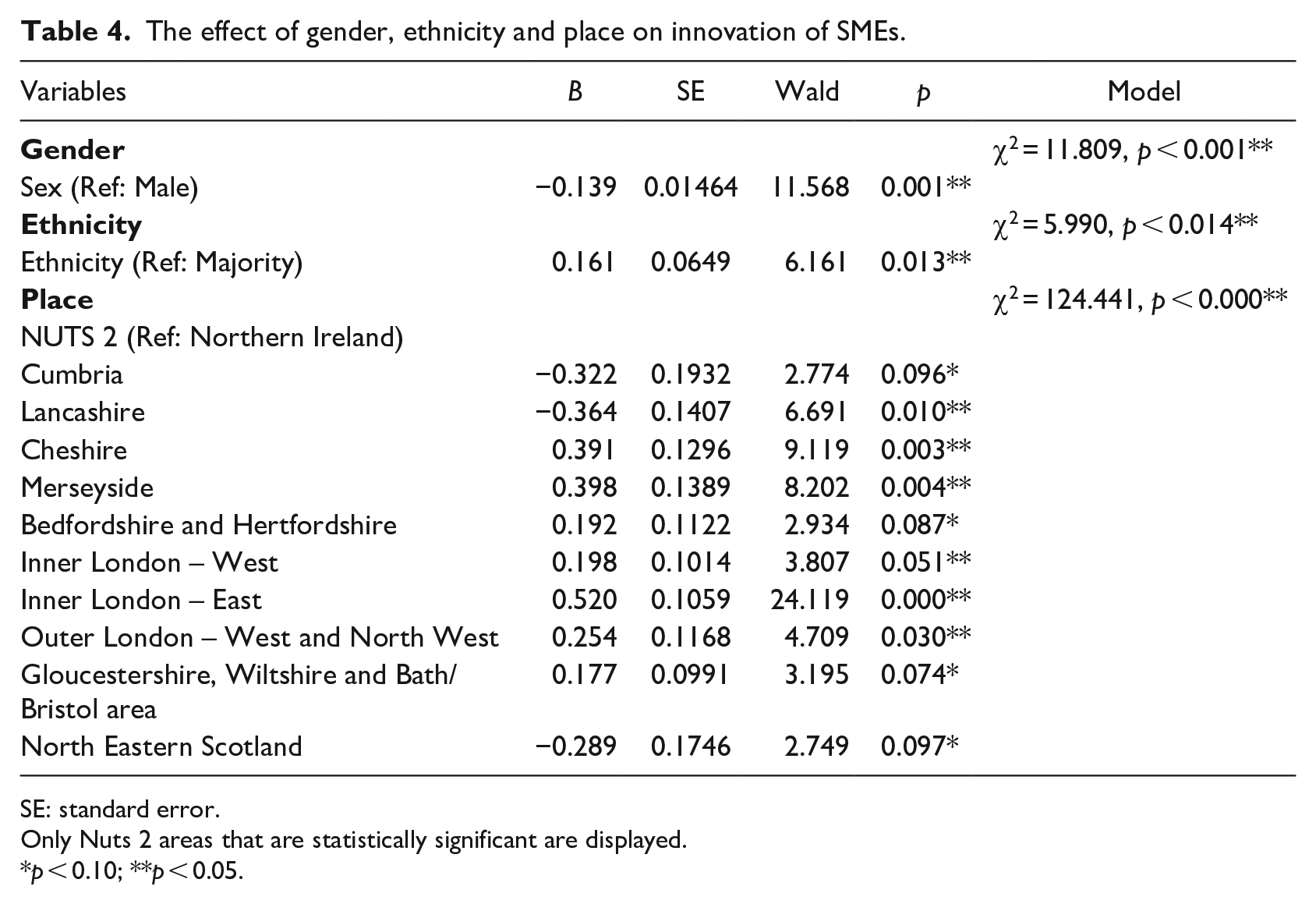
Our regression analyses involved a two-step approach. In the first step, we examine the effects of individual categories on innovation activities. The regression models indicate that gender, ethnicity and place, have significant impact on the likelihood of SMEs to engage in innovation activities (see Table 4). We observe that male-led SMEs are more likely to engage in innovation activities than WLED SMEs (p < 0.001, χ2 = 11.890). MLED SMEs are also more likely to engage in innovation than MJLED SMEs (p < 0.014, χ2 = 5.990).
The effect of gender, ethnicity and place on innovation of SMEs.
SE: standard error.
Only Nuts 2 areas that are statistically significant are displayed.
p < 0.10; **p < 0.05.
Generally, place also has a significant impact on the tendency of firms to innovate (p < 0.000, χ2 = 124.441). NUTS 2 areas in parts of the North West (Cheshire, Merseyside), East England (Bedfordshire and Hertfordshire), London (Inner London West, Inner London East, Outer London West and North West) and South West (Gloucestershire) regions, have a greater tendency to engage in innovation. However, SMEs located in NUTS 2 areas such as Cumbria, Lancashire in the North West, and North East Scotland are less likely to engage in innovation activities. It is worth noting that the regression results for some locations were not statistically significant, and these areas are not included in the tables.
Intersections of gender, ethnicity, place and innovation
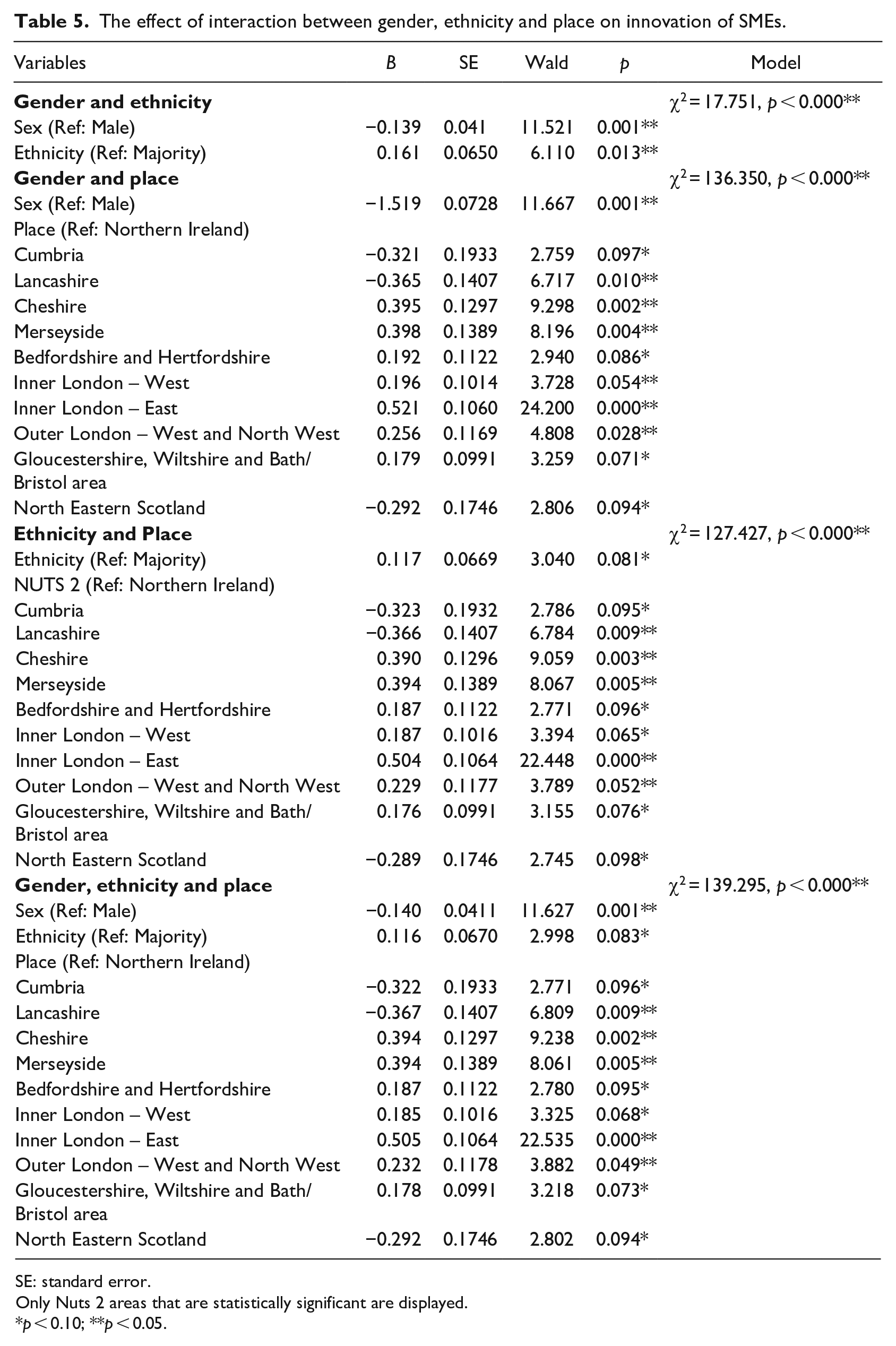
In the second step, we examine the significance of intersecting categories on an SME’s likelihood of engaging in innovation. The interaction effects between: gender and ethnicity; gender and place; ethnicity and place; as well as gender, ethnicity and place on innovation activities are presented in Table 5.
The effect of interaction between gender, ethnicity and place on innovation of SMEs.
SE: standard error.
Only Nuts 2 areas that are statistically significant are displayed.
p < 0.10; **p < 0.05.
The regression model indicates significant interaction effects between gender and ethnicity on the likelihood of SMEs to engage in innovation (p < 0.000, χ2 = 17.751). The findings further indicate that ethnicity (co-efficient of 0.161) has a relatively higher effect than gender (co-efficient of 0.139) on the likelihood of SMEs to engage in innovation. MLED firms are more likely to engage in innovation than ethnic majority-led firms. These results are consistent with the descriptive statistics. While on average, WMLED SMEs are more engaged in innovation than WMJLED SMEs (24% compared to 16%, respectively), ethnic minority male-led (MMLED) SMEs (20 %) are also more likely to engage in innovation than ethnic majority male-led (MMJLED) SMEs (19 %) (ref: Table 2).
We also observe significant interaction effects between gender and place on the likelihood of SMEs to engage in innovation (p < 0.000, χ2 = 136.350). However, with a co-efficient of 1.519, the effect of gender on innovation is significantly higher than firm location (even in places where SMEs are considered to be more likely to engage in innovation). In effect, NUTS 2 areas such as Inner London East and Outer London West and North West in London, and Merseyside and Cheshire in the North West, appear to hold a comparative advantage in terms of the likelihood of SMEs to engage in innovation. The descriptive data (ref: Table 3) indicates that SMEs engagement in innovation were above national average in these areas, that is, Inner London East – 26.5%, Outer London West and North West – 21.6%, Merseyside – 24.2%, Cheshire – 24.1%. However, when we consider WLED SMEs in these areas, the respective proportion of firms engaged in innovation is generally lower (i.e. 24.7%, 18.2%, 24.6% and 22.6%). In addition, SMEs located in NUTS 2 areas of Cumbria, Lancashire and North East Scotland are less likely to engage in innovation, and these effects are similarly impacted by the gender of the founders/directors.
The regression model analysing the interaction effects between ethnicity and place also indicates a significant impact on the likelihood of SMEs to engage in innovation (p < 0.000, χ2 = 127.427). Furthermore, with an average co-efficient of 0.3045 for locations that are statistically significant, the effect of place on innovation is higher than the potential impact due to ethnicity (co-efficient of 0.117). This is partly due to the fact that only about 5% of SMEs in the dataset are MLED. We find that when MLED SMEs are excluded from the dataset, the proportion of MJLED SMEs engaging in innovation in statistically significant places is comparable to the proportions of all SMEs engaged in innovation in that area. For example, in Lancashire, the proportion of all SMEs engaged in innovation is 13%, while the proportion of MJLED SMEs is 12.6%. However, as MLED SMEs comprise only 4% of SMEs in the area, the proportion of these firms engaged in innovation is relatively higher (21.7%). Even in areas like Outer London West and North West with a higher percentage of MLED SMEs (i.e. 22% of all SMEs in the area), the proportions of MLED SMEs (21.9%) and MJLED SMEs (21.5%) engaged in innovation is comparable to the proportion of all SMEs engaged in innovation (21.6%) in this area (ref: Table 3).
In the final model, we examine the impact of interactions between all three categories, that is, gender, ethnicity and place on innovation. We observe significant interaction effects on the likelihood of SMEs to engage in innovation (p < 0.000, χ2 = 127.427). Gender has a relatively higher impact on innovation than ethnicity (co-efficient of 0.140 and 0.116, respectively). However, with an average co-efficient 0.3056 for locations that are statistically significant, the effect of place on an SME’s likelihood to engage in innovation is higher than the impact of either gender or ethnicity. The descriptive data (ref: Table 3) indicate that approximately 60% of WMLED SMEs are located in London, South East and South West, and another 11% in West Midlands. The NUTS 2 areas in London (Inner London West – 23.1%; Inner London East – 22.7%; Outer London West and North West – 18.5%) and East England (Bedfordshire and Hertfordshire – 38.5%) regions have the highest proportions of WMLED SMEs engaged in innovation. The regression model also indicates that all SMEs in these areas are more likely to engage in innovation. This would suggest that the higher proportions of WMLED SMEs engaged in innovation in these areas has more to do with the effect of place than gender or ethnicity.
Overall, we observe that both WLED and WMLED SMEs located in NUTS 2 areas in East England (Bedfordshire and Hertfordshire) and London (Inner London East, Inner London West, Outer London West and North West) are more likely to engage in innovation compared to the other areas. In contrast, WLED and WMLED SMEs in NUTS 2 areas in the North West (Cumbria, Lancashire) and Scotland (North East Scotland) regions are less likely to engage in innovation. In addition, WLED SMEs in NUTS 2 areas of Cheshire and Merseyside in the North West have a higher tendency to engage in innovation. As technology firms generally tend to be more engaged in innovation activities, in the next section, we undertake a similar regression analyses to examine the effects of gender, ethnicity and place on the innovation activities of SMEs in the technology sector.
Women-led SMEs in the technology sector
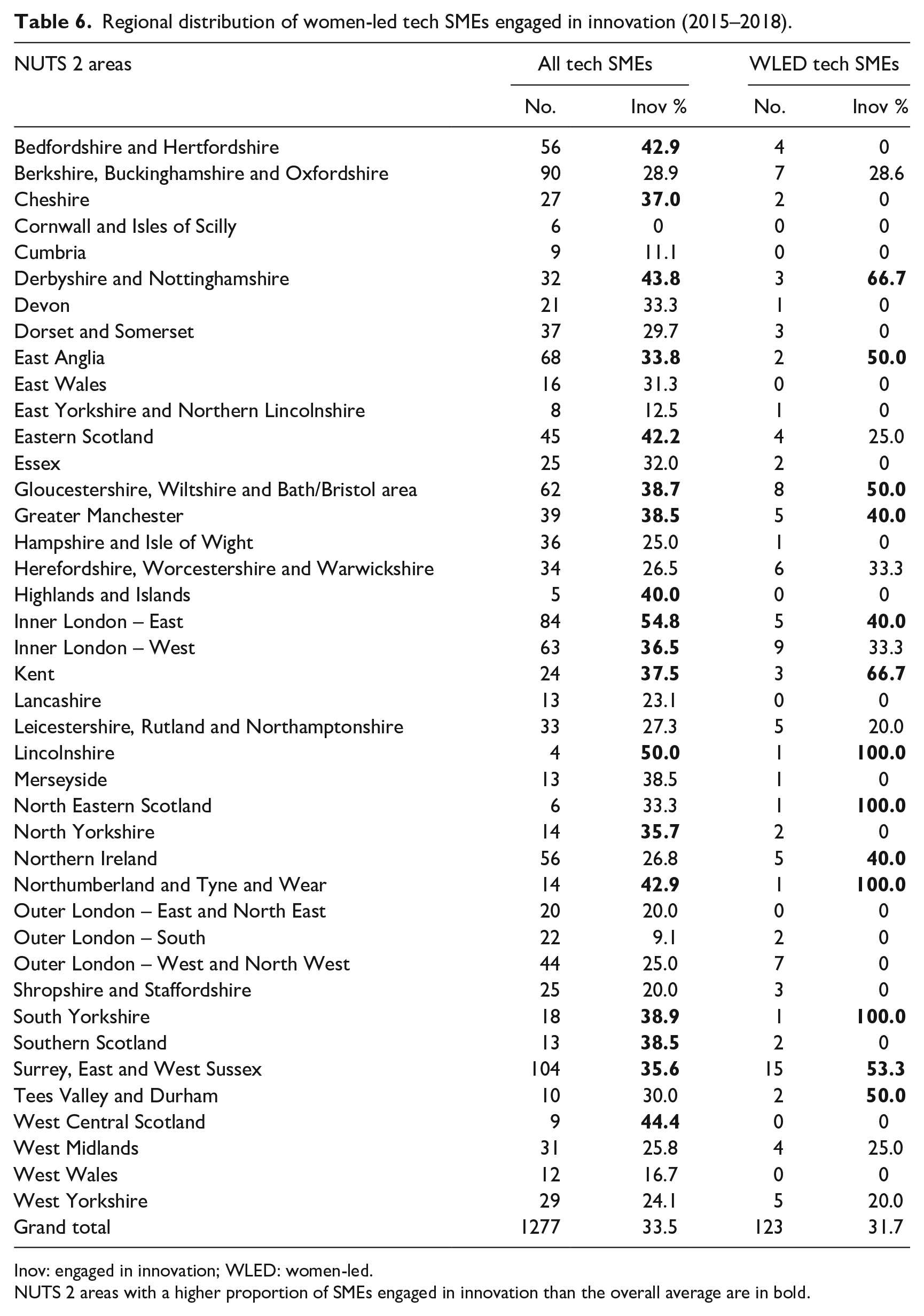
Using the 2007 Standard Industrial Classification (SIC) codes, we identified 1277 SMEs (4% of total dataset) that can be classified as technology firms. We observe on average technology SMEs are more likely to engage in innovation compared to SMEs in other sectors (p < 0.000, χ2 = 170.735, co-efficient = 0.841). A higher proportion of technology SMEs (34%) is engaged in innovation compared to SMEs in all other sectors (19%). Similar results are found when comparing WLED technology SMEs to WLED SMEs in other sectors, that is, 32% and 17%, respectively. However, WLED technology SMEs consists of only 123 firms (10%) in the dataset. WMLED technology SMEs are even fewer and represent only 11 firms (1%) (ref: Table 2). Due to these data limitations, and the sparse distribution of WLED technology firms at NUTS 2 level (see Table 6), we discuss our findings at the aggregated NUTS 1 regional level.
Regional distribution of women-led tech SMEs engaged in innovation (2015–2018).
Inov: engaged in innovation; WLED: women-led.
NUTS 2 areas with a higher proportion of SMEs engaged in innovation than the overall average are in bold.
The majority of WLED technology SMEs (60%) is located in London, South East, South West and West Midlands regions. The highest proportions of WLED technology SMEs engaged in innovation are in the South East region (46.2%), with most of these firms being located in the NUTS 2 area of Surrey, East and West Sussex (53.3%). Interestingly, we also observe below average proportions of WLED technology SMEs engaged in innovation in the London region (21.7% compared to overall average of 31.7%).
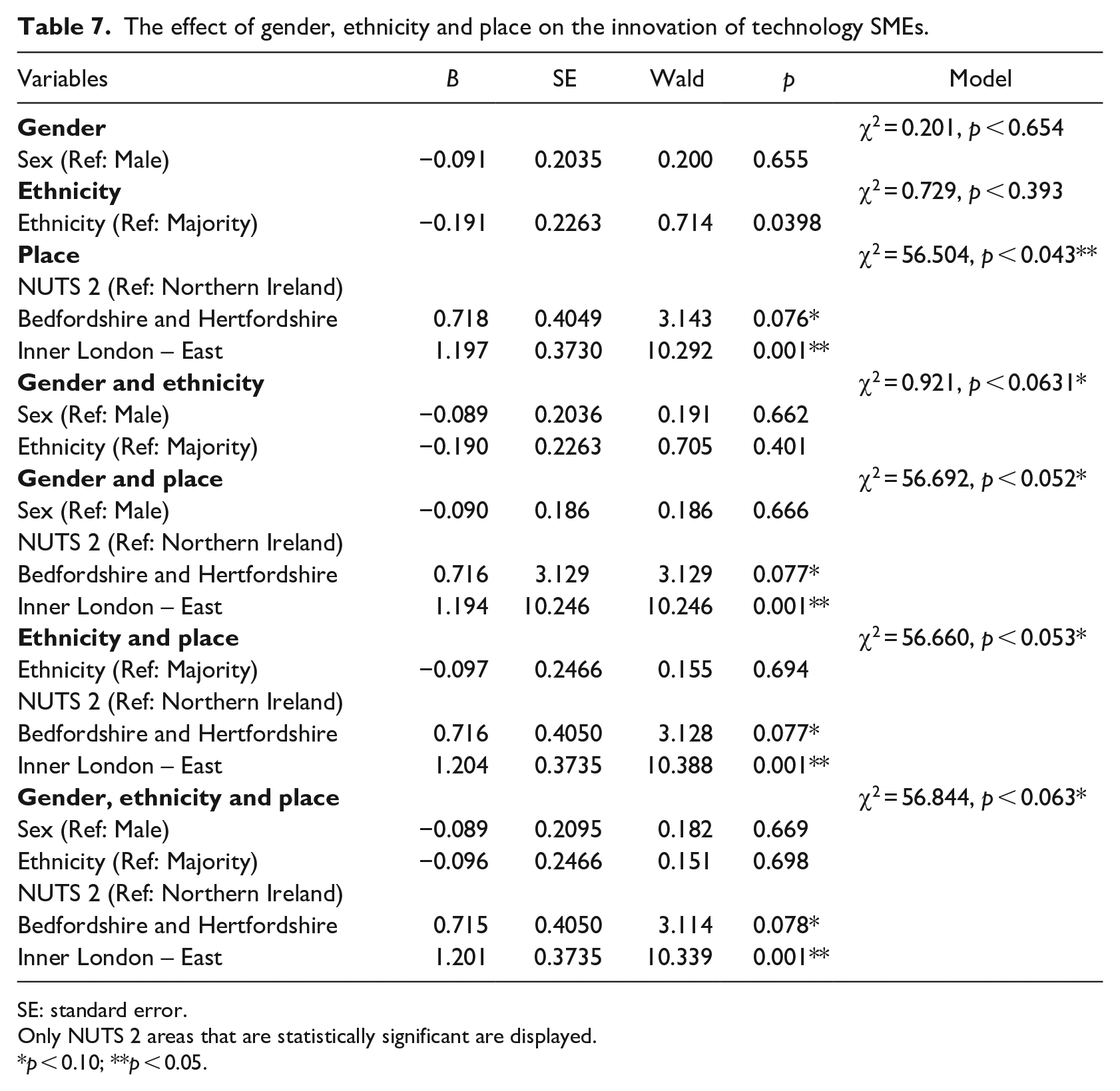
Analysing the effects of both individual and intersecting categories of gender, ethnicity and place on innovation, we observe that data limitations curtail further analysis of the impact of these categories – with the exception of place – on the likelihood of technology SMEs to engage in innovation (see Table 7). Moreover, only NUTS 2 areas of Bedfordshire and Hertfordshire in East England and Inner London East in London appear to have a statistically significant impact on SME engagement in innovation. In fact, both areas have above average proportions of technology SMEs engaged in innovation activities (42.9% and 54.8%, respectively).
The effect of gender, ethnicity and place on the innovation of technology SMEs.
SE: standard error.
Only NUTS 2 areas that are statistically significant are displayed.
p < 0.10; **p < 0.05.
Overall, our findings indicate that on average technology SMEs are more likely to engage in innovation compared to SMEs in all other sectors, and this applies to WLED technology SMEs as well. Place also has a significant effect on the likelihood of technology SMEs to engage in innovation.
Discussion
This article focused on mapping the diversity of WLED SMEs in the UK. Our findings complement the growing literature calling for greater attention to be paid to the heterogeneity of women’s entrepreneurship (Griffiths et al., 2007; Kelley et al., 2017; Welter et al., 2017) and the impact of intersecting socio-demographic categories on the entrepreneurial process (Atewologun, 2018; Knight, 2016; Martinez Dy, 2020). In particular, our results highlight the potential effects of both individual and intersecting categories of gender, ethnicity and place on the likelihood of SMEs to engage in innovation activities.
Despite the fact that only a minority of SMEs (17%) are WLED and the majority of these comprise micro-firms (62%), our results suggest that these firms are actively engaged in innovation, even though at relatively lower proportions than male-led firms. While our findings on the likelihood of MLED SMEs to engage in innovation reflect recent studies (Roberts et al., 2020), our consideration of the interaction effects between gender and ethnicity draws attention to more nuanced within-group comparisons (Atewologun, 2018). For instance, WMLED SMEs – which are even more under-represented – are more likely to engage in innovation than WMJLED SMEs. However, female founders face greater challenges in accessing both financial and social capital, and these disadvantages are further compounded when gender intersects with other socio-demographic categories of ethnicity, race and class (Romero and Valdez, 2016). For example, in 2018, majority of UK venture capital deals (83%) went to all-male teams, with all-female and mixed teams constituting only 4% and 12% of the investments, respectively (British Business Bank et al., 2019).
Our results echo the call of previous studies (Coleman et al., 2019; Foss et al., 2019), for greater attention to be paid to the complex gendered structures that influence WLED SME engagement in innovation, rather than simply viewing individual and firm level constraints as problematic. Socioeconomic factors constrain WLED SMEs to highly gendered sectors that may not be perceived as ‘innovative’ by funders and support initiatives (Blake and Hanson, 2005; Carter et al., 2015). Venture capital deals, for example, tend to focus on software and digital industries (British Business Bank et al., 2019). Our findings suggest that even though WLED technology SMEs are more likely to engage in innovation than WLED SMEs in other sectors, these firms are few and sparsely distributed. In the UK, WLED SMEs are more likely to be in the health, education, accommodation and food services, or administration sectors (Office for National Statistics, 2018). As WLED SMEs are actively engaged in innovation, it is likely that these firms are innovating in these sectors.
Accordingly, future research needs to pay greater attention to innovation activities occurring in the largely ignored ‘feminised’ sectors to gain a comprehensive understanding of the gendered aspects of the innovation phenomenon. Furthermore, as social class has been shown to play a role in influencing participation in STEM subjects, as well as access to resources (Codiroli Mcmaster, 2017; Martinez Dy, 2019), future studies examining the long-term effects of factors such as family background, education and work experience, on women’s entrepreneurial engagement in innovation would make valuable contributions. An examination of the systemic inequalities and barriers faced by WLED SMEs in accessing funding and investment, especially in the technology sector, would advance knowledge in this area.
We also build on research highlighting the importance of place for the identification and creation of innovation opportunities (Autio et al., 2014; Blake and Hanson, 2005; Hardey, 2019). Our results suggest that the location of SMEs tend to have significant impact on their engagement in innovation activities. Specifically, WLED SMEs located in NUTS 2 areas in East England (Bedfordshire and Hertfordshire) and London (Inner London East, Inner London West, Outer London West and North West) are most likely to engage in innovation, while those in the North West (Cumbria, Lancashire) region and Scotland (North East Scotland) are least likely to engage in innovation. WMLED SMEs engaged in innovation are more likely to be located in London, South East, South West and West Midlands. This is similar to reports indicating that MLED SMEs are most commonly located in London and West Midlands (Office for National Statistics, 2018).
This research therefore, confirms previous findings on the higher productivity of the South East region, with LEP areas in the East of England, the Midlands and the South East having the highest proportions of firms engaged in innovation (BIS, 2015; Centre for Cities, 2020). Even though data limitations hinder our analyses of interaction effects of gender, ethnicity and place for WLED technology SMEs, our descriptive findings indicate that these firms are also mainly located in London, South East, South West and West Midlands regions. While all regions have comparative strengths in terms of innovation, London and South East regions dominate in terms of key metrics such as business R&D expenditure, venture capital, range of innovative sectors and human capacity in STEM (BIS, 2015). This would imply possible knowledge spill over effects for SMEs located in the capital/city regions compared to rural areas. However, this is beyond the scope of our study and would require further research to analyse how institutional structures might facilitate or hinder the activities of female innovators in specific regions.
Interestingly, and contrary to prior findings that Northern regions significantly lag behind their southern counterparts (BIS, 2015; Centre for Cities, 2020), our results suggest that WLED SMEs located in NUTS 2 areas in the North West (Cheshire, Merseyside) region have a higher tendency to engage in innovation. As women are socially located within places differently from men, our results reiterate the need for further research examining the processes linking place, social identity and innovation (Blake and Hanson, 2005). It is also important to note that as our results are based on voluntary survey samples, broader national level studies of WLED SMEs would be valuable for carrying out more fine-grained analysis of important dimensions of entrepreneurial disadvantage such as race, disability and age, that are not currently captured in our data.
Limitations
Despite its contributions to women’s entrepreneurship literature, this study has some limitations that should be taken into account. As it is based on cross-sectional data over the period 2015–2018, our study did not set out to identify causal relationships between WLED SMEs and engagement in innovation, and does not claim to have reached such conclusions. In addition, as the survey is not compulsory, it does not include a comprehensive list of non-employers who are not registered for VAT, and the Dun & Bradstreet database used may not cover all these businesses, especially micro-firms. There are also potential difficulties and inconsistencies in self-reporting surveys, as answers to questions relating to the innovation activities of SMEs are to a large extent subjective. The methodological challenges faced due to data limitations have also been highlighted. Finally, as the sample is based on SMEs in the UK, study findings may not be generalisable to other geographical contexts. Future nation-wide surveys that target WLED SMEs in different geographical contexts would allow for more in-depth analysis of how intersectional factors enable or hinder women entrepreneurs’ participation in innovation.
Conclusion
Our study maps the diversity of WLED SMEs in the UK by analysing how gender intersects with ethnicity and place to influence engagement in innovation, and bases our analysis on the Longitudinal Small Business Survey (LSBS) data of 29,257 SMEs over the period 2015–2018. Prior research highlights the need for a more comprehensive understanding of the diversity and heterogeneity of women’s entrepreneurship, as well as the structural factors influencing their engagement in innovation (Brush et al., 2019; Pettersson and Lindberg, 2013; Welter et al., 2017). By adopting an intersectional approach, our study responds to calls for more nuanced within-group comparisons that consider the impact of intersecting socio-demographic categories on the entrepreneurial process (Atewologun, 2018; Knight, 2016; Martinez Dy, 2020).
Specifically, we address three main research questions: the effect of gender ethnicity and place on SME engagement in innovation activities; the extent to which innovation activities by SMEs in the technology sector are influenced by these same variables and the extent to which engagement of SMEs in the technology sector differs from those in other sectors. With regard to RQ1, we find that as individual categories, the location of the firm (place), as well as the gender and ethnicity of firm founders/directors, have a significant impact on a firm’s engagement in innovation. However, when we look at the intersections between ethnicity, gender and place, the impact on the likelihood of SMEs to engage in innovation is more nuanced. In addressing RQ2a and RQ2b, we undertook similar analyses on the subset of technology SMEs, and compared these finding to SMEs in other sectors. We found that the location of a technology SME has a significant effect on the firm’s engagement in innovation. Furthermore, on average, technology SMEs are more likely to engage in innovation activities than those in other sectors.
Our study offers the following contributions. First, our findings suggest that despite their limited number, and constraints faced in terms of firm size and industry sector, WLED SMEs are actively engaged in innovation activities. Second, our analysis of the interaction effects between gender and ethnicity enables us to draw attention to the heterogeneity of the engagement of WLED SMEs in innovation activities. Results indicate that ethnic minority WLED SMEs are more likely to engage in innovation than ethnic majority WLED SMEs. Third, we emphasise the significance of place for innovation by highlighting the variation in regional distribution of WLED SMEs, and identifying places where innovation is most likely to occur. Fourth, we provide insights for future research on the diversity and heterogeneity of women’s entrepreneurship. There is a need for comprehensive national level studies that allow for more fine-grained analyses of intersecting socio-demographic categories influencing women’s entrepreneurship. A better understanding of the long-term effects of structural factors, as well as the systemic inequalities and barriers faced by WLED SMEs in accessing resources, would also make valuable contributions to current knowledge.
There are a number of implications for policy: our findings counter the general policy rhetoric which positions women’s individual and firm level constraints as problematic, and further emphasises the need to pay greater attention to the gendered structures constraining women’s entrepreneurial activities (Coleman et al., 2019; Marlow and McAdam, 2012). In addition, the spatial variation in the likelihood of WLED SMEs to engage in innovation implies a need to tailor policies and support initiatives to the place where such activities are occurring. Given the significance of place for innovation, greater awareness of the contextual and institutional dimensions of entrepreneurial ecosystems will facilitate the development of policies that are more effective in improving the environment for women entrepreneur’s engagement in innovation (Blake and Hanson, 2005; Brush et al., 2019; Foss et al., 2019). Finally, recognising the heterogeneity of women entrepreneurs necessitates a better understanding of the multi-dimensionality of under-represented groups and the impact of intersecting socio-demographic categories on their participation in innovation (Carter et al., 2015; Martinez Dy and Jayawarna, 2020; Wright et al., 2015). As such, initiatives focused on the ‘levelling up’ agenda aimed at reducing regional inequalities should consider the complex intersectional challenges that position individuals differently within certain spaces.
Overall, our findings encourage a holistic approach towards inclusive innovation policymaking that goes beyond the prevalent reductionism of existing support initiatives that focus on gender variable characteristics, to include interventions in areas where intersectional factors, such as ethnicity and place, create particular barriers. It is likely that such an approach might also have a positive influence for other groups of entrepreneurs that are classified as disadvantaged due to socio-demographic characteristics. Accordingly, we recommend a holistic blended approach to policy initiatives that includes both targeted support aimed at specific minority groups, as well as inclusive mainstream initiatives that are focused on transforming existing hierarchical structures.
Supplemental Material
sj-docx-1-isb-10.1177_0266242620981877 – Supplemental material for Intersections of gender, ethnicity, place and innovation: Mapping the diversity of women-led SMEs in the United Kingdom
Supplemental material, sj-docx-1-isb-10.1177_0266242620981877 for Intersections of gender, ethnicity, place and innovation: Mapping the diversity of women-led SMEs in the United Kingdom by Beldina Owalla, Elvis Nyanzu and Tim Vorley in International Small Business Journal: Researching Entrepreneurship
Supplemental Material
sj-docx-2-isb-10.1177_0266242620981877 – Supplemental material for Intersections of gender, ethnicity, place and innovation: Mapping the diversity of women-led SMEs in the United Kingdom
Supplemental material, sj-docx-2-isb-10.1177_0266242620981877 for Intersections of gender, ethnicity, place and innovation: Mapping the diversity of women-led SMEs in the United Kingdom by Beldina Owalla, Elvis Nyanzu and Tim Vorley in International Small Business Journal: Researching Entrepreneurship
Footnotes
Acknowledgements
The Longitudinal Small Business Survey (LSBS) data used in this study were obtained from the Department for Business, Energy & Industrial Strategy (BEIS), UK. The authors are grateful for the constructive feedback received from the two anonymous reviewers and guest editors during the review process.
Funding
The author(s) received no financial support for the research, authorship and/or publication of this article.

Supplemental material
Supplemental material for this article is available online.
Author biographies
References
Supplementary Material
Please find the following supplemental material available below.
For Open Access articles published under a Creative Commons License, all supplemental material carries the same license as the article it is associated with.
For non-Open Access articles published, all supplemental material carries a non-exclusive license, and permission requests for re-use of supplemental material or any part of supplemental material shall be sent directly to the copyright owner as specified in the copyright notice associated with the article.
