




Abstract
This article explores the approaches of identity construction used by Chinese daughters while negotiating the successor–leader role within family businesses. A qualitative interpretivist approach was adopted to understand daughter views on gender, family business leadership and succession, as well as the approaches adopted to negotiate the role of female successor/leader in the Chinese family business. Twenty semi-structured interviews were conducted with both actual and potential female successors. Three approaches of identity construction emerged based on the degree of conformity to traditional gender roles and Confucian family values: first, to abide by conventional gender expectations and perceive themselves as a temporary leader; second, to act as the ‘second leader’ and remain involved in decision making and third, to challenge conventional gender roles and strive to be an independent leader. This article contributes to debates on women in family business and gendered identity construction of daughters in family business in the Chinese context.
Introduction
It is widely acknowledged that the family business and, to a larger extent, the wider entrepreneurial discourse have a gender-biased theoretical focus that endorses a dominance of a heroic, male ‘owner-manager’ narrative (Hamilton, 2006; Nelson and Constantinidis, 2017). This has resulted in women in family businesses for the most part, being invisible (Dumas, 1992, 1998), identified by their family roles (Jimenez, 2009), or seen as occupying secondary or supporting roles (Danes and Olson, 2003; Rowe and Hong, 2000), with their contributions marginalised (Hamilton, 2006; Jimenez, 2009). Feminist scholars have called for the conceptualisation of women’s ‘invisible’ or ‘hidden’ roles in order to develop a more nuanced understanding of power relations within the family business context (Nekhili et al., 2018; Rowe and Hong, 2000).
Succession is a key mechanism by which women can acquire visibility and involvement in the family business (Campopiano et al., 2017). However, evidence demonstrates that succession in family business is often gendered (Aldamiz-Echevarria et al., 2017) and cross-culturally, daughters have been denied successorship or face substantial barriers in claiming credible leadership roles (Hytti et al., 2017; Jimenez, 2009). We argue that understanding this context has theoretical significance, as gender is ‘done’, and sons and daughters ‘see’ themselves in reference to their families, businesses and society (Nelson and Constantinidis, 2017). Gender assumptions are embedded in family expectations and business practices, which are underpinned by norms, traditions and cultural elements, and can affect a daughter’s decision to claim leadership positions (Campopiano et al., 2017). Contrary to studies that view gender as an objective difference between male and female, that can be measured and used as an explanatory variable, we see gender as socially co-constructed through interaction with other actors and as a performance, produced through everyday practices (Hamilton, 2013).
Research has examined the self-positioning of daughters within the family business context in relation to their father’s leadership style and employees (Mussolino et al., 2019). In this article, we extend this through investigating their interactions within the wider key stakeholder ecosystem such as parents, siblings, extended family members, employees and customers. We argue that gender structures and wider social interactions, through which a daughter’s gender role is ascribed, created and recreated, are critical to understanding the construction of her successor–leader identity.
Accordingly, this article explores the approaches of identity construction used by Chinese daughters while negotiating the successor–leader role within family businesses in China. We argue that China is an important context in which to explore this, as ‘family’ refers to the ‘extended family’ (Chen et al., 2018; Yan and Sorenson, 2006) and Confucian family values 1 emphasise hierarchy and women’s obedience to men. Indeed, the Western ‘nuclear family’ model still dominates family business research (Alrubaishi et al., 2020; Byrne et al., 2019), resulting in a lack of understanding regarding important differences in family structure across cultures (Mussolino et al., 2019). In contrast to nuclear families in the West, Chinese Confucian families are found to be more rigid in their leadership and relationships, stricter in birth-order hierarchy, more authoritarian in parental control and more dependent across generations (Sison et al., 2020). Historically, patrimonial control was viewed as the birthright of the eldest son, that is, primogeniture (Cole, 1997); however, contemporary research shows that nearly one-third of family businesses in China have a female successor (Chen et al., 2018). The Communist gender equality movement 2 and the one-child policy that has dominated family planning policy in the last four decades have been reported to have improved women’s status within the family and also given them legitimate rights to claim leadership roles within the family business context (Chen et al., 2018; Kitching and Jackson, 2002). Despite these developments, very little is known about how female successors negotiate and construct their successor–leader identity within a complex social value system in modern China.
This article offers the following contributions to theory. First, we add to women in family business literature by investigating women’s leadership within the succession process, thus, further theorising women’s ‘invisibility’ in the family business context. In contrast to prior research, which refers to the supporting administrative roles that women have traditionally held in the family business context (Jimenez, 2009), the women in our sample were all in senior managerial/leadership positions. However, these women were expected to engage in intentional visibility and perform largely ‘temporary’ or ‘hidden’ roles, aimed at supporting their male siblings to succeed. In so doing, we provide a more nuanced understanding of power relations within the family business context. Second, we examine the role-identity conflict that Chinese daughters experience as they attempt to simultaneously negotiate their leadership identity with that of their daughter identity during succession. In so doing, we contribute to role identities in family business by demonstrating how women’s participation in family business can be affected by their familial and business roles, which can be contradictory. We show women engage in intentional visibility as a result of role-identity conflicts, which derive from contradicting social value systems. Third, we respond to recent calls for a better understanding of ‘culture and context’ in order to address the Western-centric bias which currently exists within the broader debate of gender, family and entrepreneurship (Campopiano et al., 2017; Marlow, 2020). We contribute to family business literature by focusing on female business successors in China and in so doing enhance knowledge of the impact of culturally informed gender roles and family heterogeneity on women’s involvement in family business in a non-Western context.
This article is structured as follows. First, we present our analytical framework, which is situated within broader discussions of gender, identity and family business succession in China. The following section presents our methodological rationale and research design process. This is followed by the presentation of our empirical findings. Finally, we discuss our theoretical contributions, limitations and suggestions for future research.
Our analytical framework
Conceptualising female successor identity in family firms
Given our interest in how daughters negotiate the successor–leader role in light of gender and family expectations, Stryker and Burke’s (2000) work on identity theory was deemed apposite, given its emphasis on social relationships and role expectations of others. An identity is viewed as a set of self-relevant meanings held as standardised norms attached to a role (e.g. wife, daughter, leader, successor; Burke, 2006). In social situations, individuals engage in behaviours that align with the meanings associated with a particular identity norm, for example, ‘task-orientation’ for a leader identity, and ‘obedience’ for a daughter identity. Behaviours that deviate from identity standards can lead to negative societal responses, as disputing the alleged ‘natural order’ results in uncertainty and suspicion (Fiske, 1989; Keltner, 1995). Individuals can learn to perform a new role through a process of role negotiation, in which they actively align with the meanings contained in the new identity (Thoits, 2012). Yet, when individuals try to match the standard for one identity, they may deviate from what is deemed appropriate for another active identity, resulting in identity conflict (Burke, 2006). In this case, individuals often compromise by shifting meanings of both identity standards, with the degree of compromise dependent upon one’s commitment to each of these roles (Burke, 2006). Identity salience depends on how individuals rank the importance of each role and direct ‘behavioural choice in accordance with the expectations attached to that identity’ (Stryker and Burke, 2000: 286). Moreover, identities are the result of ongoing relationships, interactions and negotiations with other people (Stryker and Burke, 2000).
While gender is an integral part of a person’s identity, it is often absent from the mainstream contemporary family business narrative (Hamilton, 2013; Nelson and Constantinidis, 2017). Watson (2009) sees the entrepreneurial identity as a cultural stereotype – a characterisation that has been attached to individuals by others. In most societies, the cultural stereotype of an entrepreneur is marked by masculinity (Hamilton, 2006; Ufuk and Özgen, 2001). The image of a white middle-aged male typifies the entrepreneurial identity in most theoretical and practical discussions (Marlow and McAdam, 2015). Hamilton (2013: 94) criticises this unspoken assumption of a male identity and suggests looking at ‘gender as a performance, continuously produced through everyday practices and social interaction’. In contesting the entrepreneurial identity archetype (Essers and Benschop, 2007), we concur with Watson (2009) and Wielsma and Brunninge (2019) who propose that individuals often attempt to make sense of their own identity through claims by others in a specific social and cultural context.
Within the family business literature, succession is posited as a dynamic process, which requires the transfer of knowledge, networks and resources across generations (Cabrera-Suárez and Martín-Santana, 2012). Recent reviews (Kubíček and Machek, 2019; Nelson and Constantinidis, 2017; Vera and Dean, 2005; Wang, 2010) have identified a number of gender-related factors in family business succession. First, in patriarchal societies, primogeniture has long been a tradition, whereby incumbents select their successors based on gender and birth order (Kubíček and Machek, 2019). This typically results in the eldest son being privileged to inherit the family business (Keating and Little, 1997). Even in countries with a higher degree of gender equality, there is evidence of male successors being strategically identified, integrated and trained (Constantinidis and Nelson, 2009). Daughters, even if first born, are often believed to be ‘non-natural’ successors and only appointed when there is no viable male heir available or during a crisis of management (Vera and Dean, 2005).
Second, daughters face gender stereotypes, which are contextualised within broader issues of gender norms and discrimination both within the family and society (Wang, 2010). Gender stereotypes often prevent women from taking up leadership or managerial roles across societies, as the idea of ‘think manager, think male’ still prevails in everyday business encounters (Markoczy et al., 2020; Schein, 2001). This perceived role incongruence between daughter and business leadership roles means daughters are frequently denied the opportunity to demonstrate their suitability or readiness to take managerial control (Nelson and Constantinidis, 2017). Those who are navigating leadership positions often struggle to ‘fit in’ or feel marginalised, constantly having to prove their merit to internal and external stakeholders (family members, employees, board and external partners; Vera and Dean, 2005) or conceal their leader identity to ‘make things work’ (Hytti et al., 2017).
Third, the daughter’s succession process entails interactions with and within the wider key stakeholder ecosystem (McAdam et al., 2020). To successfully construct a legitimate and credible successor identity, one must be accepted by both familial and business communities (Milton, 2008). Role-identity conflict may result in daughters finding it difficult to know whether they should behave as ‘dutiful daughters’ or as capable managers who are able to challenge their parents in business-related decisions (Overbeke et al., 2015). Such role conflicts can create confusion in the responsibilities of daughters in family businesses, generate distrust between parents and daughters, damage family relationships and consequently reduce a daughter’s chance to be considered as a successor (Wang, 2010).
We are cognisant that daughter difficulties in constructing a leader identity are situated within broader societal attitudes towards women and cultural expectations of their suitable gender roles (Wang, 2010). Alvesson and Billing (2009) note that the absence of women in higher levels of organisations is a product of earlier, historical patterns involving the division of labour between men and women in public and private spheres, stereotypes and prejudices; with patriarchal systems that shape gender roles and reproduce the subordination of women differing across societies (Patil, 2013). Given that existing research on gendered succession is largely based on Western nuclear family structures (Kubíček and Machek, 2019), we argue that daughters from Chinese Confucian families are likely to face culturally related challenges.
Daughter’s successor–leader identity construction within the Chinese family business
The majority of first-generation Chinese family businesses emerged after 1979, when the Chinese government endorsed private ownership under ‘socialist market economy reform’ (Pistrui et al., 2006). Confucian values and a market environment characterised by institutional deficiencies in supporting private ownership were the main external influences on the first generation of Chinese family businesses (Carney et al., 2011). Currently, 85% of Chinese private business are family owned and managed (Wang et al., 2016). While family businesses have been an important component of the Chinese economy in the last four decades, few studies have examined succession issues in this context in particular (Cao et al., 2015) nor has previous research fully explored the impact of this complex Chinese social context on female successors (Shi and Dana, 2013).
Identity construction is a constant process of negotiation and renegotiation, and there are two major influences in Chinese culture that could potentially affect female successor’s identity negotiation. First, traditional gender ideology deeply embedded within Chinese society has historically subordinated women and excluded them from public life (Markoczy et al., 2020). Powerful gendered concepts such as yin – feminine characteristics, such as being re-active, gentle and weak – and yang – masculine characteristics, such as being pro-active, energetic and aggressive, serve to polarise women and men (Woodhams et al., 2015). Men are expected to perform tasks outside the household and financially support the family, while women are expected to take responsibilities within the home and are dependent on their male relatives (Gao et al., 2016). Social pressure against women’s autonomy and social interactions with men outside their family is considerable (Gao et al., 2016; Leung, 2003). There is a strong belief that women are not suited to enact the Chinese model of entrepreneurial masculinity, which is symbolised by one that is knowledgeable, sophisticated and refined, and that can reinforce social ties of guanxi with clients or government officials by partaking in after-hour entertainment (Zheng, 2012).
Second, the leader identities of daughters are further contested in the Confucian family kinship system, which has been criticised for producing unequal dyadic relationships in which male values are prioritised and regarded as superior (Sison et al., 2020). The Confucian family is a social enterprise that is patriarchal, patrilineal and patrilocal (Hwang, 2012). Only men can carry on the patrilineage; with women attached to men as mothers, sisters, daughters and wives. Stability and harmony are derived from family member acceptance of unequal relationships: older generations have absolute authority and control over younger generations, and men over women (Hwang, 2012). Male heirs are privileged in Chinese family business (Chen et al., 2018), with daughters rarely involved in major decision making. Moreover, the collectivist principles of Confucianism mean that harmony must characterise all interpersonal (including business) relationships (Sison et al., 2020). Consequently, a challenge to leadership positions by daughters would be considered a threat to the stability of both the family and the business (Cao et al., 2015; Yan and Sorenson, 2006).
Notwithstanding, egalitarian values are evident in modern China (Zheng, 2012). It is argued that the Communist government’s promotion of gender equality and economic reforms has significantly changed women’s role within Chinese society (Leung, 2003). Since its establishment in 1949, China’s Communist government has endeavoured to change social attitudes about women’s roles and promotes gender equality, by providing equal access to education and increasing women’s participation in the workplace. Efforts have been particularly directed towards tackling the patriarchal family structure, which is deemed to constrain women (Xie, 2014). These efforts have included the abolition of arranged marriage, state-funded childcare facilities and communal canteens to free women from domestic chores (Leung, 2003). Under the planned economy, women, like men, were allocated jobs after graduation. A gender quota system was also introduced to ensure that women were represented across management levels (Woodhams et al., 2015). Resultantly, modern Chinese women have enjoyed unprecedented equal rights in obtaining education, employment, pension and social benefits (Cook and Dong, 2011). However, while these Communist policies have helped to change some long-held gender stereotypes, they have been criticised for limiting women’s ability to act as agents for their own change (Leung, 2003). Moreover, although four decades of economic reform have been credited for enhancing women’s entrepreneurial opportunities and financial status, women have been disadvantaged and subject to discrimination in obtaining funding and other social resources, such as training, coaching, instrumental and emotional support (Cook and Dong, 2011).
Accordingly, we adopt a social constructivist view that a daughter’s identity as successor in a family business is a constant process of construction through interaction and (re)negotiation with various stakeholder groups inside and outside the family and business, and regulated by socially shared identity standards of being a daughter and becoming a leader (Essers and Benschop, 2007; Hytti et al., 2017; Watson, 2009). While recognising these influences on successor identity construction, we argue against viewing all women as victims of structural and social pressure. Rather, successors often steer a unique path that allows them to reconcile their own desires with those of the preceding generation (Lam, 2011). Indeed, women can be agents for change (Alvesson et al., 2008) and are ‘reflexive about their situation and act upon it to make a difference’ (Zanoni and Janssens, 2007: 1372).
Methodology
Given the aim of this article, to explore the approaches of identity construction used by Chinese daughters while negotiating the successor–leader role within family businesses, a qualitative interpretivist approach (Duberley et al., 2012) was deemed apposite. It enables accessing and understanding the meanings and interpretations daughters subjectively ascribe to leadership and succession. Ontologically, we see successor–leader identities as socially constructed and formed through interactions within the broader social structure (Hamilton, 2006). By deliberately seeking to give ‘voice’ to women’s lived experiences (Hill et al., 2006), our chosen research design aligns with the call for more feminist sensitive research methodologies (De Bruin et al., 2007). This approach allowed us to work from the standpoint of the minority and ground our interpretations in theoretical interests and experience, as advocated by Sprague (2016).
Data collection
For the purposes of this article, a ‘family business’ is defined as (Chua et al., 1999) a business governed and/or managed with the intention to shape and pursue the vision of the business held by a dominant coalition controlled by members of the same family or a small number of families in a manner that is potentially sustainable across generations of the family or families. (p. 25)
In-depth interviews were conducted with both actual and potential second-generation female successors with ownership and control prerequisites aligning with the definition of an actual successor. We recognise that the distinction between actual and potential successors can be hard to draw, as some full owners made decisions jointly with the founders while some non-owner senior managers were fully independent. We thus see a potential successor as someone who was planning to take over leadership of the firm (Wang, 2010).
The sampling strategy was purposive in nature, and aided by a snowballing approach, which, despite issues of homogeneity and non-representativeness, has been widely adopted by scholars in gender studies (Baker and Edwards, 2012). Suitable interviewees were recruited through two channels: Family Business Networks in Asia and the research team’s personal business contacts. All interviewees (Table 1) were based around cities in Jiangsu and Zhejiang provinces in the Yangzi Delta economic district, which is located in the eastern coastal region, and a region heavily benefitted from the economic reforms since the 1980s. The region is especially suitable for this research given its long history of family business ownership and intensive fast-changing economic activity over the last four decades (Zheng et al., 2009).
Profile of respondents.
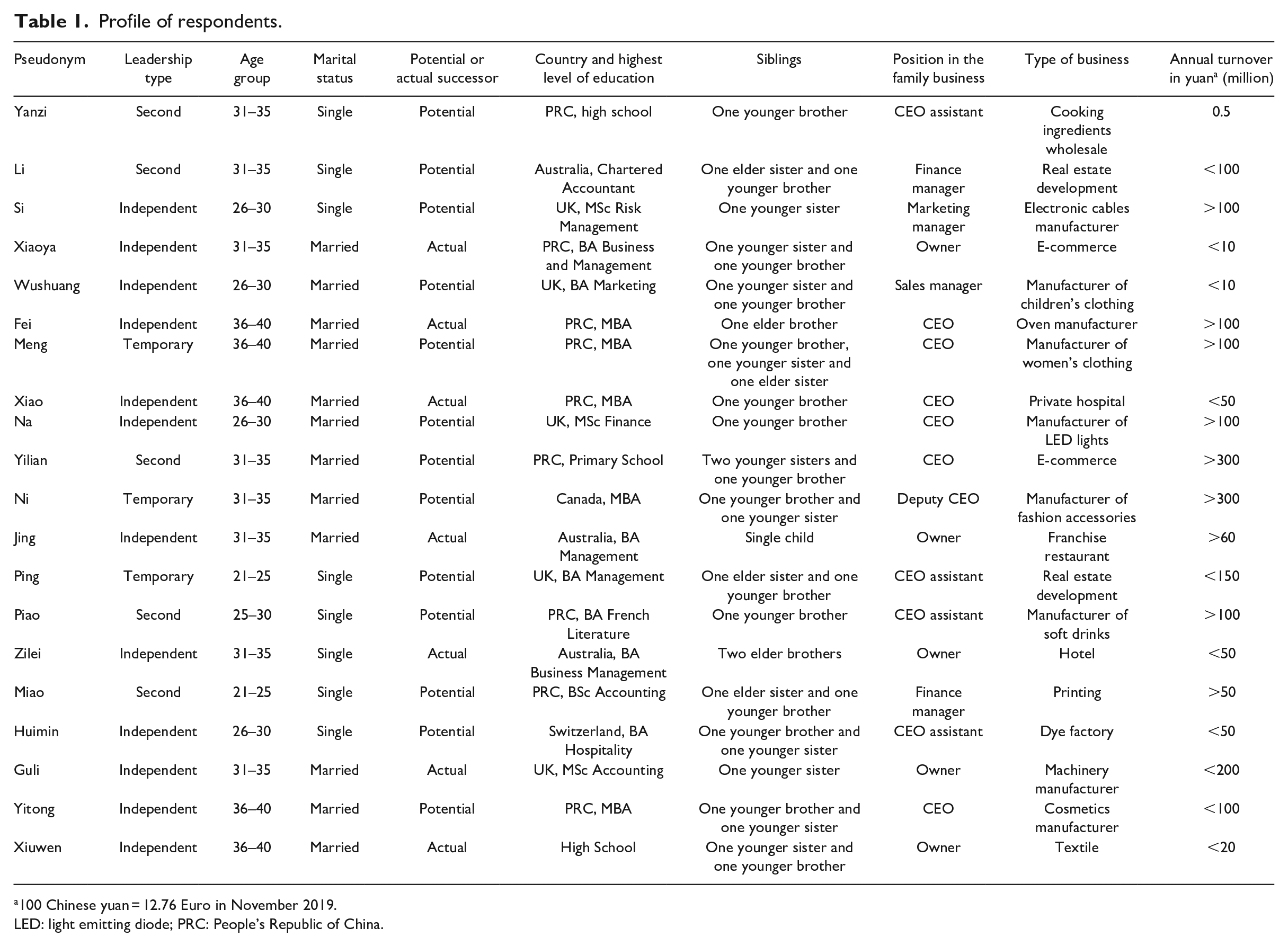
100 Chinese yuan = 12.76 Euro in November 2019.LED: light emitting diode; PRC: People’s Republic of China.
Our final sample consisted of 20 daughters aged between 20 and 45 years, with the majority in their mid-30s. Seventeen women had obtained bachelor’s degrees. Nineteen women had siblings, and among them, 17 had at least one brother. The family businesses they belonged to were mainly manufacturing-based, which reflects China’s economic structure (Gao and Hu, 2014). All interviewees had senior managerial responsibilities in their family businesses: five of our respondents were senior managers working in roles such as Marketing and Sales Director, Finance Director or Deputy CEO; four were non-owner CEOs and the rest were legal owners of the business. Pseudonyms were used to protect the women’s identities.
Face-to-face semi-structured interviews were conducted by one of the Chinese researchers in the research team. The interviews took place either in the participant’s workplace or an agreed public place, and averaged approximately one hour. A brief interview guide (Appendix 1) was used to maintain consistency and to prompt responses on topics of decision making around their own family business, parents’ expectations, being a daughter and succession. All interviews were digitally recorded with the consent of participants and transcribed into Chinese text. The stories and voices which emerged were freely narrated responses, whereby the researcher acted as an informed listener while encouraging the discussion on gender, family and succession (Boje, 1991). However, it is important to note the interpretation of these voices in addition to the own voices of researchers are all reflected in this ‘textual collaboration’ (Essers and Benschop, 2007: 56). As such, we acknowledge the co-production of gender and the researcher’s role in the production of these gendered narratives (Golombisky, 2006).
Data analysis
The analysis was focused on the simultaneous practice of gender and successor–leader role within family business (Hytti et al., 2017) and on the negotiation of identities from the wider social and cultural context. In interpreting these women’s identity construction, we examined how the women conformed to and reproduced patriarchy, or resisted gender power structures and claimed a leadership role. The translation of quotes followed a contextualised approach (Xian, 2008), which emphasised contextual rather than verbal consistency between Chinese and English. Following Braun and Clarke’s (2006) steps to thematic analysis, our data analysis procedure is now detailed.
Phase 1: Familiarising ourselves with the data. In line with best practice, the researchers immersed themselves by reading the entire data set while searching for meaning and patterns prior to formal coding (Braun and Clarke, 2006). The data set included all interview transcriptions and researcher notes. Once the researchers were re-familiarised with the data, and ideas for coding were noted, a coding manual which included definitions of each category and examples was developed (Decuir-Gunby et al., 2011).
Phase 2: Generating initial codes. In this phase, the research team identified initial codes (i.e. broad bucket codes), which were informed by our research aim and extant literature (succession, gendered succession, family business). Initial coding was conducted manually, but later these coded data were collated using NVivo 12.
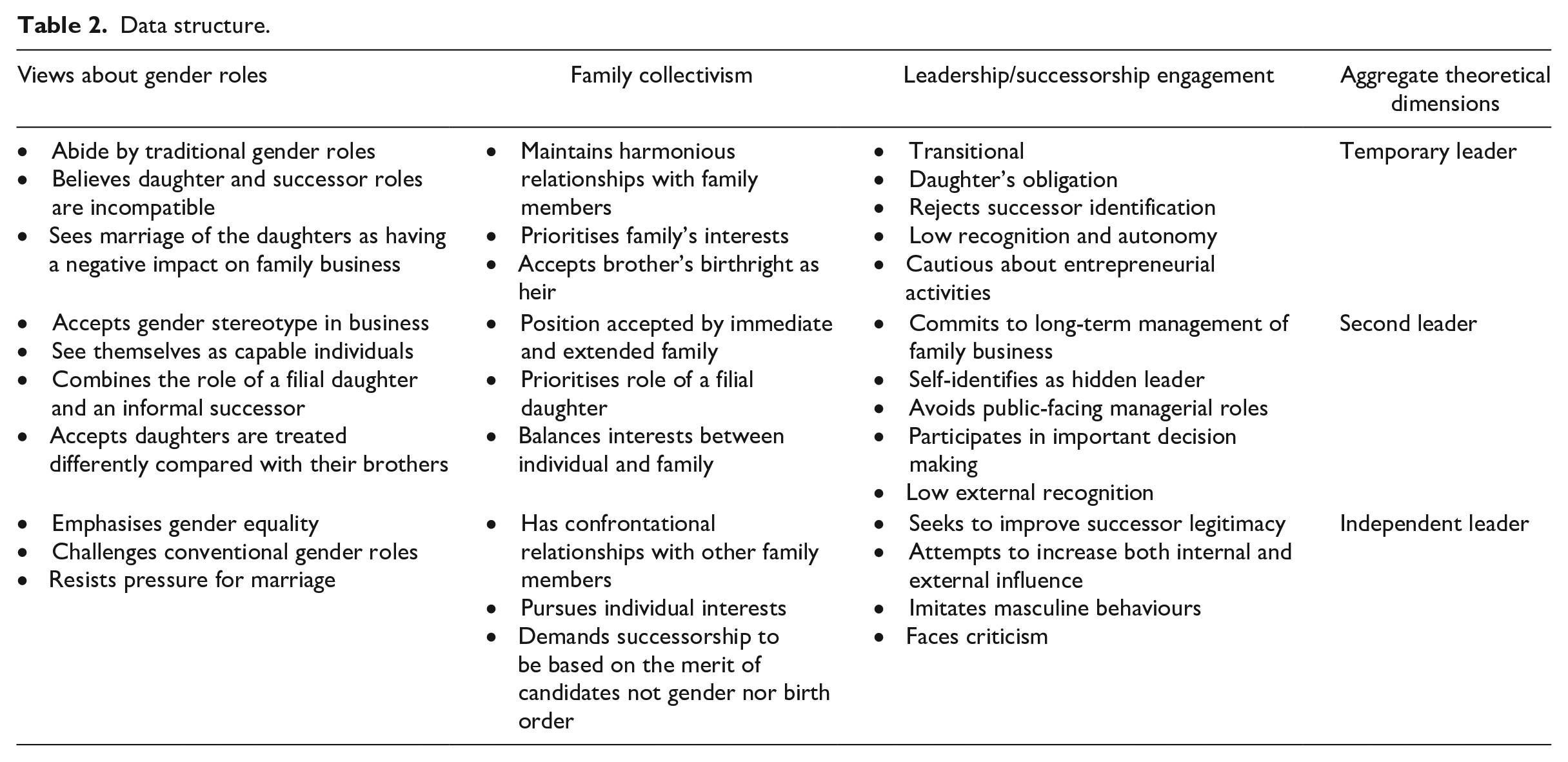
Phase 3: Searching for themes. In this phase, all data were coded, collated and sorted into overarching themes. As recommended by Braun and Clarke (2006), the researchers drew upon visual representations such as mind maps to help sort the various codes into themes. Resulting from this phase, all coded data were sorted into groups of themes such as Gender Roles; Family Collectivism and Leadership/Successorship Engagement. These categorisations were liable to be changed or refined in the next stage of analysis.
Phase 4: Reviewing themes. The refinement of identified overarching themes was undertaken in this phase. First, the coded data extracts under each theme were reviewed in order to identify coherent patterns. In instances, where a coherent pattern did not emerge, either the theme was revised or the coded data were moved to another relevant theme or discarded. Second, the entire data set was perused to determine whether the individual themes accurately represented the data. In line with Braun and Clarke’s (2006) recommendations, we stopped refining and recoding the data when such refinements no longer added value.
Phase 5: Defining and naming themes. This phase of analysis was marked by defining and further refining the themes identified. Each theme required a detailed account that explained its fit within the overall narrative and in relation to our overall aim. Themes were defined and named to be self-explanatory. Our subsequent data structure is outlined in Table 2.
Data structure.
Findings
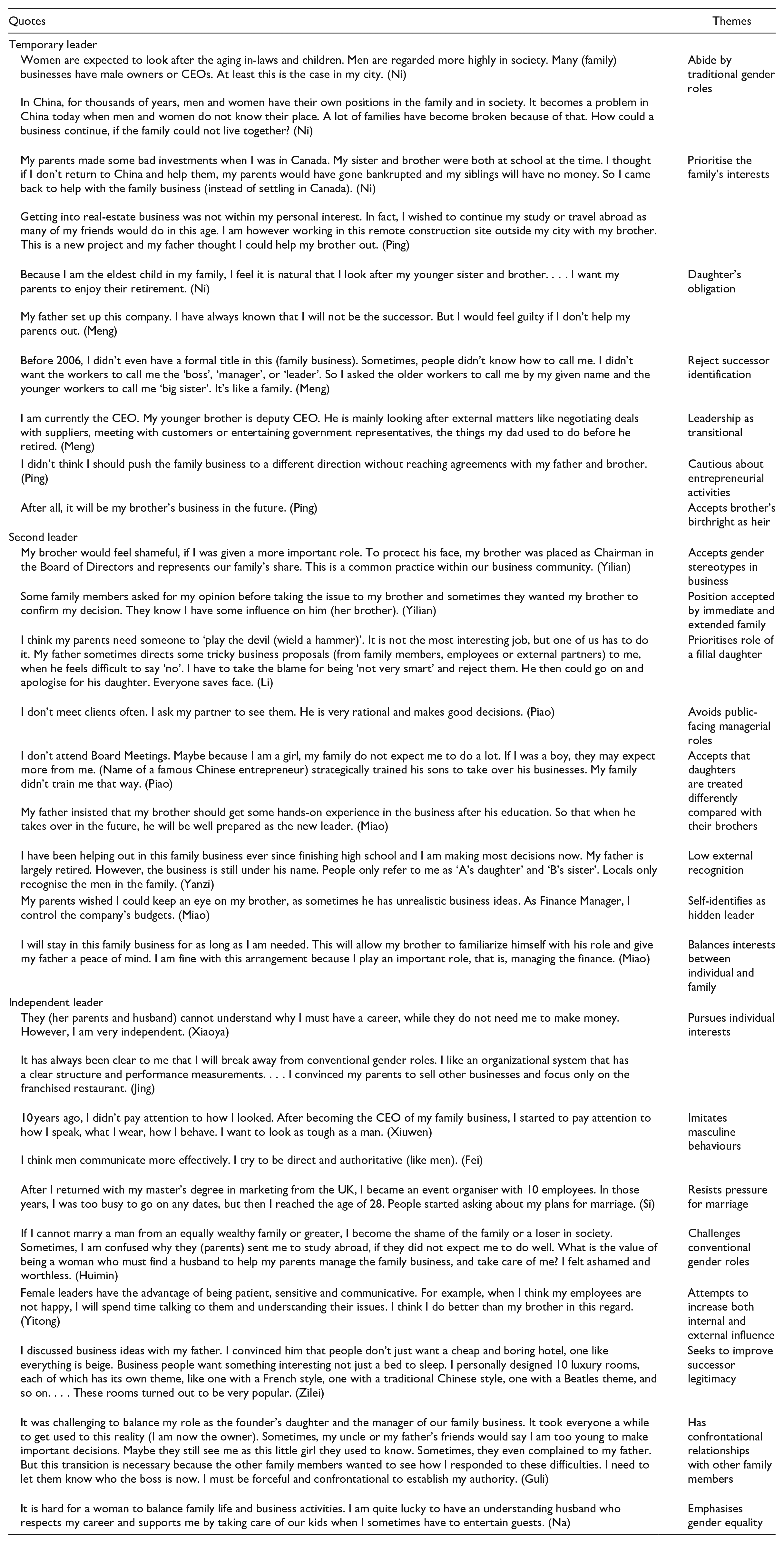
In this section, we present the emerging themes in detail as illustrated with fragments of the narrative in the form of power quotes (Pratt, 2008). More comprehensive proof quotes are outlined in Appendix 2. Our findings reveal the constant tensions between two role identities that our respondents had to negotiate – that of a filial daughter and that of the successor–leader. Three different approaches to constructing a leadership identity were conceptualised among the female successors, with each approach dependent on the degree of conformity to traditional gender roles and family values in the succession process in their family business.
Temporary leader
The first group of women subscribed to traditional gender roles and Confucian beliefs and assumed disparate roles between a daughter and successor in the family business. The women in this group considered their leadership role in the family business to be temporary, namely, during a transition period between male family members such as their father and younger brother. These women were all educated to university level, with two educated overseas. For these women, their identity as a daughter conflicted with the successor–leader identity. Ni, who occupied the second most senior position in her family business, saw conventional social norms regarding different roles for men and women as a functional structure for both Chinese family and society (Yan and Sorenson, 2006): In this ever changing and competitive business world in modern China, only family can be trusted in this materialistic world. Everyone works for money, and no one cares about morality and tradition. Many families have become broken because men and women do not know their place. I think respecting tradition should not be a choice, because this choice disrupts family life. Family harmony is critical for the business to survive across generations. (Ni)
Meng accepted the legitimacy of her brother’s succession as his birthright and tried to make sense of it by referring to the patriarchal family system: My elder sister was born in 1977. I was born in 1979. They (my parents) had my younger sister in 1982. Another girl! My grandma (mother of her father) was very upset and blamed my mum. . . . In order to have another child, my mum moved from city to city to avoid penalties from the one-child policy. My dad lost his job. Eventually, my younger brother was born in 1985. How can I challenge my brother after all these troubles? . . . Sons are precious, as they bring wealth to the family which stays in the family, while girls take wealth away. (Meng)
Similarly, Ping, one of the youngest interviewees in our sample, mentioned that both she and her elder sister are willing to accept their younger brother, who was 20 years old, as the sole successor when he completes his formal education. Despite managing the family business at the time of the interview, she defended her brother’s privileged position and argued that the appointment of a successor should take into consideration the impact of a daughter’s marriage on the ownership of the family firm, and in so doing reflecting Confucian family traditions that view women as temporary members of men’s natal family (Xie, 2014).
I understand the concern of my parents that I am a daughter and will eventually marry and leave the family. For Chinese people, a married daughter is like water that has been poured. No return. If I take over the family firm and pass it onto my child through my marriage, the family wealth will have a different family name. If my brother gets the business, it would still be kept in the family. To be honest, I kind of agree with them, considering how hard they worked for what we have today. (Ping)
The women in this group abided by conventional norms and traditions to avoid confusion and ambiguity in their roles and to preserve harmony and wealth in the family. In constructing their identities, these women were keen to retain their femininity and the meanings they associated with a filial daughter such as obedience, loyalty and respect for gender hierarchy. While they recognised that they had obligations to manage the family business, they refused to describe themselves as ‘manager’, ‘leader’ or ‘entrepreneur’. Meng wanted younger employees to call her ‘big sister’, so as to create a ‘family’ atmosphere within the business.
Both Meng and Ni at the time of the interviews had worked in their respective family firm for more than 10 years and had experienced the ‘ups’ and ‘downs’ of the business. They were committed and worked long hours. Yet, adapting to any meanings associated with a leadership identity created discomfort; with this discomfort resulting in these women rejecting any identification as future leaders. Instead, they were careful not to express ambitions of their own, other than following the footsteps of their parents. They were proud that they sacrificed themselves for the family and believed that their sacrifices were crucial for the survival of the family business. As ‘caretakers’, these women tended to be risk-averse and cautious about new entrepreneurial activities: I am the big sister. It is my responsibility to look after my brother and sisters. I don’t want them to worry about money or this business. . . . Our firm is in a healthy state. I don’t want to expand and put it at risk. Maintaining stability and our reputation are the most important things for me. (Ni)
Their temporary leader identity was also informed by the low expectations from their family and the lack of recognition and autonomy in making important decisions: In 2008, I wanted to establish an e-business. I got some consultancy companies to propose a few plans. But my dad didn’t think we had the resources and didn’t think I could do it. So I had to give up. (Meng)
Leung (2003) argues that although the Communist gender equality movement has made progress with regard to the integration of work roles into women’s identities, it has done little to remove patriarchal attitudes and men’s dominance. This is evident in the women’s accounts where the belief that women’s main responsibilities centre upon the household remained unchallenged.
Second leader
A second group of women emerged who were committed to long-term succession but still saw their gender at odds with undertaking a visible leadership position. Given that women’s responsibilities have been traditionally associated with the family as opposed to the business domain, parents often treat sons and daughters differently (Aldamiz-Echevarria et al., 2017; Jimenez, 2009). Some respondents mentioned how the daughter role became problematic not only for acquiring ownership of tangible assets but also for the transmission of intangible assets, such as family networks. Li justified the decision of her parents to make her ‘the boss behind the curtain’, but resented that she was not given the chance to prove herself: I was the smart one and was sent to study abroad by my parents. But I know the reason was that they thought once I return, my brother would have good hands to help managing the business. I do not mind being the boss behind the curtain, because it is difficult for a young woman to be taken seriously in the business world. Sometimes, people would say ‘why has the company sent a little girl, please go and get your father or brother, I will not talk to someone who cannot make decisions’. You see, they do not even give me a chance to talk and insist to see the men in the business. (Li)
Li’s narrative reflects the different expectations imposed on a daughter and a business person and thus the dissonance between her gender identity and that of the stereotypical leader identity (Swail and Marlow, 2018). While Li was willing, to some degree, to claim a leadership identity, she struggled to be granted legitimacy as a leader from external stakeholders (Derue and Ashford, 2010). The contradiction between being a daughter and a successor was accommodated by identifying herself as a hidden leader or second leader, such that she did not need to perform publicly a role that is socially validated to be masculine (Hamilton, 2013; Rowe and Hong, 2000). Consequently, these women were displaced in the family business and marginalised in their business community. However, these women did not feel they were being mistreated. Instead, they defended their families and others who undermined their position in the family business. They were concerned about the expectations and feelings of their parents and local community and thus prioritised the needs of the collective and felt it was their obligation as a filial daughter to accept such gendered succession practices. Thus, the role of a filial daughter was prioritised ahead of any self-interests and shame acquired if their behaviour was deemed to have deviated from the identity standard of a filial daughter within Confucian family values. They considered challenges to succession as misbehaviours that would disrupt family harmony and damaged their social reputation, as noted below: I think what is good for the family is best for me. The last thing I want is to go against my family. I would feel ashamed, as it would be scandalous in this small town to fight with my parents and brother for the ownership of the family business. Even if I won, I would not be respected by others, who would think I am not a decent person to do business with, and eventually that would affect the business. (Yanzi)
The above accounts speak to the dilemma these daughters faced between committing to Confucian or egalitarian views. As a compromise between two oppositional identities, they chose a middle approach whereby they accepted the gendered succession practice and positioned themselves in managerial roles that they felt were appropriate with their daughter identity. By giving up a formal successor–leadership role, these women were able to gain support from family members who endorsed their position as the second leader. These women held important yet, invisible roles such as finance manager, while their brothers had more public-facing responsibilities such as sales or general manager, which prepared them for their future leadership role. Indeed, sons are raised with the expectation that they will succeed their fathers, and often are groomed for the role, due to their natural fit with masculinity (Byrne et al., 2019; Dumas, 1992). In constructing their identity, these women were able to combine the role of a filial daughter and an informal successor, by operating ‘behind the scenes’ (Hamilton, 2006), thus reducing any role conflict between two oppositional identities.
Independent leader
Many of the traditional views regarding gender roles and successorship were challenged by our third group of women who were more likely to align themselves with egalitarian values such as gender equality and individual merit (Datta and Gailey, 2012). More than half of our interviewees were willing to become an independent leader. These respondents showed determination in negotiating the leader role, for which they challenged conventional gender roles, despite their efforts not always understood by their respective families. While these daughters were willing to negotiate the daughter identity to embrace meanings of a leader identity, role-identity conflict was most evident within their narratives. The deviation of these women from their conventional family roles was perceived to be ‘incomprehensible’, ‘abnormal’ or ‘unnecessary’, and accordingly they struggled to be considered legitimate by internal and external stakeholders.
Everyone thinks that I live the perfect life a woman could dream of. My parents and husband cannot understand why I cannot live like a normal woman who would stay home. However, I am very independent. I hate sitting at home and being taken care of. Moreover, it is not a good feeling to hear people saying that I live a good life only because I was born into a good family and married to a successful businessman. (Xiaoya)
These women expressed their deep frustration with the inequality between male and female heirs in terms of their rights to claim ownership and the leadership role in Chinese family businesses. They resented that successorship was not based on individual merit, and resultant tensions between siblings and their parents were intense. Words such as ‘war’ and ‘fight’ were used to describe the confrontations they faced while negotiating their leadership role: I do not understand why my brother is so entitled to everything. What makes me more upset is that my parents think there is no problem with this arrangement. Am I not their child? Why should I be left out of the family business? I do not think I am less capable of anything as a woman. I have been very successful in other jobs, and no one questioned my ability to work. It feels really sad. (Wushuang) After my father died, I fought with everyone in my family to gain control of family assets. My mother thinks that I should not have challenged my father’s wish to pass the business to my brother. As a daughter, I should bear it and not to create problems in the family. I do not understand why I should sit and watch my incapable brother destroy the business, while I could do something. So, I fought like a tiger, and everyone thought that I was cold-blooded. (Huimin)
In contemplating their successor identity, many of these women actively sought to improve their positions in the family business in order to develop legitimacy and increase their influence (De Clercq and Voronov, 2009). A range of strategies such as exploring new markets, setting up their own business, expanding personal network or taking up new skills were employed to proactively show how their agentic identity fitted with a perceived legitimate leader identity (Swail and Marlow, 2018). Moreover, imitating masculine behaviours also helped these women to enact credibility and win approval from different stakeholder groups. As Xiuwen reflected, I work like a man. I have to prove to the senior managers that I am their leader. These people are not from this family. They may leave tomorrow if they don’t believe in me. . . . When negotiating a business deal, I don’t want people to see me as a woman. If they see me as a woman, they might think ‘I cannot put too much pressure on her. She may cry’. (Xiuwen)
Despite these women’s extensive efforts to challenge gendered succession practices and construct a legitimate successor–leader identity, the contradiction between presumed gender roles and a leadership identity was not always perceived to be reconcilable within a Confucian collectivist tradition. Some women were urged by their family to return to traditional feminine roles such as wife and mother. In Chinese family business succession, sons are more likely to inherit the family business ownership, while daughters are given relatively small amount of cash to marry out of the family (Yan and Sorenson, 2006). Hence, pressures for daughters to marry a man with similar social standing were considerable.
My father gave me a final warning. He said ‘Please do not bring shame to the family. Our daughter will not become one of these ‘leftovers’. He actually threatened that he would pull out his investment from my company, so that I could concentrate on this matter of marriage. (Si)
Thus, these women’s attempts to combine daughter and successor roles were not well received by their respective families, and their behaviours to pursue personal goals were considered to be disruptive and rebellious. Words such as ‘cold-blooded’, ‘leftovers’ or ‘material woman’ were used to undermine their ambitions of becoming an independent leader. In the process of negotiating their independence as a female family business leader, most of the women were distressed by these criticisms. Nevertheless, these daughters showed willingness to act as agents for their own change.
Discussion
Our findings illustrate how constructing a leader identity is a dynamic process involving negotiations with various stakeholder groups (Watson, 2009; Wielsma and Brunninge, 2019), whereby the daughters in Chinese family businesses negotiated identities with parents, brothers, other family members, employees and customers in order to gain support and legitimacy (De Clercq and Voronov, 2009). This process required engaging in identity work and the managing of the role-identity conflict between familial role (daughter) and business roles (manager, successor and leader), which were perceived predominately to be masculine (Swail and Marlow, 2018). The three approaches of identity construction captured by our analysis reflect women’s different degrees of conformity to the prevailing social structures and cultural values within modern-day China and their commitment to the leadership role. We argue that this variation needs to be considered in light of traditional gender norms and recent social and economic changes within contemporary China (Lin and Mac an Ghaill, 2013).
The first approach to identity construction was to abide by conventional gender expectations and see their leader role as temporary or transitional between male leaders. In contrast to Western nuclear families, Chinese Confucian families have rigid leadership, relationships and birth-order hierarchy (Sison et al., 2020). Maintaining harmony and accepting unequal relationships are considered an individual’s primary moral obligation (Leung, 2003). The pursuit of leadership of daughters was therefore seen as a deviation from traditional gender roles and a threat to family stability and business reputation. So rather than juggling daughter and leadership identities, the daughters adopted a ‘conformist’ strategy; with their gender role central to their self-conceptions (Thoits, 2012). While this group of women experienced the lowest level of role-identity conflict, such a strategy that prioritises feminine identities and the needs of the family, although not uncommon, may have detrimental effects on modern Chinese women’s progress towards senior leadership positions (Woodhams et al., 2015). Previous research suggests that women are not considered as natural successors (Jimenez, 2009; Vera and Dean, 2005) nor have opportunities to socialise into managerial roles within the family business (Glover, 2014; Hytti et al., 2017). However, this article has demonstrated how such socialisation in itself is not sufficient to construct a leadership identity in Chinese family firms given the inherent gender bias deeply embedded in the Confucian family values.
A second approach to identity construction was to conform to traditional gender roles to a large extent but to try simultaneously to incorporate a second leader identity. This approach allowed these daughters to negotiate a managerial role within their gender limits (Essers and Benschop, 2007). Internationally, women in other cultural contexts often have to work from the shadows, playing mainly supporting roles in family businesses (Al-Dajani and Marlow, 2010; Hamilton, 2006). The Chinese daughters in our sample all occupied senior managerial positions. Yet, their identity compromise involved conceding formal successorship to male heirs but yet seeking to participate in decision making within their family firms. By giving up public-facing roles, the daughters in this group were less motivated to challenge the status quo so as to not disrupt the harmony and structure ultimately valued in Chinese family and society (Sison et al., 2020; Yan and Sorenson, 2006). This may not be surprising in that, from a collectivistic viewpoint which is characteristic of the Chinese context, successful family business succession is evaluated via the preservation of family harmony (Li et al., 2010). In effect, although these women may not have agreed with traditional views with regard to women’s roles in the family and business, most expressed a strong desire to preserve family harmony. Despite leading to frustration due to role conflict, this approach to identity construction accommodates different identity standards with contradictory values by accepting women’s secondary position within the family and business (Martin, 2001). In so doing, the separation between public (men) and private (women) spheres was adhered to (Gao et al., 2016). However, denouncing their successor identity to prioritise their filial daughterhood means these women were displaced and marginalised within their respective family businesses.
The final approach to identity construction was to resist traditional gender roles prescribed by Confucian values and to align with a strong leader identity. The combination of private ownership, economic growth and the Communist party’s commitment to women’s equal rights has been credited with promoting gender equality in China (Leung, 2003). These changes have weakened patriarchal structures and have increased propensity and self-determination for business ownership by women (Gao et al., 2016). The daughters who were willing to claim the successor role and become an independent leader in their respective family businesses questioned gendered succession practices and argued for their individual merit to be considered. Conventional gender norms did not prevent them from constructing a strong identity as a successor, but rather attempts were made to bridge the presumed incongruence between their gender identity and normative leader identity (Hamilton, 2013; Ufuk and Özgen, 2001). They often actively sought to enhance their influence and visibility within the business by deploying various entrepreneurial activities, for example, building trust with employees, exploring new markets or bringing in their knowledge to professionalise the business. Similar to measures taken by daughters in family business in Western contexts (Constantinidis and Nelson, 2009; Hytti et al., 2017), masculinisation such as presenting the professional self and denouncing their femininity in business negotiations was used to align themselves with stereotypical expectations and convince internal and external stakeholders of their legitimacy (Swail and Marlow, 2018). At the risk of jeopardising family harmony, these daughters resisted pressure for marriage and openly challenged family decisions. However, deviating too far from expected gender roles can damage personal legitimacy (Nekhili et al., 2018), as the simultaneous embracing of a filial daughter identity and a leader identity, which is deemed competitive, individualistic and aggressive, gave rise to a high level of role-identity dissonance (Thoits, 2012) and was condemned by both family and business stakeholders. This indicates that traditional gender norms and Confucian values still have a strong hold on attitudes towards women’s role in family and society. Chinese women are still expected to associate themselves with family rather than business roles and prioritise the interests of the extended family rather than those of their own (Woodhams et al., 2015). Accordingly, identity conflict (Burke, 2006) may be inevitable and not easily resolved, given the limited compatibility between these two identity standards.
Our preceding discussion illustrates how having two oppositional identities simultaneously can result in role-identity dissonance (Burke, 2006) in the family business context. While all the Chinese daughters in our sample experienced some degree of dissonance, those who tried to negotiate the meaning of the daughter identity to incorporate a strong leader identity appeared to have higher level of role-identity conflict and struggled to obtain legitimacy within the wider stakeholder ecosystem (Burke et al., 2007). We argue that this role-identity conflict represents the value conflict within modern Chinese society. Many young and well-educated women are torn between two ideologies – traditional Confucian family values, which emphasise hierarchy, birth order and women’s obligations to their families, and the Communist gender equality agenda that encourages them to participate equally in all spheres of life. While China’s recent economic progress has given them the platform to pursue independence, leadership and entrepreneurship, Leung (2003) observes that women in post-reform China are subordinated to a new patriarchal system, in which women seek emancipation largely through self-development, enhanced confidence and education, but continue to be judged by their traditionally defined feminine qualities. Their new identity combines women’s work roles, domestic roles and reproductive roles, but denounces separation and independence (Cook and Dong, 2011).
We concur with Stryker and Burke (2000) that individuals rank identities hierarchically based on salience and contextual pressures, by demonstrating how Chinese daughters prioritise their familial identity and, for some, the leader identity becomes secondary or peripheral (Stoner et al., 2011). We go further by showing how the daughters have to navigate a paradoxical tension (McAdam et al., 2020) as a result of these contextual pressures, namely, to either follow conventional gender roles and Confucian family values or to accept modern emancipatory values of equality and utilise the opportunities resulting from economic reform. Although a lower commitment to a leader identity reduces role-identity conflict to some extent, we argue that this compromise only serves to reproduce women’s invisibility in family business.
Conclusion
This article explored the approaches of identity construction used by Chinese daughters while negotiating the successor–leader role within family businesses. We argue that the process of identity construction of a female business successor is a negotiation of meanings between two simultaneous roles, namely, daughter and future business leader, both of which are shaped by two sets of interrelated values: social gender norms and Confucian family values. Three strategies of identity construction were identified based on the degree of conformity to traditional Chinese gender roles and Confucian family values and the compromise the daughters made to accommodate identity conflicts: first, to abide by conventional gender expectations and perceive themselves as a temporary leader; second, to act as the ‘second leader’ and remain involved in decision making and third, to challenge conventional gender roles and strive to be an independent leader.
We make three key contributions to the debates around gender identity and women in family business (Knapp et al., 2013; Lam, 2011). First, we provide new insights into women’s invisibility in the context of leadership identity of daughters within family business succession. Unlike previous research (Jimenez, 2009), which found that women largely participated in supporting administrative roles in family businesses that combined with domestic roles, the women in our sample all engaged in senior managerial and leadership positions in their respective family businesses. Yet, our findings reveal that well-educated daughters, who progressed to leadership positions, were expected to engage in intentional visibility and perform largely temporary or hidden roles, which aimed to support their male siblings to succeed. We extend previous understanding of women’s leadership in family business, demonstrating how gender, family collectivism and business succession contribute to the construction of women’s invisibility.
Second, we contribute to role identities (Stryker and Burke, 2000) within family business, by demonstrating how daughters experience a higher level of role-identity conflict as they attempt to simultaneously negotiate their leadership identity with that of their daughter identity during succession. Constructing a leader identity for Western daughters is a necessary step for claiming successorship (Hytti et al., 2017; Watson, 2009). However, within this study, we demonstrate that the simultaneous claiming of both daughter and leader identities can be highly problematic, as the Chinese women in our study must navigate gendered expectations from both identity norms, which are shaped by conflicting social values. The daughters with temporary leader and second leader approaches struggled to perform a role, which is predominately linked to masculinity (Essers and Benschop, 2007; Hamilton, 2006; Markoczy et al., 2020). On the contrary, the daughters adopting an independent leader approach felt criticised and ostracised. The role-identity conflict that emerged in this study reflects the tensions within the transitional economy, where traditional gender norms and family values are under scrutiny of modernisation and gender emancipation (Gao et al., 2016; Kitching and Jackson, 2002). As such, role-identity conflict enhances our understanding of the paradoxes within gender identity and family business, both of which are underpinned by contextual forces (Campopiano et al., 2017; McAdam et al., 2020).
Third, this article enhances knowledge of family business in a non-Western context by focusing on female business successors in China. It acknowledges the importance of the cultural context and challenges Western-centric assumptions with regard to gender, family and entrepreneurship (Marlow, 2020). There are increasing recognitions that contextual factors affect family’s involvement in business (Datta and Gailey, 2012) and gender and leadership identities are socially and culturally situated (Hamilton, 2013). Yet, previous studies have been mostly conducted in individualist cultures and societies that focus on the nuclear family and capitalist notions of ‘growth’ (Jimenez, 2009). This is surprising, as the notion of ‘family’ and family values varies across societies (Patil, 2013). In this study, we have demonstrated that Chinese daughters must navigate culturally specific challenges as a result of a complex value system that is dominated by conventional gender roles and Confucian family values that emphasise male leadership, hierarchy, birth order, parental control and collective goals, which are yet to be recognised in existing literature. In so doing, we provide a more nuanced understanding of family heterogeneity and acknowledge diversity of family structures across societies and the impact of such on women’s involvement in family businesses (Campopiano et al., 2017).
Our study suggests a number of possibilities in terms of future work to address some of the limitations of this study. Although we provide novel insights into the identity construction and negotiation undertaken by daughters during the succession process within a family business in China, they were cross-sectional in nature. Therefore, a longitudinal focus involving the collection of data at future points in time would enable the capturing in real time of the development of the women’s leadership construction. Second, while we consider our sample to be a fair representation of female successors in Chinese family businesses, the majority of daughters in our sample had siblings. Thus, we recognise that our findings may be subject to the presence of male siblings, as daughters may experience harsher comparisons than sons by their parent-owners. Given the widespread of the one-child policy, future research could focus on daughters who are the only child and examine their identity construction as the sole successor. Third, we anticipate that the three approaches of identity construction will be a useful tool for future research in understanding and interpreting a daughter’s leadership roles in relation to the heterogeneity of family businesses. Future empirical work could therefore seek to provide a stronger indication of the prevalence of different approaches in Chinese family businesses such as industrial sectors and stages of succession. Notwithstanding these limitations, we believe that as a research domain, family business research can benefit from this research given its particular insights into female successor–leader identity negotiation within family business succession in China.
Footnotes
Appendix 1
Appendix 2. Proof quotes
| Quotes | Themes |
|---|---|
| Temporary leader | |
| Women are expected to look after the aging in-laws and children. Men are regarded more highly in society. Many (family) businesses have male owners or CEOs. At least this is the case in my city. (Ni) In China, for thousands of years, men and women have their own positions in the family and in society. It becomes a problem in China today when men and women do not know their place. A lot of families have become broken because of that. How could a business continue, if the family could not live together? (Ni) |
Abide by traditional gender roles |
| My parents made some bad investments when I was in Canada. My sister and brother were both at school at the time. I thought if I don’t return to China and help them, my parents would have gone bankrupted and my siblings will have no money. So I came back to help with the family business (instead of settling in Canada). (Ni) Getting into real-estate business was not within my personal interest. In fact, I wished to continue my study or travel abroad as many of my friends would do in this age. I am however working in this remote construction site outside my city with my brother. This is a new project and my father thought I could help my brother out. (Ping) |
Prioritise the family’s interests |
| Because I am the eldest child in my family, I feel it is natural that I look after my younger sister and brother. . . . I want my parents to enjoy their retirement. (Ni) My father set up this company. I have always known that I will not be the successor. But I would feel guilty if I don’t help my parents out. (Meng) |
Daughter’s obligation |
| Before 2006, I didn’t even have a formal title in this (family business). Sometimes, people didn’t know how to call me. I didn’t want the workers to call me the ‘boss’, ‘manager’, or ‘leader’. So I asked the older workers to call me by my given name and the younger workers to call me ‘big sister’. It’s like a family. (Meng) | Reject successor identification |
| I am currently the CEO. My younger brother is deputy CEO. He is mainly looking after external matters like negotiating deals with suppliers, meeting with customers or entertaining government representatives, the things my dad used to do before he retired. (Meng) | Leadership as transitional |
| I didn’t think I should push the family business to a different direction without reaching agreements with my father and brother. (Ping) | Cautious about entrepreneurial activities |
| After all, it will be my brother’s business in the future. (Ping) | Accepts brother’s birthright as heir |
| Second leader | |
| My brother would feel shameful, if I was given a more important role. To protect his face, my brother was placed as Chairman in the Board of Directors and represents our family’s share. This is a common practice within our business community. (Yilian) | Accepts gender stereotypes in business |
| Some family members asked for my opinion before taking the issue to my brother and sometimes they wanted my brother to confirm my decision. They know I have some influence on him (her brother). (Yilian) | Position accepted by immediate and extended family |
| I think my parents need someone to ‘play the devil (wield a hammer)’. It is not the most interesting job, but one of us has to do it. My father sometimes directs some tricky business proposals (from family members, employees or external partners) to me, when he feels difficult to say ‘no’. I have to take the blame for being ‘not very smart’ and reject them. He then could go on and apologise for his daughter. Everyone saves face. (Li) | Prioritises role of a filial daughter |
| I don’t meet clients often. I ask my partner to see them. He is very rational and makes good decisions. (Piao) | Avoids public-facing managerial roles |
| I don’t attend Board Meetings. Maybe because I am a girl, my family do not expect me to do a lot. If I was a boy, they may expect more from me. (Name of a famous Chinese entrepreneur) strategically trained his sons to take over his businesses. My family didn’t train me that way. (Piao) My father insisted that my brother should get some hands-on experience in the business after his education. So that when he takes over in the future, he will be well prepared as the new leader. (Miao) |
Accepts that daughters are treated differently compared with their brothers |
| I have been helping out in this family business ever since finishing high school and I am making most decisions now. My father is largely retired. However, the business is still under his name. People only refer to me as ‘A’s daughter’ and ‘B’s sister’. Locals only recognise the men in the family. (Yanzi) | Low external recognition |
| My parents wished I could keep an eye on my brother, as sometimes he has unrealistic business ideas. As Finance Manager, I control the company’s budgets. (Miao) | Self-identifies as hidden leader |
| I will stay in this family business for as long as I am needed. This will allow my brother to familiarize himself with his role and give my father a peace of mind. I am fine with this arrangement because I play an important role, that is, managing the finance. (Miao) | Balances interests between individual and family |
| Independent leader | |
| They (her parents and husband) cannot understand why I must have a career, while they do not need me to make money. However, I am very independent. (Xiaoya) It has always been clear to me that I will break away from conventional gender roles. I like an organizational system that has a clear structure and performance measurements. . . . I convinced my parents to sell other businesses and focus only on the franchised restaurant. (Jing) |
Pursues individual interests |
| 10 years ago, I didn’t pay attention to how I looked. After becoming the CEO of my family business, I started to pay attention to how I speak, what I wear, how I behave. I want to look as tough as a man. (Xiuwen) I think men communicate more effectively. I try to be direct and authoritative (like men). (Fei) |
Imitates masculine behaviours |
| After I returned with my master’s degree in marketing from the UK, I became an event organiser with 10 employees. In those years, I was too busy to go on any dates, but then I reached the age of 28. People started asking about my plans for marriage. (Si) | Resists pressure for marriage |
| If I cannot marry a man from an equally wealthy family or greater, I become the shame of the family or a loser in society. Sometimes, I am confused why they (parents) sent me to study abroad, if they did not expect me to do well. What is the value of being a woman who must find a husband to help my parents manage the family business, and take care of me? I felt ashamed and worthless. (Huimin) | Challenges conventional gender roles |
| Female leaders have the advantage of being patient, sensitive and communicative. For example, when I think my employees are not happy, I will spend time talking to them and understanding their issues. I think I do better than my brother in this regard. (Yitong) | Attempts to increase both internal and external influence |
| I discussed business ideas with my father. I convinced him that people don’t just want a cheap and boring hotel, one like everything is beige. Business people want something interesting not just a bed to sleep. I personally designed 10 luxury rooms, each of which has its own theme, like one with a French style, one with a traditional Chinese style, one with a Beatles theme, and so on. . . . These rooms turned out to be very popular. (Zilei) | Seeks to improve successor legitimacy |
| It was challenging to balance my role as the founder’s daughter and the manager of our family business. It took everyone a while to get used to this reality (I am now the owner). Sometimes, my uncle or my father’s friends would say I am too young to make important decisions. Maybe they still see me as this little girl they used to know. Sometimes, they even complained to my father. But this transition is necessary because the other family members wanted to see how I responded to these difficulties. I need to let them know who the boss is now. I must be forceful and confrontational to establish my authority. (Guli) | Has confrontational relationships with other family members |
| It is hard for a woman to balance family life and business activities. I am quite lucky to have an understanding husband who respects my career and supports me by taking care of our kids when I sometimes have to entertain guests. (Na) | Emphasises gender equality |
Author contributions
All authors contributed to the study conception, design and analysis. Material preparation and data collection were performed by Dr Nan Jiang. The first draft of the manuscript was written by Dr Huiping Xian and Prof Maura McAdam. All authors commented on previous versions of the manuscript. All authors read and approved the final manuscript.
Funding
The author(s) received no financial support for the research, authorship, and/or publication of this article.
