




Abstract
Business advisors working in publicly funded enterprise agencies encounter a range of tensions as part of their everyday work. These tensions subtly shape how they provide advice and can lead to variability in how enterprise policy is delivered on the ground. We explore the competing demands facing advisors by inductively analysing advice-giving practices in public sector enterprise agencies. We find three overarching drivers of advisor role tension, including institutional demands, client demands and intrinsic demands; additionally, a further seven discrete work tactics advisors deploy to navigate these tensions are analysed. From our findings, we develop a theoretical model that advances a dynamic understanding of public sector business advice. We conclude by reflecting on the structural issues with public sector advising that might constrain the efficacy of advisors.
Introduction
Business advice, and the role it can play in supporting entrepreneurs, has received considerable scholarly attention in recent decades. Previous research has examined a variety of advisor types (Bennett and Robson, 1999), ranging from informal advisors such as family friends (Strike, 2013) to professionalised advisors such as consultants (Lambrecht and Pirnay, 2005; Schwartz and Bar-El, 2004), business function specialists (Blair and Marcum, 2015; Gooderham et al., 2004) and board members (Bennett and Robson, 2004; Clarysse et al., 2007). The proliferation of policy-driven enterprise support has, however, given rise to a distinctive form of advisory professional: the public sector business advisor (PSBA) (Malone, 2012; Mole, 2000). These individuals have emerged as central actors within entrepreneurial ecosystems (Feld, 2012; Mason and Brown, 2013; Spigel, 2017), delivering enterprise policy objectives ‘on the ground’ through a variety of public-facing support agencies (Mole et al., 2017).
Prior research has predominately sought to evaluate the impact of public sector business advice by examining its influence on firm performance, and how this relates to the perceived efficacy of wider support initiatives (Mole, 2002a; Mole et al., 2009; Robson and Bennett, 2000). Such studies often implicitly conceptualise public sector advisors as ‘cultural dopes’ who straightforwardly enact high-level policy directives (Greene et al., 2004). Yet, this overlooks the complex environment within which advisors operate and does not adequately reflect the knowledge and reflexivity of each individual advisor. As a consequence, we know little about the contradictory demands advisors encounter (Mole, 2002a) or the agency they exercise to navigate these difficulties as they attempt to deliver on higher level policy objectives (Arshed et al., 2019). Thus, by only minimally problematising the PSBA role (Arshed et al., 2016; Mole, 2002a), we argue that scholars have overlooked a critical area of practice that can provide new insights into enterprise support more generally.
Our article focusses on advice-giving and seeks to extend upon the small body of enterprise policy research that addresses implementation analysis (Arshed et al., 2016, 2019; Mole, 2002a; Vega et al., 2013). Specifically, we follow Mole (2002a, 2002b) by drawing on Lipsky’s (2010) notion of street-level bureaucracy to explain how high-level policy is adapted to further the agenda and interests of varied actors in a policy system, particularly as it moves down through organisational or systemic hierarchies. We incorporate recent theory on organisational paradox (Putnam et al., 2016) to explain how and why individuals follow particular courses of action. Our analytical focus is directed towards the most critical part of the policy process; where the business advisor directly engages with an entrepreneur to provide support as part of a consultation. From this vantage point, we explore two questions. First, what are the drivers of role tension encountered by public sector business advisors and second, what tactics do public sector business advisors adopt to manage these tensions through their advice-giving practices?
To explore these questions, we undertake an in-depth inductive study of practicing business advisors. Data collection primarily encompassed semi-structured interviews with 43 respondents across three cohorts: (1) 16 business advisors operating within the Scottish public sector; (2) 17 clients, that is, entrepreneurs or small business owners, who had interacted with these advisory services; and (3) 10 respondents who held managerial positions within support bodies. Crucially, we mobilised both sides of the advice-giving and receiving dyad in our study – a methodological step that is surprisingly rare in studies of advisory practice.
Our findings identify three categories of tension for business advisors as they advise entrepreneurs and small businesses: institutional, client and intrinsic. To resolve competing and often paradoxical demands they encounter when providing enterprise support, we identify seven tactics drawn upon to achieve a range of outcomes. These are: blurring the boundaries, moulding, reframing, reality check, gauging mind-set, laying down the law and distancing. Our analysis contributes to policy implementation studies by developing a dynamic explanation for variations in advice-giving. These findings are significant as they open new avenues of debate around how business advisory services are designed and managed, and to important questions relating to fairness and the equitable distribution of resources by enterprise agencies.
The article is organised as follows. First, we present an overview of the existing literature on the complex role of business advisors and the nature of advice-giving within public sector support ecosystems. Second, the qualitative research design is outlined and findings presented. We conclude by discussing the theoretical and practical implications of our research, emphasising the need to conceptually integrate advice-giving practices more fully into analyses of broader enterprise support.
Theoretical background
Advice-giving in a public sector context
Advice-giving is fundamentally relational activity, which requires information exchange between both sides of the advisor–client dyad (Bennett and Robson, 2005). The intensity and regularity of these social exchanges can vary significantly, ranging from multi-interaction personal relationships and contractual arrangements (Bennett and Robson, 1999) to one-off ‘fireside chats’ (Mole and Keogh, 2009). Ventures also seek external advice for a wide variety of reasons (Bennett and Robson, 2003) though typically advice-seeking relates to ‘business challenges’ that arise during particular phases of venture development (Johnson et al., 2007; Webber et al., 2010). Consequently, the literature often presents advice-giving as a form of expert knowledge transfer through which advisors play an active role in facilitating strategic interventions (Strike, 2012). Equally, extant research has highlighted the role that advice can play in engendering intangible or ‘soft’ impacts on ventures, including reassurance and the reduction of uncertainty (Malone, 2012; Ramsden and Bennett, 2005).
It is these relational practices that characterise many of the essential processes involved in advising. For instance, a considerable body of evidence finds that effective advice-giving is reliant on socio-relational factors such as client trust (Bennett and Robson, 2004, 2005; Tan et al., 2016), suggesting that communication style and bonding are important complements to tangible strategic interventions (Strike, 2013). Relational exchange also resides at the heart of how advice is shaped in practice. Diagnosing business challenges, for example, is a key aspect of the advisory role that typically requires the facilitation of reflective exchange between advisor and client (Lambrecht and Pirnay, 2005; Schwartz and Bar-El, 2004). As such, advisors have been deemed to be ‘sounding boards’ or ‘critical friends’, who shape support needs in conjunction with client feedback (Mole and Keogh, 2009). Such dyadic exchanges can be particularly challenging when clients hold critical (Dalley and Hamilton, 2000) or divergent (Miller and Sardais, 2015) perspectives on business challenges and associated support needs. A considerable element of advice-giving thus encompasses the management of client expectations often with reference to how the value of advice is perceived (Wright and Kitay, 2002).
While some essential advisory practices are transferable across different settings, there has also been recognition that factors such as advisor type can have a substantial bearing on the nature of the role (Strike, 2012). Bennett and Robson (1999), for example, distinguish between private sector consultancy, business associations and government support agencies, using ‘interaction intensity’ as a means to compare advisors that operate in different environments. Where studies have focussed specifically on PSBAs, findings have indeed highlighted how the structural conditions embodied within the public sector setting can impose significant, and often competing, demands on the role (Malone, 2012). There are a number of noteworthy considerations here. First, unlike private sector providers, publicly funded advisory services carry an obligation to provide assistance to all who request it (Capelleras et al., 2011). Consequently, studies have found that PSBAs can be burdened by unrealistic expectations about the breadth of their expertise (Malone, 2012), thus compelling them to rely on the use of generic advice (Mole, 2002). Second, unlike commercial practices, public sector advice is typically free-to-use and does not require a contractual arrangement. Third, advising in the public sector is subject to the prevailing policy objectives at any given time, thus imposing external targets on the role (Malone, 2012). Finally, public sector systems typically embody complex inter organisational networks, which place an additional imperative on the PSBA to act as a ‘boundary spanner’ (Spigel, 2017). To better conceptualise these competing and often contradictory demands, we turn to research on organisational paradoxes.
Managing organisational tensions and paradoxes
Theorising the ways in which individual actors navigate the contradictions, dialectics and paradoxes of organisations is a central and enduring concern of scholars (Putnam et al., 2016). It is argued that globalisation has contributed to the acceleration of increasingly complex forms of organising (Schad et al., 2016); this has led to organisational actors encountering paradoxical demands at macro-, meso- and micro levels of activity. Examples of these competing forces are pervasive and include tensions between profit and purpose (Siegner et al., 2018), ability and willingness (Chrisman, 1989), and control and autonomy (Radu-Lefebvre and Randerson, 2020) within organisations.
Scholars have explored how individual actors navigate these competing organisational demands from a range of theoretical perspectives. For instance, identity theory has been used as a lens to understand the nature of tensions within organisational roles (Creed et al., 2010). Kreiner et al. (2006) exemplify this when they show how contradictions between individual and collective identities are optimally balanced in the context of the Priesthood. Similarly, scholars have used institutional logics to conceptualise the manner in which competing demands are managed at an organisational level (Reay and Hinings, 2009). Pache and Santos (2013), for example, describe a compelling case that outlines tactics and strategies employed by hybrid organisations in the social sector to manage competing institutional logics.
A more systematic framework is advanced by Putnam et al. (2016), who develop a ‘constitutive’ approach for explaining organisational tensions. Their theory integrates various metatheoretical perspectives to understand ways in which ‘contradictions, dialectics, and paradoxes come into being through discourse and social interactions, draw from socio-historical conditions, co-exist with multiple tensions across diverse organisational levels, and signal struggles for meaning among multiple actors or groups’ (Putnam et al., 2016: 122). The empirical focus on organisational discourse and the interactions between key stakeholders therefore enable scholars to observe both the emergence and resolution of organisational contradictions and illuminate the reasons as to why these particular solutions were adopted.
Returning to our research context, which examines business advisors within a complex entrepreneurial ecosystem, we find only a fragmented understanding of the unique pressures facing advisors and the mitigating strategies they adopt (Malone, 2012; Mole, 2002b). The microfoundational dynamics of advice-giving have received limited attention. Strike (2013) develops a grounded model of advice-giving in a family business context and scholars have focussed more on outcomes of advice (Chatterji et al., 2019) or on the legitimacy of consulting advice itself (Wright and Kitay, 2002). We, therefore, propose to integrate Lipsky’s (1980) bottom-up approach to policy analysis and Putnam et al.’s (2016) praxis-oriented approach to organisational paradox to examine how tensions are experienced and resolved ‘on the ground’ through everyday interactions in the business advising context. Given that advice-giving is the critical locus of activity within this context, we direct our empirical focus towards this practice and ask the following research questions:
Methodology
Research aims
In order to explore how business advisors negotiate competing role demands, we investigate the practice of advising as it is experienced and understood by three relevant groups (advisors, clients and managers). We employed an interpretivist theory-building approach, which sought to both bring order to the diverse worldviews of relevant individual respondents (Jennings et al., 2005) and to shape a coherent conceptual explanation of the phenomenon under study (Gioia et al., 2013; Gioia and Pitre, 1990). Key aspects of the methodological approach are detailed below, beginning with a description of the research context.
Research context
Our study focussed on PSBAs operating in economic development agencies in Scotland, UK. Scotland has a well-developed entrepreneurial ecosystem, which encompasses a wide variety of support channels (Scotland CAN DO, 2019; Scottish Enterprise, 2019). At the heart of this ecosystem are three key economic agencies: Business Gateway, Scottish Enterprise, and Highlands and Islands Enterprise. Business advice for start-ups is provided by Business Gateway in Scotland. This has approximately 170 business advisors operating through 53 offices spread across Scotland. In 2018-19, these advisors supported 9000 new business starts and a further 3000 existing small and medium-sized enterprises (Business Gateway, 2019). In mainland Scotland, growth support is provided by Scottish Enterprise (2018) who receives annual funding of £290 million to deliver a portfolio of economic development services. One of their services supports approximately 2000 companies who receive ongoing advice from around 100 business advisors (Brown and Mason, 2012). In the Highlands and Islands, growth support is provided by Highlands and Islands Enterprise (2019), who receives annual public funding to the tune of £64 million, £22 million of which is spent on business advisory services for approximately 550 clients annually. Advice is provided at no cost to the individual or business and services feed into a pipeline of other free-to-use support sources offered both internally and by partner agencies.
Sample and respondent selection
As our analysis of the literature notes, the designation ‘business advisor’ potentially captures a wide variance of roles, ranging from public sector actors and private sector consultants to specific functions (e.g. accountants) and generalist guidance. As such, it was important that our study used clear respondent selection parameters, which reflected the particular type of business advisor that we aimed to investigate. Specifically, we focussed on business advisors that adhered to all of the following criteria: first, they worked in a public sector organisation that was responsible for ‘on the ground’ implementation of wider governmental enterprise support policies; second, their role was chiefly concerned with supporting new and young ventures; third, they worked in a ‘front line’ advisory role, which principally involved direct interaction with clients (e.g. founders); and fourth, their role emphasised provision of general support and was not limited to a specific business function (e.g. legal, finance).
A purposive sampling approach was employed, the aim of which was to recruit informants that were directly instructive to our specific research enquiry rather than to develop a representative sample of all PSBAs. We gathered our sample of respondents by leveraging networks between our research team and Scotland’s enterprise support ecosystem, restricting our search to advisors that worked in government-funded agencies. Our rationale was to maintain a degree of consistency in the institutional settings within which our respondent advisors operated. We recognise the likelihood of localised micro-variances in organisational context. Nonetheless, we believe that our broad geographical and organisation-type restrictions, coupled with our explicit respondent selection parameters, provide a basis for meaningful comparison across respondent experiences. In total, we recruited 16 business advisors to take part in the study.
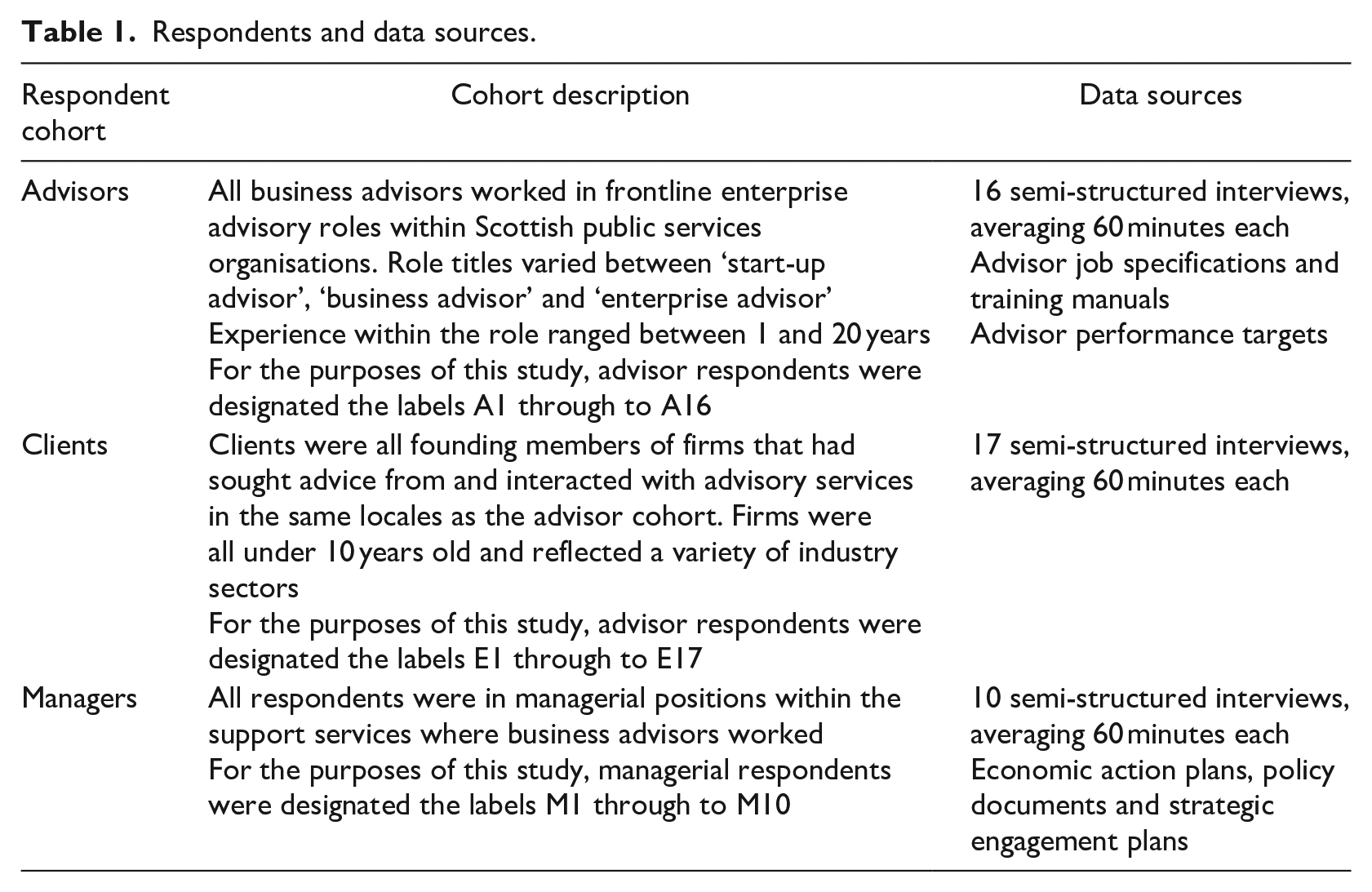
When designing the methodology, we were cognisant of the limitations associated with prior studies that empirically mobilise only one side of the advisory relationship. As such, we recruited a cohort of 17 clients, all whom had interacted with the services offered by our advisor cohort. Finally, we gathered an additional sample of 10 respondents who held managerial positions within the relevant support bodies. These individuals were able to offer pertinent insights into the wider institutional influences that impacted the advisor role. Our final sample contained 43 respondents across these three cohorts. Respondent cohort descriptions and corresponding data sources are summarised in Table 1.
Respondents and data sources.
Data collection
Data collection primarily consisted of in-depth semi-structured interviews with all respondents. Interviews were conducted between January 2017 and November 2019, and were typically 60 minutes in length. The interview protocol consisted of open-ended questions, which were designed to prompt conversation and enable us to pursue emergent lines of enquiry (Kvale and Brinkmann, 2009). Interviews were characterised by three primary lines of questioning. First, we focussed on the aspects of process that defined the role, probing respondents for their understanding of task demands and sequences. Respondent’s general understanding of advice-giving as a practice was explored; we probed for their views on what makes effective or ineffective support. We then investigated the specific experiences of advisors, asking about, for example, typical, positive, negative or challenging interactions with clients. Furthermore, we triangulated these qualitative perspectives with a range of documentary evidence that was relevant to an understanding of the advisor role. Secondary data sources included job specifications, training manuals and performance targets. Interviews with clients followed a similar, but slightly narrower, protocol, which focussed chiefly on client-side experiences of being advised. Again, this included reflections on their experience of the process, as well as on the practice of advising more generally. Interviews with managers, meanwhile, principally emphasised design of the job role and on the wider pressures that characterised it.
Data analysis
We adopted an inductive approach to analysis, which emphasised first-order coding of the data, followed by subsequent thematic organisation of codes into a conceptual explanation of the phenomenon (Gioia et al., 2013). To commence ordering of the data, we first sought to develop an ostensive understanding of the business advisor role. To do this, we initially utilised secondary data pertaining to the role, including job specifications and training manuals. Analysis of these helped us to acquire an appreciation of key tasks and processes, as well as of other wider expectations, pressures and parameters.
Next, we interrogated this understanding against the experiences of individual respondents in each of our three cohorts. We began by constructing individual narratives for each of the business advisors in our sample, detailing their views on the practices that they undertook. Next, we triangulated these with evidence from client and manager experiences, thus developing an understanding of how various stakeholder exchanges influence advisory practices. These narratives served to identify incongruities between formalised understanding of the role and the lived experience of practitioners. This, in turn, led to our first round of inductive coding, which focussed on the various pressures that exemplify the PSBA role. Initially, we developed first-order codes from individual respondent experiences, before comparing emerging analytical labels against one another in what amounted to a form of ‘cross case’ analysis (Eisenhardt and Graebner, 2007). This process allowed us to look for replication as well as to refine the codes that characterised our emerging conceptualisation. Figure 1 outlines the coding structure that we used to identify characteristic institutional, client and intrinsic pressures.
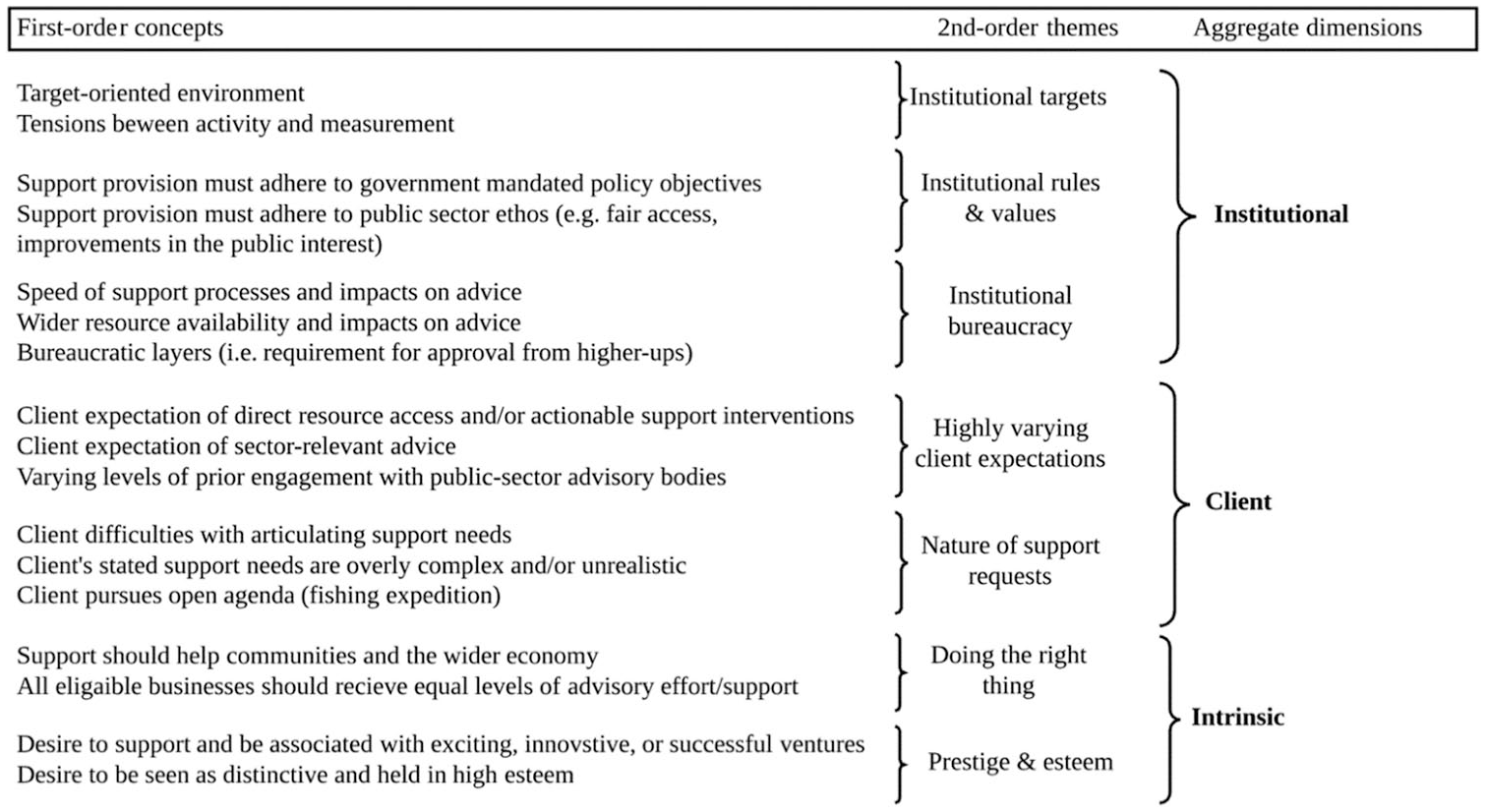
Data structure (RQ1: competing pressures).
Subsequent stages of the analysis examined the work undertaken by advisors in response to these pressures. This was achieved by isolating evidence from specific advisor–client exchanges and pinpointing different types of advisory practices undertaken. This included analysis of how, why and in what circumstances those practices were carried out. We focussed particularly on the different tactics deployed to reconcile role tensions and then constructed chains of related interactions. This allowed us to develop an understanding of the interplays between advisor tactics and the sources of pressure encountered. It was this analytical process that guided the development of our conceptual model (Figure 2), which depicts the dynamic management of the PSBA role and, in turn, forms the basis for our findings and associated theoretical contributions.
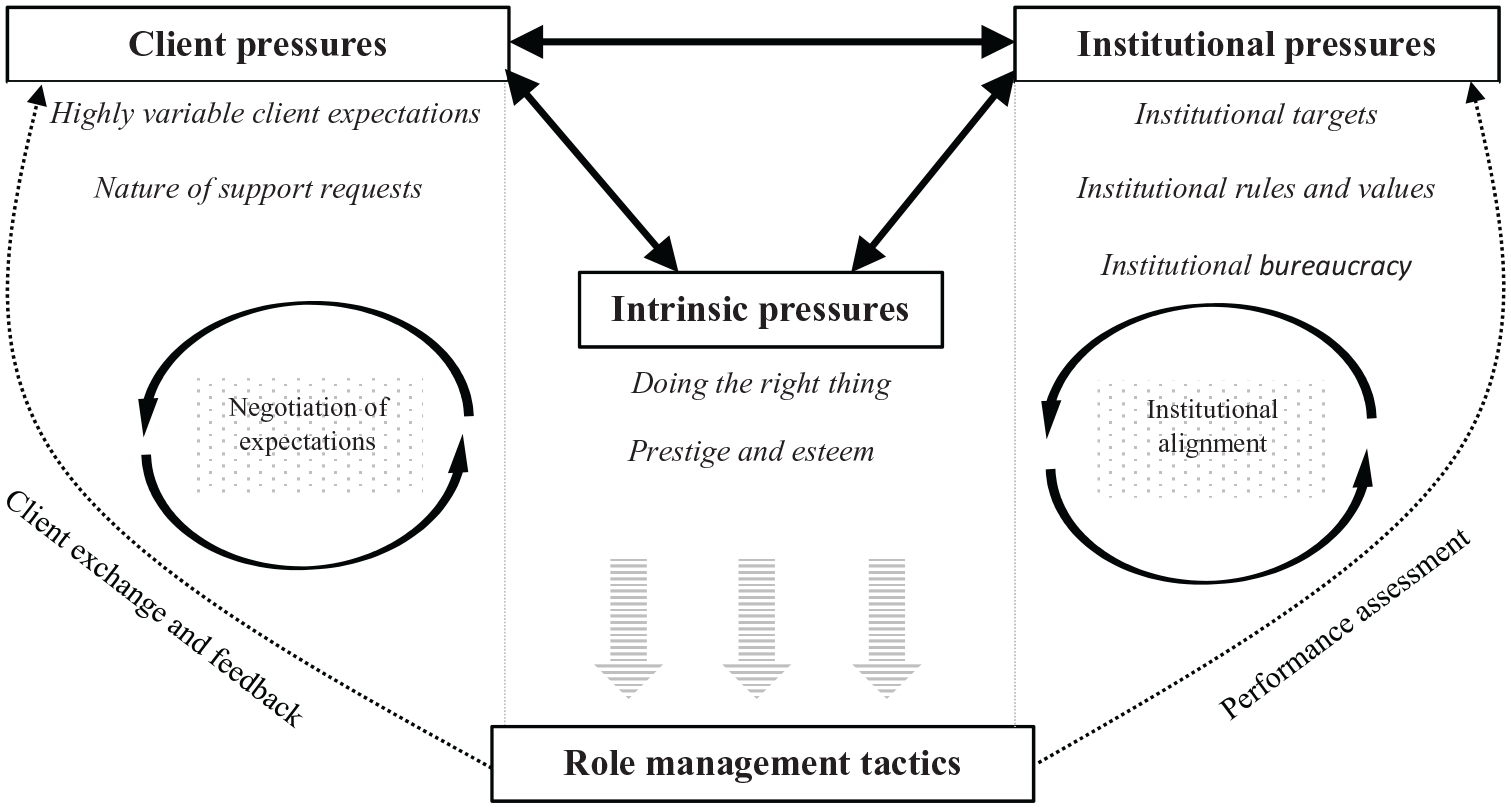
The dynamic negotiation of public sector business advice-giving.
Findings
In our ‘Findings’ section, we report on the key concepts that emerged from our inductive analysis. These findings are split into two sections. The first answers RQ1, which seeks to elicit the causes of role tension experienced by business advisors. The second section answers RQ2, which aims to understand how advisors navigate these tensions through their advice-giving practices.
Drivers of role tension in public sector business advising
We open by outlining the factors that shape public sector business advice-giving, focussing specifically on the institutional, client and intrinsic pressures that emerged from our analysis. How each of these three categories is associated with a set of role demands that can come into conflict, creating specific tensions that must be resolved by the advisor, is explored. Understanding the dynamics of these tensions provides some insight as to why there is variability in advice-giving and offers a novel explanation for why particular forms of advice-giving are pursued in this context.
Institutional
Like many managerial bureaucracies, a central feature of publicly funded business support services is a focus on performance targets and accountability. Given the significant public investment in business support, there is a strong pressure to deliver ‘value for money’ or to at least give the impression of so doing. This is a purposive and somewhat cynical distinction, and one we encountered with some frequency when speaking to advisors and their managers. Our interviewees identified a clear division between activity and measurement, explaining that although something may count towards a job target, it does not, in reality, always reflect a meaningful interaction:
So, part of it is about the number of one-to-ones we’ve had. We have an agreed target for that every year, and that’s fine. I mean, I don’t know what that tells anyone. It just means I’ve had a coffee with someone . . . We’ve met the requirements of the funding, yes. And there are others, like number of workshops and number of students touched through workshops. But what I find interesting is that’s always the issue with metrics – they are always distilled down into the quantitative issues and not qualitative issues. I think that’s one of the difficulties that besets this whole area. (A6)
This top-down target-focussed culture, largely driven by the ways in which some business support agencies bid for tenders to secure public funding, is often considered by advisors to be anathema to ‘doing the job’ properly. The volume of entrepreneurs that individual advisors are expected to consult with is considered very high by those same advisors, and this invariably shapes the nature of the client relationship:
The contract is quite target driven. So, we have to support so many start-ups, so many early-stage growth, so many discretionary appointments, so many GAS [Growth Advisory Services] appointments. Our contract manager in [our town] is on the case and making sure we are hitting targets. She likes [our region] to be up there in terms of hitting targets which is fair enough. So, we do all that, but it leaves us unable to spend a lot of time with clients. (A16)
Accountability is again emphasised by advisors as a key constraint, as they have to carefully justify the resources they allocate to clients. There is an emphasis on process standardisation in order that client companies in different parts of the country are not perceived to have access to an unfair advantage (e.g. through obtaining generous grants others are not offered). Clients are, therefore, usually filtered for support, normally based on turnover, employee headcount, growth potential and other similar factors. Such fixed parameters reduce the agency of individual advisors, their ability to tailor services and their scope to follow their own advice-giving instincts.
Advisors must also respond to evolving government policy initiatives, which at the time of our data collection in Scotland involved an encompassing focus on ‘inclusive growth’. This was perceived to add a further limitation to the scope of advice-giving in a public sector context:
I guess it’s quite new this year but it’s a huge focus for us, is inclusive growth. So, I think that’s a huge value that underpins everything that we do now. We don’t do anything without asking the important questions, of, well: how does this make opportunities for everyone, and those that need it the absolute most across Scotland? (M3)
Advisors are expected to operate according to a public sector ethos, pursuing an outcome that is both good for their client and good for the broader economy. This often poses challenges to the personal integrity of advisors as they navigate the entrepreneurial ecosystem. Given the focus on meeting targets, there is a tension between partner public sector business advisory organisations (who perhaps offer more specialised or niche services than our interviewees), as:
when you start developing metrics for public sector . . . quasi-public sector organisations, is that sometimes organisations want to hold on to your business so they can claim it as theirs the whole way through the process . . . at a certain point there are better people to advise them than X [agency name]. (A6)
Thus, advisors often face a difficult decision around when to pass on clients, particularly if it reduces their personal ability to meet a target.
Client
The varying nature of client expectations was a factor that appeared to impose considerable pressures on PSBAs. In many circumstances, negative client expectations were borne out of experience, where a previous interaction with a public sector advisory service had coloured future expectancy. Our analysis of client data suggests that advisory services were often treated with some disdain, being considered as either an impediment or necessary evil on the path to securing funding or support. We found this presented a direct challenge to the self-worth of the business advisor, casting their role as more of a lower order administrator than as a knowledgeable consultant. Indeed, poor external awareness of the scope of the business advisor role led to misaligned expectations as to what the business advisor could ultimately do:
The question I get asked an awful lot is ‘do you think this is a good idea; do you think this can work?’ And my standard response is ‘Well, I can’t actually . . . you are the person that will know this and we can give you the tools that you need to figure that out for yourself’. (A5)
This misalignment is most pronounced where clients assume it is the role of the business advisor to do parts of their work for them. Taking the notion of support quite literally, they expect the business advisor to complete time-consuming and firm-specific tasks such as developing a business plan or producing company financials:
Others come in and they’ve got really high expectations and they think you’ve got a big pot of money to give them money. They’re expecting you to do things for them. Don’t tell me how to write a business plan. Write my business plan for me and things like that. (A4)
Many of these challenges appear to relate to the vast diversity in both the type of companies that seek advice and the form of support they require. Unlike other commercial business consultants, who either provide a specialised service (e.g. tax advice, supply chain management) or work in specific sectors (e.g. oil and gas), PSBAs must be prepared to work with any qualifying organisation – from micro-firms to high-growth ventures and from the creative sector to hi-tech. This breadth reduces the likelihood that the generalist advisor will be able to offer meaningful advice (in the view of the client), and we identified this as a factor that led to advisors downplaying the status of their role:
Yes, the job title is Business Advisor, but as anybody would know who’s done this kind of work, you can’t advise very much. You can signpost, but when it gets very technical, when it becomes very specialist, you’ve got to find people out there who can help develop this business and the diversity of the businesses that I work with is astonishing. (A3)
Coupled with this, we found that clients often struggle to articulate their support needs to advisors, meaning that expectations are not always readily apparent. Our analysis examined a range of circumstances where clients engaged advisors with highly complex, nebulous or deliberately open support enquiries, thus placing a significant interpretive burden on the advisor in terms of how they shaped their intervention approach.
These factors contributed to what were fairly harsh external evaluation of the PSBA role from stakeholders, particularly where clients either overestimated how easy it was to obtain funding and/or actionable support, considered the advisor to be unnecessarily interfering in their operations or otherwise diminished the role of business advisor as they were perceived to lack specialised knowledge that would be useful to the firm.
Intrinsic
Our final role pressure, which we have categorised as intrinsic, is one that has rarely been acknowledged in past literature relating to PSBAs. This label describes the internal motivations for providing forms of advice to clients. While all business advisors, both in the public sector and private sector, have the overarching goal of helping clients, the ways in which they do so are shaped in part by a range of individual factors. The most obvious factor shaping motivations to provide advice is personal reward. While the business model for most consultancy organisations (e.g. management consultants, financial consultants) is for advisors to secure a client and then expand the range of services offered to them (thus increasing billable hours), this does not transfer across to the public sector, where the role is often about rationing services or passing a client on to another more relevant agency. Likewise, PSBAs do not receive financial rewards for doing a good job and this explained why they sought to engage in forms of advice-giving that instead boosted their esteem within their community. The primary means of doing so was to be seen to discover ‘sexy’ ventures that went on to success and win awards:
So, he was accepted into [the] growth [program] . . . he won a [high profile] award, so had just over £100,000 from [Organisation A]. And he has now developed a second product. And he’s just won the [prestigious] award for innovation and again . . . so that’s rewarding because this was a guy, he’s got a little unit out in [Town C] Business Centre, him and his partner, and things are really going to happen for him . . . he’s been put forward for account management because lots of things are going on with him and there’s been quite a bit of interest, but clever guy. But that’s rewarding, to take somebody that was working away in his little unit, doing his thing, coming up with this clever idea, to then see that idea actually go live, go off onto a facility. It’s not just an idea, it’s actually going to go to commercialisation and he will have a very successful business behind that. So, you can’t do that anywhere else, see that sort of progression. (A2)
This desire to become part of the success story of prestigious firms was common, and we found that it influenced the advisory approach adopted. Despite the bureaucratic constraints of the public advisory system, we found advisors more willing to use their own personal agency to fight for special support for firms they perceived as promising (in some cases where the firm did not fit within the parameters for particular packages of support):
So, it is identifying in the X [agency name] that these exceptional ones, I mean some of the X [agency name] will never see them, they’re few and far between. But when they come along it’s about spotting them and realising that the strategy for these ones is different. (M6)
Finally, there is also a sense of pride in the ability to help a wide range of clients. Many advisors derived self-worth from their ability to work with a challenging set of organisations. The motivation to help, and ‘do the right thing’ for clients, was pervasive:
It is a job that dealing with clients is fantastic, because you never know who you are going to get. The different variety of businesses you deal with is always challenging and it challenges you to get out of your comfort zone. (A9)
Thus, our findings suggest a clear distinction between the intrinsic motivations of commercial business advisory services and those working for a fixed salary in the public sector.
What advice-giving tactics do advisors use to manage role tensions?
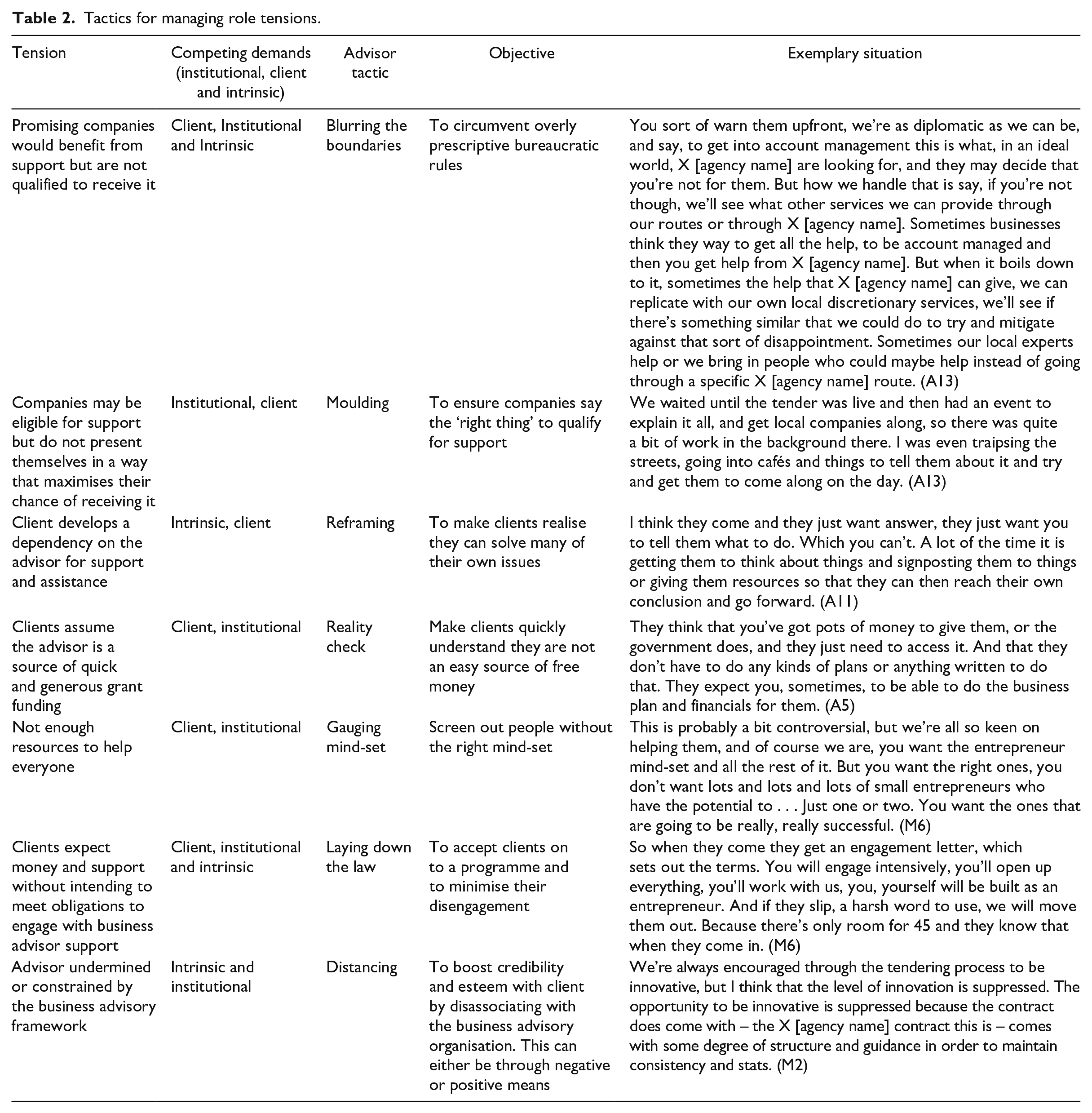
For our second research question, we seek to uncover the tactics that individual advisors use to balance the competing institutional, client and intrinsic demands that come with operating in the public sector. We do so by orienting to the interactional practices in which advisors engage through the course of their everyday work, to understand how advice-giving is shaped by both individual and contextual factors. We identify seven distinct tactics that are used to resolve a range of commonplace advisor role tensions. In Table 2, we outline the nature of each tension, the conflicting antecedents and the specific tactic(s) adopted to navigate the tension.
Tactics for managing role tensions.
Blurring the boundaries
Our first identified tactic was used by advisors to deal with the bureaucratic – and at times relatively blunt – filtering of client firms into different streams that were eligible for financial and business support. Where the advisor felt there was growth potential for a firm that had perhaps been unfairly overlooked (in the view of the client and advisors), they used their social capital and knowledge of the system to procure some form of resources (even if not equivalent to the desired support). Operating in this ‘grey area’ was not an everyday occurrence but nevertheless remained an important option for advisors to pursue in order to ‘do the right thing’ for their clients and partially to save face:
If it is really bad news, this client isn’t getting anything then I will meet with him this afternoon and apologise profusely on behalf of the whole enterprise network and then look and see what we can do . . . There might be a bit of local funding, we might be able to swing something. (A15)
We observed this tactic being used in cases where prescriptive rules were preventing what advisors believed were ‘common sense’ decisions, and where the advisor had significant experience or social connections within the advising organisation.
Moulding
A key pressure on business advisors is that they must achieve a wide range of Knowledge Performance Indicator (KPIs). This often conflicts, however, with the breadth of businesses supported and the awareness clients have of how public sector advising works. Many client businesses are naïve as to how they should present themselves to the advisory organisation for the most optimal outcome. This can have consequences. For example, a business may play down their venture growth aspirations, which can lead to them being miscategorised. We identify this as a particular issue in Scotland, where our empirical material was collected and where there is a cultural tendency towards modesty and underselling of personal business aspirations. This is a source of frustration for advisors, as they cannot categorise such businesses as potential ‘growth’ businesses as clients are not communicating the ‘correct’ mind-set or, put more fundamentally, they are not saying the ‘right’ thing to trigger support. We found advisors attempting to coax out the desired answer, partly by adopting a somewhat provocative approach to shape behaviour:
She said to me, ‘Why haven’t I got a one-to-one business advisor?’ I said, ’Well what’s your turnover aspirations?’ She laughed and she said, ‘Just holiday money’. I said, ‘Well there’s your answer’. I work with businesses who are expecting a turnover of £70,000 . . . She emailed me back the next day and said ‘I’ve done myself a disservice. I could easily do that turnover and I would really like to talk to you more about this’. So, I guess there is an element of the start-up advisors very much need to learn how to get it out of people to encourage people to think big. (A4)
Reframing
Business advisors reported that some clients exhibited a form of dependency on the business advisory organisation and the individual advisor. Although no specific advisor directly complained about this to us, we inferred their frustration when clients expected them to solve their problems for them (as opposed to with them). Hence, we observed a set of activities that we categorise as ‘reframing’ tactics, and these were largely used to make clients realise they are capable, and indeed responsible, for addressing their own issues:
. . . someone will come in and say should I be a sole trader, or should I form a limited company? And I say, well, it is up to you! I say you have to figure out how you expect the business to grow, think about if you are going to borrow money, if you are going to take on premises. We let them come to the conclusion themselves. (A11)
From the entrepreneur/client perspective, we found that the deployment of this tactic contributed to the perception of advisors as unhelpful, as their expectation of ‘advice’ was to receive more concrete guidance that allowed them to be more passive in the relationship.
Reality check
An important tactic for advisors is to manage expectations quickly following initial meetings with clients. Advisors noted that services are often publicly advertised (e.g. in the press, on billboards) in a manner that leads entrepreneurs and small businesses believing they will have easy access to money:
People are expecting handouts . . . there’s nothing in particular that they are doing . . . haven’t identified anything new . . . they just feel that they should get something because you’re the council, or you’re X [agency name] and they see adverts and you say you’ll help businesses. (A13)
We found many advisors therefore adopted a relatively robust approach to provide clients with a ‘reality check’ based on their unique circumstances:
I had a client the other day who was looking – quite small business, potential for growth but quite small at the moment – who thought they could get their salary paid because they were going to be like the international manager. And we’re like ‘no that’s not how it works, the system is that you are the business owner and you are employing someone to do this role, you can’t get . . .’ and they said ‘that’s just crap, we’ve done this, that. . .’ and I was like ‘yes but you think about it this is public sector money’. (A2)
Given business advising in the public sector is something of a volume business, requiring efficient handling of clients; we found advisors were less keen to ‘sugar-coat’ negative messages. This directness, which would not necessarily be found in advising settings where clients are paying, often by the hour, is relatively specific to contexts where advice is rationed.
Gauging mind-set
Advisors have a range of support packages or ‘products’ they can offer clients and are targeted against identifying companies that are suitable for these. It is important, therefore, that at a very early stage, the advisor can screen these businesses to get a feel for how they will develop. This informal future forecasting tactic is perhaps the practice that relies most on the individual skill and instinct of the advisor, as they typically arrange a set of early informal meetings to gauge mind-set:
So, the way that we get them, is we get referrals, they go through a kind of informal assessment process, which is generally me kind of having a meeting with a cup of coffee . . . I’m trying to get a feel of the entrepreneur, because that’s really important here. If he hasn’t got the real mind-set and ambition to build an international company of scale from the outset, he’s just not for us. It doesn’t mean he’s bad, he’s just not for us. (M6)
This early intervention provides an effective means of addressing tension between resource scarcity and the need to make sure the small number of high-potential firms are adequately serviced: ‘Obviously there are some we spend more time with, growth advisory and growth pipeline we do spend more with’ (A16).
Laying down the law
A major frustration for advisors is that they spend time working with a client to access resources and support, and then the client fails to engage further after they secure a package of help. This causes problems for the advisor as it affects objective measurements of their professional performance, and many advisors perceive it to signal a lack of respect for their relationship and role as advisor (i.e. they feel used and their self-worth is diminished). One of the managers we spoke to through our interview characterised the tactic we term laying down the law, as they effectively ‘forewarned’ prospective participants on a specialised growth programme that they were in a privileged position and should behave accordingly:
Our advisors know the kinds of businesses that we’re looking for, those ones that have got the potential for scale and growth, so it might be that they first of all introduce us. I generally will be the one that meets with companies before they apply to give them an idea of what to expect, what we’d be looking for from them, and just to ensure that we manage expectations at that stage. (M7)
For the entrepreneurs, they frequently object to committing time to workshops and meetings that are usually conditional for receiving particular forms of financial support. They often view the interventions as either ‘beneath them’ or irrelevant. Hence, the laying down the law tactic, while appearing almost discourteous, is important for minimising the risk of disengagement by filtering out those who are only interested in hard resources and not the full packages of support.
Distancing
We encountered a common tactic used by advisors to protect themselves from some of the stigma associated with public sector business advisory organisations more generally. Recognising that support is rationed and conditional, and that the bureaucratic rules and funding parameters often prevent many companies from receiving adequate support, advisors adopt a form of distancing from their organisation to protect or enhance their own self-esteem. They did this either by criticising the organisation, for example, through a conspiratorial ‘you know what they are like’ gesture, or, alternatively, by going ‘above and beyond’ for the client, supporting them in ways that are in excess of their perceived role requirements. As one entrepreneur noted,
My X [agency name] advisor is fantastic . . . she is going above and beyond her normal role for some of the things that she is doing for us, and people that she’s connecting us with. Like she called her sister to ask her sister’s boss to get a chat with me, he’s the owner of [a well-known clothing brand], and little things like that I know she doesn’t have to do. (E15)
In so doing, the advisor overcomes the constraints of the role, which diminishes their esteem and enables them to recover some self-worth by satisfying the client, even though they will not be rewarded formally through their organisation.
The dynamic negotiation of the public sector advisor role
So far, our description of the tactics used by PSBAs to navigate role tensions has relied upon evidence from specific stand-alone advisor–client interactions. In reality, however, the evolving nature of role demands and resolutions is more accurately exhibited through processes encompassed within nested chains of exchanges that occur over time. When these exchanges take place, the tactics employed by advisors feed back into and update client, institutional and intrinsic pressures in a dynamic manner. This dynamic interplay between tensions and advisor tactics thus characterises the often-delicate process of negotiating an advisory role in this organisational context. We build upon the constructs that emerged through our inductive theory-building to present this dynamic process in a conceptual model that addresses our focal research questions (Figure 2).
It is important to reiterate that client, institutional and intrinsic pressures often act in competition with one another, resulting in tensions that elicit distinctive forms of advisor agency. In some circumstances, these tensions can be relatively unique to a particular advisor–client exchange. More often, however, certain tensions present themselves consistently (and continuously) over time across a variety of advice-giving interactions. When this happens, these can emerge to become reified characteristics of the role. Our findings demonstrate a number of these common entrenched tensions in action, with perhaps the archetypal example being the paradoxical relationship between ‘doing a good job’/‘servicing the client’s needs’ and ‘meeting targets’/‘box-ticking’.
Our model is also, however, designed to reflect the inherently relational and interactive nature of advice-giving. As such, our conceptualisation recognises that clients play an active role in shaping how advisory practices are carried out. When advisors perform their role (i.e. deploy tactics), clients will typically, for example, react with some form of judgement as to the merits of an interaction. We conceptualise these judgements in the client exchange and feedback loop. While the specific nature of client judgements may vary significantly, they are most often, but not always, centred on the perceived usefulness of the advice given. In some cases, client judgements are lengthy and considered; captured, for example, in a series of interactions that occur during and following the implementation of advice. In other circumstances, assessments are based more on snap judgements, that is, the merits of advice are judged without efforts undertaken to utilise it. On some occasions, assessments of merit are analytical, whereas others appear to be rooted in socio-psychological factors, for example, the client liked or did not like the way that the advisor communicated or acted. Ultimately, it is the continual and cumulative updating of these judgements that feeds back into client pressures and thus on to future advisor practices.
We argue that this recurring interplay between client judgement and advisor action characterises the negotiation of expectations between the parties. As our empirical evidence repeatedly suggests, discrepancies between client and advisor expectations are a defining feature of the role. Thus, one of the key challenges for the advisor is to reconcile this gap in some fashion. In many circumstances, the advisor, unable to fully address complex and specific client challenges, must instead reframe them so that some form of achievable task can be carved out, thus ultimately allowing the client to get something useful out of the exchange. However, our analysis also identifies cases where the expectation gap between client and advisor becomes irreconcilable. In these circumstances, we note evidence of clients that have disengaged from the advisor, or worse, openly disparaged the service by spreading negative judgements to others. Equally though, we note that some clients are able to adjust their expectations strategically, developing a deeper understanding of the pressures that advisors operate under in order to effectively utilise them as a conduit for resource access.
We find similar interplay between advisor action and the institutional pressures present in this context. This interplay is characterised in how institutional alignment is managed. While it is clear that institutional pressures place significant restrictions on advisory practices, it is also abundantly evident that advisors are capable of exercising various forms of agency within the confines of these restrictions, reflecting Lipsky’s (2010) subversive ‘street-level bureaucrat’. This observation highlights several interesting, and often paradoxical, scenarios in terms of how institutional alignment is negotiated. An advisor might, for example, deploy tactics that misalign with institutional performance assessments, but that actually serve a particular client more effectively. Conversely, an advisor’s actions might be well aligned to institutional expectations, but not particularly well received by the client. As such, at all times, the PSBA must be cognisant of how and when to balance these competing forces through the tactics they employ.
Discussion
While prior research has gone some way to outlining the complex role of the PSBA (Mole, 2002a, 2002b), the everyday work of these advisors has rarely taken centre stage. Instead, scholars have predominantly focussed on measuring the efficacy of policy, with the consequence that issues around implementation have been minimised (Fotopoulos and Storey, 2019). In our article, we argue that this imbalance should be rectified. Studies from the field of political science show that policies are rarely implemented as intended (Weatherley and Lipsky, 1977), and so, measuring the notional success or failure of a policy requires more than quantitatively evaluating outcomes in order to get a sense of the full picture. To understand why policy diverges from intentions, we direct attention towards an important nexus of enterprise policy and the entrepreneur – the business advisor consultation. Here, we inductively analyse the competing factors that lead to advisors implementing variable forms of advice, and most significantly, we identify for the first time a set of advice-giving tactics that advisors employ to navigate the paradoxical tensions they encounter in their role. By bringing analysis down to the level of interaction between entrepreneur and advisor, we provide the basis for a more practice-oriented and performative theory of enterprise policy. In so doing, we overcome weaknesses that arise with treating enterprise policy as an abstract entity rather than as something that is constituted in and through the actions of stakeholders (Lipsky, 2010). Through these findings, we can begin to see some of the structural issues with public sector business advising that may be limiting the efficacy of this economic development approach.
Theoretical implications
Our study extends previous research that has examined the practice of advice-giving (Nikolova et al., 2009; Strike, 2013). While there is a relatively well-developed sociological understanding of how advice is both given and received in a range of contexts, including legal (McGinniss, 2018) and scientific settings (Hayat et al., 2015), we illustrate several ways in which public sector business advising exhibits unique characteristics. For example, though literature on consultancy relationships is instructive for our study, there are distinctive antecedents in the enterprise support context that radically alter how and why advice is given. Our first theoretical contribution highlights that unlike most other forms of formal business advice that entrepreneurs and other small businesses seek, there is no financial cost to them for doing so. This profoundly changes the dynamic between advisor and client and leads to a range of surprising advisory tactics that we would not necessarily expect to see in a private sector relationship; for example, it would be unlikely to see a commercial consultant ‘laying down the law’ with a paying client, nor using ‘reframing’ tactics to get clients to solve their own problems, leading to reduced revenue for the consultant. This notion of developing resilience in clients, with the hope that they do not develop dependency on the advisory service, underlines the different motivations of private and commercial settings, where advice-giving would often be designed purposively to create further engagement and revenue.
Another intriguing aspect of the PSBA role is that advisors are gatekeepers for significant financial and non-financial resources. This adds a particular tension to the advice-giving process, as advisors are acutely aware some clients are only engaging in the advising relationship so they can access these resources, rather than the advisor’s expertise. Advisors often managed this negative esteem signal by downplaying their own professional status, even to the extent where, as we reported in our findings, ‘the job title is Business Advisor, but as anybody would know who’s done this kind of work, you can’t advise very much’ (A3). While we note in the literature that many private sector consultants recognise the tenuous legitimacy of their own knowledge claims (Bouwmeester and Stiekema, 2015) and respond by (over)emphasising their credentials and impact (Wright and Kitay, 2002) or using ‘storytelling, rhetorical skills, and charisma to reduce interpretative variety and convey the symbolic meaning of a highly complex product’ (Nikolova et al., 2009: 295), we extend theoretical understanding of this dynamic in the public sector by showing public sector advisors take a contrasting approach through ‘talking down’ and ‘simplifying’ what they do.
Our second theoretical contribution builds further on the work of Mole (2002a, 2002b) who first identified some of the tensions that exist in entrepreneur–advisor relationships. We do so by integrating the constitutive theory of organisational paradox (Putnam et al., 2016) with theories of business advice (Malone, 2012; Mole, 2002; Strike, 2013) and policy implementation analysis (Lipsky, 2010). We extend Mole’s (2000) static snapshot of entrepreneur–advisor tensions by developing a dynamic model (Figure 2) that shows the inter-related and recursive nature of tensions and response tactics. In adopting this approach, we emphasise the agency, albeit sometimes limited, of business advisors and show how and under what circumstances this agency is activated. We further extend Mole’s (2000) work by adding depth to understanding of the sources of tension, particularly focussing on the nature of intrinsic factors. This is shown to be a powerful determining factor in advisors opting to deviate from institutional constraints, as they either elect to build esteem by exceeding role expectations in the view of the client or are guided by an inherent public sector ethos that justifies ‘bending the rules’ to do the right thing for their client. We argue this ‘grey area’, where advisors operate beyond the boundary of their role, is a key reason why the advising process generally works amid the paradoxical tension encountered in this environment.
Our work underscores Lipsky’s (2010) claim that ‘street-level’ public sector workers who make on-the-spot decisions to benefit or sanction clients constitute the true face of public policy. Consequently, in our article, we have advanced a conceptual explanation for how enterprise policy is crystallised in practice through entrepreneur–advisor encounters.
Practical implications
Taking this fundamental insight, that policy becomes ‘real’ during social interaction, then it is possible to rethink some aspects of the current system of advising. For example, policymakers and enterprise agencies may consider taking a different approach to managing and motivating advisors. Our study shows ‘esteem’ and ‘integrity’ are key sources of tension, typically coming into opposition with bureaucratic rules that prevent advisors providing an optimal outcome for clients, and from a client’s lack of respect for the limited scope of advice-giving advisors are empowered to offer. This notion of job status has been an ongoing issue in implementation studies (Hjalmarsson and Johansson, 2003), and our findings suggest that addressing this source of conflict directly could unlock associated difficulties relating to advice-giving in this context. For example, we show that a ‘public sector ethos’, which prioritises ‘doing the right thing’ is a dominant feature of this context, and therefore, we speculate that providing more autonomy for advisors, and reducing some of the narrow reporting obligations, may lead to more empowering outcomes for advisors and clients.
A second implication is that our focus on ‘street-level bureaucracy’ and the dynamics of advising practice may create an opportunity to directly link scholarly research with policymaking and organisational design processes. For example, we see an opportunity to work with government stakeholders, who typically adopt a top-down approach to policymaking, to highlight some of the ground-level dynamics that may lead to unintended outcomes. In addition, our findings can be applied in conjunction with theories of service design (Donetto et al., 2015) to reconfigure advisor roles and reform advising services.
Limitations and future research
While our research provides a detailed understanding of the work undertaken by PSBAs, we identify a number of boundary conditions that limit the applicability of our theory. First, we urge caution when generalising our findings outside the immediate context. While we believe our insights do have relevance beyond our empirical setting, we note specific characteristics about the Scottish ecosystem that are not prevalent elsewhere (Mole et al., 2011, highlight the regional variations in support provision in England, and Mole and Keogh, 2009, note institutional variations between Scotland and England). As our theory implies, these nuanced details can specifically influence the nature of advice-giving, and therefore a different set of tactics may be used by advisors in other settings where these antecedent factors vary. A second limitation of our study is methodological. While our in-depth interviews with multiple stakeholders and secondary documentation provide a detailed understanding of entrepreneur–advisor interactions, we believe there is a significant opportunity to go beyond this method to conduct a fully situated practice-based study. This may entail using video (Clarke et al., 2021; Hindmarsh and Llewellyn, 2018) or discourse-based methodologies (Locher and Limberg, 2012) to examine advice-giving as it unfolds, incorporating both verbal and non-verbal actions that advisors utilise to manage tensions. Such an approach would help us address a final limitation of the study, which is that we treated both advisors and entrepreneurs as relatively homogeneous groups. Future studies could benefit by analysing and comparing specific patterns of advising across different advisors to understand whether there are patterns of response tactics used by different groupings of advisor. This, we believe, could shed some light on the thorny issue of either conscious or unconscious discrimination, which, Lipsky (2010) and others (Giulietti et al., 2019) note, is a feature of public sector delivery and which may shape enterprise support outcomes for some groups.
Conclusion
Publicly funded business advisory services, which predominate across many established entrepreneurial ecosystems, offer free support and access to financial and non-financial resources for entrepreneurs and their firms. Encouragingly, our findings reveal a public sector ethos leads advisors to go beyond their remit to ‘do the right thing’ for clients, which in turn provides a general lubrication for the system. Yet this model of enterprise support is not without drawbacks. Through our empirical analysis of advisors and advisees, we show how the public sector context generates a number of paradoxical demands on advisors, in turn shaping the nature of the advice they provide. We offer granular explanation of how these tensions are resolved, through a series of advice-giving tactics. By linking specific tensions with response tactics, our analysis invites further research to explain the variations in support received by entrepreneurial firms.
Footnotes
Funding
The author(s) received no financial support for the research, authorship, and/or publication of this article.
