




Abstract
From a study following two sequential on-site data collection stages at 618 internationalising SMEs in Sweden, Poland and China, we identify and validate four distinct international knowledge acquisition strategies. In contrast to traditional theories suggesting that firms develop capabilities by generating their own experience, we show that Grafters and Pragmatists have a higher speed of international capability development than Experiencers and Networkers. Subsequently, by drawing on capability development theory, we show that the speed of capability development has a curvilinear (inverted U-shaped) effect on the speed of spread between international markets. These findings have consequences both for practitioners and theory.
Introduction
From research on the internationalisation of small- and medium sized enterprises (SMEs), we know that the speed of internationalisation has performance consequences (Sadeghi et al., 2018). We also know that the ability to acquire knowledge and develop internationalisation capabilities influences performance (De Clercq et al., 2012; García-García et al., 2017; Ipek, 2019). With the exception of recent contributions by Pellegrino and McNaughton (2015, 2017), surprisingly, few studies have integrated these two research streams and empirically studied international capability development as a determinant of internationalisation temporality.
However, the literature remains at a conceptual level, where theories on capability development are used to understand the mechanisms underlying the relationship between temporality and performance (Hilmersson et al., 2017). For example, Autio et al. (2000) show that the age at first international entry negatively affects growth in international sales and suggest that young firms can exploit a learning advantage of newness. Jiang et al. (2014) show that a short time period between subsidiary establishments abroad reduces performance and suggest that time-compression diseconomies are central in international capability development. Parallel to the literature on internationalisation speed, there is growing interest in various types of knowledge acquisition (De Clercq et al., 2012; Fletcher and Harris, 2012). As early international entrepreneurship research explained the behaviour of international new ventures as a result of inherited or grafted knowledge (Reuber and Fischer, 1997), subsequent research has turned to Huber (1991), arguing that capability development is not necessarily dependent on the generation of own experience.
Rather, inherited knowledge (De Prijcker et al., 2012; Morgan et al., 2018), inter-organisational learning (Bruneel et al., 2010; Milanov and Fernhaber, 2014) and grafting (Fletcher and Harris, 2012) have been shown to be central for internationalising firms. Whereas many studies on alternative sources of knowledge acquisition have examined individual alternatives to experiential learning (Morgan et al., 2018; Reuber and Fischer, 1997), we have witnessed a growing interest in how knowledge sources are combined. Thus, a pioneering study by Fletcher and Harris (2012) provided important qualitative insights into the role and relevance of different knowledge sources for accessing different types of knowledge. Furthermore, two studies by Pellegrino and McNaughton (2015, 2017) provided qualitative insights on how rapidly internationalising firms draw on different knowledge sources at different phases of their development. In light of this background, we address two shortcomings in the evolving literature on knowledge acquisition and its impact on internationalisation speed.
First, the literature on combinations of knowledge sources, up to this point, builds on evidence from relatively few cases and we have not yet been presented with any systematic, large sample studies allowing statistical inference. We, therefore, seek to establish heterogeneous knowledge acquisition strategies of internationalising firms thus, confirming earlier propositions in the literature (Fletcher and Harris, 2012; Pellegrino and McNaughton, 2015, 2017). Second, up to this point, we have limited insights into the effects of the strategy by which knowledge is acquired. We know that different sources are used when accessing different types of knowledge (Fletcher and Harris, 2012) and we know that depending on the stage of internationalisation, different types of knowledge acquisition are used by internationalising firms (Pellegrino and McNaughton, 2015, 2017). However, the literature has not yet systematically examined how the knowledge acquisition strategy influences the speed of international capability development and the speed of international expansion. Consequently, we examine if the variation in knowledge acquisition strategies among internationalising firms can explain variation in speed at which capabilities for internationalisation are developed and the speed at which the internationalisation process unfolds.
Based on data on 618 SMEs from Sweden, Poland and China, we establish and validate four international knowledge acquisition strategies based on how knowledge sources are combined. We show that their knowledge acquisition strategy influenced the speed of international capability development. Furthermore, we demonstrate an inverted U-shaped relationship between the speed of capability development and the speed of internationalisation. Thus, we follow the suggestions by Tuomisalo and Leppäaho (2019) and make four contributions to the literature on learning in internationalisation by analysing a multicultural sample.
First, we confirm statistically that knowledge acquisition is a multidimensional activity where different knowledge sources are combined. In our study, we establish four distinct knowledge acquisition strategies which we label based on the behaviour displayed – Experiencers, Networkers, Grafters and Pragmatists – confirming earlier literature on alternatives to experiential learning (Casillas et al., 2015; De Clercq et al., 2012; Pellegrino and McNaughton, 2015, 2017).
Second, we answer the call for future studies on the role of various knowledge sources in predicting the learning and internationalisation speed of firms (Bruneel et al., 2010; Pellegrino and McNaughton, 2017). We show that the knowledge acquisition strategy influences the speed at which international capabilities are developed.
Third, we contribute to the evolving literature on time-compression diseconomies in internationalisation (Hilmersson and Johanson, 2016; Jiang et al., 2014) by developing a new measure of the capability development process and showing that, if the speed of capability development is accelerated too much, it begins to have a destructive effect.
Fourth, we add knowledge about the drivers of internationalisation speed, which so far have attracted limited attention (Casillas and Acedo, 2013; Casillas and Moreno-Menéndez, 2014). Although, the factors enabling firms to maintain a high speed have not been explored in depth, (Ibeh et al., 2018; Puig et al., 2018), it has been argued that they are of both theoretical and practical importance (Prashantham et al., 2018).
The remaining sections of our article are structured as follows. First, we anchor our reasoning in relevant internationalisation research. Second, we develop our hypotheses. Third, we describe our method and test the hypotheses developed. Fourth, our findings are discussed, conclusions drawn and suggestions for how future research can address our limitations are presented. Finally, we end with implications for practice.
Theoretical background
The extant literature suggests a link between experiential knowledge and capability development (Autio et al., 2011). Experiential knowledge is based on the experience gained when doing business, and capabilities are experiential knowledge that has been interpreted and stored in memory of the firm (Huber, 1991), where they have been integrated and turned into bundles of useful knowledge. Capability development therefore, is dependent on routines of the firm (Prashantham and Floyd, 2012; Sapienza et al., 2006). Experience is an outcome of international duration as well as variation; the longer the time, the greater the experience and the more diverse the market, the greater the experience (Huber, 1991). Variation in experience enables both comparisons and the development of procedural internationalisation knowledge that can be used in different markets (Hilmersson and Jansson, 2012).
We make a distinction between experience and experiential knowledge (Hohenthal et al., 2003) and view experiential knowledge as useful experience. Thus, having spent time in foreign markets is only valuable if the firm has routines to turn this experience into knowledge. This makes routines essential for knowledge acquisition, as they make it possible for the firm to integrate experience (Saka-Helmhout, 2010). For efficiency reasons, firms tend to do the same things in the same ways as they have done in the past. Repetition causes a path-dependence so that routines develop. Routines are efficient tools for solving problems that are similar to problems the firm has solved in the past. In research on INVs, a critique has been raised against the importance of routines Autio et al. (2011), although Prashantham and Floyd (2012) suggest that they may simply require a more fine-grained examination.
However, routines can come under pressure and be stretched to their limits when deployed to gain new knowledge while at the same time having a critical role in the use of existing knowledge (Prashantham and Floyd, 2012). When a firm does this too much within too short a time, costs increase. Thus, if exposure to new experiences accelerates, it becomes challenging for the organisation to process new insights during a compressed time (Jiang et al., 2014). The internal process of making experience routine is a driving force in the theory of the learning advantage of newness (Autio et al., 2000). The reasoning is that when firms are new and lack experience, they have not yet built up a rigid organisational structure and can more easily develop new capabilities since they have a greater flexibility.
By building on evolutionary economics (Nelson and Winter, 1982) and the resource-based view (Barney, 1991), Knight and Cavusgil (2004) argue that the integration of experiential knowledge is the essence of capability development. Experiential knowledge acquired from various sources is embedded in routines (Autio et al., 2000), and as firms follow different knowledge acquisition strategies and integrate experiential knowledge differently, their bundles of capabilities are unique, inimitable and immobile (Dierickx and Cool, 1989). Routines, which are needed to integrate experiential knowledge into capabilities, are patterns of repetitive behaviour undertaken by multiple actors (Feldman and Pentland, 2003); they are stored as procedural memory (Cohen and Bacdayan, 1994) and are specialised in order to be recurrently mobilised for specific tasks. In this way, the acquisition of experiential knowledge results in routines that can be useful for internationalisation (Sapienza et al., 2006).
International knowledge acquisition
Acquisition of experiential knowledge has been referred to as the main driver of internationalisation (Johanson and Vahlne, 1977, 2009). More recent research, inspired by Reuber and Fischer (1997) and Forsgren (2002), challenges the assumption that firms only learn by generating their own experiences. For example, De Prijcker et al. (2012) argue that inherited knowledge serves an important role, Bruneel et al. (2010) find that inter-organisational learning with key partners fuels internationalisation, while Fletcher and Harris (2012) observe that firms rely on recruitment as a source of knowledge. In their overview of the field, De Clercq et al. (2012) conclude that international expansion is driven by a variety of knowledge acquisition strategies that seem to interact, whilst Pellegrino and McNaughton (2015, 2017) suggest that the importance of different knowledge sources are changing over time as the firm develops. Whereas, Fletcher and Harris (2012) suggest that the importance of different knowledge sources is dependent on the type of knowledge being sourced. Consequently, the literature is moving towards an acceptance of Casillas et al. (2015) who argue that a unidimensional view on knowledge sourcing is problematic, since the knowledge acquisition strategies are unlikely to be mutually exclusive. Yet, the majority of the literature is case-based and the sample size of the most recent contributions does not allow for statistical inference (Pellegrino and McNaughton, 2017). In addressing this shortcoming, we develop three central knowledge sources in ongoing internationalisation – own experiential knowledge acquisition of a firm, grafting and networking to validate the existence of generic knowledge acquisition strategies and enabling subsequent tests of their effects on the speed of capability development and international expansion.
Own experiential knowledge acquisition
Early internationalisation scholars emphasised experiential learning (Johanson and Vahlne, 1977). It was treated as an internal process, where the market and environment were faceless with limited variation. Inspired by Cyert and March (1963), direct acquisition of knowledge from own experience of the firm emphasises internal processes, where the employees of the firm learn on their own but are able to share the knowledge through interaction and information exchange. This type of experiential learning resembles how the resource- and knowledge-based views (Barney, 1991) approach the sources of competitive advantage. Acquiring knowledge outside the boundaries of the firm is a result of luck (Barney, 1991) and the focus is on how the firm combines internally controlled heterogeneous resources (Penrose, 1959). Recent research, however, has focused on how that experience is transformed into experiential knowledge and routinised in the firm.
Grafting
Grafting, when firms increase their knowledge stock through hiring new personnel or acquiring other firms (Huber, 1991), can increase the speed of capability development, but seldom has this been analysed (De Clercq et al., 2012). Fletcher and Harris (2012) argue that it has become increasingly possible to recruit managers with international experience, and we know that mergers and acquisitions have grown in importance. Grafting builds on the idea that the knowledge already exists, but it is not controlled by the firm and thus, the initial acquisition of experiential knowledge from outside the firm takes place before the knowledge is needed. Thereby, the firm cannot influence the process when experience is gained.
Networking
Several scholars observe that networking has a positive influence on internationalisation speed (Fernhaber et al., 2009; Gabrielsson et al., 2008). Knowledge gained from the network stimulates the start of internationalisation, as relationships mediate opportunities, but this network knowledge also reduces risk and uncertainty which also facilitates internationalisation (Musteen et al., 2010; Oehme and Bort, 2015). The firm may access experiential knowledge from others in networks, alliances and partnerships, such as agents or distributors (Fernhaber and Li, 2013). This type of knowledge sourcing is central in the network perspective (Johanson and Vahlne, 2003, 2006, 2009). We use the term ‘networking’ to describe the experiential knowledge gained from interacting with specific network actors. This knowledge acquisition can be conducted in business relationships (Chetty and Agndal, 2007; Guercini and Runfola, 2010) and also in social relations between business people (Loane and Bell, 2006). Networking is usually not deliberate, but is a by-product of firms doing business. Much of this happens when firms solve problems that occur in the course of daily operations. This means that learning is the outcome of the daily operations of the firm (Johanson and Vahlne, 2009).
Hypotheses development
This section develops hypotheses on how the knowledge acquisition strategies identified influence speed of capability development and hypotheses on how the speed of capability development influences speed of internationalisation. Since experience has been assumed to be the main source of knowledge in internationalisation, we use the Experiencers as our reference group.
Grafters and speed of capability development
Even though experiences generated by the firm are at the core of explanations for international expansion, more recent research suggests that external knowledge sources, such as grafting, may affect internationalisation (De Prijcker et al., 2012; Fletcher et al., 2013; Fletcher and Harris, 2012; Pellegrino and McNaughton, 2015, 2017). Grafting thus, seems particularly important in the early phases, as the firm identifies the capability and knowledge gaps which it has to address to continue internationalisation. For instance, Loane et al. (2007) observe that management teams change during internationalisation, as new team members with specific business skills are recruited and knowledge heterogeneity within the firm is increased. In response to changing needs, the firm strives to address its knowledge gaps through grafting.
When firms are confronted with problems, they can search for the specific skills needed in order to solve the problems and graft the needed knowledge. The process is often described as deliberate, when the firm understands what knowledge needs to be grafted and different alternatives are assessed (Loane et al., 2007). Grafting is thereby a form of indirect learning where the firm gets access to experiential knowledge that was partly gained in another context. It can be a question of hiring an export manager, or acquiring a competitor. It can be both individuals and groups of people who have the knowledge it needs, grafting business skills and marketing knowledge seems to be more common than grafting other types of knowledge (Nag et al., 2007). Without accumulating its own experience, the firm takes a shortcut and acquires the experience of others. At first sight, this can be an efficient way to learn quickly, as the firm does not have to learn on its own and make all its own mistakes. However, there is a risk that the knowledge grafted may duplicate or overlap with the knowledge already possessed by the firm. The risk can be avoided by excluding dysfunctional knowledge by discontinuing the graft (Madhavaram and McDonald, 2010).
Since grafting means that specific knowledge is added to the already existing body of knowledge of the firm, validity and integration are important. When an outsider is incorporated, it brings knowledge to the firm, but if that knowledge is based on experience from a specific market, it has to be valid for the firm. Its value and validity come from the usefulness of its contributions to the particular internationalisation process, which implies that the value of knowledge can vary. Grafting knowledge challenges the identity of the firm and how the employees perceive themselves as an organisation (Nag et al., 2007). New knowledge often meets resistance from those who want to preserve the current identity of the firm, which can lead to an incompatibility between existing identity and the newly grafted knowledge. Who has the power to control critical knowledge and how to control it are critical aspects of grafting (Nag et al., 2007). Thus, there is a risk that the grafting can lead to the rejection of new knowledge. Because the existing knowledge and the acquired knowledge do not fit, the intended shortcut can end up leading to a longer learning process instead.
We contend that the prevailing trade-off between potential shortcuts and avoiding the likelihood of repeating mistakes, on the one hand, and the potential difficulties associated with integrating new knowledge, on the other hand, is in favour of the benefits of grafting. Reflecting other evidence (Madhavaram and McDonald, 2010; Nag et al., 2007), we also agree that marketing and marketing knowledge are suitable for grafting, which makes it likely that firms that are internationalising, often by exporting, can benefit from grafting and knowledge acquisition at a high speed. Fletcher and Harris (2012) observe that recruiting people with relevant experience allows the firm to rapidly acquire critical knowledge. Thus, we hypothesise that
H1: Grafters will have a higher speed of capability development than firms acquiring knowledge from their own experience.
Networkers and speed of capability development
Whereas, grafting means that the firm controls its stock of knowledge, other studies (Bruneel et al., 2010; Fernhaber et al., 2009) suggest that an alternative is to acquire knowledge from others in the business network. Such inter-organisational acquisition of knowledge often appears as firms cooperate with agents and distributors. However, the agents and distributors represent more than themselves, as they, in turn, sell products of the firm to other firms. The position of the agent or distributor in the network gives them a platform to function as an information hub (Evers and Knight, 2008) or gatekeeper (Guercini and Runfola, 2010). Thereby, they can influence the volume and the direction of the information flowing in the network. Consequently, networking entails both knowledge acquired from and with counterparts in the network. But because the network is a wider system of connected relationships, it facilitates information sharing. In addition, networking enhances both the development and growth of the direct existing relationships, as well as the establishment of new relationships, because it helps the firm to identify opportunities beyond the direct relationships (Chetty and Blankenburg Holm, 2000).
The result of networking is directly related to the business the firm conducts in the network. By interacting with network partners, the firm develops capabilities (Johanson and Vahlne, 2009). The firm cooperates with and jointly solves problems with its counterparts. Thereby, the costs of knowledge acquisition are relatively low and the knowledge gained is valid and relevant. Moreover, the knowledge is rich in detail. Besides learning from and with its counterparts in the network, the firm, through its interactions with counterparts, acquires knowledge about cultures and institutions, and also about suppliers and competitors, beyond its direct network connections. We hypothesise,
H2: Networkers will have a higher speed of capability development than firms acquiring knowledge from their own experience.
Pragmatists and speed of capability development
Markets vary in terms of cultures and institutions, which influences how firms do business. This heterogeneity implies that firms need to adapt to the specific conditions in which they find themselves. Critical for this adaptation is how firms acquire knowledge and develop capabilities specific to each foreign market. Instead of pursuing a standardised knowledge acquisition strategy, which is efficient and to a lesser extent takes the specific conditions of the market into consideration, firms may have a more pragmatic approach to learning. Such an approach would entail combining several strategies that proceed from the characteristics of the market. Whereas, the strategies discussed earlier favour certain knowledge sources, the fourth knowledge acquisition strategy – Pragmatists – builds on a mix of knowledge sources. Firms following this strategy acquire knowledge in different ways in different markets, depending on the local circumstances. This type of firm acts in a flexible and pragmatic way, adapting its strategy to the local conditions.
A pragmatic strategy seems to enable a more efficient acquisition of knowledge, as the firm is better able to accumulate experiential knowledge which is critical for the specific market. For instance, in one market, it can build on what it has learned about how social networks of contacts with civil servants and politicians function, while in another market, having knowledge about legislation and formal institutions is likely to bring success. With such a strategy, the body of experiential knowledge is heterogeneous and diversified and the internal routines are expected to systemise and transform it into capabilities. The advantage of a pragmatic knowledge acquisition strategy is that it produces knowledge adapted to each specific market. Its weakness is that the demands on the routines to develop new capabilities are high, otherwise knowledge is accumulated but not utilised when the capabilities are developed. We maintain that the advantages outweigh the disadvantages for SMEs as they are able to exploit the learning advantages of newness when they are rapidly developing capabilities. Pragmatists, therefore, compensate for shortcomings in individual knowledge acquisition by turning to alternative knowledge sources where needed. We hypothesise that
H3: Pragmatists will have a higher speed of capability development than firms acquiring knowledge from their own experience.
Speed of capability development and speed of international expansion
Internationalisation is a complex and uncertain enterprise, and most studies start with the assumption that firms entering foreign markets are exposed to uncertainty concerning culture, institutions and business habits that differ from the home market and also vary between themselves (Autio et al., 2011). This makes firms reluctant to internationalise, although experiential knowledge can reduce the uncertainty (Hilmersson and Jansson, 2012). Thus, if the firm can accelerate capability development, it can reduce uncertainty, which can then lead to a higher internationalisation speed. Capabilities based on general internationalisation knowledge are not market-specific but may reduce the costs of entry into markets other than where the capability was originally developed (Eriksson et al., 1997). Each new entry, therefore, implies using old capabilities, making later market entries less costly than earlier ones, although this requires that routines are deployed in order to develop existing capabilities (Prashantham and Floyd, 2012). As markets are heterogeneous, difficulties associated with entering and operating in several international markets follow. Firms have to adapt to each market. When firms spread their operations to several markets at a high speed, they can more quickly reach economies of scale, while the costs for coordinating the operations between the markets increase. If the firm possesses capabilities that are valid and transferable between markets and routines that can be deployed in order to quickly share information between the units in various markets, costs for coordination can be decreased.
In contrast, when the expansion into heterogeneous markets is compressed in time, that is, when speed of capability development is high, routines are stretched. When this goes too far, the routines reach a point where they cannot integrate the new knowledge, which may result in inefficiencies and therefore, increased costs (Dierickx and Cool, 1989). In order to avoid this, the speed of internationalisation has to be lowered. We expect that, if the speed of capability development increases considerably, the managers of the firm will suffer from the limitations of information processing (Dierickx and Cool, 1989), which can arise from entering too many markets too quickly, when routines are too weak to develop the capabilities adequately. As a consequence, we hypothesise that
H4: There is a curvilinear (inverted U-shaped) relationship between speed of capability development and speed of spread between international markets.
Method
Sample(s) and data collection
We have collected survey data in two stages in order to initially identify knowledge acquisition strategies that, in the second step, were validated. We then collected data from the most internationally experienced SMEs in southern Sweden. This geographical delimitation was made in order to enable on-site data collection. The EU definition of SME based on a headcount of fewer than 250 employees was followed and a lower limit of an annual total export of at least SEK 10 million was set. Data for sampling were requested from Statistics Sweden. The sample identification followed two distinct steps. First, secondary data were evaluated in relation to the criteria. Second, firms were evaluated over the phone, to exclude those not representative of the population. After these 2 steps, 277 firms fulfilled the selection criteria. Of these, 203 firms filled in the questionnaire, resulting in a response rate of 73%; 74 firms did not participate in the survey – some were unreachable after four attempts. Others declined due to policies of non-participation in surveys, lack of interest or lack of time. Non-response analyses did not indicate any patterns with regard to firm size, industry or export intensity.
To validate our exploratory results and to ensure external validity, we conducted the second step of data collection. We collected data from an additional 35 Swedish SMEs, 152 Polish SMEs and 228 Chinese SMEs. For the Swedish firms added to the sample, we followed the same procedures as described earlier, but we expanded the region where firms were located. The validation data collected in Sweden covered 35 SMEs visited on site in Halmstad, Uppsala, Sundsvall and Gävle and a response rate of 82% was reached.
For the non-Swedish part of the final sample, the method and procedures from the Swedish study were replicated; we used the same measurement instrument, sampling criteria and data collection strategy. To reduce surveyor effects, we used the interview guide developed in step 1 and we carefully explained to the interviewers how to clarify questions and how to minimise missing values. The questionnaires were prepared in local languages and back translated. The interviews were conducted by skilled interviewers at Poznan University, Poland and at Fudan University in China. Owing to the lack of suitable lists to use as sampling sources, our local partners, in dialogue with local business associations and chambers of commerce, managed to establish a list of 912 Chinese and 200 Polish firms meeting our sampling criteria.
In China, data were collected in the cities of Shenzhen, Foshan and Dongguang in the Pearl River Delta Economic Zone, and in the cities of Ningbo and Hangzhou in the Yangtze River Delta Economic Zone. We reached a response rate of 25%, a final dataset with 228 cases. For Poland, data were collected in Kraków, Lublin, Warsaw, Katowice, Gdańsk, Gdynia, Poznań and Wrocław. We reached a response rate of 76%, a final dataset of 152 cases.
Our on-site strategy for data collection was labour- and cost-intensive but offered the advantages of ensuring commitment of the respondents, standardisation of the data collection and support from the researcher. The on-site visits included a short semi-structured interview before leaving standardised questionnaire. Each visit lasted between 1 hour and 1.5 hours. The person responsible for, or with the greatest experience of, international activities of the firm was interviewed. As this comes with potential biases related to single respondents, we followed the recommendations of Podsakoff et al. (2003) and analysed the different sections of the questionnaire separately. It should also be noted that we did not ask any direct questions about the dependent variable.
Variables and measures
To establish the knowledge acquisition strategy of internationalising SMEs, we derived our measures from Forsgren (2002) and Huber (1991). Three main knowledge sources in the ongoing internationalisation of the firm were extracted. We excluded inherited knowledge as a source since it has been shown to be important in the early phase but of diminishing importance in later stages (De Prijcker et al., 2012). Thus, we expect firms to develop capabilities by generating their own experience, through network partners and/or through grafting. How firms combine various knowledge sources constitutes the knowledge acquisition strategy. Consequently, respondents were asked to rate the respective importance of each knowledge source. Thus, three statements were presented to the respondent, as follows: In our organisation, we acquire knowledge about doing international business and how to organise our international activities by, (a) generating our own experience, (b) co-operating with other firms such as agents or distributors, and (c) acquiring other firms and/or employing experienced personnel. A scale ranging from one to seven, where one represents not important at all and seven represents significant importance was used.
To capture the speed of the capability development process, we divided the internationalisation capability possessed by the firm with the time taken to develop it. Consequently, in our measures, the degree of internationalisation knowledge (Eriksson et al., 1997) is the numerator and the time since first international sales is the denominator. We created a summated scale with the indicators: ‘We have well developed experience of (a) supplying foreign customers, (b) adapting our organization to meet the needs and wants of foreign customers and (c) sales and marketing of our products abroad’ to capture the degree of knowledge possessed by the firm. The summated scale, which has an Alpha value of .710, Communalities of >.6 and Factor loadings >.7, was divided by the time elapsed between first international sales of the firm and the date of the survey. To measure speed of internationalisation, in turn, we followed Casillas and Acedo (2013) and Hilmersson et al. (2017). Thus, we divided the number of foreign markets sold in by the firm by the age of the firm.
Identification, validation and interpretation of knowledge acquisition strategies
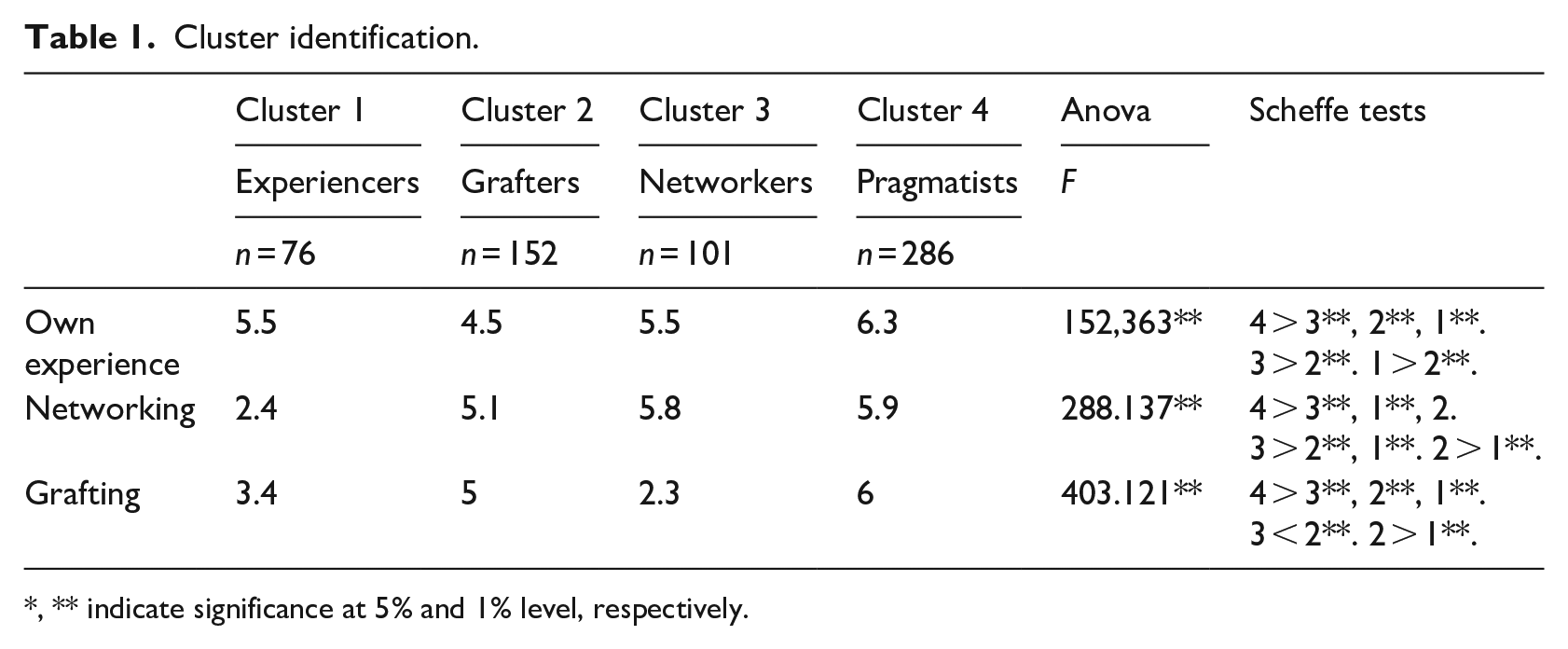
To establish and confirm international knowledge acquisition strategies, we performed a cluster analysis. We used the three measures evaluating the importance of respective knowledge acquisition sources to classify the firms. As the theory did not specify the number of clusters in advance, a two-step clustering procedure was followed (Ketchen and Shook, 1996). First, a hierarchical cluster analysis identified the most stable and suitable solution. To minimise the internal differences within the clusters, and since we observed few outliers, Ward’s method was used (Hair et al., 2006). Thus, the number of clusters is based on the agglomeration coefficient change when stepwise changing the number of clusters. The analysis revealed that the smallest change in agglomeration coefficients occurs in a four-cluster solution. In the second stage, we performed a K-means analysis where a four-cluster solution was ordered. The iterations in a K-means analysis optimise the homogeneity within the clusters, whereas they maximise the heterogeneity between clusters. Convergence was achieved after six iterations using the squared Euclidian distance. We then followed established procedures (Ketchen and Shook, 1996) to test the reliability of the clusters. We then split the sample in two and repeated our analysis. To assess the external validity, we decided to split the sample into one Swedish and one international category. The results revealed no significant changes as a four-cluster solution was suggested in both portions of the sample. The final cluster centres did not move in any noteworthy direction and the share of the sample ending up in each cluster followed the pattern of the original solution. We then re-ran the cluster solution with standardised values which was returned with stable results. Anova F-statistics and Scheffe tests revealed significant differences among the groups. The somewhat weaker statistics on experiential knowledge acquisition were expected; indeed, the extant literature underlines the role of experiential learning. Consequently, when interpreting and labelling the clusters, we placed extra emphasis on the other dimensions.
Table 1 represents cluster identification.
Cluster identification.
, ** indicate significance at 5% and 1% level, respectively.
Cluster 1 – ‘Experiencers’ reveal low scores on grafting and networking and high scores on experiential learning. An example is Trebema, founded in 1974 and supplying heating and water-heating technologies. Today Trebema is a third-generation family-owned firm with sales in 20 countries. International sales are managed by 10 employees in Sweden. A total of 50% of the sales are exported and no employees are employed abroad. For Trebema, internationalisation is an outcome of the international travels of the domestic sales team. The firm actively participates in international exhibitions and fairs, but there is no permanent location where the products are displayed. The first export venture of Trebema took place in 1995, when customers in Finland and Denmark found out about one of its products. Later, a trade fair in Germany was visited and customers in Germany, Hungary and the Netherlands identified. Since then, the 10 employees of the firm have dealt with all foreign customers, although lately, they have decided that it is better to serve geographically close customers and to withdraw from distant markets. A new strategy was recently implemented emphasising a local focus.
Cluster 2 – ‘Grafters’ reveal high scores on grafting and low scores on networking. One example is Norba, a manufacturer of refuse collection vehicles. Since Norba serves the market in collaboration with truck manufacturers such as Volvo, MAN and Scania, control of the operations is needed. A consequence being that most sales activities are internalised by using experienced employees or by acquiring local units. Local organisations have been set up in Germany, France, Poland, Italy and Spain through greenfield investments where Norba has headhunted experienced and competent local managers or from acquisitions where local distributors have been incorporated. In more peripheral markets such as the Baltic states, Portugal and Ukraine, Norba is operating with local agents or distributors who serve the purpose of scouting for opportunities. If these peripheral markets show promise, Norba expresses an interest in internalising the activities.
Cluster 3 – ‘Networkers’ reveal a high score on networking and a low score on grafting. Norden Machinery, a leading supplier of high-performing tube-filling systems, serves as example. This firm largely supplies customers in the cosmetics and the pharmaceutical market and has chosen to focus on system production and technology development while relying on agents and distributors for sales and market-feedback. Norden has 200 employees in Sweden, most of them engineers. Only six work with marketing and sales but are proud of their international sales network of 45 persons who act as agents and distributors. For the networked structure of Norden, the key is knowledge exchange and transfer between the external sales network and the product development teams. Representatives of the sales network are invited on an annual basis to discuss market- and product development. Tube-filling systems of Norden operate on every continent (except Antarctica) given their deliberate strategy to operate through agents and distributors; in large markets such as China, the United States and Germany, however, Norden has internalised regional hubs to support the sales network.
Cluster 4 – ‘Pragmatists’ have high scores on all dimensions. Both grafting and networking have been important complements to their own experiences. An example is BIM Kemi, a family-owned developer and manufacturer of technology and services for the pulp and paper-based industries. With their motto, ‘small enough to listen, big enough to act’, BIM develops its products and processes in cooperation with customers. Adaptations and product developments have been key drivers of growth. Constant adaptations are required to meet the needs of customers. BIM has local subsidiaries in Norway, Finland, England, Germany, Belgium, the Czech Republic, Portugal, France and South Africa. In Chile, Italy, Russia and Poland, agents are used, whereas China is served through distributors. Since a close customer-relationship is needed for generating experience and insights locally, BIM has followed a pragmatic internationalisation strategy. When suitable agents or distributors are identified, their expertise is exploited; in other countries, subsidiaries have been established through acquisitions, whereas, direct experience has been important in nearby markets.
Hypotheses tests
Knowledge acquisition strategy and speed of capability development
When testing hypotheses 1–3, we controlled for eight variables. First, we controlled for the country of origin of the firm. Second, we included a dummy variable to separate our two studies and thereby control for potential interviewer- and time-related biases. Third, we controlled for firm size by including a variable on the number of employees. Fourth, we controlled for the year of firm inception. Fifth, we controlled for the year of first international sales. Sixth, we controlled for the international spread of the firm. Seventh, we controlled for the share of sales exported. Finally, we controlled for the degree of commitment to international markets.
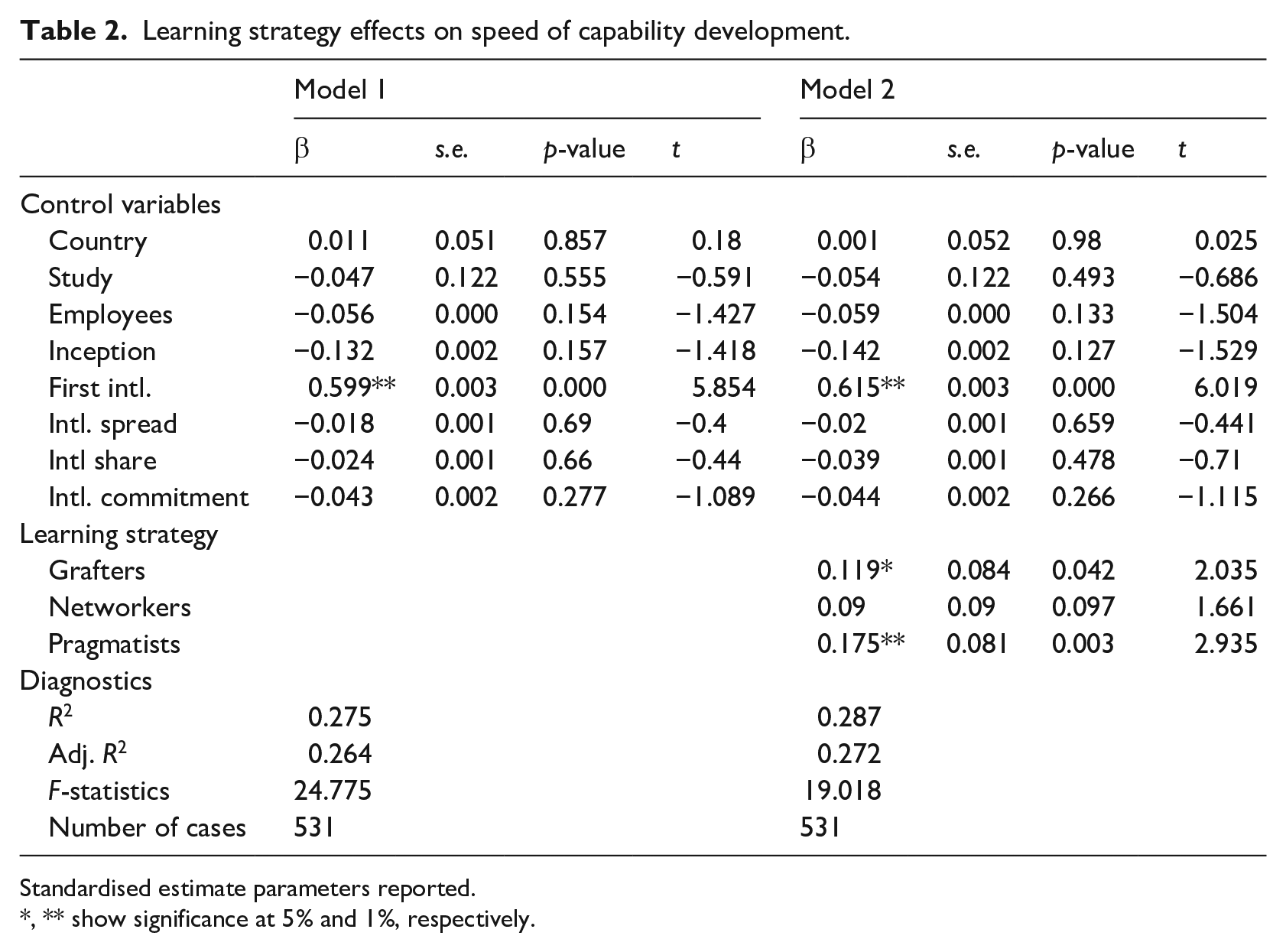
The results from our test of hypotheses 1, 2 and 3 are presented in Table 2. Model 1 reports on the control variable effects. Model 2, in turn, includes the dummy variables created for each knowledge acquisition strategy. The Beta values thereby show how the speed of capability development changes with the characteristics of the respective strategy. In support of hypothesis 1, we find that Grafters develop capabilities at a significantly higher speed than Experiencers (p-value = 0.042; β = 0.119). In contrast, regarding our second hypothesis, we found no significant support for the way Networkers develop their capabilities (p-value = 0.097; β = 0.09). We find support for hypothesis 3, suggesting that Pragmatists will develop capabilities at a higher speed than Experiencers. Our results show a positive and significant effect (p-value = 0.003; β = 0.175).
Learning strategy effects on speed of capability development.
Standardised estimate parameters reported.
, ** show significance at 5% and 1%, respectively.
Speed of capability development and speed of internationalisation
When testing hypothesis 4, we controlled for five variables. With the same logic as described for our first set of hypotheses, we controlled for the home market, the study from which the data came, the number of employees in the firm, as well as the year of firm inception. In addition, we included a variable separating family-owned firms from firms with alternative ownership.
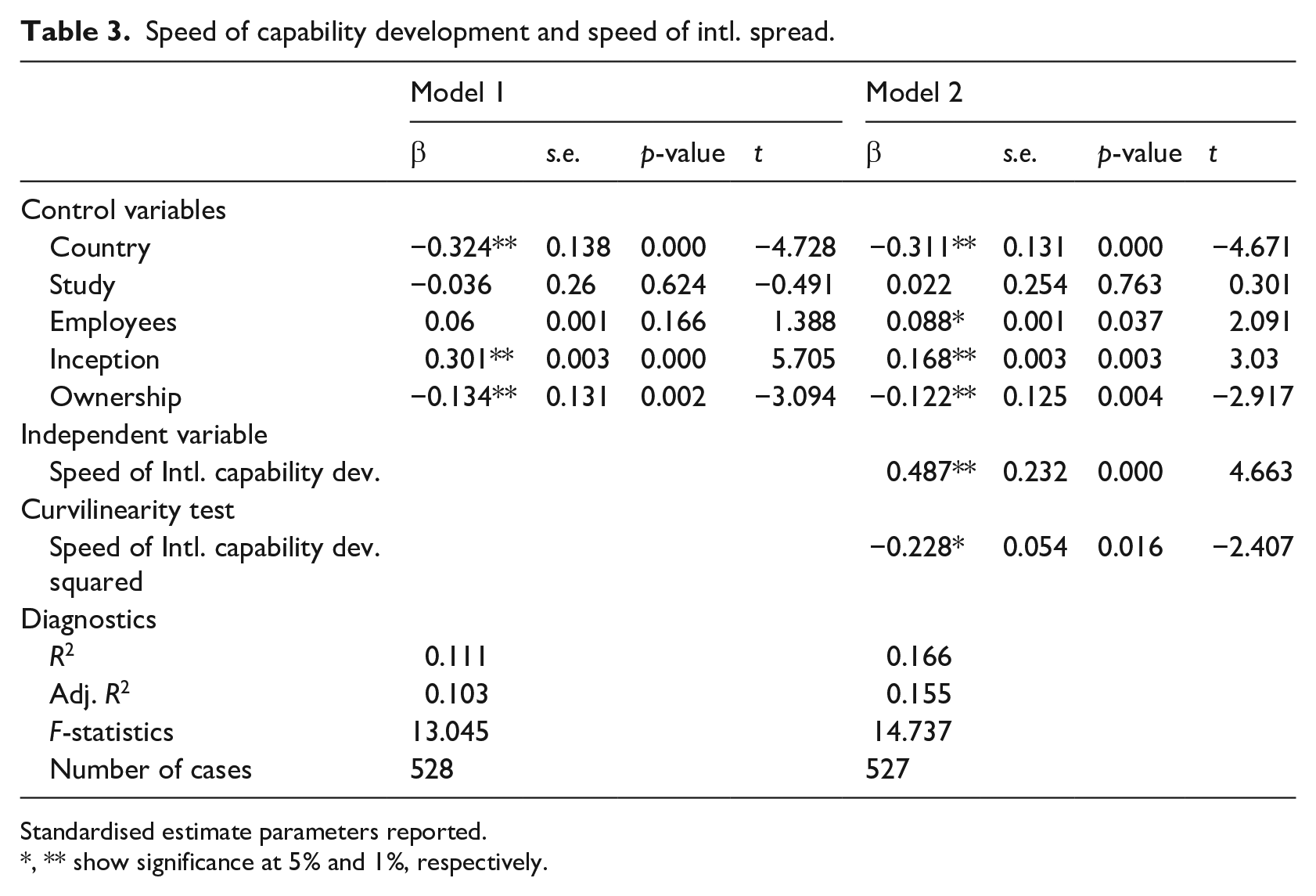
Table 3 reports on the test of hypothesis 4. Model 1 reveals the effects of the control variables, whereas Model 2 presents the effect of the independent variable as well as the curvilinearity test. Model 2 reports statistical support for Hypothesis 4 suggesting a curvilinear (inverted U-shaped) effect of the speed of capability development and the speed of spread between international markets. For the independent variable, we find a positive and significant effect (p-value = 0.000; β = 0.487), whereas we find a negative and significant effect by the squared variable (p-value = 0.016; β = −0.228).
Speed of capability development and speed of intl. spread.
Standardised estimate parameters reported.
, ** show significance at 5% and 1%, respectively.
Discussion and conclusions
Knowledge acquisition strategies
In the literature, knowledge, experience and learning are well-documented factors explaining internationalisation (Johanson and Vahlne, 1977, 2009; Petersen et al., 2008) and extant research highlights the role of experience for internationalisation capability development. However, the literature is underdeveloped when examining alternative knowledge sources and alternative ways of developing internationalisation capabilities (De Clercq et al., 2012; Tuomisalo and Leppäaho, 2019). Although, there has been a growing interest in exploring knowledge sources other than experiential learning, there are still relatively few studies addressing how different knowledge sources are combined. By building on two pioneering studies in this field, we argue that capability development is an outcome of the combination of various knowledge sources. We found inspiration in Pellegrino and McNaughton (2015, 2017) who suggest that knowledge source importance changes over time; we were also inspired by Fletcher and Harris (2012) who found that firms use different sources depending on the type of knowledge being sourced. Our initial contribution is to advance this research by highlighting how the firm combines knowledge sources into heterogeneous knowledge acquisition strategies. We show that very few firms rely solely on individual knowledge sources; instead, different sources are combined in heterogeneous patterns. These patterns we established as knowledge acquisition strategies, and, based on our data, we have established four such strategies.
First, we identified a group of firms that mainly build knowledge from generating their own experiences, who we refer to as Experiencers. This knowledge acquisition strategy reminds us of the ideas of early internationalisation research (Johanson and Vahlne, 1977), which suggests that learning comes from the generation of own experience.
Second, we identified an alternative strategy for learning consisting of firms that complement their own experiences with the employment of new personnel or with the acquisition of other firms, who we refer to as Grafters. For the Grafter firm, own experiences and networking play an important role, but compared to the other strategies, grafting is significantly more important.
Third, we identified firms that, apart from generating their own experiences, also rely on their network partners; these are the firms we refer to as Networkers. Networkers seem to combine the generation of own experiences with an extensive use of network partners for knowledge acquisition. We interpret the importance of own experiences for the networking firm as a means of validating knowledge accessed from the network and avoiding superstitious learning.
Fourth, we identified one type of firm that combines all three knowledge sources; firms with this profile we refer to as Pragmatists. The pragmatic knowledge acquisition strategy seems to be closest to the suggestions of Pellegrino and McNaughton (2015, 2017) who suggested that the importance of knowledge source changes over time. We add to this insight by also showing that Pragmatists change their sources of knowledge acquisition between contexts.
By establishing these four knowledge acquisition strategies, we have shown that none of the knowledge sources are mutually exclusive and that international capability development seems to be an outcome of how the sources are combined. Based on these findings, we argue that future studies should acknowledge how various sources of knowledge are combined rather than studying how individual knowledge sources complement experiential learning.
Knowledge acquisition strategy and speed of capability development
Our second contribution is to follow the suggestions by Tuomisalo and Leppäaho (2019) and establish a link between knowledge acquisition strategy and speed of capability development. In earlier research (Hilmersson and Johanson, 2016), the speed of capability development has mainly been treated as a theoretical mechanism explaining the relationship between, for example, internationalisation speed and firm performance, or, in the context of a high speed of internationalisation, a consequence of the fact that firms are turning to alternative knowledge sources. The speed of capability development, however, is rarely studied empirically. In contributing to this literature, we developed three hypotheses.
First, we drew on the findings of, for example, Pellegrino and McNaughton (2017) suggesting that the firm can develop capabilities at a higher speed if grafting is used as a means. We showed that, compared to Experiencers, Grafters have a higher speed of capability development, which indicates that the firm can accelerate its capability development by turning to grafting. Notably, we do not argue that grafting is an isolated or exclusive strategy. Since Grafters have a high score on experiential learning as well, we have reason to expect that, if grafting is used in isolation, there is a risk that grafted knowledge is rejected by the organisation or that it will be incompatible. If grafting is combined with experiential learning, however, the knowledge can be validated and tested. Thus, our findings support Gabrielsson et al. (2008), who suggest that to maintain a high speed of international expansion, the firm may be dependent on the grafting of experiential knowledge to compensate for internal limitations.
Second, we drew on the suggestions made by Fernhaber et al. (2009) that firms learn from their network partners. Based on the findings of Peng and York (2001), we expected that partners such as agents or distributors would be an important knowledge source. Acquisition of knowledge through a network is similar to grafting in the sense that firms do not need to generate the experience on their own. However, it is different because the capability is not controlled by the firm. Since networking is expected to reduce the cost of learning, we expected that Networkers would develop capabilities at a higher speed than Experiencers. Our hypothesis test, however, did not return with empirical support. Thus, it seems that networking is no means to accelerate capability development. Our interpretation is that agents and distributors, on the one hand, can be seen as information hubs (Evers and Knight, 2008). On the other hand, since the knowledge is not controlled by the firm, but is a significant income source for agents and distributors, there is a risk that they act as gatekeepers of knowledge (Guercini and Runfola, 2010), hindering the firm from developing critical capabilities (Wu et al., 2007).
Third, by drawing on Casillas et al. (2015), we argued that none of the knowledge sources are mutually exclusive. Instead, we have argued that the key to understanding how experiential knowledge is acquired lies in the way in which alternative sources are combined, which is likely to change over time (Pellegrino and McNaughton, 2015, 2017). The most explicit evidence we found supporting the importance of combining knowledge acquisition strategies was with the Pragmatists. We see these firms as adapting their strategy to local prerequisites. Thus, instead of following a set plan for knowledge acquisition, they adapt to what is practically doable under local conditions. When there are opportunities for grafting, when there are good partners or when own experience of firm is valuable, the firm optimises its behaviour according to these conditions. Our hypothesis test returned with positive support indicating that the firm can accelerate its capability development by realising a pragmatic strategy. Consequently, Pellegrino and McNaughton (2015, 2017) showed that the knowledge acquisition strategy followed by the firm varies in time, we show that it is also likely to vary between different contexts, and can then lead to an accelerated capability development.
Speed of capability development and speed of internationalisation
Based on Hilmersson et al. (2017), we argued that a shortcoming in the extant literature is that no identified research empirically measures or studies speed of capability development. Instead, capability development has been used as a theoretical mechanism for explaining the relationship between speed and performance (see for example, Autio et al., 2000; Hilmersson and Johanson, 2016).
As a consequence, our third contribution is to show, through an empirical study of the speed of capability development, that there is an inverted U-shaped relationship between the speed of capability development and the speed of increase in the breadth of international markets of the firm. Firms that learn at a high speed are able to spread their activities quickly between international markets, which supports previous research stating that experiential knowledge positively affects the ability to recognise international growth opportunities (Hohenthal et al., 2003). A consequence thereof, is that we find support for Oviatt and McDougall (2005), who argue that the international behaviour of the firm is moderated by the ability to develop capabilities. We underline that the strategy with which the firm develops such capabilities affects the speed at which capabilities are developed. This speed, in turn, significantly impacts the speed at which the firm spreads its activities internationally.
The inverted U-shaped relationship we have revealed indicates that capability development is subject to time-compression diseconomies. If time for capability development is compressed, the speed of internationalisation decelerates; capability development that is compressed in time runs the risk of having negative effects. Learning may have negative effects (March, 1981): the firm may learn the wrong things or the learning may make managers overestimate risks or the costs of expansion. As a consequence, the capabilities and routines developed are not necessarily useful or cost reducing for internationalisation (Eriksson et al., 1997). Capabilities developed under time compression are at greater risk of being misleading or insufficient.
The preceding discussion brings us to our fourth and more general contribution. Taken together, the model developed and tested in our study adds to the knowledge about the drivers of internationalisation speed. We have identified key factors enabling firms to maintain a high internationalisation speed, a gap which has been identified in recent literature (Casillas and Acedo, 2013; Casillas and Moreno-Menéndez, 2014; Ibeh et al., 2018; Puig et al., 2018). In contributing to this discussion, we have shown that by carefully developing its knowledge acquisition strategy, the firm can accelerate its speed of capability development. The speed of capability development, in turn, enables the firm to accelerate its internationalisation process and to maintain a high speed of expansion. Despite these advantages, the firm needs to strike a careful balance. There is a risk that, if capability development is accelerated too much, the detrimental effects of time-compression diseconomies may kick in.
Implications for theory
We view formal and informal routines, which can be more or less designed for international operations, as the theoretical mechanism driving the links between knowledge acquisition and speed of capability development and, subsequently, the speed of international expansion. This follows the international entrepreneurship literature, where the time when routines emerge is critical (Autio et al., 2000). Routines designed for domestic business may hinder internationalisation, as the experiential knowledge gained in foreign markets is costly and difficult to integrate. However, despite the important role given to routines, this study highlights the need to not only treat them as a theoretical mechanism, but also to study them empirically, if we aim to understand how firms move from experience to capabilities that can be deployed in international markets. In contrast to earlier literature, such as that by Autio et al. (2000), Jiang et al. (2014) and Hilmersson et al. (2017), we have contributed to this discussion by empirically studying and measuring the speed of capability development.
Consequently, routines are linked to the costs of expanding internationally. When too much capability development occurs during a specific period of time, there will be a backlash and the firm will make mistakes. In this case, the costs of capability development are higher than the revenues. This indicates that the costs of knowledge acquisition and the development of capabilities depend on how many markets the SME is entering and how varied they are. It seems likely that there has to be a balance between standardised strategies, which at first glance imply low costs, because the routines can be used repeatedly, and the need to adapt the strategy to each specific characteristics of market, as the experiential knowledge and capabilities developed for a specific market are not perfectly transferable between markets. This means that SMEs may have to change knowledge acquisition strategies over time and between contexts, which supports the suggestions of Pellegrino and McNaughton (2015, 2017). For both these strategies, the routines have to fit the needs in the market; they also have to fit the speed of international expansion. Routines of the firm may be instrumental and efficient for a slow capability development and international expansion process, but once the speed increases, as the insights of Hilmersson and Johanson (2016) suggest, the routines may lose their applicability and the costs grow.
Implications for practice
At a time when several internationalisation scholars are arguing that markets undergo a harmonisation process, and cultures and institutions are becoming more homogeneous, this study draws a slightly different picture. The reasons are twofold, and they have extensive implications both for firms and policy-makers. Firms relying on only one knowledge acquisition strategy, especially the generation of own experiences, tend to develop their capabilities more slowly than firms which make adaptations to each specific market and thereby, combine multiple knowledge acquisition sources. Thus, the first critical implication is that firms, which have the goal of internationalising at high speed, need to develop routines which embrace a combination of several knowledge sources. Moreover, firms need to be sensitive and flexible when they apply a strategy to a specific market, in order to use the one that is the most efficient. Consequently, we still need to think of international markets as heterogeneous and complex.
The second consequence of the study is that the speed of internationalisation is not without pitfalls, and the firm needs to tread carefully. This is even more the case now, as several studies have observed the link between speed of internationalisation and performance. As such, speed of capability development has a positive effect on speed of internationalisation, but only to a certain point, at which the firm will begin to experience a decrease in speed. Thus, the firm can maintain a relatively high speed of capability development but will have to pay attention that its speed is not so rapid as to prevent knowledge from being integrated and matured.
Limitations of the study
This study has limitations which need to be taken into consideration before generalising the results and adding to existing knowledge about firm internationalisation. The first is related to the character of the firms in the database. The database only contains SME firms from the manufacturing sector in three specific countries. This makes it problematic to generalise the findings to high technology and service firms as well as to larger firms. Such firms represent the ‘new economy’ but are not present in this database. Speed of international expansion has so far been studied primarily by born global scholars, who focus on the time from inception to the start of internationalisation. Most born globals, however, tend to be high technology firms active in the service sector. Thus, to what extent our findings are relevant for born globals remains a topic for future studies.
The second limitation concerns the measures applied in this study. We have sought to use established measures where possible, but for the knowledge acquisition strategies, we believe that more multidimensional measures can be developed based on the categories we identified. We would therefore, encourage other researchers to develop more sophisticated measures in future studies. The final limitation concerns the link to theory. We have built our reasoning on the capability, knowledge and speed literature, but having a specific theoretical point of departure excludes other possible explanations for the existence of the dependent variable. We would encourage other scholars to approach speed of internationalisation with other theoretical tools. This is even more important as previous studies have observed an under-theorisation in the literature on speed of internationalisation (Chetty et al., 2014).
Footnotes
Authors’ note
Martin Johanson is also affiliated with Uppsala University, Sweden, and University of Huddersfield, United Kingdom.
Funding
The author(s) disclosed receipt of the following financial support for the research, authorship, and/or publication of this article: This research was partly funded by The Leverhulme Trust and partly by Jan Wallanders och Tom Hedelius stiftelse samt Tore Browaldhs stiftelse.
