



Abstract
Extant studies promote opportunity belief as an antecedent of entrepreneurial action. However, we do not sufficiently understand how beliefs about the desirability and feasibility of an entrepreneurial opportunity are formed. We argue that desirability and feasibility are related but distinct micro-foundations of entrepreneurial action formed through different cognitive-emotional mechanisms. Drawing on the appraisal tendency framework, we investigate the indirect effects of three basic emotions (anger, fear and happiness) on desirability and feasibility through the appraisal tendency of controllability. In an experimental study (N = 191), we find evidence for the distinctiveness and interconnectedness of desirability and feasibility beliefs. In addition, our findings show that desirability can be predicted by emotions through controllability, but we cannot predict feasibility through the same appraisal process. Our study seeks insights concerning how desirability and feasibility beliefs regarding an entrepreneurial opportunity are distinctively formed based on the inner cognitive and emotional processes of individuals.
Introduction
Entrepreneurs act on opportunities for new venture creation if they believe that exploiting a given opportunity will bring them to a desired end state successfully (Shaver and Scott, 1991). Opportunity beliefs thus consist of future-focussed subjective judgment of the desirability and feasibility of an entrepreneurial opportunity. Yet, how do entrepreneurs come to believe that a given opportunity is desirable for them or whether that same opportunity is feasible for them? Current research on desirability and feasibility predominantly pertains to the domain of entrepreneurial intentions (Dutta et al., 2015; Fitzsimmons and Douglas, 2011) and offers critical insights into why some people, but not others, decide to pursue entrepreneurship as a career path (Liñán and Fayolle, 2015). However, we do not yet understand sufficiently why some entrepreneurs would pursue a specific entrepreneurial opportunity, whereas others would not, although in practice, this frequently occurs. It is important to study how beliefs about the desirability and feasibility of an entrepreneurial opportunity are formed to better understand when entrepreneurs act on a specific entrepreneurial opportunity.
In studying the formation of desirability and feasibility beliefs about an entrepreneurial opportunity, we argue that such beliefs are likely to be formed through different emotional and cognitive processes. Emotions have been shown to play an important role in influencing entrepreneurial cognition (Cardon et al., 2012; Doern and Goss, 2013; Foo, 2011; Kollmann et al., 2017; Welpe et al., 2012). At the same time, entrepreneurship research has made important steps in investigating individual-level cognitive processes that result in a decision to undertake entrepreneurial action (Shepherd et al., 2015). Entrepreneurship scholars jointly investigating the roles of emotions and cognitions in the entrepreneurial process have increasingly applied the appraisal tendency framework (ATF) (Foo, 2011; Podoynitsyna et al., 2012). It is important to make a distinction between cognitive appraisals, defined by cognitive appraisal theory (Roseman and Evdokas, 2004), and appraisal tendencies, defined by ATF (Lerner and Keltner, 2000, 2001). Temporally, cognitive appraisals precede and cause emotion elicitation. Appraisal tendencies occur only after emotion is elicited; they refer to the predisposition to appraise future events in line with the cognitive appraisals that characterise the emotion (Lerner and Tiedens, 2006; Winterich et al., 2010). In this study, we refer to the latter. The ATF provides a basis for predicting how appraisals elicited by emotions can alter the level at which information is construed in subsequent judgement tasks (Han et al., 2007; Labroo and Patrick, 2009; Lerner et al., 2007; Lerner and Keltner, 2000). Although the ATF acknowledges that emotions can have multiple appraisal tendencies and that different emotions can share an appraisal tendency, this point implies that there is no ‘fixed effect’ of the same emotion. Hence, the effect of one emotion could vary based on which appraisal tendency is relevant to the judgement context (So et al., 2015). However, such distinction between emotions in terms of their underlying appraisals has, thus far, not consistently been considered in entrepreneurship research (Welpe et al., 2012). Yet, this is important to capture the complex, multidimensional nature of emotions and their effect upon judgment (So et al., 2015).
Our study addresses this gap and investigates the role of three commonly experienced discrete basic emotions (anger, fear and happiness) (Angie et al., 2011), which have distinct associations with appraisal tendencies for the formation of desirability and feasibility beliefs. Emotions are likely to affect cognition when their appraisal is consistent with the object of the judgment (Dunn and Schweitzer, 2005). Previous research has found that entrepreneurs tend to categorise as opportunities those situations characterised by controllability (Jackson and Dutton, 1988). We therefore, focus upon controllability appraisals as most relevant to the context of first-person opportunity belief formation (So et al., 2015) and investigate controllability appraisal as a mediator in the relationship between emotions and desirability and feasibility beliefs.
We test our hypotheses using an online experiment (N = 191) that includes an emotion induction, measurement of appraisal tendency of controllability, and measurement of first-person desirability and feasibility beliefs concerning an entrepreneurial opportunity. The results of our study affirm the distinctiveness and interconnectedness of desirability and feasibility beliefs. Furthermore, our findings show that desirability is predictable from induced emotions through the controllability appraisal but we cannot predict feasibility through the same appraisal process.
This article makes three main contributions. First, we contribute to the entrepreneurial cognition literature (Mitchell et al., 2008) by demonstrating the importance of investigating first-person opportunity desirability and feasibility beliefs distinctively. Focussing on desirability and feasibility beliefs sheds light on new facets of entrepreneurial cognition which are the micro-foundations of entrepreneurial action. We also make an initial important step in measuring first-person desirability and feasibility. Second, we contribute to the entrepreneurship literature that examines the role of psychological factors in the entrepreneurial process (Davidsson, 2016; Frese and Gielnik, 2014). In particular, we offer new insights into the role of emotions in entrepreneurial cognition (Baron, 2008) by showing how basic emotions influence the formation of opportunity belief. Third, we extend current research on the ATF (Lerner and Keltner, 2000). Hypothesising that appraisal-driven effects of emotions on opportunity-related judgments and resulting beliefs can be different, we extend the application of ATF to the entrepreneurship literature. In addition, our results speak to the need for a more precise operationalisation of the appraisal mechanisms in general applications of the ATF. Altogether, our findings contribute to a more fine-grained understanding of why entrepreneurs pursue the opportunities that they do as a series of intertwined cognitive properties shaped by their emotional experiences.
The article is structured as follows. We first position our study in the literature on the cognitive and emotional micro-foundations of entrepreneurial action. In particular, we develop a conceptual framework based on the ATF from which we derive three hypotheses about the relationships between emotions, controllability appraisal and opportunity desirability and feasibility. In the method section, we outline the experimental procedure, the experimental materials and measures. In the subsequent section, we present our findings and test our hypotheses, applying confirmatory factor analysis (CFA) and mediation analysis. In the discussion section, we discuss our findings and offer explanations for unexpected and non-significant results. We conclude with implications for practice and suggestions for future research.
Theory and hypotheses
To develop richer insights into the micro-level cognitive foundations of entrepreneurial action, we build on the ATF to propose the conceptual model in Figure 1. In essence, we draw attention towards opportunity desirability and opportunity feasibility as distinct but related constructs, supported by arguments from the entrepreneurial action model (Dimov, 2010; Klein, 2008; McMullen and Shepherd, 2006) and construal-level theory (Liberman and Trope, 1998). We also propose a cognitive-emotional mediation process that influences the formation of these first-person future-oriented beliefs. Leveraging arguments from ATF, we predict that anger, fear and happiness exert effects on desirability and feasibility beliefs through their appraisals of controllability (Ellsworth and Smith, 1988; Lerner and Keltner, 2000; Smith and Ellsworth, 1985).
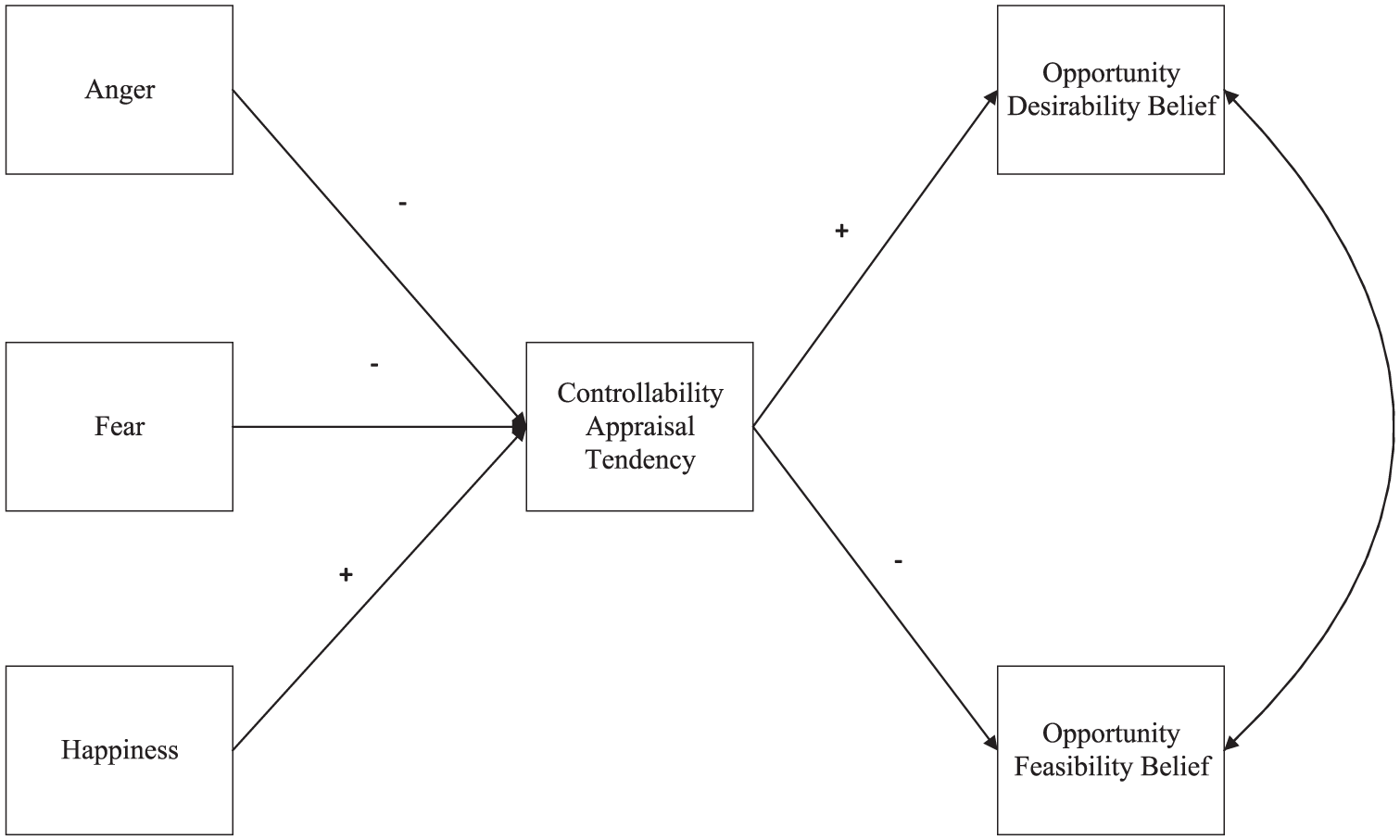
Conceptual model.
Opportunity desirability and opportunity feasibility beliefs
The idea of a first-person opportunity belief was introduced by McMullen and Shepherd (2006) to refer to an entrepreneur’s judgment that an existing opportunity is coherent with his or her value and knowledge structure. Opportunity belief arises from increasing personal conviction of both the desirability and feasibility of the entrepreneurial opportunity (Stevenson and Jarillo, 1990). It reduces the uncertainty barrier inherent to potential entrepreneurs (McMullen and Shepherd, 2006) by fostering a feeling of security in entrepreneurial action (Hayton and Cholakova, 2012). It is, therefore, essential to move beyond the objective characteristics of entrepreneurial opportunities (Grégoire and Shepherd, 2012; Wood et al., 2017) and broad categories of entrepreneurial cognition (Grégoire et al., 2009; McCann and Vroom, 2015; Wood and McKelvie, 2015; Mitchell et al., 2002) towards future-oriented cognitive judgments of narrower opportunity considerations. These result in beliefs that a given opportunity is desirable and feasible for oneself.
Building on insights from the entrepreneurial action model (Shepherd et al., 2007) and construal-level theory (Liberman and Trope, 1998), we seek to conceptually distinguish desirability belief from feasibility belief about an entrepreneurial opportunity. In the entrepreneurial action model, desirability is the belief that the successful exploitation of an opportunity would fulfil personal desires (McMullen and Shepherd, 2006; Shepherd et al., 2007). The formation of desirability belief is based on judgment about the reward or the goal of opportunity exploitation; hence, desirability can explain the motivational why aspect of entrepreneurial action. Drawing on insights from construal-level theory (Liberman and Trope, 1998), forming a desirability belief involves an abstract, distant future representation of the opportunity (Fujita et al., 2006; Labroo and Patrick, 2009; Tumasjan et al., 2013). Hence, opportunity desirability belief is formed when the entrepreneur thinks about a distant future moment when this opportunity will have already been exploited and considers in abstract terms its potential reward (Tumasjan et al., 2013). The desirability of the future reward, expected when exploiting the opportunity, is affected by the person’s current psychological state or by some enduring individual need (Shepherd et al., 2007).
In contrast, feasibility is the belief that exploiting an opportunity is possible with the means that the entrepreneur possesses (Grégoire et al., 2009; Mitchell and Shepherd, 2010). It explains the how aspect of entrepreneurial action (Liberman and Trope, 1998). Although desirability belief relates to the goal of opportunity exploitation, feasibility belief pertains to the means used for opportunity exploitation. That is, feasibility is a function of the perceived knowledge, skills, abilities and resources possessed by the entrepreneur relative to the knowledge, skills, abilities and resources required by the opportunity (Haynie et al., 2009). With greater similarity between the two, the potentially desirable opportunity appears more feasible (Mitchell and Shepherd, 2010). According to construal-level theory, the formation of feasibility belief is based on concrete-level, near-future representation of the opportunity (Liberman and Trope, 1998; Trope et al., 2007). The means needed to achieve successful exploitation are assessed in the near future, when opportunity exploitation begins (Förster et al., 2004).
Although we provide theoretical arguments above addressing why desirability and feasibility beliefs are distinct, we also theorise that they are positively related. Guided by Bandura’s (1977) social learning theory, we know that a person who values a reward that is conditional on attaining a certain goal prefers to persist in his or her efforts to achieve this goal. Hence, an entrepreneur who values the potential rewards of opportunity exploitation (i.e. high desirability) should exert more effort in exploiting the opportunity with the given means (i.e. high feasibility) (Edelman and Yli-Renko, 2010). In turn, believing that exploiting this opportunity is achievable (i.e. high feasibility) contributes to a stronger motivational drive to exploit the opportunity (i.e. desirability) (Townsend et al., 2010). Taken together, these arguments lead to the following hypothesis:
H1: Opportunity desirability belief and opportunity feasibility belief are distinct but positively related constructs.
Emotions, appraisal of controllability and the formation of opportunity desirability and feasibility beliefs
Role of emotion in entrepreneurial cognition
In general, entrepreneurs have been argued to be more susceptible to falling prey to their emotions in the early stages of their entrepreneurial career because they are constrained by their lack of entrepreneurial experience and overwhelmed by information (Westhead et al., 2005). Indeed, studies have shown that entrepreneur emotions affect opportunity risk assessments (Foo, 2011; Podoynitsyna et al., 2012) or processing and evaluation of new persuasive opportunity information (Kollmann et al., 2017; Welpe et al., 2012). In particular, previous research has found that anger, fear and happiness directly predict opportunity-related judgments (Foo, 2011; Grichnik et al., 2010; Welpe et al., 2012). In addition, there is a general consensus that these emotions meet all defining criteria for a discrete basic emotion (Tracy and Randles, 2011), being unique experiential states that occur with minimal cognitive or behavioural regulation of distinct causes (Izard, 1977) and spark different action tendencies (Izard, 1992; Stein and Oatley, 1992). Therefore, we study the effect of these basic emotions in the formation of opportunity beliefs.
Previous studies on the role of psychological factors such as emotions in early stage entrepreneurship (Baron, 2008) have found no clear direction in the relationship between anger, fear or happiness and entrepreneurial cognition. Despite its negative valence, anger has most often been found to relate positively to opportunity exploitation (Welpe et al., 2012) and risk perception (Foo, 2011). These findings speak towards the approach motivation of anger (Harmon-Jones and Sigelman, 2001), which predicts activism (Lebel and Ronel, 2009), and fuels new venture creation effort (Alvord et al., 2004). Considering the distinctive explanations of how emotions drive action tendencies versus (Frijda, 1986) how they colour interpretation of stimuli (Lerner and Keltner, 2000), the literature does not help us to understand the role of anger in entrepreneurial judgment processes such as those resulting in desirability and feasibility belief formation. Conversely, fear has been clearly shown to influence both cognitive and behavioural outcomes. Even when induced by a random external event, fear increases risk perception in pursuing an entrepreneurial opportunity (Foo, 2011), reduces opportunity evaluation (Kollmann et al., 2017) and reduces subsequent opportunity exploitation (Welpe et al., 2012). Finally, happiness has been commonly addressed as an antecedent of entrepreneurial action (Baron et al., 2012) or as an intense feeling in the context of entrepreneurial passion (Cardon et al., 2009). In entrepreneurial cognition research, happiness has been found to be associated positively with opportunity evaluation (Grichnik et al., 2010). However, other studies have suggested that happiness influences the exploitation intentions in either a positive (Welpe et al., 2012) or a negative (Grichnik et al., 2010) direction.
Appraisal tendency framework
Our investigation of the effect of anger, fear and happiness on the formation of opportunity beliefs is guided by the ATF (Lerner and Keltner, 2000). According to the ATF, how emotions colour cognitive processes is defined by their underlying appraisal tendencies (Han et al., 2007). These appraisal tendencies systematically influence subsequent judgments and persuasion (Han et al., 2014) regardless of whether the emotion is related or unrelated to that judgment (Cavanaugh et al., 2007; Garg et al., 2005). For example, fear is characterised by appraisals of uncertainty and lack of control (Smith and Ellsworth, 1985). In a risk judgment, the experience of fear will activate appraisal tendencies of uncertainty and lack of control and lead to an increased risk estimate (Foo, 2011; Lerner et al., 2003). In particular, Lerner and Tiedens (2006) note that appraisal tendencies can influence judgment through altering either the cognitive content or the cognitive process. More recent studies advocate delineating the specific path through which appraisal tendencies of emotions influence judgment (So et al., 2015). What follows is an argumentation of the effect of controllability on future-oriented cognitive processes that result in the formation of opportunity desirability and feasibility beliefs.
Effect of emotions on controllability
Researchers agree on six core dimensions that define the appraisal tendencies of emotions: certainty, pleasantness, attentional activity, controllability, anticipated effort and responsibility (Smith and Ellsworth, 1985). Of these, the controllability appraisal tendency is widely researched (Lerner and Keltner, 2001; Lerner and Tiedens, 2006). It reflects the extent to which one possesses control over an event’s outcome (Dunn and Schweitzer, 2005). Controllability is associated with experiencing different basic emotions (Frijda, 1993; Lazarus, 1991; Smith and Ellsworth, 1985; Weiner, 1985). When people feel happy or remember feeling happy, they appraise their situation as being of their own doing (Baas et al., 2012). In contrast, people feeling angry or fearful appraise their situation as not under their control (Lerner and Keltner, 2000; Smith and Ellsworth, 1985). We accordingly anticipate (see also Figure 1) that anger and fear invoke a similar appraisal of lack of control, whereas happiness initially indicates control over the situation. Hence, anger and fear will contribute negatively to controllability appraisal, whereas happiness will contribute positively to controllability appraisal.
Effect of controllability on opportunity beliefs
Previous research findings indicate that controllability is an important construct in entrepreneurship (Baron et al., 2016), which is not surprising considering that most entrepreneurs are initiators who take responsibility for their own welfare (Mueller, 2001). Prior research also indicates that a sense of controllability relates positively to business creation and success (Rauch and Frese, 2007).
We argue that controllability also plays a role in entrepreneurial cognition. Jackson and Dutton (1988), for example, found that organisational decision makers tend to categorise as opportunities those situations characterised by controllability (Jackson and Dutton, 1988). According to Bandura’s (1997) social cognitive theory, controllability shapes subjective expectancies about future outcomes. Hence, we suggest that controllability also influences future-oriented first-person opportunity judgment of ‘what will be’ if one is to exploit a given opportunity (Autio et al., 2013; Haynie et al., 2009; Martin and Wilson, 2016; Mitchell and Shepherd, 2010; Keh et al., 2002), which ultimately leads to the formation of opportunity desirability and feasibility beliefs.
Some suggest that controllability leads to a generalised subjective expectation that good things will occur (Urbig and Monsen, 2012; Weinstein, 1980) and therefore, has a positive effect on future-oriented cognition. Others argue, in contrast, that controllability can lead entrepreneurs to reduce their natural inclination to self-enhancement and result in a lower likelihood of engaging in optimistic future-oriented cognition (Baron et al., 2016). We reconcile these contradicting arguments by suggesting that controllability can simultaneously influence future-oriented cognition desirability and feasibility beliefs in opposing ways.
Controllability and opportunity desirability
We argue that by signalling that a situation is under one’s control, controllability appraisal allows people to distance themselves psychologically from the situation. A sense of controllability leads to reduced doubt and failure aversion (Van Gelderen, Kautonen, and Fink, 2015), which triggers construal of situations as benign and psychologically distant (Herzog et al., 2007; Trope et al., 2007). Psychological distancing results in taking a broader perspective, or seeing the ‘big picture’ (Bar-Anan et al., 2006; Liberman et al., 2002; Trope et al., 2007; Trope and Liberman, 2003). Thus, controllability increases distant future thinking or abstract construal, resulting in a positive effect on desirability belief.
In summary, anger and fear should be negatively associated with controllability appraisal. The lower controllability appraisal tendency in turn produces unfavourable effects on belief that a given opportunity will bring about a desired end goal. In contrast, happiness positively influences the activation of controllability appraisal tendency. Happy entrepreneurs likely form higher desirability belief. Formally,
H2a: Anger and fear will have negative indirect effects on opportunity desirability belief via controllability appraisal.
H2b: Happiness will have a positive indirect effect on opportunity desirability belief via controllability appraisal.
Controllability and opportunity feasibility
By focussing attention on the big picture, controllability reduces attention towards proximal or concrete information and allows entrepreneurs to restrain overly positive assessments of their own abilities (Baron et al., 2016). In contrast, near-future, concrete-level construal of a situation is triggered in threatening situations when controllability is low (Herzog et al., 2007; Trope et al., 2007). Therefore, the formation of feasibility belief is dampened by controllability appraisal, which diverts attention away from concrete-level considerations of the opportunity.
The lower controllability appraisal induced by anger and fear in turn produces favourable effects on the belief that exploitation of an opportunity is possible with the means that the entrepreneur has available. Thus, when signalling a lack of control over what is happening, anger and fear can boost the entrepreneur’s belief in the feasibility of successful opportunity exploitation. Because happiness positively influences the activation of controllability appraisal tendency, happy entrepreneurs likely form lower feasibility belief. Formally,
H3a: Anger and fear will have positive indirect effects on opportunity feasibility belief via controllability appraisal.
H3b: Happiness will have a negative indirect effect on opportunity feasibility belief via controllability appraisal.
Method
Sample
The study conducted an online experiment with 258 entrepreneurship students from a Dutch university. The average age of students in the sample was 20 years, with 16% women and 11% from countries other than the Netherlands (e.g. Belgium, China, Greece and Italy). Most participants (86%) had no entrepreneurial experience. All received course credit for their participation. Sampling university undergraduates is a common practice in experimental research (Colquitt, 2008). University undergraduates represent a homogeneous sample allowing control over the decision environment, which is otherwise difficult to achieve in naturally occurring settings (Falk and Heckman, 2009). Furthermore, entrepreneurship student samples have relatively homogeneous entrepreneurial intention levels (Souitaris et al., 2007) and are known to have a high potential for engaging in entrepreneurial activity (Edelman et al., 2016; Lerner, 2016). These characteristics, combined with similar (minimal) entrepreneurial knowledge (Von Graevenitz et al., 2010), make entrepreneurship students a suitable sample for studying opportunity-related cognitive processes such as the formation of opportunity beliefs (Dimov, 2007). Finally, the entrepreneurship programme at this university is open to students from all faculties, which also provides us with sufficient educational heterogeneity in the sample (Dimov, 2007).
Experimental procedure
To test our hypotheses, we conducted an online between-subject experiment, which is well suited to examining specific entrepreneurial judgment (Kraus et al., 2016) conservatively (Charness et al., 2012). All participants were randomly assigned to one of four independent experimental conditions, anger (N = 60), fear (N = 67), happiness (N = 70) or neutral (N = 61). At the start of the experiment, participants were subject to an emotion induction procedure taken from Lerner and Keltner (2001). Next, participants completed a scale to measure their controllability appraisal. We then presented participants with experimental instructions, followed by a description of an opportunity for new venture creation. After participants had read the description, we asked them to complete questions about the desirability and feasibility of this entrepreneurial opportunity. At the end of the experiment, we questioned the participants concerning their opportunity-related knowledge, entrepreneurial experience and demographics, and asked them whether the opportunity description was realistic for them.
Experimental materials and measures
Emotion induction
To induce participants into angry, fearful, happy and neutral states, we applied the autobiographical recall emotion induction procedure (Lerner and Keltner, 2001). In this procedure, participants are instructed to respond to two open-ended items: ‘(1) Describe three to five things that make you most angry/fearful/happy’, and ‘(2) Describe in more detail the one situation that makes you, or has made you, the most angry/fearful/happy’. Participants in the neutral emotion condition answered two questions in the same format, which requested them to describe three to five situations that occur on a daily basis and provide a more detailed description of one such situation. We excluded five participants who did not follow the instructions (i.e. they could not recall any situations).
Pre-test of emotion induction
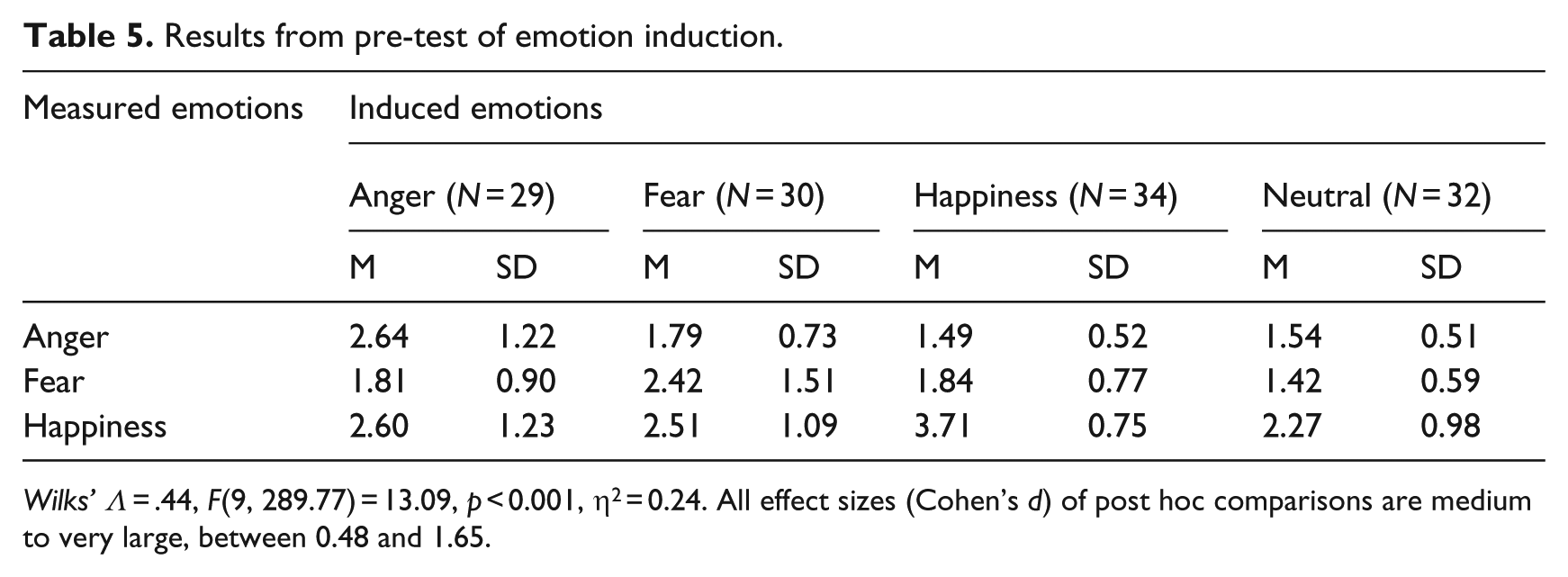
Self-reporting of emotions can reduce the effect of emotion inductions by making participants aware of their emotions (Gasper and Clore, 2002), can create suspicion about the experiment’s purpose among the main study sample (Dunn and Schweitzer, 2005; Foo, 2011) or can stimulate experiment demand effects (Larsen and Sinnett, 1991). Therefore, we pre-tested our emotion induction procedure on a sample of 125 students from the same entrepreneurship course who did not participate in the main study. Participants were randomly assigned to one of the four emotion conditions (anger, fear, happiness and neutral). After they completed the autobiographic recall emotion induction procedure, they rated the extent to which they experienced anger, fear and happiness using the PANAS-X scales (Watson and Clark, 1994). A multivariate analysis of variance using pairwise least significant difference post hoc tests indicated significant, medium to large effects of the emotion induction on self-reported anger, fear and happiness (please see Appendix 1 [Table 5] for more details). Hence, our emotion induction procedure successfully induced the desired emotional states.
Controllability appraisal
We measured controllability appraisal with one item, which was adapted from previous ATF-based research on the effect of emotions on various cognitive processes (Dunn and Schweitzer, 2005; Lerner and Keltner, 2001; Smith and Ellsworth, 1985). We asked participants to indicate to what extent they agreed that they were in control of the situation they described during the emotion induction procedure on a seven-point Likert scale ranging from ‘Strongly Disagree’ (1) to ‘Strongly Agree’ (7).
Experimental instructions
We used experimental instructions adapted from Dimov (2007) to ensure that factors related to the desirability and feasibility of entrepreneurship as a career choice were standardised across participants. Hence, we control for potential confounds related to the effects of entrepreneurial intentions on first-person, opportunity-related desirability and feasibility beliefs. Before reading about the entrepreneurial opportunity, all participants read that (1) they are interested in starting their own business, given the right business opportunity (entrepreneurship desirability); (2) start-ups in their area have recently received investments from venture capital firms (entrepreneurship feasibility); (3) as students, they are in a position to start a business that might not generate income initially (entrepreneurship feasibility); and (4) starting their own business would bring significant tax benefits (entrepreneurship desirability).
Entrepreneurial opportunity
We developed a description of an entrepreneurial opportunity based on characteristics most commonly used by novice and experienced entrepreneurs in opportunity-related cognition (e.g. technology newness, alignment between the functional characteristics of the technology with the functional needs of the market, risk and profitability) (Baron and Ensley, 2006). The opportunity was described as an alignment between a technology, Logic PLS, and a market need (Grégoire et al., 2009; Grégoire and Shepherd, 2012; Wood and Williams, 2014). The invention originated at the university at which the experiment was conducted, and its inventor contributed to the development of the opportunity description (see Appendix 2 for a full description of the entrepreneurial opportunity).
We excluded 48 participants from our sample because they spent on average only 13.13 seconds reading the entrepreneurial opportunity, whereas 60 seconds represents an average expected reading time for a text of 400 words (our entrepreneurial opportunity description is 399 words) (Graesser et al., 1980).
Pre-test of entrepreneurial opportunity
To ensure the face validity and clarity of the opportunity description, we conducted a pre-test with a sample of 31 students from the same Dutch university who did not participate in the main study or in the pre-test of the emotion induction procedure. All participants read the description of the entrepreneurial opportunity and then answered questions about its third-person opportunity desirability and feasibility, technology newness, alignment between the functional characteristics of the technology with the functional needs of the market, opportunity risk, profitability and text clarity (Baron and Ensley, 2006) The feedback led us to make minor adjustments to the opportunity description. We then tested it again by conducting interviews with six nascent entrepreneurs and five entrepreneurship academics. All interviewees indicated that the opportunity was clear and understandable. In addition, all nascent entrepreneurs viewed the opportunity description as plausible.
Dependent variables
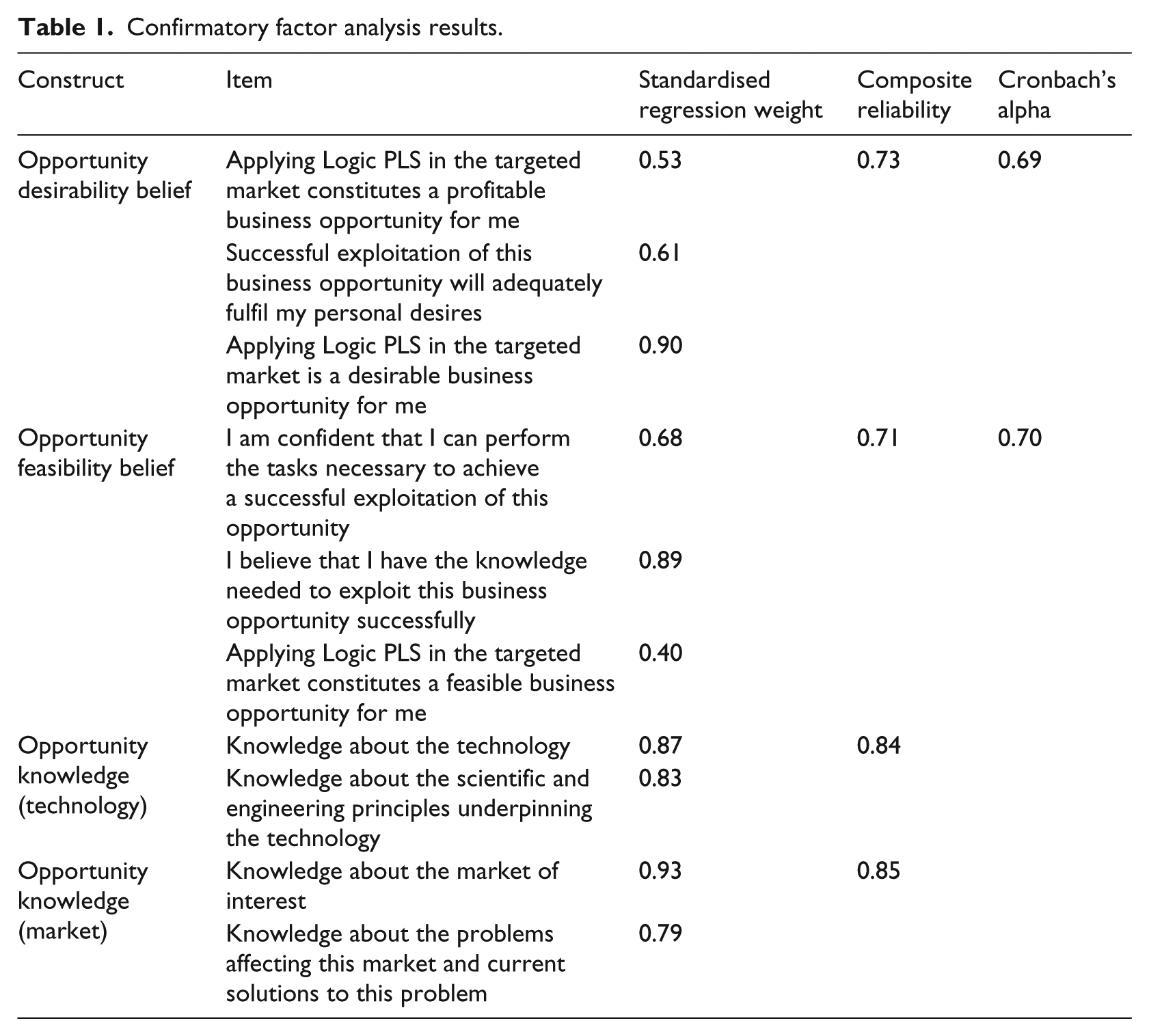
Because no validated measures of first-person desirability or feasibility beliefs are currently available, we adapted an opportunity recognition belief scale developed and validated by Grégoire et al. (2009) (see Appendix 3 for more details about the measurement of the dependent variables). Ultimately, we used three items to measure opportunity desirability belief (α = 0.69) and three items to measure opportunity feasibility belief (α = 0.70). All items used seven-point Likert scales ranging from ‘Strongly Disagree’ (1) to ‘Strongly Agree’ (7).
Control variables
Drawing on one’s prior experience and knowledge is a common judgment tactic in any entrepreneurial cognitive process (Ardichvili et al., 2003; Baron and Ensley, 2006; Gruber et al., 2008); hence, we control for technology and market knowledge and for entrepreneurial experience. Knowledge related to the technology and market were each assessed with two items (Grégoire and Shepherd, 2012). Participants indicated on a seven-point Likert scale, from ‘Minimal’ (1) to ‘Considerable’ (7) the extent to which they had prior knowledge about the technology, the scientific and engineering principles underpinning the technology, the market of interest and the problems affecting this market. In addition, we measured prior entrepreneurial experience as months of self-employment, which revealed that 86% of our sample did not have any entrepreneurial experience, whereas the remaining 14% reported experience ranging from one month to six years. The large number of zeros and positive skewness of this variable led us to create a dummy variable equal to 0 for those with no experience and 1 for those with some experience. We also asked participants to indicate their age, gender, nationality and the entrepreneurial experience of their parents.
Finally, to check whether the presented opportunity description was realistic for all participants, we included the following item at the end of the experiment: ‘Applying the technology to the targeted market is a realistic business opportunity’. We asked participants to rate this statement on a seven-point Likert scale (1 = ‘Strongly Disagree’ to 7 = ‘Strongly Agree’). We excluded 14 participants who indicated unrealistic perceptions of the presented opportunity (scores of 3 or lower), which significantly affected their opportunity desirability belief (F(1, 203) = 2.11, p < 0.001). A chi-square test (χ2(3) = 4.40, p = 0.22) reveals that there is no statistically significant association between any experimental condition and unrealistic opportunity perceptions. Thus, our final sample contains 191 participants (anger = 41, fear = 54, happiness = 50 and neutral = 46).
Results
Reliability and validity
We subjected all multiple indicator measures in our study, namely desirability, feasibility, technology knowledge and market knowledge, to a CFA. These constructs all tap into first-person opportunity judgments; hence, CFA is a suitable method to establish the distinctiveness of opportunity-related judgments and to assess the reliability and convergent and discriminant validity of our measurements. 1
Reliability
Table 1 reports the composite reliability scores of our dependent variables. They are greater than 0.7, which is the minimum requirement for adequate reliability (Daily et al., 1999). The Cronbach’s alpha scores for desirability and feasibility also are close to the minimum threshold of 0.7 (Nunnally and Bernstein, 1994). Hence, our scales for measuring opportunity desirability and feasibility beliefs are reliable.
Confirmatory factor analysis results.
Convergent and discriminant validity
We examine convergent validity by estimating whether each item’s estimated path coefficient on its posited underlying construct is significant (Anderson and Gerbing, 1988). In support of convergent validity, each path loading reported in Table 1 was greater than twice its standard error (standard errors ranged from 0.07 to 0.13).
Checking for discriminant validity, we compared the square root of each construct’s average variance extracted (AVE) with the absolute value of its standardised correlations (Fornell and Larcker, 1981). Because the square root of the AVE for each construct in the correlation matrix (Table 2) was greater than any off-diagonal correlations in the corresponding row or column, our measures achieved adequate discriminant validity.
Mean (M), standard deviations (SD), average variance extracted (AVE), and Pearson correlations of study variables.
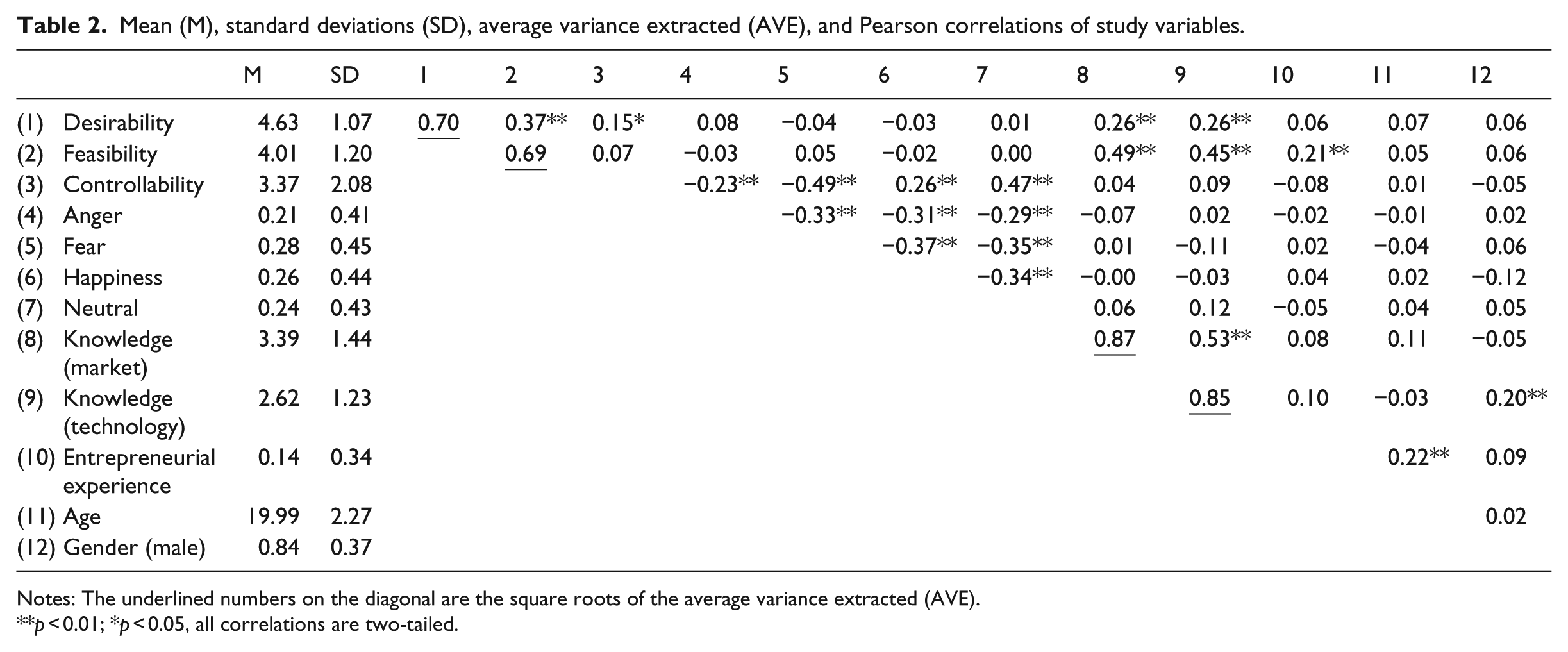
Notes: The underlined numbers on the diagonal are the square roots of the average variance extracted (AVE).
p < 0.01; *p < 0.05, all correlations are two-tailed.
Hypothesis Testing
The mean values, standard deviations, and correlations of all variables in this study are shown in Table 2. The relationship between desirability and feasibility was significantly positive (r = 0.37, p < 0.01). Desirability was also significantly, positively related to controllability (r = 0.15, p < 0.05). Controllability was negatively related to anger (r = −0.23, p < 0.01) and fear (r = −0.49, p < 0.01) but positively related to happiness (r = 0.26, p < 0.01). Correlation results suggest no critical collinearity between independent variables in our data (i.e. r > 0.80, according to Kennedy, 2003). In addition, using ordinary least squares (OLS) regression with desirability belief or feasibility belief as dependent variables, variance inflation factors (VIFs) for all of the independent variables were clearly less than the critical value of 10 (Hair et al., 2006) (highest VIF was 2.53 for fear) and indicate that multicollinearity was unlikely to be a concern in our study.
Hypothesis 1 states that desirability and feasibility beliefs are distinct but positively related constructs. The results of the test for discriminant validity already indicate that the two constructs are distinct. To further test the distinctiveness of the constructs, we assessed the fit of two different models using CFA. The results indicated that a model with four correlated constructs (desirability, feasibility, technology knowledge and market knowledge) offers the best fit for the data (χ2 (27) = 34.6, p = 0.15; root mean square error of approximation (RMSEA) = 0.04; standardised root mean square residual (SRMR) = 0.05; comparative fit index (CFI) = 0.99; Tucker–Lewis Index (TLI) = 0.98) in comparison with a single factor model (χ2(33) = 56.54, p < 0.01; RMSEA = 0.06; SRMR = 0.11; CFI = 0.96; TLI = 0.95). The distinctiveness of desirability and feasibility, as indicated by the CFA and the test for discriminant validity, together with their significant positive correlation (r = 0.37, p < 0.01), provide support for Hypothesis 1.
To test the indirect effects of anger, fear and happiness on desirability and feasibility via the controllability appraisal as predicted in H2 and H3, we used an SPSS macro programme (Preacher and Hayes, 2008). This procedure relies on bootstrapping to identify the indirect effects of anger, fear and happiness. It computes indirect effect as a product of the direct effect of each emotion on controllability and the direct effect of controllability on desirability or feasibility (Preacher and Hayes, 2008).
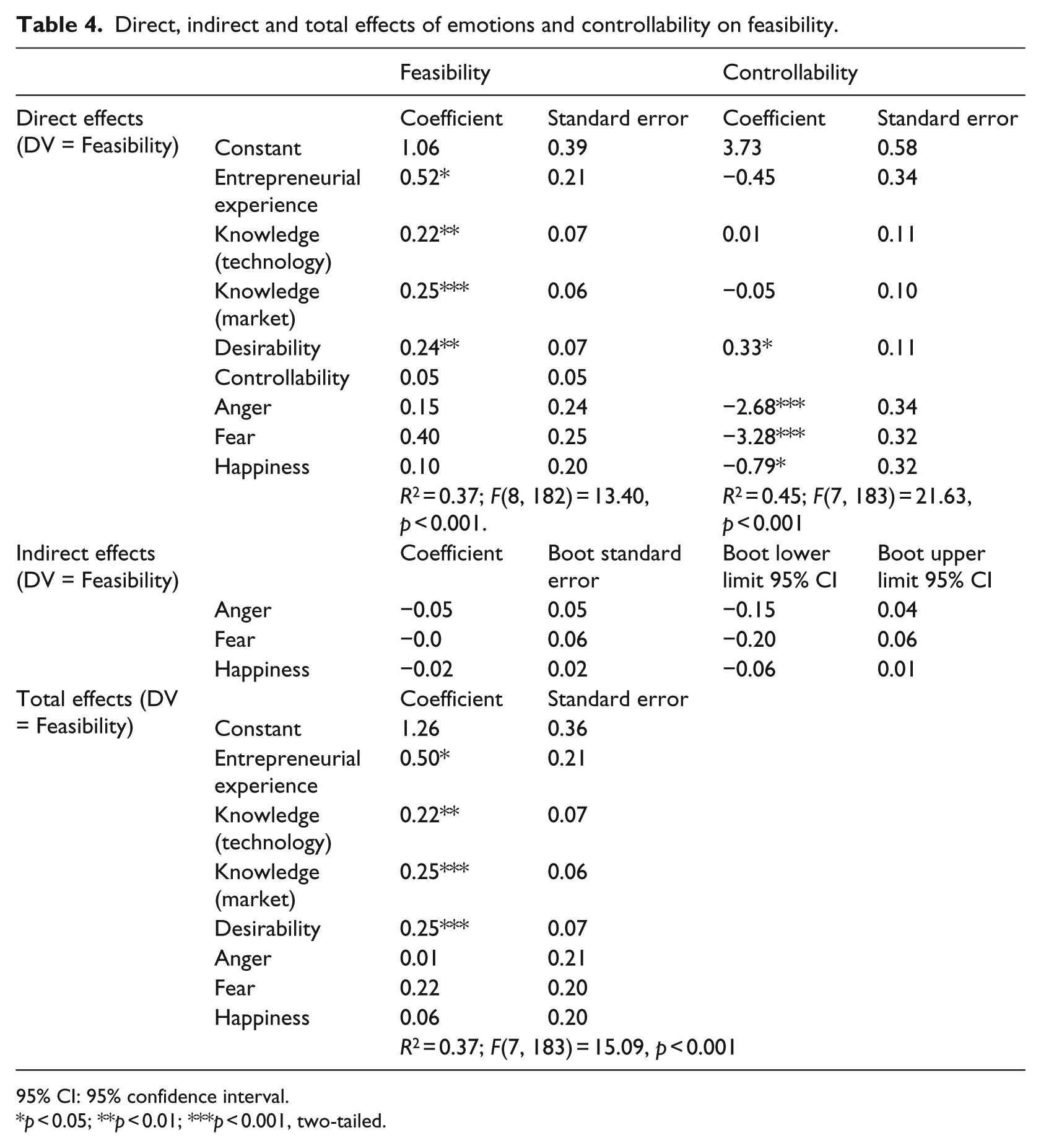
We ran two sets of analyses, one for each dependent variable, and included the other in each model as a covariate. Each set of analyses had three iterations, one for each emotion condition, with the remaining two emotions included as covariates. Anger, fear and happiness were included in the models as dummy variables, with neutral emotional state as the reference condition. All three emotions exert significantly negative direct effects on appraisals of controllability, regardless of whether the dependent variable was desirability (Table 3: anger b = −2.62, p < 0.001; fear b = −3.33, p < 0.001; happiness b = −0.80, p < 0.05) or feasibility (Table 4: anger b = −2.68, p < 0.001; fear b = −3.28, p < 0.001; happiness b = −0.79, p < 0.05). Controllability appraisal had a significantly positive direct effect on desirability (b = 0.12, p < 0.05) but no significant influence on feasibility (b = 0.05, p = 0.25).
Direct, indirect and total effects of emotions and controllability on desirability.
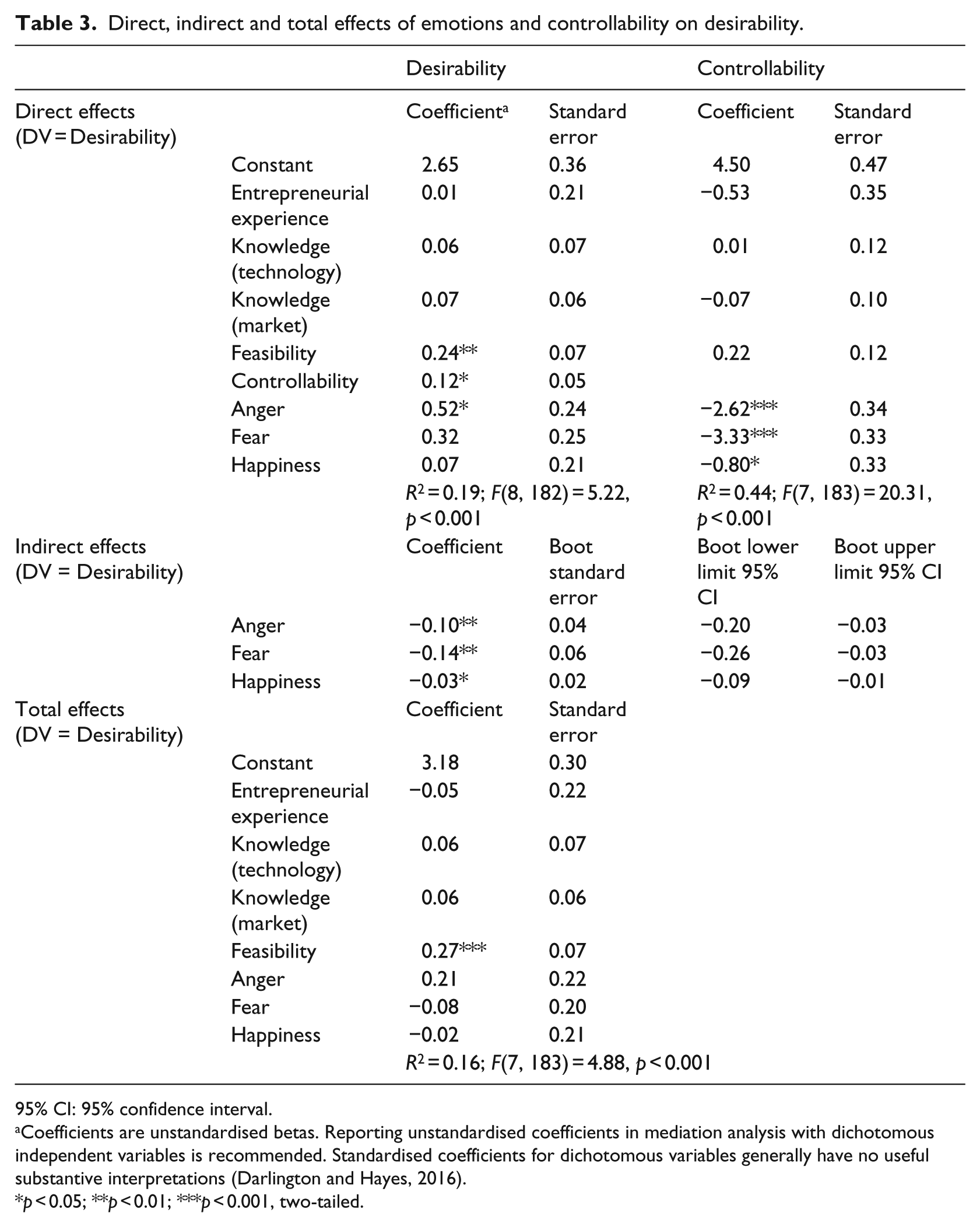
95% CI: 95% confidence interval.
Coefficients are unstandardised betas. Reporting unstandardised coefficients in mediation analysis with dichotomous independent variables is recommended. Standardised coefficients for dichotomous variables generally have no useful substantive interpretations (Darlington and Hayes, 2016).
p < 0.05; **p < 0.01; ***p < 0.001, two-tailed.
Direct, indirect and total effects of emotions and controllability on feasibility.
95% CI: 95% confidence interval.
p < 0.05; **p < 0.01; ***p < 0.001, two-tailed.
To test the significance of the indirect effects of anger, fear and happiness on desirability and feasibility through controllability appraisal, we used a bias-corrected bootstrapping procedure with 10,000 samples (Preacher and Hayes, 2008). The analyses demonstrate significantly negative indirect effects of anger (standardised indirect effect = −0.10, bias-corrected 95% confidence interval (BCa 95% CI) = (−0.20, −0.03)) and fear (standardised indirect effect = −0.14, BCa 95% CI = [−0.26, −0.03]) on desirability through controllability appraisal in support of H2a. However, happiness also has a significantly negative indirect effect on desirability through controllability appraisal (standardised indirect effect = −0.03, BCa 95% CI = (−0.09, −0.01)), in contrast with H2b. The lower and upper confidence intervals of the indirect effects of all three emotions on feasibility include 0, indicating that they are non-significant (MacKinnon et al., 2002). We thus cannot support H3a or H3b. In another unexpected result, in addition to its negative, indirect effect on desirability through controllability appraisal, anger also has a significantly positive direct effect on desirability (b = 0.52, p < 0.05).
We found no significant effect of entrepreneurial experience (b = 0.01, p = 0.95), technology knowledge (b = 0.06, p = 0.39) or market knowledge (b = 0.07, p = 0.26) on desirability. However, we find a significantly positive effect of entrepreneurial experience (b = 0.52, p < 0.05), technology (b = 0.22, p < 0.01) and market (b = 0.25, p < 0.001) knowledge on feasibility.
Finally, we used G*Power 3.0.10 to obtain the post hoc statistical power of the effects of our treatment variables based on the effect sizes and sample sizes (Faul et al., 2009). We had 99% power in detecting the smallest significant R2 = 0.12, given α = 0.05.
Discussion
We conducted an experimental study to investigate how opportunity desirability and feasibility beliefs form based on emotional and cognitive processes. We find evidence of desirability’s and feasibility’s distinctiveness and support for their interconnectedness. In addition, desirability can be predicted by emotions through the appraisal of controllability, but we cannot predict feasibility through the same cognitive-emotional process. Our findings have theoretical implications for psychological research in entrepreneurship and practical implications for entrepreneurs and teachers.
Theoretical implications
Our finding that desirability and feasibility are distinct but positively related constructs aligns and extends the current literature on entrepreneurial cognition (Baron and Ward, 2004; Grégoire et al., 2011). Scholars have conceptually distinguished between these constructs as distinct components of entrepreneurial opportunity beliefs (McMullen and Shepherd, 2006; Shepherd et al., 2007). However, most empirical studies have focussed predominantly on the formation of overall belief of opportunity attractiveness (Gruber et al., 2015; Wood et al., 2014) and treated desirability and feasibility as objective opportunity characteristics (Tumasjan et al., 2013; Welpe et al., 2012). Based on insights from the entrepreneurial action model (Shepherd et al., 2007) and construal-level theory (Förster et al., 2004), our theoretical arguments that desirability and feasibility are distinct because they result from judging different aspects of the opportunity at different cognitive levels of abstraction were supported in our empirical analyses. Thus, our results also contribute towards an initial establishment of measurement scales for first-person desirability and feasibility opportunity beliefs. Overall, our results suggest that to fully understand key aspects of entrepreneurship, it is necessary to consider the effects of variables operating at a micro level of entrepreneurial cognition (Baron et al., 2012). Hence, failing to disentangle desirability and feasibility conceptually and empirically can lead to premature and incorrect conclusions about first-person opportunity beliefs and thus, about entrepreneurial action.
Furthermore, this article adds to a growing body of literature in entrepreneurship that examines the role of psychological factors in the entrepreneurial process (Davidsson, 2016; Frese and Gielnik, 2014). In particular, we offer new insights into the role of emotions in entrepreneurial cognition (Baron, 2008) by showing how discrete basic emotions influence the formation of opportunity belief. The need to understand how emotions affect cognition is all the more pressing considering that most entrepreneurs are unaware of their emotions (Hayton and Cholakova, 2012). In fact, people generally lack awareness of the effects of their emotions on their cognition – and in many cases even deny the possibility (Winterich et al., 2010). In particular, we find that anger, fear and happiness influence the formation of opportunity desirability belief through a negative effect on controllability appraisal (Lerner and Keltner, 2000; Smith and Ellsworth, 1985). When an entrepreneur is angry, fearful or happy, he/she appears to feel powerless over the potential outcomes of opportunity exploitation. This lower controllability prevents the entrepreneur from focussing on the distant future considerations for exploitations hence, lowering his or her desirability belief that this opportunity exploitation is worthwhile. This finding is in line with previous research indicating that negative emotion such as fear decreases evaluation of the opportunity of the entrepreneurs (Grichnik et al., 2010; Kollmann et al., 2017). However, it also contradicts prior evidence that positive emotions such as happiness increase opportunity evaluation (Foo, 2011; Grichnik et al., 2010) and thereby, provides a useful point for comparing the multidimensional nature of emotions across judgment contexts. In the context of our study, unlike previous research, emotions are investigated in relation to first-person, future-focussed judgments. It is possible that under the influence of happiness, entrepreneurs find opportunities attractive (Grichnik et al., 2010) but not personally desirable because their contentment with the present restricts them from visualising the future.
However, we did not find support for the indirect effects of anger, fear or happiness on feasibility through controllability appraisals. We offer two ex post explanations for these findings. First, a probable explanation from the ATF is that the appraisal tendency of controllability is not sufficient in explaining the indirect effect of anger, fear and happiness on feasibility. Other appraisal tendencies, such as certainty, might instead be more instrumental to predict the formation of feasibility belief. Certainty appraisal, activated by emotions such as pride (Smith and Ellsworth, 1985), might facilitate the formation of higher feasibility belief. As entrepreneurs feel more certain, they are likely to believe more strongly in the possibility of opportunity exploitation with the means that they possess. Second, it might be possible that the feasibility belief is less transient than is the desirability belief. If so, this point would have important implications for the theory and practice of entrepreneurship. For theory, it would be important to investigate further the role of emotion in entrepreneurial cognition to understand what specific judgments are influenced by one’s emotion states and under what conditions does this influence occur. High-stake situations, for example, are particularly potent source of emotions that can override the effect of previously experienced, unrelated emotions (e.g. the experimentally induced emotions in our study) (Cavanaugh et al., 2007). Entrepreneurs might find the judgment of feasibility to have more important consequences compared with the judgment of desirability. Hence, they are likely to experience more pressure during the formation of feasibility belief, which could in turn block the effect of previously experienced emotions. For practice, this implication would suggest that some entrepreneurial judgments are less prone to psychological influences from unrelated events and that it might be advisable for entrepreneurs to focus on comparatively stable judgments in emotionally turbulent times. Taken together, our findings demonstrate that emotions influence entrepreneurial cognition, depending upon the underlying psychological process that they activate.
Finally, our results make a twofold contribution to ATF. First, we support the differentiation of emotions in terms of their underlying appraisals (Lerner and Keltner, 2000; Smith and Ellsworth, 1985) as an important consideration in entrepreneurship research (Foo, 2011; Welpe et al., 2012). Second, we also find evidence contradicting the current state of research on the ATF (Lerner and Keltner, 2000; Smith and Ellsworth, 1985). Some existing research assumes that anger and happiness invoke similar appraisals of controllability (Baas et al., 2012), whereas fear invokes low controllability (Horberg et al., 2011). Our findings suggest however that, relative to a neutral state, anger, fear and happiness all signal lower controllability. Because basic emotions are intense and short-lived (Baron, 2008), any emotion would typically be characterised with less controllability compared with a neutral state that is experienced during habitual events. Therefore, we call on researchers to measure and specify the relationships between basic emotions and core dimensions of appraisal tendencies.
Practical implications
Our results have implications for entrepreneurship practice and education. First, it is important to draw entrepreneurial awareness to micro-level cognitive properties of the why and how of entrepreneurial opportunities. It is important for entrepreneurs to recognise that the desirability and feasibility of an entrepreneurial opportunity are results of subjective processes that are open to the influence of his/her emotions and cognitions. This point might contrast with an entrepreneur’s views that the evaluation of an entrepreneurial opportunity depends upon objective characteristics. Recognising the subjectivity of the opportunity evaluation, entrepreneurs must then also consider how their emotions will influence their judgments about the desirability and feasibility of an opportunity. If an entrepreneur experiences, for instance, fear, anger or happiness, his or her desirability to exploit an entrepreneurial opportunity decreases. However, entrepreneurs should also know that their belief about the feasibility of an opportunity is less likely to be influenced by their emotions.
In addition to understanding the effects of their emotions on the formation of their desirability and feasibility beliefs about an entrepreneurial opportunity, entrepreneurs also obtain insights into the cognitive processes that drive this relationship. Their emotions are related to appraisals of controllability, which influences how far in the future the opportunity is envisioned. Thus, controllability appraisal shapes their opportunity beliefs. This knowledge can help entrepreneurs to focus on the controllability of the entrepreneurial opportunity rather than on their emotional state, because this focus particularly influences their desirability belief. Overall, our study’s findings help entrepreneurs to understand how their desirability and feasibility beliefs form, how these beliefs are influenced by their emotions and which cognitive considerations are relevant.
Second, our results have implications for entrepreneurship education. Typically, entrepreneurship programmes focus on teaching concepts such as business plans, business opportunities and strategies for obtaining venture finance. Although students often develop critical skills pertaining to these concepts, such as evaluating business opportunities from a third-person perspective, our study also highlights a need to incorporate first-person opportunity evaluations. This approach would imply that students learn the difference between entrepreneurial opportunities that objectively represent attractive opportunities and judging entrepreneurial opportunities that are desirable and feasible for them. Related to this learning objective is the recommendation to teach entrepreneurship students the necessary skills to judge adequately the desirability and feasibility of an entrepreneurial opportunity. Such skills would include the intrapersonal component of emotional intelligence (Petrides and Furnham, 2003), that is, one’s ability to recognise and regulate one’s own emotions. This skill can be enhanced by educating entrepreneurs about cues for recognition of emotions in one’s self, affective self-monitoring techniques (Durlak et al., 2011) and training on different strategies for emotion regulation and their trade-offs (Richards et al., 2003).
Limitations and future research
A few limitations are worth noting when interpreting our results. Because this study is one of few to investigate the distinctive processes of desirability and feasibility belief formation, our operationalisation of the dependent variables needs further elaboration. For example, our study measured desirability and feasibility simultaneously, so we cannot determine the causal relationship between desirability and feasibility. Further research therefore, might explore the causality in forming opportunity desirability and feasibility beliefs and the transition from belief formation into entrepreneurial action (Hatak and Snellman, 2016). It will be interesting to undertake additional experimental studies that test for the causality of desirability and feasibility beliefs and for the effect of emotions on opportunity beliefs mediated by different appraisals, for example, certainty under different conditions of judgment importance, as suggested in the discussion of our unexpected results.
Although our experimental study has high internal validity in testing the causal effects of emotions on belief formation (Campbell et al., 1966), our experiments are also limited in their external validity. Presenting participants with an opportunity description cannot fully represent a situation in which an entrepreneur judges an opportunity in his or her own domain of knowledge and interest according to its desirability and feasibility. Hence, we hope that future studies will replicate our findings in a field study with nascent entrepreneurs who are in the actual process of judging their entrepreneurial opportunity. Nevertheless, using scenarios in opportunity evaluation research is a common practice (Gupta et al., 2014; Wood and Williams, 2014) because doing so can minimise confounding effects from opportunity variability to reveal cognitive processes unique to entrepreneurship (Shane et al., 2003).
Finally, we used a student sample to test our hypotheses, a practice often subject to criticism in entrepreneurship research because of the limited generalisability of the hypotheses to non-student populations such as entrepreneurs (Segal et al., 2005). For our study, however, which investigates universal psychological processes of potential entrepreneurs, a student sample is appropriate because this population is likely to engage in the entrepreneurial process as potential entrepreneurs. Hence, we do not expect any qualitative changes in our findings with a different sample such as employees. In a sample of active entrepreneurs, our findings might additionally be affected by factors that are specifically related to entrepreneurs such as passion (Cardon et al., 2005, 2009) or overoptimism (Baron et al., 2012; Hmieleski and Baron, 2009).
Conclusion
Overall, the article investigated how desirability and feasibility beliefs regarding an entrepreneurial opportunity are formed based upon individual basic emotions and associated appraisals of controllability. Entrepreneur emotions of fear, anger and happiness lead to a decrease in opportunity desirability belief because of their associated perception of low control over situational outcomes. However, entrepreneurial opportunity feasibility belief is not influenced by the same appraisal process. Thus, our study contributes to a more fine-grained understanding of the emotional and cognitive processes leading to the formation of opportunity beliefs that will ultimately determine entrepreneurial action.
Footnotes
Appendix 1
Results from pre-test of emotion induction.
| Measured emotions | Induced emotions |
|||||||
|---|---|---|---|---|---|---|---|---|
| Anger (N = 29) |
Fear (N = 30) |
Happiness (N = 34) |
Neutral (N = 32) |
|||||
| M |
SD |
M |
SD |
M |
SD |
M |
SD |
|
| Anger | 2.64 | 1.22 | 1.79 | 0.73 | 1.49 | 0.52 | 1.54 | 0.51 |
| Fear | 1.81 | 0.90 | 2.42 | 1.51 | 1.84 | 0.77 | 1.42 | 0.59 |
| Happiness | 2.60 | 1.23 | 2.51 | 1.09 | 3.71 | 0.75 | 2.27 | 0.98 |
Wilks’ Λ = .44, F(9, 289.77) = 13.09, p < 0.001, η2 = 0.24. All effect sizes (Cohen’s d) of post hoc comparisons are medium to very large, between 0.48 and 1.65.
Appendix 2
Appendix 3
Funding
The author(s) received no financial support for the research, authorship, and/or publication of this article.