



Abstract
Various factors enable manufacturing firms to attain a competitive advantage based on service innovation – that is, to achieve service innovation performance. Starting from a dynamic capabilities perspective, this article predicts that absorptive capacity is one such critical factor, which in turn may be driven by employee collaboration and the firm’s search breadth. The findings of a survey study of small to medium-sized Dutch manufacturing firms confirm that employee collaboration and search breadth have positive effects on an organization’s potential absorptive capacity, whereas employee collaboration also reinforces its realized absorptive capacity. Thus realized absorptive capacity ultimately enhances service innovation performance. The results have implications for dynamic capabilities theory, and they provide practitioners with potential means to outperform their competitors in service innovation efforts.
Keywords
Introduction
Many manufacturing companies integrate services as a distinctive feature in their competitive strategy (Matthyssens and Vandenbempt, 2008). The process of creating value by shifting from selling products to selling solutions, that integrate products and services, is known as servitization (Baines et al., 2009). This strategy has been implemented by not just large companies, such as General Electric, IBM, Xerox and Rolls-Royce Aerospace (Kastalli and Van Looy, 2013), but also by small and medium-sized enterprises (SMEs). For example, a small manufacturer of climate control systems for livestock stalls added information technology (IT) services to its products to inform farmers about emergencies, through alerts on their mobile devices. For such servitization efforts to succeed, they demand service innovation (Lightfoot and Gebauer, 2011; Martin and Horne, 1992), which can establish a key competitive advantage (Storey et al., 2016). The ability to achieve a competitive advantage based on service innovations represents service innovation performance (Storey et al., 2016).
Servitizing companies seek to provide better services (Berry et al., 2006), but many businesses fail to innovate their services systematically (Gebauer et al., 2008). Such a failure to achieve service innovation performance (Gebauer et al., 2005; Spring and Araujo, 2009) might occur because firms lack a formal approach to guide their service innovation efforts (Baines et al., 2009; Storey et al., 2016). Empirical studies indicate that few firms use formal approaches to service innovation and instead adopt a haphazard process that simply ‘happens’ (Gebauer et al., 2008; Lightfoot and Gebauer, 2011). Such firms fail to reap the potential benefits of servitization and potentially suffer negative financial returns (Visnjic et al., 2016). In particular, SMEs are vulnerable to the risks of investing in service innovation as they often lack the resources or experience needed to develop and provide new services (Kowalkowski et al., 2013). In addition, SME owner-managers usually define the strategic development of their firms, so their own cognitive and affective characteristics imprint upon the full organization (Hermann and Nadkarni, 2014; Zhang et al., 2006), potentially creating a quasi-lock-in situation hampering changes to routines (Liao et al., 2008). Moreover, approximately 70% of SMEs are family owned, so they often prioritize socio-emotional wealth preservation over business renewal (Gómez-Mejía et al., 2007). Changing routines to achieve service innovation would be even more difficult in manufacturing SMEs, which traditionally have attained their competitive advantages through product innovation (Madrid-Guijarro et al., 2009; Maes and Sels, 2014; Raymond and St-Pierre, 2010; Terziovski, 2010).
Studies that investigate how SMEs might excel in their service innovation are relatively scarce (Kowalkowski et al., 2013; Van de Vrande et al., 2009). Some cite key antecedents of service innovation performance, including internal organizational factors, such as proficient operations and delivery systems, a strong innovation culture and appropriate organizational design practices (Atuahene-Gima, 1996; Storey et al., 2016). In addition, we know from the (open) innovation literature that fast-changing environments demand that SMEs cooperate closely with their stakeholders to speed up the innovation process and deliver appropriate products or services (Mina et al., 2014). Yet, we lack insights into how SMEs extract knowledge from these relationships to enhance their service innovation performance. This question is especially relevant for manufacturing firms exploring service opportunities, which can attain success by leveraging external knowledge rather than creating knowledge internally in their R&D departments (Storey et al., 2016). Challenges to the organization of a firm’s knowledge management capabilities, thus, result from the need to recombine different knowledge inputs (Mina et al., 2014).
To address these aspects, we commence with a dynamic capabilities perspective as this theory explains how organizations can achieve sustainable competitive advantages in rapidly changing business environments by combining valuable resources into capabilities at the organizational level (Teece et al., 1997). We examine specifically how knowledge management influences service innovation performance. A dynamic capability framework is both appropriate and timely in that manufacturing SMEs confront changing markets, new customer demands, new (often low-cost) competitors and product commoditization (Kindström et al., 2013). Therefore, we study SME absorptive capacity (ACAP) or the ability to recognize and assimilate valuable external knowledge and then apply it to commercial ends (Cohen and Levinthal, 1990). ACAP comprises potential absorptive capacity (PACAP), including knowledge acquisition and assimilation capabilities, and realized absorptive capacity (RACAP), including knowledge transformation and exploitation capabilities (Zahra and George, 2002). ACAP can lead to the creation of a sustainable competitive advantage (Zahra and George, 2002) as it drives product innovation performance (Alegra et al., 2013; Chen et al., 2009; Fosfuri and Tribó, 2008). However, successful product and service innovation have different antecedents (Nijssen et al., 2006), so we cannot simply assume that ACAP leads to service innovation performance. We examine this relationship explicitly herein.
To enhance knowledge-related capabilities and achieve service innovation performance, SMEs must also establish mechanisms that facilitate the acquisition of knowledge from their dynamic interactions with internal and external partners (Chirico and Nordqvist, 2010; Volberda et al., 2010). External knowledge gained from inter-firm collaborations must combine with existing internal knowledge before it can be applied (Jansen et al., 2005), that is, external knowledge cannot be used effectively without internal collaboration efforts (Benson and Ziedonis, 2009; Rothaermel and Alexandre, 2009). Without the collaboration of employees, ideas that are reaped from the external environment might suffer from the ‘not-invented-here’ syndrome (Herzog and Leker, 2010; Katz and Allen, 1982). External collaboration, however, is crucial as it provides an opportunity to grasp emerging technologies and markets, thereby complementing the organization’s internal knowledge base (Perkmann and Walsh, 2007). In short, both internal and external collaboration mechanisms facilitate the acquisition, assimilation and exploitation of external knowledge. Although the extant literature recognizes that dynamic capabilities encompass collective learning and coordinated efforts by organization members (Helfat and Winter, 2011), the social foundations of these capabilities remain largely unexplored (Fainshmidt and Frazier, 2016; Wilden et al., 2016). Therefore, we also investigate whether internal employee collaboration (i.e. extent to which personnel engage in service innovation) and external collaboration (i.e. search breadth, or the degree of diversity of external innovation partners) affect ACAP and thereby influence SME service innovation performance.
We study the effects of these factors among a sample of Dutch, servitizing, manufacturing SMEs. We find that search breadth and employee collaboration have positive effects on PACAP. Employee collaboration also drives RACAP which in turn drives service innovation performance. The identified mechanism allows us to contribute to the body of literature on service innovation, dynamic capabilities and SMEs. First, we increase our understanding of how service innovation can be facilitated in SMEs and offer theoretical and managerial guidelines on how to reach service-based competitive advantages. We achieve this by demonstrating that internal and external collaboration encourage the development of a dynamic knowledge capability (ACAP), eventually resulting in a competitive advantage based on service innovation. Accordingly, we affirm that although a focus on service innovation demands new mind-sets, operations, strategies and capabilities (Benedettini et al., 2015), building a knowledge base is critical to service innovation, just as it is for product innovation. Second, we substantiate that employee collaboration has a positive impact on the development of dynamic capabilities (ACAP). This finding advances dynamic capabilities literature, which has devoted relatively less attention to the context of SMEs (Kevill et al., 2017), such that it remains unclear what effects organizational members other than managers, such as employees, have on the development of dynamic capabilities (Helfat and Peteraf, 2015). Third, we reveal that SMEs rely on the diversity of their external networks to engage in service innovation. As noted, service innovation in SME contexts remains under-researched (Kowalkowski et al., 2013; Van de Vrande et al., 2009); this article provides the novel insight that manufacturing SMEs depend heavily not only on their external networks to extend into service businesses due to their lack of resources but also on the diversity of these networks.
In the next section, we review existing literature and derive our hypotheses. After we describe the sample, measures and data analysis methods, we present our results and the implications of the analysis. We also suggest avenues for further research.
Literature review and hypotheses
Service innovation performance
We define service innovation performance as the degree to which an SME achieves a competitive advantage based on service innovation (Storey et al., 2016). Service innovation performance is a critical success factor of servitization (Lightfoot and Gebauer, 2011; Martin and Horne, 1992), such that the search for drivers of service innovation performance started decades ago (De Brentani, 1989) and increased recently (Storey et al., 2016). Factors such as service quality, proficient operations and delivery systems have been identified as antecedents of service innovation performance (Storey and Easingwood, 1998), as have a strong innovation culture and the development of an innovation strategy, which help prioritize the development of new services (Storey et al., 2016). Closely related to this strategic need is the importance of appropriate organizational designs, such as reward structures (Atuahene-Gima, 1996; Storey and Hull, 2010) and the involvement of frontline staff (De Brentani, 1989).
We turn to the dynamic capabilities literature to predict how the combination of internal and external capabilities might facilitate the development of knowledge critical to the service innovation process (Freiling and Dressel, 2015; Lusch et al., 2007). Service-focused firms succeed by using external knowledge rather than creating knowledge internally (Storey et al., 2016), so knowledge gained from customers (Carbonell et al., 2009; Melton and Hartline, 2010) and other external relations (Storey et al., 2016) enhances service innovation performance. Given that external knowledge must be recognized and assimilated before it can be used to achieve service innovation performance, ACAP likely represents a highly relevant capability to enhance service innovation performance (Storey et al., 2016).
ACAP as a dynamic capability
Traditional definitions of ACAP note ‘the ability to recognize the value of new information, assimilate it, and apply it to commercial ends’ (Cohen and Levinthal, 1990, p. 128). Using external knowledge to foster internal innovation (Flatten et al., 2011), ACAP develops cumulatively, is path dependent and builds on existing knowledge (Cohen and Levinthal, 1994). Previous research often includes ACAP as an antecedent of innovation performance (Gebauer et al., 2012), noting its benefits for a firm’s long-term viability and product innovation (Tsai, 2001; Zahra and George, 2002).
Whereas Cohen and Levinthal (1990) introduce three sequential ACAP processes (identification, assimilation and exploitation), we adopt an approach advanced by Zahra and George (2002), who suggest that ACAP is a dynamic capability, that is, an organizational process and routine by which firms synthesize and acquire knowledge resources and then generate new applications from those resources (Kogut and Zander, 1992). Dynamic capabilities imply an ability to renew, augment and adapt a core competence over time (Teece et al., 1997). Therefore, ACAP consists of four complementary dimensions that build on one another (Zahra and George, 2002). Acquisition refers to the ability to discover and obtain relevant external information. It describes whether an organization knows where potential sources of information are located (Fosfuri and Tribó, 2008). The assimilation dimension refers to an organization’s routines and processes that allow it to analyse, process, interpret and comprehend the information obtained from external parties. Transformation entails an ability to modify and adapt external knowledge in such a way that it can be combined with existing internal knowledge. Exploitation refers to an ability to apply the transformed knowledge in the organization’s operations. Zahra and George (2002) also divide the process into two sections: PACAP, which consists of the first two dimensions, and RACAP, which comprises the latter two dimensions.
The extant literature addresses the positive relationship between ACAP and product innovation performance (Alegra et al., 2013; Chen et al., 2009; Fosfuri and Tribó, 2008; Tsai, 2001). However, the different antecedents of product and service innovation performance (Nijssen et al., 2006) prevent a basic assumption that ACAP also leads to service innovation performance. Acquisition and assimilation are required to identify, capture and process relevant external knowledge to enhance service innovations, but ACAP only leads to a competitive innovation advantage if the knowledge subsequently gets transformed and exploited (Fosfuri and Tribó, 2008). These two processes together form an organization’s RACAP (Zahra and George, 2002). For example, scientific knowledge from a university or research institute can facilitate the identification of a new target market or market segment, or it can be a source of radical innovations (Tether, 2002). Scientific knowledge can also increase SME managers’ awareness of the possibilities of new business models and technological developments (Bishop et al., 2011). Collaborations with universities might serve to build additional knowledge-based networks (Dada and Fogg, 2016). The resulting knowledge helps firms address customer needs and respond more quickly to market opportunities (Slater and Narver, 1995). Knowing about customer needs also leads to better service quality (Voss et al., 1992), and competitor knowledge can be a source of benchmarking and best practices (Drew, 1997). Exploiting such external knowledge produces competitive advantages, including those achieved with service innovations (Lusch et al., 2007). But this external knowledge cannot be used effectively without internal collaboration (Benson and Ziedonis, 2009; Rothaermel and Alexandre, 2009). In short, firms succeed in service innovation by combining external knowledge with existing internal knowledge and applying the transformed knowledge (Jansen et al., 2005; Storey et al., 2016). Being able to transform and exploit external knowledge (RACAP) should have a positive effect on service innovation performance:
H1. An SME’s RACAP positively influences service innovation performance.
Employee collaboration
Kleinbaum and Stuart (2014) stress the importance of employee social interactions for the firm’s ability to adapt and coordinate changes in its resource base. In other words, the proliferation of dynamic capabilities depends on the behaviour, willingness and ability of employees to act (Schein, 2004; Wilden et al., 2016). Knowledge of employees only translates into ACAP if social interaction patterns enable these employees to engage in the transformation of new knowledge (Hotho et al., 2012). In other words, mechanisms that encourage employees to facilitate the exchange, transformation and exploitation of knowledge (Vega-Jurado et al., 2008). In a similar vein, Jansen et al. (2005) conceptualize employee participation in decision-making as a determinant of an organization’s PACAP. It enhances a firm’s acquisition and assimilation capabilities, in the form of an increased number of employees who function as ‘receptors’ in the innovative environment (Cohen and Levinthal, 1990). These receptors scan the external environment and then filter and facilitate the acquisition of new external knowledge (Aldrich and Herker, 1977). Such employee collaboration is particularly critical in a service innovation domain because contact personnel provide the most important interface for gathering external knowledge (Atuahene-Gima, 1996). In particular, high levels of collaboration with service employees increase the amount of information collected about customer problems (Kelley, 1993); these employees represent internal organizational resources that the firm can use to gather and assess necessary information to create successful new services (Melton and Hartline, 2013). Employees, thus, are key to gathering, enabling and interpreting relevant external knowledge that can lead to new service innovations (Melton and Hartline, 2013).
Moreover, employee collaboration in decision-making is shown to affect the organization’s RACAP by increasing its abilities to transform new external knowledge (Jansen et al., 2005). As Cohen and Levinthal (1990) argue, interactions among people with diverse knowledge structures augment the organization’s capacity to establish novel linkages and associations. Dynamic capability theory similarly posits that including functionally distinct employees, such as contact employees, in the innovation process contributes to successful knowledge creation (Eisenhardt and Martin, 2000). Interactions among employees who possess varying forms of knowledge improve the organization’s ability to transform external knowledge. As we noted previously, external knowledge cannot be used effectively without an ability to share the knowledge internally (Benson and Ziedonis, 2009; Rothaermel and Alexandre, 2009). Schneider and Bowen (1984) also argue that collaboration with contact employees facilitates innovation implementation because it helps the organization exploit opportunities and create successful new services (De Clercq et al., 2015; Melton and Hartline, 2013). Thus, employee collaboration increases an organization’s ability to transform and exploit external knowledge:
H2. Employee collaboration positively influences an SME’s (a) PACAP and (b) RACAP.
Search breadth
Collaborative competence with external actors enhances the comprehension of knowledge from the wider environment (Lusch et al., 2007). According to dynamic capability theory, strong alliance processes grant access to external knowledge and thereby drive superior performance (Eisenhardt and Martin, 2000). Teece (2007) also underscores the importance of broad-based, external knowledge searches, such as from universities, competitors and suppliers. Inter-firm relationships can spur the creation, sharing and exploitation of knowledge (Masiello et al., 2015) and thus constitute antecedents of ACAP (Cohen and Levinthal, 1990; Fosfuri and Tribó, 2008; Zahra and George, 2002). Gaining knowledge from external sources and learning from partners are critical inter-organizational antecedents of ACAP for SMEs (Geneste and Galvin, 2013; Volberda et al., 2010). In short, the external linkages of an organization exert important impacts on how ACAP, as a dynamic capability, evolves (Teece et al., 1997). Organizations also use the knowledge from various external partners for different purposes (Mina et al., 2014; Teece, 1980). An SME’s search breadth, or the diversity of its external innovation partners, enhances its propensity to acquire external knowledge (Van Wijk et al., 2001). The more diverse the interactions with external knowledge sources, the greater the experiential learning accumulated by the organization, which makes the assimilation process simpler (Fosfuri and Tribó, 2008). Openness to external sources also enables organizations to identify and acquire ideas in the external environment and increases the opportunities available to them; too much of an internal focus may result in missed opportunities (Laursen and Salter, 2006). Therefore, diversity in an SME’s portfolio of external partners is highly valued (Love and Roper, 2015). Search breadth enhances its abilities to acquire and assimilate knowledge from diverse partners, due to experiential learning, so we predict that greater search breadth results in better developed acquisition and assimilation capabilities (Figure 1):
H3. Search breadth positively influences an SME’s PACAP.
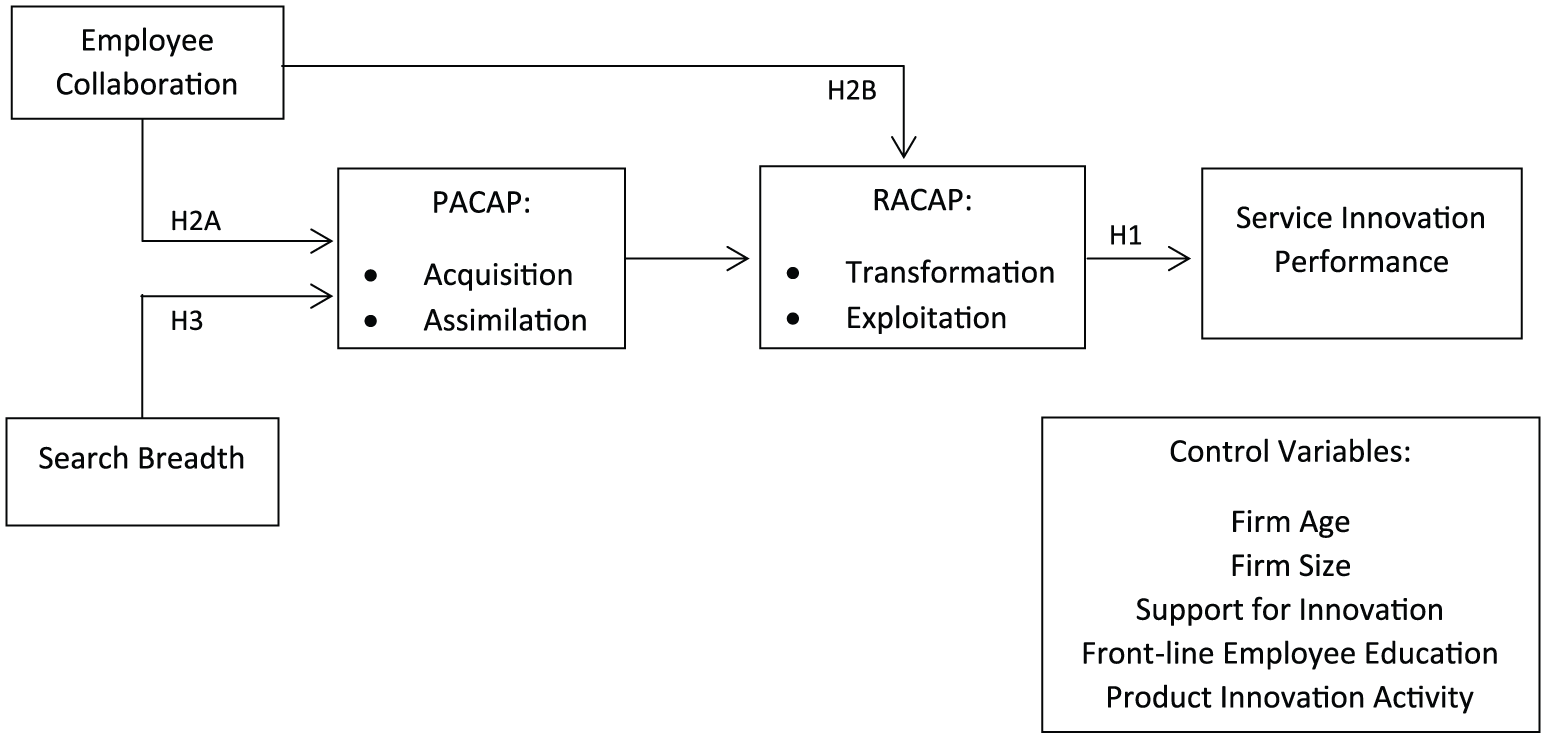
Structural model.
Research methodology
Sample and data characteristics
The items for this study were included in a larger questionnaire that evaluated the innovativeness of manufacturing SMEs. Data came from Dutch manufacturing SMEs in the southern provinces of the Netherlands. We defined an organization as an SME if it had fewer than 250 employees, in line with the European Union definition. The questionnaire was first sent to 1711 SMEs via email, which contained a link to an online survey. If we received no answer, we sent a reminder email. Following no response, we then sent a reminder letter by postal mail, including a printed survey and a reply envelope. In total, 246 organizations answered the survey, for a response rate of 14.4%, which is normal for this type of research (Baum et al., 2001; Moreno and Casillas, 2008; Wiklund and Shepherd, 2005; Zahra and Garvis, 2000). Our investigation focuses on how SMEs can achieve service innovation performance, and only 121 SMEs indicated that they had implemented at least one service innovation in the past year. In other words, 49% of the SMEs in the overall sample implemented at least one service innovation in the past year – a seemingly small percentage, considering the advantages SMEs can obtain through service innovation. After deleting 21 observations because of missing values or not meeting the sample criteria, we obtained a final data set of 100 respondents.
We checked for the potential selection bias that may arise because only SMEs that already servitize are included. Specifically, we applied the two-step approach by Heckman (1979) three times, one for each endogenous variable. For each analysis, the inverse Mill’s ratio was highly insignificant (p-values: 0.31, 0.47 and 0.77 for PACAP, RACAP and service innovation performance, respectively), which suggests that selection bias is not a concern for this study. To check for nonresponse bias, we conducted a t-test of the differences between early and late responses (Armstrong and Overton, 1977). We found no significant differences for any of the relevant variables at the 0.05 significance level.
Measures
Service innovation performance
To operationalize service innovation performance, we use scales from Carbonell et al. (2009), who adapted De Brentani’s (1989) measures to assess the competitive superiority of new services. Three items determine the performance of service innovations that actually came to market, such as ‘Our customer solutions are superior to those of our competitors’ and ‘Our new services give us an important competitive advantage’. We rely on self-reported measures because SME owners tend not to disclose their financial performance data (Naman and Slevin, 1993; Poon et al., 2006). Furthermore, research shows that subjective and objective performance data are highly correlated, especially in SME contexts (Basco, 2014; Dess and Robinson, 1984; Hoffmann et al., 2016). The expected outcome of dynamic capabilities is the achievement of a competitive advantage (Helfat et al., 2009; Teece et al., 1997), so this comparative measure, relative to competition, fits our study context. Table 1 contains the full list of items.
Measurement scales.
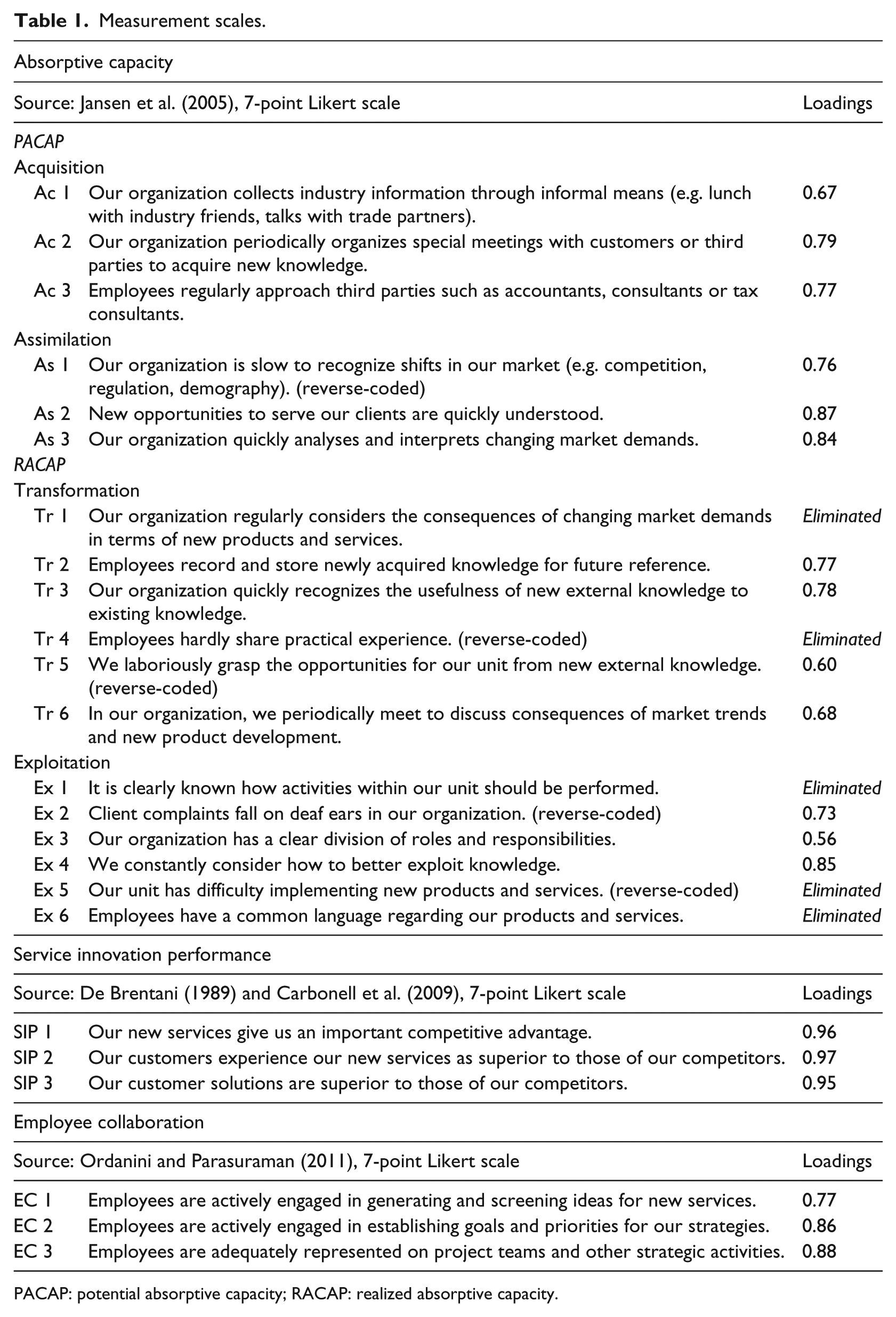
PACAP: potential absorptive capacity; RACAP: realized absorptive capacity.
ACAP
Muscio (2007) and Volberda et al. (2010) note a lack of consensus about how to conceptualize and measure ACAP, especially for SMEs, because a conventional proxy uses R&D (Zahra and George, 2002), but R&D activity among SMEs tends to be minimal (Whittaker et al., 2016). Jansen et al. (2005) propose a scale to measure ACAP that distinguishes PACAP (acquisition and assimilation) from RACAP (transformation and exploitation) (Zahra and George, 2002). Although acquisition and assimilation form PACAP, they are clearly distinct dimensions. Because acquisition and assimilation do not share a high mutual correlation and measure different capabilities, we regard PACAP as a reflective–formative, second-order construct (Becker et al., 2012; Cepeda-Carrion et al., 2012; Wilden et al., 2013). That is, acquisition and assimilation are measured reflectively, but the two dimensions formatively constitute PACAP. The same logic applies to RACAP. We use Jansen et al.’s (2005) scale but exclude three items from the acquisition dimension that did not fit our SME context: ‘Our unit has frequent interactions with corporate headquarters to acquire new knowledge’, ‘Employees of our unit regularly visit other branches’ and ‘Other divisions of our company are hardly visited’. Thus, we measure acquisition and assimilation with three items each; the transformation and exploitation dimensions are measured by six items each.
Employee collaboration
With a three-item scale from Ordanini and Parasuraman (2011), we measure the extent to which contact personnel engage in the service innovation process, adapted to represent participation of employees in the development of new strategies, priorities and services. For example, a survey item was, ‘Employees are actively engaged in establishing goals and priorities for our strategies’.
Search breadth
Similar to Classen et al. (2012) and Hewitt-Dundas and Roper (2017), we follow Laursen and Salter (2006), who conceptualize search breadth as the number of external partners with which organizations cooperate in an innovation context. Five types of external innovation partners appear in our questionnaire: customers, suppliers, competitors, universities or knowledge institutions and the public sector or government. These five binary variables take a value of 1 if the SME makes a connection with that type of external innovation partner, and 0 otherwise. Search breadth then equals the sum of these five binary variables.
Control variables
We include firm age as a control variable; existing research shows that older firms engage in less innovation (Huergo and Jaumandreu, 2004). Furthermore, we control for SME size, measured by the number of employees as full-time equivalents. Size affects the innovativeness of SMEs by influencing their ability to finance innovation-related investments (Berchicci et al., 2016; Nooteboom, 1994). We control for support for innovation, measured by an item that indicates, ‘assistance in developing new ideas is readily available’ (Anderson and West, 1998). In doing so, we account for the importance of support when it comes to achieving service innovation performance (Storey et al., 2016). Also, we include the level of education of front-line employees who provide the service. To measure this control variable, we asked the respondents to indicate the extent to which they agree with the statement, ‘Front-line employees are highly educated’. Finally, we control for whether the SMEs engaged in product innovation activity, as this could have an impact upon the endogenous variables in the conceptual model.
Analysis
We used partial least squares structural equation modelling (PLS-SEM) to test the model and hypotheses. As a multivariate analysis technique, PLS enables researchers to examine latent and manifest variables simultaneously (Fornell, 1987). This method is particularly useful when analysing sources of competitive advantage (Hair et al., 2012), and PLS-SEM is appropriate for this study for several reasons. First, it can deal with non-normal data (Chin, 1998; Hair et al., 2012). Hair et al. (2012) advise conducting Kolmogorov–Smirnov or Shapiro–Wilk tests to assess whether data are normally distributed; both tests indicate that our variables are non-normally distributed. We also check for skewness and kurtosis, following the general guidelines (Hair et al., 2016), and thus confirm that our data are non-normally distributed. Second, PLS-SEM can deal with small sample sizes (Chin, 1998; Hair et al., 2012). Our final sample size of 100 respondents is comparable to the sample size of Wilden et al. (2013) who use PLS-SEM for a similar study. Hair et al. (2016, 2012) offer minimum sample size requirements for PLS-SEM research to detect different R2 values at a 5% significance level while still accounting for the complexity of the PLS path model (i.e. maximum number of arrows pointing at a construct). For this research, the maximum number of arrows is five, so we need 45 observations to identify R2 values of at least 0.25 at a 5% significance level. Thus, our sample is sufficiently large. Third, PLS-SEM can handle both reflective and formative constructs (Hair et al., 2012; Henseler et al., 2009). In addition to the reflective constructs, such as employee collaboration, we measure PACAP and RACAP as reflective–formative constructs, similar to the operationalization of dynamic capabilities by Wilden et al. (2013). For these reasons, we use PLS-SEM and, specifically, apply SmartPLS 3.0 to conduct the analyses (Ringle et al., 2015). Our model assessment consists of two steps. First, we evaluate the measurement, or outer, model, which connects manifest variables to their latent variables. We use a standard PLS-SEM algorithm and settings and apply case-wise deletion for missing values. Second, we test the structural model, which reveals the relationships among latent variables (Fornell and Larker, 1981; Hulland, 1999).
Results
Measurement model
To ensure construct reliability, we check the item loadings and composite reliability values. First, for individual item reliability, we note the loadings. A common rule of thumb is that item loadings should be 0.7 or higher (Hair et al., 2016), although Hulland (1999) acknowledges that several items in an estimated model may have loadings below this threshold, especially for newly developed scales or existing scales transferred to a new context. Items with loadings between 0.40 and 0.70 thus should be considered for removal only if their deletion increases the composite reliability or average variance extracted (AVE) (Hair et al., 2016). With these criteria, we delete two items with loadings less than 0.4 from the exploitation dimension of RACAP, two items from the transformation dimension and one item from the exploitation dimension of RACAP, which improved the composite reliability and AVE values. All other items are retained. Because Jansen et al.’s (2005) scale originally was developed for large organizations, the low item loadings of several items might reflect our SME study context. For construct reliability, Hair et al. (2016) recommend relying on the composite reliability score in PLS-SEM research, although Cronbach’s alpha is a more common measure of internal consistency. Unlike Cronbach’s alpha, though, composite reliability does not assume that all indicators are equally reliable. Furthermore, Cronbach’s alpha is sensitive to the number of items in the scale (Hair et al., 2011, 2016). As Table 2 reveals, the composite reliability is above the recommended threshold of 0.7 for all latent variables.
Reliability, validity and measurement model.
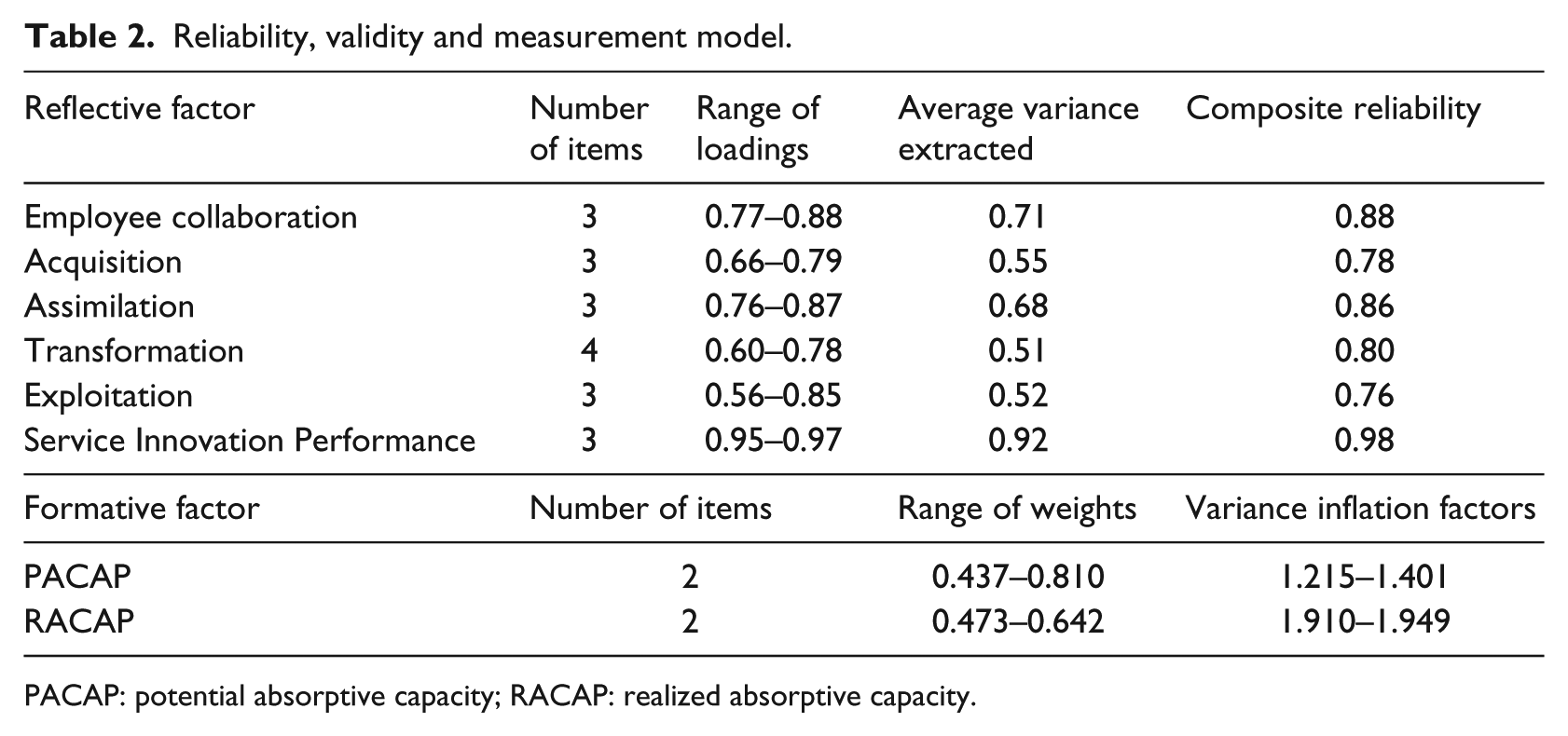
PACAP: potential absorptive capacity; RACAP: realized absorptive capacity.
The measure of convergent validity uses the AVE, which should be greater than 0.5 (Bagozzi and Yi, 1988; Hair et al., 2016). The lowest AVE we find is 0.51, so this condition is satisfied for all our constructs. In turn, we regard the internal consistency of each construct as sufficient. To ensure discriminant validity, each construct also must share more variance with its measures than with any other constructs, as indicated by a higher square root of the AVE for each construct compared with its correlations with other constructs (Fornell and Larker, 1981; Hair et al., 2016). The square root of the AVE also should have a value of at least 0.7 (Chin, 1998). As Table 3 shows, all the constructs met these criteria; this implies the presence of discriminant validity.
Correlations and square roots of the average variance extracted (on the Diagonal).
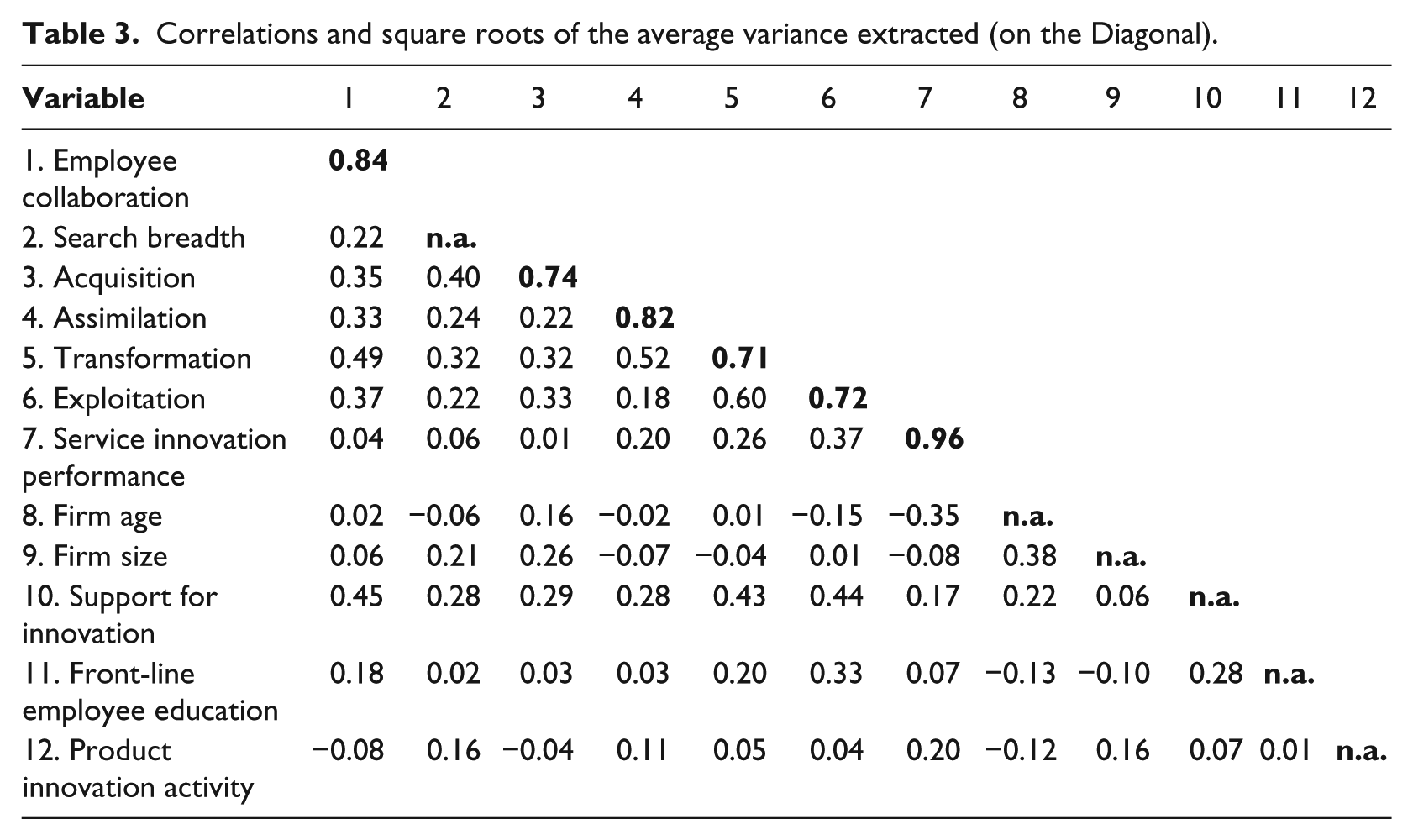
To assess the second-order formative ACAP construct, we test for the multicollinearity of its formative indicators, that is, the first-order reflective constructs acquisition, assimilation, transformation and exploitation (Diamantopoulos et al., 2008; Henseler et al., 2009). The variance inflation factors do not exceed 1.949, which is well below the commonly accepted threshold of 5 (Hair et al., 2016). Furthermore, the formative indicators are all significant, with weights between 0.437 and 0.810. Therefore, we verify the validity of the second-order formative construct.
Both our dependent and independent variables come from the same source, so common method bias could be a potential threat (Podsakoff et al., 2003). Therefore, we conduct two statistical analyses to assess the degree to which a common method bias is present. First, Harman’s single-factor test indicates that only 23.86% of the variance is explained, so no single factor accounts for the majority of variance. Second, we follow a procedure developed specifically for PLS research by Liang et al. (2007; see also Lanero et al., 2016; Lechner and Gudmundsson, 2014) and create a common method factor that includes the indicators of all constructs in the model (Podsakoff et al., 2003; Williams et al., 2003). Next, we compute how much of the variance for each indicator can be attributed to the principal construct and the method factor. Only 3 of the 24 method factor loadings are significant, and the substantive variances of the indicators are substantially greater than their method variances. Therefore, common method bias is not a concern for this study. Because the conditions for the measurement model all are satisfied, we turn our focus to the structural model.
Structural model
To evaluate the structural model, we use the R2 values of the dependent variables: 0.33 for PACAP, 0.41 for RACAP and 0.25 for service innovation performance, all well above the commonly accepted thresholds set by Falk and Miller (1992), Chin (1998) and Hair et al. (2011). These values are also comparable to those in existing PLS research in SME contexts (e.g. Brettel and Rottenberger, 2013; Sousa et al., 2014). We determine the significance of the coefficients according to 5000 bootstrap samples (Hair et al., 2011). Among the control variables - firm age, firm size, support for innovation, front-line employee education and product innovation activity - only firm age has a negative significant effect on service innovation performance. Younger firms are able to achieve higher service innovation performance.
In line with our first hypothesis, an SME’s RACAP has a positive effect on service innovation performance (β = 0.267, p < 0.05). Although we did not formulate an explicit hypothesis about the link between PACAP and RACAP, our results indicate that PACAP has a significant effect on RACAP at the 0.1% significance level (β = 0.427, p > 0.001). This finding concurs with previous research models that depict ACAP as a sequential process, where RACAP builds on PACAP (Todorova and Durisin, 2007; Volberda et al., 2010; Zahra and George, 2002). Consistent with H2a, employee collaboration has a positive influence on an SME’s PACAP (β = 0.395, p < 0.001), and as we predicted in H2b, it also has a positive effect on an SME’s RACAP (β = 0.314, p < 0.01). Finally, an SME’s search breadth relates positively to its PACAP, in support of H3 (β = 0.342, p < 0.01) (Figure 2).
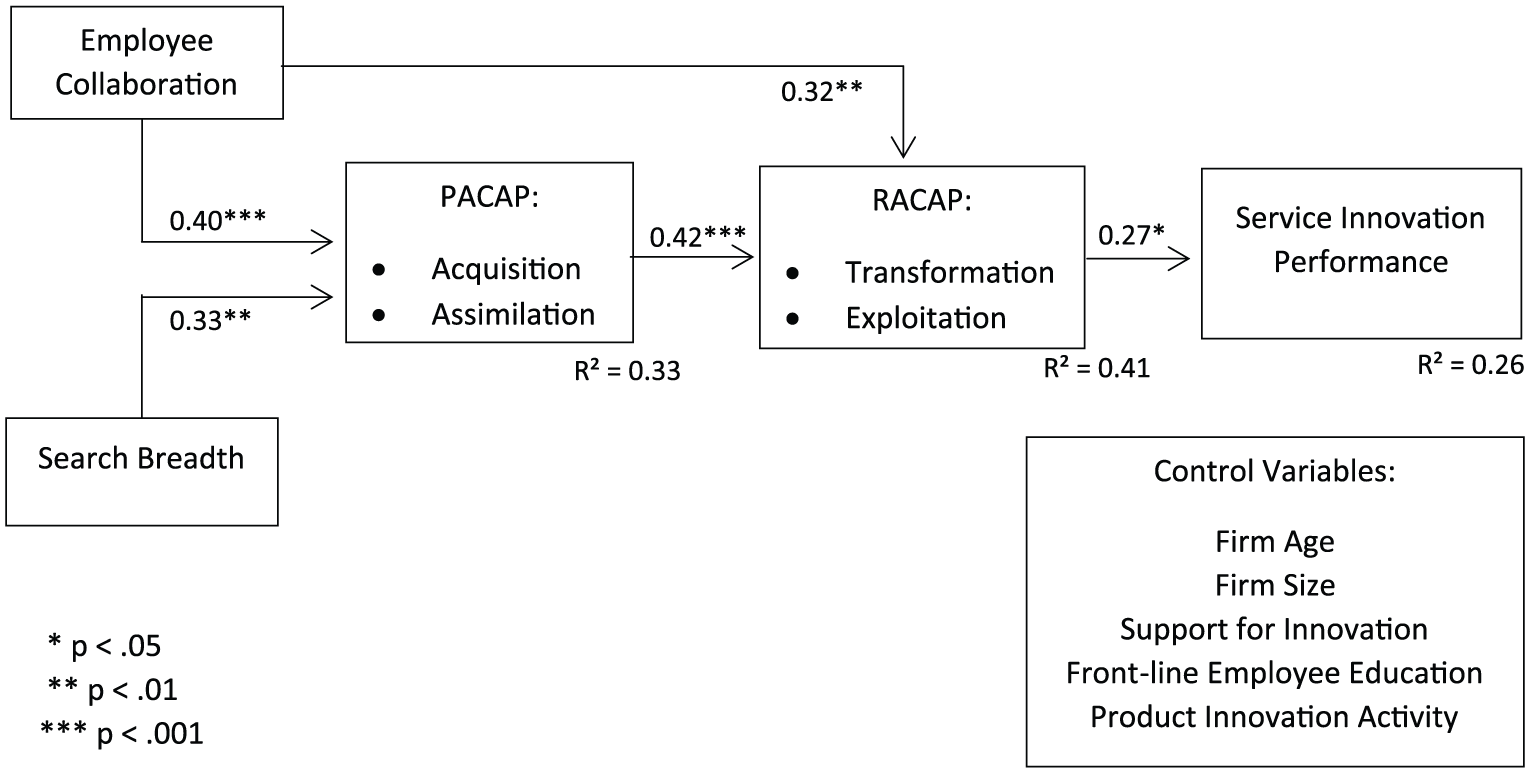
Results.
Robustness check
Some items from the transformation and exploitation dimension were omitted from the analysis because these items had low loadings or their deletion improved the AVE and composite reliability. To check whether this affected the final results of this study, an extra analysis including all previously omitted ACAP items was conducted. None of the hypothesized relationships significantly changed after adding the items, strengthening the support for our results.
Discussion and conclusion
In manufacturing industries, SMEs are increasingly focused on servitization strategies (Visnjic et al., 2016). Despite their concerted efforts, most firms fail to deliver service innovations effectively and do not achieve the expected servitization benefits (Neely, 2008; Visnjic et al., 2016). Given that service innovations offer an important way to retain or gain competitive advantages (Storey et al., 2016), it is important to find ways for manufacturing SMEs to deliver service innovations more successfully. Using a dynamic capabilities perspective, we empirically investigate ACAP as a potential antecedent of service innovation performance in SMEs, as well as how an SME’s search breadth, through its effect on PACAP, and employee collaboration, through its effects on both PACAP and RACAP, can drive service innovation performance. We find support for all our hypotheses. Using external knowledge, through RACAP, has a positive effect on service innovation performance, so a manufacturing SME can achieve service innovation performance if it has the capability to transform and exploit relevant external knowledge it has acquired and assimilated. Collaboration with employees in the innovation process also drives service innovation performance by augmenting all dimensions of ACAP. More diverse innovation partners affect service innovation performance too, through its impact on PACAP.
These findings offer several contributions to theory. First, they help increase our understanding of how manufacturing SMEs can achieve service innovation performance and provide theoretical and managerial guidelines of how to reach a service-based competitive advantage. We do this by showing how internal and external collaboration drive the development of a dynamic knowledge capability, which in turn leads to a competitive advantage based on service innovation. Our findings provide empirical support for Storey et al.’s (2016) suggestion that ACAP is an important driver of service innovation performance. Some scholars suggest that dynamic capabilities are required for the early phases of initiating servitization, but research into the effect of dynamic capabilities, as a critical success factor for servitization performance, is missing (Kanninen et al., 2017). To address this gap, we show that ACAP as a dynamic capability drives service innovation performance. In so doing, we also contribute to the debate about whether successful servitization requires a radical change in the way organizations think about their operations and value delivery (Gaiardelli et al., 2015). Many organizations fail to servitize successfully, and the key factors that lead to product innovation performance differ from those that lead to service innovation success (Nijssen et al., 2006), prompting some researchers to propose that servitization demands a new approach (Benedettini et al., 2015). For example, Storey et al. (2016), claim that ‘servitizing manufacturing firms need to adapt their innovation practices and capabilities to recognize the differences between services and products’ (p. 19). Without denying the differences, our results demonstrate that similar knowledge mechanisms drive both types of innovation. Previous research already confirms the positive influence of ACAP on product innovation (Alegra et al., 2013; Chen et al., 2009; Fosfuri and Tribó, 2008; Tsai, 2001); we show that ACAP also drives service innovation performance. The importance of developing and increasing the firm’s knowledge base thus does not change in relation to servitization processes. Rather, the main differences may involve the nature of the external knowledge that gets acquired, assimilated, transformed and exploited. Because services are intangible, the relevant knowledge tends to be more tacit and difficult to manage (Blindenbach-Driessen and Ende, 2014).
Second, we substantiate that employee collaboration has a positive impact on the development of a dynamic knowledge capability (ACAP). This finding advances the dynamic capabilities literature, where less attention has been devoted to the context of SMEs (Kevill et al., 2017) and which has focused predominantly on organization-level outcomes (Battisti and Deakins, 2017; Rice et al., 2015; Vickers and Lyon, 2014). We illustrate that in an SME context, ACAP is a sequential process, such that RACAP builds on PACAP. Prior research also reveals increasing consideration of a micro-foundations perspective on dynamic capabilities, and the role of managers in particular (Helfat and Peteraf, 2015; Kevill et al., 2017; Wilden et al., 2016; Winter, 2013). However, in addition to managers, other organizational actors affect the development of dynamic capabilities too (Helfat and Peteraf, 2015). In support of this assertion, we show that it is not just managers but also employees who have important roles for the development of dynamic capabilities. Dynamic capabilities depend on the ability of organizational members to act (Wilden et al., 2016), as reflected in the link between employee collaboration in the service innovation process and ACAP as a dynamic capability.
Third, we extend SME service innovation literature. Relatively little research has considered service innovation in an SME context (Kowalkowski et al., 2013; Van de Vrande et al., 2009), and that which does reveals that manufacturing SMEs depend heavily on actors in their network to extend into the service business, because of their lack of resources. We contribute to this literature by detailing how SMEs rely on their diverse networks. An SME’s external knowledge acquisition and assimilation capabilities depend on the diversity of its innovation partners. In this sense, we provide an initial response to a question posed by Mina et al. (2014): ‘An important question remains as to whether openness (in the service innovation process) translates into superior market performance’ (p. 863). We show that a more diverse set of innovation partners leads to the development of PACAP. In turn, PACAP is positively associated with RACAP, ultimately leading to a competitive advantage based on service innovation.
The analysis also has implications for SME management and policy-makers. Service innovations can help manufacturing SMEs retain their competitive advantage even when products become increasingly commoditized (Chesbrough, 2011). The existing literature proposes that servitization is the best strategy for manufacturing organizations to escape the commodity trap (Chesbrough, 2011), but to outperform competitors through service innovation, they must develop or enhance their ACAP. Having employees who can participate actively in the service innovation process and increasing the diversity of external partners, also offer key means to develop ACAP and indirectly improve service innovation performance.
Given that service innovations can help firms retain their competitive advantages (Chesbrough, 2011), subsidies aimed at stimulating service innovation represent an effective policy for strengthening local manufacturing. Investing in SME capacity to acquire, assimilate, transform and exploit external knowledge can spur service innovation performance. In particular, if SMEs lack information about potential partners and the benefits of cooperation with a diverse set of partners (Hewitt-Dundas and Roper, 2017), network events and awareness sessions, during which SME managers can discuss cooperation possibilities with customers, suppliers, competitors, universities and local governments, could be beneficial. Such events may encourage the development of the acquisition and assimilation dimensions of ACAP. Workshops and training programmes in which employees from all departments collectively work on an innovation case also could reiterate the power of employee collaboration for innovation, resulting in more organization-wide involvement in innovation efforts that encourage growth in all dimensions of ACAP.
Our study has several limitations. First, the cross-sectional nature of the data limits our ability to verify the causal relationships. In other words, the sequencing of the effects that we find cannot be tested. It could be the case that a successful service innovation in its turn reinforces the degree to which employees are included in the service innovation process. Future longitudinal data could provide conclusive evidence for the temporal sequencing of these effects. Second, caution is warranted regarding the generalizability of the results of this study. The model is analysed based on a sample of Dutch servitizing manufacturing SMEs, which is a very specific cultural context. Furthermore, although selection bias is not an issue, the fact that only servitizing manufacturing SMEs are part of the analysis limits the representativeness of our sample. Third, our data do not allow us to distinguish among different types of service innovations. Services are heterogeneous and can manifest in very different offerings (Ulaga and Reinartz, 2011). Therefore, it is possible that drivers of service innovation performance are not identical across different types of service innovation, a point that warrants further investigation. For example, researchers could use Berry et al.’s (2006) typology to investigate the effects of ACAP on different types of service innovations. In addition, further research could investigate whether ACAP develops differently in manufacturing SMEs that choose to servitize and strive for service innovation performance, compared with SMEs that do not choose this route. Finally, achieving service innovation performance requires a changed mind-set throughout the organization (Benedettini et al., 2015). Our research suggests that SMEs should ensure the collaboration of their employees in the service innovation process, but additional studies could investigate how manufacturing SMEs can establish the effective adoption of such a mind-set. Investments in employee motivation, training and other capability developments should be encouraged (Kanninen et al., 2017). An interesting research avenue would be to investigate how managers can stimulate employee collaboration, such as through support for innovation, which eventually should lead to service innovation performance and successful servitization efforts.
Footnotes
Funding
The author(s) disclosed receipt of the following financial support for the research, authorship, and/or publication of this article: This research is part of a doctoral programme sponsored by the province of Limburg [SAS-2013-01855].