



Abstract
The politicization of the environment in the 1970s involved a paradigmatic challenge to the ‘hegemony of growth’. In the Netherlands, this economic growth debate was particularly fierce and long-lasting, with protagonists among left-wing parties, Christian democrats, and right-wing liberals, all advocating some sort of ‘limits to growth’. Moreover, the Dutch growth debate also took on a policymaking dimension. Propelled by earlier attempts to implement ‘selectivity’ in certain policies, the Selective Growth Memorandum of 1976 set out to surpass the hegemony of growth and align environmental and economic objectives. As such, the Dutch growth debate of the early 1970s inspired a rapprochement in which environmental regulation was framed as a positive-sum game in consonance with economic considerations by stimulating investments, productivity, and growth. Even though the memorandum ultimately ended up primarily re-articulating the growth paradigm, this article highlights that discursively, it still prefigured the discourse of ecological modernization that would dominate the environmental discourse in the 1980s and 1990s.
Introduction
The long 1970s witnessed an ‘ecological revolution’ and has been described as the ‘pivotal decade’ in the emergence of modern environmentalism. 1 Following the 1972 publication of The Limits to Growth, the famous report to the Club of Rome, criticism of the hegemony of growth also became an important element in the politicization of the environment. The awareness of the damaging, potentially even catastrophic effects of economic activity led to new ideas about state intervention in the economy and modification of the growth paradigm, including radical pleas for a stable economy or decroissance (degrowth). 2 Whether growth should be maintained, adjusted, or abandoned was a key topic during the discursive struggles of the (early) 1970s. Even if debates about growth continue until the present day, it was only during this decade that the ‘hegemony of growth’ was truly shaken. 3
Matthias Schmelzer has shown that the Organisation for Economic Co-operation and Development (OECD) was a main battleground for this so-called growth debate. 4 Indeed, since the crisis of growth was a global event in which traditional ideas about modernization and orthodox conceptions of progress were questioned by a plethora of (international) actors such as experts, grassroots activists, and new social movements, scholars have mostly focused on international organizations, transnational networks or local activism. 5 As such, as was recently highlighted in a special issue dedicated to the politicization of the environment in the 1970s and 1980s, ‘the interplay of the “global” environmental question with specific national-political cultures has been largely overlooked’. 6
Following up on the plea to ‘recapture the contextual national grounds’, this article sets out to investigate the politicization of the environment in the Netherlands by analysing the debate about economic growth during the long 1970s. The Dutch case is interesting for a couple of reasons. First, the growth debate was exceptionally fierce and lasted longer than in most other countries. Moreover, politicization of the environment was swift, resonated widely, and catalysed ideological and discursive innovation in a fragmented political landscape. Ambitions were high, with leading Dutch actors eager to ‘pioneer’ the transition away from the old growth paradigm. Secondly, the growth debate entered the phase of policymaking when the incoming centre-left Den Uyl government (1973–1977) embraced the notion of ‘selective growth’. Thirdly, the connection between the fierce growth debate and the early embrace of ‘ecological modernisation’ in the Netherlands during the late 1970s has remained unclear. 7 As this article shows, the vehemence of the growth debate inspired the translation of discourse into policy, leading to the discursive convergence of economy and environment. No ‘black-and-white’ choices were needed, the 1976 Selective Growth Memorandum stressed, instead, environmental protection could fruitfully coexist with economic growth objectives. As such, the integrative approach to environmental policy that would become a hallmark of Dutch policymaking from the late 1970s onwards, could be traced back to the mid-1970s. The memorandum of 1976 in that sense prefigured the discourse of ecological modernization that would dominate the 1980s and 1990s, popularized with the concept of ‘sustainable development’ in the 1987 UN Brundtland report. 8
Combining an analysis of discourse and parliamentary debates with that of policymaking, this article will start by briefly exploring the impact of the Limits to Growth debate in the Netherlands. Second, the way existing ideologies and discourses were reconfigured by the politicization of the environment will be analysed by discerning three discourse coalitions shaping the Dutch growth debate. As will be shown, the neoliberal discourse coalition played a key role in the Dutch growth debate, remoulding their market-oriented discourse, and pioneering the idea of selective growth. In the final two parts the translation into policy will be examined. The concept of ‘selectivity’, that had emerged earlier in Dutch policymaking, helped facilitate the alignment of economic and environmental objectives. As such, the Netherlands indeed took the pioneering role many (progressive) politicians had been aspiring to in the early 1970s, but ultimately not in transcending the hegemony of growth but by spearheading its re-articulation in ecomodernist terms. Besides the use of parliamentary debates, this article is based on government sources, secondary literature, and historical newspaper reports.
Trailblazing the Transition
In the Netherlands, the Limits to Growth debate started in the summer of 1971, seven months before the publication of the actual report. In late August a leading Dutch newspaper scooped: ‘Disaster threatens world. Computer model predicts catastrophe’. 9 Besides sparking a true media hype, key parliamentary debates now focused on environmental issues. Already in previous years, acute water, air, and soil pollution had started to attract some political attention throughout the Western world. In comparison to other European countries, public awareness about the environment grew rapidly in the Netherlands. 10 Smog and contaminated surface and drinking water sparked outrage, public protest, media attention, and the rise of numerous new local and national environmental movements. In 1969 and 1970 the first water and air pollution laws were passed in the Dutch parliament. Also, ‘quality of life’ or leefbaarheid had officially been made the sixth goal of Dutch economic policy in 1969, while in 1970, opinion polls showed that 96.2 per cent of the population favoured strong state intervention to deal with pollution. In the run-up to the 1971 national elections, 42 per cent of voters identified ‘the environment’ as the most important political topic. 11
One of the main reasons for the high degree of politicization and public awareness in the Netherlands was the impact and visibility of pollution in a densely populated country rich in industry and intensive farming, located downstream of foreign industrial centres along the Rhine and Meuse rivers. These grassroots movements attracted attention with extra-parliamentary actions through which they sought to pressure public opinion, politics, and corporations. During the 1970s, these new movements increasingly participated in the decision-making process, their advisory role being formalized when the Central Council for Environmental Health was founded in 1974. Besides environmental movements, this advisory body included representatives of trade unions, industry, and employers’ organizations. 12 Widespread pollution also triggered the rise of environmental movements in other countries, which coincided with a cultural shift. As Michael Bess has shown for France, nature was reconceptualized during the 1960s ‘as a bounded and fragile space, requiring intensive human nurturing and protection’. 13 In the Dutch case, a similar development took place which built, however, on strong cultural assumptions stemming from the man-made character of the Dutch landscape. It inspired what scholars have labelled an ‘anthropocentric way of looking at nature’. 14
Secondly, the presence of radical elements in the fragmented arena of Dutch politics contributed to the swift politicization of the environment. As in other countries, the presence of newly established parties, even if they failed to enter Parliament, was instrumental in this process of politicization. 15 Without an electoral threshold, in the Netherlands new parties could quite easily enter Parliament. 16 In 1971, this was exemplified by three political newcomers, among which was the Political Party of Radicals (PPR), a party that consisted mainly of progressive Christian democrats leaving the larger Catholic and Protestant parties KVP and ARP. Together with Democrats 1966 (D’66), established in 1966 to ‘blow up’ the old political system, and the small Pacifist Socialist Party (PSP), that had been ridiculed over its ecological concerns since its arrival in Parliament in 1959, the PPR gave prominence to issues such as democratization, international solidarity, and the environment. These issues were also addressed by New Left, a movement of young radicals established in 1966 within the Dutch Social Democratic Party (PvdA).
Even though the process of politicization had already started during the late 1960s, the Club of Rome scoop had a huge impact in the Netherlands. Seemingly separate cases of pollution and environmental degradation, such as smog plaguing the Rotterdam area, were suddenly linked together by the predication of a worldwide catastrophe. Large-scale and systemic change now seemed necessary. Referring to the still unpublished Limits to Growth report, early copies of which had been distributed among the leading politicians of D’66 and PvdA, opposition leader Joop den Uyl of the Social Democratic Party opened the annual budget debate in October 1971 by lamenting out-of-control industrial production and the prevailing ‘growth ideology’. Den Uyl called for strict limits to growth, enforced by the state: ‘It cannot be left to the market mechanism’. 17 A similar chord was struck by two smaller left-wing parties (PPR and PSP) and by Hans van Mierlo, leader of progressive-liberal D’66, the most vocal party with regard to the environment in the early 1970s.
The 1971 budget debate was particularly sombre, reflecting the sense of crisis after the Club of Rome scoop, the collapse of the international monetary system in August 1971, and inflation rates that were the highest in Europe. In the grip of uncertainty, an acute awareness that the post-war epoch of growth and prosperity was ending beset Dutch politicians. Even mainstream politicians like Frans Andriessen, leader of the large Catholic party (KVP), admitted that growth was no longer ‘sacred’, calling for ‘cleaner’ growth instead. The debate mainly illustrated that growth had become a pressing political issue. This continued apace: soon even Protestant Prime Minister Barend Biesheuvel (ARP) called for a re-orientation of economic policies towards ‘optimal growth’, strict enforcement of environmental policy, higher taxes, and less private consumption. 18
Left-wing politicians remained most vocal in their pleas to enforce limits to growth. The most prominent advocate was Social Democrat Sicco Mansholt, who had been the European Commissioner for Agriculture since 1958 and vice-president of the EC since 1967. In late 1971, Mansholt embraced the analysis of Limits to Growth and caused huge commotion by advocating a centralized European plan to avert ecological collapse. In the light of the report to the Club of Rome, it was clear, Mansholt wrote in February 1972 in a public letter to his EC-colleagues, that European policies ‘must be radically redirected’. Instead of maximizing growth, a plan should be drafted reorienting policies towards ‘gross national happiness’, the centralized distribution of raw materials, heavy taxation, and a ‘non-polluting production system’. 19 Even though his colleagues in the Commission did not take his ideas at all seriously (had Mansholt become a hippie?), public attention soared, with many lectures (including a discussion with Herbert Marcuse and other French intellectuals in June 1972), international media coverage, and huge amounts of fan mail from all over the world. In the Netherlands, Mansholt chaired the ‘committee of six’ installed in late 1971 by PvdA, D’66, and PPR to explore the possibility of merging into one Progressive People's Party. The Limits to Growth agenda was seen as the perfect ideological framework for this new party. 20
The Netherlands would have to become a pilot country, Mansholt and the committee of six concluded in their final report, stepping up as global pioneer or gidsland in rebuking the old growth paradigm. To substantiate their claim, the committee of six quoted Dennis Meadows, who, as one of the authors of Limits to Growth, had stated that the worldwide transition had to start in the Netherlands or it wouldn’t start ‘at all’. 21 Even Prime Minister Biesheuvel said it was mere logic that the Dutch would spearhead the transition, referring to the country's location, population density, and degree of industrialization. 22 In March 1972, VVD minister of Economic Affairs Harry Langman argued smugly that ‘here, everything happens thirty years earlier’. 23 Indeed, the gidsland trope would spread rapidly in Dutch debates and the self-perception of politicians. 24 Even though this article argues that the Netherlands would indeed play a pioneering role in a re-articulation of the growth paradigm, it is not propagating the discarded idea of Dutch exceptionalism. 25 In fact, rather than pioneering with far-reaching environmental policies or a radical departure from economic growth, this article points out that the Netherlands would only lead the way in a reformulation of the growth paradigm in ecomodernist terms.
Rooted in a utilitarian tradition of water and land management, optimism about planning, science, and technology would define the Dutch debate about Limits to Growth. 26 This optimism was evident in the political demand, expressed in the late 1960s by both left- and right-wing parties, for a policy instrument to fine-tune spatial and regional economic policies. 27 These pleas resulted in a detailed investment planning scheme called the Selectieve Investeringsregeling (SIR). This policy instrument, designed in 1972 by the centre-right Biesheuvel administration, imposed regional levies on investments, aiming to slow down development in congested areas such as the Randstad. With the rapid politicization of the environment in the early 1970s, this ‘selective’ investment scheme was soon identified as a possible instrument to target economic activities that were causing (grave) pollution. 28
The fact that a right-wing coalition submitted the SIR bill, caused quite some political consternation. After all, control over investments had long been a desire of Social Democrats. Prominent left-wing economist and PvdA Parliamentarian Hans van den Doel qualified the 1972 bill as a U-turn in economic policy, rejoicing the fact that a liberal minister initiated ‘the march towards socialism’. He even described the SIR as ‘the first executive order of the Club of Rome in the Netherlands, in other words: imposing limits to economic growth’. 29 Facing criticism, VVD minister Langman referred to the coalition agreement of 1971, which had announced centralized ways to deal with congestion problems and other negative externalities of production and consumption. 30 Thus, set in a broader tradition of centralized spatial and regional economic policies, the Dutch growth debate instantly acquired a policy dimension in the Netherlands. 31
Discourse Coalitions in the Netherlands
During the 1970s, three discourse coalitions can be identified which shaped the Dutch growth debate: leftist critics, confessional reformers, and a market-oriented, neoliberal camp. The first coalition consisted of growth critics within the left-wing parties, mainly PvdA, D’66 and PPR. Mansholt and the committee of six he chaired, spearheaded this discourse coalition. By the time the committee presented its final report, in March 1972, the Club of Rome had also officially published Limits to Growth. The Dutch translation rapidly sold more than 350,000 copies (34 per cent of worldwide sales). As stated above, the final report hailed the Club of Rome conclusions as a blueprint for the future Progressive People's Party. In doing so, the committee also propagated the Dutch role as gidsland. Discussions within the committee had, however, already provoked tension within the PvdA, largest of the three parties discussing the merger. Leading figures such as party leader Den Uyl worried that strict limits to growth would endanger conventional social democratic objectives such as the redistribution of wealth and large-scale investments in public goods. 32
Social democrats in other European countries made similar reservations but generally faced less ideological mobilization in opposition to growth. In 1971, Olaf Palme, leader of the Swedish Social-Democrats, argued that ‘economic growth is quite simply necessary’ to meet demands for increased wages, living standards, and equality. 33 The environmental turn of the UK Labour Party took ‘a long time to unfold’, Marzia Maccaferri showed, with the Left truly embracing environmentalism only in the late 1980s and 1990s. 34 In West Germany, Willy Brandt, leader of the SDP and Chancellor between 1969 and 1974, hailed ‘quality of life’ as a complement to GDP growth, which could no longer be ‘the sole yardstick of progress’. However, these initiatives soon met fierce criticism, placing a reform-oriented faction within the SPD against a conservative, growth-oriented camp, as Stephen Gross has shown. 35 Within the Dutch Social Democratic Party something similar took place. In trying to strike a balance between economic needs and criticism of the prevailing ‘growth ideology’, Den Uyl and other leading figures within the PvdA were, however, closely watched by the radical and reform-oriented New Left faction within its own ranks and smaller left-wing parties such as PPR and D’66 who took a more radical stance on environmental issues.
The Dutch Social Democratic Party also faced left-wing actors that were far more sceptical about abandoning the growth paradigm. Leading trade union NVV argued in 1972 that it was not the quantity of growth that should be limited but its composition that had to change. 36 As in other European countries, the Communist Party took a similar position, opposing the ‘environmental mania’, warning of wage cuts and unemployment, blaming capitalists and multinationals for pollution. Unlike its Italian and French counterpart, the Dutch Communist Party was, however, small and did not play a significant role in the left-wing discourse coalition. 37 Nonetheless, a clash between old and new ideals split the Dutch left and the merger between the three left-wing parties was called off in April 1972. By then Mansholt, who had been touted as leader of the new party, had accepted the offer to succeed Franco Maria Malfatti as president of the European Commission. 38 Nonetheless, even if the merger failed to materialize, PvdA, PPR, and D’66 agreed on a combined programme called Keerpunt 1972 (i.e., Turning Point 1972) for the 1972 national elections. In this manifesto environmental concerns still figured prominently. 39
The second discourse coalition took shape within Christian Democratic circles, which, in the Netherlands, were religiously pluriform and consisted of numerous political parties. Protestants in particular embraced environmentalism, a trend visible in other countries as well. 40 As such, intellectuals of the Protestant ARP soon became protagonists of the Dutch growth debate. Besides Senator Wil Albeda, who called for increased market intervention to protect the environment, ARP-economist Bob Goudzwaard campaigned for alternatives to the growth-oriented policies within his party, drafting an environmental manifesto for the ARP in early 1972, which sparked a lively debate. 41 Linking economic ideas to the Biblical mandate of earthly stewardship, Goudzwaard had advocated pricing pollution and other negative externalities in his 1970s PhD dissertation. 42 As such, he represented a generation of economists trying to bridge the gap with ecology, advocating new conceptions of welfare and gross domestic product (GDP). Similar criticism informed high-level debates about growth and GDP-measurement within the OECD. 43 Groundbreaking work was also carried out by economist Roefie Hueting of the Dutch Central Bureau of Statistics, who would invent the concept of sustainable national income (SNI). 44
Besides the Protestant ARP, dominated by its powerful progressive wing, the limits to growth agenda also resonated within Catholic circles. With (young) progressive Catholics flocking to the breakaway PPR after 1968, leading KVP politicians were apt to endorse pleas for clean and ‘harmonic’ growth. Several leading politicians supported ideas put forward by Mansholt in the early 1970s, only criticizing the degree of centralization advocated by the left. 45 Growth critics even stepped up within the conservative CHU, smallest of three confessional parties that had collaborated since 1973 and would form the unitary Christian Democratic Party (CDA) in 1980. Jacques Huijsen, who in 1976 would become the first openly gay parliamentarian in the world, pushed for co-operation with the left to achieve a ‘welfare revolution’. 46 In their joint election manifesto of 1972, ARP, KVP, and CHU stressed the urgent need for state intervention to address ‘contemporary problems’, such as environmental pollution, the quality of life, social fragmentation, and urban decay. Aiming at the integration of a ‘welfare dimension in public policy’, economic growth was deemed desirable only if ‘harmonious’ and kept within ‘responsible limits’. 47
The conservative wings of the confessional parties were far less critical of growth. While these parties had faced internal divisions throughout the post-war period, tensions had mounted in the late 1960s. After 1968, the PPR became a magnet for progressive Christian voters, while the Social Democratic Party, opting for a strategy of polarization, actively tried to pull the confessional parties apart. During the growth debate of the early 1970s, Catholic and Protestant conservatives kept advocating pro-growth policies, distancing themselves from both the left and internal reformers such as Goudzwaard. Especially the Protestant ARP was torn between a progressive and conservative wing, the latter personified mostly by Jelle Zijlstra, former ARP prime minister and acting president of the Dutch central bank. 48 As an active participant in the growth debate, Zijlstra was critical of attempts to limit growth, and deemed fundamental changes to the social order – i.e., more centralized planning and abandoning the market mechanism – unnecessary for solving environmental problems.
Zijlstra's approach effectively corresponded with a neoliberal discourse coalition which centred around the Society and Enterprise Foundation (SMO), a think tank affiliated with the two largest employers’ associations in the Netherlands. Alarmed by radical trends in the Dutch growth debate, in 1972 SMO established the committee ‘Work for the Future’, composed of notable figures such as Zijlstra, Royal Dutch Shell director Gerrit Wagner, other representatives of leading Dutch multinationals, and two leading economists of the PvdA, Jan Pen and Nobel Prize Laureate Jan Tinbergen. 49 Described by a newspaper as the Dutch ‘counterpart’ of the Club of Rome, this high-profile working group distanced itself from pleas to slowdown or even stop economic growth. Even though change was needed, environmental issues could be solved within a market-oriented framework. 50
In spring 1973, members of the SMO working group presented their views at a symposium devoted to the Club of Rome report hosted by Queen Juliana. 51 During these lectures at the Royal Palace in Amsterdam, which received wide media coverage and were published as a booklet soon thereafter, the need for radical societal change was rejected. As Zijlstra put it succinctly: the pressing questions of the survival of life on this ‘finite planet’ required dedicated labour instead of grim prophecies of doom. Future growth was needed to pay for the resolution of environmental problems, as the final report of the SMO committee stated. Views among members of the working group differed somewhat with regard to the degree of state intervention. While economists Zijlstra and Pen advocated adherence to the ‘polluter-pays’ principle in the form of tariffs and levies, Shell director Wagner proposed public–private partnerships and research director W. J. Beek of the multinational Unilever pleaded for the business community instead of government to take the lead. 52
Most important, however, was the notion of ‘selective growth’ the working group put forward in its final report. Echoing the concept of selectivity that figured in the 1972 SIR proposal, the exact meaning of the concept remained unclear. Without elaborating on the instruments with which ‘selectivity’ could be achieved, selective growth was articulated as an alternative to both the traditional growth paradigm and limits to growth proposals. 53 In that sense, selective growth was a variation of ‘qualitative growth’, a concept that gained prominence in both West Germany and the UK. All these notions were expressions of what Alexander King, co-founder of the Club of Rome and director of the Science department of the OECD had called ‘another kind of growth’. 54 However, in contrast to both West Germany and the UK, selective growth in the Netherlands echoed earlier pleas for ‘selective’ spatial and regional economic policy and drew upon policy plans formulated in the 1972 SIR proposal. As will be expanded upon later, the Dutch growth debate thus acquired a concrete policy dimension right from the start.
Selective growth emerged as a discursive invention within neoliberal circles and, as such, was mostly referred to by leading industrialists and economic experts associated with either the VVD or the conservative wing of the confessional parties. Already in March 1972, prominent economist and VVD Senator Johan Witteveen, who would become managing director of the IMF in 1974, argued eloquently that ‘other aspects – especially environmental considerations – must be emphasized more vis-à-vis growth, implying above all that economic growth should be directed differently’. 55 At an environmental congress of the VVD two months later, Fritz Böttcher, the only Dutch member of the Club of Rome, stated that curbing population growth, not economic growth, was needed. He also distanced himself vehemently from the centralized approach put forward by Mansholt and the left-wing parties, hailing principles of liberalism instead: private initiative and individual responsibility would help solve the challenges posed by Limits to Growth. 56 In the summer of 1974, leading industrialists again highlighted the importance of selective growth. 57
Thus, facing swift politicization of the environment and a fierce growth debate, the neoliberal coalition took a prominent role with their discursive invention. In fact, after the publication of SMO's final report, selective growth slowly became the focal point of the Dutch debate and a guiding principle of economic policymaking. 58
Dutch Politics Embracing Selective Growth
After the growth debate went through its first round in 1971 and 1972, a new momentum was apparent when the centre-left Den Uyl administration took office in May 1973 (Figure 1). Known as the most left-wing government in Dutch history, it came about after difficult negotiations with ultimately only two of the five participating political parties granting full parliamentary support (PvdA and D’66, while KVP, ARP, and PPR took part but didn’t endorse it fully). Nonetheless, especially on the left, expectations were high, also with regard to environmental policy. After all, Limits to Growth had inspired the election manifesto Keerpunt 1972, which cabinet members of the left-wing parties regarded as the unofficial coalition agreement. Moreover, the PvdA had managed to take control of the department of Health and Environmental Hygiene, which had been founded during the 1971 cabinet formation. Soon, however, it became clear that Irene Vorrink, the PvdA-minister in charge of this department, adopted the same pragmatic approach that her KVP-predecessor had outlined. As in other European countries, the ministry focused on regulating pollution in an ‘incremental and technocratic’ way. 59
After a few months in office, Vorrink started to face criticism from both left and right for a lack of ambition and determination. Besides fierce right-wing opposition, it was coalition partner D’66 that explicitly profiled itself as ‘more green’ than Vorrink's PvdA. 60 Besides electoral concerns, D’66 and other left-wing progressives were troubled by Vorrink's modest ambitions and reluctance to link environmental issues to the question of limits to growth. In her first debate, Vorrink had already emphasized that environmental regulation should not cause unemployment. As such, Vorrink's line of reasoning reflected the ambiguous attitude towards the Limits to Growth debate among parts of the Social Democratic Party and within the trade unions. 61
Led by D’66-leader Jan Terlouw and the right-wing opposition, Parliament urged the Den Uyl administration to speed up the legislative process on environmental regulation and broaden the mandate of Vorrink's relatively young department. The recently established Scientific Council for Government Policy (WRR) also argued for concentrating more tasks in a strengthened environmental ministry. Even though Parliament, until 1977, would reiterate these demands year after year, both the issue of new legislation and a wider mandate would drag on for years. An interdepartmental power struggle over this new policy field was a major cause. 62 Curiously, Vorrink opposed calls for strengthening her department. Environmental policy, she reasoned in Parliament and cabinet meetings, was not to be isolated in one ministry, but to be pursued jointly by all departments and cabinet members. In the end, Vorrink argued, the department of Environmental Hygiene had to become redundant. 63 This integrative approach, coupled with Vorrink's insistence on co-operating with Economic Affairs, can be interpreted as an early step towards transcending the dichotomy between environment and economy. 64
In late 1973, while criticism of Vorrink's views was rampant, the concept of selective growth started to gain prominence in Dutch politics. Connecting it to the agenda of the left-wing parties, and with reference to the Club of Rome, the Den Uyl administration embraced the concept, stating that ‘reconsidering’ the growth paradigm was a ‘cornerstone of government policy’. 65 In January 1974, the newly founded WRR published its first reports, advising government on the ‘structure’ of the Dutch economy, energy concerns, and environmental policy, issues explicitly echoing the Club of Rome-agenda and the ‘futurological ambitions’ of the new institute. 66 In its report, the WRR urged government to make ‘non-economic objectives’ such as environmental concerns ‘guiding elements’ of economic policy. A new, overarching policy framework was needed, designed by ‘more than one ministry’ to ensure a proper alignment of the different, sometimes contradictory, policy objectives, the Council insisted. 67
Nonetheless, when the Den Uyl administration discussed the follow-up of this report, Economic Affairs managed to gain the sole initiative. Internally, high-ranking officials of the department had been alarmed by the prospect of interdepartmental or even external co-ordination: the very ‘soul’ of the department was at stake. 68 This short-lived challenge to the prerogative of Economic Affairs shows striking similarity with the power struggle some years before at the OECD: even though the Science Directorate, led by Alexander King, challenged the ‘hegemony of growth’, the Economics Department managed to regain the upper hand, rebuking attempts to reconsider OECD policy, and reinstating the growth paradigm shortly after the oil crisis of 1973. Elsewhere, economic growth was also making a comeback. 69
In the Netherlands, however, the growth debate entered a second phase in 1973–1974 with selective growth as a rallying cry for both left and right 70 – a ‘magic word’, as left-wing economist Jan Pen, member of the abovementioned SMO-committee, stated, pivotal in an ‘emerging consensus’. However, a clear-cut definition was still not agreed upon. 71 As time went by, parliamentarians wondered how government was planning to implement selectivity. With what sort of instruments, by which criteria, and in what way? 72 In December 1974, Economic Affairs admitted that still ‘the process of determining the substance of the concept was by no means finished’, but minister Ruud Lubbers stressed that his department had made ‘sincere efforts’ to elaborate on it. 73 In reality, top-level officials at Economic Affairs remained growth-oriented and opposed attempts to redefine economic policy, a dynamic similar to that within the OECD. 74
Towards the end of 1974, the political tide also started to turn. Faced by a deepening recession, politicians and press increasingly focused on the link between environmental policy and unemployment. Should environmental regulation be eased to dampen the economic downturn? Furthermore, political tension rose after a controversial and widely reported speech by Prime Minister Den Uyl at the annual meeting of a major employers’ association. In fact, the issue of selective growth played a prominent role in this address. Den Uyl highlighted the need for norms to reduce pollution and implement ‘selectivity’. This would require state control over investments and ‘evaluation’ according to criteria such as sustainable use of raw materials, energy efficiency, and pollution. 75
The 1974 speech led to an outcry of criticism about Den Uyl's alleged aim to ‘socialize’ the market economy, especially among right-wing politicians and the business community. Even though the ARP remained in favour of ‘a certain degree’ of intervention in private enterprise, in general, political parties were now re-orienting themselves, shifting priority back to stimulating economic growth, while concern for the environment started to wane. In 1975, the influential Dutch Planning Bureau (CPB) published a report quantifying the ‘costs’ of environmental policy. This report added fuel to the fire and was referred to repeatedly in Parliament and cabinet meetings. 76 While smaller left-wing parties such as PPR and PSP still adhered to the Limits to Growth discourse, leading actors within the PvdA started to backtrack, increasingly emphasizing the traditional objectives of fiscal discipline, supply-side incentives, and economic growth over environmental concerns. Referred to as ‘the economists’ battle’, this shift sparked deep controversy within the Social Democratic Party, with Keynesian-oriented economists and the progressive wing diametrically opposing neoliberals such as Finance Minister Wim Duisenberg, who headed the Dutch central bank between 1982 and 1987 and became the first president of the ECB in 1998. 77
Translation into Policy
After retaining the initiative in the follow-up to the WRR report of 1974, policymaking had progressed steadily at the department of Economic Affairs. The objective of what would become the Selective Growth Memorandum of 1976, was an overarching framework for aligning economic and environmental objectives. This was in line with Vorrink's ideas: environmental concerns could only be addressed when successfully ‘integrated into other policy fields; something that must now be ensured’. 78 However, the regulative approach in which the memorandum rooted (the 1972 SIR investment scheme), was slowly reversed by Economic Affairs officials: levies were phased out and the focus shifted to incentives instead of regulation. 79 First, in 1975, Economic Affairs finally defined selective growth as a configuration of continuity and selectivity. Continuity referred to the long-term state of the economy, while selectivity was characterized as criteria or ‘facets’ that would delineate growth- and continuity-oriented policy. Facets included environmental protection, spatial planning, efficient use of natural resources and the interests of developing countries. 80 However, during the policy-drafting years, emphasis slowly shifted away from these facets. While selectivity was the prime focus of early drafts of 1974 and 1975, clearly influenced by a committee of external advisers that included progressive ARP economist Goudzwaard, from 1975 onwards, the orientation of the memorandum changed. The external advisors were side-tracked and the Catholic minister Lubbers (KVP) himself took control. Soon everything (presentation, wording, and lack of concreteness) showed that selectivity was losing out to continuity. 81
This change reflected broader shifts taking place in the mid-1970s. Confidence in centralized planning diminished and economic objectives regained priority in the face of the prolonged recession after the oil crisis of 1973. Furthermore, the paradigm of neoliberalism started to gain ground, composed of monetarist and supply-side thinking which challenged Keynesian ideas that seemed unable to offer an adequate policy response for stagflation. In the Netherlands, the turn to neoliberalism took shape in the mid-1970s and can in fact best be understood as a return to ideas on economic, fiscal, and monetary policy which had already been dominant in the 1950s and 1960s. 82 This hard-fought shift, which materialized slowly during the late 1970s and early 1980s, consisted of a reformulation of a rules-based budgetary framework to curb the rise in collective spending and monetary restriction imposed by the Dutch central bank beginning in the summer of 1976. 83 Besides, supply-side economic policy took shape in the Selective Growth Memorandum.
As the role of selectivity diminished in the later drafts of Lubbers’ memorandum, the need for major supply-side incentives was inserted in order to safeguard the continuity of the Dutch economy. 84 Ultimately selectivity was completely side-lined: the framework of facets was to be developed and implemented at a later stage. Even though Vorrink and other progressive members of government by now criticized Economic Affairs, lamenting the fact that environmental concerns featured only ‘marginally’ and facets were not operationalized in the memorandum, Lubbers managed to push it through, backed by fellow Christian democrats and Duisenberg's Finance department. 85 Parliamentary support was obtained in the summer of 1976 in a trade-off with upcoming (progressive) bills, and due to skilful manoeuvring by Lubbers. 86 Facing criticism, but lacking credible alternatives, the Catholic minister solemnly pledged that selectivity would take shape after a first phase in which stimulating growth ‘tout court’ gained priority. 87 Thus, without any selective criteria, a tax deduction scheme for corporate investments called the WIR (Wet op de Investeringsrekening) was introduced, for which a total of 19 billion guilders was allocated between 1977 and 1980. 88
The Selective Growth Memorandum can thus be interpreted in multiple ways. First, as the outcome (and symbol) of the notably intense and long-lasting Dutch growth debate. Second, as an example of the reformulation of the growth paradigm, with economic objectives triumphing over environmental concerns. And, thirdly, as a case of emerging neoliberal and supply-side thinking in the Netherlands during the mid-1970s. However, the memorandum can also be interpreted in a fourth way, namely as a step towards the discourse of ecological modernization. This becomes evident by analysing the discursive link between economy and environment in the memorandum. Its objective was to align ‘continuity’ with ‘selectivity’, merging economic objectives with environmental concerns and other non-economic ‘facets’. This did not imply ‘black-and-white’ choices, the memorandum stated, rather, stimulating growth and creating jobs could go hand in hand with environmental protection. Or, as the memorandum stated: ‘the objective of continuity can be brought about without renouncing relatively high demands for selectivity’. Aligning different policy areas in ‘mutual cohesion’ would bring about an ‘integrated approach’. While environmental policy had to be tailored to the continuity of the Dutch economy (by state subsidies and delayed policy implementation), economic policies had to integrate ecological and planning concerns. After all, in the long run, these facets were the ‘pre-conditions’ for the continuity of economy and society. 89 In this regard, the memorandum called for state support for technological innovations that could decrease pollution and boost the economy at the same time. The memorandum thus aimed to articulate an overall principle for policymaking: effective integration was required to simultaneously achieve economic objectives and a ‘systematic improvement of the quality of life’. 90
The discourse of the Selective Growth Memorandum was innovative and reframed environmental concerns as compatible to economic growth objectives. In doing so, the memorandum prefigured the discourse of ecological modernization, the origins of which are often traced back to international institutions such as the OECD and the UNEP. 91 Even though the Netherlands are known to have adopted the discourse of ecological modernization early on, even becoming a ‘net exporter of environmental policy concepts’ during the 1980s, scholars have largely overlooked the early emergence of this discourse in Dutch politics. 92 While Hajer has traced back the origin of ecological modernization to the Dutch SO2 Policy Framework Plan of 1979, this article shows it was the fierce growth debate of the early 1970s which sparked the formulation of an overarching perspective on economy and environment. 93 Building on earlier attempts to implement selectivity, a broad consensus emerged favouring selective growth. The policy framework articulated by the 1976 Selective Growth Memorandum was discursively innovative and influenced both the environmental policies of the centre-right Van Agt administration (1977–1981) and the way the VVD profiled itself as ‘green’ in the second half of the 1970s and 1980s. 94 In 1980, the importance of the Selective Growth Memorandum was highlighted in the influential WRR report on industrial policy, which played a key role in the final turn to neoliberalism in the Netherlands. Far from being ‘out of touch with reality’, the approach adopted in the 1976 memorandum was deemed ‘readily justified’, while the idea of policy integration ‘had not lost any of its significance in the current circumstances’. The approach was increasingly shaping environmental policies, the WRR report stated. 95 As such, the roots of the ecomodernism that was to be ‘hegemonic’ during 1980s and 1990s, can indeed be traced further back, to the fierce growth debate of the early 1970s, which led to the Selective Growth Memorandum of 1976. 96
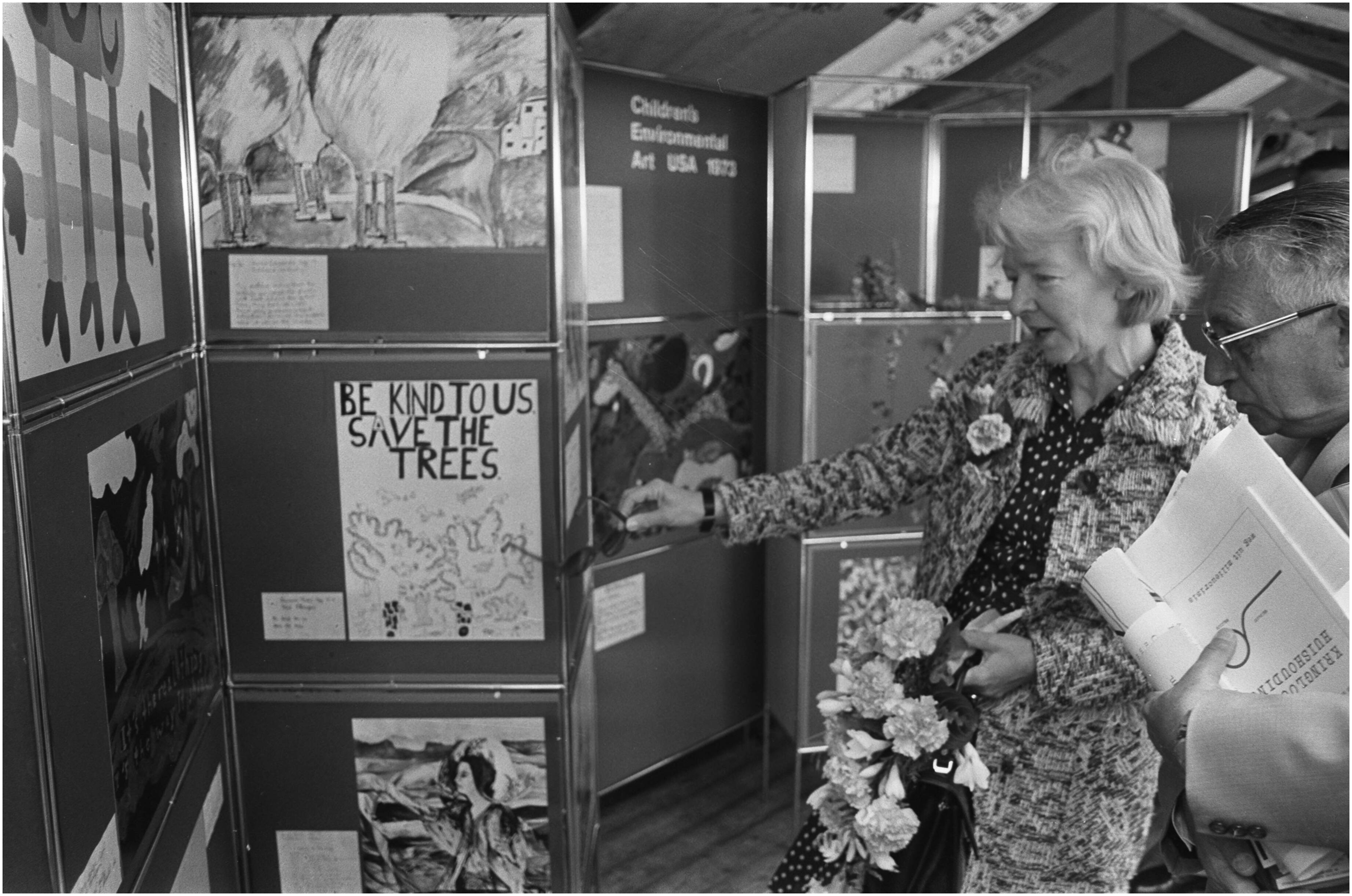
Minister for the Environment Irene Vorrink opens an eco-market in The Hague ahead of 1973 World Environment Day (National Archives of the Netherlands, CC0).
Conclusion
The idea of trailblazing the transition (gidsland) quickly gained prominence in the Netherlands during the early 1970s. Notable figures such as Mansholt called for a radical overhaul of the growth paradigm, while even conservative politicians agreed that the country should spearhead change due to the country's location, the degree of pollution, and prevalent ideas on planning and managing the environment. Indeed, as scholars pointed out earlier, the Dutch growth debate lasted for a comparatively long time. Even though this did not lead to radical experiments in limiting growth, this article shows that the fierce growth debate sparked the translation of ideas into policymaking, bringing about a rapprochement of economic and environmental policy objectives in the Selective Growth Memorandum of 1976.
This memorandum can be interpreted in multiple ways. First, it can be seen as a symbol of the fierce and long-lasting debates on economic growth in the Netherlands, and secondly, as an example of the waning interest in environmental issues during the 1970s in favour of a renewed prioritization of growth in the face of the prolonged global recession. Thirdly, the memorandum marked a move back towards a neoliberal paradigm in the Netherlands, with large-scale supply-side stimulus triumphing over demand-side fiscal policy. Fourthly, the Selective Growth Memorandum can be analysed as a first step towards the discourse of ecological modernization. As some scholars have recognized, the Netherlands was one of the first countries to reshape environmental policy in an ecomodernist fashion in the late 1970s. This article traces the roots of ecomodernism even further back, highlighting the importance of the Selective Growth Memorandum – as the offspring of fierce growth debates – in broaching the alignment of economy and environment, emphasizing ‘continuity’ on the one hand and ‘selectivity’ on the other.
The department of Economic Affairs played a leading role in this, although the new ministry of Health and Environmental Hygiene also pushed for policy integration early on. This article also demonstrates that the concept of selective growth originated within a neoliberal discourse coalition and became the vocal point of Dutch growth debates and policymaking after 1973. ‘Selectivity’ in itself had a tangible policy history and was tied into a tradition of spatial and regional economic planning. During the policy-drafting procedure, Economic Affairs managed to keep other departments and external advisors at bay. As a result, while the ecological dimension retained a key role on paper, economic objectives were prioritized. Selective growth thus re-articulated the growth paradigm while simultaneously discursively aligning environmental ‘facets’ with economic objectives. As such, the Netherlands was indeed trailblazing the transition in the 1970s, not by transcending the hegemony of growth but by pioneering the discourse of ecological modernization.
Footnotes
Acknowledgements
The author would like thank Liesbeth van de Grift, Hagen Schulz-Forberg, and Kristian Mennen for their remarks on an earlier version of this article. Since it was partly written during a visiting scholarship at the University of Jyväskylä, he would also like to thank the Department of History and Ethnology for granting him the opportunity to work abroad.
