




Abstract
Recent imagological scholarship about the Balkans has revised the Balkanism thesis by examining the sympathetic lens through which British liberals viewed the peninsula's Christian and Slavic nationalities following the 1903 establishment of the Balkan Committee. Revisionist historiography has, however, overlooked how non-Christian and non-Slavic communities were represented in Britain beyond overgeneralized orientalist stereotypes of ‘the villainous Turk’. This article aims to correct this imbalance by examining representations of Albania in the travel writing and political commentary of Mary Edith Durham and Aubrey Nigel Henry Molyneux Herbert, Britain's most notable supporters of Albania's national movement in the early twentieth century, who came to sympathize with the country because of their own peripheral position in relation to the British cultural and political mainstream, by virtue of gender and an unfashionably conservative worldview. Focusing on their published travel writing and political commentary between the 1904 publication of Durham's first narrative, Through the Lands of the Serb, and Herbert's untimely death in 1923, this article proposes that they articulated a counter-discourse to liberal writing on south-eastern Europe and that their representations of Albania foregrounded the capacity for self-governance, in contrast to the cultural chaos attributed to the country by liberals.
Keywords
During the First Balkan War (1912–1913), Ismail Qemali, the leader of the Albanian national movement, convened the country's first national assembly in Vlorë, which declared independence from the Ottoman Empire on 28 November 1912. 1 As the Balkan League occupied the vilayets of Ioannina, Kosovo, Bitola and Shkodër, which were claimed by Albanian nationalists, Qemali's Provisional Government declared its neutrality and telegrammed Herbert Asquith's Liberal government requesting that it ‘recognise this change in the political life of the Albanian nation’. 2 No response was forthcoming from London. 3 The lack of any expression of support by the British government for ‘the foundling state of Europe’ reflected the dominant position that liberal championing of the Christian and primarily South Slavic nationalities of south-eastern Europe assumed during the First Balkan War. 4 Speaking with the advances of the Balkan allies in mind, Asquith noted that public opinion would not permit ‘the victors … to be robbed of the fruits which cost them so dear’. 5 This absence of enthusiasm for Albania was echoed in the British press, which dismissed developments in Vlorë as a barrier to Montenegrin, Serbian and Greek expansion into territories to which they had a ‘historical right’. 6
Albania's declaration of independence nevertheless thrust the country into the British public eye to an extent that had not been seen since the enthusiastic reception of Lord Byron's Childe Harold's Pilgrimage in 1813. 7 Most sections of organized opinion – travellers, politicians, journalists and scholars – were dismissive of Albanian nationalism, but a small number of writers publicly supported the country through travelogues and articles in the press. This article will examine representations of Albania in the travel writing and political commentary of two of the country's most ardent British supporters in the first decades of the twentieth century: Mary Edith Durham and Aubrey Nigel Henry Molyneux Herbert. As this article contends, Durham and Herbert came to sympathize with Albania because the country's peripheral status in the British political imagination reflected their own marginal position in relation to the cultural and political mainstream.
Durham's most significant works were Through the Lands of the Serb (1904), The Burden of the Balkans (1905), High Albania (1909) and The Struggle for Scutari (1914), a series of travelogues which demonstrated her disillusionment with the liberal perspective on south-eastern Europe. 8 Durham's travelogues have primarily been examined from the perspective of the ‘gender paradigm’ in travel writing studies at the expense of her representations of Albania, an imbalance this article rectifies by demonstrating that her sympathy for the country was intertwined with the sense of authority she assumed there that transgressed early twentieth-century gender standards. 9 As significant in the dissemination of a sympathetic portrait of Albania in Britain was Herbert, whose interest in the country was rooted in his unfashionably conservative admiration of hierarchal and pre-industrial social structures. Herbert has been overlooked by historians because of his untimely death in 1923 and scattered literary output. 10 Alongside Durham, however, he was the most significant political supporter of Albania around the time of the First World War: he founded the Albanian Committee in 1912, which changed its name to the Anglo-Albanian Association in 1918, and authored numerous articles on the country under the nom de plume Ben Kendim (Turkish for ‘I, myself’) as well as a travelogue that was posthumously published in the year of his death. 11 Herbert's travel diaries, newspaper articles, correspondence and public speeches are held by the Somerset Heritage Centre, the county in which he resided and represented as a member of parliament. These archival materials have rarely been examined in previous studies of British images of the Balkans and represent a missing link in excavating ‘patterns of perception’ in the early twentieth century. 12
I
Studies of representations of the Balkans can be situated within the academic discipline of ‘imagology’, a branch of comparative literature which critically examines ‘discursive articulations of national, cultural or ethnical characterisations’. 13 This field of study gained impetus during the disintegration of Socialist Yugoslavia, as the cultural reductionism in Western media and political commentary about the conflicts of the 1990s focused scholarly attention on how representations of south-eastern Europe as ‘a peripheral zone of barbarism and conflict’ developed during the nineteenth and twentieth centuries. 14 Adapting Edward Said's Orientalism, Maria Todorova outlined the influential concept of Balkanism, which suggests that the region had been represented as ‘a repository of negative characteristics against which a positive and self-congratulatory image of “Europe” and “the West” has been constructed’. 15 A number of historians and literary critics approached Balkan imagology from the perspective of Balkanism and demonstrated how external observers perceived the region as ‘the ambivalent lands between what is properly East and properly West, a bastard borderland’. 16
Revisionist scholars have critiqued this ‘overgeneralised image of monolithic and continual misrepresentation’ by granting greater consideration to how British domestic politics and culture shaped perceptions of south-eastern Europe. 17 Mika Petteri Suonpää argues that ‘tangible’ points of military, religious and commercial contact shaped British perspectives of the Slavic Balkans in patterns at odds with Balkanism. 18 Examination of tangible cross-cultural contacts has focused attention on the Balkan Committee, a liberal pressure group founded in 1903 by Noel and Charles Buxton to promote the causes of the South Slavic and Christian peoples of south-eastern Europe in Britain. 19 According to Eugene Michail, if it had not been for the Committee's public engagement ‘the 1900s would have been a forgotten decade for the Balkans’. 20 The Balkan Committee, as both Samuel Foster and James Perkins suggest, generated public sympathy for anti-Ottoman struggles and made ‘Southern Slav folklore and history’ a ‘recurrent archetype in British depictions of the Balkans’. 21 This organization, however, overlooked the political future of non-Christian and non-Slavic communities in the Balkans, an imbalance that has been replicated by revisionist historiography which elides how Albanians and other non-Slavic and non-Christian communities were represented beyond ‘denigratory balkanism’. 22
The Balkan Committee was a ‘direct descendent’ of William Gladstone's Bulgarian agitation in its ideology and interpreted south-eastern Europe through the prism of Slavic Christians struggling against an oppressive Islamic empire. 23 Albanians did not fit easily within this framework because of their associations with Islam and the prominent positions the country's Muslims attained in the Ottoman administration. 24 Despite proposing autonomy for what remained of the Ottoman Empire in Europe, the Balkan Committee generally disregarded the political future of the Albanians. The committee's programme stipulated the creation of an autonomous Albania, but it was to comprise only the vilayets of Ioannina and Shkodër, thus ignoring the claims made by Albanian nationalists since the formation of the League of Prizren in 1878 on the vilayets of Kosovo and Bitola. 25 Kosovo, despite its majority Albanian population, was renamed ‘Old Servia’ in the Committee's plans, marking it out for future Serbian expansion because of its significance to the country's nationalist mythology. 26 The neglect of Albania in committee policy was reflected in the opinions of late-Victorian and Edwardian travel writers who viewed the Albanians as a people who ‘can scarcely be said to have ever had a national history’ and were defined by ‘centrifugal tendencies’ because of their confessional diversity (Muslim, Orthodox and Catholic) and linguistic division between a northern Gheg and southern Tosk dialect. 27 At the beginning of the Edwardian era, the dominant British perception of the Albanians was therefore of a people so divided that they scarcely deserved to be classed as a ‘nation’ and for whom political independence was considered a distant prospect.
This article challenges claims made by recent imagological historians that British images of south-eastern Europe around the time of the First World War revolved around the Southern Slavs by exploring the politically polarized nature of Balkan expertise between the 1904 publication of Durham's debut travel narrative and Herbert's death in 1923. The support for Albania expressed by Durham and Herbert relegated them to a peripheral position concerning liberal commentary on the Balkans, and their sympathetic representations of the country have consequently remained largely unconsidered by revisionist historiography. This article contends that Durham and Herbert's discursive articulations of Albanian cultural characteristics, notably the sense of order evoked by the country's tribal laws and national identity that transcended religious and linguistic divides, foregrounded capacity for self-governance and represented a counter-discourse to liberal commentary that envisaged south-eastern Europe's post-Ottoman political settlement as a uniformly Christian one. While recognizing Durham and Herbert's unique political perspective, this article indicates points of convergence between their representations of Albania and liberal images of the Slavic Balkans. As Perkins and Foster identify, the Balkan Committee's pastoral representations of South Slavic society ‘created a discursive space for the expression of concern at the impact of industrialisation and urbanisation on British society’. 28 Durham and Herbert's sympathy for Albania was similarly rooted in their interpretation of the country as a prelapsarian society in which they could assume positions of authority that they felt were denied or threatened amid the modernistic social and cultural changes of early-twentieth-century Britain.
II
In the context of the Balkan Committee's pro-Christian sentiment, Mary Edith Durham was one of the few public figures to defend the interests of Albania and her representations of the country countered liberal advocacy for the Southern Slavs. Durham remained unmarried her entire life and visited the Balkans for the first time in 1900 after spending the 1890s resigned to a life of domesticity caring for her invalid mother. Like many other middle-class women, she struggled to cope with a static existence lived under the ideology of separate spheres: ‘the future stretched before me as endless years of grey monotony’. 29 These restrictive conditions led Durham to develop health conditions and her doctor ordered her to travel anywhere ‘so long as the change is complete’. Shortly thereafter she visited Dalmatia where she experienced the sense of revitalizing alterity she had been instructed to seek out. ‘Touching every day at ancient towns where strange tongues were spoken and yet stranger garments worn’, she wrote, ‘I began to feel that life after all might be worth living and the fascination of the Near East took hold of me’. 30
Durham compiled her experiences of travel in Dalmatia, Serbia and Montenegro between 1900 and 1902 into Through the Lands of the Serb. Indicative of public disinterest in these countries at the time, Durham struggled to find a publisher before the 1903 assassination of Serbia's King Alexander Obrenović and Queen Draga led to a scramble for information about the country. 31 The content of her first narrative was more lightweight than her later travelogues and diverged little from the stereotypical images of Eastern Europe found in tourist literature that appealed to Britain's nostalgic middle classes. 32 This work nevertheless established her reputation as one of Britain's foremost woman travellers. The press classed her as ‘the same type of energetic and fearless Englishwoman as the late Miss Mary Kingsley of West African fame’, reflecting both women's admiration for pre-industrial societies in which they found ‘a sense of achievement and authority’ unattainable for women in Britain. 33
Durham's first travelogue followed liberal discourse about the Balkans. She sympathized with the ‘heroic’ Montenegrins and urged Arthur Balfour's government to end ‘the apathy of England towards the suffering of Balkan Christians’. In an early demonstration of her political engagement, she proposed a solution for the status of Albania, arguing that Montenegro's Prince Nikola should have ‘larger scope for his administrative powers’ through the extension of his principality into northern Albania, which she claimed was ‘rightly and properly’ Montenegrin because of its historical association with the medieval Serbian kingdom of Stefan Dušan. By contrast, although Durham admitted that the Albanians comprised most of the population, she deemed them ‘Asiatic invaders’ and dismissed their demands for autonomy as ‘a wild scheme’. 34 Durham, however, distinguished herself as a more astute cultural observer than liberal commentators and diverged from popular representations that suggested the Albanians were too religiously divided to comprise a nation: ‘Whether Christian or Mussulman’, she wrote, ‘the Albanian is intensely Albanian’. 35
The success of Durham's first travelogue elevated her to the status of Balkan ‘expert’, a position attainable for an Edwardian woman because there were no dedicated academic centres for the study of south-eastern European cultures in Britain before the First World War. 36 She was consequently employed to distribute humanitarian aid for the Balkan Committee member Henry Noel Brailsford's Macedonian Relief Fund (MRF) following the 1903 Ilinden-Preobrazhenie Uprising, a failed nationalist rebellion against the Ottoman Empire. Durham organized relief in Ohrid and Resen but her opinions on the Slavic peasantry shifted away from those held by liberals. Although her criticisms of the peasantry remained part of the liberal ‘victimhood narrative’ identified by Foster that attributed perceived cultural failings to Ottoman oppression, they were more immutable than those voiced by Balkan Committee members. 37 Durham characterized the Slavic population as ‘slow-witted’ and ‘animal-like’ and loathed their pleading for extra rations. She pondered if this peasantry of ‘the lowest type’ could even ‘belong to the same genus as I do – let alone species’, a comment arguably reflecting the influence of her brother, Herbert, who worked under the Bavarian eugenicist Max von Gruber, and sister, Florence, a Mendelian geneticist at Newnham College. 38
Durham recounted her Macedonian experiences in The Burden of the Balkans, a travelogue that distanced her from liberal representations and shifted away from the picturesque tone of her previous work. In contrast to the liberal view that Perkins describes as having ‘a tendency to lapse into “Cross versus Crescent” superficialities’, in an eighty-page introductory essay on south-eastern European history she stressed that Macedonia's ‘troubles are largely of racial, and not of religious, origin’, a fact she claimed proven by the activities of Bulgarian, Serbian and Greek nationalist paramilitaries that ‘direct attacks not only upon Moslems but murder Christians of all the other Balkan races when the opportunity occurs’. 39 By providing a more accurate portrayal of the inter-ethnic conflict in Macedonia, Durham brought into focus the selectivity of liberal commentators for whom ‘When a Moslem kills a Moslem it does not count; when a Christian kills a Moslem it is a righteous act; when a Christian kills a Christian it is an error better not talked about; it is only when a Moslem kills a Christian that we arrive at a full-blown “atrocity”’. 40 From these comments, it is clear that by the end of her disenchanting work with the MRF Durham had arrived at a more nuanced understanding of Balkan affairs than her liberal contemporaries who viewed Macedonia as a simplistic battleground between Christian ‘civilisation’ and Islamic ‘barbarism’. 41
More broadly, Durham rejected the breezy ‘liberal internationalism’ associated with advocacy for the Southern Slavs, a cause which Perkins and Florian Kiesinger demonstrate was discursively connected to other issues that weighed on the progressive consciousness, such as slavery in the Belgian Congo, Russia's interference in Persia and Home Rule in Ireland. 42 As Marcus Tanner notes, Durham ‘despised, or just did not care’ about many liberal campaigns, notably women's suffrage. Whereas Brailsford married a Scottish suffragette and went on to found the Men's League for Women's Suffrage, Durham described militant feminists as ‘ninnies whose conduct will forever remain a blot on the record of women’ and believed the government should deport them to Australia. 43 Durham's disdain for suffrage campaigns was arguably an attempt to distance herself from ‘agitators’, an alliance with whom she feared would undermine her own credibility and detract from her uniquely privileged position as a politically engaged woman traveller. 44
After her work with the MRF, Durham travelled to Albania where she encountered Christian and Muslim Albanian nationalists, concluding that the British tendency ‘to recognise only a strip of mountain land along the coast as truly Albanian can but lead to disaster’ and that an autonomous Albania with ‘sufficient flat plain-land to make a living on’ should be created. Durham tailored Albanian demands for autonomy for liberal audiences by representing the Islamic culture of the country as no more than a ‘veneer’, especially among the Bektashites, adding that ‘in the event of a free Albania, it seems probable that many … will turn Christian’. 45 Despite this, most reviews of The Burden of the Balkans focused on the plight of Slavs living under the Sultan's rule and scarcely acknowledged her support for the Albanians. 46 An exception was a review by Brailsford that criticized her ‘partisan’ position and noted that as ‘a political guide to the tangle of the Balkans she is apt to be capricious’, reflecting his irritation at her critical view of the Slavic populations he had employed her to help. 47
The reasons behind Durham's decision to promote Albanian interests were complex. In contrast to the Southern Slavs, she sympathized with the Albanians as they had few British supporters because liberals ‘did not recognise their existence as a people’. 48 Durham was also a defender of the interests of the British Empire, writing that she would never let it be ‘scored off’ and suggesting the importation of Albanian mountain dogs to deal with Irish nationalists. She was therefore alarmed by what she viewed as the growing influence of Russia, Britain's traditional adversary in the Eastern Question, among the Balkan Slavs and argued that this fuelled their ‘frenzied Nationalism’. 49 Most importantly, she was attracted to Albania because of the elevated social position she assumed as a female British traveller within the country's pre-modern social structures, which she admired as ‘uncorrupted by civilisation’. 50 This perspective on Albania produced complex forms of othering through which Durham represented town-dwelling Albanians in less favourable terms than their rural counterparts. ‘The ordinary Albanian of the town’, she wrote, ‘is very different from the up-country savage, and is a pathetically childish person. He tries very hard to be civilised’. 51 Despite Durham's aversion to liberal politics, the cultural hierarchies she determined within Albania mirrored liberal criticism about the towns of the Slavic Balkans, as both were part of ‘a wider critique of “cosmopolitanism”, urban culture and commerce’, features of contemporary society that she travelled to get away from. 52 Literary critics argue that women viewed foreign travel as ‘a means of redefining themselves, assuming a different persona and becoming someone who did not exist at home’. 53 Durham's travels in Albania can therefore be characterized as journeys to authority denied in Britain: in Shkodër she was imperiously titled by authorities ‘Edith of London’ and ‘Mary of England’ and in Tepelenë locals assumed she knew the Sultan, leading her to remark that ‘their insistent belief in my power would have made me believe I was the British Empire’. 54 As Hammond notes, one senses that at times Durham's interest was less in Albania than in what she could achieve there. 55
Despite these self-gratifying motivations, Durham's sympathy for Albania influenced her textual representations that were suggestive of order, prosperity and a nation fit for self-governance. In an implicit criticism of the Macedonian Slavs, she wrote that once in Albania there were ‘no more wooden, lath-and-plaster houses, but well-built stone ones, with red-tile roofs, near villages and scattered on the hillslopes, the big wealthy-looking dwellings of the local Begs’. The villages themselves were ‘clean – really clean … with straight, well-paved streets … quite free from dogs and garbage’. This sense of order, in contradistinction to the cultural chaos attributed to Albania by liberal commentators, continued into the domestic sphere; Albanian interiors were ‘specklessly clean, the boards scrubbed to whiteness, the cups and cooking utensils shining’. 56
Although Durham increasingly favoured Albania, she continued to present the South Slavic position in British periodicals, as in her article ‘As Others See It (A Sketch in Old Servia)’, and made Cetinje her base for travels into Bosnia and Herzegovina. 57 She also found herself in prominent positions in Montenegrin politics and was appointed by Prince Nikola as Montenegro's commissioner at the 1907 Balkan States Exhibition in London, an event proposed by the Balkan Committee to highlight the post-Ottoman ‘progress’ of the peninsula's independent states. 58 Durham found this role exasperating because of the disorganization of the Montenegrin delegation and the breakdown of communications with Cetinje. She later wrote with a typically inflated sense of self that it was only because of her skilful diplomacy that ‘the Balkan War did not break out at Earl's Court’ between the Montenegrin, Serbian and Bulgarian parties. 59 Durham's frustration at the Montenegrins in London shifted her sympathies further towards Albania and in 1908 she decided to leave Montenegro. This decision was influenced by the string of bombings orchestrated by Montenegrin students associated with the Black Hand that had rocked Cetinje the previous year. The Bombaš Affair aimed to overthrow the Petrović-Njegoš monarchy and force unification with Serbia, which seemed proof to Durham that the principality was falling victim to Russian plotting and propaganda. 60
After leaving Cetinje, Durham was invited to undertake ethnographic research in northern Albania for the Royal Anthropological Institute (RAI). The outcome was High Albania, a pro-Albanian travelogue that captured the period of optimism following the Young Turk Revolution as the Committee of Union and Progress (CUP) had promised Albanian nationalists in Ferizaj a host of privileges that were ‘grotesquely at variance with their real political programme’ of Ottomanization. 61 Alongside studying the customs of the Catholic tribes around Shkodër, Durham's travelogue included an account of travel in Kosovo in which she firmly supported Albanian territorial claims: ‘Kosovo-Polje’, she declared, ‘is Albanian’. Challenging the arguments made by liberals that Serbia had a historic right to Kosovo, Durham stated that for the Serbs the region was ‘lost, dead and gone – as lost as Calais is to England, and the English claim to Normandy’. Durham found that without ‘the support and instruction’ in the Serbian language supplied by Orthodox theological colleges the ‘scattered’ Slavic population in Kosovo would have been ‘absorbed’ by the Albanians. This was particularly so in Prizren, coveted by Serbian nationalists as the former stronghold of the medieval Serbian Empire, in which she found the only Slavic inhabitants to be the masters of the theological college who had emigrated from Belgrade. 62 To her mind, Serbian efforts to establish an ethnic foothold in Kosovo were ‘a pathetic and useless struggle’ fuelled by Russian-sponsored pan-Slavic ideology. 63
Durham was aware of the denigrating stereotypes about Albanians circulating in Britain and took it upon herself to address these in High Albania. In particular, she challenged the portrait of Albania in William Le Queux's sensationalist travelogue An Observer in the Near East. Le Queux visited northern Albania in 1906 as part of a longer journey through the Balkans and described it as ‘the wildest and most savage country in the East … held by brigandish tribes, who shot the traveller at sight or held him to ransom’. 64 Describing him ironically as ‘that self-styled “Observer”’, Durham wrote that she could ‘only say that someone had been pulling that poor gentleman's leg very badly’ as to the dangers of the country. In contrast to Le Queux's lawless depiction of Albania, Durham represented the country as an orderly society defined by hierarchy and adherence to codes of conduct: ‘There is perhaps no other people in Europe so much under the tyranny of laws’. High Albania contained detailed anthropological research into the Kanun of Lekë Dukagjini, one of the sets of customary laws that ‘legislated minutely’ nearly all aspects of life among the Catholic tribes. The complexity of the kanun was such that Durham had ‘difficulty in unravelling’ it, but she nonetheless praised the ‘fidelity with which the laws of blood are observed’ and noted that when they were broken Albanians were ‘as genuinely shocked as is a suburban mission meeting over the sacrifices of Dahomey’. 65
Governed by this regime of laws, order emerged as the prevailing characteristic Durham ascribed to Albania. This was captured in her account of the proclamation of the 1908 CUP constitution in Shkodër after which ‘two thousand heavily-armed men’ poured into the streets and began firing their weapons in celebration. Even though ‘bullets whistled continuously over every roof’, she wrote that ‘there were no fatalities, nor any street fighting nor drunkenness’ and ‘perfect order was maintained’ without any police presence, an implicit criticism of the growing militancy of Irish nationalists, socialists and feminists that brought what Elie Halévy called ‘domestic anarchy’ to Edwardian Britain. 66 Although Durham disliked liberal politics, her representations of Albania correlated with liberal portrayals of the Southern Slavs, which used the perceived virtues of the region's agrarian societies to critique Britain's ‘degradation as an outcome of urbanisation’. 67 As we will see further with Herbert, the parallels between portraiture of the Albanians and the Slavs was evidence of the pervasiveness of what Frank Trentmann calls ‘the matrix of new romanticism’ in Edwardian Britain, as commentators of various political opinions ‘shared a common culture of anti-modernism’ centred on an idealization of the stability, integrity and community of pre-industrial social orders. 68 Indeed, despite their different politics, the secretary of the Balkan Committee, Rolfe Arnold Scott-James, praised Durham's travel writing for taking the reader away from ‘the moral poverty of the West … far from London, Paris, and Berlin, and their constant rattle of politics and problems’ to introduce them to peoples who ‘have so little respect for western ideas’. 69
Durham's approval of Albanian culture in High Albania ‘inferred the possibility of self-government’. 70 This was made explicit in her pronouncement that the Albanians would ‘follow to the death a Prince in which they believe’, the prime candidate in her mind being the Prince of Mirdita and member of the Young Turks, Prenk Bib Doda. 71 Durham's interest in Albanian politics superseded her study of the country's folk traditions during the period of the Balkan Wars and Albanian independence. 72 She returned to Shkodër in 1910 and observed plummeting support for the CUP whose policies involved forcing conscription, tax collection and disarmament on the Albanians. ‘We will not give money to the Turks to buy gold braid for the officers and guns to kill us with’, an Albanian told her. 73 The following year this discontent evolved into open revolt against the Porte. In The Struggle for Scutari, her final major work before the First World War, Durham described the 1911 rising as ‘the great betrayal’ because Montenegro's King Nikola had incited the northern Albanian tribes to revolt, intending to exploit the unrest to expand his kingdom, which had been proclaimed in 1910. Any residual sympathy she had for the Slavs was shattered and she became increasingly critical of the Petrović-Njegoš dynasty whose ‘sordid internal politics’ had turned Montenegro into ‘a hubble-bubble of hate’. 74 Durham made her disgust for Montenegro a public affair, notifying The Times that she had returned the medal awarded to her by the Montenegrin government for her work at the Balkan States Exhibition because of ‘the mutilations and gross cruelty and injustice’ they had inflicted upon the Albanians. 75
During the Balkan Wars, she reported on the Montenegrin and Serbian siege of Shkodër for a variety of British newspapers and argued that the ‘destruction of the Albanian race was the avowed intention of both Serb and Montenegrin’. Durham saw pan-Slavic ideology as the cause of conflict in the Balkans and wrote that the ‘guilt at handing over Albanian districts to be butchered rests primarily with Russia’, an unpopular view at a time of growing Anglo-Russian collaboration following the 1907 convention that settled the ‘Great Game’ in Central Asia. The invasion of Albania by Serbian, Montenegrin and Greek forces raised the issue of the country's national frontiers, and Durham – by now labelled hypocritical in the press because she was a ‘sympathiser turned critic’ of the Slavs – stressed that Montenegro's claim to ‘solidly’ Albanian Shkodër was unjustifiable. 76 Although eclipsed by pro-Balkan commentary, her negative stereotyping of the South Slavic armies was an attempt to generate sympathy for the Albanians by highlighting their ‘pitiable plight’, and in reports from Shkodër and Podgorica she urged Britons to donate money to her recently established Albanian Relief Account. 77 Her advocacy during the Balkan Wars increased her status in Albania and she was honoured with the sobriquet ‘Queen of the Mountain Men’. 78 Historians have suggested that this imperious title was an example of ‘imagined colonialism’ through which travellers indulged ‘fantasies of personal control’, but Durham was certainly held in high esteem in the country. 79 Indeed, Henry Nevinson, a member of the Balkan Committee not necessarily sympathetic to Durham's politics, made the revealing comment that during the First World War British units in Thessaloniki that had trouble with Albanians ‘had but to mention the word “Durr-ham”’ and all difficulty vanished. 80
III
In this defence of Albania against the Balkan allies, Durham was joined by the Tory parliamentarian Aubrey Herbert. The pair first met in Shkodër in 1913 and Herbert was shocked by Durham's transgressive appearance: ‘She cuts her hair short like a man, has a cockney accent and a roving eye. … She would have been a suffragette, if these other things had not come her way’, a comment belying the British gender norms that Durham subverted in Albania and Herbert's own ignorance of Durham's disdain for the women's movement. 81 However, they came to collaborate on Albanian issues, exchanging upwards of five hundred letters before Herbert's death in 1923, and Durham was a founding member of the Anglo-Albanian Association, the successor to the Albanian Committee founded by Herbert in 1912 to promote the country's interests at the Treaty of London that concluded the First Balkan War. 82 In the 1930s it was claimed that ‘modern Albania is to a large extent the creation of Aubrey Herbert's efforts’ and while this is certainly an exaggeration, not least because it erases the role of Albanians themselves in establishing their state, he remains celebrated by contemporary historians for having been the country's ‘greatest friend in the English-speaking political world’. 83 Following his death, the Albanian newspaper Afirmi declared that ‘Albania will never forget its friends, and their names will be written in gold in our history’, indicating the stature he has acquired in the country. 84
In contrast to Durham's middle-class background, Herbert was ‘impeccably aristocratic’. His father, the Earl of Carnarvon, owned land across Somerset, Hampshire and Nottinghamshire and instilled in his son the ‘family cult of knight-errantry’ defined by notions of chivalry and hereditary privilege. 85 Herbert did not fit in easily at Eton where he was subjected to ‘continual’ bullying on account of his partial blindness, somewhat ameliorated by an operation in 1897, and developed a reputation for ‘general oddness’ that would follow him all his life. 86 Herbert's wealth ensured that he never had to work for a living and could dedicate his life to travelling and political issues outside the mainstream that befitted his eccentric personality. After graduating in 1902 with a first-class degree in History from Balliol College, he took unpaid positions as honorary attaché to British ambassadors, first in Tokyo in 1902 and then in Istanbul in 1904. This latter post gave him his first experience of the Balkans and he mixed easily with the empire's ruling elite because of his aristocratic upbringing and conservative disposition. In letters to his mother, he contrasted ‘the cringing, unattractive Christians’ against ‘the genial, polished Turk’. 87
Herbert's introduction to Albania came from Kyazim Kukeli, an Albanian bey from Dibër who he employed as a guard for an excursion from Thessaloniki to Bitola but who over time became ‘a faithful friend’ (Figure 1). Kukeli accompanied Herbert on subsequent travels, notably a journey to Yemen in 1906 during which he regaled him with stories of Skanderbeg, Albania's national hero, and ‘spoke unceasingly of the beauty and the coolness of his own land’. 88 This instilled in Herbert an interest in Albania, as illustrated by his poem ‘The Albanian in Yemen’, published in his collection Eastern Songs, which was dedicated to Kukeli and eulogised the flora, fauna and landscapes of Albania that at the time of writing he had yet to visit. 89
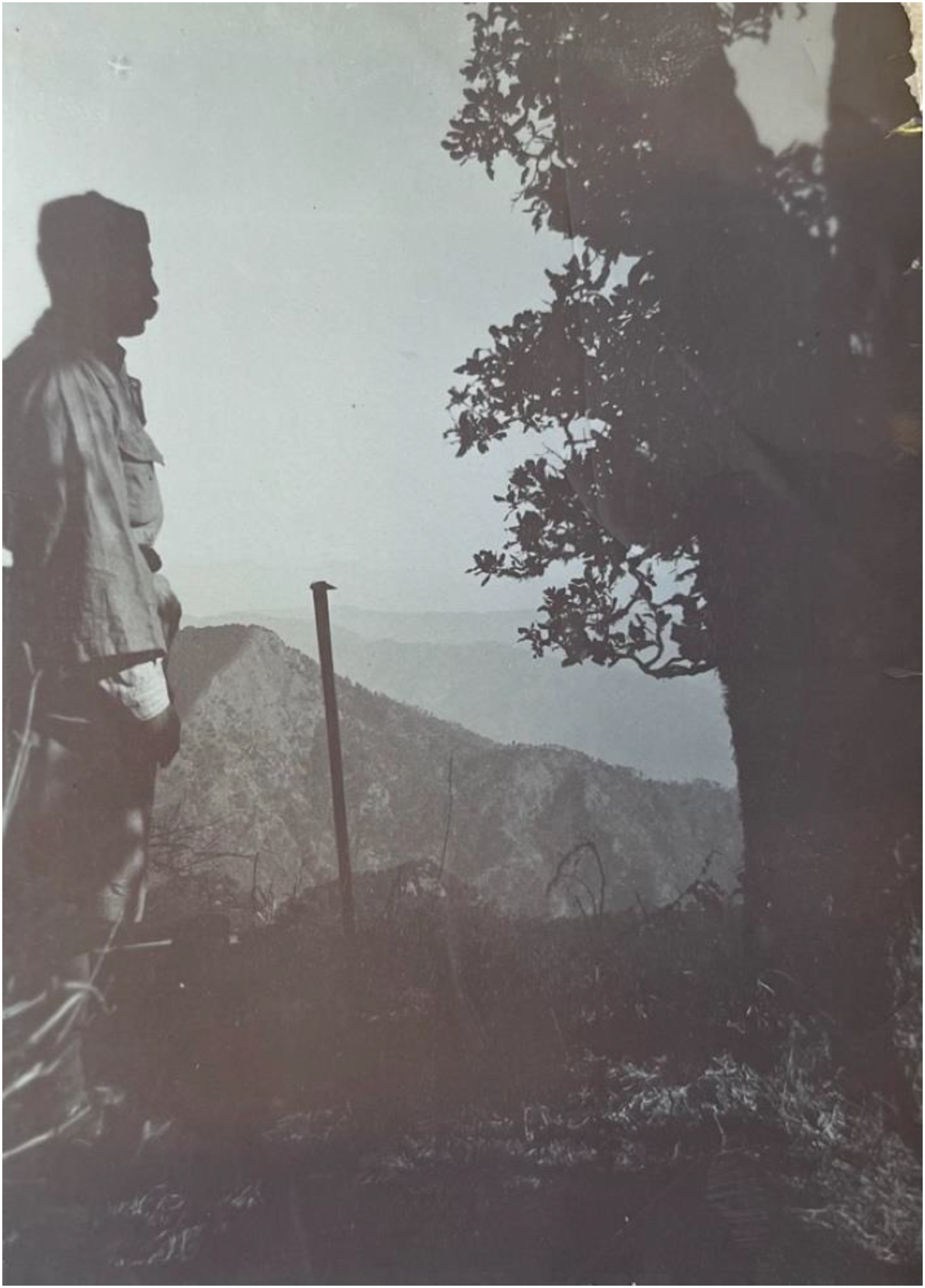
A photograph of Kyazim Kukeli in Albania by Aubrey Herbert, c. 1907–13 (DD/DRU 38. Reproduced courtesy of Somerset Heritage Centre).
Albania captured Herbert's imagination as it appealed to his noble instincts. Believing himself part of a family with an ‘unbroken legacy from the Middle Ages’, his hierarchical worldview, based on pre-industrial ideas of aristocratic Englishness, looked ‘out of date by the 1890s’ and towards the end of his life was ‘downright anachronistic’. Herbert never felt comfortable in Britain where the social relations and codes of honour he idealized were being eroded through the rise of the commercial middle-classes, organized labour and demands for women's suffrage, causes that he was known to despise. 90 He noted that his sense of self ‘worked better in old semi-civilised communities’ like Albania where ‘the chivalry of the Middle Ages continued to exist’ and the population retained the values of ‘truth, courage, and fidelity’ being ‘very like English squires’. 91 There was a critical difference between Herbert's idealization of the perceived timelessness of peasant communities in Albania and the liberal perspective on the Balkan Slavs. 92 The Balkan Committee interpreted the peasant proprietor societies of the Slavic Balkans as an ‘antidote’ to the materialism and degeneration of British society, particularly by providing a discursive vehicle to promote land reform to create Britain's own class of peasant landowners, as Perkins identifies. 93 Herbert's view of Albania was more reactionary than reformist. Rather than framing south-eastern Europe's peasant societies as transnational archetypes through which domestic policy concerns could be addressed, Herbert perceived Albania as an escape from the increasingly democratized nature of contemporary society, a retreat into ‘those far-off days before acceleration was regarded as a manifestation of civilisation’. 94
Herbert sought to explain Albania to the British public at the behest of Kukeli who urged him to ‘speak well of his people’. 95 Herbert visited Albania for the first time in 1907 and over the following two years travelled extensively, acquiring greater knowledge of its people and politics, before writing his first articles about the country under the pen name Ben Kendim. The first of these, ‘Riza Bey’, provided what Daut Dauti calls ‘basic, informative knowledge’ of the Ghegs for readers who likely knew little about them. 96 This article, however, was more than an account of the customs of northern Albania as it expressed deep sympathy for and connection with the Albanian people that derived from his friendship with Kukeli: ‘They are’, he concluded, ‘good friends, and if they have their faults, well there is the Turkish proverb, “He who wants a faultless friend, friendless will remain”’. 97 Despite holding admiration for the Albanians, Larry Wolff's assertion that Herbert ‘developed a feeling of committed partisanship’ during his early travels must be qualified because his commitment to the country was secondary to broader support for the Ottoman Empire. 98 He argued for Albanian autonomy within a reformed empire rather than independence, a position similar to that of Albanian nationalists before the Balkan Wars, and romanticized the Ottoman elite as ‘the dearest old boys’ with whom it was ‘love at first sight’ through a sense of class-based kinship. 99
Herbert enthusiastically supported the CUP and attended the ceremonial opening of the revolutionary parliament in Istanbul. He wrote an account of the occasion for The Spectator in which his admiration for the reformers was clear: ‘Will these men from the country who have done so much, be able to hold their own against European intrigue and the rapacity of the West? Inshallah’. 100 In the aftermath of the revolution, Herbert travelled from Mitrovica to Peja and realized as Durham had that there was a divergence between Albanian expectations and the reality of the CUP programme. He wrote that the nationalists ‘thought that the constitution was simply the sharia, the opposite of what it really is’ and questioned whether they would consent to taxation and conscription. 101 Although foreseeing problems ahead, Herbert remained wedded to the Young Turk project and praised it as ‘one of the really great events of the world’ in his maiden speech to parliament following his 1911 election victory in South Somerset. 102
Herbert's election meant that he did not witness the unrest that gripped Albania in 1911 and 1912 and he only returned to the country once the revolt had subsided and the Albanians had won concessions from the CUP that amounted to ‘quasi-state’ status. 103 Herbert's travelogue of this journey was serialized in The Morning Post and projected a sense of optimism at ‘the golden future’ Albania had within the reformed Ottoman state. 104 Privately, however, Herbert's allegiances were shifting, because of meeting the guerrilla fighter Isa Boletini, who had spearheaded resistance to the CUP in Kosovo and was rumoured to command 20,000 men. This level of support indicated to Herbert the growing feeling among Albanians that autonomy was no longer the best path to defend their country from Greek and Slavic neighbours. More generally, Boletini embodied the pre-modern atmosphere that Herbert found enchanting about Albania: ‘he had a great and just reputation for courage and resource. His deeds had become legends, and his escapes from the Turks and Serbs, fables’. 105 Herbert romanticized the guerrilla fighter as comparable to Robin Hood, a personification since the publication of Walter Scott's Ivanhoe a century earlier of the pre-industrial social order of England that Herbert admired. 106
The outbreak of the Balkan Wars meant that the concessions won by the Albanians were not implemented, which forced the recalibration of Herbert's views. From being a Turcophile with Albanian sympathies, he became a proponent of Albanian independence as he recognized this as the only option to ensure the country's survival. Herbert emerged as one of the staunchest critics of the Balkan Committee, denigrating them as ‘a bunch of cursed old women’ as he suspected they were getting reports of atrocities against Albanians held back from the press. 107 In 1912 he formed the Albanian Committee, which he described as ‘a light canoe negotiating fierce rapids’ of pro-Slav opinion, that brought together an ideologically disparate membership, including what he called ‘political Mahommedans from the Gold Coast and many parts of the world’ who sympathized with their religious kin in south-eastern Europe. 108 Reflecting Herbert's conservative politics, as well as his aim of attracting a wide base of support for Albania, he framed the focus of the committee within wider imperial politics to encompass the promotion of ‘a good understanding between Christian and Mohammedan the world over’ to ensure the stability of British colonies in Africa, the Middle East and India. 109 A similar imperial orientation was taken by the Ottoman Association, which Herbert founded in 1913 with the aim of ‘averting a lamentable upheaval in our Indian Empire’. 110 Indeed, the Indian Office noted that the pro-Christian commentary of the Balkan Wars was inflaming anti-colonial sentiment among India's Muslim population. 111 Despite Herbert's shift towards Albanian independence, the founding of the Ottoman Association demonstrated that his allegiances in south-eastern Europe remained somewhat conflicted. As Bejtullah Destani and Jason Tomes note, he was simultaneously campaigning ‘to defend ailing empire and new-born state’. 112 Herbert's equivocal stance contrasted with Durham who criticized ‘the wreckage of dead Empires’ strewn across Albania and believed the country should ‘be left to work out its own salvation’. 113
The immediate purpose of the Albanian Committee was to assist Qemali's Albanian delegation in the Treaty of London negotiations, but more generally it was to inform the British public about the country. 114 As Herbert wrote, ‘The general impression was that the Albanians were another branch of the Armenian family, and indeed, as far as massacres were concerned, this was most understandable’. 115 The dissemination of information about Albania was primarily undertaken through a series of pamphlets published by the Committee, which included first-hand accounts of the atrocities committed by allied forces and descriptive travel narratives about the country. Following news that Serb and Montenegrin generals were boasting publicly of massacring Albanians, Herbert wrote that the allies were carrying out a ‘deliberate policy of extermination’ against ‘undeniably the oldest inhabitants of the Near East’. Justifying Albanian territorial claims by tracing their ethnogenesis to the ancient Illyrians, he characterized them as ‘a noble race of men – fearless, brave, industrious and truthful’ and a ‘valuable element’ for the future development of Europe. By depicting the Albanians as a historical ‘European’ people, Herbert hoped to persuade British readers that the country was deserving of ‘the reasonable minimum territory’, which he delineated as those regions in which the Albanians comprised a ‘compact mass’ of the population, stretching from Arta in the south to Novi Pazar in the north and east into Macedonia. 116
Under Herbert's leadership, the Albanian Committee provided a counter-discourse to pro-Christian liberal commentary by emphasizing the religious and linguistic unity of Albania. The differences between Gheg and Tosk dialects were said to be no more than that of ‘the popular speech of Northumberland and Somerset’ and religion was described as subsidiary to ‘the national sentiment’. To counter liberal claims of ‘fanatical’ Muslim atrocities against Christians in the Balkans, the committee stressed that Albanian nationalists ‘do not wish to create a Mussulman state’ and that the country's Muslim inhabitants ‘know how to respect the beliefs of all’. 117 To explain that Albania's confessional diversity was not a barrier to self-rule, the committee compared the country to Switzerland, ‘whose aptitude for self-governance is unquestioned, in spite of the fact that there are also wide divergencies among them both in language and blood’. The goal of this representational emphasis on the unity of the Albanians, as Herbert made clear, was to challenge Greek and Slavic demands for the country's partition based on apparent linguistic and religious divisions. 118
To preserve the balance of power between Austria-Hungary and Russia in the Balkans, the Treaty of London returned Shkodër to Albania, a decision enforced through an international garrison in the city and the establishment of an International Control Commission to facilitate the building of Albania's state apparatus. Despite this victory for supporters of Albania, the national boundaries determined at the conference were less extensive than those proposed by Herbert, notably because Kosovo and Malësia were incorporated into Serbia and Montenegro. He complained that this decision undermined the viability of an independent Albania because ‘every fertile spot was the prize of greedy invaders’. 119 In a lengthy article in The Spectator penned from Shëngjin, Herbert tried to generate sympathy between Albania and British readers to pressure the government to support territorial adjustments in Kosovo and Malësia: the coastal town, he wrote, was filled with ‘streams of refugees’ fleeing ‘political, racial, and religious massacres’ in occupied territories that ‘would horrify the civilised world, if they could find a place in the press’. He compared the abuses suffered by Albanians to the ‘horrors’ faced by the British during the Indian Mutiny and urged the European powers to appoint a prince to rule the country, a position filled by Prince Wilhelm of Wied in early 1914. 120
The Prince of Wied had not been the Albanians’ favoured choice as the Provisional Government had been keen to make Herbert their sovereign, an offer that appealed to his ‘romantic nature’. 121 Indeed, when travelling in the country in 1913 he was lauded as ‘the paladin of liberty’ and crowds chanted ‘Hurrah for Herbert!’ in the streets. 122 Herbert, however, declined the offer after the intervention of Edward Grey, the Foreign Secretary, who did not want Britain to be ‘drawn into the Balkan tangle’. 123 Despite turning down the Albanian crown, Herbert promoted the suitability of the Albanians for a foreign prince as they had been ‘perfectly willing to recognise the authority of and to carry out any orders given by the Commission of Control’, a portrait far removed from the rebellious image of Albania that the country's opponents articulated. 124 Herbert's textual representations of the obedience of the Albanians were particularly important in countering news of the formation of a rival Albanian government in Durrës led by Essad Pasha Toptani, a warlord from Tirana, that made front-page news in Britain's leading pictorial weekly, Illustrated London News, and seemed evidence to liberals of the country's fractious nature. 125 It should be noted that Durham's staunch opposition to external interference in Albania meant she was less convinced about the need for a ‘wholly incapable and incompetent’ foreign prince, writing that the story of Prince of Wied's appointment was ‘among the most sordid that the Powers have woven’. 126
The treaties that concluded the Balkan Wars left unresolved the status of Epirus, which became the focus of Herbert's activities in Albania until the July Crisis. Conflict in Epirus did not cease following the Treaty of Bucharest that ended the Second Balkan War as Greek paramilitaries established an autonomous republic at Gjirokastër. 127 In tandem with this guerrilla conflict, a war of representations erupted in the British press between Herbert and members of the Anglo-Hellenic League and the Aegean Islands Committee who put forward what W. P. Reeves, chairman of the former organization, called ‘a plea for civilised Epirus’ under Greek administration. 128 In a series of reports authored from southern Albania, Herbert emphasized that Greek insurgents had abandoned ‘the codes of chivalry’ of their Classical ancestors and contrasted them against the noble Albanians ‘fighting for their life, their liberty, and their language’. 129 Herbert's romantic view of the Albanian cause in Epirus met a stony reception in Britain as philhellenic writers estimated that seventy per cent of Epirotes ‘so earnestly desire union with Greece that they are ready to fight and die for it’. 130 He was accused of making ‘sweeping accusations against the Greeks’, of ‘propagating calumnious charges’ and labelled a ‘Simple Simon’, a ‘curious crank’ and a believer of Albanian ‘cock and bull stories’. This unfavourable perception of Albanian claims on Epirus was reflected in textual representations in which the region's Greek inhabitants were portrayed as ‘cultivated gentlemen, officers, scholars, and business men’, a population with a historical and cultural right to govern Epirus. 131 In contradistinction, the Albanians were described by Captain A. H. Trapmann, who followed the Greek army in the region, as ‘semi-civilized bandits, without education, without cohesion, or at least ambition for national existence or legislation’. 132 Reeves summarized the dominant perception well when he asked of Epirus, ‘To Greece or to Albania? To progress or to stagnation?’ 133
IV
The First World War brought the Greek army's occupation of Epirus, and Herbert wrote that his championing of Albanian claims was now ‘irrelevant’. 134 Indeed, his support for the country ultimately amounted to little, as the Prince of Wied and the International Control Commission fled the country, leaving it with few state structures and at the mercy of its neighbours. 135 The outbreak of war left Durham similarly disaffected. She was in Vlorë when Archduke Franz Ferdinand was assassinated and hoped that the involvement of Bosnian Serbs would turn Britain against Russia. She reported her ‘shame and disgust’ when she found that Britain had ‘declared war on the side of the Slav’. ‘The cup of my humiliation was full’, she wrote. 136
Durham and Herbert ‘collaborated harmoniously enough’ during their careers, but as we have seen their views on Albania did not always correspond. 137 This was particularly so during the First World War, as Herbert's loyalties were conflicted because of his longstanding admiration of Italy, which sought to extend its influence in Albania. ‘If a man can have a second country’, he declared in 1912, ‘Italy is my second country’. 138 Indeed, the first work he published under ‘Ben Kendim’ was not about Albania but the lands surrounding his familial villa in Portofino. 139 Before the war, authorities in Montenegro had even suspected he ‘was an Italian bent on mischief’ because of his reliance on Italian for communication. 140 Herbert's Italian connection gained concrete form during the First World War, as his last visit to Albania in 1918 was as a liaison officer attached to the Italian army that occupied the country to varying extents between 1916 and 1920. 141 He believed that Albania's political and economic stability could be improved by a ‘vague form of Italian suzerainty’ and unsuccessfully pressured the British government to propose such an arrangement. 142 It should be emphasized, however, that Herbert's opinion on Italy's presence in Albania was ambivalent; he believed that the Albanians, divided between pro-Italian and anti-Italian camps, should have the final say. ‘If only the Albanians could agree amongst themselves there would be very little to fear’, he concluded. 143
Durham, by contrast to Herbert's equivocal position on Italian influence, lamented that Albania had become ‘the prey of … unscrupulous European intriguers’ who ‘wish her destruction’. 144 In response to the Italian occupation of the strategically important island of Sazan off the coast of Vlorë in 1914, Durham ‘felt it her duty to set foot on the island to protect it from all rival claimants’. Harry Hodgkinson, a friend of Durham in her later life, wrote that she, ‘Stuffed an Albanian flag into her blouse and advanced to the beach, she had to her chagrin tried without success to induce any of the boatmen to brave a storm and take her over’. 145
After Herbert's noted wartime career in military intelligence his influence went into decline, although his acquaintance with Lord Robert Cecil, an architect of the League of Nations, was important in securing Albania's ascension to the organization in 1920. Incapacitated by increasing blindness, his anachronistic worldview had few political allies, an exception being the future leader of the British Union of Fascists, Oswald Mosley, which indicates the direction his politics might have taken had he not died in 1923. 146 After Herbert's death, Durham cut an even more isolated figure in British politics: her hatred for Serbia outweighed her interest in Albania, which she visited for the last time in 1921, and she became infamous for her ‘extreme revisionist’ stance on the war's origins that had much in common with German reactionaries. 147 For these controversial views she was largely ostracized from political life and her work discredited as no better than ‘pothouse gossip or braggadocio’, although she remained a prominent member of the RAI and authored her final article on Albania in 1941 denouncing Mussolini's invasion of the country. 148
V
The outsider status of Durham and Herbert certainly limited their post-war legacy, but it was also what attracted them to Albania in the first instance, as they identified with the country because its ‘unbefriended’ status mirrored their peripheral position within British politics and society. 149 This was in marked contrast to liberal champions of the Southern Slavs, who were propelled to greater prominence in the interwar period following Britain's alliance with Serbia and the post-war creation of the Kingdom of Serbs, Croats, and Slovenes. Despite this, the prolific travel writing and political commentary of Durham and Herbert represented an important counter-discourse that challenged the tendency of liberal commentators to ignore the political demands of Albanian nationalism, albeit one which shared many of the anti-modern representational motifs present in discourses about the Southern Slavs. Both travellers battled the tides of political opinion to represent Albania as a unified and orderly nation with the capacity for self-governance, a feature of British discourse about the Balkans which has been overlooked in revisionist historiography that has been primarily concerned with the Balkan Committee.
The personal motivations and concerns behind Durham and Herbert's images of Albania represent an element of cross-cultural representation that has been regularly overlooked by imagological scholarship focused on what Patrick Finney calls ‘outlining the lineaments of discourse’. 150 Although imagological scholarship about the Balkans has made a great effort to distinguish itself from Said's Orientalism, it has frequently replicated the flaws associated with the orientalist paradigm, notably the identification of a ‘totalising project, a master-narrative of Western power’ that overrides pluralism. 151 Recent scholarship on liberal advocacy for the Southern Slavs has brought a greater degree of nuance to the study of Balkan imagology by emphasizing historical contingency and tangible points of contact between Britain and the region that shaped patterns of perception in more complimentary forms than the Balkanism thesis allows for. Nevertheless, these studies often eschew examination of ‘authorial idiosyncrasies’, which destabilized dominant discourses about and established atypical political allegiances with south-eastern Europe's nationalities. 152 The case of Durham and Herbert's championing of Albania, therefore, underlines the need for imagological scholarship to attribute greater significance to individual experiences of the Balkans, as textual representations are ultimately refracted through the personal concerns of those doing the perceiving.
Footnotes
Acknowledgements
Thank you to the archivists at the Somerset Heritage Centre who were ever helpful during my research on Aubrey Herbert and to Professor Churnjeet Mahn, Dr Mirna Šolić and Dr Nicholas Barnett who advised on earlier drafts of this article.
Funding
The author disclosed receipt of the following financial support for the research, authorship, and/or publication of this article: This work was supported by the Scottish Graduate School for Arts and Humanities.
