




Abstract
Focused on transnational exchanges, this article examines a series of trips to Fascist Italy that were undertaken by pupils of Nazi elite schools in their role as youth ambassadors of the Third Reich. As a form of cultural diplomacy that continued during the Second World War, these trips were part of Fascist and Nazi efforts to foster a new cultural order. However, although intended to strengthen ties between the two regimes, the trips also laid bare national differences.
In August 1937, a group of pupils from one of Nazi Germany's elite state secondary boarding schools, the National Political Education Institutes (Nationalpolitische Erziehungsanstalten [NPEA]), embarked upon a week-long school trip to cultivate contacts in Fascist Italy, in their capacity as hand-picked future leaders of the Third Reich in all walks of life.
1
In a retrospective account published at the beginning of the following year in the school's newsletter, one of the pupils in question expounded the rationale behind the visit as follows: As Jungmannen [pupils] of a National Political Education Institute, Italy interests us because it is the country which in its politics is most tightly linked with Germany, whose Weltanschauung accords to the greatest possible extent with ours, and which together with us battles the greatest enemy of humanity. We wanted to see how another people tackled the problems which, due to our similar situation, are in part the same as those which we have to solve. We wanted to get to know the youth of an allied state, and, if possible, cement ties between us and them. … The other three ‘Italian groups’ from the institutes at Ilfeld, Potsdam and Spandau were officially travelling to Italy for ‘study of the Balilla’ [the Fascist youth organization]. We were [also] supposed to get to know the Italian Volk and Mussolini's politics.
2
During the last fifteen years or so, in the wake of the so-called ‘transnational turn' in historical scholarship, ever more attention has been paid to the significance of entanglements and transfers between fascist regimes and movements, and the necessity of considering their political, social, and cultural development transnationally, rather than from a strictly national perspective. 6 Following the publication of Sven Reichardt and Armin Nolzen's ground-breaking comparative volume in 2005, analyses of Fascist Italy and Nazi Germany in this vein also began to proliferate, emphasizing the importance of exchange and transfer between the two dictatorships, and the complex ways in which their troubled relationship evolved over time. 7 Such approaches have proved especially rewarding in the sphere of cultural diplomacy, which has recently received sustained attention in a series of influential monographs by Benjamin Martin, Christian Goeschel and Nils Fehlhaber. 8
From this perspective, as scholars of transnational fascism such as Arnd Bauerkämper and Gregorsz Rossolinski-Liebe have noted, despite being frequently overlooked, youth interactions can provide a particularly fruitful sphere for the examination of mutual perceptions, cross-border networks, and cultural exchange. 9 Young people, in their capacity as present and future advocates and disseminators of fascist policy and ideology, often played a significant role in cementing international relations between the various fascist regimes and movements. 10 Initiatives involving youth representatives should therefore be seen as part and parcel of a more ‘holistic’ approach to foreign policy which extended well beyond the confines of ministerial or ambassadorial discourse, and which positioned such social and cultural encounters as key armaments in both dictatorships’ diplomatic arsenal. 11 Hence, it is necessary to move beyond mere observation of the two fascist regimes’ extreme commitment to the ideological rhetoric of youth, and to consider the youthful actors who represented them in their own right. 12
While numerous works have delineated the activities and structures of the Hitler Youth and the Opera Nazionale Balilla (ONB) or Gioventù Italiana del Littorio (GIL) separately, and Alessio Ponzio's comparative study of these two youth movements, Shaping the New Man, also contains two suggestive chapters focusing on interactions between youth leaders in Italy and Germany, none of these studies have systematically examined the perceptions of the young people in question when encountering the fascist ‘other’. 13 The following article aims to remedy this deficit when it comes to considering the actions, interactions and reactions of youthful participants in fascist cultural diplomacy via an in-depth exploration of NPEA-pupils’ perceptions of Mussolini's Italy, with a particular focus on their encounters with members of the ONB or GIL. 14 The source-base consulted consists of the entire corpus of personal and official documents (including diaries and school newsletters) upon which I drew for my comprehensive monograph on the NPEA, encompassing accounts from trips from a wide variety of different schools which took place during the 1930s and early 1940s; the two case studies discussed below have been chosen for detailed analysis due to their representative and substantial nature, while other relevant accounts are cited throughout as supporting evidence. 15
In analysing the German elite-school pupils’ encounters with the Fascist youth movement (which go unmentioned in Ponzio's study, since they did not explicitly take place under the aegis of the Hitler Youth), I draw in particular upon recent research which presents the performative aspects of cultural diplomacy and personal interaction as crucial to the forging and long-term stability of the Axis alliance. From this perspective, as Christian Goeschel has noted, the influence of prevailing national stereotypes must also be acknowledged if we are fully to comprehend the complexity of that ‘strange mix of reciprocity and hostility, of ambivalence and adoration’ which fuelled interactions between Fascist Italy and the Third Reich, shedding light on what Nils Fehlhaber has termed the ‘paradoxical contrast’ between brutality and friendship which consistently characterized Italo-German relations during this period. 16 This state of affairs was both predicated upon – and exacerbated by – a German centuries-old tradition of hostile anti-Italian national stereotyping, which had grown particularly virulent when fused with contemporary racial theories which castigated the so-called ‘Mediterranean peoples’ as ‘racially inferior’. 17
Interestingly, this investigation also bears out Jana Wolf's hypothesis that neither the Italian nor the German authorities were particularly interested in fostering mutual connections between their respective youthful ‘elites'; hence, the NPEA do not appear to have made a priority of engaging with the ONB/GIL ‘Collegi', which performed a similar function within their own scholastic universe. 18 We might ascribe this approach – which bears a marked difference to the Napolas' constant attempts to engage with the supposedly ‘racially related' future leaders at British public schools and U.S. academies – to such stereotyping, as well as to a wish to engage specifically with more ‘ordinary’ Italians. On the few occasions for which we do possess evidence of interactions between NPEA-pupils and pupils at Fascist academies (see below), German perceptions of the Italian students still seem to be mediated through ideological frameworks of racial hierarchy, rather than being moulded by expectations of mutual respect.
Given the heterogenous nature of the trips undertaken by the NPEA-pupils, which were largely initiated by the elite-schools themselves, and which rarely involved sustained long-term engagement with any one single ONB or GIL group, the following analysis focuses upon the experiences and accounts rendered by the German participants, paying particular attention to the ways in which national and racial stereotypes coloured their view both of their Italian counterparts, and of the Fascist regime in general. Most of the German pupils who participated in these trips would have gone on to serve as officers in the Wehrmacht and the Waffen-SS, and the racist ideas of Italian inferiority which were cultivated during their travels may also have played a role in their subsequent treatment of Italian soldiers and civilians, both before and after Italy's capitulation to the Allies in September 1943. 19
As mentioned above, relevant sources include a number of first-hand accounts written at the time by NPEA-pupils and teachers who travelled to Italy as part of this programme, including journal entries – some of which were published for wider consumption in school newsletters. While the schoolboy authors may have glossed over some aspects of their experiences in accounts which were published in these newsletters, often focusing on those themes which were deemed to be of particular political relevance, the overlap between private and public-facing accounts suggests that the depictions of events (and of German attitudes towards their Italian counterparts) are generally trustworthy. Analysis of the corpus of NPEA newsletters when compared with accounts written in pupils' private diaries, which can more straightforwardly be styled as ‘ego-documents', shows that texts from the diaries were often changed only very superficially on publication, with the correction of orthographical or typographical errors as the only substantive change to be introduced by members of school staff. On occasions where we possess both ‘private' and published accounts, for the most part, the difference is negligible. Whether pupils had wholly internalised Nazified prejudices, or whether this ideological style of writing was inherently performative, this performativity still surfaced in ostensibly personal accounts. That even the more ‘private' accounts should have been steeped in Nazified ideological assumptions should scarcely surprise us, however, given how deeply the Napola-pupils were steeped in the regime's doctrine throughout their sojourn in these ‘total institutions’, with alternative frames of reference being deliberately suppressed. 20
The article will begin by briefly contextualizing the youth diplomacy practised by the National Political Education Institutes both in terms of the ideological curriculum offered by these elite schools, and within the broader context of Nazi-Fascist youth exchange. It will then consider the scope of the schools’ ‘fascist interactions’ and their political aims. Focusing in particular on two longer case studies, the performative aspects of the cultural diplomacy practised by participants will then be explored, along with the influence played by racist stereotypes on the German boys’ perceptions of the Italians whom they met. In conclusion, the article will articulate the significance of these findings for our understanding of the Rome-Berlin Axis.
The Nationalpolitische Erziehungsanstalten, colloquially known as Napolas, were state-run boarding schools for pupils aged 10–19; they were first founded as a birthday present for Hitler in 1933 by the Prussian Culture Minister and later Reich Education Minister Bernhard Rust. By the end of World War II, there existed approximately 40 of these schools in all corners of the ‘Greater German Reich’, including present-day Poland and Czechia, Flanders, and Holland. Pupils who attended the schools were supposed to become members of the regime's elite in all walks of life – not just the armed forces (though pre-military training featured prominently in the curriculum), but also in politics, academia, journalism, and other professions.
The NPEA were open to children of any background, and prospective pupils were subjected to a rigorous and gruelling selection process, which not only tested their alleged ‘racial purity’ and academic abilities, but also placed extreme emphasis on physical prowess and sheer courage. Boys who successfully passed all aspects of the selection examination would join their Napola's first ‘Zug’ or platoon (the word used for a class), learning to live in a highly militarized and enclosed boarding-school community. The schools provided an extensive variety of activities – academic lessons, though taken seriously, took a back seat compared with physical education, which included the opportunity to learn to ride, glide, sail, drive and ski, as well as pre-military training. Pupils also had the chance to visit many European countries as the Reich's ‘cultural ambassadors’, and took part in long-standing exchanges and sporting tournaments with English public schools and U.S. academies. 21
It is in this context that NPEA-pupils acted as youthful ambassadors between Hitler's Germany and Mussolini's Italy. On one level, trips to Fascist Italy merely formed part of the overarching NPEA programme of visiting and establishing ties with a whole raft of neighbouring countries, with the intention of fostering German interests in regions where border disputes were rife, or where political cooperation might be considered particularly cogent. 22 Trips to countries all over Eastern Europe, Scandinavia, the Baltic States and the Balkans, as well as the Mediterranean, Britain, and occasionally even the Americas, were considered a key feature of the Napola education. While the trips to other countries in Southern and Eastern Europe generally served the purpose of cementing relations with ‘ethnic German' youth, and fostering revanchist sentiments among their communities, and trips to allegedly ‘racially related' countries such as Britain and the Nordic states were intended to build ties whilst also showcasing Germany's undisputed fitness to lead the world's ‘white nations’, the political aims of the Italian trips in terms of cementing fascism were arguably unique, as was the blend of praise and prejudice which accompanied them. 23
However, during the 1940s, the NPEA also served the interests of the Reich Youth Leadership by providing groups to undertake return exchange visits to GIL-chapters which did not require direct organization by the Hitler Youth, and by fostering frequent contact with expatriate representatives of the Hitler Youth in Italy (Auslands-HJ). 24 From this perspective, the NPEA trips to Italy also fit neatly into an existing pattern of reciprocal exchange between the two fascist youth movements, spearheaded in the first instance by their respective leaders, Renato Ricci and Baldur von Schirach. 25 Despite a marked cooling off in relations at the time of the failed Nazi coup in Austria, which scarcely accorded with Mussolini's foreign policy aims at the time, by 1936–1937, the youth alliance had come into its own. 26 Thereafter, despite the dismissal of his close friend Ricci, which accompanied the Fascist youth movement's wholesale absorption into the Party apparatus, Schirach's plans for wide-ranging cooperation between the two organizations continued to burgeon both before and after the outbreak of World War II, including the initial formation of a European Youth Association which was intended to encompass all of the allied youth movements, jointly led by the Hitler Youth and the GIL, in September 1942. 27
Above all, the aim of the NPEA visits to Italy was to foster a form of soft ‘cultural diplomacy’, whereby potentially useful contacts and acquaintances could be fostered, and the youth of each nation could gain an appreciation of the other's customs and political ideals. While the German boys might be encouraged to appreciate Italy's natural and cultural beauties and its ancient past, including its supposed resurrection in a new ‘Roman empire’, establishing connections with the Fascist regime was ultimately considered most important.
28
A report by Hauptzugführer Leitzke, a senior teacher at NPEA Ilfeld, reflecting on a trip which took place in 1942, sheds further light on the aims of the programme at this time: We are marching together with Italy in the battle for the future of our Reich and of Europe. To make a friendly visit was the official task of our journey, which was carried out in cooperation with the Reich Youth Leadership; we were reciprocating similar visits by Italian groups to the Reich. Through such personal contacts, the allied peoples should get to know and understand one another better. Since we were in far closer contact with the Fascist Party and Italian youth in Italy, we really came far closer to the Italian way of life than is normally possible on a three-week-long trip. We therefore had a particularly good opportunity to get to know the aims and achievements of Fascism. We recognized how similar in many ways are the preconditions from which Fascism and National Socialism grew, and hence how related their aims are, but the comparison also demonstrated the differences, which stem from differences in racial/national character, the historical situation and economic conditions. … Thus, a journey to Italy offers multifarious possibilities. It cannot simply be a pleasure trip, but rather it is the apogee of our educational work. This was what we wished our trip to be, and we are thankful that we could realize our plans with the help of the German and Italian authorities.
29
The programme which the trips followed varied: elements of sight-seeing and cultural edification might predominate at times, especially during the pre-war years – for instance, in summer 1937, pupils from Berlin-Spandau travelled to Verona, where they attended a performance of Turandot in the amphitheatre, experienced the delights of Rome, Florence, Ischia, Vesuvius, and Naples (including the Museo Nazionale) – but also visited a Balilla camp in Siena. 32 During the 1940s, a more dedicated commitment to sustained collaboration with the Italian youth movement often came to the fore – as in the case of those pupils from NPEA Wien-Breitensee who were sent to GIL summer camps. 33 In February 1942, 10 representatives from the NPEA were also selected to compete at the Axis Youth Winter Games in Asiago, where they made contact with members of the pro-Nazi Hungarian, Slovak and Croatian youth movements, and received the Italian youth leader, Sandro Bonamici, at their camp, as well as paying a visit to the ‘Gauleiter’ of Verona on their way home after the games had ended. 34
In similar vein, pupils from NPEA Berlin-Spandau regularly formed a guard of honour for Fascist dignitaries visiting the Nazi capital, including Education Minister Giuseppe Bottai, Renato Ricci, and Galeazzo Ciano, while pupils from NPEA Plön were even selected to participate on 25 September 1937 in the gargantuan parade before Hitler and Mussolini in Munich which celebrated the cementing of the Axis alliance (see Figure 1). 35 Indeed, SS-Obergruppenführer August Heißmeyer, the second Inspector of the NPEA, went so far as to use a calque of the Italian Fascist slogan ‘Believe, Obey, Fight’ (‘Credere, obbedire, combattere’ / ‘Glauben, gehorchen, kämpfen’) as an NPEA motto. 36 Graduates from a number of GIL academies also appear to have visited an NPEA on at least one occasion, in March 1942, and Bottai himself paid visits to various Napolas during the 1940s, including NPEA Klotzsche, near Dresden, which he inspected at the end of September 1941. 37
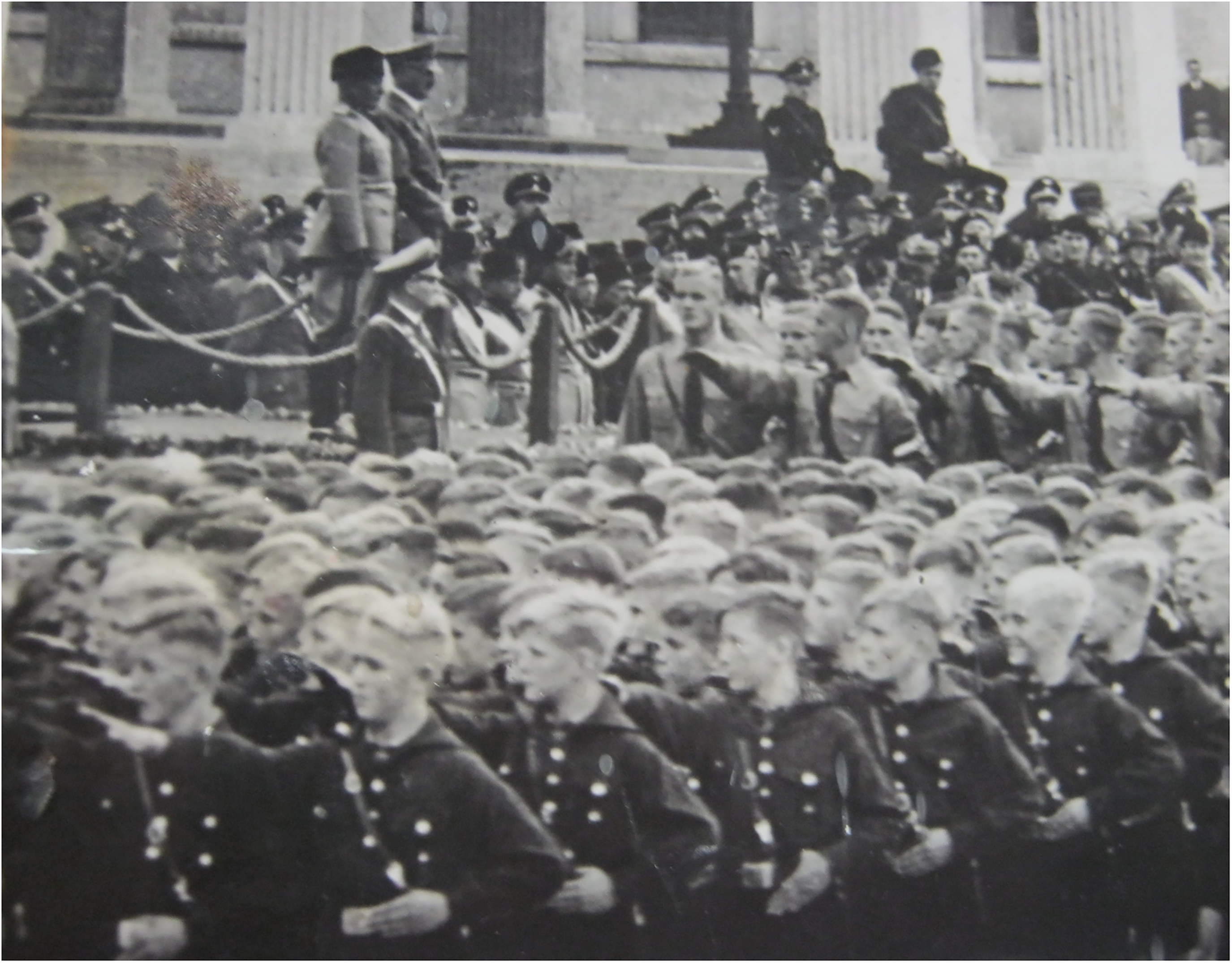
Pupils from NPEA Plön participate in the march-past which took place before Hitler and Mussolini in Munich on 25 September 1937, in celebration of the forging of the Rome-Berlin Axis (photograph reproduced courtesy of Harald R., former pupil of NPEA Plön).
Although all of these collaborations and contacts were summarily shelved after Italy's capitulation to the Allies, when Napola-pupils were more likely to decry the Italians as ‘Badoglio-swine’ than to desire to engage with them diplomatically, 38 they nevertheless betray the importance which had been attached to the programme, especially once opportunities for travel in other parts of Europe had been systematically curtailed by the outbreak of war. By the early 1940s, Italy was one of the most frequent destinations for extended trips by Napola-pupils, and former pupils’ eyewitness testimonies often wax lyrical about how amazing it was to have the opportunity to travel there, even in wartime. 39
Even if encountering local wine and girls, and exploring gorgeous Italian landscapes were at least equally significant in personal terms for some of the Jungmannen who participated, 40 establishing contact with members of the Fascist administration and Party functionaries, as well as with ‘German schools’, consulates, and representatives of other expatriate German institutions such as the Auslands-HJ, was officially considered crucial to the success of the Napola ‘missions’. 41 Thus, surviving accounts of the NPEA-pupils’ travels abound with numerous depictions of meetings and receptions by Italian youth leaders; tours of Fascist institutions and model towns or factories; presentations of symbolic gifts such as the Italian youth medal or the most exalted sporting trophy of the Italian youth movement, and generally heartfelt welcomes by local dignitaries and GIL groups. 42 These frequent and often rather formulaic cultural-diplomatic encounters allowed the participants to ‘stage’ friendship between the two Fascist nations via a common vernacular of reciprocal speeches, sing-songs, and the observation of common rituals of guest-friendship via the Italian hosts’ lavish provision of food and drink, even when the two groups might have difficulties understanding each other’s language. 43 From the German perspective, the tours of Fascist youth headquarters (known as GIL-houses) and other Fascist educational institutions, such as the GIL Academy in Rome or the German School in Florence, usually met with much approbation and appreciation for the high standard of their amenities (indeed, the facilities laid on by the local Hitler Youth leaders might at times be found wanting in comparison). 44
However, attitudes towards the Italians whom the NPEA-pupils met (including GIL representatives) were not always so stable, nor so overwhelmingly positive. The following section will therefore explore the NPEA-pupils’ experiences and perceptions of these encounters in more detail, focusing in particular on two case studies. We will begin with a trip undertaken in April 1942 by NPEA Ilfeld, before moving on to the account of the 1937 trip by NPEA Köslin which was first quoted at the start of the article. 45
The first account, written by Jungmann von Schmeling, is entitled ‘The memorable day of Andria’.
46
Beginning in medias res, the author describes the Ilfeld group's arrival at the town of Andria in Apulia, home of the thirteenth-century fortress Castel del Monte, whose connection with the Hohenstaufen Holy Roman Emperor Frederick II (one of the more prominent historical heroes in the National Socialist pantheon) had made this an important place of pilgrimage for the group: The bus stops in front of the Casa Littoria, [the local Fascist Party headquarters]; the doors are thrown open. GIL officers … receive us and lead us past a guard of honour into the building. Commands ring out, and a fanfare greets us. We actually wanted to continue straight on to Castel del Monte … but when our plans are made known to the Italians, who incidentally can’t understand a word of German, we are requested to stay with truly genuine warmth. They have prepared everything for us with such touching forethought …
The group are informed proudly that their presence makes this a great day for Andria, recalling a long-ago visit made by Kaiser Wilhelm II, and they are led through the hustle and bustle of ‘loudly yelling’ street-traders to the town hall to meet the mayor.
47
The end wall of the great hall is draped with the flags of the two allied nations – in the German case, the black-white-red imperial flag which had previously been flown in the Kaiser's honour had simply had a swastika stitched on top of it. The mayor, who is approvingly described as ‘a large well-built man, blue-eyed and blond’, welcomes the group with gifts of cigarettes (refused) and photographs of Castel del Monte (accepted).
48
Immediately, the boys are given a tour of the nearby military hospital, where they are instructed to greet the wounded Italian soldiers in each ward with cries of ‘Evviva’ from the corridor, while the chief medic and NPEA-staff inform the patients that their German comrades have come to greet them.
49
The group are then given a tour of the GIL headquarters, and driven to an agricultural college situated in a nearby former monastery, whose gymnasium has been transformed in their honour into a temporary banqueting hall, its well-laid tables liberally decorated with swastika-shaped flower arrangements: Towards the end [of the meal] the boys streamed into the hall and sang us the Giovinezza and their battle-song ‘Vincere’. We thanked them with the song of the Condor Legion and the ‘Englandlied’. Then they shouted ‘Heil Hitler’ and we ‘Evviva il Duce’. In the end, this developed into a full-on vocal duel, in which the Italians yelled ‘Hitler’ – or rather ‘'itler, 'itler, 'itler’, and we ‘Duce, Duce, Duce’. Then along with the students we still had to sing together what has practically become the Axis anthem, the inevitable ‘Lili Marleen’. The farewell was just as tumultuous; only with difficulty could our vehicles reach the main road.
50
Upon their return to the GIL headquarters in Andria, the group were then presented with a display of military and sporting exercises by the GIL, though the fact that female members contributed by posing gymnastically in quasi-military fashion was subsequently decried by the author as ‘laughable’. The visit was brought to an end with two song-and-dance numbers performed by the youngest children, a joint parade of both the Italian and German youth-groups, and a long speech of gratitude ‘larded with superlatives’ by Zugführer Leitzke, the leader of the German expedition, along with three cheers from the NPEA-pupils, to which the local population apparently responded with unceasing cries of ‘Evviva’ and ‘Heil Hitler’. 51 The performative nature of these effusions demonstrates the at least superficial effectiveness of ‘staging friendship' in this fashion, seemingly cementing relationships between the two participating national groups.
Throughout the account, much is made of the allegedly ‘Swabian’ blood which must surely still be present in the local population from the time that the city was ruled by the Hohenstaufen dynasty, and the inhabitants’ antiquarian affection for the relics of Frederick II, one-time doyen of Castel del Monte, is noted with great approbation. 52 The sturdy ‘ancient Roman’ build of many of the locals, their blond hair and blue eyes, are compared unfavourably with the ‘southern Italian’ look of the nearby port-town of Trani, which the author dismisses as ‘dirty [and] strongly racially influenced by the Orient’. 53
As this brief précis suggests, the overall tone of the account, while never making light of the generosity of the boys’ Italian hosts, is still often couched in rather patronizing, at times even quasi-Orientalizing terms. The connections of the local area, especially Castel del Monte itself, with Hohenstaufen rule – and the resulting claims regarding its German cultural heritage – are repeatedly affirmed, while the activities of the population at large and the manoeuvres of the local youth group are observed with a more critical eye, as well as a keen sense of the purported ‘racial differences’ between the Germans and the Italians. 54 Here, the ideology of German supremacy was combined with an idealized vision of the Italian past which had never existed in reality.
These themes are even more pronounced in the account by the group from NPEA Köslin with which this article began. The aim of the trip, which took place in August 1937, was ostensibly to speak to people in Italy about the National Socialist Weltanschauung, acting as ideological proselytizers, as well as attempting to ensure that they would make acquaintances in all circles of the Italian people, and learn more about the achievements of the Fascist regime.
55
However, the first part of the account of the trip itself focuses primarily upon the travails of the German-speaking population of the borderland region of South Tyrol (Südtirol), whose status as a newly-acquired Italian territory after World War I had long plagued the Nazi-Fascist alliance in foreign policy terms.
56
The author asserts that the Italian authorities had pushed forward harmful Italianization policies in the region at all costs, and that some of the German-speaking farmers there had ended up in prison merely on trumped-up charges of having spoken ill of Italy: It is also hard for us to answer the [German farmers] when they ask when they will eventually return to Germany; why the friendship between Italy and Germany has not led to a resolution of the Tirolean question; why this friendship should even exist at all, when the Italians don’t treat the Germans in a friendly fashion. One has to console them, request that they stick it out and – hope. One has to make it clear to them that the Third Reich's foreign policy, which has led to this friendship with Italy, is necessary … We … hope that by our presence we have at least strengthened their sense of belonging to the German people. By contrast with the Italians whom we encountered in the North as a minority, the others were very friendly and helpful. In particular, when they heard that we were German, they were enthusiastic and constantly assured us of their friendship. We got the impression that they genuinely took this friendship seriously, even if one can ascribe a large portion of their present enthusiasm to the Mediterranean temperament. After all, they’ve seen that it's in their own interest to foster good relations with Germany.
57
From this perspective, observation of alleged Italian ‘racial peculiarities’ could easily descend into racially-motivated vilification, leading the NPEA-pupils not only to perpetuate the widely-prevalent stereotype that southern Italians were inherently lazier and less capable of leadership than their Italian counterparts, but also to dismiss them as useful allies tout court.
60
A further example of this kind of national-racial stereotyping, which was to have extremely negative consequences for Italian troops and civilians after the Axis alliance had turned sour, can be found in an account by Walter Petricek of NPEA Wien-Breitensee, who had published a report of his participation at a GIL summer camp in the school newsletter: The Italian boys looked very orderly, fully dressed in uniform with khaki shorts and shirts, each with a gun in his arms. … They carried out all orders very strictly, but in the time when we were waiting around, when there was nothing to do, then they showed their Mediterranean temperament. For us it was completely self-evident that no one should move, not even a tiny bit, but the Italian boys – as we saw – behaved quite differently: scarcely were we all standing in the ‘at ease’ position than they began to turn their heads, whisper etc. Even at that time we noticed that the Italian is different from us; the Italian youth, the Italian soldier – he can put on an excellent parade, he is serviceable – but he only makes an effort when it's really necessary; as soon as the moment of the fiercest attack is over, then he relaxes much more than we’re accustomed to.
61
While there is no doubt that many German observers throughout this period were viewing Italy and the Italians through a Nazified racial lens, this habit is particularly apparent in the reports by the NPEA-pupils, who were especially attuned to the dictates of National Socialist ideology, given the constant indoctrination which they received both inside and outside the classroom. 64 Here, then, in microcosm, we can see the paradox of the Nazi-Fascist alliance laid bare. For, however enthusiastically the NPEA-pupils and their counterparts in the Italian youth movement might put on a convincing show of mutual friendship and solidarity, these ‘potent performances of unity’, of ‘working towards the Axis’, at least from the German perspective, usually masked deeper tensions which the two regimes’ deep-seated ideological affinities could never quite dispel. 65
Thus, just as the meetings of Hitler, Mussolini, and other statesmen promoted an image of Axis solidarity which was shaped above all by ‘contingency, strategic tensions, and national stereotypes’, so too were these personal meetings at the level of individual youth groups. 66 As Alessio Ponzio has argued, the analysis of such interactions can provide both a unique perspective when exploring the complex nature of the Nazi-Fascist relationship, and a means of appreciating the significant role played by Fascist and Nazi youth as ambassadors of the two regimes. 67 However, as the case studies and corpus analysis above have shown, closer analysis of the preconceptions and prejudices involved in such encounters also enable us better to appreciate the contested, competitive, and, at times, highly unstable nature of the Axis alliance. 68 As these examples have demonstrated, the regard held by National Socialist elite youth for Fascist Italy and the Italians was not wholly a propaganda construct. Yet, the political effects of Germany's long tradition of ambivalent attitudes towards Italy, characterized by a mixture of admiration for Italy's artistic heritage and beautiful landscapes and hostility to the Italians themselves, 69 in conjunction with the NPEA-pupils’ highly racialized education, meant that the ambivalence of their vision of Italy would never wholly be vanquished.
In conclusion, then, we can see that existing nationalist antagonisms made the overarching ideological, political and cultural project of the Nazi-Fascist New World Order – and other forms of what Benjamin Martin has termed ‘totalitarian internationalism’ – extremely difficult to realize in practice. 70 The racism and xenophobia inherent in National Socialism meant that, in this context as in many others, its attempts to foster cultural and political alliances commonly ran the risk of devolving into a form of brutal hegemony rather than a true partnership, since the Nazi elite were loath to consider any other country as wholly entitled to equal treatment and equal respect. 71 This applied even to the most allegedly ‘Germanic’ countries in Scandinavia and the Low Countries, let alone to a country which the Nazi elite viewed with as much racial prejudice as Italy. 72 Ultimately, just like the broader project of the New European Order, the Italo-German alliance therefore remained stymied in a condition which is most aptly epitomized by the ‘heiling’ contest in which the NPEA-pupils and their Italian counterparts engaged at the agricultural college outside Andria: a politicized performance of collaboration which could all too easily slide not only into competition – but also, more dangerously, into contempt.