




Abstract
In the second half of the sixteenth century, many Italian learned physicians moved to the Habsburg courts, entering the service of the imperial family. This paper traces their professional itineraries, identifying the decisive socio-cultural factors which influenced their hiring at court. Most of the Italian physicians achieved significant advancements, enhanced their social status, and obtained economic privileges. In this context, they proved their professional versatility, carrying out non-medical tasks as well as providing medical services. However, pursuing a long-term career depended not only on a large spectrum of unpredictable factors – the Emperor's will, the economic means at his disposal, and the need of the imperial family for health assistance – but also on the physicians’ ability to earn the Emperor's favour and that of his entourage. Based on a comparison between Italian and non-Italian court and imperial physicians in terms of recruitment, tasks, remuneration, privileges, and duration of career, this article also tries to understand to what extent Italian physicians integrated into the Habsburg courts and what legacy they left there.
Keywords
Introduction: Historiographical Field, New Research Perspectives, Sources
This article is an investigation into the professional activities of the numerous Italian physicians hired at Habsburg courts in the second half of the sixteenth century. Their interplay with the imperial power and the cultural-scientific relationships they built up with their German-speaking colleagues allow us to examine the Italians’ role within the Habsburg court space.
There is a general consensus that between the late Middle Ages and the mid-seventeenth century, Italian physicians provided an influential model across Europe, 1 and, as Robert John Evans and Gabor Almásy have shown, a large group of Italian physicians served the Habsburg courts in the second half of the sixteenth century. 2 However, although they pursued prestigious careers there, we lack an all-encompassing study of them. For some physicians, we only have short biographical notes. 3 For others, like Giulio Alessandrini and Ottaviano Rovereti, more extensive articles exist, but they do not centre on their imperial service. 4 Further contributions, focused on Rovereti himself, Giovanni Pietro Merenda, Bartolomeo Guarinoni, and Cristoforo Guarinoni-Fontana, give a little more room to their imperial career, but are far from exhaustive. 5 A more extensive work, published in 2019, specifically revolves around the physicians coming from Trent, but the professional activities they performed at the Habsburg courts and their relations with these political centres fade into the background. 6 The extensive studies of Pietro Andrea Mattioli stand out in their consideration of his Discorsi sopra la materia medica by Greek naturalist Pedanius Dioscorides (1544). 7
This survey of the Italian physicians’ experiences at the Habsburg courts fits into the broader context of the early-modern European court space. In recent decades, historians have understood the court environment as a centripetal force capable of drawing in many specialized professionals – jurists, historians, artists, and physicians. 8 In particular, physicians coveted a court post, as becoming the attending doctor of a prince enhanced the physician's rank 9 and offered titles and privileges, 10 as Sandra Cavallo has shown. Cavallo reconstructed the hierarchy system which encapsulated the surgeons working at the Turin court, in the Dukedom of Savoy, and compared them with the learned physicians hired at the same court. 11 The court system helped to define social status and identity, and provided job opportunities when an academic career was unfeasible given the numerous intellectual and financial constraints faced by universities. 12 Other important studies, too, explored the court physicians’ activity. Marylin Nicoud defined the presence of learned physicians at the court of the Duchy of Milan in the fifteenth century as essential, and stressed the close relationship between the Duke and his physicians. 13 Similarly, Cordula Nolte pointed out the trust-based relationship which linked the master to his Leibärzte (personal physicians) within the courts of German princes between 1450 and 1550. 14
Regardless of the master – the Pope, a German prince, the Roman Emperor, the French King – the social identity of court employees was defined by a fundamental relation of service and overlordship. They were simultaneously professionals at the prince's disposal and recipients of his favour, 15 and for this reason, their remuneration was not so much conceived as a payment but as a gracious concession made by the prince. 16 In the second half of the sixteenth century, a large group of Italian physicians took part in this complex socio-political system. In light of both their number and their outstanding medical culture, we should also understand whether they held a prominent, privileged place at the Habsburg political centres. Through two main sections, the present paper answers this crucial question.
The first section focuses on how the Italian physicians came to serve the Habsburg family. I will also provide new angles on both the medical care at court and the non-medical activities carried out there. In the second section of the article, attention will shift to the Italians’ relationships with both imperial power and their fellow imperial physicians. The ultimate goal of the article is to comprehend the overall legacy of the Italian physicians at the Habsburg courts.
Professional Itineraries
Italian Physicians at the Habsburg Courts: Significant Patterns
Looking at the Italian physicians’ professional itineraries at the Habsburg courts in the second half of the sixteenth century, some trends emerge. First, while most were recruited in the 1550s by Ferdinand I, they continued to be hired regularly until the 1590s. This played a great role in driving Italians to his court: after Giovanni Pietro Merenda and Giovanni Betta's employment in the 1540s, Giulio Alessandrini, Andrea Gallo, and Giovanni Planerio were hired in Vienna in 1553; 17 further, under Ferdinand I's reign, Giovanni Odorico Melchiori (1556) 18 and Francesco Partini (1557) 19 gained positions at the Vienna court, whereas Mattioli reached Prague in early 1555. 20
Ferdinand's successor and son, Emperor Maximilian II, inherited many of his father's physicians (Alessandrini, Planerio, Melchiori, Partini, and Mattioli) but, in tune with his tendency to gather many learned men around him, Maximilian also hired Andrea Camuzzi and Andrea Alessandrini, Giulio's son. After his death in 1576, many of Maximilian's scholars remained in Prague and Vienna, forming the core of Rudolf's court. 21 In this respect, employment at the Habsburg courts was characterized by less dynamism compared to the papal court, whose patronage system changed every time a new pope was elected. In fact, the composition of the papal household largely depended on the favour of each pope, and papal physicians owed their positions more to the conclave's wheel of fortune than to their medical abilities. 22
In turn, Rudolf expanded the range of physicians at court tremendously, 23 and, in this context, the number of Italian physicians further increased. As seen in Table 1, alongside the physicians already active at the Rudolfine court – Alessandrini and Partini – Rudolf hired almost a dozen more. This growth can be ascribed to two main reasons. Firstly, Rudolf surrounded himself with a whole collection of artists, scholars, and professionals, including physicians. Secondly, as we shall see below, Rudolf needed constant medical care.
A chronological overview of the Italians’ employment
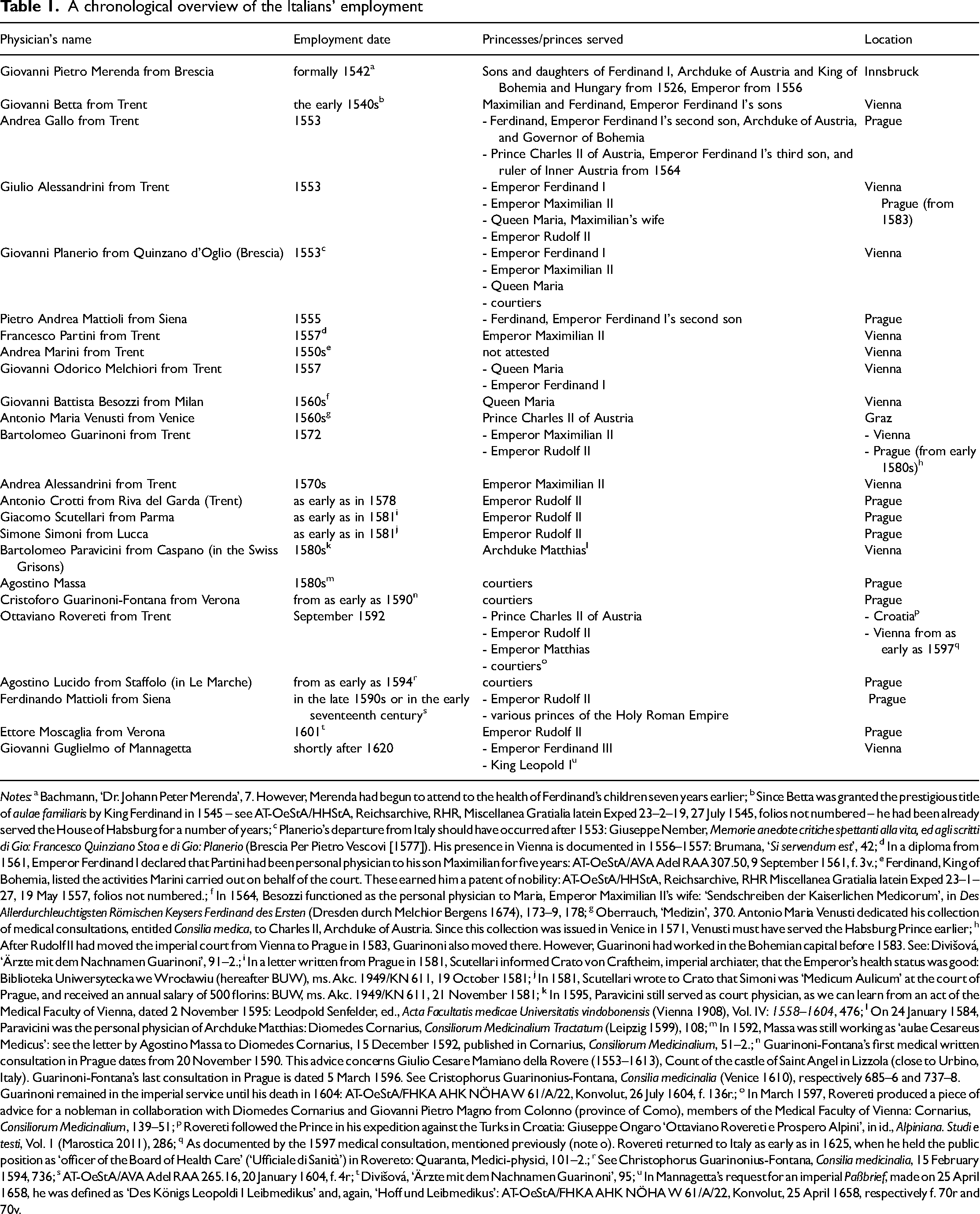
Notes: a Bachmann, ‘Dr. Johann Peter Merenda’, 7. However, Merenda had begun to attend to the health of Ferdinand’s children seven years earlier; b Since Betta was granted the prestigious title of aulae familiaris by King Ferdinand in 1545 – see AT-OeStA/HHStA, Reichsarchive, RHR, Miscellanea Gratialia latein Exped 23–2–19, 27 July 1545, folios not numbered – he had been already served the House of Habsburg for a number of years; c Planerio’s departure from Italy should have occurred after 1553: Giuseppe Nember, Memorie anedote critiche spettanti alla vita, ed agli scritti di Gio: Francesco Quinziano Stoa e di Gio: Planerio (Brescia Per Pietro Vescovi [1577]). His presence in Vienna is documented in 1556–1557: Brumana, ‘Si servendum est’, 42; d In a diploma from 1561, Emperor Ferdinand I declared that Partini had been personal physician to his son Maximilian for five years: AT-OeStA/AVA Adel RAA 307.50, 9 September 1561, f. 3v.; e Ferdinand, King of Bohemia, listed the activities Marini carried out on behalf of the court. These earned him a patent of nobility: AT-OeStA/HHStA, Reichsarchive, RHR Miscellanea Gratialia latein Exped 23–1–27, 19 May 1557, folios not numbered.; f In 1564, Besozzi functioned as the personal physician to Maria, Emperor Maximilian II’s wife: ‘Sendschreiben der Kaiserlichen Medicorum’, in Des Allerdurchleuchtigsten Römischen Keysers Ferdinand des Ersten (Dresden durch Melchior Bergens 1674), 173–9, 178; g Oberrauch, ‘Medizin’, 370. Antonio Maria Venusti dedicated his collection of medical consultations, entitled Consilia medica, to Charles II, Archduke of Austria. Since this collection was issued in Venice in 1571, Venusti must have served the Habsburg Prince earlier; h After Rudolf II had moved the imperial court from Vienna to Prague in 1583, Guarinoni also moved there. However, Guarinoni had worked in the Bohemian capital before 1583. See: Divišová, ‘Ärzte mit dem Nachnamen Guarinoni’, 91–2.; i In a letter written from Prague in 1581, Scutellari informed Crato von Craftheim, imperial archiater, that the Emperor’s health status was good: Biblioteka Uniwersytecka we Wrocławiu (hereafter BUW), ms. Akc. 1949/KN 611, 19 October 1581; j In 1581, Scutellari wrote to Crato that Simoni was ‘Medicum Aulicum’ at the court of Prague, and received an annual salary of 500 florins: BUW, ms. Akc. 1949/KN 611, 21 November 1581; k In 1595, Paravicini still served as court physician, as we can learn from an act of the Medical Faculty of Vienna, dated 2 November 1595: Leodpold Senfelder, ed., Acta Facultatis medicae Universitatis vindobonensis (Vienna 1908), Vol. IV: 1558–1604, 476; l On 24 January 1584, Paravicini was the personal physician of Archduke Matthias: Diomedes Cornarius, Consiliorum Medicinalium Tractatum (Leipzig 1599), 108; m In 1592, Massa was still working as ‘aulae Cesareus Medicus’: see the letter by Agostino Massa to Diomedes Cornarius, 15 December 1592, published in Cornarius, Consiliorum Medicinalium, 51–2.; n Guarinoni-Fontana’s first medical written consultation in Prague dates from 20 November 1590. This advice concerns Giulio Cesare Mamiano della Rovere (1553–1613), Count of the castle of Saint Angel in Lizzola (close to Urbino, Italy). Guarinoni-Fontana’s last consultation in Prague is dated 5 March 1596. See Cristophorus Guarinonius-Fontana, Consilia medicinalia (Venice 1610), respectively 685–6 and 737–8. Guarinoni remained in the imperial service until his death in 1604: AT-OeStA/FHKA AHK NÖHA W 61/A/22, Konvolut, 26 July 1604, f. 136r.; o In March 1597, Rovereti produced a piece of advice for a nobleman in collaboration with Diomedes Cornarius and Giovanni Pietro Magno from Colonno (province of Como), members of the Medical Faculty of Vienna: Cornarius, Consiliorum Medicinalium, 139–51; p Rovereti followed the Prince in his expedition against the Turks in Croatia: Giuseppe Ongaro ‘Ottaviano Rovereti e Prospero Alpini’, in id., Alpiniana. Studi e testi, Vol. 1 (Marostica 2011), 286; q As documented by the 1597 medical consultation, mentioned previously (note o). Rovereti returned to Italy as early as in 1625, when he held the public position as ‘officer of the Board of Health Care’ (‘Ufficiale di Sanità’) in Rovereto: Quaranta, Medici-physici, 101–2.; r See Christophorus Guarinonius-Fontana, Consilia medicinalia, 15 February 1594, 736; s AT-OeStA/AVA Adel RAA 265.16, 20 January 1604, f. 4r; t Divišová, ‘Ärzte mit dem Nachnamen Guarinoni’, 95; u In Mannagetta’s request for an imperial Paßbrief, made on 25 April 1658, he was defined as ‘Des Königs Leopoldi I Leibmedikus’ and, again, ‘Hoff und Leibmedikus’: AT-OeStA/FHKA AHK NÖHA W 61/A/22, Konvolut, 25 April 1658, respectively f. 70r and 70v.
As noted above, many court and imperial Italian physicians continued to occupy the same positions when a new Emperor took over. Conversely, in the seventeenth century, only two Italian physicians were hired: Ettore Moscaglia in 1601 and Giovanni Gugliemo Mannagetta in 1620. The reversal of this trend might be connected with the gradual decline of seventeenth-century Italian medical education, 24 and the parallel rise of other academic institutions, able both to compete with the Italian ones and provide highly-qualified professors. Another factor, which may explain the smaller number of the Italians hired in the seventeenth century, is the fact that Rudolf II's successors had probably realized that it was more convenient to employ local physicians, since relying on Italians was more expensive overall due to overheads.
Geographically, many of the Italian physicians came from the Prince-bishopric of Trent: Alessandrini, Betta, Gallo, Melchiori, Partini, and Marini. This was not a coincidence: Trent was tightly connected with the House of Austria by political, administrative, and military bonds. Further, the physicians from Trentino pursued long-term careers: Alessandrini served three emperors (Ferdinand I, Maximilian II, and Rudolf II); Melchiori served the imperial family for thirty years; 25 Bartolomeo Guarinoni, also originally from Trent, was engaged as the physician of both Emperor Rudolf II and his son Maximilian in 1572, 26 and he continued to serve the imperial family as the personal physician to Mathias, Rudolf II's successor. 27
The group from Trentino also included Andrea Marini, employed in the 1550s; 28 Antonio Crotti, personal physician to Emperor Rudolf II; 29 and Mattioli, who served as the personal physician to Ferdinand, Emperor Ferdinand I's second son, Archduke of Austria, and Governor of Bohemia, until 1571. 30 Although originally from Siena, Mattioli had worked for Prince-bishop Bernardo Cles from 1528 until the latter's death in 1539. 31 Subsequently in 1541, Mattioli begged Cristoforo Madruzzo, Prince-bishop of Trent from 1539 to 1578 and political ally of the Holy Roman Empire, to hire him as his personal physician. However, Madruzzo, who already had a medical practitioner in his service (doctor Giovanni Betta), could not afford to pay a second one. 32 Later that year, Mattioli began to work as a municipal physician in Gorizia, a town in the county inherited by the Habsburgs at the beginning of the century. 33 Meanwhile, Mattioli continued to foster his relationship with Madruzzo, dedicating the second edition of his Discorsi (Venice 1548) to him. 34
Recommendations, Kinship Bonds, Medical Erudition
It appears that there were no standardized requirements for gaining a position as a court or imperial physician. However, a number of socio-professional elements proved to be particularly important in hiring processes. Networking seemed especially important at the start of these careers. Recommendations, friendship, and kinship relations constituted systematic procedures of engagement. Recommendations made by trustworthy people and kinship bonds ensured applicants the greatest chances of success and, at the same time, were regarded by the Emperor as an efficient means to recruit reliable human resources. Specialized medical erudition was also appreciated in the court environment, but, in most cases, it was not sufficient for employment. A recommendation from a trustworthy source could even trump medical expertise. Recruitment decisions could also depend on the financial standing of local governments, but the Emperor had the final say.
Recommendations made by influential people represented one of the most important instruments for landing a position at court. For instance, Cristoforo Madruzzo probably recommended the Italian physician Giovanni Betta. In 1541, Betta was personal physician to Bishop Cristoforo. 35 It is not by chance that, in 1545, Betta served as the personal physician to both Archdukes Maximilian and Ferdinand 36 and, in that year, he was elevated to the rank of ‘aulae familiaris’ by King Ferdinand. 37 Six years later, in 1551, he still occupied the same post. 38
The case of Francesco Partini is also interesting. King Ferdinand heard of Francesco for the first time in 1538, when he relied on the ‘testimony of a trustworthy person’. 39 This can be identified as Nicolò Madruzzo, commander of the imperial troops, who was treated by Partini between 1536 and 1539. 40 However, it was not until some twenty years later that Partini landed a position as the personal physician to Maximilian II, Emperor Ferdinand I’s son. A second recommendation must have thus ensued. It was probably made by Otto Truchseß von Waldburg, Bishop of Augsburg and close friend of Ferdinand I, 41 while Partini was working for him (1546–1547).
This and other cases show that the best chance of pursuing a career as court or imperial physician coalesced from a combination of recommendations and kinship bonds. Giovanni Merenda was hired thanks to the recommendation made by his father-in-law, Giovanni Cazzani from Brescia, who practised medicine in Schwaz (Tyrol), and later at the Innsbruck court. From 1535, Cazzani relied on Merenda's help in his medical practice and, at the beginning of 1539, when Cazzani was about to die due to a serious illness, he recommended that Emperor Ferdinand replace him with Merenda. However, the Government of Innsbruck preferred another physician (‘Dr Johann Mörl’), who had been practising medicine for 26 years and had largely proved his expertise. Conversely, Merenda was not a long-experienced physician, although he was learned. Despite the Government's evaluation being heavily weighted towards Mörl, Archduke Ferdinand ultimately chose Merenda, and, on 17 June 1542, he charged the Government to appoint him as his sons’ physician. 42
More generally, as Heinz Noflatscher observed, Italian experts were ‘not so much professionals outside of the court but rather court members, whose fathers had already served the Habsburgs at least at local level’. 43 This preference is clearly evident in Giulio Alessandrini's career, as well as the career of his sons Giovanni and Andrea and his brother Francesco. Over three generations, the Alessandrinis managed to prosper within the court environment. The basis of such success had been laid down by both Pietro, Giulio's father, and Manfredo, perhaps Pietro's brother. Both of them had begun to serve the Emperors Maximilian I and Charles V in the first decade of the sixteenth century. Pietro, doctor of Both Laws, had been imperial ambassador (‘orator’) in Trent as well as imperial counsellor. 44 Manfredo had worked as both attorney and party consultant in lawsuits conducted by the Reichskammergericht. 45 Furthermore, Maximilian I had ascribed Pietro to the imperial nobility, and had granted him the title of comes palatinus on 4 October 1518. Maximilian I also established that, if Pietro's sons achieved a doctoral degree, they would be granted the same title. 46 It was in virtue of the merits gained by his father that Giulio was able to land a position as ‘Protophysicus’ to Emperor Ferdinand I. Such a role was thereafter confirmed under Maximilian II. 47 Similarly, on 22 June 1558, Giulio was granted the title of comes palatinus, whose assignment was firstly justified by the privilege of the Palatinate, previously conferred to his father Pietro. Giulio's loyalty towards the House of Austria, ‘the good customs and honesty’ (‘spectatam tuam probitatem et integritatem’) he had shown, and his medical erudition equally contributed to his obtaining such an honour. It is worth clarifying that ‘honesty’ did not correspond to one of Alessandrini's inherent qualities, but was used by the Emperor to define his loyal behaviour towards the House of Austria. Giulio was also given the ability to appoint ordinary judges and notaries. 48 On 1 May 1573, Emperor Maximilian II ascribed Giulio to the rank of the imperial nobility, for carrying out a particularly accurate medical service. 49
Giulio's brother, Francesco, and Giulio's sons, Giovanni and Andrea, enjoyed the same success. In 1558, Francesco, doctor of Both Laws and clergyman of the Cathedral of Trent, was granted both the title of comes palatinus and the ability to appoint ordinary judges. 50 Giovanni, doctor of Both Laws and clergyman of the Churches of Trent and Brixen, took a role as an imperial counsellor, tackling ‘many serious affairs and questions of great breath’ regarding the Habsburg politics. 51 On 26 August 1573, Maximilian II granted Giovanni an annual pension of one thousand golden shields to honour a commitment made by Pope Pius V. The pope had promised to allocate this sum of money to the emperor's most valued clergyman, and when Pius V died in 1572, Maximilian II decided to fulfil his promise by assigning the money to Giovanni. The pension was renewed by Emperor Rudolf II in 1580, not only because Giovanni had faithfully carried out his role, but also because of his father's merits. 52 Furthermore, on 20 March 1578, Giovanni was given the honorary title of ‘an Neuenstein’, 53 the same title his father had received in 1573. 54 Giulio's other son, Andrea, offered his medical services to Emperor Maximilian II. In 1573, along with his brother Giovanni, Andrea was elevated to the rank of ‘aulae caesareae familiaris’, and both of them obtained the imperial noble status. 55
Similarly, Ferdinando Mattioli's career was initially supported by his father, Pietro Andrea, who coaxed Ferdinand, Archduke of Austria, to fund Ferdinando's studies in 1577. 56 Yet, the position as imperial physician and counsellor Ferdinando enjoyed later (1621) also depended on the medical services he had successfully provided to Italian and German princes before his imperial service. 57
The titles of aulae familiaris and comes palatinus as well as the title of noble, mentioned above, need some clarification. The term aulae familiaris indicated that the holder belonged to a socio-functional elite within the court society; 58 these title holders were guaranteed special treatment, and their position was supported juridically. 59 We can find aulae familiares as far back as 1392: due to his prominent predisposition to science in general and the medical arts in particular, the Jewish physician Angelo was bestowed with the title of familiaris noster together with fiscal exemptions by Pope Boniface IX. 60 In turn, the title of comes palatinus played an important role within the administrative and judicial system of the Empire. As seen above, this title was conferred upon Giulio Alessandrini, and was also granted to both Bartolomeo Guarinoni in 1589, 61 and Cristoforo Guarinoni-Fontana in 1599, with the specific faculty to appoint public notaries and judges throughout the Empire. 62 Letters of ennoblement were also commonly received by the Italian physicians: as seen above, Giulio Alessandrini reached the noble imperial rank; further, the various activities Andrea Marini carried out until 1557 made him worthy of a patent of nobility. 63 In 1562, Mattioli obtained an aesthetic improvement of his noble family emblem, and was granted the power to seal public and private acts with red wax. 64 Three decades later, in 1599, Rudolf II approved and confirmed Guarinoni-Fontana's ancient noble family emblem, which, with the Emperor's permission, was further enriched in 1601. 65
Alongside kinship bonds, another factor helped physicians earn the Emperor's respect. In an imperial diploma dated 24 May 1589, Rudolf II stated that he had heard of Bartolomeo Guarinoni's outstanding scholarship and, subsequently, during his service, he was able personally to ascertain his scrupulous medical practice and ‘honesty’ (‘morum honestate atque integritate’). 66 As noted above in Alessandrini's case, this expression referred to fidelity to the imperial family. In any case, the qualities attributed to Guarinoni were the same qualities which, according to the famous Paduan Professor Girolamo Mercuriale (d. 1606), were required to become an imperial physician. When, in December 1578, Mercuriale proposed Giacomo Scutellari from Parma for that role, he justified his choice by citing Scutellari's ‘customs, science, and ability in medical practice’. 67 Mercuriale also stated that Scutellari, ‘known for his doctrine and the exercise of the ars medendi’, was largely approved by Giulio Alessandrini too. 68 Two years later, in June 1580, while he was reflecting on a suitable candidate who could replace the imperial archiater, Crato von Craftheim from Breslau (1519–1585), Mercuriale repeated that the candidate's medical ability, customs, and authority had to be as excellent as those of Crato. 69
Among the requirements a court physician had to fulfil, a certain weight was placed on outstanding medical expertise. However, when it came to hiring a physician who had been recommended, this prerequisite lost a bit of its relevance. As seen above, Archduke Ferdinand preferred Merenda, recommended by the loyal physician Giovanni Cazzani, to Johann Mörl, although Mörl had more experience. Conversely, in the case of Pietro Andrea Mattioli, it seems that his employment was based almost exclusively on his medical erudition and skill. Mattioli's reputation derived from the publication of his Discorsi. As a result, Ferdinand I appointed Mattioli as the personal physician to his son at the Prague court. The broad circulation of the Discorsi is mentioned in an imperial act dated 5 January 1558, which granted Mattioli a 10-year printing privilege for the German version of his work. 70 Furthermore, Mattioli was well known for his surgical skills, something which was quite rare among physicians with a degree. Mattioli treated 80 wounded soldiers during the military campaign Archduke Ferdinand led in Hungary from August to October 1556. 71 His surgical ability must have impressed the Archduke, since Emperor Ferdinand I stressed ‘those services’ Mattioli had provided in Csanád, the Hungarian fortress where the imperial troops were lodged during the war against the Turks. 72
Finally, the relationships the Italian physicians had cultivated in their native country facilitated employment at court. In 1555, Pietro Andrea Mattioli, personal physician to Archduke Ferdinand, recommended Giovanni Melchiori, his pupil and collaborator, for a post at the Viennese court, 73 and in 1594, Agostino Lucido became court physician at the court of Prague through the mediation of one of his close friends, the imperial physician Cristoforo Guarinoni-Fontana. 74
Medical and Non-Medical Activities
In general, Hofärzte (court physicians) treated members of the imperial family and/or of the court: for instance, Giovanni Betta provided health care services to Emperor Ferdinand I's sons Maximilian and Ferdinand, 75 and, in the 1550s, Andrea Gallo was physician to Archduke Ferdinand of Austria at the Prague court. 76 Conversely, imperial Leibärzte provided medical services to the Emperor himself. Rovereti, for instance, provided day and night medical service for Rudolf II in Prague and, for this purpose, he used to sleep in the anteroom of the Emperor's bedroom. 77
However, the boundaries between Hofärzte and Leibärzte were surprisingly fluid. For instance, Andrea Gallo assisted Charles of Austria on 23 December 1558, after other physicians had examined him. 78 Melchiori, the personal physician to Maria, Maximilian's wife, also provided medical service to Emperor Ferdinand I. 79 In turn, the imperial physician Alessandrini treated Maximilian's wife too, as emerges from the patent of nobility dated 28 December 1566 and addressed to Alessandrini himself. 80
Further possibilities might arise. Merenda, who treated Archduke Ferdinand's children, was also explicitly charged with assisting the counsellors of the Öberösterreichische (Hof-)Kammer of Innsbruck; 81 Planerio ‘exercised the medical art in Vienna for Emperors Ferdinand, Maximilian and for Maria, mother of Emperor Rudolf, for many years’, 82 and also assisted court members. 83 Mattioli was Leibarzt to Archduke Ferdinand, 84 and addressed a medical consultation to a young Bohemian man named Bohuslaw. 85 Although Mattioli was granted the title of imperial physician in 1562, 86 there is no historical evidence that he actually treated Emperor Ferdinand I. 87 Giacomo Scutellari, who was the physician to Rudolf II, also treated the imperial chamberlain. 88 Some physicians, such as Bartolomeo Guarinoni, even added private practice to the Habsburg family's medical service. 89 Rovereti also participated in a joint consultation held in May 1597 discussing the health status of an unnamed patient together with both Diomedes Cornarius (1535–1600) – son of the famous physician Ianus Cornarius, professor at the Medical Faculty of Vienna, and Leibarzt of Maximilian II from 1566 – and Giovanni Pietro Magno from Colonno (in the province of Como), another medical professor in Vienna. 90
In addition to health care, Italian physicians also functioned as scholars, political counsellors, diplomats, and financial consultants. Cristoforo Guarinoni-Fontana served as imperial political counsellor; 91 Bartolomeo Guarinoni became a member of the imperial Council; 92 and Bartolomeo Paravicini was counsellor of Matthias, Archduke of Austria. 93 In the diplomatic field in particular, given that in the early-modern era sovereignty remained personal and great importance was given to the Prince's physical presence, the role as familiaris with representative tasks was very significant. 94 For example, Archduke Ferdinand emphasized not only Giovanni Betta's ‘accurate expertise in the health care activity’ (‘exactam in medendi facultate peritiam’), but also his ‘ability to conduct businesses’ (‘rebusque gerendis dexteritatem’) – the diplomatic responsibilities Betta had taken on when he had followed Emperor Charles V in his expeditions both in at home and abroad. 95 A reference to a Betta's diplomatic journey to Wurmsham (Germany) is mentioned in the Hofzahlamtbuch referring to the year 1545. 96 Finally, Andrea Marini worked as a financial advisor and carried out economic business on the behalf of the Viennese court. 97
Economic Aspects and Duration of Careers
In the court environment, academically trained and cultured doctors were expected to be the main beneficiaries of aristocrats’ patronage. For instance, in the late sixteenth century, the archiaters in the service of the pope received large rewards, 98 and, in some cases, were also assigned a house. 99 However, at the seventeenth-century Savoy court, it was the surgeons who frequently received these perks. This derived from the surgeon's close proximity to the Duke's body. 100 By virtue of this intimacy, the surgeons’ salaries were surprisingly high. 101
The remuneration of Italian physicians at the Habsburg courts seemed to differ slightly. First, at least in the 1540s and 1550s, payment for medical services provided did not follow a systematic procedure. The case of Merenda is telling. Merenda was officially hired in 1542, the dedication of Merenda's Evacuandi ratio (1547) indicates that he arrived in Innsbruck in 1537: Since I have been paying both obliging and favourable attention to the study of all scholars for the last seven years, subsequently, for all this time span, during which I have so far exercised the medical activity at court at the service of the Serene sons of your Majesty, I have attempted to acquire a more accurate knowledge of those scholars.
102
Further, when a new Emperor took over, the payments the physicians had received under his predecessor were no longer taken for granted. In 1564, Emperor Ferdinand I granted Melchiori an annual salary of 100 florins – a salary he would receive as long as he provided health care to Queen Maria. A year after Ferdinand I's death (July 1564), Melchiori begged Emperor Maximilian II to assign his salary to the imperial ‘treasury’ (‘aerarium’) he had inherited from his father. 103 The fact that Melchiori had to ask for assurance that he would have the same salary means that remuneration was not guaranteed. Similarly, in 1618, Bartolomeo Guarinoni asked Emperor Matthias for the annual ‘Provision’ which Rudolf II had promised him. 104 Only one of several imperial diplomas examined mentioned an annual salary – in which Archduke Ferdinand specifically stated that Giovanni Betta was to be employed as a physician with an annual salary. 105 Pensions were similarly insecure, depending on both the Emperor's will and the physicians’ ability to claim their rights. In 1562, Gallo had to ask for an annual pension of 2000 guilders, 106 but we do not know if he obtained it.
Conversely, during Rudolf II's reign, Italian physicians received respectable, regular fees. The Emperor paid his physicians 600 florins annually, 107 with some exceptions (e.g., Simone Simoni, an imperial physician in Prague in 1582–1583, earned 500 florins annually). 108 Habsburg court physicians, like Agostino Massa, earned less than imperial physicians (360 florins annually). 109 Moreover, 600 florins was well above the European average: in fact, in the 1530s and 1540s, the physicians in the service of the Margrave of Prussia received 100 florins annually, 110 and Marcello Squarcialupi, the personal physician to Sigismund Báthory, the Prince of Transylvania from 1579 to 1585, had an annual remuneration of 500 thalers (about 285 florins annually).
Successively, Rudolf increased his physicians’ remuneration. When Ottaviano Rovereti started working as the personal physician to Rudolf II, he received a ‘Provision’ of 800 florins, and enjoyed benefits like his own lunch table (with waiters) and a house in Prague. Like Rovereti, Moscaglia earned 800 florins annually and had personal waiters. 111 Cristoforo Guarinoni-Fontana and Ettore Moscaglia managed to further increase their emoluments: Guarinoni-Fontana came to earn 2333 florins in 1598; 112 on 19 January 1612, Moscaglia received a reward of 5000 thalers (2857 florins) for the arduous medical service provided to the Emperor day and night. 113
Alongside a regular remuneration, Italian physicians received extra money. In 1558, Pietro Merenda obtained from Emperor Ferdinand I a sum of money to return home temporarily; 114 twenty years later, Antonio Crotti asked Emperor Rudolf II for 2500 florins to pay a debt. 115 The Italians also exploited their position to obtain economic support for their families. In 1569, Mattioli obtained from the Emperor an annual sum of 100 florins to pay for his son's education. Five years later, Archduke Ferdinand claimed that, after Mattioli's death, his elder children would receive an additional 200 florins. When Mattioli died, his widow gained economic support for his youngest son. 116 In 1604, a ‘Gnadenbewilligung’ was approved in favour of the widow and sons of Guarinoni-Fontana, who remained in service until his death. 117 The ‘Gnadenbewilligung’ was the sum due to the heirs after an imperial employer's death. Likewise, in 1618, the Emperor allocated 2000 gold florins to Bartolomeo Guarinoni's children. 118
Other factors facilitated a long-lasting career. The system of medical advancement at the Habsburg courts was not ‘deterministic’. Rather, it corresponded to an unstable and unplannable itinerary, which depended on the sovereign's will. It only vaguely depended on the physicians’ medical successes. In fact, aside from blatant cases such as the unexpected death of the Emperor or another imperial family member, therapeutic failures could go unnoticed and they did not substantially affect the physician's reputation. Further, the feeling of being ill or having recovered was largely subjective. Some patients understated or even denied their symptoms; others wanted to believe in their partial or full recovery, even though there had not been any real improvement. Alternatively, the physician himself sometimes ascribed the alleged restoration of the previous health status to the cures he had prescribed. However, as we shall see below in greater detail, the physician–patient relationship was far more complicated. As court officials, imperial physicians were tied to the Emperor by personal trust, and, for this reason, they might not allow themselves to disappoint his expectations in terms of treatment.
Apart from healing methods, there were other factors which had a significant impact on career trajectory. Once a physician had been employed, the most important merit, which made his service durable, was his reliability and the distinctive feature of a long career was the physicians’ ability to earn the Emperor's trust. Loyalty to the House of Austria was an essential aspect of their identity as court and imperial physicians, and the diplomas issued by the Emperor stressed the importance of loyalty, a concept expressed by the Latin terms ‘fides’, ‘fidelitas’, ‘devotio’, and ‘observantia’. Often, the mutual trust between Emperor and physician was the outcome of a collective process involving multiple actors, as demonstrated by Merenda's case. On the one hand, Merenda had continued to prove his devotion both to Archduke Ferdinand and the imperial family; on the other, Merenda's brothers ‘were never strangers’ to such devotion. His brother, Bartolomeo Merenda, had demonstrated his loyalty by fighting with the imperial troops both against the Turks and during the Schmalkaldic War. In 1547, he met his death in the territory of Saxony. 119 Alessandrini's case, examined above, also shows trust built generation after generation.
Conversely, unfaithful behaviour led to the disruption of the imperial service, as the case of Andrea Camuzzi shows. In October 1577, to obtain a printing privilege for his work Excussio brevis (1580), 120 Camuzzi tried to persuade the Oberstkämmerer Wolfgang Siegmund Rumpf with flattery and gifts. However, convinced that Camuzzi had attempted to purchase the privilege by deceit, Rumpf banned the physician from the court. Nevertheless, Camuzzi persevered, and decided to submit his request to the imperial counsellors. They, however, reckoned that Camuzzi had acted behind the Emperor's back, who, in turn, had already rejected his request. As a form of punishment, the counsellors held on to a copy of Camuzzi's manuscript. 121
Other careers were relatively brief, but the reasons for their end remain unclear. For instance, there is no documentary evidence that connects Renato Brasavola from Ferrara with any official or potential court role, although he dedicated a medical consultation to Archduke Ferdinand on 14 February 1554. 122 Renato was the son of the celebrated physician Antonio Musa, and held a position as professor of ‘Logica ordinaria’ at the Studium of Ferrara. 123 In turn, Giovanni Planerio, who had begun his service in the 1550s, returned to Italy suddenly in 1566, 124 a year after the conclusion of the second apostolic visit of Nuntius Zaccaria Dolfin to Vienna (1561–1565). 125 It was the latter, ambassador at the Viennese court, who gave Planerio the money to go back home. 126 However, Planerio did not retire when he left: he continued to work, and reintroduced himself professionally into the echelons of Venetian society. According to Giuseppe Nember (1752–1815), member of the renowned Accademia Roveretana degli Agiati, Planerio's sudden departure may derive from his preference for Italian medical knowledge over that of Germany, leading him to disdain his local colleagues. Such an arrogant attitude must have needled the court Germans, who then attempted to undermine Planerio in the eyes of Maximillian II, leading to his departure. 127 However, Nember did not mention the sources on which he based this reconstruction nor do documental traces confirm his version.
The deterioration of Planerio's relationship with the court was not an exception. For example, in 1581, after twenty years of service, Crato von Craftheim left his post as imperial archiater for similar reasons. He returned to Breslau not only, as we will see below, due to his increasingly difficult relationship with Rudolf II, but also because the courtiers in Vienna chafed at his religious beliefs. Crato, influenced by Calvinistic theology, had become the leader of the crypto-Calvinist circle of Prague. 128 Despite Maximillian II's promotion of a spirit of reconciliation between Protestantism and Catholicism, his death in 1576 led to a profound change in the cultural and religious climate of the Viennese court, and Counter-Reform Catholicism began to emerge. In such a milieu, Crato's crypto-Calvinism was unappealing, 129 and he soon became the target of envy by Counter-Reform Catholics. 130
Other careers ended even before they got started, but this did not necessarily depend on the court environment. Girolamo Donzellini's brief career was his own doing. Originally from Brescia, in the Republic of Venice, he worked at the court of Vienna without taking any official role. Accused of being a protestant, Donzellini had been banned from the Republic of Venice by the Inquisitorial Court in 1553, and had subsequently fled Italy. In 1555, he moved to Augsburg to beg for Archduke Ferdinand's help, who, in turn, was participating in the imperial diet that year. Later, Donzellini treated courtiers in Vienna, 131 and Emperor Ferdinand I offered him a post as the personal physician to his daughter, Catherine of Austria and Queen of Poland. 132 Donzellini, however, turned this down and went back to Italy for good in 1559.
Similarly, Girolamo Mercuriale remained at the Viennese court for only three months (August–October 1573). 133 Although brief, his sojourn was trying. In fact, he was involved in a medical dispute at court, which might have influenced the duration of his stay. Since 1552, Emperor Maximilian II had suffered from an accelerated heartbeat, 134 which afflicted him until his death in 1576. 135 When, in August 1573, Mercuriale examined the Emperor, he attributed his heart palpitations to the ingestion of poison contained in the mushrooms the Emperor had ingested. The poison had injected ‘its bad quality’ into his heart, destroying his natural temperament. 136 In the same period, the physician Benedetto Patini from Brescia (1534–1577) also examined the Emperor personally. His conclusions, however, diverged from Mercuriale's analysis: if the disorder had depended on the vapours caused by the poison, Maximilian would have been regularly affected by palpitation until the power of the poison had run out. Instead, the symptoms had appeared irregularly, since the beginning of the disease. Accordingly, Patini believed that the irregular heart rate had been sparked by watery humours, which had filled up the membrane around the heart. 137 The disagreement between Mercuriale and Patini might have induced the former to leave the court in October 1573, and when, six years later, Mercuriale refused a post as imperial physician for family reasons, 138 he did so also because he realized that medical disputes at court could undermine his reputation.
Experiences at Court
An Ambivalent Tie with the Political Power
Early-modern European courts were able to nourish a close relationship between power and knowledge, and scientists often had to conform to the cultural model the prince created. In this respect, the court of the Landgrave Maurice of Hesse-Kassel (1572–1632) was one of the most interesting German courts, since he influenced the kind of medicine practised within his court. Maurice acquired a reputation as a practitioner of medicine and chemical pharmacy, and developed a circle of Paracelsian physicians, alchemical adepts, and hermetical-alchemical protégés. For this reason, his Leibmedici (personal physicians) were required to accept the relevance of chemical medicine as a part of therapy. 139 Court scientists were also supposed to produce works that glorified and legitimated the prince, 140 as was the case in the Rudolfine court. 141 The Czech Matthias Borbonius (1566–1629) compiled a volume of insignia accompanied by their poetic legends, highlighting the sovereign's penchant for the classical idea of emperor (Caesarism). As a result, Borbonius earned Rudolf's favour early on. 142
In light of these considerations, we have to wonder how power could influence the medical practice of court physicians. The sovereign's health might have an impact on both religious and political affairs, 143 and, when a prince fell ill, his entourage had to be careful how they presented the situation without undermining the reputation and honour of the reigning House. 144
This analysis of the medical encounters between the Italian physicians and their patients at the Habsburg court shows that they had to use caution in their medical practice. While treating Archduke Ferdinand in Chomutov (Bohemia) in 1563, Mattioli had to reconcile two contrasting needs: he had to protect Ferdinand's health while heeding the expectations of Ferdinand's father, the Emperor. Meanwhile, the Emperor ordered his son to travel to Innsbruck. However, Mattioli deemed Ferdinand too unwell to undertake the journey. Eventually, Mattioli stated that Ferdinand felt better and could walk, but feared that Ferdinand's symptoms could recur. 145 On examination a few days later, he added that the Archduke had succumbed to melancholia: foul flatulence had ascended from the abdomen to the head, affecting the brain, and producing dreads and headache. 146 Mattioli communicated to the Emperor that, in the subsequent days, Ferdinand would not sufficiently recover, and might undertake the planned journey only in 10 days. 147 Mattioli's treatment had to adapt even further, 148 as Ferdinand refused all recommended medicines. 149
In 1581, Rudolf began to suffer from a violent cough, which became persistent in the last years of his life. Later on, breathing difficulties, bloody sputum, and night sweats turned up. 150 In the same year, Girolamo Mercuriale affirmed that the Emperor's disease was incurable. 151 It was likely consumption. 152 Rovereti added that the Emperor's health status had become worse in the final days of his life, since he had refused all medical prescriptions, and ignored even the recommendations given by his closest attendants. 153 The Emperor – Rovereti concluded – ‘excessively trusted in his own nature’. 154 Attending to Rudolf's health even impacted the personal lives of his physicians. In 1585, Crato von Craftheim complained that his own health had worsened due to the exhausting medical service he had been providing to the Emperor in the previous years. 155
Even retirement was complicated. Court physicians were often compelled to return to the court, although they were no longer able to perform their medical tasks as well as in the past. Alessandrini asked for and obtained a permission to retire from imperial service in December 1566, for health reasons. 156 Nonetheless, the Habsburgs summoned him once again: on 26 September 1576, a month before Maximilian II's death, Alessandrini was in Vienna at the Emperor's bedside. 157 Furthermore, in April 1578, only a few months after he had left the court in October 1577, 158 he went to Prague again to examine Rudolf II. Although Alessandrini expressed his annoyance, since he had not been briefed on the reasons for his call, he returned to Prague by virtue of his loyalty towards the Emperor. 159
Italian- and German-Speaking Physicians at Court: A Comparison
The Habsburg courts employed physicians from countries other than Italy. Only two came from non-German-speaking territories: the Netherlands and Belgium. The first, Stefan Laureus from Amersoorf (fl. 1556–1564), became a ‘Hoffphysicus’ (court physician) in 1563. 160 The second, Nicolas Biese (1516–1573) from Gent, had taught medicine at Louvain University for several years before becoming a court physician in Vienna. 161 The others came from German-speaking territories. Johann Neefe (1499–1574), originally from Chemnitz (Saxony), studied medicine at the University of Leipzig, and served the Electoral prince Karl August of Saxony before being called upon at the Prague court in February 1563 to examine Archduke Ferdinand. 162 A year later, Neefe became the personal physician of Emperor Ferdinand I. 163 At this point, Neefe had already experienced a long and prestigious career, and Mattioli wrote that ‘he was so famous for his erudition and so skilled in the medical arts, in which he had exhausted himself, that, throughout Germany, he was second to none in the treatment of diseases’. 164 Aside from Neefe, almost all other German-speaking physicians were famous academic professors in Vienna and Prague. 165
A comparison between the Italian physicians and their German counterparts is helpful to contextualize the significance of the Italians’ role and experience at court. The recruitment process was an important difference. While the Italians were principally hired through patronage networks, the German-speaking court physicians were recruited for reasons of academic reputation. For instance, Tadeáš Hájek (1525–1600) taught mathematics at the University of Prague, from 1553 until 1557, where he gained great fame. Thereafter, he began to practise medicine and became a personal physician to Maximilian II. He continued in this capacity under Rudolf II. 166 The case of the Johann Emmerich Johann Aicholtz (1520–1588) from Vienna is even more telling. After studying medicine in multiple European universities, Aicholtz settled permanently in Vienna as a practising physician. Shortly after, he was appointed to the chair of anatomy there. He served as dean five times and, in 1574, became Rector of the University. In 1581, after a twenty-year academic career, he accepted a post at the Prague court, offered to him by Emperor Rudolf II. 167 Similarly, after he had served as dean of the Medical Faculty of Vienna four times, in 1549, Mathias Cornax (1508–1564) was appointed personal physician to King Ferdinand. 168 Both Diomedes Cornarius, already mentioned, and the Lusatian Paulus Fabricius (1529–1589) followed suit: already professor of medicine in Vienna, in 1566, Cornarius became the personal physician of Emperor Maximilian II; Fabricius taught astronomy at the University of Vienna, and worked as an imperial physician and court mathematician as well. Further, the Austrian Benedikt Perger, several times dean of the Medical Faculty of Vienna, became personal physician to Archduke Matthias in 1592; 169 Andreas Dadius, affiliated to the University of Vienna for 34 years – initially as a teacher of Aristotelian and dialectic philosophy, and thereafter as a professor of medicine – 170 also served the Habsburg court. 171
When the German-speaking physicians began to occupy court positions, they already had successful careers in the academic field. The Italians, meanwhile, did not have academic careers to their credit and were at the beginning of their careers or, at least, had not yet made a major advancement in their careers. Mattioli, one of the most acclaimed court physicians, never taught at a Studium. Only Girolamo Mercuriale and Andrea Camuzzi had been university professors before being called upon by the Habsburg courts. 172 However, Mercuriale only carried out a medical consultation for Maximilian II, and never became a court – or imperial – physician; Camuzzi was banished from the court because of his unfaithful behaviour towards the Emperor. In this context, Giovanni Guglielmo Mannagetta turns out to be an exception. In fact, he managed to combine a career as imperial physician with a role as academic scholar. 173
The Italian physicians’ ages at recruitment opened up the path to long-standing careers. Many would remain in imperial service for decades. In particular, Mattioli, Alessandrini, and Melchiori worked for the imperial family for thirty years, even longer than Crato von Craftheim, who was imperial archiater for some twenty years (1560–1581). A longer stay at court could potentially lead to other roles, and the Italians took on the functions of political counsellors too. In contrast, German-speaking physicians hardly ever fulfilled similar tasks. It is possible they did not have time for other activities, and were instead devoted to their academic work.
There was also a financial difference. As seen above, in the context of remuneration, Moscaglia and Guarinoni-Fontana earned considerably more than other physicians, and were the exception rather than the rule under Ferdinand I, Maximilian II, and Rudolf II. Mattioli managed to arrange financial support for his family at a level rare even for court physicians. Further, the Italians obtained extra money to return home, whereas few financial requests from the German-speaking physicians in the second half of the sixteenth century are to be found in the Austrian State Archive. 174 This was probably due to the fact that they resided in Vienna or Prague and did not need extra money to return home. We also have to note that the Italians were granted the title of noble and that of comes palatinus more often than their local colleagues, and their descendants inherited these privileges. Further, the sons of Mattioli and Alessandrini managed to work at court too. In turn, in the seventeenth century, the most honoured court physician turned out to be Mannagetta. 175
A final aspect has to be taken into consideration. Before being hired at court, medical professors in Vienna might have felt a pang of envy for the court physicians, who often enjoyed privileged status. 176 In a letter from the physician Hermann Siderus, originally from the Netherlands, to Emperor Maximilian II, Hermann Siderus defined court and imperial physicians as a privileged group. In particular, he stated that Giulio Alessandrini, Crato von Craftheim, Nicolas Biese, and Giovanni Odorico Melchiori did not endure the oppression exercised by the College of Doctors of the Medical Faculty, and enjoyed a high social status (notably two of these were Italian). Hermann also accused the academic institution of limiting the exercise of medicine. In fact, according to the Faculty rules, only those physicians who had already been admitted, by presenting a public dissertation before the doctors of the Medical Faculty, were allowed to practise medicine in Vienna. 177
This control of the municipal medical marketplace on the part of the Faculty affected not only non-academic healers (apothecaries, surgeons, barbers, bath-house attendants, empirics) but also graduated physicians who had earned their degree out of Vienna. 178 However, court and imperial physicians were completely devoted to their imperial tasks, and invested in maintaining their posts at court. Accordingly, they were not so interested in acquiring the prerogatives of the medical professors. Further, since they followed the court, which was often on the road, they could aspire to wield only a limited power on the health care system. 179 In turn, it seems that the Medical Faculty of Vienna was exclusivist: the Italians hired there were only a few: Antonio Binelli, who was accepted in 1588, 180 and Pietro Magno, who filled the role as decanus seven times, in 1596, 1598, and 1600–1604. 181
Concrete Forms of Collaboration among Peers
Italian physicians integrated into the Habsburg courts to different extents. These political and cultural hubs hosted outstanding intellectual personalities – historians, natural philosophers, collectors, students of minerals, plants, and stones. 182 These scholars came from many countries, and fostered the cultural dynamics peculiar to the European Republic of Letters. 183
The collaboration between Italians and their local colleagues in the field of medical practice has not received much attention until now, although the sources bear witness to it. For example, the extensive correspondence carried on by both Giulio Alessandrini and Bartolomeo Guarinoni with Crato von Craftheim shows that Crato helped Alessandrini in the publication of his works, and in turn, both supported Crato in the scientific fights he got into. The three physicians also exchanged opinions on the health status of the imperial family members. 184
There are many traces of the collaboration between Italian physicians and their local colleagues in the field of medical practice. In a letter dated 7 February 1564, four imperial physicians of the time – Alessandrini, Laureus, Crato von Craftheim, and Neefe – reported back to Maximilian on the health of his father, Emperor Ferdinand I. Since the remedies previously administered had not brought any improvement, they decided to consult Maria's personal physicians, Giovanni Odorico Melchiori and Giovanni Maria Besozzi, as well as Matthias Cornax and Paul Weidner, doctors of the Medical Faculty of Vienna. 185 In 1584, at Diomedes Cornarius's behest, Bartolomeo Paravicini provided a patient with more information on the therapies prescribed. Paravicini was also in contact with physicians from Kraków. 186
Mattioli's professional network also shows a history of practical collaboration. In the mid-1550s, Mattioli and Andrea Gallo supervised a Bohemian medical intern: Georg Handsch from Leipa, a town in the Czech Republic. In the subsequent decade, Handsch followed Archduke Ferdinand to Innsbruck and became his personal physician. 187 Handsch's interactions with other physicians varied: he witnessed a poison trial conducted by Mattioli at the Prague court in 1561, 188 and in his handwritten medical notes, Handsch often reported extracts of the conversations on clinical cases he had with Gallo. 189 He also turned to his mentors when their advice was necessary. In November 1559, he was attending the health of one of Mattioli's patients in Prague. The patient in question was ‘Herrin von Wartenberg’, an influential noblewoman coming from Wartenberg, a town in the Czech Republic and not far from Leipa, Handsch's native town. 190 On 24 November, Handsch addressed a letter to both Mattioli and his assistant Johann Willebroch asking for their advice on the most suitable therapies for the patient. In particular, Handsch asked them whether an internal enema-douche could purify the woman's ‘polluted uterus’. 191
In light of what is discussed above, it is evident that the Italians contributed to the transmission of Italian medical knowledge in the Habsburg territories. We hold proof of this process in a letter addressed by Mattioli to Joachim Camerarius the Younger, physician and botanist from Nurnberg. In this letter, Mattioli stated that Kaspar Peucer, a learned physician who had worked for the German principalities of Saxony, Dessau, Kassel, and Heidelberg, 192 presented Mattioli's works to his fellow scholars as ‘texts which have to be read’, and exhorted other erudite men to read them. 193 Mattioli would probably have encountered Peucer in Prague, which the latter visited in 1569. 194
The picture provided above does not exclude frictions connected with either divergence of medical opinions or professional rivalries. In fact, although the medical Republic of Letters was sustained through affective bonds and mutual support, this was not absolute. 195 In this respect, some German physicians insisted on their familial pride perhaps as a reaction against dismissive treatment of northern European culture by some Renaissance Italians. 196 Further, bitter medical-botanical disputes are attested to between Pietro Andrea Mattioli and his German-speaking colleagues Melchior Wieland, Leonhart Fuchs, and Conrad Gesner. To silence his adversaries, who had criticized his Discorsi, Mattioli resorted to two arguments: the alleged superiority of Italian over German medical scholarship, and the unreliability of Protestants. 197 The second argument shows how Mattioli involved the sixteenth-century interdenominational fights in scientific conflicts. Mattioli's pro-Italian and anti-German remarks could also reflect a time-honoured political antagonism between Italian and German scholars. In this context, Thomas DaCosta Kaufmann suggests that the frictions between the Prince-bishopric of Trent and the Holy Roman Empire might have influenced Mattioli's attitude towards his German-speaking interlocutors. 198
In conclusion, the Italians developed quite large networks of cooperation, whereas the sources show a minor number of tensions.
The Italian Physicians: A Privileged Professional Group at the Habsburg Courts?
We can now address the crucial question: Were the Italian physicians treated more generously than their fellow physicians at court? As has been shown, complex factors influenced every medical career at the Habsburg courts, and many can be seen as exceptions due to their peculiarities. Nonetheless, we can formulate some reasonable assumptions.
Unquestionably, in the second half of the sixteenth century, the number of the Italian court – and imperial – physicians was far higher than that of their German-speaking colleagues. This fact matters at least for two reasons. First, if we look at the broader German-speaking area, according to a comparative perspective, we note that hiring a vast number of court physicians was not a widespread practice among German princes. Indeed, they tended to hire only a single physician for the entire court. Even when the prince's personal physician was on the road with him, another personal physician was not hired for the prince's wife, who was instead examined by the other medical practitioners already at court. 199 Secondly, and more importantly, the Habsburg courts regularly sought and found suitable physicians at the Medical Faculty of Vienna and Prague, which, in turn, cultivated a close relationship with Habsburg political power. 200 Although emperors had a large spectrum of academic physicians at their disposal, they relied on Italians, who were not established academic scholars nor did they live close to the court. Further, as seen above, the Italians pursued longer careers compared to their fellow physicians at court, took on the role of imperial counsellors, and, in some cases, earned far higher sums than other physicians.
Their common geographic provenance and academic learning, as well as concrete forms of cooperation, contributed to forging the way in which the Italians considered themselves. They perceived themselves as a conscious circle and a cohesive reliable professional group. In 1578, when Mercuriale realized that Cristoforo Guarinoni-Fontana was hesitating to accept the imperial post he had been offered, Mercuriale expressed his indignation at this behaviour, which would cast a bad reputation upon all Italian physicians: ‘I am sorry that, by giving up the office of imperial physician, Guarinoni has cast if not the stigma, at least a bad reputation on Italian physicians’. 201 The same three factors mentioned above also contributed to shaping the way in which the Italians were seen by their court colleagues. Both Tadeáš Hájek, mentioned above, and Thomas Jordan from Klausenburg (today Cluj in Romania), official physician to the imperial army, considered Alessandrini as an authority in terms of medical practice. 202 Alessandrini's fame even reached the ears of Andreas Dudith, Italian-Hungarian ecclesiastic, erudite humanist, and ambassador for the Roman Empire. As documented by Tadeáš Hájek, Dudith was interested in Salubrium, de sanitate tuenda by Alessandrini, 203 a treatise which enjoyed a great circulation. 204
Conclusion
Italian physicians constituted a deeply culturally-marked and highly-specialized group in the context of early-modern professional mobility across Europe. To gain better professional opportunities, they moved to the Habsburg courts, which could offer socio-economic advantages, and represented a suitable space for fulfilling professional aspirations and cultivating scientific interests.
Once the Italians had been hired, they represented an important presence at the Habsburg courts on a medical, political, and even financial level. However, both their professional trajectories and their responsibilities varied substantially. The classic distinction between Leibärzte (personal physicians of the Emperor) and Hofmedici (or Hofphysici, i.e. court physicians) has to be re-thought, since a court physician could be consulted about the Emperor's health and, conversely, an imperial physician could assist an imperial family member. Furthermore, the title of court – or imperial – physician was often granted only after the related tasks had been carried out for many years.
The duration of each career also varied greatly. It mainly depended upon the physician's ability both to prove full allegiance to the imperial family and to establish a trust-based relationship with the Emperor. Within the imperial courts, the Italians had to balance different and often opposing needs: they had to prove themselves to be devoted subjects and adaptable professionals, capable of fulfilling political, diplomatic, and administrative tasks; they needed to safeguard their economic interests; and they had to meet the imperial family's expectations in terms of healing methods.
From a comparative perspective, their careers differed from those of their fellow physicians at court in terms of recruitment, professional duties, and duration of stay; from an economic point of view, it seems that some Italians also managed to earn more than their colleagues. However, beyond the specific differences discussed above, the most relevant aspect is constituted by the fact that the Italians managed to reach imperial positions, although the Habsburgs were used to choosing their physicians among the academic professors of Vienna and Prague.
Finally, the Italian physicians built up networks of solidarity with their fellow countrymen, and cultivated relationships of actual professional collaboration with their German-speaking colleagues. The Italians persistently sought occasions of encounter, discussion, and exchange of medical and botanical opinions. Through these extensive professional networks, they played an important role in the transmission of Italian medical knowledge and some of their works, like the Discorsi by Mattioli and the De sanitate tuenda by Alessandrini, enjoyed a wide circulation. The fact that some physicians, such as Mattioli 205 and Mannagetta, 206 could speak German also helped the transmission of Italian medical knowledge. All these aspects made the Italians’ integration into the Habsburg courts possible.
Footnotes
Acknowledgements
This research was funded by the Austrian Science Fund (FWF), project number: M 2907-G. I am grateful to the anonymous reviewers for their precious suggestions. Sincere thanks go to Amanda Dillon, Peter Anderson, and Kate Ferris for their accurate linguistic revision.
