




Abstract
The relationship between the rise of the modern European state and military resource mobilization has been studied either through the capacity of Europe's fiscal-military states to mobilize war-making resources internally or the continued importance of private, non-state contractors to fund, recruit and supply armies. Missing from this literature is an understanding of how military contractors acquired supplies outside of national borders as well as the sorts of diplomatic and personal connections these contractors drew upon to move war goods across multiple jurisdictions for hundreds of miles. This article adopts a micro-historical approach to the history of military resource mobilization, paying close attention to one shipment of grain purchased in central Europe by the British army during the War of Spanish Succession (1701–1714). By studying closely how British money paid French Huguenot contractors to buy the grain and transmit it across northern Italy to feed German and Spanish troops fighting in Spain, this one case shows how scholarship can move towards a transnational history of military logistics based on key urban centres rather than nations and borders.
In November 1709, the British Resident at the Republic of Venice, Christian Cole, confessed to his counterpart in Turin, John Chetwynd, that ‘having had your letter … I found myself in a rare pickle’. 1 The pair's problem was that the Most Serene Republic had stopped several ships carrying corn for them to the British and allied forces fighting in Spain during the War of the Spanish Succession (1701–1714). Chetwynd had hired French Huguenot contractors for the corn earlier in the year to be bought from middlemen in central Europe, had changed his mind, and now wrote to Cole to change it back. However, Cole had learnt that one of the local dealers he had hired to move the cargo had sold some illegally, breaching the terms of passports granted to the duo by the Imperial Court in Vienna of the Holy Roman Emperor. With the papers in hand, Cole and Chetwynd had hoped the grain would transit effortlessly across the many Imperial duchies and fiefs of the Po valley, over the Apennines, across the western Mediterranean, and on to Iberia. Now accused of fraud, the whole operation halted, hence the invalidation of the passports, hence the Venetian detention of the ships, and hence the pickle in which Cole found himself. This problem, its context, and the solutions found provide a unique and important perspective on international warfare and state formation in the early modern period. Pushing back against an established literature which emphasizes bureaucracy, revenue and the nation-state, this article uses a micro-historical approach to test new arguments that early modern warfare also relied on international diplomacy and commerce and networks of informal connections to overcome the challenges of supplying and provisioning armies.
Literature Review and Concepts
Studies of the rise of the ‘modern’ nation-state in early modern Europe have overwhelmingly focused on the growing capacity of European states to mobilize money, manpower and materiel for war from within their own (shifting) borders. Scholarship by Michael Roberts, Geoffrey Parker and others on the early modern ‘military revolution’ emphasized how external military competition and technological change pressured states to better mobilize internal war-making resources. 2 ‘War made the state and the state made war’, Charles Tilly noted, taking for granted that both states and warfare were national ventures. 3 The popularization by John Brewer of the concept of a British ‘fiscal-military state’ in 1989 and its application to other early modern states has only reinforced this focus, especially given the lack of competing models to replace it. 4 Thus, even work on Habsburg Austria, more of a composite monarchy than a homogenous national state, continues to focus on internal politics in central and southern Europe rather than the projection of power beyond its national borders. 5 The ‘pickle’ in which Christian Cole and John Chetwynd found themselves in though is a reminder that not all the resources necessary for war could be found within the territories of individual states. As numerous scholars have recently noted, state bureaucrats frequently contracted out to private merchants to fund, recruit and supply their armies and navies, often using foreign resources. 6 While this ‘contractor state’ model has illuminated much about the relationship between public states and private contractors, it has offered little on how the individuals hired by the state met the terms of their contracts by acquiring supplies elsewhere across multiple jurisdictions, sometimes many hundreds of miles away. Still missing from the literature on military resource mobilization has thus been an understanding of how contractors projected ‘official’ diplomatic resources as well as their own ‘personal’ social and political capital beyond national borders.
The new concept of the early modern European ‘fiscal-military system’ recently developed by Peter Wilson offers a means to account for and conceptualize this international flow of military resources. This model emphasizes the dependence of European states on external resources in addition to the international networks of merchants, bankers and contractors supplying them. 7 Defined not by borders or boundaries but by the connections between key urban nodal points or ‘hubs’, the fiscal-military system shifts our attention towards how diplomats and contractors struck agreements to allow military resources to flow smoothly. The process required negotiation, coordination and trust between key parties, thus requiring different skill sets than those usually associated with state formation. This helps to make sense of much recent work on early modern state formation already noted above. In the case of the Nine Years’ War (1688–1697) and the War of Spanish Succession in the Mediterranean theatre, for example, scholarship on the remittance of military funds has shown how diplomats and financiers struggled to send money through international financial markets. 8 Caleb Karges has examined failures of logistics in the same region as a product of poor coordination and the bad personal relations between a few key commanders. 9 Less has been written on the trade in grain for military campaigns, but literature on this commerce in the Low Countries has focused its attention on a handful of contractors who sourced grain from across Europe, built the infrastructure necessary to store it, and transported it to the armies of all the belligerents in the theatre. 10 Yet although these works offer a degree of support for the concept of the fiscal-military system, many of them lack the necessary detail, and fixate on the final stages of the process in Amsterdam and the Low Countries rather than the long chain of intermediary stages which brought grain from central and eastern Europe via the Baltic. 11
The concept of the early modern European fiscal-military system therefore raises fresh conceptual possibilities but also fresh methodological difficulties, requiring new studies capable of approaching a trade spanning many contracts, individuals, networks, states, borders, and (of course) archives. Rather than one state, one economic sector, one family, one firm, or even one person, the frames which have so far dominated work on both the fiscal-military state and the contractor-state, this article therefore instead seeks to test the validity of the model of the European fiscal-military system by adopting a radically microscopic, micro-historical approach to the history of military resource mobilization, paying close attention instead to one shipment of grain in northern Italy in 1709. We do not believe that a study on this scale is uniquely capable of unknotting the messiness of extra-territorial resource mobilization during the War of Spanish Succession, but that microstoria as it was originally conceived by Italian historians in the late 1970s enables us efficiently ‘to test the validity of macro-scale explanatory paradigms’ and to uncover ‘the interconnection between multiple phenomena’. 12 Rather than being needlessly complex or, worse still, idiosyncratic, Cole and Chetwynd's grain contract serves then as an example of what Edoardo Grendi, a pioneer of microstoria, once called ‘the exceptional normal’ – an unexpected person or document that shines a light on larger trends, in this case, the entanglement of states, markets, and warfare in early modern Europe. 13 Indeed, microhistory has proved an especially fruitful tool for unknotting the tangled nature of pre-modern commercial transport, which demanded that merchants negotiate with authorities both local and distant as well as across complex, jumbled jurisdictions often resulting in commercial practices difficult for modern economic historians to grasp. 14
This particular approach also carries its own difficulties, since its international focus means that the relevant materials are scattered piecemeal across multiple archives in Europe, both public and private, raising challenges which the recent pandemic has only increased. The following analysis therefore draws primarily on the letters of Cole and Chetwynd, to each other and to various other actors, on the basis that they were involved in the shipment during the entire course of its transit across northern Italy and therefore offer the most complete picture of the various public and private networks involved in the process. More importantly, using this group of sources makes it possible to view the European fiscal-military system, or at least this very particular and specific aspect, from the perspective of the British fiscal-military state itself, through the eyes of the officials who had to engage with it most directly in order to project British power abroad using local resources. It is our contention then that a micro-historical study of grain, passports and the ‘rare pickle’ that Cole found himself in has as much value for understanding the missing aspects of elite politics, commerce, and diplomacy necessary for moving the millions of sacks of grain from one side of Europe to another as one on cheese and worms has for the cosmology of the peasants who harvested and transported that grain.
The Context: Feeding Spain (1706–1708)
Cole and Chetwynd's plan in 1709 originated in the major provisioning challenges facing armies during the War of Spanish Succession, the decade-long struggle over the Spanish throne between Bourbon France and its opponents from the Grand Alliance of Great Britain, the United Provinces, Austria, and Savoy. 15 The half-century proceeding the conflict had witnessed a revolution in military logistics as states moved away from the improvised requisitioning used during the Thirty Years’ War (1618–1648) to complex systems of state-owned magazines supplied by private contractors. 16 States seeking to supply and feed armies in the field or in garrison faced a challenge equivalent to providing for a large town, hence the reliance on experienced victuallers with international networks. 17 In northern Italy, both towns and armies relied upon a complex set of commercial networks or ‘victualling systems’, in Luca Clerici's words, which combined public and private institutions and personnel in efforts to ensure reliable supplies of grain. 18 Of paramount importance was the basic military ration, or ‘biscuit’, a one-pound or half-kilogramme loaf of twice-baked bread, which troops supplemented with salt meat, cheese, beer and other essentials. Military campaigns rose and fell on the basis of such quotidian articles, and although in northern Italy and the Low Countries such victualling systems proved relatively effective in the eighteenth century at feeding troops on campaign, states often experienced difficulties when projecting power further afield.
Victualling the British, Dutch, German, Portuguese, and Spanish troops campaigning in Iberia during the War of Spanish Succession was especially challenging. 19 Victory in Spain was critical for Archduke Charles of Austria, the allied candidate for the throne, to gain the Spanish crown. Yet little grain could be found for allied soldiers in Iberia itself since their Bourbon opponents controlled much of the most fertile land, the allies routinely undersupplied the theatre, and any attempt by soldiers to requisition supplies from the local population diminished Archduke Charles’ support. Troops could only be supplied with foodstuffs from elsewhere, and allied provisioners sourced grain from the Barbary Coast, Naples, Sardinia, Sicily, Dalmatia, and the Morea to feed the armies in Spain throughout the conflict. Vital too was northern Italy, whose commercial centres provided an important intermediate market for grain. Networks of Italian and Jewish merchants in the Adriatic and Tyrrhenian seas brought grain from North African and Eastern Europe to the peninsula and through to the ports of the Western Mediterranean. 20 French merchants in particular had a long-established practice of drawing on these northern Italian urban hubs for foodstuffs in times of acute crisis. The peninsula's stores had lessened a Provencal famine in 1693 during the height of the Nine Years’ War (1688–1697). 21 And while military defeats had irrevocably undermined the French position in the peninsula after 1706, its merchants continued to vie for grain with allied suppliers in the region. 22
Beyond French competition, northern Italy's patchwork political geography threw up barriers to the easy movement of military supplies. Cargo moving up the critical internal waterway of the Po River at the war's onset would have started its journey at the river's mouth on the border of the Republic of Venice and the Papal States. It would then have floated past the Duchies of Mantua, Guastalla, and Parma, continued through Spanish-Habsburg Milan and passed the fortress of Casale-Monferrato (controlled by the Gonzaga of Mantua) before finally reaching the river's headwaters in the lands of the Duchy of Savoy, moving through these states’ many customs posts along the way. Astride the Po and to its south were also the republics of Genoa, Venice, and Lucca as well as the Grand Duchy of Tuscany, all fiercely neutral in the conflict despite their capital cities (along with the Tuscan-controlled port of Livorno) acting as essential centres or hubs for the mobilization and distribution of military resources, including grain. 23 As vassals or fiefs themselves of the Pope, the king of Spain or the Holy Roman Empire (Venice aside), the Italian states suffered greatly during the war first through military occupation and, after the Bourbon defeats of 1706, the imposition of heavy Imperial war extractions. A key political backdrop to the grain contract discussed below was also the sharp increase in Austrian Habsburg power in the region after 1707 relative to the lighter touch of the previous Pax Hispanica. 24
Other problems plagued allied victuallers in northern Italy. Despite strong commercial ties to the region, neither the British nor the Dutch possessed a large or experienced diplomatic presence. 25 The main British players were John Chetwynd (c. 1680–1767), his brother William (1684–1770), and Christian Cole (1673–1734), the envoys to the duchy of Savoy in Turin, to the republic of Genoa, and to the republic of Venice respectively. None had much experience in military logistics, and were all in their mid-twenties or thirties. 26 Their Dutch counterpart though, Albert van der Meer, was an experienced diplomat who had served in Turin for much of the 1690s, as was Prince Filippo Hercolani, the Imperial or Austrian ambassador to Venice since 1705. However, Cole and the Chetwynds knew and trusted each other, helping to establish close-knit relationships which would become crucial for the management of military logistics. ‘I am so well acquainted with your integrity, and we know one the other almost from children so that I shall as long as I live retain the great respect I have for you and the well-grounded opinion of your open dealings’, Cole told John Chetwynd in 1709. 27 The organization of grain for the allied forces in Spain therefore relied on a multinational coalition of diplomats rather than a single national administration. It was exercised not through a centralized location but a variety of places, including economic hubs such as Venice, Trieste, and Genoa where ships were arranged, and diplomatic centres such as Vienna and Milan where passports could be secured, as well as London, which provided the finance necessary for purchasing the grain, within a wider interconnected fiscal-military system, as shown in Figure 1.
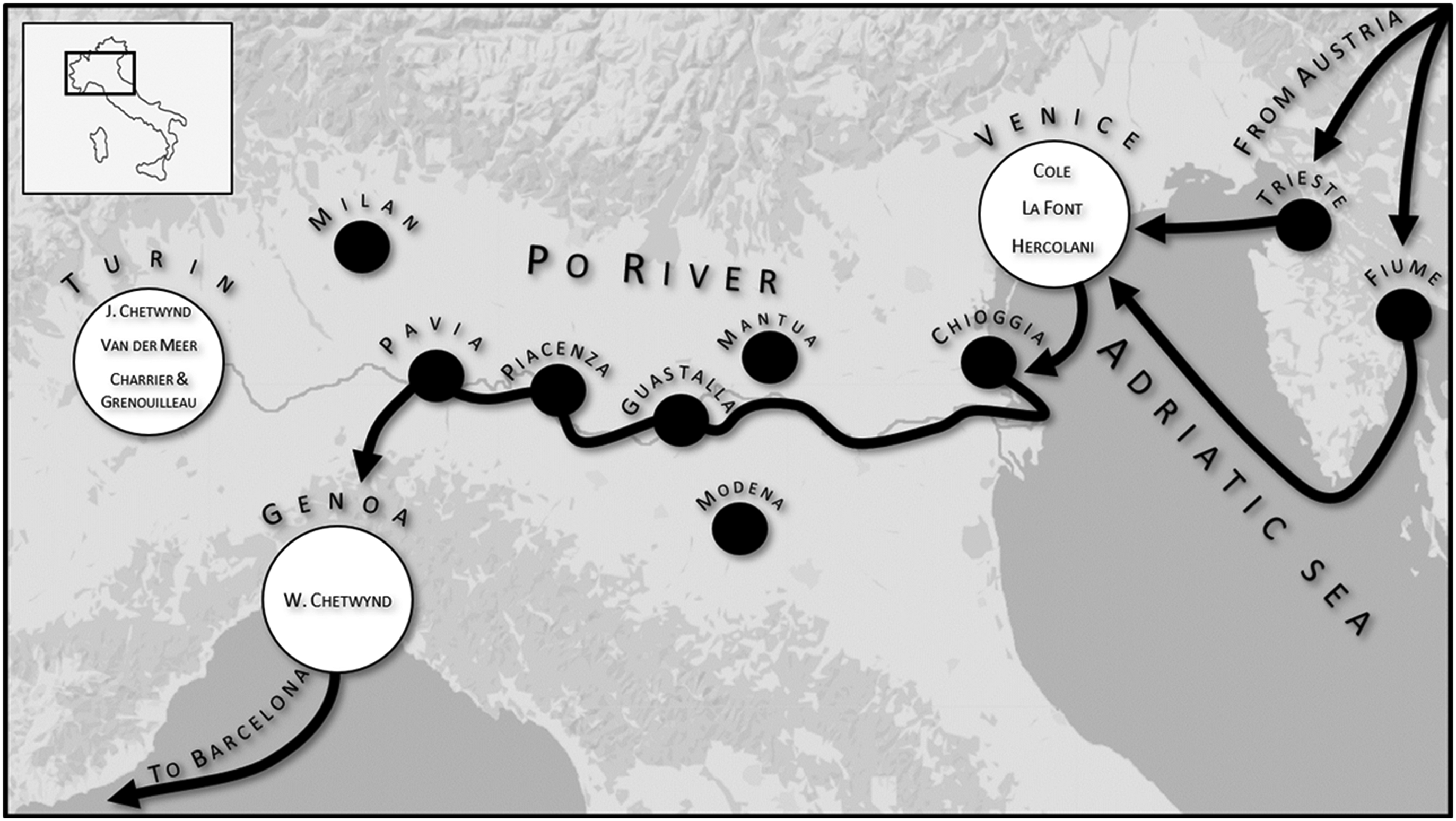
Cole and the Chetwynds' grain shipment, 1708-1710 (Michael Paul Martoccio 2022).
To effect this process before 1709, Cole and the Chetwynds drew on commercial relationships which they had been cultivating for several years. For example, in October 1707 John Chetwynd obtained grain on behalf of Britain and the Dutch Republic for feeding the German troops crossing over to Barcelona by hiring local undertakers who would purchase and ship it to Spain at their own risk, persuading the contractors to send out nearly 15,000 sacks and giving the allied forces the right to refuse the shipment if they were unhappy about its quality. 28 The whole operation required deft management. Chetwynd coordinated with local British naval commanders to escort the grain transports, and he smoothed over relations with the British deputy-paymaster in Spain when the bills drawn by the German troops for paying the contractors were refused payment, going so far as to act as guarantor for the bills, along with the Dutch envoy van der Meer. 29 The Chetwynds performed much the same service for the troops in Spain the next year. When 5000 sacks of oats were needed as forage for horses at the front, John Chetwynd asked Christopher Crowe, the British consul at Livorno, to try and pick some up as cheaply as possible, ‘it being for the Queen's service, in which we are to act with the greatest economy’. 30 In the end, Chetwynd decided once again to rely on French Huguenot contractors in Genoa to find the oats (which were promptly turned over to van der Meer), establishing a relationship with men who were to play a major role in the events of 1709 as Chetwynd bought up a consignment of grain for the armies in Spain, secured the necessary passports, and attempted to ship it across Italy.
The Contract: September 1708–May 1709
This drama began in September 1708, when the British commander-in-chief in Barcelona, James Stanhope, wrote home warning that ‘the most terrible enemy we shall have to face next Spring will be famine, if measures be not taken in time’, the army requiring an immediate supply of grain, ‘ … [and] if we are disappointed of this, ‘twill be impossible to take the field’. 31 With no grain available as always in Spain itself, British diplomats set out across the Mediterranean to find some. Their reports back were grim. ‘I am going on a new journey to [the] Barbary [Coast] to see if I can get any corn’, a British official wrote in February 1709, adding darkly that while ‘there are other strings to our bow but in such a ticklish point as starving, we cannot have too many’. 32 Similar reports came in from Italy, where five years of war had stripped the peninsula bare, Tuscany and the Romagna being (as John Chetwynd reported) ‘the only places along this coast, that have not been eaten up by the Germans’. 33 Worse still, Tuscany banned the sale of grain: ‘they are not themselves in a condition of sending any abroad’, the British envoy in Livorno, Henry Newton, later reported, ‘[as] the harvest, which had the best appearance of any, happening to be very indifferent’. 34
Even Britain's Italian allies refused to provision the armies in Iberia. ‘Now as they do complain all over Italy of the same scarcity, it will not be a little difficult for me to supply them and I must expect to pay a good price for what I get’, William Chetwynd wrote on 24 February 1709, only for Archduke Charles’ viceroy at Naples to deny him ‘the free extraction for what corn I can find in the Kingdom of Naples … there being no other place from whence one may expect to be supplied in any time’. 35 So too did the viceroy, Cardinal Vicenzo Grimani, rebuff William's later requests in September of that year. 36 ‘It is hard’, complained John Fleetwood, the British consul there, ‘that the extraction of corn which should be denied to the troops of Her Maj[esty] … w[hen] they are fighting to maintain and defend the country which produces it’. 37 The same was true in Habsburg-ruled Milan. 38 Chetwynd could only find 10,000 sacks of corn on a Dutch ship in Liguria promised to the Duke of Savoy, which he was able to redirect to Barcelona by assuring the Duke that he would replace the lost grain with corn bought from Habsburg officials in Milan, who, typically, rejected Chetwynd's proposal. 39 Given that the Savoyards had only switched to the Allied camp a half-decade ago and still needed to feed an army of approximately 17,500 men, Chetwynd's broken promises carried great weight. 40 Such inaction from Habsburg leaders – who were, again, not only British and Dutch allies, but dynastically tied to the very man whose throne the Grand Alliance was fighting to win – exemplifies the delicate interplay of diplomacy, commerce, and, as Caleb Karges has noted, individual egos in victualling Spain. 41
‘It being impossible to buy any [corn] all along the coast of Italy’, the Chetwynds had no choice but to think outside the box. ‘The only way’, John wrote to Stanhope from Turin in late November 1708, ‘will be to send you such as may be got by people of this place from Austria or Styria, Carinthia and Dalmatia’, all regions in southern central Europe that were part of the Austrian Habsburg erblande or ‘Hereditary Lands’. 42 To obtain corn, Chetwynd struck an agreement with the firm of Messers Charrier and Grenouilleau of Turin, who promised to move around 30,000 sacks of corn to the Austrian-controlled ports of Trieste and Fiume, whence the cargo would be then carried around Italy by ship to Genoa before finally leaving for Barcelona. A formal contract was signed in March 1709. On one side were the Chetwynds, acting on behalf of the British Crown and the Grand Alliance. 43 On the other side were the two French Huguenot contractors based in Turin, Charrier and Grenouilleau, and their agents in Vienna (Imbert) and Venice (La Font). 44 The Chetwynds had worked with the Turinese firm before and the two parties had formed a budding personal relationship. In 1707 and 1708 John Chetwynd had hired the firm to remit specie for the British state in northern Italy and fulfil grain contracts, the contractors even going so far as to propose an (ultimately failed) plan to expand their firm to Barcelona to transit all the necessary grain and money to the armies there. 45
However, Charrier and Grenouilleau also had a chequered history with the Austrian Habsburgs. In fact, the corn the duo had assembled in the Austrian Hereditary Lands (which Chetwynd was now trying to get shipped to Spain) had originally been meant for the Imperial Commissary for northern Italy. According to Sir Philip Meadows, British ambassador at Vienna, the supplies ‘had been bargained for by the Emperor's Commissary (General Schlick) and Marshaul Dhaun [Wirich Philipp von Daun], but the agreement after the arrival of Prince Eugene here was soon cancelled’, disrupting efforts to support the Habsburg forces in northern Italy but clearing the way for Chetwynd, ‘never too much to be praised’, to swoop in and take over the contract. Indeed, Meadows noted that ‘three thousand florins were actually telling out, and the passports ready signed’ by the President of the Chamber, Count Gundaker Starhemberg, and Charrier and Grenouilleau's ‘agent [Imbert was] intending to leave this place that night … [having] agreed with some Genoese merchants for the corn’, when Meadows had ‘pretty fortunately interposed’ and delayed the deal long enough for Chetwynd to sign the contract. However, the cancellation of the original contract by Eugene had created a minor diplomatic spat between Schlick and Daun on the one hand and the duke of Savoy on the other, ‘who knew the ability as well as the punctuality of them [Charrier and Grenouilleau], they having served the army in Italy some years to the satisfaction of the Duke of Savoy and of the Emperor's troops’. Meadows thought that Schlick and Daun had reneged on the deal as ‘too prejudicial a contract for the Emperor’, evidently because the President of Milan had ‘set up his people to do the business so much cheaper with a view of reaping himself what advantages are to be made’. 46 Regardless of the true story, the result was a great deal of bad blood, which then followed the contractors to Italy even though Meadows obtained for Imbert the passports necessary for moving the corn from the Hereditary Lands to Trieste and Fiume for embarkation. 47
The whole operation thus relied upon Imperial passports, paper passes permitting the smooth passage of grain customs-free through the Hereditary Lands and, if necessary, the aforesaid warren of Imperial territories across northern Italy. 48 ‘I cannot do this without the permissions of the several princes through whose states it must pass’, John Chetwynd worried, warning Stanhope that ‘it would be proper to send me a recommendation or passport from the King [of Spain] or some of his ministers … to facilitate procuring a passport from the Court of Vienna’. 49 ‘I must desire you to solicit it at your court in such a manner as the delay may not serve for a pretext to retard the embarkation’, he told Meadows, showing his awareness of the delicate timing involved in moving the perishable grain. 50 Although there is a growing literature on passports in the Mediterranean in this period, it largely focuses on how these permits regulated nationality, citizenship or subjecthood. 51 Yet such passes also managed and coordinated military resources, especially in the large coalition wars of the eighteenth century. The brothers had strict orders ‘not to suffer any quantity [of corn] to pass without due transits and proper permits’. 52 In fact, at the very time the Chetwynds were toiling to secure paperwork at Vienna for Imbert, they were denying similar grants to northern Italian traders in an effort to deprive the French of vital grain shipments as famine scythed through Provence in 1709. 53 ‘I shall be very watchful to see whether it is employ’d for [the French]’, William Chetwynd wrote to his superiors from Genoa after giving some merchants passes for Levantine grain. 54 He demurred again later that year when two papal representatives confronted him for passports to allow grain to be shipped from Genoa to Avignon because the grain ‘might go to supply the enemy … [though they] assured me that the corn was actually for the City of Avignon’. 55 On the other side of the peninsula, Christian Cole followed suit, issuing passports in August 1709 for three Italian captains to travel from Venice to the Morea to load corn, sail it back, and sell it at Livorno or Genoa only on the condition that it not be sold to the French. 56
The Chetwynds therefore relied on such passes frequently, issuing their own passports to allow friendly, neutral ships to avoid being stopped and searched by British vessels and their goods confiscated. They also served the British ambassadorial corps in Italy as a sort of diplomatic weapon. In this case they were a vital form of insurance, even if they were not used, since the contractors had by virtue of the contract of March 1709 the power to choose their own route and transport the grain at their own risk. As the contract John Chetwynd made with Charrier and Grenouilleau in March 1709 explained, the entire operation remained fluid, the French pair were required ‘to embark the said grain … which is entirely at the risk of Charrier and Grenouilleau’. 57 As in 1708, Chetwynd carefully hedged his position, adding ‘a counter-contract by which I am free from all engagements, and at liberty to take the corn or not’ and allowing some of it to be offloaded by the contractors at Genoa ‘more to oblige them in getting the extraction than anything else’. 58 In return, Chetwynd put up little beyond securing – through Meadows at Vienna, of course – duty-free transit of the grain, sureties for all transports used in the operation, and, most importantly, passports for Charrier and Grenouilleau's Viennese agent, Imbert. Chetwynd's role was then to facilitate rather than direct.
Indeed, as the Turinese contractors were themselves subjects of the Duke of Savoy, the Chetwynds and Cole lacked any formal power over them. Instead, the diplomats mobilized a judicious mixture of sticks and carrots to pressure Charrier and Grenouilleau. For example, the diplomats threatened to take their business elsewhere. In August 1709, Cole contacted a British merchant in Venice, Robert Davies, who offered to import corn from the eastern Mediterranean and then either ship it directly to Genoa ‘under Italian names, and kept very secret’ or ferry it up the Po under military escort, a route ‘much cheaper than by sea, to be sure with more certainty’. 59 ‘No greater service can be done in supplying Her Majesty's army and preventing the French from having those supplies they have had these past years’ Davies wrote to Cole. 60 He made clear though that any deal rested on Chetwynd finding him passports up the Po ‘to save customs and other impediments that may attend’. 61 In the end, a combination of inexperience and pique scuttled the deal. First, Cole and Chetwynd could not agree on the proper weight of the sacks of corn they wished to buy, delaying the whole process by weeks. 62 Then Davies raised the price. ‘We must not expect the least favour from any merchant when he is at liberty to dispose of his corn at the market price’, Chetwynd fumed at Cole, 63 threatening Davies on the same day that ‘nobody can meddle with corn to come by the Po except the Duke of Savoy or some Italian prince and I believe you will find your account better by dealing with me than anybody else’. 64 By the next week, the deal had collapsed, and Chetwynd recommended that Davies sell the corn instead to the agent of the Duke of Savoy to replace the 10,000 sacks Chetwynd had redirected in March to Barcelona, justifying the whole affair by arguing that he, as the envoy to Turin, could not be seen as profiting from the contract. ‘I may not be suspected to play the merchant, for that is become so general a faith at present that a little matter makes people talk and the word is easily given to censure the clearest conduct’. 65
Though the deal with Davies came to nothing, it does demonstrate how Chetwynd and Cole drew on a range of informal contacts in an effort to exercise a check over their primary contractors, and to provide a degree of insurance in case their plan failed. Another British firm, Messrs Thomas and Samuel Williams, likewise approached John Chetwynd directly with an offer to sell to him in-bound grain from the Aegean or else to put together another journey east by means of ‘honest masters as may be our factors, men practised at those seas’. 66 Although nothing came of the negotiations in the end, the Williams’ offer points again to the importance of informal networks, the two having brokered negotiations for a new trade deal between Cole and the Venetian trade ministry (Savii del Mercanzia) earlier that May. 67 Cole himself served as a further check on malfeasance; Chetwynd instructed him in September 1709 to report back if La Font, as the agent in Venice of Charrier and Grenouilleau, ‘does not act as he should with all honour and integrity, that I may have him changed’. 68 The distributed and informal nature of the logistical infrastructure gave Chetwynd and the British state a wide range of information and expertise, distinct advantages over other foreign officials such as a certain Monsieur Picon, the aforesaid agent of the Duke of Savoy, whom Davies said had achieved little in Venice besides raising the price of corn for everyone else. 69 ‘Merchants love to have to do with their equals, and not swordsmen’, he added, ‘which is the sole reason the Duke of Savoy is not served’.
Rather than a single bureaucratic hierarchy, the military commissariat in Italy was based around an overlapping but ad hoc tapestry of mercantile, commercial and diplomatic networks distributed amongst several important fiscal-military hubs instead of being concentrated in a single place. Tapping into commercial networks at Venice required a range of skills from officials such as John Chetwynd and Christian Cole, many of them different from, and even incompatible with, the impartial and systematic rigour expected in rational bureaucratic structures. The same was true of the diplomatic measures required to move the corn that Charrier and Grenouilleau found, which relied upon passports allowing customs-free transit. The effectiveness of military supply through northern Italy depended on the quality and efficiency of both the mercantile networks which actually sourced and transported the grain and the diplomatic networks which secured the necessary paperwork, a process that had little to do with bureaucratic state formation, and much more with informal politics and negotiation at a handful of fiscal-military hubs. This can be seen most clearly in mid-1709, as Chetwynd's arrangements began to fall apart and left Cole in the ‘rare pickle’ noted at the start of this article, since the grain was seized and impounded at Venice and concerted diplomatic efforts were required before it could proceed on its way.
The Crisis: May–November 1709
The difficulties began almost immediately after the grain arrived in Trieste and Fiume as Chetwynd received word from his brother, William, in Genoa that French privateers based out of Bourbon-controlled Sicily had effectively shut the Straits of Messina and the route around the heel of the Italian peninsula to allied shipping. 70 Neither could he find at that point any other sources of grain, unless by contracting directly for it at the risk of the public, ‘so I leave you to judge’, he told Stanhope, ‘whether it be more better to pay something more and be sure’. 71 In the end, John Chetwynd decided ‘to bring [the corn] by the Po, near to Nova [i.e., Novi Ligure] and from hence to Genoa by land, so that I am no longer in pain for the risks of the sea’. 72 But the route up the Po was little easier. For one, Chetwynd now needed two more sets of passports, one from the Venetians to bring the grain over from Trieste and Fiume and others from the various Po princes, who, as nominal fief-holders of the Holy Roman Emperor, may or may not have accepted the Imperial passports Imbert attained in Vienna. ‘I believe I shall never get this passport’, Cole seethed, ‘the chief reason is that [the Venetians] will have no vessels but their own cross the Gulph, and I find the Emperor's ambassador here is not fond of this thing’. 73 Stuck, Chetwynd tried to draw on the services of the Venetian agent of the Marquis of Prié, Imperial ambassador to Rome, to get the Italian passes, but he failed. ‘Mr Olm [the agent] seems resolved to send the corn from Trieste to the Po without a pass … He says they may avoid the Venetian galleys well enough and if they should be taken by them, they would but sell the corn here and give the money’, Cole wrote to Chetwynd in July, adding cynically that ‘since the merchants are to deliver it at their peril, I think I had as well trouble my head no more with it’. 74 Chetwynd doubted Charrier and Grenouilleau as well, apologizing to envoys Cole and Meadows for his requests ‘to favour the merchants who I fear have not dealt so fairly with us as I had reason to except at first’. 75
In June, Chetwynd, frustrated with continued delays in getting passports for the cargo's journey up the Po, changed his mind about the need for grain. He asked Cole therefore to authorize Charrier and Grenouilleau to put the corn up for private sale at Trieste without any Venetian passports. But then Chetwynd, vacillating again, changed his mind back, and told Cole to send the grain from Trieste up the Po and on to Spain, a decision both quickly regretted when the Venetian navy seized the unlicensed cargo in the Gulf of Venice before it ever reached the river's mouth. 76 Impounded at Chioggia in the Venetian lagoon, the corn now passed to the care of the contractors’ agent in Venice, La Font, whom Cole wrote to in early September ‘lest he should be intimidated to part with some corn’. 77 But relations between Cole and La Font only worsened when the agent learned of the former's negotiations with Davies and Williams, the two abovementioned English merchants, about alternative sources of grain. 78 Chetwynd's position deteriorated further when the Duke of Savoy, his harvest having also failed, now demanded that Chetwynd replace the 10,000 sacks of corn the diplomat had acquired back in March from the Dutch ship outside Genoa, and sent an agent to Venice to try and secure some. 79 With the collapse of the Davies deal and under increasing pressure from the Savoyards, Chetwynd then instructed Cole to secure the release of the corn from Venetian custody and free passage for the rest across the Gulf. The Most Serene Republic needed to ‘comprehend how easy it is for the Queen to do herself justice whilst she has so great a fleet in the Mediterranean’, Cole threatened the Venetians in early November, who, fearing greater British naval and diplomatic sanctions, released the corn a few days later. 80
However, the whole confusing affair had already triggered a cascade of misunderstandings and delays which placed immense strain on the makeshift networks that Chetwynd had built. Most embarrassingly for Cole, in the midst of his heavy-handed defence of the Queen's right to ship corn for her own service, the diplomat was informed by the Abbe Giardini, the Duke of Modena's agent, that the employees of Charrier and Grenouilleau had disposed of half the corn to the Venetian Magistrato delle Biade and were offering the other half for sale. 81 ‘You may imagine how this struck me’, he told Chetwynd since, having stated just a few days earlier in front of the Venetian Senate that the corn was entirely for British public service, men nominally working for him had been caught red-handed in the act of selling it for profit. 82 Chetwynd replied that he had only given permission to sell the Queen's corn if it were spoilt, but Cole reported that La Font, as Charrier and Grenouilleau's agent in Venice, had secured the keys from the Magistrato and found to his surprise that the corn was in perfectly sound condition. 83 The causes of this uncomfortable episode were almost ridiculously banal. Cole later found that La Font had employed a third man, a certain Monsieur Roussaux, as his sub-contractor in Venice to purchase corn, and since this man traded on his own credit and worried that Cole and Chetwynd might delay paying him, he had colluded with others to have the corn declared spoilt so that it could be sold. 84 News of these proceedings had also reached the ears of Prince Hercolani, the Emperor's envoy in Venice. 85 Having already accused the British diplomats of fraud the previous month due to a missing Swedish grain ship bound from Genoa to Barcelona and no doubt aware of the cloud hanging over Charrier and Grenouilleau for their perceived misconduct with the Imperial Commissary, he blocked further exports out of a concern that Chetwynd and the contractors were misusing the Imperial passports. 86
It is worth standing back briefly to consider what this affair tells us about the fiscal-military system writ small. The whole episode represented a major setback for the effectiveness of the British state, delaying the supply of corn to Spain, disrupting commercial relations and bringing Britain and Venice close to war. It reflected a breakdown in communication between everyone involved: between British officials in Turin (Chetwynd) and Venice (Cole); between British (Cole, Chetwynd), Italian (Giardini), and Imperial (Hercolani) diplomats; between these diplomats and their contractors (Charrier and Grenouilleau); between the contractors and their agent (La Font); and, finally, between this agent and his sub-contractor (Roussaux). It was only thanks to the unpredicted intervention of Abbe Giardini that the whole debacle came to light; ‘we would be in a fine pass if the agent of Modena had not advised me of this’, Cole noted to Chetwynd, ‘[as] the corn would have been sold yesterday and delivered, and what answer should I have had from the Senate? What could they have said of us in London?’ 87 He praised the Abbe, saying he had ‘saved your and my honour’. 88 The issue was not corruption and malfeasance, but miscommunication. By concealing the corn's destination and vacillating in June, Chetwynd left Cole without directions and unable to counter rumours – which turned out to be accurate – that the corn had briefly been released back to Charrier and Grenouilleau for private sale. As Cole told Chetwynd later, ‘I am very sorry I was not advised from the very beginning of all the matter of fact, and then I could have known how to act’. 89 Worse than that, Roussaux's fraud lay hidden in October and November because Chetwynd (and perhaps Charrier and Grenouilleau) had no idea who the sub-contractor was, and Cole repeatedly failed to tell Chetwynd what Roussaux had said. 90 The whole affair also did real damage to the relationship between the Chetwynds and Charrier and Grenouilleau; early the next year when the Chetwynds concluded a contract to supply £20,000 a month to the army in Iberia they chose a different Turinese firm to manage the money. 91 Chetwynd replied that Charrier ‘lays the fault on his correspondents at Venice and tells me that he hath or will change them for having acted without his knowledge’, suggesting either that the Huguenot contractor's network had failed him or that he was a thoroughly convincing liar. 92
Even when the relevant parties ironed out this spat and got the grain moving again, they met with further delays. Rumours spread up the Po with the cargo, and Imperial officials seized the grain again at Pavia and arrested Charrier and Grenouilleau's clerk, a fiasco only exacerbated by the fierce resentment between the contractors and the Milanese Secretary of War, Fidel, who (as John Chetwynd told Stanhope) ‘hath been the author of all this bustle … a very good-for-nothing fellow’. ‘More out of a private pique to the Chancellor than anything else … [Fidel] hath been the sole cause of these as well as the scandalous reports of my designing the corn for the enemies’, he added, and badgered Stanhope, as commander in chief of the British forces in Spain, to ‘be so much my friend as to engage yourself heartily in my quarrel … [and] as to procure me some just satisfaction’. 93 Unless Stanhope provided him with the political support necessary to generate diplomatic leverage, Chetwynd argued, he would be unable to procure the relevant passports, and therefore the entire venture to ship corn for the supply of the army in Spain would be wasted; ‘unless you can support me in what I do’, he concluded, ‘I flatter myself that you are so much my friend as not to employ me’. Stanhope thus wrote to the relevant parties in Barcelona, Milan and Vienna to confirm that the grain was, and had only ever been, intended for the supply of allied forces in Spain, thereby simultaneously putting the shipment back on track and clearing Chetwynd's name of any wrongdoing. Stanhope's intervention was vital, Chetwynd wrote, to right ‘the injustice they have done me as to my reputation not only by seizing what came accompanied with my passports but in doing it in so scandalous a manner as to make the world believe I was engaged in clandestine trade to serve our enemies. This vexes me heartily’. 94
In the end, all parties resolved that the solution was not more state oversight and the creation of a bureaucratic hierarchy, but better communication, and the closer integration of key agents and actors, by bribes and gifts if necessary. Cole argued that they needed better relations with Prince Hercolani. ‘I found he was of the opinion that both he and I should have been informed of all from the beginning, and then, he says, the corn would now all have been where it was designed’, Cole wrote, though less admirable motives were also in play, ‘ … [as] I believe he would have had his secretary get something, and I assure you it would have been worth Mr Charrier's while’. 95 Hercolani also pointed out that large amounts of corn had already been shipped across the Gulf from Trieste to Venice using Chetwynd's passports, claiming to be on Her Majesty's service; ‘this may perhaps be’, Cole admitted, ‘but let the officers of the Emperor's customs look to that, [as], he says, with a little money they shut their eyes’. 96 When Chetwynd and Cole made plans to ship further amounts of grain in early 1710 along the same route, they adjusted their plans accordingly. ‘I hear Mr Charrier has the commission to furnish all the army with corn etc’, Cole noted in February, ‘[and] I do therefore give my humble opinion that he ought to let the Prince Hercolani know of it, and act in concern with him, for else he will be angry and cross him where he can’. 97 Two months later he noted that the prince's family had recommended a certain Count Salvatore to help Charrier supply grain magazines via Imperial-controlled Comacchio and Mantua, further braiding together the diplomatic and commercial networks of all the respective partners. 98
Cole's earlier sabre-rattling also paid dividends, since the Venetian Senate immediately released a ship with corn and Chetwynd's passport which had been driven into the nearby port of Chioggia, and even permitted ships to offload corn brought from Trieste for reshipment by smaller vessels and gave them Venetian passports. 99 When in early 1710 Venetian authorities seized another ship, ‘done by malice of the patron Tomaso Tomicich’, Cole managed to get Tomicich arrested ‘and … punished if guilty…so others [may be] frightened that should design the roguery’. 100 By June 1710, Cole and La Font had organized the unloading of all the corn, hired captains from Trieste and Turin to transport it, and found passports to secure these barges’ passage from Chioggia up the Po. 101 ‘The corn goes on now, and I will let the rest come to Chioggia and then demand a passport for it all at once, and so finish this troublesome business’ Cole reported. 102 But he was not free yet. News then arrived that the Habsburg courts in Barcelona and Vienna were concerned that none of the corn appeared to have arrived in Spain. Once again, the cause for the whole debacle rested in poor communication among all involved. In truth, Chetwynd had given some of the 30,000 sacks promised for Spain to Turin in return for the corn he had redirected from the abovementioned Dutch ship the previous March. As noted above, Chetwynd had originally hoped to replace this corn with some he had bought from the Imperial Commissary at Milan, the very men who now accused him of fraud. 103
Furious, Chetwynd and Cole had to rehearse everything they had done once again. ‘I heartily wish I was once out of this embroil, and which you have also had your share’, Cole commiserated with Chetwynd. 104 ‘It is very disagreeable for me to think that the Emperor and his ministers should suspect my integrity in this business of the corn and that they should have raised so many different obstacles after having granted the passports’, Chetwynd told the new British envoy at Vienna, but he persisted, ‘for after the noise it hath made all over the world, it is not for my reputation to let it drop as the Imperial ministers seemed inclined to do’, and even looked to see whether it might be possible to claim monetary compensation for the delays that had been caused. 105 ‘If I ever engage in a matter of the like nature, on never so pressing an occasion, I will readily consent to have ten times the trouble and not only suffer the like scandal but something more’, he wrote, bruised and exhausted, in May 1710. 106
Conclusions: Military Supply in the Fiscal-Military System
What can one corn contract tell us about the ability of the early modern state to perform the most basic function of war-making – feeding troops? As this article argues, a great deal indeed. Supplying allied armies in Spain during the War of the Spanish Succession posed a considerable challenge for the British and Imperial states, which makes it necessary to rethink the wider literature on early modern state formation in Europe. The issues that officials such as Chetwynd and Cole faced coordinating the movement of corn across foreign jurisdictions were neither bureaucratic nor fiscal, but diplomatic and commercial. Mercantile networks for Mediterranean grain were highly integrated both in the Adriatic and Tyrrhenian seas, but linking these markets across the patchy jurisdictions and sovereignties of the Po Valley in a time of famine and war was a different exercise. Rather than new cadres of Weberian bureaucrats, the army depended on unpractised diplomats, the leaders of neutral states such as Venice, private contractors such as Charrier and Grenouilleau, and nominally friendly merchants like Davies and Williams. Heavy-handed coercion and threats were occasionally effective at coordinating the flow of information and avoiding delays, but better personal working relationships with key figures, both diplomats and merchants, were more common. This process took place in regional fiscal-military hubs such as Venice and Vienna outside the borders of these states, not just in the ostensible centres of British and Dutch fiscal-military power in London, and Amsterdam and The Hague, respectively. In these commercial and diplomatic centres, merchants, contractors, diplomats, paymasters, and agents assembled, shared information, socialized, and, if the mood struck them, toasted to each other's success.
Thus, to return to Tilly's aphorism, neither the wars that the states made nor the states that those wars made were as clearly defined and nationally delineated as they would become in the late nineteenth and twentieth centuries, and they projected, of necessity, beyond the borders of their individual states. This emerges most clearly from a micro-historical focus that shows the multinational nature of this key transaction, as British money paid French Huguenot contractors to buy central European grain and ship it through Italian states with passports from the Imperial Court for the benefit of the British, German, Dutch, Portuguese and Spanish troops in eastern Spain. It therefore emphasizes the need to move beyond scholarship based on national histories of state formation. Neither the model of the ‘fiscal-military state’, which focuses on bureaucratic action at home, nor the ‘contractor-state’ model, which has tended to examine the ends rather than the middle of a military commodity chain, can accommodate and conceptualize the role of the diplomatic and commercial negotiations by which foreign resources were marshalled and sent from one foreign territory to another via a large number of intermediary ones. The grain Cole and Chetwynd bought in 1709 could only move through northern Italy because of the pre-existence of a wider, European system. Taking a close look at one example, albeit a telling one, of this system in medias res accordingly allows us a better understanding of the larger development of states, markets and warfare in early modern Europe more generally.
Footnotes
Acknowledgements
The authors are grateful to Professor Peter Wilson and their colleagues on ‘The European Fiscal-Military System, 1530–1870’ project at the University of Oxford for their comments on earlier versions of this article, and for the feedback offered by the editors and reviewers at European History Quarterly.

Correction:
This article was funded by the European Research Council Horizon 2020 Grant #787504, ‘The European Fiscal-Military System, 1530–1870’.