




Abstract
This article explores the Romani contribution to the construction of urban space(s), focusing on the city of Berlin between about 1890 and 1933, with a particular emphasis on the period between the turn of the century and the First World War. Drawing on press reports, it offers evidence for public awareness of a new Romani presence in and around the city, and proposes that media representations of ‘Gypsies’ in the new suburbs reflected the heightened sensitivity to setting boundaries between urban and rural, civilized and uncivilized, that informed Berlin's ‘urban imaginary’ at a time of expansion and modernization. In a second step, the agency of Romani Berliners in defining the city as a multi-ethnic metropolis and shaping spaces within it is considered. The account focuses on productive interactions between Romani and non-Romani actors in the horse markets which drew Sinti and Roma to settle in Berlin and on the lives of horse-dealing families in the city at large, including the tendential emergence of ‘Gypsy’ neighbourhoods.
In June 1912, the Berlin police banned ‘Gypsies’ from travelling in groups through the suburban districts of Charlottenburg, Schöneberg, Neukölln, Wilmersdorf and Stralau. 1 The decade that preceded the First World War witnessed an intensification of anti-Gypsy policies all over Germany, accompanied by a spike in attention to Romani groups in the press, most of it negative. In the light of this, the Berlin ban appears as simply another chapter in a long history of discrimination. It can also, however, be seen as a move in a more complex process of marking a border between the city and its hinterland, or of defining urban space. This article proposes that the fact of a new Romani presence in Berlin around the turn of the twentieth century contributed to perceptions of the cityscape at a critical point in its development as a modern metropolitan capital. An exploration of this ‘urban imaginary’ 2 necessarily emphasizes the perspective of the non-Romani majority, and that is of course the perspective that is privileged in the surviving sources, which originate almost entirely with the policing authorities and the popular press. 3 Following an understanding of space as the product of material practices, actions and performances characterized by ‘articulations of power’, 4 however, the article’s second purpose is to explore the material agency of Berlin’s Romani inhabitants in shaping the cityspace and spaces within it. The emergence of identifiable ‘Gypsy’ neighbourhoods, first in the suburbs and then within the historical bounds of the city itself, was the result of choices and decisions that Sinti and Roma made in response to changing material and legal circumstances.
The means of pursuing a livelihood that they chose, adapting familiar practices to the circumstances of the city, meant that the city's horse markets came to be identified by Roma and non-Roma as ‘Gypsy’ spaces. In attempting to map a ‘Romani Berlin’ this article focuses on Romani horse dealers and on the interactions that shaped the space of the horse market. Living with and dealing in horses has long been an intrinsic part of the lives of many European Romani communities and households, both settled and itinerant. Often understood as a rural phenomenon, before widespread motorization the buying and selling of horses was also key to Romani integration into urban local economies. Horse markets were part of Berlin's urban scene and its economic calendar until the 1930s, and organic points of encounter between Romani and non-Romani Berliners.
The scholarship on Romani horse dealers has tended to consider the Romani subjects in their relation to themselves, each other and the market, drawing conclusions about how economic practices express and enact Roma identities or (re)situating increasingly ‘niche’ ‘Gypsy economies’ in relation to the logic of the wider market economy. 5 Here, I consider evidence for productive interactions. During the period covered by this article, the horse trade was a vital part of the economy, and Romani people made their own contribution to an ethnically segmented market. But the market space itself was one in which that segmentation was manifested as cultural interaction and exchange between members of a majority population and people positioned in wider cultural discourses as stigmatized outsiders. In many parts of Germany, the horse trade was dominated by members of another ethnic minority, Jews. Accordingly, the most sophisticated historical work analyzing market transactions in terms of the dynamic balance of trust and suspicion between ethnic insiders and outsiders has focused on relations between Jewish livestock dealers and their customers. 6 Here, I explore the distinct but analogous interactions between Romani and non-Romani Berliners, giving close attention to what happened at the horse market.
There, interactions were structured by the asymmetry of information which is intrinsic to every market situation. Sellers know more about their wares than buyers, and this is a particularly acute problem with horses: each one is a unique exemplar of any one of a wide variety of different breeds, and in the formal market situation the only checks on fraud were the veterinary examination at the gate and the possibility of the appeal to law afterwards. The performance that this required of both buyer and seller implied the flattening or even reversal of power relations, as each party demonstrated his own competence and acknowledged the competence of the other. The dialogue might be coloured by the buyer's underlying wariness of the ‘Gypsy’ (who, as seller, had the upper hand) but would never have taken place if he had actually accepted the public stereotype of Romani horse dealers as cheats and thieves. The transactions which I describe in detail below do not differ substantially from negotiations between non-Romani horse dealers in Germany. 7 In this sense, the focus on market interactions reveals spaces in which equal agency, mutual respect and intercultural competence were on display.
At the same time, the horse market which brought buyers and sellers together was one of the spaces in which the multi-ethnic character of the wider society became visible and audible. This article traces how in Berlin horse markets were both associated with and attracted a new Romani presence. Beyond the market spaces or representations of them, figures of Romani men and women became part of the conversation about the shape of urban space itself as Berliners undertook a self-conscious programme of modernization and expansion. They were also drawn into a process of acknowledging and mapping the diversity of the city's population in terms not only of class but of ethnicity, revisioning the cityscape in ethnic or racial terms as successive new populations arrived and came to be associated with particular areas of the city. 8 The article begins by setting out the impact of these developments on Berlin's imagined cityscape before turning to the evidence of how ‘Romani spaces’ were shaped from within by Sinti and Roma themselves in interaction with (their) Others. In other European cities in the twenty-first century, the phrase Gypsy Urban Area (GUA) denotes a lived reality as well as an object of policy, and recent scholarship that brings together studies of ‘urban Gypsies’ with analyses of the racialization of urban space offers a lens through which to explore the confluence of real changes in Romani lives and lifestyles and the growth of a metropolitan area. 9 If in these terms what is observable in Berlin in the early twentieth century seems barely more than a tendency, our picture of ‘Romani Berlin’ a sketch-map at best, then its blank spaces need to be understood in part as artefacts of the ‘absent presence’ that characterizes the archival record in Romani history, 10 an absence compounded by the fracturing of local memory in Berlin.
Berlin at the Turn of the Century: Media Landscape and Urban Identity
During the years under consideration here, Berlin was embarked on a series of moves that extended its jurisdiction and drew new outlying communities into the rapidly developing regime of physical and administrative urbanism. This would culminate in the formation of Greater Berlin in 1920. While retaining the formal status of independent towns, Charlottenburg accepted the jurisdiction of the Berlin city government and its police regulations in 1877, Spandau in 1887 and Schöneberg in 1898; Neukölln-Rixdorf joined them in 1899 and Wilmersdorf in 1906. In 1908, visions of expansion and rationalization were mobilized in the launch of the Greater Berlin Competition (Wettbewerb Groß-Berlin), which ran until 1910. The competition invited schemes for reconstructing the historic city centre, stopping the uncontrolled building of high-density housing and making space for parks, introducing garden villages in the suburbs, and improving mobility with public transport and a system of major traffic arteries. Starting in 1912, a ‘Zweckverband Groß-Berlin’ (Greater Berlin Administrative Union) took these planning issues forward. By 1914, the planning jurisdiction of the city of Berlin had extended to cover most of the area we now recognize as Berlin, including significant suburban and rural spaces: 59 settlements still designated rural communities (Landgemeinden) and 27 landed estates (Gutsbezirke). 11
The question of where the city ended and the countryside began was thus acutely present in imaginings of Berlin and of the kind of urban space it was destined to become. Peter Fritzsche described some aspects of these imaginings in his 1996 study Reading Berlin 1900. The book is based on a survey of the newspaper press which saw an explosive growth in the same period and whose leading proponents, Ullstein, Scherl and Mosse, made Berlin into the media as well as the political capital of the German Empire at its confident peak. Fritzsche’s proposition is that the new city and the new medium made each other, and among the key themes he identifies is that of the suburb, or Vorstadt. In his account the Vorstadt has positive connotations – the new opportunities to be seized by first-generation incomers, the ‘forward movement’ of the expanding city – and embodies a microcosm of the metropolis. 12 In these general terms, Fritzsche is a persuasive guide to the imaginative formation of the Berlin cityscape. However, his vision of the Vorstadt focuses on the working-class suburbs and is strongly coloured by the celebration of forms of white working-class domesticity that were a cliché in Berlin popular culture. Attention to the representation of Sinti and Roma draws the eye to the totality of the suburban space, middle-class as well as proletarian, and to the fact that the city’s claims on the Vorstadt were contestable.
Urban Horse Markets and the Creation of the ‘Gypsy Village’ Weißensee
Planning for the growth of the city involved thinking about the supply of horses. An official survey of 1900 showed that there were 51,000 horses in Berlin; in addition to some 4400 maintained by the army, these included horses owned by individuals for leisure and sporting purposes and above all working animals employed in public and private transport. However, as the Berlin City Assembly was reminded in 1902, the city itself had no public horse market.
13
Instead, Berliners relied on markets held in Charlottenburg, Spandau and Weißensee. The demand was such that smaller, private markets continued to pop up in the city and the suburbs, and individuals could also buy and sell from their own premises.
14
But the proposal to open a municipal horse market in Rixdorf underlined the tension between visions of the modern city and the life of the market. It was prompted by reports from a private market that had recently been opened on the edge of a space planned for a public park: A horse market with its noise and coming and goings has no place in a district for whose development the city only recently made considerable sacrifices and is committed to further expenditure. It cannot be conducive to the planning of the area around Körner Park and associated housing developments to have horse markets being held there.
15
Accordingly, Berlin’s largest regular horse markets moved to and remained at the edges of the expanding city (see Figure 1). The first market in Charlottenburg, for example, started on one of the main thoroughfares in the 1850s, but moved twice to more open spaces on the edge of the district. The site in use from 1906 to 1937 was north of the Spree and bounded by two canals, an area which is still open space devoted to allotment gardens. 16 The Spandau market, in operation until 1929, stood on a site to the west of the Havel River which was still undeveloped at the turn of the century. 17
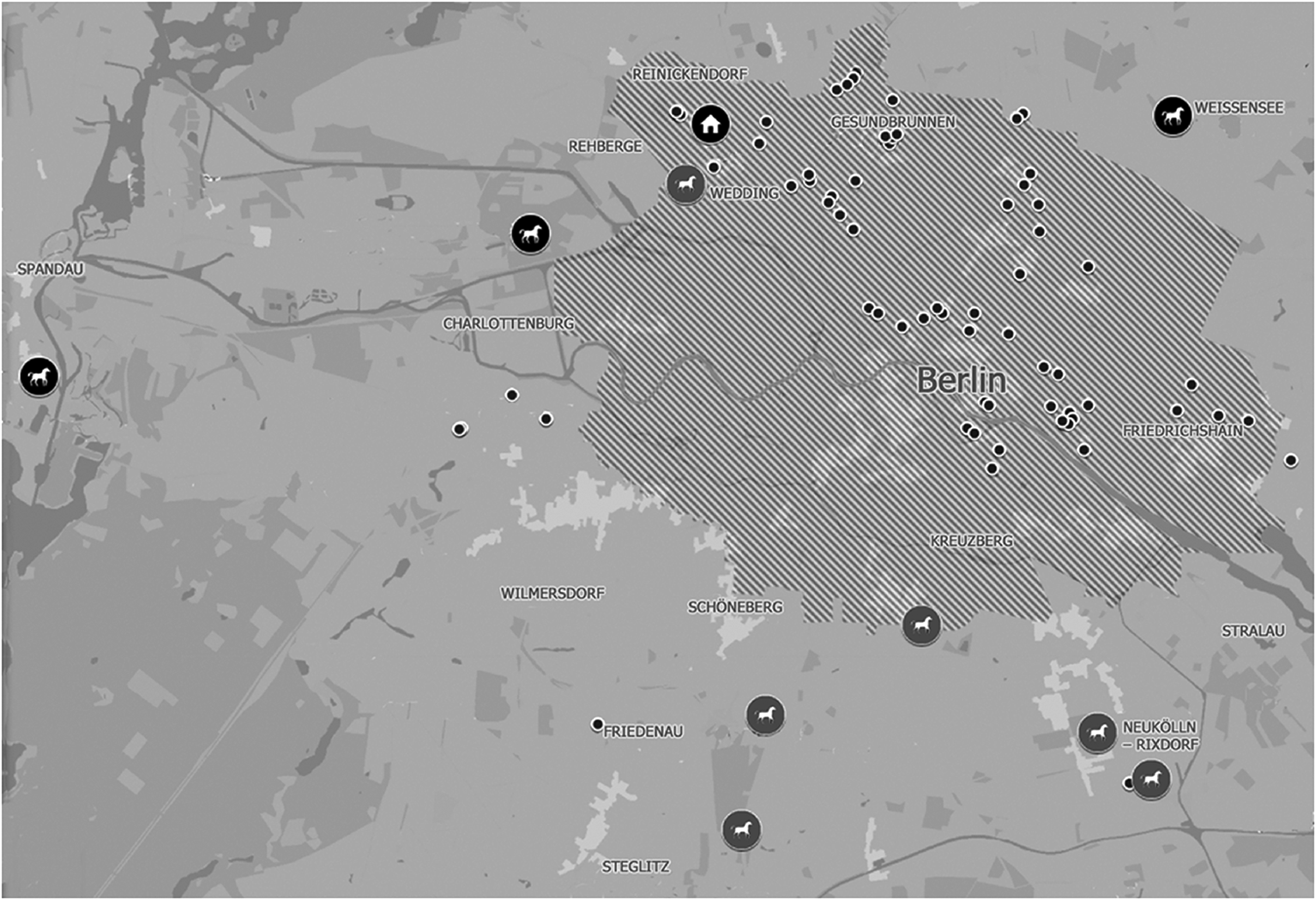
Romani Berlin 1905–1916 showing sites of the principal horse markets (black) and occasional private ones (grey), the 1910 Mission, and locations of Romani residences and businesses. The cross-hatched area represents the built area of Berlin (without incorporated municipalities and suburbs) covered by Straube's 1910 map. (Map: Emily Smith; Straube Map Wikimedia commons).
The largest and best known of the horse markets in the Berlin area was the one in Weißensee, northeast of the city boundaries. The plan for its creation began in 1881, when it was observed that a private market held on the grounds of Weißensee Palace was very successful. The new market covered four hectares in Neu-Weißensee, an extension of the historic settlement that had newly laid-out streets but few houses when the market went into operation in 1885. By 1902, it was being held 24 times a year, with an average presence of 1400 horses. 18
Almost from its beginnings, the Weißensee market was associated with Romani horse dealers and with a new and intriguing ‘Gypsy’ presence in the environs of Berlin; by 1914, the connection was so well known that it had reportedly become common for Romani men and women to name Weißensee as their home irrespective of where they actually came from. 19 In 1901, the regional newspaper that covered Weißensee reported that ‘Gypsies’ had become a permanent feature at horse markets since numbers of them had started settling down in the area: ‘They often come in large troupes and in some places they dominate the trade in medium- and low-grade material … Their offensive behaviour has led to repeated complaints from native horse dealers’ – complaints that testify to the skills of Romani dealers and their prowess on the market. The response of the police authorities was to restrict entry to the markets to dealers who were in possession of the most expensive kind of trading licence. In a rhetorical hostage to fortune, a reporter declared, ‘The Gypsies’ booming trade in horses is over for the foreseeable future’. 20
While Romani settlement in Weißensee seems to have dissipated by about 1905, they remained a presence at the horse market. On 1 April 1933, the Weißensee District authorities took over the direct administration of the market, at the same time reducing the area it covered; officially explained by falling demand for its services, this has been interpreted by local historians as intended to shut out the Sinti and Roma who continued to dominate the market space. 21 It is possible that they had become numerically more dominant as motorization did, after all, render the market increasingly marginal, and their visibility all the more problematic as the city had by now engulfed Neu-Weißensee. But the date of the takeover is not insignificant in this context: it was the day of the first nationwide boycott of Jewish businesses.
The Weißensee and Charlottenburg horse markets were formally shut down at the beginning of 1937. 22 This measure, too, can be seen as part of the crackdown on the Romani presence and way of life that intensified from 1936 onwards. In Prussia that involved intensified police surveillance of horse markets and the exclusion of Sinti and Roma from those that could not be closed down, and in Berlin the first removals to the internment camp in Marzahn. 23 The extent to which the market was embedded in Berliners’ imaginations at the point when it was closed down is suggested by an official announcement issued on 23 February 1937: ‘To answer any remaining uncertainty in interested circles about the fate of the Weißensee horse market, we hereby point out again that the horse market is … closed with effect from 1 January 1937’. 24
Public fascination with the Romani presence in Weißensee was reflected during the 1890s and beyond in the figure of the ‘wealthy Gypsy’, embodied in a new celebrity figure. The focus of media reports was a certain Petermann, variously given the title King or Captain of the ‘Gypsies’. In 1891, the local press reported that the Petermanns had settled in Weißensee, purchasing a property adjacent to the horse market and opening a horse-shearing business nearby.
25
In the following years, Petermann featured in reports of two prosecutions, one against him and his wife for child-snatching while the family was camping in Rixdorf and one against his mother and brother for creating a public nuisance when refusing to leave a tavern near the Weißensee horse market.
26
An 1897 newspaper report read: The prosperity of the Gypsies who have their domicile in Weißensee and foray out from here in all directions, mainly to visit the horse markets, is noticeably increasing … [The] adults indulge in extreme luxury. The women wear extravagant gold jewellery and are expensively dressed after their own fashion. Wherever the Gypsies turn up they organize huge binges where plenty of wine is drunk. The Captain pays every penny of the bill, which often amounts to hundreds of Marks. Petermann himself has bought a carriage with a glass roof and silver fittings, in which he drove through Spandau on Thursday at the head of his company.
27
Petermann’s notoriety was such that at a society masked ball in February 1898 guests appeared costumed as the ‘Captain of the Gypsies’ and his wife. 28 Reportedly expelled from Weißensee by the police in November 1897, in 1904 he was said to be purchasing a rural estate 20 km east of Berlin as a residence for himself and his wife, ‘the daughter of a respectable citizen of Köpenick’. 29 As late as 1907 he featured in a spread on the Charlottenburg horse market in the Berliner Illustrirte Zeitung. The photo of a portly, moustached man, respectably clad in greatcoat and homburg hat and holding a riding crop and walking stick, was accompanied by a similarly stereotype-challenging text: ‘The Gypsies play a special role there, chief among them their well-known captain Petermann, who is particularly respected as a dealer in and connoisseur of horses’. 30
It remains unclear whether there was a single individual behind these stories. In two of the press reports he features as Joseph. Other accounts refer to men with different names ‘known as Petermann’. 31 In the absence of material certainty about his identity we can (at least) place him in a tradition of mythical bandit kings in which ‘Gypsies’ had a place of their own. 32 But even as an icon he is of interest for his movements: Rixdorf, Weißensee, Spandau and northern Charlottenburg, places of licensed horse dealing, also mark the spaces in the north and east where the open roads and villages of Berlin’s hinterland met the open borders of an expanding city.
‘Gypsies’ on the Frontiers of the New Berlin
From the 1890s, and with increasing intensity after 1900, the popular press registered a heightened public awareness of a Romani presence not only in Weißensee, but in the city of Berlin itself. Reflecting actual changes in settlement patterns, which are discussed below, reports focused respectively on the gentrifying south-central fringes of the metropolis and the expanding proletarian north, each presented as a kind of frontier. In the southern suburbs, as the 1912 ban on travelling in groups cited at the beginning of this article suggests, ‘Gypsies’ appear as inherently out of place, as marauders or invaders from the countryside in areas which were developing as districts of middle-class housing and which lay between the rural hinterland and Berlin’s fashionable ‘West End’. The local newspaper for Friedenau reported periodically on the appearance in the main streets of travelling families, sometimes specifically identified as coming from Steglitz to the southwest. 33 Increasingly, the citywide press featured stories about Romani women turning up in shopping areas nearer the centre. Typically, they are represented as feigning respectability, pretending to shop, sometimes ‘disguised’ as ordinary women, to cover their real purpose of pickpocketing, swindling unsuspecting shop assistants or stealing from the till. 34 A report of 1912 – whose author could not deny that the women in question were well provided with cash and ready to pay for goods once they had haggled the price down – described them as ‘children of the Puszta’ visiting Friedenau, Steglitz, Wilmersdorf and Schöneberg from their ‘wagon fort’ (Wagenburg) in the southwest. 35 If the reference to the Puszta, a recurrent cliché, invokes wide open spaces and marauders from the East, the term Wagenburg has echoes of the recent colonial wars in South West Africa and also of the American Wild West. 36
Journalists who looked in the opposite direction focused increasingly on the territory north of Wedding. Wedding was a working-class area abutting on the less salubrious parts of the old centre; its character marked by the presence of new industries, much of it was already densely settled by the end of the nineteenth century. To the north, in Gesundbrunnen and Reinickendorf, stretched main roads and side streets that were still awaiting the housing and businesses for which they were planned. Buildings old and new alternated with construction sites and still-waste land. Further north was a hinterland of open spaces. In February 1908 a journalist for the Berliner Zeitung am Mittag reported on his visit to a ‘Gypsy camp’ ‘beyond Gesundbrunnen, where the streets meet the open fields’. He described families living in a farmyard in houses and caravans ‘in the same way as when they were still roaming the countryside’. Among other curious visitors from the city, the reporter was the only one (he claimed) to venture beyond the fence into this alien territory in search of a woman to read his palm – while others parried the sales pitches of the Romani men looking to sell horses and violins. 37 This vision of a sub-proletarian frontier was mobilized between 1910 and 1914 by press reports of a pitched battle between Romani families and its aftermath, the ‘battle of the Gypsies in Koloniestraße’: on 17 November 1910 a property in Koloniestraße (Wedding/Gesundbrunnen) inhabited by a group of Romani families ‘who make their living as horse dealers and musicians’ was attacked by members of other Romani families. Shots were fired, the police were called and four men were arrested for disorderly conduct, their prosecutions stretching over three and a half years. Reporters who speculated inconclusively about the reasons for the fight named nearby addresses in Gesundbrunnen and two streets in the eastern central district Friedrichshain as the home territory of other members of the family and their attackers. 38
The vision of ‘Gypsies’ as uncivilized and uncivilizable was of course embedded in German culture by the nineteenth century. 39 The anxiety that rural disorder and animal energies were penetrating into the heart of urban modernity is signalled in 1906 reports about a group of Roma who had taken up residence in the Roßstraße. This was in a neighbourhood at the eastern end of Berlin’s central island, where two- to four-storey buildings dating from the beginning of the nineteenth century housed small businesses and specialty shops as well as a small working-class population. Amid reports of the newcomers’ over-conspicuous conviviality, the press highlighted their commercial activities: ‘They are completely relaxed about carrying on the horse trade there, putting the horses through their various paces in Roßstraße and Schornsteinfegergasse in defiance of the traffic’. 40 This group of Roma was not allowed to stay long, but as more permanent settlements developed the term Zigeunerquartier emerged to capture a new category of urban space in the body of the city. The locations mentioned in the press coverage of the Koloniestraße incident had already acquired this label, and they recur in the context of more and less sympathetic reports of criminal disorder, squalid living conditions and disease as well as efforts by municipal and private landlords explicitly to deny ‘Gypsies’ access to rented property. 41
It is thus possible to trace a development in the urban imaginary of Berlin around the turn of the century in which the Romani presence appears to threaten the still-fragile distinctions between urban and rural, orderly and disorderly, civil/ized and uncivil/ized on which the image of the modern city rested, and to do so by testing the boundary and buffer spaces constituted by the new suburbs. At the imaginative level, of course, this drawing of attention to the boundaries served to confirm those distinctions. At the same time, the increasing visibility of Romani settlement, first in the Weißensee suburb and then within the bounds of the city, was articulated in terms of a racialized division of interior space – the ‘Gypsy neighbourhood’ – with attendant implications for policing and control. In this sense, the fact of the Romani presence itself contributed to the discursive shaping of the Berlin cityscape, but the discourse was largely beyond the control of the Romani actors. They were not, however, without agency in this process, and in the following section I turn to the evidence for the materiality of Romani life in the new Berlin, their willed actions and the resources they called on in shaping their own spaces.
Romani Spaces
The spheres of action of Sinti and Roma in Berlin around the turn of the century were shaped by a confluence of cultural and political developments. One was the preoccupation of the Berlin planners and public with the city's ‘physiognomy’ (Fritzsche), manageability and policeability, which I have outlined above. A specifically municipal concern, this was nevertheless related to Berlin's unique status as the capital of a nation state that was learning to feel its commercial and military power and their consequences for life at home. These included a heightened defensiveness about national space. Conflicts over the management of the African colonies which Germany had acquired in the 1880s, including debates over the genocidal counter-insurgencies in Southwest and East Africa (1904–1908) and the rights and status of colonial immigrants, added a layer of racial anxiety to concerns about migration. 42 Since the mobility of Sinti and Roma constituted a permanent challenge to the integrity of national borders, they were caught in a transnational spiral of policing measures that gave a new quality and intensity to the discrimination that they had suffered over five hundred years. In Germany, a panic among regional police and politicians about the ‘Gypsy nuisance’ came to a head. Calls for radical measures of elimination emerged alongside repeated renewals of such policies as were actually within the powers of governments that had not abandoned the rule of law; the key levers available to the authorities were the policing of nationality status and the system of licensing traders. 43
In February 1906, the Prussian Interior Ministry issued a decree which aimed to consolidate existing measures against the Romani presence and their mobility. Under its terms, foreign ‘Gypsies’ were to be refused entry to the territory and expelled if they were found in Prussia. Those who could demonstrate that they were citizens of one of the states of the German Empire were to be forced to settle down if possible. Every effort should be made to avoid issuing identity papers and or licences to trade. The key preconditions for licensing were proof that the applicant had ‘a dwelling under circumstances that give evidence of an intention to remain indefinitely’ and that their children were continuously attending school. Where there was evidence of neglect, children were to be removed from their parents and placed in care. 44
Anecdotal evidence suggests that this measure prompted some Romani families to seek to establish permanent residence, sometimes by buying property, and others to leave Germany permanently or temporarily. 45 A reporter for Berlin's liberal Vossische Zeitung, writing in October 1906, thought the police pressure explained the appearance of a ‘Gypsy colony’ – a cluster of families whose children were just settling into the local schools – in the area around Seestraße on the outer edge of Wedding. 46 The new Romani presence is signalled among other things in the Berlin City Mission's establishment of an outpost dedicated to the Gypsies in an apartment just north of Seestraße in 1910. Two years later the mission opened its own premises about two kilometres to the west on the Rehberge, and this says something about the continuing instability and liminality of Romani settlement. Transformed into a city park after the First World War, in 1912 the Rehberge was an undeveloped stretch of dunes and forest ‘a long way out’, 47 where the Mission could engage with Romani families while avoiding conflict with non-Romani neighbours. Nevertheless, from about the middle of the 1900s there is evidence for a Romani population resident in the city or regularly returning over more than one generation, basically settled though often travelling in the spring and summer months. 48 In the spring of 1914, a Berliner Tageblatt correspondent reported that a Romani informant estimated that there were about 300 Sinti and Roma living in Berlin; the reporter proposed that this meant a presence of some 1800 over the course of a year, given that some households or their members were transient or seasonal. 49
Press reports often acknowledged that within the city Sinti and Roma generally maintained legal tenancies, signing leases or contracts for premises of whatever quality they could afford, and paying the rent punctually. This is confirmed by other sources, which also give evidence of a variety of housing circumstances. In an echo of the Petermann story, the press reported in 1905 on the real estate dealings of Franz Strauss, aka ‘Captain Watusch’. He had sold a property in Halle in order to move into a villa in Adlershof, a fast-developing residential suburb to the southeast of Berlin, where he accommodated the caravans of a wider circle of friends and family in his garden and carried on a brisk trade in horses. 50 An article of April 1906, observing that ‘whole Gypsy caravans’ could be seen moving into the north of the city in the wake of the new police measures, noted that they tended to occupy newly built tenements at low rents. 51 At the far end of the spectrum, Sinti and Roma were registered at sites whose character meant that they lived in their own caravans parked on open ground, but even there they held leases or contracts. Where it was reported that ‘Gypsy’ families were living in overcrowded, squalid and unsanitary conditions, there were always landlords who could be held liable for improvements or who had to buy them out if the neighbours complained (as was the case with the Roßstraße horse dealers). 52 Typically, it was the responsibility of a male head of household to complete the rental agreement with a landlord. In these transactions they appeared as respectable Berliners, though when the residence was in a neighbourhood where they could expect to be unwelcome, Romani renters might have recourse to non-Romani friends to ‘front’ the arrangement. 53
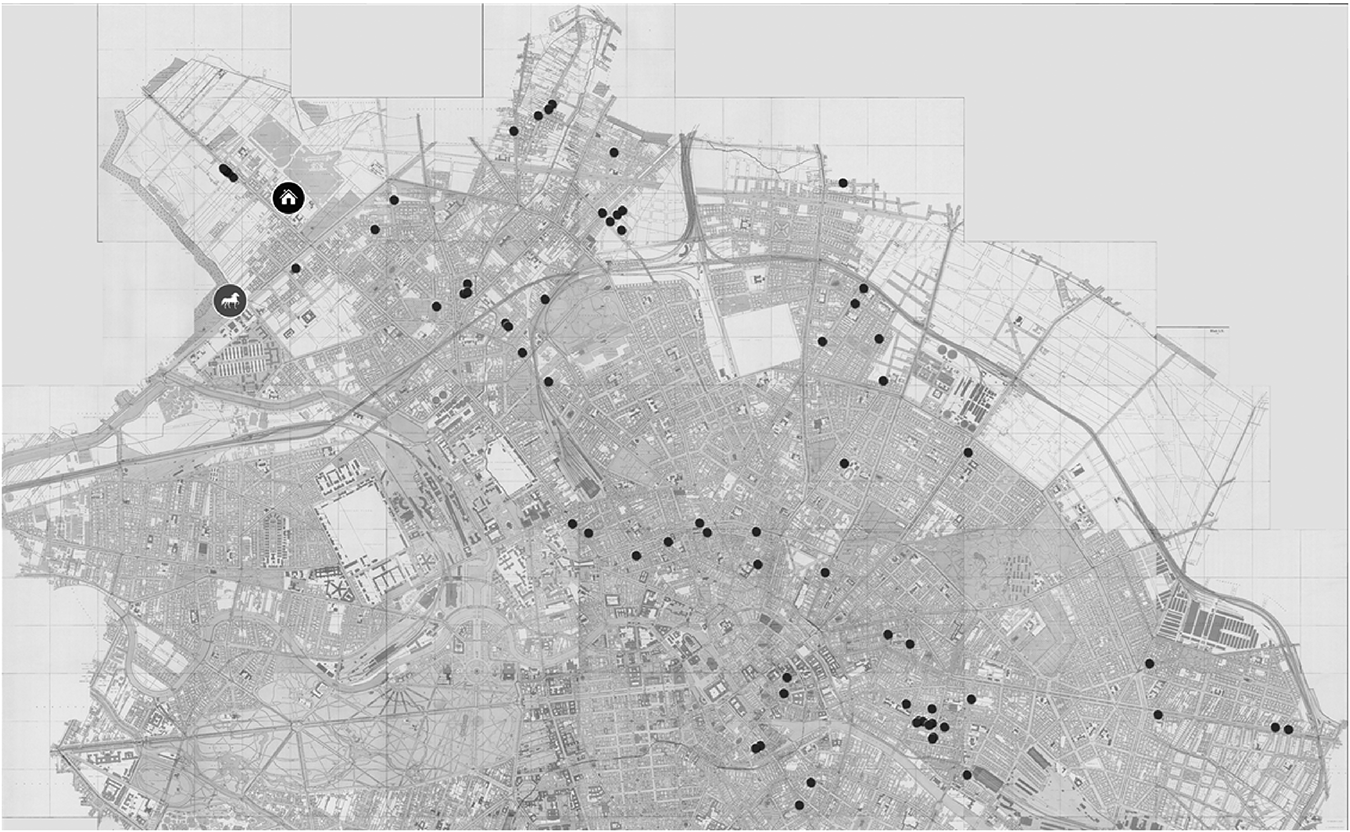
One contemporary source that allows some insight into the everyday lives of Roma and Sinti in Berlin in these years is the files of the Berlin police on applications for licences to trade. 54 The evidence for the nature of the applicants’ business and their lifestyle on which the issuance of a licence depended was often provided by the precinct police. In many cases these files can be supplemented and corroborated by entries in the Berlin city directory – and for both sources it should be emphasized that the Sinti and Roma who are named there are there because of their intention to carry on business legally. These sources confirm the press reports that before 1914 such households were mainly settled in two areas outside the centre (see Figure 2). The first was the northern suburbs described above: an arc that extended from the northwest edge of Wedding (Seestraße running broadly east-west on the border and Müllerstraße, a traffic artery which led northwards out of the city) through the parts of Reinickendorf and Gesundbrunnen that featured in the Koloniestraße incident. A second concentration was around the Frankfurter Allee in Friedrichshain, due east of the centre. Friedrichshain was not a ‘frontier’ territory like the neighbourhoods to the north; here the attraction was the availability of spaces that were well adapted to business, and especially to the horse trade. Frankfurter Allee, a boulevard leading out of town, and adjacent streets were also home to non-Romani horse dealers.
Among the Romani residents of Friedrichshain was Wilhelm Steinbach, born in 1859 near Aachen and trading in horses in Berlin since 1905. When interviewed in April 1911, he was renting premises in Frankfurter Allee that served both as a fixed place of business and as a dwelling (one room with kitchen) for a monthly rent of 21 RM (about €130), on a lease that still had six months to run; this was the fifth address he had had in the area. He claimed to be in partnership with a Rixdorf horse dealer, and when his eligibility for a licence was challenged, he pointed out that he had already had six licences and had no criminal record. ‘[He] did not travel about the country’, he said, ‘but bought horses only on the markets and sold them only here in Berlin and the region’. The four previous licences on file are an index of the dimensions and solidity of his business; they authorized him to buy and sell horses using two two-horse wagons in return for the payment of substantial business taxes. Material from another file suggests that he was employing or subcontracting to individual Romani horse buyers in other parts of the city, and reinforces other evidence for business and mutual support networks that stretched across the city: 21-year-old Antonie Schopper, applying for a licence to trade in lace in her own right, reported that she was living with horse dealer Hugo Franz, her ‘foster father’, and that her own father dealt in horses on commission for Steinbach. In 1908 Muto Strauss was paying 60 RM monthly for a dwelling and stall on a builder's yard just off Seestraße, from which he bought and sold horses using a single one-horse wagon. He had paid both state and municipal income taxes in the previous year. His 19-year-old son, the oldest of seven children, was registered as his assistant and stable boy and contributed to the rent. Gustav Otto and Hermann Rose were both horse dealers living in rented accommodation in Kösliner Straße (Wedding) in 1908; both their households included assistants charged with displaying the horses, in addition to older or adult children who helped in the trade. Otto was clearly a more ambitious businessman than Rose, however: he reportedly bought horses in Russia and transported them by rail.
The Space of the Horse Market
The key space of operation of these and many other Berlin Sinti and Roma was the horse market. In formal terms, this was a highly structured space, the procedures for its operation dictated by regulations set by the municipal authorities (Marktordnung); the first record of such regulations being issued for Weißensee dates from 1907, and these were updated after the incorporation into Greater Berlin. Their principal focus was the control of movement into and around the market space: entry only through three gates (one each for ‘luxury’ horses, other horses and vehicles), with veterinary checks at the entrances; no entry without paying a fee; specified areas for hitching horses, standing vehicles, displaying the horses for sale and putting them through their paces; hours of opening (in 1907, 10 am to 2 pm in winter); prohibitions on ambulatory selling within the market and on sales outside the gates of the market on market days; penalties (exclusion, fines or imprisonment) for breaches of order. The day-to-day operation of the market was managed by a lessee (Pächter), who paid the municipality an annual amount. He was responsible for maintaining buildings and equipment and for keeping order (with the support of the police), and was permitted in turn to keep the entry fees and hitching fees and to operate the restaurant on the grounds. The first Pächter was a ‘known and trusted restaurateur’. The control of the conditions under which horses were displayed implied a concern for the control of information – levelling the position of buyers and sellers – which was also present in the requirement that every seller display his name and address on boards provided for the purpose, in legible characters and not obscured by ‘blankets, harnesses or the like’. 55
The concerns about order and transparency that these regulations reflect were embedded in the lore of horse markets and horse trading, which had its own Berlin variant even before Weißensee went into operation. Of Charlottenburg there was already a well-established catchphrase: ‘Spandau wind, a kid from Berlin, a Charlottenburg horse, you couldn’t do worse’. 56 This signalled the fact that it was mainly work horses of relatively low quality that were on offer there, as at Weißensee. 57 But it also reflected the wariness of the horse market itself as an institution, and the persistent risk of being swindled. And part of the risk and promise of the fair was that the trade depended on interactions with alien and exotic others. A report on the Charlottenburg horse market from 1872 focuses on the merchandizing skills ‘of that oriental race, which have helped it to conquer the world of commerce and made it the sovereign ruler of finance’. 58 This is a reference to the Jews who continued to play a significant role in the horse dealing business in Berlin as elsewhere. A generation later it was the Sinti and Roma at the Charlottenburg market that attracted journalistic comment and the attention of press photographers.
The formal regulations intimate the way in which the market scene was necessarily characterized by a combination of the order necessary to do business and the disorderly energies inherent in the management and display of horses. The result was that at every moment all participants were engaged in one or another kind of theatre. Displaying the animals in motion by putting them through their paces (Vorführung) was at the heart of the market scene, a moment which epitomized the aesthetic and physical excitement of dealing with horses and which was a favourite subject of visual artists and documentarists.
59
Recording in the 1950s his memories of Weißensee around 1930, Wolfdietrich Schnurre (1928–1989) captures the contrast between the orderly lines of wagons at the gate of the market and the drama of the Vorführung in a Romani figure: At the end of the runway three horses were lined up, fiery steeds, prancing and each held tight on a short rein. Then a man with a greasy jockey cap pushed to the back of his head gave a sign, and the Gypsy who was holding the first horse ran forward with it. It was wonderful to see how the two trotted over the sand which rose in clouds around them; the horse had yellow straw braided into its mane and bright red boots on, and the Gypsy's earrings kept flashing in the sun.
60
The Vorführung deployed the arts of presentation at a distance; on the runway and in the stall dealers practised ways of showing off a horse's good points and disguising its weaknesses. The next stage in a sale was the close inspection of the horse by the buyer, examining its teeth, feeling its legs, flanks and sides. At such close quarters cosmetic skills came into play – combing, dressing and decorating the horse and also such practices as re-touching the coat with shoe polish. When seller and buyer were face to face, however, the key decider was the sales pitch. Schnurre gives an account of such a transaction on the Weißensee market from the perspective of a child observer. The dealer, in this case Jewish, manages to unload ‘the ugliest horse I ever saw’ on a buyer, first by talking it up: ‘He didn’t just call it a splendid horse, he transformed it into a splendid horse … I couldn’t understand how I hadn’t noticed right from the start how beautiful, how powerful, how racy it was’. The buyer's commitment is finally won, however, by the dealer's show of not wanting to part with the horse – another piece of theatre that features in many reports of horse trading. 61 The sale agreed, the dealer, ‘nodding as he counted the money, put it away in a big purse and, with a wink, stretched out his hand to the red-faced man, who reached out and slapped it’. 62 Known in English as the ‘chop’, the act of sealing the deal by clapping hands, the seller with his palm turned upwards, was and remains nearly universal among horse dealers; it was often the last in a series of such gestures, each accompanied by a proposed price.
In fact, the process by which a negotiation came to this conclusion was never a matter of a one-sided pitch, and it was rarely only the seller who was performing. The transaction was typically an extended dialogue in which each party used displays of expertise and indifference to whet the appetite of the other, before they entered into a final negotiation over the price. This was a theatre in which the actors met on equal terms, but it was in the nature of the trade that those terms included shifting measures of trust and suspicion. The buyer had to rely on a combination of his own expertise and trust in (or critical assessment of) the seller to reach the point where he was ready to close a sale. Both of these came with experience of the market and mutual familiarity. Grounds for mistrust were many, particularly when the seller was from an outsider group. The popular stereotype of the ‘Gypsy’ horse dealer was that he always dealt in sub-standard wares and succeeded in making sales only through double-talk and cosmetic tricks. But any experienced buyer would be aware that positioning and handling a horse so as to make it appear healthier, bigger, stronger, more lively than it really was, and using every rhetorical trick to persuade a buyer that this was the horse he really wanted, belonged to a repertoire that was fully accepted by ‘respectable’ horse dealers and even recommended in the handbooks. 63 The one account that we have of such a transaction from the Romani perspective is that of Reinhard Florian, whose father dealt in horses in East Prussia. Florian's account focuses on the buyer, who he knows is putting on as much of an act as the seller. The fine balance between familiarity and distance, self- and other-awareness in these relationships is also apparent in Florian's good-humoured contempt for the (non-Romani) farmers – ‘idiots’ whose worn out horses his father was able to buy cheap, re-condition and sell on for an honourable profit. 64
Apart from Wolfdietrich Schnurre’s story, there are very few published accounts of what actually went on at the Berlin horse markets. This is probably related to the fact that while they retained a fascination for Berliners, they differed from the large annual horse fairs held in the provinces (like the Wehlau fair attended by the Florians) in that they were not associated with other kinds of entertainments like fun fairs and (as Baedekers of the period show) were not advertised to tourists. Much of the evidence for life on the markets is accordingly visual. A significant source of representations for the early twentieth century is the work of press photographers. The Haeckel brothers, Otto and Georg, Conrad Hünich and Philipp Kester gave particular attention to the horse markets, the Romani presence, and the combination of the two. The Haeckels’ agency was the source of the photograph of Petermann cited above, one of a series taken in Charlottenburg and Weißensee. In Weißensee they photographed scenes of Romani life outside the market, including a 1910 wedding. 65
There seems to have been a second wave of press interest in Berlin’s Sinti and Roma and also in the horse markets around 1930, and the best visual documentation that has so far come to light is Laszlo Moholy-Nagy's 1932 short film Grossstadt Zigeuner [sic] (City Gypsies). Moholy-Nagy regarded his film as an aesthetic experiment and many of the episodes he filmed at a Romani caravan site in (probably) Reinickendorf were deliberately provoked or set up, but the scenes of the Romani families setting off for the horse market and the goings-on in Weißensee that occupy most of the first third of the film have an indisputably documentary character. They portray all the elements of the market scene described above, from the Vorführung to the inspection of the horses and the dramatic body language of the buyers and sellers – for the most part non-Romani and Romani respectively – to the ‘chop’. 66
The visual evidence is suggestive among other things about the gendered character of market work. That Berlin’s markets really were places for business is suggested ex negativo by the absence of reports of Romani women telling fortunes on the premises or at the margins of the market. This was a characteristic feature of other, periodic markets and fairs attended by Roma. At a fair like Wehlau, which could go on for several days, there was typically a particular space on the edge of the fairgrounds where visiting Romani families camped. While the men and boys entered the market space to do business, the camp could be visited by fairgoers interested in the spectacle of the exotic or in the frisson of having their fortunes told. 67
In Berlin, there is plenty of evidence for the persistence of a gendered division of labour in the Romani family economy in the wider city-space. Like Antonie Schopper, women named the peddling of various items as their own trade while their male relatives dealt in horses. The distinction in roles is signalled in the 1910 report of a Danish linguistician who visited a group of horse dealer families recently settled in Müllerstraße after years of itinerancy. He observed that while the men were dressed in the clothes typical of German small businessmen, the women continued to wear more colourful, Romani-style apparel – a badge of authenticity important to their public-facing work peddling and fortune-telling. 68 And it is confirmed by the continuing reports of women selling ‘traditional’ goods and/or offering to read palms on the streets, a practice which figures in Grossstadzigeuner, intercut with scenes of nattily dressed Romani men peddling textiles.
But there is also evidence that women were an active if secondary presence in the city horse markets, which took place more frequently and in a more compressed space than the periodic fairs and had no tourist periphery. In their photographs of Romani subjects, the Haeckels, Hünich and Kester gave particular attention to capturing picturesque individuals, many of them women. Significantly, many show Romani women among the male dealers and visitors, at or near the centre of the action and in at least one case showing off a horse, whip in hand. A notable exception to the predominance of exotic costume and hairstyles in the photos is one that shows two young women dressed in the height of urban fashion amid the horses and wagons. Moholy-Nagy, too, shows horses being sold on the market from a family caravan in which a young woman is seated. These images appear to confirm that to some degree at least the gendered division of space and labour that historically characterized Romani family work on the market scene was being eroded in the urban context. The arrest of Mother Petermann in the Weißensee tavern also points to this, and there are further hints of a more active role for women in the trade licence applications: Katharina Franz, wife of the horse dealer Berthold Rosenbach, is described as his assistant (Begleiterin), her role being to accompany him when he travelled to sales and to help out ‘in a small way’, holding the horses and leading them out and back. Of Heinrich Arendt's wife it was reported that she looked after their six children, seeing to it that the three eldest attended school. When she did leave the house it was to attend the Weißensee horse market, on those occasions leaving an adopted daughter in charge of the children. 69
The business of buying and selling remained the sphere of the men, however, and in the course of his business the same Heinrich Arendt was the subject of a dispute that offers some insight into the conditions of trade on Berlin horse markets. In July 1916 the police refused Arendt a licence, on the grounds that he was subject to a prosecution for fraud – a charge which he denied. On Weißensee market, he had sold two horses to a farmer from nearby Brandenburg for the sum of 3300 RM. They had not agreed a schedule of payments, which in Arendt's view, as communicated by his lawyer, meant that ‘obviously’ they would follow the practice ‘which has become absolutely standard in wartime’ that full payment would be made on the spot (Zug um Zug). Arendt accordingly refused to hand over the horses for a 1000-Mark down payment given by the buyer, and as the dispute developed the buyer called for Arendt's arrest. The two ended up in the Weißensee police station, accompanied by another horse dealer, Gees, who had assisted the transaction by writing out the formal guarantee on the horses. At the police station, an officer grabbed the money from Arendt's breast pocket and handed it to the buyer. The buyer himself ‘still had enough of a sense of justice to give Arendt 10 Marks for the delay to his business that had been incurred through his [the buyer's] own fault’. In response to Arendt's protest that the officer was acting unlawfully in seizing the money, the policeman responded that Arendt ‘was just a Gypsy, and with Gypsies they didn’t have to go out of their way like that’. In the end the prosecution against Arendt was dropped. 70
Heinrich Arendt’s story reveals little about the details of the transaction that preceded the dispute. The inspection of the horses, the haggling and the ‘chop’ are taken as read. What we do learn is that under normal circumstances the payment schedule would have been part of the sale agreement, and that under the extraordinary conditions of wartime a custom emerged that while unofficial was universally honoured – by locals at least. We also see cooperation between Romani and non-Romani dealers; Gees was probably not Romani, and very likely an employee of a well-established Wedding dealership. 71 And in sharp contrast to the programmatic hostility of the police which frames the narrative as it coloured the everyday lives of Berlin Sinti and Roma, we see the buyer’s acknowledgement of the inherent normality of the transaction and his own error.
Conclusion
Heinrich Arendt had a Jewish lawyer. He was not the only Romani businessman to call on the help of Jewish attorneys, many of them known for their progressive politics and defence of labour or anti-colonial activists. 72 That connection indicates the existence of local networks operating within an emerging Romani community and crossing ethnic boundaries. It signals among other things the growing visibility of Sinti and Roma as an urban minority which could be the object of advocacy as well as exclusion within a shared civic space. This article has argued that images of a substantially new Romani presence became part of the way non-Romani Berliners pictured the growth of the new city around the turn of the century, such that the real and imaginative borders between urban and rural, civil/ized and uncivil/ized came to be represented by ‘Gypsies’ in urban, and especially suburban space. They thus formed part of an increasingly racialized (though not formally segregated) cityscape. This article has also attempted to complement this non-Romani perspective by sketching the material dimensions of a shifting cityscape in terms of the lives lived in ‘Romani spaces’ within the city. Some of those spaces, the horse markets, were intrinsic parts of Berlin's economic life and sites of productive interaction between Romani and non-Romani Berliners – and acknowledged as such. That is, the texture of Romani life was changing as the city changed, and those changes were dialectically related, as Berlin was developing as a self-consciously multi-ethnic city, like other twentieth-century metropolises before the First World War and beyond. The account presented here remains a series of sketches and hypotheses, and this reflects the state of the archival record in relation to the lives of Romani Germans. It is a record that is not only systematically biased, but also incomplete and fragmented. In this, it is a monument to the destruction of Berlin's Sinti and Roma by the Nazi regime. In pursuit of their own civic and urban imaginary, the Nazis prosecuted to its logical conclusion the racist dream of clearing the cityscape of ‘Gypsies’. Those who were not interned in the Marzahn ‘Gypsy Camp’ in anticipation of the 1936 Olympics were immobilized and forced into destitution; the last records we have for the addresses of Sinti and Roma in Berlin before 1945 are those created when they were deported to Auschwitz in 1943. 73
That genocide, and the historical ruptures that followed, have notoriously left Berlin as a space of fractured and layered remembering – the definitional ‘urban palimpsest’. 74 At the beginning of the twenty-first century the genocide is memorialized, but the Romani presence is largely absent from narratives of the pre-war city. Memories of how the horse market shaped Weißensee, and of how by virtue of its presence the district became for a time a ‘Gypsy village’, are preserved by members of the Weißensee neighbourhood association. 75 They recognize in themselves the last generation of long-term residents in a part of the former East Berlin which has itself nearly disappeared from popular consciousness, except as lines on an old map and, with the emergence of post-socialist ‘roots tourism’ since 1989, the site of two historic Jewish cemeteries. 76
Footnotes
Acknowledgements
This article is framed within the HERA-funded BESTROM project (Beyond Stereotypes: Cultural Exchanges and the Romani Contribution to European Public Spaces). I am grateful to my BESTROM colleagues, and especially to Tamara West, as well as to the (anonymous) reviewer for EHQ, for their comments and suggestions. During 2019–2020 my research and writing benefited from the facilities and intellectual stimulation provided by a Visiting Professorship at the Critical Global Studies Center, Sogang University, Seoul.
Declaration of Conflicting Interests
The author declared no potential conflicts of interest with respect to the research, authorship, and/or publication of this article.
Funding
The author disclosed receipt of the following financial support for the research, authorship and/or publication of this article: by the HERA Joint Research Programme ( ), which is co-funded by AoF, NCN, AHRC, AEI and the European Commission through Horizon 2020: by a National Research Foundation of Korea Grant funded by the Korean Government (NRF-2017S1A6A3A01079727).