




Abstract
In this article, the authors address the presence and societal impact of Romani people in the public spaces of the circus. The focus is on the French circus family Bouglione, originally Sinti from Italy, and their Wild West show performed in France and abroad from 1925 to 1934. As well as forming arenas for cultural transfer, circuses and similar exhibitions made entryways to exotic otherness. The remarkably successful exhibition brought the family both status and wealth, enabling the Bougliones to operate the Cirque d’Hiver (Winter Circus) in Paris, which continues to enjoy renown for having one of the most prestigious circus venues in the world. The authors’ contribution examines how the Romani family carefully followed social phenomena and used their Wild West show not only to respond to a general interest in exotic exhibits but also to satisfy a contemporary desire for an anti-bourgeois lifestyle. Although the Wild West Show represented a financial undertaking for the Bougliones, it also strengthened the family's societal security.
For centuries, many European circuses had been run by minority groups, particularly Jewish and Romani, 1 with performers from diverse ethnic and social backgrounds, including people with physical disabilities. However, with the onset of anti-Jewish directives in Nazi Germany in the 1930s, the freedom and business opportunities that Jewish circus families had hitherto enjoyed ended abruptly. Members of famous Jewish circus families like the Blumenfelds, Lorchs and Strassburgers, who once owned big tops in Germany, emigrated or ended up in concentration camps. 2 The most prominent and wealthiest circus family of Romani origin was and continues to be the Bouglione family, which to this day runs the legendary Cirque d’Hiver building in Paris. As Sinti, the Bougliones were certainly vulnerable during the Nazi occupation of France, though they somehow managed to evade persecution by Nazi German or collaborative authorities. In Nazi Germany, members of circus families with a Romani background who did not have the fortune to have such a distinguished name, for example those from the Sinti families Frank, Lagrin, Lemoine or Traber, met with different fates after the mid-1930s. The scale of racially motivated persecution ranged from occupational bans and house arrests to forced sterilizations and deportations into concentration camps. 3 The internment of non-sedentary groups occurred in German-occupied France and Vichy France as well. The occupation also had an impact on the lives of ambulant entertainers, among them many small family circuses of Sinti origin, also known as Manouche in France. 4 While the Jewish influence is barely visible in today's ambulant entertainment milieu, many circuses and related attractions continue to be operated by families with a Romani background. Although they are primarily small family-run circuses, in the case of the Sinti families, Bouglione in France and Orfei in Italy, Romani enterprises form significant players in the cultural scene.
As such, circuses constituted cosmopolitan and mobile spaces able to traverse many borders, not only those of cities, towns and villages but also national, ethnic and social borders. In this sense, circuses with their Romani involvement offered amusement with sensations and miracles, but also established arenas for culture transfer and entryways to exotic otherness. Travelling entertainers set up their tents or open-air arenas to stage their shows in public spaces, though generally on the outskirts of villages and cities. They also tended to select locations that had no stationary circus buildings or entertainment facilities. Such empty spaces were then rapidly transformed by the circus people – a group of mysterious outsiders accompanied by international artists – into an entertainment venue replete with strangeness. The people with their tents, wagons and animals, some of them exotic and wild, made up a world unto itself. What is more, this strange little world offered glimpses into ways of life that differed from those generally known to the local dwellers of the villages and cities visited by the circus. While some circus companies regularly returned the next season to the same locales, others travelled further afield across Europe in search of new audiences for their shows.
Labelled as ‘exotic’, circus people's performances, either authentic or fabricated, enabled them to open a window onto other cultures. While such show acts could initiate dreams or increase personal longings, circus performers and show acts also could unwittingly serve to substantiate existing prejudices and pejorative conceptions. 5 Despite the significance of these above-mentioned aspects for the evolution of modern European societies, we have only scant information about the role of the circus and similar entertainment forms in these processes.
Nonetheless, it is essential to understand that performing otherness can also be used as a strategy among vulnerable groups for obtaining security while hiding their real origins behind another persona. Members of the ambulant entertainment community with its Romani presence have always demonstrated keen business acumen: they have carefully followed developments in society, adapted to the tastes of their audiences and learned to devise new product ideas to pursue their livelihood. Acts related to the Wild West theme were and still form the most popular topics for circus performances and even for the compositions of entire shows, which tended to make heroes out of the cowboys and spotlight the exoticism of the Native Americans. Furthermore, the Wild West theme offers spectators the occasion to envisage adventures in faraway lands and wild natural settings, to escape briefly the industrialized world, and to dream of the United States as a country of unlimited opportunities, while still offering an encounter with otherness in a safe and controlled space. 6
Research Challenges in Studying the Ambulant Entertainment Milieu
Studying the circus milieu in search of reliable research sources is challenging for several reasons. Firstly, the scene is particularly contested in documenting its life, activities, and obstacles due its mobile nature. For hundreds of years, artists have been touring and leaving behind no trace except for memories, posters and a few flyers. In addition, caravan and winter grounds fires may have destroyed any remaining records, images and personal documents. Secondly, oral tradition is still today a fundamental tool in transmitting circus knowledge, both artistic and technical expertise, as well as family and circus stories, true or believed to be authentic, to the following generations. Thirdly, some circus people from marginalized communities rely on different codes, depending on the interlocutor, and tend to mistrust ‘private persons’ a term to designate people from the majority population. The security strategy of marginalized communities, based on cross-generational experiences of discrimination and persecution, may involve a conscious decision to share no information about family with a larger audience, which also explains the lack of information available to the public about the ambulant entertainment business. 7
In the last two decades, this mindset has manifested itself particularly in response to animal activist actions and a growing disapproval of the keeping and presenting of exotic animals among the general public. Against the background of the community's tendency to insularity, the memoirs published in 2011 by Rosa Bouglione, the matriarch of the Bouglione family and ‘grande dame’ of the circus world, who died at the age of 107 in 2018, forms one of the few exceptions within the milieu. 8 At the same time, members of the travelling entertainment world have for advertising reasons always needed to maintain good communication channels with the press and similar agencies. It is still largely thanks to the private collections of circus enthusiasts that researchers studying the history of circuses can obtain access to substantial information for research. One such example is the collection of Dr Alain Frère, the mayor of Tourrette-Levens, a town in south-eastern France. The assemblage, displayed in his Musée du Cirque at the same place, 9 includes documents and posters from the Bouglione Wild West show. 10 An important contemporary source about the Bougliones and the French circus milieu in the first part of the twentieth century comes from the Vesque sisters. From 1902 to 1948, Marthe Vesque (1879–1962) and her sister Juliette Vesque (1881–1949) saw a circus or vaudeville show almost every week. The sisters put their observations on record in a diary and created illustrations that constitute a lively chronicle of French circuses in Paris and nearby. 11 The works of the Vesque sisters belong to the collections of the Musée des Arts et Traditions Populaires, nowadays part of the MuCEM – Musée des Civilisations de l’Europe et de la Méditerranée, which opened its doors in Marseille in 2013. With French governmental support the MuCEM made the sisters’ diary, Le journal de Marthe et Juliette Vesque, electronically accessible. 12
In recent years, academic institutions, often in cooperation with public bodies, have become more determined to preserve records on circus history. An example of that trend is the cooperation between French circus historians and the French National Library, which resulted in an online project about different circus disciplines. 13 Recently, Bernd Paul, director of the German circus Roncalli and owner of a large private circus collection, stored in the company's winter grounds in Cologne, has started to tackle the process of assessing and systematizing his collection. In the internationally renowned Circus Zeitung, he was looking for a trained historian in 2019. 14 However, the key to the small museum (180m²) of the Bouglione family inside the Cirque d’Hiver building remains in the hands of only one man, Louis-Sampion Bouglione.
Not only for ethical research reasons, but also in order to fill gaps in understanding and supplement academic knowledge about the circus milieu, the authors have pursued a participatory study approach, integrating the voices of the actors into the research from the outset and calling on the assistance of community members and local experts on the circus scene. 15
The Story of the Bouglione Family and their Struggle to Survive in the Entertainment Business after the Outbreak of World War I
Originally named ‘Boglione’, the Bouglione family came from the Piedmont region. In the late nineteenth century, like many other Sinti groups, they travelled between Italy and France, at a certain stage earning their living by exhibiting wild animals. For decades, the family ran a menagerie and worked as show people, forming part of the ambulant entertainment milieu. The Bougliones first entered the circus business in 1924. The following year, they started their successful Wild West show Le Stade du Capitaine Buffalo Bill. Thus, the Bougliones went through different occupational stages on their way to becoming a European circus dynasty: from travelling animal presenters, owners of a menagerie with wild animals, to a famous circus family and operators of the Cirque d’Hiver in Paris. However, the social advancement of the Bougliones, associated with an increased material security, was not a straight path. World War I and its aftermath spelled hardships for the entertainment business and often required many to seek new ways to earn their living. It was the search for a new occupational direction that led the Bougliones into the circus scene.
According to the official family legend, at some time in the nineteenth century the son of an Italian textile retailer fell in love with a young animal tamer of Romani origin and married her. According to this story, Scipion Bouglione went with his wife Sonia to France and started to exhibit animals in a travelling menagerie. A century later, the grandsons transformed the menagerie into a circus. A series of tours with the Wild West show Le Stade du Capitaine Buffalo Bill brought the Bougliones fame and fortune. This is clearly a romanticized version of the family's history that members of the public learn when they visit the Cirque d’Hiver. 16
Christian Hamel, an expert on French circus history, offers a more in-depth account of the Bougliones’ family story. Although Hamel could not find a source for a lineage created by a Scipion Bouglione and his companion Sonia he unearthed a Michel Boglione, 17 most probably born in 1792 in Verolengo, which is located 25 kilometres northeast of Turin. Michel Boglione, an ambulant merchant, was married to the Italian Agnès Baudino, born around 1805. She gave birth to their first child, Jean-Baptiste Boglione (1833–1913), on French soil, in Véron, a commune in the Yonne department in north-central France. 18 The mayor of the town of Châtillon-en-Michaille, in eastern France, permitted Jean-Baptiste Boglione to travel freely through the country as ‘a wild animal tamer’ (conducteur d’animaux féroces), with an interior passport re-issued annually from 1869. 19 According to Hamel, Jean-Baptiste Boglione was the first family member to earn a living by exhibiting animals. 20 He married Jeanne Marie Sintot (1823–1917), and the couple toured on the ambulant entertainment scene and acquired the milieu-related designation ‘showmen’ (banquistes).
As the youngest child of seven siblings and three half siblings, Joseph ‘Sampion’ Bouglione (1875–1941) continued to run the menagerie after the death of his father Jean-Baptiste, who died on the eve of World War I. The exhibition had previously travelled in Belgium and the Netherlands, as evidenced by the birth certificates of son Firmin (1905–1980) in Manage (Wallonian province of Hainaut) and Nicolas, better known as Sampion II (1910–1967), in Visslingen (Province of Zeeland), and the marriage with Alexandrine Dumas in Saint-Gilles (District of Brussels) in 1907. 21 The couple's four children were Germaine Jeanne (1899–1939), Alfred, better known as Alexandre (1900–1954), Joseph (1904–1987) and Odette (1916–1986). Information about the approximate size of the menagerie is provided by a request from the Bougliones to the office for foreigners in Brussels in 1906. The family applied for a permit to install their 17-metre-long tent to display 10 wild animals and a number of snakes and monkeys. 22 Between 1908 and 1911, Belgian press articles reported the Bouglione menagerie in Liège and Charleroi. From 1913 onwards, the press registered the menagerie in France, in Amiens in July 1913 and in Paris at two different places in October and December 1913. At the annual fairground in Nancy in 1914, a journalist reported about the Bougliones’ Lion Palace (Le Palais des lions). According to this author, the menagerie had specialized in taming and breeding lions. In general, the family had assembled ‘a superb collection of wild animals’ (une superbe collection d’animaux sauvages). 23 This positive image of the Bougliones’ menagerie might also be related to the family's skilful handling of the press for their own benefits. No fewer than 10 French newspapers reported about an accident in October 1913 while Joseph ‘Sampion’ Bouglione was performing with his lions. Various clues, such as the embellished accompanying text and the same wording in the reports, however, indicate that the Bougliones staged the incident to attract public attention for their menagerie. 24
The outbreak of World War I in 1914 had a significant impact on the ambulant entertainment business. The milieu suffered from the confiscation of horses and equipment, but also from the recruitment of men for the fighting armies. Events were cancelled and the means to travel were limited. Further restrictions on fuel and general blackouts to avoid being spotted by zeppelin raids compelled members of the ambulant entertainment business to place booths and caravans in barns. Big menageries and circuses moved to their winter quarters. The Bougliones were forced to settle in Rennes at that time. The lack of food during the war presented yet another challenge. Circuses and menageries were even forced to have their wild animals put down. The Bouglione family also had to make some hard choices regarding their exotic animals. 25 After the war, many families and owners of circuses and fairground attractions had to make a new start or reorient themselves professionally.
Even while the war was going on, the Bougliones opened a skating rink named Grand Skating Américain, commonly named Skating Bouglione in the French press (1916–1920). 26 Not long after the end of the war, in April 1919, the family was on the road again with a menagerie. But they also stopped to stage a small exhibition, at the Foire du Trône in Paris, the biggest fairground in France. 27 According to the French circus expert Christian Hamel, the Bougliones’ menagerie toured in this year in France with only two female lions, a hyena, and a bear, 28 evidence for the collection's loss of animals and the lack of financial resources in the wake of World War I.
New ideas and occupations were needed to ensure the family's survival. Menageries and traditional equestrian circuses were starting to fall behind the times. On 1 January 1923, the family suffered a severe blow. A fire destroyed the menagerie, although they were able to rescue the animals. 29 As a consequence of this accident, the Bougliones cooperated in the following year with the circus and menagerie of Pierre Périé. 30 In Belgium and France, the traditional homelands of the Bougliones, the circus landscape was dominated by Alfred Court's travelling Zoo Circus and the circus of the Amar-brothers and their huge animal collection at that time. 31 In her memoirs, Rosa Bouglione reported that her husband Joseph ‘Sampion’ Bouglione was then searching for a new concept that would enable the family to stand out from the rest. 32
It remains unclear when exactly the Bougliones acquired the former posters of Buffalo Bill's Wild West that gave them the idea of starting a Wild West show of their own. The exhibit of William Fredrick Cody alias Buffalo Bill had toured Europe eight times, the first four tours between 1887 and 1892, and the last four from 1902 to 1906. Also, there are several legends describing how the Bougliones came across the colourful and captivating advertising material on Buffalo Bill’s Wild West. According to one account, the Bougliones bought the posters from Marcel Chaffreix, another predator tamer. Chaffreix would have obtained the material from the showman Georges Mège, who himself tried but failed to launch his own Wild West exhibit. 33 A second story claims that the Bougliones bought the material from a commercial printer who had stored the posters for years in an attic. 34 Sylvestre Barré-Meinzer refers in his version to André-Joseph Bouglione, great grandson of Joseph ‘Sampion’ Bouglione. According to Barré-Meinzer, the Bougliones found the posters in a wagon which they bought to mislead the owner about their original intention. 35 Although Joseph ‘Sampion’ Bouglione came across Buffalo Bill’s Wild West by accident, he decided to hold on to it and make the Wild West the theme to his enterprise. Rosa Bouglione noted in her biography that her husband ‘was convinced to hold the business of the Century’ (était convaincu de tenir l’affaire du siècle). 36
The unforeseen acquisition drove Joseph ‘Sampion’ Bouglione to elaborate upon a new concept which progressively improved from the premiered show in Belfort in August 1925 until the conquest of the Parisian public by Le Stade du Capitaine Buffalo Bill in May 1928. 37 At the end of this month, newspaperman Pierre Drouaire, who visited the show in Paris, noted that the ‘son of Colonel W.-F. Cody’ (fils du colonel W.-F. Cody) – Joseph ‘Sampion’ Bouglione apparently palmed himself off as such a figure – had declared: ‘I waited for my organization to reach the highest level of perfection before presenting it [Le Stade du Capitaine Buffalo Bill] to the Parisians’ (J’ai attendu que mon institution atteigne le plus haut niveau de perfection pour la présentation aux Parisiens). 38
The Wild West Comes to Europe – The Show of Buffalo Bill and his Imitators
Founded in 1881, Colonel Cody's Buffalo Bill’s Wild West not only inspired the Bouglione family on their journey to becoming a famous circus dynasty, but it also had a lasting impact on the further development of European popular entertainment. It influenced both the circus, with its traditional one-ring presentations and historical ties to the itinerant performers who once followed the medieval markets, and the other modern forms of show business, in terms of their advertisement strategies and merchandising sales, artistic content and scenic performances, infrastructure and logistics. At the same time, the North American circus with its show giantism and transport by train to cover greater distances had influenced Buffalo Bill’s Wild West, and the exhibition itself did incorporate traditional circus features too. The term ‘circus’, however, always presented something of an ‘anathema’ on the Buffalo-Bill set, according to Don Russel, historian and expert on the American West. In Russel's view, American Wild West shows should be classified as ‘exhibitions’ illustrating scenes and events that their producers regarded as characteristic of the Far West Frontier. 39
For numerous reasons, the Wild-West topic evolved into the most prominent and enduring exotic motif displayed in the circus and similar showgrounds. Performances of skirmishes between cowboys and ‘Indians’, 40 occasionally featuring genuine cowboys and Native Americans were extremely popular; audiences were thrilled by the scenes portraying the hero, a cowboy, often single-handedly fighting his enemies. 41
A further factor was the European longing for untouched wilderness as a way to escape the modern world, 42 adroitly used by circus and other show advertisements displaying landscape dioramas of the Wild West on their billboards and souvenir cards. Yet, on the whole, it was a fascination with the United States as a country of unlimited opportunities that made the Wild West theme enormously popular. 43
In France, Buffalo Bill’s Wild West was first presented with a longer scheduled visit in Paris during the Exposition Universelle in 1889. The show included programme elements that would become standardized features in the following years of touring; these included the Pony Express, dance acts of ‘Indians’, the buffalo hunt, the attack on the Deadwood coach, horse races, numerous shooting acts and other cowboy games. 44 The Bougliones also incorporated these acts into their programme, or at least used them to advertise their arrival and upcoming performances. 45
In addition to the show programme, Buffalo Bill's Wild West offered an open camp for visitors to become acquainted with the purportedly ‘real life’ of the peoples of the American West. 46 Thus, Buffalo Bill’s Wild West brought an exotic foreign world to life for its European audiences. Visitors could also purchase a range of souvenirs, for example, the exceedingly popular Stetson, and thus identify with the bravery and ruggedness of the cowboys. Decades later, both Joseph ‘Sampion’ Bouglione and his rival Amar Aîné were dressed in cowboy attire, including a Stetson and a pistol, when presenting wild animals in the predator cages to their audiences. 47
Buffalo Bill's second engagement in Paris, a two-month visit during the tour of 1905, is remembered as the most successful in tent-show history. The programme brochure also mentioned a side-show schedule, labelled Annexe, for the exhibit in Paris. This additional programme showed the influence of circus ideas on Buffalo Bill's projects; it consisted of traditional circus acts and characters: ‘snake charmer, dwarf, giant, sword swallower, magicians, contortionists, trained birds and monkeys’. As early as 1893, Buffalo Bill's Wild West had broadened its show programme and included numerous rider formations in colourful outfits from legendary equestrian cultures, for example, groups of Arabs, gauchos, Mongols and Turks. 48 From today's perspective, the presentation of lions and other exotic animals together with acts related to the Wild West theme within Bouglione's Le Stade du Capitaine Buffalo Bill show might be regarded as conceptually incoherent, but it indeed followed Buffalo Bill's original exhibition concept.
Buffalo Bill's Wild West travelled throughout Europe in an American-style showbiz extravaganza with several hundred actors, workers and a large number of other animals. Like the circuses in the New World, Buffalo Bill hired men to travel to destinations beforehand to advertise his show. Soon, European circuses tried to keep up with the enormity of the American shows and expanded the size of their companies. They also picked up on the Wild West topic for their shows and adopted a North American advertising style and strategy too. The Wild West theme with cowboys and ‘Indians’ often served as a motif on large banners for circuses announcing their approach. 49
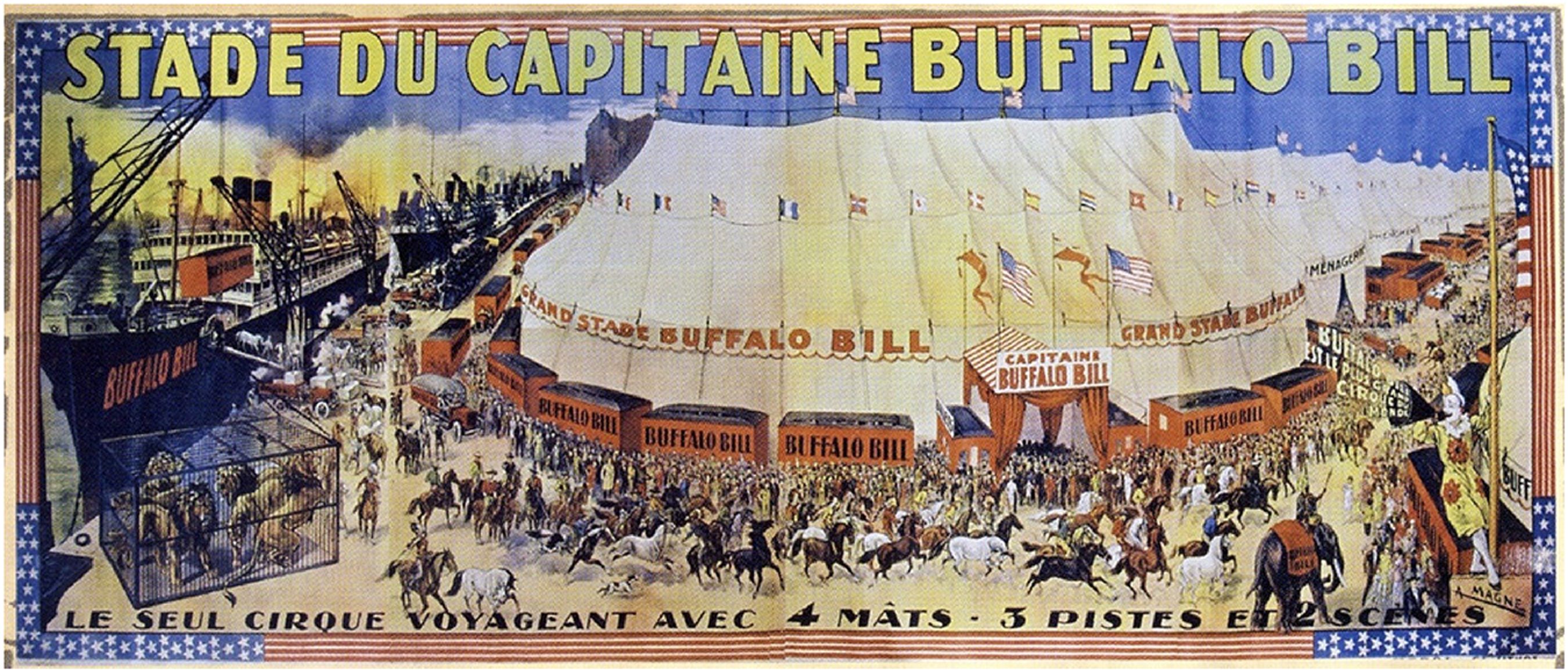
Poster of the Bouglione Wild West show, 1926 (by courtesy of Henk van den Berg)
The Bougliones employed two motifs to attract audiences to their Le Stade du Capitaine Buffalo Bill show. One way to attract spectators was to emphasize the size of the company and include illustrations of the family's animal menagerie. Another was to feature Wild West scenes as poster motifs. The Bougliones’ advertisements depicted stereotypical scenes of cowboys and ‘Indians’ in battle as well as images of them hunting buffalo and lassoing mustangs. The show posters added to the effect of authenticity. Framed with stars and stripes and featuring titles in English, these advertisements further impressed potential spectators that the upcoming performances were bona fide artefacts from the New World. To underline the authenticity of their Wild West product, the Bougliones even produced letterheads featuring an ‘Indian’ chief wearing a headdress with a panoramic view of an ‘Indian’ village in the wilderness above the chief. In the middle of the dramatic clash between cowboys and ‘Indians’, the portrait of Joseph ‘Sampion’ Bouglione shone forth. 50
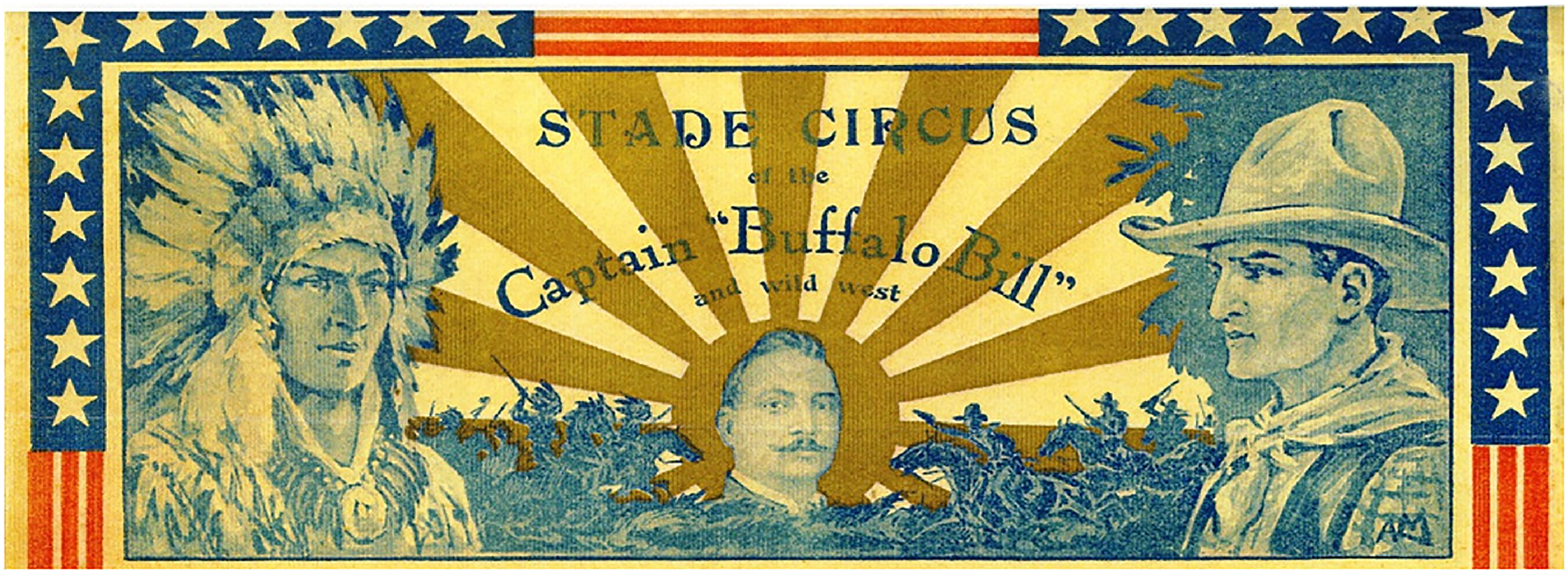
Top of the Bougliones’ letterhead, 1926 (by courtesy of Henk van den Berg)
In addition, members of the Bouglione show troupe wore their Wild West outfits while they were out in public, pretending to be real North American cowboys to attract attention among journalists and the general populace. 51 Joseph ‘Sampion’ Bouglione wore a Stetson and a cowboy outfit in the wedding picture with his wife Rosa Bouglione. The self-conscious presentation of himself to the outside world with a Wild West identity can be discerned both from the placement of the groom as a cowboy in the corner of the portrait 52 and its publication in the newspapers.
In general, the Bougliones were exceptionally adept at using the press and other advertising methods for their own purposes. Even before experiencing the Bouglione show, potential spectators could gaze upon the posters with their adventure-filled scenes and other images depicting the upcoming event. Such images obviously captivated the imaginations of viewers, also inspiring the younger ones to re-enact Wild West scenes.
Playing Cowboys and ‘Indians’ – Romani People in Wild West Entertainments
The Bouglione family never did present any authentic cowboys or Native Americans in their Wild West programme, nor did the Buffalo Bill show feature any Native American performers at first. In fact, until 1877, the ‘Indians’ were all played by white actors in costume. 53 If a circus or other entertainment company in Europe wanted to have authentic Native Americans in their exhibitions, as well as paying their salaries they had to cover their travel expenses, subsistence costs and sign an agreement regarding the payment of repatriation costs in the case of death. 54 Only the key players in the entertainment business could afford such expenses. Masquerading was a far cheaper option, and Romani people played a vital role in acting as cowboys and ‘Indians’ in the entertainment field. Indeed, the exhibitions did not lose any of their appeal even though Europeans were more intrigued by an America of their own making than a more realistic experience of America.
This observation also applies to the film industry where ‘Indian’ film characters and extras were played by non-Native-Americans. In Southern France before World War I, Roma of Spanish origin might have played the roles of cowboys and ‘Indians’ in films featuring actor Joë Hamman, as suggested by Alain Antonietto in his 1985 article on Romani engagement in the early years of the French cinema. According to Antonietto, for these Westerns ‘it was necessary to have dark-skinned Indians, who naturally were recruited from the surrounding Gypsy camps’ (il fallait des indiens au teint basané que l’on recrute naturellement dans les campements de Gitans des alentours). 55 Other sources generally pointed to the gardians, the mounted herdsmen who took care of the cattle and horses in the Camargue, as extras in the French Western movies. 56 The French actor Gaston Modot, who started his career in 1909 and who had worked in the Camargue, remembered the makeover of the town Saintes-Maries-de-la-Mer into a Wild West town with horses lining the streets and extras dressed as cowboys and ‘Indians’ loitering about on the town's corners. 57 What remains unclear, however, is the historical relationship between Romani groups in Southern France and the legendary herdsmen of the Rhône river. Although various Romani groups regard Saintes-Maries-de-la-Mer as a famous pilgrimage destination, where gardians have had a traditional role in the religious procession for decades, the daily lives of local townspeople have only rarely intersected with those of the Romani people in modern times, maintains sociologist Marc Bordigoni. 58
Nonetheless, the French Arizona Bill films may have had an influence on the outfits worn in Bouglione's Stade du Capitaine Buffalo Bill – show. The Western series, particularly so for the film Facing the Bull (Face au taureau) from 1914, typically featured the actors, apart from Arizona Bill, wearing the traditional garments of the Camargue region. 59 The US-journal The Billboard, the leading gazette for the entertainment business, writing in 1950 about Bouglione's Wild West exhibit, stated that ‘the show's redskins were black’ and that the main character Buffalo Bill resembled ‘a Spanish Don’. 60
The Wild West acts of circus and show people with undeniable Romani involvement offered audiences both entertainment and the opportunity to imagine adventures in distant lands. At the same time, the European image of the Wild West was shaped more by desires and ideologies than by facts and thus was likely to meet the audience's expectations. A press article about the Bougliones’ Le Stade du Capitaine Buffalo Bill from October 1926 testified that people were coming from all the villages around Meaux to see the Wild West show. 61 Other articles observed that people were sitting on benches in an overcrowded space long before the actual start of the performance. 62 Reporting in July, 1927, a journalist from Cherbourg maintained that the show, ending with a scene play around the Buffalo Bill theme, ‘With its scale and originality, its extraordinary equestrian, acrobatic and other attractions, seduces and moves even the most jaded spectator’ (Par leur ampleur et leur originalité, les extraordinaires attractions équestres, acrobatiques et autres, séduisent et émeuvent le spectateur le plus blasé). 63 Without a doubt, the Bouglione Wild West show won the race for the favour of the audiences. According to an article in a local newspaper, the exhibition made many Cherbourg inhabitants forget all about the fairgrounds of Octeville, Tourlaville and Saint-Clair à Querqueville. 64
At the same time, these Wild West acts and similar shows were gateways to an encounter and acceptance of an exotic otherness. For audiences, however, the authenticity of the characters was of no importance. A press article by Legrand-Chabrier in 1926 gave a description of Bougliones’ Le Stade du Capitaine Buffalo Bill, calling it ‘A fine establishment with a brand-new big top, a large menagerie, a stable with beautiful horses’ (Un bel établissement, chapiteau tout neuf, ménagerie importante, écurie avec de beaux chevaux). He also mentioned a parade with ‘a group of cow-boys, a cow-girl and two redskins’ (un groupe de cow-boys, une cow-girls et deux peaux-rouges) with the additional comment in brackets ‘not authentic, but nonetheless exotic’ (pas authentiques, quoique exotiques). 65 In the last tour year of the Bouglione Wild West show, in 1934, the programme included a tumbling group presenting a five-men-high human pyramid. Such acts were commonly a specialty performed by acrobats from Northern Africa. Within the Bouglione show programme the performers were announced as a ‘troupe indienne’. 66 Audiences did not appear to mind the presentation; in fact, they were delighted and impressed. According to a local newspaper from the former Department Seine-et-Oise, many visitors left the tent saying that the show ‘was well worth the money’ (en avait eu pour son argent). 67
Four decades later, Romani people were still trapped in racial clichés, but could nonetheless earn a salary by playing ‘Indians’ and ‘Mexicans’ in Wild West movies, thus contributing to the success of the so-called Spaghetti Western and similar productions, roughly between 1960 and 1978. 68 Even for the US film industry, shooting in Spain and using Roma from Andalusia as extras and minor roles was far cheaper than hiring actors in North America. 69 For the Romani performers it was possible to fit easily into the Wild West scenery with their existing horse-riding skills, which also made it easier for them to perform stunts. 70 The idiom ‘feather people’ (gente de pluma) is a common expression among Spanish Roma that refers to, among other things, their participation in Wild West performances. 71
Nonetheless, the movie industry's quest for ‘primitive authenticity’, manifested in its use of another marginalized vulnerable minority to perform in hybridized performances as ‘Mexicans’ or ‘Indians’, further perpetuated the domination and discrimination of those employed and those represented; to be sure, these practices underscore the industry's indifference to and ignorance of postcolonial structures at the time. 72
Even today, showmen and stuntmen of Romani origin can be seen playing characters from the Wild West in European amusement parks. Most of the smaller family circuses in Central Europe, several of whom have a Romani background, still regularly include cowboy and ‘Indian’ acts in their programmes; these shows involve performers dressing up in costume to take part in lasso, bullwhip and knife throwing acts. Traditionally, the needed artistic skills are passed on from generation to generation. Like the fakir performances and stage presentations performed in ‘oriental’ dress with snakes and camels, acts related to the Wild West theme embody the exotic element in these circuses. 73
A good example of this use of the exotic can be seen in a travelling circus company based in the Netherlands; its operator, David Bossle, is of German extraction and has verifiable ties to the Romani culture and milieu. His grandfather had let his black hair grow long and had performed as a Chief of the Blackfoot tribe in amusement parks, circuses and at other show locations. Erhard Bossle's son, Peter, who was born into the family's ‘Wild West’ show, strongly identifies himself as ‘Bear Claw’, the chief's son, to this day. It goes without saying that the posters for David Bossle's circus display an ‘Indian’ chief with an impressive feather headdress gazing into the distance. 74
The Bossle family's shared relics accumulated over generations play a constitutive role in culture in the mind, in the formation of cultural identity and subjectivity. Interacting and overlapping with another culture enabled the Bossle family to produce a new form of cultural meaning and hybrid identity, obliterating existing boundaries and challenging ordinary categorizations of culture and identity. Moreover, this creative opportunity within a ‘third space’ as conceptualized by Homi K. Bhabha has the potential to undermine the domination and discrimination of the marginal and the vulnerable by the powerful. 75
Envy and Competition – The Bouglione Family with Their Wild West Show Take Over Domains Once Held by Established Circuses
When the Bouglione brothers started to perform their Wild West show in spring 1926, they had nothing left to lose after the hardships of the previous years. 76 The years of success of Le Stade du Capitaine Buffalo Bill were not only based on the attraction of the Wild West theme and the increased popularity of the USA after World War I, but also on the show's mobile and functional infrastructure. Joseph Bouglione had learned about the daily and efficient organization of a travelling show during his engagement with the circus and menagerie of Périé. The achievements of the Bougliones also awakened envy and suspicion among other participants within the established circus scene. The Bouglione brothers were considered usurpers and thus others resorted to unfair methods to undermine their success. With their show, a combination of Wild West acts and a traditional circus programme with elephants and predators, the Bougliones achieved financial wealth and stability, which enabled them to obtain the stable circus building Cirque d’Hiver in Paris. As a result, they were also able to lay the foundation for the birth of a circus dynasty. The family resolutely defended their achievements and at the same time enhanced their secure position in society by going confidently to court and winning legal disputes against their business rivals.
In August 1926, the circus owner Théodore Dubois was touring with his show in the same region as Bouglione's Le Stade du Capitaine Buffalo Bill. However, Dubois caused confusion when he copied the posters and show names of the Bouglione exhibition. The weak content of his show, however, which failed to meet the promises of the advertisements, sparked protests by several mayors. Complaints were anonymously passed on to the Alès-Journal, which published an article blaming the Bougliones for the fraud. 77 The stain on their reputation lasted at least until the season of 1927 and had an adverse impact on the Bougliones’ tour planning: towns like Vittel refused to allow them to give their performances. The Bougliones took legal action and on 4 July 1928, the Commercial Court of Roanne (Loire) ordered Dubois to pay compensation to the Bougliones and forbade him to use the name of Buffalo Bill for his exhibit. Two years earlier, in 1926, the Bougliones had registered their exclusive rights on the character at the commercial court of Bézier. 78
A coalition formed against the Bougliones’ monopoly on the Buffalo-Bill figure within the circus scene. In the article in the Alès-Journal, a letter, dated 28 February 1927, from the Australian Circus 79 to the American ambassador in Paris, was reproduced. A French local, Raoul Farina, owned the Australian Circus along with his son Alexandre Frank-Harmel, who pretended to be a former employee of the New York Herald. The latter stated that the letter to the American ambassador was written on behalf of his director and other circus directors. In this letter, Frank-Harmel questioned the Bougliones’ exclusive right to use the name of Buffalo Bill. He also asked if Colonel Cody was still alive and if it would be possible to get his address.
Three days after the premiere of Bouglione's Le Stade du Capitaine Buffalo Bill at the Porte de Champerret in Paris in May 1928, leading French circus directors met to denounce what they viewed as the dishonourable contest of a cheating usurper who claimed to be the son of the deceased colonel Cody. According to them, as journalist Pierre Lazareff revealed in an article entitled ‘Buffalo Bill is not Buffalo Bill’ (Buffalo Bill n’est pas Buffallo Bill), published in the daily newspaper Paris Midi in May 1928, the newcomer was a ‘Gypsy’ (Rabouin), a ‘Bohemian’ called Bouglione, who had been travelling with a menagerie for the past four years and suddenly went so far as to go out on a Wild West parade. Lazareff visualized this chain of thought with a caricature in which Bouglione appeared as a fleshy and vulgar-looking outlaw. The illustration portrayed him not with a Stetson but with a hat low on his forehead to hide his eyes and a plaid scarf over his mouth. His stance looks aggressive and menacing. The drawing bore no resemblance to the long and thin silhouette of the historic Buffalo Bill. 80 For a journalist at Candide, Bouglione's Buffalo Bill was not Buffalo-Bill, it was ‘at most Blufallo-Bill’ (c’est tout au plus Blufallo-Bill). 81
The traditional entertainment milieu regarded the Bougliones with contempt. For instance, Oscar Dufrenne (President of the Association of Show Directors) and Gaston Desprez (Director of the Cirque d’Hiver), who were among the most respected personalities within the French circus scene at that time, opposed the huge bluff of this so-called American circus by putting up posters all around Paris denouncing the Bouglione family's show as the work of fraudsters. Nevertheless, Henri Thétard, a circus commentator and circus enthusiast, stated that it was ‘the lack of an alliance between French circuses directors’ that ‘made this gigantic farce possible’. 82 In fact, the Vesque sisters noted in their diary the ‘great exasperation over the Buffalo-Bill case’ (grande exaspération autour de l’affaire Buffalo-Bill) and also mentioned the memo stating that ‘no director wanted to risk the price of a trial’ (aucun directoire n’a voulu risquer le prix d’un procès). 83 When Jean Houcke, a member of one of the famous French circus dynasties, joined the Bouglione family, the Vesques sisters described this step as a betrayal of the existing circus establishment, indicated by using the compromising verb ‘collude’ (pactisé). 84
Even in the following decade, their rivals pulled no punches in their competition with the Bougliones. The owners of the Circus Amar emerged as particularly stubborn adversaries. In the mid-1930s, the Amar Brothers had sent letters to the administrative bureaus of French cities, falsely informing them that Stade du Capitaine Buffalo Bill was not registered as a professional company. They also claimed that the shows were miserable, that the tent lacked any comfort, and that the Bouglione Wild West show was basically a ‘hoax’ (escroquerie). In their letters, the Amar brothers encouraged the mayors to refuse permitting the Bougliones to set up their big top, and rather to support ‘serious’ companies like their own. This dispute also ended in court and with a victory for the Bouglione family. The Paris Commercial Court ruled on 15 May 1936 that the actions of the Amar Brothers went beyond ‘tolerable competition’ (contrecarre) and that their actions against their rivals were defamatory. 85
Feelings of envy persisted within the circus community even long after the four Bouglione brothers had purchased the Cirque d’Hiver from its insolvent director Gaston Desprez. Thereafter Joseph ‘Sampion’ Bouglione became the first chairperson of the newly constituted French circus owners and directors’ association in autumn 1934. In spring 1950, the US magazine Billboard was still writing contemptuously about the family's former Wild West show, ‘which they flamboyantly billed as Le Stade du Capitaine Buffalo Bill’. 86 During a summer tour of the Bouglione circus in Belgium that same year, the Belgian journal Spartacus displayed its patriotic bias in an article denigrating the French circus. The release criticized the Bouglione family for misleading the audience with their billboards promising sensational acts. In addition, the circus was blamed for having extremely bad working and living conditions for their employees. The incriminations concluded with a direct reference to the Romani origin of the Bouglione family: ‘If you want to deceive the public, ask a Romani’ (Il n’y a que les romanichels pour tromper le public). 87
The Role of the Wild West Show in the Bougliones’ Success and the More Recent Spotlight on Their Romani Roots
The French Bouglione family, which is of Sinti origin and which had been travelling with a menagerie for decades, entered the circus business with its Wild West Show, which was performed from 1925 to 1934. Until the end of 1929, the show was called Le Stade du Capitaine Buffalo Bill. With start of the following season the exhibit was named Cirque Ménagerie Buffalo Bill. After having taken over the Cirque d’Hiver in 1934, the Bougliones went on to change the title of their show a few more times. They announced their upcoming performances with names such as Cirque international, Cirque Franco-Belge and Le Cirque des 4 Frères Bouglione. 88
The Wild West theme on display promised adventure and escape from the petty-bourgeois world, cashing in on the general appeal of the United States, which had become even more attractive after World War I. The attraction of Bouglione's show was not diminished by the fact that no authentic cowboys and Native Americans appeared in the programme. In fact, the performances reinforced an already existing image of the Wild West, including certain notions about cowboys and ‘Indians’. Until the present day, it is common to present circus acts in the guise of exotic cultures to increase the attractiveness of the performance. This phenomenon, slipping into another character, and acting as somebody else even outside the original show act, is also found among those Romani people who acted as cowboys, ‘Mexicans’ and ‘Indians’ in films or in Wild West shows and acts presented in circuses and amusement parks.
Due to the triumph of Le Stade du Capitaine Buffalo Bill, Bouglione family's circus became one of the most famous cultural institutions in France, thus increasing the family's status in French society. The Bougliones were ready to defend their social climbing in court against the defamatory actions of their rivals and they received justice from the legal system. With the financial success of Le Stade du Capitaine Buffalo Bill, the economic bases for the Bouglione family's further projects were generated. This included the operational takeover of the legendary Cirque d’Hiver building in Paris in 1934.
In October 1940, only a few months into the German occupation of France, the Nazi authorities decreed the internment of all non-sedentary groups in the northern occupied zone. The decree did not apply to the Bouglione family, however, because they had a permanent residence at the Cirque d’Hiver in Paris. They were therefore still allowed to travel and to perform. The family even continued presenting shows at the Cirque d’Hiver, though the management had been handed over briefly to Paula Busch, the owner of the German Circus Busch. 89
Running the prestigious Cirque d’Hiver helped accelerate the family's rise to becoming one of the leading circus dynasties in Europe. The honours ‘Prix special Emilien Bouglione’ and ‘Prix Cirque d’Hiver Bouglione’ awarded at the annual International Circus Festival of Monaco, the most important circus event of its kind in the world, underline the family's status within the circus community. 90
The Bougliones and the Parisian circus building became world famous thanks to the Hollywood film Trapeze starring Tony Curtis, Burt Lancaster and Gina Lollobrigida. The film was shot at the Cirque d’Hiver and premiered in 1956. In France, the family's cultural impact reached its climax with the circus show Stars of the arena (La Piste aux étoiles). From 1956 until 1978, this show was produced with the Bouglione family at the Cirque d’Hiver in Paris in alteration with the Pinder circus and broadcast on national television channels. 91
In recent decades, the distinct status enjoyed by the Bouglione family in French society has gradually started to erode. The business of displaying exotic cultures, the circus business in general, is facing major challenges due to increased regulation and bans on keeping wild animals, but also caused by the significant elimination of communal spaces where big tops can be set. However, the Bouglione family, like other members of the ambulant entertainment community, of whom many others had a Romani background, has repeatedly demonstrated its ability to adapt to new situations and changing consumer behaviour and to develop new business ideas.
Since the late twentieth century, voices within the Bouglione family have been saying that it is time to acknowledge their Romani origins. The first family member to foreground their ethnic heritage and bring it back into the public realm was Alexandre Romanès. In 1993, the son of Firmin Bouglione and the nephew of Joseph ‘Sampion’ Bouglione founded Cirque tzigane Romanès. The circus, which initially had set up its tent and caravans in the north-east of the French capital, but nowadays occupies the Square Alexandre-et-René-Parodi in the west of Paris, has a programme mainly relying on the talents of Roma circus artists and musicians from Eastern Europe. 92 In 2016, Alexandre Romanès was presented with the ‘Ordre National de la Légion d’honneur’; this was a historic first, for he was the first Romani man to be awarded this prestigious honour. At the awards ceremony, Audre Azoulay, the French Minister of Culture, lavishly praised Alexandre Romanès’ firm commitment to the Romani culture. 93
In spring 2019, the branch of the Bouglione family responsible for running the Cirque d’Hiver made a point of publicly remembering their Romani background, also drawing upon this heritage for advertising purposes as well. They also set up a temporary summer restaurant and bar called Gypsy on the grounds of the stationary circus building in Paris. The restaurant with its refurbished circus wagon, live music and other performances functions as a gateway to another, more exotic world. According to the official presentation, ‘Gypsy, la terrasse du Cirque d’Hiver’ was ‘designed to allow people to discover or rediscover one of the most beautiful Parisian monuments while imagining it with an original Gypsy & Bohême-chic identity, true to its roots’ (a été pensé pour faire découvrir ou redécouvrir l’un des plus beaux monuments parisiens tout en l’imaginant avec une identité tsigane & bohême-chic inédite, propre à ses racines). 94
In the twenty-first century, the Bougliones no longer feel the need to slip into characters of the Wild West to attract their audiences. Instead, the family members now recognize their Romani origins and have learned to benefit from their roots for their business endeavours. In fact, the meaning and public acknowledgement of the Bougliones’ Romani origins have become a significant part of their agenda setting. With the Cirque tzigane Romanès at Square Alexandre-et-René-Parodi and the summer terrace with live performances at the Cirque d’Hiver, the Bougliones have re-mapped and re-imagined public space in the French capital as performative, on the one hand, and as part of a transnational, cosmopolitan Romani history and culture, on the other.
Footnotes
Acknowledgements
This article is framed within the BESTROM project.
Author Biographies
Dr  ) at CENS. From 2010 to 2021, he was Finland's representative in the committee ‘Genocides on the Roma’ within the International Holocaust Remembrance Alliance (IHRA).