



Abstract
This article analyses the forms of symbolic resistance in everyday life in Francoist Spain during the 1960s, when the post-war crisis had been relegated to the past and the concerns and interests of Spanish society had begun to diversify. Firstly, it examines the way in which day-to-day resistance functioned under dictatorial regimes. Secondly, it studies the anti-Franco expressions of popular culture, including insults and blasphemies. Finally, it focuses on other manifestations of symbolic resistance hostile to the regime, such as toasts to political dissidents who were victims of reprisals; insults aimed at the Spanish and Falange flags; and subversive cries and slogans. To this end, this article examines a large number of archival sources, mainly documentation from the Ministry of Information and Tourism available in the General Archive of the Administration (AGA).
This article argues that despite the oppression during the Francoist dictatorship there was room in daily life for minor expressions of dissidence. Based on this presupposition, it explores the subtle, less well-studied episodes of symbolic resistance. It focuses on the 1960s, when the day-to-day lives of Spanish people changed substantially. 1 The worst years of hunger and repression had passed. 2 Although the dictatorship continued to monitor and punish expressions of dissent until it came to an end in 1975, the violence of the repression diminished somewhat in the 1960s. This allowed dissenters to reassess the cost-benefit relationship and to widen their range of targets for criticism. However, given that they took on greater risks, their actions were not necessarily safer. Whereas during the post-war period (1939–1952), daily acts of resistance were above all economic and motivated by the need to survive in a context of extreme poverty, during the decade of ‘desarrollismo’ (developmentism) they would become more ideological. 3 With their basic needs guaranteed and access to consumer goods such as cars and electrical household appliances becoming more widespread, some people felt emboldened enough to be able to implicitly attack the official religion, the single political party and even some authorities including Francisco Franco. Thus, the manifestations of resistance in the 1960s were more clearly political. 4 This can be deduced from the profile of the actors, the subjects that motivated their acts of disobedience and the ways in which they expressed their lack of conformity. Those displays of resistance also became distanced from the open, collective and organized protests that took place during the late period of Francoism (the late 1960s and early 1970s) within the framework of the social opposition movements. 5
The objective of this article is to demonstrate that during the 1960s there were small individual acts of symbolic resistance against diverse aspects of the dictatorship and that these were more ideologically charged than those of the post-war period, when repression and fear made their articulation very difficult. In particular, it seeks to highlight that those insults or blasphemies aimed at Franco were evidence of the cracks appearing in the ‘myth of the Caudillo’, according to which the dictator enjoyed wide social acceptance and was not included in the growing popular criticism. Likewise, it aims to underline the importance of these everyday expressions of irreverence towards a regime that was, to a large extent, based on the leadership and myth of its most visible head. Finally, the text aims at exploring the effectiveness of these and other symbolic forms of expressing dissidence in the face of other dimensions of dictatorial power, such as its repressive nature, its tenacious centralism and its single political party. As will be demonstrated, there were even manifestations of sympathy for Soviet communism, which was demonized by Francoism.
The Everyday Practices of Resistance Under the Dictatorships
Many studies have already revealed the ability of ‘ordinary people’ to appropriate the conditions of their existence and the power structures and to resist them, even those who lived under the inter-war European dictatorships or Stalinism.
7
Since these ‘everyday forms of resistance’ were theorized by James C. Scott, they have been given different names, including ‘non-violent’, ‘unarmed’, ‘peaceful’ or ‘passive’, depending on the aspects that were emphasized at each particular time.
8
This article opts for characterizing these acts of resistance as ‘symbolic’, given that the cases analysed often included some type of verbal violence and involved an active attitude on the part of their protagonists. Moreover, the description ‘non-violent’ is generally used to refer to organized non-violent movements that differ considerably from the specific actions looked at here.
9
The concept of ‘symbolic resistance’ is used to refer to small acts of dissent that were generally individual, spontaneous and unarmed and that took place in spaces of everyday socialization. Ana Cabana refers to them as apparently innocuous situations because they are no more than words or symbols, but are not insignificant, because they demonstrate disaccord with the powers that be. The symbolic action is a representation, a metaphor, which serves at the same time as a means of expression, like a space of recognition and regrouping, and possesses the great virtue of being difficult to destroy by repression.
10
This is what James Scott qualified as a ‘hidden discourse’ or what Graham and Labanyi defined as ‘elliptical protests’. 11 These acts of resistance can take the form of rumours, fake news and gossip, as well as songs, jokes, insults and blasphemies with a political content. They are manifestations of popular culture that often use double entendres or jocular intonations that function as the ‘weapons of the weak’ as Scott terms it. 12 These expressions were frequently articulated in public spaces such as bars, taverns and town squares and became ‘emotional refuges’ in which individuals enjoyed a certain autonomy. 13 Such places were essentially masculine environments where alcoholic drinks were often consumed in a relaxed and leisurely atmosphere. In such an ambience those present tended to relax their guard and feel confident enough to be able to make critical political comments. 14
Nevertheless, the notion of ‘symbolic resistance’ is extremely complex and not free of the contradictions and incongruences characteristic of Alltagsgeschichte (history of everyday life). 15 It has sometimes been used in historiography as an over-extensive form that serves as a joker card. Therefore, it is necessary to establish a gradation that avoids excessively broad categories and allows us to go into detail. It is here that we believe it will be useful to employ the German concept Eigen-Sinn, understood as the obstinacy to construct one's own subjective space that is not necessarily subversive, but is generally pre-political. 16 As Bergerson pointed out regarding Nazi Germany, ‘Eigensinn most frequently takes the form of jokes, pranks, or parody’, 17 which are some of the practices analysed in this paper in the case of Francoist Spain.
The main discussion in this respect has revolved around whether the actions that tend to be interpreted as resistance actually had a ‘political’ dimension, as the boundaries of this analytical category are often vague. Some scholars have reminded us that not all of those who disobeyed the dictatorial powers had an ideological motivation. 18 Others have argued that, instead of using the term ‘resistance’, we should be talking about a quest for ‘normality’. 19 In the case of Francoism, this idea would have been concretized in the desire to recover the stability lost following the exceptional situation brought about by the Civil War (1936–1939). This desire would have been prolonged during the 1950s and 60s, once all hope for any type of foreign intervention had been lost and the dictatorship had been accepted as a lesser evil. 20 Nevertheless, it seems obvious that the symbolic shows of resistance take on a particular dimension in such highly oppressive contexts as that of the Francoist dictatorship, in which the public sphere as such was practically non-existent. 21 In such dictatorial frameworks, in which proposing open protest actions involves very high risk, the subversive potential of small everyday practices is greater than under democratic regimes. Therefore, as proposed from the perspective of the history of the everyday life, in the case of dictatorships, it seems reasonable to expand the notion of the political. 22 In this way, a larger number of actions can fit into the category of ‘resistance’. This particularly makes sense in the case of Francoism, a regime that politicized practically every aspect of daily life, including religion and morality.
When it comes to assessing whether we are dealing with resistance or simply a quest for survival – as appears to have been the case of many hunger-driven thefts in the post-war period 23 – it is necessary to consider the possible intention of their protagonists. 24 For some it was just a way of venting their feelings in the face of the regulatory rigidity imposed by the dictatorship. Others sought to keep alive the anti-Francoist memory transmitted by their progenitors, to express their hopes for regime change or simply to make fun of those in power. Therefore, in contrast to those who disobeyed the autarkic economic order of the dictatorship during the 1940s, those who transgressed the ideological order in the 1960s intended their actions to be heard or seen. In so doing they sometimes achieved a certain group complicity that strengthened their feelings of belonging to the community (of dissidents). Achieving that unity in criticism may have contributed to the recourse to expressions in popular speech that were shared by all. In any case, these symbolic actions reflected a loss of fear, even if only for a moment. To gauge their subversive potential, we also need to look at the way in which they were perceived by both the rest of the community and the powers against whom they were presumably directed. In this respect, it is known that many ‘ordinary’ people who saw or heard declarations that were hostile to the regime or its rulers reported them to the authorities, who severely punished such conduct. 25
It has been proposed that such everyday displays of resistance would, to a certain extent, have been tolerated by the powers, which perceived them as innocuous ‘escape valves’ – providing they did not cross certain red lines – and even necessary for their own survival. 26 However, that should not lead us to underestimate the considerable risk taken by those who, living in a dictatorship, decided to take part in dissident actions, however symbolic these may have been. 27 During Francoism such people risked severe punishment – including fines and prison sentences – imposed by a state that was present in their everyday life. This in turn was symptomatic of the regime's concern when faced with this type of ‘injurious’ action in a public space it aspired to control with an iron fist. 28
With respect to the results, it is true that symbolic resistance alone is not capable of toppling a dictator. However, as Christie Davis proposes in relation to political jokes made under communist regimes, they were not so much the sword but an ‘attractive decoration on the scabbard’. 29 To an even greater extent than jokes, blasphemies and insults fulfilled a critical function and constituted a kind of barometer for measuring the political state of mind of the community. In the case of those blasphemies aimed at Franco in the 1960s, they were much more than one-shot attacks on the dictator. In addition to manifesting the animosity felt towards the ‘Caudillo’, they were indicative of popular displeasure with a regime that was to a large extent based on the figure of a strong and mythicized leader. 30 They were also evidence of the attrition of the dictatorship, which was materialized in the expansion of protest culture motivated by the hardening of the regime's political stance and the intensification of its repression, manifested in the recourse to states of emergency. This shows that the regime was concerned about these everyday expressions of hostility, which they sought out and punished rigorously, as happened under other dictatorships, for example the Italian one. 31
It was precisely that inherent ambiguity in the symbolic displays of resistance that was astutely capitalized on by their protagonists. By deliberately playing with that component, they believed they could express criticism involving a certain severity and risk with a greater safety margin and with greater chance of avoiding possible penal consequences. This can be seen clearly in the case of political jokes: as they did not constitute obvious criticism, jokes were more difficult to go after ‘seriously’. Among the advantages of symbolic shows of resistance as a form of expressing dissatisfaction was their greater potential for gaining sympathy among other members of the community, particularly as they did not involve physical violence. Moreover, some of these manifestations – such as the jokes, caricatures or coplillas (satirical or humorous folk songs) – were very creative and ingenious, making them even more appealing and attractive. 32
The profile of the protagonists of these small actions of popular disobedience during the 1960s was somewhat different to that of those who resisted the regime in the post-war period. During ‘the years of hunger’ (1939–1952), people from different socioeconomic statuses and political backgrounds found themselves involved in illicit economic activities that challenged Franco's autarky, such as the black market or smuggling, to guarantee their survival. This group included a large number of women, many of whom had been widowed by the war, since they were responsible for sustaining domestic economies. This does not mean that during the 1940s and early 1950s there were no ideological displays of resistance by ‘ordinary people’ who sought to vent or to express their discontent, but rather these had relatively minor weight. Nevertheless, during the 1960s the scales tipped towards political as opposed to economic disobedience. The protagonists in this case were individuals with a more ideological profile, many of them with left-wing backgrounds.
However, they were not exclusively convinced anti-Francoists, but came from a wide range of backgrounds. In a moment of rage, anger or desperation even a social supporter of the dictatorship could utter an injurious, non-ideological phrase against the figures or symbols of the regime. Or, more likely, they could become accomplices to the insults and blasphemies uttered by others by agreeing or laughing out loud. Those cases could well fit into the category of Eigen-Sinn, which underlines the ability of individuals ‘on the margins’ to have agency. In the case of Nazi Germany, Patrick Merziger noted that political jokes against the regime also amused those who were close to those in power, which he categorized as ‘laughing together’. 33 Nevertheless, these displays of empathy had important limitations, as can be seen from the existence of a ‘guard community’ devoted to surveillance tasks and reporting such behaviour to the authorities. As has been pointed out in many studies, in dictatorial regimes charges against resistors did not only come from the authorities and members of the security forces, but also from ‘ordinary neighbours’. Although these collaborationist practices were less important during the second era of Francoism than they had been in the post-war period, a time of extreme political polarization, they continued to occur, above all in rural communities. Women were particularly active in them, as some of the examples below will show. 34
Despite all this, the symbolic displays of resistance had important limitations, as they were no more than extraordinary moments that broke with the day-to-day routine. 35 Those who lived under authoritarian systems were not constantly resisting, but generally combined that type of action with passive behaviour or even acquiescence to some of the regime's policies. As has already been shown in various studies, social attitudes to dictatorships were heterodox and changing. In fact, most of the population, rather than positioning themselves towards the extreme of affiliation or of opposition, would have put themselves in an intermediate or ‘grey’ zone. 36
‘Yo lo Colgaba con Toda su Maravilla’. Symbolic Displays of Resistance Against Franco
From the coup d’état in 1936, the new regime's propaganda machine began to mythologize the figure of Francisco Franco.
38
The doctrine of his leadership gained new impetus during the Second Word War, when he was presented as the ‘saviour of the motherland’ who had been responsible for Spain's neutrality during the conflict.
39
These propagandistic discourses on the Generalísimo may have convinced large sectors of the population, who often blamed their day-to-day problems on the corrupt and inept politicians that surrounded him.
40
As Cazorla pointed out, ‘Franco was more popular than his regime’.
41
Admiration for his personage continued to be widespread in the 1960s, when, coinciding with the economic improvements and the incipient consumer society, propaganda struggled to project a human, family and sportsman-like image of the dictator.
42
In 1961, for example, the civil governor of Jaén affirmed that the ‘political tendencies’ in the province were characterized by ‘an unshakeable loyalty to the person of the Caudillo’.
43
Some years later, in 1966, a referendum was held on the Ley Orgánica del Estado (Organic Law of the State). The results, with 95.86% of the votes in favour, were presented by the regime as a symptom of the dictator's popularity. The provincial authorities of Granada, amongst others, interpreted these statistics as a sign of ‘absolute and unconditional adherence to the Caudillo’. Neither did the regime miss the opportunity to interpret the victory in the plebiscite as a display of popular desire to continue along the path of ‘progress’ under the ‘command of Franco’.
44
Two years later, on the occasion of a national homage promoted by a magazine to show him ‘the affection and gratitude’ of the Spanish people, the dictator was presented as a providential saviour and illustrious and exemplary ruler who, with his privileged abilities of intelligence and command, has led the fatherland to heroic deeds so unexpected that today with acknowledged pride we merit the respect and admiration of the civilized world.
45
Nevertheless, despite the assurances of the authorities, the figure of the dictator was not always subject to praise by the common people. On the contrary, during the 1960s there were frequent displays of hostility. Some manifested the wish that he would disappear, such as the handing out of pasquinades [flyers] with the slogan ‘Franco, go away’ in Málaga in 1960. Or the dissemination of a false rumour in Granada that the declaration of a state of emergency in 1969 was due to the dictator's death or illness. 46 There were also abundant political jokes and satirical caricatures that ridiculed him. In some (Figure 1) he was represented with a swastika, alluding to his alignment with Nazi Germany. 47 The many popular songs mocking his person gained considerable importance in the oral transmission of discontent. This was seen in 1962 with the publication in Italy of the book Canti della nueva resistenza spagnola (1939–1961), a compilation of satirical poems and folk songs critical of the Francoist regime. The publication was subjected to a major discreditation campaign and was finally sequestrated in Turin for ‘vilification of religion and causing offence to a foreign head of state’. 48 Among the displays of hostility towards the Caudillo there were also insults and denigrations, such as that proffered in the shouts of a resident of Alcalá de Henares (Madrid) who, in February 1966, branded Franco as ‘shameless’ in the middle of the town square. 49 The proliferation of this type of critical expression in the public arena contradicted the regime's caudillista discourse and nuanced the widespread notion that the popular dissatisfaction did not reach Franco, who remained above any criticism.
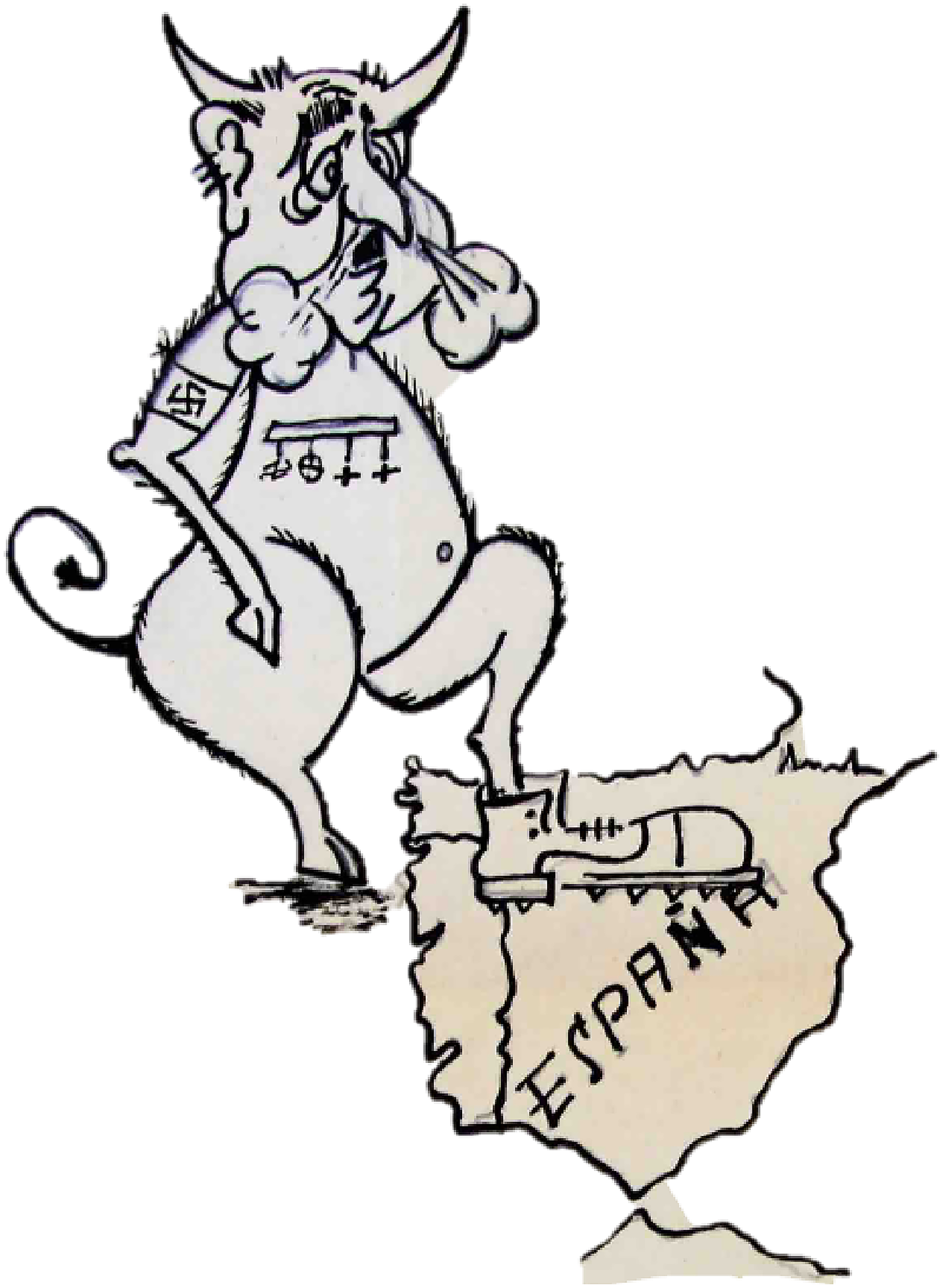
Caricature of Franco drawn by J. Zafra in the letter he sent to the communist broadcaster La Pirenaica in 1963. Historical Archive of the Communist Party of Spain (Madrid).
Some of these symbolic actions aimed at the Caudillo blamed him for the precarious socioeconomic situation the country was still in at the beginning of the 1960s. On the one hand, it has to be taken into account that in many places the post-war poverty continued throughout the 1950s and even into the early 1960s. 50 On the other hand, the discourse of the ‘Spanish economic miracle’ inaugurated by the regime in the sixties as a new source of legitimacy had major limitations. The deficits of this advertised economic ‘progress’ were particularly visible in rural areas, from which the mechanization of farming had caused a mass exodus to the more industrialized urban zones, and which were often bypassed by the social policies of the dictatorship. Although some absolved the ‘Caudillo’ of all responsibility for the food supply crisis of the post-war period and the continuing socioeconomic problems, there was no shortage of people who blamed the dictator for the situation.
This was the case for a resident of Logroño who, in January 1966, while imbibing wine in the Bar Taza, stated loudly and in the presence of several witnesses that ‘Franco was the number one cancer in the nation and that he was killing it with hunger’. Those present at the time included an air force lieutenant who ended up reporting him to the authorities, considering those declarations critical of the head of state as ‘extremely insulting’. 51 There was a similar incident around the same time in Segovia. It took place when a resident ‘with a bad (political) background’ who had moved to the town for work decided to sit on a bench in one of the town squares with two other people he did not know. When these strangers began talking about the bullfighter ‘El Cordobés’, he was unable to contain his indignation and shouted out ‘that people paid too much attention to that bullfighter instead of to beans, chickpeas and other kinds of food, as well as to so many Spanish men and women who were being forced to cross the frontier in search of work’. On hearing this, those present expressed their surprise at his apparent lack of respect for Franco. It was then that he exclaimed, ‘Yo lo colgaba con toda su maravilla’ (‘I would hang him in all his glory’), with the bad luck that the two men he was sharing the bench with turned out to be a captain in the artillery corps and a retired member of the Policía Armada (Armed Police) who denounced him to the authorities. 52
A second group of public declarations against Franco was motivated by his role as executioner in the repressive processes implemented by his regime. Many people could not forget the savage repression of the post-war period that was maintained to varying degrees right up until the last days of the dictatorship. They continued to believe that the dictator's hands were stained with blood and that he signed death warrants while drinking coffee, as Paul Preston suggested. They also kept in mind that the repression had worsened in the 1960s due to the intensification of anti-regime opposition movements. 53 These criticisms emphasized the Caudillo's cruelty and lack of scruples and were of an unequivocally political nature. They were sometimes accompanied by other types of expression that left no doubt as to the ideology of those who uttered them or that their protagonists had left-wing pasts. For that reason, the arguments they put forward in their defence when caught tended to be somewhat implausible.
We can find an example in Seville, where in 1964 a resident who had been arrested for hitting a bus when throwing stones in the air shouted at the police officers who were taking him to the police station that they were ‘Franco's hitmen’, while criticizing the dictatorships of Franco and Primo de Rivera. 54 In another case in Chiclana de la Frontera (Cádiz) in April 1965 a man referred to Franco as a ‘war criminal’, in reference to his responsibility in the Civil War repression, while at the same time loudly acclaiming communism. In his defence he later claimed that at the time he had drunk large amounts of alcohol to assuage the grief he felt for his mother's recent death, which came on top of that of his father during the ‘liberation crusade’. This was confirmed by several witnesses who pointed out that when the deeds occurred ‘he was not in his right mind’. 55 That same year a resident of Osuna (Seville) with a ‘bad (political) background’ and a ‘long criminal record’ sent two letters to the chief of the municipal police in which he made statements such as ‘from Franco down they’re just a gang of assassins’ or that they were ‘the bully-boys of capitalism’. The man attempted to justify his actions by explaining that ‘he was drunk and desperate at the time due to being out of work and broke’. 56 There were also women among those who dared to refer to the ‘Caudillo’ in such terms. This was the case with a woman from ‘a bad (political) background’ who, at the beginning of August 1965, was arrested in front of a newspaper kiosk in Pez Street (Madrid). Staring at the front page of a newspaper with the photograph of a person under arrest, she shouted ‘When will I see Franco's assassins like that’. She was overheard and denounced by a police inspector and eventually sentenced to two and a half years in prison. 57
Although it seems that jokes about the Caudillo's physical features that could be made fun of, like his high-pitched voice, were not very popular, 58 there was graphic humour on this matter, such as the satirical cartoon depicting Franco as a fuming and paunchy bull (Figure 1). There was also an abundance of irreverent comments that questioned his masculinity or his sexual orientation. These expressions that attempted to violate his honour as a man mainly came in the form of swearwords and other popular expressions. One of them was spoken in February 1965 by a resident of Plasencia (Cáceres) while attending a party to celebrate the investiture of the new mayor. During the event, in which the most important local authorities would have been present, he drank ‘abundantly’ and at a certain moment blurted out that ‘Franco has no balls’. 59 And in April of that same year a French citizen who was in a bar in Figueras (Gerona) in the company of other French people made fun of the picture of the Caudillo hanging on one of the establishment's walls. Once outside he repeated up to three times that Franco was ‘a poof’. Despite the fact that there were not many people around when he made these statements, he was sentenced by the Tribunal de Orden Público (Court of Public Order) to six years in prison, as he was not considered to have been drunk at the time of proffering the insults. 60
Blasphemies aimed at the dictator were also common. In the words of Manuel Delgado, this type of expression constituted ‘a form of violence, a grievous act committed against the highest order by placing it in the lowest, an offence whose effect is not physical, given that it affects not material, but symbolic objects’. Its objective was ‘to cruelly harm the very identity of the divine, the moral integrity of the holiest of people and that which is most untouchable, and to do so by using formulas that bring into play the lewd, the coarse, the smutty, the excremental, the “lower parts of the body”’. 61 It should be noted that, as Enrique Moradiellos explained, the figure of the dictator was sanctified from the outset. After the Civil War, Franco was elevated by the Church to the category of homo missus a Deo, an envoy of the Divine Providence. His political authority was understood in Catholic terms, as is shown by the formula ‘Caudillo by the grace of God’ or the right he had obtained to be under the pallium. 62 In this respect, the offensive language directed at the Spanish head of state and the pope, the vicar of Christ, successor of Saint Peter and the spiritual father of the Catholic community, were revealing. This was the case with the expression ‘I defecate on the dead relatives of Franco and on the pope’ uttered by a man in a bar in Vallecas, a working-class neighbourhood in Madrid, in late 1965. 63
This scatological version of blasphemy was very common and became ‘an established way of speaking among proletarian men, as forms of swearing invariably invoked defecating on the sacred, most commonly on God’. 64 Nevertheless, whereas in the case of the expressions referring to the divinity it could be argued that on some occasions these phrases had been said ‘without meaning them’, it appears that we cannot say the same about those referring to the dictator. Moreover, their political intention is obvious in those cases in which they were accompanied by attitudes of violence or resistance to the authorities or if they were pronounced in revealing contexts or in places that symbolized the municipal power.
In this respect, of particular importance were the events that took place in a tavern in Murcia in October 1964, when a local man exclaimed ‘I defecate on Franco and on his mother’. When the police became involved, the man reacted aggressively and finally ran off. For these deeds he was charged and sentenced for insulting the head of state, as well as defying the authorities. 65 Around that time there was a similar incident in Seville, this time on board a bus. One of the passengers was a man on his way back from a wedding at which he had probably drunk alcohol. During the journey he was annoying other passengers, leading the conductor to ask him to stop and eventually requesting the intervention of two members of the Policía Armada. When the man was made to get off the bus, he shouted ‘I defecate on Franco's dead relatives’, while attempting to take out a small pocketknife. He was sentenced to 11 months in gaol and fined 10,000 pesetas. 66
On other occasions it was the context that evidenced the markedly political significance of these blasphemies aimed at the Caudillo. One example occurred a short time later in a bar in Badajoz. As the television set in the establishment was showing pictures of the Portuguese and Spanish dictators, one of those present, apparently drunk, blurted out: ‘I defecate on the mothers that gave birth to Salazar and to Franco and to all their ministers’. This comment cost him a six-month prison sentence. 67 Another indicator of the political nature of these statements, which we can add to those previously mentioned, was the places in which they were made. One example is what happened in 1965 in Utrera (Seville) when a 35-year-old farmworker shouted ‘serious insults’ against the head of state, as well as against other authorities (ministers and the civil governor) and the forces of law and order (the army and the Guardia Civil), with the aggravating circumstance that he did so in front of the police married quarters in the town. Moreover, the man had to be restrained as he refused to stop shouting the insults and was waving a knife. Apparently, he was drunk and ‘held a grudge against everybody’ for having been punished previously for theft and hooliganism. 68
As some of the cases show, it was common for such displays of irreverence to be shouted out in a state of drunkenness, when alcohol consumption caused the individuals to lose their inhibitions and be less aware of the risk. This would have been what happened in the case of a resident of Vallecas in December 1965, when he made offensive statements about the ‘Caudillo’ in the Bar Cáceres. According to the witnesses, the man was ‘dead drunk’ at the time of the incident, although that did not help him in avoiding a prison sentence. 69 On other occasions, the excuse of drunkenness may just have been a way of trying to get off as lightly as possible. This appears to have been the case with L. G. G., who, in August 1966, caused a ‘big scene’ in Huelva while waiting to be admitted to the antitubercular hospital. During the altercation he ‘defecated’ on Franco and on the civil governor of the province. After being reported by two women, he attempted to excuse himself by explaining that, faced with the desperation caused by his illness, ‘he had consumed unspeakable amounts of alcohol until he was completely drunk’. He claimed to have no recollection of anything that had happened. However, one of the women who informed on him insisted that the man showed ‘no signs of being drunk’. 70 A resident of Alcalá de Henares (Madrid) who insulted Franco resorted to the same excuse, but the Guardia Civil disputed this, stating that he knew ‘exactly what he was saying’. 71
As some of the examples given above show, many of those who proffered such exclamations against the Caudillo had left-wing backgrounds. This placed them at greater risk, at the same time as it revealed the clearly political nature of their actions. This can be seen in the case of a resident of Casas de Millán (Cáceres) whom the authorities described as ‘listening to Radio España Independiente [La Pirenaica] and blaspheming frequently’, and who, in February 1965, referred to Franco as a ‘poof’. 72 Even clearer is the case of two prison inmates in Lorca (Murcia) who had been sentenced for the offence of ‘aiding rebellion’. In September 1964 one of them, who was blind, decided to send a letter to Franco. He asked his cellmate to write down what he dictated. The result was a missive addressed to the Pardo Palace full of ‘insulting phrases’ about the dictator. When the two men were discovered, they attempted to evade responsibility by affirming that all they wanted to do in the letter was to ask for clemency for the one who was blind and for his daughter. With this chicanery, as well as by denying the deeds, they were attempting to make their captors believe that they trusted in the compassionate and magnanimous nature of the Caudillo. However, the strategy failed and they were both sentenced to 10 years in gaol by the Tribunal de Orden Público. 73
These desperate attempts to avoid or lighten punishment were tiresomely frequent. Of particular note among these tactics adopted by offenders was that of ‘feigned ignorance’, which attempted to argue lack of awareness of the law at the same time as taking advantage of the stereotypes of power according to which subordinates were poorly educated. 74 During Francoism opponents of the regime believed they could convince the forces of law and order of their innocence or at least mitigate the punishment by appealing to their religious sentiments. The material author of the aforementioned letter written in prison explained that he was a ‘Catholic’ and, therefore, ‘incapable of disrespecting the Caudillo’. 75 Likewise, it was common to resort to language and discourses that legitimized the dictatorship in an attempt to escape from the situation unscathed. 76 This must have been the tactic of the man from La Rioja who insulted Franco in a bar, when he explained to the authorities that it would never have occurred to him to direct insults at the head of state, ‘whom he loved and admired so much as the main creator of this peace that we enjoy’. 77 In so doing, he astutely appealed to one of the main legitimising discourses of Francoism, that of social peace.
‘A Toast for Grimau’. Symbolic Anti-Francoist and pro-Communist Displays of Resistance
Franco visited a small town in Badajoz province and, of course, when he walked out onto balcony, he said:
‘Now I’m here, I want you to ask me for anything the town needs, and it will be yours’.
From below him in the town square the people cried out:
‘What we want here is for you to bring us water, from wherever, a canal or a borehole. We want water because we’re suffering from a terrible drought and nothing grows here’.
And Franco said:
‘Why are you asking me for this when two or three kilometres before entering the town all I could see was green, it was beautiful, a sea of green’.
It was then that the person standing next to Franco tugged at his sleeve and said:
‘Your Excellency, what you saw were members of the Guardia Civil’.
As well as presenting Franco as an executioner, during the 1960s there were other symbolic forms of railing against the dictatorial repression, also carried out by individuals with highly politicized profiles. For example, in October 1964, a person who had previously been imprisoned for ‘aiding rebellion’ proposed a toast in a Barcelona bar to Julián Grimau, the communist who had been sentenced to death by the regime in 1963 and whose execution had led to a wave of solidarity both in Spain and abroad. 79 Many of the listeners to the communist radio station La Pirenaica had written letters expressing their condolences to his widow and daughters and there were even women who had gone into mourning after his killing. 80 Moreover, the man proposing the toast exclaimed that ‘in those 25 years of “peace” it was impossible to live in Spain and that he wanted to go to gaol, which was the only place where you could find decent people’. Another person who symbolically expressed his rejection of Francoist violence was a Basque union leader who, in early 1965, declared before the court that was trying him for possession of illegal propaganda ‘that he did not want them to remove his handcuffs because they were the symbol of the opprobrium with which the regime oppressed Spain’. Both men were punished for their declarations with prison sentences of one and two years, respectively. 81
Another group of symbolic anti-establishment practices was directed against the insignias of the regime. One of the main symbols was the rojigualda flag that had replaced the tricolour flag of the extinct Republic and represented the strong Francoist centralism that denied the peripheral nationalisms. Such nationalisms were particularly powerful in Catalonia and the Basque Country, where a historic regionalism had increased its animosity towards Spanish nationalism during the dictatorship. In 1968, for instance a man had an argument with a group of French people in the Cafeteria Parisien in San Sebastián (Guipúzcoa) because one of them was dressed in the colours red and yellow. During the altercation he said to him ‘Filth, shave off that beard and dress more like an Indian than with the colours of the national flag’, to which he apparently added ‘whose colours are repellent’. The prosecutor initially called for a prison sentence of seven years for having insulted the national flag, although the petition was subsequently reduced to one year. Some years later, at the beginning of the 1970s, there was a similar incident in Villarino de los Aires (Salamanca), this time against the flag of the sole political party. The perpetrator was a 20-year-old medical student who had probably been drawn into politics in the heat of the powerful student movement and, on returning to his hometown, would have shared his ideas with other young people in his peer group. One of those visits home took place during the town's patron saint's day festival in August. Along with some friends, he spent two nights tearing down and burning the flags of the single political party FET de las JONS (Falange Española Tradicionalista de las Juntas de Ofensiva Nacional-Sindicalista) that adorned the balconies. Accused of offending the National Movement, in his defence the student claimed he had been drinking alcohol and that he had ‘nothing in particular against the Falange’. 82
Finally, during the 1960s there were also symbolic and individual displays of resistance of a pro-communist nature. The persistence under Francoism of a communist political culture with the ability to express dissent through symbolic actions was favoured by the active role played by the Communist Party of Spain (PCE) during the dictatorship. In the post-war period, the PCE fed the anti-Francoism movement with initiatives such as support for the armed struggle of the maquis. From the 1960s the party linked itself with the social movements opposing the dictatorship, including those found in the universities, the Church and in workplaces, making a decisive contribution to the struggle for democracy. 83 Some members of the party in hiding carried out symbolic actions of considerable impact. An example is an event which took place in Granada in 1961. On 14 April, the thirtieth anniversary of the proclamation of the Second Republic, a group of communists placed a wreath of flowers and a hanging with the Republican flag and the dedication ‘Your comrades will not forget you’ on the cemetery niche of Ricardo Beneyto, a guerrilla leader shot by the dictatorship in 1956. 84 Moreover, the party was able to increase its popularity through strategies such as the clandestine radio station La Pirenaica, also known as Radio Verdad (Radio Truth), that many Spanish households tuned into secretly as it was not subject to censorship. 85
Moreover, the rabid anti-communism of the Spanish regime led many dissidents, or even those merely adapting to Francoism who did not have a party membership card, to idealize both communism and the Soviet regime, which they considered to be at the opposite pole to the Francoism they abhorred. Some of these people ended up exteriorizing this sentiment by shouting out at moments of desperation. This must have been what happened in 1964 to a labourer in Seville who shouted ‘Viva Stalin’ (Long live Stalin) and ‘Viva Rusia’ (Long live Russia) in a drinks kiosk in the Plaza de España, where he had gone on his own. 86 Likewise, in 1965 a miner from Atalaya (Huelva) – married and a father of five children – shouted ‘Communism yes, Fascism no’ in front of the town's Guardia Civil headquarters, one of the main local symbols of power. This apparently happened after an argument with his wife and his subsequent consumption of alcohol. 87 Another example is a man from Laujar (Almería) who shouted ‘Long live Communism’ and various epithets aimed at Franco in the town square and in the presence of children. 88 On other occasions similar ideas were expressed in writing and, therefore, more consciously and with premeditation. This happened in Alhama de Almería (Almería) in 1967 during Holy Week, a very important festival in the calendar of the Catholic Church. Following a confrontation between the parish priest and some local residents regarding the holding of a procession, several painted slogans appeared around the town. One bore the communist hammer and sickle symbol and the other read ‘Biba [sic] URSS’ (Long live the USSR). 89 There was a similar incident in 1969 in the provincial capital of Almería when, coinciding with the announcement of the state of emergency, an anonymous hand wrote ‘Viva Stalin’ (Long live Stalin) in capital letters on a school classroom blackboard. 90
Conclusions
During the 1960s, part of civil society understood that within the framework of the dictatorship it was also possible to appropriate some of its rules, practices and discourses and give new meaning to them, and even turn these around to improve certain aspects of their daily lives. 91 Under that presupposition some were able to resist, symbolically and perhaps only momentarily, the oppressive power of Francoism. They did this through small spontaneous actions on an individual scale without necessarily involving any political party or receiving aid from an organized social opposition movement. Nevertheless, some of these practices could, in some way, set a precedent for the large anti-Francoist mobilizations that began to be organized around that time and that intensified in the early 1970s. These actions took place in the public arena of the town square or the street or in places of male socialization, such as bars and taverns in which politics (or infrapolitics) continued to be practised. As some of the cases described above show, sometimes festive occasions, such as a wedding, a town's saint's day festival or Holy Week, were taken advantage of to express dissident feelings. These were one-off episodes that brought to the surface hidden desires and longings thanks to the intake of alcohol, high spiritedness, a false perception of safety or an outburst of courage.
The 1960s saw a continuance of the everyday actions of resistance directed against the socioeconomic situation that had monopolized expressions of unease during the 1940s. However, the repertory of resistance was considerably expanded by the incorporation of new criticisms, coinciding with the escalation of dictatorial repression, the burgeoning of anti-Francoist protests and the consequent risk-benefit re-evaluation. Of particular note among the forms of symbolic resistance in this period were the verbal insults against the dictator that contradicted the regime's discourse on the leadership of the mythicized Franco. These critical expressions were motivated by the precarious socioeconomic situation and the inequalities that continued to exist in many parts of the country in the 1960s, despite the fact that the regime referred to this as a period of ‘desarrollismo’ [developmentism]. It was also caused by the regime's responsibility for the repression during the post-war period and the hardening of violence during the late period of Francoism, coinciding with the increasing opposition. There were frequent jibes that ridiculed the head of state by questioning his virility, as well as scatological blasphemies aimed at him. Also common were symbolic criticisms of dictatorial violence, insults aimed at national symbols and acclamations of communism or the Soviet regime. Those who uttered them did not need to be communists, nor even understand what that meant, for they were simply aware that it was an ideology demonized by the dictatorship. That was a good enough reason to idealize Communism or to see in it hope for improvement.
As defended by the proponents of Alltagsgeschichte, historical actors are able to imbue their everyday actions with political connotations. Nevertheless, the strictly political nature of symbolic displays of resistance under authoritarian regimes has been questioned. Insults and blasphemies clearly do not cause dictatorships to fall, but was that really what their protagonists wanted or needed? The actors to whom this article has referred did not always have a clearly ideological intent but were often expressing their discontent in the absence of legal instruments to do so, relieving their frustrations or simply mocking the dictatorship. Although their actions remained in the realms of the symbolic, they could contribute to wearing down the image of the regime – if only minimally – and serve as a reminder that not all was acquiescence and consensus, which became particularly important in such a long-lived dictatorship as that of Franco. As has been demonstrated in this article, the political component is more evident in those cases in which the manifestations of hostility were accompanied by violent attitudes and were uttered in particularly significant contexts or in the seats of local power. In any case, they are all certainly good examples of ‘stubborn and self-willed’ behaviour of the Eigen-Sinn type designed to create a temporary distance from the regime.
In this respect, it is also revealing to see how these actions were perceived by the authorities who, rather than showing themselves to be pseudo-tolerant, opted to severely punish such behaviour. Another good indication in this respect is the profile of the protagonists who, to a greater extent than those who disobeyed the economic regulations of the post-war period, tended to have left-wing backgrounds. However, they were not always clean objectors, because the excuses they sometimes offered to the forces of law and order in their defence –that their offences were committed in a moment of perturbation when they were drunk – may have been true. In these cases, in which the resistant nature of the act can be questioned, the category of Eigen-Sinn is of great validity. In any case, those who shouted insults at a member of the regime or damaged one of its symbols were able to deliberately take advantage of the ambiguous nature of symbolic displays of resistance to achieve greater success. Moreover, their symbolic and unarmed nature may have increased their ability to attract the sympathy of the rest of the community. However, aware of their anti-establishment potential, many people responded by reporting such episodes to the authorities.
Footnotes
Acknowledgements
The author is a member of the research projects: ‘Heritages of Hunger: Societal Reflections on Past European Famines in Education, Commemoration and Musealisation’ (NWA.1160.18.197, NWO, Radboud University & NIOD Institute); ‘La hambruna española: causas, desarrollo, consecuencias y memoria (1939–1952)’ (PID2019–109470GB-I00, Spanish Ministry of Economy, Granada University); and ‘La construcción de la cultura y de la identidad de Andalucía’ (B-HUM-066-UGR18, FEDER, Granada University), which funded the research that underlies this article.