




Abstract
This article focuses on the years 1982–1984, which witnessed the first systematic effort to establish a moderate right-wing youth organization in Greece during the Cold War. It shows that the invention of the political songs of the Liberal youth ONNED underpinned its mass mobilization in 1982–1984. In this vein, our analysis enriches recent historiographical approaches that focus on cultures of Conservatism and on political and cultural changes in post-authoritarian Southern Europe in the 1970s to 1980s. Those political songs were linked to both the rhetoric and the practices of ONNED cadres and members. Their lyrics conveyed anti-Communist post-memories of the Civil War in Greece (1943/1946–1949), as reconfigured and filtered through the experiences of ONNED cadres and members in the aftermath of the 1967–1974 dictatorship and the electoral victory of the Socialists in 1981. Thus, the study of the Liberal youth complements the analysis of moderate right-wing subjects in Spain, for whom the Civil War was no reference point after democracy was restored in 1975. Simultaneously, the article enriches research on the Greek Liberal youth so far, which has neglected how this subject reconfigured its approach to the Greek Civil War in comparison to the Right in the preceding decades. Our article also shows that the songs under study accompanied a wide range of ritualistic and prosaic practices of ONNED cadres and members. Listening to and singing those songs was part of a double demarcation process between ONNED cadres and members and their left-wing opponents, as well as within ONNED. For instance, in Thessaloniki, the more Conservative members embraced those songs in their leisure activities and their everyday spaces. By contrast, the more centre-right members were more critical, but still tolerated such music. The everyday life and spatial history approach is crucial to illuminating the varying reception of the political songs of ONNED within this organization.
According to Dimitris Parasidis, a member of the Liberal youth in Thessaloniki in the 1980s, ‘if our life was a film … Vassilis [one of the composers of political songs for the group] had composed its soundtrack’. 1
This extract points to the central question for this article: the relationship between music and the mobilization of the members of ONNED (Organosi Neon Neas Dimokratias, Youth Organization of New Democracy) in Greece, the youth wing of the Liberal Nea Dimokratia (New Democracy) Party. Nea Dimokratia and ONNED labelled themselves ‘Liberal,’ but attracted a wide range of members and supporters, including Liberals and Conservatives. 2 The article focuses on the years 1982–1984, an era marked by the first systematic effort to establish a mass centre-right and democratic right-wing youth organization in that country during the Cold War. 3 This was also a period in which the legacy of the extreme right-wing 1967–1974 dictatorship continued to shape political debates.
Results of university student elections, 1982–1984
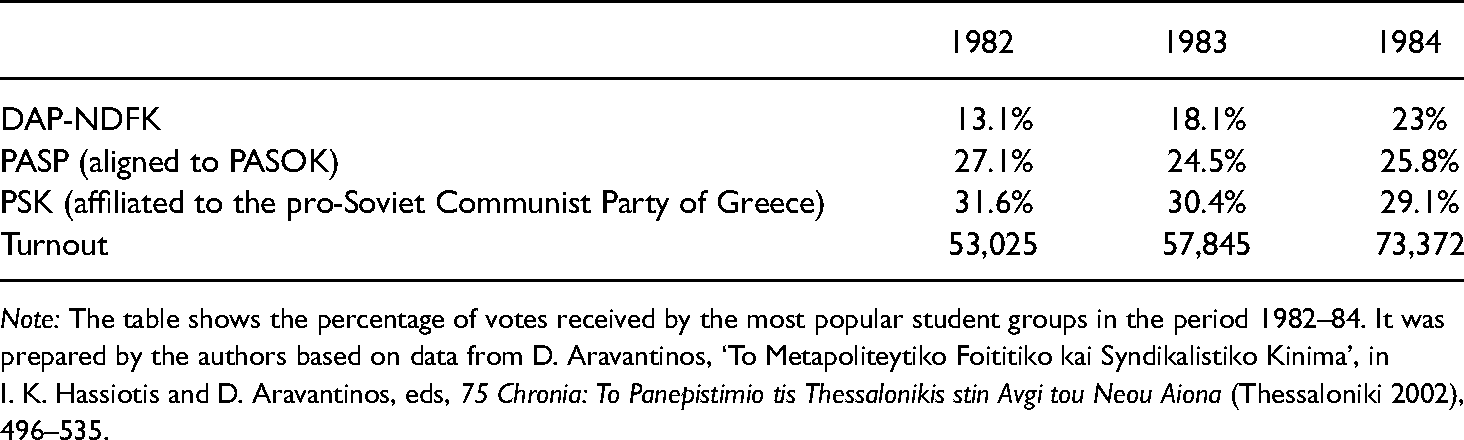
Note: The table shows the percentage of votes received by the most popular student groups in the period 1982–84. It was prepared by the authors based on data from D. Aravantinos, ‘To Metapoliteytiko Foititiko kai Syndikalistiko Kinima’, in I. K. Hassiotis and D. Aravantinos, eds, 75 Chronia: To Panepistimio tis Thessalonikis stin Avgi tou Neou Aiona (Thessaloniki 2002), 496–535.
Our main argument is that the invention of political songs contributed to the mass mobilization of the growing number of members of the Liberal youth in 1982–1984. This galvanization also involved the attempt of ONNED cadres and members to become visible in spaces where their presence had been minimal in 1974–1981, namely the first post-authoritarian years. The invention of political songs was a top-down and bottom-up process. The leadership initiated it, but it did not merely impose them on ordinary members: those songs struck a chord with the rank and file. The political songs served as a means of demarcating ONNED cadres 4 and members from their left-wing political opponents. Nevertheless, a segment of the Liberal youth that opposed its leadership were more sceptical than supporters of the latter towards such music. Still, even those more critical ONNED members tolerated the songs under study, which underpinned a wide array of activities of ONNED in 1982–1984. This article revolves around music particularly due to its pervasiveness in the political activities of ONNED cadres and members, specifically in the period 1982–1984: music and, especially, the political songs of ONNED, reproduced the main symbols of its rhetoric and underpinned some of the key political practices of the post-authoritarian era, which ONNED and Nea Dimokratia employed. Thus, the article lends credence to recent interdisciplinary approaches to cultures of Conservatism, endorsed, among others, by Anna von der Goltz. Such scholars place a premium on culture in the study of centre-right and right-wing groups in the 1970s and 1980s. 5 Moreover, our article contributes to pioneering analyses of transitions from dictatorship to democracy as well as of post-authoritarian transformations in Southern Europe during the 1970s and 1980s: these have challenged the emphasis of relevant scholarship on institutional change and combine the analysis of politics with that of culture, taking a perspective from above and below. 6
In addressing music and politics, this article investigates the interaction between how the Liberal youth leadership aimed to shape its rhetoric and practices underpinned by music and the negotiation of these by the rank and file in their daily routines. In so doing, we complement research on Nea Dimokratia and ONNED, which so far has also almost exclusively explored the voices of their cadres. 7 To illuminate this negotiation, our analysis draws on the history of everyday life and space. The latter is a key new interest in recent approaches to everyday life history, as Paul Steege, Geoff Eley and Kate Ferris, among others, have shown. 8 Analyses of space as a cultural construct have also developed beyond historical research: the work of philosopher and sociologist Henri Lefebvre and philosopher, psychoanalyst, social scientist and historian Michel de Certeau have been precursors to the spatial turn in historical studies. 9 In studying the spatial dimensions of daily political routines of ONNED cadres and members, we resonate with Geoff Eley. 10 Eley has written that ‘everyday-life historians creat[e] a “third space” between the older institutional accounts of labour history and the structural approaches to industrialization and working-class formation preferred by social science historians’. 11 Although we do not examine workers and industrialization, we explore the concrete ways in which the symbolic practices of political songs unfolded in contexts, such as university corridors, student gatherings, and tavernas. In line with Kate Ferris, we show that these spaces were both shapers and products of the mobilization of ONNED cadres and members to which political songs contributed. 12
In investigating the link between the rhetoric of the Liberal youth and the symbols that figured prominently in its political songs, we show that the latter echoed post-memories of the 1940s in Greece with a robust anti-Communist inflection, post-memories that figured prominently in the texts of ONNED in general in this period. In employing the notion of post-memories, we appropriate the concept employed by Marianne Hirsh. We refer to traumatic memories of events that ONNED cadres and members had not lived through themselves but which had been transmitted to them by older generations, especially their family members, or through symbols used by younger and older Liberals and Conservatives. 13 In focusing on ONNED rather than on Nea Dimokratia and showing that young Liberals and Conservatives were receptive to symbols used by older political subjects, we help nuance the emergent research on moderate right-wing youth subjects in Western Europe in the 1970s and 1980s in general. Such scholarship has stressed the generation gap between younger and older political subjects on the right of the political spectrum. 14 Such a gap was not evident in the case of the political songs of ONNED and the post-memories they contained, as these were also appreciated by the leadership of Nea Dimokratia.
The post-memories in question revolved around anti-Communist references to the Civil War in Greece (1946–49) and the resistance against the Tripartite Occupation 15 of Greece in 1941–1944. Such references in the political songs of ONNED built, to an extent, on right-wing discourses, which had appeared in Greece from the Civil War until the collapse of the dictatorship in 1974. However, ONNED cadres and members after 1974 and, especially, in 1982–1984, did not merely repeat almost unaltered the anti-Communist repertoire of the previous decades, as Magda Fytili argues. 16 Instead, they reconfigured it: ONNED cadres and members employed anti-Communism in conjunction with an anti-1967–1974 dictatorship rhetoric. Therefore, we argue that the 1967–1974 dictatorship served as a symbol that helped filter and reframe the anti-Communist rhetoric of centre-right/right-wing groups in Greece after 1974, a process which has been largely neglected by research on Liberal political subjects in Greece. 17 The analysis of the anti-Communist rhetoric of ONNED cadres and members through the lens of their political songs also helps enrich the study of (post-)memories endorsed by Liberal and Conservative parties more broadly in Western Europe. ONNED’s emphasis on Civil War references is in stark contrast with the attitude of centre-right-to-right-wing subjects in Spain, another Southern European country that had experienced both a Civil War and a right-wing dictatorship: those political actors in Spain refrained during the mid-to-late 1970s and 1980s from addressing the Civil War. 18
The political songs of ONNED and the post-memories they echoed were vital not only in reproducing the main symbols used by the Liberal youth, but, also, in underpinning its practices, as mentioned above. As the article shows, ONNED cadres and members placed music at the core of mnemonic practices that were, simultaneously, key symbolic practices, to employ a term introduced by Alf Lüdtke, prominent advocate of the history of everyday life approach, for its cadres and members. 19 By symbolic practices, Lüdtke refers to the activities and social interactions through which workers construct and express meaning that they attach to the ‘real world’ of industrial work. These ‘symbolic practices’ may assume an exceptional, ritualistic form, such as the celebration of a birthday or a company anniversary, but can also be prosaic, such as the daily handling of tools. 20 In this article, the concept of ‘symbolic practices’ refers to individuals from diverse backgrounds, both working-class and middle-class ones, and their activities in politics.
In exploring both the rhetoric of ONNED cadres and members and its repercussions for their practices, ritualistic and prosaic, the article builds on diverse sources: the newspapers and pamphlets of the organization and coverage of its activity in the mainstream press, both right-wing and left-wing. 21 Such material is particularly useful in identifying the main symbols in the rhetoric of ONNED, the ways in which the Liberal youth ran ritualistic practices and the spaces where these practices occurred. Besides, the article also rests upon the interviews and written autobiographies of 19 ONNED cadres and members who varied in terms of their ideological orientation within the group (‘centre-right’/‘Liberal’ and ‘right-wing’), social class, geographical origins (urban centres, provincial Greece), and gender. These individuals do not form an accurate sample that helps in gathering quantitative data. Rather, the assemblage of their stories is a ‘miniature’, as depicted by Lüdtke: the oral testimonies we have gathered ‘do not deal exhaustively with the multi-layered structure of historical processes’. 22 Still, these stories enable a close reading of the attitudes of ONNED cadres and members from various backgrounds towards the political songs of the organization and its ideological profile in general. Our analysis particularly considers the significance of Anteilnehmen (active identification and involvement), as formulated by Lüdtke: we try to understand the ONNED cadres and members we are studying in relation to us as researchers who are not aligned to the Liberal youth. This implies an ‘awareness of the shape of that distance separating “them” from “us”’. 23 In our case, it means an effort to empathize with the subject in question, but also to read the stories we have collected against the grain, seeking potential ambiguities in what has been narrated to us.
The analysis proceeds in three main steps: the first section provides background information on the unfolding of anti-Communism from its inception until the early 1980s. The following three sections analyse the official rhetoric of ONNED, the symbols that the political songs of ONNED conveyed and their reception by the rank and file of the group. The next two sections explore the use of those symbols in ritualistic and prosaic practices involving individuals affiliated to ONNED in 1982–1984.
The Trajectories of Anti-Communism, 1920s–Early 1980s
Anti-Communism in Greece was indelibly linked with the doctrine of ethnikofrosyni, namely self-proclaimed proper patriotic credentials. Ethnikofrosyni was first employed in the interwar years. At that point, its use was limited, and its meaning was often vague. 24 Nevertheless, shortly after the end of the Tripartite Occupation of Greece (1941–1944), namely from the mid-1940s on and during the 1946–1949 Civil War between the pro-‘Western’ government and the Communist guerrillas, ethnikofrosyni became clearly defined. It served as a doctrine lambasting the Communist Left as posing an ‘existential’ threat to the Greek nation and allegedly imperilling the territorial integrity of Greece, acting in unison with the ‘Slavic enemies’ of the Greeks. 25 Ethnikofrosyni was the grounds on which the state justified the persecution of Communists during the Civil War and throughout the post-Civil-War era of ‘weak’ democracy in 1949–1967, including the ban on the Communist Party of Greece between 1947 and 1974. 26 Right-wing parties employed this doctrine, albeit to varying degrees, throughout the ‘weak democracy’ years, while centrist parties did so until the early 1960s. 27
Between 1967 and 1974, a right-wing dictatorship ruled Greece. It weaponized ethnikofrosyni as a means of persecuting the Left. Nevertheless, the militaristic regime also targeted centrist and right-wing politicians and banned all political parties. 28 The incipient collaboration between left-wing and some right-wing forces against the dictatorship led to the questioning of ethnikofrosyni as a doctrine by subjects beyond the Left and the Centre, according to David Close. 29
As a result, the initial post-authoritarian period between 1974 and 1981 witnessed the decrescendo, but not the total disappearance of ethnikofrosyni. The 1974–1981 era was marked by a stable democracy. For most of this era, left-wing groups prevailed across much of the civil societies, such as in university student bodies, while the government was formed by Nea Dimokratia, 30 founded in 1974. 31 Nea Dimokratia was part of a national unity government from 24 July 1974, and, from November 1974 until October 1981, the sole governing party. Ethnikofrosyni played a diminishing role in justifying political exclusions after the collapse of the 1967–1974 dictatorship. In stark contrast to the practice of ethnikofrosyni until 1974, the national unity government legalized all Communist Parties and youth organizations in September 1974. Nea Dimokratia did not reverse this decision after its victory in the parliamentary elections in November 1974.
In terms of their official rhetoric in the initial post-dictatorship era of 1974–1981, Nea Dimokratia and ONNED vacillated between sustaining elements of anti-Communism of the 1949–1967 ‘weak democracy’ era and revisiting the content of this doctrine. Overall, Nea Dimokratia and ONNED cadres and members increasingly employed a pro-European Economic Community (EEC) rhetoric in 1974–-1981, which they counterposed to Communism and totalitarianism in general. However, concerning the former, they showed a degree of uncertainty in defining anti-Communism in the initial post-dictatorship era of 1974–1981. The government of Nea Dimokratia sustained some anti-Communist rituals of the ‘weak democracy’ era, as shown in the section on ritualistic practices. However, DAP-NDFK, the student wing of Nea Dimokratia, claimed in 1976 that it did not subscribe to the anti-Communism of the dictatorship and no longer advocated a ‘sentimental’ anti-Communism focusing on the Civil War. Rather, it opted for an abstract opposition to Marxism as an ideology that did not respect the individual. 32 Simultaneously, Nea Dimokratia and ONNED targeted what they viewed as facets of right-wing totalitarianism. They were critical of such phenomena not only at an international level, as advocates of ethnikofrosyni had been in the aftermath of the 1946–1949 Civil War, when they criticized Adolf Hitler. 33 They also lambasted the extreme right-wing 1967–1974 dictatorship in Greece, which they also depicted as ‘totalitarian’. 34 Democracy, safeguarded by the EEC, appeared as the antidote to all facets of totalitarianism in this discourse. 35 In this vein, the government of Nea Dimokratia ensured that Greece joined the EEC in 1981. 36
Hardening Anti-Communism and Mass Mobilization of Members, 1982–1984
The period 1982–1984 saw the reversal of some political characteristics of the initial post-authoritarian era: Nea Dimokratia no longer formed the government, but the Liberal youth gained in strength among university students. ONNED engaged in general in mass recruitment and mobilization of members during the years 1982–1984. A core component of this effort was an ideological re-orientation: The new leadership of Nea Dimokratia and ONNED hardened their anti-Communist discourse from the end of 1981.
Shortly after Nea Dimokratia lost the general election on 18 October 1981 to PASOK (Panellinio Sosialistiko Kinima, Panhellenic Socialist Movement), Evangelos Averoff-Tositsas (often mentioned simply as Evangelos Averoff) became the president of the former on 9 December 1981. 37 Averoff appointed Vassilis Michaloliakos as president of ONNED in January 1982. Michaloliakos remained in that position until 1984. The leadership of Nea Dimokratia also appointed the Executive Committee of ONNED, namely the leadership of the latter. Michaloliakos was loyal to Averoff, as was most of the leadership of ONNED.
In 1982–1984, Nea Dimokratia departed from the organizational atrophy of the 1974–1981 era, which had been based on the activity of some cadres and had neglected the mass recruitment of members. This shift occurred against the backdrop of a profound polarization between PASOK and Nea Dimokratia. According to Efthymios Papavlassopoulos, the fact that political parties also played a prominent role in political patronage in the post-authoritarian era further facilitated the substantial increase of their members. 38 Overall, within two years (1982, 1983), Nea Dimokratia managed to attract 70,000 new members. 39 Two main target groups for the party were women and the youth. 40 In this vein, it appointed a new executive committee for ONNED with the task of expanding the youth group. This proved successful instantly: ONNED’s membership (mainly university students, high school pupils, unemployed individuals) increased from 5000 in 1981 to 115,563 in August 1984. 41 Crucially, its student group, DAP-NDFK, gained in popularity, which is evident in the results of the student elections between 1982 and 1984, which can be seen in Table 1. The leadership of Nea Dimokratia and ONNED in this period wished to develop a massive youth organization, whose members would be disciplined, ardently anti-Communist and anti-totalitarian, and oriented to activism rather than debates around political theory. 42
A hardening of anti-Communism was a core component of the substantial re-organization that Nea Dimokratia and ONNED underwent under their new leaders. The new leadership of Nea Dimokratia and ONNED concurred in being politically to the right of the leadership of Nea Dimokratia in 1974–1981 under Konstantinos Karamanlis and Georgios Rallis. Averoff and Michaloliakos retained some elements of the orientation that the Nea Dimokratia’s leadership introduced in 1974: they continued to be ardent supporters of Greece’s entry to the EEC. 43 They preferred the term ‘liberal’ rather than ‘ethnikofron’ to describe themselves. 44 However, the attitudes of the leadership towards anti-Communism hardened from the end of 1981 and, particularly from 1982 until 1984. The official rhetoric of Nea Dimokratia and ONNED concurred in 1982–1984 in emphasizing the tropes of ethnikofrosyni in what we could describe as a dialogue across generations on this theme. 45 In particular, both dropped any existing element of self-reflection on anti-Communism and linked it unequivocally with (post-)memories of the 1940s that portrayed the Communists as prone to terrorizing their opponents and as being ‘totalitarian’. 46 Moreover, they construed right-wing/centre-right subjects as the sole guardians of Greek national interests, juxtaposing these to the alleged collaboration between Communists and the Slavic ‘enemies’ of Greece. 47 Those had been core components of the ethnikofrosyni doctrine, as endorsed by right-wing parties during the weak democracy years (1949–1967), as shown in the previous section.
Simultaneously, while sustaining a hard-line approach to anti-Communism, the leadership of the Liberal youth reconfigured elements of ethnikofrosyni in comparison to the weak democracy years (1949–1967). This process occurred against the backdrop of political developments after the collapse of the dictatorship in 1974 and after the electoral victory of PASOK in 1981. The latter was significant, because no Socialist had won any national election during and after the Civil War. From the collapse of the dictatorship in 1974, Nea Dimokratia and ONNED had been facing a tough challenge from their political opponents, such as the Socialists: the latter accused the Liberal subjects of placating extremist, pro-dictatorship elements. Agonistis, the newspaper of the PASOK Youth, claimed that the student group of ONNED included aggressive advocates of the militaristic regime. 48 This trope continued in 1982–1984. For instance, the pro-Socialist newspaper Ta Nea maintained that ONNED cadres and members collaborated with the Extreme Right in ‘numerous’ high schools. 49 The leadership of the Liberal youth responded by accusing the Socialists, whom Ta Nea supported, of collaborating with authoritarian Communist regimes. It filtered its anti-Communist rhetoric, including their references to the Civil War 50 , by re-interpreting it through the lens of the 1967–1974 dictatorship: Similar to their predecessors in 1974–1981, the new leaders of ONNED differentiated between the Liberal youth, on the one hand, and this dictatorship as well as Communist ‘totalitarianism’, on the other. 51 Simultaneously, the leadership of ONNED maintained that the practice of the Socialist government resembled that of the right-wing 1967–1974 dictatorship. ONNED leaders lambasted PASOK as allegedly shedding crocodile tears for the conduct of the 1967–1974 dictatorship, while trying to establish a ‘one-party dictatorship’. 52 A slogan that the leadership of ONNED encouraged cadres and members to use, at least from 1983, about the Socialist government was ‘Dictatorship it is, it will pass’. 53 ONNED leaders also described the PASOK government from 1981 on using the same terms that the Right had used to criticize the Communist conduct in the 1940s, such as ‘totalitarianism’. 54
Meanwhile, ONNED cadres and members were exposed to an explosion of left-wing memories of Communist resistance against the Tripartite Occupation of Greece (1941–1944). Feeling that the 1967–1974 dictatorship had totally discredited ethnikofrosyni and in the context of growing freedom after 1974, left-wingers increasingly voiced in public a left-wing narrative that challenged the anti-Communist representations of the ethnikofrosyni doctrine of the 1949–1974 period. 55 After 1974, numerous memoirs of Communist guerrillas were published, many associations of the Communist-led resistance fighters were founded, and relevant commemorations frequently took place. 56 Crucially, from the final years of the dictatorship, left-leaning dissident students of different social backgrounds often met in tavernas to discuss politics and to sing collectively, among others, songs of the left-wing partisans who had fought against the Tripartite Occupation of Greece in 1941–1944. 57 It was a prosaic practice that Kostis Kornetis beautifully describes as a ‘taverna ritual’ generating a ‘cathartic energy’. 58 Socialist and Communist students and workers perpetuated this practice throughout the 1970s. Young Socialists and Communists also sang collectively such partisan songs in their Festivals after the collapse of the dictatorship: each of the main left-wing groups held its own Festival in early autumn, with the pro-Soviet KNE (Kommounistiki Neolaia Elladas, Communist Youth of Greece), beginning already in 1975. 59 The taverna rituals and the Festivals were ways in which young Communists and Socialists claimed that the Left represented genuine patriotism both in the 1940s and in the 1970s to 1980s. 60 The effort to assert their patriotism underpinned several other music-based activities of left-wingers during and after 1967–1974. Such music could contain but was not limited to partisan songs of the 1940s. These activities entailed concerts blending Greek folk with rock music in the Kyttaro club in Athens in 1971–1974, cultural events run by Greek migrants in West Germany in 1967–1974 that included various Greek left-wing political songs, and large concerts in sports stadia in Athens shortly after the collapse of the dictatorship. 61 One way or another, left-wingers challenged the doctrine of ethnikofrosyni that portrayed them as ‘traitors’.
Moreover, once in power, the Socialists officially acknowledged the contribution of the Communist-led resistance through law 1285/1982, a measure which no previous government had taken. 62 In this vein, PASOK fielded as candidates key figures of left-wing resistance groups in the 1940s. A case in point was Manolis Glezos, renowned for removing the Nazi flag from the Acropolis in Athens alongside Lakis Santas on 30 May 1941. Glezos stood as a candidate in collaboration with PASOK in the 1981 and 1985 national elections. 63
Reacting to these developments, Nea Dimokratia cadres under Averoff counterposed the non-Communist resistance in the early 1940s. They portrayed the latter as the real patriots in comparison to the Communist-led groups, and described ONNED as perpetuating the struggle of this non-Communist resistance. 64 This constituted a re-narration of the 1940s in discourses of ethnikofrosyni: between the mid-1940s and 1967, the ethnikofrosyni doctrine, at least as expressed in the official rhetoric of right-wing and centrist parties as well as in mainstream newspapers, focused on the Civil War and sidelined the resistance against the Tripartite Occupation (1941–1944), including the non-Communist one. Reference to the latter would need to acknowledge the significant role that Communist forces played in this resistance and would be incompatible with their representation of Communists as subverting the Greek national interests. 65 By contrast, mentions of the non-Communist resistance of the early 1940s had already been appearing in publications of ONNED in the period 1974–1981. 66 However, given the relative uncertainty in the official rhetoric of Nea Dimokratia and ONNED around anti-Communism at that point, this re-narration emerged in full swing only in 1982–1984, forming part of the hardening anti-Communism in that era.
The Invention of Political Songs by ONNED
A tool for the anti-Communist mass mobilization of ONNED was the invention of its political songs in 1982–84. These songs reflected the official rhetoric of the Liberal youth. Their composition was initiated by its leadership but happened in the context of the daily routines of some of its ordinary members. ONNED leaders did not use anti-Communist songs that had been composed during and shortly after the Civil War, like ‘Antartopliktos’ [plagued by the partisans] composed by Babis Bakalis in 1949. 67 Instead, they opted for new ones, which drew continuities between the Civil War era and the 1980s, as shown below in more detail.
Music was not the only means of mobilizing ONNED members. Those members of Nea Dimokratia and ONNED who supported the previous leader, Konstantinos Karamanlis, or opted for more economically liberal politics than the ones endorsed by Averoff, controlled institutions related to the party, which delved into political theory. A case in point was KPEE (Kentro Politikis Erevnis kai Epimorfoseos, Centre for Political Research and Training). Meanwhile, cultural products other than musical ones, such as novels and films, also galvanised ONNED members in this period. ONNED and Nea Dimokratia did not necessarily produce these. A case in point is the novel Eleni authored by Greek-born American author and journalist Nicholas Gage (Nikos Gatzogiannis). The book recounted the Communist violence in Thesprotia, northern Greece, during the Civil War from the perspective of Gage’s mother, Eleni. The latter appears to have been executed by Communist partisans. The book was also the basis for the eponymous film, released in Greece on 20 March 1984. 68 Its screening was polarizing: members of the pro-Soviet Communist youth KNE tried to prevent it. By contrast, some young Liberal narrators remember the film as significant in mobilizing them. 69
Music definitely helped galvanise ONNED cadres and members in the period 1982–1984, however. There were two bands and a musician besides these that composed political songs for the Liberal youth. The first one that emerged was the Orchestra of Galazia Genia (Azure Generation), or, simply, Galazia Genia, which was also a metaphor that ONNED cadres and members further used to identify themselves. 70 It was created in 1982 at the initiative of the leadership of ONNED. It comprised amateur musicians, who were members of the group in Athens. Its first record was released in 1982 and first presented in public in the sporting stadium in Athens on 11 June 1982. 71 All the songs, lyrics and music, were composed by Charis Chatzikokolis and were released as a vinyl record entitled ‘Ta Tragoudia tis [The Songs of] Galazias Genias’ in December 1982. 72 The section of Public Relations of ONNED co-ordinated the production of the first record. 73 The band also produced a second record in 1984. The music for most of the songs of the second record was composed by Kostas Galanis, while the lyrics were written by several individuals, such as Giorgos Rossolatos, Polykarpos Diamantis, and Thanasis Tsionaras. Other members of the band, who joined between 1982 and 1984, were Kostas Psomas, Yanna Vrahnou, Martha Irakleous and Dimitris Athanassiou. 74
Another prominent band was the Galazioi Machites (Azure Fighters). They were formed, apparently in 1983, in Thessaloniki. 75 The band soon released its only set of political songs, particularly marches, whose lyrics and music were composed by Vassilis Synatsakis. Synatsakis and all the members of the band were affiliated with ONNED and were amateur musicians. 76
The third musician involved in this project was Robert Williams. In contrast with the musicians of the other two bands, Williams had been a prominent professional musician already in 1971, when he was a member of the pop group Poll. 77 Williams himself had been affiliated with Nea Dimokratia from the first post-dictatorship years. In line with the aim of this party to vindicate their anti-dictatorship resistance pedigree, in 1976 his eponymous LP (Robert Williams) featured the song Mi Nomizeis [Do not Think]. The latter contained lyrics that addressed the Polytechnic Uprising in 1973 against the dictatorship. 78 Later on, Williams composed a record for ONNED and Nea Dimokratia, which was entitled ‘Afieroma O.N.NE.D. Dimokratia. Eleytheria [Tribute to ONNED. Democracy, Freedom]’ and released in May 1984. The lyrics and the music for all the songs but one were composed by Williams. He also sang all of them apart from one, the Anthem of Nea Dimokratia, which was sung by Viktor Polydorou. 79 The executive committee of ONNED undertook the production and financing of the record, which also circulated as a cassette. 80
While the leadership of ONNED initiated and supervised the composition of such music, it was the prosaic symbolic practices of some ONNED members that served as the breeding ground for the songs of the Orchestra of Galazia Genia and the Galazioi Machites. A key space for their composition was the headquarters of ONNED, where its cadres and members spent much of their time in their everyday lives. As Dimitris Xifaridis, ONNED member in Thessaloniki and university student at that point, recounted, ‘we went on workdays, including Saturday, to our headquarters, every day between 19.00 and 21.00’. 81 Lambros Christakis [pseudonym], ONNED member and member of the Orchestra of Galazia Genia, adds that the band rehearsed their songs in the central headquarters of ONNED. 82 Similarly, Galazioi Machites carried out their rehearsals in a taverna that one of their members as well as an ONNED member, Vasilis Synatsakis, owned in the district of Analipsi in Thessaloniki. This was close to the headquarters of ONNED in that district, where its members who formed part of that band spent much of their time. According to Parasidis, ‘Vassilis [Synatsakis] rehearsed in the taverna those songs with the folks [Galazioi Machites] who did not know how to play music in general, but merely those songs’. 83
Beyond the headquarters, the homes of those ONNED members who composed the political songs of that organization were an important space for their musical activity. Their testimonies point to a spatial designation in which the boundaries of ‘public’ and ‘private’ were transcended: they discussed politics and prepared these songs in both spaces, being in close contact with one another every day after work. 84
Most songs composed by the Orchestra of Galazia Genia and the Galazioi Machites were oriented towards marches. However, Williams’s songs were mainly ballads. In any case, the lyrics of all these songs were ardently anti-Communist. They perpetuated fundamental traits of ethnikofrosyni during the weak democracy (1949–1967) years: the alleged Slav-Communist ‘threat’ to Greece was implied, for instance, in the song ‘Macedonia’ of the Orchestra of Galazia Genia, which referred to Civil War battles and the ‘thousands of enemies’ who invaded Northern Greece, but were all ‘defeated’. 85 The songs of Galazioi Machites stood out as being more aggressive and even calling ONNED members to expel the ‘red pest’ from Greece, a thinly veiled reference to the Communists. 86 Moreover, the Galazioi Machites differed from the other bands also in being the only one that commemorated in one of their songs the slaughter of Security Battalion members in Meligalas in the Peloponnese by the Communist Resistance in September 1944. 87 The Security Battalions collaborated with the Occupation authorities in the early 1940s without necessarily subscribing to Fascism. 88 However, Galazioi Machites downplayed this collaboration and remembered them as victims of the Communists, in line with the official rhetoric of Nea Dimokratia at that point. 89 In the songs of all those bands and artists, however, there was also an emphasis on non-Communist resistance against the Tripartite Occupation (1941–1944), which was part and parcel of the above-mentioned process of the re-narration of the 1940s. In this vein, references to the partisans of the right-wing EDES (Ethnikos Dimokratikos Ellinikos Syndesmos, National Democratic Greek League), led by Napoleon Zervas, and to the partisans of the centrist EKKA (Ethniki kai Koinoniki Apeleytherosis, National and Social Liberation), led by Dimitrios Psarros, became rife. A notable example was the song ‘Ethniki Antistasi’ (National Resistance, often remembered as ‘Zervas’) in the first record of the Orchestra of Galazia Genia. 90 When referring to Zervas and Psarros, the songs did not really address their activity against the occupying forces, however. Rather, these songs focused on the representation of those resistance fighters as victims of the Communists. Both Zervas and Psarros had been targeted by Communist partisans, who killed the latter in 1944. Thus, the songs approached the non-Communist resistance from the prism of the Civil War. Finally, the lyrics of those political songs did not simply make anti-Communist references to the 1940s: they also employed anti-Communist sentiments to address contemporary Cold War developments, chiefly the imposition of martial law in Poland in 1981. 91
While the political songs of ONNED attacked Communism, they made less frequent references to Fascism/the right-wing dictatorship. The latter was mostly criticized in Williams’s song on the Polytechnic Uprising against the Greek militaristic regime. 92 When these songs addressed totalitarianism beyond Communism, these songs maintained that ‘it was time to throw off the yoke’ of the Socialist government. 93 Regardless of whom they portrayed as their opponent, these political songs maintained that ONNED and Nea Dimokratia were the genuine patriotic groups. Crucially, the anthem of Nea Dimokratia, composed by Williams, mentioned: ‘Hurray for the fatherland, religion and Nea Dimokratia!’. 94 Thus, overall, the political songs of ONNED used loyalty to the nation to embrace what they described as its ‘Greek Orthodox values’.
‘Zerva, Get Out of the Grave’: Political Songs and Post-Memories of the 1940s
The political songs of ONNED were crucial not only for the leadership of ONNED and the members that played them. A miniature, namely an assemblage of individual stories of some ONNED cadres and members, shows that diverse cadres and members of the Liberal youth welcomed or, at least, tolerated its political songs.
ONNED’s cadres and members were concerned that, in contrast with young left-wingers, until 1982 their organization lacked music-related practices. Xifaridis mentioned that he ‘envied’ the various stripes of the Left for having developed their own political songs. 95 Indeed, the invention of its distinct set of political songs strengthened the commitment of cadres and members to participate in the activities of ONNED. As Elpida Lagina, who came from a provincial town in central northern Greece and was a university student in Thessaloniki and an ONNED member at that point, said ‘this was our passion, this gave us the energy … that you need, when you are of that age’. 96 Cadres and members felt that such ‘energy’ was crucial particularly in the post-1981 context with Nea Dimokratia and ONNED being in the opposition: Iakovos Yannis, ONNED member from a lower-middle-class family in Athens and a university student there from 1984 recounted that these songs were ‘reassuring’ for him in the context of political defeat. They made him hope that the Liberal political subjects would persevere and, one day, sooner rather than later, return to power. 97 The oral testimonies we have collected show that political songs galvanized them only once they had joined the Liberal youth, however: at least in those autobiographical sources, there is no reference to political songs having motivated them to become affiliated to ONNED.
The mobilization of ONNED cadres and members through political songs occurred through their rhythm and melody. Lagina narrated that the marching rhythm of many of the political songs of ONNED helped give her the ‘passion’, as mentioned earlier, for her political activity. 98 Takis Vasilaros, ONNED member and university student from a middle-class family in Thessaloniki, also narrated that the rhythm of the songs enthused ONNED members. 99
The lyrics of the political songs of ONNED were also crucial for cadres and members of the Liberal youth. The re-narration of the 1940s, mentioned in the section on hardening anti-Communism, is a fundamental reason that our interviewees, both cadres and ordinary members, narrated that they appreciated the lyrics of these songs. Such a re-narration, manifest also in the content of the political songs of ONNED, was a means of responding to the aforementioned explosion of the left-wing memory of resistance against the Tripartite Occupation, including left-wing taverna singing rituals. Vassilis Papapetrou, who came from a working-class family in Drapetsona and was a university student in Athens as well as ONNED cadre at that point, recounted that ‘enough was enough with the left-wingers! We were fed up with them incessantly talking about the Communist-led resistance army of ELAS. 100 We said: now you will also listen about Zervas!’. 101 For him and for other interviewees of ours, such as Giorgos Ratseas, another senior ONNED cadre at that point, what mattered was not the actual ideas of Zervas. 102 Rather, they placed a premium on the Communists having assassinated him and Psarros. The lyrics of the Orchestra of Galazia Genia that mentioned ‘Zerva, get out of the grave, look at the azure generation that has become a shield and fire against deceit and violence’ was not just a memory battle, however, but also a message with relevance in the present. As Haris Zemberakis, a university student in Athens from a middle-class family and ONNED cadre at that point, recounted, this was a battle over which resistance groups had served the nation well. 103 Moreover, in claiming to be the heirs of the non-Communist resistance, individuals affiliated with ONNED presented themselves as the only credible patriotic force in the 1980s, again pitting themselves against the Communists and the Socialist Left. A central symbol that appeared in the lyrics of the songs, and also in the names of some of the Liberal political bands, was ‘azure’, as mentioned in the previous section. This is a symbol of both ONNED and Nea Dimokratia and the Greek nation, appearing in the Greek flag. Thus, by portraying themselves as the ‘azure’ ones, also through their political songs, the ONNED cadres and members aimed to distinguish themselves from the Left as the real patriots. This ambiguous meaning of ‘azure,’ both as a national and as a party symbol, was a significant reason why those songs enthused Lagina, for instance, as she recounted. 104
The political songs of ONNED and the references to the 1940s that they carried not only demarcated the ONNED rank and file from the left-wingers, but also functioned as an internal battleground within the Liberal youth. The latter contained two main tendencies in 1982–1984. The first was a ‘Conservative’/‘right-wing’ one, which was loyal to Averoff and to which most leading figures of ONNED belonged. The organization also entailed a heterogeneous tendency that opposed the leadership of ONNED and included individuals from various ideological backgrounds, ranging from ‘right-wing’ to ‘centre-right/Liberal’. 105 In 1982–1984, ONNED sections in Thessaloniki witnessed debates around its members who were loyal to the leadership of the organization and described themselves 106 as having been ‘right-wing’ or ‘Conservative’. The second group defined themselves as ‘centre-right’ and were members of the heterogeneous internal opposition towards Averoff and Michaloliakos. 107 Even though their social origins were not clear-cut, the ‘right-wing’ group tended to present itself as the ‘popular Right’ with provenance from provincial Greece, whereas the latter faction identified itself as ‘middle-class’. In the ‘centre-right’ vein, Nektarios Trimis felt that the moment of the entry of Greece to the European Economic Community was more meaningful for them than post-memories of the 1940s. Trimis argued that no members of his family had been killed during the Civil War, and, in any case, this was not an issue that had to define debates in the 1980s. 108 Still, anti-Communist post-memories were conveyed to him through the symbols that reigned supreme in the rhetoric of Nea Dimokratia and ONNED, symbols that he tolerated. By contrast, for the ‘Conservative’ tendency, such as for Vangelis Netkas, a mid-ranking cadre and university student coming from a provincial town in northern Greece, the ‘red terror’ references were a key element of preserving a traumatic post-memory. The latter included family members who had been ‘killed by the Communist [partisans in the Civil War]’. 109 These references amounted to post-memories, as Hirsch has defined them, transmitted particularly by older family members to ONNED members and cadres, especially given that ONNED cadres and members often came from families affiliated with Nea Dimokratia. 110 In reproducing this anti-Communist post-memory, Netkas recounts that the ‘Conservative’ tendency asserted its ‘patriotic superiority’ over the centre-right ONNED members. 111 Despite such differentiations between ONNED members in Thessaloniki, there is however no evidence pointing to rancorous debates within ONNED around those songs in 1982-1984. 112
While the references to the 1940s that the political songs of ONNED conveyed were contentious within the organization, the same did not apply to the trope of ‘PASOK dictatorship’, which appeared in those songs and in slogans of the Liberal youth. Both ‘Conservative’ and ‘centre-right’ cadres and members were happy with that. 113 One way or another, ONNED cadres and members portrayed themselves as the real patriots and enemies of ‘totalitarianism’ through those songs.
Ritualistic Practices and Political Songs in 1982–1984
Music including the political songs of ONNED conveyed symbols underpinning a wide array of the ritualistic practices designed by the leadership of ONNED and Nea Dimokratia. Some of these practices dated back to the 1949–1967 era, while others were first conceived in the post-dictatorship period.
A ritualistic practice of ONNED cadres and members, where music figured prominently, was the commemoration of the victory against Communists in the Civil War on the Grammos and Vitsi mountains in Northern Greece. From 1959 until the electoral victory of PASOK in 1981, state institutions had been involved in the acts of remembrance of the Communist defeat. 114 Branches of ONNED had also participated since the 1974–1981 era. 115 Under Michaloliakos, ONNED undertook the organization of this commemoration in 1983. 116 The commemoration of the Communist defeat entailed visits to Vitsi. A crucial element of these commemorations for the ONNED cadres and members since the 1974–1981 era had been music that referred to fights over Macedonia in several points in the first half of the twentieth century. Such music did not include the political songs of ONNED, though, as these were deemed ‘too partisan’ for such an occasion. 117 According to Netkas, ‘I have been attending these commemorations in Vitsi on 12 February up to the present day. In those gatherings, we listened to the soundtrack of the Pavlos Melas film there, we listened to this music a lot in the activities of Nea Dimokratia until 1982’. 118 Pavlos Melas led guerrilla fighters in 1904 who were loyal to Greece and fought particularly against ones those who were supportive of Bulgaria. 119 In listening to this music on such an occasion, ONNED members portrayed Communists and Slavs as a joint threat to the territorial integrity of Greece. Thus, music was crucial to how Netkas lived the space of Vitsi and for the symbolic associations he attached to it, namely for his experience of Vitsi as a representational space, to employ the notion introduced by Lefebvre. 120 Despite trying to distance themselves from the dictatorship, the ONNED cadres and members employed the soundtrack of a film commissioned by the 1967–1974 dictatorship and released in 1973. 121 This complexity is evident in Netkas’s narration: ‘The film was produced during the dictatorship, but denoted a fair patriotic fight for Macedonia, it did not reflect the orientation of the dictatorship … its soundtrack is a march that enthused [ONNED members]’. 122 Thus, a careful analysis of this extract along the lines of Anteilnehmen shows that at least some individuals aligned with ONNED did not wholly distance themselves from the cultural production of the dictatorship, without, however, depicting themselves as advocates of the 1967–1974 militaristic regime.
Besides these commemorations, there were ritualistic practices in which the novel political songs of ONNED of the early 1980s were an integral piece. A case in point are the annual Festivals of ONNED, Giortes Dimokratias [Feasts of Democracy]. Youth festivals were one of the most significant ritualistic practices of the left-wing youth groups, which ONNED tried to appropriate. 123 The first Giorti Dimokratias ran in 1978 and continued to be held throughout the 1980s. 124 Another example of ritualistic practices, where the political songs of ONNED figured prominently, was the rallies during the electoral campaigns of Nea Dimokratia. Those rallies were a key feature in the political activity of all Greek parties from 1974 on. 125 In the case of Nea Dimokratia, the music helped warm up the Nea Dimokratia and ONNED cadres and members during the rallies of the Liberal party. Elena Antonakou, an ONNED member and university student in 1984, coming from an upper-middle-class family in Athens, narrated that on such occasions she met other ONNED members in Kypseli, a middle-class district of Athens, in the local section of the youth organization. 126 ONNED political songs could be heard there through amplifiers. Then, she and the other ONNED members moved to Syntagma Square, a large square at the centre of Athens opposite the Parliament, where the main rallies of Nea Dimokratia took place during the electoral campaigns from the 1980s. From Kypseli to Syntagma Square there were amplifiers in several streets, which played the political songs of ONNED. She and the other ONNED members listened, collectively sang these songs and bounced to the rhythm, as they walked. 127 In this sense, the political songs marked the paths spatially that the supporters of ONNED and Nea Dimokratia followed while moving to the rally. They also underpinned a kinaesthetic experience for Antonakou, to use a term employed by Yannis Hamilakis. Hamilakis has argued against the dominant perception in the ‘West’ that there are five delimited senses. Instead, he stresses that there are infinite combinations of them that emerge through interactions with things. In this vein, he analyses kinaesthesia as a sensorial modality, namely ways of moving one’s body in relation to things and other bodies. Sensorial modalities are a crucial element to one’s experience of space, as manifest also in Antonakou’s case. 128 Once the supporters of ONNED and Nea Dimokratia gathered in Syntagma Square, political songs continued to play. Zemberakis shows how these songs shaped the representational space of the rallies, at least for him: they were the ‘carpet’ that further prepared the supporters emotionally for the culmination of the rally, the speech of the president of Nea Dimokratia. 129 A key song that was played shortly before the speech was the Anthem of Nea Dimokratia, composed by Williams. 130
Going to electoral rallies in groups and singing political songs had a cumulative impact, at least for our interviewees: the more they did so, the more enthusiastic they became about the rally: as Antonakou recounts, ‘this gave you goosebumps, it strengthened your resolve!’. 131 She remembers that one of the songs they heard and sang together was ‘Ethniki Antistasi’, mentioned in the section on the invention of political songs. 132 Therefore, the re-narration of the 1940s underpinned the contemporary political activity of ONNED members also on this occasion. In creating a sense of unity, however, this walk to the rally also reproduced gender hierarchies within the group, at least as appears in the oral testimony of Antonakou. 133 Antonakou recounts that ‘the boys were ahead and around the girls, the boys were physically stronger and were patrolling the march, while all of us were singing’. 134
Those rallies were not merely a ritualistic practice, but they also had repercussions for the political identities of both cadres and members of the Liberal youth in their everyday lives. Antonakou narrates that she felt ‘emboldened’ to express her political views in debates in her everyday life in her neighbourhood, after having participated in such massive rallies. 135 Similarly, Zemberakis narrates that the rallies, speeches in the Festivals and their accompanying music ‘constructed’ the ‘political reality’ of the rank and file of ONNED alongside placing posters in public spaces, such as the streets of Athens: ONNED members digested the political message of their group and helped promote it through their physical participation in the activities of the Liberal youth. 136 Nevertheless, the ways in which individuals affiliated with ONNED used the political songs they heard in those rallies varied and followed the lines of internal divisions within the Liberal youth. While ‘Conservative’ members loyal to the leadership felt deeply moved by those songs, as already mentioned, those who defined themselves as ‘centre-right’ took a different stance. A case in point for the latter is Trimis: he construed the political songs in the rallies and Festivals as a practical tool that tracked and helped shape the strengthening of the political action of cadres and members of the Liberal youth. He added, however, that these songs did not define the political and cultural identity of his and his ‘centre-right’ peer group in Thessaloniki. 137 Thus, ‘Conservative’ and ‘centre-right’ ONNED members diverged not only in their attitude concerning the post-memories of the Civil War contained in their political songs, but also in terms of the significance of those songs for their daily political routines.
The ‘Battlegrounds’: Prosaic Practices and Political Songs
The political songs of ONNED shaped the everyday lives of some ONNED cadres and members directly well, as they were ubiquitous in their prosaic practices.
In 1982–1984, ONNED cadres and members sang their political songs in university buildings. The corridors of those buildings formed an everyday space that helped shape but was also affected by political debates. These corridors attracted numerous students who waited there for lectures to begin or who socialized there during lecture breaks. Thus, they provided a fertile ground for the activity of political groups that wished to recruit students. Appearing in those corridors after the collapse of the dictatorship were tables used by political student groups, surrounded by their posters. Political student groups aiming to attract the students who gathered there left, simultaneously, their imprint on that everyday space. Members of DAP-NDFK recount that their group increasingly tried to use those corridors from 1982 on. 138 This stood in stark contrast with the period 1974–1981, when they hardly appeared in public at the university schools. 139 In claiming part of those corridors, they set up their own tables, where they also played political songs. One occasion when they did so was the registration of new students at the beginning of the academic year, when they tried to recruit new members. 140 Another example of political activities in those corridors were the pigadakia, namely informal political discussions. As Giorgos Yakinthou, ONNED member and university student in the era in question recounts, he used political songs in university corridors to embolden the members of the organization to confront the arguments of their political opponents. 141 A key song that was used in the corridors of the university buildings was ‘Ethniki Antistasi’, at least as some of our interviewees remember. 142 The re-narration of the 1940s that this song clearly carried was significant, as it helped ONNED members express the symbols that distinguished them from their political opponents. As Zemberakis recounted, this was yet another context where ‘in referring to the Flag and the [religious] Cross [which is part of the lyrics of the ‘Ethniki Antistasi’ song], one said that I am Greek and the opponent [the Socialist and the Communist Left] is internationalist and does not care about Greece, the Flag, and the Cross’. 143 Therefore, political songs contributed to making their presence more visible in those spaces. They also shaped these areas as frontiers, to use a notion formulated by de Certeau, as university spaces witnessed both the contact between, and the differentiation of students affiliated to different political groups from one another. 144
Political songs underpinned not only debates, but also violent confrontations between ONNED cadres and members and their opponents, mainly the members of the KNE and the PASOK Youth. The 1980s was an era of polarization, as already mentioned above, and tensions were running high. The pro-Socialist press was rife with references to violence perpetrated by ONNED against the young Communists and Socialists as well as to violence between supporters of different ideological tendencies within the Liberal youth. 145 This source needs to be taken with a pinch of salt, given that it tried to challenge the democratic credentials of the political subjects it opposed. 146 Our interviewees did not deny that their organization sometimes employed violent means. Nevertheless, both the cadres and the members we interviewed situated this within a self-victimizing narrative: they felt surrounded by opponents, whom they believed, correctly or not, were ready to attack them physically. This emotion fitted hand in glove with the above-mentioned trope of the ‘PASOK dictatorship’, through which the cadres and members of the Liberal youth blended anti-Communism with their opposition to the Socialist government. While not using this trope explicitly, one of the composers of the political songs of ONNED, Stelios Lapichos [pseudonym], implied that the Socialist government was stifling dissent: ‘I was told that the videos screened were now green [supportive of the Socialist government] … an aunt of mine working at a state channel told me that they do not screen your songs, because you are a right-winger’. 147 More clearly, Christos Nestorakos, an ONNED senior cadre in 1981–1984 from a rural area in the Peloponnese, recounted that a key fight of the Liberal youth was against the ‘totalitarianism of Andreas’ [Papandreou, the leader of PASOK], adding: ‘Every time, it was a battle … the entirety of this period [1982–1984] was a battle, they beat us up, our life was in danger’. 148 A case in point was a gathering of Nea Dimokratia and ONNED in Kalamata on 12 July 1983, when ONNED members were shot with rifles, allegedly by political opponents of theirs. The Socialist government claimed that violent ONNED members attacked citizens in that city, while none of those who responded were affiliated to PASOK. Nea Dimokratia counter-argued that all wounded individuals were aligned to ONNED and none of them were Socialists. 149 This incident was framed in Nestorakos’ testimony as encompassing the essence of the ‘PASOK dictatorship’. 150 It was also connected with the political songs of ONNED. Nestorakos narrates that he visited those wounded at the hospital, who sang ‘Ethniki Antistasi’ to show that their commitment to the struggle remained unscathed despite the pain that they felt. 151 The Kalamata incident was also, or at least it was remembered as, the impetus for the composition of the song ‘Kalamata’, included in the second record of the Orchestra of Galazia Genia. 152 Its lyrics asserted that ‘liberty is in danger’, but also that the ‘azure spring is upcoming’. 153
Interestingly, neither the political songs of ONNED nor the autobiographies of the Liberal cadres and members referred to the attacks of right-wing EREN (Ethniki Rizospastiki Enosis Neolaias, National Radical Youth Union) members on their opponents in the 1960s. 154 The same sources did not include references to the violent incidents in the early-to-mid-1960s in which EREN members collaborated with individuals affiliated to the extreme right-wing EKOF (Ethniki Koinoniki Organosis Foititon, National Social Student Organization). 155 EREN was an ‘embryonic’ organization that constituted the youth wing of the right-wing party ERE (Ethniki Rizospastiki Enosis, National Radical Union). 156 ERE either formed the government or was the main opposition party between 1956 and 1967. It was led by Konstantinos Karamanlis, who was later the leader of Nea Dimokratia. Given the dominant role that ERE played in Greek politics and the concurrent marginalization of the Communist Left in this era, EREN members could have hardly appeared as the victims of Communist violence in the oral testimonies of our interviewees. This may be the reason why any relevant references are missing from the autobiographies of the latter.
An Anteilhehmen approach to the oral testimonies we have gathered shows further ambiguities in the narration of ONNED cadres and members, which complicate the ONNED victim/left-wing perpetrator dichotomy. At least some ONNED members self-consciously chose to employ violence against their political opponents. Getting involved in those confrontations was a key element of the dynamic organizational model endorsed by the leadership of ONNED at that point, as mentioned previously. A testament to this was that it established two groups, the Kentavroi, and the Rangers, who were tasked with resorting to violence to safeguard the visibility of the Liberal youth. 157 Political songs underpinned the involvement of violence also from the side of ONNED. Antonakou narrates that the ONNED members sometimes chanted slogans and sang political songs in university schools in Athens as a means of provoking the young Communists and Socialists, while, simultaneously, making sure that the left-wingers respected their presence. 158 Violent confrontations, underpinned by music, similarly occurred in the streets of Thessaloniki. Dimitris Parasidis, a university student and ONNED member at that point, narrates that the songs of Galazioi Machites encouraged ONNED members to confront, even violently, their opponents. He narrated: ‘There was a song, it said, let’s expel from the country the red pest, we sang this collectively and marched, we gained strength in order to confront and scare our opponents, who were dispersing as we approached them’. 159
While political songs underpinned the political activity of ONNED members, their link to the leisure pursuits of the latter was complex. Members’ varying attachment of those tendencies to the political songs of ONNED, led to their differing engagement with those songs not only in ritualistic, but also in prosaic practices. For the ‘centre-right, middle-class’ ONNED members in Thessaloniki, leisure was totally disconnected from political songs. They preferred frequenting clubs, such as one called Container. 160 They danced to various music genres there, such as hard rock. 161 By contrast, political songs had some significance for the leisure pursuits of ‘Conservative’ ONNED members in Thessaloniki who came from provincial Greece and were loyal to the leadership. Some advocates of this tendency gathered in a taverna called ‘O Dromos’ (The Road) near the seafront. Lagina narrated that they sat around the tables there, engaged in discussions and listening to the political songs of ONNED. 162 For them, this was a prosaic practice in-between leisure and politics. Still, the political songs did not cover all the leisure pursuits of the ‘popular’ and ‘Conservative’ tendency, either. Lagina and Netkas narrated that other music genres prevailed in what they depicted as their ‘spare time’, such as disco music, which had been thriving in Greece since the late 1970s. 163 One way or another, political songs were not the sole feature of the leisure pursuits for the advocates of any of those tendencies.
The Aftermath
Konstantinos Mitsotakis succeeded Averoff as the president of Nea Dimokratia in September 1984. Michaloliakos resigned alongside Averoff and Evangelos Meimarakis became ONNED’s new president, to be succeeded by Giorgos Voulgarakis in 1987. Voulgarakis was the first elected leader of ONNED since his predecessors had been handpicked by the leadership of Nea Dimokratia. Under Mitsotakis and after a series of elections with inconclusive results in 1989, Nea Dimokratia won an absolute majority in the election of 1990, governing until 1993.
Under Mitsotakis, Nea Dimokratia and ONNED stepped up their efforts to recruit members. ONNED had 150,000 members in 1988, and was by far the most influential political youth organization in Greece. 164 Simultaneously, Nea Dimokratia developed a more ambiguous attitude to anti-Communism in comparison to Averoff and Michaloliakos. Simultaneously, the new leadership of Nea Dimokratia tried to promote national reconciliation: from 1986 both Nea Dimokratia and the Left growingly sidelined references to events of the 1940s, which could polarize their supporters. 165 In this vein, the Orchestra of Galazia Genia and Galazioi Machites appeared in the activities of the Liberal youth at a declining rate. 166 The political songs of ONNED and their anti-Communist references did not vanish into thin air, though. DAP-NDFK created its own radio station in 1986 to challenge the state monopoly over radio and TV stations. Part of its programmes were the songs of Galazia Genia. 167 Meanwhile, music and the re-narration of the 1940s continued to play a role in confrontations between ONNED members and left-wingers. As Antonakou recounts, ‘the song about Zervas mostly annoyed the members of the KNE [the pro-Soviet Communist Youth]. We sang it and what followed was a verbal and, sometimes, a physical confrontation …’. 168 Overall, despite efforts for reconciliation, the Konstantinos Mitsotakis’ era did not mark a growing oblivion among young Liberals and Conservatives. Political songs carrying controversial references to the 1940s continued to underpin the symbolic practices of ONNED cadres and members throughout the 1980s.
Conclusions
This article concentrates on the years 1982–1984, an era marked by the first systematic attempt in the history of democratic right-wing and centre-right youth wings in Greece to become mass organizations. The main contention of the article is that the invention and circulation of the political songs of ONNED underpinned the successful effort of the organization to mobilize a massive number of members in the 1982–1984 period. The music in question helped convey symbols employed in the official rhetoric of the organization in a wide array of its practices. Therefore, the analysis of such music helps enrich recent approaches to cultures of Conservatism as well as to post-authoritarian transformations in Southern Europe in the 1970s that study political and cultural change in conjunction. In exploring the symbols that those songs reproduced, the article nuances Fytili’s argument that in the early 1980s Nea Dimokratia and ONNED repeated the anti-Communist repertoire that was prevalent in post-Civil War Greece. By contrast, this article shows that such anti-Communism was reconfigured in light of developments between the late 1960s and the early 1980s. The first development was the difficulty for Liberal subjects to employ it after 1974 given its use by the 1967–1974 dictatorship. This was compounded by the widespread use of references to left-wing partisans of the 1940s by the Communist and Socialist Left. Finally, the Socialist government acknowledged the Communist-led resistance against the Tripartite Occupation in 1982. As a result, the rhetoric of the Liberal subjects, including the lyrics of their songs, merged anti-Communism with a narrative that portrayed the Socialists as akin to the 1967–1974 dictatorship. Moreover, Liberal subjects re-narrated the 1940s, placing much more emphasis on non-Communist resistance than right-wing discourses had done in post-Civil War Greece. This article also shows that the political songs of ONNED were a key element of its political practices in 1982–1984. It explores those practices both from above and from below. It also demonstrates that the successful circulation of the political songs of ONNED was the outcome of both a top-down and a bottom-up process: the invention of these songs was initiated by the leadership of ONNED and was largely welcomed by the rank and file, despite the varying reception of such music within the Liberal youth. The political songs of ONNED were significant in the leisure pursuits and in the everyday spaces of ONNED cadres and members in Thessaloniki who defined themselves as ‘Conservative’ and loyal to the leadership. By contrast, those ONNED cadres and members who identified themselves as ‘centre-right’ and opponents of the leadership were more critical of these songs, but, still, tolerated them. Everyday life and spatial history are crucial for illuminating such differing prosaic symbolic practices that the ONNED political songs underpinned.
Footnotes
Acknowledgements
We would like to cordially thank the editors of this special issue, Kate Ferris and Claudio Hernández, for their support during all stages of the preparation of this article. We would also like to thank the anonymous reviewers for their very helpful comments. We wish to thank the Konstantinos G. Karamanlis' Foundation, the Municipal Library of Thessaloniki, Robert Williams, Yannis P. Triantafyllou, Metaxia Triantafyllou and Haris Tobouloglou for the material they have provided us with. We would also like to thank Basil C. Gounaris, Paris Milas, Argiris Economou, Jeroen Kohls and Alexandros Zervas for bringing us into contact with interviewees. Moreover, we would like to thank Thanos Papoulis for his help in searching archival material in the early stages of our research. Of course, we are solely responsible for the analysis and the errors herein.