




Abstract
This article charts the role of Finnur Jónsson’s Historia Ecclesiastica Islandiæ in the development and display of proto-nationalist ideas in eighteenth-century Iceland through the formation of a national identity based on an idealized past. The research presents an analysis of how contemporary ideas about science, freedom and the North came to be projected onto Iceland, a country that found itself in a state of dependency within the Danish realm, in order to constitute its identity within and across the boundaries of that realm. The study outlines the changing environment in which this could happen, the methods used to guarantee its acceptance, and the overwhelming acclaim the work received internationally, anchoring a positive image of Iceland for the next century.
Introduction
In the ongoing debate on the formation of national identities, we often find ourselves expected to take a primordialist or modernist stand: is nationalism, with its cultivation of culture, a modern phenomenon or not? When studying historical texts that show signs of self-awareness, a distinction can be made if the benchmark used is the presence of a political agenda. Yet some texts complicate such a distinction, because they may not serve a political goal due to circumstances, but nevertheless seek to profile a country’s culture. One such example is the Historia Ecclesiastica Islandiæ (1772–1778), a unique case because of its origin – a country in dependency – and its character – a Latin text discussing important aspects of national identity. 1 This substantial history of the Church in Iceland was the last great work produced on Iceland in Latin; its author, bishop Finnur Jónsson (1704–1789) (see Figure 1), spent more than thirty years constructing this magnum opus, commissioned by the Danish Lutheran Church Council, and getting it published. The reward was that Iceland would have a Church history of its own, that was to serve students at the Latin schools of both Icelandic dioceses, but the final commission was more general in its scope, providing the author with the opportunity to profile his country outside its borders, which is exactly what he did. Historia Ecclesiastica Islandiæ (HEI) went far beyond the original goal, and its international reception was hugely favourable – it became the standard work on Iceland. Most of all, the initially humanist ideas used to profile Iceland gave way to contemporary ones that show a transition towards a modern, cultural-political debate. Such a text calls for closer inspection.
The text reflects the encyclopaedic nature of the literature of its day, yet in content and thought supposedly rests on the historiography of the preceding two centuries. 2 Finnur studied in Copenhagen, which has had scholars place him in a Danish school of predominantly humanist historiography. 3 This premise is seemingly supported by Finnur’s extensive use of Crymogæa sive rerum Islandicarum libri III by historiographer Arngrímur Jónsson the Learned (1609) – a history of Iceland fundamentally humanist in thought – for its depiction of the Icelandic state and its history. The general perception is that Finnur made use of what was supposedly at hand in Crymogæa: Bodinian ideas about the Roman state projected onto Iceland, resulting in a glorification of the mediaeval Icelandic past. 4 This is supposed to root Finnur in a historiographical tradition of glorifying Iceland’s past, and to close off an era of ‘baroque historical writing’ on Iceland, as it has been called. 5
However, times had moved on. Finnur wrote HEI in the age of ideas about liberty and independence, something one would expect to be reflected in a country’s historiography. Finnur’s position did not accommodate the display of such thinking though, because the circumstances for writing had not changed: Iceland was still in a state of dependency within the Danish realm. However, the example of how Arngrímur had handled these restrictions provided Finnur with a manual to overcome certain barriers. Next, his commission was clear: to write Iceland’s Church history using authentic documents. 6 This did not seem to leave room for authorial autonomy. Still, if Finnur wanted to introduce Iceland to a wider readership, an upgrade of the line of thought used was called for: for a contemporary and international audience, it had to feature eighteenth-century thinking. Therefore, Finnur’s challenge was to encompass modern ideas on state and liberty in his work that would provide the update required to the material that was at hand.
This article aims to investigate how Finnur dealt with the urge to display contemporary ideas in a difficult situation. I will argue that his critical approach to source material – a novelty in Icelandic historiography – allowed him to establish a certain distance from the past described. Furthermore, I aim to show that he used the practical approach and historical angle from Crymogæa, anchoring the notion of the Icelandic past’s continuation into the present. More importantly, he elaborated on it, for he provided a significant update to Iceland’s state history. It is my opinion that both a positive change in foreign perceptions of Iceland and the emerging of national self-awareness within the Danish empire enabled Finnur to profile Iceland in a way that was no longer apologetic. I will propose that the ideas in HEI concur with ideas circulating within and outside the realm, and are not the culmination of a trend supposedly set by Arngrímur. 7 My aim is to show that HEI displays a well-wrought self-awareness, previously undetected, that, in terms of the ideas that Finnur used and the image of Iceland that he shaped with them, ranks Finnur as a proto-nationalist who reinterpreted the Icelandic past. Finally, I hope to shed light on the stage of Icelandic self-awareness in this era and establish a review of modern ideas on Finnur’s work – that the perceived glorification of the past in Crymogæa is continued in HEI – which will contribute to a more comprehensive appreciation of Finnur’s achievement.
The Eighteenth Century on Iceland
The fact that HEI saw the light of day is not obvious, for in the 1700s life on Iceland was difficult. Natural disasters, livestock disease and hardship befell the country; living circumstances and education were at a low and the population fluctuated heavily. 8 Such was the situation when schoolmaster Jón þorkelsson (1697–1759) pleaded with the Danish Church Council to improve education on Iceland. His plea resulted in the Council sending him and the Danish bishop Ludvig Harboe (1709–1783) to Iceland in 1741; Harboe was to investigate the state of the Church, to introduce catechism and to regulate confirmation. He did much more and enforced numerous reforms to improve living conditions and to educate the population. 9
One of the gaps Harboe identified was the lack of a history of the Church on Iceland. The first part of Pontoppidan’s Danish Church history had just appeared, and it seemed advisable that a similar work become available for the Latin schools on Iceland. On 17 June 1746, Harboe wrote to the Council that the only texts containing information about Iceland’s Church history were Crymogæa and other works by Arngrímur Jónsson, and stressed the need for a Church history at these schools – and elsewhere, if it came to pass. He informed them of two candidates for the job: the brothers Finnur and Vigfús Jónsson, clergymen, who had promised to take on the assignment. He asked the Council to send them a formal invitation asking them to proceed, and added that the work be written in Icelandic or Latin and on completion be sent to the Council ‘for further inspection’. 10 Harboe had chosen the brothers purposefully: for their professional background, their acquaintance with historiography, and the fact that they had the best collection of sources. 11 The Council promptly sent the invitation, encouraging the brothers to write the work ‘til landets Berømmelse og Publici Nytte’, i.e. ‘for the country’s greater glory and the public good’. 12 The Council indicated that the choice of language – Latin, Danish or Icelandic – was theirs: ‘Da det for resten kand være lige meget, i hvad sprog entnu Latin, Dansk eller Ißlandsk den bliver skrivet’. Finally, as Harboe had suggested, the Council requested that completed parts of the work be sent to them for revision and approval.
The Jónsson brothers were indeed suitable. Their father, archdeacon Jón Halldórsson, had written annals of churches and monasteries and biographies of various clergymen; he introduced them to historiography, and his writings supplied information that was used in HEI. 13 Furthermore, Finnur had studied theology in Copenhagen, where he was influenced by scholars such as royal historiographer Hans Gram, bishop Erik Ludvigsen Pontoppidan, and antiquarian Árni Magnússon. 14 They acquainted him with contemporary historiography and useful sources. Pontoppidan’s history of the Church in Denmark, the Annales Ecclesiæ Danicæ Diplomatici, was to be the model for HEI: it provided a suitable frame of reference for readers – both Icelandic and foreign – to learn about the history of Church and state on Iceland. 15
Both brothers responded positively, in September of 1746 and of 1747 respectively, but indicated they were moderately enthusiastic. The main reason for this lay in the availability of sources considered necessary, a problem that would last throughout the project, and furthermore they foresaw a clash with their daily duties. 16 Nevertheless, they got started and the first results were sent to the Council in 1747. 17 Years of labour would follow, interrupted by illness, hardship and the struggle for sources and publication. Vigfús would disappear from the picture, royal advisor Jón Eiríksson would be contracted for proofreading, and Finnur’s sons would be employed for practical support. 18 Finally, despite all setbacks, the first volume appeared in 1772, the last in 1778.
From the Past to the Present
Finnur had produced a text the extent of which no other Icelandic author of his time could boast: a comprehensive Church history in Latin. He did not have to start from scratch though: the road before him had been paved by the aforementioned Arngrímur Jónsson, with his two major works Brevis Commentarius de Islandia (1593) and Crymogæa: the former apologetic, the latter a historiography. With Crymogæa, Arngrímur had introduced humanist historiography to Iceland, and in doing so had put Iceland’s history on the map in ways no one could refute. 19 Aided by Jean Bodin’s Methodus ad facilem historiarum cognitionem (1566), Arngrímur developed a framework that was recognizable to a foreign audience, into which he fitted the Icelandic state. He designed Icelandic history as a continuation from past to present: an aristocracy turned into a monarchy, first Norwegian and then Danish. By Bodin’s standards, both kinds of government were virtuous, and by applying them to Iceland Arngrímur could present his country’s past and present in a legitimate, positive way. It was a construction that provided room for singing Iceland’s praises safely; for example, he could call the era of aristocracy, when Iceland was independent, ‘laudabilis’, ‘praiseworthy’, which in the context of Bodin’s ideas was self-evident: no one would take offence to it. 20
Arngrímur further profiled his country by opposing one of Bodin’s thoughts on change in languages, which he argued did not apply to Iceland. 21 He highlighted the purity of Icelandic to profile it as a modern classic, thus ranking it higher than other Scandinavian languages, even Latin – a statement that the learned Danish audience could hardly oppose with the arguments provided. 22 The result was a narrative with a general focus on Iceland’s continuous history, which was accepted internationally soon after. Arngrímur achieved his goal, which provided future Icelandic authors with a basis for describing the past and tools for displaying self-awareness. No less important is the fact that his works showed them how to overcome censorship: the dedication to the Danish king and the choice of an accepted genre and of Latin as the language of the learned – not a vernacular that might endanger the common man’s way of thinking – would all have contributed to approval by the censors. Both texts passed censorship, and the same path was bound to assist his successors.
Finnur followed this example in all three respects. The question is whether he did so consciously. In the case of Crymogæa, Arngrímur likely took care of these matters purposefully to help procure publication, since he wrote the work without the king’s commission using sources meant for other purposes. 23 Finnur however had a commission, so he went through the motions with the work’s dedication. 24 The genre had been decided by the Council, so that would not be a point of contention, and as to the choice of language, the Council had been clear that that was up to him.
Still, the choice of Latin is interesting. It would not benefit many Icelanders outside the Latin schools: only few had a command of Latin, and, as Finnur indicated, few would be willing or able to make the purchase in such hard times. 25 Since the Council’s approach was more comprehensive than Harboe’s, designating the work for ‘the country’s greater glory and the public good’, Finnur was given carte blanche to profile Iceland outside its borders – at least within the realm. So, the commission was a restriction, but it also left him with unforeseen opportunities. If he was to remain within the commission’s outline and reach a wider audience, that obviously was to be learned, Latin was the logical choice: at that time Latin was the vehicle for conveying information about Iceland outside its boundaries. 26
After deciding on the language, he chose to model HEI on Pontoppidan’s recent history of the Church in Denmark. Pontoppidan’s work provided an appropriate, acknowledged and therefore safe framework to comply with the Council’s wishes and reach the intended audience.
First of all, the set-up was suitable. Pontoppidan’s Annales consisted of the introduction of Christendom in the North, followed by a description of state and government and descriptions of kings, bishops and events within the Church per century. Finnur used a similar construction: his first periodus contained a description of Iceland after its settlement, of early Christians there and of its Christianization. The following periodi consisted of a description of events under worldly reign, followed by the state of Church and religion, and bishops of both dioceses and their actions. The most important event– the Reformation – he placed at the centre of HEI. The set-up constituted a mould in which each period started with the description of the country’s – to a foreign audience probably more interesting – general state history.
Secondly, this mould was recognizable in its encyclopaedic structure. Pontoppidan had used a construction providing varied information in an organized and systematic manner, resembling contemporary foreign writings that presented information in a similar way. To reach a foreign audience, this modern approach would do well.
Thirdly, Finnur adopted Pontoppidan’s modern critical approach towards his sources. Instead of merely citing sources used, Pontoppidan indicated whether they were integral and explained their use and presented his own conclusions. Having been taught a critical approach to handling sources by Gram, Finnur followed suit: he accounted for the set-up of HEI, the sources used and his treatment of them, and thanked his co-workers. 27 In the main text this approach is reflected by a critical appreciation of his sources, in the footnotes by supplementing quotes with critical information. For instance, instead of adopting Arngrímur’s term ‘aristocracy’ to refer to the state from the age of settlement (±871/872 AD) until approximately 1220 AD, Finnur added that it could also be called a mix of aristocracy and oligarchy. 28 Another example can be seen in his comment on Arngrímur’s credulity in believing the fictitious Engravilandia to be Iceland. 29 Also, he took a critical distance to events, such as the way the Reformation on Iceland took place, by saying it happened in a way that was far from ideal, even perverse. 30 As Sigurðsson points out, his interpretation of history was autonomous, using the criterion of progress. 31 Finnur accounted for his autonomous approach: he stated that in his Church history he had expressed his own views, as other authors had done in theirs. 32 His critical perusal of sources enabled him to voice his own ideas, resulting in a modern, hermeneutic kind of historiography that facilitated a distance between past and present.
Another clue as to how Finnur designed a text that would appeal to his audience and the censors lies in the prominent use of works by Pontopiddan, Harboe, Arngrímur and other historiographers and theologians in the Danish realm. 33 Their texts had passed censorship and found international acceptance: the intended readership would have been acquainted with them. Finnur used Pontoppidan’s work as a point of reference for the history of the Church in the realm, Harboe’s for the Reformation on Iceland, and Arngrímur’s for Iceland’s socio-political history. Incorporating a state history into a Church history may not seem obvious, but in the context of the Danish realm, whose king was head of the State Church, it was. Pontoppidan explained this by saying that ‘the State is that on which the outward condition of the Church depends’. 34 Finnur’s explanation was that it was his intention to display the fruits of Church and State so as to show God’s goodness, wisdom, omnipotence and providence. 35 Where Finnur refers to Pontoppidan, it mainly concerns subjects concerning both Denmark and Iceland already discussed by the latter. 36 In the case of Arngrímur, Finnur referred to his writings for details about the Icelandic state that did not need reiteration. 37
With these choices, Finnur created a situation for profiling his country in a way that was keeping up with contemporary historiography. It left one important matter to deal with: with which ideas was he to construct his story – that of the history of Iceland’s Church, but more so of Iceland as a state – in such a way that it would be recognizable to a foreign audience? He did not have to look around: the starting point for his discussion of the Icelandic state had to be Crymogæa, not only because it was the most comprehensive account available, but also because it was pretty much the only one. 38 Nevertheless, it offered a suitable basis to work from: ideas from Crymogæa on various subjects were still used as a point of reference for discussing Iceland around the world. 39 Finnur introduced Arngrímur as nostratium doctissimus, ‘the most learned of our countrymen’, in writing about the Icelandic state, thus canonizing an accepted legacy.
The notion of continuity from past to present introduced by Arngrímur offered an unparalleled starting point: there was no better foundation for a positive picture of the present than to use one that was equally positive firmly secured in the past. Arngrímur’s application of Bodin’s ideas about good types of government to the political structures Iceland had known led his readers to the conclusion that Iceland, save for a short period of political instability, had always known good governance, first aristocratia and later monarchia: Etenim sub ipsum mutandæ Reipub. tempus laudabilis illa Islandiæ Aristocratia in pessimam Oligarchiam transformari cæpit [sic]. […] Nec enim alia visa est incolis pacandæ Reipub. expeditior, nec magis tuta ratio, quam si tam Magnates quam plebs unius Regis imperio coercerentur. [For prior to the change of State, Iceland’s praiseworthy Aristocracy turned into the worst kind of Oligarchy … No plan for bringing back peace to their State seemed more agreeable or sound to the Icelanders than if both chieftains and common men were subjected to the rule of one king.]
40
It is no surprise that Finnur would make use of this legacy, and he actually said so.
43
It offered a frame of reference for information on state-related events, especially on the internal strife during the so-called Sturlungaöld between 1220 and 1264 that led to the transition into monarchy. What is new, and understandable from a theologian’s point of view, is that he introduces the cause of this transition as acts of God’s grace and disposition.
44
The first of three further causes echoes Crymogæa: aristocracy had degenerated into oligarchy, until there was no better way out than to submit to one ruler: Tandem vero incolis non alia visa est pacandæ reipublicæ expeditior ratio, qvam si universi unius imperio cöercerentur [sic] […] Antiqvæ Aristocratiæ, primo in Oligarchiam, tandem vero in Tyrannidem & Anarchiæ qvandam speciem, degeneratio […] cui malo medendo non alia visa est expeditior ratio, qvam si omnes unius Regis imperio coërcerentur. [In the end, no plan for bringing back peace to their State seemed more agreeable to the Icelanders than if all men were subjected to the rule of one single person. […] A degeneration of the old Aristocracy, first turned into Oligarchy and later even into Tyranny and some sort of Anarchy […] for which evil no remedy seemed more agreeable than that all would be subjected to the rule of one king.]
45
… inconveniens et impium esse, Islandos præter reliqvarum gentium morem nullius Regis imperio subjectos. [… it is unsuitable and improper that the Icelanders, contrary to what is other peoples’ wont, are not subject to any king’s rule.]
47
Another part of Arngrímur’s legacy that provided tools for profiling Iceland was the fact he had classified Icelandic as a modern classical language. He claimed that, unlike other languages, Icelandic had not been affected by the passing of time. 49 Icelanders were the only ones to speak unadulterated Old Norse, which Arngrímur stated had its roots in Gothic, implying that the Icelanders spoke a classical language. He added that the purity of the language could be seen in mediaeval manuscripts. Finnur in turn used the mediaeval Icelandic writings to prove another point, i.e. that no one could deny that hardly any other natio had produced so many authors in so many disciplines of science during an era otherwise considered dark. 50 Also, he pointed out that education and literature had experienced the same rise and fall as in other countries, which in Iceland’s case happened between 874 and the Reformation, its peak having been between 1106 and the middle of the fourteenth century. 51 He added that Iceland could hardly have been better, more renowned or more learned in this respect, if at the time it had known that there was ‘a religion free from the fermentation of popery’ and ‘a blameless way of living’ – thereby implying that Iceland could never truly peak in any way until after the Reformation. 52 Using old tools for new ends, Finnur profiled Iceland as a country of science and scholarship before modern times, maintaining a suitable distance to the past – more manoeuvres recognizable to an audience focused on science.
Finnur, it seems, provided minor, adequate updates and characterized Iceland as a place of learning that would appear as one of the highest standards in its day, with the manuscripts to prove it. The political state in the Sturlungaöld had changed by divine decree, and a combination of royal diplomacy and ecclesiastical authority had expedited the process. It displayed the connection between Church and state in Finnur’s time, although the narrative concerned the era of Catholicism, and gave the outcome of the events a teleological meaning, where state and Church went hand in hand. 53 The ensuing account of events under monarchy featured ups, such as the Reformation, and downs, such as the plague and the occasional neglect of Iceland by the otherwise praiseworthy kings. 54 Finnur stated positive and negative facts while voicing his opinion and working towards the uniqueness of his own time. Formally, he was writing contemporary historiography, but the ideas conveyed in it seemed outdated. Old wine in eighteenth-century bottles – would this serve as a Church history intended for a learned, foreign audience?
Iceland: The Land of the Free
Indeed not, Finnur must have realized as the work drew to an end. The last book contained a history of Icelandic monasteries, as well as addenda and corrigenda to the former three. In discussing the end of the Sturlungaöld as described in Book One, Finnur repeated his statement that the Icelanders did not submit to royal authority due to force or threats, but by persuasion, pleas and promises, plus the fact that the aristocracy had started to topple. He used the same wording to describe the change of state, and added that the Icelanders did not regret how the monarchy had looked out for their interests. He then stated that most Reipublicæ such as Athens and Rome had ended this way: despite their excellent state structures and refined standard of learning, they were subjected to royal authority eventually. Who, then, would be surprised that the Icelandic Respublica would be reduced to this state, Finnur asked – one should wonder much more that in spite of internal conflict it was able to maintain itself and secure freedom in the preceding four centuries! … qvis Rempubl. Islandicam ad has incitas tandem redactam fuisse mirabitur? Sane qvod per qvadringentos fere annos tot intestinis seditionibus & externis insidiis vexata, stare & libertatem tueri potuerit, multo magis mirandum est. [… no wonder that the Icelandic State was reduced to this state. One should wonder much more about the fact that it was troubled by internal strife and external stratagems for nearly four hundred years and still was able to hold its ground and maintain its freedom.]
55
He continued by saying that the Icelanders had not regretted their choice, and quoted Lucan’s Pharsalia, stating that peace had returned along with a ruler: ‘… vere itaqve cum Poëta dicere possumus: “Cum Domino ista pax venit”’. (‘Therefore we can truly speak with the poet: “That peace came with a ruler”’.) 58
A word to the wise? Lucan referred to the fact that anyone praying to the gods for an end to a civil war must realize that ‘such is the kind of peace that comes with a ruler’, to indicate that imperial rule may bring peace, but also means the end of libertas. With the use of ista pax in chiasm to hic furor (the madness of the civil war), Lucan left it to the reader to decide the relative merits of either. 59 Citing Lucan could not have been accidental: it was the prelude that allowed Finnur to launch a new take on Iceland’s political past, a take much more explicit than anything written previously in HEI and different from Crymogæa, because it does open up doors to elevate the past over the present. Finnur’s normative revaluation of the term res publica in contrast to imperium monarchicum consequently enabled him to paint a picture of an idealized, imaginary political past of Iceland as a land of the free, as opposed to a political present that is the lesser, more preferable, of two evils: dependency in peace versus internal strife in freedom.
The final blow had been dealt to Arngrímur’s well-balanced two-state construction: it was replaced by a new profile with a different value to the concept of res publica, in favour of aristocracy over monarchy, aided by ideas about state and liberty that seemed more in line with contemporary authors such as Montesquieu. Iceland had been given a new rationale that conformed to modern standards: Finnur was not ‘unwittingly Bodinian’, as Svavarsson concludes, he was not Bodinian at all. 60 He had come a long way since 1746. Earlier passages featuring respublica and libertas show the onset of the grand finale in Book Four, but there is no link yet, nor have they reached their final form. The term respublica occurs once before denoting the type of state on Iceland during the age of aristocracy, in a footnote to the passage that leans on Arngrímur’s description of the Sturlungaöld in discussing the relationship between the Archbishop of Norway and the bishops of Iceland during the respublica. 61 The connotation with libertas is absent, but at the beginning of the same chapter Finnur states that the Norwegian king in that era came to experience the Icelanders’ love of their ancient freedom, a statement reiterated in the next chapter. 62 The association of libertas with the Sturlungaöld does not occur again until the aforementioned passage in Book Four. 63 In other words, both concepts are associated with the same era, but the profile of Iceland’s past through a connection between the two does not take shape until the end.
The moderate description of Iceland’s past and present in Book One had given way to an outspokenly glorious past and mediocre present in Book Four. Why did it take Finnur such a long time to advance his stand? No identifiable point of reference for the ideas connecting state and liberty can be found: he does not quote anyone in the passages concerned. The train of thought in his portrayal of the historical Icelandic state, with freedom as its trademark, is in line with contemporary ideas, but where did it come from? Moreover, how did he get away with such a blatantly positive statement about Iceland’s political past at the expense of the present?
The most plausible answer lies outside Iceland’s borders. Initially, the circumstances for writing HEI called for an apologetic approach: the opinion of Iceland in foreign literature was generally negative – something that had hardly changed since Arngrímur’s days. 64 Actually, in 1746 one such book was published providing incorrect, derogatory information about Iceland and its inhabitants that its German author, Johann Anderson, had from hearsay; among other things, he claimed Icelanders were godless, superstitious and malicious. 65 The work was translated into Danish shortly afterward; its account of the situation in their dependency alarmed Danish authorities, who, engaged with the enlightenment of its people in general, immediately undertook action. The Royal Danish Academy sent attorney Niels Horrebow to Iceland in 1749 to investigate and write a truthful report about Iceland. Ísleifsson rightfully remarks that this action stemmed from ideas about educating people through science, not hearsay, but a more practical reason was that Anderson’s work was considered a tarnish on the realm. 66 In 1752, Horrebow published his findings in the polemical Tilforladelige Efterretninger om Island (‘A Reliable Account of Iceland’), in which he refuted Anderson’s misconceptions categorically. 67 Still, Horrebow did find that Iceland was in need of attention ‘for lack of enlightenment’, and wrote that Iceland could become a country that ‘would do the king honour and thereby would make thousands of people happy’. 68 In other words: the record had been set straight, but there was room for improvement. Danish honour was at stake, something had to be done.
After Horrebow, the authorities sent scholars Eggert Ólafsson and Bjarni Pálsson to Iceland to produce an even more extensive account that would conclude the correction of Iceland’s image. This resulted in Reise igiennem Island (‘Travels through Iceland’) from 1772. 69 Both Tilforladelige Efterretninger and Reise igiennem Island were translated and found international reception; as a consequence, the general take on Iceland abroad changed dramatically. With the availability of modern accounts meeting scientific standards, it did not take long before foreign explorers headed for Iceland and published their own findings. 70 Anderson’s work triggered a snowball effect that changed the foreign opinion of Iceland once and for all. In these developments, Bishop Finnur was instrumental, since he provided explorers with information supplementing their knowledge of Iceland. Their mention of his knowledge earned him great acclaim, and the references to his Church history yielded interest in years to come. 71 Finnur stood in the middle of the changes around him, and the new positive outlook on Iceland opened the gate for a display of self-awareness that no longer had to be apologetic and assured the author of an international audience.
This increasingly Iceland-friendly environment allowed Finnur to use outspoken, modern ideas to construct the final design of the Icelandic state. They had to be acceptable to the Council and the Crown of course, but he had the wind in his sails. In the early 1750s, the king commissioned Paul-Henri Mallet, a Swiss professor at the university of Copenhagen, to write his Introduction à l’Histoire de Dannemarc, aimed at elevating the Danish realm in its entirety.
72
Writing from a political angle, which concurrent authority could francophone Mallet use better to draw a positive picture of the Danish realm than Montesquieu himself? And so we find him using Montesquieu’s De l’Esprit des Loix to determine Scandinavia’s superior position over other countries and to assert that freedom was born in the North: La grande prérogative de la Scandinavie, dit très bien l’admirable auteur de l‘Esprit des loix, & qui doit mettre les nations qui l’habitent au dessus de tous les peuples du monde, c’est qu’elles ont été la ressource de la liberté de l’Europe, c’est à dire, de prèsque toute celle qui est parmi les hommes. [The great prerogative of Scandinavia, which must rank its inhabitants above all peoples of the world, as the admirable author of The spirit of the laws puts it so well, is the fact that they have been the source of freedom in Europe; that is to say, of nearly all the freedom that exists among mankind.]
73
Une colonie de Norvégiens […] s’établit en Islande … ils ne tardérent pas à se choisir des magistrats, à publier des loix … Le génie de ces peuples, leur bon sens naturel, & leur amour pour la liberté y paroissent sans aucun nuage. […] Les Islandais guidés par un heureux instinct trouvent […] cette constitution si belle où la liberté est assise sur son vrai fondement, sur une sage distribution des différents pouvoirs. [‘A colony of Norwegians […] settled on Iceland … they did not waste any time and immediately chose magistrates and proclaimed laws … The genius of these people, their natural good sense and their love of freedom showed itself in all clarity on this occasion. […] Guided by a happy instinct the Icelanders devised this beautiful constitution in which freedom rests on its true foundation: on a sensible distribution of the different powers of authority.]
76
A critic and a prelate, Finnur added that the Icelanders’ love of freedom, as part of the native character that evolved from the fact that they descended from kings, nobility, vikings and other kinds of people accustomed to freedom, went along with arrogance – something that did not change until their conversion to Christianity: Islandi […] ex Regibus, Comitibus, Baronibus, Magnatibus, piratis & tali hominum genere prognati, qvod avitæ libertati & qvicqvid audendi licentiæ, nil vero invite pati adsuetum […]. Talis, ut puto, majorum nostrorum nativus character, ex fastu & libertatis amore promanans […] usqvedum Christiana imbuerentur religione. [The Icelanders […] descendants of kings, earls, barons, chieftains, vikings and the like: the kind of people that are accustomed to their ancient freedom, the liberty to undertake things, and not having to suffer anything against their will […]. Thus, in my opinion, is the native character of most of our people, which sprang from arrogance and love of freedom […] until they were imbued with the Christian faith.]
80
With Mallet’s notion that political dependence is fine as long as the dependents remain equal and happy, Finnur’s statement that the Icelanders did not regret this decision, and his quote of Lucan, can be seen in a new light. It resembles the concept of a social contract: the Icelanders were still free – sort of – as it was innate to their nation, and the king could make or break their happiness. Nothing, however, surpassed the state of freedom experienced in a different political context, which also featured a heyday in sciences and scholarship. Finnur did not suggest a direct link between the two, for those heydays only covered parts of the era between 874 and 1264, and the relevant remarks were made before his concept of Iceland as the land of the free had taken shape. 83 Besides, scientific excellence and scholarship were proficiencies prone to change and in need of restoration, unlike love of freedom, which was a permanent quality. Arngrímur Jónsson’s political continuity had given way to a continuity of national disposition that craved a different political reality.
It was strong language in a safe setting: Finnur had profiled Iceland as the land of the free and learned – and now moderately happy – on historical grounds, as part of the Danish realm. The authorities could and would not object, and Book Four passed censorship as well. Closing the ranks on the works of Horrebow cs, HEI was the final polish that the Danish crown needed, and the best advertisement Iceland could want.
Finnur Jónsson (1704-1789), from HEI vol. 4 (Copenhagen: Gerhardus Giese Salicath,1778).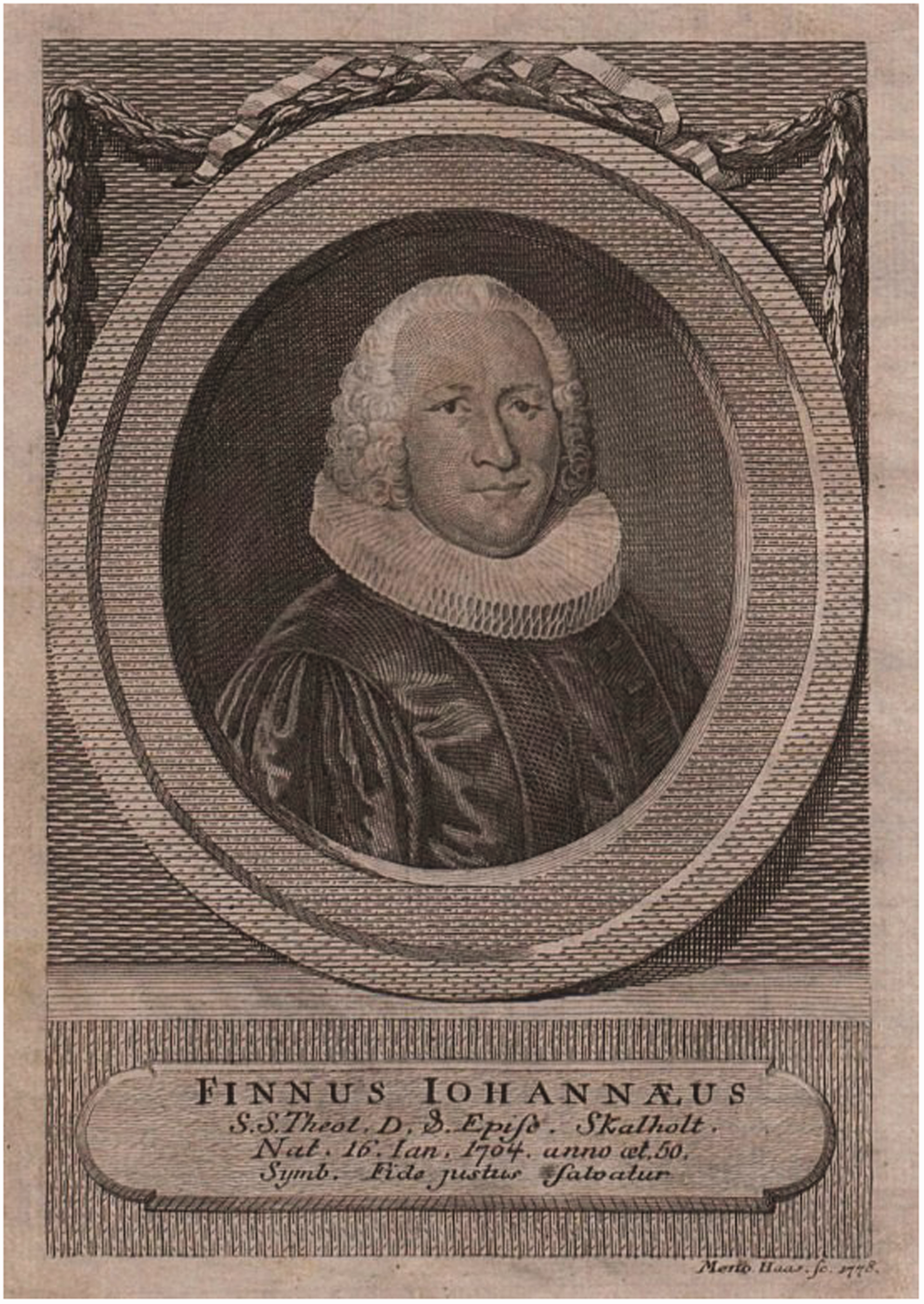
Conclusion: ‘For the Country’s Greater Glory’
The new outlook on Iceland was a fact: the seeds for the glorification of an imagined past ratified by modern thought had been sown. In the change of climate, Finnur had closed the door on Arngrímur’s line of political continuity for good. Freedom was the keyword: Finnur’s libertas referred directly to an absolute freedom inextricably connected to a historical respublica invented by him, not to a relative freedom under a monarchy, as Svavarsson has suggested. 84 The conceptual framework concerning the state had undergone a dramatic change, a normative revaluation: there was a distinction between the past and the present. Finnur took leave from a tradition straight into his own era; he was no Arngrímur come of age, but a man in his own right. 85 I would go as far as to say that Finnur is the first Icelandic author to refer to the free Icelandic state or republic, long before nineteenth-century nationalists and modern scholars did so. By distancing himself from political–humanist discourse in the discussion of the Icelandic state, Finnur’s discourse is leaning towards a cultural approach in connecting the state to the native character of its people. He used a critical approach to historical sources and enlightened thought to highlight Iceland’s political past in connection with a national identity characterized by scholarship and freedom, not language. His approach constitutes a kind of Icelandic self-awareness that is recognizable, yet moving in new directions. From an apologetic start, the outcome of HEI can be described as proto-nationalist. It did not feature the political agenda of nineteenth- and twentieth-century nationalism, which a highly placed cleric such as Finnur would have neither the need or possibility to pursue, but it did shape the image of Iceland with the onset of ideas on culture and a golden past that would become commonplace in nationalist thought. The tide had turned for the better, and all Finnur had to do was swim along.
He achieved his goal: the reception of HEI throughout Europe was overwhelming. The encyclopaedic set-up, in Latin, had the desired effect: for at least a century, HEI remained the standard reference work about Iceland. It immediately made its way into foreign periodicals that discussed it extensively. 86 Information about kings, bishops, monasteries, history and literature, political and legal matters, as well as texts of poems, prose and letters: anything was read, used and reproduced. 87 All expressed their appreciation, calling it the most important work about Iceland’s history – even the best Church history in the Nordic countries – containing invaluable material. 88 Finnur was praised as a learned man, an eminent author. 89 At his death in 1789, HEI was proclaimed one of the best, most useful histories of Iceland, over which foreign scholars fought to bestow their praise. 90
Finnur had produced a magnum opus by modern standards, asserting himself as a modern historiographer who published in appropriate periodicals. 91 The greatest reward must have been the fact that his views were accepted. The arguments used to profile mediaeval Iceland as a land of sciences and learning were adopted integrally by his Swedish colleague Uno von Troil as early as 1777. 92 Von Troil adopted Finnur’s description of the stages through which Icelandic literature and education went before the Reformation: he wrote that they ‘had been subject to the same revolutions’ as elsewhere, something Finnur had only implied. 93 He also adopted Finnur’s statement that Iceland was practically the only country that had cultivated sciences and produced learned writings between 1000 and 1264 AD; moreover, he explicitly stated that that era had ended ‘when Iceland was cast under the Norwegian yoke’ in 1264 – something Finnur could hardly say out loud. 94 Von Troil named things that were implicit in HEI when it was safe to do so, and underlined Finnur’s presentation of Iceland as a learned nation with roots in the past. It is a pity that he wrote his letters before Book Four had appeared – we will never know how he might have handled the highlight of Finnur’s endeavours: Iceland as the land of the free.
Eventually Finnur’s work found its way to Iceland. In 1841 Bishop Pétur Pétursson published a sequel; for this he accounted in his introduction and paid due respect to his predecessor, ‘the most learned man on Iceland in his age’. 95 This new HEI also was written in Latin, printed in Copenhagen and dedicated to the king, who had supported it. The intended readership would have been foreign again, because the number of Icelanders able to read or afford such a book had not altered much since Finnur’s days. 96 Half a century later, the geographer Þorvaldur Thoroddsen would use and reproduce sources and historical information from HEI in Landfræðissaga Íslands (‘A Geographical History of Iceland’). 97 The same can be said about historian Jón Espólín and politician Jón Sigurðsson, who diligently refer to information provided by Finnur. 98 And so the echo of Finnur’s work resounded in Iceland: it was used for its information and sources, as a book of reference.
However, HEI had much more potential than that: with his ideas, Finnur paved the way for Icelandic generations to come, his idea of a golden Icelandic age avant la lettre fitted perfectly with what became a common theme in nineteenth-century nationalist thought. He was a century ahead of his time: the notion of the mediaeval Icelandic free state would become instrumental in defining Icelandic identity and discussing Iceland’s past from the late nineteenth century onward, as well as a given in the discussion of Iceland’s past. Finnur shaped Iceland’s identity in a way that would have been the envy of any nationalist, a whole century before such ideas came into vogue. One can truly say that the purpose of writing for the country’s greater glory, as commissioned, had been fulfilled.
Footnotes
Acknowledgements
This study was written as part of a PhD project titled ‘Signs of Self-Awareness. The Road to National Identity on Iceland, sæc. xiii–xx’. It was supported by the Graduate School of the Humanities at the University of Groningen. I would like to thank to Dirk Jan Wolffram and Martin Gosman at the University of Groningen for their ongoing support and insightful criticisms, and Ármann Jakobsson at the University of Iceland for his help and valuable comments. This article is a concise version of Kim P. Middel, ‘Finnur Jónsson’s Iceland: Writing History in a Changing Climate’, in Kim P. Middel, The Search for Self-Awareness: The Road to National Identity on Iceland, sæc. xiii–xx (Groningen: PhD thesis, 2018), 71–100. This publication is available at:  (3a1681b2-4d94-441d-a4d4-9828df91a694).html, accessed 7 March 2019. It was written as the third in a series of articles aimed at investigating contemporary thought in Icelandic texts, in order to map the development of national self-awareness. It is the sequel to Kim P. Middel, ‘Alexanders saga: Classical Ethics in Iceland’s Alexander Epic’, Viator, Vol. 45, No. 1 (2014), 121–48, and Kim P. Middel, ‘Arngrímur Jónsson and the Mapping of Iceland’, in Lotte Jensen, ed., The Roots of Nationalism: National Identity Formation in Early Modern Europe, 1600–1815 (Amsterdam 2016), 109–33, and the prequel to Kim P. Middel, ‘Íslenzkt þjóðerni: Jón Jónsson Aðils’ Iceland and the Road to the Future’, European Journal of Scandinavian Studies, Vol. 48, No. 2 (2018), 125–48.