




Abstract
This article de-constructs and re-constructs the dynamic of a sixteenth-century political dispute between the Catholic Bavarian Duke Wilhelm V and the Protestant Saxon Elector August I. By focusing on the visual imagery which ignited the dispute, the paper explores sixteenth-century ‘ways of seeing’ and the epistemic role realistic images played in the production of knowledge about the natural world. While the peculiar dynamic of the affair is based on a specific understanding of the evidential role of images, the paper also argues that the wider socio-cultural context, in particular certain strategies of truth-telling, provide further clues as to the dynamic and closure of the affair.
Keywords
In 1884 the Saxon military surgeon Carl Benno Credé and the archivist Theodor Distel announced an exciting discovery they had made in the Dresden state archive. 1 In the Archiv für pathologische Anatomie und Physiologie und für klinische Medicin, one of the leading medical journals of the time, they reproduced a watercolour drawing of a large kidney stone that had been executed by an anonymous draftsman in 1580. 2 The stone had belonged to the Bavarian duke Albrecht V (1528–1579), and Credé and Distel were proud to present the watercolour as the earliest naturalistic depiction of a kidney stone in Western medicine.
By the late nineteenth century visual representations of body parts and substances in the form of drawings or photographs were a common feature in the Archiv, which had been founded in 1848 by Germany’s foremost medical scientist, the anatomical pathologist Rudolf Virchow (1821–1902). 3 Their familiarity and increasing popularity reflects a fundamental change in the understanding of the epistemological function of images in the production of scientific medical knowledge. At the centre of this shift stood the new ideal of scientific ‘objectivity’ that began to guide and dominate scientific practice from the second half of the nineteenth century. 4 At its base was the belief that the nature of any natural phenomena could be analysed and represented without the investigator’s personality playing any role whatsoever in the proceedings. The ‘objective’ scientific account was impartial, and ideally could be accepted by anyone because it did not draw on the assumptions, prejudices, or values of the scientist involved. Virchow was one of the paragons of this ideal, as well as a foremost advocate of a new way of ‘seeing’ that accompanied this new enthusiasm for objectivity. 5 Increasingly scientists like him believed that their perception could be trained so as to control and tame all ‘subjective’ disturbances that might cloud it, and hitherto had hindered scientists from unveiling the hidden laws of nature. In the new science of pathological anatomy, ‘to see’ pathological conditions in the human body was ‘to know’ them. 6 The unmediated pure scientific act of seeing, so Virchow and his peers believed, was represented most faithfully through photography and photographic-like realistic images. 7 These kinds of visual representations therefore became central to the making, propagation and popularization of scientific knowledge; they were used to present and prove new theories, announce breakthroughs, and settle controversies. 8 The many illustrated articles in Virchow’s famous Archiv are testimony to this new belief in the epistemological power of the objective ‘medical gaze’ and its visual representations. 9
Articles on historical topics in the Archiv, such as that by Credé and Distel on the kidney stone, were frequent and themselves often offer historical explanations for the emergence of the objective scientific gaze: new optical theories and practices in the natural sciences since the Renaissance (alongside the introduction of linear perspective in painting) ‘finally’ put vision on a secure and logical basis, they maintain. According to this positivist narrative, these developments made it increasingly possible to separate and represent ‘true’ natural phenomena from visual illusions or outright fakery. It was the Renaissance and its humanistic and scientific culture, according to these accounts, that began to redefine visual cognition so as (‘eventually’) to match the reality of the objects perceived. Symbolic mysticism was finally stripped away and the laws of nature revealed for all to see. In the area of medicine, anatomical publications such as Andreas Vesalius’s De Fabrica (1543), which presented the human body in a realistic way for the first time in Western medicine, were identified as exemplars of this new unmediated way of seeing. Ever-more illustrated anatomical works demonstrated the triumphal victory of a hands-on empirical medicine over a hitherto predominantly theoretically-based one that relied heavily on the texts of the Ancients. Finally, according to this narrative, physicians could separate scientific ‘facts’ from vulgar errors, superstition and popular belief.
Credé and Distel in their interpretation of the archival material that accompanied the kidney stone picture were very much within this master narrative. The realism of the image was so powerful, they thought, that it brought to a final conclusion a dispute between two important political players in Reformation Germany: Duke Wilhelm V (1548–1628) of Bavaria, and the Saxon Elector August I (1526–1584). The controversy between them of 1580 was ignited by a letter August sent to Wilhelm on 21 March 1580.
10
In the letter August asked Wilhelm to clarify certain rumours at the court in Dresden regarding a kidney stone that had allegedly been extracted from his father’s body after his death on 24 October 1579. August reported that rumour-mongers were claiming that the stone found in Albrecht V’s body was of an enormous size and wondrous shape, and that parts of it resembled a Jesuit’s head. The allegation was based on a watercolour, which August enclosed with his letter. He asked Wilhelm to report to him confidentially whether the stone resembled in form the one in the picture. Wilhelm wrote back on 13 April 1580 confirming that while a large stone had indeed been extracted, it did not resemble the head of a Jesuit. However, he was not at all astonished that Dresden courtiers ‘against our religion’ were spreading such rumours. In his letter, he enclosed an image (Figure 1), which is the one Credé and Distel discovered and published in the Archiv in 1884. Wilhelm assured August that this was the only true counterfeit (wahre conterfeyt) of his father’s stone. To further assuage August’s anxieties Wilhelm offered to send him the actual stone extracted from the princely body. But this proved unnecessary: in a letter dated 5 May 1580 August accepted Wilhelm’s assurances and remarked apologetically that he himself had never really believed the rumour but as the story had reached him from ‘esteemed places’, he felt obliged to inquire into its truthfulness. He assured Wilhelm that he considered the issue resolved and bemoaned the sad fact that in ‘this disorderly world of ours’ nobody ‘whatever Estate he may be, not even in his grave, is safe from malicious gossip’.
Image of Albrecht V’s kidney stone as discovered in the Dresden archive by Credé and Distel in 1884 and reprinted in their article in the Archiv. (Source: Sächsisches Staatsarchiv Dresden, Geheimer Rat (Geheimes Archiv), Bestand 10024, Loc. 8506/2, fol. 185).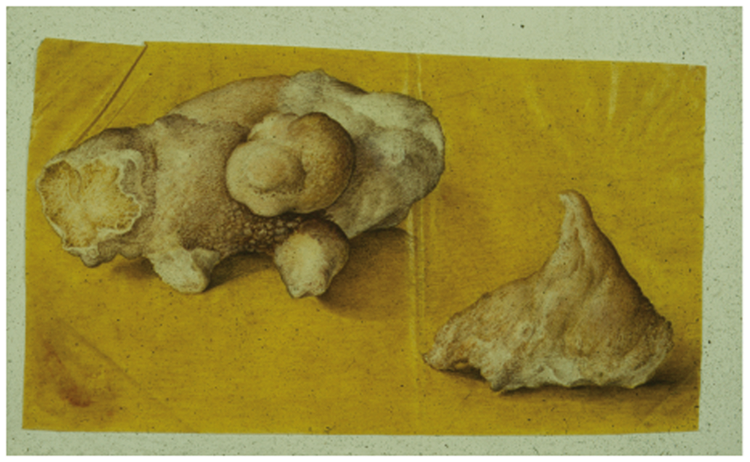
For Credé and Distel this correspondence illustrated a widespread ‘superstition of the time’. 11 They had no doubt that the realistic picture, sent by Wilhelm to August (Figure 1), cut through the mists of superstition. The image permitted August to identify the fraudulent nature of the Jesuit-headed watercolour. Having Wilhelm’s true counterfeit in hand (Figure 1) August could see with his own eyes – Credé and Distel maintained – that his Jesuit-headed Dresden image (which, perhaps significantly, was not reproduced in the Archiv article) was in truth a caricature (Spottgemälde). The false image was strategically aimed at discrediting Albrecht V who had been widely known as one of Germany’s foremost supporters of the Jesuit order, the intellectual spearhead of the Counter-Reformation. Albrecht’s (and his son Wilhelm’s) enemies at the Protestant court in Dresden, Credé and Distel argued, had drawn up a picture of the stone and intentionally altered its morphological shape by wilfully adding in the features of a face, headgear and hat. By claiming that the picture resembled the head of a Jesuit these anti-Bavarian elements at the Dresden court sought to draw attention to (and hence criticize) the strong position of the religious order at the Bavarian court. They also wanted maliciously to suggest that the spiritual influence of Jesuits had triggered real physical effects: it had inflicted disease on Albrecht, and eventually caused his death.
Credé and Distel’s interpretation of August’s and Wilhelm’s encounter has been reiterated by subsequent historians.
12
It has also been reinforced empirically through the discovery of another ink drawing (Figure 2), one executed by Albrecht V’s personal physician, Dr Thomas Mermann (1547–1612).
13
Mermann’s drawing depicts an anatomical object in realistic fashion and is accompanied by an autopsy report, written by himself beneath the image.
14
Although Mermann’s image was never mentioned in the surviving archival correspondence between the two rulers (and it is therefore unclear whether either of them ever actually saw it), historians of Bavaria have readily interpreted it as further visual proof that the Dresden Jesuit-headed image was a fake. The realistic drawing by Mermann – the physician hailed by historians as Bavaria’s Vesalius – accompanied by an autopsy report, surely must represent the original natural object. How could it be other than a one-to-one representation of Mermann’s investigative mind and scientific rational gaze? Ergo, the Dresden Jesuit-headed image had to be a caricature.
Dr Thomas Mermann’s autopsy report on Albrecht V with a drawing of the kidney stone. (Source: Bayerisches Hauptstaatsarchiv (Geheimes Hausarchiv), Korr. Akten 609/V).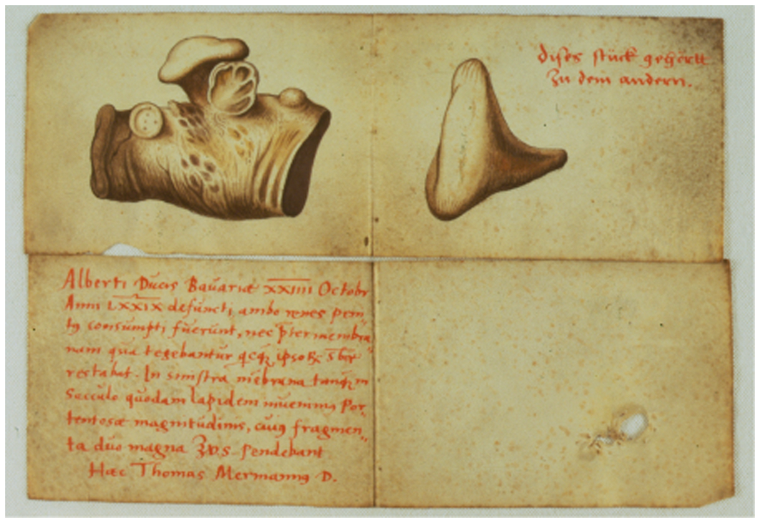
It is significant that in all the subsequent historical discussions of the affair the alleged Jesuit-headed Dresden image has never been reproduced. By introducing it here as a new piece of evidence in the discussion, I want to suggest that it might help us cast light on questions that historians have been unable to answer: Why was it that August became so worried about the Dresden images (Figure 3) which claimed to represent the Jesuit-headed kidney stone of one of Germany’s most powerful Catholic rulers? Why did he not immediately identify it as fraudulent and discard it as a politically motivated caricature (as historians since the discovery of the archival material have tended to do)? Why did he feel the urge to inform Wilhelm about a painting that to our eyes is manifestly a fake? These questions are informed by and refer to recent literature on early modern visual culture and visual perception, and the history of science and medicine. Such works investigate, amongst other things, the epistemological and evidential function that was attributed to realistic images of natural objects in sixteenth-century culture.
15
Drawing on this literature, I want to argue that neither the naturalistic image sent to August by Wilhelm (Figure 1) nor the anatomical drawing by Thomas Mermann (Figure 2) possessed the immediate evidential and persuasive power conventionally attributed to them since the late nineteenth century. In their context, it was impossible for these images to end the dispute in and of themselves, by virtue of being more ‘realistic’ and more ‘objective’ and thus closer to the original natural object than the Jesuit-headed image from Dresden (Figure 3).
Image of Albrecht V’s ‘Jesuit-headed’ kidney stone as sent to Wilhelm V by August I, 21 March 1580. (Source: Bayerisches Hauptstaatsarchiv (Geheimes Hausarchiv), Korr. Akten 609/V).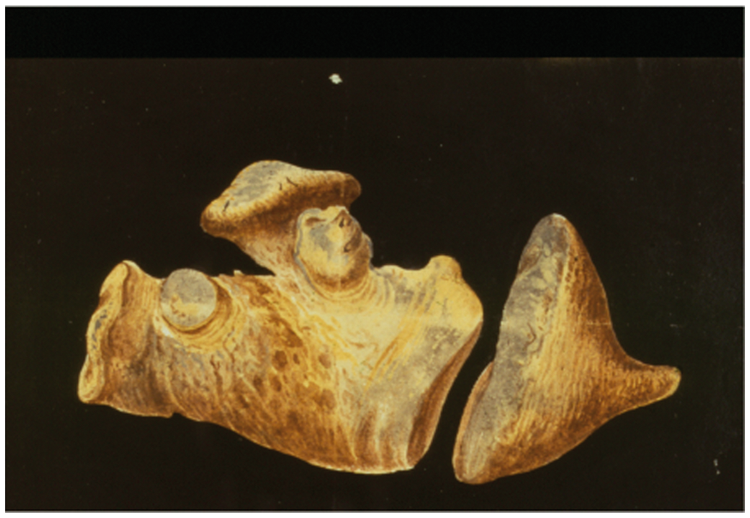
How, then, might we understand the epistemic function of the images within the dispute and how was this function couched within more general sixteenth-century ideas about vision and perception? I want to explore this in the first part of my discussion. Yet, in order to grasp what Wilhelm and August and their courtiers ‘saw’ in the different images of Albrecht’s kidney stone, and more importantly, how the two rulers agreed on their respective meanings, I need to do more than merely investigate the evidential function of early modern images of natural objects. The wider socio-cultural context in which the affair took place also shaped its dynamic and the meaning of the images involved. Stuart Clark has recently argued that cultural anxieties over the meaning of images, and the veracity of sight more generally, substantially increased during the Reformation, which was marked by deep distrust of all kinds of visual representations. 16 Contrary to what historians have previously argued – that the sixteenth century gave birth to a rational scientific gaze – Clark contends the exact opposite: that the period experienced a ‘de-rationalization’ of vision and perception. Sixteenth-century contemporaries did not feel in control of the external world, he argues, but rather, increasingly doubted what they ‘saw’; they suffered from what he calls ‘ocularphobia’. It was within this context, fuelled by the delicate political situation that August faced in the spring of 1580, that there was good reason to be worried about the circulation of an image allegedly presenting a Jesuit-headed kidney stone. I shall investigate these issues in the second part of this article. The third and final section explores the closure of the affair in more detail. I suggest that particular strategies of truth-telling were also necessary to allow both parties to agree that the Dresden Jesuit-headed image (Figure 3) was nothing more than a politically motivated caricature. In short, by de-constructing and re-constructing the dynamic of the sixteenth-century kidney stone affair, this article explores how sixteenth-century ways of seeing natural objects played a part in the production of knowledge about the natural world.
‘Seeing’ in the Sixteenth Century
A closer look at the ‘stepping-stone’ to the affair, the water colour image that was sent to Wilhelm by August, shows a large two-piece stone that floats on a black background (Figure 3). On the upper convexity of the larger piece one can identify a head and a face wearing some kind of headgear (albeit with a degree of interpretive latitude). This must be the face of the ‘Jesuit’ that the Dresden courtiers allegedly ‘saw’, and which August was referring to in his letter to Wilhelm. Odd, or even infantile, as it might seem to us, the act of ‘seeing things into something else’ was a widespread and far from trivial phenomenon in the sixteenth century. 17 As many scholars of early modern art and science have demonstrated, human faces and characteristics were commonly ‘seen’ in natural objects and animals. The widespread art and practice of physiognomy was entirely based on such resemblances and analogies. 18 But early modern contemporaries also commonly perceived faces of demons and witches in the morphology of rock formations or clouds, and artists drew such features naturalistically, believing them to be real. 19 This ‘seeing things into something else’ could often provoke public debate, particularly during the Reformation, as many surviving tracts and prints demonstrate. The art historian Svetlana Alpers cites a telling example of a controversy over a mass-produced Dutch print, in which some Protestant viewers perceived the figure of Catholic priests in the bark of an old apple tree. 20 In a country still at war with Catholic Spain, this perception immediately triggered an anxious and excited debate over the meaning of the image.
Although today we can still relate to this way of seeing – of not discriminating between things or showing differences, but rather of searching instead for resemblance – the early modern belief in the reality of such visual resemblances was based on a radically different logic pertaining to the workings of the natural world. Nature was not ordered by discrete laws, but by ancient philosophical notions of causality, of matter and form, correspondences, analogies, similitude and verisimilitudes. 21 Based on the notion and practices of resemblance this order of the natural world allowed for the entanglement of the experience and practice of medicine, faith and politics, things that today we perceive as separate and distinct. Central to this worldview was the ancient idea of the existence of two worlds, the micro- and macrocosm, which provided investigations into the realm of nature with the assurance that all earthly matter would find its mirror and its macroscopic justification in the heavens. It indicated that there indeed existed a greater world, and that its parameters defined the limits of God-created things. Nature here, as Foucault perceived, ‘is closed upon itself in conformity with the duplicated form of the cosmos’. 22 The physical environment was believed to be morally sensitive and responsive to human fortunes and transgressions, a mirror and cipher of the spiritual sphere. The whole of the natural world was thus considered one large emblem and hieroglyph of celestial wisdom, a revelatory text whose individual signs needed to be deciphered so that the pious observer could come to understand the Almighty’s intentions and thus act accordingly.
The macrocosm was also mirrored in the human body; in it ‘the Almighty has imprinted its own image’, the medical historian Mary Lindemann has pointed out. 23 Malfunctioning bodies were thus the result of correspondences ‘out of joint’. In this analogical reasoning the human body was always part and parcel of the God-created and controlled cosmos; it was at once natural and spiritual, animated and sustained by the mechanisms of what another historian of the period has called a ‘spiritual physiology’. 24 Marks and objects found on bodies or excreted from them were subject to this logic. While, most of the time, physical signs were interpreted as having natural causes (and thus fell into the domain of medicine), the most celebrated and often controversial of all bodily signs were those allegedly bearing explicitly holy significance. Famously, the objects found in the exhumed heart of Clare of Montefalco (1268–1308) were claimed to look like symbols of Christ’s passion, a crucifix and scourge, and were thus taken to be conclusive evidence of her holy life. 25 Another example, discussed in detail by Katharine Park, is that of the visionary Margaret of Citta di Castello (1287–1320), whose heart contained three stones upon its opening by Dominican friars. These were immediately ‘seen’ as images of the Virgin Mary, the cradled infant Jesus, and that of Margaret herself. Again, they were accepted as materialized physical evidence of Margaret’s exemplary spiritual life. 26 Men, too (if less so than women) revealed through their physical signs their inner spiritual struggles and the experiences of divine inspiration during their lifetimes. St Francis of Assisi’s miraculous body transformation through the stigmata of Christ is but one example. 27 As Park reminds us, contemporaries understood such objects and bodily transformations, not as mere ‘representations’ of a personal miraculous experience but as one-to-one ‘reproduction’ of it. 28
An organ or body part that resembled a Jesuit-head in 1580 was wholly within this realm of conception, and, it is not at all surprising that such a bodily sign provoked debate. The Reformation, although repudiating the existence of Catholic miracles, changed thinking little in this respect; indeed controversy over godly or devilish signs intensified over the period. 29 The belief in demonic spirits expressed in sensible signs in or on the body, for example, fuelled and shaped prosecutions during the witch hunts in the second half of the century in Catholic and Protestant territories alike. 30 Sixteenth-century contemporaries of all denominations were fascinated with human malformations and monstrosities and other anomalies of nature. They were seen as a signs of imminent crisis, and were invested with religious significance. 31 Perceived as oracular tokens, any of these God-sent phenomena required urgent interpretation within their web of correspondences. The ignorance of such signs, so contemporaries believed, could attract God’s anger and consequently trigger disaster in all areas of human life.
And, yet, as one scholar of Reformation Germany has recently reminded us, it is not enough to see such discourses as mere expressions of a fearful theocratic society; they were also strategic elements in political discourse around power and legitimacy within the deeply divided Holy Roman Empire. 32 Within such a worldview of resemblance, an image claiming to represent a Jesuit-headed kidney stone, taken from the body of one of the most powerful rulers of the time was not easily dismissed. As a possible godly sign it demanded further investigation. I shall return to the historical context and reveal how it shaped the affair in the second part of this paper. First though, we need to consider the epistemological function of realistic images of natural objects, as well as their perpetrators.
A Collector’s Item: Thomas Mermann’s Drawing
It is easy to be persuaded that Thomas Mermann’s naturalistic image of Albrecht’s kidney stone (Figure 2) provides evidence for the emergence of a modern scientific gaze in sixteenth-century Bavaria. Surely it proves, as late nineteenth-century historians believed, that educated and forward-looking men of science and medicine of the time were beginning to discern the laws of nature and separate them from what would come to be called ‘superstition’. Did not such men begin to ‘see’ like Virchow? In short, the image without the Jesuit head (Figure 2) can only lend support to the contention that Mermann was not part of the world of resemblance described above, but rather he was a precursor to the practices and epistemological values of nineteenth-century medicine. Surely, what Mermann ‘saw’ and drew was what he actually identified as the seat of Albrecht’s disease and cause of his death.
But such an interpretation of Mermann’s drawing (Figure 2) is, I think, misleading. In the sixteenth century ‘seeing’ a destroyed organ taken from a dead body did not (yet) automatically mean ‘knowing’ the workings of disease in the living body. In Mermann’s understanding no direct and constant correlation existed between the ‘seeing’ of an altered organ made visible through post-mortem dissection and the workings of disease in the living body. 33 Unlike in nineteenth-century anatomical pathology, altered organs were not considered the necessary material and visible location of disease. Moreover, images of such organs did not permit the drawing of definite conclusions about the workings of disease in the living body. In Mermann’s universe, dead and living bodies were separated by a gulf that perception could not easily bridge. Once the vital spirit – believed to be seated in the heart so as to regulate its vital signs, maintaining heartbeat, pulse and respiration – had left the dead body, it was regarded as an altogether different object of nature. 34 Mermann could have learned little for his daily medical practice from the observation of dead tissue and the tracing of anatomical lesions and their visual representations. 35 For sixteenth-century academic physicians like him the knowledge of ‘life’ was still fundamentally based on the largely invisible essence of living.
We can gain some idea of how Mermann, educated at the university of Pisa, understood these matters from the collection of consultation letters to his patients. 36 These were published posthumously in 1678 by one of his successors and ardent admirers at the Munich court. 37 The Consultationes ac responses reveal Mermann’s deep admiration for, and strict adherence to, the ancient medical authorities, above all Hippocrates and Galen. 38 Chapter V of the Consultationes is dedicated to diseases of the kidneys, bladder and genitals and contains 30 such cases. The 18 cases that deal directly with illnesses related to kidney stones allow us to reconstruct Mermann’s diagnostic perception.
Mermann considered the natural causation of kidney stones as intrinsically related to each patient’s innate mixture of the four humours (her ‘complexion’ or ‘temperament’). Every person, he believed, was born with an idiosyncratic mixture of the four humours – blood, yellow and black bile, and phlegm – which were thought to be ‘cooked’ from the daily intake of foodstuff in the stomach and liver. As long as one kept a regular regimen, which comprised a careful control of the so-called six non-naturals – air, food and drink, rest and exercise, sleeping and waking, excretion and repletion of fluids, and a governance of the passions – the four humours would be kept in their innate and healthy balance. Disease occurred, Mermann warned his patients, when the innate balance of the humoral mixture got into disorder. As such, disorders of the humours were also unique to each person; kidney stones had multifarious causes, which differed from patient to patient. 39 Nevertheless, Mermann offered his suffering clients a general definition of the most commonly identified material cause of such stones, namely, ‘thick fluid, muscous and viscous, which leads to excess heat in the kidneys that consumes whatever is thin in this humour, and breathes upon them and dries out the rest, boiling it down to sand and calculi’. 40
Although kidney stones caused excruciating pain to their bearers, they posed a particularly vexing problem for medical diagnosticians. Unlike bladder stones, kidney stones could not be sensed by the practitioner. 41 Their existence could only be inferred from the many symptoms and signs felt by the patient, such as mictions of blood in the urine, pains in the stomach or in the lower back region. The matter was complicated by the fact that, even if a patient reported these symptoms, an academic physician could not base a definite diagnostic verdict on the empirical collection of physical signs alone. Throughout the Consultationes Mermann is always careful not to offer a rushed judgement. For example, his response to a noble woman is typically vague: ‘I cannot say for certain whether one of several calculi are hiding, but I do not dare to say it is not the case’. 42
In order to gain ‘certain’ knowledge in such cases, Mermann needed to match his empirical findings with the testimony given by ancient physicians in their writings on the subject of kidney stones. Empirical evidence always required approval by the wise, as this response demonstrates: Having carefully weighed what has been written about the kidney pain which My Lord has endured earlier and still experiences until today, and also about the sandy deposits which appear, I do not doubt that it can be affirmed that a small stone is underlying – an angular one, a rough one, through whose friction the substance of the kidneys has been led to exculpate, and the veins to open.
43
Mermann was aware of the challenges to the infallibility of ancient authority emerging among his contemporary medical peers at the time.
44
Indeed, he sympathized with parts of their critique. However, he also objected to the ways some of his colleagues legitimized their critical stance vis-à-vis the Ancients: Currently, there is no small number of physicians who believe that the causes of kidney calculi … have not been sufficiently observed and understood by the ancient and other classical authors of our time. Personally I would most willingly subscribe to this, if I could say that they have found ingenious solutions and if they would confirm the remedies, which they keep quoting by experiments in which patients have been restored to good health, by case studies and examples.
45
For any university-trained physician like Mermann, medical treatments that were solely based on successfully administered cures (‘experiments’) could not possibly count as ‘truthful’ or ‘certain’ evidence. Knowledge gained by ‘experimentation’ which was then defined as ‘knowledge of one thing without rational examination’, was considered only a preliminary stage of knowledge production in the Aristotelian tradition of scientia in which Mermann was trained. 46 Scientia’s overarching goal was the formulation of statements of universal truth, which were to be reached by explaining the particulars of observation by deduction from final and principle causes. In the case of medicine, Mermann reminded his colleagues in the quotation above, that this universal truth was reached through the deductive usage of particular ‘case studies and examples’. In other words, the specific condition of a patient served as a means to make these universal truths concrete; it did not hold in itself universal truth. For Mermann, medical efficiency, which was demonstrated by a successful treatment, always needed to be legitimized by ancient medical doctrine.
Mermann thus tied his medical empirical experience closely together with his knowledge of texts. The sensible symptoms and signs on a patient’s body and the reasoned descriptions of symptoms in classical authoritative texts penned by his long-dead medical peers needed to resemble each other. Mermann deciphered the god-created human body through the scriptures of the Ancients, and, simultaneously, unlocked the secrets of the ancient scripts through the bodies of his patients. Their respective truth had to be revealed through their resemblances and affinities. ‘To know’ was for Mermann to interpret, or (as Foucault would have it) to ‘find a way from the visible mark to that which is said by it and which, without that mark, would lie dormant within things’. 47 In all of his consultation letters Mermann establishes as many correspondences as possible between ancient text and physical bodies, between what he calls reason and experience. A master at this erudite divination, he was in fact hailed by contemporaries as the ‘Bavarian Galen’. 48 Important for my purposes is that Mermann’s intellectual approach to the human body generally dispensed with visual aids as techniques in proving arguments: significantly, nowhere in the Consultationes do visual illustrations appear. 49
Recent research in the area of visual culture and early modern medicine tends to confirm the prevalence of Mermann’s episteme. Even when images were deployed, their epistemological function and meaning were ambivalent. According to Sachiko Kusukawa, this was also the case in the famous naturalistic representations of the human body in Andreas Vesalius’s De Fabrica. 50 The key to understanding Vesalius’s use of images, she argues, resides in the term historia, which Vesalius repeatedly employed to characterize his ambitious visual project. Within the Aristotelian scheme of knowledge, which aimed at the discovery of causal first principles, historia denoted a particular type of knowledge. Compared to ‘true’ and ‘certain’ philosophical knowledge, historia was considered only a preliminary stage of inquiry. It denoted a descriptive knowledge, preparatory to the investigation of final causes. 51 By describing his project as historia, Vesalius made clear that the demonstration of final causes was not what he was after. Instead, the text and the pictures in De Fabrica formed integral parts of his unique humanistic enterprise of reviving – not overturning – the practice of ancient Galenic medicine. 52 His naturalistic images of the body had a didactic function directed at a predominantly academically-trained audience; they aimed at communicating something specific that the humanist Vesalius wished to argue about ancient medical theory. 53 From this it follows that the tying of visual imagery to such individual humanist projects had important epistemological consequences: it inhibited a general agreement on what these images meant. 54 As Kusukawa concludes, realistic pictures of natural objects did not ‘show’ the same thing to everybody, and did not imply a theoretical commitment to an unmediated observation of nature for its own sake. 55
Why then did Mermann draw his picture of Duke Albrecht’s kidney stone if not for purposes of studying and explaining kidney stone related diseases? I want to suggest that the drawing of the kidney stone was a further instance of Mermann’s humanistic passion for everything rare and wondrous to be found in the natural world, rather than some early testimony to ‘the rational gaze’ in medicine. During his lifetime Mermann was widely known as an expert collector of fine arts and natural curiosities – an amor et corculum musarum (a lover and darling of the muses), as friends nicknamed him. 56 It was a passion he shared with his patrons Albrecht V and his son Wilhelm V. 57 Unfortunately, Mermann’s extensive collection, housed together with an alchemical laboratory at his large town house in the immediate vicinity of the ducal palace, has been lost. However the content of the much larger cabinet of curiosity (Kunstkammer) of the Bavarian dukes can be reconstructed through surviving inventories. These reveal that, in common with most early modern cabinets of curiosity, the Munich collection also juxtaposed objects of nature and artifice (naturalia and artificalia) and displayed many hybrid objects, in which the two realms were intertwined or put ‘at play’ with each other. 58 The choice of objects was not left to chance. As a historian of the cabinets of curiosities has explained, the production, collecting and ordering of such rare and strange things in the cabinet was ‘subjected to the idea of a combinatory web of relationships consisting of resemblances and differences, affinities, sympathies and analogies’. 59 The surviving reports of visitors to such cabinets describe the often visually dazzling effect these juxtaposed, combined and fused rarities of nature and art produced on them, and how they were drawn into, and marvelled upon the game of resemblances and affinities within the wider micro-macrocosmic order of the natural world outside the cabinet.
Central to the Munich display of miraculum naturae, as they were called in the surviving inventories, were human body parts, and among these was a collection of bladder stones. The most precious among these stones was object number 2108 in the inventory of 1598, which had once belonged to Albrecht V’s own brother, Duke Ernst of Bavaria (1500–1560). 60 It had been extracted from his body in September 1550 by an Augsburg surgeon who had received the inordinate amount of 1000 fl. for the operation (Ernst had apparently behaved ‘bravely and manly’ throughout). 61
Mermann’s own collection of curiosities probably contained even more examples of extraordinary body parts. In my opinion, his drawing of Albrecht’s kidney stone was a depiction of one such miraculum naturae. The original might well have been in Mermann’s possession since it was not at all unusual for local court physicians to keep interesting and unusual corporeal objects extracted from their noble patients. 62 Such objects added to the record of nature’s strange and wondrous ways, and could be displayed in private collections. Stones, natural and human, were also sought after as matters of exchange between sixteenth-century scholars interested in the natural world. Not only the stones themselves, but also the drawings of them, or even copies made from gypsum, were sent back and forth between collectors. One such stone enthusiast was Mermann’s Saxon colleague, the court physician Johannes Kentmann (1518–1574), a well-known naturalist who also published a book on human stones, which was shelved in the ducal Munich library during the period of Mermann’s court appointment. 63 Dedicated to a fellow stone-enthusiast, friend and correspondent, the Swiss natural philosopher and physician Konrad Gesner (1516–1565), Kentmann’s Calculorum qui in Corpore ac Membris Hominum Innascuntur (Torgau, 1565), contained 12 chapters on wondrous stones found in various body parts and, significantly here, included 32 illustrations of them. 64 The choice of these stones and their visual depiction was partly related to the dramatic suffering of the persons from whom the stones were extracted, and partly to the social status of the sufferer. The chapter on kidney and bladder stones, for example, centred on the story of the kidney stone of the Saxon elector Friedrich III (1463–1525), 65 who, according to Kentmann, endured an exemplary Christian death, bearing heroically the excruciating pains caused by the stone. For Kentmann, Friedrich’s ability to act in such an exemplary way in the face of death was a sign of God’s favour regarding the Protestant reform movement, and he took the opportunity to remind the reader at great length of Friedrich’s support of Luther after his excommunication and his founding of Wittenberg University as one of the centres of Protestant teaching and learning. 66
In view of this, I want to suggest that Mermann’s naturalistic representation of the kidney stone tells us in fact little about new rational practices of medicine or about the emergence of a new form of medical perception. It tells us more, I think, about a world of humanistic values, logic and rhetoric, and the importance of natural philosophical principles in the daily practice of medicine. Further, it amplifies a world of patronage and court medicine with a passion for collecting and displaying wondrous bodily objects. Indeed, there seems to have been a European-wide market for the exchange of such objects. A telling passage in Kentmann’s book on human stones reports on the exchange network of Elector Friedrich’s personal surgeon Johannes Trautmann, who had discovered the stone in May 1525 when he had prepared his patron’s body for the public laying out. The heirs of Trautmann, of which four are surviving, good men, gave me this stone upon my request, as I promised to faithfully return it. I have meticulously crafted a gypsum cast of it, dear Gesner, as a true image for most acute study, and I am sending it along together with the other calculi’s copies, which may enable you to consider more accurately the wondrous form of this stone, which slew such a great ruler.
67
It is impossible to know whether Albrecht V’s kidney stone or Mermann’s image of it (Figure 2) had been part of such a scholarly exchange network connecting the two courts in Munich and Dresden. But the close resemblance between the Jesuit-headed watercolour from Dresden (Figure 3) and Mermann’s own drawing (Figure 2) suggests that the Dresden artist had at least seen Mermann’s images. While both images adopt the same perspective, it is only in the Dresden Jesuit-headed image (Figure 3) that the onlooker can perhaps identify facial features and a head in the upper convection of the stone. Whether these features would be universally identified as belonging to a Jesuit head is of course another matter. Why August was inclined to ‘see’ a Jesuit head in the image (Figure 3) and why this perception was a source of concern to him, leads us to the wider socio-political context in which such a perception took place.
A Devilish Friend?
It was no secret to Protestants in the Holy Roman Empire that Albrecht V of Bavaria strongly supported the cause of the Catholic Counter-Reformation. 68 His uncompromising course of action against the spread of reformed ideas in his territory culminated in the expulsion in the early 1570s of all subjects of the Lutheran faith. Moreover, Albrecht generously supported Rome’s militant Counter-Reformation spearhead, the Society of Jesus. Jesuits were invited into the duchy in the late 1540s and soon established themselves as the country’s spiritual and intellectual leaders. 69 Lavishly sponsored, Jesuit colleges and churches mushroomed and the universities of Ingolstadt and Dillingen fell under their control. 70 The Society’s increasingly influential role at the Munich court did not go unnoticed. Local courtiers and foreign diplomats and visitors wondered, worried and remarked upon the intimate relationship between the dukes and the Jesuits, who were also the principal spiritual advisers of the ruling family. 71 A frequent visitor to the Munich court, the Protestant merchant and art dealer Philip Hainhofer (1578–1647) from nearby Augsburg, reported that Wilhelm V even had a secret underground tunnel built to connect the nearby Jesuit college to his private rooms. 72 At a time when a country’s politics and the faith of its ruler were inseparable, such close relations were bound to raise eyebrows and generate loud Protestant protest. And so they did.
Since the second half of the sixteenth-century, Protestant propaganda had aggressively targeted Catholic territories such as Bavaria, especially in connection with their dealings with the Jesuit order. 73 In books and broadsheets propagandists denounced the Jesuits’ missionary work as evil and diabolic sorcery, accusing its members of being the personifications of Satan or the ‘devil’s shit’, as one author put it. 74 There was no crime so heinous or bizarre that could not be attributed to them. Although on the outside Jesuits appeared to be the very model of well-ordered piety, readers were encouraged to view their private lives as conducted in the greatest luxury and sensuality. Stories of Jesuits siring demoniac progeny were told all over the German lands, fed by contemporary fascination with strange and horrific births. 75 Due to the Jesuits’ evil nature and black magic, it was not enough merely to expel them from the country, the propagandist proclaimed, but it was also necessary to burn them at the stake. 76
Despite such propaganda, the Protestant Elector August of Saxony remained friendly with Albrecht of Bavaria until the latter’s death in 1579. Albrecht had even been invited to Dresden several times. The Munich Kunstkammer inventories list many gifts August had offered to Albrecht on these occasions, among them exquisite pieces of ivory turnery, which the Saxon Elector, a skilled artisan, had crafted himself. 77 However, it would be naïve to assume that friendship between these sixteenth-century rulers was built entirely on personal affection and mutual interests. August and Albrecht both pursued wider political interests through their friendship. 78 The continuation and smooth functioning of the political machinery of the Holy Roman Empire stood at the top of August of Saxony’s political agenda, and in pursuit of this he was always ready to accept compromises, even over issues of religion. His tolerance allowed him personal dealings and, as we have seen, even friendship, with major Catholic political players such as the Bavarian dukes. Thereby, August was able to exercise considerable influence over the politics of the Empire and its Catholic emperor. 79 The downside, however, was that until the mid-1570s his tolerant stance inhibited the formation of a united political position of all Protestant princes.
Albrecht of Bavaria largely shared August’s efforts at preserving the Holy Roman Empire. But he also maintained the friendship to achieve other goals, which was a worry to August’s Dresden councillors. The papal Curia in Rome interpreted August’s religious ‘ambivalence’ not as a political strategy, but as a sign of indecision in his choice of faith, and nourished the hope that he might be persuaded to re-convert. 80 As the Curia did not wish to entertain any diplomatic relations with Protestant rulers, one of its most noble defenders on German soil, Albrecht of Bavaria, was approached to act as a broker. Although Albrecht was sceptical about the success of such a mission, he agreed to collaborate. In the 1570s he had several conversations with August, the final one taking place on the occasion of his last visit to Saxony in 1576. Yet, his efforts were to no avail; August remained a devoted Lutheran. In fact, by the time of Albrecht’s death in 1579, August’s position vis-à-vis other denominations had considerably hardened, not least as a consequence of the inter-Protestant political struggles dating from the mid-1570s. Until then August’s religious ambivalence had not only served him well in high political places, but had guided the governance of his Electorate where various Protestant groups competed with each other. In order to minimize religious confrontation, August strategically avoided championing one side over another, and had even chosen as his closest political advisers followers of Philipp Melanchton (1497–1560) who traded in humanistic ideas of religious reform. 81 August’s non-confrontational policy worked well until 1574, when the same group of advisers went public with their versions of the Lord’s supper, which reflected a strong Calvinist influence. August became alarmed, suddenly fearing the undermining of the tenets of his own Lutheran faith. He also worried about potential upheaval and political unrest in his country. His reaction was swift and merciless: all of his advisers were arrested, executed or imprisoned for life. 82
Although the attempted coup d’état (as August interpreted it) was successfully quashed, it compelled August to change direction in his confessional politics. Ambivalence was now replaced by an explicit and unambiguous support of the Lutheran faith along with the suppression of other denominations. 83 August was doing more than merely purging his country from Philippism (as this Melanchton-inspired type of Protestantism became to be known), he was also actively seeking confederates for his vision of a unified Lutheran faith among his noble Protestant peers. Thus, in April 1580, when the images of the Jesuit-headed kidney stone (Figure 3) circulated at his court, August was only a step away from finally collecting the fruits of his relentless diplomatic pursuit: the publication of the Lutheran doctrinal faith (or Concordia formula) in the Book of Concord. 84
At one of the most difficult but potentially most celebratory and rewarding moments of his reign, the rumours about Albrecht’s kidney stone began to circulate at August’s Dresden court. The appearance of an image allegedly depicting the Jesuit-headed stone (Figure 3) belonging to his Bavarian ‘friend’, a powerful Catholic ruler and most generous patron of the Jesuit order, became problematic for the Elector. How should he understand it? It could be a political caricature, aiming at attacking and ridiculing Albrecht and indirectly criticizing August’s continuous relations with him. This interpretation could potentially damage August’s relations with his Protestant peers. But what if the image harboured a hidden message? What if the image faithfully represented one of God’s wondrous portents? If so, what exactly did God wish to tell August, who, as we know, took the appearance of heavenly signs sufficiently seriously to allow them to shape his daily political decision-making? 85 Like any ruler at the time, August knew that not to heed such signs from the Almighty could result in disaster. He needed immediately to know whether or not the strange image represented a divine portent. And if it did, what did God have in mind by sending it to him at precisely this auspicious moment?
Truth-Making Strategies
How could the meaning of the Jesuit-headed image be established in a world governed by resemblances? What were the strategies and techniques of credulity that affected the process of truth finding? How could an image move from a statement of fact to a politically motivated fraud? A clue, I submit, is to be found in Wilhelm’s letter to August, sent on 18 April 1580. 86 As we know, it contained the watercolour (Figure 1), which, according to Wilhelm, was the only true representation of his father’s extracted kidney stone. Wilhelm’s use of the German term conterfeyt in this context was, I think, deliberate and it needs to be understood in a contextually specific way. The art historian Peter Parshall in his investigation of German/Latin lexica offers us guidance as to the understanding of the sixteenth-century meaning of the term. The German word conterfeyt, Parshall explains, had no classical counterpart and only came into use in German during the period we are discussing. 87 Most frequently, it meant simply an image or portrait, though it could also be used in the sense of the Latin terms effigie or imitatio. This use of conterfeyt Parshall argues, was intended as a substitute for the thing itself, as much as or instead of a mere portrayal or re-presentation of it.
If sixteenth-century ‘seeing’ was not simultaneously knowing, and contemporary onlookers did not necessarily ‘see’ the same thing when they were ‘seeing’, Wilhelm’s use of the term conterfeyt was arguably very pregnant. In the sense of effigie or imitatio, Wilhelm was asking August to accept his watercolour (Figure 1) as ‘the thing itself’, as a substitute for the real kidney stone kept in Munich. And the watercolour itself (Figure 1) supported Wilhelm’s statement. In contrast both to the drawing by the physician Mermann (Figure 2), and the Jesuit-headed watercolour from Dresden (Figure 3), the stone in Wilhelm’s drawing (Figure 1) now no longer appeared as floating in a black space, the anonymous artist having grounded the object on a flat surface. A completely different perspective had been deliberately chosen and shadows had been carefully added to provide a three-dimensional impression. The stone tilted forward towards the onlooker, and in this perspective the convexity – represented as a head-like shape in the Mermann drawing and in the Dresden watercolour – was revealed as two convexities positioned behind one another. Wilhelm’s image (Figure 1) could thus be seen to break the endless game of resemblance by visually unmasking the Dresden image (Figure 3) as representing an illusion of the eye, or as a product of ‘untruthful seeing’. 88 The same applies to Mermann’s image (Figure 2), which might have been used, as suggested above, as a template by the Dresden artist. Wilhelm’s wahre conterfeyt (true counterfeit) revealed the visual trick of the other two images, and exposed the Jesuit-headed stone image (Figure 3) as a fake.
Nevertheless, we must be careful not to fall back into positivist modes of thinking and assume that the visual evidence provided was self-explanatory. As I have indicated, within the world of resemblance, things (including images of objects such as body parts) could not provide ‘truthful’ and authoritative evidence. As Ian Hacking puts it, ‘[t]estimony and authority were primary and things could count as evidence only insofar as they resembled the witness of observers and the authority of books’. 89 We need, therefore, to add a further and final dimension to our investigation into the dynamics of the kidney stone affair, namely sixteenth-century courtly behaviour and social hierarchy, and the special relationship that existed between the idea of a person of noble rank and that of truth-telling. Recognition of aristocratic honour and noble rank, that is to say, were additional necessary features in establishing the credibility of Wilhelm’s watercolour (Figure 1) over that of the Jesuit-headed image (Figure 3). The epistemology of visual evidence needs to be embedded within concrete socio-cultural practices, above all those connecting credibility and trust in relation to honour and social rank. 90
August’s letter of 23 April 1580 reveals that he had received the Jesuit-headed watercolour image (Figure 3) from ‘esteemed places’, that is to say a courtier (or courtiers) whose social standing he respected. What August was looking for in order to refute the image (Figure 3) as a fake was direct testimony from a peer of similarly high or higher rank than the person who had first placed the image into his hands. Albrecht’s own son Wilhelm would have perfectly suited this requirement, allowing August to disregard all utterances and images to the contrary by those of lesser rank. By receiving Wilhelm’s watercolour (Figure 1), which unmasked the Dresden image (Figure 3) (as well as Mermann’s drawing (Figure 2)) as a visual illusion, and the Duke’s assurance that only this was the true counterfeit of his father’s stone, August would have been able to settle the affair and put his worries aside. The image of the Jesuit-headed kidney stone could thus shift from the realm of a possible God-sent portent requiring decipherment, to the domain of fakery and intentional political critique. Thus, within the world of resemblance, the kidney stone affair could be closed.
Conclusion
How can we look anew at a historical event that was first written about in the late nineteenth century without having any substantially new archival material to hand? 91 This paper has suggested a re-interpretation of the three key objects at the centre of this visually-loaded incident. Previous historians understood the images involved to be self-evident, stable and universal in their meaning. By doing so, they were unwittingly applying concepts of the epistemological function of anatomical images to these sixteenth-century pictures that only developed after the mid-nineteenth century. On the basis of this retrospective ‘viewing’, the Jesuit-headed image (Figure 3) has been confidently identified as a fake, while the other two (Figures 1 and 2) have been considered ‘truthful’ and ‘objective’ representations of Albrecht V’s original kidney stone. What this confident interpretation fails to solve, however, is the question of why a powerful and well-educated ruler would be concerned about the Dresden Jesuit-headed image (Figure 3) in the first place? Why did August not unmask it immediately? Why was he inclined to ask Wilhelm for clarification? To continue to answer this question by referring to the widespread superstition of the Reformation period – as previous, more positivistically inclined historians have done – is methodologically unacceptable. This article has therefore focused on recent work in the history of vision, visual culture and art, historical epistemology, and the history of science and medicine to reconstruct the dynamic of the affair.
While I do not wish to subscribe to Stuart Clark’s idea that during the Reformation vision was de-rationalized, 92 I do follow works that argue that in the sixteenth century, vision and perception (including that of naturalistic images) was anything but secured in its supposed relationship to external objects. The kidney stone affair demonstrates that, in conflict situations, realistic images did not possess the power to convince and unite all of the participants involved in the struggle over their meaning. In a world of seeing that did not yet predominantly discriminate between things, or that aimed at showing differences, but searched instead for resemblances, images alone could not provide enough truthful evidence to resolve controversies such as the kidney stone affair once and for all.
Recent scholarship in the history of science, medicine and art has amply demonstrated that the understanding of the sixteenth-century natural world was not arranged around immovable categories, and that nature did not function according to laws. And yet, how images fitted into this fluid world of meaning-making has been little explored and not resolved. Much scholarship continues to investigate naturalistic images and their epistemological function in and of themselves (and/or in relation to text), and, thus, tends to separate them from the wider socio-cultural and political context in which they circulated and were consumed and comprehended. Recent work on representations of natural prodigies often follow the opposite route of analysis: while providing thick description of the socio-cultural context of such images, they focus little on the epistemological and evidential function of such illustrations within the argument of the text. Conflict situations, such as the Bavarian-Saxon kidney stone affair, I argue, permit us to bring the epistemological function of naturalistic images alongside the specific historical context and the socio-cultural strategies that helped to fix their meaning. 93 They show realistic images of natural objects ‘in action’. Hence, controversies, situated at the intersection of different cultural practices and experiences, which we have come to consider as separate, can contribute to exploring the limits of nature and the natural in the early modern period. They show that ‘seeing’ realistic images in the sixteenth century did not separate vision and interpretation. August’s initial reaction to the Dresden Jesuit-headed watercolour (Figure 3) reveals that such images had the potential to inspire and guide the viewer’s imagination and were able to suggest meanings that by today's standards today can only appear magical. The early modern way of seeing images corresponded to subtle political strategies of persuasion, and the debates over their meaning demonstrate that sixteenth-century knowledge production not only relied on classical natural philosophical texts and humanist rhetoric and logic, but also responded to social hierarchies and conventions of the time. The unity of early modern culture was a conflicting system of rhetoric, cultural practices and interpretations. Realistic images of natural objects did not escape this fluid system of meaning-making but were integral to it.
My interpretation of the archival material is, however, in the final analysis only suggestive; I do not claim a final say in this matter. New material might be discovered that could highlight different aspects of the story; 94 historical methodology, too, may change. My interpretation of the material was inspired by recent scholarship on the visual turn. But on the horizon new ‘turnings’ seem to be emerging, ones that move away from postmodern concepts such as ‘representation’ and ‘fluidity of meaning’ to embrace (once again) beliefs in ‘certainty’ and the conviction that the truth of the past can be ‘discovered’ through empirical practice. 95 The neurosciences with their promise to ‘solve’ the problem of human perception once and for all, have begun seriously to attract historians. 96 How such new empirical methods based on the natural sciences will change the way we understand images and perceptions in the past will be interesting to see. I predict that they will remind us much of the ways in which late nineteenth-century historians interpreted the visual evidence of the ‘kidney stone affair’. Whether these new approaches will bring us closer to the truth of perception in the past is of course debatable. But like the story of the kidney stone affair’ itself, we can be sure that new historical interpretations of the affair will be a product of the episteme of the historians’ own times.
Footnotes
Acknowledgements
This paper has been a long time in the making and several friends and colleagues have read and commented on different version of it. Special thanks go to John Christie, Roger Cooter, Rebecca Earle, Sander Gilman, Fabian Krämer, Sachiko Kusukawa, Angela Matyssek, and Molly Rogers. Gregroire Chamayou’s inspiring comments on the occasion of my colloquium at the Max-Planck Institute for the History of Science at Berlin made me rethink the structure and argument. I am also grateful to all the participants of the colloquium for their valuable criticism and advice. All remaining errors and mistakes are my own.
Notes
Author Biography