




Abstract
Keywords
I Introduction
Many children attend some form of early childhood education (Australian Bureau of Statistics, 2018). Of the 4–5-year-old children attending early childhood education centres in Australia, 95% attend for at least 15 hours per week (ABS, 2020). It is well-established that quality early childhood education supports children's development and has an impact on future social, academic and communicative success (Pinto et al., 2013; Tayler, 2016). In Australia, early childhood education and care providers are governed by the National Quality Framework (NQF). The purpose of this framework is to ensure quality education, health and safety for children (Australian Children's Education and Care Quality Authority [ACECQA], 2011). The framework established national benchmarks across seven quality areas related to the educational program, children's health and safety, environment, staffing, relationships, partnerships and governance (ACECQA, 2011). Amongst these quality areas, minimum standards were established to improve the quality of educational environments including educator-to-child ratio requirements and percentage of qualifications required at each centre (ACECQA, 2011). In addition to these minimum standards, the NQF also established the importance of considering children's home language use as well as the quality and interactions between educators and children (ACECQA, 2011).
The quality of verbal interactions between educators and children also impacts children's social, academic and language outcomes (Tayler et al., 2016). Of particular importance for communication development is instructional support. Instructional support includes the use of discussions and activities that promote higher-order thinking, feedback quality and language modelling (Pianta et al., 2008). Children who attended centres with higher levels of instructional support were found to have strong cognitive, verbal and academic growth through the early years and into primary school (Tayler, 2016). One study (Tayler et al., 2016) and its associated report (Tayler, 2016) examined educator–child interactions in Australia with a five-year longitudinal study of 2494 children (aged 3–4 years) who attended early childhood education centres in the state of Victoria. In this investigation, it was found that overall, educators provided moderately high to high levels of emotional support and high levels of classroom organisation encapsulating well-structured rooms with engaging activities to support children's learning. However, 87% of the centres in this study provided low levels of instructional support (Tayler, 2016). An observational study of 22 educators in Canada reiterated these findings of minimal use of language support practices in early childhood education centres (Bouchard et al., 2010). In Bouchard et al.’s (2010) investigation, 10 out of 22 educators observed, rarely used language support practices with the children in their care. The practices included child-oriented strategies, waiting and listening, following the child's lead, interaction-promoting strategies, encouraging turn-taking, language-modelling strategies and expanding the child's utterances (Bouchard et al., 2010). Furthermore, educators themselves have reported inadequate education regarding communication development and expressed the need for additional training (Mroz, 2006). One way to support educator learning to improve the quality of instructional support is through professional development (PD) to promote language growth in children.
Speech-language therapist (SLT)-led professional development
Learning Language and Loving It™ (LLLI, Weitzman and Greenberg, 2002) is one example of professional development training that is designed for early childhood educators. The LLLI training is an evidence-based program developed by the Hanen Centre® in Canada which includes eight face-to-face workshops and six video-feedback sessions over a 14-week period. LLLI embraces several principles of an effective professional development program, including video-feedback, active learning opportunities and an intensive schedule (Desimone and Garet, 2015; Fukkink et al., 2011). Within LLLI, many opportunities for reflection are provided through role-plays, discussions, written worksheets of reflections and action plans, coaching support and video feedback.
The LLLI program has been implemented effectively in a number of contexts with positive outcomes for educators and mixed outcomes for children (Flowers et al., 2007; Girolametto et al., 2003, 2006). Following the training, educators have demonstrated significantly improved language-support practices (Flowers et al., 2007; Girolametto et al., 2003, 2006) and the children in their care used a higher number of complex utterances (Girolametto et al., 2003). Comparable outcomes of the LLLI training were replicated in the Australian context for early childhood educators with significant improvements in instructional support, however, there were no differences found in children's vocabulary outcomes (Eadie et al., 2019). Such findings are not unique to the LLLI program. Chaitow et al. (2023) designed a 10-week SLT-led language and literacy training program and found increased language support behaviours self-reported by trained educators with mixed child outcomes. While there were significant improvements in children's literacy outcomes in this study, no significant changes were found in children's oral language subtest scores (Chaitow et al., 2023). The lack of transfer of positive educator outcomes to children's language outcomes is not fully understood but may be due to lack of test-sensitivity and insufficient time from educator change to post-tests of children outcomes (Eadie et al., 2019), lack of consideration of early childhood education ecology (Cunningham et al., 2023) or the dosage of content exposure by individual children with the proposition that a focus on specific language areas (e.g. vocabulary) as opposed to broadly targeting language may lead to measurable outcomes in children (Chaitow et al., 2023). Educator and director perspectives may provide valuable insight into the content of training and the realities of early childhood education ecology.
While there is evidence for the effectiveness of the LLLI training in educator outcomes, the length and intensity of the training offered to early childhood educators does not always translate to all contexts. The prohibitive intensity and resources required to implement the full training have prompted subsequent modifications for different contexts (i.e. Britton et al., in preparation; McDonald et al., 2015; Scarinci et al., 2015). One modified version of LLLI reduced the length of the program from 8 to 4 weeks and from 6 to 2 video-feedback sessions (McDonald et al., 2015). Another included two intensive workshops across two weeks and no video-feedback sessions (Scarinci et al., 2015). Educators in the study by McDonald and colleagues (2015) demonstrated significant improvement in two areas of language support: (a) not asking closed-ended questions and (b) cueing children to continue the conversation. Educators who completed a lower intensity training were not found to have significant improvements in their language-support practices, although educators did report an increase in knowledge, confidence and skill (Scarinci et al., 2015). Neither of the modified versions elicited changes in language-support practices to the extent of the complete LLLI training (Girolametto et al., 2003, 2006). Thus, any modifications to established professional development programs, like LLLI, require evaluation to ensure that they are supporting educators as expected. Changes to the intensity, length or educational content may impact the efficacy of these programs on educators’ practices. In subsequent evaluations of these programs, change in educator knowledge and/or skills is only one area to consider. In addition to evaluating the direct impact, it is also important to consider participants’ experiences of the training.
Training experiences of educators and centre directors SLT-led PD training; what do we know?
Educators’ experiences have been investigated following participation in the complete LLLI training (Eadie et al., 2017), modified versions (McDonald et al., 2015; Scarinci et al., 2015) as well as similar training programs (Brebner et al., 2017; Chaitow et al., 2023). During their investigation of a modified version of LLLI, McDonald et al. (2015) interviewed educators regarding the course content and key training elements such as video feedback, while Scarinci et al. (2015) used written questionnaires with one open-ended question to understand the educators’ experiences regarding the training. Eadie et al. (2017) conducted focus groups with 43 educators as well as individual semi-structured interviews with three educators and nine directors. Similarly, Brebner et al. (2017) conducted focus groups with 14 educators and individual semi-structured interviews with two directors. Together these studies report on the perceived impact of SLT-led PD training and demonstrate educators self-reported increases in confidence, knowledge and skills after the completion of PD training (Brebner et al., 2017; Eadie et al., 2017; McDonald et al., 2015; Scarinci et al., 2015). Educators relayed that practical learning methods, including video feedback (Eadie et al., 2017; McDonald et al., 2015) and on-site coaching (Brebner et al., 2017), benefited their learning. In other words, the opportunity to implement learning and receive feedback was meaningful and influenced educators’ skills and knowledge. It is also valuable to understand centre director perspectives, since they manage early childhood education centres and can provide a deeper understanding of the suitability of any training provided to their staff (Brebner et al., 2017; Eadie et al., 2017). However, across the literature, there has yet to be due consideration of the feasibility of the training for the educators and centre directors themselves (Brebner et al., 2017; McDonald et al., 2015; Scarinci et al., 2015). Eadie and colleagues (2017) did consider sustainability of the training including challenges of resources and cost. Yet, there was no description of educator and centre director experiences regarding their own capacity to complete the training. Understanding the experiences of key stakeholders, namely of directors and educators, will elucidate contextual influencers and subsequently can inform future implementations of professional development with enhanced acceptability, relevance and fit for educators and centre directors in early childhood education centres.
Research questions
The overall aim of this study was to understand the perspectives of educators, who completed the modified version of LLLI (Weitzman and Greenberg, 2002), as well as the centre directors whose staff participated in the training. The following research questions were established for the study:
With specific consideration of training feasibility, what were the experiences of early childhood educators who completed a modified LLLI professional development training program? With specific consideration of training feasibility, what were the experiences of centre directors whose staff engaged in the professional development training?
II Methods
This study adopted a qualitative inductive approach congruent with the broad nature of the research question (Braun and Clarke, 2006). This research was approved by the Human Research Ethics Committee of the Sydney Children's Hospital Network (LNR/18/SCHN/534).
Current study context and PD training details
The current study was completed as a part of an investigation into the feasibility of a professional development training program for early childhood educators in Western Sydney, Australia (Britton et al., in preparation). Hanen-certified SLTs from the Western Sydney Local Health District (WSLHD) delivered a condensed version of LLLI (Weitzman and Greenberg, 2002), modified with permission and approved by the Hanen Centre. The modified training included changes to the schedule of the full LLLI training including the reduction of the training length from 14 weeks to 8 weeks, as well as reduction in content. For example, the modified training did not include any of the LLLI training content related to supporting emergent literacy skills. The eight-week training included five 2.5 hour evening workshops run by at least two SLTs and conducted on-site at one of the childcare centres, and three one-on-one video-feedback sessions conducted at each centre (see Table 1 for the schedule of the modified training).
Modified LLLI training schedule of the current study.

Modified LLLI training schedule of the current study.
GW: group workshop; VF: 1:1 video feedback session.
The workshops focused on topics around communicative development and strategies for the promotion of language and social skills. During these workshops, there was a mixture of learning activities including role-plays, discussions, video samples (demonstrating language-promoting and -hindering interaction styles) and paper-based worksheets. For homework, educators were expected to write a video action plan to detail the strategies they planned to implement during the video feedback sessions. Educators recorded at least one video prior to each video feedback session; this video included the educator–child interactions and their implementation of strategies learned. The video was used for discussion with the SLT during the video feedback sessions. After watching their video interaction, educators were required to complete a written reflection related to their interaction and propose a plan for future interactions.
This study was conducted with two participant groups: Early Childhood Educators (named as Educators herein) and Early Childhood Centre Directors (named Directors herein). Final participants for the current study were six educators and four directors. The small sample size is appropriate for qualitative research (Polgar and Thomas, 2013).
Educators: A total of 44 educators from 9 early childhood education centres participated in the modified LLLI training. All educators who participated in the training were eligible for the current study and were invited to participate in a semi-structured interview at the end of the training. Interest in attendance for an interview was indicated during the completion of a post-training questionnaire; centre directors and other educators were not informed of specific educator participation. Eight (18.2%) educators provided consent to participate in an interview. Final interviews were conducted with six educators and were completed within 4 months of completing the training. Due to scheduling conflicts, two educators were not available to participate in an interview. All six participating educators were female. They had an average of 14.3 years of experience (range = 5–33 years). Five (83.3%) educators had Diplomas in Early Childhood Teaching, while one was studying towards this Diploma.
Directors: The 9 centres had 15 directors in total and all were invited to a focus group regardless of whether they had, or had not, completed the training. Six provided consent to participate in a focus group but only four were available to attend the scheduled focus group. Two of the four director participants completed the modified LLLI training. All director participants were female. They had an average of 20.2 years of experience (range = 10–38 years) as an educator and an average of 9.6 years (range = 2–30 years) as a director. Three (75.0%) directors had a Bachelor of Teaching (birth to 5) and one had a Diploma in Early Childhood Education. All four directors had participated in additional training in at least one of the following areas: management training, training and assessment, inclusion, language, behaviour management and childhood trauma.
Procedure
The educators and directors were not interviewed together to minimise possible effects of coercion as the educators were, in some cases, employees of the directors.
Educators: Individual semi-structured interviews were conducted 12–14 weeks after the training completion date via phone for all educators. Phone calls and individual interviews were utilised for educators because they added convenience and allowed for flexible scheduling. These interviews were conducted by an experienced interviewer on the research team, who was trained as a SLT and had post-doctoral experience in qualitative research; she was not involved in the training and had no prior contact with the educators. Educators were informed of the interviewer's professional background. Standard guiding questions were used as a point of reference for all interviews (Appendix 1) and follow-up questions were asked to explore experiences described by the participants. Follow-up questions were also used to elicit more information and to confirm the interviewer's understanding of what was said (Brinkmann and Kvale, 2015). All interviews were recorded with an audio recorder, a less invasive option than a video recorder (Polgar and Thomas, 2013). They were then transcribed verbatim by a SLT research assistant and deidentified. All transcripts were emailed to the respective participant for member checking; no educator participants revised their transcription.
Directors: One face-to-face focus group for the directors was held 4 weeks after the training completion date on-site at one of the early childhood education centres and was conducted by two experienced interviewers who were not part of the training team. The interviewers did not have any prior contact with the directors. Guiding questions were again used to guide the interview (Appendix 2). The interviewers did not aim to reach a consensus, rather they aimed to create an environment where conflicting viewpoints were welcomed (Brinkmann and Kvale, 2015). Focus groups were chosen to facilitate more expressive and cognitive data; subsequently influenced by participants building on each other's views (Brinkmann and Kvale, 2015). The director focus group was also recorded on an audio recorder, transcribed by a SLT research assistant, deidentified and emailed to the focus group participants for member checking; three directors clarified statements that they had made during the focus group.
Analysis
The data analysis was conducted by three authors: one research fellow at the university (SM), one clinician at the health district (HF) and one novice researcher (SB). All researchers were from the speech pathology discipline. The research fellow and the novice researcher did not take part in the SLT-led PD training. The clinician was, however, one of the SLTs who delivered the training but was blinded to the names of the participants in the current study.
Reflexive thematic analysis was used to analyse the interview data; this approach enabled a rigorous analysis via flexible and accessible means (Braun and Clarke, 2021). This analysis included an inductive process of interpreting the data first into codes to capture shared experiences across participants. Codes were then organised into themes consistent with a semantic approach where a theme represented unifying concepts of codes for explicit and semantic meanings (Braun and Clarke, 2006; 2021). Finally, themes were organised into larger and highly interpretative overarching themes to ease interpretation and discussion and to assist with clarity and organisation. Overarching themes and their subthemes were discussed and developed between the three data analysts (SM, HF, SB). The formation of codes and themes was an iterative process following the steps outlined by Braun and Clarke (2006). All three researchers reviewed the transcripts and initial coding was conducted by the novice researcher using line-by-line coding in NVivo. Codes and themes were constantly reviewed by renaming, deleting, adding and/or merging them; all codes were discussed for an enriched understanding and interpretation of data (Braun & Clarke, 2021).
III Results
Educator and director experiences were captured within three overarching themes which encompassed workplace learning. These overarching themes related to the appropriateness and acceptability of the training, impact of the training and professional engagement facilitated through the training. Within these three overarching themes, eight themes were identified (see Table 2).
Overarching themes, themes and codes identified from the director focus group and educator interviews.
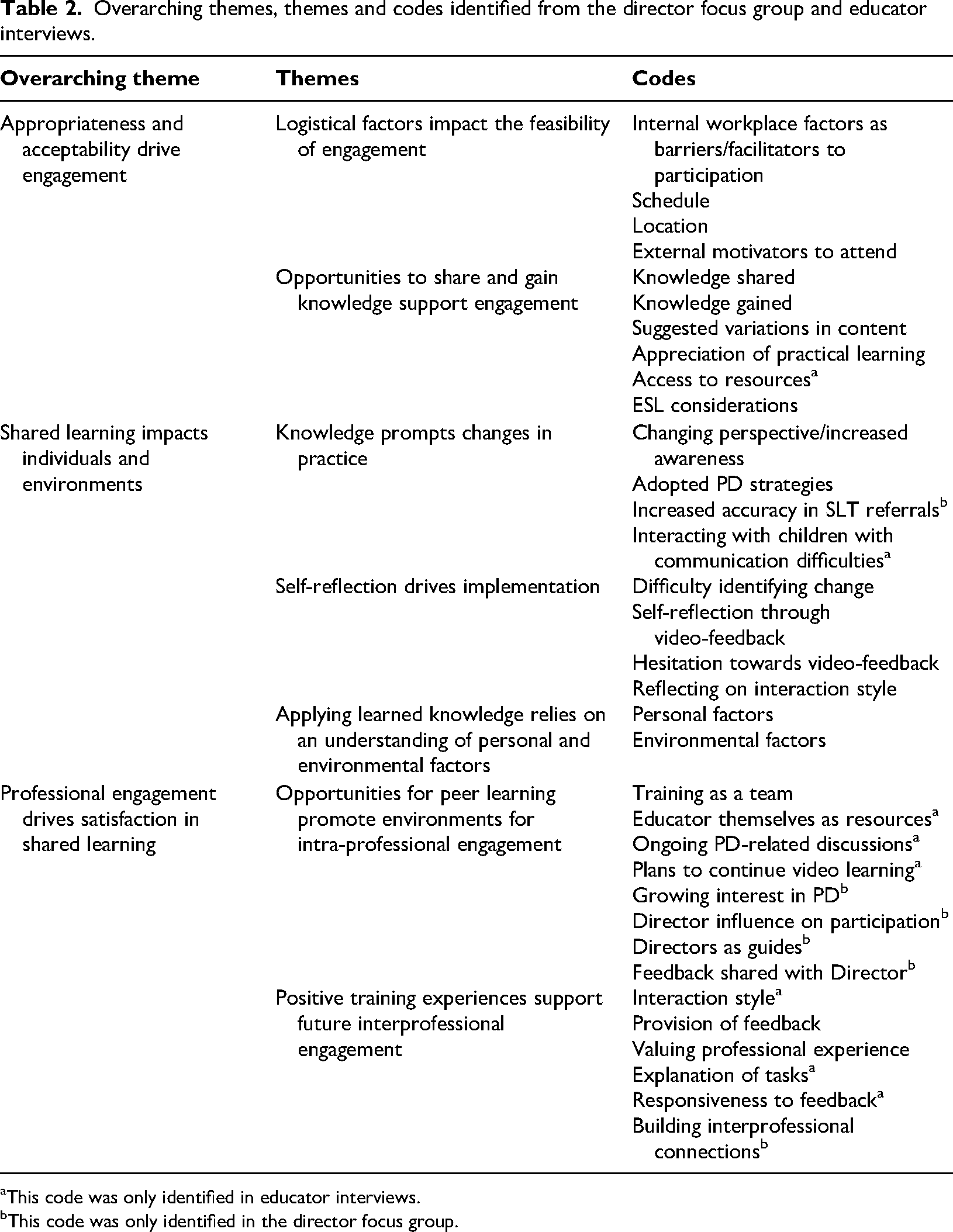
Overarching themes, themes and codes identified from the director focus group and educator interviews.
This code was only identified in educator interviews.
This code was only identified in the director focus group.
This overarching theme included sub-themes related to the factors that impacted the feasibility of engagement as well as content-specific opportunities to share and gain knowledge. These themes defined the practicality and acceptability of the training.
a Theme 1: Logistical factors impact the feasibility of engagement
This theme reflects the internal workplace factors, schedule, location and external motivators to attend (e.g. catering) that impacted educator engagement in the training. These factors influenced the feasibility of attending the training but also completing the training's tasks (e.g. video recordings). The internal workplace factors included completing the training within busy schedules for educators, and meeting workplace ratios. Participants commented that they found attending workshops challenging ‘we got tired after work … immediately we have to run for this training … It's really hectic’ (Educator 2, [E2]).
The challenge of busy schedules was thought to impact educators’ engagement with the training. Educators reported reduced concentration during the evening workshops, difficulty completing the video action plans and difficulty taking video recordings of their interactions with children. The demand of meeting workplace ratios was reported by both educators and directors. One educator commented ‘it was a struggle because … I was still part of the ratio’ (E6). The implications of the ratios were felt by the directors in managing the required ratios when staff were absent to attend training, ‘sometimes we had to replace them with casuals as well’ (Director 2, [D2]).
When directly asked, five educators suggested changes to the training schedule for future implementations although these suggestions were highly variable. Educator suggestions included to reduce or increase the training length, reduce the 2.5 h workshop length and change the timing of the workshops. In comparison, directors were satisfied with the schedule of the training, ‘… when training is spread out over a few weeks and they [the educators] get that opportunity to come back and put in to practice what they have learnt, it cements the learning’ (D3).
Convenience and flexibility of the workshop timing and location were identified as a contributor to the feasibility of the training for educators. Nevertheless, directors suggested replacing some workshops with online/offline modules, webinars or zoom meetings for even more convenience.
b Theme 2: Opportunities to share and gain knowledge support engagement
Participants’ descriptions of the training were interpreted to include the impact of the presenter delivery style as well as the relevance and usefulness of the content. The descriptions provided by participants were captured in two ways as: (a) knowledge shared and (b) knowledge gained. Educators and directors reported that parts of the content were a refresher because it was congruent with their existing knowledge, with some participants suggesting to further refine the content. The new knowledge gained by educators and directors related to language growth and increased quality of adult–child interactions. E4 stated that one ‘helpful’ strategy she learned was to ‘partner them [children who communicated less] with … a social sociable child partner than with a bit more quiet one just to balance it out’ (E4). Educators and directors reported positive learning experiences during the workshop sessions but also provided suggestions to alter the delivery style. One consideration for delivering content was learners who had English as an additional language. Multilingual educators shared challenges of keeping up with content and some strategies the educators used (e.g. further reading).
Overarching theme II: Shared learning impacts individuals and environments
This overarching theme included sub-themes related to the impact of the training from the perspectives of educators and directors. The perspectives of both educator and directors were interpreted to be both desirable for their own practice as well as for the professional environment of their centre.
a Theme 1: Knowledge prompts changes in practice
This theme captured the positive changes to practice that were described by participants as a result of engagement in the training. Both educators and directors expressed that the training changed their perspective regarding their practice. As described by E3, the training prompted her to begin ‘viewing the things differently’ (E3). Participants also described changed views on the importance of certain language-support practices. For instance, D2 discussed that educators at her centre began to change their interactions with young children as a result of the training. Previously, ‘they didn’t see the need of talking’ with young children and reported a change in confidence and interactions following the training, stating that it ‘gives them confidence that yes, it is an important thing to talk’ (D2).
Educators and directors described implementation of knowledge including adopting language-support strategies into practice, increasing the accuracy of SLT referrals and changing interaction styles for children with communication difficulties. An example of an adopted strategy for E1 was ‘sitting at their [the children's] level’ (E1).
b Theme 2: Self-reflection drives implementation
The theme ‘self-reflection’ captured instances where the training was reported to initiate desirable changes in educators’ practice. Educators and directors reported processes of self-reflection that were understood to enhance their awareness of language-hindering behaviours as well as language-supporting practices. Educators and directors also communicated observations of peers reflecting on their own performance, ‘Most of the educators they just like to talk especially … I heard many of them saying, oh ok we should give more chances for children to talk’ (E6).
Some educators described the challenge of reflecting on changes in practice due to their work becoming routine for them. That being so, educators and directors expressed that video feedback was a useful tool for facilitating self-reflection; ‘When you look at the video, you actually realise yourself, oh you should have done this way, you should have done that way. You reflect on your performance’ (E6). Despite initial discomfort and hesitation relayed by educators, ‘It was confronting at the first one but then at the end I’m like okay whatever (laughs)’ (E4) and by directors, ‘Oh, everyone was uncomfortable. Particularly the first one. … even myself when I got video’d, I thought “this is terrible” like, I’m so awkward’ (D1).
c Theme 3: Applying learned knowledge relies on an understanding of personal and environmental factors
This theme related to personal and environmental factors which influenced the impact of the training and the ability to apply learned knowledge.
Personal factors: These factors included the self-implemented prompts described by educators to facilitate the application of knowledge (e.g. using post-it notes to remember strategies). D2 reported perceived personal factors for educators including English language proficiency, ‘… when the educators are trying to talk with the children, they do struggle with the words, particularly when English is not their first language’ and level of education, ‘… They had done their education like, 10–15 years ago… maybe they were not as in touch as your [D1] staff who are young and who had done their qualifications recently’.
Environmental factors: Environmental factors were identified when educators and directors reported challenges of applying new knowledge. Educators and directors described workplace context as a notable challenge regarding the suggestion of interacting with children in small groups (one educator to four children) due to limited staff, ‘… we were a little bit frustrated cause… [we have] always at least ten children to one educator and sometimes more’ (E6). This difficulty was reiterated when two educators suggested to use video samples that were more reflective of the Australian context (e.g. 1:10 educator-to-pre-schooler ratios instead of 1:4 in the videos).
Overarching theme III: Professional engagement drives satisfaction in shared learning
This overarching theme captures the sentiment that professional development training provided an opportunity for professional engagement where knowledge is shared and transferred intra- or inter-professionally.
a Theme 1: Opportunities for peer learning promote environments for intra-professional engagement
This theme reflected instances of intra-professional engagement with colleagues of the same workplace and across different work contexts and captured both informal (i.e. educators and other educators) and formal (i.e. directors and educators) relationships.
One interpreted benefit of training as a team was that educators themselves became resources, specifically for peer learning. Educators described being asked questions by other educators who did not fully understand the content of the training. E4 shared that peers at other centres consulted her for clarification, ‘they ask for advice … not in my centre but in the training’ highlighting that peer learning occurred with educator participants across different centres. One educator also reported embracing a teaching role for colleagues who did not attend the training. Additionally, educators supported each other with the homework requirements (e.g. recording video interactions). Educator engagement in relation to the training did not cease with the completion of training, ‘we communicate all the time’ (E2). These ongoing interactions within the workplace illustrated the opportunity for continual learning without requiring a trainer.
Directors’ roles were understood as being guides for their educators when they participated in the training, ‘I’m going to each training to try and find the best so I can just do a kind of reminder for myself and the educators as well’ (D2). In contrast, not participating in the training hindered directors’ ability to fully guide their educators. For D4, not participating in the training also meant that her knowledge of the training was limited to hearing ‘second-hand’ recounts, ‘So, I’m sort of hearing a lot second-hand I suppose’ (D4). These intra-professional benefits were yielded through the training being delivered concurrently to educators and directors of the same or other local centres.
b Theme 2: Positive training experiences support future interprofessional engagement
Interprofessional engagement was captured through educators’ and directors’ expressions of learning from the discipline-specific expertise and knowledge of the SLTs, ‘You are interacting with that profession and you’re getting that knowledge directly from them. And that was a good feeling’ (D2). Educators also reflected that the SLT trainers supported learning through their provision of feedback during the video-feedback sessions. Educators valued when the feedback was positive and balanced with constructive feedback, ‘… she has given really very good feedback like how we did, what we did and where we were wrong, and how we can improve those things …’ (E2).
Furthermore, directors identified that this training instigated interprofessional connections between the educator workforce and SLTs. These interprofessional connections were interpreted to establish the foundations for promoting future interactions with the SLTs; who were also working as clinicians within the local area of the early childhood centres. D2 outlined that these relationships were important for future contact between the two professions in the case of educators sending referrals to SLTs, ‘Just talking to a person who's a total stranger compared to a person who has … come a number of times’ (D2).
IV Discussion
The overall aim of this study was to understand the perspectives of educators and directors around the feasibility of the modified professional development training, LLLI. The experiences shared were classified into three overarching themes related to acceptability and appropriateness, impact and professional engagement. Due to the similarity between educators and directors, the two perspectives are described simultaneously in the sections below.
The feasibility of the training was a critical factor having implications on the acceptability and appropriateness of the training. The two main logistical challenges for feasibility were: (a) completing the training within busy schedules for educators and (b) meeting workplace ratios, a difficulty for both educators and directors. These challenges led to suggestions, made by some educators, to ease the burden of the training by reducing its intensity and length. However, intensity and length have been correlated to the effectiveness of the training (Desimone and Garet, 2015) with LLLI iterations of greater length and intensity yielding higher efficacy (McDonald et al., 2015) compared to iterations with lower length and intensity (Scarinci et al., 2015). This dichotomy indicates a decision to be made for future implementations for modifying training intensity with consequences being either burden on educators or reduced success of the training. Nevertheless, arrangements to accommodate for workplace ratios by directors (e.g. one director reported to arrange for casuals) may ease this challenge for educators. Additionally, directors’ suggestions for moving some workshops to online mediums could be considered in the future to aid convenience.
In relation to the content of the training, some educators and directors reported that aspects of the content crossed over with their existing knowledge. Although they reported partial benefit of this repetition of knowledge as being a refresher, suggestions were made to further refine content. However, this view was not expressed amongst all participants. This suggests that future implementations of this training could uncover the shared knowledge between educators and SLTs as well as their desired learning content. It could also propose the need to have a greater focus on the application of knowledge rather than the teaching of content.
Educators and directors valued practical learning and coaching opportunities as a means to gain knowledge, reflect and change practice. Most notably, all educators and directors described that video feedback was a powerful teaching tool and a catalyst for self-reflection, despite being challenging initially. Educators in other studies have shared the same sentiments (Eadie et al., 2017; McDonald et al., 2015) and the effectiveness of video feedback was confirmed in a meta-analysis study evaluating professional development programs (Fukkink et al., 2011). The success of video feedback could be related to its instigation of self-reflection as educators and directors communicated that through it, they recognised language-hindering practices or the need for greater use of language-support practices.
In addition, educators and directors expressed personal and environmental factors which may be determiners of the impact of training. One director perceived that lower-level qualifications were a determiner for increased benefit of this training. However, this notion is conflicting to a recent study of the LLLI training, where no correlation was found between educator qualifications and the impact of the training (Eadie et al., 2019). Although educators were not directly asked about cultural and linguistic diversity, two educators did discuss their own experiences and challenges as learners with English as a second language.
Professional development training is more impactful when there is coherence and applicability of what is taught in the workplace context (Desimone and Garet, 2015). Educators and directors revealed contextual challenges that potentially hindered their own implementation of language-stimulation strategies. For instance, while the LLLI training videos featured a ratio of one educator to four children for small-group interactions, in reality, participants reported routine engagement with larger groups of children. This difficulty, however, was not reported by educators of Eadie and colleagues’ (2017) study perhaps due to their educators looking after children aged 0–2 years old where the NQF regulations regarding educator-to-child ratio is one educator for four children for this age group (ACECQA, 2011). For our participants, perhaps these videos did not reflect their authentic practice. The broader literature also reports less effective outcomes when professional development with teachers lacks coherence and ease of applicability to classroom environments (Desimone and Garet, 2015). These findings may partially enlighten why improvements in educators’ skill and knowledge are not always translated to positive children’s language outcomes (Chaitow et al., 2023; Eadie et al., 2019). This issue leads to two suggestions. Firstly, training should be more reflective of the context in which participants are working to ensure perceived validity and successful implementation (Desimone and Garet, 2015). Secondly, the context in which participants are working should be more reflective of the needs of children in their care. That is, while ratios exist to mandate the number of educators and children in any one space at any one time, the reality of busy early childhood education centres means that educators are engaging with larger numbers of children at any one time. Cunningham et al. (2023) theorised that children's language outcomes may be achieved through a conceptually integrated model of language and social-emotional support which provides considerations of complex early childhood education ecologies, however, this model is yet to be tested. It is necessary to continue to evaluate early childhood education communication environments and support further structural change to optimise educator-to-child ratios. Another challenge educators expressed was communicating with children with communication difficulties and challenging behaviours. This finding elucidated the need to better equip educators with knowledge and skills for challenging situations in future training.
A positive outcome, that was not a direct aim of this PD training, was the augmented inter- and intra-professional relationships. Participants’ experiences denoted that learning and engagement were elicited by educators, directors and SLT trainers, with importance given to peer learning amongst educators. Peer learning was embodied in educators’ recounts of learning from each other and engaging in ongoing discussions regarding their learning after the completion of the training. Peer learning was also highlighted by educators in another study, evaluating the complete LLLI training (Eadie et al., 2017). These findings signified that peer learning was still facilitated, even when the length of the training was reduced to 8 weeks. Moreover, educators in Eadie's study explained that ongoing training-related discussions amongst peers ensured that changes to practice were maintained. Increased trainee's skills, knowledge and positive changes in practice were also evident in another professional development training for teachers where high levels of collegial discussions and collaborations were encouraged (Gersten et al., 2010). The Gersten training (2010) was completed across 16 sessions with facilitators who had specialised expertise in reading and was held twice monthly during an 8 month period. These findings of Eadie et al. (2017) and Gersten et al. (2010) may provide context as to why joint participation with colleagues is a key part of the conceptual framework for successful professional development training presented by Desimone and Garet (2015). Early childhood education and care professionals in a more formal inquiry group with high levels of intra-professional discussions expressed a sense of empowerment and agency when undertaking active roles in advocating for positive changes in early childhood education; this was argued to be a viable means of professional growth, with a shift in recognising early childhood education and care professionals as capable and ‘knowledgeable insiders’ for meaningful and positive change (Escamilla and Meier, 2018: p. 18). It is, therefore, encouraged that future implementations of professional development for early childhood educators embrace the ability of educators to share knowledge and resources amongst themselves and with their trainers. More critically, embracing these intra- and interprofessional relationships may be an agent for system-wide cultural change within the educator workforce.
Limitations
There were several limitations which should be considered when interpreting these findings. First, participants of this study may have had a positive experience of the training, causing them to be motivated to take part in this research in comparison to people with more neutral experiences. In turn, there may have been a bias with the findings being predominantly positive. Second, we may have unknowingly influenced the way participants described their experiences by focusing on the feasibility of the training and given the professional background of the researchers. Lastly, in qualitative research, there is the inevitable challenge of the researchers’ lens influencing the interpretation and relay of findings (Braun and Clarke, 2006). This challenge was mitigated through being transparent on research methods and by committing to report findings as was described.
Future directions
Future investigations of professional development for educators should consider the commitment and potential burden on educators participating in training. This may be mitigated by replacing some workshops to online media but the efficacy and acceptability of this suggestion for future research. Additionally, there is a need to understand professional development with educators who are culturally and linguistically diverse. A broader study (or studies) is warranted for investigating the sustainability of delivering LLLI in different early childhood environments. These investigation/s should consider the tailoring of the training to the local context (including local policies, community languages and day-to-day schedules), financial and non-financial resources (e.g. time required and funding available) and sustainable collection of outcome measures.
V Conclusions
This study's findings encompassed educator and director perspectives related to the sustainability and impact of the training. Overall, participants reported positive experiences and desired changes to their practice. However, even though participants described the training as relevant, appropriate and acceptable for themselves and their workplace context, there were some challenges identified (e.g. busy schedules). Participants also detailed positive outcomes of the training beyond the outcomes intended; these were the facilitation of inter- and intra-professional relationships. There is value in understanding these experiences to improve quality early childhood education environments as needed. By considering the experiences reported in this study, future training implementations in similar contexts to Australia can maximise the appropriateness, acceptability and feasibility while considering participants’ learning needs and workplace environments.
Footnotes
Acknowledgements
We thank the research team, participants and the Local Health District for their support and engagement.
Declaration of conflicting interests
The authors declared the following potential conflicts of interest with respect to the research, authorship, and/or publication of this article: One of the authors was involved in the training but was blinded to the transcripts. Other authors have no further conflicts of interest to declare.
Funding
The authors disclosed receipt of the following financial support for the research, authorship, and/or publication of this article: The research team acknowledges the financial support received from DOOLEYS through the ClubGRANTS Scheme (2018–2019) and from NSW Health through the Paediatric Innovation Funding Scheme (2019–2021). Sarah Masso acknowledges funding support from The Australian Research Council Discovery Early Career Research Award (DE200101078) and the Alexander von Humboldt Foundation.

Appendix 1. Guiding questions for educators (semi-structured interviews)
How did you find the training?
Let's talk about the training sessions. Would you like to make any comment about the way the training was offered, for example, the availability of staff for the training session dates and times? Do you have any thoughts about the individual coaching sessions? How have you found implementing these skills with children at your centre? Was there anything that did not work well either during the PD training sessions or the individual coaching sessions? Do you have any suggestions regarding any changes or improvements that could be made if we were to implement this training again? What are your views about receiving this professional development from the speech-language pathologists who delivered the training?
Have your views about speech-language pathologists changed since your experience of this training? Is there anything else you want to discuss?
Appendix 2. Guiding questions for directors (focus group)
How did you find the training? (for directors who attended training)
Let's talk about the training sessions. Would you like to make any comment about the way the training was offered, for example, the availability of staff for the training session dates and times? Do you have any thoughts about the individual coaching sessions? How do you think your team found the training? Do you have any comments about your team implementing these skills with children at your centre?/How have you found implementing these skills with children at your centre? What do you think your team learnt the most from this professional development? What do you think your team found the most challenging from this professional development? Do you think there has been any change (positive or negative) in the interactions between educators and children at your centre? Was there anything that did not work well either during the PD training sessions or the individual coaching sessions? Do you have any suggestions regarding any changes or improvements that could be made if we were to implement this training again? What are your views about receiving this professional development from the speech-language pathologists who delivered the training?
Have your views about speech-language pathologists changed since your experience of this training? Is there anything else you want to discuss?