




Abstract
This study examines the displayed communicative competence and agency of a non-speaking student at a compulsory school for children with severe learning disabilities. The use of two different speech-generating devices (a single-message versus a multi-message speech-generating device) and the assignment of participation role (having the role of ‘student’ or ‘teacher’) were compared in two morning meetings. The two interactional sequences ‘question-answers’ and ‘repair actions’ were chosen because they provide participants with opportunities to display communicative competence and agency. The analysis showed that the displayed communicative competence and agency of the non-speaking student differed in relation to the kind of speech-generating device and the associated participatory role. Furthermore, the displayed communicative competence and agency was a product of the close collaboration between the student and the assistant and teachers who scaffolded the process. The study shows that teachers and assistants can influence the communicative competence and agency of non-speaking students.
Keywords
Introduction
In this study, we use applied conversation analysis (CA) to explore communicative competence and agency (Antaki and Crompton, 2015; Kovarsky et al., 1999). We compare how two types of speech-generating devices (SGDs) affected a non-speaking student's possibility to display communicative competence and agency in two morning meetings in a compulsory school for children with severe learning disabilities. Research on SGD-mediated interaction shows that non-speaking students can improve their social and communicative skills with the use of an SGD (Rispoli et al. 2010). Yet, research also shows that SGDs are seldom used in whole-class education, for example, morning meetings (Andzik et al., 2016).
Review of literature
Communicative competence
According to Light (1989), and Light and McNaughton (2014), communicative competence is an intrapersonal skill: a combination of inter- and intrapersonal skills consisting of individuals’ linguistic, operational, social and strategic intrapersonal skills and their attitude, motivation and resilience to interacting with each other. In this study, we embrace an ethnomethodological perspective, which means that we view communicative competence as a multimodal co-constructed interactional phenomenon that is temporally and sequentially organized and understood. It is a joint achievement of interlocutors’ understanding of each other's linguistic and embodied practices, when treating each other's observable and recognizable actions as meaningful social actions (Moody, 2022).
Even though the body of research on displayed communicative competence among individuals with speech and language disabilities is sparse, all interactional studies point out that meaning-making is a close co-construction between the non-speaking and the speaking participant. For example, Clarke and Wilkinson (2013) examined peer interaction. They found that the displayed communicative competence of the non-speaking boy they studied was a product of the typically developed speaking friend's shared affiliation and ‘sensible alignment of speech, vocalization and non-verbal actions’ (Clarke and Wilkinson, 2013: 37). Furthermore, Antaki, Walton and Finlay (2007) analysed the interaction between service-users (i.e., adults with intellectual disability) and their staff. Their study demonstrated that staffs’ practices of naming the service-users and redoing questions with pre-known answers provided the service-users with an opportunity to display communicative competence. The practices were attention-generating and made the choices comprehensible for the service-users. Another group of researchers, Killmer et al. (2021) examined the interaction between a man with aphasia and his wife; they suggested that communicative competence can create agency. Hence, if individuals with speech and language disabilities are provided with opportunities to display communicative competence, they may also display agency.
Agency
According to Enfield (2013), agency is a combination of individuals’ accountability and flexibility. Accountability refers to individuals’ willingness and entitlement to take responsibility for their actions. Hence, accountability is a combination of interactional rights and duties to make meaning, take initiatives, where individuals are expected or granted to take on accountability and responsibility. Flexibility refers to individuals’ possibility to control and compose a contribution, and the comprehension of their actions. Flexibility also implies individuals’ possibility to foresee responses and thereby select and compose contributions that serve their motives. Agency and flexibility are interactional constructions that are jointly achieved (Antaki and Crompton, 2015; Killmer et al. 2021).
Similar to research on displayed communicative competence, research on agency among individuals with speech and language disabilities is sparse. Yet, Killmer et al. (2021) illustrated in their study that the man with aphasia could display agency when his wife supported his attempts to initiate storytelling by removing her gaze and thereby provided him with a prolonged interactional floor. In another study, Antaki and Crompton (2015) illustrated that when horticultural therapists treated service-users’ actions as meaningful and designed their turns as suggestions or requests of a joint purpose of the activity and used the inclusive ‘we’, service-users were presented as independent individuals with agency. Hence, the agency in their study was described as the ‘service-user's sense of control over, and choice in, their everyday lives’ (Antaki and Crompton, 2015: 646). The step-by step scaffolding actions on the part of the staff created an ‘agentive discourse’ for the service-user to display communicative competence (Antaki and Crompton, 2015: 652). Finally, agency has also been examined in classroom interaction including typically developed children. For example, Houen et al. (2016) who examined the concept of agency in classroom interaction including children 3–5 years of age found that the children were provided with agency when the teachers accepted the children's decisions, suggested formulation or negotiation of ideas, and provided solution-focused practices such as encouraging listening to each other. By doing this, children were seen as agents with resources to interact.
To conclude, the displayed communicative competence and agency in interaction involving individuals with speech and language disabilities is a joint achievement. In this study, the participating individual is a non-speaking teenager with an intellectual disability using a single-message versus a multi-message SGD.
SGDs and participatory roles
Children who cannot use speech for interaction can use other resources, such as SGDs. SGDs range from battery-driven single-message devices to multi-message computers consisting of single words, pre-recorded phrases, letters that are represented by graphic symbols, or characters linked to synthetic voice output. An SGD can for example be accessed by eye-gaze tecknology, which means that a camera on the SGD registers the eye movements of the user and transforms them to the cursor. The user has to make the cursor stand still for an individually adopted time to activate the synthetic voice.
SGD-mediated interaction is a careful co-construction between non-speaking and speaking participants (Clarke and Wilkinson, 2013; Higginbotham and Wilkins, 1999). It requires knowledge and practice. For example, speaking participants need knowledge for system up-keep and understanding to choose a vocabulary that will meet the needs of children (Johnson et al. 2006). In addition, the time spent composing an SGD-mediated turn is prolonged compared to speech. An average person produces about 100–150 words per minute compared to just a few words per minute with an SGD. This means that an SGD-mediated turn easily gets sequentially and temporally misplaced in the ongoing interaction, which may complicate understanding (Higginbotham and Caves, 2002). Savolainen et al. (2020) examined how participants treated this prolonged composition by analysing video recordings from naturally occurring interaction between children interacting with SGDs and their mothers. The analysis demonstrated that the speaking participants (the mothers) treated the non-speaking participants’ (their children's) gaze orientation towards the SGD as a signal for taking the turn: when children oriented towards the SGD, mothers withdrew their gaze and remained silent during the production phase. The practise worked to prolong the children's response space. In another study, Howery (2018) investigated non-speaking students’ lived experiences of the prolonged composition in a school context. No matter how fast and competent the students were, they experienced difficulties participating in multiparty peer interaction (i.e., four participants or more). One of the informants avoided SGD-mediated interaction in peer conversations because her contributions were often too slow and sequentially and temporally misplaced. Due to constant misunderstandings, she had stopped using her SGD in multiparty peer interaction. Yet, a study by Clarke and Wilkinson (2007) indicates that dyadic peer interaction might be easier, especially if the speaking peer produces first pair part of an adjacency pair (e.g., asking a question in a question-answer sequence) prompting the non-speaking peer to say something. By doing this, the second pair part of the adjacency pair (i.e., the response on the SGD) becomes comprehensible despite being a single word. However, using an SGD may be challenging and embodied practices as gazing at subjects are often quicker. An SGD can be used in institutional as well as mundane settings. However, the interactional conditions differ between institutional (e.g., at school, in health care, at court) and mundane interaction (Heritage & Clayman, 2010). In institutional settings, talk is more ritualized and participants receive roles with unequal power (e.g., teacher-student, doctor-patient). There are constraints on what can and should be said, by who, and to whom.
Despite participatory role, non-speaking children's ability to interact and participate highly depends on communication partners’ (e.g., parents, teachers, assistants) use of scaffolding practices (Norén and Sigurd Pilesjö, 2016; Tegler et al. 2020).
Scaffolding practices in special needs education
Even though the concept of scaffolding originally refers to teachers’ practices enabling students to carry out school assignments that are beyond their capacity with adapted support from teachers or more experienced peers (Wood et al., 1976) the concept has also been used to describe the practices that make SGD-mediated interaction possible. Many children who use SGDs participate in special needs education. According to Radford et al. (2015), scaffolding practices in special needs education can roughly be divided into (a) emotional support that scaffolds students’ confidence in learning, (b) curriculum support that eases students’ access to knowledge, and (c) relational support that facilitates peer interaction. The study also identified the practice of repair scaffolding, which focuses on learning and heuristic scaffolding, which focuses on encouraging students to use their own strategies. Teachers’ practices could also be described in terms of prompts that work to accomplish studentś ongoing turns (Savolainen et al., 2020).
To conclude, there is a rich body of research on pedagogical approaches (including scaffolding practices) that can contribute to include children with special educational needs in mainstream classrooms (Rix et al. 2009) but studies, including non-speaking students using SGDs in multiparty classroom interaction, are rare (Tegler et al. 2020). We attempt to contribute to this gap in research by using applied CA, as CA is an analytic method that has been found well suited to analyse interactional phenomena such as communicative competence and agency in everyday interactional contexts (Antaki and Crompton, 2015; Kovarsky et al., 1999).
Aim
The aim was to investigate if, and if so how, a single-message SGD versus a multi-message SGD influenced a student's displayed communicative competence and agency in two morning meetings.
The specific research questions were:
How were communicative competence and agency displayed and achieved when the student responded to questions or performed self-repairs using his single-message SGD versus his multi-message SGD? Which scaffolding practices were used? How did the diverse composition time affect the student's displayed communicative competence versus agency?
Method and analytic procedures
Design, data, setting, and participants
The study is an observational case study. The selected data (01:14:49) are drawn from a corpus of approximately 20 h of video recordings including users of SGD-mediated interaction collected in 2018. The main participant, a non-speaking student who we call Rickard, was a 19-years old adolescent with physical and intellectual disabilities due to severe cerebral palsy. He used a wheelchair and could not use his hands. Apart from embodied resources (gazing up for YES and down for NO and facial expressions), Rickard used an SGD for interaction. His language comprehension, assessed with TROG (Test for Reception of Grammar) (Bishop, 1982) equalled 5:1 when he was 11 years. Rickard attended a Swedish special needs school. In general, school days start with a scripted morning meeting including; greeting each other, sharing experiences and ideas, a group activity involving all students and news and announcements. The overall aim of morning meetings is to create a platform for students to practice democratic ideas (Bondy and Ketts, 2001; Tilhou, 2020).
Rickard's personal assistant Adam participated in both morning meetings. Adam was a 21-year-old man who had completed the ‘Treatment and care program’ at upper secondary education. Rickard and Adam had known each other for one and a half years at the time of data collection.
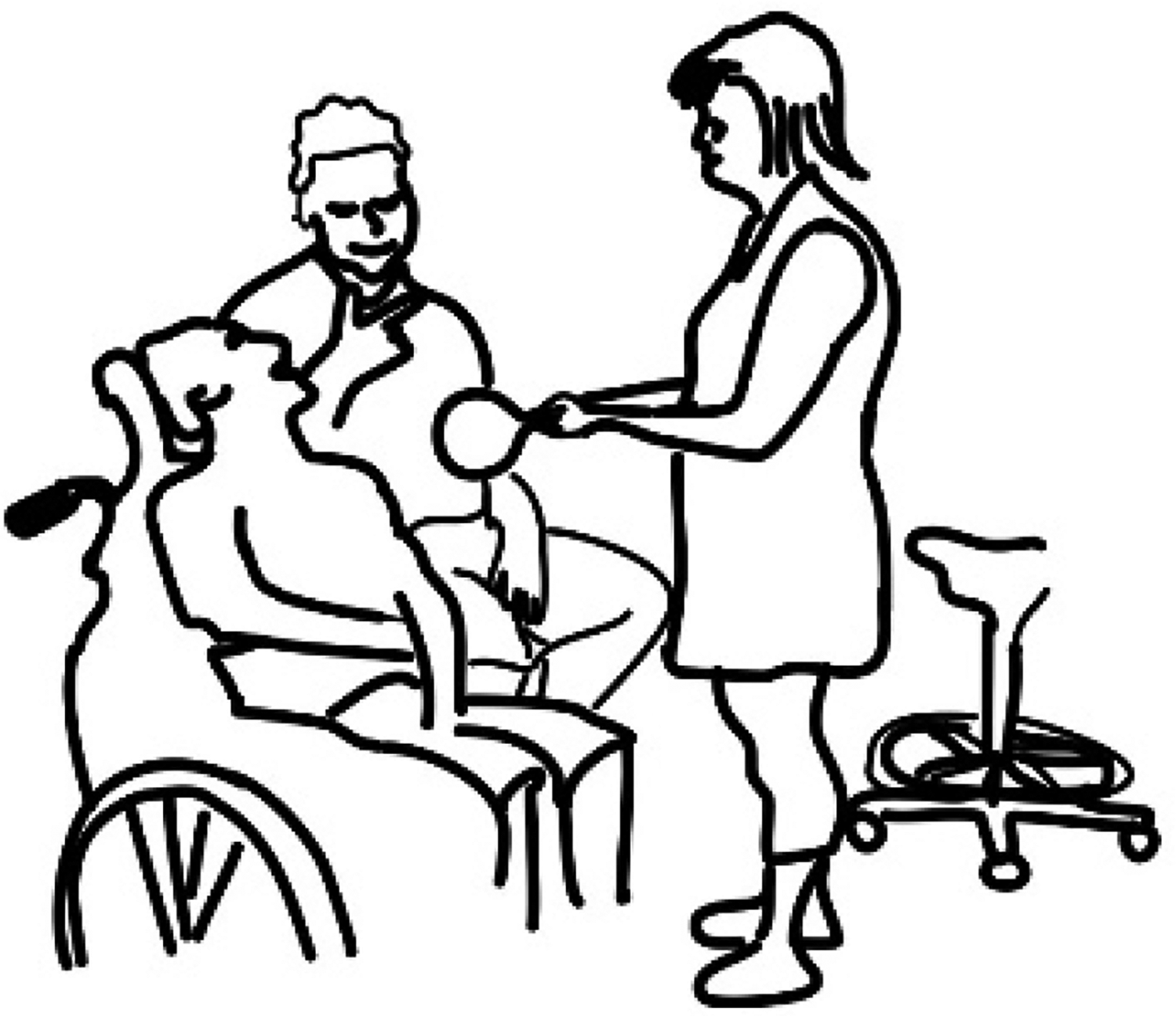
In the first video recording in June, Rickard had four non-speaking classmates who were wheelchair users. They vocalized and used single-message SGDs. Rickard used embodied resources and a prerecorded single-message SGD that he could activate with his hand if the SGD was positioned accurately (Figure 1). The teacher was a 55-years-old female special needs teacher who had been working with non-speaking students for about 2 years. In addition, there were four teaching assistants who assisted the classmates. The morning meeting was organized in classical teacher-led IRE-sequences (i.e., initiative, response, evaluation sequences) (Mehan, 1979). The teacher initiated the sequence by making a request, an offer, or a demand and then allocated the turn to a student. The allocated student responded and the teacher evaluated the response. The participants had their traditional participatory roles: the teacher led and controlled the meeting (she chose the topic and allocated the next speaker) and the students awaited their turn (Heritage and Clayman, 2010: 27). The agenda of the present morning meeting was shortened and included only greetings (a name song) and group activity (blowing a balloon). After that, the class listened to music.
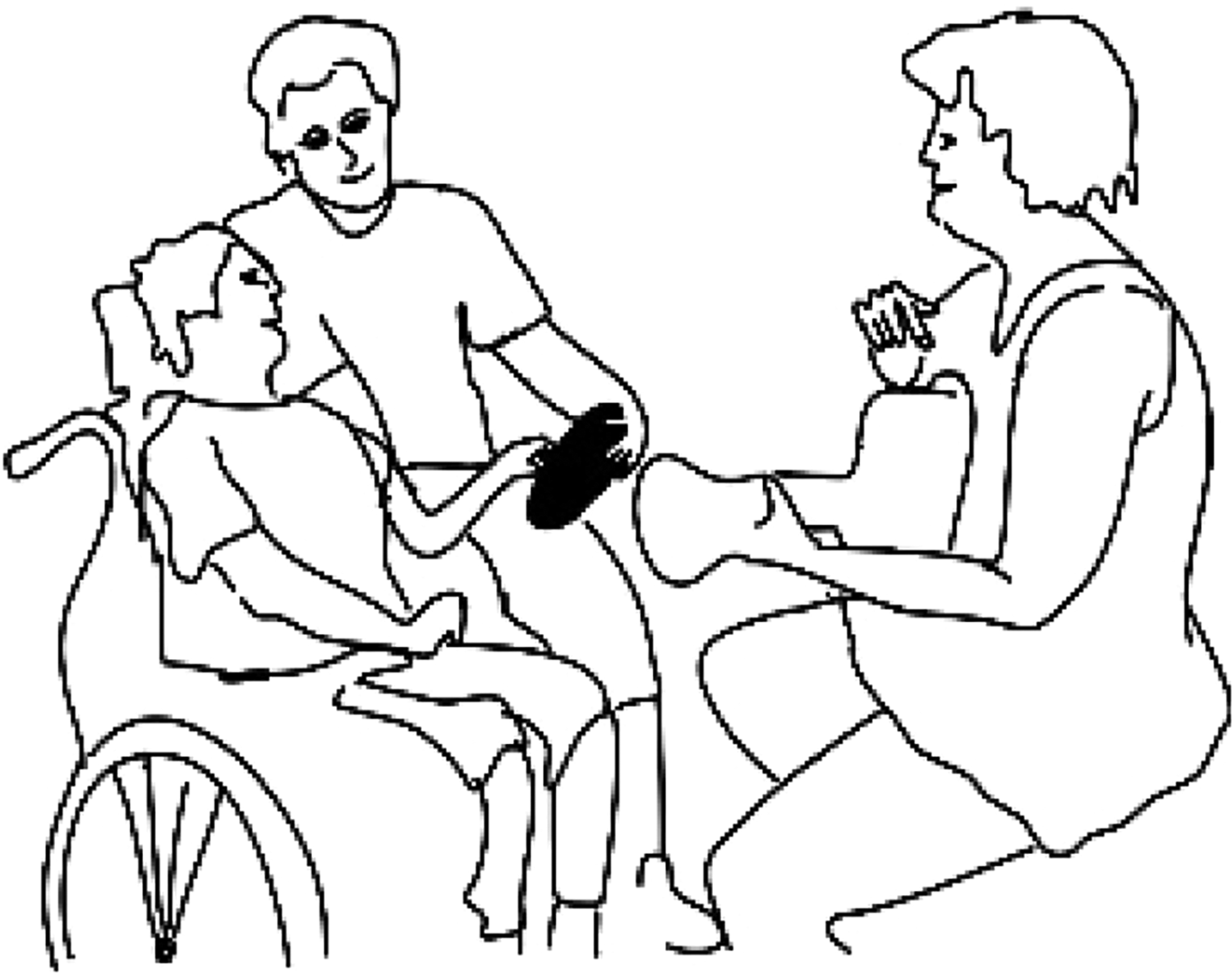
Rickard responds his name with the speech-generating device (SGD).
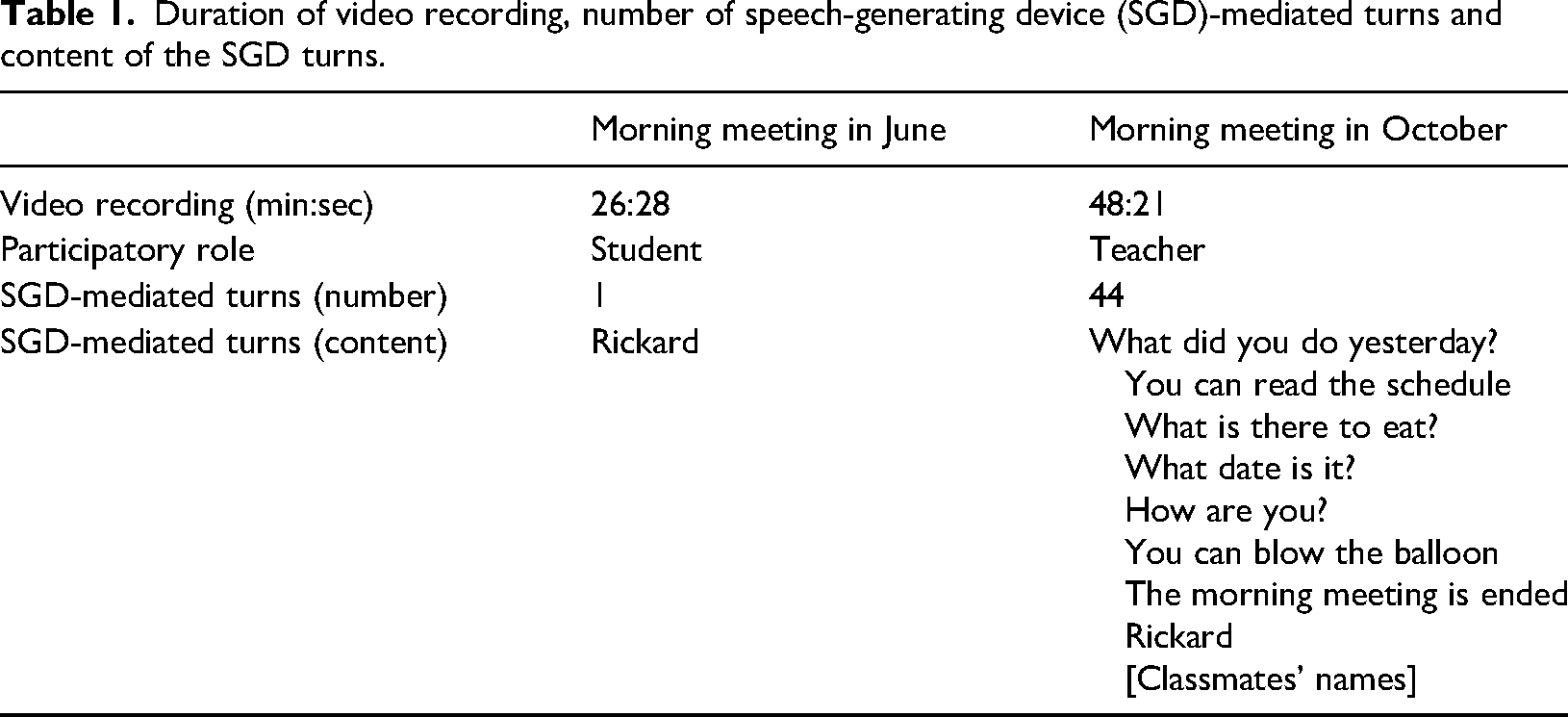
In the second video recording taken in October, Richard had changed class: he had four new classmates and a new teacher. Three classmates had a few comprehensible words and all used manual signs for interaction. The teacher was a 60-year-old female recreation instructor and teacher in sports and health. Apart from embodied resources, Rickard used a multilevel eye-gaze accessed SGD (Tobii Dynavox with software Communicator) with approximately 200 symbols arranged in three levels with 4–15 symbols per page. There was one generic page and context-specific pages (Figure 3). The morning meeting was differently organized compared to the morning meeting in June (Table 1). The students took turns in taking the role of the teacher leading the morning meeting. This morning it was Rickard's turn to lead the group (i.e., taking the participatory role of the teacher). Rickard first chose the task and then allocated a classmate. The agenda of the morning meeting included talk about feelings, weather, and schedule, lunch menu, retelling an activity and blowing a balloon. All tasks and classmates were represented with a separate picture on Rickard's SGD.
Duration of video recording, number of speech-generating device (SGD)-mediated turns and content of the SGD turns.
Ethics
In the current study, all data was anonymized, caregivers were provided with easy-to-read information with photos and graphic symbols to inform their children and ask for their participation. Written informed consent for this study was obtained prior video recording from caregivers, teachers and assistants.
Analytic approach
In order to analyse the data, we use the perspective and methodology of ethnomethodological multimodal CA (EMCA), which is a method for detailed analysis of interaction including both linguistic and embodied resources (Goodwin, 2000; Mondada, 2011). EMCA is an inductive data-driven method in which participants’ contributions are sequentially and temporally understood. A central assumption is ‘next turn proof procedure’, which means that contributions are understood when analysing next speaker's responses. By doing detailed EMCA, observable but not noticeable actions can be identified and anlysed: patterns of interactional actions can be discovered.
The analysis was carried out stepwise. First, all data was transcribed verbatim including transcription of embodied resources (e.g., gaze and body orientation as well as deictic gestures). Second, two kinds of sequences were chosen: question-answer sequences and repair actions. The sequences were chosen because they provide opportunities for participants to display communicative competence and agency. Two question-answer sequences were identified: W-questions and polar questions (Raymond, 2003) and two repair sequences (i.e., other-initiated self-repair and other-initiated other-repair) (Schegloff et al., 1977). W-questions are questions that require more than acceptance/denial (YES/NO) while polar questions can be responded to with acceptance/denial. Repair actions follow the identification of a problematic turn. The problem can either be identified by someone else (other initiated) or the speaker (self-initiated) and the repair can also be carried out by someone else (other repair) or the speaker (self-repair). The identified sequences were transcribed using the conventions developed by Jefferson (2004) with some additional study-specific notations (see Appendix). Third, illustrative examples were chosen to illustrate displayed communicative competence (Moody, 2022) agency (Antaki and Crompton, 2015; Enfield, 2013) and composition time (Savolainen et al. 2020).
Findings
The analysis demonstrates how communicative competence and agency were displayed and accomplished in the two morning meetings when the student used two different SGDs. We compare the use of the two SGDs in relation to responding to W-questions, accomplishing other-initiated self-repairs, and time composing a turn. In addition, we discuss the scaffolding practices of the staff and how the two participatory roles affect the student's opportunity to display communicative competence and agency.
Responding to W-questions with the SGD
The analysis of the two morning meetings revealed that the two teachers and the assistant posed W- or polar questions. We did not include the polar questions because Rickard responded to these with eye gaze (gazing up for YES and down for NO) and did not use his SGD.
Displayed communicative competence and agency responding to a W-question with the single-message SGD
The first excerpt is from the morning meeting in June in which Rickard (R) uses his single-message SGD (S). Rickard has the participatory role of student. He and his non-speaking classmates (C) are sitting in their wheelchairs in a circle with their assistants in between and the teacher (T) in the middle of the circle. Adam (A) (Rickard's assistant) is on Rickard's left-hand side.
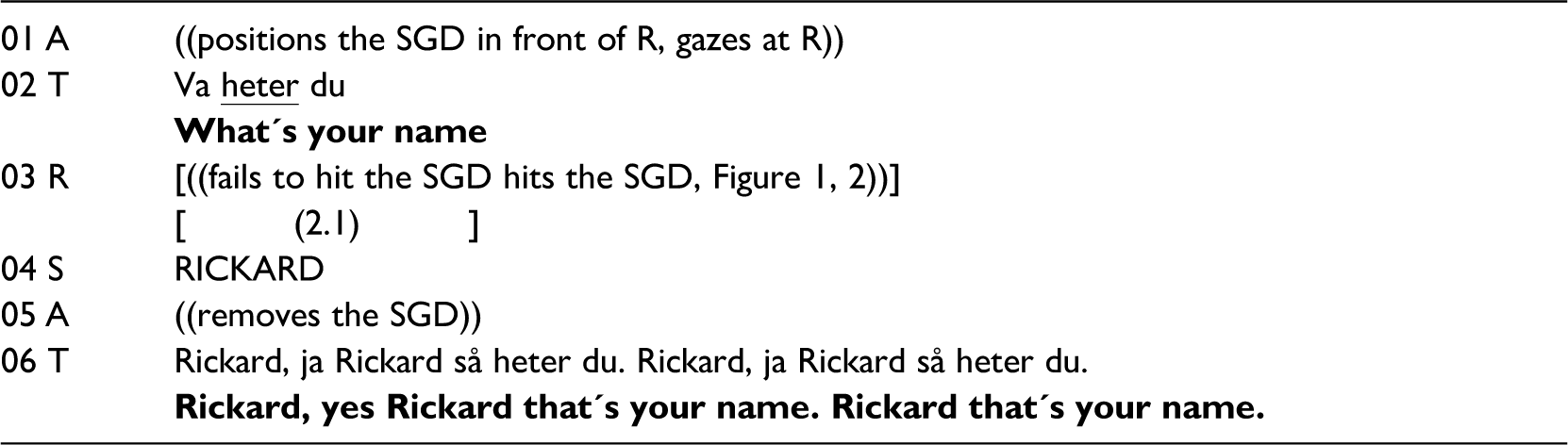
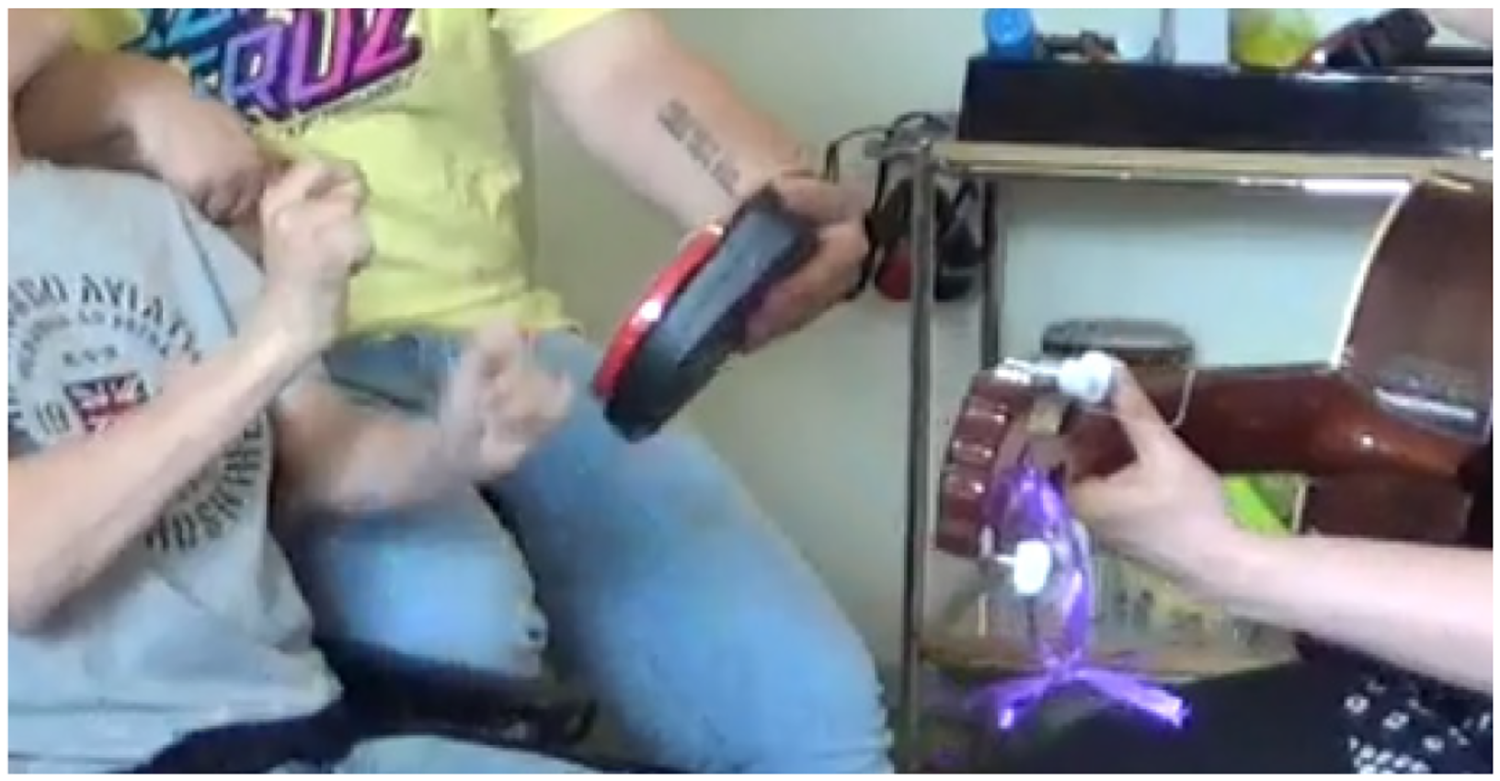
Rickard responds to his name with the speech-generating device (SGD).
The excerpt starts in the middle of a song in which the allocated student is supposed to say his or her name. The teacher produces a singing initiative requesting, ‘What's your name?’ By doing the request, the teacher allocates a slot for Rickard to take the turn. Just preceding the teacher’s turn, Rickard's assistant Adam has picked up and turned on the SGD and placed it in front of Rickard, looking at him. This action clearly orients to the SGD as a relevant resource and the gaze allocates the next turn to Rickard. Rickard produces a response as he touches the SGD that utters ‘Rickard’ (line 4). In line 6, the teacher repeats ‘Rickard’ and adds ‘Yes, Rickard that is your name’ twice, thereby acknowledging Rickard´s response. Even though the teacher's acknowledgement (repeating his name) is a pre-decided line in the song, it resembles the practice of voicing (animating an aided turn) (Sigurd Pilesö and Rasmussen, 2011). By repeating the whole phrase (line 6), the teacher acknowledges Rickard's response and provides a positive evaluation.
Adam's scaffolding practice, positioning the activated SGD with a preferred response within reach for Rickard, creates an ‘agentive discourse’ in which communicative competence can be displayed (Antaki and Crompton, 2015; Killmer et al. 2021). Rickard displays communicative competence and provides a well-timed second pair part of the question-answer sequence as he presses the SGD. He takes up the participatory role of being the student and produces a response without delay. By using the single-message SGD, progressivity but not flexibility is prioritized. Rickard's action presents a very restricted agency even though he aligns sequentially well-timed and presents willingness to take his turn. However, the fact that he has only one possible turn to produce on the SGD, his first name, severely restricts his flexibility and agency. He has no option to produce another word.
Displayed communicative competence and agency responding to a W-question with the multi-message SGD
The next excerpt is from the morning meeting in October in which Rickard uses his multi-message SGD and has the participatory role of teacher, controlling the interaction. The whole class (four classmates, four teaching assistants, the teacher, Rickard and the assistant Adam) are sitting around a square table, Adam is on Rickard's left-hand side and the teacher on his right-hand side. The multi-message SGD is placed on the table in front of Rickard during the whole morning meeting (Figure 4). Adam turns on and off the SGD multiple times during the morning meeting, indicating turn allocation. He poses W- questions such as ‘What are we going to do?’ and ‘Who will do that?’
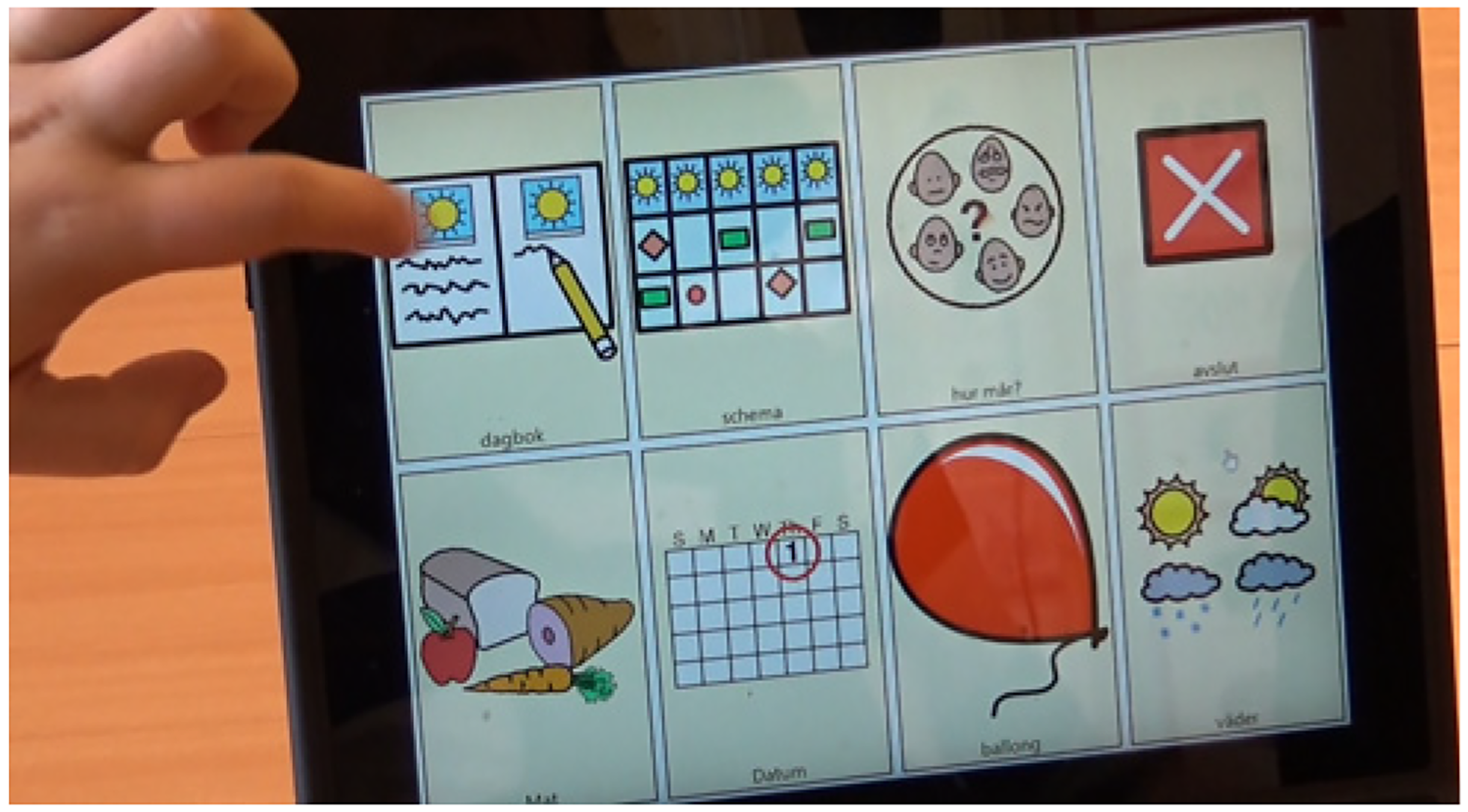
The text under the symbols, upper row: Diary, schedule, how are you? Text under symbols, lower row: food, date, balloon, and weather.
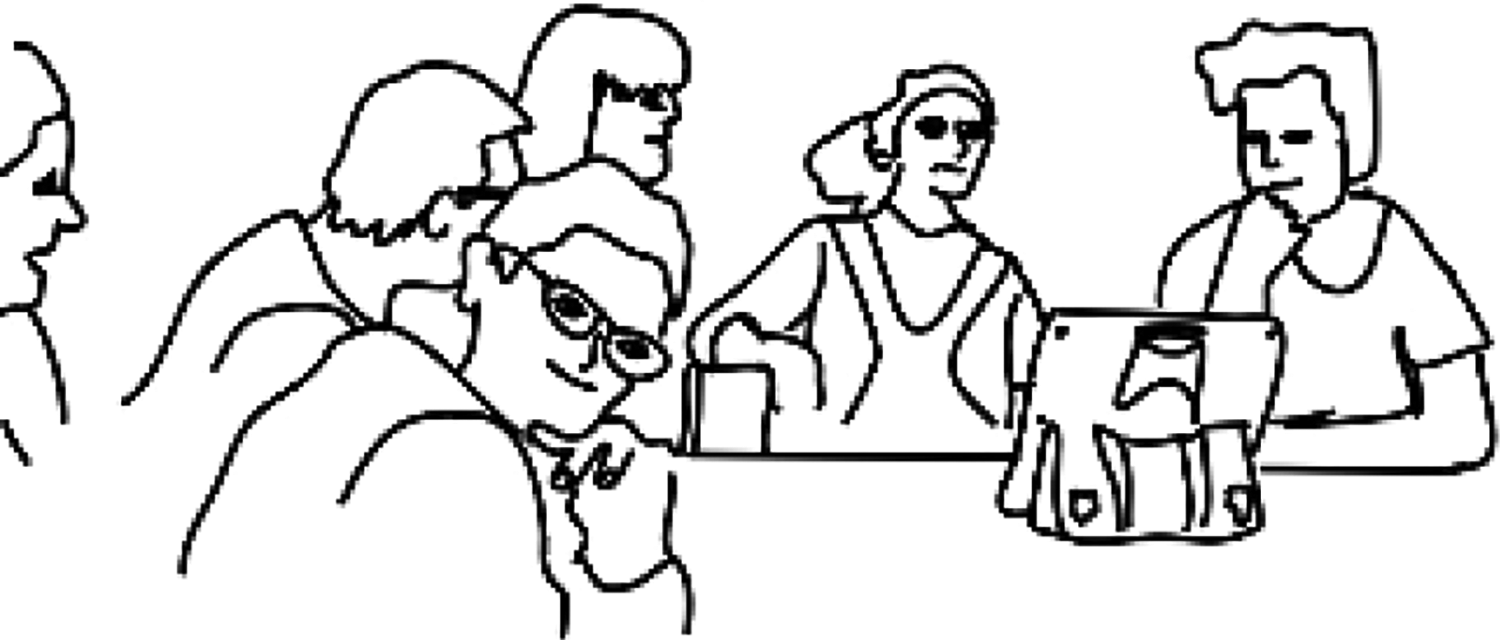
Rickard asks a question.
The following excerpt is drawn from the beginning of the morning meeting where the participants greet each other and share their experiences. Adam has just activated the eye-gaze technology on the SGD and points at the symbol of a POSTCARD representing the question ‘What did you do yesterday?’ Rickard aligns and starts to choose an activity and allocate a classmate as he orients towards the SGD (line 2).
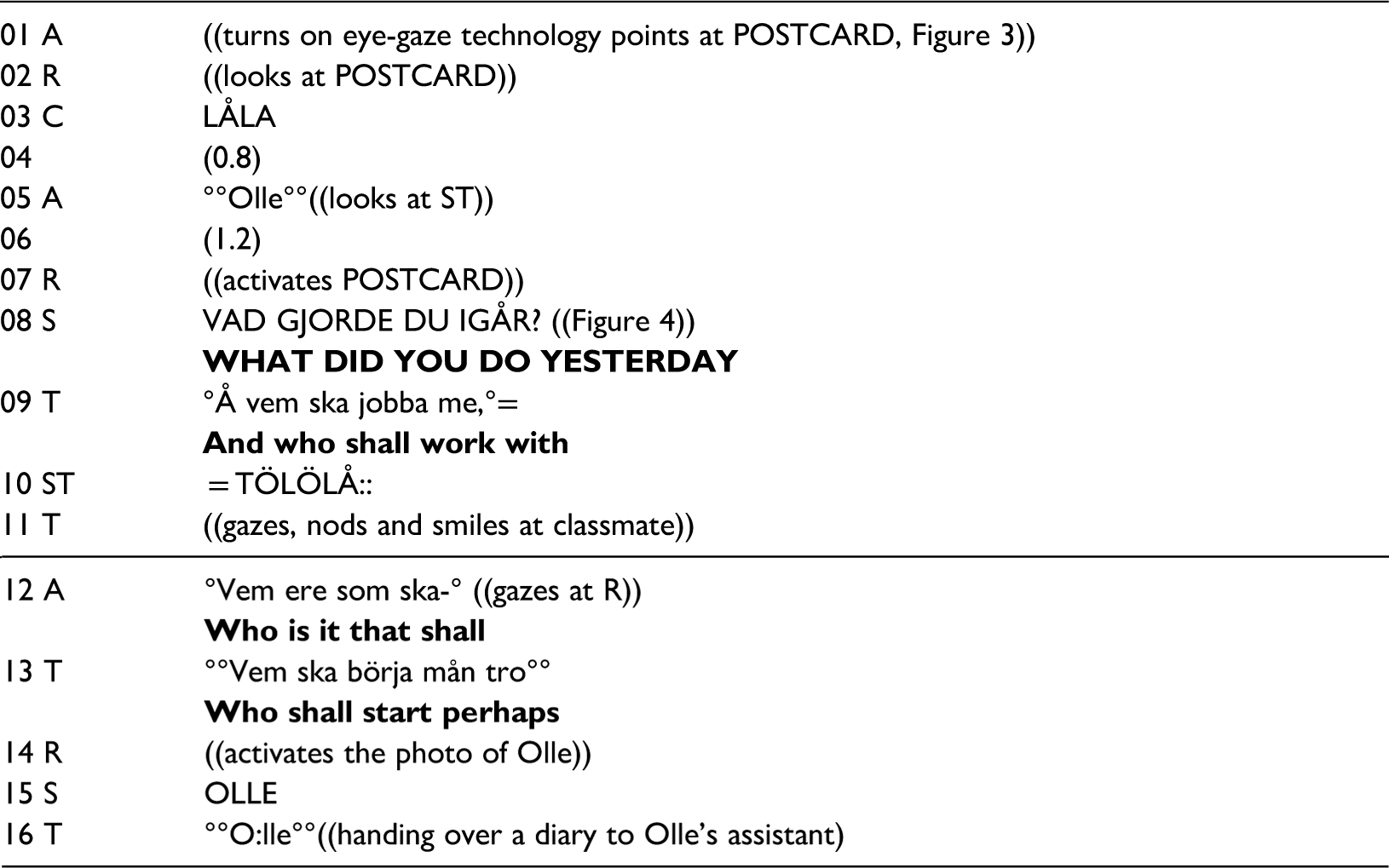
It takes 2 s for Rickard to get the cursor to stand still on the picture and thereby activate the synthetic voice saying ‘What did you do yesterday?’ (lines 2–8). During this period, a side-sequence develops. One of the classmates self-selects and vocalizes loudly (line 3), which one of the teaching assistants voices (reformulates) in a whispering voice (line 5). Rickard manages to activate the synthetic voice (line 8), the screen changes, and a layer with photos of the classmates appears. Next, Adam orients to the second part of the task i.e., assigning a classmate. He orients towards Rickard and asks ‘And who shall work with?’ clearly indicating that allocating a person is a relevant next move (line 9). Once again, a side-sequence develops as the same classmate self-selects again and produces a second vocalization (line 10), which the teacher responds minimally to with gaze and smile. Adam reformulates the question into a cognitive issue, ‘Who shall start perhaps?’ in a whispering voice, thus reallocating the turn to Rickard and including the classmates who are expectantly waiting. As a response, Rickard indicates ‘Olle’ (line 14-15) on the SGD, which the teacher voices and then hands over the diary to Olle's assistant. In doing this, the teacher confirms Rickard's contribution.
Despite two side-sequences, Rickard displays communicative competence in close co-construction with Adam and the teacher who provide him with supportive scaffolding (Bowles et al., 2018). Adam activates eye-gaze technology and points at one of the symbols representing activity within the agenda of the morning meeting. By doing this, he shortens the first part of the two-step allocation practice and thereby decreases the time it takes to produce a contribution. Rickard aligns: He treats Adam's action activating the eye-gaze technology and pointing at one of the symbols as a signal for taking the turn and he commences the two-step allocation practice. This support enables Rickard to display communicative competence as he can carry out the action (telling the activity) despite interrupting classmate. The teacher's supportive scaffolding (i.e., dealing with the self-selecting classmate in a quiet side-sequence) creates an agentive discourse that promotes Rickard with a prolonged response space. The multi-message SGD offers Rickard an opportunity to compose a variety of contributions (flexibility) and the participatory role prolongs the interactional floor as the task is two-parted. However, Adam's curriculum support in the first step of the two-step process (choosing an activity, line 1) might be viewed as a deontic action that restricts Rickard's agency. He takes advantage of his moral right to suggest for Rickard what task to choose, which might be viewed as restricting Rickard's agency. The action works in a directorial fashion and does not promote independency and flexibility. The second part of the two-step task, allocating a classmate, however, yields greater opportunity for Rickard to display agency. The teacher and Adam continue to provide Rickard with scaffolding support as they take turns in updating Rickard's turn, providing Rickard with a communicative space and dealing with the self-selecting classmate. By doing this, they create an agentive discourse that promotes Rickard's opportunities to demonstrate responsibility and accountability in performing the participatory role of the teacher. He activates one of the photos and allocates a classmate. By doing this, he presents willingness to undertake the task and he displays knowledge of what is expected of him (allocating a classmate). In sum, Rickard displays communicative competence and agency in terms of accountability. However, agency in terms of flexibility is partially limited.
The accomplishment of other-initiated self-repair
The repair sequences in this study were all other-initiated, which mirrors previous research on repair in SGD-mediated interaction. For example, Norén et al. (2013) examined the interaction between a teacher and non-speaking student using an SGD. They found that other-initiated self-repair initiated by the teacher restricted the student's fluency and prevented the student from changing the topic. In another study, Clarke and Wilkinson (2008) analysed the interaction between a speaking student and his non-speaking classmate using an SGD. They found that the SGD-related problem sources were other-initiated but jointly solved. The speaking peer's actions were affiliative and displayed a similar stance towards the problematic turn as the non-speaking peer.
Displayed communicative competence and agency doing self-repair with the single-message SGD
The following excerpt is from the morning meeting in June in which Rickard uses his single-message SGD. The SGD is turned off and placed under Rickard's wheelchair. The teacher's polar question ‘Shall I blow more?’ (line 1) is latched with Adam's test question (line 2). Hence, it is unclear to which question Rickard responds (line 3).
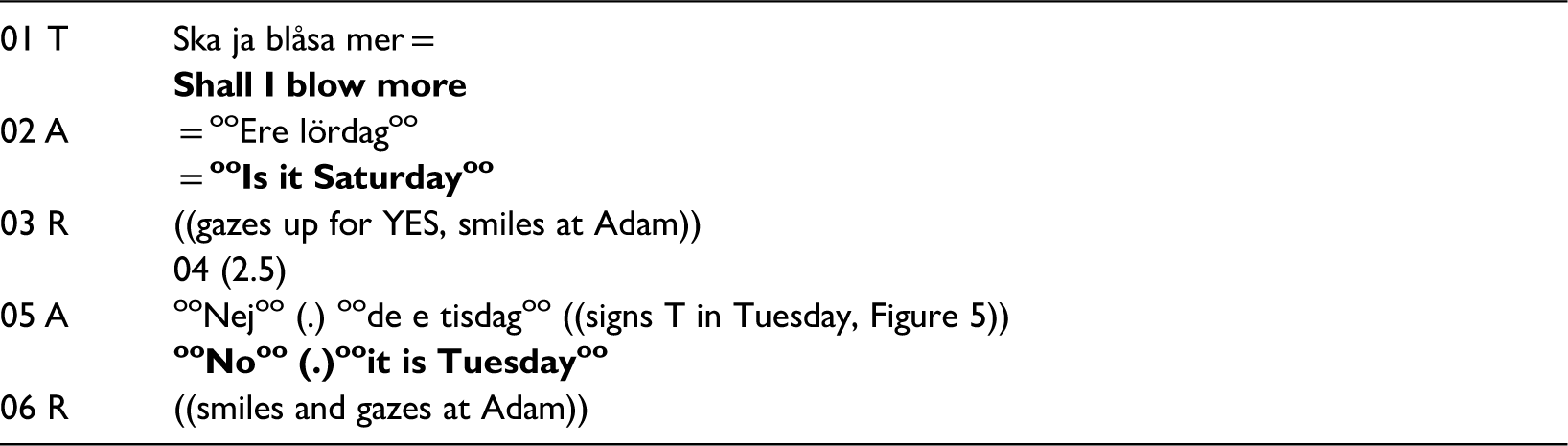
Adam provides other-initiated other-repair.
Adam's test question ‘Is it Saturday?’ is not contextually relevant. The question is delivered in a whispering voice in the middle of the task of blowing a balloon. Rickard can confirm or deny with embodied resources (i.e., gaze upwards for YES and downwards for NO). He does not have access to his single-message SGD with his name as the prerecorded message, but responds ‘Yes’ by gazing upwards. It is not possible to know to whom he responds. The assistant does not voice Rickard's response, which is otherwise a systematic pattern in our data. Instead, he identifies the trouble source as he produces other-initiated other-repair ‘No it is Tuesday’ and Rickard is not offered the possibility of accomplishing self-repair.
Adam treats Rickard's response as problematic and initiates a repair. The teacher does not evaluate Rickard's response. Adam's request is produced in a whispering voice and she might not hear it. Yet, by doing other-initiated other-repair, Rickard is not provided with an opportunity to display communicative competence. Neither Adam nor the teachers provide Rickard with scaffolding to do a self-repair. Regarding agency (in terms of accountability and flexibility), Rickard does not make a self-repair or add something. Without the multi-message SGD, his possibility (flexibility) to compose a turn with elaborated linguistic content is restricted.
Displayed communicative competence and agency doing self-repair with the multi-message SGD
We will now examine Rickard's opportunity to carry out repair actions with his multi-message SGD. When the excerpt starts, the morning meeting in October has progressed for 22 min and Rickard has just activated the picture FOOD and the SGD utters ‘What's for lunch?’ Rickard's next action is to allocate a classmate.
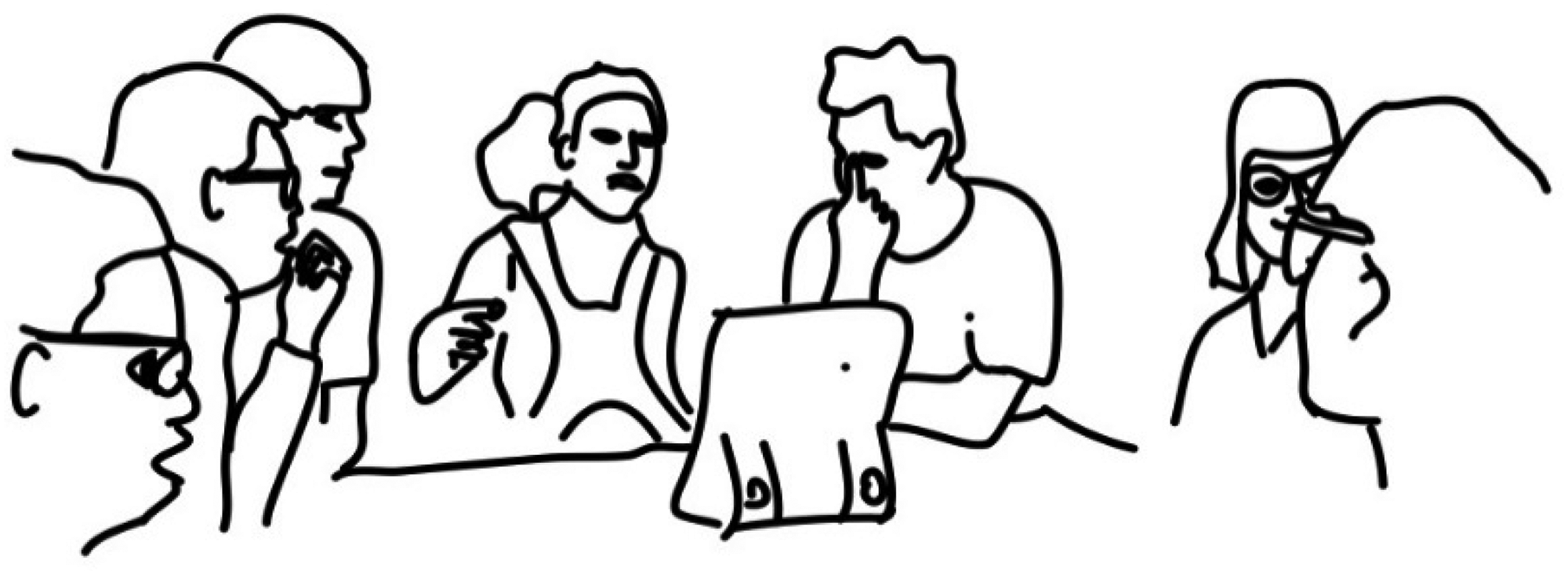
Adam repeats the question.
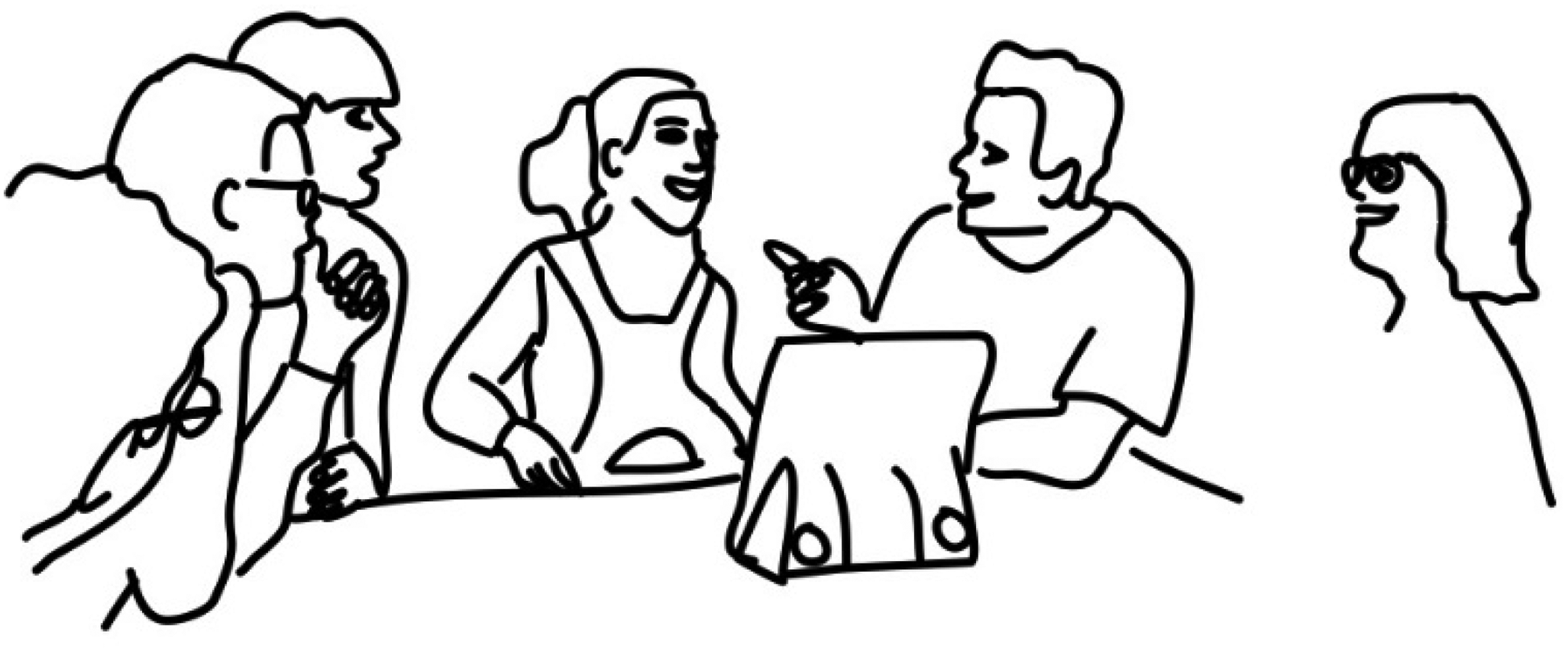
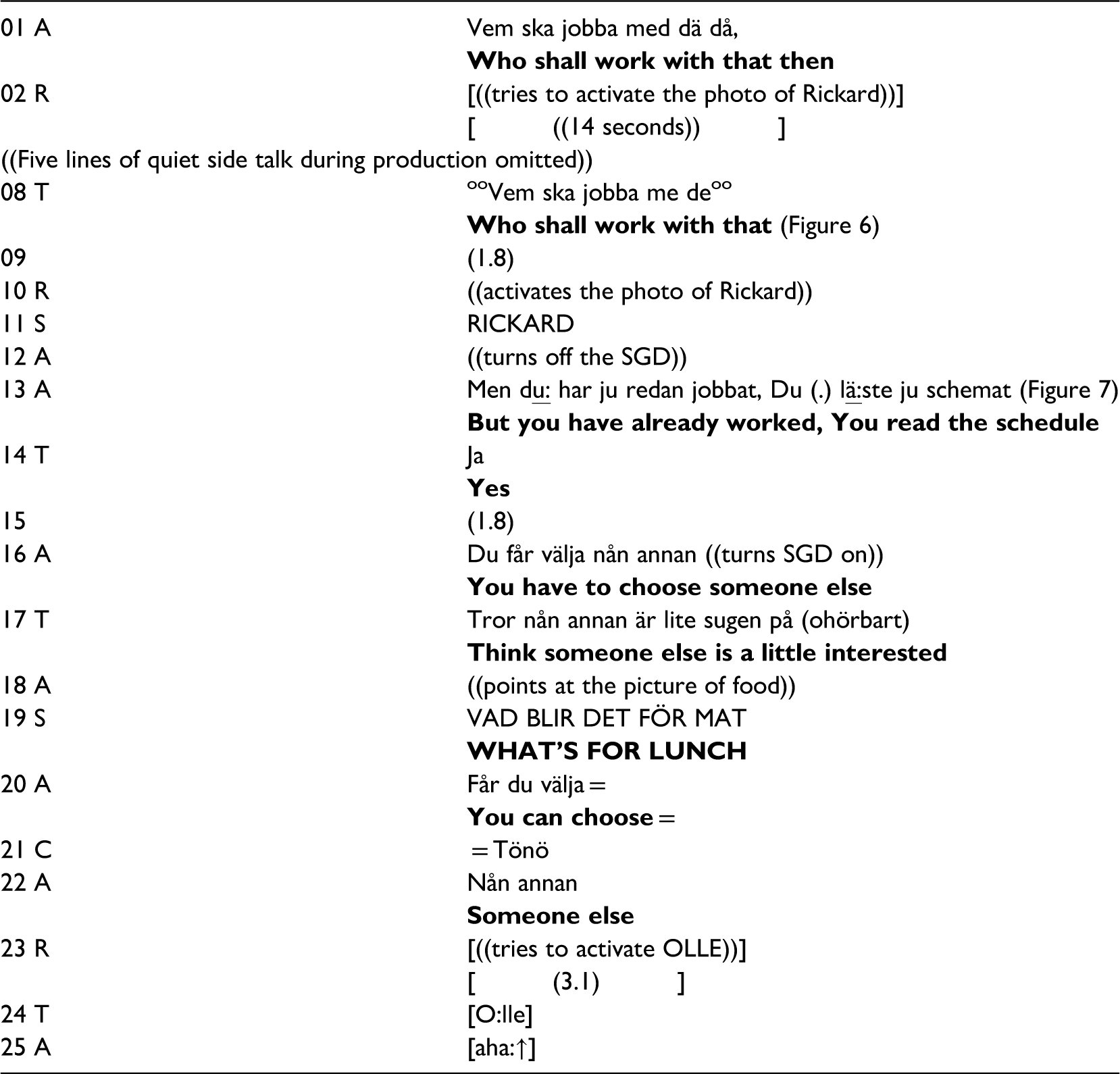
Adam comments that Rickard has already worked.
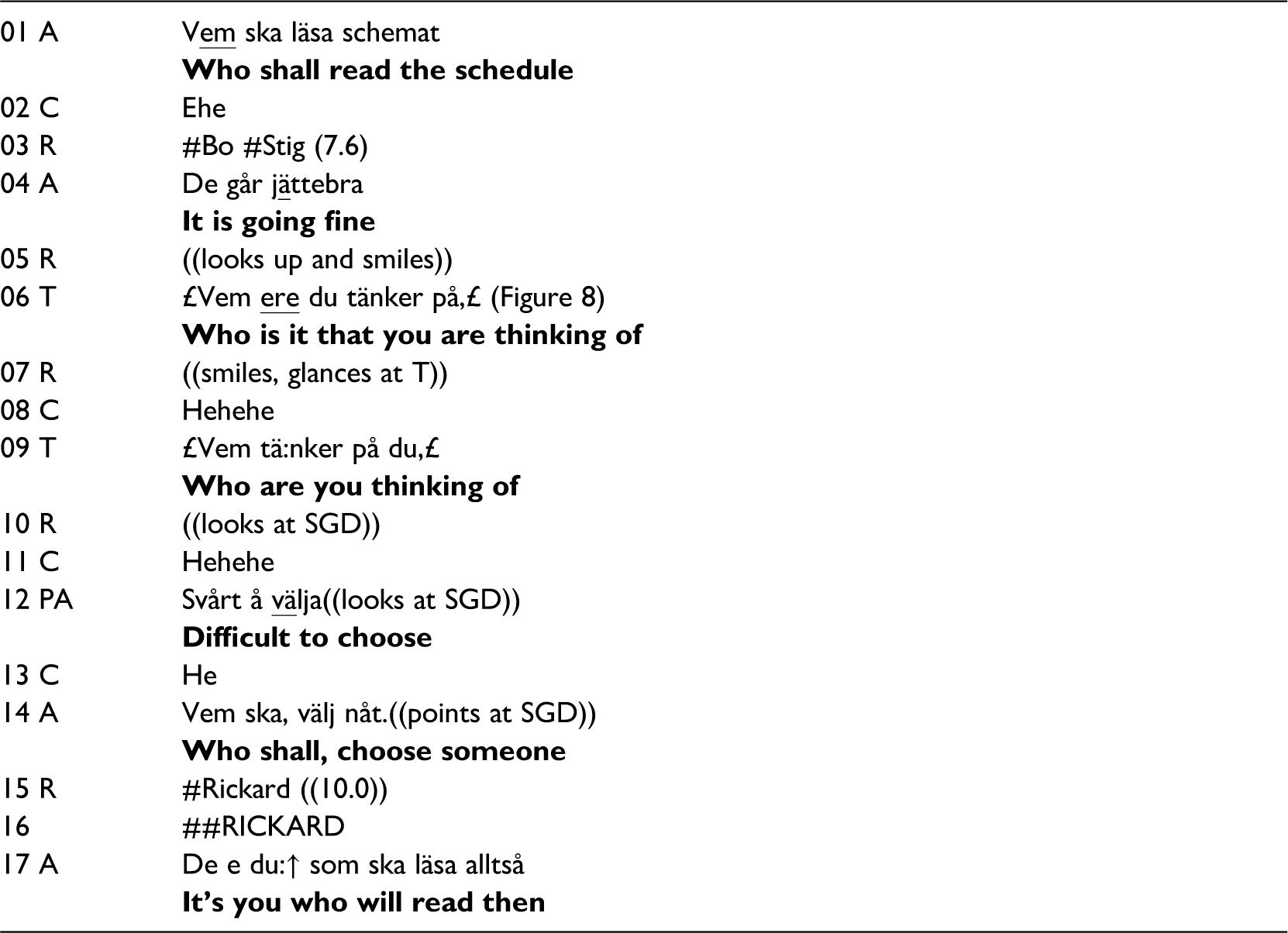
Adam asks ‘Who shall work with that then?’ (line 1), thereby doing a request for information: Who will Rickard allocate? Rickard orients towards the SGD and tries to get the cursor to stand still on his own name for 16 s before the synthetic voice says ‘Rickard’. Adam identifies the response as problematic and initiates a self-repair action in two steps. First, he turns off the eye-gaze technology (line 12) and objects ‘But you have already worked. You read the schedule’ (line 13) indicating that Rickard´s reply is problematic. The objection refers to the allocation rules: all classmates should be allocated turns equally. By doing a self-selection after already having carried out one of the tasks, Rickard breaks this rule. The teacher aligns with Adam's objection with a minimal confirmation ‘Yes’ (line 14). Second, Adam reformulates the initiative to a deontic construction demanding Rickard ‘You have to choose someone else’ (line 16). By doing this, Adam adopts a repair scaffolding role that provides Rickard with a communicative space to conduct the self-repair. The teacher aligns and provides emotional and relational supportive scaffolding (Radford et al., 2015) suggesting ‘[I] think that someone else is a little interested’ (line 17). Adam touches the picture FOOD on the screen and the synthetic voice once again utters ‘What's for lunch?’ The layer on the SGD screen changes to the photos of classmates. By doing this, Adam scaffolds Rickard to do a self-repair. He identifies Rickard's contribution as problematic and demands Rickard to do a self-repair ‘You have to choose someone else’ (lines 20 and 22). Repair actions, right after identification of problem sources, can enhance students’ social, emotional and linguistic ability (Radford et al., 2015). Hence, providing students with opportunities to do self-repair is important for their development and their possibility to solve problems. Rickard aligns with Adam's demand and selects ‘Olle’, which the teacher confirms by voicing his response in overlap with Adam who acknowledges his choice by a minimal response produced with final pitch rise indicating surprise and approval.
The analysis shows how Rickard can display communicative competence doing a self-repair action in co-construction with the assistant's and the teacher's scaffolding practices. They treat Rickard's self-selection as a problematic contribution, rather than for example as a possible joke. The assistant produces a deontic construction that clearly restricts Rickard's response alternatives and the teacher produces a turn that relates to the emic perspective of the classmates: she appeals to Rickard's ability to recognize the classmates’ expectations. Rickard is required to perform a repair action within the assistant's and the teacher's scaffolding support. In terms of agency, Rickard displays willingness to accomplish the repair action. He aligns to the demand of next selecting someone else. The SGD, along with the verbal prompts to choose, provide him with the flexibility to provide a variety of responses and he chooses one that is contextually relevant. Similar to excerpt 2, the participatory role of being the teacher prologues Rickard's interactional floor: He is provided with the opportunity to do a self-repair after the two-step allocation process. In contrast to excerpt 1, which illustrates progression by the use of the single-message SGD, the multi-message SGD scaffolds multiple opportunities to produce a contribution.
Time composing a turn
We will now explore how the different time composing a turn affected Rickard's displayed communicative competence and agency. Producing an SGD-mediated contribution is hard work and often takes much longer time than responding with speech (Higginbotham and Wilkins, 1999; Savolainen et al. 2020). In order to compare the single-message with the multi-message SGD, we need to return to excerpt 1 since the single-message SGD was only used once.
Displayed communicative competence and agency during turn composing with the single-message SGD
As mentioned above, the first excerpt (1) took place in the first-morning meeting in June. All students were sitting in a circle with the teacher in the middle. The teacher was playing the guitar, singing a name song to one student at a time.
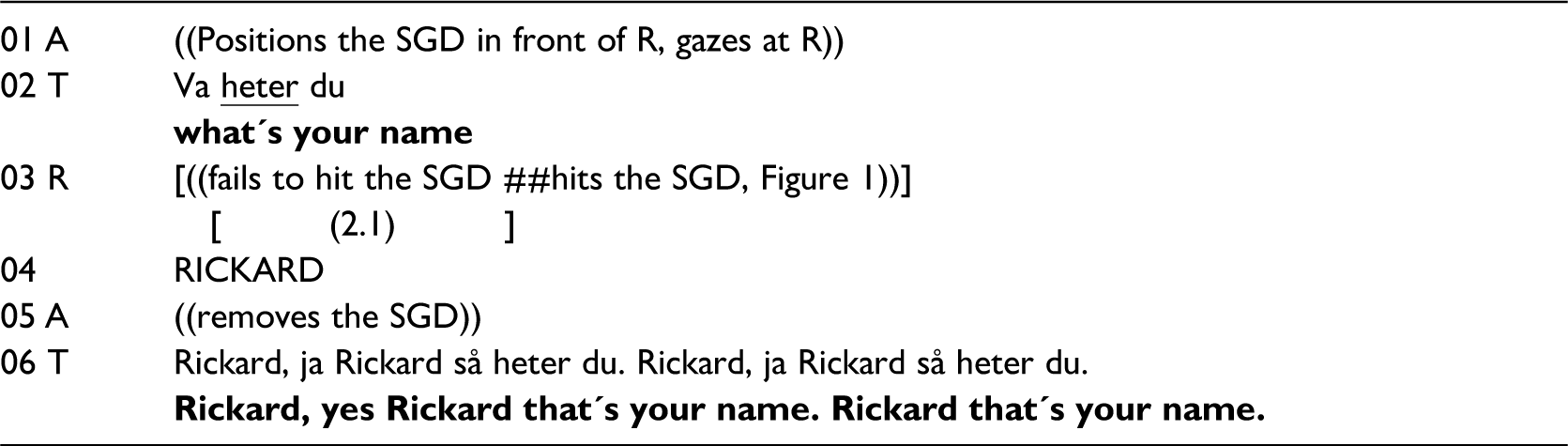
The teacher's request ‘what's your name?’ is oriented towards Rickard. The assistant Adam positions the single-message SGD (with Rickard's name) within reach for Rickard to activate it. By doing this, he scaffolds an opportunity for Rickard to produce a well-timed response. Due to Rickard's physical impairment, it takes him two seconds to compose his turn.
The use of the single-message SGD, provided Rickard with an opportunity to display communicative competence as he produced a predicted response within the expected time. The SGD enabled progression of the interaction, but not flexibility. Hence, using the single-message SGD restricted Rickard's agency in terms of flexibility but not in terms of accountability. Rickard had no option to change his contribution and he could not be sure what was pre-recorded on the SGD.
Displayed communicative competence and agency during turn composing with the multi-message SGD
Composing a turn with the multi-message SGD was often a prolonged project that was richly scaffolded by Adam and the teacher. The following excerpt (5) illustrates one of the longest composition processes. Rickard has chosen the task of reading the schedule and Adam asks ‘Who shall read the schedule?’, hence doing a request for Rickard to do the second part of the allocation practice: assigning someone.
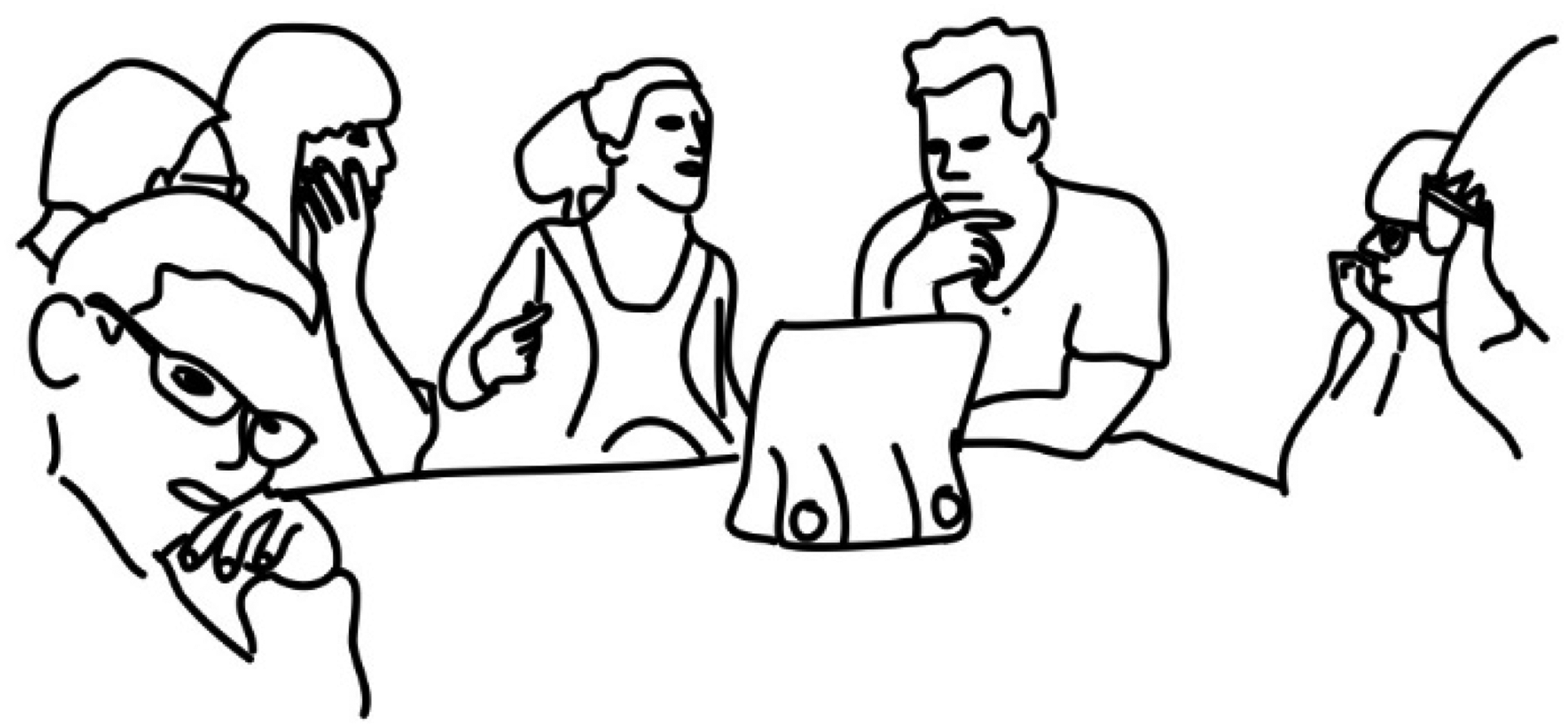
The teacher asks ‘Who are you thinking of?’.
Similar to excerpt 2, one of the classmates vocalizes during the prolonged composition time: he produces anticipatory laughter (lines 2, 8, 11, 13). This does not interrupt the composition process (Rickard continues to orient towards the SGD) but Rickard has great difficulties getting the cursor to stand still long enough to activate a photo with the interconnected synthetic voice. The assistant and the teacher, but no one else, can see the screen and Rickard's attempts to allocate two classmates (line 3). After seven seconds, Adam and the teacher provide Rickard with supportive scaffolding. Adam confirms ‘It is going fine’ (line 4), a kind of emotional support to which Rickard responds with a smile. The teacher adds in a smiley voice ‘Who is it that you are thinking of?’ (lines 6), which identifies the absent response as a cognitive issue. Rickard continues to orient towards the SGD and Adam presents an account for the delay ‘Difficult to choose’, also orienting to the missing response as a cognitive issue (line 12). The supportive scaffolding works relationally: it helps the classmates to listen to each other. Adam upgrades his request by pointing at the SGD demanding Rickard to choose someone ‘Who shall [it be] choose someone’ (line 14). Until now, Rickard has tried to allocate a classmate but now he has the cursor on his own photo and name. Rickard succeeds after 10 s to activate his own name (line 16), which is a self-selection. The heuristic scaffolding support, encouraging Rickard to use his own strategies, presents Rickard as a knowledgeable person. Adam presents a candidate understanding ‘It's you who will read then’ (line 17). The question is produced with stress and pitch rise on ‘you’, possibly indicating that Rickard's choice is new to Adam.
The analysis shows that Rickard can display communicative competence despite the prolonged production process, thanks to the teacher's and the assistant's supportive and heuristic scaffolding (Bowles et al., 2018) and the classmates’ acceptance of turn-taking rules. The assistant and the teacher provide Rickard with supportive scaffolding, creating a communicative space, in the shape of meta-cognitive turns and agentive discourse, referring to Rickard's hard work in getting the marker to stand still. The scaffolding practices and the participatory role create a prolonged interaction sequence in which Rickard can produce his contribution. It also makes it obvious for the classmates who are allocated not claiming the turn. The teacher's and the assistant's scaffolding commenting on Rickard's attempts is needed because neither the classmates nor the assistants can see the screen. The scaffolding practices do not only support Rickard in his attempts, but also the classmates and the assistants who are notified that Rickard is trying to produce a contribution. Regarding agency: Rickard has the flexibility to choose among all classmates when answering. We can see in line 3 that he tries to allocate two classmates but fails because he cannot control the eye-gaze technology fully and this restricts his displayed flexibility. Yet, we can see that he is willing to take on the task (accountability): he tries to allocate a person for 17 s.
Concluding discussion
In this study, we have demonstrated that the single-message SGD provided the student with the best opportunity to display sequentially and well-timed communicative competence when responding to a W-question while the multi-message SGD provided the student with a better opportunity to display both communicative competence and agency not only when responding to questions but also doing repair actions. While the single-message SGD promoted progression of interaction, the multi-message SGD enhanced flexibility and thereby agency.
The analysis also indicated that Rickard's agency was unrestricted in terms of accountability and willingness using both SGDs, but it was restricted in terms of flexibility. Even though Rickard had more response options using his multi-message SGD, his flexibility was restricted due to difficulties in managing eye-gaze technology and the limited pre-chosen response options on the SGD. The interactions in both morning meetings were highly dependent on the two teachers’ and the assistant's emotional, relational, supportive, and physical scaffolding practices. They made physical arrangements in order for Rickard to be able to use his SGDs and they commented on his protracted attempts to activate symbols. This guided the classmates in the prolonged composition process and updated the turn for Rickard repeatedly. The practice of assigning students the participatory role of the teacher resulted in many more opportunities for the student to take and retain a turn and to display communicative competence and agency. The student's displayed communicative competence and agency was a product of the close collaboration between Rickard and his assistant and teachers scaffolding the interaction. Thanks to the assistant's and teachers’ scaffolding of the interactional organization, Rickard was allowed to practice his skills in a meaningful way and thereby develop and display communicative competence and agency.
The finding that W-questions with restricted response options rather than open-ended questions created opportunities for the student to display communicative competence echoes previous research (Tegler et al. 2020). The questioning format, the continuers and the scaffolding yield opportunities for the student to control the turn, which mirrors Antaki and Crompton (2015) who found that supportive actions can create an agentive discourse in which individuals with disabilities are able to display communicative competence and agency. As Killmer et al. (2021) suggested, the opportunity to display agency succeeds presenting communicative competence: our analysis showed that agency in SGD-mediated interaction assumed communicative competence.
In sum, the findings of this study highlight three influencing factors that can be useful for teachers and assistants when planning for augmenting the display of communicative competence and agency with an SGD in the classroom. First, if students with severe speech and language disabilities display physical, cognitive and/or linguistic ability, it is crucial to consider offering them SGDs with multi-message opportunities because without multiple choices a student's agency is severely restricted. In the best possible situation, there are cases where flexibility and agency can be prioritized before progressivity. Second, scaffolding practices are fundamental in SGD-mediated classroom interaction. They guide classmates during silent composition as they update the turn and encourage non-speaking students to continue their SGD-mediated turn. Moreover, scaffolding practices prolong non-speaking students’ interactional floor and create knowledgeable and accountable non-speaking students. Third, the practice of assigning students the participatory role of the teacher gives students rights that prolong the interactional floor in which students are provided with multiple learning situations.
The findings cannot be generalized to a larger population since they are based on one student´s participation in two morning meetings. However, we believe that it highlights the influence of different SGDs, different participatory roles on communicative competence and agency, including the importance of scaffolding practices. The data is collected in an everyday setting which adds validity to the study. Therefore, the study contributes to enhance our knowledge on SGD-mediated interaction in classroom settings.
Footnotes
Acknowledgements
The authors thank the participating student, teacher and assistant.
Author’s Note
Helena Tegler, School of Education, Culture and Communication, Division of Special Needs Education, Mälardalen University, Västerås, Sweden.
Declaration of Conflicting Interests
The author(s) declared no potential conflicts of interest with respect to the research, authorship, and/or publication of this article.
Ethical approval
The Swedish Ethical Review Authority approved the study (2021-05340-01).
Funding
The author(s) received the following financial support for the research, authorship, and/or publication of this article: This work was supported by the Swedish Research Council for Health, Working Life and Welfare (grant number 2021-01240) and the Foundation of Norrbacka-Eugenia (grant number 849/21) and Swedish grant FORTE (STY-2021/0001).
Informed consent
Written informed consent for this study was obtained prior video recording from caregivers, teachers and assistants.
