




Abstract
Language disorder (LD) is a common childhood condition affecting language development, which can in turn impact children's peer relationships. Although most children with LD are included in mainstream classrooms, there is limited knowledge about the way friendships support or hinder the learning experiences of children with LD in inclusive settings. Typically developing (TD) peers’ views tend to get overlooked when considering inclusion but they need to be heard as they too adapt to inclusive classrooms. In this small-scale study, we explored the perspectives of peers on their friendship quality with children with LD. We conducted friendship interviews with classroom friends (n = 9) of 6–8-year-old children with LD (n = 9), who attended the enhanced provision and mainstream classrooms in the United Kingdom and the Republic of Ireland. We used sociometric nomination methods to identify the reciprocal friends of children with LD. We then interviewed these friends using art-based methods and analysed our interview data using thematic framework. Friends of children with LD attending the enhanced provision showed an inclusive mindset and revealed their own strategies for overcoming potential communication barriers. In contrast, friends in full-time mainstream classrooms did not report experiencing communication difficulties when interacting with a peer with LD. We conclude that educational practice should build on those inclusion strategies that children find natural and consider the importance of teaching all children about adjustments that can support inclusion of those with communication difficulties.
Keywords
I Introduction
In an average class of 30, approximately 2 children experience language difficulties at a clinical level (Norbury et al., 2016; Tomblin et al., 1997). Language disorder (LD) denotes limited abilities to use and/or understand language. LD can occur without a known cause (developmental language disorder, DLD) or can be associated with potential biomedical conditions (e.g. intellectual disability, hearing loss, autism spectrum disorder) (Norbury et al., 2016). LD presents academic challenges to affected children, who often face co-occurring literacy and learning difficulties (Bishop and Snowling, 2004; Dockrell and Lindsay, 2004). In addition, LD places children at risk of social, behavioural and emotional problems (Yew and O’Kearney, 2012) that often manifest in poor peer relationships (e.g. Forrest et al., 2021; Laws et al., 2012). In the United Kingdom (UK) and the Republic of Ireland (RoI), children with LD have been traditionally supported through the enhanced provision and specialist speech and communication classrooms with tailored education programmes. However, an ongoing emphasis on inclusion brings challenges as inclusive settings must support children's learning as well as their social functioning.
Moving towards inclusive education stems from the United Nations’ (UN, 2006, p. 17) efforts to seek ‘inclusive, quality and free’ education for people with disabilities, so that they have equal learning opportunities to others within their communities. Countries, including the United Kingdom and the RoI, have translated this human right into mainstream schooling policies but the effectiveness of inclusive education in practice needs to be assessed more systematically (Kenny et al., 2020; Lindsay, 2007). Implementing inclusive schooling is a complex process, which we can understand better if we consider the perspectives of the main actors – children. Peer interactions and friendships are key to children's social functioning, yet peer relationships studies of children with LD scarcely involve children as active informants (Janik Blaskova and Gibson, 2021). Therefore, this investigation promotes the voice of typically developing (TD) peers, who are essential to the social adjustment of children with LD, and who also need to adapt to inclusive settings.
Research shows that children with LD are poorly accepted by peers and tend to have fewer reciprocal friends than TD children (e.g. Andrés-Roqueta et al., 2016; Gertner et al., 1994; Fujiki et al., 1999; Laws et al., 2012). Children with LD initiate and respond to peers less frequently than their TD peers, and instead, they show more withdrawn and non-social play behaviours (Guralnick et al., 1996; Hadley and Rice, 1991). In self-reports and interviews, children with LD confirm being aware of their peer difficulties (e.g. Jerome et al., 2002; Lindsay et al., 2008). Experiencing higher levels of victimisation and lower peer support in comparison to their TD peers (e.g. McCormack et al., 2011; Redmond, 2011), children with LD consider friendships as crucial to their perceived quality of life (Lyons and Roulstone, 2018; Nicola and Watter, 2018). This evidence highlights that children with LD find their social wellbeing important and keep facing peer relationship difficulties in school.
What we do know about the way peers perceive children with LD comes from observation studies that complement previously outlined findings from peer and friendship nominations. Peers tend to preferentially choose to interact with TD children and not with children with LD (Guralnick et al., 1996; Rice, 1991). Children with LD and speech impairments can be ignored twice as often as their TD peers (Hadley and Rice, 1991). However, interventions have shown a potential to change the low frequency of interactions. Training teachers in redirecting help seeking requests from children with LD to peers, increased peers’ positive or neutral responses to children with LD (Schuele et al., 1995). In newly formed playgroups of children with mixed language abilities, all children had similar friendship experiences and peer selected children with LD as friends at similar levels to other TD children (Guralnick et al., 1996). This suggests that peers may not necessarily see limited language abilities as a barrier to making friends with children with LD and that other factors could hinder the social integration of children with LD (Guralnick et al., 1996).
Dyadic and triadic observations show the potential of peer support to scaffold children with LD in peer interactions (Brinton et al., 2000) and could potentially mediate interventions enhancing the communication of children with LD (DeKroon et al., 2002; Murphy et al., 2014; Robertson and Weismer, 1997). In further efforts to design peer-facilitated interventions, potential impact on peers needs to be considered. Observations reveal that TD children make more low-quality requests and talk more about negative feelings when interacting with children with LD compared to interacting with TD peers (Murphy et al., 2014). Still, knowing how peers perceive children with LD as friends presents a crucial piece of information for planning any therapeutic or educational interventions and creating truly inclusive settings.
Peer nominations, reciprocal friendship data and observations give some indications of how peers consider children with LD as friends, but we lack the specific aspects that peers appreciate or do not like in children with LD. Our small-scale study aims to identify a number of potential areas to investigate on a large scale. By talking to peers, we aspire to find answers to the following research questions:
How do TD peers perceive children with LD as friends? Is the friendship quality between children with LD and TD peers influenced by the language and communication difficulties of children with LD?
Answers to the above questions will contribute to a more thorough picture of peer relationships of children with LD.
II Method
The current study is part of a broader project investigating the peer relationships of children with LD in series of case studies. It received ethical approval from the University of Cambridge and the Health Research Authority, who supported the recruitment. We identified participating children by contacting primary schools, LD supporting charities and organisations via social media, emails and in person during conferences.
We adopted a qualitative approach to understand the subjective experiences and perceptions of children with LD and their peers. This article analyses sociometric nominations and interviews conducted with classroom friends (n = 9) of children with LD (n = 9). We consider friends as active informants about children with LD, who are the focus of our study.
Participants
Participating children with LD attend the enhanced provision and mainstream primary schools in the United Kingdom and the RoI. In the enhanced provision, children with LD join a specialist language and communication class in the morning. The morning class has maximum of eight children, receiving interventions to improve their speech, language and communication. In the afternoons, children join their mainstream classroom and curriculum.
Children with LD in the mainstream settings attend the mainstream classroom full-time and receive speech, language and communication interventions on a pull-out basis.
Children who presented with LD due to a known mitigating medical condition or syndrome were excluded from the study.
Data collection
Data collection took place from March to November 2019. We visited schools on an average of eight different occasions to collect data about each child with LD. We collected data from observations, interviews, linguistic and sociometric assessments.
Following sociometric assessments, we paired children with LD with a classroom friend, whom we interviewed twice. We conducted friendship and retrospective interviews. We enquired about a dyadic play recording and validated our preliminary findings.
Standardised language and NVIQ assessments
Psycholinguistic data about children with LD was collected in a number of 10–15-min meetings. We used Ravens progressive matrices to collect performance IQ data and calculated percentile of the raw score (Raven et al., 2004). Our language battery included sentence comprehension and naming tasks from the Assessment of Comprehension and Expression 6–11 (Adams et al., 2001) and sentence recall from the Clinical Evaluation of Language Fundamentals Assessment of Comprehension (Semel et al., 2006). The psycholinguistic details served as a background information about children with LD.
Sociometric assessment
We used peer nomination and reciprocal friendship measures to establish how mainstream classroom peers perceive children with LD. In peer nomination, children gave three names of peers they like to play with most and three of the least preferred peers (Coie et al., 1982). We followed the Coie and Dodge (1983) method to identify the social status categories of rejected, popular, neglected, controversial and average.
In addition, we identified reciprocal friends by asking children to list their three best friends and cross-referencing their responses (Sanderson and Siegal, 1995). In case of no reciprocal nomination, we expanded the criteria to best friend nominations regardless of reciprocity and consulted teachers to identify a peer who interacts with the child with LD most of the time.
Interviewing children
We invited identified friends to interviews that commenced with art-based activities. First, we demonstrated the circle of friends activity illustrated in Figure 1.
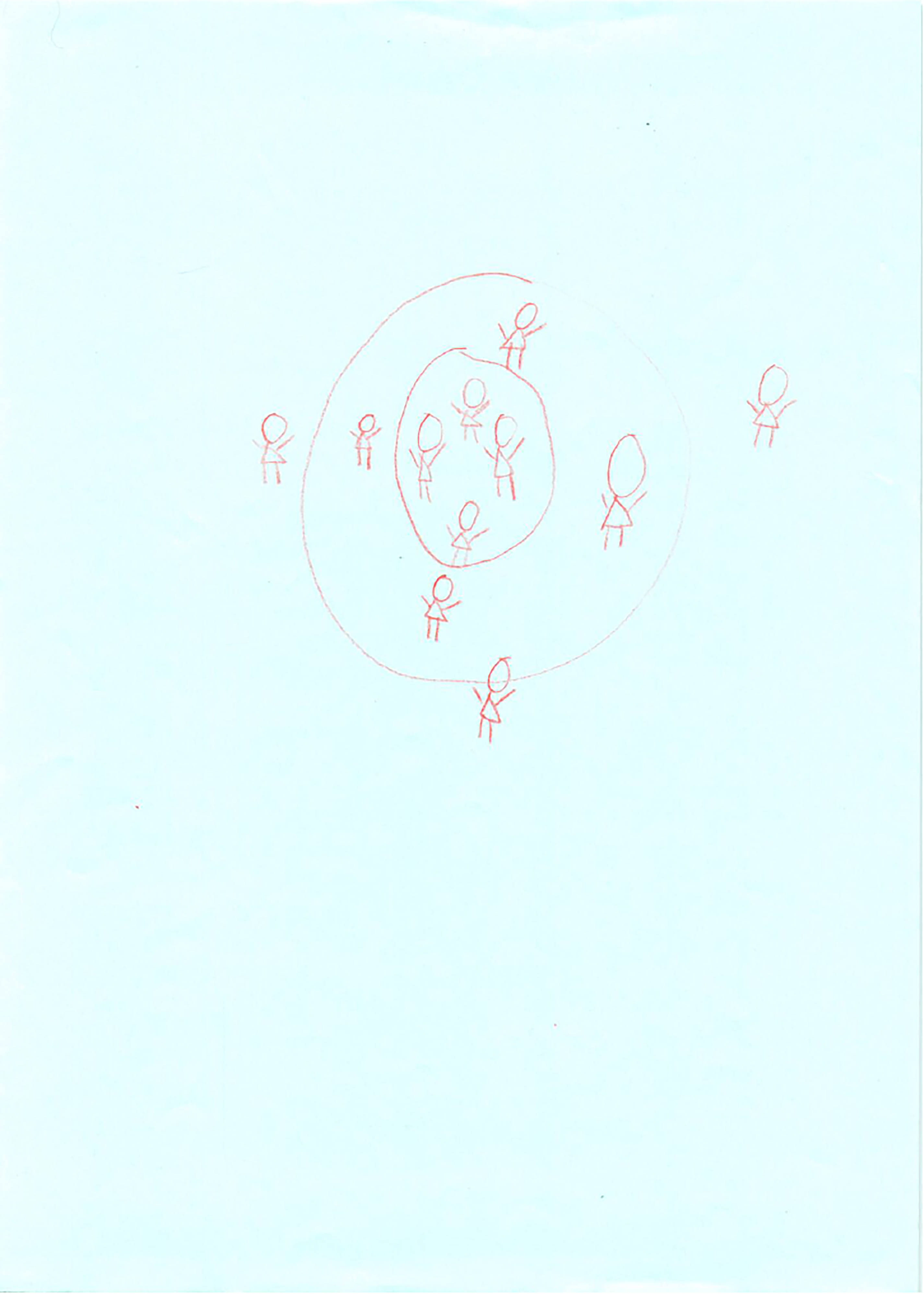
Circle of friends by the friend of CH10.
We drew ourselves in the middle and described our school friends while drawing them closer or further from us, depending how we liked or did not like playing with them. Afterwards, we invited children to draw and describe their own circle of friends from the classroom. This activity sought to confirm that they actually were friends with the child with LD. If the interviewed friend did not mention the child with LD, we specifically asked about them.
Next, we invited children to portray the child with LD using coloured papers, crayons, stickers and other art and craft items. As they were doing the activity, we asked about the child with LD following the friendship quality interview guide of Dunn, Cutting, and Fisher (2002) and supplementary probes (available as Supplemental material).
Additionally, we asked friends about their communication with children with LD. We formulated this interview question in a rather informal manner, relating to the researcher's own experiences:
You know, sometimes I find it difficult talking to [name of a child with LD]. Sometimes I don’t really understand what they say…Has it ever happened to you? Have you had any difficulties, maybe, understanding [name of a child with LD]?
Initially, we were concerned about friends conforming with our experiences; however, this was not the case. Friends' responses varied and described friends' own experiences.
Interviewing children needs specific ethical considerations to preserve their best interests while ensuring their voices are heard. We followed the guidelines of the British Educational Research Association (BERA, 2018), obtained informed assent from children and worked towards eliminating their perceptions of adult–child power imbalance. We briefed children about confidentiality and the need to raise any concerns to their health and safety if they come up.
Interviewing peers of children with LD is unusual, and we paid special attention to eliminate potentially adverse effects to children's relationships. We reiterated our goal to learn about children's friendships and help other children make friends. We strived for sensitivity, and when children revealed any negative peer interactions, we stayed attentive, responded with compassion but avoided judging or giving advice.
Framework analysis
We used MAXQDA, a computer-assisted data analysis tool, to transcribe, organise and code our data. We adopted a framework analysis (FA) because of its detailed and methodical steps, appreciated by qualitative researchers in health and social studies (Parkinson et al., 2016; Ritchie and Spencer, 1994). We familiarised ourselves with the data and noted our ideas for themes. Our preliminary analytical framework consisted of concepts from peer relationship literature, the friendship quality interview guide, our study objectives and themes that stemmed from the data. Establishing the analytical framework involved multiple discussions between the authors and with peer researchers at the University of Cambridge. The final version integrated all feedback and was agreed by both authors (available as Supplemental material).
In parallel with establishing the analytical framework, we started with indexing our data by assigning them to descriptive codes, categories and themes. Indexing was an iterative process, we kept re-organising and re-naming the categories as we refined our ideas. After finalising our analytical framework, we revisited our indexed data and discussed any discrepancies.
In the next step, charting, we summarised and organised the indexed data into charts. Columns represented children with LD and rows outlined the themes analysed across cases (Ritchie and Spencer, 1994). In the final mapping and interpretation stage, we looked for patterns and explanations among themes as presented in the data. This inductive process requires researchers’ immersion in the data, which can be very intuitive and rather complex to capture (Ritchie and Spencer, 1994).
Credibility and trustworthiness
To establish the credibility and trustworthiness of the current study, we followed a number of guidelines suggested by Lincoln and Guba (1985). We built trust with participants when conducting classroom and playground observations that were part of the broader project. We collected data on numerous occasions to prolong our engagement with participants. We verified our understandings of children's responses in a validation interview, where participants clarified and elaborated on some of their previously described examples. Reflective journals helped keep the researcher biases in check and capture ideas for further exploration and initial analysis. Furthermore, we engaged with peer researchers at the University of Cambridge and presented them with our preliminary findings. Their reflections endorsed our supportive evidence, confirming that our results represent our data meaningfully.
III Results
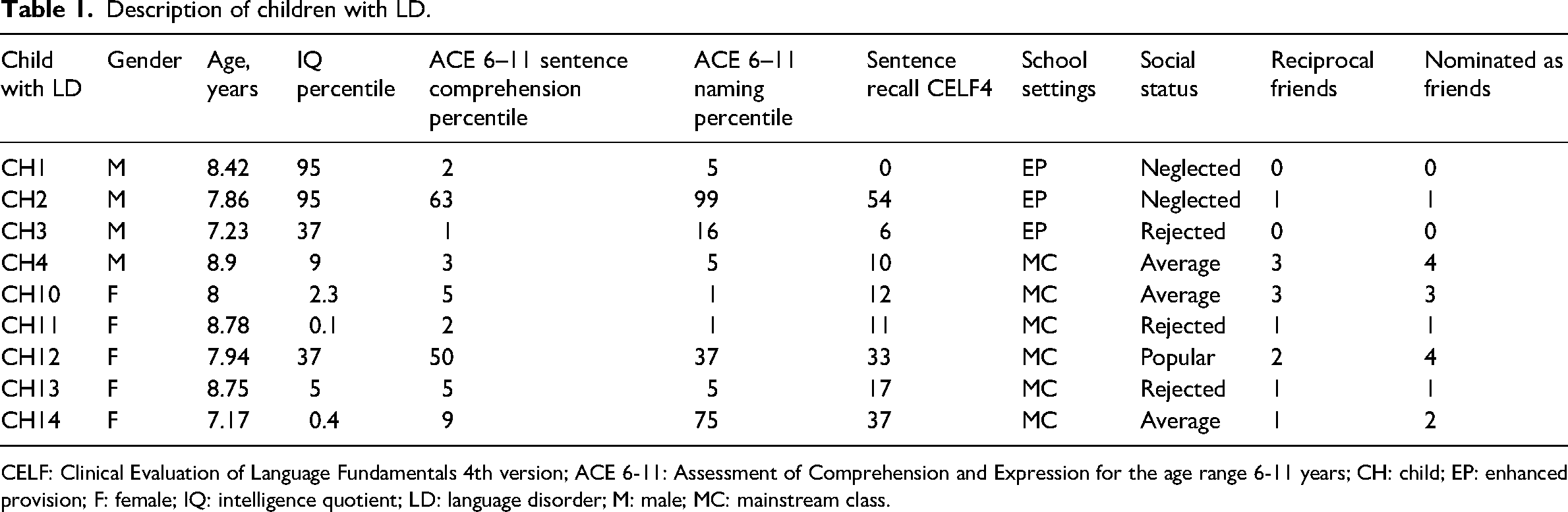
Table 1 outlines the background characteristics of children with LD in this study.
Description of children with LD.
Description of children with LD.
CELF: Clinical Evaluation of Language Fundamentals 4th version; ACE 6-11: Assessment of Comprehension and Expression for the age range 6-11 years; CH: child; EP: enhanced provision; F: female; IQ: intelligence quotient; LD: language disorder; M: male; MC: mainstream class.
We observed no preponderance of any status category (3x Average 3x Rejected 2x Neglected) and identified only one child with popular and none with controversial status. Potential differences were observed between classroom settings. Children from the enhanced provision were on the low preference scale. In mainstream, half of the children were in the average group and one child had popular status.
Similarly, reciprocal friendships gave a variety of results and indicated differences between settings. Two children with LD in the enhanced provision were not nominated as friends at all, and only one identified a reciprocal friend. All children with LD from the mainstream settings made a reciprocal friendship nomination, and half of them reached the maximum 3 reciprocal friends number, limited by the measure.
Table 2 presents the characteristics of the participating friends that we interviewed.
Interviewed friends of children with language disorder.
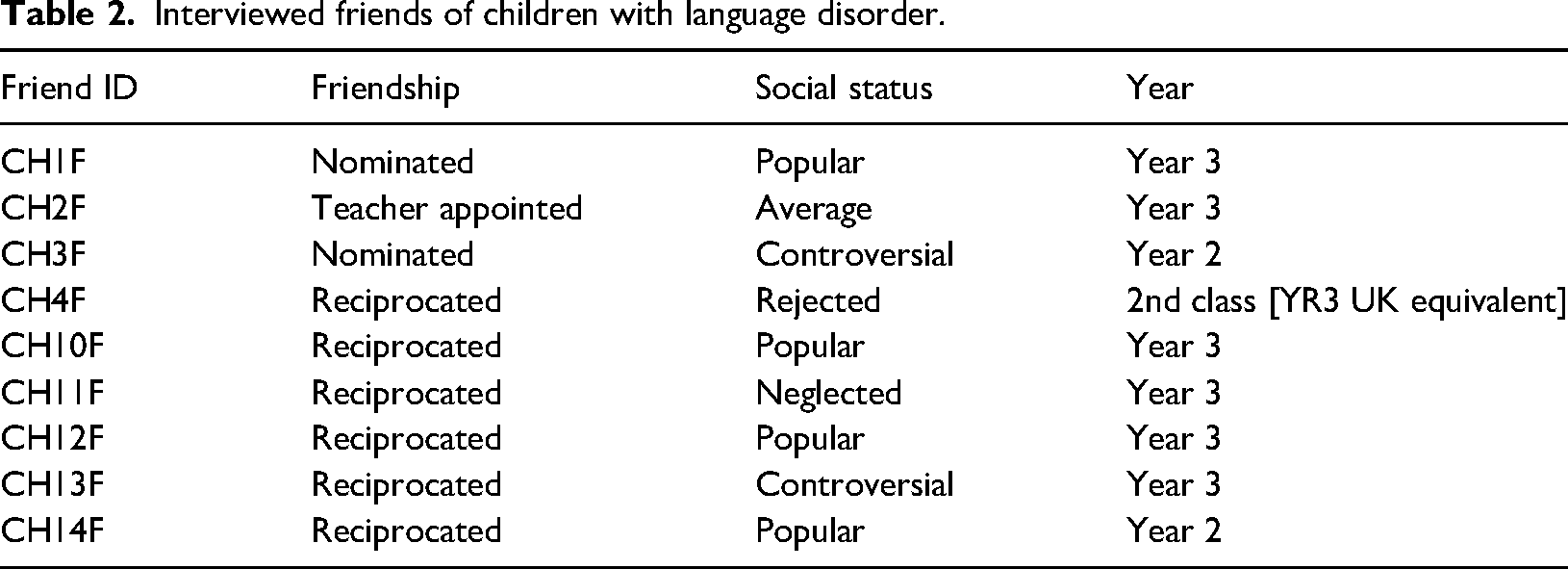
Findings from interviews with friends of children with LD are presented according to themes outlined in our analytical framework and include illustrative quotations.
We asked friends how they perceive their mutual communication. The friend of CH1, who was the least verbal child with LD, acknowledged that the communication can be challenging.
But, we find it a little bit hard but then we do understand.
How do you understand? What is the trick, tell me?
Ehmmm…, we listen to the words he says, then we try and work out what he’s trying to say, then we understand it.
CH2 had the highest scores in the language assessment from participating children with LD in the enhanced provision but still, their difficulties are noticeable. Their friend does not seem to perceive the difference in their communication and look for ways to overcome any potential communication barriers they may face.
…How is it talking to [CH2]?
It’s like everyone else.
…So, I mean, how do you play with them [children from the Enhanced Provision], ‘cause, even myself, I’ve found it difficult talking to them, you know sometimes, I don’t really understand what they say.
So, sometimes, I ask them, when [names another child from the Enhanced Provision] is playing with us, I ask him ‘what do you wanna play?’ Give him some options like Hide and seek, It, One, other stuff, I let them pick and then that’s the same with [CH1] or [CH2].
A friend of CH3, who is one of the least verbal participating child from the enhanced provision, reports trying to stay connected through communication in different ways.
Ermm, some of his words, when he says them, erm, they’re, erm, I actually understand, some of the words I’m thinking what the sentence, the whole sentence would be.
Sometimes I just make things up to answer him back.
Do you?
((nodding))
And why, why would you do that?
Ehm, ‘cause sometimes I don’t really understand him so I just answer something else.
Yeah. Is it just to, just to tell him something? Is it that you want him to keep talking or you don’t want to feel bad or you feel like you need to say something?
Uhm, just feels like I just need to say something back.
From the above responses of friends of children with LD attending the enhanced provision in mornings, the effort and interest of their friends plays a role in their mutual communication.
In mainstream settings, only one friend revealed that CH14 has difficulties understanding words. This friend of CH14 supports CH14 with reading, which makes them aware of the particular difficulties.
I think when me and CH14 read a book together, and then, CH14 was (confused) as one word as something completely different to what it really is and then it just makes me laugh cause of what she thinks it is.
Okay. Do you remember the word at all?
Ehm, no, but sometimes she thinks some words, words are completely different words and she doesn’t really understand that and it just makes me laugh.
And do you think she minds if you laugh about it?
Erm, I don’t think she really does mind, ‘cause I think she realises ‘Oh, that isn’t actually the word.’
In addition to reading, CH14 has noticeable difficulties with speech (fronting). Interestingly, CH14F did not reflect on that at all. Other friends from mainstream settings did not report experiencing or noticing difficulties of children with LD with communicating.
What peers like about their friends with LD
The qualitative interviews revealed the specifics of a child's characteristics that their friend likes and dislikes. Friends like social play and playful behaviours in children with LD.
And what do you really like about [CH3]?
Hmm… That he plays nicely.
So, what, what is it that you like about [CH4] the most?
Mm, that he plays with me.
….And, what do you really like about [CH11]?
Ehm, she is really funny sometimes and she does really funny dances and I like dancing, and… ehm, she, likes music and so do I.
A friend recognised prosocial and collaborative behaviour in CH1, who is almost non-verbal.
Mhm. And what do you really like about [CH1]?
Ehm… Because when we’re doing work with him, he listens and helps us.
Friends further like inclusive tendencies in children with LD, who let peers join in or invite others to play, and do not limit their play to their friends only.
Some friends mentioned that they extend their social play with a child with LD and together, they invite other peers to play.
I like her because ehm, she likes let me join.
Mhm. […] How does she let you join?
Ehm, she lets me join in, because I sometimes see her not- playing with no one, so I say ehm ‘Do you want me to play with you?’ and she said ‘Yes’
Okay.
[and] then we went to play em It and Duck-duck-goose
Duck-duck-goose. Okay. So sometimes she plays on her own.
((nodding))
Okay. That’s very kind for you to join her play. (.) And can you maybe tell me more how-
So like, sometimes, em, we like em, ask CH12F or CH12, ehm to play, because em, we need more people, and if they’re not, em, e, if they’re like sick or away, we just go and play with someone else.
Further to joined play and playful behaviours, friends in mainstream settings appreciate emotional support from children with LD.
What is it that you really like about [CH12]?
Ehm, that she likes to play with me a lot and that she sometimes comes and looks after me.
Alright. How does she look after you?
Ehm, sometimes I get a bit upset, so she comes to look after me.
So is there anything else that you like about [CH13]?
[Mmm] (.) (.) She makes me happy
How does she make you happy?
And plays with me when, when, when I’m upset.
To summarise responses in both settings, friends appreciate playfulness, humour, support and care in children with LD.
What peers dislike about their friend with LD
Friends seem to find it difficult to describe what they dislike about children with LD and only six responded to a direct question about the drawbacks of children with LD. Two of these friends talked about children in the enhanced provision and mentioned their behaviour.
Ehmm…ehm. we sometimes, when we play with him, he ehm, doesn’t really listen to us but sometimes he does listen to us.
…every time I see [CH3] don’t play with me, he just runs away sometimes.
Does he?
((nodding))
He doesn’t want to play? Okay. Why do you think is that? Where does he run to?
He maybe runs to em, to go and hide somewhere.
Mhmm. So what do you do then?
Then I go and play with someone else.
These examples resonate with withdrawal and imply that the behaviour of children with LD may be misinterpreted by their friends. If children with LD find explaining their intentions difficult, friends may not understand or even like how children with LD can behave.
In children with LD from mainstream classroom, friends do not like selfish and mean behaviours during play.
Is there anything that you maybe don’t like about him. You know sometimes =
= when he annoys me.
And how does he annoy you, what does he do?
When I wanna play with him and he says,’n, no I wanna play by myself’
Does he do that?
When I went for him and then he just goes over to his other friend.
Alright, aah. D’you know why that might be?
Mmm ((intonation as if I don’t know))
Mm. (.)
He thinks, I’m just annoying him when I wanna play with him. When I wanna, when I keep asking him to play with me, when he’s on his bike.
I thought he was a bit greedy when I first met him.
Really? Why, what makes you think that?
A small (bit)
Mm?
Mm, I don’t know. ‘Cause he was. I don’t know.
CH10 and CH12 are part of a bigger group of close friends, who observe more complex unpopular behaviours.
You’ve also mentioned something about CH10 that you don’t like when she says things.
She is always whispering things into CH12’s ears about me, which like mean like,”why do we have to play with her” ‘Why does she always have to follow us? She is always saying “stop following us” when I just wanna play.
Mhmm. Okay. So how do you know what she’s [CH10] whispering to CH12? Can you hear or…?
I can’t hear but I know she is saying it because she would normally be doing that.
Mhmm
Once she said it quiet loudly into [CH12]’s ear, so I could hear it.
What does CH12 do then?
She normally just goes with it.
To friends, the less liked characteristics in children with LD relate mostly to play behaviours. In mainstream settings, unpopular behaviours seem more complex as their peer relationships tend to have more intense dynamics.
Disputes in friendships
Friends report that the communication difficulties that children with LD experience could result in conflicts between them or with other peers in the class. A friend of CH1 does not it like when CH1 believes that their friend would try to wind them up.
I’ve already asked you that sometimes people fall out or have arguments, and I’m not sure if you might have ever fallen out with CH1 or =
= yeah.
Yeah?
Because sometimes he, ehm, ‘cause some other people wind him up and tap him on a shoulder, then he thinks it’s us. And we say, no [CH1], stop. But he just keeps on doing it.
Mhmm. So, somebody taps him on a shoulder and he thinks it’s you?
Yeah
What does he do then?
He chases us.
Aaah, I see, okay. Yeah, ‘cause he thinks it was.. mm.. And so how does it usually finish?
Eehm, I er, I don’t really know.
Mhmm. And how do you feel about it, like, when that happens?
Ehm, quite disappointed.
Hmm. And why, why is it that disappointment? Because he thinks it’s you or =
= yeah.
Aaah. So you think he should really trust you, when you say it wasn’t you, that he should
Yeah.
Mmmm. And does that happen often? [Like]
[Sometimes].
In mainstream children, friends fall out with children with LD because other peers enter the relationship. There are more than two friends in the close friendships of CH11, CH12 and CH14, which increases the group dynamics and makes peer relationships more challenging to navigate.
Though, but then when Hannah ((pseudonym of another child from the class)) is with me and CH14, it doesn’t always work out.
Mm.
Hannah and CH14 have never been friends and I don’t think they ever will be friends.
Hmm. So, what do you do when they don’t get on?
Ehm, I just try and stay out of it because I normally don’t have anything to do with it, and then it’s just them who have got into an argument about what we’re doing.
mhm, mhm
So just try and stay out of it.
Cool. It must be difficult.
Yeah. Yeah it definitely is. Cause CH14 is my friend but then, she gets sad easily, it’s sort of hard to play with her when she is sad because she doesn’t let anybody talk to her
Oh really? [Mm]
[Most] of the time, [when she is up-]
[not even you?]
ehm, I don’t but, CH14 does, and most of my friends do run away, when they aren’t happy. And they won’t talk to you the whole rest of the day, is then, it continues in class and they just don’t talk to you but then next day, they’re really, just fine with you.
Children make more efforts to navigate through disagreements when their relationships become more complex – there are more close friends or their play preferences may change.
Making friends advice to children with LD
In an effort to support children with LD in making friends and fitting in, their friends were asked about a specific piece of advice they would give them. Most of these this advice were reactions to the conflicts that friends may experience with children with LD.
And what do you think might help, help him to make more friends in the classroom?
Ehmmm … To listen to more people, and not get angry with them.
A friend of CH2 would advise CH2 to capitalise on their strengths when making friends in class.
Always try and help people and then if you see someone stuck at work, because usually people are quite stuck, and he is finish, he can always go and help them.
Playing together is another strategy suggested to children with LD to make friends. If they experience difficulties, friends propose approaching teachers.
Erm, just tell them to play with, with each other.
Mhm. Okay. That easy. And what if they don’t want to? Or what if they don’t understand each other?
Mmm. Just tell the other person, just tell teacher.
Interestingly, some friends described situations that they orchestrate themselves and which could help children with LD make friends.
when you, when you play with [CH3] is there somebody else or is it just the two of you?
It’s just the two of us.
Mmm
And I try to, erm, er, to make him Matthew ((pseudonym of another child from the class)) play with us too.
…How do you think he can make more friends?
Ehm, so when he plays with us, I’ll try and (leak) other people come and play with me and then they, and then I’ll get [CH2] to play with the other people whose play with us
Aah, ok
And then, they can make ne- more friends and then [he’ll]
[mhm]
and then, the person, I made them talk to will talk to another, some person, and then they will play together and then they’re making more, more and more friends.
That’s very smart! How do you know all this?
That’s, ehm, that’s how I really make friends as well.
Friends therefore could act as gatekeepers introducing children with LD to more friends.
IV Discussion
This small-scale study provides deeper insights into the friendships of children with LD. We explored the unique perceptions of peers in qualitative interviews and peer nominations.
Our sociometric data revealed that except for one child with popular status, children with LD had average, rejected and neglected social statuses, resonating with earlier peer relationship studies (e.g. Andrés-Roqueta et al., 2016; Gertner et al., 1994). More encouragingly, participating children with LD had more reciprocal friendships and best friends nominations than indicated in previous research (e.g. Fujiki et al., 1999).
Considering the enhanced provision and mainstream classrooms prompted us to take the social status evidence further and make preliminary comparisons between classroom settings. Our data propose that compared to mainstream classrooms, children with LD from the enhanced provision may be at a disadvantage. In support, Laws et al. (2012) noted less negative peer nominations after children with LD moved from the enhanced provision to full-time mainstream classrooms. Inclusive settings may facilitate the development of social interaction skills in children with LD (Henton, 1998), and in studies with mixed peer groups, children with LD increased their social bids more than those in a group with children with impaired language and communication (Guralnick et al., 1996). Nevertheless, considerably more work will need to be done to validate whether mainstream settings can positively impact the peer relationships of children with LD. The severity of communication difficulties, however, may not always allow children with LD to join mainstream settings and the findings could, therefore, also reflect differential placement according to social difficulties.
In the enhanced provision, the preponderance of neglected and rejected statuses and only one reciprocal friendship (with another child from the enhanced provision) might be explained by changing classrooms and limited presence in mainstream settings during the day. At the age of 6 to 8 years, children give more weight to physical interactions when it comes to their understanding of friendships (Hartup, 1996; Selman, 1980). Thus, limited interactions reflect lower preference of peers to consider children with LD from the enhanced provision as play partners. Perhaps a bigger sample study examining the social status of children with LD in different settings could validate this hypothesis.
LD and friendship quality
We now move to discuss our key learnings from interviewing friends of children with LD. One of the most striking findings is friends’ low recognition of language difficulties in children with LD. Even when asked directly, especially friends from mainstream settings, do not report limited language as a barrier in their interactions. In children with LD attending the enhanced provision, friends acknowledged that language difficulties substantially impede their interactions. This learning may reflect the severity of language difficulties, corresponding with the child's educational setting. Children with LD in mainstream classrooms can communicate without considerable difficulties. Although a social desirability bias could play a role in friends’ responses, this finding, nonetheless, identifies important area for future research – the peer perceptions of language and behaviours of children with LD. A future study comparing children's relationships with other typically developing peers and with children with DLD might reveal some universal behaviours that children like and dislike, regardless of language abilities. The work of Lee et al. (2003) on friendships of children with disabilities offers a useful comparative design of a qualitative enquiry.
The most remarkable finding though is the inclusive mindset of friends of children with LD in the enhanced provision. These friends look for strategies to overcome the language barrier. They adjust their own communication or simply stay connected verbally even if they may not fully understand the child with LD. Some friends show further inclusive tendencies by inviting other peers to join their play with a child with LD. These strategies seem natural to children and so could directly feed into interventions enhancing the inclusive learning environment for children with LD. Schools already implement programmes developing inclusive peer behaviours (Frederickson and Turner, 2003; Meyer and Ostrosky, 2015); however, it is not clear to what extent these interventions build upon strategies coming from children. Strategies increasing peer interactions in children with special education needs (e.g. Buysse et al., 2003) and children with LD proved successful (Beilinson and Olswang, 2003; Schuele et al., 1995). Thus, adapting and testing similar interventions to encourage inclusive behaviours in peers of children with LD should be explored.
Implications for practice
Our ideas about educational and therapeutic interventions start with handling inclusion more explicitly. To make inclusive education a reality, placing a child with LD in a classroom without acknowledging their specific needs to peers may not be enough. Children encounter communication breakdowns, as was the case of an interviewed friend responding to a CH3 without fully understanding them. Although this pseudo-interaction creates a social connection, pretending to understand the message does not benefit the relationship and can make any follow-up interactions awkward. To eliminate confusion in interactions, we need to raise awareness of the communication needs of children with LD. Communication supporting strategies are readily available and have been successfully used with siblings of children with LD (Donaldson, 2016) and with autism (Murray Law, 2020). Finding balance in revealing sufficient information without making children with LD feel uncomfortable will require consulting carers, special education needs coordinators, and even children with LD themselves.
Similar to peers, sharing the diagnosis and its implications with children with LD is an important therapeutic area to investigate further. Making children with LD aware that their peers can struggle with certain aspects of their communication could help children with LD understand some peer reactions. This may be sensitive to present to children with LD; nevertheless, it is equally important for their healthy development and impacts the formation of their identity and agency. Examples of sharing child's additional needs with classroom peers demonstrate a very positive and authentic way to inclusive practice (e.g. Eredics, 2018; Gus, 2000). Although more work needs to be done to identify the most child-friendly and appropriate ways to implement similar activities in classrooms, we should not underestimate the abilities of children with LD to collaborate on this quest. To illustrate, a dyadic play video recording captured CH2 from the enhanced provision taking initiative and showing their mainstream friend the speech and language intervention room. When retrospectively asking CH2F about this instance, they revealed that they would like to know more about the morning class activities of CH2. Since similar conversations may already be happening and some mainstream peers seem to be aware of the differences, sharing the specific communication needs and supportive strategies explicitly but in a child-friendly manner presents a more constructive approach to inclusive education.
Study strengths and challenges
Interviewing friends of children with LD is the strongest aspect of our study. We took time to build relationships with children and reduce the potential power imbalance between researcher and participant. We adopted a child-centred approach and used art-based activities to make interviews enjoyable. Our study shows the importance of actively involving children in research.
We recognise the generalisability limitations of our qualitative approach. Our small sample size is not fully representative of the population of classroom peers of children with LD. Although the participating children come from different schools, their experiences may not reflect other settings and geographical locations. All children with LD participating in our study are receiving educational support to their language development. This is not always the case, and many children, especially those with developmental language disorder, may go undiagnosed in big classrooms. Our findings are indicative and represent opportunity for further validation in quantitative approaches. We aimed to decrease the researcher bias by reviewing preliminary findings with the participants and consulting themes with peer researchers before applying them to framework analysis.
V Conclusion
To our knowledge, this study is the first one to interview peers about their friendship with children with LD in the enhanced provision and mainstream classrooms. We showed that peers do not always perceive language difficulties as a barrier to making friends with children with LD and find ways to socially connect if facing any communication challenges. Friends further demonstrated their inclusive mindset by acting as gatekeepers to more classroom peers and that can positively impact the socioemotional functioning of children with LD in inclusive settings. Thus far, inclusive education research seems to be concerned about helping children with different neurodevelopmental profile adjust to the environment. Maybe we should consider how the mindset and behaviours of others actually make children with neurodiverse profiles feel different and look for ways to nurture inclusive mindset in peers.
Supplemental Material
sj-docx-1-clt-10.1177_02656590221139231 - Supplemental material for Children with language disorder as friends: Interviews with classroom peers to gather their perspectives
Supplemental material, sj-docx-1-clt-10.1177_02656590221139231 for Children with language disorder as friends: Interviews with classroom peers to gather their perspectives by Lenka Janik Blaskova and Jenny L Gibson in Child Language Teaching and Therapy
Footnotes
Declaration of Conflicting Interests
The author(s) declared no potential conflicts of interest with respect to the research, authorship, and/or publication of this article.
Funding
The author(s) disclosed receipt of the following financial support for the research, authorship, and/or publication of this article: This study is part of a PhD research project funded by the Lego Foundation and Cambridge Trust.

Supplemental material
Supplemental material for this article is available online.
References
Supplementary Material
Please find the following supplemental material available below.
For Open Access articles published under a Creative Commons License, all supplemental material carries the same license as the article it is associated with.
For non-Open Access articles published, all supplemental material carries a non-exclusive license, and permission requests for re-use of supplemental material or any part of supplemental material shall be sent directly to the copyright owner as specified in the copyright notice associated with the article.
