




Abstract
Describing events may be challenging for any child, but children who use communication aids may face unique linguistic, pragmatic, and strategic challenges in conveying information with the communication means they have available. This study explores strategies used by young, aided communicators when describing the content of a video unknown to their communication partners. The participants of the study were 48 aided communicators (aged 5;3–15;2) from nine countries and seven language groups and their communication partners (parents, professionals, and peers) who used natural speech. Descriptive and statistical analyses were utilized to investigate the relationships between individual characteristics, linguistic and non-linguistic factors, linguistic strategies, and performance in conveying the content of the video event. Analyses of the 48 videotaped interactions revealed the use of a variety of linguistic elements and multimodal strategies, demonstrating both creativity and challenges. Success in relaying messages was significantly related to age, mode of communication, and individual profiles, such as everyday communication functioning and comprehension of grammar. Measures of receptive vocabulary and non-verbal reasoning were not significantly related to communicative success. The use of shared context and negotiation of meaning of potentially ambiguous utterances demonstrate the shared responsibility of disambiguation and meaning construction in interactions involving aided and naturally speaking communicators.
Keywords
Introduction
Event descriptions are an essential part of everyday conversations. Learning to describe events is an important feature of language development. Children start to describe events around the age of 2–3 years in communication with caregivers about routines and singular events in daily life (Nelson, 1996). Besides competence with vocabulary and linguistic structures, event descriptions demand skills in constructing extended discourse and understanding how the listener may interpret what the communicator has expressed (Ninio and Snow, 1996).
Describing events involving information that is unknown to the communication partner may be challenging for any child, but children who rely on aided modes of communication (e.g. spelling or graphic symbols; see von Tetzchner and Martinsen, 2000), may face unique challenges in expressing their ideas and thoughts through the communication means available to them. Interactions using aided communication have been described as time-consuming and sometimes effortful, often involving overt co-construction and collaboration among interactants (Clarke, 2016; Higginbotham et al., 2016; von Tetzchner and Martinsen, 1996). Consequently, aided communicators may have less communication experience and fewer opportunities for communication involving different topics, contexts and communication partners than their speaking peers (Clarke and Kirton, 2003; Soto and Starowicz, 2016).
Supporting aided language development requires understanding how the communicative means available to aided communicators may allow or constrain relaying of information. Unlike typical language development, access to aided language occurs through planned processes and thus is likely to differ in many ways from the experience of children learning to use natural speech (von Tetzchner, 2018). Aided communicators must learn the spoken language(s) of their environment, the linguistic codes of their aided system, how graphic symbols may represent meanings of spoken words and how the symbols can be combined to produce messages (Sutton et al., 2010; von Tetzchner, 2015). Aided communicators often have limited lexical knowledge (Lund and Light, 2006) and may use a limited range of syntactic and morphological structures (Binger and Light, 2008; Sutton et al., 2010). While the vocabulary of individuals with typical language development increases rapidly, external vocabularies of aided communicators tend to develop slowly, often reliant on what is provided by the supporting adults in their environment. Selecting vocabulary to be used by someone else is challenging. The vocabulary chosen by others may be centred on daily activities and specific core words needed in everyday life. Vocabulary related to more unusual and rare topics may be overlooked. The ability to spell or to use spelling and symbols opens up possibilities to express meanings with more exact and precise vocabulary. However, learning to read and write is often challenging for individuals who use aided communication and may require extensive educational efforts (Smith et al., 2009). Therefore, before developing more advanced expressive skills, aided communicators may need to overcome vocabulary gaps by creating their own strategies for expressing meaning with aided language (Deliberato et al., 2018; von Tetzchner, 2015). For example, the use of key symbols as semantic clues to meaning has been recognized in several studies (see e.g. Brekke and von Tetzchner, 2003; Collins, 1996). Furthermore, aided communicators may attempt to guide partners to interpret intended meanings using a metonymic strategy (e.g. pointing to the kitchen to refer to a familiar person who works in the kitchen, see Brekke and von Tetzchner, 2003) or associations (pointing to a person to refer to an association between the person and the intended action, see Neuvonen et al., 2021). In addition, like children developing natural speech, aided communicators incorporate different modalities in their aided constructions, such as gestures, symbolic object pointing and vocalization (e.g. Clarke and Kirton, 2003; Clarke and Wilkinson, 2007). Creative use of language and multimodal constructs is a potential strength of aided communicators, but its success requires that the communication partners recognize potentially modified or idiosyncratic use of aided and unaided constructs (von Tetzchner, 2015).
Negotiation of meaning and co-construction are core elements of conversations in general (Jacoby and Ochs, 1995; Mandell, 1984), but co-constructing negotiated meanings may be more explicit and overt in conversations involving aided communication (Clarke, 2016; Soto and Starowicz, 2016). Co-construction of meaning typically happens over several turns as the communicator produces the aided utterance and the partner recasts and expands the construct producing a potential interpretation. Co-construction may enable rich and elaborate communicative interactions where the partners support the fluency of communication (Smith et al., 2018). However, aided communicators may also become accustomed to relying on their communication partners to translate and interpret the meaning of their aided output (Solomon-Rice and Soto, 2011), saving time and effort. Therefore, co-construction may come at a price; aided communicators may learn to construct utterances that are only partially adequate (Stadskleiv and von Tetzchner, 2018). Familiarity of the communication partners and mutual experience of aided interactions may have a decisive impact, allowing partners to utilize knowledge about strategies from earlier conversations. However, it may also limit the ability of aided communicators to relay content that is unknown to the partner when contextual support is limited (Savolainen et al., 2020; Smith et al., 2018). As a consequence, interactions may remain routinized and lack the sharing of truly novel information.
The present study explores the strategies and linguistic constructs that children and adolescents who use aided communication utilize to describe an unshared video event to a familiar communication partner without any contextual support. The study investigates aided utterance construction when the aided communicators are unlikely to have access to the specific vocabulary usually used to describe such an event. The study further investigates factors that may influence the partners’ co-construction of the descriptive content.
The following research questions were addressed in the current study:
How do young aided communicators convey information related to a video event unknown to the communication partners? What types of linguistic strategies do the aided communicators produce and how are these strategies related to their performance in conveying information? What individual characteristics affect the aided communicators’ performance in describing events?
Method
The present study is a part of a larger project “Becoming an Aided Communicator (BAC): Aided Language Skills in Children and Adolescents aged 5–15 years: A Multisite and Cross-Cultural Investigation”, addressing developmental achievements and challenges of young, aided communicators (see von Tetzchner, 2018). Ethical approval for the study was obtained from the relevant ethical boards (e.g. the university hospitals or educational boards) in accordance with national requirements in each participating country. The children and their communication partners were informed about the study purpose, and they assented to participation in the study. Written consent was given by the parents of each child.
Participants
This study draws data from 48 dyads including forty-eight aided communicators (25 females and 23 males) and their speaking communication partners from nine countries (Canada, Finland, Germany, Ireland, Netherlands, Norway, Spain, Sweden, and United Kingdom) and seven language groups (Dutch, English, Finnish, German, Norwegian, Spanish and Swedish). The participants were recruited with the help of professionals (such as speech-language therapists and special educators) at each national site. Table 1 provides a summary of the aided communicators’ characteristics and demographic information. Ages of the aided communicators ranged from 5;3 to 15;2 (years;months), with a mean age of 10;11 (SD 3;0). The participants fulfilled the following criteria as defined in the BAC project: (a) age between 5;0 and 15;11, (b) speech production absent or very difficult to understand, (c) not considered by their teachers to have an intellectual disability, (d) did not have a diagnosis on the autism spectrum, (e) had speech comprehension considered adequate or near adequate for age, (f) had aided communication as their main form of communication and had used aided communication for a minimum of 1 year, and (g) had normal hearing and vision (with corrective technology if required). No formal testing was set as a recruitment criterion; instead the teacherś and therapistś views of the aided communicatorś functioning in their daily life were accepted. The graphic symbols used by the aided communicators included Blissymbolics (Bliss, 1965), Pictographic Ideographic Communication (PIC; Maharaj, 1980), Picture Communication Symbols (PCS; Mayer-Johnson et al., 1993) and Minspeak (Baker, 1982). The communication partners of the aided communicators were parents (N = 29), familiar professionals (e.g. school teachers or personal assistants, N = 13) or peers (N = 6), all of whom used natural speech. The peers were chosen by the aided communicators or their families comprising a group of friends, classmates or siblings close to the age of the aided communicators.
Characteristics of the aided communicators.
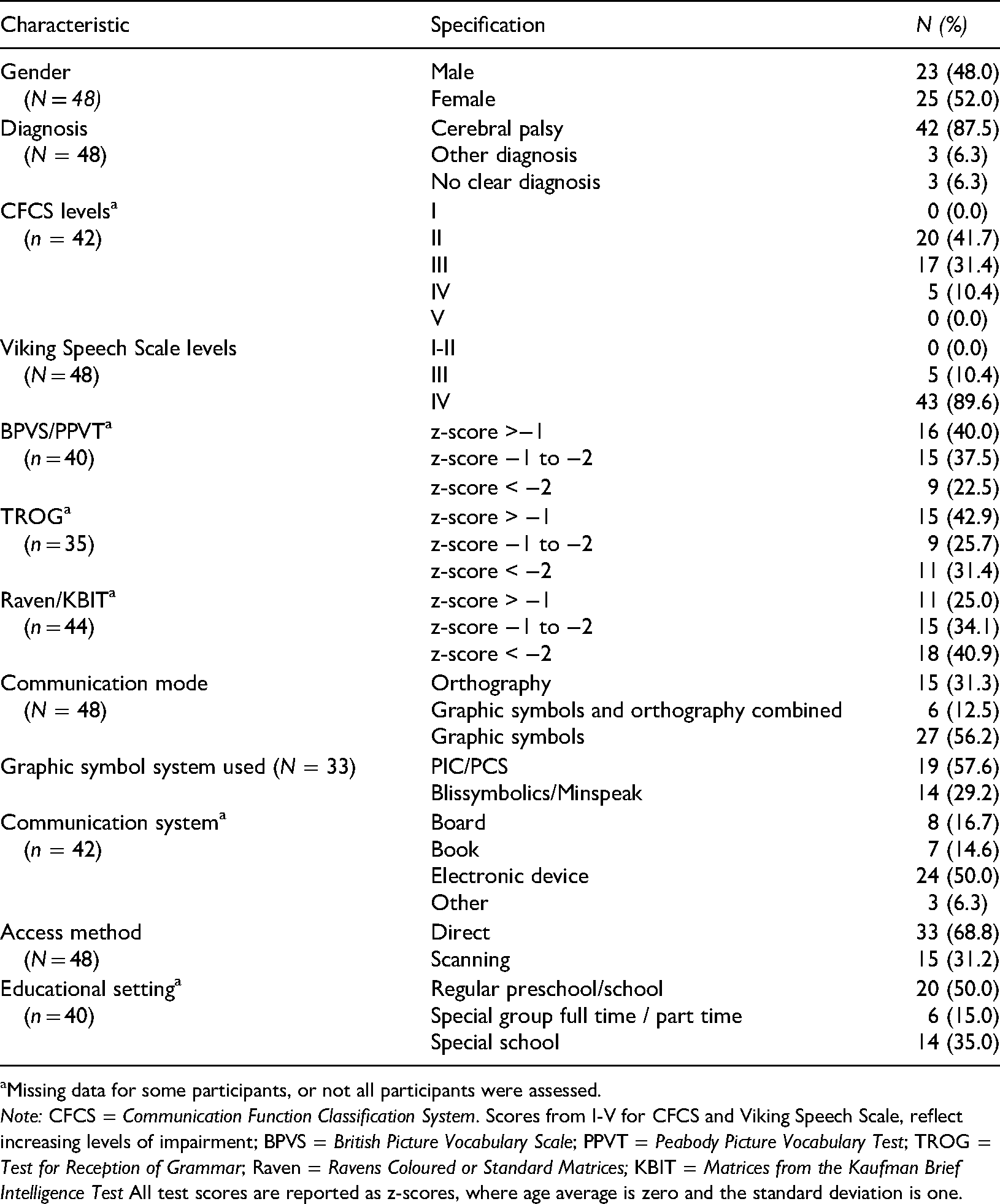
Missing data for some participants, or not all participants were assessed.
Note: CFCS = Communication Function Classification System. Scores from I-V for CFCS and Viking Speech Scale, reflect increasing levels of impairment; BPVS = British Picture Vocabulary Scale; PPVT = Peabody Picture Vocabulary Test; TROG = Test for Reception of Grammar; Raven = Ravens Coloured or Standard Matrices; KBIT = Matrices from the Kaufman Brief Intelligence Test All test scores are reported as z-scores, where age average is zero and the standard deviation is one.
Assessment
Measures of spoken language comprehension and non-verbal reasoning were administered with each child, as appropriate and available in each participating country. Everyday communication level was assessed using the Communication Functioning Classification System (CFCS; Hidecker et al., 2011), which is used to classify children with cerebral palsy on the basis of their effectiveness as senders and receivers of messages. The quality of the participantś speech was assessed with the Viking Speech Scale (VSS; Pennington et al., 2013). Receptive vocabulary was assessed with national editions for either the British Picture Vocabulary Scale, second edition (BPVS-II; Dunn et al., 1997) or the Peabody Picture Vocabulary Test (PPVT; Dunn and Dunn, 2007), third or fourth edition. Grammatical competence of spoken language was assessed with the Test for Reception of Grammar, second edition (TROG-2; Bishop, 2003). Non-verbal reasoning skills were assessed with Raven's Matrices, either the coloured version (Raven, 2008) or the standard matrices (Raven et al., 2000), or with matrices from the Kaufman Brief Intelligence Test (KBIT; Kaufman and Kaufman, 2004). The CFCS and VSS are classification scales, where functioning is classified at five (CFCS) or four (VSS) levels; level one indicates the best possible function and level four/five the most severe impairment. All test results are reported as z-scores (which has an age average score of zero and a standard deviation of one). In the group, there was variability in the scores, but the mean scores were within two standard deviations of the age average. The scores on PPVT/BPVS ranged from −3.3 to 2.11, with a mean(SD) of −1.1(1.3). The scores on TROG-2 ranged from −3.0 to 1.3, mean(SD) was −1.2(1.3) On Raven/KBIT the scores ranged from −3.7 to 2.1, mean(SD) was −1.5(1.3).
Materials
The communicative interactions analyzed in this study occurred during a video description task where the aided communicator was asked to relay to a partner what had happened in a short video not seen by the partner. Altogether, eighteen video description tasks were developed for the BAC project and each participant completed a maximum of six video description tasks with each partner (partner, professional and peer): one training trial and five description tasks. None of the videos included voice. The current study describes data from a video event showing a billiard cue hitting a billiard ball that hit another ball that rolled down into the pocket of a billiard table. The event was videotaped with a video camera above the billiard table, showing the action of shooting the balls. No people were seen in the event. For the purposes of this study, the video with the billiard event was chosen because it was assumed to elicit a variety of aided communication strategies in conveying information about a short event including potentially unusual vocabulary.
Procedure
The study was conducted in a quiet location in the participant's home or at school as part of the larger BAC project. The child could watch the video up to five times while the partner was out of the room. After the child had indicated that (s)he was satisfied with looking at the video, the communication partner was asked to come into the room. The instruction given to the child was: ‘Tell your parent/teacher/peer what happened in that video,’ and to the communication partner: ‘X has seen a video and is going to tell you what happened. You should wait for her/him to tell you but if you are uncertain about something, you may ask her/him.’ The partner had no prior knowledge of the event and no cues to context and thus had to infer the content of the video from the information given by the child. The researcher was present during the interactions, gave instructions to both participants and videotaped the conversations with two cameras; one aimed at the two people interacting and one at the child's communication aid. Otherwise, (s)he did not intervene in the descriptions or conversations except to encourage the participants to continue or to ask if they were finished, as needed.
Data transcription, translation, coding and reliability
The conversations from the 48 dyads were first transcribed orthographically by researchers in each national site, using the notational conventions for augmentative and alternative communication proposed by von Tetzchner and Basil (2011, see Appendix). Transcriptions were translated from the original language to English as necessary, by researchers in the participating countries. The translations were checked for accuracy by the authors who had adequate knowledge of English and the original language. Further comparisons between the original language and translations were done as necessary during the coding of linguistic elements. The time for each interaction was measured as part of the transcription: from the moment the aided communicator initiated the description of the event to the moment the child expressed that they had reached the end result.
Several steps were taken in the process of coding and analysing the data. Based on previous studies (e.g. Deliberato et al., 2018; Murray et al., 2018), three main variables were chosen to reflect the dyads’ achievement: performance in conveying and recasting information, the number of linguistic elements expressed, and the type of linguistic strategies utilized. Table 2 shows the coding framework “Classification of ideas expressed
Classification of ideas expressed/recast in event description.
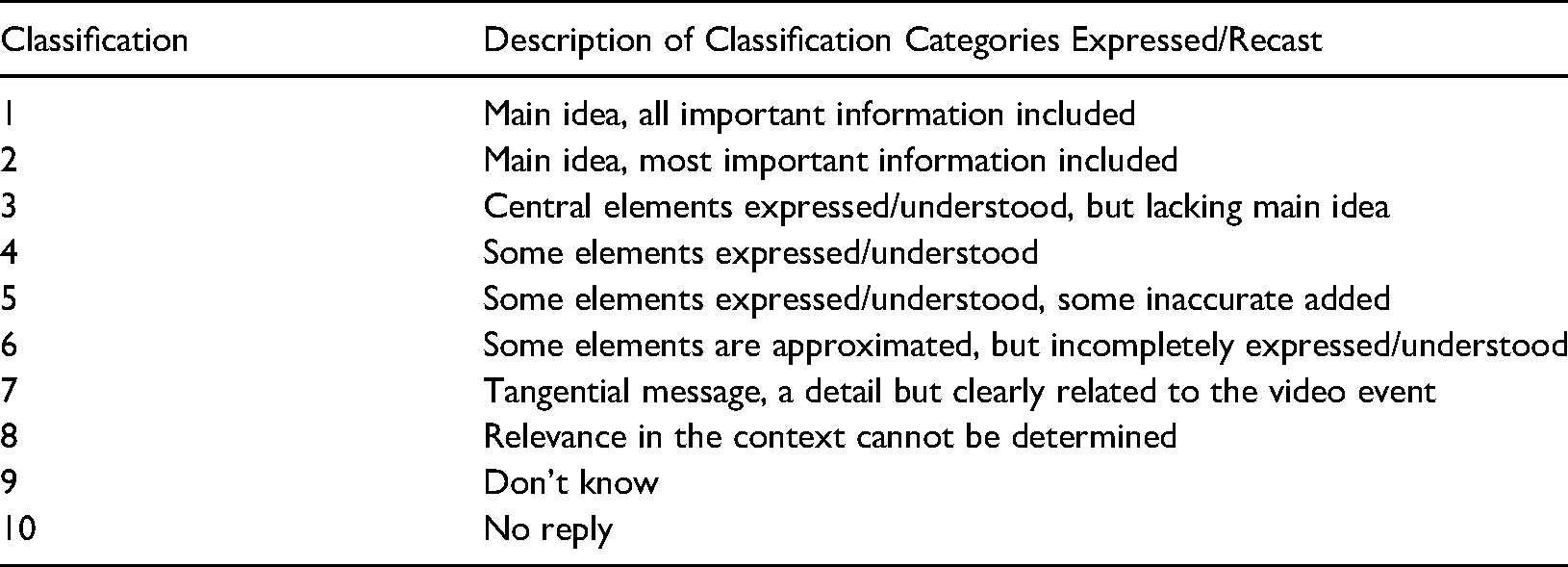
Second, the authors counted the number of linguistic elements based on the agreed coding procedures in the BAC project. Basic units of linguistic elements were spoken words, orthographic and synthetic words, whole utterances (i.e. prestored utterances that are usually programmed as full sentences in the communication aids in advance), graphic symbols, gestures and deictic or symbolic use of eye gaze (such as looking at persons, objects, or locations in the environment to represent a concept). Repetitive use of elements was counted only once. If the participants produced two or more words that could be understood as one element (e.g. “billiard table”, “billiard ball”, “I like” or “I dońt know”) or prestored utterances (e.g. “We-had-billiard-table-tennis-football-game-and-playstation”) they were treated as one element. Auxiliary verbs were not counted as elements unless they changed the content of the utterance (e.g. “didńt go”). Prepositions, postpositions and inflections were counted if they affected the content of the description (e.g. referring to the location such as to the pocket of the billiard table). The linguistic features of different languages were acknowledged by comparing the original language and translations as necessary. For example, if the communicator produced an orthographic utterance “pöydällä” (Finnish origin, translated “on the table”), the word was considered to include two elements: the noun (“table”) and the location (“on”). The first author counted the number of linguistic elements based on the agreed counting system. Potentially unclear cases were solved through negotiation among the authors.
Third, the linguistic elements produced by the aided communicators were categorized to reflect the communicatorś linguistic strategies in utilizing the vocabulary. The linguistic strategies were grouped according to their semantic accuracy on the basis of their relationship to the target video event. Categorization of linguistic strategies was based on work previously done within the BAC project (see Deliberato et al., 2018). The types of linguistic strategies were categorized as exact (e.g. billiard ball or pool table), superordinate (e.g. table or ball), approximate or related (e.g. baseball, table tennis table), descriptive (e.g. colours, numbers, size, location), idiosyncratic (only personal association recognized), relevance not known in the context (e.g. walk, outside), other (e.g. somebody, stranger) or “I don’t know”. The first author coded all the linguistic strategies according to the agreed framework and reliability was evaluated by independent coding of 50% of the data by second and the third authors. The initial agreement was 77% and 90% respectively, with most differences involving potentially irrelevant elements and the interpretation of modified gestures as distinct elements. Once these differences were resolved in each category, the agreement in coding throughout the whole data was 100%.
Fourth, for the purposes of this study, the aided communicators were divided into groups based on their scores on classification of ideas expressed. For the investigation of success in conveying information of the video event and the types of linguistic strategies used, the aided communicators were divided into four groups. The division was made on the basis of similarities in adjacent scores on the classification scale, for example scores 1–2 including conveying main information. Second, for the binomial regression analysis (see further Statistical analysis) the aided communicators were divided into two groups in two phases according to their success in conveying information, that is, lower classification scores indicating better success in conveying the content of the video event.
Statistical analysis
IBM SPSS, Statistical Package for Social Sciences 25.0, was used for all statistical analysis. All tests were utilized to explore the performance on ideas expressed and recast based on classification scores described in Table 2. As the number of elements expressed/recast and classification of ideas expressed/recast did not follow the presumptions of normal distribution as shown by Shapiro-Wilk’s test of normality (p < .05), non-parametric tests were utilized. Spearman's rank order correlation test was used to explore bivariate correlations between the following variables: length of time used, scores on classification of ideas expressed, scores on classification of ideas recast, and number of linguistic elements. This test was also used to explore the relationship between scores on classification of ideas expressed and measures of linguistic and non-linguistic abilities.
Binomial logistic regression analysis was utilized first to investigate which factors contributed to success in conveying the main idea or central content of the event (scores 1–4 on ideas expressed) and then to explore which factors contributed to the success in conveying the main idea (scores 1–2 on ideas expressed). The variables investigated were age, verbal comprehension (mean z-scores on BPVS/PPVT and TROG), and primary communication mode (symbol versus spelling). The variables were chosen based on previous literature to explore the effect and variability of potential key predictors relevant to this study (Batorowicz et al., 2018; Stadskleiv et al., 2018). Acknowledging that many of the participants used a combination of graphic and orthographic modes of communication, the first and second authors independently reviewed each transcript to determine which mode should be classified as the main mode for each participant in this task, with 100% agreement on the classification.
Results
The average score on classification of ideas expressed by the aided communicators was 4.1 (SD = 2.2) and of the ideas recast by the communication partners 3.9 (SD = 2.5). The average number of linguistic elements produced in the group of aided communicators was 4.5 (SD = 2.3; range 1–11) and communication partners 4.8 (SD = 2.4; range 1–11). The average time used in the event description was 232 s (SD = 218; range 34 to 1234 s; n = 42).
The first two research questions considered the performance of the aided communicators in conveying information (“Classification of ideas expressed”, Table 2) and the utilization of linguistic strategies in describing the video of the game of billiards, based on the division of the participants into subgroups described previously. Table 3 describes the characteristics of aided communicators (age and mode of communication) in each group and Table 4 provides information related to distribution of the types of linguistic strategies in each group.
Characteristics of four groups of aided communicators according to scores on “classification of ideas expressed.” .
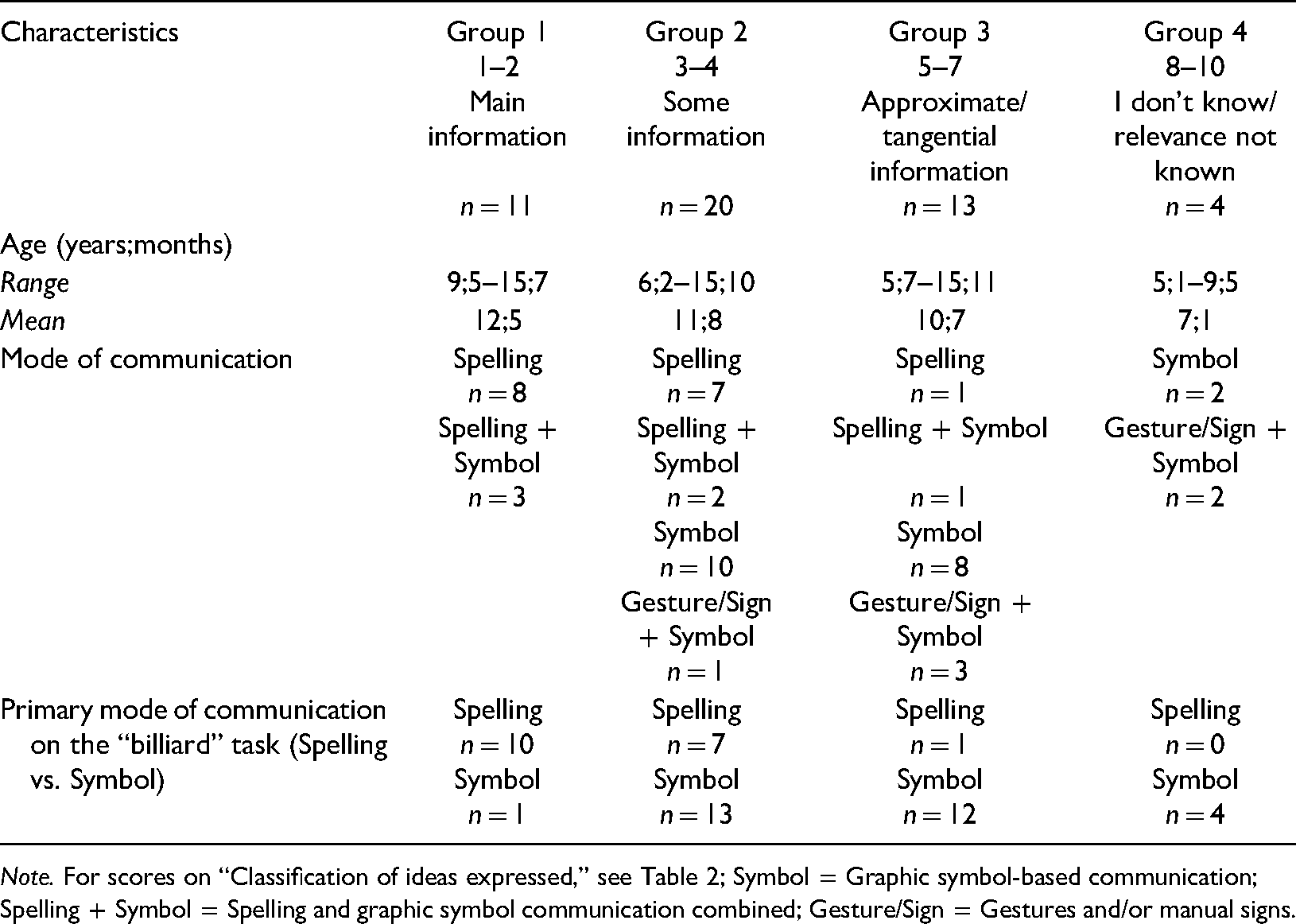
Note. For scores on “Classification of ideas expressed,” see Table 2; Symbol = Graphic symbol-based communication; Spelling + Symbol = Spelling and graphic symbol communication combined; Gesture/Sign = Gestures and/or manual signs.
Distribution of types of linguistic elements in the four groups of aided communicators (mean scores).
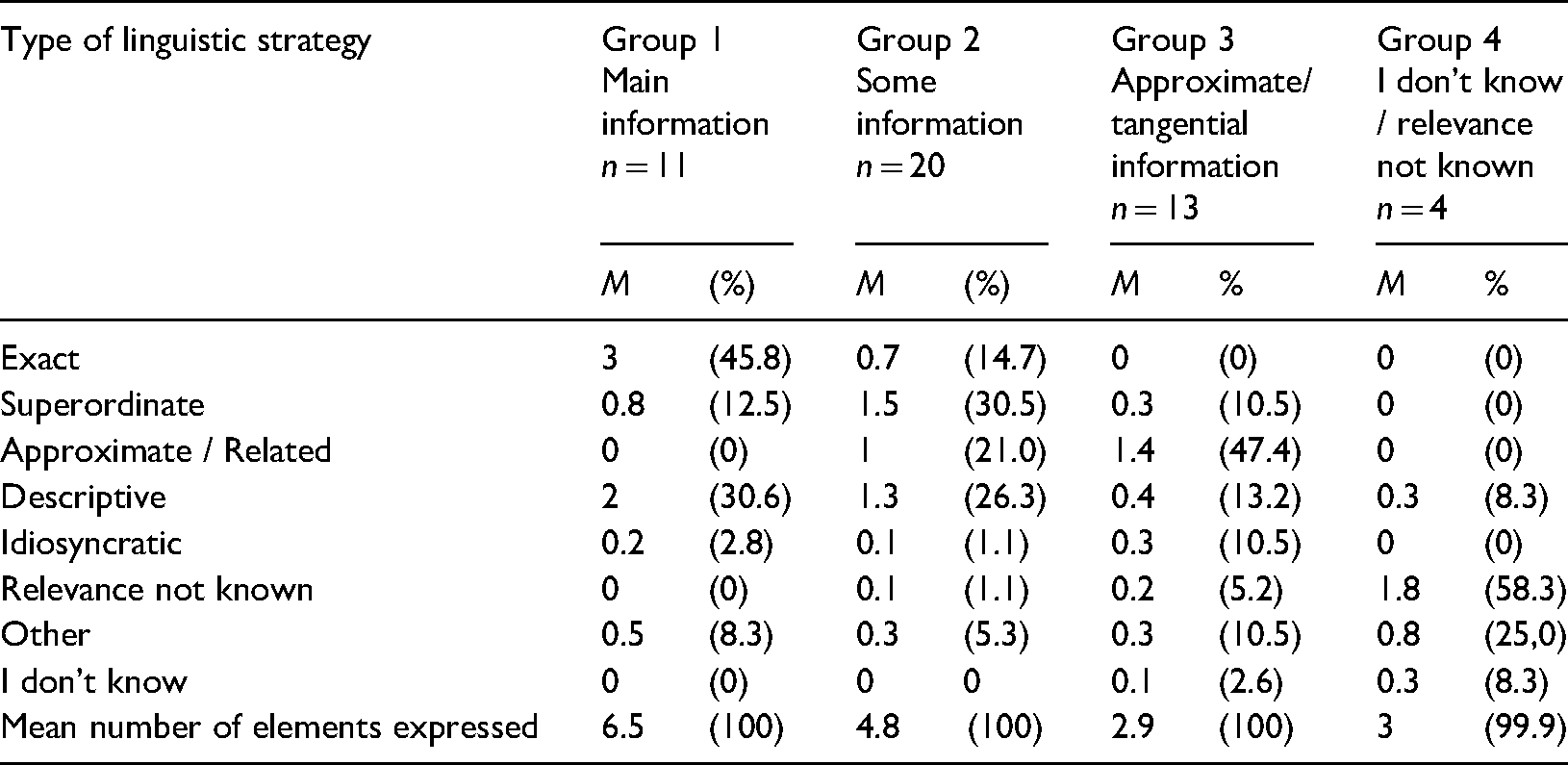
Aided communicators in Group 1 provided all or most of the important information in the video event (i.e. scores 1–2 on ideas expressed). The average number of linguistic elements ranged from 2 to 11. The shortest description provided the core of the event “billiard playing”, the longest provided a detailed story: “A person is playing pool. They hit a purple ball which goes to the side. The purple ball also hits the white ball. The white ball goes in. The purple ball does not go in.” All the aided communicators in this group provided explicit information using specific terms such as “playing billiard” or “billiard table”. The majority of the linguistic strategies were categorized as exact or closely similar, with addition of descriptive details such as colours, numbers and location. As would be expected, communication partners were able to repeat or recast the provided information, scoring 1 or 2 on classification of ideas recast
The aided communicators in Group 2 provided central or some elements but lacked the main idea (scores 3–4). Two of the 20 aided communicators used exact terms, such as billiard or pool, but the main types of linguistic strategies produced by them were superordinate and descriptive, with generic words aligned with descriptions of characteristics of the elements (e.g. “TABLE GREEN”, “BALL 2”). Several of the aided communicators utilized a combination of modes (e.g. graphic symbols and spelling or graphic symbols and gestures, for examples, see supplemental material Tables 1–2). The communication partners of Group 2 scored between 2 and 6 on ideas recast, representing a wide range in terms of how much information related to the event they were able to recast Six of the communication partners were able to infer the main content of the video (i.e. that the event was a game of billiards), most of them through co-construction and meaning-negotiation (see supplemental material, Table 3).
The aided communicators in Group 3 expressed some elements approximating or tangentially related to the event (scores 5–7). The majority of the linguistic strategies were approximate or related, such as using the graphic symbol BASEBALL (the visual image of a baseball bat and a ball, with a verbal label baseball written above the image) to index some features of the event. Gestures and manual signs were more common in this group, suggesting attempts to overcome a lack of specific event vocabulary (see supplemental material, Table 4). The information recast by their communication partners varied widely, with scores from 2 to 9. Only two communication partners successfully inferred that the event involved a game of billiards. In both of these interactions, the participants utilized prior shared information, such as referring to a previous experience related to billiards and football field (see supplemental material, Table 5).
Correlations between Time, scores on the Classification of Ideas Expressed/Recast and the Number of Linguistic Elements: Spearma’s Rank Correlation Coefficients (Mean, Standard Deviation).
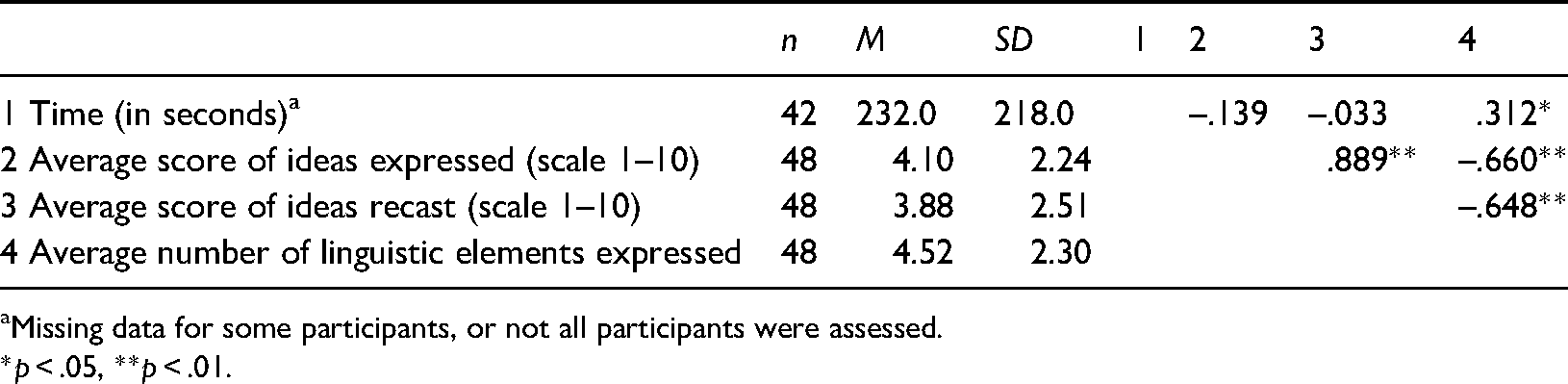
Missing data for some participants, or not all participants were assessed.
*p < .05, **p < .01.
The participants in Group 4 (scores 8–10) expressed that they did not know how to describe the event or provided information the relevance of which could not be determined in the context, such as “someone is picking flowers”. The communication partners in this group acknowledged what the communicators had expressed but did not engage in further discussion.
Ideas expressed/recast, number of elements expressed and individual factors
Table 5 shows the correlations between time, scores on classification of ideas expressed/recast and number of linguistic elements. There was a significant relationship between time use and the average number of linguistic elements expressed; the more linguistic elements aided communicators provided, the longer it took to describe the event. There was no significant relationship between time needed and performance on the scores on ideas expressed/recast; longer interactions did not necessarily yield more ideas. There was a significant relationship between the scores on ideas expressed and ideas recast; the more accurate information provided by the aided communicator, the better the communication partners were able to recast that information. There were significant correlations between the number of linguistic elements expressed and the scores on ideas expressed, and between the number of linguistic elements expressed and the scores on ideas recast
Table 6 shows the correlations between scores on classification of ideas expressed, age, classification of expressive communication functioning and test measures of language comprehension and non-verbal cognition. Age was significantly related to scores on ideas expressed. There were significant correlations between scores on ideas expressed and communication functioning (CFCS) and receptive grammar (TROG), but not scores on non-verbal reasoning (Raveńs matrices/KBIT) or comprehension of vocabulary (PPVT/BPVS).
Correlations between scores on the classification of ideas expressed, Age, CFCS, language comprehension and Non-verbal reasoning: spearma’s rank correlation coefficients (number of participants).
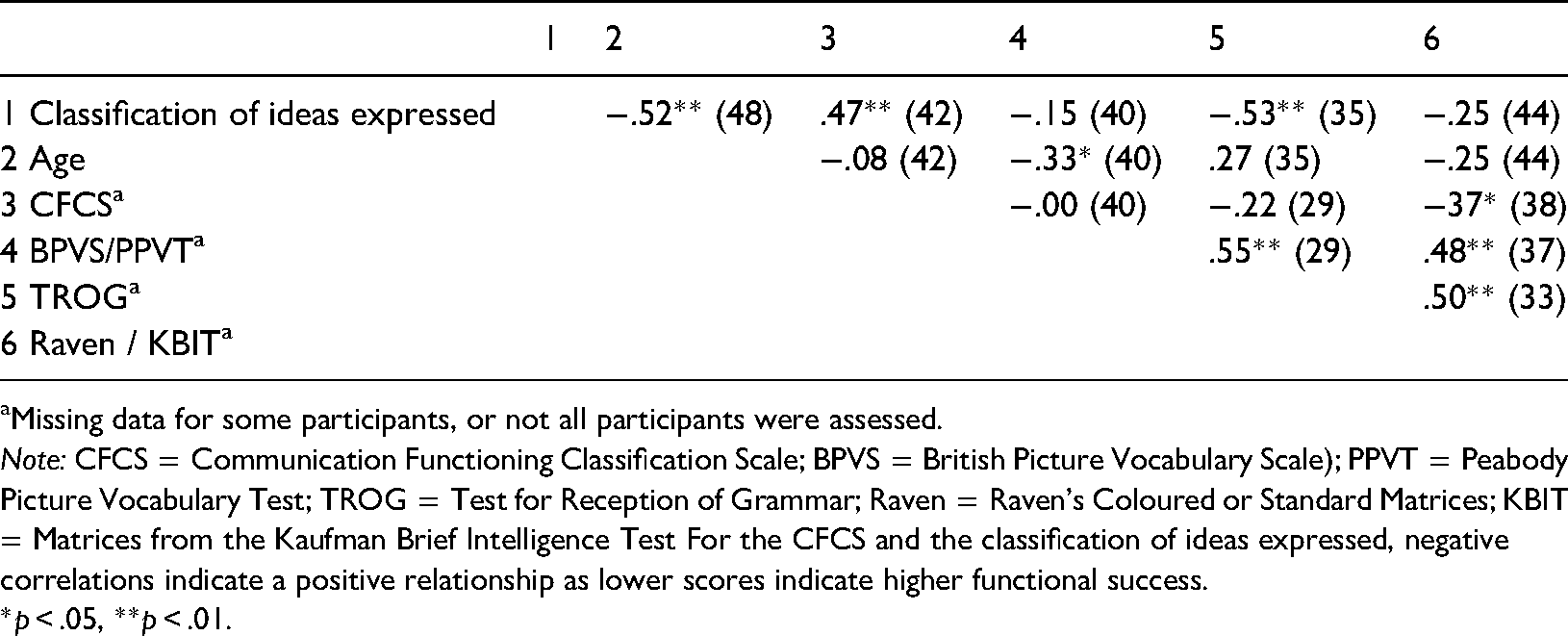
Missing data for some participants, or not all participants were assessed.
Note: CFCS = Communication Functioning Classification Scale; BPVS = British Picture Vocabulary Scale); PPVT = Peabody Picture Vocabulary Test; TROG = Test for Reception of Grammar; Raven = Raven's Coloured or Standard Matrices; KBIT = Matrices from the Kaufman Brief Intelligence Test For the CFCS and the classification of ideas expressed, negative correlations indicate a positive relationship as lower scores indicate higher functional success.
*p < .05, **p < .01.
The first logistic regression, exploring factors related to performance in conveying the main idea or central content of the video (i.e. scores 1–4 on ideas expressed), revealed that age was the factor that best explained performance when the aided communicators were divided in two groups according to their scores on ideas expressed, (i.e. scores 1–4 or 5–10). Overall, the model of factors contributing towards explaining communicative success or lack of it, fitted well with the data, as indicated by a significant omnibus test of model coefficients, χ2(3) = 20.8, p < .001, and a non-significant Hosmer-Lemeshow goodness of fit test, χ2(7) = 6.6, p = .477. The model correctly classified 78% of the cases, which is better than the predicted 63% (based on observed percentage of children not conveying main idea or central content). Cox and Snell R2 as well as Nagelkerke R2 were calculated as approximations of the coefficient of correlation, in order to describe the strength of the relationship. Cox and Snell R2 equaled 0.36 and Nagelkerke R2 0.50 indicating that overall, age, verbal comprehension and mode of aided communication explained between 36 and 50% of the variance. The odds ratio (Exp ß) of mode was 1.03, with a 95% confidence interval of 1.00–1.06.
The second logistic regression analysis, exploring factors related to performance in conveying the main content of the video (i.e. scores 1 or 2 on ideas expressed), revealed that the mode of communication was the factor that explained most of the variance of performance, when the aided communicators were divided in two groups according to their scores (i.e. 1–2 or 3–10). The model fitted well with the data, as shown by a significant omnibus test of model coefficients, χ2(3) = 21.2, p < .001, and a non-significant Hosmer-Lemeshow goodness of fit test, χ2(7) = 4.5, p = .719. The model correctly classified 87% of the cases, which is better than the predicted 76% (based on observed percentage of children not conveying main idea). Cox and Snell R2 equalled 0.37 and Nagelkerke R2 0.55 indicating that age, verbal comprehension and mode of aided communication explained between 37 and 55% of the variance. The odds ratio (Exp ß) of mode (symbol versus orthography) was .37 and the Inverted Exp β was 27.0 implying that it was 27 times more likely that an aided communicator who used spelling gave a precise event description, than an aided communicator using graphic symbols as the main mode of communication. Confidence interval was 2.8–250.
Discussion
Analyses of the event descriptions in the present study demonstrate both achievements and challenges of the young, aided communicators when they described an event that was unknown to the communication partner. As would be expected, the more precise the information provided by the aided communicators, the more likely it was that the communication partners were able to infer and recast what had happened in the video event. There was a robust relationship between the score on the ideas expressed and the number of linguistic elements provided by the aided communicators, and the recasts of the communication partners. In addition, the CFCS categorization, reflecting general expressive communication skills, was related to communicative performance. The time the aided communicators needed to describe the event varied, but time usage was not significantly related to performance in conveying information. Thus, both short and long interactions resulted in successful and unsuccessful event descriptions, suggesting that motor speed was not a decisive factor.
The results of the present study support previous findings indicating a relationship between some aspects of language comprehension and expressive aided language skills (e.g. Murray et al., 2018; Suttonet al., 2010). It is notable that comprehension of syntactic relations was significantly related to communicative performance, while comprehension of vocabulary was not. This may indicate that the child's understanding of how linguistic elements may be linked together is more central to the task of relaying event information that is unknown to the communication partner than scores on vocabulary tests based on knowledge of increasingly rare words (BPVS or PPVT). The billiard video was selected, because billiard terminology is not usually part of the vocabulary in the communication aids of young, aided communicators. The lack of relevant vocabulary in the communication aids may reflect the potentially limited experience of children with motor impairments with billiards, but may also imply a more complex relationship between available expressive vocabulary and world knowledge in young, aided communicators than in children with typical development.
In the absence of exact vocabulary, the aided communicators made creative attempts to describe the video event, combining aided and unaided communication modes. They generated constructions using superordinate, approximate and related vocabulary as thematic and physical clues to the meaning. This creativity may reflect strategies observed in younger typically developing children when they attempt to overcome vocabulary limitations, such as using words they know may not be quite right, but which are the best available options (i.e. close to the intended meaning), relying on the partner to make the connection between the elements expressed and the intended meaning (Falkum et al., 2017). Aided communicators may also offer graphic symbols and other expressions as clues to an intended meaning, relying on the communication partner to produce the final construction (Smith et al., 2018; von Tetzchner and Martinsen, 1996). However, giving more responsibility to the communication partners in inferring meaning only works if the partner understands the strategy and treats the elements as clues from which the meaning can be inferred. Familiar communication partners may be used to utilizing shared knowledge to navigate communication but may face challenges when the information is unknown and contextual support is sparse. For the participants described here, referring to potentially shared knowledge (e.g. a familiar person or place) seemed effective in helping the communication partners arrive at the right interpretation, but the partner also had to understand how the shared information was associated with the event to be inferred. For example, when viewing the video after finishing the task, one communication partner expressed: Oh! Actually she told me. She pointed over there [room location] to the Wii – we have that game on Wii. Thus, both the aided communicators and their partners need to learn how to frame potential contexts within which the clues should be understood.
Age was a decisive factor in predicting success in this task; the older children had better descriptive skills in general. The logistic regression analysis showed that age contributed most to communicative success, that is, relaying main content or central event information (scores 1–4). Aided communicators, particularly those who are not literate, are usually dependent on others to provide their vocabulary. With age, more vocabulary is likely to be provided and aided communicators may become more involved in choosing their own vocabulary (Brekke and von Tetzchner, 2003). However, for aided communicators using graphic symbols and/or who have limited spelling skills, expressive vocabulary is likely to remain considerably more constrained than the vocabulary of their peers using natural speech – or indeed their own receptive vocabulary. With time, aided communicators may also become more skilled in using available vocabulary more creatively and precisely. Moreover, with stronger metalinguistic skills, they may better understand what information is crucial to enable the partner to accurately infer their intended message, and which parts of the utterance may need to be elaborated. Thus, with age and experience, aided communicators become better at co-constructing accurate messages with communication partners. Older children may also be more persistent in demanding that their partners engage in co-construction of meaning, while younger children may expect that partners know the message and therefore accept the interpretation offered. The development of meta-communicative skills may depend on opportunities to assume greater communicative responsibility and greater knowledge of the strategies needed.
When assessing the information conveyed by participants in the event descriptions, the results of the second logistic regression analysis revealed that communication mode explained most of the variance in performance in describing the billiard event with specificity. Better orthographic competence may have allowed the construction of more exact vocabulary and utterances compared with aided communicators who used graphic symbols as their main means of communication. These findings highlight the benefits that may accrue from the considerable educational efforts often needed for teaching reading and writing to children who use aided communication (Smith, 2005). However, many aided communicators struggle to reach sufficient competence to be able to use orthography as their main mode of communication, and some never do. They rely on a combination of modes and need to be taught how to use clues and modify utterances in flexible ways during conversations involving co-construction. The modes used by aided communicators are not static and their strategies may be used creatively and dynamically, meeting their needs under different circumstances.
Limitations of the study
There are some important limitations that must be considered in interpreting the findings of this study. First, it was not possible to check if the participants had the aided vocabulary needed to describe the event, (e.g. billiard, pool), nor whether they recognized the game of billiards. However, the aim was to explore the strategies they used to describe what they had seen and to relay unshared information, independent of whether they had access to the specific words needed. Billiards is likely to be an uncommon conversational topic for most aided communicators; even if available they may not have remembered whether they had the specific vocabulary needed or where it was located, and thus the video was an appropriate choice for eliciting varied aided language strategies.
Second, the data include the results for only one video event. The task may have been difficult for younger children, although the results seemed to indicate that they recognized the event and portrayed strong efforts to communicate even when facing difficulties. However, the findings cannot be generalized to other types of interaction contexts or to other more familiar event description tasks.
Finally, the data are drawn from a large international data set involving different languages and researchers from several countries. Although measures were taken to ensure reliability and validity, and there were numerous discussions among the researchers to recheck possible ambiguities throughout the study, it is possible that there were inconsistencies in the data collection, transcription, and translations processes. Moreover, some of the data was missing, (e.g. assessment results due to lack of available test materials in each country and time utilized in discussing the event). It is acknowledged that this may have affected the findings assessing the relationships between different variables.
Conclusion and future directions
Young, aided communicators apply a variety of strategies in order to externalize their wishes, ideas, and feelings and (co)-construct messages that are understandable to their communication partners. The diverse ways in which the children in the present study used aided modes, modified their utterances according to the event they were describing, and provided clues to the communication partners to infer their intended meaning, have shed new light on aided language processes and development. Professionals who work with children who have little or no speech need these insights to develop ways of supporting aided communicators and their communication partners in overcoming communicative challenges and exploiting the potential of aided conversations. It may be important, for example, to construct interventions that focus on increasing competence in using strategies to overcome vocabulary limitations in addition to a focus on vocabulary expansion. Such interventions may need to consider how best to support young, aided communicators as well as their partners to maximize success. More research is needed to understand how the vocabulary and communication means available to aided communicators may support or constrain their possibilities for relaying information. Furthermore, although a detailed analysis of the strategies of the communication partners was beyond the scope this paper, the results point to the importance of shared responsibility in developing efficient co-construction skills and the need to understand more of the multifaceted and multi-layered processes of co-constructing meaning in conversations involving aided communication.
Supplemental Material
sj-docx-1-clt-10.1177_02656590211050865 - Supplemental material for Strategies in conveying information about unshared events using aided communication
Supplemental material, sj-docx-1-clt-10.1177_02656590211050865 for Strategies in conveying information about unshared events using aided communication by Kirsi A. Neuvonen, Kaisa Launonen, Martine M. Smith, Kristine Stadskleiv and Stephen von Tetzchner in Child Language Teaching and Therapy
Supplemental Material
sj-docx-2-clt-10.1177_02656590211050865 - Supplemental material for Strategies in conveying information about unshared events using aided communication
Supplemental material, sj-docx-2-clt-10.1177_02656590211050865 for Strategies in conveying information about unshared events using aided communication by Kirsi A. Neuvonen, Kaisa Launonen, Martine M. Smith, Kristine Stadskleiv and Stephen von Tetzchner in Child Language Teaching and Therapy
Footnotes
Acknowledgements
The authors thank the participating children, families, teachers, and therapists for giving their time to the project, and the following colleagues for help with collection of the data: Carmen Basil, Beata Batorowicz, Annika Dahlgren Sandberg, Krista Heimonen, Margareta Jennische, Janice Murray, Gregor Renner and Hans van Balkom.
Declaration of interest
The authors report no conflicts of interest
Declaration of Conflicting Interests
The author(s) declared no potential conflicts of interest with respect to the research, authorship, and/or publication of this article.
Funding
The author(s) received no financial support for the research, authorship and/or publication of this article.

Supplemental material
Supplemental material for this article is available online.
Appendix
References
Supplementary Material
Please find the following supplemental material available below.
For Open Access articles published under a Creative Commons License, all supplemental material carries the same license as the article it is associated with.
For non-Open Access articles published, all supplemental material carries a non-exclusive license, and permission requests for re-use of supplemental material or any part of supplemental material shall be sent directly to the copyright owner as specified in the copyright notice associated with the article.
