



Abstract
We examined whether the attachment dimensions of avoidance and anxiety predict the content of nostalgic recollections and accompanying well-being benefits. For this purpose, we developed a coding scheme to evaluate written narratives of nostalgic memories across three themes: self, others, affect. In Study 1 (N = 431), all participants narrated a nostalgic event and completed an attachment orientation measure. Participants lower (vs. higher) on avoidance included more details about others, connection to others, self-expansion, and positive affect. Those lower (vs. higher) on anxiety included less positive and negative affect. In Study 2 (N = 392), participants were randomly assigned to narrate either a nostalgic or ordinary memory and reported state well-being. Both avoidance and anxiety were associated with other-related narrative content, which in turn related to well-being benefits. Participants lower (vs. higher) on avoidance expressed greater positivity about others and connection in their nostalgic (but not control) narratives. Participants lower (vs. higher) on anxiety expressed less negativity about others in their nostalgic (but not control) narratives. Both dimensions showed indirect effects via these narrative features on well-being in the nostalgia condition. Overall, avoidance was consistently related to others’ portrayal in nostalgic narratives, whereas anxiety’s influence on nostalgia was less consistent. Attachment insecurity shapes the content of nostalgic narratives and consequent well-being outcomes.
Nostalgia is a sentimental longing for meaningful aspects of one’s past (Sedikides & Wildschut, 2018). Arising from reflection on fond and personally significant memories, nostalgia is a complex, ambivalent emotion, but more positively- than negatively-toned (Hepper et al., 2012; Leunissen, 2023; Van Tilburg et al., 2018). In nostalgizing, one feels warm, tender, and content, tinged with yearning or sadness for the irrecoverable past. Content analyses of nostalgic narratives reveal that the self is commonly the protagonist, embedded in social context (e.g., graduations, anniversaries, birthdays) and surrounded by close others (e.g., partner, family members, friends; Wildschut et al., 2006). Nostalgia also confers well-being benefits (Hepper & Dennis, 2023). Converging evidence from cross-sectional and experimental studies indicates that, compared with ordinary, positive, or lucky autobiographical memories, nostalgia uniquely promotes social connectedness (Sedikides & Wildschut, 2019), meaning in life (Sedikides & Wildschut, 2018), self-continuity (Sedikides et al., 2016), self-esteem (Hepper et al., 2012), and optimism (Cheung et al., 2013). However, individual differences may shape the experience and benefits of nostalgia, as some people profit more from the emotion than others. We examine how the content of nostalgia memories and their well-being benefits vary by individual differences in attachment orientation, as a trait that colors perceptions of self, others, emotions, and memory.
Attachment Orientation
Attachment theory (Bowlby, 1969/1982) provides a framework for understanding individual differences in representations of self and others, known as internal working models. They encompass expectations and strategies for managing interpersonal relationships, exploratory behavior, and distress. In adulthood, these differences are best captured by two continuous attachment dimensions: avoidance and anxiety (Brennan et al., 1998; Mikulincer & Shaver, 2003). Individuals low on both dimensions are securely attached. They report high and stable self-esteem (Hepper et al., 2012b), a positive view of others (Mikulincer & Shaver, 2003), and effective emotion regulation (Mikulincer & Shaver, 2019).
Avoidance reflects distrust toward close others and discomfort with closeness (Brennan et al., 1998). Individuals who are high on the dimension of avoidance (hereafter “high-avoidance individuals” for brevity) maintain negative working models of others (Bartholomew & Horowitz, 1991). This constrains their desire for self-expansion—the process of incorporating others into one’s self-concept (Aron et al., 1992)—stemming from their belief that others are untrustworthy. Avoidant strategies entail deactivating the attachment system and suppressing emotional experience and expression (Mikulincer & Shaver, 2019). Under stress, high-avoidance individuals inhibit proximity-seeking, intensify their distrust of others, and rely on coping mechanisms such as suppression (Mikulincer & Shaver, 2003) or self-reliance instead of social support (Simpson et al., 2007). Additionally, high-avoidance individuals downplay the importance of relationships and derive self-esteem from independence, though their self-esteem is considered somewhat fragile (Hepper & Carnelley, 2012a). They also show negative memory biases or poor recall for relationship-relevant information due to defensive exclusion processes (Dykas & Cassidy, 2011; Fraley & Brumbaugh, 2007; Wang et al., 2017).
Attachment anxiety reflects worry of abandonment or rejection by close others (Brennan et al., 1998). Those high on the dimension of anxiety (hereafter “high-anxiety individuals”) believe they are unworthy of love and hold negative working models of the self (Bartholomew & Horowitz, 1991). They exhibit low or unstable self-esteem (Hepper & Carnelley, 2012b), low self-concept clarity (Emery et al., 2018), and negative self-descriptions (Doyle & Markiewicz, 2005). Anxious attachment strategies entail heightened activation of the attachment system (Mikulincer & Shaver, 2003), ineffective emotion regulation (Mikulincer & Shaver, 2019), and ambivalence about relationships (Mikulincer et al., 2010). Under stress, high-anxiety individuals seek greater closeness to attachment figures yet are hypersensitive to relationship threats (Simpson & Rholes, 2012), which may exacerbate their emotional volatility (Tidwell et al., 1996) and rumination (Gentzler et al., 2010). Due to this hypervigilance, they recall more negative than positive relational interactions (Gentzler & Kerns, 2006) and memories (Mikulincer & Orbach, 1995).
Nostalgia and Attachment Orientation
Given that attachment orientation shapes emotion regulation strategies and interpersonal memory, the past-oriented emotion of nostalgia may afford a unique lens into the operation of attachment dynamics. Nostalgia involves not only simply recalling events but reliving meaningful personal memories that often involve close relationships (Hepper et al., 2012; Wildschut et al., 2006). The specific memories people recall and the feelings they experience during nostalgia, therefore, may be shaped by their attachment orientation. After all, memories partially mirror how a person perceives themselves and their relationships with significant others (Bluck et al., 2005). Moreover, nostalgia occurs at least weekly in more than half of people across ages (Hepper et al., 2021) and cultures (Hepper et al., 2024), and is often triggered by psychological threats in order to restore well-being (Wildschut & Sedikides, 2023). Hence, it may be recruited in ways that align with an individual’s attachment needs (cf. Mikulincer & Shaver, 2019). Indeed, individuals are known to recruit memories in the service of emotion regulation goals (Tamir et al., 2008). As a result, the well-being benefits of nostalgia might be dampened by attachment insecurity—or alternatively nostalgia might serve to support insecure individuals’ emotional needs. The latter is indirectly supported by the presence of nostalgia themes in attachment-security scripts (Carnelley & Rowe, 2010).
Evidence supports a moderating role of attachment orientation (specifically, avoidance) on certain benefits of nostalgia. Some studies have induced nostalgia with the validated Event Reflection Task (Sedikides et al., 2015), which involves recalling and describing a nostalgic (vs. ordinary) event. Although participants typically experience greater social connectedness from nostalgic (than ordinary) reflection, Wildschut et al. (2010) found that this effect was only significant for those low in avoidance. Additionally, low-avoidance individuals express a stronger desire for a romantic relationship after nostalgic (than ordinary) reflection (Juhl et al., 2012). Finally, high-avoidance individuals show weaker preference for relationship nostalgia, which predicts lower partner commitment (Swets & Cox, 2023). These findings, all focusing on social aspects of well-being, indicate a role for attachment orientation. However, they do not explain the underlying mechanisms.
One reason that nostalgia influences people differently based on attachment orientation might be that they remember their past in different ways. The content of nostalgic narratives offers a window into the emotional tone and content of the memory. For example, topics of nostalgic narratives (e.g., family, positive affect) predict benefits (Fetterman et al., 2025). Only one study has addressed the association between attachment orientation and content of nostalgic narratives (Abeyta, Routledge, Roylance, et al., 2015). The authors coded narratives from an undergraduate student sample on four themes: sociality (social interaction), attachment feelings (loved, protected, trusted), agency (competence, success, power), emotional tone (positive, negative, ambivalent). Nostalgic narratives contained more of these elements compared to ordinary narratives. In nostalgic narratives, avoidance correlated with more attachment feelings and less agency. No significant associations emerged between avoidance and the remaining two themes, or between anxiety and the four themes. However, Abeyta et al.’s themes were designed with avoidance in mind, meaning that other potential associations may have gone undetected. Moreover, it is unknown whether those themes related to psychological benefits of nostalgia. Finally, the sample was limited to undergraduates, whereas older individuals might manifest different patterns. Therefore, examining how attachment orientation relates to both the content of nostalgic narratives and their benefits would offer greater insight into how attachment orientation shapes the nostalgic experience.
Research Overview
Objectives
Our first objective was to examine how attachment orientation relates to nostalgic narrative content; the second was to test whether this content mediates the link between attachment and nostalgia’s well-being benefits. Pursuing these objectives could clarify why high-avoidance individuals benefit less from nostalgia and inform strategies to help them, as well as identify how, if at all, attachment anxiety shapes nostalgia. We developed a coding scheme for nostalgic narratives based on working models of self and others (Hepper & Carnelley, 2012a). In Study 1, participants wrote about a nostalgic event, allowing us to address the first objective. In Study 2, participants wrote about either a nostalgic or ordinary event and reported well-being, enabling us to address the second objective.
Themes and Hypotheses
Coded Themes and Subthemes

The first theme was self. As nostalgia is a self-relevant emotion (Van Tilburg et al., 2018), we examined how individuals represent the self in their nostalgic narratives. Given that the (negative) working model of self is central to attachment anxiety but not avoidance, we focused on anxiety in this theme. High-anxiety individuals describe themselves unfavorably (Doyle & Markiewicz, 2005) and endorse more undesirable self-representations in memory (Rom & Mikulincer, 2003). Hence, nostalgic narratives might reveal similar patterns. Alternatively, as nostalgia boosts self-perceptions (Hepper et al., 2012), these effects of anxiety might be attenuated. No research has examined the link between attachment orientation and self-representations in nostalgic narratives. To address this gap, we focused on three subthemes: self-negativity (mentioning one’s undesirable qualities), self-positivity (mentioning one’s desirable qualities), and specific self-references (mentioning one’s specific traits or attitudes). In Study 1, we hypothesized that participants lower (vs. higher) on anxiety would include less self-negativity, greater self-positivity, and more self-references in their nostalgic narratives. In Study 2, we hypothesized that these indices of positive/greater self-representations would all link to higher well-being, and would mediate the effects of attachment anxiety, especially in the nostalgia (vs. control) condition. We did not offer hypotheses about attachment avoidance, as it does not directly map onto self-representations.
The second theme was others. As nostalgia is a social emotion (Sedikides & Wildschut, 2019), we examined how individuals represent others in their nostalgic narratives. Given that the (negative) working model of others is key to attachment avoidance but not anxiety, we focused on avoidance in this theme. In prior research (Abeyta, Routledge, Roylance, et al., 2015), avoidance was negatively associated with attachment feelings but unrelated to number of references to social interactions. These results, however, do not address the detail or valence of how individuals represent others in nostalgic memories. High-avoidance individuals suppress relational memories and emphasize others’ flaws, showing lower warmth and connectedness (Dykas & Cassidy, 2011; Fraley & Brumbaugh, 2007). They also derive less social connectedness from nostalgia (Wildschut et al., 2010). We examined whether these patterns characterize nostalgic narratives by coding six subthemes: details about others, other-negativity (mentioning others negatively), other-positivity (mentioning others positively), self-expansion, connection (feeling connected to others), and disconnection (feeling disconnected from others). In Study 1, we hypothesized that participants lower (vs. higher) on avoidance would include more details of others, self-expansion, other-positivity, and connection, and less other-negativity and disconnection in their nostalgic narratives. In Study 2, we hypothesized that these favorable other-representations would be associated with greater well-being, and would mediate the effects of attachment avoidance, especially in the nostalgia (vs. control) condition. We did not offer hypotheses about attachment anxiety, as it does not directly map onto representations of others.
The third theme was affect, given nostalgia’s blend of positive and negative affect (Leunissen, 2023). We considered avoidance and anxiety, because emotion regulation is central to both (Mikulincer & Shaver, 2019). Prior work found no affect differences by attachment in nostalgia narratives (Abeyta, Routledge, Roylance, et al., 2015), but we revisited this issue using broader coding and larger samples. We examined negative affect (NA) and positive affect (PA). In Study 1, we analyzed coded affect, and, in Study 2, both coded affect and self-reported affect. In Study 1, we hypothesized that lower (vs. higher) avoidance participants would include less coded NA and more coded PA in their nostalgic narratives. Similarly, we hypothesized that lower (vs. higher) anxiety participants would include less coded NA and more coded PA. In Study 2, we hypothesized that less coded NA and more coded PA would mediate associations between attachment dimensions and self-reported well-being, PA, and NA, especially in the nostalgia (vs. control) condition.
Adult attachment orientation is characterized by the joint contribution of avoidance and anxiety rather than either dimension in isolation (Fraley et al., 2015; Mikulincer & Shaver, 2016). As such, we explored whether their interaction predicted nostalgia content and effects on well-being. We formed no hypotheses about these interaction effects.
Study 1
In Study 1, we tested the cross-sectional association between attachment orientation and nostalgic narrative content in a lifespan adult sample. We conducted secondary coding and analysis of a dataset in which some unrelated variables have been reported (Hepper et al., 2021), but the narratives had not previously been analyzed or reported. Participants wrote a narrative about a personal nostalgic event and self-reported attachment orientation as part of a battery of measures. We hypothesized that attachment anxiety would be associated with self-related and affect content of nostalgic narratives, and attachment avoidance would be associated with other-related and affect content of nostalgic narratives.
Method
Participants
Participant Demographics in Study 1

Note:aThese data were collected before we had updated our inclusive practices and so participants who identified as a different gender may have left the question blank.
Procedure
Participants read a definition of nostalgia (“sentimental longing or wistful affection for the past”; The New Oxford Dictionary of English, 1998) and recalled “a nostalgic event in your life … a past event that makes you feel most nostalgic.” They were instructed to take 8-10 minutes to write about the experience and how it made them feel. The narratives ranged in length from 17–615 words (M = 174.13, SD = 91.87).
After a few filler measures, participants completed, due to time constraints, an abbreviated version of the Experiences in Close Relationships-Revised scale (Fraley et al., 2000; 1 = disagree strongly, 5 = agree strongly). This version measured avoidance (5 items; α = .89, M = 2.07, SD = 0.85) and anxiety (5 items; α = .94, M = 2.31, SD = 1.05). We selected items with the highest factor-loadings for each attachment dimension (Sibley et al., 2005).
Coding
The first author coded all narratives, rating them or calculating percentages (Table 1). A second coder coded a subset of the narratives (n = 44, 10%) for nine subthemes (self-negativity, self-positivity, self-references, detail of others, other-negativity, other positivity, self-expansion, coded NA, coded PA). A third coder coded the same subset of narratives for the remaining two subthemes (connection, disconnection). All coders were unaware of participants’ demographic and attachment scores, and the second and third coders were unaware of hypotheses. Interrater reliability was good for all subthemes, r (42) > .74, p < .001 (Supplemental Table S1).
Results
We provide descriptive statistics in Table S1. We examined how favorably participants’ narratives described themselves, others, and affect, using paired t-tests between opposing (e.g., positive vs. negative) narrative content subthemes. Participants were significantly more likely to mention their positive than negative attributes or deeds, t (430) = 4.63, p < .001, d = 0.22. They described others more positively than negatively, t (397) = 10.31, p < .001, d = 0.52, and included more connection than disconnection, t (397) = 16.58, p < .001, d = 0.83. Lastly, they expressed more PA than NA, t (430) = 18.41, p < .001, d = 0.89.
Nostalgic Narrative Content as a Function of Attachment Dimensions in Study 1

Note. PA = Positive affect. NA = Negative affect. Significant effects are highlighted in bold for ease of reading.
Discussion
Participants’ nostalgia narratives expressed positive self- and other-representations, connection, and were more positive than negative in affective tone. Attachment orientation shaped these features. As hypothesized, participants higher (vs. lower) in avoidance mentioned fewer details of others, less self-expansion, less connection, and less PA. This partially supported our hypotheses, although avoidance did not map onto all other-related subthemes (i.e., other-negativity, other-positivity, disconnection). The results expand on prior findings (Abeyta, Routledge, Roylance, et al., 2015) by indicating that high-avoidance individuals represent nostalgic memories less positively and with less social connection.
Participants higher (vs. lower) in attachment anxiety expressed both more NA and more PA in their narratives. We had hypothesized that high-anxiety individuals would report less PA, but the finding is consistent with their hyperactivated attachment system, relational ambivalence, and difficulties with emotion regulation (Mikulincer & Shaver, 2019). However, contrary to hypotheses, anxiety did not correlate with any self-related subthemes. This implies that either higher-anxiety and lower-anxiety individuals reap the same level of self-positivity from nostalgia or an unexamined variable moderates these effects.
Although the results clarified attachment differences in nostalgic narratives, the study has limitations. First, the cross-sectional design limits causal claims and leaves unclear whether the findings are specific to nostalgia or reflect general memory processes, as attachment differences are also evident in autobiographical memory recall (Wang et al., 2017). Second, the results do not determine whether nostalgic content predicts well-being, an important issue given high-avoidance individuals’ reduced benefits from nostalgia (Wildschut et al., 2010).
Study 2
In Study 2, we extended the Study 1 findings using an experimental design, whereby participants narrated either a nostalgic or ordinary event. This approach enables us to evaluate whether attachment orientation is associated with differences specifically in the content of nostalgic (vs. control) narratives and, in turn, how narrative content contributes to nostalgia’s benefits. Building on Study 1, we hypothesized that avoidance and anxiety would be more strongly associated with the content of nostalgic than ordinary narratives. We focused again on the associations between avoidance and other-related and affect codes, and between anxiety and self-related and affect codes. We further hypothesized that differences in content would mediate the relation between attachment orientation and nostalgia’s benefits, reflecting a moderated mediation pattern. After writing nostalgia (vs. ordinary) narratives, participants self-reported their psychological well-being, PA, and NA. We hypothesized that less-positive other-related and affect codes would mediate the negative association between avoidance and well-being, more strongly in the nostalgia (vs. control) condition. Additionally, more-negative self-related and affect codes would mediate the negative association between anxiety and well-being, more strongly in the nostalgia (vs. control) condition.
Method
Participants
Participant Demographics in Study 2

Materials and Procedure
Response options for all scales ranged from 1 (strongly disagree) to 7 (strongly agree). We assessed attachment orientation with the Experiences in Close Relationships scale (Brennan et al., 1998), comprising an anxiety (18 items; α = .92, M = 3.71, SD = 1.19) and avoidance (18 items; α = .95, M = 2.89, SD = 1.17) subscale.
Then, we randomly assigned participants to the nostalgia (n = 201) or control (n = 191) condition. We induced nostalgia with the Event Reflection Task (Sedikides et al., 2015), a validated and widely-used nostalgia induction method (Wildschut & Sedikides, 2025). In the nostalgic [control] condition, participants read: “think of a nostalgic [an ordinary] event in your life. Specifically, try to think of a past event that makes you feel most nostalgic [is ordinary, normal, and everyday—that is, events that you experience on a regular basis].” Narratives ranged in length from 31-411 words (M = 153.36, SD = 76.09).
Next, we assessed nostalgia’s well-being benefits with the revised Nostalgia Functions Scale (Hepper et al., 2012; α = 0.96, M = 5.25, SD = 1.22). It included 20 items preceded by the stem “Right now, I feel…” forming five, 4-item subscales: social connectedness (e.g., “connected to loved ones”), meaning (e.g., “life is meaningful”), self-continuity (e.g., “connected with my past”), self-esteem (“I like myself better”), optimism (e.g., “hopeful about my future”). We combined the subscales into a single well-being index to maintain analytic parsimony, given their positive intercorrelations (rrange = .60-.77, ps < .001) and that we did not have separate hypotheses (for a similar approach, see Yılmaz-Özdemir et al., 2025).
Subsequently, we assessed self-reported NA and PA. Participants completed the 12-item Scale of Positive and Negative Experience (Diener et al., 2009), which comprises six negative (e.g., sad, afraid; α = .92, M = 2.37, SD = 1.37) and six positive (e.g., happy, pleasant; α = .95, M = 4.99, SD = 1.44) feelings. We presented items in randomized order. We concluded with a 3-item manipulation check (Wildschut et al., 2006), preceded by the stem “When I recalled my past memory …” (e.g., “I am feeling quite nostalgic”; α = .98, M = 4.99, SD = 2.01).
Coding
The first author—unaware of condition and scale responses—coded all narratives. A second coder—unaware of hypotheses, condition, and scale responses—coded a subset of the nostalgic (n = 60, 30%) and ordinary (n = 56, 29%) narratives. Interrater reliability was good for all codes, r (116) > .90, p < .0001 (Table S1).
Results
Manipulation Check
Effects of Condition on Narrative Content and Self-Reported Outcomes in Study 2

Note. PA = Positive affect. NA = Negative affect. Significant effects highlighted in bold.
Correlations Among Variables
We report correlations in Supplemental Table S6. The self subthemes were uncorrelated. Self-expansion, other-positivity, detail of others, and connection were positively intercorrelated, and generally negatively related to other-negativity and disconnection. Coded PA and NA were negatively correlated. Well-being, self-reported PA, and self-reported NA correlated with most nostalgia content subthemes, supporting the notion that narrative content relates to the well-being outcomes of the memory.
Effects of Condition on Narrative Content and Self-Reported Outcomes
Narratives of nostalgia (vs. control) memories included significantly more detail of others, other-positivity, self-expansion, connection, and coded PA, but less self-negativity, other-negativity, and coded NA (Table 5). Supplemental analyses comparing opposing subthemes (e.g., positive vs. negative) showed that the character of nostalgic narratives was similar to Study 1 (Supplemental Materials).
Participants in the nostalgia (vs. control) condition reported higher well-being (Table 5). There were no significant condition differences in self-reported PA and NA.
Attachment Differences in Narrative Content
To examine whether attachment orientation predicted each narrative subtheme, we conducted a series of moderation models (including 3-way interactions; PROCESS Model 3; Hayes, 2022). In each model, we added condition as the focal predictor (coded nostalgia = 1, control = −1), with avoidance and anxiety (mean-centered) as interacting moderators. We probed significant interactions by estimating simple effects of attachment in each condition (for full simple effects results, see Table S7).
Effects of Attachment Avoidance on Narrative Content and Self-Reported Outcomes in Study 2

Note. The model also included anxiety, condition, and all interactions. Main effects of condition (Table 5) did not alter in significance so are omitted for brevity. Avoidance × Anxiety results are presented in Table S8. PA = Positive affect. NA = Negative affect. Significant effects highlighted in bold.
Effects of Attachment Anxiety on Narrative Content and Self-Reported Outcomes in Study 2

Note. The model also included avoidance, condition, and all interactions. Main effects of condition (Table 5) did not alter in significance so are omitted for brevity. Avoidance × Anxiety results are presented in Table S8. PA = Positive affect. NA = Negative affect. Significant effects highlighted in bold.
Avoidance
Avoidance was significantly negatively associated with other-positivity, connection, and coded PA, and positively with self-references (Table 6). Its associations with other-positivity and connection were moderated by condition (Table 6 and Figure 1). Avoidance was negatively associated with both other-positivity and connection in the nostalgia condition, Bother-pos = −.307, Bconnect = −.268, ps < .001, but not in the control condition, Bother-pos = .040, p = .569, Bconnect = .026, p = .721. Consistent with Study 1, avoidance shaped representations of others in nostalgic narratives. Condition did not moderate the associations between avoidance and self-related themes, affect themes, or the remaining other-related subthemes. Significant Condition × Avoidance Interactions on Narrative Content in Study 2. Note. Points are plotted at M±1SD on avoidance
Anxiety
Attachment anxiety was significantly negatively associated with self-references, connection, and coded PA, and positively with self-negativity and coded NA (Table 7). The moderating effect of condition was significant for self-negativity, self-references, other-negativity, and disconnection (Table 7 and Figure 2). Anxiety was significantly negatively associated with self-references in the nostalgia condition, B = −9.364, p < .001, but not in the control condition, B = −2.164, p = .289. Anxiety was positively associated with other-negativity in the nostalgia condition, B = .126, p = .010, but not in the control condition, B = −.058, p = .267. Thus, two effects of attachment anxiety were unique to nostalgia narratives. In contrast, anxiety was positively associated with self-negativity and disconnection in the control condition, Bself-neg = .168, p < .001, Bdisconnect = .100, p = .014, but not the nostalgia condition, Bself-neg = −.001, p = .992, Bdisconnect = −.025, p = .504. These two negative effects of attachment anxiety were present only in ordinary narratives (Figure 2). Significant Condition × Anxiety Interactions on Narrative Content (upper four panels) and Self-reported Well-being (lower panel) in Study 2. Note. Points are plotted at M±1SD on anxiety
Attachment Differences in Well-Being
To assess whether attachment orientation was associated with self-reported well-being, we conducted a moderation model for each self-reported outcome. Both avoidance (Table 6) and anxiety (Table 7) were negatively associated with self-reported well-being and positive affect, and positively associated with negative affect. Condition moderated the association between anxiety and well-being, such that the negative association was significant in the control condition, B = −0.26, p < .001, but not in the nostalgia condition, B = −0.05, p = .426 (Figure 2, lower panel).
Mediating Role of Narrative Content on Attachment Differences in Well-Being
Moderated Mediation Analyses: Condition as a Moderator of the Indirect Effects of Attachment on Well-Being via Narrative Content in Study 2
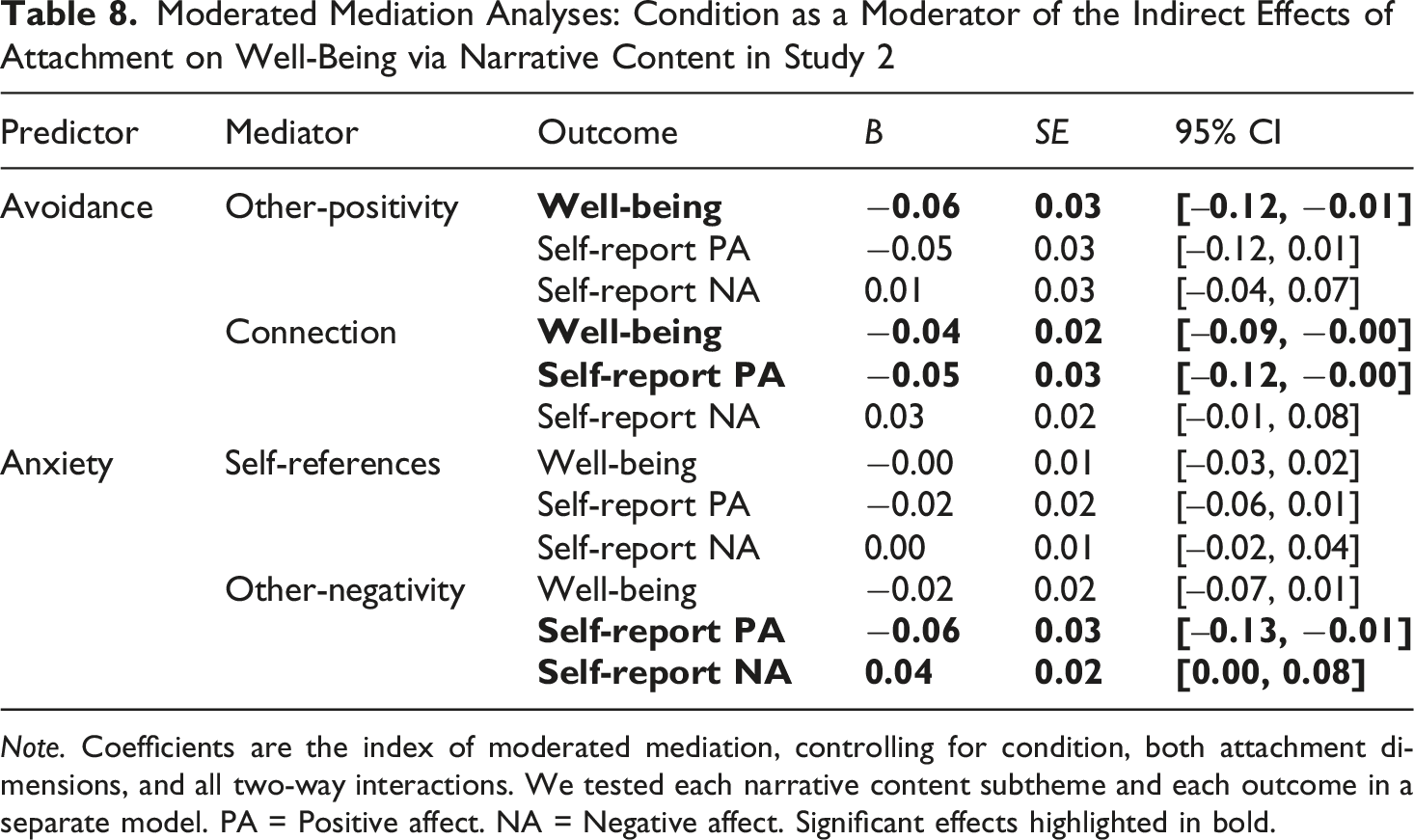
Note. Coefficients are the index of moderated mediation, controlling for condition, both attachment dimensions, and all two-way interactions. We tested each narrative content subtheme and each outcome in a separate model. PA = Positive affect. NA = Negative affect. Significant effects highlighted in bold.
We report full results only for the content mediators that were significantly associated with attachment in the nostalgia condition. For avoidance, these were other-positivity and connection; for anxiety, these were specific self-references and other-negativity. In Supplemental Materials, we report additional models with the remaining nine content mediators (Table S9) and overall indirect effects excluding condition (Table S10).
Avoidance
Moderated mediation effects were significant via both other-positivity and connection. The indirect effect (ab) from avoidance → other-positivity → well-being was significant in the nostalgia condition, ab = −0.05, 95% CI [‒0.10, −0.01], but not in the control condition, ab = 0.01, 95% CI [‒0.01, 0.03]. Similarly, the avoidance → connection → well-being indirect effect was significant in the nostalgia condition, ab = −0.04, 95% CI [‒0.08, −0.01], but not in the control condition, ab = 0.00, 95% CI [‒0.02, 0.03]. Finally, the avoidance → connection → self-report PA indirect effect was significant in the nostalgia condition, ab = −0.04, 95% CI [‒0.10, −0.00], but not in the control condition, ab = 0.00, 95% CI [‒0.02, 0.03]. No other moderated mediation effects were significant for avoidance (Table S9), but there was a significant indirect negative association with well-being across conditions via reduced coded PA (Table S10). 5
Anxiety
Moderated mediation effects were significant for other-negativity, but not for self-references. The indirect effects from anxiety → other-negativity → lower self-reported PA and higher self-reported NA were significant in the nostalgia condition (PA: ab = −0.04, 95% CI [‒0.08, −0.01], NA: ab = 0.03, 95% CI [0.00, 0.06]) but not in the control condition (PA: ab = 0.02, 95% CI [−0.02, 0.07], NA: ab = −0.01, 95% CI [−0.05, 0.02]). Supplemental models with other mediators (Table S9) suggested that anxiety also showed some opposing patterns. Specifically, high-anxiety individuals’ greater disconnection and self-negativity were associated with reduced well-being and self-reported affect in the control condition, but not in the nostalgia condition. Further, anxiety showed significant indirect associations with reduced well-being indices across conditions via coded PA and coded NA (Table S10).
Discussion
Nostalgic narratives differed from control on most narrative content subthemes, manifesting the positivity and social connection hallmarks of nostalgia (Hepper et al., 2012). Nostalgic recall also increased state well-being, whereas self-reported PA and NA did not differ between conditions. This pattern is compatible with some prior research showing inconsistent nostalgia effects on state affect (Frankenbach et al., 2021) and non-significant effects on self-reported PA (Cheung et al., 2013, Study 3; Stephan et al., 2014, Studies 4-5). The finding that nostalgia increased state well-being without altering PA or NA is also concordant with suggestive evidence that nostalgia more reliably contributes to eudaimonic than hedonic well-being (Hepper & Dennis, 2023).
Nostalgic (vs. control) narratives displayed attachment-related differences in content. Extending prior research (Abeyta, Routledge, Roylance, et al., 2015) and Study 1, several key differences were specific to nostalgic memories. Lower avoidance was associated with greater positivity toward others and interpersonal connection in nostalgic narratives, a pattern not observed in control narratives. These positive other-related features were, in turn, associated with greater well-being and self-reported PA. The findings support the hypothesis that positive other-representations fostered by low-avoidance individuals’ nostalgia contribute to its benefits. This pattern was not observed for different other-representations (i.e., details of others, other-negativity, self-expansion, disconnection) or for coded affect, implying that positive social connections are the most important mechanism explaining the differential outcomes by avoidance. Of note, avoidance was negatively associated with well-being across conditions, but this was only mediated by interpersonal narrative content in the nostalgia condition. Hence, high-avoidance individuals’ low well-being in the control condition likely reflects dispositional tendencies to suppress affect rather than the specific ordinary memory they recalled.
We hypothesized that attachment anxiety would be associated with self-related and affect subthemes in nostalgic (more than control) narratives. As in Study 1, the results were somewhat unexpected. Participants lower (vs. higher) in anxiety exhibited less negativity about others in their nostalgic narratives, which indirectly carried through to more positive and less negative self-reported affect. Although they also included more specific self-references, this did not relate to well-being outcomes, suggesting that other-representations in nostalgia are more influential. Conversely, high-anxiety participants expressed greater negative self-representations and disconnection in control narratives, but this pattern was absent in nostalgic narratives. This pattern indicates that nostalgia is not a generally negative experience for high-anxiety individuals but may even counteract some of their generally negative recall tendencies. Moreover, supplementary analyses suggest that nostalgia’s reduced disconnection and self-negativity may help indirectly to buffer high-anxiety individuals’ lower well-being.
General Discussion
In two studies, we examined how attachment orientations shape the content of nostalgic narratives and ensuing state well-being. The results clarify the representations of self and others in nostalgic memories. Nostalgic (vs. ordinary) narratives portray others more positively and with greater depth, emphasizing connection and incorporating others into the narrator’s self-concept. Representations of the self are also less negative, albeit no more positive. Findings also replicated the predominance of PA over NA in nostalgic narratives (Sedikides et al., 2015). Hence, nostalgia facilitates rehearsal of positive over negative representations of self and others. These narrative features correlated with state well-being outcomes, suggesting that positive self- and other-representations contribute to the social connectedness, self-continuity, and self-esteem benefits prompted by nostalgic reverie (Hepper et al., 2012; Sedikides et al., 2016; Sedikides & Wildschut, 2019). Future work could examine whether positive and close other-representations in nostalgic memories account for increases in social approach motivation or perceived romantic relationship quality (Evans et al., 2022).
Importantly, the results illustrate the relevance of attachment orientation in shaping the experience and benefits of nostalgia, extending previous work (Abeyta, Routledge, Roylance, et al., 2015; Wildschut et al., 2010). We discuss attachment avoidance and anxiety in turn, given their different theoretical dynamics and given that we observed no meaningful interactions between the dimensions.
Attachment Avoidance
We anticipated that avoidance would shape the representations of others in nostalgia, and findings largely supported this proposal. In Study 1, low avoidance was associated with greater details of others, connection to others, self-expansion, and coded PA in nostalgic narratives. In Study 2, low avoidance was associated with more other-related positivity and connection in nostalgic (but not control) narratives, a pattern that mediated well-being and self-reported positive affect. Thus, avoidance consistently maps onto other-representations in nostalgic narratives. Low-avoidance individuals included close relationships in their narratives, expressing greater positivity and connection to others. High-avoidance individuals maintain interpersonal distance by omitting others from memories (Study 1; see also Juhl et al., 2012) and downplay positivity and connection specifically in their nostalgic memories (Studies 1–2). Our findings show that high-avoidance individuals’ negative working model of others and distance-focused strategies color their most meaningful memories.
Moreover, Study 2 findings indicate that these features also prevent higher-avoidance individuals from reaping the psychological benefits of nostalgia. Hence, their nostalgia-recall strategies may account for the inhibited interpersonal benefits shown in prior nostalgia studies (e.g., feeling less socially supported or loved; Juhl et al., 2012; Wildschut et al., 2010). It remains unclear whether these individual differences first occur during the event (e.g., closeness to their family), at encoding (e.g., they paid less attention to interpersonal connections), in rehearsal (e.g., they recall positive aspects of nostalgic memories less-often), and/or at prompted recall. Fraley and Brumbaugh’s (2007) studies suggested that high-avoidance individuals defensively exclude emotional information at encoding, but nostalgic memories often become emotional only after the passage of time so might not be subject to the same encoding strategies. Future research could examine whether prompting high-avoidance individuals to recall others in more positive or connected ways during nostalgic reflection mitigates these effects.
Low-avoidance individuals expressed more PA in both nostalgic and ordinary narratives, which carried through to general well-being. This pattern aligns with the notion that high avoidance involves emotion suppression (Mikulincer & Shaver, 2019) and recalling events as less positive than they are (Gentzler & Kerns, 2006). The non-specific nature of this tendency indicates again that affect is less important than social connection as a mechanism through which attachment shapes nostalgia’s unique benefits.
Attachment Anxiety
Across studies, findings were less consistent for anxiety than for avoidance. We anticipated that anxiety would shape the representations of self in nostalgia. The only clearly supportive finding was that anxiety was negatively associated with specific self-references in nostalgic but not control narratives (Study 2), consistent with high-anxiety individuals’ reduced self-concept clarity (Emery et al., 2018). However, anxiety was unrelated to the valence of self-representations in nostalgic narratives in either study. Moreover, self-references did not mediate the association between anxiety and resulting well-being. Instead, in Study 2 high-anxiety individuals’ greater negativity about others in nostalgic (vs. ordinary) narratives mediated their reduced well-being. This finding is compatible with evidence that high-anxiety individuals recall more negative than positive interactions with attachment figures (Gentzler & Kerns, 2006). Broadly, our findings indicate that nostalgia’s well-being benefits are more strongly tied to interpersonal rather than self-focused narrative content. Despite the self’s prominence in nostalgia, other-representations in nostalgic recall seem to drive outcomes.
Study 2 obtained the novel and unexpected finding that participants high in attachment anxiety expressed more self-negativity and disconnection in ordinary narratives, but not in nostalgic narratives. Moreover, these features mediated a similar pattern on state well-being. These findings converge with previous evidence that high-anxiety individuals portray the self negatively in autobiographical memories (Mikulincer & Orbach, 1995), yet they newly suggest that nostalgia does not exacerbate such representations and may even counteract them. This pattern also adds nuance to prior evidence that nostalgia boosts self-esteem (Hepper et al., 2012); high-anxiety individuals may especially benefit by attenuating negative self-views (cf. Vess et al., 2012) rather than enhancing positive ones. Future research should aim to replicate this pattern of buffered well-being and explore further psychological mechanisms (e.g., boosted felt security, reduced fear of rejection).
Attachment anxiety also exhibited inconsistent associations with expressed affect. High-anxiety individuals included more coded PA and NA in nostalgic narratives in Study 1, but less coded PA and more NA across conditions in Study 2. Although heightened emotional intensity among high-anxiety individuals is consistent with their sensitivity and emotional turbulence (Mikulincer & Shaver, 2019), this variability observed here echoes prior findings that nostalgia is less consistently linked to anxiety than avoidance (Abeyta, Routledge, Roylance, et al., 2015; Wildschut et al., 2010). This pattern may reflect the affective and interpersonal ambivalence characteristic of attachment anxiety, which can manifest differently across retrieval contexts (Mikulincer et al., 2010). Future research could examine whether directing high-anxiety individuals to recall nostalgic memories that foreground positive representations of others and more coherent or specific aspects of the self can amplify nostalgia’s well-being benefits.
Limitations
Our samples, albeit large, gender-balanced, and age-diverse, were drawn from Westerner populations. Despite evidence that nostalgia is similarly conceptualized cross-culturally (Hepper et al., 2024), future research should assess whether the present attachment-linked narrative patterns and well-being effects generalize across cultural contexts. In addition, we relied on the Event Reflection Task to induce nostalgia. Although this task is well-validated (Wildschut & Sedikides, 2025), alternative inductions, particularly romantic nostalgia (Evans et al., 2022), may be more directly aligned with attachment dynamics. Follow-up investigations should examine whether attachment orientation moderates the content and benefits of romantic nostalgia or its interpersonal consequences. Finally, we did not collect certain demographic characteristics (e.g., disability status, sexual orientation). Incorporating these variables in future work would provide a more inclusive account of how individuals engage with and benefit from nostalgia.
Conclusion
Attachment orientation shapes the character and psychological benefits of nostalgic memories. Securely attached (low in avoidance and anxiety) individuals derive benefits from reflecting interpersonal positivity and closeness in nostalgic memories, highlighting the role of social connectedness. Insecure attachment, marked by higher avoidance or anxiety, was associated with nostalgic memories featuring relative disconnection or negative representations of others, which may attenuate nostalgia’s capacity to promote well-being. Although nostalgia can offer a rich psychological resource to maintain well-being, it also shines a spotlight on the negative interpersonal representations that insecurely attached individuals apply to their memories. Those negative internal working models then prevent them from reaping the full rewards of nostalgia. These findings point to potential intervention targets. Encouraging insecurely attached individuals to retrieve nostalgic memories that emphasize positive representations of others may strengthen nostalgia’s regulatory function, whether in self-guided reflective practices or therapeutic contexts.
Supplemental material
Supplemental Material - Attachment Orientation and the Landscape of Nostalgia: Narrative Content and Well-Being Outcomes
Supplemental Material for Attachment Orientation and the Landscape of Nostalgia: Narrative Content and Well-Being Outcomes by Amelia Dennis, Erica G. Hepper, Tim Wildschut and Constantine Sedikides in Journal of Social and Personal Relationships
Footnotes
Acknowledgements
We thank Francesca Trevisan and Ethan Dennis for help with data coding.
Ethical Consideration
The research received ethical approval from University of Southampton.
Funding
The authors received no financial support for the research, authorship, and/or publication of this article.
Declaration of Conflicting Interests
The authors declared no potential conflicts of interest with respect to the research, authorship, and/or publication of this article.
Data Availability Statement
Open Research Statement
As part of IARR’s encouragement of open research practices, the authors have provided the following information: This research was not pre-registered.
The data used in the research are available. The data can be obtained at:  . The materials used in the research are available. The materials can be obtained at: https://osf.io/esxuq/.
Supplemental material
Supplemental material for this article is available online.
Notes
References
Supplementary Material
Please find the following supplemental material available below.
For Open Access articles published under a Creative Commons License, all supplemental material carries the same license as the article it is associated with.
For non-Open Access articles published, all supplemental material carries a non-exclusive license, and permission requests for re-use of supplemental material or any part of supplemental material shall be sent directly to the copyright owner as specified in the copyright notice associated with the article.
