




Abstract
For emerging adults, developing and maintaining close relationships is an important developmental task relevant for well-being. Therefore, it is important to understand and assess relationship self-efficacy (RSE), reflecting one’s confidence in maintaining and managing close relationships. Most previous research on RSE has focused on romantic relationships, but developing work suggests similar processes may occur in friendships and other types of relationships, a key conceptual question. This study randomly assigned 654 US emerging adults to complete measures of RSE for either romantic relationships, friendships, or close relationships (generally), and examined associations with other key correlates (general and social self-efficacy, self-esteem, relationship satisfaction). With minor modifications, measurement invariance testing supported partial invariance up to the scalar level, suggesting items had similar meanings across contexts. Correlations with self and relational constructs were similar across RSE types with minor exceptions. Further research is needed to understand how RSE develops and relationships between different types of RSE.
Emerging adulthood, spanning ages 18–29, has gained attention as a unique life stage characterized by feelings of “in between,” identity exploration, and navigating role and relationship changes (Arnett et al., 2014). The various life changes associated with emerging adulthood have the potential to increase psychological distress. During this period, close relationships (often identified as best friendships, romantic relationships, family relationships, or more generally intimate and responsive relationships; Clark & Lemay, 2010) serve as central sources of social support and contribute to overall psychological well-being (Garcia-Mendoza et al., 2024). This emphasis on relationships aligns with Erikson’s psychosocial theory of development (1968) in which identity is understood as inseparable from social and cultural influences, with adult identity emerging through close interpersonal relationships (Mayseless & Keren, 2014). Given this, relationship self-efficacy (RSE), confidence in one’s ability to maintain close (typically, romantic) relationships and to manage difficult situations arising within such (Riggio et al., 2011, 2013), may be especially important.
Romantic RSE (RRSE) is linked to other aspects of self-efficacy, self-concept, and relationship outcomes. For example, RRSE is associated with both general self-efficacy (Riggio et al., 2011, 2013) and social self-efficacy, an individual’s confidence in their social skills more broadly (Matsushima & Shiomi, 2003). Similarly, self-esteem, one’s sense of value and worth, has also been linked to RRSE (Cabeldue & Boswell, 2012). Relationship satisfaction is also closely connected to RRSE (Riggio et al., 2013; Shurts & Myers, 2012); higher RRSE leads to increased engagement in relationship maintenance behaviors, leading to higher relationship satisfaction (Weiser & Weigel, 2016).
A developing research area has been RSE outside of romantic relationships, mostly close friendships. Similar to RRSE, best friendship RSE is negatively related to depressive symptoms and social anxiety and positively associated with friendship satisfaction (Fitzpatrick & Bussey, 2014). Other work has extended this construct to cross-ethnic friendship self-efficacy (Bagci et al., 2020) and workplace friendship self-efficacy (Fasbender et al., 2023). However, it is not clear whether friendship RSE (FRSE) and RRSE share deeper similarities. That is, is RRSE unique, or merely a facet of overall confidence in close relationships? It is possible both FRSE and RRSE could be conceptualized as specific aspects of a broader construct of close relationship self-efficacy (CRSE), one’s ability to maintain close relationships in general (friendships, romantic relationships, family relationships, etc.). Therefore, in the current study, we will assign participants to complete the same items for either RRSE, FRSE, or CRSE. We predict that:
An adapted measure of RRSE will function well for FRSE and CRSE and will demonstrate measurement invariance across all three groups.
RRSE, FRSE, and CRSE will be associated with general and social self-efficacy, self-esteem, and relationship satisfaction (for romantic relationships, friendships, and close relationships).
Are there differences between RRSE, FRSE, and CRSE in these associations?
Method
Participants & Procedure
A total of 654 individuals (44 men, 593 women, 14 non-binary individuals, two transgender men, and one preferred not to answer) age 18-29 (M = 19.45, SD = 1.98) were recruited from a US public university’s SONA system and convenience sampling (social media, direct contacts). Responses from those older than 29 were omitted from the study given the focus on emerging adults. Most were White (53.8%), followed by Black/African American (22.5%), Asian (11.2%), American Indian/Native Alaskan (2.8%), Native Hawaiian/Pacific Islander (0.5%), and “prefer not to answer” (9.3%); 50.6% were non-Hispanic/Latino(a) and 48.6% were Hispanic/Latino(a). Regarding relationship status, 48.6% were single, 45.3% dating/in a relationship, 3.5% cohabitating/domestic partnership, 1.1% married, 0.2% separated/divorced; 1.4% preferred not to answer. Most were heterosexual (71.1%) followed by bisexual (12.3%), lesbian (3.8%), asexual (3.5%), pansexual (2.1%), queer (2%), “other” (1.5%), gay (0.8%); 2.9% preferred not to answer.
Participants completed an online Qualtrics survey. This project was declared exempt by the Texas Woman’s University Institutional Review Board (IRB-FY2024-274). SONA participants received course credit; no other compensation was provided. Participants provided informed consent and were randomly assigned to RRSE, FRSE, or CRSE.
Measures
Relationship Self-Efficacy
RSE was assessed using the Self-Efficacy in Romantic Relationships Scale (Riggio et al., 2011), replacing the term “romantic relationships” with “friendships” or “close relationships.” Two subscales, interpersonal difficulty (9 items) and persistence (3 items), were combined in a total score. Participants responded using a Likert scale from strongly disagree (1) to strongly agree (9). Cronbach’s alphas were .79 (FRSE), .81 (RRSE), and .82 (CRSE).
General Self-Efficacy
General self-efficacy was measured using the 10-item General Self-Efficacy Scale (Schwarzer & Jerusalem, 1995). Participants responded on a scale from not true at all (1) to exactly true (4). Items were summed. Cronbach’s alpha was .77.
Social Self-Efficacy
To measure social self-efficacy the 25-item Perceived Social Self-Efficacy Scale (Smith & Betz, 2000) was used. Individuals rated their confidence in handling social situations (e.g., making friends, going to an event) from no confidence (1) to complete confidence (5). One item was omitted due to error. Scores were calculated by averaging. Cronbach’s alpha was .94.
Self-Esteem
We measured self-esteem using the 10-item Rosenberg Self-Esteem Scale (Rosenberg, 1965). Responses are made on a scale from strongly agree (4) to strongly disagree (1). Total scores were summed after reverse-scoring relevant items. Cronbach’s alpha was .74.
Relationship Satisfaction
Relationship satisfaction was measured using the single-item Relationship Assessment Scale (Fülöp et al., 2020), a 5-point Likert scale from not satisfied (1) to very satisfied (5). Participants rated satisfaction with romantic relationships (if applicable), friendships, and close relationships.
Approach to Analysis
Measurement invariance was tested across RRSE, FRSE, and CRSE using the four-step procedure for ordinal data (Bowen & Masa, 2015) and the lavaan package in R (Rosseel, 2012): (1) baseline models in all groups separately, (2) single factor model for all groups (configural invariance), (3) constraining loadings to be equal (metric invariance), and (4) constraining loadings and thresholds to be equal (scalar invariance). Unacceptable change between subsequent models was defined as ΔCFI > −.01 combined with either ΔRMSEA ≥.015 or ΔSRMR ≥.01 (Chen, 2007) or poor absolute model fit (well-fitting: CFI ≥.95, SRMR ≤.09, RMSEA ≤.08; Hu & Bentler, 1999). There were two correlated latent factors for the subscales.
Correlates were added to the final scalar invariance models, in separate models. Correlations were first estimated freely across groups, then constrained. As an exploratory analysis (RQ1), omnibus χ2 (df = (2) difference tests were used to compare these models, with a nonsignificant χ2 indicating a lack of difference in correlations. Only following a significant χ2 (to limit multiple comparisons), pairwise comparisons were conducted using Fisher’s r-to-z test.
Results
Preliminary Analyses
The lowest category (“Strongly disagree”) for item 3 was not used in the RRSE group, and the top category (“Strongly agree”) for item 6 was not used in the FRSE group. These options were collapsed for all groups on those two items to estimate invariance. Due to the smaller sample size for romantic relationship satisfaction, additional response options were collapsed in those analyses only.
Measurement Invariance
Model Fit Information
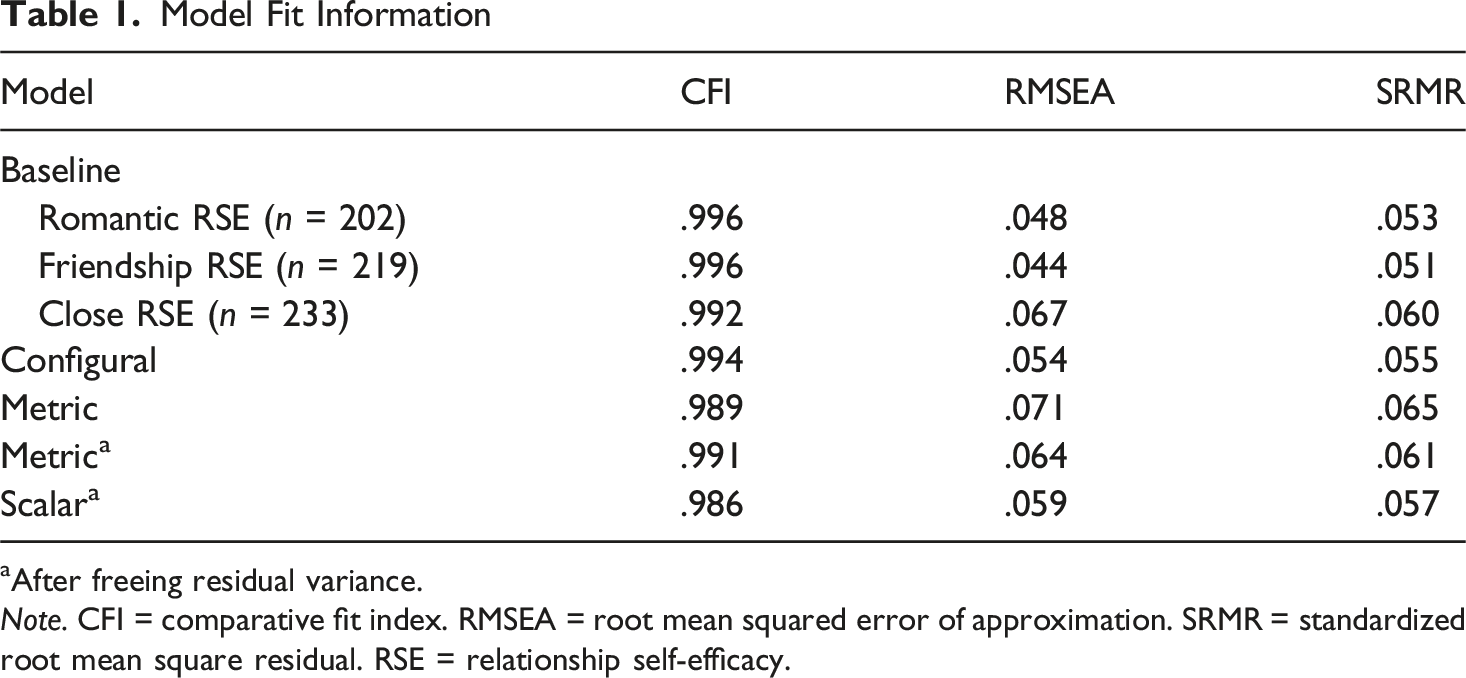
aAfter freeing residual variance.
Note. CFI = comparative fit index. RMSEA = root mean squared error of approximation. SRMR = standardized root mean square residual. RSE = relationship self-efficacy.
Correlations
Correlations
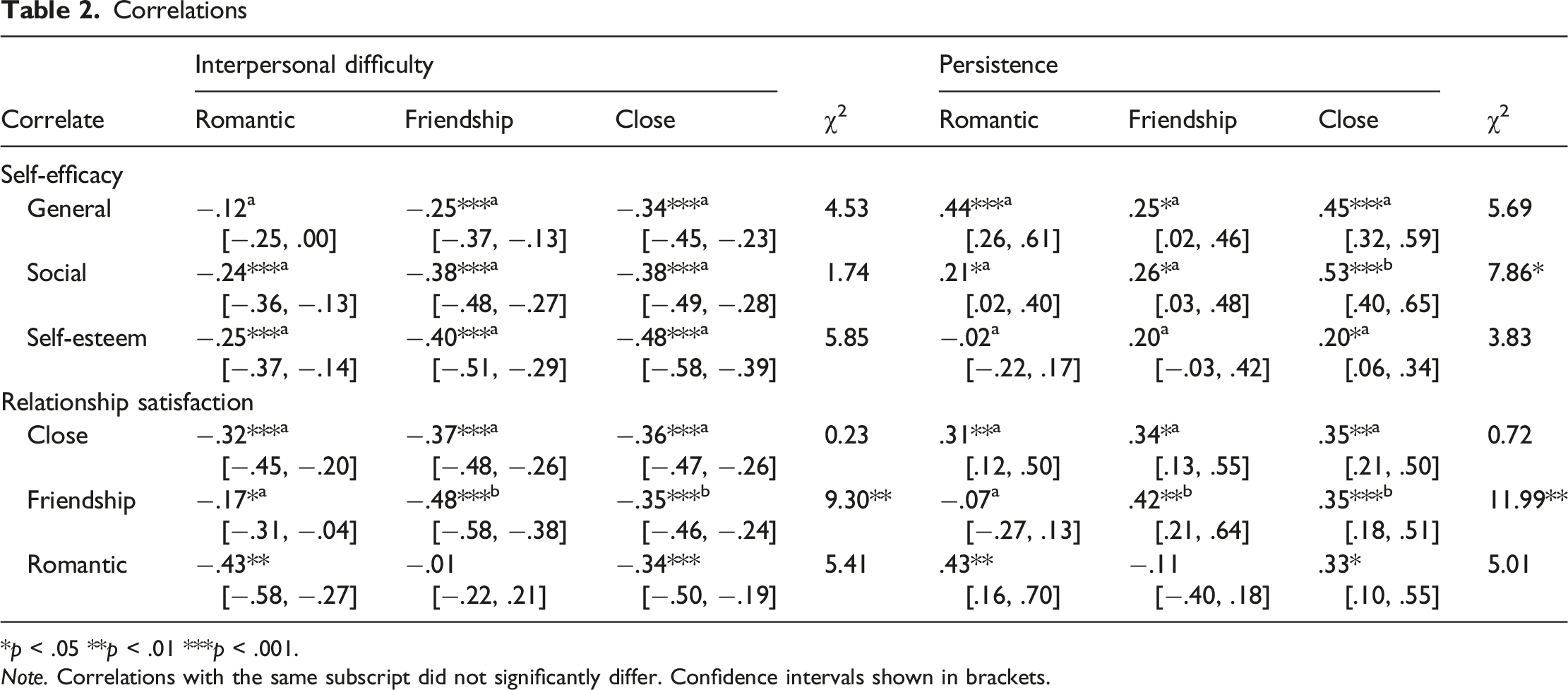
*p < .05 **p < .01 ***p < .001.
Note. Correlations with the same subscript did not significantly differ. Confidence intervals shown in brackets.
Three χ2 tests were significant (RQ1). FRSE and RRSE persistence were less strongly related to social self-efficacy than CRSE persistence. Both dimensions of RRSE were less strongly related to friendship satisfaction than FRSE or CRSE.
Discussion
RSE does not appear to be specific to romantic relationships. The adapted measure fit well across all three groups and demonstrated up to partial scalar invariance (freeing one pair of residual variances), mostly supporting predictions. Furthermore, RRSE, FRSE, and CRSE had similar patterns of association with general and social self-efficacy, self-esteem, and relationship satisfaction. However, CRSE was more closely related to social self-efficacy, possibly due to greater conceptual overlap in these two broader measures. While social self-efficacy focuses on initiating relationships and interacting in broader social contexts with co-workers, acquaintances, and strangers (Matsushima & Shiomi, 2003), compared to CRSE’s focus on close relationships and relationship maintenance, both constructs focus on relationships as a general domain, suggesting further need to map theoretical associations between CRSE and other forms of self-efficacy. Also, RRSE and FRSE showed some domain specificity, being less related (or unrelated) to relationship satisfaction in the other domain.
These findings suggest that RSE holds similar meaning across relational contexts, and the potential benefits of RSE are not limited to RRSE. While many emerging adults prioritize building intimate partner bonds (Mayseless & Keren, 2014), family and close friendships are also essential for well-being during this transitional phase (Camirand & Poulin, 2022; García-Mendoza et al., 2024). In line with psychosocial perspectives emphasizing identity development through interpersonal relationships, CRSE may represent a broader developmental resource in emerging adulthood (Mayseless & Keren, 2014) and could be conceptualized as a higher-order trait (within which RRSE may be nested). This suggests that building RSE could be a pathway toward better well-being, whether or not an emerging adult is pursuing romantic relationships.
The interpretations of these findings should take several limitations into account. First, participants were predominantly female (90.7%) and drawn from a US convenience sample. Results may not generalize across genders or cultures with different norms around close relationships and emerging adulthood (Hendry & Kloep, 2007). Some other demographic information, including class and disability, was not collected. Additionally, the cross-sectional self-report design of this study leads to possible response biases (e.g., inaccurate recall, socially desirable responding) as well as common method effects (possibly explaining the stronger link between CRSE and social self-efficacy). Future longitudinal and/or multi-method work should seek to replicate these findings. Further, participants’ relationship history is unknown. Those assigned the romantic condition may have never experienced a romantic relationship or experienced one in an earlier developmental period (e.g., adolescence). The use of a single-item relationship satisfaction measure also limits the sensitivity of some analyses, as does the collapsing of categories on some RSE items to allow for group comparisons (especially analyses involving the subset of partnered participants). The term “close relationships” was not defined for participants, and perceptions may vary. Lastly, the study was not preregistered.
By conceptualizing RSE as a broader construct across close relationships, this study opens up new pathways to understand how and when RSE translates across different relationships. For example, development of RSE may begin in family relationships and friendships before translating to romantic relationships in adolescence and young adulthood (Xia et al., 2018). Additional theoretical work is needed to explore how best to conceptualize RSE (e.g., as a relational schema or a subdomain of self-efficacy). Investigating RSE across time and relationships may be meaningful for improving well-being in emerging adulthood and beyond.
Supplemental material
Supplemental Material - Romantic, Friendship, and Close Relationship Self-Efficacy in Emerging Adulthood: Differences and Similarities
Supplemental Material for Romantic, Friendship, and Close Relationship Self-Efficacy in Emerging Adulthood: Differences and Similarities by Alannah Shelby Rivers, Anitta Biju, Rachel Morrison, Ashley Ates, Gracie Graham in Journal of Social and Personal Relationships
Footnotes
Declaration of conflicting interests
The authors declared no potential conflicts of interest with respect to the research, authorship, and/or publication of this article.
Funding
The authors received no financial support for the research, authorship, and/or publication of this article.
Open science statement

Ethical Considerations
This project was declared exempt by the Texas Woman’s University Institutional Review Board (IRB-FY2024-274). All participants provided informed consent.
Supplemental material
Supplemental material for this article is available online