




Abstract
Despite its negative reputation, gossip is a common conversational behavior that can benefit relationships. However, its potential advantages have not been explored in romantic partnerships. Using a naturalistic observation method (the Electronically Activated Recorder; EAR) we assessed how frequently 76 same- and different-gender couples gossiped with each other, and whether this frequency was associated with self-reported happiness and relationship quality. Actor-Partner Interdependence Models revealed preliminary evidence that romantic partner gossip was positively associated with both happiness and relationship quality. This association held for both same- and different-gender couples. Given that romantic partners are primary sources of conversation and emotional exchanges for many adults, gossip may play a particularly important role in strengthening these bonds. Future research should replicate this finding and explore potential causal mechanisms and specific gossip characteristics that drive these associations, as gossip may be a fruitful avenue to test as a communication strategy for improving well-being in romantic partnerships.
Keywords
People are inherently motivated to share social information. Over time, this tendency has been ascribed a label with a poor reputation: gossip – the exchange of information about a person who is not physically present or actively involved in a conversation (Baumeister et al., 2004). Despite its disrepute, gossip is common in everyday conversations and is generally not malicious (Robbins & Karan, 2020). Studies examining friend, coworker, and stranger interactions provide evidence that gossiping can facilitate positive relationship qualities between the sharers and receivers of the social information (Bosson et al., 2006). These qualities include greater cooperation, bonding, commonality, and liking (Peters & Kashima, 2007). Even negative gossip can promote trust and greater perceptions of emotional disclosure between gossip sharers (Dores Cruz et al., 2020). These findings suggest that gossiping between romantic partners might confer similar relationship benefits. However, to date, no research has examined romantic partners’ gossip and its associations with individual and relationship well-being. This study addresses this gap, using a naturalistic observation method to sample couples’ everyday gossip with each other, and explores its associations with self-reported happiness and relationship quality.
Couple communication
Romantic partners serve as the primary source of social support for many adults and, for better or worse, the quality of these relationships has consistently been linked to well-being outcomes (Braithwaite & Holt-Lunstad, 2017). Communication behaviors between partners, such as discussion of events and experiences, emotional exchanges, and interaction frequency are important aspects of relationship functioning. These exchanges can function as indicators of support, understanding, and commitment to the partner’s well-being (Johnson et al., 2021). Therefore, gossip may indicate romantic partners’ motivation to and comfort with disclosing their social experiences and thoughts with each other and provide opportunities to seek and receive support.
Relational gender and gossip
When studying gossip between romantic partners, it is important to consider how each partner’s gender might interact to influence gossip frequency. Approaching this topic using relational gender – a term based on the “gender-as-relational” approach (Thomeer et al., 2020) – allows researchers to account for the possibility that women and men communicate differently with their partner depending on that partner’s gender. For instance, men may gossip with a woman partner differently than a man partner. Research on gossip in non-romantic relationships suggests that gender mis/match may be an important factor when predicting how often and with whom people gossip (Robbins & Karan, 2020). These gender-based differences have been attributed to socialized gender norms and values. For instance, women are more likely to gossip about relationships, sexuality, and physical appearance, whereas men are more likely to gossip about achievement-related topics, social status, and wealth (Eckhaus & Ben-Hador, 2019). Thus, same-gender romantic partners may gossip with one another more frequently than different-gender partners due to similar gossip topic interests. Additionally, stereotypes classifying gossip as a behavior characteristic of women (McAndrew, 2014) might motivate men to avoid gossiping with women partners.
There is also evidence suggesting gender differences regarding with whom romantic partners choose to gossip. Self-report research found that men in different-gender (heterosexual) relationships claimed to gossip more with their romantic partner than with their same-gender friends, whereas women gossiped equally with their partner and same-gender friends (McAndrew et al., 2007). This finding mirrors a broader literature showing that men in different-gender marriages often engage in more emotional exchanges with their partner compared to their friends, while women generally engage more evenly with both their partner and same-gender friends (Stronge et al., 2019). Gossip may be a distinct form of communication that varies across relational genders, potentially reflecting differences in how partners interact conversationally. However, none of these past studies have examined gossip behavior dyadically, nor included people in same-gender romantic relationships, leaving these patterns largely unexplored.
Prior research demonstrates that same-gender romantic partnerships have unique strengths that enhance relationship quality, such as more concordant views on autonomy, sexual behaviors, intimacy, health behaviors (Joyner et al., 2019), more appreciation for individual differences, effective communication skills, positive emotions during interactions, commitment, and shared egalitarian ideals (Rostosky & Riggle, 2017). However, little is known about how these strengths play out in day-to-day conversations. Perhaps a tendency to gossip with one’s same-gender partner more frequently contributes to the relationship strengths often observed in same-gender couples.
As an important note, although we use inclusive language (e.g., ‘same-gender’ and ‘different-gender’ couples), we occasionally reference ‘heterosexual’ relationships when summarizing past research that used this terminology, for consistency. We acknowledge that such terms can conflate gender and sexual orientation and may not fully reflect participants’ identities. Further, there is no specific mention in past literature of gossip behavior among people who are gender diverse, to our knowledge, so our reference to ‘different-gender’ refers to couples where one partner identifies as a man and the other as a woman. We acknowledge this language may, and should, evolve as research increasingly includes gender-diverse individuals.
Studying romantic partner gossip using naturalistic observation
Gossip studies overwhelmingly rely on questionnaires, observations of experimentally constructed social interactions, or asking participants to predict their behavior in hypothetical scenarios (Watson, 2012). Consequently, our current knowledge of gossip is limited to what people are willing and able to report, or how they behave in artificial settings. While essential in advancing our understanding of how people perceive their gossiping behavior and how they engage in gossiping in experimentally-controlled social situations, these methods introduce biases. Considering that gossip is perceived as an immoral and socially undesirable behavior (Dores Cruz et al., 2019) and is often subtle or habitual, gossip may be underreported when using retrospective questionnaires. Indeed, studies have found discrepancies between observed and self-reported gossip engagement (Hartung & Renner, 2013), and associations between trait social desirability and reduced reports of gossip engagement (Nevo et al., 1993). The few gossip studies that have used observational methods only captured gossip in specific social settings, such as students in a university lounge (Levin & Arluke, 1985), or did not explicitly study gossip between romantic partners (Robbins & Karan, 2020). Lastly, people generally cannot accurately report their past behaviors or predict future behaviors (Nisbett & Wilson, 1977). Therefore, retrospective gossip measures and methods asking people to anticipate future or hypothetical gossiping could lead to inaccurate estimates. Addressing this topic using naturalistic behavioral observation is needed to obtain a comprehensive understanding of how romantic partners gossip in their everyday lives and whether it is reliably linked to relationship quality and well-being indicators.
The Electronically Activated Recorder (EAR) – a portable electronic device that records ambient sound from the participant’s environment throughout the wearer’s day – is a naturalistic observational measure that provides an ecologically valid account of social interactions. Data collected using this method are less affected by biases associated with social desirability, impression management, retrospection, and setting selection (Mehl et al., 2012); thus, several social psychologists have called for greater use of naturalistic observation methods over the last few decades (Robbins et al., 2021). Participants in EAR studies go about their daily routines and engage in conversations in both public and private settings, allowing researchers to obtain a real-world representation of gossip engagement. Therefore, in addition to being the first study to examine everyday gossip engagement between romantic partners, we also add a rare, naturalistic observation perspective to gossip research.
Present study
The current study uses a naturalistic observation method (the EAR), with a dyadic approach, as a first step examining how frequently same- and different-gender romantic partners gossip with each other. Additionally, we explore links between romantic partner gossip and self-reported happiness and relationship quality. We also account for whether this association differs depending on one’s own gender and the gender of their partner (i.e., relational gender). Data were collected from both partners and analyzed at the individual and couple levels. The following hypotheses and research question were tested:
More frequent, observed romantic partner gossip will be positively associated with participants’ self-reported happiness.
More frequent, observed romantic partner gossip will be positively associated with participants’ self-reported relationship quality.
Do the associations between romantic partner gossip and well-being outcomes differ based on relational gender?
Method
Participants
The current study obtained data from both members of self-identified same-gender (i.e., woman in a relationship with a woman, man with a man) and different-gender (i.e., man with a woman) romantic couples. Couples were recruited throughout Southern California via flyers, which were distributed in public places, and through newsletters from the LGBT Community Center of the Desert in Palm Springs, from 2014–2018. Eligible couples were: (1) married or in a self-determined marriage-like relationship, (2) living together for at least 1 year, and (3) had no symptoms of physical or mental health conditions that impeded their daily functioning. These criteria ensured that we studied people in committed romantic relationships who were not coping with health problems that would change their normal activities. Participants were compensated $25 for each weekend they completed the study procedures, which totaled $50 per individual, and $100 per couple over the two-weekend period.
Demographic characteristics of participants.
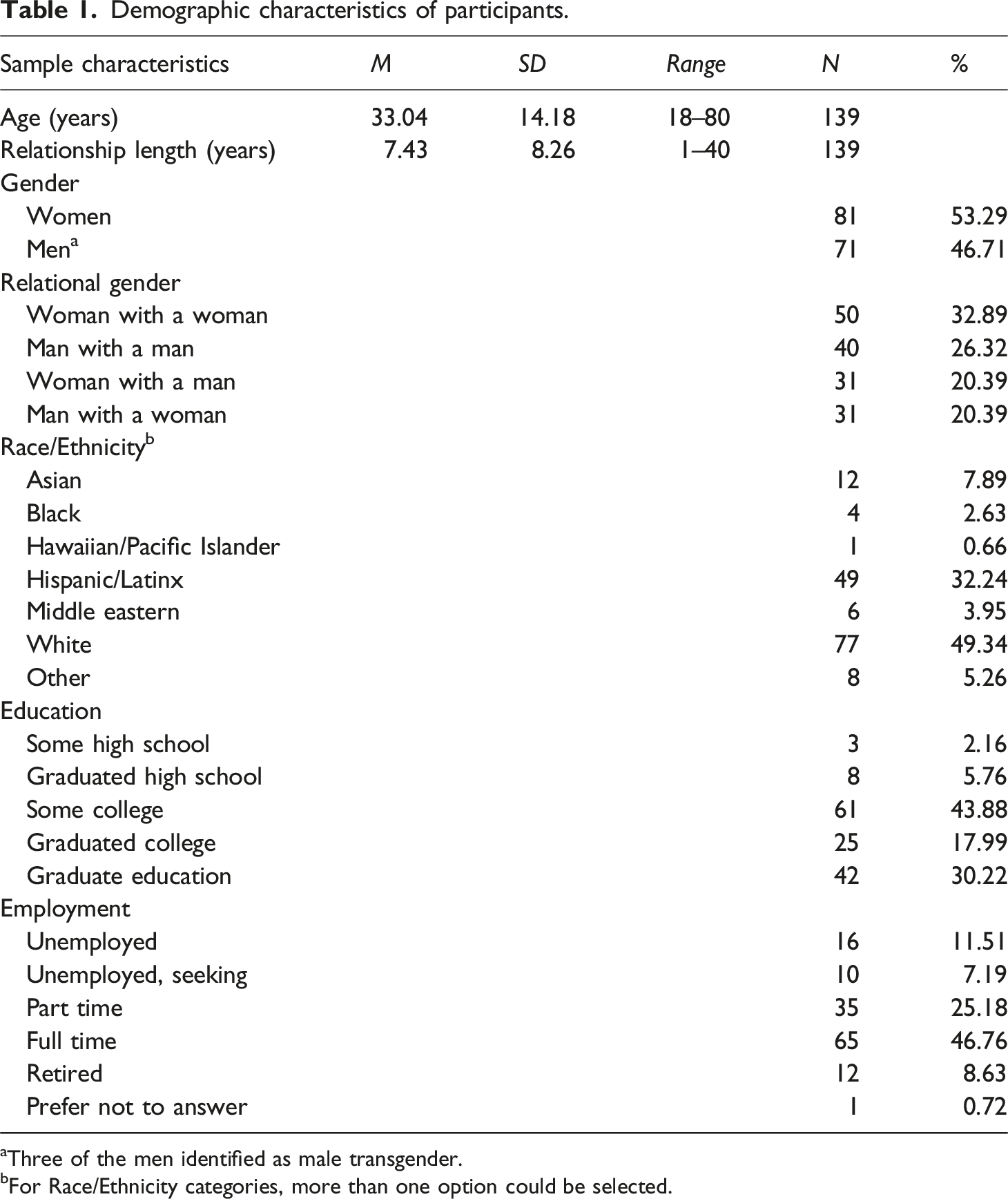
aThree of the men identified as male transgender.
bFor Race/Ethnicity categories, more than one option could be selected.
Two previous studies used this dataset. The first used data collected using ecological momentary assessments to examine associations between social network size, social interaction quality, and affect (Robbins & Karan, 2020). The second used the EAR data to examine the association between social network size and indicators of well-being, and whether these differed based on the relational gender of the couple (Robbins, Spahr, & Karan, 2024; Robbins, Jonnalagadda, & Spahr, 2024). None of the analyses performed in these studies overlap with the analyses conducted in the present study.
Procedure
Participants were first given detailed verbal information about the study and then indicated their willingness to participate in the study by signing a written consent form. Participants met with the experimenter on two separate Fridays, separated by one month, and were briefed on the naturalistic observation procedures that they would complete over the weekend. Participants were instructed to attach the EAR to their waistline and wear it as often as they were able during their waking hours. In accordance with ethics and California state law, participants were also asked to wear a bystander button with a picture of a microphone and the words “This conversation may be recorded” (Manson & Robbins, 2017). At the end of the specified recording period, participants were given the opportunity to privately review the recorded sound files and delete as many as they wished. They then returned their devices, and the sound files were uploaded to a secure storage platform where they could be accessed by trained research coders. Participants also completed several questionnaires during both the first and second weekend, which included demographics and measures of happiness and relationship quality.
Measures
The EAR
EAR device
The EAR application was installed on an iPod and worn in a protective case around the participants’ waistline (Mehl et al., 2012). It recorded ambient sound from participants’ immediate environments throughout their waking day at preprogrammed time intervals. In the current study, the EAR was programmed to record 50 s of sound every 6 min. The purpose of this far more intensive sampling procedure, compared to typical EAR studies, was for a separate methodological study of how sampling rate affects coded estimates of behavior and social settings (Karan & Robbins, 2017). This yields far more coding work than is necessary for robust estimates of the behaviors of interest (Mehl et al., 2012). Thus, we omitted every third sound file from coding to make the coding process maximally efficient for the project. This resulted in a variable sampling rate, where half the data were sampled with an interval of 6 min, and the other half were sampled with an interval of 12 min and 50 s (see Robbins, Spahr, & Karan, 2024; Robbins, Jonnalagadda, & Spahr, 2024 for more sampling information). The EAR recorded Friday afternoon or evening through Sunday night (i.e., recordings lasted about 2.5 days each, for five days total). The second weekend of monitoring, one month after the first, followed the same procedures. Participants were monitored over the weekend, as opposed to a weekday to maximize the amount of leisure time participants could choose to spend with their partner and others in their social network, and to avoid potential privacy concerns associated with being recorded at work. On average, the EAR recordings yielded a 14% sample of a participant’s 16-h waking day. Less frequent sampling rates (30 s every 12.5 min) have yielded reliable estimates of behavior in previous EAR research (Mehl et al., 2012). In prior studies, the EAR has demonstrated good acceptance and compliance in a variety of populations and is minimally bothersome to participants (Manson & Robbins, 2017). For more information about the EAR method, see the EAR Repository (https://osf.io/n2ufd/; Robbins et al., 2021).
Talking coding
Talking frequency was operationalized as the proportion of total recorded files in which the participant spoke.
Gossip coding
A team of research assistants were recruited and trained in the EAR coding process and given a coding scheme based on the gossip-related variables of interest. Coders were instructed to listen to all sound files in which the participant spoke (talking files), based on previous coding (Robbins, Spahr, & Karan, 2024; Robbins, Jonnalagadda, & Spahr, 2024). The presence or absence of gossip within a sound file was dichotomously coded (1 = present, 0 = absent). If the participant gossiped with any person within a given sound file, research assistants coded this category as present (total gossip). Gossip was defined as any discussion of a person who was not present in the participant’s conversation. To count as gossip, the participant needed to be contributing, and not merely listening, to the gossip. The conversation was not coded as gossip if the participant was discussing an event that happened to themselves, discussing a brand or company (does not qualify as a person), or describing an event that involved a non-specific person (e.g., “somebody robbed that house”).
Next, coders indicated who the participant was gossiping with (1) romantic partner, (2) acquaintance/close other (i.e., acquaintance, friend, family member, or coworker) and (3) stranger. These categories were not mutually exclusive. For instance, participants could be gossiping with their romantic partner and a friend simultaneously. The acquaintance/close other category was inclusive of multiple roles due to the difficulty of distinguishing between them. For example, in the absence of familial titles (e.g., Mom) or referencing a common family member, it is nearly impossible to distinguish a family member from a friend. Participant’s EAR-measured data were aggregated across both weekends, yielding an estimate of the amount of time spent gossiping.
Romantic partner gossip
Romantic partner gossip frequency was operationalized as the proportion of total recorded files over the two-weekend recording period. This included gossiping exclusively with one’s partner and gossiping with one’s partner in addition to another person. When discussing this variable in the dyadic analyses, to avoid confusion between the term “romantic partner” and discussion of “partner effects,” the terms “actor’s gossip with partner” and “partner’s gossip with actor” will be used to refer to actor and partner effects of romantic partner gossip frequency, respectively.
Self-report measures
Subjective happiness
Happiness was assessed using the 4-item Subjective Happiness Scale (SHS; Lyubomirsky & Lepper, 1999). This questionnaire asked participants to report how statements regarding happiness or unhappiness applied to them. For example, “Some people are generally very happy. They enjoy life regardless of what is going on, getting the most out of everything. To what extent does this characterization describe you?” with response options on a 7-point scale (1 = not at all, 7 = a great deal). Composite scores were calculated by averaging item responses.
Participants completed the SHS at two time points – immediately before the first (time (1) and second (time (2) weekends of EAR. This measure demonstrated good internal consistency at time 1 (α = .86) and time 2 (α = .87). Additionally, participants’ SHS composite scores across time points were highly correlated (r = .71, p < .001), therefore, these scores were averaged to create a single index of subjective happiness.
Relationship quality
Relationship quality was measured using the 32-item Dyadic Adjustment Scale (DAS; Spanier, 1976). Participants were asked to report the extent of agreement or disagreement between themselves and their partner and report their perceptions of relationship distress, satisfaction, and partner interactions. The response options varied across questions (e.g., 1 = always agree, 6 = always disagree; 1 = every day, 5 = never). Following the DAS scoring guidelines outlined by Spanier (1976), summary scores were generated by summing all item responses. Summary scores can range from 0 to 151, with higher scores indicating more positive dyadic adjustment.
Participants completed the DAS at time 1 and time 2. This measure demonstrated good internal consistency at time 1 (α = .89) and time 2 (α = .89). Additionally, participants’ DAS summary scores across time points were highly correlated (r = .87, p < .001), therefore, these scores were averaged to create a single index of dyadic adjustment. Person-mean imputation (i.e., using the average of the available item data in place of the missing scores) was used for participants that had missing data. Previous research has found that person-mean imputation methods provide good estimates of measure reliability in cases where the items missing within scales were 20% or less (Bono et al., 2007). Therefore, person-mean imputation was used for participants that responded to at least 80% of the questions included in the DAS. The only DAS participant data that was excluded based on this cutoff was one couple who did not respond to any DAS questions at time 3. Their time 1 DAS data were used in analyses.
Relational gender
Based on participants’ self-reported gender, couples were categorized based on their relational gender. Stemming from the “gender-as-relational” approach which proposes “gender within relationships is shaped by three key factors: own gender, partner’s gender, and the gendered relational context” (p. 220, Thomeer et al., 2020), relational gender accounts for how the gender composition of romantic couples might influence their gossiping behaviors. In this study, participants were categorized into one of four relational, rather than solely individual, genders: a woman in a relationship with a woman (WW), a man in a relationship with a man (MM), a woman in a relationship with a man (WM), or a man in a relationship with a woman (MW).
Extraversion
Extraversion was assessed using the 2-item extraversion subscale of the Ten-Item Personality Inventory (TIPI; Gosling et al., 2003). The TIPI asks participants the extent to which they agree a pair of traits applies to them on a 7-point scale (1 = disagree strongly, 7 = agree strongly). The statements in the extraversion subscale included “extraverted, enthusiastic” and “reserved, quiet” (reverse scored). Composite scores were calculated by averaging responses on the two items, with higher scores representing greater extraversion.
Social network
Two subscales of the Social Network Index (SNI; Cohen et al., 1997) were used to assess the total number of regularly contacted social network members (“total contacts”) and the number of roles (e.g., spouse, children, friends) in which these regularly contacted social network members belonged (“network diversity”). Regular contact was defined as contact that occurs at least once every two weeks. The 12 possible roles included: spouse, parent, child, child-in-law, close relative, close friend, church/temple member, student, employee, neighbor, volunteer, and group member. Total contact was calculated by summing the number of people the participant indicated they regularly contacted across all 12 categories of relationship roles. Participants were given the answer options of 1–7 or more for each category – but could leave the question blank if there were no regular contacts in a particular role – making the possible total contact range 0–84. Network diversity was calculated by summing the number of roles participants indicated having regular contact with, which could range from 0–12. Although these subscale scores were strongly correlated (r = .79, p < .001, CI [.75, .85]), we opted to control for both variables in our models as they could separately influence the association between variables of interest, and calculated the variance inflation factor (VIF) to test for issues with multicollinearity.
Data analyses
All data were analyzed using IBM SPSS Statistics Version 27–29. Before conducting dyadic analyses, we ran correlations to examine the raw associations between the study variables. To account for the dyadic nature of the data (i.e., individuals nested within couples), we used the Actor-Partner Interdependence Model (APIM), which allowed us to test for differences based on gender and relational gender (West et al., 2008). All continuous variables included in APIM analyses were z-scored to yield standardized estimates. We provide descriptives of predictor and outcome variables, that are statistically compared in the APIMs, while accounting for the non-independence in the data. Any differences in gossip engagement between relational genders, as well as their associations with happiness and relationship quality, were accounted for within these APIMs. To ensure that multicollinearity between the primary predictor variables and covariates (i.e., extraversion and social network index variables) would not pose issues during the APIM analyses, we calculated the VIF for all variables (Marcoulides & Raykov, 2019).
Three APIMs were run per dependent variable: happiness and relationship quality (6 models total). Due to the indistinguishable nature of the couples, an extension of APIM, the factorial method, was used (West et al., 2008). The total number of files in which the participant spoke was included as a covariate in our analyses to account for the possibility that talking more frequently overall might drive the link between gossip, happiness, and relationship quality. Participants’ reported number of social contacts and extraversion scores were included as covariates in four APIM analyses, as these variables have been linked to both happiness and relationship quality (Sayehmiri et al., 2020). The first model type used actor gender, partner gender, actor’s gossip with partner, partner’s gossip with actor as the predictors, with actor talking files, partner talking files, and actor age included as covariates. The second model type included additional covariates: extraversion, network diversity, and total social contacts. The third model type included two-way interactions between actor gender and partner gender, actor gender and actor’s gossip with partner, partner gender and actor’s gossip with partner, as well as a three-way interaction between actor gender, partner gender, and actor’s gossip with partner.
We followed the guidelines outlined by Hurlbert and colleagues (2019) to interpret our results, reviewing patterns, effect size magnitudes, and widths of confidence intervals, in addition to considering exact p-values, to judge the quality of evidence. Therefore, our conclusions were largely based on which effects were most likely to be meaningful and robust, rather than the arbitrary threshold of p ≤ .05. Our criterion for deconstructing interactions was p ≤ .20. This cutoff has been recommended in previous literature because it allows for the opportunity to detect differences rather than assuming there are none (Kenny & Ledermann, 2010). When interactions met the threshold, they were deconstructed using Case 1 of the online HLM 2-way and the HLM 3-way interaction utilities at quantpsy.org (Preacher et al., 2006).
Results
Descriptives
Romantic partner gossip
Out of the total number of sound files (98,873) recorded for the 152 participants, 31,440 files (31.80%) included instances of the participant talking. Of those 31,440 talking files, 3,790 (3.83% of all recordings, 12.05% of talking files) included gossip with any person and 2,942 (2.98% of all recordings, 9.36% of talking files) included gossip with one’s romantic partner.
Descriptives for full sample and relational gender means (SD) for EAR and self-report data.
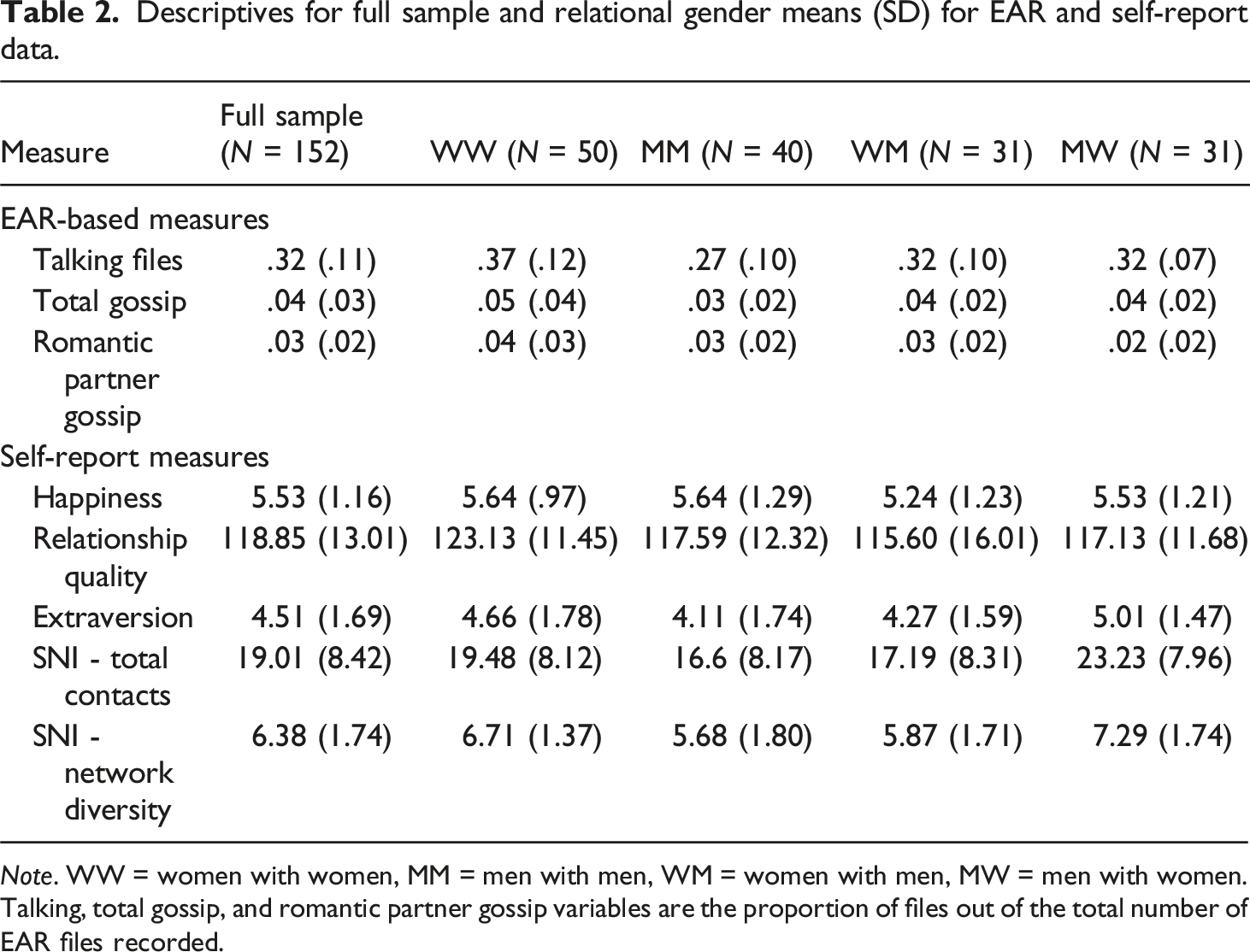
Note. WW = women with women, MM = men with men, WM = women with men, MW = men with women. Talking, total gossip, and romantic partner gossip variables are the proportion of files out of the total number of EAR files recorded.
Outcome variables: Subjective happiness and relationship quality
As shown in Table 2, participants’ mean happiness score was above the scale’s midpoint and is considered moderately high (range: 2.25–7.00; Lyubomirsky & Lepper, 1999). Based on averages across relational genders, WW and MM self-reported similar levels of happiness, and WM reported the lowest levels of happiness. WW reported the highest relationship quality on average, relative to other relational genders.
Covariates: Extraversion and social network index
As shown in Table 2, participants’ mean extraversion score (range: 1.00–7.00) was above the scale’s midpoint. Extraversion was similar across relational genders, although MW scored slightly higher. Participants’ mean number of total frequent contacts (range: 2–44) and diversity of frequent contacts (range: 2–12) are reported in Table 2. On average, MW had higher scores on the SNI subscales.
Correlations
Correlation coefficients, p-values, and CIs for associations between gossip variables, relationship quality, happiness, extraversion, and social network domains.
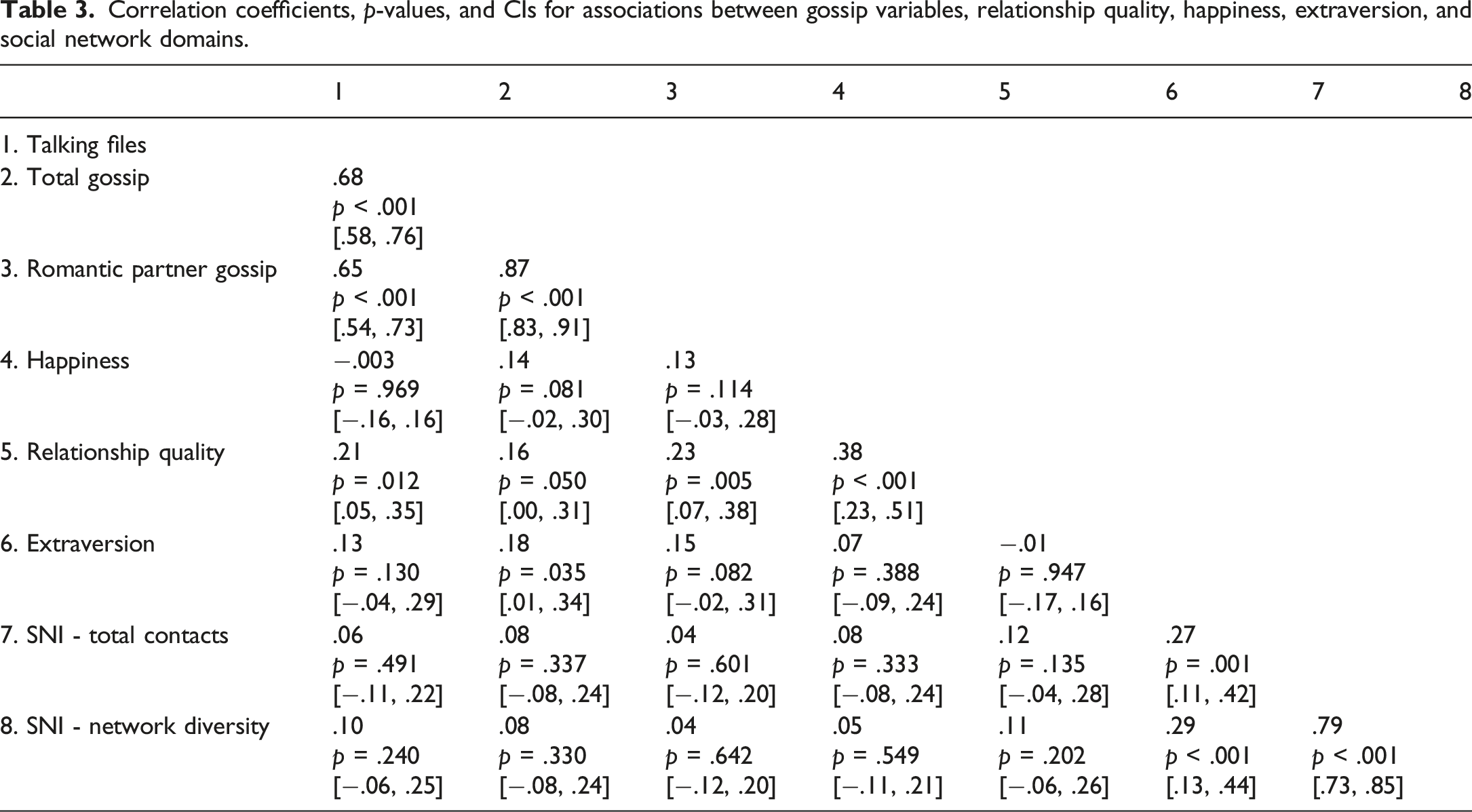
To determine whether controlling for extraversion and SNI variables in our models would lead to multicollinearity issues, we calculated the VIF, and values ranged from 1.12–2.93. These low values suggest that the moderate correlations between predictor variables in our model are not severe enough to indicate that multicollinearity would lead to problems when running the APIMs (Frost, 2017).
APIM hypothesis testing
Gossip and happiness
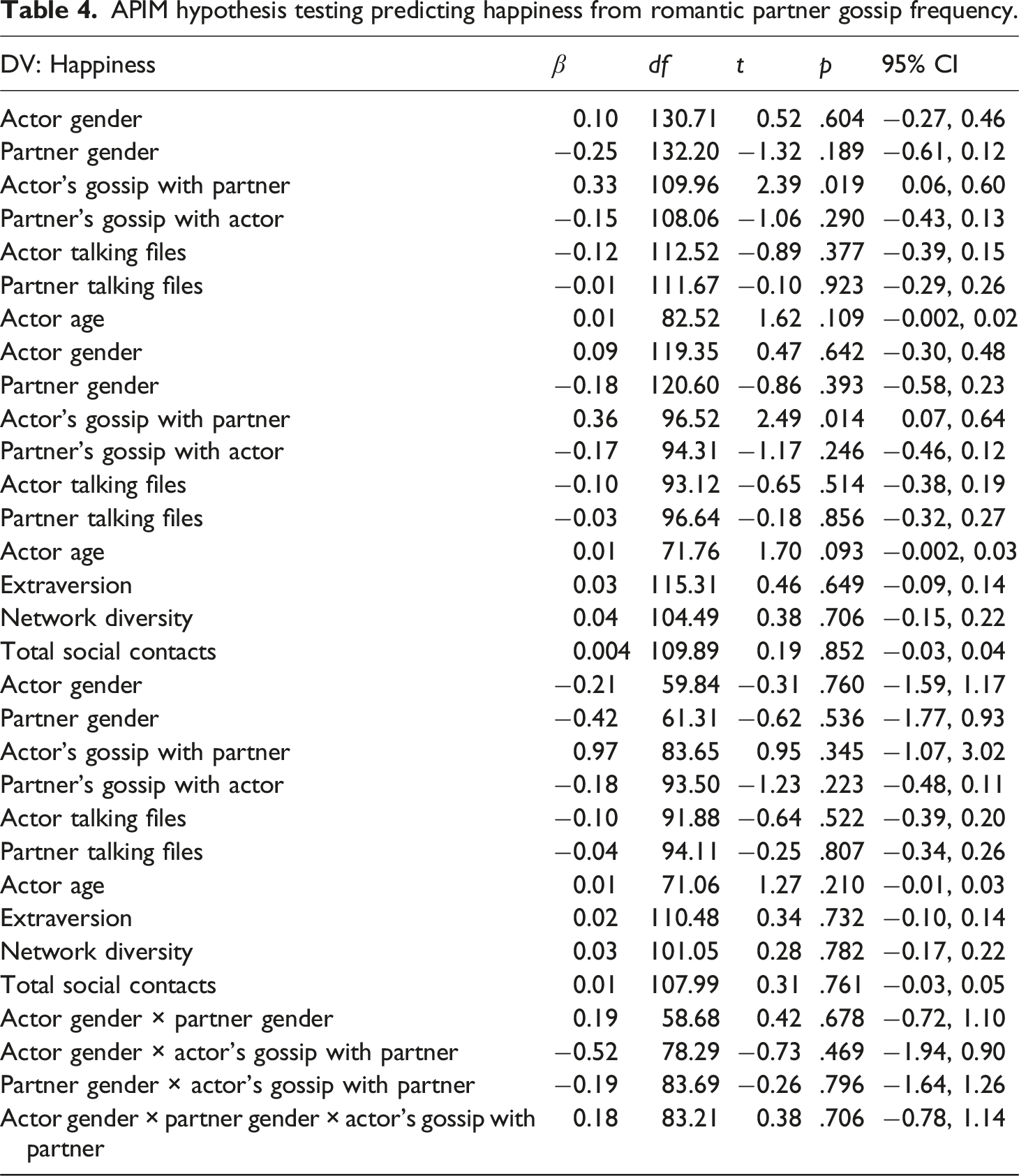
APIM hypothesis testing predicting happiness from romantic partner gossip frequency.
Gossip and relationship quality
APIM hypothesis testing predicting relationship quality from romantic partner gossip frequency.
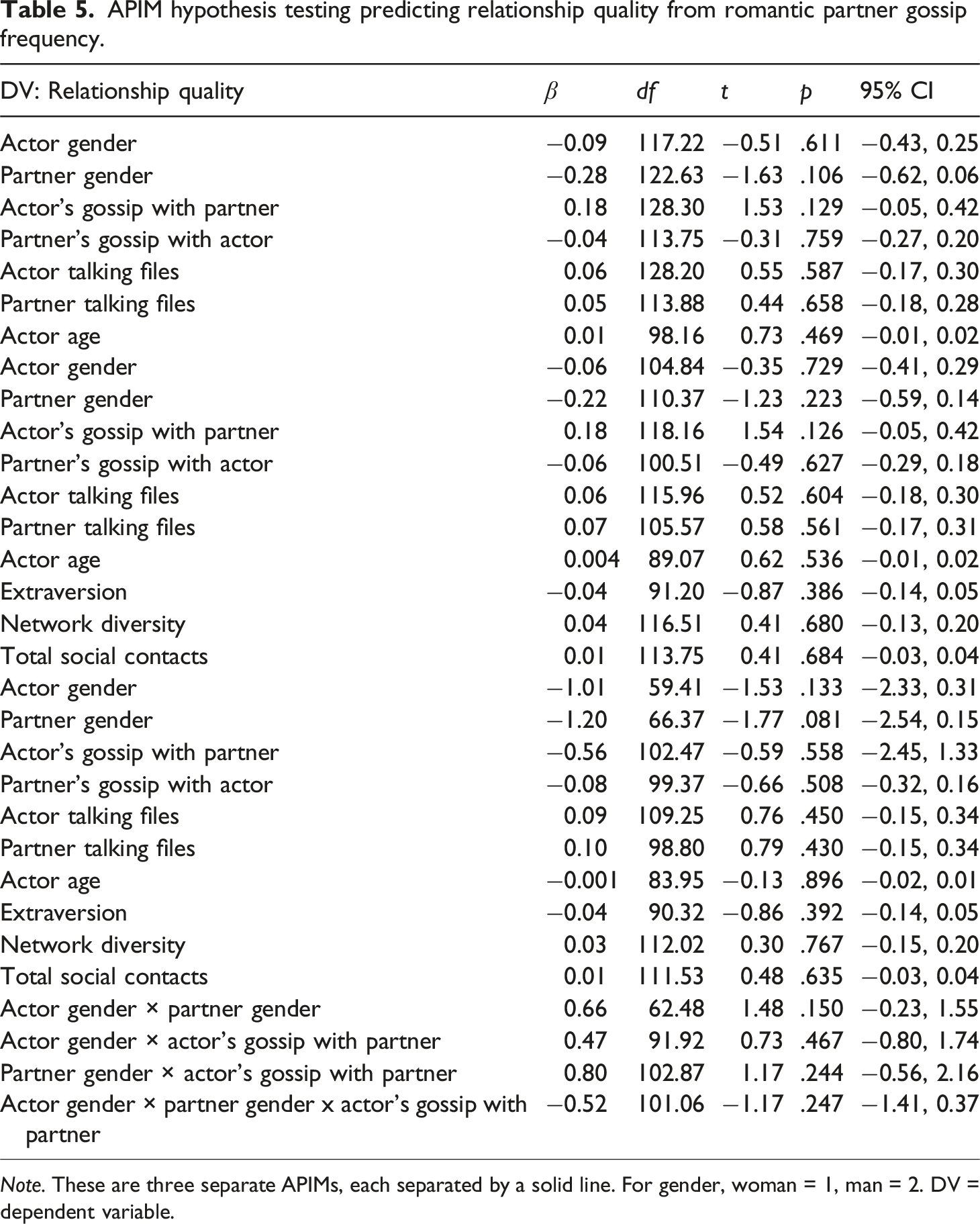
Note. These are three separate APIMs, each separated by a solid line. For gender, woman = 1, man = 2. DV = dependent variable.
Among the four interactions examined, only the interaction between actor gender and partner gender predicting relationship quality met the p ≤ .20 threshold for deconstruction (β = 0.66, t = 1.48, p = .145). Simple slopes revealed evidence that WM reported lower relationship quality compared to WW (β = −0.54, t = −1.98, p = .053), and weaker evidence for all the other comparisons (βs < .35, ps > .18).
Discussion
This naturalistic observation study revealed preliminary evidence that greater engagement in gossip with one’s romantic partner is associated with higher self-reported individual and relationship well-being among same- and different-gender couples. Initial raw correlations revealed a stronger positive association between romantic partner gossip and relationship quality; however dyadic analyses accounting for covariates showed that romantic partner gossip was more strongly and reliably related to happiness than relationship quality. Furthermore, these associations did not differ based on relational gender, meaning that they were consistent across men and women in same- and different-gender couples.
Gossiping between romantic partners, particularly about shared social networks or mutual acquaintances, may serve as a form of emotional bonding and facilitate more communication among partners (Bosson et al., 2006). Because gossip is a shared activity, it may reinforce the perception that partners are “on the same team,” enhancing feelings of connectedness, trust, and other positive relationship qualities (Dores Cruz et al., 2020), as well as contributing to overall well-being. For example, negatively gossiping with one’s romantic partner on the way home from a party could signal that the couple’s bond is stronger than with their friends at the party, while positively gossiping could prolong the fun experiences. Future research should test these causal pathways and mechanisms.
Another potential explanation for these findings is that gossip can function as a social regulation or norm-learning tool within relationships (Jolly & Chang, 2021). Discussing the behaviors and actions of others could help partners align their own expectations and behaviors, contributing to a harmonious relationship. This alignment may lead to greater happiness, as both partners feel understood and supported.
Descriptively, it appears that couples with more women incrementally increase in average total gossiping, despite the lack of statistical differences in romantic partner gossip in the APIMs. Based on a 16-h waking day, participants gossiped an average of 38.40 minutes per day. WW gossiped an average of 6.72 more min than WM, who gossiped 4.80 min more than MW, who gossiped 6.72 min more than MM. Examining relational, instead of individual gender differences, sheds more precise light on gender differences, revealing that the combination of partners’ genders may matter just as much as one’s own gender to predict differences in social behavior.
The only statistical difference found between relational genders in this study was unrelated to gossip engagement. The interaction between actor and partner gender was included as a control variable when predicting relationship quality, and the findings are noteworthy. The data suggest that WM reported lower relationship quality compared to WW. Though this finding was unrelated to the purpose of this study, it is consistent with a wealth of evidence that same-gender, compared to different-gender, romantic relationships tend to be higher quality (e.g., Joyner et al., 2019; Rostosky & Riggle, 2017).
Limitations and future research
Despite its strengths, this study was limited as the first step in a novel line of naturalistic observation research on couples’ gossip. As a first step, we did not examine the subject of gossip, setting, or other descriptive factors; but paved the way for future questions, such as whether different types of gossip differently relate to well-being, whether gossip facilitates relationship maintenance behaviors such as support, and whether gossiping within a couple promotes well-being. Although our sample was ethnically diverse, future research should explore whether these findings generalize to populations outside Southern California. This region tends to be more accepting of same-gender couples, which may facilitate greater well-being. On average, participants reported relatively high relationship quality and happiness, indicating potential selection effects—partners willing to participate in this research together may have higher quality relationships. Finally, and importantly, future research should move beyond binary gender categories and examine the social dynamics of all individuals in romantic relationships, regardless of their sex, gender, or sexual orientation (Meuwly & Randall, 2019).
Conclusion
This study is the first to investigate the frequency of naturally-occurring romantic partner gossip, explore relational gender differences in gossip engagement, and examine its associations with happiness and relationship quality. By using the EAR, a naturalistic observation method, we yield insights beyond the laboratory and what people can recall or report. These data revealed another potential positive side of a behavior with a bad reputation: gossiping with a romantic partner of any gender is positively associated with well-being.
Footnotes
Declaration of conflicting interests
The authors declared no potential conflicts of interest with respect to the research, authorship, and/or publication of this article.
Funding
The authors disclosed receipt of the following financial support for the research, authorship, and/or publication of this article: This research was supported by the Committee on Research of the Riverside Division of the Academic Senate Regents Faculty Development Award.
Open research statement
As part of IARR’s encouragement of open research practices, the authors have provided the following information: The research was pre-registered. The aspects of the research that were pre-registered were project materials, methods, and hypotheses. A portion of the preregistered materials and hypotheses are presented in the current study, with additional hypotheses to be investigated in subsequent research. There were minor deviations from the preregistration. The registration was submitted to https://osf.io/xqty2. The data used in the research is publicly posted. The data can be obtained at: https://osf.io/rc8a6/?view_only=96985350aaac4c11ab08394d3703653c. The materials used in the research are publicly posted. The self-report materials used in this study are searchable and publicly available. Information about the EAR method can be found in the EAR repository:  .
.
Ethics considerations
This study received Institutional Review Board approval from the University of California, Riverside (HS-14-072). All participants were verbally given information about the study and then received a written informed consent form, where they indicated their willingness to participate.