




Abstract
In response to growing concerns about the early age at which children receive smartphones, this study examines the factors influencing parents’ decisions on when and why to allow their children access to these devices. A total of 642 parents from a region in the Basque Country (northern Spain) participated in an open-ended survey. The sample was diverse in terms of gender, child age (2–16 years, M = 9.26), and place of residence. While 26.9% had purchased a smartphone for their child, most either allowed shared use (65.3%) or restricted access entirely (7.7%). The data were analyzed using the Reinert method via Iramuteq software. Five key thematic categories emerged: the desire for children to be part of peer groups, social pressure perceived by parents, enabling children’s autonomy in public spaces, facilitating local communication practices, and exercising parental control. These findings reveal how smartphone-related decisions are shaped by community norms, safety concerns, and evolving definitions of childhood independence. The study highlights the importance of culturally responsive resources that support diverse parenting approaches without prescribing universal rules about the “right” age for smartphone ownership.
Keywords
Introduction
The increasing prevalence of smartphones in children’s lives has sparked ongoing debates regarding the appropriate age for their first ownership (Haidt, 2025). While some parents view mobile phones as essential tools for safety, communication, and digital literacy, others express concerns about their potential impact on children’s well-being, social development, and academic performance (Bergert & Lange, 2021). Despite these discussions, there is a lack of recent, context-specific research examining the motivations behind parents’ decisions to provide their children with smartphones, particularly in non-Anglo-Saxon contexts. This study addresses this gap by exploring how sociocultural and contextual factors influence parents’ decisions regarding smartphone ownership among children in the Basque Country, Spain. To frame this analysis, the following literature review examines the current trends in mobile phone ownership among children, the impact of smartphone use on their well-being and development, and the role of social, economic, and geographical factors in shaping parental decisions. This review provides the necessary context to understand the motivations that guide parents when purchasing smartphones for their children
The use of mobile phones by children
The rapid advancement of technology has made mobile phones essential tools for communication, learning, and entertainment. As a result, children are increasingly becoming mobile phone users at younger ages (Modrego et al., 2021). Duek et al. (2012) highlight how mobile phones have become indispensable in modern society, reinforcing their role in maintaining connectivity for both children and adults.
Trends in mobile phone ownership among children show a steady decline in the age of first acquisition. In 2004, 35% of children aged 8 to 10 in Germany already owned a mobile phone (Böhler & Schüz, 2004), and by 2005, 76% of children aged 9 to 12 in Hungary had their own devices (Mezei et al., 2007). More recently, in Spain, 69.5% of children aged 10 to 15 owned a mobile phone in 2020 (INE, 2020). This widespread ownership is further regulated by national policies on digital access, such as Spain’s current legislation, which sets the minimum age for opening a social media account at 14 years. In June 2024, the Spanish government approved a draft law to raise this minimum to 16 years (Torres & Valdés, 2024).
This pattern extends beyond Europe. In the United States, 35% of children aged 3 to 5 own their own mobile devices, using them for an average of 115.3 minutes daily, primarily on applications like YouTube (Radesky et al., 2020). Similarly, in Turkey, Kucuk et al. (2020) found that while the average age of first mobile phone ownership is 12.1 years (±2.5), some children receive their first phone as early as age 3. These findings indicate a global trend toward younger smartphone ownership, driven by increased accessibility, changing parental attitudes, and evolving digital environments. However, access to mobile technology is not uniform across all children, as socioeconomic factors play a crucial role. Research suggests that higher-income families are more likely to provide their children with smartphones at an earlier age and to use digital monitoring tools, whereas lower-income families may struggle with access and oversight, leading to different usage patterns (Reddick et al., 2020). Urban families, with easier access to technology and the Internet, are more likely to integrate digital tools into daily routines, emphasizing digital literacy and academic enrichment. In rural areas, limited access to reliable digital infrastructure may result in a more selective or utilitarian approach to mobile phone use, often focusing on practical benefits like schoolwork or family communication (Yan & Schroeder, 2020).
Moreover, smartphone use among young people has risen sharply over the past decade. In Europe, only 5% of children aged 9 to 16 accessed the Internet daily via a smartphone in 2010, whereas by 2020, this figure had risen to over 80% (Coureux et al., 2023). Beyond their role in entertainment and communication, mobile phones have also become integral to family organization, helping parents coordinate schedules, school activities, and household tasks more efficiently (Wilska, 2003). While many parents provide mobile phones to their children for safety and communication purposes (Kucuk et al., 2020), this trend also raises concerns regarding exposure to inappropriate content, problematic smartphone use, and digital dependence. Matthes et al. (2021) suggest that parents’ own excessive smartphone use can undermine their ability to regulate their children’s digital habits.
The effects of early mobile phone ownership on children’s social development and well-being have been widely studied. Problematic mobile phone use is particularly prevalent among secondary school students, with 15% of adolescents at risk (Besolí et al., 2018). A 2018 Pew Research study in the United States revealed that 95% of teenagers have access to a smartphone, and 45% report being online “almost constantly” (Jenco, 2018; Madigan et al., 2018).
Parents often struggle to regulate their children’s smartphone habits effectively, particularly as digital environments evolve rapidly and present new challenges (Bäckström et al., 2022). Many parents feel unprepared to set clear boundaries, which can contribute to difficulties in limiting screen time or ensuring balanced technology use. While extensive research has explored the implications of children’s smartphone use, less is known about the motivations behind parents’ decisions—not just to allow smartphone use, but to actively purchase these devices for their children. Understanding these motivations is key to assessing whether early smartphone ownership aligns with children’s developmental needs or is primarily driven by social and contextual factors.
The developmental and social implications of smartphone use in childhood
The widespread presence of smartphones in children’s lives has raised significant concerns among health professionals, educators, and families. Numerous studies suggest that early and intensive exposure to smartphones may negatively affect children’s academic performance, motivation, and attention. Dempsey et al. (2019) and Hartati et al. (2023) found that the use of digital devices in learning contexts, when not properly regulated, may reduce attention span and motivation, potentially leading to poorer academic achievement. Sigman (2017) highlights how multitasking and continuous screen switching can disrupt concentration and undermine cognitive performance.
Beyond academic aspects, excessive or unregulated smartphone use has been linked to psychosocial and emotional difficulties. Sahu et al. (2019) associate problematic use with anxiety and depressive symptoms, while Wacks and Weinstein (2021) note links with stress, social withdrawal, and self-esteem issues. Twenge and Campbell (2018) also emphasize increased vulnerability to sleep problems and emotional dysregulation, particularly in preadolescents and adolescents.
From a physical health perspective, the Children’s Hospital of Philadelphia (2018) warns about risks such as eye strain, fatigue, and myopia due to prolonged screen exposure. These issues, while not universally experienced, contribute to a sense of parental caution regarding early smartphone ownership.
Finally, Crescenzi-Lanna (2022), in a longitudinal study in Ireland, show how early patterns of digital engagement can shape later academic and personal trajectories. Taken together, these studies provide context for understanding parents’ hesitations and decisions. Although our study does not directly assess these consequences, the concerns reflected in the literature help explain why many parents consider age, readiness, and context before granting smartphone access.
Smartphones also play a crucial role in shaping the processes of socialization and identity formation in children and adolescents. While they offer opportunities for communication and connectedness, their excessive or unstructured use has been associated with social, emotional, and behavioral difficulties (Lee et al., 2023). The transition from face-to-face to digital interaction is increasingly evident, with over 80% of adolescents reporting that they feel deeply connected to friends through social media (Anderson & Jiang, 2018). This shift reflects the broader transformation of social dynamics in digital environments (Kopomaa, 2002), where peer interaction is mediated by screens rather than physical presence.
For many adolescents, the smartphone becomes a space for identity exploration and self-validation. Digital belonging is often mediated through social networks, where self-image is constructed in relation to online feedback and visibility (Zizek, 2017). However, early and excessive screen time during critical developmental stages can hinder socio-emotional growth (Nayeem, 2024), displacing opportunities for physical and social engagement (Alotaibi et al., 2022). Patterns of smartphone use vary by age: younger children often use devices passively or for communication with family, whereas adolescents rely on them for more complex social interaction, peer bonding, and self-expression (Tang, 2015).
Gender differences also emerge in how technology is introduced and used. Parents may steer boys toward gaming or problem-solving apps, while girls are often encouraged to use creative or educational tools, reflecting traditional gender roles (Cooper & Heaverlo, 2013). As dependency increases, children tend to prefer solitary digital play over collective social activities, which may contribute to withdrawn behaviors and hinder self-confidence (Hye Park, 2020; Zheng, 2022). These shifts in socialization are further associated with sedentary habits, a factor linked to the rising prevalence of childhood obesity (Figueroa-Duarte & Campbell-Araujo, 2022).
Finally, navigating digital environments also requires different interpersonal skills from those developed in face-to-face interaction. Many children struggle with these new social demands, which can lead to miscommunication, frustration, or exclusion (Zizek, 2017). These developmental and social dynamics help explain why many parents express concern over the appropriate timing and conditions under which smartphones should be introduced to children. While our study does not directly assess these consequences, this body of research offers important context for understanding the motivations behind parental decision-making.
Parents’ perceptions of smartphone use among children and families’ reasons for buying mobile phones
Parents’ perceptions of smartphone use among children reflect a balance between concern over potential risks and recognition of tangible benefits (Bäckström et al., 2022). Many express anxiety about excessive screen time, which has been linked to sleep disruption, attention deficits, and behavioral issues (Eirich et al., 2022; Lissak, 2018; Sadri, 2018). They also cite worries about exposure to inappropriate content, online risks, and smartphone addiction (Danet, 2020; Marsh et al., 2024), often feeling unprepared to guide their children’s digital habits (Bäckström et al., 2022).
Nonetheless, safety and constant communication are leading motivations for allowing smartphone use. Parents want to stay connected, monitor whereabouts, and ensure children’s security. In the U.S., children receive their first smartphone at an average age of 12.2 years, mostly for functional reasons (Richter et al., 2022). In Spain, while current regulations set 14 as the legal age for social media access, a 2024 draft law proposes raising it to 16 (Torres & Valdés, 2024).
Mobile phones also help parents manage family logistics and maintain emotional closeness in contexts such as divorce, single-parent households, or reconstituted families (Oksman & Rautiainen, 2002; Wilska, 2003). Some parents view smartphones as educational tools that support digital literacy and access to information (Soyoof et al., 2024). However, many are mindful of setting boundaries, implementing screen time rules, modeling responsible use, and maintaining open communication (Sandua, 2023).
Socioeconomic status and geographic location significantly shape how families approach smartphone use (Konca, 2022; Tang, 2015). Urban families often prioritize digital literacy and enrichment (Yan & Schroeder, 2020), while rural families—facing limited infrastructure—may take a more utilitarian view, using smartphones primarily for academic or practical purposes. Financial capacity also affects monitoring: higher-income households can afford supervision tools and educational programs, while lower-income families may face barriers to access or digital oversight (Reddick et al., 2020).
While existing studies outline broad patterns in smartphone adoption, there is a need for updated research into parents’ current motivations and the implications of early smartphone ownership in rapidly evolving social contexts. Factors such as age, gender, SES, and geographic setting are known to influence smartphone adoption, but their interaction in specific cultural environments remains underexplored. This study addresses that gap by analyzing parental motivations in a region of the Basque Country, Spain, focusing on the interplay between sociocultural factors and family dynamics. It aims to understand how decisions around smartphone ownership reflect parents’ desire to foster trust, communication, and autonomy as part of contemporary caregiving.
In light of the concerns and contextual factors reviewed, this study explores the primary motivations guiding parents in a region of the Basque Country, Spain, when deciding whether to provide their children with smartphones. It also examines how these decisions vary according to key factors such as parents’ and children’s gender, school year, town of residence, and type of smartphone use (ownership, shared use, or non-use). The literature presented offers a foundation for this inquiry, which is guided by the following questions: (1) What are the primary motivations of parents when deciding to provide their children with a smartphone? (2) How do contextual and demographic variables influence these motivations? (3) What are the perceived implications of children owning smartphones, as expressed by parents?
Methodology
To achieve the objectives set for this project, both qualitative and quantitative data were systematically collected through meticulously designed online questionnaires tailored for this purpose. These surveys incorporated a blend of open-ended and closed-ended questions to ensure comprehensive and detailed responses from parents.
Sample
The sample comprised 642 parents from a region within the autonomous community of the Basque Country in northern Spain. The average age of the parents was 43.85 years (sd = 5.13). Regarding gender, 53.11% (n = 341) of parents identified as female/mothers, 46.57% (n = 299) as male/fathers, and 0.003 (n = 2) as non-binary. The average age of their children was 9.26 years (sd = 2.06), with an age range of 2–16 years. In terms of gender distribution, 53.1% identified as girls, 46.6% as boys, and 0.3% as non-binary.
Most participants, 62.6% (n = 402), resided in a town of around 16,000 inhabitants. Another 14.5% (n = 93) lived in villages with between 1,000 and 2,000 inhabitants, and the remaining 22.9% (n = 147) lived in villages with fewer than 1,000 inhabitants.
Of the 642 parents who participated in the study, 26.9% (n = 173) had already purchased a smartphone for their children, while 65.3% (n = 419) had not bought a smartphone but allowed their children to use theirs. The remaining 7.7% (n = 50) had neither bought a smartphone for their children nor allowed them to use theirs. Including parents who have not yet purchased a smartphone for their children is particularly relevant, as it allows us to explore the factors that influence their decision-making process, their concerns, and the conditions under which they might consider allowing smartphone ownership. This group represents a key target for prevention strategies aimed at delaying smartphone acquisition or guiding parents toward responsible technology use. Understanding their hesitations provides valuable insights into potential intervention points that could influence parental decision-making.
Procedure
Before data collection, approval was obtained from the ethics committee of the University of the Basque Country [M10_2024_073]. All participants voluntarily agreed to participate in the study after receiving detailed information about the research procedures. Recruitment was conducted using a non-probabilistic snowball sampling method in the 9 existing schools in the area. An online questionnaire was created by the researchers and disseminated through schools to all the parents. No incentive was offered for completing the questionnaire.
Instrument
The questionnaires were organized into two distinct sections. The first section asked participants to provide specific socio-demographic information relevant to the study, including their own and their children’s age, gender (with options for Women, Men, or Non-binary), age, school year of the children, town of residence, and the type of smartphone use by the children (own smartphone, use an adult’s smartphone, do not use a smartphone). They were also asked at what age they thought a smartphone should be purchased or given to their children and were instructed to ask their children the same question.
In the second section, parents were asked to write down or state four reasons they would buy their children a smartphone. These responses formed the basis for subsequent analysis. Data collection and analysis were conducted in Spanish. Once all the analyses had been carried out, the results were translated into English. This translation was carried out by a professional translator so that there was as little bias as possible as explained in the text.
Analysis
To analyze the open-ended responses, we employed the Reinert method (Reinert, 1983) using the Iramuteq software. This method is widely regarded as a robust tool for analyzing open-ended textual data and has been extensively applied in research involving children across various disciplines (Idoiaga Mondragon et al., 2021; Legorburu et al., 2022). Its proven ability to address issues of reliability and validity in text analysis has been highlighted in prior studies (Klein & Licata, 2003), making it particularly suitable for this study. Unlike conventional qualitative methods that rely heavily on manual coding, the Reinert method provides a computationally driven, statistically validated classification of textual content, offering an objective lens through which themes and structures can be identified with high reproducibility (Reinert, 1990).
The Reinert method is based on a top-down hierarchical clustering approach, which segments text into lexical classes characterized by co-occurring words and text fragments. It uses statistical indicators, such as chi-square values (χ2), to determine the most representative words and text segments for each class (Idoiaga, N., & Belasko, 2019). These values highlight the words that are statistically overrepresented in a given class, indicating their relevance and association with the class themes. For instance, words with high chi-square values are those that appear more frequently within a specific class than would be expected by chance.
This approach produces what are referred to as “lexical worlds,” which consist of clusters of semantically related words and text segments that collectively represent distinct patterns in the data. In line with previous applications of this method (Camargo & Bousfield, 2009), the raw textual data were processed in Iramuteq, which systematically assigned words and segments to classes based on their statistical associations. The classification process follows a rigorous sequence: first, the text corpus is segmented into units, ensuring that each segment contains a meaningful portion of discourse. These units are then analyzed using a descending hierarchical classification algorithm, which recursively partitions the text into clusters based on word co-occurrence patterns. The method identifies key lexical items that serve as thematic markers, allowing for an inductive classification of the dataset (Mennani & Attak, 2024).
Following previous applications of the Reinert method (Camargo & Bousfield, 2009), the raw data were entered into Iramuteq. Significant vocabulary items in each class were selected based on three criteria: (1) an expected word value exceeding 3; (2) chi-square statistical evidence of association with the class (χ2 ≥ 3.89, p = .05, df = 1); and (3) the word predominantly appearing in that class with a frequency of 50% or more. Iramuteq also identified representative text segments for each class, ranking them by their chi-square values. These segments provided qualitative context to the lexical worlds, further enriching the interpretative process. This hybrid approach strengthens the analytical process, ensuring that lexical patterns are not only statistically derived but also contextualized through participants’ discourse.
The identified classes were then linked to passive or independent variables to explore relationships within the data. The passive variables in this study included: gender (parents and children), school year, town of residence (16.000 inhabitants, between 1.000–2000 inhabitants, and fewer than 1.000 inhabitants) and type of smartphone use (own smartphone, use parents smartphone or do not use a smartphone). The analyst then derived a series of classes comprising typical words and text segments (quotes) with the highest chi-square values, forming the basis for interpreting the classes as lexical worlds. By systematically connecting lexical worlds with these variables, the method facilitated a nuanced exploration of the relationships between textual themes and demographic or contextual factors, offering a more in-depth understanding of the underlying patterns in parental decision-making regarding smartphone use.
The classification process in Iramuteq, based on the Reinert method, is fully automated and guided by hierarchical descending clustering algorithms, which segment the text into lexical classes according to word co-occurrence patterns. The emergence of sub-factors within certain primary factors is a direct result of this statistical analysis, where the software identifies sub-classes only when it detects statistically significant internal differentiation, determined through chi-square tests. Therefore, the resulting structure of factors and sub-factors reflects the lexical and statistical properties inherent in the dataset, eliminating researcher subjectivity in categorization (Reinert, 1990).
The Reinert method stands out in comparison to traditional qualitative methodologies. Unlike thematic analysis (Braun & Clarke, 2006), which relies on manual coding and researcher interpretation, the Reinert method applies a computationally driven, data-based approach that significantly reduces subjectivity and enhances replicability. By employing statistical tests to validate lexical clusters, it offers a degree of objectivity that manual coding approaches cannot easily achieve. Additionally, the method’s ability to systematically detect recurring themes across a large corpus makes it particularly effective for analyzing extensive qualitative datasets. However, one limitation of the Reinert method is that it focuses on word co-occurrences and statistical relationships rather than semantic nuances.
The final phase of the analysis involved the interpretation and labeling of the lexical classes, which was conducted through a rigorous validation process. Two researchers independently assigned preliminary labels to each class based on the most statistically significant words and representative quotes. A third researcher reviewed and finalized the class labels, ensuring consensus and consistency across classifications. This collaborative approach reduced individual bias and ensured a more reliable interpretation of the lexical worlds, further enhancing the methodological rigor of the study.
The Reinert method produces statistical, transparent, and reproducible data up to the point of interpretation, where the analyst assigns labels (Schonhardt-Bailey et al., 2012). The integration of both quantitative classification and qualitative interpretation provided a more comprehensive analysis of parents’ motivations for smartphone use in children. This methodological approach enabled us to balance computational precision with the richness of participant narratives, allowing for a more nuanced and contextually relevant understanding of the data (Montalescot et al., 2024).
In order to analyse the quantitative data, the variables under study were initially recoded, subsequently grouping them into new variables (age ranges and town ranges according to their number of inhabitants). Thereafter, the relevant descriptive and frequency analyses were conducted, in addition to the chi-square statistical test. This was performed using IBM SPSS statistical software version 28 (Armonk, NY, USA).
Results
Primary reasons why parents would give their children a smartphone of their own
Using a descending hierarchical analysis, the Reinert method was employed to identify the top reason why parents would give their children a smartphone. Each reason or concept is represented by a collection of characteristic words and text segments, referred to as a “class.” The analysis segmented the corpus into area 590 sections, yielding five distinct classes, as illustrated in Figure 1. These classes will be examined individually in the subsequent sections of this article. Hierarchical clustering dendrogram showing the most frequent words and those with the greatest association χ2 (1), p < .001 extracted by the Reinert method.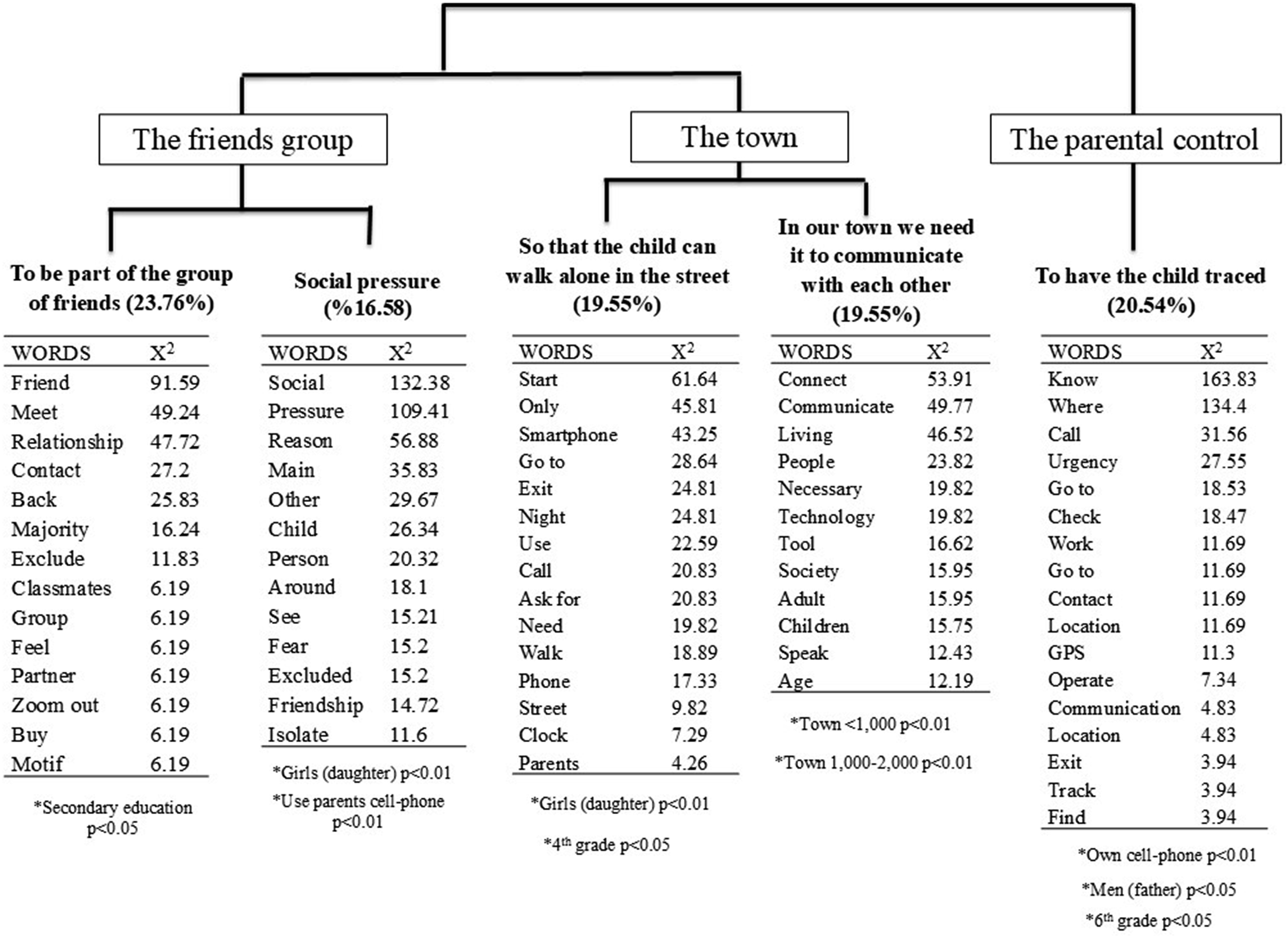
As shown in Figure 1, the analysis generated five distinct classes. Two classes were related to peer groups and socialization: “To be part of a group of friends” and “Social pressure.” Another two classes were connected to the specific context or town where the families live: “So that the child can walk alone in the street” and “In our town, we need it to communicate with each other.” The fifth class addressed the need for parents to monitor their children and was labeled “Parental control.”
The first idea extracted from the hierarchical clustering dendrogram within the reasons related to peer groups emerged with a weight of 23.76%. This idea is that parents would be willing to give their children a smartphone so they could be part of their group of friends. Parents emphasized the importance of children being able to connect with their friends and not feeling left out or excluded by the group. Notably, this idea was mentioned more frequently by parents of children in secondary education (12–16 years) (p < .05). The following are the most significant quotations from this class, representing those with the highest chi-square values: • So that they can stay with their friends and not be excluded from the group (Mother, daughter, fourth grade, χ2 = 199.26) • When others have it, I suppose we will buy it. So that he doesn’t get excluded. (Mother, son, fourth grade, χ2 = 195.74) • To be able to go out with friends, do team tasks, and meet up with them. (Mother, son, third grade, χ2 = 194.07) • Not to be left out of the group of friends (Mother, daughter, fifth grade, χ2 = 193.94) • In order not to be excluded from friendship plans (Mother, son, sixth grade, χ2 = 192.74) • Because it is very important to me that my son does not feel excluded (Father, son, 3th grade, χ2 = 187.27)
The second reason mentioned by parents, closely linked to the first and still within the category of reasons related to peer groups, was social pressure, emerging with a weight of 16.58%. Parents openly used the term “social pressure” to describe the pressure they and their children feel to have smartphones to avoid exclusion from their friends, school group, or sports team. This concern was more frequently mentioned by parents of daughters (p < .01) and parents whose children do not have their own smartphones and instead use their parents’ devices. (p < .01). The most significant phrases parents used to explain this idea were: • We would like the main reason to be that we see her as ready to manage it, but it is likely to be social pressure not to look different or feel less important than the rest of her environment at that time. (Mother, daughter, second grade, χ2 = 329.92) • Social reasons, mainly pressure (Mother, daughter, fifth grade, χ2 = 288.95) • Social pressure not to be isolated (Mother, daughter, fifth grade, χ2 = 256.52) • That others have it (social pressure) (Mother, daughter, fifth grade, χ2 = 256.26) • I don’t want to feel social pressure because all his friends have it (Father, son, second grade, χ2 = 253.51)
In summary, although both peer-related classes reflect concerns about children being excluded, they differ in their nature. “To be part of the group of friends” refers to a perceived intrinsic need in children to belong and stay connected, while “social pressure” captures a sense of externally imposed obligation—most frequently perceived by children themselves—that is then echoed by parents. In this case, the motivation stems not from the child’s emotional desire, but from fear of social exclusion generated by broader community norms.
The second block of reasons for parents giving their children a smartphone concerns the village or urban context in which they live. The first idea mentioned within this block is that parents believe a smartphone will become necessary for their children when they start to go out alone in their village, as it will enable their children to communicate with them and ask for help if needed. This concern is particularly strong when children begin walking alone, especially at certain times or in specific situations, such as dusk or evening. Additionally, some parents see the smartphone as essential because they can no longer accompany their children in their daily routines, and having a smartphone provides them with reassurance about their child’s safety. Notably, this concern was more frequently mentioned by parents of daughters (p < .01) and by parents of children from the fourth grade of elementary education (9–10 years) (p < .05). The most significant phrases used by parents to explain this idea were: • When she starts to go out alone with her friends, especially in the evening or at dusk when it is dark (Mother, daughter, second grade, χ2 = 205.89). • One day, she will start going out alone with her friends, and at that time, I will buy her a smartphone so we can keep in touch (Mother, daughter, first grade, χ2 = 200.08). • I guess we will buy it for her when she needs to call us, for example, when she starts going out alone with her friends. But we still can’t imagine when she will be in that situation, going out with her friends yes but not needing a smartphone, maybe when she is 14 (Mother, daughter, first grade, χ2 = 180.18). • When she started to stay alone with friends, go alone to places, for example, to the beach. (Mother, daughter, secondary education, χ2 = 167.43). • We bought it for her out of necessity; she has to go to many places alone, and we are more relaxed if she has a smartphone, even if she doesn’t use it. When she gets to the place she has to go, she notifies us by writing a message; that way, we are more relaxed. (Mother, daughter, secondary education, χ2 = 159.24). • When they are out with friends, it is important to have the chance to talk to their parents (Father, son, fourth grade χ2 = 90.90).
The second idea within this block, with a weight of 19.55 %, is that parents in this regional context believe the village context itself is important. This study was conducted in a region where a main village of around 16,000 inhabitants is surrounded by small villages, most with fewer than 1,000 residents. In this context, the parents of children living in the small villages point out the need for a smartphone because their children must travel to the larger village to socialize with their friends. Similarly, some parents of children living in the larger village argue that their children need a smartphone because they do not live in the center or do not typically meet their friends close to home. This concern was more frequently mentioned by parents living in towns with fewer than 1,000 inhabitants (p < .01) and by those in towns with populations between 1000 and 2,000 inhabitants (p < .01). The most significant phrases used by the parents to explain this idea were: • We live in a small town and the children usually stay in a bigger town next door, so it is good for us to communicate with him, to go and pick him up, etc. because we don’t have a good transport service. It is true that it is influenced a lot by what others have (Mother, son, fifth grade, χ2 = 157.79). • Because reaching an age can be a useful tool. Always agreeing on the rules and talking a lot. Also, we live in a small town, and we know that with the smartphone they have more freedom to meet with friends and it can be useful to communicate from a certain age (Mother, son, third grade, χ2 = 124.06). • Because we don’t live in the center of the village, it is easier to stay with friends and come back home to contact us (Mother, daughter third grade, χ2 = 110.00). • Because we don’t live in the town to be able to contact us when they go out with friends (Mother, daughter, third grade, χ2 = 110.00). • We bought a smartphone to communicate with our children when they are outside our town and to get the necessary information to them (Mother, daughter, third grade, χ2 = 104.46). • He needs it to maintain his relationship with his friends as we live in a small town near the school. (Father, son, third grade, χ2 = 94.92).
The final reason why parents would buy a smartphone for their children, with a weight of 20.54%, is labeled parental control. In this category, parents indicated that having a smartphone allows them to know exactly where their child is, either by directly asking them or by using applications that can track the child’s location in real-time. This idea was more frequently mentioned by parents whose children already own a smartphone (p < .01), by fathers (p < .05), and by parents whose children are in the sixth grade of elementary education (11–12 years) (p < .05). The most significant phrases used by parents to explain this idea were: • To find out where she is and to contact her at any time. (Mother, daughter first grade, χ2 = 319.49). • To know where he is when he goes out alone and if something happens so that he can call us (Mother, son, first grade, χ2 = 314.36). • To know where she is when she goes out on the street (Mother, daughter, secondary education, χ2 = 309.92). • To know where she is when she goes out with friends and her exact location (Mother, daughter, sixth grade, χ2 = 309.92). • To find out where he is (Father, son, fifth grade, χ2 = 300.38).
Age at which both children and parents believe they should own a smartphone
When children were asked at what age they thought a child should be given or bought a smartphone, the average response was 12.77 years old (sd = 2.63). When parents were asked the same question, the average response was 14.43 years (sd = 2.45). The results show that there are statistically significant differences between children’s and parents’ responses, U = 60935.50, p = .001, r = .45. Regarding gender, there was no significant difference between boys and girls in the age at which they thought children should be given a smartphone (X 2 = 16.21(20), p = .703). Similarly, among parents, no significant differences were found either by their gender (X 2 = 9.47 (12), p = .662) or by the gender of their children (X 2 = 12,41(12), p = .413). Concerning the village where they live, no significant differences were observed in either the children’s (X2 = 7.40(8), p = .494) or the parents’ responses (X2 = 3.50, p = .745).
The only statistically significant association was related to age groups and school year (X 2 = 1473 (16); p = .001; Vcramer = .76), but it cannot be considered significant as one of the basic assumptions of these tests is that the expected frequencies in each cell of the contingency table are at least 5. The mean age at which children thought they should be given a smartphone decreased with age, with the highest mean being reported by the youngest children in infant education (under 6 years old) (M = 13.43; SD = 1. 05), followed by children in the first and second years of primary school (M = 13.20), third and fourth years (M = 13.06; SD = 0.91), fifth and sixth years (M = 12.40; SD = 1.23) and finally secondary school (over 12 years) (M = 11.90; SD = 1.02). Statistically significant associations by year were also found in the parents’ responses by year (X 2 = 107.10 (24); p = .001; Vcramer = .21).
Discussion
The main objective of this research was to determine the reasons reported by parents in this study for deciding whether to provide their children with smartphones. In a social context where significant debate surrounds the appropriate age for children to have their own devices, this research offers context-specific insights into the motivations of parents in a particular sociocultural setting. The responses from participating parents highlighted three main reasons for buying a smartphone for their children: peer influence, the town or context in which they live, and parental control.
Starting with the reasons related to peer influence, it is essential to recognize the complexity of growing up in a digital age where social relations are formed both in real life and in virtual environments (Anderson & Jiang, 2018). Smartphones, particularly messaging groups, play a critical role in early socialization. They allow children to meet friends in the real world while also enabling socialization in the virtual world (Schnauber-Stockmann et al., 2021). As a result, friendships exist in both environments, and those who are not digitally connected can be excluded (Marengo et al., 2021) — a significant concern for parents. Beyond enabling social inclusion, smartphones can also shape the nature of children’s friendships, strengthening or weakening relationships depending on how they are used. While digital interactions allow children to maintain friendships beyond physical limitations (Lorenzová & Svoboda, 2018), they can also lead to conflicts and misunderstandings, as digital communication lacks the nonverbal cues essential for emotional expression (Hye Park, 2020).
Additionally, smartphones play an increasingly central role in how children experience friendship dynamics, influencing their sense of belonging and self-esteem (Zizek, 2017). Given that many social activities now involve digital coordination—such as making plans, sharing experiences, and discussing personal issues—children without smartphones may feel disconnected from key peer interactions. This can be particularly problematic for adolescents, as peer approval and social comparison become critical during this developmental stage (McMahon et al., 2020). Thus, while smartphones can enhance social connections, they also introduce new forms of pressure and emotional dependency on digital validation, which future research should explore in more depth.
During childhood, and especially in adolescence, friendships become a fundamental pillar of psychological well-being, and not feeling part of a group can severely impact a child’s mental health (McMahon et al., 2020). In the digital era, exclusion issues are exacerbated by the division between children who have their own smartphones and those who do not, as they lack the same communication channels (Collie, 2020). Without a smartphone, children miss out on a crucial part of socialization —the virtual plane (Lorenzová & Svoboda, 2018) — which parents of secondary school children indicated as a reason for viewing smartphones as essential for group inclusion.
Many parents also expressed concerns about social pressure, stating that they would be prepared to buy a smartphone just to prevent their children from being excluded. This sentiment was especially prevalent among parents who have not yet given their children a smartphone, likely because they are currently experiencing this pressure. This approach does not consider whether children are developmentally ready to socialize in a digital environment, which can often replace real-world interactions (Zizek, 2017). Positive social development requires direct contact, and virtual socialization in children and adolescents has been linked to problems ranging from misunderstandings (Hye Park & Park, 2021) to cyberbullying (Balas et al., 2023).
This finding highlights a distinct facet of peer influence: while the group inclusion reason is associated with children’s own expressed desire to maintain friendships, the social pressure reason reflects a more externally induced concern—one that is perceived primarily by children and secondarily by parents, who often feel compelled to act to avoid their child’s marginalization.
Therefore, giving a smartphone to children solely to help them fit in, without considering their readiness or providing guidance on digital socialization, can be counterproductive and harm their social and psychological well-being (Karabatak et al., 2022; Sun et al., 2023). It is important to reflect on the fact that, in many cases, giving a smartphone to a child is not an individual decision but a social one driven by external pressures (Oksman & Rautiainen, 2002). To delay the introduction of smartphones, as recommended by several studies (Sun et al., 202; Vaterlaus et al., 2021), it is important to recognize the importance of this being a collective decision. Some parent groups have already agreed to delay the purchase of a first mobile device until the age of 14 or 16 (Banfield-Nwachi, 2024; Pérez, 2023), understanding that this collective approach is necessary to avoid creating a division between children with and without smartphones.
Additionally, some motivational differences emerged depending on the child’s school year. Parents of children in lower primary grades (around 9–10 years old) more frequently mentioned safety concerns related to children beginning to walk alone in their town, suggesting that initial motivations are linked to managing early autonomy. In contrast, parents of sixth-grade students (11–12 years) showed higher concern for monitoring and location tracking—reflected in the emphasis on parental control. Among parents of secondary school children (12–16 years), peer inclusion became the dominant motivation. These results suggest a developmental shift in parental concerns: from safety and supervision in middle childhood to social integration in adolescence. This evolution supports the view that smartphone acquisition is not a static decision, but one shaped by age-related expectations and contextual demands (Livingstone & Blum-Ross, 2020).
Another interesting point is that social pressure was more frequently mentioned by parents of daughters than by those of sons. This suggests the need to analyze this phenomenon from a gender perspective. Group dynamics may differ between adolescent boys and girls, with virtual interactions playing a more significant role for girls. This may be because, at this age, girls tend to socialize more through communication, while boys’ groups often bond through other activities such as sports (Arnon et al., 2008). Therefore, future research should explore whether this social pressure is more pronounced for girls and, if so, develop specific tools and training to address their needs.
The second main reason parents cited for giving their children a smartphone was the village or context in which they live. Parents believe a smartphone becomes necessary when children, especially girls, start going out alone. They expressed particular concern about certain situations, such as being at the beach or out at night, and emphasized the need to maintain contact with their children at all times. Parents in smaller towns also highlighted the need to monitor their children when socializing outside their immediate area.
The context of smaller villages or remote neighborhoods warrants further analysis. Previous research has shown that although street violence rates have decreased in recent years, parents’ perceptions of risk when their children are alone have increased significantly (Legorburu et al., 2022), influencing the decision to purchase a mobile device (Oksman & Rautiainen, 2002). Additionally, it is common for parents to perceive their daughters as being at greater risk than their sons, leading to more restrictive measures for girls (Morawska, 2020).
In the villages studied, children typically start walking alone around the age of 9–10 years, making it understandable that parents of children this age are particularly concerned. Towns and cities must create safe spaces where children can socialize under community protection, as has been accomplished in other contexts, such as autonomous commuting to school (Idoiaga et al., 2024). Communities can support parents by sharing knowledge about the different types of digital devices and their potential uses depending on children’s needs and developmental stages.
The third main reason for giving children a smartphone was parental control, particularly the ability to track their children’s exact location via GPS. The need for parental control has increased in recent years, and various applications have been developed to meet this demand (Stewart et al., 2022). From the perspective of educational psychology, which emphasizes concepts such as scaffolding, it is important for parents to gradually grant their children more autonomy (McCurdy et al., 2020). However, beyond being a tool for supervision, smartphones also play a fundamental role in shaping parent-child relationships. For some parents, providing a smartphone signifies an effort to balance granting autonomy with ensuring security, reinforcing trust between them and their children (Akter et al., 2022). In this sense, digital devices are not merely tools for control but also mediums that facilitate open communication, allowing children to feel supported while progressively gaining independence and parental control tools can support this process when combined with proper training on smartphone use (Stewart et al., 2022). Therefore, it is essential to equip parents with the knowledge and tools to guide their children toward digital autonomy (Badillo-Urquiola et al., 2020).
Beyond these reasons, this study also examined the age at which parents and children believe it would be appropriate to give a child a smartphone. The findings revealed a nearly two-year gap between the average age proposed by children (M = 12.73) and that proposed by parents (M = 14.42). While these ages are relatively close, they are crucial in a child’s development, particularly during early adolescence when personal identity and socialization are key (Van Dijk et al., 2020). The scientific community should focus on developing guidance and educational resources rather than prescribing a single recommended age for smartphone ownership. Given the significant variability in influencing factors—including urban versus rural environments, gender norms, peer group dynamics, and broader sociocultural contexts—a rigid, universal recommendation may not be feasible or appropriate. Instead, context-sensitive guidelines could help parents and educators make more informed decisions based on their specific circumstances. These guidelines could be complemented by training programs for educators and parents, equipping them with the necessary knowledge to assess the readiness of children for smartphone use and to implement strategies that balance opportunities and risks. Notably, no significant differences were found in the dependent variables, except for school year in the case of children, where older children tended to believe that smartphones should be given at a younger age.
The findings of this study highlight the profound impact of familial relationships on parental decisions to provide smartphones to their children, emphasizing that these choices are inherently relational rather than purely functional. By framing motivations such as ensuring safety, maintaining communication, and fostering inclusion within peer groups as expressions of care and connection, the study demonstrates that technology acts as a medium to reinforce parent-child bonds. For instance, providing a smartphone often signifies a parent’s effort to balance granting autonomy with ensuring security, fostering trust, and enabling open communication (Akter et al., 2022). These decisions reflect not only parents’ practical concerns but also their relational priorities, underscoring the role of digital tools in navigating modern familial dynamics. By incorporating this relational perspective, the study contributes to understanding how technology use reshapes traditional parenting roles and strengthens the relational fabric of families in an increasingly connected world.
In conclusion, this research offers valuable insights into the ongoing debate about when children should be given a smartphone of their own (Ritcher et al., 2022). These findings highlight the relational nature of parents’ decisions around smartphone ownership, influenced by safety concerns, peer dynamics, and local contexts. Rather than promoting rigid age-based guidelines, it is essential to support families with culturally responsive resources and open dialogues that help them reflect on their children’s needs, family values, and local realities. Initiatives that facilitate collaborative discussions among parents, educators, and communities can empower families to make informed decisions while respecting diverse parenting approaches. Children’s access to smartphones has significant implications for their well-being (Dyrek et al., 2024; Sun et al., 2023; Vaterlaus et al., 2021), and this decision must be seen not just as an individual one but as a collective responsibility, with communities playing a key role in safeguarding children’s wellbeing.
Limitations
This study was conducted in a specific geographic area, providing a localized snapshot of the phenomenon under investigation. As a qualitative study, the findings are not intended to be generalized but rather to provide deep insights into parenting experiences within a defined cultural and social context. Consequently, the findings are influenced by the particular characteristics of this cultural and social context. To enhance the generalizability of the results, it would be necessary to replicate the study in other regions. For instance, it would be valuable to examine whether similar outcomes are observed in larger urban settings.
Furthermore, while this research gathered data from multiple perspectives, future studies could benefit from expanding the range of viewpoints included. For example, incorporating input from teachers could provide additional valuable insights and further enrich the analysis.
Lastly, employing alternative methodological approaches in future investigations could enhance the depth and breadth of the findings. Techniques that yield either more detailed data or different types of information would contribute to the overall quality and robustness of subsequent research efforts.
Footnotes
Declaration of conflicting interests
The author(s) declared no potential conflicts of interest with respect to the research, authorship, and/or publication of this article.
Funding
The author(s) disclosed receipt of the following financial support for the research, authorship, and/or publication of this article: This was supported by KideOn research group.
Open science statement
As part of IARR’s encouragement of open research practices, the authors have provided the following information: This research was not pre-registered. The data used in the research are available. The data can be obtained by emailing:
