



Abstract
Parental attachment is a robust predictor of parents’ emotion regulation and parent-child interaction quality. However, little is known about how attachment representations influence parents’ ability to engage in savoring, the process of attending to and prolonging positive emotional experiences. This study examined the association between maternal attachment and two aspects of savoring quality in the context of a large randomized controlled trial. Mothers (N = 147) of toddlers (aged 18–27 months) participated in this longitudinal study. Prior to being randomized to a Personal Savoring (PS) or Relational Savoring (RS) condition (delivered four times over a 4-week period), participants completed the Adult Attachment Interview (AAI) and the Experiences in Close Relationships-Revised questionnaire (ECR-R). Savoring quality was coded from transcripts of the savoring sessions and two indices of savoring quality were derived, positivity and specificity. AAI secure attachment predicted higher savoring quality (higher positivity and specificity), whereas AAI dismissing attachment predicted lower savoring quality (specifically, lower positivity but not specificity). Neither ECR-R avoidance nor ECR-R anxiety was associated with savoring quality. These results suggest that narrative assessments, such as the AAI, can reveal attachment dynamics that may be not captured by self-report measures in relation to savoring quality. AAI dismissing attachment is associated with lower positivity during savoring, highlighting the need for interventions that specifically address the emotional distancing characteristic of dismissing attachment. Additionally, the link between AAI secure attachment and specificity suggests that enhancing specificity could be an effective intervention target to promote positive outcomes in savoring practices.
Introduction
Parenting young children requires emotion regulation skills. It is not easy for parents to ride the waves of toddlers’ emotions and maintain calm while also adapting to the changing roles and circumstances of parenting (Hajal & Paley, 2020). Given the challenges inherent in regulating one’s emotions as a parent and the importance of emotion regulation for children’s development, many interventions for parents of young children focus on enhancing parental emotion regulation (Maliken & Katz, 2013; Morawska et al., 2019). Savoring interventions seek to help people, including parents, focus on positive emotional experiences in the service of heightening positive emotions, reframing cognitions, and modifying emotion regulation strategies for the better (e.g., Craske et al., 2019).
There are many influences on parents’ ability to regulate their emotions within their parenting roles (e.g., the presence of partner support, financial stability, access to childcare), but one important contributor is the experiences they bring with them to the parenting role (Fraiberg et al., 1975). Cognitive and emotion schemas related to parenting – parents’ internal working models of attachment (IWMs; Bretherton & Munholland, 2008) – are heavily influenced by the care that parents received in their own relationships (Bretherton, 1990; Lieberman et al., 2005). IWMs can impact parenting behavior and might also impact parents’ responses to interventions designed to support emotion regulation in the parenting role, making them more or less receptive to such interventions. This topic deserves more empirical attention and is the focus of the current study. Specifically, we examine whether mothers’ attachment, measured via narrative (attachment with their own parents) and self-report (attachment to partners), predicts savoring quality during an intervention with mothers of toddlers.
Measuring adult attachment
Individuals create long-lasting internal representations of relationships between themselves and other people starting with the relationships they have with their primary caregivers (Ainsworth & Bell, 1970; Bowlby, 1980). Bowlby’s attachment theory (Bowlby, 1973) states that the quality of early interactions shapes individual differences in people’s IWMs of attachment (Bowlby, 1988; Sherman et al., 2015). IWMs are cognitive and affective models that represent individuals’ knowledge, expectations, and experiences in close relationships, and thus, they can explain how people relate to significant others in their lives (Bretherton, 1990).
In adulthood, individual differences in attachment representations have been measured using two distinct methods: narrative-generation procedures and self-report measures. The Adult Attachment Interview (AAI), a semi-structured interview, is thought to reveal adults’ mental states regarding their relationships with their childhood attachment figures (George et al., 1996; Main et al., 1985). According to van IJzendoorn (1992, p. 80), one’s state of mind with respect to attachment fundamentally boils down to “direction and organization of attention and memory.” In other words, the way that people describe their childhood experiences with caregivers is thought to reveal more about their attachment state of mind than the content of the narrative itself (Hesse, 1996). Coders rate respondents’ ability to coherently discuss their experiences, generating a narrative that is internally consistent, specific, and free of contradictions (Hesse, 1996; Main & Goldwyn, 1998). A secure state of mind is conveyed by a coherent, consistent, and balanced narrative about attachment experiences. In contrast, a dismissing state of mind involves minimizing or devaluing the importance of attachment experiences, often accompanied by idealized descriptions of caregivers and a lack of specific memories. A preoccupied state of mind is marked by an entangled and emotionally charged narrative, reflecting an ongoing preoccupation with past attachment experiences. Lastly, an unresolved state of mind is indicated by a disorganized or incoherent narrative, particularly when discussing loss or trauma, suggesting a lack of resolution regarding these experiences.
The second measurement approach utilizes self-report questionnaires, such as the Experiences in Close Relationships Scale-Revised (ECR-R; Fraley et al., 2011), to assess attachment to romantic partners. The assumption here is that individuals have the requisite knowledge and insight to report on their own behaviors, emotions, and cognitions in their current close relationships. This measure assesses insecure attachment in terms of two independent dimensions, avoidance and anxiety. Avoidance refers to feelings of unease with emotional intimacy (e.g., reluctance to rely on others, commitment avoidance), whereas anxiety refers to feelings of insecurity about relationships (e.g., fear of rejection, need for constant reassurance). Per the ECR-R, attachment security is characterized by low scores on both avoidance and anxiety scales.
Both methods of assessing attachment (AAI interviews and ECR-R questionnaires) are grounded in Bowlby’s theorizing and Ainsworth’s original typology. Relatedly, both traditions suggest that people with insecure IWMs expect attachment figures to be less available, and therefore, they tend to cope by withdrawing (e.g., avoidant attachment) or by desiring excessive closeness and reassurance (e.g., anxious attachment) (Mikulincer & Shaver, 2005, 2012). Despite their shared theoretical underpinnings, studies that have administered narrative and self-report measures to the same participants report weak or no correlation between attachment IWMs derived from the AAI and ECR-R (Crowell et al., 2008; Roisman, Holland et al., 2007). That is, there are likely important differences in the constructs being measured by these tools.
Adult attachment and parenting
Attachment theory helps to explain why there are empirical links between measures of adult attachment and parents’ behavior with their children. Attachment theory initially focused largely on characterizing individuals’ experiences of receiving care, positing that children form IWMs of relationships in response to the sensitivity and consistency of care they received from their parents. In a later theoretical advance, researchers posited that the care-giving system is closely related to the care-receiving system in that they are both centered on a goal of protection; care-receiving pertains to seeking and receiving care and security, whereas care-providing is driven by the need to offer protection, particularly to one’s children (Solomon & George, 1996). Thus, how a person experienced the receipt of care (and mentally represents their receipt of care) is thought to shape how one provides care – the interpersonal perceptions and interpretations formed as a child, the ways emotions were regulated as a child, and the behaviors acquired as a child can have a pervasive influence across other close relationships, including those with one’s own children and partners (Mayseless, 2006; Mikulincer & Shaver, 2007).
Supporting this theoretical connection, evidence indicates that scores on both the AAI and the ECR-R are associated with parenting behavior. Thus, attachment states of mind measured via narrative coherence on the AAI are associated with subsequent relational outcomes including sensitive parenting behaviors (Roisman, Holland et al., 2007). For example, a parent who received sensitive and responsive care will be inclined to attend closely to signals from their infant or child, to regulate their own strong emotions during challenging caregiving situations, and to empathically attune to their children’s emotions and behaviors in order to help them learn to regulate emotion, explore, and learn. The link between IWMs captured via the AAI and parenting behaviors reflects the common origins of the care-receiving and care-giving systems in the goals of protection and growth.
In comparison, when adult attachment is measured via self-report on behaviors and attitudes toward romantic partners, as with the ECR-R, individuals’ tendencies toward avoidance and anxiety with adult romantic partners are captured. In other words, their ability to both receive and provide care are assessed, but outside the context of the first relationships those individuals experienced with their own parents. Even so, based on the tenets that IWMs of care-receiving and care-giving are linked, and that these function across multiple intimate relationships, instruments like the ECR-R should also predict individuals’ behavior as parents. For example, parents high in attachment anxiety fear rejection and seek excessive closeness, which could lead to intrusive and overcontrolling behaviors (Feeney & Collins, 2001). In contrast, those with high attachment avoidance tend to exhibit discomfort with intimacy, resulting in indifference and lack of support as caregivers (Rholes et al., 1999).
Indeed, research shows that parents with secure attachment, measured via self-report, experience less anxiety in relation to parenting, report more closeness to their child, and display supportive parenting behavior (Jones et al., 2015). In contrast, parents who report greater attachment avoidance and greater attachment anxiety exhibit poorer parenting (e.g., lower sensitivity to their children’s cues: Mills-Koonce et al., 2011; less joy related to parenting: Nelson-Coffey et al., 2017; less involvement in their parenting role: Karavasilis et al., 2003; misreading of children’s cues, discouraging children’s exploration: Selcuk et al., 2010; overprotective parenting: Feeney, 2002). Specifically, these studies report empirical links between parents’ self-reported attachment styles and parenting behaviors (i.e., less optimal and inconsistent parenting behaviors), emotions (i.e., higher levels of stress and negative emotions) and cognitions (i.e., negative perceptions).
Given that both the AAI and the ECR-R are associated with aspects of parenting but are also different in how they tap into attachment behaviors and stances, incorporating both measures in our study will allow for a more comprehensive assessment of adult attachment. Using multiple measures ensures specificity and sensitivity, potentially enabling us to detect how attachment-related cognitive patterns influence engagement with emotionally salient memories during savoring.
Interventions to improve attachment relationships: A focus on savoring
Given the foundational role of attachment in parenting (Koehn & Kerns, 2018; Nelson-Coffey et al., 2017), interventions focused on enhancing parent-child relationship quality have received considerable attention (e.g., Gregory et al., 2020). Focusing on positive emotions is an important and often overlooked port of entry for attachment-based interventions, as enhancing positive emotions may be an effective tool for promoting healthy relationships (Nelson-Coffey et al., 2021; Seligman, 2011). Bryant describes savoring as an active process of enjoying, attending to, and prolonging the pleasure associated with positive experiences (Bryant & Veroff, 2007). Savoring is associated with promising mental health benefits (e.g., Craske et al., 2019; Smith & Hollinger-Smith, 2015). Relational Savoring (RS) is a form of savoring that focuses on moments of close interpersonal connectedness (Borelli, Bond et al., 2020); it can be used as an emotion regulation strategy that people use reflexively or as a conscious choice, and it can also be administered as an intervention (Borelli et al., 2015, 2023).
The RS intervention guides individuals to recall and savor memories of a time when they provided or received sensitive care. Specifically, the intervener helps people choose memories that emphasize the attachment concepts of safe haven and secure base. Safe haven refers to the role of the attachment figure as a source of comfort and reassurance when the child feels scared or distressed. Secure base refers to the role of the attachment figure in encouraging and promoting independence for the child to explore, knowing there will be a reliable source of support to return to (Cassidy et al., 2013; Waters & Cummings, 2000). Based on the core idea that feelings of security promote positive adjustment (Bowlby, 1988), and the argument that positive emotions can lead to cascade-like effects on well-being (Fredrickson, 2001), in theory, RS can maximize the psychological benefits of past positive interactions (Borelli, Bond et al., 2020). By encouraging individuals to focus on a moment of positive connection with another person (Borelli et al., 2015), RS is thought to activate a positive mental representation of oneself in the relationship, increase positive affect, and strengthen a secure attachment representation of the relationship (Borelli, Bond et al., 2020). Studies have found that those with secure, as opposed to insecure, attachment can more easily experience memories containing emotions that characterize a deep connection to another person or joy in one’s own experience (Gentzler et al., 2010; Gentzler & Kerns, 2006; Sheinbaum et al., 2015).
RS has been implemented with a wide range of individuals. Studies have shown short-term benefits among parents of young children (Borelli et al., 2023; Burkhart et al., 2015), adults in long-distance romantic relationships (Borelli et al., 2015), adolescents in residential treatment (Wang, Henry et al., 2020), and older adults (Borelli, Bond et al., 2020). The most in-depth investigation of RS in parents revealed that compared to savoring a positive personal memory (Personal Savoring [PS]), mothers who completed RS exhibited greater increases in pride, gratitude, and feelings of closeness to their children (Borelli et al., 2023).
It is worth noting that the PS intervention used as a comparison condition in past studies also had positive benefits. PS involves savoring a positive moment in which one experienced pleasure or joy individually. In one study, mothers in both the RS and PS conditions exhibited short-term increases in feelings of contentment, calm, interest, pride, and gratitude (Borelli et al., 2023). Further, in both groups, there were paths by which mothers could arrive at higher reflective functioning (RF), although the paths were distinct (Borelli et al., 2023). Thus, consistent with prior studies on general savoring (e.g., Smith & Hollinger-Smith, 2015), this research suggests that both RS and PS may lead to positive parenting outcomes.
Attachment as a predictor of savoring content and quality
Despite findings that link RS to a variety of positive outcomes, research that identifies factors – such as adult attachment – that affect the quality of savoring is still limited. A handful of studies have examined associations between adult attachment and the frequency, content, and quality of savoring narratives. In a study with mothers and their school-aged children, mothers high in self-reported attachment avoidance were less likely to encourage their children to savor positive events, whereas mothers high in self-reported attachment anxiety were more likely to minimize their own positive experiences (Gentzler et al., 2015). Further, people higher in attachment avoidance tended not to focus spontaneously on positive interpersonal events (Mikulincer & Sheffi, 2000) and generated lower quality savoring narratives (Bond & Borelli, 2017; Palmer & Gentzler, 2018). To date, no studies have examined the link between attachment and savoring quality in the context of an intervention study, but these prior correlational studies provide hints that the two are related. Given that internal representations of attachment influence other relationships (e.g., Mikulincer & Shaver, 2007), attachment cognitive frameworks (i.e., IWMs) may shape how individuals perceive and interpret emotional experiences with others, which in turn, might impact the capacity to engage with and reflect on emotionally charged memories. On the other hand, in the context of a therapeutic trial, with the presence of a therapist guide, it is possible that the link between attachment and savoring quality might not be present. If attachment insecurity is related to lower-quality savoring, this could be for several reasons. People with greater attachment insecurity might experience difficulty immersing themselves in positive emotional experiences, either because they avoid thinking about relationships (i.e., avoidant/dismissing attachment) or because they have difficulty disengaging from negative views of interactions (i.e., attachment anxiety/preoccupation). If parental insecure attachment impacts savoring quality, and/or if parental secure attachment predicts aspects of savoring quality, these findings may point to ways of improving clinical interventions that use savoring.
The current study
We conducted a comprehensive evaluation of the associations between two different measures of adult attachment IWMs and savoring quality with an ethnically diverse sample of mothers of toddlers. After mothers provided assessments of attachment (AAI, ECR-R), they were randomly assigned to complete one of two savoring interventions (relational savoring [RS] or personal savoring [PS]). We pursued two main research aims.
Our first aim was to examine whether maternal attachment measured through AAI predicted savoring quality. In particular,
We also explored whether savoring condition (PS/RS) moderated the association between AAI and savoring quality, as well as the associations between AAI and the savoring quality subcomponents, positivity and specificity. Savoring condition – in other words, the focus on a relationship or a personal memory – could differentially impact the association between attachment orientations and overall savoring quality or its components.
Our second aim was to examine whether maternal attachment measured through self-report (ECR-R) predicted savoring quality. In particular,
Finally, we examined whether savoring condition (PS/RS) moderated the associations between self-reported attachment and overall savoring quality, positivity, and specificity. Although we anticipated that insecure self-reported attachment would predict lower savoring quality in general, we hypothesized that this association would be particularly strong in the RS condition, given its relational focus. Specifically, we expected to see stronger negative associations in the RS condition compared to the PS condition.
Method
Participants
This study was approved by the Principal Investigator's IRB (#4/29/2016JB-MP). A total of 164 mothers of toddlers were recruited through advertisements on the internet and websites such as Facebook. Of the original 164 mothers, 148 proceeded to begin the first intervention session, and 147 completed the follow-up assessments. Among the 147 mothers who completed the follow-up assessments, AAI data were missing for 11 participants; therefore, we implemented multiple imputation analyses (Mackinnon, 2010) using the automatic method and five imputations as default. Eligible mothers co-resided with their children aged 18–27 months old; children did not have a diagnosis of developmental disability. Mothers received $60 for baseline visits, and $80 for the in-home intervention period ($20 per home visit intervention session). Each participant was compensated equally for each visit completed. Children received their compensation in the form of one small toy at the end of each in-lab visit. A power analysis conducted with G*Power, assuming a small effect size (ηp 2 = .025) for a repeated-measures ANCOVA, assuming α = .05 and power of .95, with two covariates (estimated) and two groups, suggested we would need a sample size of 130. We conservatively recruited 26% above our desired sample size of N = 130 to account for attrition. We stopped recruiting when we had a sufficient number of mothers within each condition.
The self-reported ethnic and racial distribution of the sample included 68.00% White, 41% Latino, 11.6% more than one race, other, or declined to state, 5.44% Asian, 2.04% Black/African American, and 1.36% American Indian/Alaska Native. Mothers’ mean age was 30.63 years (SD = 5.33), and children’s mean age was 20.93 months (SD = 2.90). A majority of participants (69.4%) reported annual earnings of $40,000 or more, and the majority (89.8%) had at least some college education.
Procedure
Participants first provided informed consent, followed by demographic data and baseline measures of attachment (AAI, ECR-R). Participants were randomized using a random number generator into RS (n = 77) or PS (n = 70) intervention conditions. In the PS condition, participants savored memories referring to the self, whereas in the RS condition, participants savored memories related to interactions with their child (see Borelli, Bond et al., 2020; Borelli et al., 2023 for more information on the different savoring interventions). The primary purpose of the PS condition was to provide a comparison condition under which we could examine the impact of activating positive (non-relational) memories. Evidence from this and prior studies suggests that the PS condition benefits mothers (Borelli et al., 2023; Pereira et al., 2021), but it does not improve relational outcomes like closeness to child (Borelli et al., 2023). Use of PS as a comparison condition thus allows us to isolate the effects of savoring personal experiences from those involving relational dynamics. In both conditions, the savoring sessions occurred once per week for four weeks.
Measures
Attachment
Adult attachment interview (AAI)
The AAI (George et al., 1996) is a 20-question semi-structured interview that assesses adult attachment. The interview takes approximately 1 hour to complete and is administered by a trained interviewer. A trained and certified coder analyzes the interview responses on 5 experience and 8 state-of-mind scales (Idealization, Lack of Memory, Preoccupied Anger, Fear of Loss, Passivity, Derogation, Metacognitive, Unresolved Attachment). A general coherence score is also generated, which is thought to summarize the 8 state-of-mind scales. The participant is then classified into one of three organized categories (secure-autonomous, insecure-dismissing, and insecure-preoccupied) or into one of two disorganized categories (unresolved/disorganized and cannot classify). The AAI has been established as a valid measure of adult attachment and has demonstrated test-retest reliability of 78% (
In this sample, the interviews were coded by a rater who had been certified as reliable on the AAI. A subset of the interviews (n = 30, 21%) were double-coded by a second rater who had also been certified as reliable, with good interrater reliability (
The AAI literature commonly uses the coherence score to assess attachment security. However, with this study, we sought to explore whether different aspects of insecure attachment may be associated with savoring in an attempt to provide a granular analysis. To disentangle different aspects of insecure attachment through the AAI, we referred to previous literature (Roisman, Holland et al., 2007). We analyzed AAI attachment data following the method recommended by Roisman, Fraley et al. (2007), using key attachment dimensions to create an AAI secure factor (comprising the mean of coherence of transcripts and the metacognitive scale) and an AAI dismissing factor (comprising the mean of idealization and lack of memory scales). We used a Spearman-Brown calculation to test the reliability of the composite scales (Eisinga et al., 2013). The secure measure showed very good reliability (r = 0.82), and the dismissing measure showed good reliability (r = 0.55) and were consequently included in further analysis.
Experiences in Close Relationships-Revised (ECR-R)
The ECR-R (Fraley et al., 2011) is a self-reported measure of adult romantic attachment consisting of 36 items on a 7-point Likert scale (1 = Strongly Disagree to 7 = Strongly Agree). The questionnaire consists of two 18-item subscales, one measuring attachment avoidance (e.g., “I prefer not to be too close to my romantic partners,” α = .92) and one measuring attachment anxiety (e.g., “I worry a lot about my relationships,” α = .93). The ECR-R has been established as a reliable and valid self-report measure of attachment style (Sibley et al., 2005). The anxiety and avoidance subscales comprise distinctive dimensions, each showing high internal reliability, replicability, and temporal stability.
Savoring interventions and savoring coding
In line with previous research on RS and PS (Borelli, Bond et al., 2020), both savoring conditions began with a one-minute mindfulness exercise that involved deep breathing and relaxation, designed to help mothers achieve a reflective state in preparation for the intervention. Following this minute-long mindfulness exercise, both conditions included two key components: a memory generation phase and a reflection phase. For RS, the memory generation involved identifying a parent-child attachment memory that elicited strong positive emotions of connectedness (closeness, safety). For the PS condition, memory generation focused on selecting a personal memory (unrelated to the child) that also involved positive emotions (enjoyment, peace). The memory reflection phase followed a structured reflective process comprising five steps: (1) recalling sensory details, (2) exploring emotional content, (3) engaging in meaning-making to understand the cognitive aspects of the memory, (4) reflecting on the memory’s significance for the participant’s future, and (5) allowing for free association or mind wandering.
Prior to beginning intervention delivery, interveners participated in 4 hours of didactic training led by the principal investigator (PI), followed by supervised mock sessions to practice the protocol. The PI reviewed session recordings and provided feedback, while weekly lab meetings offered ongoing guidance. To maintain consistency, interveners were assigned to the same mothers across all four in-home sessions.
Adherence to treatment protocols for RS and PS interventions was assessed using a fidelity coding system informed by established measures for mentalization-based treatments (e.g., Suchman et al., 2017). The system included fidelity scales for general savoring strategies, rapport-building behaviors, RS-specific techniques, and therapeutic environment, scored on binary or three-point scales (see Borelli, Bond et al., 2020 for further details). Fidelity ratings for savoring sessions were conducted by a group of 14 coders. Coders underwent training that included reviewing the coding manual, listening to recordings of savoring sessions, and practicing the application of the coding system to these sessions. During the rating process, coders were instructed to focus exclusively on the interveners’ behaviors, disregarding participants’ responses to the intervention. Fidelity scores on all scales were high and differed across conditions, indicating that the interventions were delivered as intended. The intervention procedure is described in greater depth elsewhere (Borelli, Bond et al., 2020, 2023). Intervention sessions were audio-recorded, transcribed verbatim by a trained transcriber and quality-checked by another trained transcriber.
The savoring session transcripts were coded by applying a coding scheme validated in other studies (Bond & Borelli, 2017; Borelli et al., 2015; Burkhart et al., 2015) to measure savoring quality. Transcripts were coded by three raters according to a 5-point scale, with higher scores indicating greater savoring quality, similar to what has been reported elsewhere (Bond & Borelli, 2017). To ensure that the raters could not easily identify the condition based on the content, we anonymized the transcripts by removing any explicit references to the nature of the savoring activity (e.g., specific mentions of child or personal activity). Instead, the transcripts focused on the emotional and cognitive processes involved in the savoring experience. Coders achieved moderate to high inter-rater reliability (.64 ≦ α’s ≦ .95).
Savoring quality is characterized by six constructs: (1) connectedness, (2) secure base/safe haven content, (3) child-focus, (4) self-focus, (5) specificity, and (6) positivity. Connectedness is the degree to which mothers’ savoring content focuses on experiential connection with the child (e.g., sharing a feeling state), or having a particularly emotionally intimate role in the child’s life. Secure base and safe haven content refer to how mothers describe instances of providing support and guidance for the child’s autonomous exploration or providing comfort and assistance to soothe a child’s distress, respectively. Child-focus is the extent to which mothers spend the savoring exercise considering any aspect of the child. These first three scales are expected to be higher in the RS condition, given their focus on relational aspects of the caregiver-child dyad. Self-focus refers to the extent to which mothers consider any aspect of themselves during the savoring reflection and is expected to be higher in the PS condition. Specificity refers to rich, detailed, and elaborate savoring content regardless of topic. Positivity is the degree to which the savoring reflection is marked by a positive emotional tone. These two latter scales, specificity and positivity, are expected to reach similar levels in both PS and RS conditions.
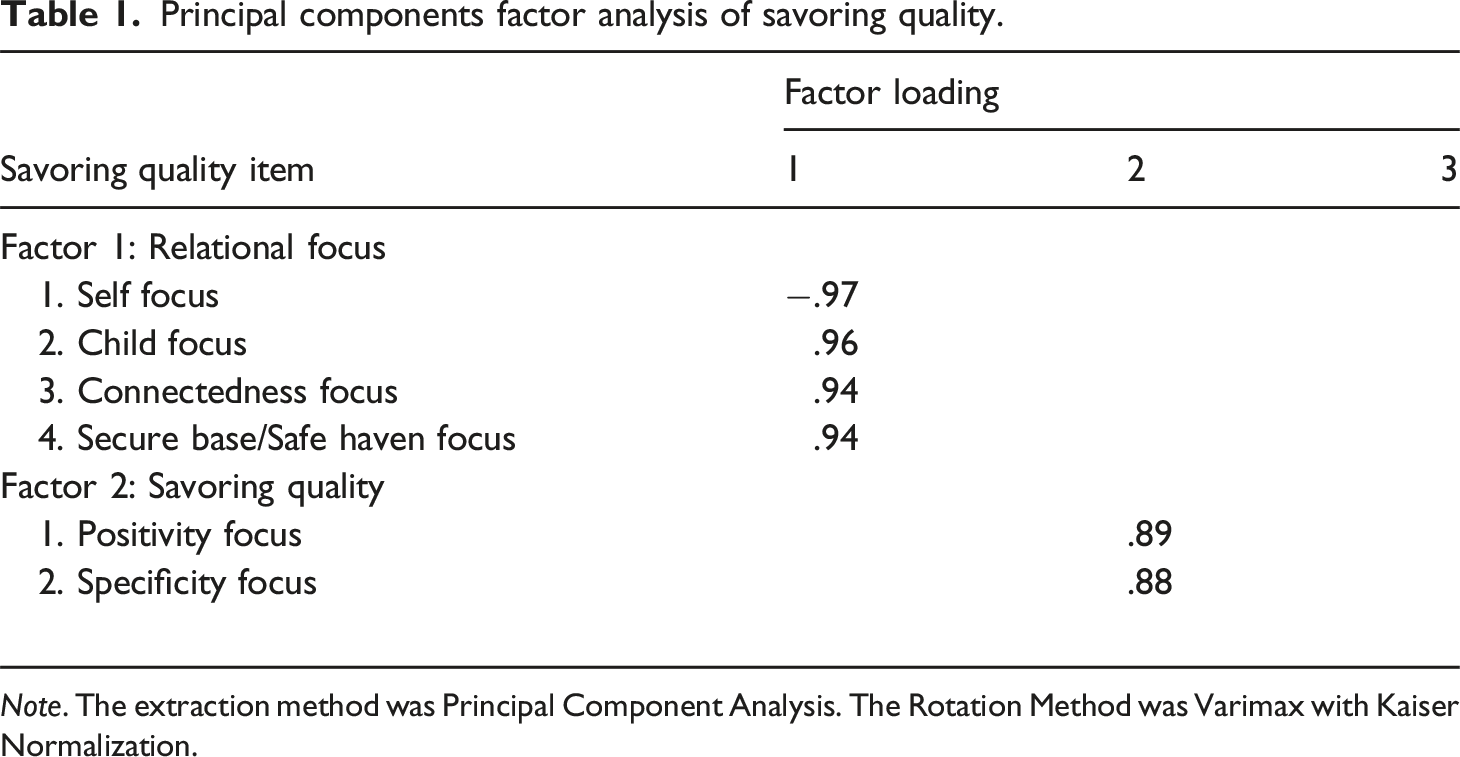
Principal components factor analysis of savoring quality.
Note. The extraction method was Principal Component Analysis. The Rotation Method was Varimax with Kaiser Normalization.
The results yielded two factors explaining 89.73% of the total variance. Factor 1 was labeled Relational Focus because the variables that captured the relational nature of the RS intervention loaded highly on this factor, namely, connectedness to the child (.94), secure/safe haven (.94), and child focus (.96). Further, self-focus (−.97) had a high negative factor loading on this relational factor. This factor explained 61.31% of the variance. Factor 2 was labeled Savoring Quality due to the high factor loadings for positivity (.89) and specificity (.88) (see Table 1). The variance explained by this factor was 28.43%. The two factors were uncorrelated, r = .00; p = 1.00, leading us to create two variables, which we refer to as Relational Focus (mean of variables identified in Factor 1, after reverse-scoring self-focus, with high scores indicating a relational focus) and Savoring Quality (mean of variables identified in Factor 2, with high scores indicating high savoring quality). However, we did not utilize the Relational Focus (i.e., relational vs. non-relational content) factor in subsequent analyses because it was strongly related to intervention condition, with higher levels in the RS than PS condition, M diff = 2.22, W = 18, p < .001, and therefore would not provide an adequate cross-condition index of high-quality savoring. We used the Savoring Quality variable in subsequent analyses since there was no difference between conditions, W = 4147; p = .42. Due to our desire to capture savoring quality in a way that generalized across conditions, we elected to focus on positivity and specificity as these two coding scales cut across the two conditions.
Analytic plan
Statistical analyses were performed using R-software (R Core Team, 2021). First, we calculated descriptive statistics and checked all variables for normality (Shapiro & Wilk, 1965). Then we calculated bivariate correlations among key variables and used parametric t tests or non-parametric Wilcoxon-Mann-Whitney tests to measure differences between conditions. We examined key demographic variables (i.e., child age, maternal age, ethnicity and educational level) for potential differences between conditions and to identify covariates. Among the demographic variables, maternal age in PS (M = 30.09, SD = 5.13) was significantly lower than maternal age in RS (M = 31.77, SD = 4.95; t = -2.02, p = .05), so we controlled for maternal age in all analyses. Furthermore, we conducted an additional analysis to examine potential differences in AAI and ECR-R scores between the PS and RS groups. The results indicated no significant differences in AAI secure scores between the two conditions (W = 2904, p = .42). Likewise, no significant differences were found for AAI dismissing, W = 2507, p = .46; ECR-R anxiety, W = 2654, p = .88; or ECR-R avoidance, W = 2776.5, p = .75.
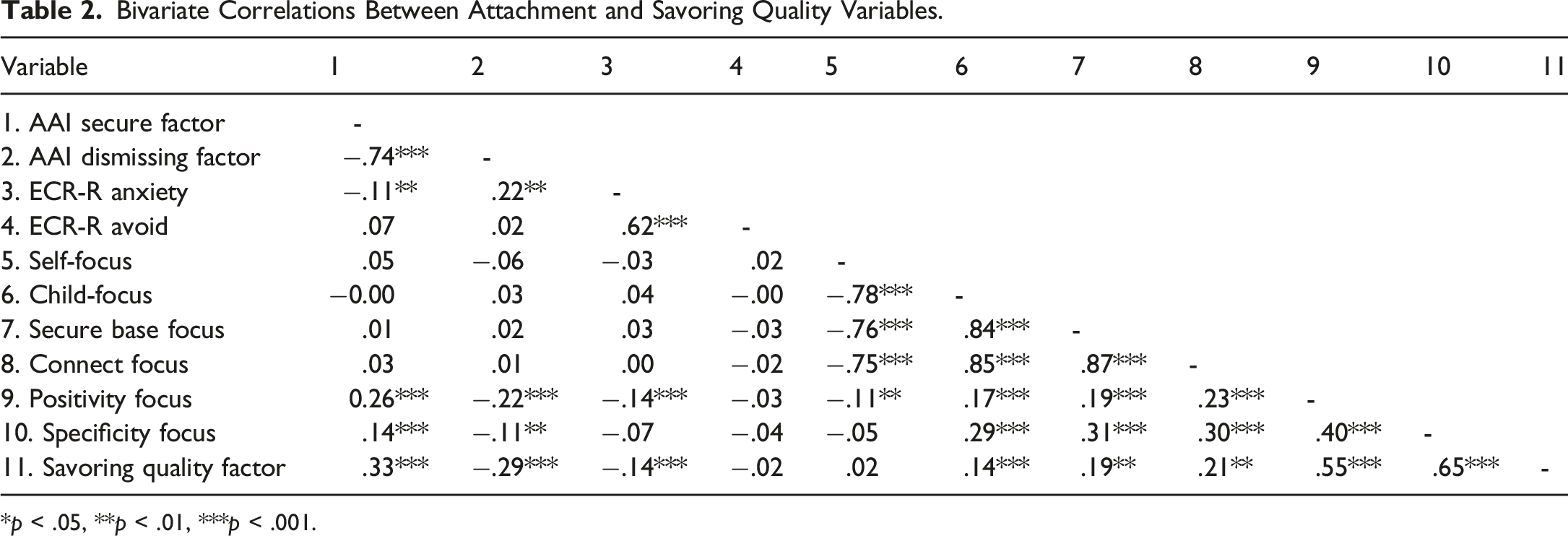
For the purposes of this study, we conducted multiple mixed models procedures (lmer package) to investigate the association between attachment (measured via AAI and ECR-R) and savoring quality, accounting for nested data. In order to evaluate individual participant effects, we also accounted for the participant as a random intercept. Additionally, we implemented a more fine-grained analysis to examine the subcomponents of savoring quality, positivity and specificity, separately. Given the significant correlation we observed between AAI dismissing factor and ECR-R Anxiety (r = .22, p < .01), we implemented separate mixed models with AAI and ECR-R to avoid multicollinearity. Finally, we used two or three-way interactions to test the effect of condition on associations between attachment and savoring quality variables. For further validation of the mixed models (Luke, 2017), we applied ANOVA Wald’s test with Satterthwaite approximation (Satterthwaite, 1946). Post-hoc analyses were conducted using CRAN Package emmeans to obtain estimated marginal means (EMMs) for significant interaction effects in mixed models.
Results
Bivariate Correlations Between Attachment and Savoring Quality Variables.
*p < .05, **p < .01, ***p < .001.
Aim 1: AAI maternal attachment and savoring quality during the intervention
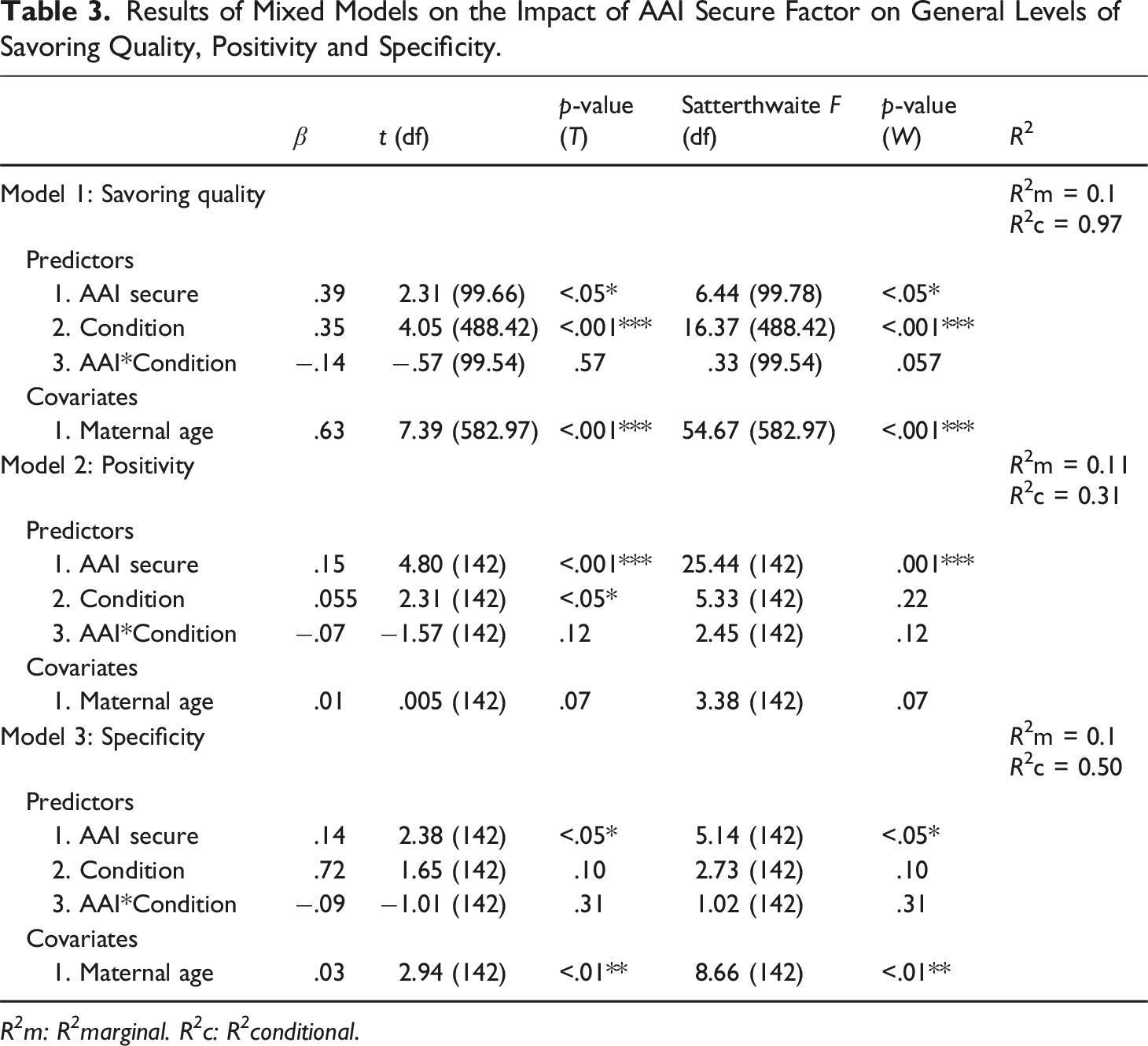
Results of Mixed Models on the Impact of AAI Secure Factor on General Levels of Savoring Quality, Positivity and Specificity.
R 2 m: R 2 marginal. R 2 c: R 2 conditional.
Furthermore, to examine the two components of savoring quality (i.e., positivity and specificity) individually, we conducted separate mixed models using each component as a dependent variable. In the model predicting savoring positivity (H1b), the AAI secure factor and condition were included as independent variables, with maternal age as a covariate, along with the interaction between AAI secure attachment and condition. AAI secure, β = 0.15, t(142) = 4.79, p < .001, and condition, β = 0.55, t(142) = 2.31, p < .05, significantly predicted savoring positivity, with higher levels of AAI secure attachment associated with higher positivity (see Table 3). No other effects were significant. To further explore the significant association between secure attachment and savoring positivity by condition, we conducted a simple slope analysis, revealing that secure attachment significantly predicted savoring positivity in both conditions, but the strengths of the association differed. In the PS condition, secure attachment was positively associated with savoring positivity (b = 0.15, SE = 0.01, p < .001). In the RS condition, secure attachment was also positively associated with savoring positivity, but the effect was weaker (b = 0.08, SE = 0.03, p = .02).
Similarly, in the model predicting savoring specificity (H1c), the AAI secure factor and condition were included as independent variables, with maternal age as a covariate, along with the interaction between AAI secure and condition. AAI secure, β = 0.13, t(142) = 2.38, p < .05, and maternal age, β = 0.30, t(142) = 2.94, p < .01, significantly predicted savoring specificity, while no other effects reached significance. In particular, higher levels of AAI secure and older maternal age were associated with greater specificity (see Table 3).
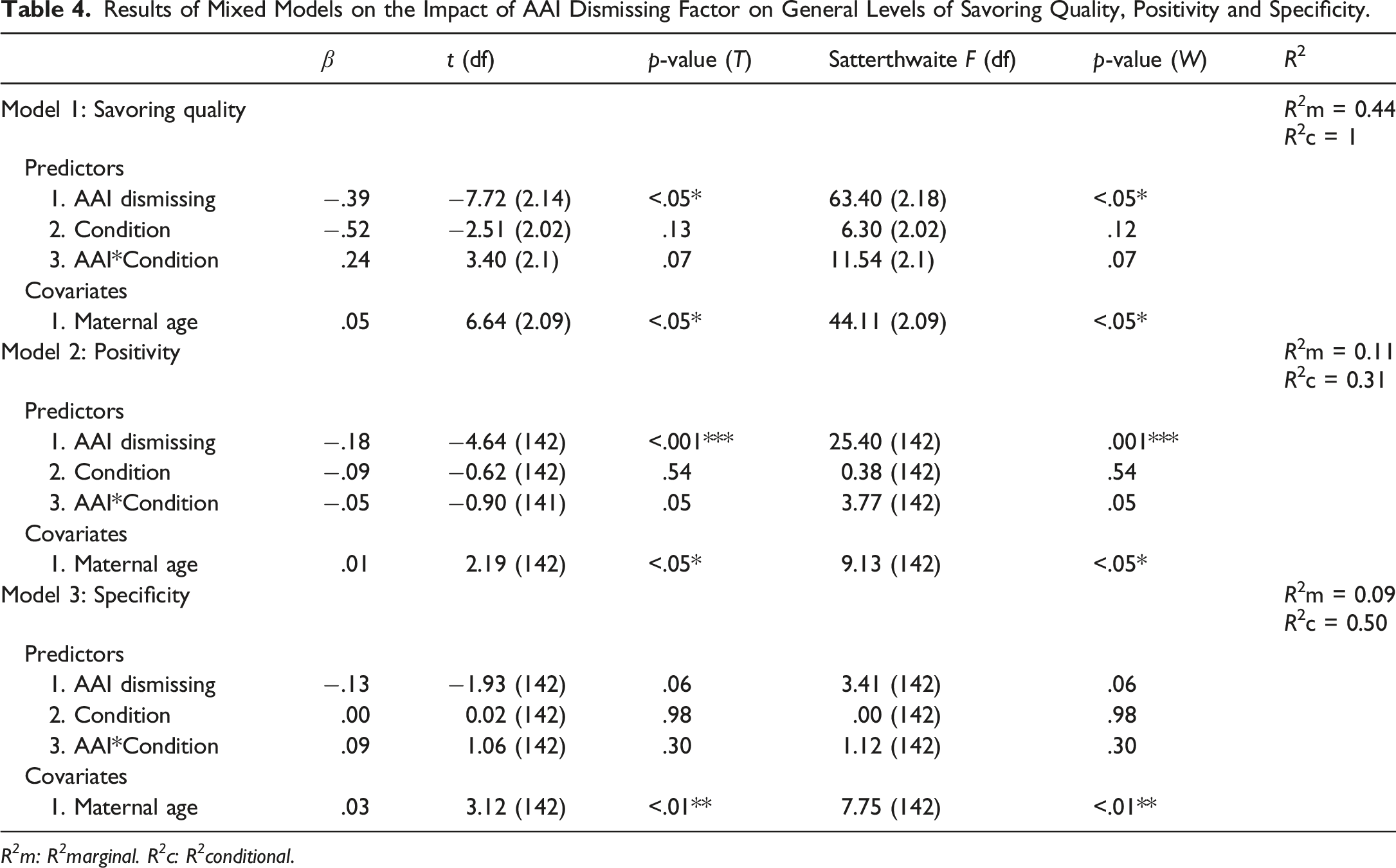
Results of Mixed Models on the Impact of AAI Dismissing Factor on General Levels of Savoring Quality, Positivity and Specificity.
R 2 m: R 2 marginal. R 2 c: R 2 conditional.
With an interest in considering the two components of savoring quality (i.e., positivity and specificity) separately, we conducted separate mixed models with these components as dependent variables. For the model predicting savoring positivity (H2b), we included AAI dismissing and condition as independent variables, maternal age as a covariate, and the interaction between AAI dismissing and condition. AAI dismissing attachment, β = −0.18, t(142) = −4.78, p < .001, and maternal age, β = 0.01, t(142) = 2.19, p < .05, significantly predicted savoring positivity, with higher dismissing attachment predicting lower positivity (see Table 4). The interaction between AAI dismissing and condition was non-significant. For the model predicting savoring specificity (H2c), we included AAI dismissing and condition as independent variables, maternal age as a covariate, and the interaction between AAI dismissing and condition. Maternal age, β = 0.31, t(142) = 3.12, p < .01, significantly predicted savoring specificity (see Table 4). No other effects were significant.
Aim 2: ECR-R maternal attachment and savoring quality during the intervention
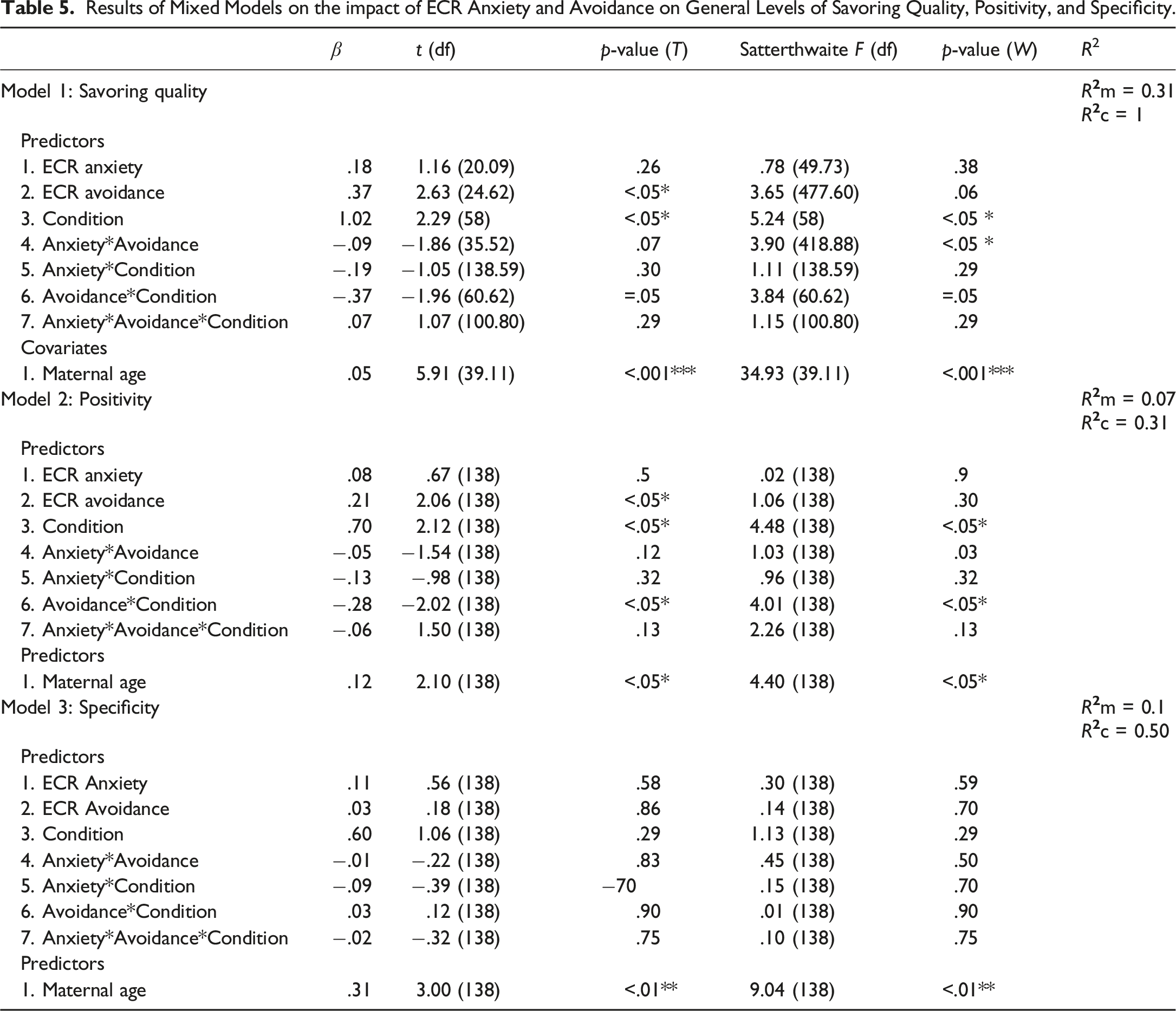
We implemented additional mixed models to investigate the impact of self-reported attachment (ECR-R) on savoring quality (H3a). ECR-R anxiety and avoidance were entered as independent variables, with maternal age as a covariate. Further, we considered two-way and three-way interactions between ECR-R anxiety, avoidance, and condition. ECR-R avoidance, β = 0.37, t(24.62) = 2.63, p < .05, condition, β = 1.02, t(58) = 2.29, p < .05, and maternal age, β = 0.5, t(39.11) = 5.91, p < .001, predicted overall savoring quality. Avoidance was associated with higher savoring quality but anxiety was not significantly associated with savoring quality. No significant interactions were found. The ANOVA Wald test with Satterthwaite’s method confirmed the significant effect of condition in savoring quality but did not confirm the effect of ECR-R avoidance. Therefore, the relation between ECR-R avoidance and savoring quality was not considered further (see Table 5).
In addition, we conducted analyses considering positivity and specificity separately. For the model predicting savoring positivity (H3b), we included ECR-R anxiety, avoidance, and condition as independent variables, and maternal age as a covariate. We also tested two-way and three-way interactions between ECR-R anxiety, avoidance, and condition; the three-way interaction was not significant. However, we found a significant interaction between ECR-R avoidance and condition, β = -0.28, t(138) = −2.02, p < .05. To further explore this interaction, we conducted a simple slope analysis to examine the relation between ECR-R avoidance and savoring positivity within each condition. ECR-R avoidance was not significantly related to positivity in the RS condition (b = −0.04, SE = 0.05, p = .38) nor in the PS condition (b = 0.07, SE = 0.05, p = .16). That is, although the slopes differed from each other, neither of the simple slopes was different from zero (see Figure 1). Regarding the main effects, ECR-R avoidance, β = 0.21, t(138) = 2.06, p < .05, condition, β = 0.70, t(138) = 2.12, p < .05, and maternal age, β = 0.01, t(138) = 2.10, p < .05, significantly predicted savoring positivity, whereas ECR-R anxiety was not significantly associated with positivity. However, when using the ANOVA Wald test with Satterthwaite’s method, the effect of ECR-R avoidance was not significant, suggesting that the association between ECR-R avoidance and savoring positivity is not robust when considering all predictors together in the model. Relationship between ECR-R avoidance and positivity by condition.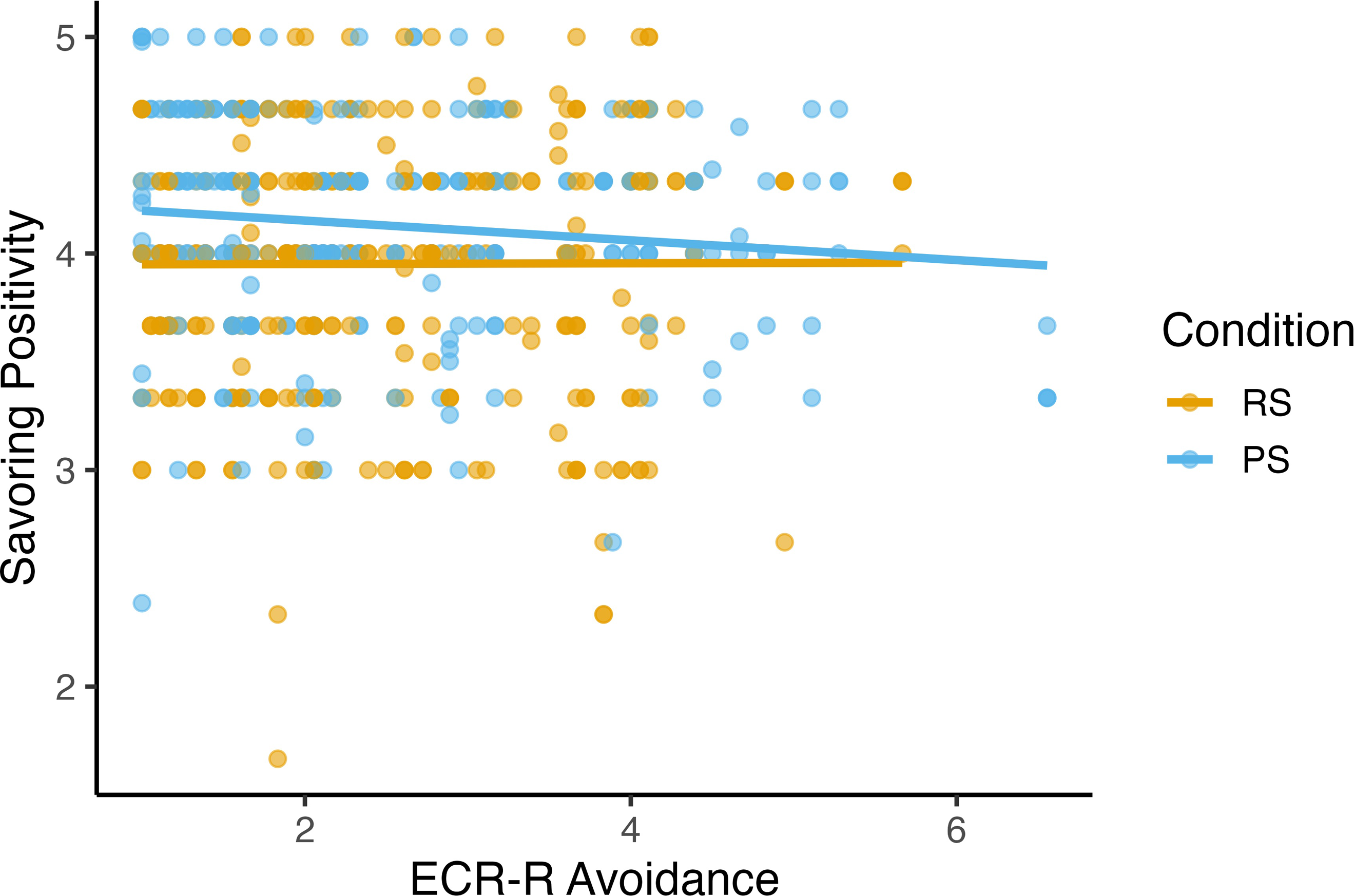
Results of Mixed Models on the impact of ECR Anxiety and Avoidance on General Levels of Savoring Quality, Positivity, and Specificity.
Discussion
This study offers an in-depth analysis of the associations between adult attachment and savoring quality in PS and RS interventions with mothers of toddlers. We considered two measures of attachment-related constructs, the AAI and ECR-R, and found that they yielded different results in predicting savoring quality. Specifically, AAI secure attachment predicted higher general savoring quality and AAI dismissing attachment predicted lower general savoring quality, whereas neither ECR-R avoidance nor anxiety was associated with savoring quality. When we examined the savoring quality subcomponents, we found that AAI secure attachment was associated with higher positivity (more strongly in the PS condition) and specificity in savoring, whereas AAI dismissing attachment was associated with lower positivity across conditions, but not with specificity. We discuss these findings below.
Associations between measures of attachment and savoring
Secure attachment, as measured by the AAI, was associated with greater overall savoring quality, across conditions (RS vs. PS), suggesting that mothers with greater attachment security are able to engage with and elaborate on positive emotional experiences, reflecting a coherent and emotionally rich narrative style regardless of savoring context. In addition, secure attachment was positively associated with savoring positivity for mothers in both conditions, although somewhat more strongly for those in the personal savoring condition. Secure attachment was also positively associated with specificity of savoring for mothers in both conditions, implying that secure attachment may foster not only emotional depth but also cognitive detail in savoring. Although correlational, our findings suggest that secure attachment provides a stable foundation for engaging with positive memories, regardless of whether they are personal or relational in nature. Consistent with attachment theory, we found that higher AAI dismissing attachment was associated with lower savoring quality (particularly lower positivity). Dismissing attachment is characterized by an unwillingness or inability to recall and talk about childhood attachment experiences, a marked distancing from emotional content, and a lack of interest in emotional closeness (DeOliveira et al., 2007; Nelson-Coffey et al., 2021). Consistent with the idea that dismissing individuals also tend to deny the negative implications of adverse experiences, they use fewer negative emotion words compared to secure and preoccupied adults (Kerr et al., 2019). If a dismissing mother’s attachment reflects a restricted range of negative affect, she is likely to also find it difficult to identify, discriminate, and understand a full range of positive affect as well (DeOlivera et al., 2007). Notably, dismissing mothers in our study showed less positivity when reflecting on memories, whether experienced alone or with their children (in personal and relational savoring narratives).
One explanation for the associations between AAI dismissing attachment and savoring quality is that mothers who have difficulty accessing childhood memories and engaging with emotional content during the AAI also experience difficulty reflecting on past moments that involve positive emotions and take place outside their families of origin. That is, mothers high in dismissing attachment may create distance from emotional experiences during savoring that manifest in lower levels of positivity in their reflections. This explanation aligns with the concept of emotional deactivation, using strategies that create emotional distance (Cassidy & Shaver, 2002). Indeed, people high in dismissing or avoidant attachment use deactivating strategies following separation from a romantic partner; by avoiding former partners or reminders of the relationship, they seek to suppress attachment-related cognitions and emotions and thus avoid distress (Davis et al., 2003). Similarly, mothers high in dismissing attachment might utilize deactivating strategies during savoring that keep them from fully engaging with the savoring task and reflecting on the positive aspects of past events.
Although AAI dismissing was associated with mothers’ ability to produce narratives characterized by positive affect, it was not related to the specificity of their memories. That is, some mothers with higher levels of dismissing attachment described relational memories with higher levels of detail, whereas others did not. This is somewhat surprising given that one feature of dismissing attachment is an insistence on lack of memory regarding childhood attachment experiences (Cassidy & Shaver, 2002). That is, we might have predicted that mothers high in dismissing attachment would have reliably generated memories that were lower in specificity. Although individuals with dismissing attachment are reluctant to engage with emotional aspects of attachment experiences (Cassidy, 1994; Fraley & Shaver, 1999), it is possible that for some of them, the ability to provide detailed information serves as a coping mechanism. A focus on specific details could represent an attempt to maintain emotional distance while still engaging in a memory-related task. Indeed, the absence of a clear association between dismissing attachment and the specificity of memory recall suggests that the observed difference in the positivity of memories is not necessarily due to difficulties in recall. Instead, it suggests a more direct link between dismissing attachment and the lack of positive emotional content in remembered experiences. On the other hand, the positive association we found between secure attachment and specificity suggests that eliciting detailed memories could be a meaningful target for intervention for mothers with dismissing attachment. That is, enhancing specificity could help them deepen their emotional engagement with positive memories, thereby supporting overall emotional well-being.
Interestingly, although the level of specificity in savoring memories was not associated with dismissing attachment, we found a positive association between specificity and maternal age that is worth discussing. Research suggests that memory recall, particularly for autobiographical events, tends to improve with age due to more effective cognitive strategies and changes in neural structures (Nyberg et al., 2012; Park & Reuter-Lorenz, 2009). Older mothers with more life experiences may be better able to cope with challenges and recall more details of life events, as suggested by the cognitive reserve hypothesis (Stern, 2002). Moreover, older mothers often have a rich reservoir of experiences related to their children and tend to prioritize positive emotional experiences over negative ones, enhancing the depth and specificity of positive emotional memories (Carstensen & Mikels, 2005). This effect is also linked to improved emotion regulation strategies, which help in encoding and retrieving emotionally significant memories (Blanchard-Fields et al., 2007). Finally, neuroimaging studies have shown that the maternal brain undergoes changes that enhance emotion processing, particularly in regions associated with memory and emotion (Kim et al., 2010). As mothers age, these neural adaptations may further support enhanced recall of specific, emotionally significant memories related to their children, contributing to the observed increase in memory specificity with maternal age.
Our findings with the ECR-R are not inconsistent with previous studies. On the one hand, associations between self-reported attachment avoidance and poorer savoring quality, as well as poorer outcomes after savoring, have been reported (Bond & Borelli, 2017; Palmer & Gentzler, 2018). Individuals with insecure avoidant attachment have shown more difficulty engaging with relational compared to non-relational content, are more prone to undervaluing positive events, and more often underestimate the positive effects of emotions associated with previous interpersonal experiences (e.g., Palmer & Gentzler, 2018). Because attachment avoidance is characterized by discomfort with emotional closeness and dependency, we expected that higher ECR-R avoidance would also be associated with lower savoring quality, particularly when savoring relational content. However, we did not observe associations between ECR-R scales and mothers’ savoring quality. Given that the ECR-R assesses attachment in romantic or intimate relationships, it is possible that this measure does not capture attachment dynamics that impact savoring quality when mothers reflect on moments with their young children. For example, feeling uncomfortable opening up, avoiding discussing problems and concerns, or being unwilling to share deep feelings may be signs of avoidant adult attachment but these feelings or actions do not occur between parents and their young children. In addition, in previous research, self-reported attachment measures have diverged from interview-based measures like the AAI, particularly in predicting outcomes related to emotion processing and relational dynamics (Roisman, Fraley et al., 2007). As we saw, there was a different pattern with the AAI data. In fact, the AAI, with its focus on assessing unconscious aspects of attachment through coherence of narrative responses, may be particularly sensitive to the defensive mechanisms and emotional disengagement typical of dismissing individuals. More research is needed to understand the different outcome variables that are predicted by these two measures of adult attachment.
It is possible that the association between the AAI, but not the ECR-R, and savoring ability may be explained by their shared reliance on narrative-based processes. Both the AAI and savoring tasks require individuals to construct and reflect on personal memories, using cognitive and emotional mechanisms that enable them to integrate past experiences into a coherent narrative. Main’s concept of attachment security on the AAI highlights the importance of attentional processing in maintaining coherence, suggesting that individuals who can stay focused and organized in their narratives are better able to integrate and reflect on their experiences (Main, 2000). This same process might support the ability to fully savor positive experiences. Individuals with greater narrative coherence, for example, may be better equipped to vividly recall, organize, and connect with a savored memory. In other words, narrative coherence could be a third variable impacting the observed link between AAI and savoring quality. Some research supports the idea that narrative coherence is a significant factor in how individuals process and reflect on their attachment experiences (Talia et al., 2019). Similarly, we found that individuals higher on the AAI Secure factor that includes coherence also had greater ability to engage in savoring tasks.
We also found that the association between insecure, dismissing attachment and overall savoring quality did not differ significantly between the RS and PS conditions. It was reasonable to hypothesize that a focus on RS, which emphasizes interpersonal connections and shared positive experiences, would be particularly challenging for mothers with dismissing attachment. However, our findings suggest that dismissing attachment is associated with a more generalized poverty of positivity in savoring, one that is not necessarily amplified by savoring relational memories. One possible explanation is that savoring, regardless of its relational or personal focus, requires a level of emotional engagement and openness. In other words, the requirement for emotional engagement during savoring interventions may be the primary barrier to effective savoring for mothers of toddlers. These results align with studies showing that flexibility and adaptability of savoring strategies are present across different contexts (Smith & Hollinger-Smith, 2015). Savoring quality may be less dependent on the specific focus of the intervention and more on the individual’s capacity to engage with positive experiences in general.
To conclude, it is worth noting that the relation between savoring and attachment is potentially bidirectional. Although theory holds that attachment IWMs shape how individuals engage with and interpret emotional experiences, the process of savoring positive moments, whether personal or relational, might also help reshape attachment-related cognitive frameworks going forward. Savoring encourages individuals to focus on moments of security, support, and connection, reinforcing and potentially changing or shifting positive working models of relationships as well as self-related experiences. Over time, engaging in savoring could promote attachment security through various mechanisms, including highlighting positivity, increasing awareness of sensitive behavior, promoting emotional openness, and increasing reflective functioning (Borelli, Bond et al., 2020). That is, savoring interventions have the potential to strengthen mothers’ relational and personal emotional functioning.
The study’s implications for intervention are noteworthy. First, although savoring specificity was not associated with AAI dismissing attachment, its positive association with AAI secure attachment suggests that specificity may be a critical ingredient in enhancing savoring quality. That is, even if specificity is not impaired in all individuals with dismissing attachment, specificity remains a critical factor to target in interventions. Integrating strategies that promote the elaboration of specific details in positive memories—such as guided imagery, narrative elaboration, and sensory-focused reflection—could help strengthen savoring outcomes. By fostering greater specificity, interventions could enhance emotional engagement and contribute to improved savoring quality.
Second, that we found associations between savoring quality and AAI dismissing attachment (but not ECR-R insecure attachment) suggests that there are benefits of using narrative assessments when exploring attachment dynamics. Third, our findings highlight the need for interventions that specifically address the challenges faced by individuals with dismissing attachment representations. Knowing that mothers with dismissing attachment generate savoring narratives that are low in positivity suggests that attention should be devoted to attempting to heighten positive emotion – for example, helping clients focus their emotion, capitalize on positive emotion, and notice positive emotions as they arise in daily life can significantly enhance emotional well-being (Fredrickson, 2001). No studies to our knowledge have examined intervener factors that predict participants’ savoring positivity, but one study examined demographic factors that affect intervener behavior. As compared to interveners with bachelor’s degrees, interveners without bachelor’s degrees deliver both RS and PS with higher levels of positivity (Borelli et al., 2024), a finding that could guide decision-making. Finally, although mothers with dismissing attachment were more likely to generate less positive savoring, there was no association with the specificity of their reflections. However, because more specificity did characterize savoring for mothers with secure attachment representations, practitioners might work to harness detailed memory recall as a foundation for intervention, working to transform detailed recollections into sources of positive emotional experience.
A methodological note: interview and self-report measures of attachment
Attachment interviews investigate individuals’ states of mind with respect to childhood relationships with attachment figures, whereas self-report questionnaires prompt them to characterize their approach to romantic relationships. These measures differ both in their methodology and theoretical stance (i.e., attempts to capture unconscious vs. conscious representations). Perhaps not surprising, our findings demonstrated a divergent pattern of findings for these measures in relation to savoring quality. Others have reported that the AAI and self-report measures of attachment, including the ECR-R, are only weakly, or not at all, associated with one another (Riggs & Jacobvitz, 2002; Roisman, Holland et al., 2007). Nevertheless, both measures have been associated with theoretically-related constructs, such as relationship quality, emotion, and well-being (for a review, see Eilert & Buchheim, 2023). Our findings are largely consistent with these prior findings, as the AAI and ECR-R scales were weakly or not at all correlated in our study, and the measures were associated with savoring quality in different ways.
Strengths and limitations
As a longitudinal study involving multiple measures of attachment, multiple savoring sessions, and a diverse sample, this study has numerous strengths. However, there are limitations that qualify the conclusions that can be drawn from the work. One limitation is the exclusive reliance on mothers, which limits the generalizability of the findings, particularly given the importance of fathers in children’s lives (Fitzgerald et al., 2020). Further, given the known differences in fathers’ and mothers’ emotional experiences of parenting (Kerr et al., 2021; Yaffe, 2020), studies that include fathers are necessary to inform our understanding of the links between attachment and savoring quality, as well as to inform savoring intervention refinement. Second, although the sample was quite ethnically/racially diverse, there was insufficient statistical power to examine ethnic/racial differences in the associations between attachment and savoring quality. This is an important direction for future work given documented racial/ethnic differences in the valuing of positive emotional experience (e.g., Wang, Bouche et al., 2020). Furthermore, the inclusion of Latine participants with relatively high levels of education may limit the generalizability of the findings to the broader Latino/a/e/x population. Gender identity information was not collected and should be explored in further studies.
Third, although this was a longitudinal study, we chose to avoid saturating our models by examining time-related research questions. In future studies it will be important to examine changes over time. For example, important questions remain regarding changes in savoring quality (e.g., do people high in dismissing attachment show greater improvements over time in savoring quality compared to those with secure attachment? Does change vary as a function of savoring focus?). These questions could be addressed using this or another similar dataset. Studies could explore why different methods of assessing attachment reveal different associations with savoring quality with different populations. Understanding these differences could provide deeper insights into attachment theory and its implications for emotional and psychological well-being. Since we did not include any other outcome variables in our analysis, future research should explore whether attachment insecurity predicts not only savoring quality but also affects the intervention’s broader impact on overall well-being or emotion regulation.
Conclusion
This study explored associations between maternal attachment and savoring quality in mothers of young children. AAI secure attachment was positively associated with savoring quality and its components, whereas AAI dismissing attachment was negatively associated with overall quality and positivity of savoring, but not with specificity. Additionally, ECR-R avoidance and anxiety were not associated with savoring quality nor with its sub-components. Interestingly, older maternal age was associated with greater savoring specificity across conditions. These findings highlight the importance of considering the links between attachment – and how it is assessed – and the ways that mothers narrate their relational or personal experiences in savoring interventions. Parenting, and in particular parenting young children, comes with challenges, and interventions aimed at supporting maternal psychological well-being, such as savoring, may be helpful tools for community and clinical mental health practice. Better understanding the factors that predict savoring quality – and have the potential to impact intervention outcomes – is indicated.
Footnotes
Declaration of conflicting interests
The author(s) declared no potential conflicts of interest with respect to the research, authorship, and/or publication of this article.
Funding
Funding was provided through Pomona College Faculty Research Grants (Borelli, Smiley); David L. Hirsch III and Susan H. Hirsch Research Initiation Grant (Borelli); and American Psychoanalytic Association Grant (Borelli).
Open research statement
This research was not pre-registered. The data used in the research can be publicly posted. The data can be obtained at  or by emailing