




Abstract
During challenging periods like the transition to parenthood, support from one’s partner becomes of vital importance for maintaining a healthy relationship. Responsiveness describes that relationship partners attend to and react in a supportive manner to one’s disclosed concerns and feelings in times of need. Perceived partner responsiveness occurs when one partner acts in a way that the other partner perceives as responsive to his or her needs, conveying understanding, validation, and care. However, such perceptions are highly subjective and shaped by attachment orientations of the perceiver, especially during challenging times. Besides, when partner behavior is perceived as responsive, this can also be beneficial for the relationship and promote a sense of security. The current study examined whether attachment insecurities predicted changes of perceived partner responsiveness across the transition to parenthood, and whether perceived partner responsiveness predicted changes in attachment orientations across time. We investigated changes in perceived responsiveness in 120 mixed-gender couples across the transition to parenthood over four different time points (during pregnancy, 6 months, 12 months, and 18 months after the birth of their first child). The results suggest that although perceived responsiveness increased during the transition to parenthood, the increase was significantly less strong in individuals who scored higher in attachment insecurities. Additionally, examination of changes in attachment orientations shows significantly less increases of attachment insecurities when individuals perceived their partner’s responsiveness across the transition to parenthood.
Introduction
The transition to parenthood is a complex process characterized by personal and family changes, which require adjustment (Epifanio et al., 2015) and have a significant impact on relationship functioning (Doss et al., 2009). Changes in the daily structure of couples’ life can cause stress (Doss et al., 2009; Reid & Taylor, 2015) and undermine personal and relational well-being, while dealing with stress requires individual and social resources (Lazarus & Folkman, 1984). Intimate relationships can be a valuable source of support during this transition (Cohen & Lemay, 2007). Perceived partner responsiveness, defined as the extent to which one partner perceives the other as attending to and supporting their needs through understanding, validation, and care, plays a pivotal role and contributes to the growth and well-being of relationships (Reis & Gable, 2015). In addition, perceived partner responsiveness plays a particularly important role during major life transitions, such as the transition to parenthood, by helping individuals feel supported and understood during stressful times (Clark & Lemay, 2010). However, individual differences in attachment orientations can influence perceived partner responsiveness (Bowlby, 1973). Individuals higher in attachment anxiety and attachment avoidance tend to evaluate support attempts negatively, and therefore perceive less partner responsiveness (Mikulincer & Shaver, 2005; Rholes et al., 2001). As suggested by the security enhancement model (Arriaga et al., 2018), partners can play an important role in maintaining these attachment insecurities through time by reinforcing existing negative working models of the self and other. However, perceiving partner responsiveness should enhance attachment security in an intimate relationship for both anxiously and avoidantly attached individuals (Rice et al., 2020). Research has shown that individuals may exhibit attachment security when their partner responds supportively to their needs (Mikulincer & Shaver, 2003). In the current study, we examine the role of attachment anxiety and attachment avoidance in predicting changes in perceived partner responsiveness and we also examine changes of attachment insecurities predicted by perceived partner responsiveness across the transition to parenthood. By focusing on these dynamics, our research aims to elucidate the reciprocal relationship between attachment orientations and perceived partner responsiveness, offering insights into how these factors contribute to relationship adjustment during this critical life stage.
Transition to parenthood
The transition to parenthood is a major life transition that affects new parents’ bodies, minds, social roles, and relationships (Cowan & Cowan, 2000). They face the challenges of fatigue, momentary strain, and work-family conflict. At the same time, they must also learn to be parents and coparents (Mitnick et al., 2009). As a result, and although there is growing research suggesting that parenthood is associated with greater marital stability (Roy et al., 2013) and satisfaction (Guttmann & Lazar, 2004), the stress conditions associated with the transition to parenthood can take a toll on couple’s relationship and individual well-being (Mitnick et al., 2009). Given the health risks associated with increased levels of stress, they may negatively impact physical and psychological health (Robles et al., 2015).
Although the extent that the transition to parenthood undermines relationship functioning has been discussed controversially (Doss et al., 2009), parents seem to generally experience steeper declines in marital quality (Kiecolt-Glaser & Newton, 2001) and relationship satisfaction than childless couples (Doss & Rhoades, 2017; Mitnick et al., 2009), at least temporarily (Lawrence et al., 2008). Often, couples report higher levels of stress during the transition to parenthood (Doss et al., 2009), a decline in relationship satisfaction during the first 18 months after birth (Cowan & Cowan, 1995), increases of marital distress (Cowan & Cowan, 2000), and increases in conflict interactions (Kluwer, 2010). Additionally, an increased risk for mental health issues in both partners has also been observed (Cowan & Cowan, 2000), with increases in depressive symptoms (Simpson, Rholes, Campbell, Tran, & Wilson, 2003). Changes in roles and demands help explain why couples experience declines in relationship functioning (Cowan & Cowan, 2000). As women typically bear the majority of family responsibilities, the negative impact of stress, time constraints and exhaustion may disproportionally affect wives, leading to a decrease in their ability to self-regulate (Kluwer, 2010). Despite these negative implications, not all couples experience a deterioration in relationship functioning across the transition to parenthood. Some couples do not experience a drop in relationship satisfaction after childbirth (Ter Kuile et al., 2017), some report a medium decrease in the first year post-partum and a small decline after the first year post-partum (Bogdan et al., 2022) and some couples even experience increases in satisfaction and their relationship flourishes (Doss et al., 2009). Individual differences in attachment orientations, and some characteristics of the relationship, such as perceived partner responsiveness, might help explain such differences in adjustment (Kohn et al., 2012).
The role of partner responsiveness
Partner responsiveness is operationalized as the degree of understanding, validation, and care that partners display toward one another, and it has been associated with positive outcomes in relationships. It refers to the process through which relationship partners attend to and respond supportively to each other´s needs, wishes, and concerns (Clark & Lemay, 2010) and it involves one´s partner disclosure of affect personal information (verbal or nonverbal) and the other partner´s contingent response to subjective perception of this disclosure (Reis & Gable, 2015). For both partners, perceived responsiveness contributes to attraction and commitment (Reis & Shaver, 1988) and it is contingent on the partner’s responsive actions and the perceptions of being responsively supported (Reis & Clark, 2013). It also plays a pivotal role in establishing and maintaining intimacy in relationships (Laurenceau et al., 2005), and it predicts better adaptation to parenthood in the long term (Ter Kuile et al., 2017).
The benefits of perceived partner responsiveness are not observed only among partners who receive high levels of responsiveness, but also in the responsive partners themselves, arguably because caring for others is an innate human tendency (Bowlby, 1988). However, stressful contexts like the transition to parenthood may compromise the impact of responsive support (McLeod et al., 2020). Stressors are likely to impact both partners to some degree, regardless of whether the impact is direct or not (Randall & Bodenmann, 2009), and can contribute to disengagement and withdrawal (Bodenmann, 1995). Indeed, new parents can be at risk for parental burnout, which can lead to emotional distancing (Roskam et al., 2017) and greater conflict (Blanchard et al., 2021), which in turn may undermine perceived partner responsiveness and relationship satisfaction (Smallen et al., 2021).
Therefore, intimate relationships and individual characteristics play a vital role as a primary source of responsive support during life challenges, such as the transition to parenthood. They provide essential resources like partner responsiveness, which help individuals to adjust to this demanding period (Cohen, 2004), although they may also diminish these resources. While responsiveness is beneficial for both partners, stressful contexts like parenthood may undermine its effects, leading to disengagement and withdrawal (McLeod et al., 2020). Therefore, understanding the dynamic between attachment orientations and partner responsiveness is critical for explaining relationship changes during this period (Ter Kuile et al., 2017).
Attachment needs and perceived partner responsiveness: A dynamic interplay in relationships
Adult attachment theory suggests that attachment orientations are closely related to experiences and perceptions of social support (Bowlby, 1973). Indeed, studies suggest that attachment orientations predict the tendency to seek support when coping with stress (Simpson et al., 1992), and they also shape perceptions of partner responsiveness (Bartholomew et al., 1997). Sometimes enacted partner support is not perceived as such or is interpreted as unhelpful, even on occasions where support seems to be responsive and sensitive to the specific needs of the partner (Collins & Feeney, 2004). Attachment orientations may explain such discrepant perceptions: individuals with a secure attachment orientation perceive their partner as being better caregivers (Kane et al., 2007), while people who are more insecure in their attachment orientations might be less likely to perceive their partners as responsive to their needs (Collins & Feeney, 2004). Some studies have indeed supported that fluctuations in perceived partner responsiveness may vary as a function of individual differences in attachment orientations (Hazan & Shaver, 1987; Mikulincer, & Shaver, 2005). For instance, anxiously attached women seem to perceive less responsiveness pre-birth and show relatively large declines in perceptions of responsiveness from pre-birth to six months after birth (Rholes et al., 2001). Similarly, individuals with an anxious attachment orientation report being under-supported (Brock & Lawrence, 2014). They tend to negatively evaluate support attempts (Don & Hammond, 2017), and report lower availability of support (Stanton & Campbell, 2014) mainly because anxiously attached individuals are more likely to interpret information in a way that typically confirms their negative expectations of attachment figures (Shaver & Mikulincer, 2002). Moreover, anxiously attached individuals are motivated to monitor their partners for signs of deficient or declining availability and emotional proximity (Cassidy & Berlin, 1994). Such results may also extend to individuals with avoidant attachment orientations. Individuals high in attachment anxiety and attachment avoidance (matching the fearful attachment type) feel substantially less supported by their partner’s supportive notes than their more secure counterparts (Collins & Feeney, 2004). Besides, people with an avoidant attachment orientation report lower perceptions of support availability (Mak et al., 2010). For avoidantly attached individuals repeated failure in the past to gain proximity eventually suppresses future behavioral attempts to achieve it (Simpson et al., 1992). Since reciprocity is a commonly observed norm within intimate relationships, individuals might project their own relationship feelings, insecurities and views regarding their responsiveness onto their partners (Mikulincer & Horesh, 1999), essentially seeing a reflection of their own actions and intentions (Debrot et al., 2012; Lemay & Neal, 2013).
These discrepancies in perceived partner responsiveness highlight how attachment orientations can affect both how partner support is sought and how it is interpreted, particularly in the context of major life transitions like parenthood (Simpson et al., 1992). When attachment–related insecurities are heightened, they can shape how partners interpret and react to each other’s behaviors across the transition to parenthood (Collins & Feeney, 2000). Long-term decreases in perceived partner responsiveness negatively affect relationship satisfaction and promote discontent in relationships (Reis & Gable, 2015).
However, perceptions of partner responsiveness are not one-sided but exert reciprocal influences on attachment security and relationship satisfaction over time (Reis & Gable, 2015). Although the majority of the literature so far portrays individuals as being chronically anxiously or avoidantly attached, it is important to mention that attachment orientations can change over time (Chopik et al., 2019). Some factors that may foster attachment insecurities across time could be a lack of clarity in one’s working models (Davila & Cobb, 2003) and low marital satisfaction (Davila et al., 1999). On the contrary, there are factors which can foster increases in attachment security across time such as trust (Arriaga et al., 2014) and responsive partner support processes (Simpson, Rholes, Campbell, & Wilson, 2003). Additionally, perceived partner responsiveness is thought to be important for a secure attachment orientation (Reis et al., 2004). Research has shown that when individuals perceive that their partners are responsive to their needs, they are more likely to experience feelings of security within their relationship (Feeney & Collins, 2001). In line with this reasoning, more recent research suggests that partner support and perceived responsiveness can be a source of promoting attachment security resulting in more satisfying relationships (Arriaga et al., 2018). Thus, attachment orientations are dynamic and can change under certain dyadic interpersonal processes. For example, some longitudinal findings have shown that anxiously attached individuals became more secure if they perceived encouragement of personal goals that contrasted with their working models involving an incompetent self (Arriaga et al., 2014).
To summarize, on the one hand attachment orientations are not fixed, and their dynamic interplay with perceived partner responsiveness influences how individuals perceive their partner’s responsiveness, with insecure attachment (anxiety and avoidance) orientations being linked to perceptions of lower responsiveness (Collins & Feeney, 2000). On the other hand, perceived partner responsiveness fosters a secure attachment orientation (Reis et al., 2004) and promotes more satisfying relationships (Arriaga et al., 2018). The transition to parenthood, in particular, presents a critical window for such changes.
Parenthood as a catalyst for shifts in attachment and perceived partner responsiveness
The birth of a child constitutes a dyadic stressor (McGoldrick & Carter, 2003) and parents need to engage in coping efforts not only to manage their own stress but also to respond to their partner’s needs (Bodenmann, 2005). Bowlby posited that transition periods, such as the transition to parenthood, are periods during which new information about attachment-relevant events and attachment figures—such as partners in intimate relationships—become salient. These periods, therefore, provide an opportunity for new information to alter both working models and attachment orientations (Bowlby, 1988; Simpson, Rholes, Campbell, & Wilson, 2003). There are several explanations for this. The ongoing stress and interpersonal challenges inherent to the experience of having a child (Cowan & Cowan, 2000) can prompt individuals to become more open to reassessing, updating, and potentially revising their self-perceptions and views of significant others (Caspi & Bem, 1990). Moreover, the birth of a child—especially the first child—can revive important attachment-related memories and issues from the expectant parents’ past relationships (Bowlby, 1988), and caring for a new baby typically introduces individuals to a range of new personal and interpersonal experiences (Cowan & Cowan, 2000). On the one hand, individuals higher in attachment anxiety when they are distressed, tend to cling to their partners, ruminate about their negative emotions (Mikulincer & Florian, 1998), and remain dissatisfied with available partner support (Bartholomew et al., 1997). This indicates that individuals who are highly anxious are inclined to perceive a lack of adequate support from their partner, particularly when they are confronted with stressors that test the resilience of their relationship (Simpson & Rholes, 2002). On the other hand, individuals higher in attachment avoidance harbor more negative beliefs about the availability of partner support. Accordingly, stressful contexts may limit the impact of responsive support on easing a recipient’s distress (McLeod et al., 2020). One potential explanation for this is that when partners do respond in a responsive manner under high levels of stress, their behaviors may be perceived as inauthentic or forced, which in turn may also have a detrimental impact on relationship quality (Lemay & Clark, 2008). Along these lines, one study showed that parents during pregnancy became more secure when they received responsive support, possibly because it allowed them to revise negative expectations of partner support and dependence (Rholes et al., 2020). The transition to parenthood is a period in which relationship dynamics can shift (Nelson-Coffey et al., 2019; Twenge et al., 2003). Certain forms of insecurity may render some people more vulnerable to such changes (Mikulincer & Florian, 1998) and new parents may be more reactive to their partner’s behaviors, which may contribute to changes in working models and attachment orientations (Bowlby, 1988).
In summary, attachment orientations may influence perceptions of partner responsiveness in such a way that insecurely attached individuals may struggle to perceive their partners as responsive. Thus, entering the transition to parenthood with insecure attachment orientations may negatively impact perceptions of partner responsiveness in the long term. However, given that attachment orientations can change over time as a function of interpersonal experiences, and that perceived partner responsiveness is thought to play a key role in promoting attachment security, it is equally theoretically plausible that entering the transition to parenthood with a belief that one’s partner is responsive to one’s needs and concerns will promote a more secure and stable attachment orientation during this challenging period. Thus, it is important to understand the links between attachment orientations and perceptions of responsiveness, especially during major life transitions such as parenthood.
The current study
The current study examines the trajectories of perceived responsiveness and attachment insecurities across the transition to parenthood, two relational domains that are likely to mutually affect each other. To test associations between attachment orientations and changes in perceived partner responsiveness we collected self-report measures of attachment orientations and overall assessments of perceived responsiveness during pregnancy (T0), at six months (T1), 12 months (T2) and 18 months (T3) after the birth of the first child. Based on previous work, a 6-month measurement interval design was considered an appropriate approach to capture meaningful changes in relationships across the transition to parenthood. We expected that participants with a more anxious attachment orientation would perceive their partner as less responsive at the prenatal measurement (T0) and that these participants would rather decrease than increase in perceived responsiveness across measurements in early parenthood (measurements T1, T2, T3) (H1). Furthermore, we expected that participants with a more avoidant attachment orientation would perceive their partner as less responsive before the birth of the child (T0) and that their perceptions of the partner’s responsiveness would decrease rather than increase in early parenthood (measurements T1, T2, T3) (H2). Finally, based on findings suggesting that attachment orientations can change over time, and to address the gap in the literature of empirical research directly examining the impact of responsiveness on attachment orientations, we examined whether perceiving the partner as more responsive during pregnancy was associated with decreases of attachment anxiety (H3) and avoidance (H4) across the transition to parenthood.
Material and method
Participants
Participants were recruited from flyers and word-of-mouth advertisement. Data collection started in March 2018 and was completed in June 2023. Eligible couples had to speak German or French, be over 18 years old, live in the same household and expecting their first child. The current sample consisted of 151 mixed-gender couples at T0 (N = 302), 130 mixed-gender couples at T1 (N = 260), 125 mixed-gender couples at T2 (N = 250) and 118 mixed-gender couples at T3 (N = 237). Fifty percent of the participants identified as women and the other 50% identified as men. The mean age was 31.55 years for women (SD = 3.66) and 33.19 years for men (SD = 4.06). The mean relationship duration was 6.73 years (SD = 3.01). The sample consisted of participants with a relatively high level of education. Specifically, 65.5% reported holding a university degree, 11.9% held another type of advanced training and diploma, 10.3% had completed an apprenticeship, 5.6% were undergraduate students, 5% had completed high school, and 1.7% had completed the secondary school. During data collection at T1 70.9% of the participants reported being employed, 8.6% were unemployed, 10.9% were self-employed and 9.6% were in managerial positions. About 40% of the participants earned the equivalent of up to CHF4.500$ per month. Another 56% of the participants earned an equivalent of between CHF5.000- 10.000$ and few (4%) had a monthly salary of more than CHF11.000$. Participants spoke German (36.4%) or French (63.6%) and resided in various cities in Switzerland. Most participants reported that the pregnancy was planned (85%), and 15% reported it as unplanned. Before recruitment started, the sample size was determined based on a priori power estimation for a medium sized between-subject effect (effect size r = .25) on a within-subject slope across four time points. Analyses suggested statistical power of .800 for 286 participants (143 couples).
Procedure
The data for this study are part of a longitudinal study with four measurements (pregnancy, six, 12 and 18 months after the birth of the first child). Data collection was scheduled for the second and third trimester of pregnancy, and for 6, 12 and 18 months after birth. Each participant completed an online survey that included questions on demographic characteristics, mental health, well-being, interpersonal dispositions, attachment orientations, perceived responsiveness, and on evaluations of the relationship. Other assessments of the study included a diagnostic telephone interview on mental health, home visits with interaction tasks, physiological measures, and an evaluation week which included a three-day assessment of physiological measures and the seven-day ecological momentary assessment. Participants were invited to join the study through various channels, including flyers distributed by midwives, gynecologists, birth centers, and prenatal classes, as well as through social media platforms and personal recommendations. Posters were also placed in locations such as universities, and hospitals to reach a broader audience. Interested individuals could reach out to the research team via email or phone to ask questions and discuss their possible involvement in detail. All participants completed and signed the informed consent form and after each assessment point, they received a value of approximately 180$ per couple. The project was approved from the ethics review board of the regional government.
Measures
Attachment orientations
The Experiences in Close Relationships-Revised (Fraley et al., 2011) French version (Favez et al., 2016) and German version (Neumann et al., 2007) was used to assess individual attachment on two dimensions: anxiety and avoidance. The questionnaire constitutes of 36 items, of which 18 assess attachment anxiety (e.g., “I am afraid that I will lose my partner’s love”) with a high internal consistency for women (α = .87) and for men (α = .88), and another 18 items assess attachment avoidance the degree to which individuals avoid closeness and intimacy (e.g., “I prefer not to show how I feel deep down”) with a high internal consistency for women (α = .87) and for men (α = .81). Participants responded to each item using a 7-point scale from 1 (strongly disagree) to 7 (strongly agree), rating the extent to which each item is descriptive of how they usually feel and behave in romantic relationships. Ratings were averaged to compute scores for each dimension. Higher scores reflected more anxious and more avoidant attachment orientations. Metric invariance was suggested for men and women at all measurement times when unconstrained models were tested against models with constrained factor loadings (Δχ2 (17) > 22.641, p > .161). Comparative analyses of the variables of interest between couples who withdrew from the study and couples who were retained at T3 suggested no significant difference in attachment anxiety or attachment avoidance at T0 (t < .712, p > .477).
Perceived partner responsiveness
Participants answered to three items, drawn from the MIDUS self-administered questionnaire (Slatcher et al., 2015). These items, previously utilized in a study examining the association between responsiveness and mortality within the MIDUS project (Selcuk & Ong, 2013), requested participants to gauge the extent to which their spouse or cohabiting partner demonstrates care, understanding, and appreciation towards them. These items align with the fundamental elements of responsiveness (i.e., understanding, validating, and caring) as recognized in the literature (Reis & Gable, 2015). The items asked to what extent “… my partner understands me”, “…my partner appreciates my opinion and capacities” and we adapted the item referring to care as a result of the backtranslation process to ascertain validity, asking “how important are you to your partner”. Answers were on a 6-point scale from 1 (not at all) to 6 (really a lot). The scale yielded a moderate internal consistency for women (α = .68) and for men (α = .62). Testing unconstrained models against models with constrained factor loadings suggested metric invariance across men and women at all measurement times (Δχ2 (2) > 4.360, p > .113). Comparing perceived partner responsiveness at T0 suggested a significant difference between participants who withdrew from the study and couples who remained in the study at T3 (Cohen’s d = .304; t = 2.094, p = .037), suggesting that participants who withdrew perceived their partner as less responsive.
Data analysis
For the analyses of results, we used Multilevel Modeling (MLM) to separately model variance within individuals and dyads and variance occurring between individuals and dyads. In our models, the fixed effects captured population-level associations, including the effects of time (weeks), attachment variables (anxiety and avoidance), and their interactions. Estimates for random variation accounted for variability of effects of the predictors (e.g., attachment variables) across dyads. Our models thus captured both an overall estimate for the effects at the population level and variability in the strength of these associations across dyads. We assumed compound symmetry for the correlation structure, reflecting substantial correlation among repeated measures within dyads and over time. We used maximum likelihood (ML) estimation to account for missing data and variations in the time intervals between repeated measurements (Hruschka et al., 2005; Nicolson, 2008). At Level 2 we captured the differences between dyads and at Level 1 we captured the differences within individuals. Our models were run with R Studio (RStudio Team, 2020) and the package nlme (Pinheiro et al., 2018) following suggestions for momentary assessments by Bolger and Laurenceau (2013). Model comparisons between separate estimates for males and females and pooled estimates revealed that the pooled models offered a better fit. Consequently, we report results based on the pooled estimates for both genders. We ran a linear growth model, using attachment anxiety and attachment avoidance at T0 as predictors of linear change in perceived partner responsiveness across the transition to parenthood. Attachment variables at T0 were centered at the grand mean. The following equation shows the main model for anxiety predicting changes in perceived partner responsiveness:
Perceived Partner Responsivenessχψ = π0γ+π1γ(Attachment Anxietyχ)+π2γ(Timeχψ)+π3γ(Attachment Anxietyχ × Timeχψ)+υ0+υ1+εχ
Perceived partner responsiveness χψ reflects a person’s current perceptions of responsiveness from the partner χ at time ψ . Then, π 0γ denotes the intercept (a person’s mean level of perceived partner responsiveness), π 1γ represents the coefficient for attachment anxiety of person χ at time 0 , reflecting to what extent individual differences of anxious attachment during pregnancy were associated with differences in perceived partner responsiveness at the same time. The parameter for π 3γ is the coefficient for the time covariate and reflects the extent to which perceived partner responsiveness changes as a function of time across the four measurements. The time variable used was constructed to reflect the time that has passed from the day on which the participant completed the first questionnaire to the day on which the subsequent measurements were taken, and the unit of measurement is in weeks. The estimate π 3γ (Attachment Anxiety χ * Time χψ ) represents the interaction effects between attachment and time, informing on the extent that attachment anxiety was associated with changes in responsiveness over time. The error term υ 0 shows the error term for the intercept at Level 2. The error term υ 1 denotes the residual variance for the slope at Level 2. The error term ε χ shows the error term for time at Level 1. An equivalent model was used for attachment avoidance instead of attachment anxiety predicting changes in perceived partner responsiveness.
Each report across time (Level 1) was modelled as nested within couples (Level 2), and partners’ residuals were allowed to be correlated. We ran two models, one testing attachment anxiety and one testing attachment avoidance, in the prediction of perceived partner responsiveness. Because relationship duration was correlated with attachment anxiety (r = −.203, p < .001), we included this variable as a covariate in our model testing attachment anxiety.
For the dyadic analyses predicting changes in attachment orientation across time our equation was:
Attachment Anxietyχψ = π0γ+π1γ(Perceived Partner Responsivenessχψ)+π2γ(Timeχψ)+π3γ(Perceived Partner Responsivenessχψ × Timeχψ)+υ0+υ1+εχ
Anxiety reflects a person’s χ current attachment anxiety level at time t, π 0γ denotes the intercept, a person’s mean level of attachment anxiety, π 1γ reflects a person’s χ mean score of perceived partner responsiveness at time 0 , π 2γ was included as a covariate at Level 1 and reflects the time that has passed from the first recorded date that the participant completed the questionnaire. Last, π 3γ reflects the interaction effects between perceived partner responsiveness and time passed from T0 to T3. The error term υ 0 shows the error term for the intercept at Level 2. The error term υ 1 denotes the residual variance for the slope at Level 2. The error term ε χ shows the error term for time at Level 1. An equivalent model was used to examine predictions of linear change in attachment avoidance.
Results
Descriptive statistics
Prenatal (time 0) to postnatal (time 1,2,3) mean changes.
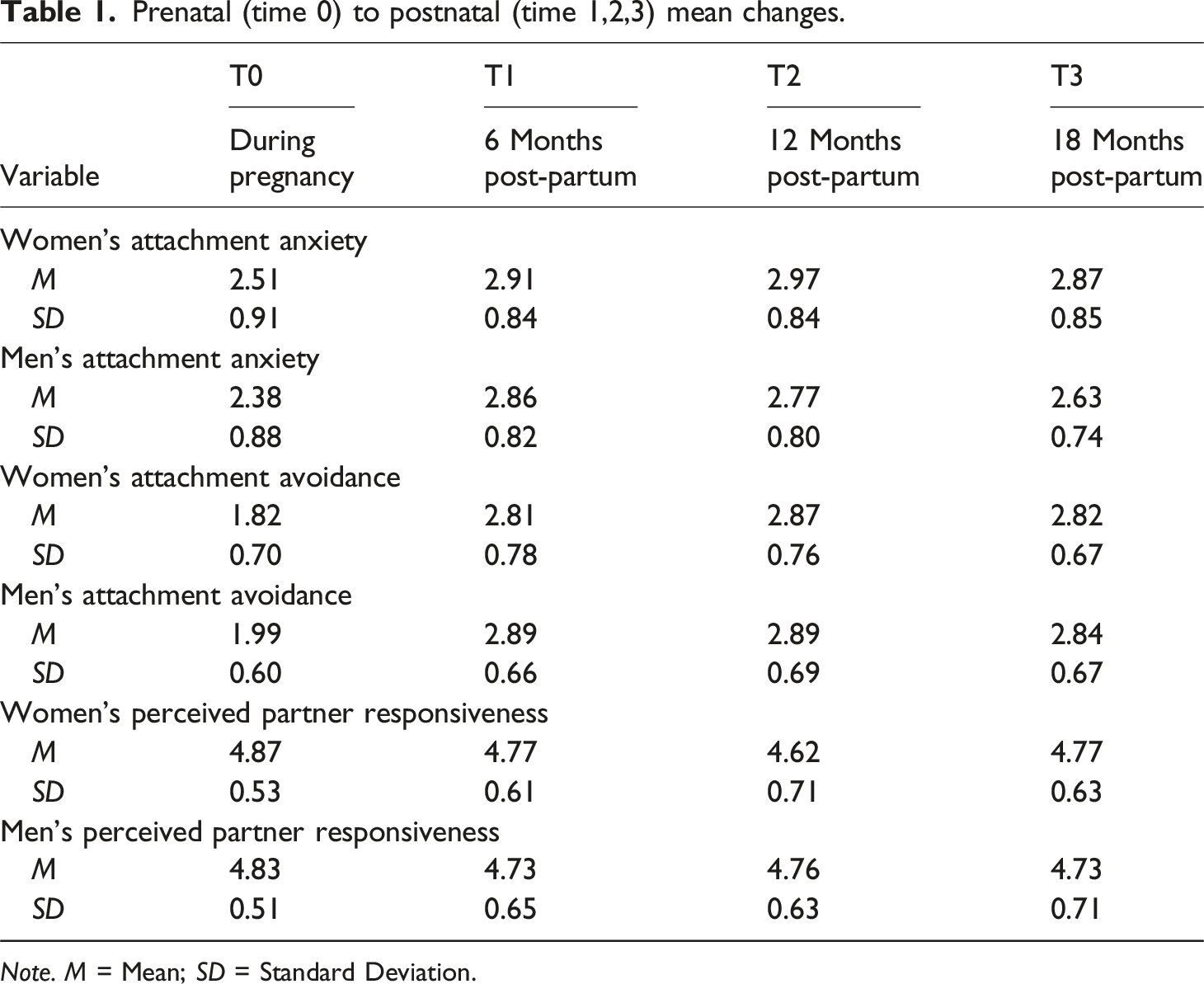
Note. M = Mean; SD = Standard Deviation.
Correlation matrix for attachment anxiety, attachment avoidance and perceived partner responsiveness at pregnancy (T0).
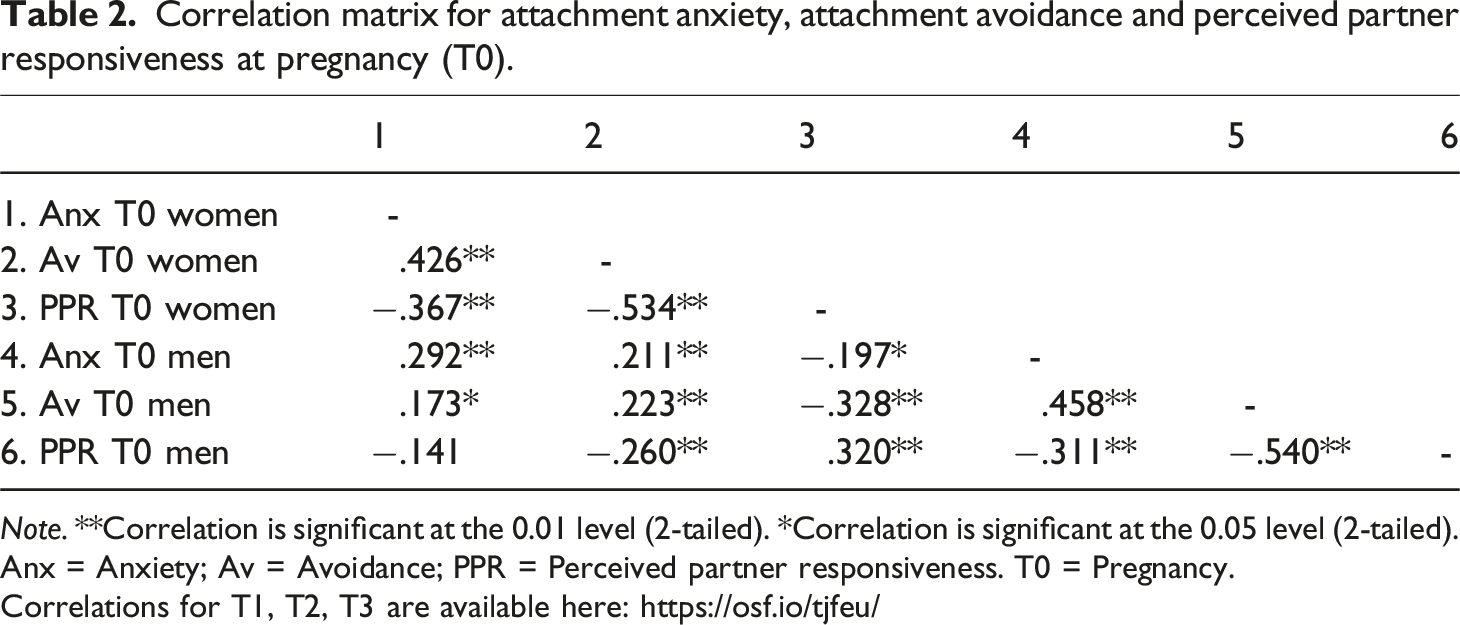
Note. **Correlation is significant at the 0.01 level (2-tailed). *Correlation is significant at the 0.05 level (2-tailed).
Anx = Anxiety; Av = Avoidance; PPR = Perceived partner responsiveness. T0 = Pregnancy.
Correlations for T1, T2, T3 are available here: https://osf.io/tjfeu/
Attachment insecurities predicting changes in perceived partner responsiveness
Our H1 and H2 were confirmed, and results suggested that individuals with more anxious and avoidant attachment orientations perceived their partners to be less responsive than did their more securely attached counterparts across the transition to parenthood. Additionally, examining changes of perceived partner responsiveness across the transition to parenthood as a function of attachment, we found significant interactions of attachment and time.
Attachment anxiety–perceived partner responsiveness
Attachment orientations predicting changes in perceived partner responsiveness across the transition to parenthood.
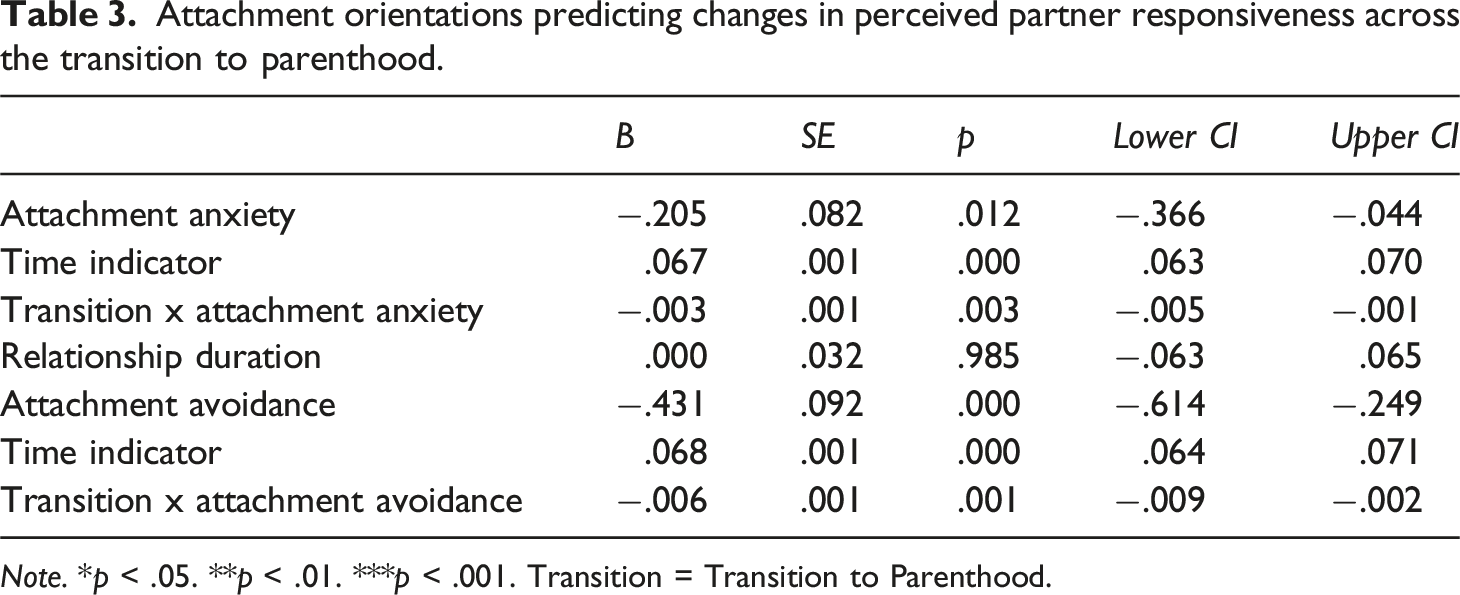
Note. *p < .05. **p < .01. ***p < .001. Transition = Transition to Parenthood.
Attachment avoidance–perceived partner responsiveness
Similar findings resulted for attachment avoidance, confirming our second hypothesis (H2; see lower section of Table 3). Time was positively associated with perceived partner responsiveness, suggesting linear increases of perceived partner responsiveness across the transition to parenthood (b = .068, p < .000). Attachment avoidance was negatively associated with perceived partner responsiveness (b = −.431, p = .001), suggesting that individual differences in attachment avoidance during pregnancy were associated with perceptions of less responsiveness in the partner at the same time point. The coefficient for the interaction of time and attachment avoidance suggests that, across the transition to parenthood, participants higher in attachment avoidance showed less increases of perceived partner responsiveness (b = −.006, p = .001) than participants lower in attachment avoidance.
Perceived partner responsiveness predicting changes in attachment orientation during the transition to parenthood.
Overall, greater perceived partner responsiveness was associated with decreases in attachment anxiety and attachment avoidance across their transition to parenthood, and both hypotheses (H3 and H4) were confirmed.
Attachment anxiety
Attachment orientations predicting changes in perceived partner responsiveness across the transition to parenthood.
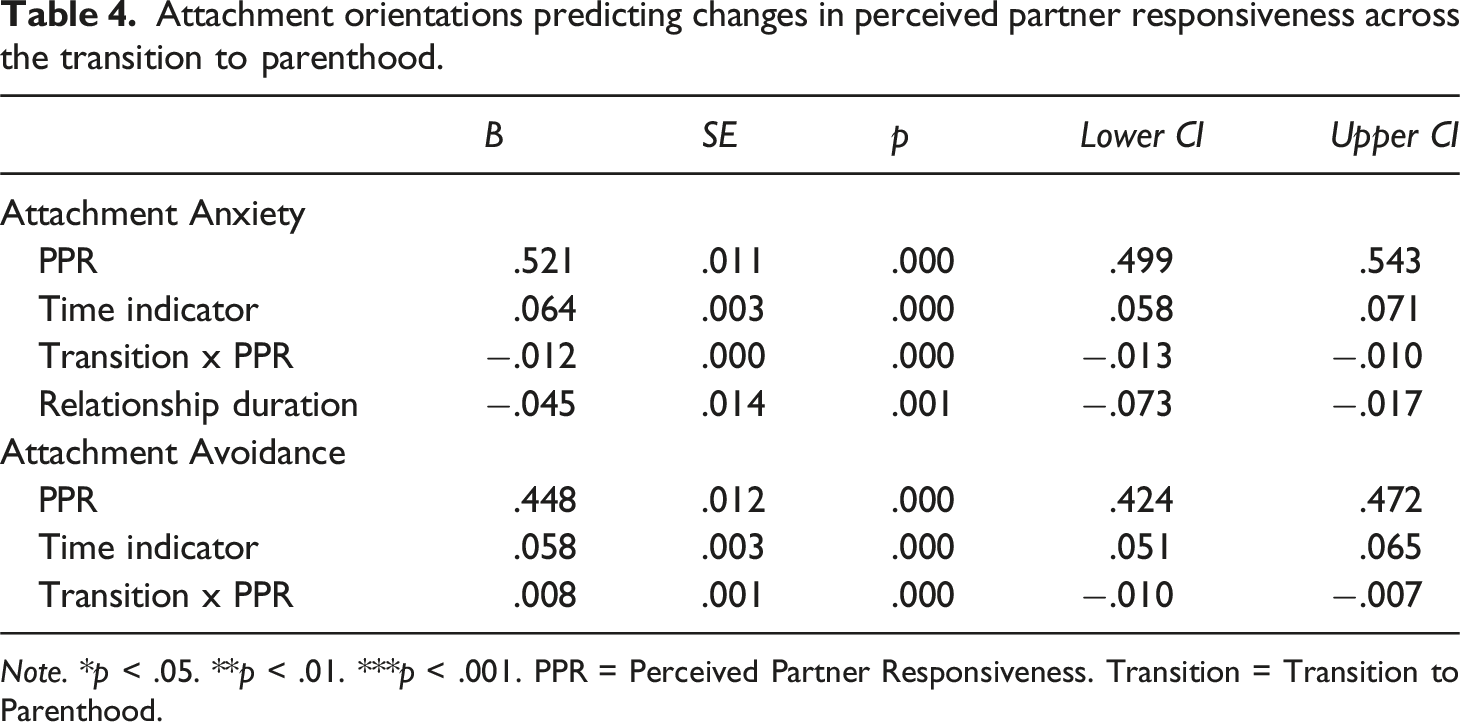
Note. *p < .05. **p < .01. ***p < .001. PPR = Perceived Partner Responsiveness. Transition = Transition to Parenthood.
Attachment avoidance
The lower section of Table 4 presents estimates of changes in attachment avoidance. The estimate for time indicates an increase in attachment avoidance across the transition to parenthood (b = .058, p = .000). Furthermore, the main effect for perceived partner responsiveness suggests that participants who perceived their partner to be responsive showed higher level of attachment avoidance overall (b = .448, p = .000).
Finally, the significant interaction term between time and perceived partner responsiveness suggests that individuals who perceived their partner to be more responsive when entering parenthood showed less increases in attachment avoidance (b = −.008, p = .000), across the transition to parenthood.
Discussion
In this study, we examined the impact of attachment insecurities on perceived partner responsiveness during the transition to parenthood, as well as how changes in perceived partner responsiveness influenced attachment anxiety and avoidance. Our findings confirmed both H1 and H2, revealing that individuals with higher levels of attachment anxiety and attachment avoidance perceived their partners as less responsive compared to those with more secure attachment orientations. Additionally, we observed that while perceived partner responsiveness generally increased over time, individuals with higher attachment insecurities experienced smaller gains in perceived responsiveness. Moreover, consistent with H3 and H4, greater perceived partner responsiveness was associated with a decrease in attachment anxiety and attachment avoidance across the transition to parenthood, indicating that responsiveness plays a crucial role in mitigating attachment insecurities during this critical life stage. These results reflect the dynamic interplay between attachment orientations and perceived partner responsiveness, particularly in the context of the transition to parenthood.
So far, research has provided evidence that anxiously attached individuals have received, or believe they have received, inconsistent care and support in past relationships (Cassidy & Berlin, 1994). They doubt their worth as partners in intimate relationships and are hypervigilant to cues of being abandoned. Bowlby suggested that one of the most powerful cues of being abandoned should be diminished support in times of need (Bowlby, 1973). In line with these findings, anxiously attached people’s perceptions are formulated based on the assumption that they do not have enough support from their partners in a stressful period like the transition to parenthood, when support is mostly needed (Simpson & Rholes, 2008). The same study also found that anxiously attached women perceived less support than their husbands claimed to offer. Working models of highly anxiously attached individuals may distort their perceptions of partner responsiveness and support, which could explain such results. Research has so far shown that insecurely attached individuals have a difficulty perceiving responsiveness provided by their partners (Simpson & Rholes, 2008). They are inclined to interpret enacted support as unhelpful even in cases when support seems to be responsive and sensitive to their specific needs (Collins & Feeney, 2004). On the one hand, highly anxiously attached individuals are sensitive to threats of rejection and they need approval, which may explain why they tend to evaluate support attempts and responsiveness from their partner more negatively (Mikulincer & Shaver, 2005). Past research has consistently shown that partners of anxiously attached women tend to be dissatisfied mainly because of the realization that they are not able to meet the needs and demands for support of their partners, or because they are never granted with sufficient credit for the support they give (Cassidy & Berlin, 1994). On the other hand, individuals with an avoidant attachment orientation prefer partner responsiveness that allows them to feel autonomous and that de-emphasizes closeness and intimacy (Mikulincer & Shaver, 2005). Thus, they may not recognize and perceive their partner’s responsiveness if they do not receive this type of support. This may also help to explain the current result that individuals who entered parenthood high in attachment avoidance perceived their partner as less responsive during the parenthood transition than those low in attachment avoidance.
Another factor that influences perceptions of responsiveness in intimate relationships is motivated construal. Partners may project beliefs about their own levels of responsiveness onto their partners in the context of a highly reciprocal close relationship. Consequently, what they perceive is a mirror of their own behavior or intentions (Lemay & Clark, 2008; Lemay & Neal, 2013). Therefore, in the current results, one possible explanation may be that individuals high in attachment insecurities showed less increases in perceptions of caring and responsiveness from their partner than their more secure counterparts, because they themselves might be less responsive. However, other authors emphasized that perceptions of responsiveness reflect actual partner–enacted behavior. For example, daily diaries have found substantial correspondence between one partner’s reports of enacted responsiveness and the other partner’s reports of perceived responsiveness (Reis et al., 2014) and it is likely that perceptions of responsiveness are influenced by both the partner’s actual behavior and the perceiver’s motivated construal (Reis & Clark, 2013). It may be that working models of self and others are more powerful because, as Bowlby argued, social perceptions would be dysfunctional if they were not accurate impressions of the real experiences those individuals have really had (Bowlby, 1973).
It is important to consider that the current assessments of perceived responsiveness were taken during a period characterized by high levels of stress. When partners behave in a responsive way under high levels of stress, their behaviors may be perceived as inauthentic or compelled (Lemay & Clark, 2008), and thus responsiveness may not be properly evaluated, especially from highly insecurely attached individuals. A study on couples during the transition to parenthood found that anxiously attached individuals were more pessimistic than would be expected on the basis of their support environment (Simpson, Rholes, Campbell, Tran, & Wilson, 2003). On the one hand, anxiously attached individuals have negative models of the self, which may affect perceptions of responsiveness by leading one to doubt the partner’s unconditional regard and good intentions toward the self. On the other hand, avoidantly attached individuals have negative models of others and may affect perceptions of responsiveness by leading one to doubt the responsiveness and good will of others (Collins & Feeney, 2004).
Perceived partner responsiveness predicting changes in attachment
Results confirmed that attachment tendencies can change over time (Chopik et al., 2019), as individuals with higher perceptions of partner responsiveness maintained more security across the transition to parenthood than individuals who entered parenthood with lower perceptions of partner responsiveness. Previous studies have suggested that individuals who perceive their partners to be responsive are more likely to experience feelings of security within their relationship (Feeney & Collins, 2001). The current data suggest that greater perceived partner responsiveness during the transition to parenthood was associated with less attachment anxiety, confirming previous findings. It has been found that anxiously attached women, who perceived their intimate partner as more responsive before childbirth, had some beneficial effects (Rholes et al., 2001). Specifically, these positive perceptions of responsiveness seemed to assuage the worries and concerns harboured by highly anxiously attached individuals, allowing them to deal with the challenges of the transition to parenthood more effectively (Rholes et al., 2001). Accordingly, positive experiences with partners during the transition to parenthood may lead high anxiously attached people to feel more secure (Treboux et al., 2004). Another study has shown that the perceived support of a wife’s partner appears to alleviate the worries and concerns of anxious women, helping them to cope more effectively with the challenges of the transition to parenthood (Cassidy & Berlin, 1994).
Lending support to our fourth hypothesis, we also found that individuals who perceived their partner as more responsive when entering parenthood, also had more secure attachment orientations, and attachment security was also more likely maintained across the transition to parenthood. This finding might be explained by previous studies, suggesting that the type and amount of responsiveness provided play a vital role in determining whether it is beneficial. If the type of support provided is not in accordance with the specific needs of an anxious or avoidant individual, then even if it is perceived, it might not be beneficial and it might not contribute to the ways that individuals can potentially become more secure in their intimate relationships (Overall et al., 2022). Specifically, the type of partner support that seems most effective for a person high in attachment anxiety is one that addresses the underlying fear of rejection or abandonment by the attachment figure (e.g., expressing empathetic words). In contrast, effective and beneficial responsiveness for individuals high in attachment avoidance orientation is one that addresses the distrust in partner by supporting their autonomy, and providing instrumental support like giving helpful information (Collins & Ford, 2010). Thus, it is probable that in this study partners during the transition to parenthood were able to provide the type and amount of support that was needed in their relationship, which is beneficial in building security in intimate relationships.
Another factor, which could have impacted the present findings, is whether individuals themselves asked for support from their partners. A study on couples during their transition to parenthood found that women who sought more prenatal support became less avoidantly attached across the transition, while those who sought less support became more avoidant. What is interesting is that women’s prenatal perceptions of responsiveness did not explain this change in attachment avoidance (Simpson, Rholes, Campbell, & Wilson, 2003). Therefore, the findings of this study align with previous studies that suggested contact with a responsive partner to be the most effective way of alleviating distress when individuals encounter stressful experiences, like the transition to parenthood and restoring feelings of security (Cutrona & Russell, 2017). One possible explanation for restoration of security is that the working models of insecurely attached individuals might change when individuals encounter experiences, such as responsiveness from their partner, which challenge their insecure models of self and others (Arriaga et al., 2018; Chris Fraley, 2002). The presence of an anxious or avoidant attachment orientation may undermine parents’ adjustment (Jones et al., 2015). Furthermore, parents with high scores of attachment avoidance reported more difficulties in adjusting to parenthood (Kazmierczak, 2015) and higher scores on parenting stress (Rholes et al., 2006; Trillingsgaard et al., 2011). Similar findings have been found for attachment anxiety with general adjustment to parenthood (Kazmierczak, 2015) and mothers’ (Trillingsgaard et al., 2011) and fathers’ parenting stress (Schoppe-Sullivan et al., 2016). Therefore, promoting the decrease of attachment insecurities in intimate relationships and restoring attachment security, especially during challenging transitions, is of vital importance for the well-being of individuals and couples. Perhaps one of the most important implications of this study is that the maintenance versus the change of the attachment orientations over time, and, in particular, over critical and challenging periods, is an active process in which partner perceptions of responsiveness generate changes in working models by accommodating new information (Bowlby, 1973) of self and others. The findings are also in line with evidence for self-reported feelings of security fluctuating in response to interpersonal experiences (Davila & Cobb, 2003).
While the broader literature often highlights a decline in relationship functioning during the transition to parenthood, our findings present a somewhat counterintuitive pattern increases in perceived partner responsiveness and decreases in attachment insecurities. This divergence could be attributed to several factors. First, it is possible that the quality and type of support provided by partners during this transition were particularly well-matched to the specific needs of individuals with attachment insecurities, as suggested by previous research (Collins & Ford, 2010). For instance, anxiously attached individuals may have received consistent, empathetic support that directly addressed their fears of abandonment, while avoidantly attached individuals may have experienced support that respected their need for autonomy, thus fostering a sense of security. Importantly, previous findings have supported indeed that throughout the transition to parenthood, a well-adjusted and supportive couple relationship, characterized by more positive and fewer negative interactions, led to reduced emotional distress in mothers and fewer symptoms of anxiety and depression in both mothers and fathers (Figueiredo et al., 2008; Whisman, 2013; Whisman et al., 2011).
Moreover, our findings could reflect a selection bias in the sample, where couples who were more resilient or had better communication skills were more likely to participate and report positive experiences. It is also plausible that the transition to parenthood, while stressful, may have prompted some couples to increase their mutual support and responsiveness, leading to improvements in relationship dynamics contrary to the general trend reported in the literature. In the current sample the mean of relationship satisfaction was high, which is in line with previous findings suggesting that parenthood is associated with greater marital stability (Roy et al., 2013) and more satisfaction with the relationship in first-time parents in comparison to childless couples (Guttmann & Lazar, 2004). Also, in the majority of the couples the pregnancy was planned and planned pregnancies have been associated with higher pre pregnancy satisfaction scores compared to nonparents (Lawrence et al., 2008).
Finally, it is important to consider that our measures of perceived partner responsiveness and attachment were collected across several time points, which might have captured a more nuanced picture of relationship dynamics. The observed increases in perceived partner responsiveness might not fully contradict the literature, if we consider that these increases could be relative to initial declines that were not captured by our study’s time frame. Therefore, our findings might suggest a recovery or adaptation phase rather than a continuous improvement, highlighting the complexity of relationship dynamics during the transition to parenthood.
In sum, the findings confirmed that individuals with higher attachment anxiety and avoidance perceive their partners as less responsive, although perceived responsiveness generally increased over time. This increase was smaller for those with higher attachment insecurities. The study also demonstrated that higher perceived partner responsiveness is associated with reduced attachment insecurities, underscoring the significant role of partner support in alleviating attachment-related anxieties. The complex dynamics of intimate relationships during the transition to parenthood have been highlighted, suggesting that the quality of partner responsiveness and individual differences play a crucial role in this transition.
Practical implications
The current studies extent prior research on the role of attachment in intimate relationships during the transition to parenthood, which is a significant and often a stressful real-life event when partners become more interdependent (Cowan & Cowan, 2000) and more vulnerable to mental disorders (Mitchell et al., 2019; Paulson et al., 2006; Zaers et al., 2008). Insecure working models play a central role in the genesis of emotional and relational difficulties (Mikulincer & Shaver, 2010). Therefore, interventions to promote relationship well-being can be applied at both a therapeutic and preventive level. Couples during the transition to parenthood are more vulnerable to develop mental disorders, such as depression or anxiety (Grant et al., 2008; Paulson et al., 2006; Zaers et al., 2008). Thus, therapeutic interventions should consider attachment orientations of couples in therapy because they are likely to have implications on how individuals perceive partner responsiveness and manage their well-being, especially in the context of stressful events. Clinicians can emphasize on helping partners be more responsive and act as a secure attachment figure for their partner, leading to an increase of positive and a decrease of negative emotions, which can be beneficial for both partners (Schade & Sandberg, 2012). Emotion Focused Therapy (EFT) helps couples improve their relationship functioning by creating a more secure attachment bond (Johnson, 2004). This type of therapy combines the intrapsychic and the interpersonal systemic perspective and assists distressed partners to shape their emotional accessibility, responsiveness, and engagement–all of which are key elements of attachment security–in their intimate relationships (Johnson, 2004; Moser & Johnson, 2008). Particularly during the transition to parenthood, secured bonds may foster partners’ ability to support each other via the management of emotional turmoil (Johnson, 2004). Parenthood may come with idealized expectations that may not align well with the reality of caring for a child (Kochanska et al., 2004). Therapeutic interventions may therefore help couples to manage and adapt such expectations, handle stress, feel secure in the relationship, and face the challenges of parenthood (Doss et al., 2009).
Limitations and future directions
The current results should be interpreted with caution. One limitation of this study is that it measured perceived partner responsiveness globally and did not assess what specific behaviors may be perceived as responsive. Perceiving responsiveness can vary by context (Reis et al., 2004). Considering that insecure individuals perceive less responsiveness, future research should examine more specifically the type of partner behaviors that insecure individuals consider as responsive and as beneficial for their well-being in the relationships, as well as their felt security. Another limitation is that this study is of a correlational nature, which means that making definitive causal interpretations of the results is not possible, and any such conclusions should be approached with careful consideration. Moreover, insecure individuals may be underrepresented in this sample, which consisted of young healthy couples with rather high levels of relationship satisfaction, potentially leading to an inaccurate representation of the impact of attachment insecurity in the current data. This possibility is emphasized by the observation that participants who dropped out of the study reported less perceived partner responsiveness during T0 than their counterparts who were retained at T3. As a result, obtaining data from a sample of individuals with lower levels of perceived partner responsiveness, or with higher levels of attachment anxiety and attachment avoidance, may yield different results that are more representative of couples who are more distressed. Furthermore, it is unclear whether these findings generalize to more diverse populations, cultural contexts, or relationship types. This sample represented young adults who lived in Switzerland, were in an intimate relationship, and were expecting their first child. They were relatively well educated, and low-income families were not adequately represented. Another limitation of this study is that we did not have detailed information on the ethnicity and cultural background of the participants, a factor that may have influenced people’s attachment orientation or perceptions of partner responsiveness. It remains to be examined whether these findings hold true for other groups of people and for intimate relationships under different conditions or at different life stages. Also, the presence of missing data, particularly due to participant withdrawals is another limitation of the study. Analysis revealed that there was a significant difference in perceived partner responsiveness at baseline (T0) between participants who remained in the study and those who withdrew at the final time point (T3). Specifically, couples who withdrew reported perceiving their partner as less responsive at T0 (Cohen’s d = .304; t = 2.094, p = .037). This suggests that the sample may not fully represent the range of partner responsiveness perceptions, potentially biasing the results. While we retained all couples who participated at each time point, this differential dropout could introduce potential bias and limit the generalizability of the findings. However, by including only those couples who completed all assessments, we aimed to maintain consistency in our sample across the study period. Finally, another limitation of this study is possibly inflated estimates due to mono-method variance, as multiple variables of the models were measured using self-reported data and common method biases such as social desirability or cognitive consistency could distort the findings (Spector et al., 2019). While this may have affected estimates of main effects, it is less likely that it affected associations involving change over time and moderation estimates thereof.
Conclusion
The current study provides empirical support for attachment insecurities during the transition to parenthood predicting perceptions of responsiveness from the intimate partner. It is one of a few studies offering evidence for perceived partner responsiveness predicting changes in attachment anxiety and attachment avoidance over time in an intimate relationship. If the current findings are corroborated by future studies, they may have important implications to practitioners working with couples on perceiving responsiveness from the partner, changing the internal working models, recognizing supportive behaviors, and building trust and security in the relationship, especially under stressful conditions like the transition to parenthood. Responsiveness is of critical importance to building intimacy and well-being in romantic relationships. These findings help to better understand the mechanisms of it and its interplay with romantic attachment orientations, which seem to affect and to be affected by specific behaviors in relationships.
Footnotes
Declaration of conflicting interests
The author(s) declared no potential conflicts of interest with respect to the research, authorship, and/or publication of this article.
Funding
The author(s) disclosed receipt of the following financial support for the research, authorship, and/or publication of this article: The data is based on a project which was funded 100% by the Swiss National Science Foundation (SNSF) to Professor Dominik Schoebi.; 100014_175620/1.
Open Research Statement
As part of IARR’s encouragement of open research practices, the author(s) have provided the following information: This research was not pre-registered. The data can be obtained at:  or by emailing: