




Abstract
The process of discussing conflict can impact the quality and longevity of a couple’s relationship. Limited research has characterized the dynamic nature of conflict discussions, including how these discussions unfold and how an actor’s behaviour elicits particular responses from their partner over the course of the discussion. It is also important to consider how additional factors, such as alcohol intoxication, can influence this dynamic. A challenge in conducting this research is having sufficiently fine-grained data along with appropriate analytic methods to characterize the conversation dynamics. To address this gap, we utilized time-varying effect modeling (TVEM) to examine the correspondence of actor-partner behaviours as a function of time and alcohol consumption. We examined this using data from 139 heterosexual couples who were observed for 15 minutes while discussing a conflict. Couples were randomly assigned to have either one, both, or neither drink alcohol prior to the discussion. Using the Rapid Marital Interaction Coding System (RMICS), individuals’ behaviours were coded as either positive, negative, or neutral during each speaking turn. The results supported that positive behaviour tended to elicit positive behaviour and the strength of this relationship increased over the course of discussing conflict. While negative behaviours tended to elicit negative behaviours, the strength of this relationship was stable over time. Alcohol consumption did not alter the relations between actor-partner behaviours over time. Taken together, the findings support the dynamic nature of some aspects of actor-partner behaviours when discussing conflict. Future research could consider how these dynamics predict future relational outcomes or characterize how they unfold in naturalistic settings.
Keywords
Introduction
The way couples communicate can influence the overall functioning, quality, and satisfaction of a couples’ relationship, as well as extending to individual well-being and mental health. For example, a recent meta-analysis found that positive and negative communication patterns are associated with relationship functioning, with negative patterns correlating with decreased relationship quality and subsequent relationship dissolution (Kanter et al., 2022). Additionally, couples’ communication has been linked with individual mental health, including depression (Sher et al., 1990) and anxiety (e.g., Abramowitz et al., 2013; Arnow et al., 1985; Marcaurelle et al., 2005; McCarthy & Shean, 1996), and other health behaviours (e.g., Dailey et al., 2011; Song et al., 2012). As a result, couples’ communication has become a focal point in couples psychotherapy treatments, reflecting the recognition of its profound influence on the overall health and stability of relationships.
Nonetheless, further research of couples’ communication patterns is needed to address limitations in the research literature and address knowledge gaps. For instance, effect sizes for associations between communication skills on individual- and couple-level outcomes have been generally small-to-moderate (Kanter et al., 2022). Further, the direction of associations has been inconsistent. Some research has supported an inverse relationship between positive/negative partner communication and relationship satisfaction, counter to the associations discussed above (e.g., Gill et al., 1999; Heavey et al., 1995). Refining the ways we examine how these interactions unfold over time using stronger methodologies may help reconcile these discrepancies. Further, there may be unexamined contextual factors that alter the strength and nature of associations between partner communication and responses. Contextual factors, such as alcohol consumption, can influence the nature of social interactions (Aan Het Rot et al., 2008; Fairbairn & Testa, 2017). Alcohol use within couples has been associated with a range of relational outcomes, both positive and negative (Birditt et al., 2018, 2019; Derrick et al., 2023; Fairbairn & Testa, 2017; Marshal, 2003; Testa et al., 2014; Torvik et al., 2013). However, there is limited understanding of how alcohol affects real-time communication behaviours, and whether these effects vary over the course of an interaction (e.g., conflict discussions). Thus, further investigation of couples’ communication patterns and contextual factors that may influence them is needed and may provide important insights for couples’ psychotherapy treatment approaches.
Behavioural observation coding systems & couple interactions
Measurements of couples’ communication styles frequently rely on self-report, introducing issues related to response bias, social desirability, limited insight, and memory limitations (Nederhof, 1985). Moreover, these self-report measures generally lack the objectivity of observational methods, which are less susceptible to such biases and provide a more direct assessment of communication behaviours (Mehl et al., 2012). Behavioural observation coding systems for couples’ interactions were born out of recognizing these limitations of self-report measures and the belief that couples generally lack insight into their communication patterns (King, 2001). Researchers focused on understanding transactional processes in interpersonal interactions have developed various assessment and coding schemes to capture momentary behaviours between individuals (e.g., Ekman & Friesen, 1978; Gottman & Krokoff, 1989; Heyman, 2001). Early coding systems focused primarily on negative aspects of couples’ interactions (e.g., negative affect, criticism), with the aim of understanding possible causes of or aspects that exacerbate negative outcomes. However, positive interactive processes are also important to consider in terms of identifying possible buffers against negative outcomes. As such, more recent models have recognized that positive interactions are also of value in understanding the spectrum of communication styles and factors that exacerbate or buffer against conflict, and those which may improve dyadic communication, such as those involved in problem-solving (Kerig & Baucom, 2004).
The Rapid Marital Interaction Coding System (RMICS) is an event-based coding system developed to record observed dyadic behaviour, capturing all observable actions, including verbal and non-verbal behaviour and communication (Heyman, 2004). RMICS measures the frequency of behaviour and behavioural patterns (called “sequences”) during conflictual interactions. It provides codes for different types of positive, negative, and neutral behaviours observed in couples’ interactions, and tracks how much time each person “holds the floor” (i.e., speaking time). A key advantage of couple interaction coding systems, such as RMICS, is their ability to capture how couples’ behaviours influence each other’s responses (Heyman, 2004; Kerig & Baucom, 2004). That is, how couples interact, whether emitting positive, negative, or neutral communication behaviours, may influence their significant other’s response, back and forth, over the course of a conversation. How this process unfolds may impact the couple’s ability to arrive at a resolution when engaging in discussion over conflict, which may impact both individual and couple level outcomes such as mental wellbeing and relationship satisfaction (Heyman, 2004; Kerig & Baucom, 2004). Early studies by Notarius and Markman (1989) observed that distressed partners tend to start conversations with hostility, maintain hostile interactions, reciprocate and escalate hostile behaviors, and engage less in positive behaviors.
Importance of examining dynamic interactions with appropriate analytic tools
While RMICS has been useful in characterizing a couple’s interactions, often the codes are “lumped” together (see Heyman et al., 2021 for an overview of the “lump-versus split dilemma”) and examined in aggregate form (e.g., Heyman, 2001; Heyman et al., 2021; Kiecolt-Glaser et al., 2005; Malik et al., 2020). Characterizing the presence of or levels of positive or negative behaviours in a given time frame can provide a general sense of interaction qualities (e.g., overall level of positivity and negativity), but loses information about how the interaction actually unfolds over time. Understanding the temporal pattern of the interaction can elucidate how people navigate or adapt to discussing conflict in response to their partner. For instance, consider two couples asked to discuss a conflictual topic. One couple may initially exhibit pleasantries but then spiral down a negative feedback loop that they never recover from versus a couple who may initially exhibit negative behaviours but are able to self-regulate and eventually work through it in an effective way. The proportion of negative behaviours may look similar between both couples, but the dynamics over time look quite different and would likely result in different relational outcomes. These considerations point to a gap in the broader field of couples research, where analyses of interactions often overlook the nuances of moment-to-moment changes that are critical for understanding relationship resilience and communication adaptations.
Traditional time-based analytic approaches (e.g., multilevel models, latent growth curve models) can describe the overall association between actor-partner behaviours (e.g., partner-actor behaviour is positively related) or their change over time (e.g., partner-actor behaviours increase together). These analytic approaches, however, are not well-suited to answer questions about how behaviours and corresponding associations change in more complex temporal patterns over the course of the interaction (Atkins, 2005; Kurdek, 2003). Other analytic techniques have been successful in examining certain temporal aspects of couple interactions. For instance, sequential analysis (e.g., Bakeman & Gottman, 1997; Gottman et al., 1977) has been employed to examine the sequence of interaction behaviours at distinct event timepoints, identifying the probability of certain response patterns. This method allows researchers to examine how one partner’s communication behaviour (e.g., hostility) influences the likelihood of certain communication behaviours (e.g., reciprocity of hostility) in the other partner at subsequent timepoints during an interaction (Bakeman & Gottman, 1997; Gottman et al., 1977). However, as this analytic approach involves assessing fixed time intervals, it does not account for continuous changes in communication behavior across the entire course of the conversation.
In contrast, the time-varying effect model (TVEM; Tan et al., 2012) can describe how behaviours and the relationship between them changes moment-to-moment and unfolds over time. TVEM is a recently popularized statistical method that estimates how the associations between two variables change as a function of time (Tan et al., 2012). That is, instead of having one coefficient to describe the overall relationship between a predictor and outcome variable, TVEM estimates coefficient functions that allow the relationships between these variables to fluctuate freely over time. As a result, TVEM can characterize strengthening, weakening, or stability of predictor-outcome associations over time (Dermody et al., 2017; Tan et al., 2012). For instance, TVEM has been used to examine how behaviours unfold while couples describe the best things about their relationship (Dermody et al., 2017). Using TVEM, it was possible to detect that, on average, affiliative behaviours increased over the course of the interaction. Further, the partner’s affiliative behaviours became more “in sync” over time, as demonstrated by a strengthening of the relation between the partner-actor’s affiliative behaviours over the course of the conversation. Taken together, implementing TVEM can provide a nuanced understanding of temporal patterns of couple’s interactions.
Couple interactions and alcohol consumption
When examining how couples navigate conflict, it is also important to account for the potential role of alcohol intoxication during these interactions. Alcohol consumption is a common shared activity for couples (Levitt et al., 2014; Roberts & Leonard, 1998), with up to 45% of couples reporting that they drink together (Birditt et al., 2018). Additionally, research indicates that individuals in intimate relationships drink alcohol with their romantic partner more frequently than they do with other social interaction partners (Birditt et al., 2019).
With respect to the influence of alcohol on these interactions, on the one hand, there is evidence to suggest that alcohol corresponds with positive outcomes. For instance, alcohol use in couples may lead to greater marital satisfaction when drinking patterns of partners align (Homish & Leonard, 2005); act as a buffer against marital dissatisfaction over time (Homish & Leonard, 2007); and lower the likelihood of divorce (Leonard et al., 2014). On the other hand, alcohol use in intimate relationships is linked to adverse outcomes like dysfunction, dissolution (Marshal, 2003), and intimate partner aggression (Foran & O’Leary, 2008), including hostility if one partner has an alcohol use disorder (Floyd et al., 2006). Moore et al. (2011) and Testa and Derrick (2014) demonstrated in diary studies that the risk of perpetrating verbal and physical aggression increased later in the day, intensifying over time, following alcohol use, a pattern observed in both women and men.
Importantly, recent research suggests that in some couples, alcohol consumption may increase the likelihood of engaging in conflict discussions. Research conducted by Derrick et al. (2023) found that couples who experience relationship tension or conflict prior to consuming alcohol were more likely to report conflict post-alcohol consumption. One interpretation of this finding could be that, in couples with heightened relationship discord, alcohol consumption may increase the likelihood of revisiting or addressing unresolved conflicts. Given the prevalence of alcohol consumption in couples and its potential impacts on relational outcomes, understanding how alcohol affects the moment-to-moment communication behaviours of partners in these interactions is critical.
There is evidence to suggest that alcohol use may not only increase the likelihood of discussing conflict, but also affects how couples behave and communicate during these interactions. Studies by Testa et al. (2014) and Fairbairn and Testa (2017) have shown that moderate alcohol consumption can lead to decreases in negative, and increases in positive, communication behaviours in members of a dyad during couple conflict discussion interactions. While this appears to contradict findings that suggest that alcohol use increases likelihood of subsequent conflict, these findings pertain to the immediate, rather than delayed effects of alcohol consumption on interaction behaviours. Indeed, research suggests that at moderate doses, alcohol may lead to a short-term increases in positive social behaviours (e.g., agreeableness) and improvements in affective states (e.g., increased positive affect, decreased negative affect; Aan Het Rot et al., 2008; Franzen et al., 2018). It is possible that this effect of alcohol acts as a buffer that decreases baseline negative communication behaviours and promotes positive communication behaviours that facilitate conflict resolution. However, although some research has found short-term positive impacts of moderate drinking on social interactions in some situations (e.g., Aan Het Rot et al., 2008; Fairbairn & Testa, 2017; Franzen et al., 2018; Testa et al., 2014), other findings suggest these effects may vary based on individual and situational differences (Franzen et al., 2018). For instance, the results of a study by Franzen et al. (2018) suggest that individuals who drink socially frequently are less likely to experience the positive effects of moderate drinking (e.g., increased agreeableness, positive affect) than those who drink less frequently, reporting increases in quarrelsome behaviours and decreases in positive affect.
Both investigations by Testa et al. (2014) and Fairbairn and Testa (2017) focused on the impact of alcohol consumption on the overall nature of the interaction, rather than on how the interaction unfolded over time. By using TVEM, it is possible to identify if alcohol use impacts relational dynamics during specific periods of the conflict discussion (e.g., earlier on vs. later on). Moreover, employing TVEM could significantly advance our understanding of these processes more broadly, offering insights not only into how alcohol affects relational dynamics, but also into the more nuanced aspects of how couples communicate and resolve conflicts over time when intoxicated.
The current study
To improve our understanding of the dynamic nature of couples discussing conflict, we explored data from a large-scale experimental study of couples (Testa et al., 2014). As described above, prior analyses of this data provided a holistic picture of negative and positive behaviours exhibited by the couples discussing conflict with and without drinking alcohol. They did not examine how these interactions unfolded moment-to-moment. TVEM allows for the effects of predictors to vary over time, providing a more nuanced representation of dynamic interpersonal processes (Dermody et al., 2017; Tan et al., 2012). The present study used TVEM to examine how positive and negative partner behaviours unfolded over the interaction and how they influenced their partner’s responses (e.g., whether and to what extent partners’ positive and negative behaviours elicit positive or negative behaviours in return over the course of a conflict discussion couple interaction). Furthermore, the present study examines whether alcohol interacts with these dynamics moment-to-moment. Based on previous findings it was hypothesized that (1) consistent with prior research supporting reciprocity in couples’ interaction dynamics, positivity or negativity of the actor’s behaviours would be positively related to the positivity or negativity of the partner’s responses, respectively; (2) in line with prior TVEM work supporting couples’ behaviours becoming more in sync with discussing a positive topic, it was expected that partner’s behaviours would become more “in sync” over time, demonstrating stronger interrelations between similarly-valenced partner-actor behaviours and responses as the interactions progress; (3) given limited prior literature, associations were expected between opposite valenced behaviours but the direction was considered exploratory; and (4) consistent with prior work with these data, it was expected that alcohol consumption would interact with positive and negative behaviours such that actor alcohol consumption would correlate with changes in the expression of negative behaviours over time; however, given the novelty of the analytic methods to answer this type of question the nature of these time-related changes was considered exploratory.
Methods
Participants
An in-depth description of the research methods and materials is in Testa et al. (2014). Pre-screening questionnaires were sent to 20,000 random households in Buffalo, New York, United States and additional advertisements were placed in newspapers and on Facebook. The study recruited heterosexual married or cohabiting couples (for at least a year), and aged 21–45, who drank at least 4 drinks monthly and were willing to drink up to six vodka drinks for the study. Participants were excluded if they had prior psychiatric or substance use disorder treatment, and pregnancy (in women) or a medical condition that conflicted with alcohol use. Following the telephone screening, participants were sent booklet questionnaires which consisted of questions regarding relationship quality and aggression, depressive symptoms, and drinking history. Participants were then asked to complete a laboratory session of up to 7 hours. Following the session, they would be transported home by taxi.
Originally, 152 couples completed the study, including 152 women and 152 men with an average age of 32.33 (SD = 6.64). The majority of couples were married (69.1%). The sample’s race was predominantly white (93.42%), with 3.6% Black and 2.96% Asian American, Native American, or other, and ethnicity included 3.95% Hispanic or Latinx and 96.05% non-Hispanic or Latinx. Their median annual income was $60,000, with most working either full-time (68.09%) or part-time (14.8%), 1.32% noting disability preventing employment, and 5.59% noting being stay at home parent. Original data sheets were not preserved for all participants. This resulted in 139 (91.45%) participants being included for the presented analysis.
Procedures
Upon arrival at the lab participants were separated and provided informed consent. Couples were brought back together to elicit areas of actual disagreement in their relationships. They independently rated the amount of disagreement on an array of topics from 1 to 100. Couples discussed their second most disagreed upon topic in the first 15-min interaction. These data were not examined here because alcohol was not administered. The present analysis focuses on their second interaction in which couples discussed their most disagreed upon topic and were told to work out the disagreement to the best of their ability. Alcoholic beverages were given before the discussion. Each couple was randomly assigned to one of the four conditions: both partners were given alcohol (n = 35), neither were given alcohol (n = 35), male only (n = 34), and female only (n = 35). Beverages were 80 proof vodkas mixed with cranberry juice (2.39 mL/kg for men and 2.22 mL/kg for women) with a target BAC of 0.8%. Couples in the non-alcoholic condition were given the same amount of juice and no deception was involved in any of the conditions. The drinks were mixed in front of the participants and distributed in 3–6 glasses depending on weight. Participants were told to consume each drink within 5 minutes. Those in the alcohol condition were subjected to a breath alcohol analysis using Alco-sensor IV starting 15 minutes after their last drink. Couples were reunited when they reached a BrAC of at least 0.6% or after 15 minutes if neither of them had alcohol. Following the disagreement discussion, couples were led through a happy times discussion to dispel any negative emotions. Couples in which one or both consumed alcohol were given a meal, movies, and magazines until their BrAC dropped to 0.3%. Each partner was compensated $90 for their time. In no alcohol couples, each partner was compensated $45. To ensure safety each partner was contacted 48 hours following the lab session for follow-up. Laboratory procedures were originally approved by the University at Buffalo Social and Behavioral Sciences Institutional Review Board. The secondary data analyses presented here were deemed exempt by the [MASKED FOR REVIEW] Research Ethics Board.
Measures
The recorded interactions were coded by using the Rapid Marital Interaction Coding System (RMICS; Heyman, 2004). The RMICS consists of five negative codes (psychological abuse, distress-maintaining attribution, hostility, dysphoric affect, and withdrawal), four positive codes (acceptance, relationship-enhancing attribution, self-disclosure, and humor), one neutral code (constructive problem discussion/solution) and one other code (Heyman, 2004). Each time a partner spoke or had an utterance a code was recorded. If the speaker turn was longer than 30 seconds, it was coded in 30 second intervals. During these intervals, the partner can also receive codes by interruptions or nonverbal gestures.
For the present study, we wished to analyze the interactions as they unfolded moment-to-moment. Prior analyses examined the proportion of negative and positive behaviours in the aggregate (Testa et al., 2014), as a result, we needed to enter the individual paper-based RMICs codes into excel spreadsheets based off of the hand-written coding sheets. Double data-entry was used, and discrepancies were resolved by referring back to the coding sheets and through discussion for unclear handwriting. Because there could be multiple codes per participant turn in the interaction, these codes were aggregated to characterize each turn as either positive, negative, or neutral. This was done consistent with prior research where negative codes took precedence over positive codes and positive codes took precedence over neutral codes (Fairbairn & Sayette, 2013; Testa et al., 2014). Using the new singular codes, independent and dependent variables were created. A set of two dummy-coded predictors were used as the independent variables, with each variable indicating if positive behaviour or negative behaviour occurred (each coded as 1 for the respective variable) with neutral behaviour as a referent (coded as 0). Separate negative and positive interaction dependent variables were made. For the negative interaction dependent variable, negative interactions were coded as 1, positive interactions as missing, and neutral as 0. For the positive interaction dependent variable, positive interactions were coded as 1, negative as missing, and neutral as 0. Variables were coded such that the IV occurred immediately before the corresponding DV in time.
Data analysis
Logistic time-varying effect models were estimated with the total sample of dyads (N = 139). The models were run using the R package TVEM (Dziak et al., 2021). The function uses penalized B-splines to automatically fit the coefficient curve with the appropriate level of complexity (e.g., a greater number of knots corresponds with a more complex curve with more inflection points). Sandwich standard errors were used to account for the within-subject correlation in lieu of random effects. The time variable was the RMICS sequence, which ranged from 0 to 159. Although all participants were observed for 15-min, turn-lengths and therefore number of sequences varied by couple. The positive (vs. neutral) and negative (vs. neutral) interaction dependent variables were examined in separate models because logistic TVEM can predict one binary dependent variable at a time. Sex assigned at birth was included as a time-invarying covariate in all models.
First, in order to characterize the occurrence of positive and negative behaviour outcomes over the course of the interaction, intercept-only models were estimated. Second, the impact of alcohol condition on the positive and negative behaviour outcomes was examined by adding the following predictors: actor condition (alcohol vs. none), partner condition (alcohol vs. none), and their interaction (actor condition X partner condition). In separate models, alcohol condition was evaluated as time-varying and time-invarying predictors. Third, the time-varying association between actor and partner behaviours were examined in order to determine if the couples’ behaviours became more or less in sync over time. This was accomplished by including the set of dummy-coded predictor variables indicating the actor’s positive and negative behaviours immediately preceding the partner’s response (dependent variable). Fourth, in order to evaluate whether or not the couples’ interaction unfolded differently as a result of drinking, the interaction between alcohol condition and actor and partner behaviours were examined using a moderation analysis. A selection of the R codes used for the TVEM models are provided as Supplemental Material for reference.
Results
Overview of interaction data
The mean maximum number of sequences was 71.18 (SD = 29.59). Accordingly, the number of observations contributing to the model estimates decreased below with increasing sequences. To our knowledge, there is no recommended minimum sample size to conduct TVEM; however, smaller samples will lead to larger standard errors and confidence intervals (AIM Lab, 2020). To explore the impacts of the smaller number of observations at larger sequence values, sensitivity analyses were conducted focusing on sequences 0–90. The upper limit represents the sequence after which 75% of the sample completed their interaction. The results were analogous between the sensitivity and original analyses; therefore, the results with the full dataset are presented only.
Positive behaviour outcome
In the intercept-only model, the odds of positive behaviours were low throughout the interaction (corresponding probabilities of ∼15–25% at each sequence with most behaviours being neutral). The odds of positive behaviours decreased over the course of the interaction (Figure 1). The confidence interval bands were relatively larger in the later parts of the interaction, likely due to the fewer number of applicable observations at higher sequence numbers, and reflect a greater degree of uncertainty in these estimates. The time-varying odds of positive behaviours occurring relative to neutral behaviours while discussing a conflict. Note. This figure depicts a bolded solid line representing the odds of positive behaviour occurring at each sequence (range 0–159) during the interaction. The surrounding two lines depict the corresponding 95% confidence interval. The odds is statistically significant when the confidence interval does not contain 1 (represented by the horizontal dashed line).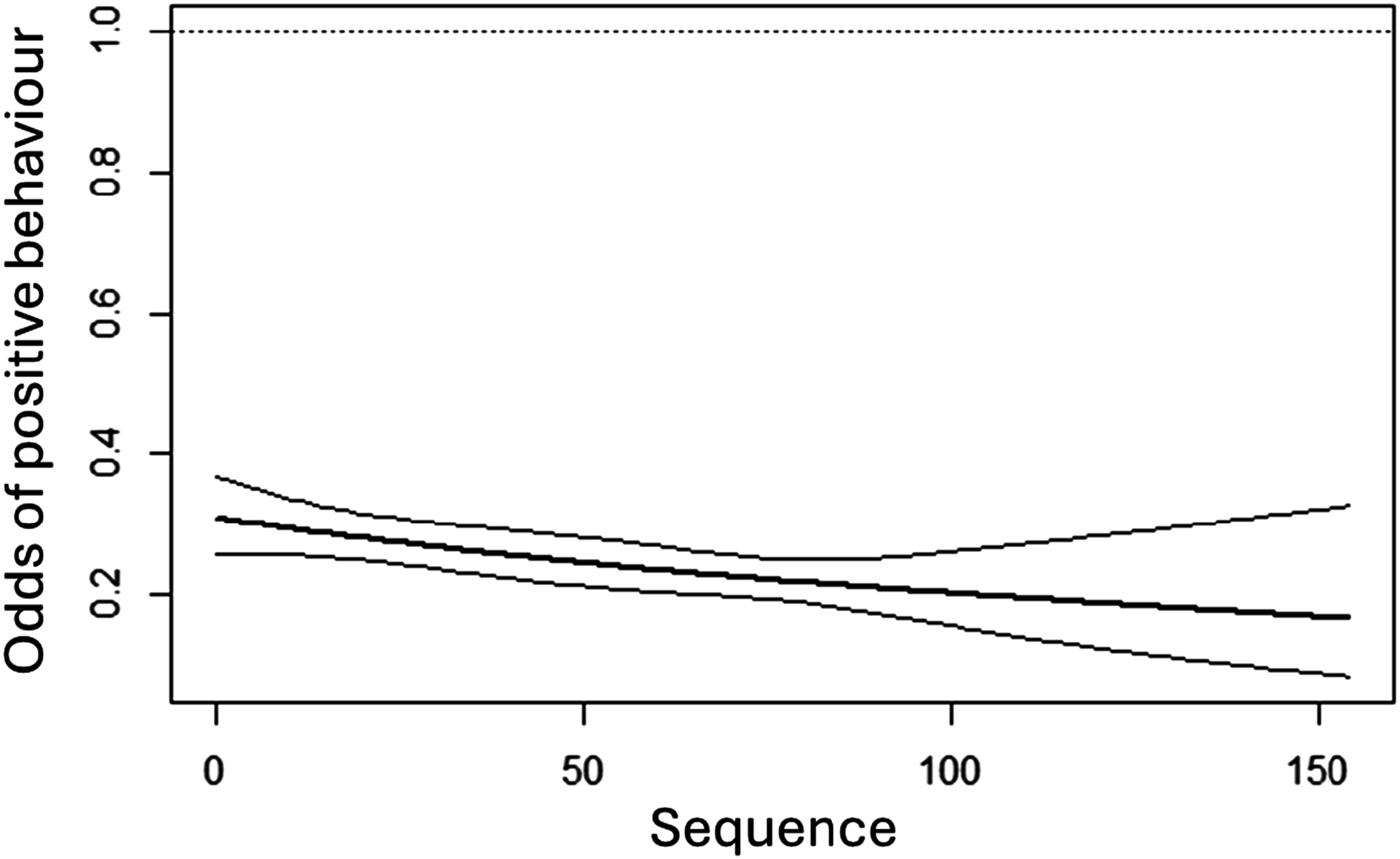
When examining the role of alcohol condition, the interaction between partner and actor alcohol condition did not significantly predict positive behaviour, thus it was removed from the model (b = −0.24, SE = 0.17, p > .05). Partner (b = 0.14, SE = 0.08, p > .05) or actor (b = −0.04, SE = 0.08, p > .05) alcohol condition were not significant time-invarying predictors of a positive behavioural response. The alcohol condition variables were also not statistically significant when examined as time-varying predictors.
There was a positive association between an actor exhibiting a positive behaviour and their partner responding positively (rather than neutrally). This appeared to be time-varying as the strength of the association increased over the course of the interaction from OR = 15.88 to 31.82 – particularly during the first 105 sequences (Figure 2). When examining interaction dynamics, there was a consistent and positive association between an actor exhibiting a negative behaviour and their partner responding with a positively coded behaviour rather than neutral (OR = 2.70, 95% CI: 2.19, 3.35). This association did not appear to be time-varying. Time-varying association between actor positive behaviour and partner positive response. Note. This figure depicts a bolded solid line representing the odds ratio summarizing the association between actor positive behaviour and partner positive response occurring at each sequence (range 0–159) during the interaction. The surrounding two lines depict the corresponding 95% confidence interval. The odds ratio is statistically significant when the confidence interval does not contain 1 (represented by the horizontal dashed line).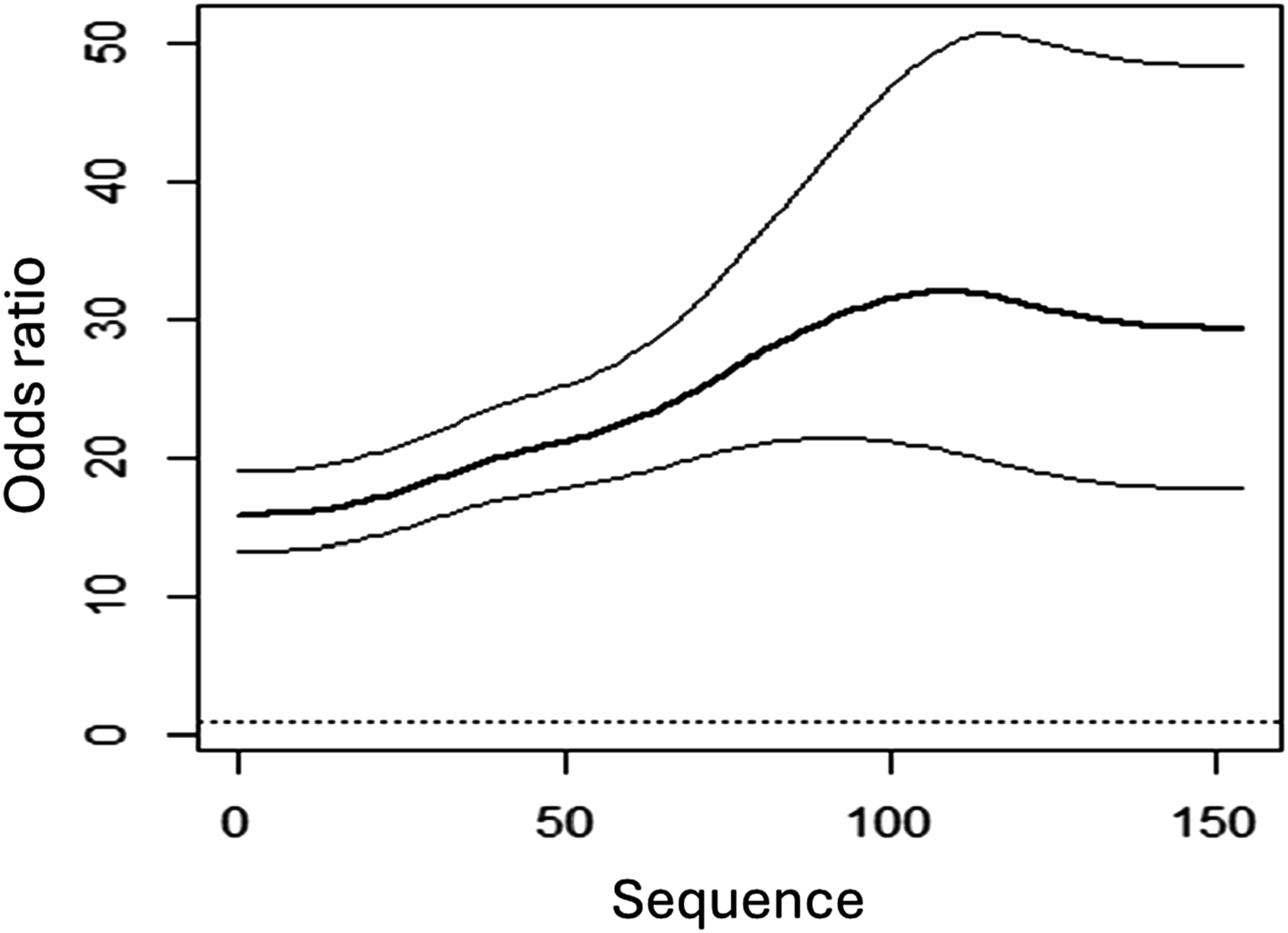
Alcohol condition was also examined as a moderator of the relations between positive and negative partner behaviour predictors with the positive behaviour outcome. The interaction between partner alcohol and actor alcohol use (b = −0.07, SE = 0.19) as well as their interactions with other variables (positive behaviour b = −0.17, SE = 0.30, negative behaviour b = −0.25, SE = 0.44) were non-significant (ps > .05), and thus they were removed from the model. This means that the moment-to-moment relation between the actor’s positive or negative behaviour with the partner’s positive behaviour did not statistically differ based on the alcohol consumption status of the actor or partner. After doing so, there were also no significant associations between partner or actor alcohol use with the positive or negative behaviour predictor variables (ps > .05). This suggests that alcohol condition did not significantly predict momentary occurrence of positive or negative behaviours when controlling for the partner’s preceding behaviour.
Negative behaviour outcome
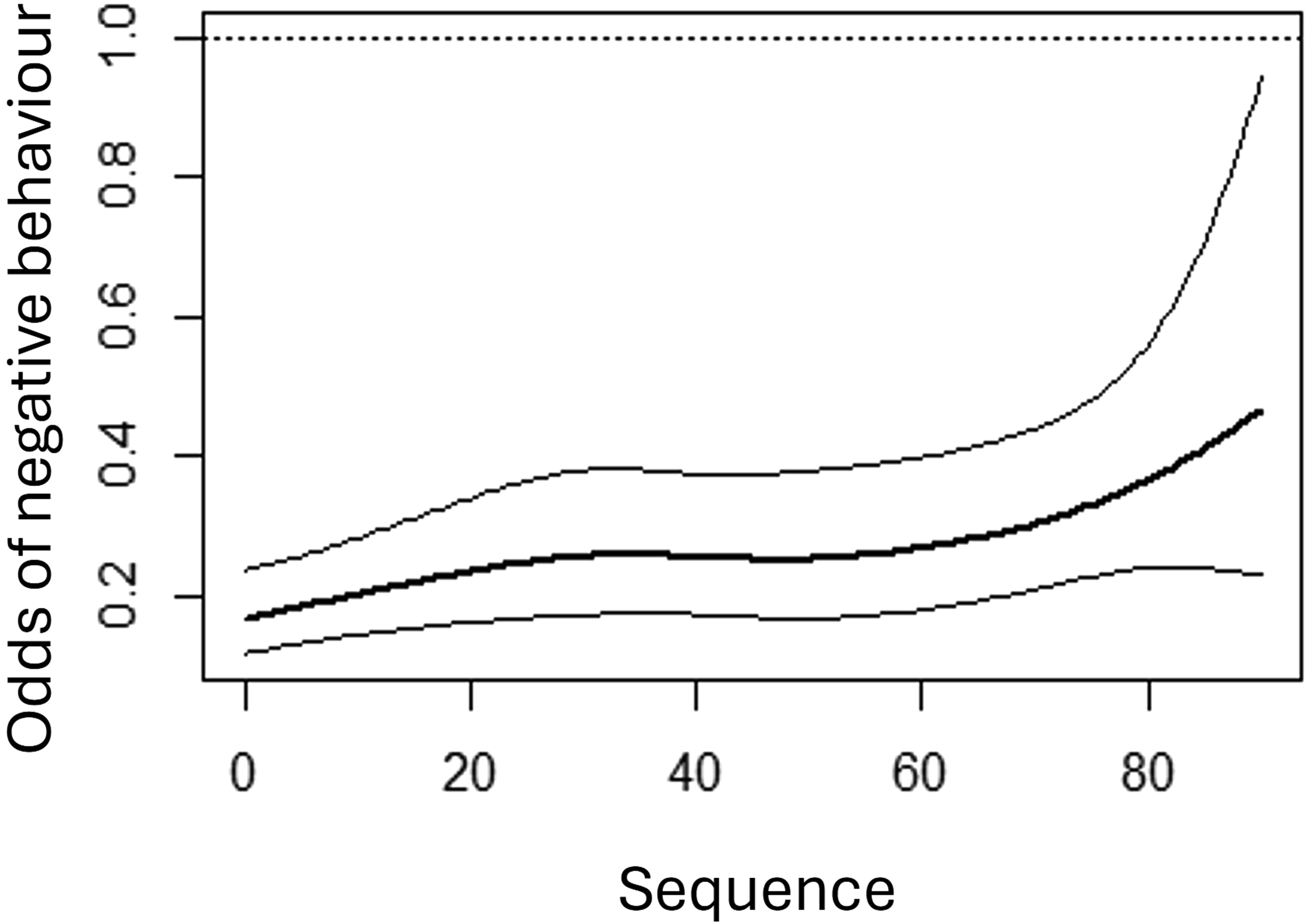
In the intercept-only model, the odds of negative behaviours were low throughout the interaction (corresponding probabilities of 13–25% at each sequence up until sequence 100 with most behaviours being neutral; Figure 3). The odds of negative behaviours increased during the later parts of the interactions. The confidence interval band was relatively large in the higher sequences, likely due to having a small number of applicable observations at these sequence numbers, and points to greater uncertainty in the corresponding estimates. Further, the confidence interval band at the higher sequences includes one, indicating that the probability of a negative behaviour was not significantly different from 50%. The corresponding sensitivity analysis for the intercept-only model focusing on sequences 0 – 90 is presented in Figure 4 because it more clearly depicts the estimates and confidence bands during this time frame than Figure 3. The time-varying odds of negative behaviours occurring relative to neutral behaviours while discussing a conflict. Note. This figure depicts a bolded solid line representing the odds of negative behaviour occurring at each sequence (range 0–159) during the interaction. The surrounding two lines depict the corresponding 95% confidence interval. The odds is statistically significant when the confidence interval does not contain 1 (represented by the horizontal dashed line). The time-varying odds of negative behaviours occurring relative to neutral behaviours while discussing a conflict when data are restricted to sequences 0 to 90. Note. This figure depicts a bolded solid line representing the odds of negative behaviour occurring at each sequence (range 0–90) during the interaction. The surrounding two lines depict the corresponding 95% confidence interval. The odds is statistically significant when the confidence interval does not contain 1 (represented by the horizontal dashed line).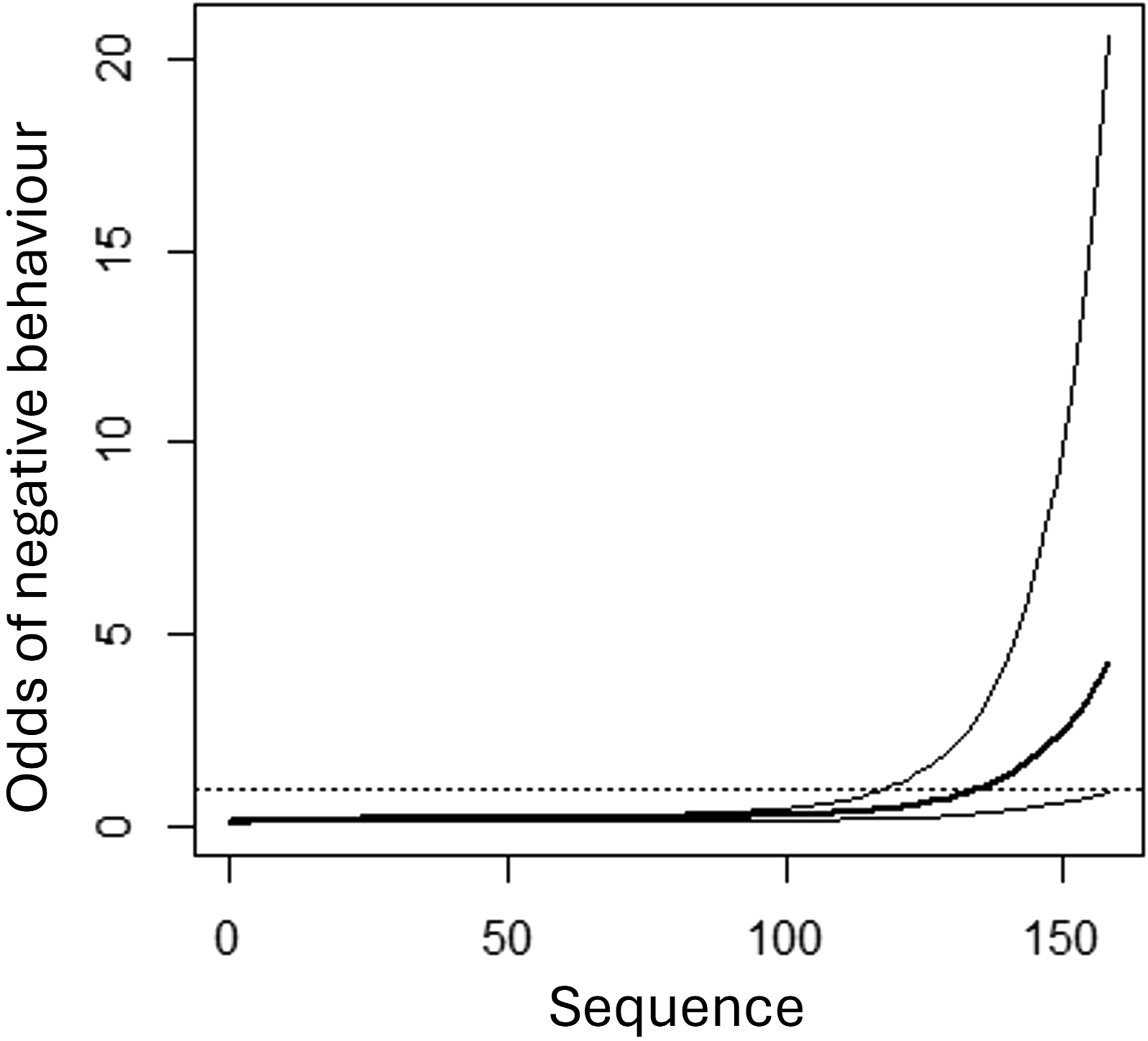
When the alcohol condition predictors were examined, the interaction between partner and actor alcohol use was a non-significant predictor (b = 0.003, SE = 0.41, p > .05) and was removed from the models. There were also no significant time-invarying associations between alcohol use of the partner (b = −0.27, SE = 0.15, p > .05) or actor (b = −0.18, SE = 0.14, p > .05) on the likelihood of negative behaviours over the course of the interaction. These findings were upheld when examining the condition variables as time-varying predictors.
When examining the association between actor and partner behaviors, there was a positive association between an actor exhibiting a negative behaviour and their partner responding negatively (rather than neutrally; OR = 46.53, 95% CI: 35.87, 60.95). This did not appear to be time varying. There was also a consistent and positive association between an actor exhibiting a positive behaviour and their partner responding with a negatively-coded behaviour (rather than neutral; OR = 2.02, 95% CI: 1.66, 2.46). This did not appear to be time varying. Interactions between alcohol condition and positive/negative partner behaviour were explored, but were not statistically significant. That means that associations between the actor’s positive or negative behaviours on the odds of their partner exhibiting a negative (vs. neutral) response did not significantly differ between the alcohol conditions after adjusting for the actor’s preceding behaviour.
Discussion
The purpose of this study was to examine the dynamic nature of couples’ interactions when discussing conflict. We analyzed moment-to-moment behavioural observations of 139 couples’ interactions using TVEM, which enabled us to characterize the nature of the couples’ behaviours over the course of discussing a conflict. Further, we could examine the extent to which couples became more or less in sync with each other as the interaction progressed. While discussing a conflict together, the instances of positive behaviours tended to decrease over the course of the interaction while instances of negative behaviours tended to increase. This suggests that, on average, the process of discussing the conflicts resulted in fewer positive and more negative behaviours over the course of the interaction. These findings support the importance of examining time-varying patterns of couples’ interactions, as the nature of the interaction can change in perceptible ways even over the course of a relatively short interaction.
Further, we supported that the actors’ behaviours tended to elicit specific responses from their partners, and that this also unfolded dynamically over the course of the interaction. Positive actor behaviours tended to elicit positive responses by the partner. Further, negative actor behaviours were quite strongly related to negative responses by the partner. These findings align with the concept of positive and negative reciprocity, meaning, the tendency of partners to reciprocate each other’s negative or positive communication behaviours (Gottman, 1980). This phenomenon is often observed during conflict discussions (Gottman, 1980; Ramos Salazar, 2015). Notably, the strength of the association between positive actor and partner behaviours changed over time. Specifically, the relations between positive actor and partner behaviours increased in strength over the course of the interaction. This suggests increased synchrony over the course of discussing the conflict with respect to positive behaviours specifically (as this was not observed for the negative behaviours). The increased momentum of positive behaviours in couples’ conversations has also been identified in prior research using TVEM, but focusing on couples discussing a positively valenced topic (i.e., the best things about their relationship; Dermody et al., 2017). In contrast, the relationship between partner-actor negative behaviours was relatively stable and it is not clear why there was not a similar increase in synchrony over time. One explanation is that the relationship was already quite strong, and therefore, there was limited opportunity to increase further in strength. Taken together, these findings could be explained by a number of interpersonal processes. The stronger interplay could result from the couple becoming comfortable with the discussion topic over time. Further, it could signify improved affiliation as the couple navigated the challenging discussion while still exhibiting positive behaviours. Prior research has linked the interplay of positive behaviours in couples (referred to as complementarity) to positive relationship outcomes (Markey et al., 2010). Future research could consider how increased complementarity in positive behaviours when discussing conflict relates to future relational satisfaction.
Interestingly, negative behaviours tended to elicit positive responses by the partner and vice versa. This association was stable over the course of the interaction and was not impacted by alcohol consumption by the partner and/or actor. While this was not expected, the finding may be explained by our use of neutral behaviours as the comparison outcome. These findings may reflect that partners are unlikely to react neutrally to either positive or negative actor behaviours. Of note, the associations for same-valence reactions were larger in magnitude than these cross-valence associations. This suggests that the more common response by the partner when discussing conflict is to mirror the behaviour they are responding to (e.g., negative begets negative), which is consistent with behaviours typically eliciting same-valenced reactions. At the same time, neutral reactions to either positive or negative behaviour are unlikely to occur in this particular context.
The present study did not support any effects of alcohol consumption on the unfolding of couples’ interaction dynamics. While this finding appears to contradict Testa et al. (2014), it is important to note that we tested distinct research questions with differing statistical methods. Testa et al. (2014) found alcohol was associated with an overall reduction in the proportion of negative behaviours and increased proportion of positive behaviours in couple behaviours, particularly when one partner drank and the other one did not. It is important to note that the way the data were analyzed was quite different and thus different empirical questions were being answered. In contrast, our analyses examined the impacts of alcohol on the occurrence of these behaviours (relative to neutral) in any given moment in response to their partner’s behaviours. Therefore, while alcohol may impact the overall pattern of behaviour by a given partner, it did not predict the tendency to respond in a specific way immediately following the actor’s behaviour. It is also possible that we would have supported a greater role of alcohol condition if we considered specific moderators, such as relationship quality (Fairbairn & Testa, 2017).
There are some limitations to note for this study. First, the recruited sample was heterosexual adults who drink heavily but were not receiving treatment, which is not representative of couples in general. Findings may not generalize to couples who drink at higher or lower levels or have diverse sexualities or relationship structures. Second, there was no deception for alcohol administration, which means expectancy effects could not be controlled for with this study design. Further, only one alcohol dose was considered; it is possible that varied doses could produce different findings (Fairbairn & Testa, 2017). While prior research suggests varied doses of alcohol consumption may have negligible, or even immediate positive effects on communication behaviours, it is important to note that heavy drinking is associated with various negative relational outcomes. For example, heavy drinking is associated with increased aggression, intimate partner violence, risk of divorce, and further increases in future alcohol use (Bácskai et al., 2008; Foran & O’Leary, 2008; Torvik et al., 2013). These risks associated with heavier alcohol consumption should not be overlooked.
Further, the pattern of findings at the higher sequences should be interpreted with caution given the smaller number of observations that may not be representative of couples who had a fewer number of sequences. Even though the observation length was consistent between couples, it is conceivable that qualities of the exchange (e.g., negativity) could have affected turn lengths (e.g., negative exchanges leading to shorter turn lengths). In fact, we found that negative behaviours were disproportionately represented in the higher sequence counts.
The present study also had several strengths, including the rich data from numerous couples being observed when discussing a conflict. Coupled with a sophisticated data analytic tool, TVEM, it was possible to demonstrate that these interactions were dynamic even within a relatively short observation period. For instance, over the course of discussing a conflict, positive behaviours decreased over time. Nonetheless, when positive behaviours occurred, they tended to elicit a positive response, and this phenomenon strengthened over the course of the interaction. These findings demonstrate the valuable information that can be obtained when the richness of the data collected is matched to appropriately sophisticated analytic tools. These methodological pairings can facilitate describing complex interaction dynamics of interest.
Supplemental Material
Supplemental Material - Time-varying relational interaction dynamics in couples discussing conflict
Supplemental Material for Time-varying relational interaction dynamics in couples discussing conflict by Sarah S Dermody, Elizabeth A Earle, Catherine Fairbairn and Maria Testa in Journal of Social and Personal Relationships
Footnotes
Acknowledgements
We greatly appreciate the efforts by research assistants who assisted with the data preparation for this project.
Declaration of conflicting interests
The author(s) declared no potential conflicts of interest with respect to the research, authorship, and/or publication of this article.
Funding
The author(s) disclosed receipt of the following financial support for the research, authorship, and/or publication of this article: The original data collection was supported by National Institute on Alcohol Abuse and Alcoholism Grant R01AA016127 to Maria Testa.
Open research statement
As part of IARR’s encouragement of open research practices, the authors have provided the following information: This research was not pre-registered. The data used in the research are cannot be publicly shared but are available upon request. The data can be obtained by emailing:

Supplemental Material
Supplemental material for this article is available online.
References
Supplementary Material
Please find the following supplemental material available below.
For Open Access articles published under a Creative Commons License, all supplemental material carries the same license as the article it is associated with.
For non-Open Access articles published, all supplemental material carries a non-exclusive license, and permission requests for re-use of supplemental material or any part of supplemental material shall be sent directly to the copyright owner as specified in the copyright notice associated with the article.
