




Abstract
Adolescence represents a sensitive period for embarking on trust-based friendships, which lay the foundation for successful close relationships later in life. The recent trust sequence model assumes that the trust process is universal regardless of the developmental stage. However, how the trust process may vary has been under-researched, especially during the critical period of adolescence and in the context of friendships. Therefore, this study qualitatively explored how people experience the process of forming trust in friends from early adolescence to adulthood. We conducted eight focus groups (N = 39 participants) with early (11-12 years), middle (14-15 years), and late (18-19 years) Czech adolescents and a comparative sample of adults. Data were analyzed using reflexive thematic analysis, employing an inductive, semantic, and experiential approach. We identified four overarching themes: (1) Experiential Trust Building, (2) Absence of Reasons to Not Trust, (3) Relying on Intuitive Connection, and (4) Trusting the Right/Wrong Person (the third and fourth themes being exclusive to adolescents). Participants thus described multiple variations of the trust process, with much of the variation residing in the perceived importance of diminishing the leap of faith, i.e., the risks and uncertainties inherent in trusting. Immediate affect and stronger moral essentialism were relevant to trust formation among adolescents but not adults. These findings provide unique insights into experiences with forming trusting friendships from early adolescence to adulthood and extend the trust sequence model. Further research should explore the trust process in low- and high trust societies.
Keywords
Introduction
A recent model of the trust process – the universal trust sequence – argues that there is “only one essential ‘trust experience’” (Dietz, 2011, pp. 215). It assumes that people always move from assessing others’ trustworthiness through making the decision to trust and taking the uncertain, vulnerability-laden leap of faith into trusting behavior, such as asking for help (Dietz, 2011; Six & Latusek, 2023). However, whether and how the course of the trust process varies has yet to be empirically studied, especially with respect to life periods during which trust building represents a salient developmental task. One such period is adolescence, during which people begin to establish close, trust-based friendships (Blieszner & Roberto, 2004). Gaining a better understanding of how adolescents form trusting friendships is highly relevant because experiences and interpersonal skills acquired within such friendships are crucial for establishing and maintaining close relationships later in life (e.g., with romantic partners in adulthood; e.g., Allen et al., 2020). Therefore, this study aimed to qualitatively explore diverse ways in which people navigate and experience the process of forming trust in friends from early adolescence to adulthood.
Adolescence as a sensitive period for the development of trusting behavior
As adolescents begin forming close relationships with peers, the nature of their friendships transforms. While childhood friendships center around companionship and shared hobbies, mutual trust becomes more salient from adolescence to adulthood as friendships shift to fulfill the needs for security, intimacy, and support (Blieszner & Roberto, 2004). Adolescents also increasingly differentiate friends from neutral peers (Güroğlu et al., 2014) or strangers (Güroğlu et al., 2014; Sweijen et al., 2023) when choosing towards whom to behave in a trusting manner. If successfully navigated, these changes foster the development of trust-relevant skills, like mentalizing (Desatnik et al., 2023; Güroğlu, 2022), differentiating aspects of the social world (e.g., distinguishing between generalized trust and trust in specific others; Flanagan & Stout, 2010), or managing negative emotions (Riediger & Klipker, 2014).
The ability to flexibly adapt one’s trusting behavior based on the course of the interaction also markedly improves from early adolescence to adulthood, as evidenced by findings from trust game research. In this experimental paradigm, the trustor can keep the entire initial endowment or transfer any amount to the trustee. The trustee receives the amount multiplied by the experimenter, choosing to keep or share the increased endowment with the trustor (Lewicki & Brinsfield, 2012). In the study by van den Bos et al. (2012), early adolescents, middle adolescents, and young adults played the trust game with interaction partners who differed in how cooperative they were in sharing money. All age groups noticed that their counterparts differed in trustworthiness. However, only middle adolescents and young adults adapted their behavior to the behavior of their partners; that is, they increasingly shared more with trustworthy partners and less with untrustworthy partners. Similarly, participants in Sijtsma et al.’s (2023) longitudinal study decreased their cooperation with untrustworthy trust game partners across three consecutive years spanning early to middle adolescence.
In line with the developmental task perspective, which considers the formation of close friendships a developmental task of adolescence, sufficiently developing the abovementioned skills in adolescence continues to influence the quality of relationships into adulthood (Masten & Coatsworth, 1998). For example, Allen et al. (2020) found that social competence demonstrated by forming and sustaining close friendships in adolescence uniquely predicted romantic life satisfaction in adulthood. Adolescents who can manage the socio-emotional demands of these new friendships can rapidly develop abilities crucial for establishing close, trust-based relationships across the lifespan.
Understanding the trust process
Notwithstanding these developmental changes, the current theorizing postulates that the trust process leading to trusting behavior follows a universal trust sequence model (Dietz, 2011; Dietz & Den Hartog, 2006; Six & Latusek, 2023). People first assess other persons’ trustworthiness to form expectations about their behavior. Positive expectations culminate in the decision to trust (i.e., to render oneself vulnerable). For trust to materialize in trusting behavior, such as sharing sensitive information, one must take the leap of faith to trust, that is, accept the uncertainty and vulnerability that the positive expectations may have been erroneous (cf. Möllering, 2006; Rempel et al., 1985). The outcomes of trusting, such as whether the other person keeps or shares sensitive information, affirm or modify trustworthiness beliefs, and, in turn, the tendency to trust the same person again. One will be more inclined to share another secret with someone who has kept previous secrets to themselves than someone who disclosed them. On the contrary, if the other person seems untrustworthy and people hold negative expectations about their behavior, they withhold the decision and the leap of faith to trust. As a result, they refrain from acting in a trusting manner or commence protective actions (e.g., limiting contact with the untrustworthy person; Six & Latusek, 2023).
Nonetheless, the trust process may not be universal. Prior experiences with trusting others can carry over into new relationships, altering how people progress through the trust process, not only with a particular person but also in general. The reinforcement learning perspective suggests that previous experiences with trusting other people influence individuals’ willingness to be trusting in new relationships. For some, initially trusting and taking weightier risks might be more rewarding as it does not prematurely preclude possibly high-quality connections. Others may find their comfort level in remaining more reserved, for example, after being hurt in previous relationships (Schilke et al., 2021). Likewise, according to the social learning theory, experiences gained in particular situations affect one’s expectancies and trusting behavior in comparable situations (Landrum et al., 2015; Thielmann & Hilbig, 2015). For example, positive experiences of confiding in a peer can strengthen one’s willingness to trust peers with vulnerable information and assume a more open and less self-protective stance when confiding in peers in the future. These effects of reinforcement and social learning can be particularly pronounced in adolescence, which is characterized by a relatively high sensitivity to social rewards (Güroğlu, 2022). Whether there are individual variations in the trust process and how they may unfold thus warrants empirical exploration.
The common methods in current trust research allow limited insights into the trust process, as they typically focus on other aspects of trust (e.g., trustworthiness) or are not best suited for studying processual phenomena. The existing questionnaire-based research has extensively concentrated on trustworthiness, especially on evaluating the other person’s characteristics (McAllister, 1995; Rempel et al., 1985), but only a few questionnaire studies tapped into intentions to act in a trusting manner (e.g., Gillespie, 2012), and even fewer included items assessing trusting behavior (e.g., Breuer et al., 2020). In addition, questionnaires offer only a static snapshot of trust based on pre-defined categories. As such, they are of limited use in exploratory research focusing on the process of trust formation because they do not capture the full complexity and temporal dynamics of the trust process (i.e., how the course of the trust process may vary and change over time). The other line of empirical research employing trust games is limited to a single trust-relevant situation – cooperation on dividing resources – and is highly structured, offering participants little room for variability in handling the situation. Furthermore, while people distinguish between financial risk and the no less costly social betrayal in trust games (Alós-Ferrer & Farolfi, 2019), the presumed personal risk and vulnerability when engaging in trusting behavior in close relationships are much higher. Thus, the trust game does not allow the exploration of the broader patterns of trust in real-life situations and the establishment of trust in others in the longer term beyond a limited series of interactions.
The present study
The trust sequence model posits that people decide to trust others if they appraise them as trustworthy while accepting the risk that their assessment may be incorrect. It, therefore, presumes that people undergo the trust process uniformly (Dietz, 2011; Six & Latusek, 2023). On the other hand, the social learning theory (Landrum et al., 2015; Thielmann & Hilbig, 2015) and reinforcement learning perspective (Schilke et al., 2021) jointly suggest that people differ in how they navigate the trust process based on prior trust experiences and their outcomes. However, empirical understanding of how the course of the trust process may vary remains limited, especially during adolescence, which marks a critical period for initiating trust-based friendships (Blieszner & Roberto, 2004) and trust-relevant abilities (Allen et al., 2020; Desatnik et al., 2023). The present study sought to fill these gaps by qualitatively exploring variations in the trust process in the context of friendships. We analyzed the data collected from focus group interviews with early, middle, and late adolescents and a comparative sample of adults using reflexive thematic analysis to address the following research question: How do people experience the process of forming trust in friends from early adolescence to adulthood?
Method
Study design
The present study was a secondary analysis of qualitative data from a large-scale focus-group investigation of meanings and sources of trust and distrust in institutional and interpersonal contexts. The first part of focus group interviews explored trust in authorities and institutions during the COVID-19 pandemic, with the second part concentrating on trust in close others. The large-scale project aimed to collect rich data for use in a descriptive project report focused on sources of trust and distrust and for further analyses, with reflexive thematic analysis as the intended analytical approach.
Participants
Participant characteristics.
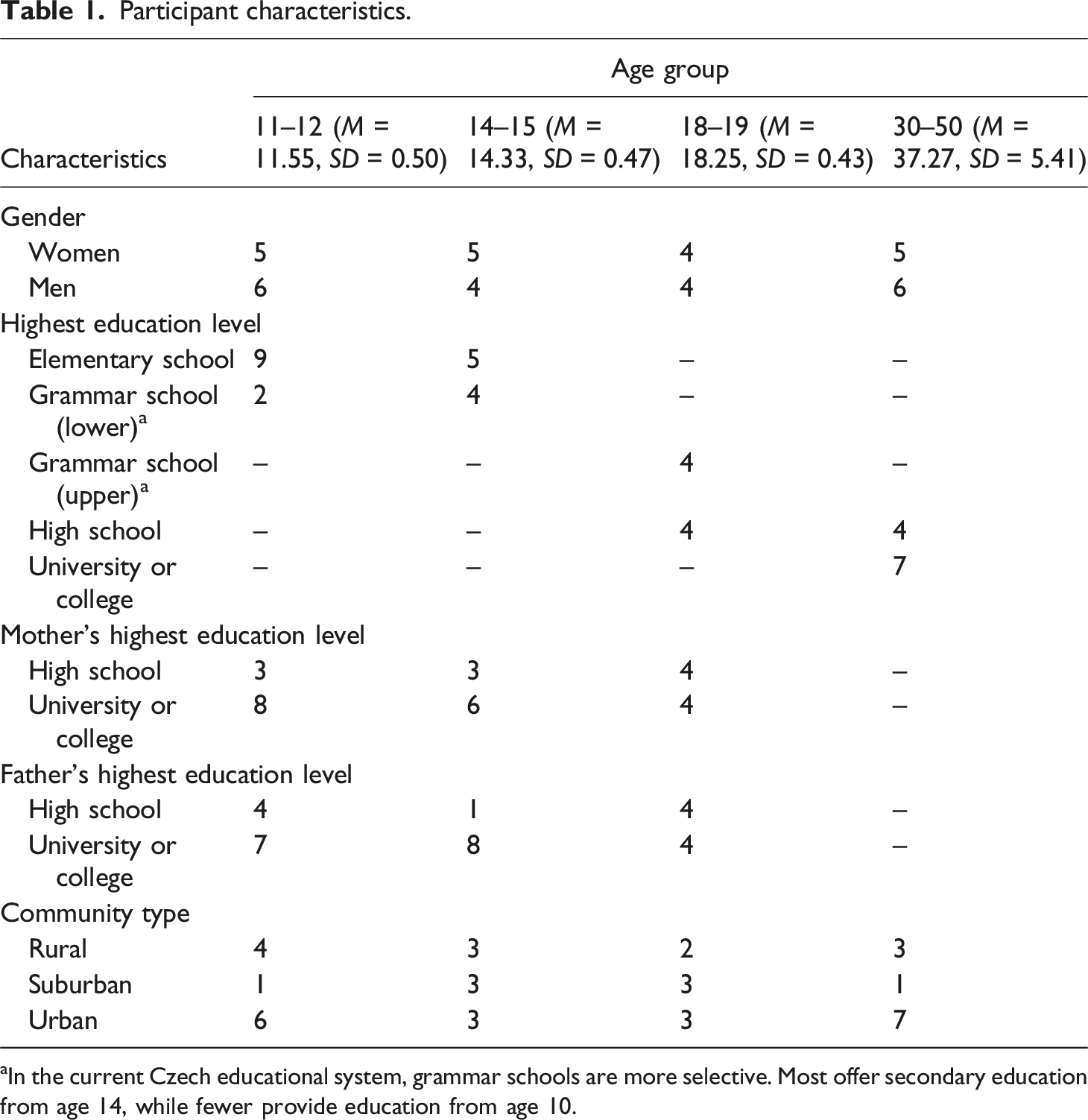
aIn the current Czech educational system, grammar schools are more selective. Most offer secondary education from age 14, while fewer provide education from age 10.
Procedure
We held eight online semi-structured focus group interviews in total, two per age group, from June to September 2022. Participants were recruited through social media and personal contacts using non-probability sampling. We balanced the focus groups by gender, education level, and community type. We used a dual moderator approach, with each focus group featuring one main moderator and an auxiliary moderator (Krueger & Casey, 2000). The average duration of a focus group was 68 minutes (Min = 63 minutes, Max = 74 minutes). In this study, we analyzed the second part of the focus group interviews, which lasted on average 25 minutes (Min = 19 minutes, Max = 30 minutes), focusing on the participants’ answers to the following questions: 1. “Up to now, we have talked a lot about COVID and the government. Now, we would like to know how you feel about people you know. Try to imagine a person that you trust. You do not have to say who it is; just picture this person. Could you tell us why you trust this person?” 2. “Now, try to imagine someone whom you distrust. Could you tell us why you distrust this person?”
We coded participants’ responses to identify people they recalled. All participants spoke primarily about friends, with a few participants also mentioning family members. In this analysis, we focused on the excerpts about friends.
Ethics
All participants included in the study signed an informed consent. For the participants younger than eighteen, we also obtained informed consent from their parents. We removed identifying information from the transcripts. We identified participants by the number of their respective focus group (e.g., FG1) and pseudonyms (e.g., Carl). Importantly, the participants agreed that their anonymized data could be used in multiple research subprojects for secondary data analysis. The Research Ethics Committee of Masaryk University approved the research (approval No. EKV-2019-072).
Data analysis
The flexibility of reflexive thematic analysis allowed us to study patterns of the variations in the trust process, adopting an inductive, semantic, and experiential approach epistemologically underlined by tempered realism (Braun & Clarke, 2022), which we found suitable for studying an underexplored phenomenon. Our coding was, therefore, driven by the data rather than existing theoretical constructs, focusing mainly on exploring the meaning at the explicit level, even though we shifted toward generating more latent codes as we progressed with the analysis. We aimed to capture and explore people’s lived experiences under the tempered realist assumption that while the reality of participants’ experiences and meanings are reflected in their language in a largely uncomplicated manner, researchers and participants influence each other through their values and assumptions.
We followed Braun and Clarke’s (2022) six-phase guidelines: (1) familiarization with the data, (2) initial coding, (3) generating initial themes, (4) developing and reviewing initial themes, (5) defining, refining, and naming themes, and (6) producing the final report. We used MAXQDA (VERBI Software, 2024) to analyze data and store analytical memos. All authors were pre-familiarized with the data as they took part in the data collection and processing, with the second and fourth contributing authors also interviewing the participants. The first and second authors re-read the transcripts multiple times before the analysis to refamiliarize themselves with the raw data. The first and second authors worked in pairs to generate and refine codes and to generate, develop, refine, and name the themes. The first author generated the initial codes and candidate themes, with the second author reviewing the codes and themes and suggesting changes. The first two authors then met regularly to exchange the MAXQDA files, coding schema, and theme delineations; discuss and refine the codes and themes; resolve discrepancies; and check the themes against the data. The first two authors also selected participant quotes and produced write-ups. The third and fourth authors assessed the themes and write-ups for clarity, non-redundancy, and appropriateness. For an illustrative example demonstrating the theme generation process, see Table S1 in Supplementary Materials.
We followed the procedures outlined by Nowell et al. (2017) for conducting trustworthy thematic analysis. We employed prolonged engagement with the data, researcher triangulation, an audit trail of code and theme generation, and a reflexive journal. We used memos in the transcripts to track coders’ emotions, attitudes, experiences, or prior knowledge of the topic. Diagramming was used to explore connections within and among themes. Finally, we described the coding and analytical process in detail. Regarding the secondary nature of the conducted analysis, we adhered to the recommendations by Ruggiano and Perry (2019). All authors of this study collaborated on the large-scale data collection, the analytical approach in this study aligned with the methodology of the large-scale data collection, and participants explicitly agreed to the data being used for secondary analyses.
Results
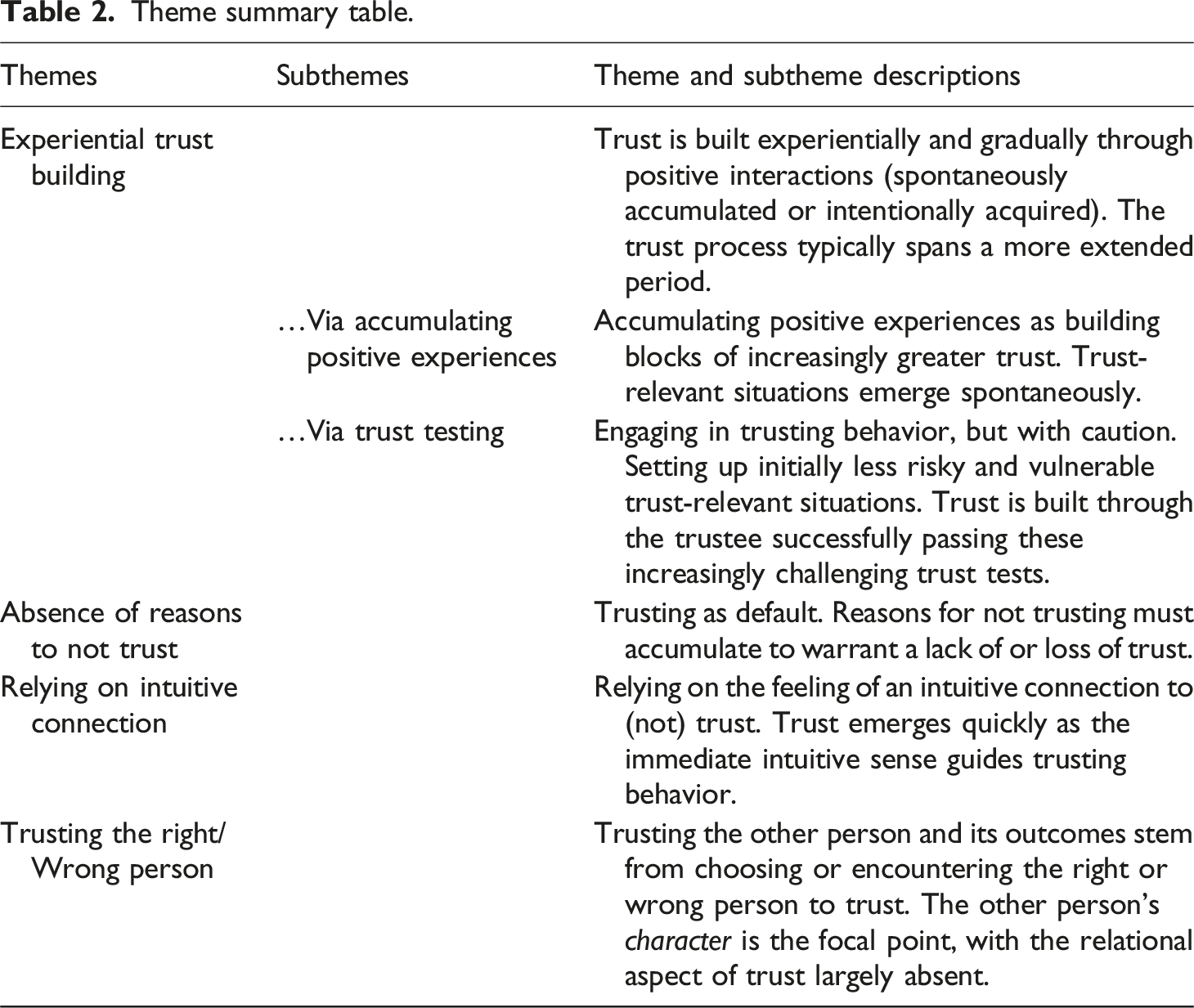
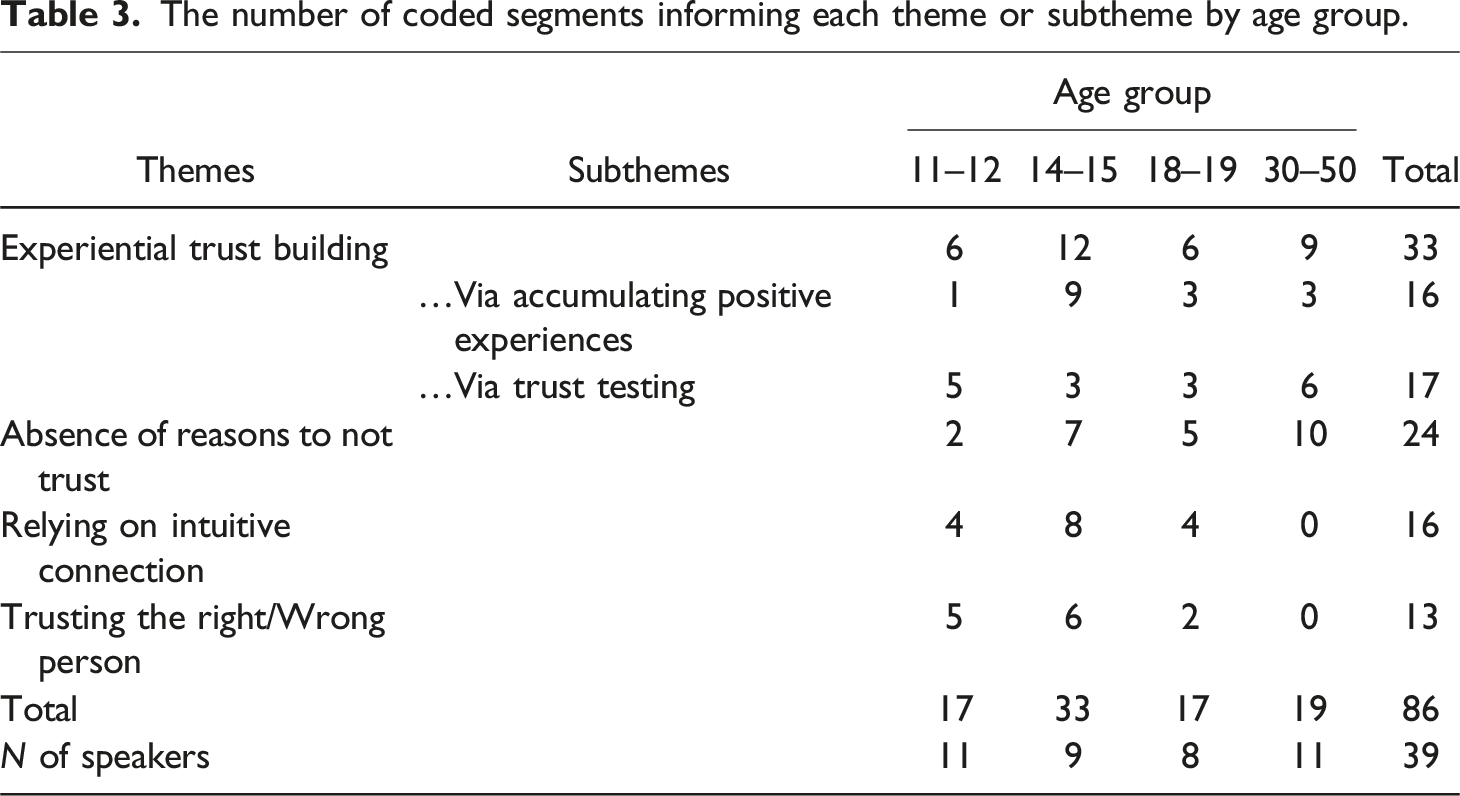
We constructed four overarching themes to capture the variations in the process of forming trust in friends from early adolescence to adulthood: (1) Experiential Trust Building, (2) Absence of Reasons to Not Trust, (3) Relying on Intuitive Connection, and (4) Trusting the Right/Wrong Person. The themes and corresponding subthemes are depicted in Figure 1 and summarized in Table 2. For the number of codes that informed each theme and subtheme by age group, see Table 3. The salience of each theme nonetheless derives primarily from the theme representing a meaningful pattern that helps answer the research question. The number of coded segments is merely an auxiliary indicator (Braun & Clarke, 2022). Importantly, many participants showed more than one variation of the trust process when recalling their experiences with different friends or within various trust-relevant situations. A structural diagram of themes and subthemes. Theme summary table. The number of coded segments informing each theme or subtheme by age group.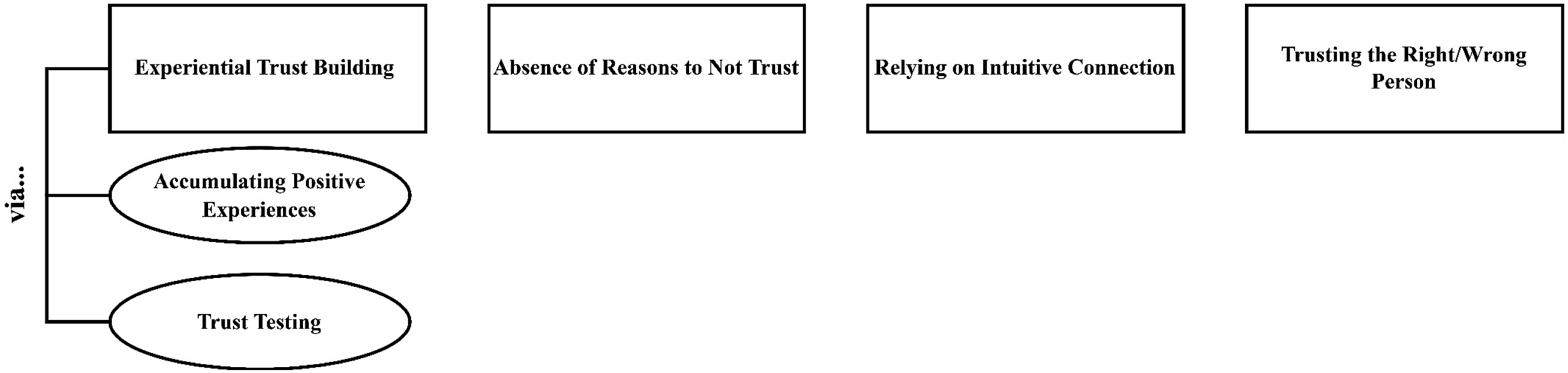
Experiential Trust Building
The central feature of Experiential Trust Building was that trust increased gradually based on ongoing positive interactions. Participants acquired the positive experiences either in a slower and more spontaneous manner through (a) Accumulating Positive Experiences or faster and more deliberately through (b) Trust Testing. Both subthemes were present across all age groups.
Via Accumulating Positive Experiences
Several participants described accumulating positive experiences with the other person to build trust gradually, with trust understood by participants as “the question of some positive experiences [with the friend] acquired over time” (Agnes, 46yo, woman, FG2). The participants highlighted collecting the experiences within a longer time frame. Honza (19yo, man, FG7) believed that basing trust on a single positive experience is too risky: I think it’s dangerous. (…) When we trust someone, even though maybe we haven’t even known them for that long or we trust them based on something… in one situation, we don’t really know how they would behave in other situations.
Laura (15yo, woman, FG4) provided a contesting view when she enunciated that “there can be a friend you have known for a long time and trusted for a long time, but then a breaking point can happen, and they can do something you would have never expected [of them].”
Positive experiences emerged throughout the relationship rather than being actively pursued. Participants spontaneously listed positive experiences that they collected over time with their friend, be it happy memories or vulnerable moments that the friend helped them navigate: Libor (14yo, man, FG6): I have a friend who has always been there for me, always helped me. We’ve had quite a few experiences together. (…) And then I have another friend who is older and whom I also trust. (…) We rappel down, and there is quite a trust. I trust him that he thought it out well enough for it [the rope] to hold us. Moderator: like down rocks? Libor (14yo, man, FG6): Well, in buildings. We’ve rappelled down old buildings. So, I trust him to the extent that he figured it out, so I won’t fall.
Most participants described instances when the accumulation of positive experiences deepened initial trust, as Erik (34yo, man, FG2) illuminated: “I try to rather trust people with whom I have something in common or who are around me and I like them. But, of course, some greater trust that I can really rely on that person comes with experience.” Intriguingly, repeated positive experiences also had the power to override the first impressions of untrustworthiness and gradually kindle trust: I hadn’t even talked to him much before, and I hadn’t even noticed him in that class. (...) When I started talking to him, I wrongly associated him with the people I had talked to [from his friendship group]. I had a collective picture of that group of people. (...) So, from the beginning, I wasn’t completely, one hundred percent fond of him. But then, I found out that he wasn’t like the others [from that group], he had his own head… That’s how the trust began for me... I started trusting him more and more and more. (Hubert, 15yo, man, FG6)
Via Trust Testing
For some participants, Experiential Trust Building occurred through deliberately entering and even setting up trust-relevant situations akin to a series of trust tests, with trust growing as the other person successfully passed them. As such, the participants did not consider trust testing a one-time occurrence, with the friend proving themselves trustworthy based on one situation; instead, they conceptualized trust building as a gradual process involving buffering of their initial wariness: “I’ve verified several times that I can trust him. That he won’t betray me, that he’ll help me” (Helga, 33yo, woman, FG2).
Most participants engaged in trust testing from a place of initial trust, though guarded, which was exemplified by the phrase “trust but verify” (Sven, 42yo, man, FG2). Karel (19yo, man, FG7) explained the initial cautiousness: “It’s better to verify that person first, well, not to tell them everything right away, so that I don’t come out of it [the trusting] badly.” These participants mustered up enough trust to become vulnerable just enough to gain information about whether the other person could be trusted. However, they simultaneously took steps to ensure they were in control of the situation and the personal risks taken.
Initial trust was nonetheless not viewed as a prerequisite for acting in a trusting manner. Elen (12yo, woman, FG1) intentionally entered multiple trust-relevant situations, even with initial distrust: I was sort of distrustful of her at first, and that’s because we’ve known each other for a short time – I actually joined a new school. Uh, but then she said [some] things, and I didn’t trust her, right, so I started checking it. And I was actually inquiring if she was saying everything correctly… Well, it sounds odd now that I was somehow monitoring her, but I was just finding out that I [could] trust her. And now I just… I don’t have a problem trusting her with something.
Ellen’s experience also illustrates that a couple of well-navigated trust-testing situations led most participants to conclude that they have “tested out” (Laura, 15yo, woman, FG4) the other person sufficiently to establish a certain level of trust, which did not require further rounds of verifying the other person’s trustworthiness, at least for the time being. With the more profound trust came a willingness to undergo more risky, personally vulnerable situations with the trustee: “She really knows a lot of [my] secrets and I know hers” (Laura, 15yo, woman, FG4). Despite being gradual, looking for or creating trust-relevant situations instead of waiting for them to naturally occur was also a way to speed up the course of the trust process, with participants adopting a very active role.
Absence of Reasons to not trust
The core of this trust process variation lies in trusting by default unless the other person gives one sound reason not to, “usually trying to trust people from the beginning until… well until those people lose my trust one way or another” (Max, 31yo, man, FG5). The initial trust typical of this variation can be viewed as a general tendency to trust others, as portrayed in the quote by Sofie (18yo, woman, FG8): I sort of have this approach that I’m probably too trusting, but I trust even strangers until they prove to me that I shouldn’t trust them. (….) Because I simply hope that people are kind and mean well. (…) I just feel like, why not trust people? I mean, if they give you the reason [not to], then of course, don’t [trust them].
Rather than building trust through acquiring positive experiences, trust was deepened when negative experiences did not come up as the relationship progressed: “I have known them for a long time, but the main thing is, they have never given me a reason not to trust them” (Cyril, 14yo, man, FG4). The participants most mentioned the lack of disappointments and focused on the fact that their trusted friends had not done anything to taint the trust they had placed in them, discussing the overarching “experience with that person [the friend] that they have never failed my trust” (Karin, 36yo, woman, FG2). Increasing trust was, therefore, not a matter of what the friend had done but rather of what the friend had not done.
The adult group emphasized not only needing reasons to not trust but also needing multiple disappointments to diminish trust or warrant distrust. Benny (38yo, man, FG2) described: “It’s more about the experiences. I trusted him [the friend] twice, it didn’t work out twice, so no more [trust], right.” Adults also considered intentionality and expressed greater tolerance for mistakes, which was not present in the adolescent age groups, while deeming it acceptable to cease contact after several letdowns: Agnes (46yo, woman, FG2): Many times, a person makes mistakes, makes a misstep, that can happen to anyone. But if I feel it was intentional or it happens repeatedly. In that moment, it [the trust] goes down and down. Sven (42yo, man, FG2): Yeah, that’s exactly what I wanted to say, that, of course, the distrust comes from the fact that these are repeated excesses. (…) And then, of course, I try not to come into contact with that person anymore.
Relying on Intuitive Connection
Several adolescents used an affect-based strategy when forming trust in friends, relying primarily on their intuition. Immediacy was inherent in this variation of the trust process, with trust emerging after only “knowing the person [the friend] briefly… very briefly” (Johana, 14yo, woman, FG6). Participants commonly used the phrase “we clicked” to portray the intuitive sense that allowed them to quickly establish trust based on a feeling of connection: “We somehow immediately clicked, and I just felt like I could trust them” (Beata, 14yo, woman, FG4). How the feeling came about was “hard to explain” (Magda, 12yo, woman, FG3) for some participants, further demonstrating that trusting the other person, in this case, was not something the participants had deliberately thought about but something that came with easiness and they just felt, as Beata said.
At the same time, trust based on an immediate feeling of connection sparked discussion, with a couple of adolescents expressing that quickly forming trust based on intuition may be possible, although difficult to imagine, as Dita (14yo, woman, FG4) conveyed: How much you click with the person... (…) I mean, I think it’s possible, but I haven’t experienced it myself yet, trusting a person after a short period. I think, at the minimum, always after we get to know each other properly. So maybe a year, sometimes even two [years] before I would be able to tell [them] anything, a bigger secret or something.
Similarly, Cyril (14yo, man, FG4) added: “I don’t get to know the person all at once. Like that, I would immediately click with them. I must get to know them first to confide [in them] or something [like that].”
Even though two other adolescents did not rely on the immediate connection when forming friendships, they used negative gut feelings as a warning signal: “It also protects us from something, and it’s good to listen to it. It’s just that when we feel inside that we don’t trust someone, it’s wrong to trust them” (Kurt, 12yo, man, FG3). Ondra (18yo, man, FG8) described protective actions, such as “not talking about more confidential stuff with that person,” should follow.
Regarding the developmental aspect, this theme depicts a variation of the trust process that was conceivable only for some adolescent participants who considered it a way to either swiftly start or refrain from trusting. Adults, on the other hand, did not mention affect-based trust at all.
Trusting the Right/Wrong Person
For several adolescents who centered on their friend’s character, the course of the trust process hinged on choosing or less deliberately encountering the “right” or the “wrong” person. Many adolescents also drew the dichotomy between trusting “good” versus “bad” people. Corroborating the essentialist stance that individuals possess personality traits that make them innately right and good or wrong and bad, there was an air of certainty that the other person would eventually reveal their true nature: We thought that this person was either good or maybe even [had] some other positive… another positive quality. (…) We believed they were a certain way, but when it turned to what they were really like, it disappointed us and crushed us. (Magda, 12yo, woman, FG3)
Trusting the wrong people was viewed as having detrimental consequences. For example, “when we don’t confide in a good person, it can further add to our burden and make things even worse” (Beata, 14yo, woman, FG4). For some participants, trusting the wrong person shed a negative light on the trustor as well, as Dušan (14yo, man, FG6) advocated: „I think it’s wrong to trust bad people or people who shouldn’t be trusted. (…) One mustn’t be naïve. One must not trust everyone and immediately.” Trusting the wrong person was, therefore, not only linked to being harmed but also considered an indication of one’s poor judgment.
Participants differed in the amount of control they perceived to have over trusting the right person. The youngest adolescents assumed a more passive role, expressing the belief that trusting the right or wrong person remains largely a matter of chance. Artur (12yo, man, FG1) aptly described this perspective: “Trust is like a lottery – you either bet on a good person whom you can trust, and you know they won’t disappoint you, or you bet on someone who… whom you trust, and then they betray you.” In contrast, older adolescents offered a rationalized view and were more proactive, underscoring the necessity of “finding the right person” (Laura, 15yo, woman, FG4) or “choosing the right people” (Johana, 14yo, woman, FG6). As such, they believed they could foresee and prevent the negative consequences of trusting a bad person: “When we know that the person is not entirely good and could do us dirty or give us bad advice, I would rather not trust them, and I wouldn’t take their advice” (Anežka, 18yo, woman, FG8). Older adolescents thus placed a high value on their agency, positing themselves as the choosing subjects. Ascribing greater importance to chance also arguably entailed more uncertainty and risk than feeling relatively assured in one’s ability to rationally decide whether to trust based on the assessment of the other person’s personality.
While the participants who elaborated on this variation of the trust process differed in their emphasis on rationality and perceived control, their view was overall quite reductionist in its narrow focus on personality characteristics and on dichotomizing others into two categories – as either good or bad based on their true nature. Moreover, the previous two patterns of the trust process were relational, i.e., trust was construed as a dynamic and reciprocal process formed within the relationship between two people. On the other hand, the relational aspect was largely absent in this final theme. Labeling the friend as an inherently good person worth trusting was also exclusive to adolescents.
Discussion
This study aimed to deepen our understanding of the trust process by exploring the diverse ways in which people form trust in friends. Focus group interviews were conducted with early, middle, and late adolescents and a comparative sample of adults. Using reflexive thematic analysis, we constructed four main patterns of the trust process: (1) Experiential Trust Building (Via Accumulating Positive Experiences and Via Trust Testing), (2) Absence of Reasons to Not Trust, (3) Relying on Intuitive Connection, and (4) Trusting the Right/Wrong Person. Our findings extend the most recent version of the universal trust sequence model (Six & Latusek, 2023), provide unique insights into adolescents’ experiences with forming trust-based friendships, and hint at developments in trusting behavior from early adolescence to adulthood. Overall, the results show multiple variations of the trust process, with many participants recounting experiences with more than one variation depending on different friends or trust-relevant situations. These findings align with the social learning theory (Landrum et al., 2015; Thielmann & Hilbig, 2015) and reinforcement learning perspective (Schilke et al., 2021), which suggest that people develop various ways of navigating the trust process based on their prior experiences with trusting others.
The course of the trust process varied largely based on how important and feasible it was for the participants to minimize the risks associated with trusting (i.e., the leap of faith; Möllering, 2006; Six & Latusek, 2023). Three courses of the trust process – Experiential Trust Building Via Accumulating Positive Experiences or Via Trust Testing and Trusting the Right/Wrong Person by choice – can be interpreted as focused on decreasing the leap of faith. Participants who endorsed Experiential Trust Building Via Accumulating Positive Experiences narrowed the leap of faith by relying on several positive experiences acquired over time rather than on a one-time occurrence. In Trust Testing, participants reduced the leap of faith by creating several trust-relevant situations, each time only as risky and vulnerability-laden as needed, to gain more information on whether the other person can be trusted in more demanding scenarios. In Trusting the Right/Wrong Person, the older adolescents tried to get to know the personality of their potential friends, lowering the risks by attempting to ensure they found the right person to trust. On the other side of the spectrum, Absence of Reasons to Not Trust, Relying on Intuitive Connection, and Trusting the Right/Wrong Person by chance encompassed substantial leaps of faith, though differently experienced and navigated. In Absence of Reasons to Not Trust, participants were aware of but accepted the risks associated with the large leap of faith. In contrast, participants who championed Relying on Intuitive Connection did not consider this trust process course risky. Finally, younger adolescents who spoke of Trusting the Right/Wrong Person by chance believed the leap of faith was an unavoidable necessity.
Individual differences can account for the variation in needing to actively diminish the leap of faith. First, generalized trust – the tendency to trust others and hold positive views about them – affects risk perception in relationships. People high on generalized trust view missing out on high-quality connections as riskier than getting hurt, whereas the opposite applies to individuals low on generalized trust (Yamagishi et al., 2015). As such, low trustors are likely more inclined to minimize the leap of faith than high trustors. In our results, high generalized trust was most prominent in Absence of Reasons to Not Trust, as participants spoke of trusting others unless they gave them reasons not to and held the belief that people are generally good and kind. Second, people with secure attachment styles find it easier to trust others than people high on attachment anxiety or avoidance (Mikulincer & Shaver, 2016). Therefore, people with secure attachments can be expected to accept the leap of faith more easily than those with insecure attachment styles. Third, people with high risk-taking propensity (Meertens & Lion, 2008) may be more willing to undertake the inherently risky leap of faith. Finally, rejection sensitivity is related to expecting, intensely reacting to, and avoiding rejection in close relationships (Downey & Feldman, 1996), which implies that people with high rejection sensitivity likely exert efforts to minimize the leap of faith.
Importantly, this study extends the universal trust sequence model (Six & Latusek, 2023) in several ways. First, the model suggests that emotions accompany trust or distrust but are not part of the inputs shaping trustworthiness beliefs or trust decisions (Six & Latusek, 2023). However, our study showed that an intuitive, emotion-based connection can initiate trust in new friends. This is consistent with the feelings-as-information theory, which posits that emotions elicited by the target of judgment serve as a source of information in decision-making (Schwarz, 2012), in this case, the decision of whether to trust. As a result, we also provide insights into the generally under-researched role of emotions in trust formation (Legood et al., 2023).
Second, the model assumes that untrustworthiness beliefs preclude opportunities for learning more about others (Six & Latusek, 2023). However, we found that adolescents form trust-based friendships with peers they initially deemed untrustworthy by learning more about them and having positive experiences with them. Similarly, a trust game study by Lee et al. (2016) found that even early adolescents reciprocated the cooperative behavior of allegedly untrustworthy interaction partners, and this reciprocity increased from early to late adolescence. However, unlike the trust game paradigm, where interaction is inevitable, we showed even early adolescents can actively update their initial negative beliefs without rendering themselves vulnerable in the natural context of friendships.
Third, the model asserts that the evaluations of trustworthiness always precede the decision to trust. However, the theme Absence of Reasons to Not Trust captures a reversal of these trust sequence steps. In this theme, the participants first chose to trust the potential friend, driven by their general tendency to be trusting and reluctance to forgo potentially high-quality close relationships. They then turned to evaluating the friends’ trustworthiness only if the friend betrayed the trust that they bestowed upon them.
In addition to extending the universal trust sequence model (Six & Latusek, 2023), our findings empirically corroborate and extend other theorizing on trust building. The Experiential Trust Building theme aligns with Simpson and Vieth (2022) core principles of interpersonal trust, where trust is built through naturally occurring (as in Via Positive Experiences) or deliberately created (as in Via Trust Testing) trust-relevant situations. Within the Via Trust Testing subtheme, our participants also commonly referred to the phrase trust but verify, used in Lewicki et al.’s (2006) combined trust/distrust model for bounded relationships (e.g., at work) entailing monitoring of risks and high trust in some (e.g., sharing information) but also high distrust in other areas (e.g., meticulously checking if the information provided is correct). While risk monitoring was also typical of the Trust Testing subtheme, our participants verified the other person’s trustworthiness to reach high trust and low distrust in their friendships, which Lewicki et al. described as typical for close relationships. Our results extend the combined trust/distrust model by showing that trusting yet verifying can cultivate high-trust friendships, not just sustain bounded relationships.
Regarding developmental differences in trusting behavior, only adolescents, but not adults, spoke of Relying on Intuitive Connection when forming trust in friends. Adolescents’ accounts of forming trusting friendships may be more emotionally charged in the face of the increasing importance of peer relationships along with the temporarily higher emotional reactivity during adolescence (Riediger & Klipker, 2014), especially with regards to social evaluation (Somerville, 2013; Veenstra & Laninga-Wijnen, 2023). Adolescents may thus recount their friendships as involving greater stakes and emotional intensity than adults. Our findings also showed that moral essentialism was stronger among adolescents, with the theme of Trusting the Right/Wrong Person absent in the accounts of adults who instead spoke of positive experiences with friends or their transgressions. The decreasing reliance on evaluating others as good or bad people when forming trust-based friendships corroborates previous research on moral essentialism, according to which moral essentialism decreases from childhood to adulthood, as adults tend to refer to specific behaviors of the other person instead (e.g., Heiphetz, 2020).
Limitations and future directions
Even though the data were intended for secondary analyses and the data collection methodology aligned with our analytical approach, the secondary nature of the analysis entails disadvantages. First, the moderators did not concentrate on inquiring about the trust process. Second, the first part of the focus group interviews dealt with trust in authorities during the COVID-19 pandemic, with the second part exploring interpersonal trust. The early questions may have prompted abstract reflections on trust and increased awareness of trust-related risks as participants discussed trust violations committed by the authorities during the pandemic. However, no participants referred to the pandemic in the second half of the interviews. We purposefully employed the imagination task instruction (detailed in the Method section) to facilitate the topic transition. These design aspects should be considered when planning similar research. From a practical standpoint, the second half of the interviews was also affected by participant fatigue, which was most apparent among the youngest adolescents. All participants nonetheless remained engaged throughout their respective focus groups. While the focus group format sparked fruitful discussion, it may have been more difficult for some participants to talk about vulnerable experiences or deviate from the prevailing stance when in a group as opposed to an individual interview.
While our findings suggest that adolescents and adults might differ in relying on feelings and moral essentialism when forming trust in friends, more studies are needed, as our design did not allow us to establish the magnitude of identified differences. Future research should also explore the process of refraining from the leap of faith into trusting others. A better understanding of how people avoid entering trust-relevant situations is of great importance because the process of not trusting or distrusting may also vary and, in some cases, prematurely preclude the trust diagnostic opportunities for learning whether the other person can be trusted or not (Rempel et al., 1985; Six & Latusek, 2023). Our study provided detailed insights into the experiences of Czech adolescents and adults. Czechia is characterized by moderate generalized interpersonal trust (European Social Survey European Research Infrastructure, 2023) and a highly homogenous racial and ethnic composition. However, variations of the trust process or their commonality may be influenced by cultural factors. We encourage further research to explore the trust process in low- and high-trust societies and to include participants from diverse ethnic and racial backgrounds. We did not collect data on participants’ sexual orientation and disabilities; thus, we encourage future studies to consider these characteristics. Finally, investigating the impact of individual differences on the trust process would also be valuable.
Conclusion
This study advances existing research by empirically exploring the variations of the trust process within friendships, focusing on adolescence as a crucial period for embarking on first trust-based relationships with peers (Blieszner & Roberto, 2004) and acquiring skills necessary for forming and maintaining trusting relationships (Allen et al., 2020). The qualitative design allowed us to gain unique insights into adolescents’ and adults’ experiences with forming trust in friends. Unlike extant trust research, which often focuses on experimental situations and intentions, we explored a real-life context and past actions. Our findings extend the most recent version of the trust sequence (Six & Latusek, 2023) by describing several variations in the course of the trust process. Additionally, this research contributes to the growing evidence regarding decreases in moral essentialism from childhood to adolescence (Heiphetz, 2020) and underscores the role of affect in adolescents’ close peer relationships (cf. Riediger & Klipker, 2014; Somerville, 2013; Veenstra & Laninga-Wijnen, 2023).
Supplemental Material
Supplemental Material - “That’s how the trust began”: Forming trusting friendships from adolescence to adulthood
Supplemental Material for “That’s how the trust began”: Forming trusting friendships from adolescence to adulthood by Jana Fikrlová, Andrea Albrecht, Jan Šerek and Petr Macek in Journal of Social and Personal Relationships.
Footnotes
Funding
The author(s) disclosed receipt of the following financial support for the research, authorship, and/or publication of this article: The Czech Science Foundation Grant GA24-11851S supported this work. The data presented in this paper have been obtained within the project “Enlightened trust: An examination of trust and distrust in governance—conditions, effects and remedies” (EnTrust), funded by the European Union’s Horizon 2020 research and innovation programme (grant agreement 870572).
Open research statement
As part of IARR’s encouragement of open research practices, the authors have provided the following information: This research was not pre-registered. The data used in the research cannot be shared with any person because the Research Ethics Committee of Masaryk University did not approve of sharing the focus group interview transcripts publicly due to the nature of the large-scale investigation within which the data were obtained. Therefore, the participants also did not agree for their data to be shared publicly, so supporting data is not available. The materials used in the research, specifically the full focus group interview guide in Czech and English, can be obtained by emailing:
Data availability statement
This study is a secondary analysis of data from a large-scale investigation. The data from this investigation were also used for a  (Fikrlová et al., 2023). However, the report focuses primarily on (dis)trust in political institutions and conceptualizations of (dis)trust. There is, therefore, no overlap.
Supplemental Material
Supplemental material for this article is available online.
References
Supplementary Material
Please find the following supplemental material available below.
For Open Access articles published under a Creative Commons License, all supplemental material carries the same license as the article it is associated with.
For non-Open Access articles published, all supplemental material carries a non-exclusive license, and permission requests for re-use of supplemental material or any part of supplemental material shall be sent directly to the copyright owner as specified in the copyright notice associated with the article.
