




Abstract
The vital role social relationships play in mental health and well-being has been well-documented. Disruption of an intimate bond through bereavement can be enduringly stressful, with loneliness featuring prominently, possibly compromising mental and physical health. We systematically reviewed studies examining loneliness across marital status groups, focusing on the widowed. The aim was to establish what is known about the prevalence of loneliness in widowhood, to compare loneliness between widowed and people with other marital statuses (divorced, married, never-married persons), and to investigate correlates of loneliness. Furthermore, our objective was to compare the empirical understanding of loneliness within the context of widowhood to how loneliness is addressed in contemporary grief literature. Searches were conducted via multiple, relevant databases. Studies investigating loneliness across marital statuses were considered if they included an adult, bereaved sample, were written in English, and used quantitative research methods. Thirty-eight studies met inclusion criteria. Widowhood was associated with a greater likelihood of loneliness. On average, the widowed were found to be lonelier than divorced, married, and never-married people. Additionally, correlates of loneliness were identified, including mental health adversities, lack of social support, recent loss, and gender. Comparing empirical information from the two domains of marital status and grief research contributes to a more comprehensive knowledge about loneliness and bereavement. However, evidence remains limited due to several methodological shortcomings, such as inconsistent use of comparison groups, insufficient control for bereaved individuals in non-widowed marital statuses, lack of prospective, longitudinal studies, unreported means, and the use of different measures of loneliness.
Keywords
Introduction
Close relationships are critical to mental and physical health, assisting in regulating people’s lives and contributing to well-being (Sbarra, 2015). Losing an attachment figure through death is among the most difficult experiences one can encounter (Mikulincer & Shaver, 2008; Shear, 2012). Such loss can create loneliness, commonly defined as the distressing response that arises when an individual perceives that their social needs are not being fulfilled by their interpersonal connections (Hawkley & Cacioppo, 2010). The concept of loneliness encompasses various factors and can be approached from – amongst others – psychological and sociological frameworks (McHugh Power et al., 2018). Weiss (1973) in his relational theory of loneliness, made a crucial differentiation between emotional loneliness (EL) and social loneliness (SL). EL is characterized by a profound sense of aloneness, regardless of the availability of companionship. SL pertains to the lack of a meaningful social network. Based on principles of attachment theory (Bowlby, 1982), Weiss (1973) postulated that finding relief from EL necessitates establishing a new intimate relationship that offers a feeling of attachment, whereas alleviating SL involves joining a network of friendships that fosters a sense of social integration.
Analogously, the ending of marriage, by death or divorce, is associated with psychological distress and great social impact (Braver & Lamb, 2013). Marital statuses encompass socially prescribed role expectations in a large cultural context (Antonucci et al., 2009). In his work in 1936, Linton (1936) introduced the concepts of role theory, defining a “role” as both a position within a social structure and the expected behaviors associated with individuals occupying that position. Thus, from a sociological angle, transitioning from a married status to either divorced or widowed status means that individuals may no longer have access to the social relationships they were accustomed to, which can result in unmet social needs leading to loneliness (George, 1993; Maciejewski et al., 2022). Further, marriage is a “greedy” institution (Coser, 1974; Sarkisian & Gerstel, 2008, 2016). That is, relationship support and closeness to family members such as parents and siblings weaken when a person enters into marriage and does not fully recover even after divorce or widowhood. Likewise, family support is more influential for mental health among the never married than the ever married (Stokes & Moorman, 2018). Yet, divorce and widowhood pose two very different ways of “partner loss”, particularly as pertains to the availability of relationships and support following this transition (Kalmijn, 2007).
From a psychological perspective, marriage dissolution has shown to increase the risk of long-term detriments to well-being and health, including depression (Sbarra, 2015; Stroebe et al., 2017; Wójcik et al., 2021). Attachment theory offers an explanation for this effect, as both widowhood and divorce involve separation from a close person, which – as stated above - may be specifically impactful (Bowlby, 1982; Weiss, 1973). Yet divorce in particular often represents the dissolution of a straining and unsupportive relationship, with potential benefits for health and well-being afterwards (e.g., Hawkins & Booth, 2005). Hence, examining loneliness within the context of relationship statuses and dissolution and considering both psychological and sociological viewpoints increases our understanding of the nature and correlates of loneliness.
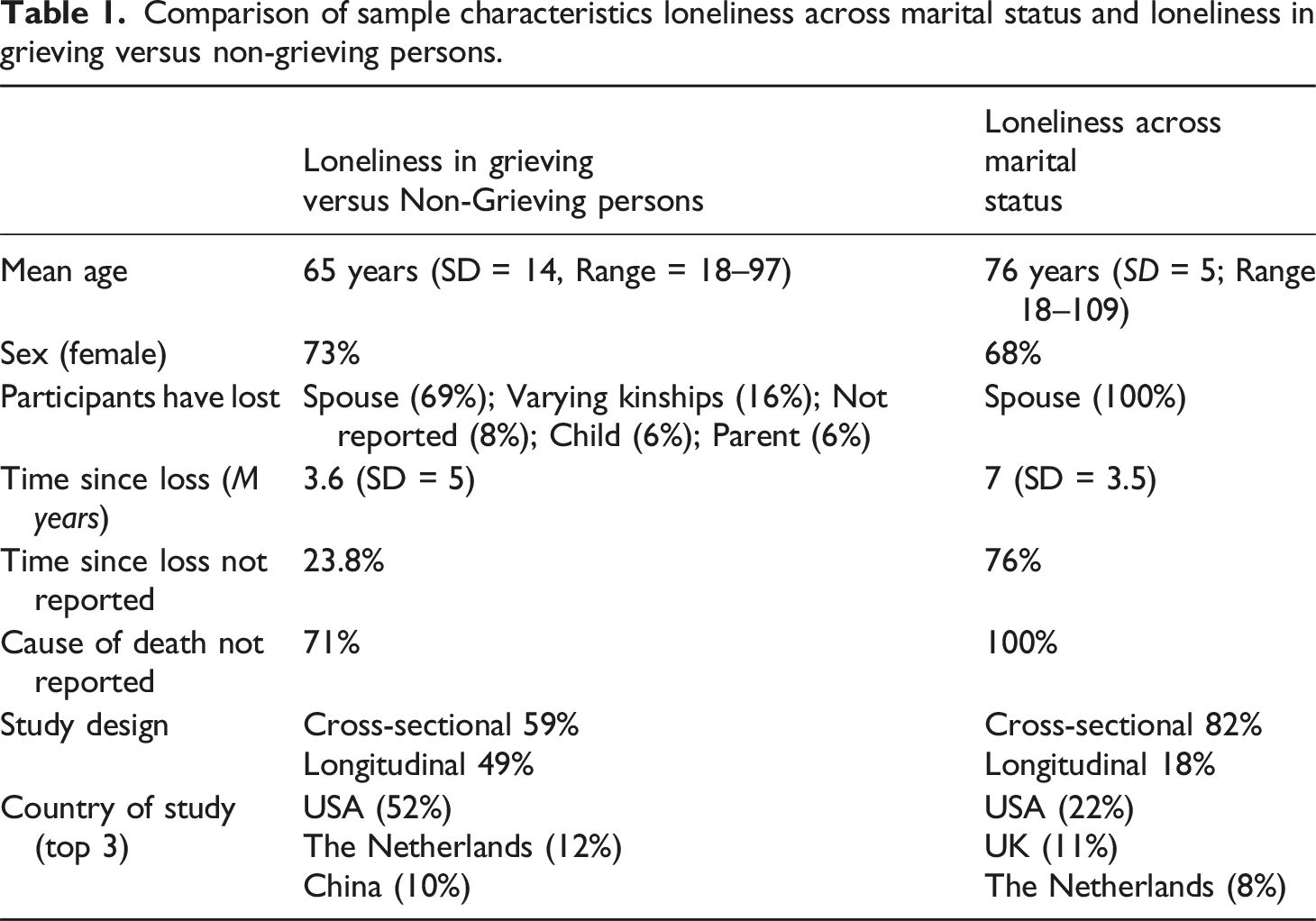
Comparison of sample characteristics loneliness across marital status and loneliness in grieving versus non-grieving persons.
More difficult to predict are the levels for the widowed compared with the divorced. Both have moved from couple to single status, however differential selection factors, possibly pointing to less loneliness in divorced persons, need consideration. Although all relationships can encounter conflict, the divorced category includes individuals who may have had a negative relational experience, possibly lowering their desire for a new relationship (Dykstra & Fokkema, 2007). At the same time, divorced marital status includes those who initiated the separation, which is associated with better mental health (cf., Hewitt & Turrell, 2011) and higher likelihood of remarriage, thus selecting the healthier divorced back into the married category (Gloor et al., 2021; Hewitt & Turrell, 2011). Selection out of the widowed and back into the married status category also occurs, but the divorced are quicker and more likely to remarry following their marital dissolution, compared with the widowed (Watkins & Waldron, 2017). Further, in contrast to divorce, widowhood increasingly occurs with advancement of age and the older the person is, the lower the probability of remarriage (Wolff & Wortman, 2006). Thus, widowhood may be associated with a greater predisposition to loneliness compared to divorce.
Stability of relationship status may account for better overall health (Hughes & Waite, 2009). Interestingly, this may also hold for unmarried individuals. With advancing age and over time, associations between loneliness and unmarried status becomes less pronounced, while satisfaction with partner-status increases (Böger & Huxhold, 2020).
Several variables may be correlated with loneliness and relationship status. After the dissolution of an intimate bond, there seems to be a gendered nature to repartnering. Men seem more likely than women to repartner after both divorce and widowhood (Brown et al., 2018; Carr & Boerner, 2013). Moreover, men – regardless of their partner status – tend to have smaller support networks and report higher levels of SL (Wright et al., 2019). However, men also tend to find life harder without a partner, which is associated with the experience of more EL and SL (Dykstra & Fokkema, 2007). Furthermore, loneliness plays a key role in mental health after loss. To illustrate, Fried et al. (2015) suggested that loneliness might be a “gateway” factor, important in the emergence of depressive symptoms, worsening the mental health impact of widowhood (see also Burger et al., 2020; Cacioppo et al., 2006).
Current study
In a previous review, we documented that loneliness is associated to grieving the loss of a personal relationship (various kin) through death (Vedder, Boerner, et al., 2021). The distinction between “grieving”, often seen as the more immediate response to loss in our society, and “widowhood”, which is perceived less as grieving and more as an extended aftermath of bereavement and simply a “marital status”, has inspired us to broaden our systemic search with the current review.
Our first aim was to conduct a systematic review of the empirical literature on loneliness across various marital statuses, with the objective of gaining insights from comparisons between widowed individuals and those who are not widowed with a special focus on marital statuses reflecting relationship-dissolution (widowed and divorced). The following research questions were formulated: 1. Are the widowed lonelier than people with other marital statuses? 2. Are the widowed lonelier than the divorced? 3. What are correlates of loneliness in widowed individuals compared to those with other marital statuses?
Given that marital dissolution has negative health and well-being consequences and for various reasons addressed above (for review: Sbarra & Hazan, 2008), we expected that the loss experiences of widow(er)hood would turn out as being particularly harmful. On balance, we anticipated higher rates of loneliness among the widowed compared to other marital statuses, albeit with smaller differences between the widowed and the divorced. Finally, we explored correlates of loneliness and marital statuses. Although we did not specify hypotheses beforehand, based on the above findings we anticipated age, gender, duration of relationship(-dissolution) and social support to be addressed.
Our second aim was to outline similarities and differences in loneliness after loss in grief literature on the one hand (as considered in our previous review; Vedder et al., 2021aVedder, Boerner, et al., 2021) and loneliness across multiple marital statuses on the other (current review). In doing so, we aimed to bridge the gap between quantitative research findings drawing from psychological perspectives and those gathered from sociological perspectives. Our research question was: 4. What complementary insights do studies on marital status and grief provide regarding loneliness following loss?
In both this review as well as our previous review, bereavement is elemental as it is the only entrance to widowhood and precedes grief. Bereavement is defined as “the objective situation of having lost someone significant; grief is the emotional response to one’s loss” (Stroebe et al., 2008, p. 5). To clearly distinguish our earlier and current reviews, we will use the terms “'marital status research”; “widowhood’” and its derivations when referring to the current results and '“grief research”; “grief’” to address the previous review.
In conclusion, this paper offers both a systematic review of loneliness across different marital statuses and a synthesis of the experiences of loneliness and grief as they may extend into widowhood.
Methods
The present study extends our previous review (Vedder et al., 2021a), conducted following the PRISMA Statement for systematic reviews (Moher et al., 2009). It was pre-registered at PROSPERO international registry of systematic reviews (registration number CRD42019128401). For both reviews, a systematic search was conducted in PubMed, PsycInfo, Web of Science, Medline and Scopus using the keywords “Bereavement” and “Loneliness”. For the current review, we extended our search string from the previous review with the term “Widow*”: ((Bereav*[Title/Abstract] OR Grief[Title/Abstract] OR Mourning[Title/Abstract] OR Widow*[Title/Abstract] OR “Loss of a partner”[Title/Abstract] OR “Partner loss”[Title/Abstract] OR “partner loss”[Title/Abstract] OR “Loss of a spouse”[Title/Abstract] OR “Loss of a child”[Title/Abstract] OR “Child loss”[Title/Abstract] OR “child”) AND (Lone*[Title/Abstract] OR “Social isolation”[Title/Abstract] OR Solitude[Title/Abstract] OR Withdrawal[Title/Abstract]).
Results
The search conducted on March 12, 2020, resulted in 8,119 articles. After removing 5,600 duplicates, 2,519 papers were left for screening. Screening and selection of papers was done independently by four authors of this paper following pre-defined criteria for eligibility including a separate analysis for loneliness, an adult bereaved population, marital status comparisons, and quantitative study designs. Differences in opinion were discussed until consensus was reached. Following title and abstract screening, 312 articles were retained, which, at that point, still included both the studies retrieved without and with the search term “widow*”. During the full-text screening, we subsequently excluded 274 articles not focusing on loneliness across marital statuses. This left 38 new articles for inclusion (Figure 1). Consequently, the studies included here and in our previous review did not overlap. PRISMA flow diagram.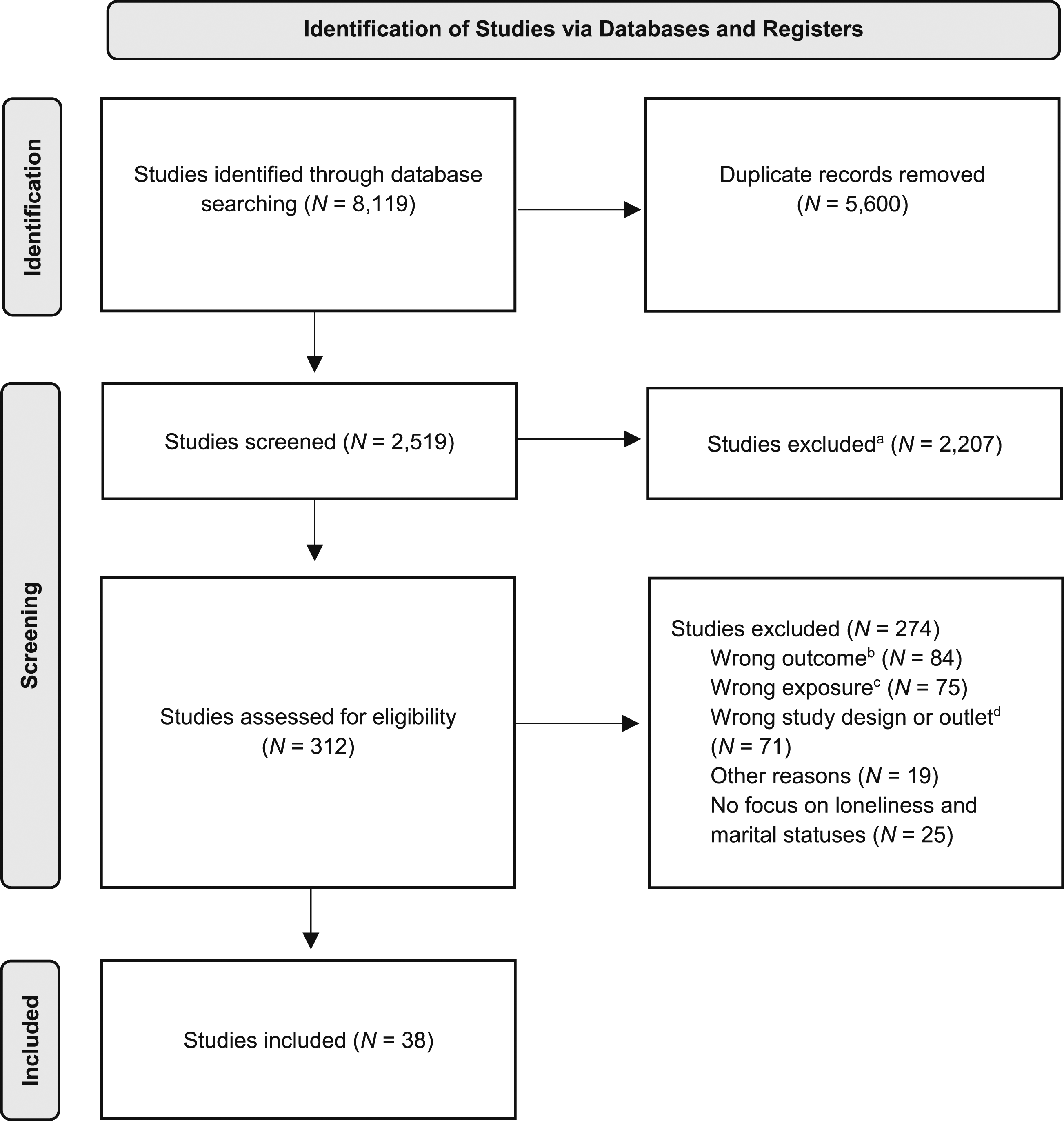
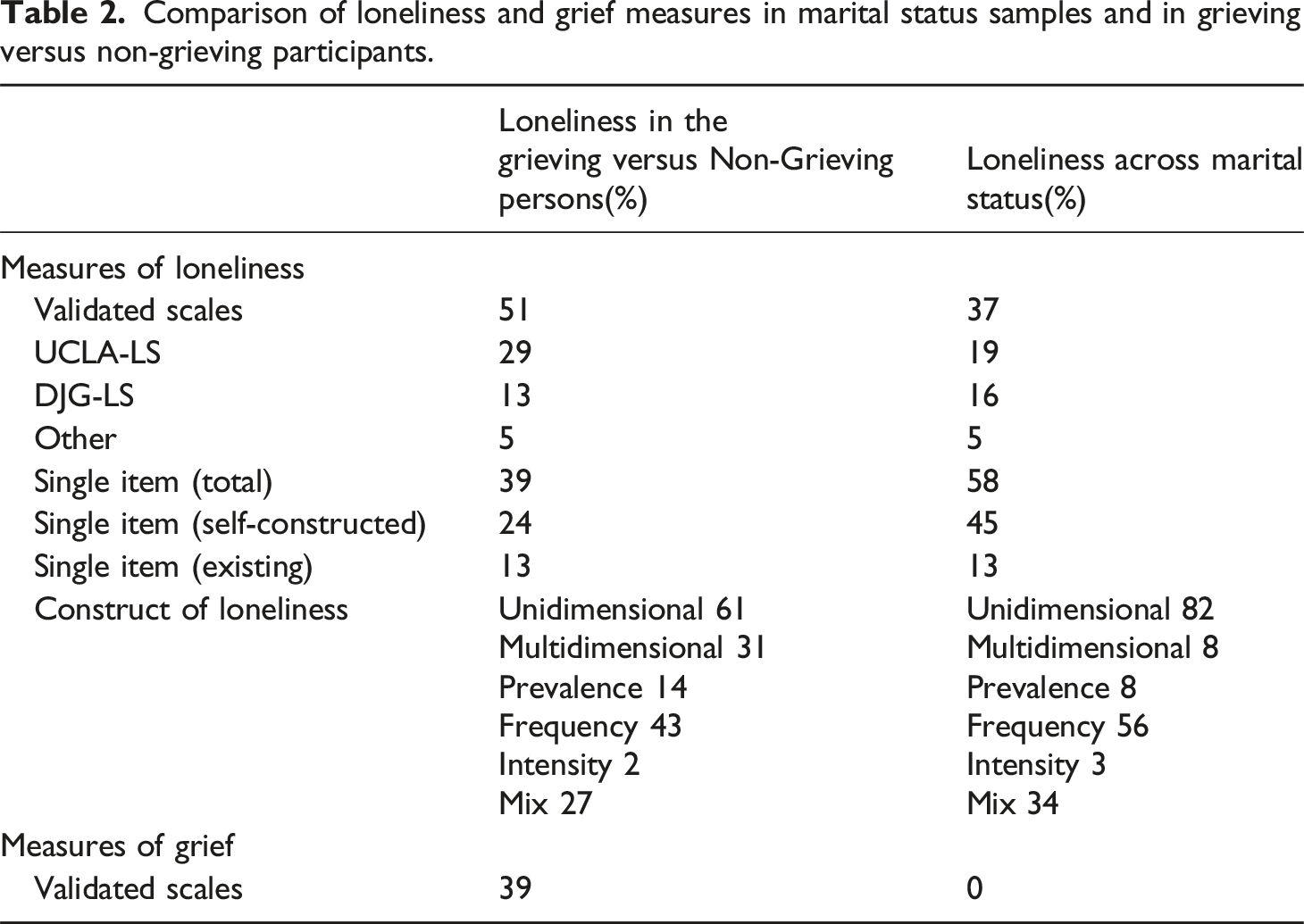
Comparison of loneliness and grief measures in marital status samples and in grieving versus non-grieving participants.
Sample characteristics
Weighted mean age was 76 (SD = 5; Range 18–109) years. On average, the participants were 66% female. Nine studies reported duration of widowhood with an average of 7 years (SD = 3.5; Ben-Zur, 2012; Brittain et al., 2017; Burger et al., 2020; Hansson et al., 1986; Katz, 1991; Panagiotopoulos et al., 2013; Perrig-Chiello et al., 2016; Pinquart, 2003; Savikko et al., 2005). Studies were mostly conducted in the USA (N = 8, 21%; Bishop & Martin, 2007; Christian et al., 1989; Dugan & Kivett, 1994; Hansson et al., 1986; Hoeffer, 1987; Kivett, 1979; Koropeckyj-Cox, 1998; Wright et al., 2019), followed by the UK (N = 4, 11%; Brittain et al., 2017; Dahlberg & McKee, 2014; de Koning et al., 2017; Jones et al., 1985), and the Netherlands (N = 3, 8%; Rius-Ottenheim et al., 2012; Van Tilburg et al., 2004; Van Tilburg & Suanet, 2019).
Study design
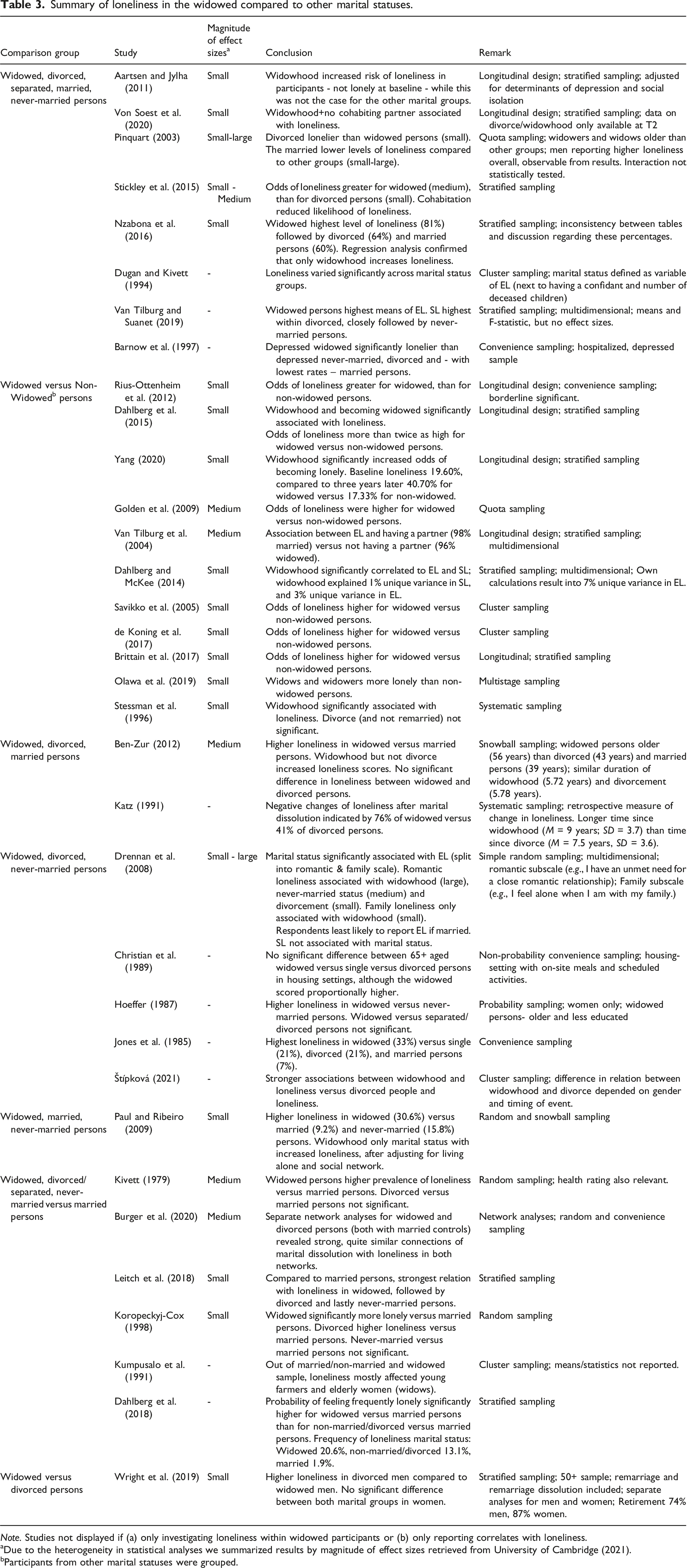
Summary of loneliness in the widowed compared to other marital statuses.
Note. Studies not displayed if (a) only investigating loneliness within widowed participants or (b) only reporting correlates with loneliness.
aDue to the heterogeneity in statistical analyses we summarized results by magnitude of effect sizes retrieved from University of Cambridge (2021).
bParticipants from other marital statuses were grouped.
Measures of loneliness
Fifteen studies (39%) used validated scales to measure loneliness. Eight studies (21%) worked with a version of the UCLA Loneliness scale (UCLA-LS; Ben-Zur, 2012; Bishop & Martin, 2007; Christian et al., 1989; Hansson et al., 1986; Olawa et al., 2019; Panagiotopoulos et al., 2013; Russell, 1996; Štípková, 2021; Wright et al., 2019). Six studies (16%) applied the De Jong Gierveld Loneliness Scale (DJG-LS; Dahlberg & McKee, 2014; De Jong Gierveld & Van Tilburg, 1999; Pinquart, 2003; Rius-Ottenheim et al., 2012; Van Tilburg et al., 2004; Van Tilburg & Suanet, 2019; Von Soest et al., 2020). Von Soest et al. (2020) added a single item question (direct measure) to the DJG-LS-3 (indirect measure). Drennan et al. (2008) applied the Social and Emotional Loneliness Scale for Adults (SELSA, N = 1, 3%; DiTommaso & Spinner, 1993) and Golden et al. (2009) used the Geriatric Mental State (GMS, N = 1, 3%; Copeland et al., 1988). All other studies investigated loneliness with a single/few item question, either self-constructed or derived from an existing scale (N = 22, 58%). Of all the aforementioned studies investigating loneliness, raw mean scores of loneliness were only reported by Ben-Zur (2012). Most studies investigated loneliness as a unidimensional concept (N = 31; 82%), while eight studies (21%) used a multidimensional concept of loneliness (i.e., EL and SL; Dahlberg & McKee, 2014; De Jong Gierveld & Van Tilburg, 1999; Dugan & Kivett, 1994; Pinquart, 2003; Rius-Ottenheim et al., 2012; Van Tilburg et al., 2004; Van Tilburg & Suanet, 2019; Von Soest et al., 2020). Lastly, loneliness was assessed predominantly by asking how often it is experienced (frequency; N = 21, 55%), but also by investigating its general occurrence in someone’s life (prevalence; N = 3, 8%; Barnow et al., 1997; de Koning et al., 2017; Leitch et al., 2018), or by asking if someone is bothered by it (intensity; N = 1, 3%; Perrig-Chiello et al., 2016). A mix of the former was also common (N = 13, 34%; Dahlberg et al., 2018; Dahlberg et al., 2015; Dugan & Kivett, 1994; Kumpusalo et al., 1991; Savikko et al., 2005 + all studies using DJG-LS mentioned above).
Are the widowed lonelier than people with other marital statuses? Are the widowed lonelier than the divorced?
Thirty-four studies (89%) compared loneliness between the widowed and other martial statuses. The scientific interest in loneliness amongst the widowed is evident, as all of the studies investigated feelings of loneliness within the widowed. However, only 18% of the included studies compared these results between all marital statuses separately. Grouping all other non-widowed marital statuses in (statistical) comparisons, was the most common practice (N = 11, 30%), followed by only using married individuals as comparison group for all other marital statuses (N = 7, 18%). Interpreting the results of these studies with regards to our research questions was therefore complicated. Table 3 presents an overview of all results, ordered according to the marital status comparison made in the specific studies. Additionally, we have added magnitudes of effect sizes and notes which are of particular interest for our review (e.g., sampling methodology).
Seven studies (18%) compared loneliness between all marital statuses (Aartsen & Jylha, 2011; Barnow et al., 1997; Dugan & Kivett, 1994; Kumpusalo et al., 1991; Pinquart, 2003; Van Tilburg & Suanet, 2019; Von Soest et al., 2020). Overall, descriptive as well as statistical results showed widowhood to be associated with greater loneliness than other marital statuses.
Sixteen studies (42%) compared loneliness between widowed and divorced participants. Most of these indicated that widowed individuals reported higher loneliness compared to divorced individuals (Aartsen & Jylha, 2011; Barnow et al., 1997; Drennan et al., 2008; Jones et al., 1985; Katz, 1991; Leitch et al., 2018; Nzabona et al., 2016; Stickley et al., 2015; Van Tilburg & Suanet, 2019; Von Soest et al., 2020, 2020típková, 2021). Five studies yielded contradictory results when: (1) persons were situated in housing settings that provided on-site meals and scheduled activities (Christian et al., 1989); (2) the duration spent in the previously married statuses were comparable and participants were relatively young (Ben-Zur, 2012); or (3) the widowed group was older, experiencing spousal loss more recently, reported frequent contact and high quality relations with adult children (Pinquart, 2003). Notably, there is evidence of a gender effect with divorced women and widows showing no difference in loneliness, while divorced men reporting more loneliness than widowers (Hoeffer, 1987); Wright et al., 2019).
What are correlates of loneliness in widowed individuals compared to those with other marital statuses?
Many reviewed articles reported correlates of loneliness in the widowed and compared these to other marital statuses. Again, comparison groups differed across studies. Results from widowed-only studies should be interpreted cautiously as some of them may also represent general main effects, instead of widowhood specific factors (depending on comparisons).
Intrapersonal correlates of loneliness across marital statuses
Most of the included studies focused on well-being and daily functioning. Mental health adversities, in terms of depressive symptoms, showed widowhood to be associated with higher loneliness (Barnow et al., 1997; Burger et al., 2020; Hansson et al., 1986; Panagiotopoulos et al., 2013). Self-rated health and functional status (e.g., ability to climb stairs) were reported to be associated with less loneliness across all marital statuses. Perceived stress and neuroticism were most strongly associated with higher loneliness in the divorced compared to other marital statuses (Bishop & Martin, 2007).
A further focus was gender and its relation to loneliness and marital status, resulting in reports of moderating effects. Men exhibited a higher probability of loneliness if widowed, and – to a lesser extent – when divorced than did women (Leitch et al., 2018; Van Tilburg & Suanet, 2019, 2019típková, 2021).
Interpersonal correlates of loneliness across marital statuses
Social relations with children, family, friends, and neighbors were the second-most investigated topic of the included studies. The investigations ranged from perceived social and emotional support (Bishop & Martin, 2007; Panagiotopoulos et al., 2013) to quality and quantity of social contacts and type of kin (sibling-, child and neighbor-relationships; Pinquart, 2003). There were significant associations between personal relationships and loneliness across every marital status group, most consistently in widowed persons. The only study not reporting associations between social connection and loneliness across marital status groups was conducted by Štípková (2021), which investigated social network-size.
Situation and circumstances of marital status and loneliness
Some studies focused on the duration of the loss, but associations between loneliness and duration of the separation (or the moderating role of time, impacting the difference between those two marital groups) were not statistically analyzed. Results showed recency of loss to be significantly associated to more loneliness in widowhood (Brittain et al., 2017; Dahlberg et al., 2015; Jones et al., 1985; Savikko et al., 2005).
Two studies examined changes of loneliness across historical time periods. Overall, widowed women were reported to be less lonely in more recent times, while this difference was not found for widowed men (Perrig-Chiello et al., 2016; Van Tilburg & Suanet, 2019).
In summary, studies comparing widowed to other marital statuses identified mental health, gender, social support, recency of loss, and historical time to be associated with loneliness.
What complementary insights do studies on marital status and grief provide regarding loneliness following loss?
To begin, most of the articles reviewed here were linked to a sociological or gerontological perspective, in contrast to the psychological approach predominant in the studies from our previous review. Furthermore, both sociological and psychological researchers utilized correlational analyses that require continuous variables. However, studies on marital status primarily focus on categorical variables and differences between groups.
Below, we compare the sample characteristics from both reviews (see also Table 1) and the measures of loneliness (for an overview, see Table 2). Additionally, we compare the correlates of loneliness related to marital status (findings above) with those related to grief (cf. Table 3; Vedder et al., 2021a).
Sample characteristics
The studies on marital status included in this review exclusively examined spousal loss. In contrast, our previous review on grief covered losses of spouses, partners and various family members, including children and parents. Furthermore, research on marital statuses tends to include older participants who have experienced loss a longer time ago compared to participants in grief studies, which more frequently examine participants early after loss, and utilize longitudinal designs more frequently. Both fields predominantly conducted their studies in Europe and North America; however, grief researchers also focused on China in their investigations.
Loneliness measures
Overall, studies investigating loneliness across marital statuses more frequently measure loneliness with a single item, in contrast to grief research, which predominantly uses validated scales. Additionally, the single items were more often self-constructed. In both marital status as well as grief research, loneliness was most commonly examined as a unidimensional construct, whereby a higher frequency was interpreted as higher prevalence of loneliness. The multidimensional construct of loneliness is relatively more often represented in studies comparing grieving to non-grieving individuals than studies comparing marital statuses.
Intrapersonal correlates of loneliness
Increased loneliness was found to be correlated with lower mental and physical health in both widowed and grieving individuals, while this association was less prominent for non-widowed and non-grieving people. Symptoms of depression were most commonly examined, and emerged as being associated to loneliness after loss in both reviews. This was also the only mental health variable of focus within the marital status comparison and loneliness, while grief research also included other mental health outcomes (e.g., posttraumatic stress, prolonged grief), reporting associations with mental ill-health and loneliness beyond symptoms of depression. Attachment style was not part of the marital status-related examinations, while studies on grieving versus non-grieving persons have analyzed its connections with reported associations to (emotional) loneliness after loss. Likewise, studies considered in this review did not focus on age. In our companion review, most studies found no association between loneliness in grieving individuals and age. Next, the current review indicates that gender moderates the association between loneliness and marital status. Therefore, it is tempting to infer that the loss of a spouse may be associated to more loneliness in men than in women. However, the current grief literature (previous review), is more inconclusive. There, we find some studies confirming men to experience more loneliness, but the same number of studies documenting equal levels of loneliness in men and women.
Interpersonal correlates of loneliness
Social support has been investigated elaborately in both fields. Overall, lack of social support seems to be associated to heightened loneliness across the widowed marital status and in grieving individuals.
Situational and circumstantial correlates of loneliness
Here a difference in focus is evident. While the studies focusing on marital status investigated duration of widowhood and historical period as possible influential factors, grief studies concentrated more on the cause of death or type of lost relationship.
Both research fields primarily focus on the unidimensional definition of loneliness and the frequency of this experience. Studies are mostly conducted with European and North American participants. Overall loneliness correlates with poorer mental and physical health, exacerbated by a lack of social support. Marital status research sheds light on the circumstances of loneliness and spousal loss among older participants, with potential gender moderation. Grief research explores factors related to death, often in younger samples with recent losses, revealing associations with mental health outcomes beyond depression, alongside attachment styles and coping mechanisms.
Discussion
Loneliness is a common consequence of bereavement, which poses a serious risk to the mental and physical health of grieving individuals (Vedder et al., 2021a). While loneliness typically decreases over time (Stroebe et al., 2017), the long-term course is not well-understood. In this systematic review, our primary goal was to compare loneliness among widowed individuals with that of individuals in other marital statuses. Additionally, we aimed to juxtapose the empirical findings on loneliness from marital status research (current review) with those from grief research (previous review), integrating insights from both research domains.
Loneliness across marital statuses
Overall, widowed persons are lonelier than individuals with other marital statuses. Diverse social and societal factors may account for this relative excess. For example, widowed often have fewer social resources, for instance, when their social network does not align with their age-related, intensifying support needs (Cattan et al., 2005; Rook, 2009). Moreover, increases in loneliness have been found to be moderated by social wealth and income (Freak-Poli et al., 2022).
We expected higher levels for loneliness among widowed, specifically as compared to divorced persons. This assumption appeared to be confirmed, as most results pointed to more loneliness in the widowed. Hence, the loneliness experience in widowhood and divorce may differ considerably. Some explanation for this emerged from the included studies on EL versus SL. EL appears to reflect the experience of widowed persons, while divorced participants specifically report higher SL. This is in line with attachment theory (Bowlby, 1982) posing that losing a spouse will lead to longing and yearning for that specific person or intimate relationship, possibly leading to EL. By contrast, dissolution of a marriage through divorce is often followed by having to re-establish shared friendship-circles as well as losing neighbourhood connections due to relocation, resulting in higher SL (Dykstra & de Jong Gierveld, 2004). This reasoning emphasises the need to assess loneliness with measures that cover these two loneliness sub-types.
Next, we explored subgroup patterns of loneliness among marital statuses. Overall, mental health adversities seem to be associated with more loneliness in widowed individuals. However, studies rarely investigated this issue between different marital statuses and the emphasis was placed on depression. Another main focus is the association between loneliness and social support. Here, statistical comparison between all the marital groups were included. In sum, while social connections are crucial in addressing loneliness, it is equally important to customize support according to individual needs (e.g., keeping normative and gendered role expectations in mind; targeting EL and SL differently). To illustrate, the study by Pinquart (2003) revealed unique benefits of different social ties per marital status. Widowed participants seem to benefit most from regular contact with children, while divorced individuals – when feeling lonely – may need to improve the quality rather than quantity of their parent-child interactions. Based on this review, enhancing someone’s social support system via friends seems to be a beneficial strategy for all marital statuses. Again, differences of EL and SL ensuing distinct needs with regards to social support should be taken into account. People who seek someone to confide in, may not be helped by having more social contacts. Additionally, normative role expectations significantly influence how non-kin social support is perceived. In married individuals, for instance, heightened support from friends may offer less assistance, as the expectation is often for spouses to fulfill that role (Warner & Adams, 2016).
Finally, the current review suggested moderating effects of gender on loneliness across marital status – especially among the widowed. This is in line with research reporting men to experience more negative health effects after spousal-loss, especially if not remarried, whilst widowed women do not report worse health than married or divorced women (Williams & Umberson, 2004). Older women are also reported to have larger social support systems than older men, reaching out more likely in times of need (Okamoto & Tanaka, 2004; Oliver et al., 2005; Pinquart, 2003). Again, this could potentially stem from societal expectations of traditional gender roles, where men and women anticipate and are anticipated to fulfill different roles within both their familial and non-familial relationships.
Insights from marital status and grief studies on post-loss loneliness
The second aim was to compile evidence of loneliness across marital status (current review) and loneliness in grief (previous review). In both reviews, loneliness emerges as key feature after loss. Mean time since loss was higher in the marital status sample compared to our grieving versus non-grieving sample, but the association between loss and loneliness was evident in both, indicating the persistence of loneliness throughout the years after the loss. The assessment of loneliness is heterogeneous and still predominantly unidimensional, lacking attachment-theory driven investigation, although grief researchers focus more on this aspect of (coping with) loss. Grief measures are absent in the included marital status studies, but also integrated only marginally in bereavement research. Hence, currently, there exists a deficiency of research measuring possible relations between loneliness and the intensity of grief.
In general, the lack of comparison groups is evident in contemporary research on both marital status and grief. In exploring the impact of loneliness following loss, studies on marital status should consider losses due to death (of any family member) within their non-widowed groups as well, before making conclusions about bereavement and factors related to grief. Conversely, grief research involving bereavement should preferably include comparison groups consisting of non-bereaved individuals.
Taking the two reviews together, mental health and well-being factors seem to be associated to loneliness after loss. From grief research we learn that attachment and coping are potential factors connecting loneliness and bereavement too. Although social support has been studied extensively in both fields, in both psychological as well as sociological endeavors, there is a lack of theory-driven empirical research elaborating on the possible mechanisms through which social connections alleviates loneliness after loss. Finally, while gender seemed to influence the link between loneliness and marital status, our examination of grief studies, which focused on death-related factors and psychological responses to loss, provided less conclusive findings. This indicates that sociological factors may play a larger role in explaining why men experience increased loneliness after marital dissolution compared to women.
Altogether, the two relatively independent domains of marital status and grief research sometimes provide complementary information, with each contributing to a general body of knowledge about loneliness after loss.
Limitations and future directions
Several limitations should be considered when interpreting the results of our systematic investigation. Our choices for certain databases and the applied search-syntax have influenced the retrieved literature. The evidence reported in this review reflects the quantitative published research, while further knowledge may be available in additional data sets that were not identified via our search techniques. In our attempts to understand loneliness following loss, we focused solely on widowhood and did not include other marital statuses in our literature search. As a result, studies comparing loneliness across, for example, married and divorced individuals, were not included. Therefore, our synthesis does not encompass the entirety of marital status research. We also need to consider that the studies included in this review mostly researched formal, legal and traditional marital relations. Consequently, generalization is limited. To illustrate, in none of the included studies participants identified as other than cisgender men or women (although we do not know if alternatives were actually assessed). Furthermore, only heterosexual relationships were explicitly mentioned, which is why we assumes that the data-sets include only heterosexual relationships. Lastly, only three studies included relationship-history, re-partnering or co-habitation as a variable (Van Tilburg & Suanet, 2019; Von Soest et al., 2020; Wright et al., 2019). Future work in this area should focus on, for example, queer relationships but also both prior and current marital status, registered partnerships and co-habitation, in order to uncover implications for (older) adults' loneliness (Dykstra & de Jong Gierveld, 2004). Additionally, as this review includes mostly participants from western and individualistic countries, efforts to investigate loneliness in a non-western and/or collectivistic context is called for. Nonetheless, a number of critical points for future research and practical implication emerge from our review and the integration with results from grief-studies.
Comparison groups
First, the published scientific knowledge about loneliness across marital status is scattered, lacking systematic investigation. Comparison groups are rarely the same (see Table 3) and non-widowed marital statuses are grouped together in most of the statistical analyses. Analyses of loneliness seem to be focussed on widowed marital status - which is, as substantiated by our examination, a crucial group to concentrate on. However, we also provide evidence of prevailing loneliness in divorced, never-married and – to a lesser extent – in married individuals. These restricted comparisons of marital status groups limited the evaluation of correlates too. To illustrate, gender differences in loneliness may not only be evident in widowed but in men and women generally, thus reflecting a general finding rather than it being specific for one marital status group. Furthermore, as most of the included studies used a retrospective, cross-sectional design, associations were investigated in a statistical sense rather than a causal relation. All these aspects are evident in research on grief as well. Thus, to gain further knowledge about the possible impact of loneliness and potential protective factors, it seems valuable to avoid merging all non-widowed marital statuses into a single comparison group and to control for bereaved individuals within the non-widowed comparison groups. Ultimately, to reveal protective and risk factors for loneliness after loss, prospective longitudinal studies are essential.
Loneliness measures
Second, the assessment of loneliness needs closer examination (cf. Maes et al., 2022). Currently, various measures of loneliness are adopted in marital status research. The majority of the included studies used single/few-item measures. These items vary so much in terms of formulation, theoretical understanding of loneliness (unidimensional vs. multidimensional) as well as aspect measured (prevalence, frequency or intensity) that generalizations of results become difficult to make. Scales like the UCLA, DGJ-LS or SELSA, used in a minority of the studies, consist of similar variances in assessment (e.g., frequency vs. intensity), but enable differentiation of EL and SL, potentially providing important understanding of marital status differences and the lasting effects of loneliness after loss. Comparable measurement-issues are evident in grief research. At present, the inconsistency with which loneliness is measured results in heterogenous, incomparable findings, associated with a lack of evidence-based knowledge and therefore support. Accurate measurement of loneliness may lead to different approaches when tackling loneliness (e.g., emotional support vs. enlarging social networks). Future research should aim to adopt loneliness-measures fitting the target group as well as research objective and – ideally – consider both EL and SL (for an overview, see Vedder, Stroebe, et al., 2021).
Psychological aspects of loss
Third, in studies focusing on the aftermath of loss, mental health adversities such as (intensity of) grief and trauma were associated to more loneliness, while flexible coping was associated to less loneliness. However, in marital status comparison of loneliness these factors were not investigated. Finer-grained information about the cause, expectancy, and time since death versus breakup, could clarify the impact of loss through passing or divorcement.
Sociological aspects of loss
Fourth, information about the impact of marital dissolution in young age is still lacking. The average age of widowed persons in this review was 76 years old, while they were 65 in the previous investigation. The connection may be either smaller, as young widow(er)s are more likely to have a larger social network and remarry, or greater because the loss is not age-normative, which may lead to less availability of coping strategies (Boerner & Jopp, 2007; Yang & Gu, 2021). Further research on this topic could reveal interesting information about possible differential influences across marital statuses, especially when it comes to the potential impact of marital dissolution(s).
Combining psychological and sociological aspects of loss
Lastly, the synthesis of our earlier (Vedder et al., 2021a) and current reviews could provide foundational knowledge for investigating loneliness following loss and enabling adjustments during bereavement. Importantly, Maciejewski et al. (2022) introduced a micro-sociological theory of adjustment to loss. They outline distinct social needs stemming from both psychological and sociological perspectives of bereavement, which appear to resonate with our findings (EL and SL; gendered moderation of loneliness and marital status). Additional research is needed particularly concerning the gendered nature of both the widowhood experience compared with that of divorce, as well as the gendered nature of social network and support responses to these distinct marital status transitions (Dykstra & Fokkema, 2007; Kalmijn, 2007; Rook & Charles, 2017).
Conclusion
We summarized contemporary research on loneliness across marital statuses, showing that on average the widowed are lonelier than the divorced, never-married and married individuals. Moreover, our review of studies concerning widowhood and loneliness also revealed various associated, negative consequences of loneliness after loss and provided information on protective factors which may reduce this experience among widowed persons.
To the best of our knowledge, this article represents the first attempt to integrate empirical findings from both marital status research and research on grief. By merging these two domains, we demonstrate how the disciplines of psychology and sociology complement each other, highlighting how their combined insights can enhance our understanding of loneliness following loss both theoretically and practically.
Overall, our results demonstrate the importance of assessing and understanding loneliness after loss, so that efforts can be directed toward ameliorating it, as well as the importance of conducting research on its antecedents and causes, consequences, and possible interventions.
Supplemental Material
Supplemental Material - Exploring loneliness across widowhood and other marital statuses: A systematic review integrating insights from grief research
Supplemental Material for Exploring loneliness across widowhood and other marital statuses: A systematic review integrating insights from grief research by Anneke Vedder, Margaret S. Stroebe, Jeffrey E. Stokes, Henk A.W. Schut, Bibi Schut, Kathrin Boerner and Paul A. Boelen in Journal of Social and Personal Relationships
Footnotes
Funding
The author(s) received no financial support for the research, authorship, and/or publication of this article.
Open research statement
As part of IARR’s encouragement of open research practices, the author(s) have provided the following information: This research was pre-registered. The aspects of the research that were pre-registered were the review question, searches, types of study to be included, condition or domain being studied, participants/population, main outcomes, measures of effect, data extraction, risk of bias, strategy for data synthesis, review team, type and method of review. The registration was submitted to: Prospero. All files and analyses prepared for the current review are available from first author upon reasonable request.

Supplemental Material
Supplemental material for this article is available online.
References
Supplementary Material
Please find the following supplemental material available below.
For Open Access articles published under a Creative Commons License, all supplemental material carries the same license as the article it is associated with.
For non-Open Access articles published, all supplemental material carries a non-exclusive license, and permission requests for re-use of supplemental material or any part of supplemental material shall be sent directly to the copyright owner as specified in the copyright notice associated with the article.
