




Abstract
Up to date, the systemic mechanisms that explain the intergenerational transmission of familial dysfunction remain theoretically and empirically unclear. Hence, this study examines the intergenerational transmission of relational and intrapersonal dysfunction and their collective effect on the psychological adjustment of third-generation children through the lens of Bowen family systems theory. Lithuanian parents (N = 348; Mage = 40.66; range 26–59) of children aged six to ten years cross-sectionally reported on their differentiation of self (DoS), emotional and relational dynamics within their family-of-origin and nuclear family, and the psychological adjustment of their child of greatest concern. Structural equation modeling and mediation analyses findings offered empirical support to Bowen theory, highlighting that family-of-origin dysfunction is associated with nuclear family intrapersonal and relational dysfunction, and ultimately with third-generation’s psychological maladjustment. Results demonstrated that a poor family-of-origin emotional system appears to contribute, via triangulation processes, to reduced DoS in adult children. The reduced DoS appears to perpetuate intergenerational triangulation, and to negatively impact couple relationship and co-parenting functioning within the nuclear family. In contrast to triangulation, couple dysfunction was found to predict poorer psychological adjustment in third-generation offspring. This study advances family systems theory by (i) examining the prominent role of triangulation and DoS within the intergenerational transmission process, (ii) highlighting the potential differential impact of a negative nuclear family emotional system on children through triangulation, and (iii) clarifying the potential role of spousal relationship satisfaction and co-parenting in mediating the relationship between parental DoS and offspring’s psychological adjustment.
Keywords
Introduction
According to the Centers for Disease Control and Prevention ([CDCP]; 2023) between 2016 and 2019, approximately 5.8 million youth were diagnosed with anxiety, 5.5 million with behavioral problems, and 2.7 million with depression. Similar to CDCP’s concerning report, the first epidemiological Lithuanian study with a nationally representative sample of 3309 children aged 7–16 years reported the disturbing 13.1% estimated point prevalence of ICD-10 psychiatric disorders (Lesinskiene et al., 2018). Whilst considering this alarming reality, the present study aims to shed light on the potential contribution of intergenerational, and familial emotional and relational dynamics to this apparent mental health pandemic (Gutkin, 2012) among children and adolescents.
Empirical research involving children and adolescents typically ranges from a monadic (i.e., individualistic) to a dyadic focus. Monadic type of studies have shown, for instance, that suicidality in children and adolescents is associated with depression, anxiety, substance abuse, comorbid psychiatric disorders and personality traits, such as neuroticism and impulsivity (Carballo et al., 2020). Likewise, a systematic review by Stiglic and Viner (2019) has documented robust evidence linking screen time with elevated depressive symptoms among children and adolescents. Dyadic type of studies have underscored among others the significant impact of family experiences on youth’s well-being and mental health. For example, recent systematic reviews and meta-analyses have consistently shown associations between parental autonomy support and children’s psychological health (Vasquez et al., 2016), severity and chronicity of maternal depression and children’s adjustment (Sutherland et al., 2022), parental warmth and positive control, and increased prosocial behavior in children (Van der Storm et al., 2021), types of parenting and children’s self-esteem (Pinquart & Gerke, 2019), perceived parental psychological control and depression, and anxiety in children (Chyung et al., 2022), and perceived parental hostility/aggression and children’s psychological maladjustment (Khaleque, 2016).
Beyond the monadic and dyadic empirical landscape, Bowen family systems theory (Bowen theory; Bowen, 1993; Kerr & Bowen, 1988) postulates that a child’s psychological adjustment or mental health is an integral functional component of the nuclear family emotional unit; with the nuclear family unit being an integral functional component of the broader intergenerational transmission process. Within this systemic reasoning, a child’s psychological maladjustment is construed as a reflection of emotional and relational pathology that embeds within the nuclear family. In turn, the family-level pathology is hypothesized to stem from dysfunctional relational patterns that have been transmitted from preceding generations. From this systemic vantage point, the present study seeks to examine whether relational pathology may indeed transmit from one generation to the next one, and whether family-level dysfunction may contribute to children’s mental health problems in Lithuania. Lastly, this study seeks to construct and empirically test a complex three-generation mediation model founded on Bowen theory’s core constructs namely, intergenerational transmission, relational and individual dysfunction, differentiation of self (DoS) and triangulation which are discussed next.
Intergenerational transmission of familial dysfunction
Bowen theory (Bowen, 1993; Kerr & Bowen, 1988) describes the broad intergenerational transmission mechanism through which dysfunctional familial patterns may perpetuate across generations. The morbid patterns are theorized to disrupt the spousal (or parental) relationship and/or lead to pathology within a targeted family member. While considering these theoretical intergenerational insights, the transmission of mental health morbidity could be explained across generations (vertically) as well as within the nuclear family (horizontally). Within the vertical intergenerational process, parents may transmit varying degrees of their immaturity to successive generations (Bowen, 1993). The vertical process is not expected to affect all siblings alike, as a particular child typically becomes the focal point of the family projection process (i.e., the child who later becomes the family’s greatest concern). This child is expected to show lower levels of DoS (Skowron & Schmitt, 2003) which, in turn, is expected to negatively influence their psychological adjustment and life achievements. In contrast, siblings less engaged in and affected by the parental relationship are expected to exhibit differentiation of self (DoS) levels unrelated to or even higher than those of their parents.
Despite the presence of well-developed theoretical concepts, Lawson and Brossart (2001) emphasized the limited attention given to the intergenerational transmission of morbid familial relational patterns. Their study revealed a robust generational influence from the participants’ parental relationship on the participant-spouse relationship and a comparably weaker influence on third-generation children over issues of family-level intimacy and individuation. Furthermore, Lawson and Brossart (2001) emphasized that patterns of individuation exhibited the most significant contribution to the processes of intergenerational transmission.
Following on from Lawson and Brossart (2001), Klever contributed significantly to the longitudinal and systemic investigation of the intergenerational transmission process. Klever (2001) found that young spouses whose families-of-origin experienced more emotional dysfunction were more prone to encountering emotional challenges compared to their counterparts from families with fewer emotional problems. Subsequently, Klever (2003) discovered that more distant or overly involved relationships with the couples’ parents correlated with more symptomatic nuclear families. The same author (Klever, 2004) showed that dysfunctional spousal relationships were associated with offspring’s dysfunction, and in a later study (Klever, 2015) that heightened emotional detachment from the family-of-origin was linked to a more pronounced nuclear family symptomology. Likewise, Baptist et al. (2012) showed that adults’ conflict styles were influenced by the interplay between perceived family-of-origin emotional functioning and attachment. Collectively, these studies provide compelling evidence that morbid nuclear family dynamics can indeed traverse generational boundaries. Bowen theory (Bowen, 1993; Kerr & Bowen, 1988) has clarified that the intergenerational transmission can be realized in parallel interconnected levels: At the family level, intergenerational transmission may take place through triangulation processes that signify spousal relational disharmony; with both contributing to a dysfunctional nuclear family emotional system. At the individual level, intergenerational transmission may take place through family members’ lower levels of DoS. Next, we discuss these interconnected systemic constructs.
The role of differentiation of self in the family emotional system: a link among couple relationship and co-parenting quality, triangulation, and child adjustment
Differentiation of self is a systemic concept in Bowen theory which involves both an intra- and an interpersonal dimension. Intrapersonally, highly differentiated individuals are thought to distinguish between affect and thinking and able to remain collected at the face of conflict and adversity. Interpersonally, highly differentiated individuals are thought to successfully hold on to their self while being engaged in intimate relationships and able to achieve a healthy balance of autonomy and intimacy (Bowen, 1993; Kerr & Bowen, 1988). Research has consistently showed that DoS appears to be crucial for optimal human functioning. Higher DoS is associated with well-being across relationships, and better mental and physical health (e.g. Calatrava et al., 2022; Işık et al., 2020; Lampis, 2016). Bowen (1993) asserted that individuals tend to choose partners with similar levels of DoS, thus couples with lower DoS are expected to experience heightened dyadic discord especially in the face of adversities due to their expected difficulties in managing anxiety, effective problem-solving, and in balancing autonomy and intimacy (Kerr & Bowen, 1988). Put differently, poorly differentiated couples are expected to develop a compromised nuclear family emotional system as this may be reflected in poor couple relationship satisfaction, co-parenting discord, children’s triangulation, and, over time, personal, partner and/or children emotional dysfunction.
Numerous studies validated the decisive role of DoS in a healthy nuclear family by documenting significant associations between higher levels of adult DoS and positive outcomes in various couple relationship domains, including adjustment, satisfaction, quality, and intimacy (e.g., Işik et al., 2020; Kapel Lev-Ari et al., 2020; Lampis, 2016; Lampis et al., 2019). Likewise, a scoping review of 56 studies (Calatrava et al., 2022) indicated a strong support for positive DoS outcomes, such as better dyadic adjustment, higher marital and sexual satisfaction, better communication, less conflicts etc.
Unlike the consistent association between higher DoS and better couple adjustment, empirical evidence concerning the association between parental DoS and offspring adjustment is both scarce and inconsistent. Skowron (2005) found that in low-income urban families, mothers with greater DoS had children with reduced aggression and better verbal and math achievements. Similarly, Peleg et al. (2015) discovered that higher maternal DoS related to lower separation anxiety in adolescents. In contrast, Peleg et al. (2006) found that higher maternal DoS correlated with increased children’s separation anxiety and neurotic behaviors. In light of these conflicting findings, parental DoS may indirectly influence children’s adjustment perhaps through complex mediated relationships. Perceived co-parenting quality and triangulation are discussed next as possible mediators.
Parkes et al. (2019) argued that positive co-parenting during preschool years contributed to supportive couple relationships which were in turn associated with reduced externalizing problems during middle childhood. In the same vein, families facing higher risk factors (Li et al., 2022), such as co-parenting conflict and family instability, were more likely to exhibit negative parental sensitivity and show a decline in their turn-taking patterns. Further to its associations with couple relationship quality, co-parenting quality has emerged as a mediating factor in several studies. Co-parenting conflict (Zemp et al., 2018) was found to link interparental verbal aggression and child problems. Likewise, co-parenting quality was found to mediate the association between marital relationship quality and child adjustment (Camisasca, Miragoli, Di Blasio, et al., 2019), and the association between intimate partner violence (reflective of lower DoS) and child behavior problems (Kolsky & Gee, 2021).
Similar to co-parenting quality, triangulation processes have been found to be crucial to nuclear family functioning. Triangulation arises when a third party, typically the most vulnerable child, becomes involved in the conflicting and/or alienated relationship of comparatively lower differentiated spouses (or parents). Triangulation is thought to materialize a family projection process, wherein parents transmit their own immature DoS to the targeted child. This intergenerational transmission is theorized to negatively impact children’s mental health and psychosocial adjustment (Bowen, 1993; Kerr & Bowen, 1988) with extensive empirical evidence substantiating this theoretical notion (e.g., Buehler et al., 2009; Camisasca, Miragoli, & Di Blasio, 2019; Dallos et al., 2015; Fosco & Grych, 2010; Grych et al., 2004; Van Petegem et al., 2022). In a similar vein, McCauley et al. (2021) empirically supported the theoretical assertion that the primary function of triangulation is to mitigate anxiety and maintain harmony between parents.
However, empirical evidence has linked triangulation with family functioning in multiple as well as complex ways. For instance, Fosco and Grych (2010) discovered in their longitudinal study that adolescents’ experience of being caught in the middle predicted elevated self-blame and perceived threat appraisals, with the latter predicting a decline in coping abilities over time. Additionally, Dallos et al. (2015) suggested in their qualitative study that spousal conflict may lead to “the 'dreaded' fear of their parents breaking up [that] represents a massive attachment threat, namely, the loss of their family, home, stability, and sources of affection” (p. 13). This fear may exacerbate self-blame and efforts to resolve parental conflicts by becoming further engaged in triangulated relationships, such as forming alliances with one parent against the other or engaging in scapegoating behaviors. Furthermore, Song et al. (2022) showed that family-of-origin triangulation detrimentally affects marital stability and co-parenting thereby impacting children’s adjustment. Additionally, Fosco and Grych (2008) found that triangulation during parental conflict shaped children’s subsequent appraisals and distress responses as well as predicted externalizing problems. Likewise, McCauley and Fosco (2022) demonstrated that low family cohesion amplified triangulation risk over time, suggesting that family strategies for managing interparental conflict were influenced by the broader family climate.
The present study
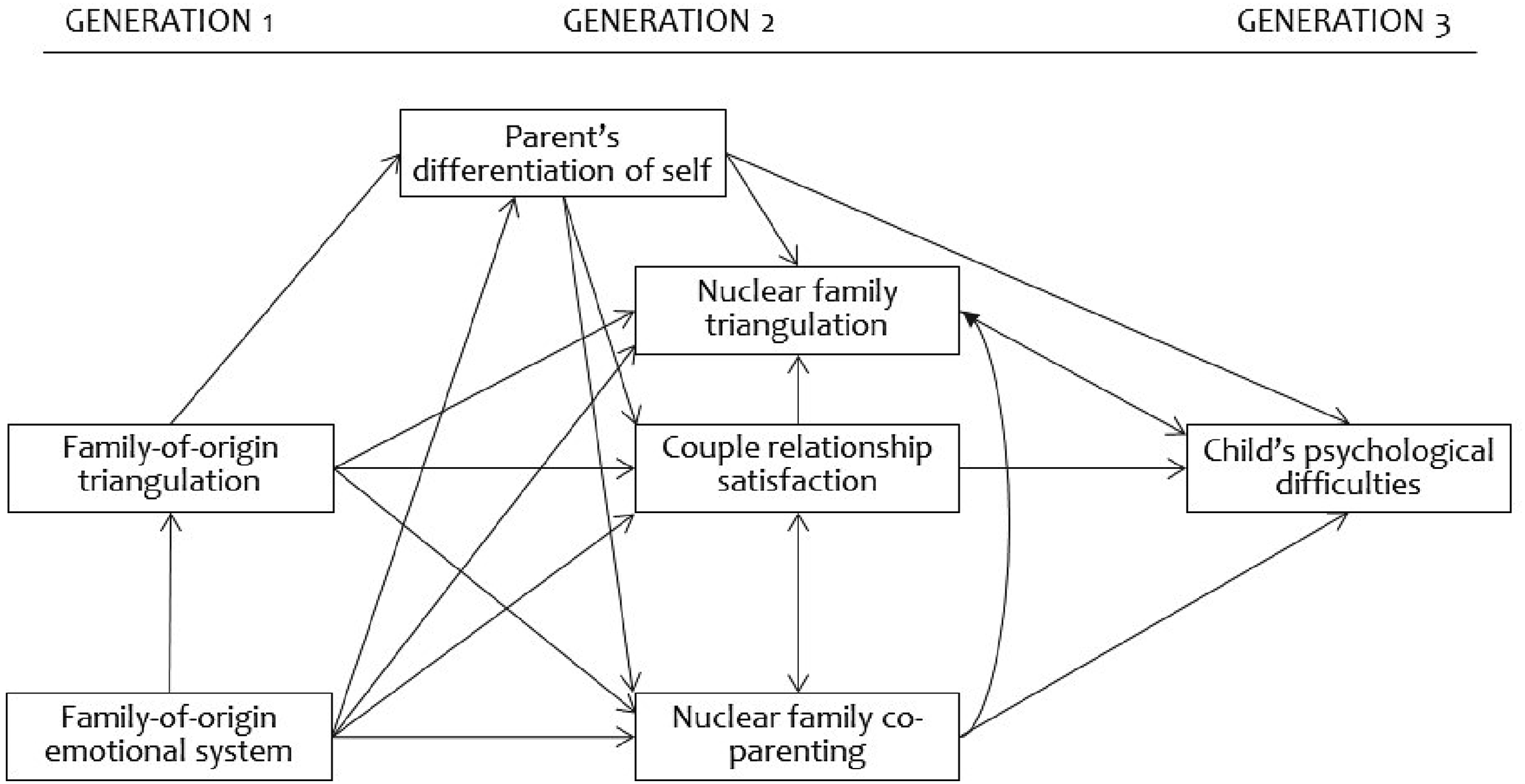
Whilst there is an exponential increase in research in Bowen theory (Bowen, 1993; Kerr & Bowen, 1988), a collective empirical investigation of nuclear family emotional dynamics, and the intergenerational transmission of relational and intrapersonal dysfunction is lacking. Therefore, we empirically tested our proposed theoretical three-generation complex mediation model (see Figure 1) that foresees the intergenerational transmission of relational dysfunction which, in turn, predicts the psychological dysfunction of third-generation children. Our proposed theoretical model involves the interconnected systemic phenomena of family-of-origin emotional system, triangulation (both within the family-of-origin and nuclear family), parental DoS, nuclear family couple relationship satisfaction, and nuclear family co-parenting quality, and their effect on the psychological adjustment of third generation children. Further to the overall testing of our proposed mediation model, we employ mediation path analyses to better clarify specific relationships within the model while testing the following hypotheses: 1. We expect family-of-origin experiences to have an effect on adult children’s relationships with their partners and co-parenting. Regarding family of origin processes, we hypothesize that a dysfunctional emotional system will positively associate with triangulation. These family of origin processes, mediated by lower levels of adult children’s DoS, are expected to associate with nuclear family reduced couple relationship satisfaction and poorer co-parenting practices. 2. We expect that the association between family-of-origin triangulation and nuclear family triangulation will be mediated by adult children’s DoS. 3. We expect that adult children’s family-of-origin experiences will indirectly impact their offspring’s psychological adjustment. Specifically, we hypothesize that the relationship between the family-of-origin emotional system and family-of-origin triangulation, and the third generation’s psychological adjustment will be mediated by nuclear family dynamics (namely, adult children’s DoS, couple relationship satisfaction, co-parenting, and triangulation). Theoretical complex mediation model of relationships among familial subsystems across three generations based on Bowen theory.
Methods
Participants and procedure
Cross-sectional data were collected with SoSci Survey online software (https://www.soscisurvey.de) in Lithuanian language between the years 2020 and 2021. Study’s survey link was disseminated via Lithuanian Facebook groups for couples and parents, and Lithuanian school-owned e-platforms reaching teachers and parents. The survey required informed consent, no incentives were offered, and ethical approval was granted by the Ethics Committee of Psychology Research of Vytautas Magnus University (approval: EKL-2020.02).
For this analysis, participants were included from a larger study who met specific criteria: raised by both parents, being in a relationship at the time of the study, and having a child aged 6 to 10. The selected age group represents children attending Lithuanian primary schools, as they are an understudied population and were accessible to the researchers. Sample consisted 348 participants aged between 26 and 59 with an average age of 40.62 years (SD = 5.88). Participants were 91% women and 9% men (n = 315; Mage = 40.66; SD = 5.86) and no participant chose gender option other. Married participants were 89% (n = 311) and 11% (n = 37) were cohabitating. Average age of participants’ partners was 42.51 years (SD = 6.40). Average relationship duration was 14.95 years (SD = 6.73). In terms of education, 68% (n = 238) completed university studies, 15% (n = 52) college studies, 8% (n = 28) professional training, 8% (n = 26) secondary education, and 1% (n = 4) had education below secondary level. Majority of participants (78%, n = 272) were employed, whereas 1% (n = 3) were students, 7% (n = 23) were working students, and 14% (n = 50) were unemployed. Participants were not asked about their nationality, but considering study’s language, study’s dissemination sites, and that ethnic Lithuanians make up the majority of the population (84.6%; Lithuanian Official Statistics Portal, n.d.) we reasonably assume that most of the sample comprised ethnic Lithuanians. Parents assessed the psychological adjustment of their child aged 6–10 years old and in the case of more than one, their child of greatest concern. Children’s average age was 7.56 years (SD = 1.34).
Measures
Family-of-origin emotional system was assessed using the Family-of-Origin Expressive Atmosphere Scale (FOEAS; Yelsma et al., 2000), which is a revised version of the Family-of-Origin Scale (FOS; Hovestadt et al., 1985). Following exploratory factor analysis, Yelsma et al. (2000) identified a single factor consisting 22 items that accounted for the majority of interpretable variance in the FOS. The FOEAS assesses diverse facets of the family-of-origin emotional environment (e.g., “The atmosphere in my family was cold and negative”, inverted item “In my family, I felt that I could talk things out and settle conflicts”). Participants rated each item on a scale ranging from 1 (strongly agree) to 5 (strongly disagree). Ten items require reverse scoring and total score ranges from 22 to 110; higher scores indicate a less supportive emotional system. In this study, scale’s Cronbach α was .97.
Family-of-origin triangulation was measured using the Triangular Relationship Inventory (TRI; Bresin et al., 2017). This 24-item self-report measure examines late adolescents’ and early adults’ experiences of triangulation in their families-of-origin. The inventory was slightly adjusted, with authors’ permission, to retrospectively assess triangulation in the family-of-origin. Example items are “I had to take sides when my parents disagreed”, inverted item “My parents resolve their differences without including me”. Items are rated on a 5-point Likert-type scale from 1 (strongly disagree) to 5 (strongly agree) with 6 items having reverse scoring. Total scores range from 24 to 120, with higher scores indicating higher triangulation. In this study, Cronbach’s α was .89.
Differentiation of self was evaluated using the Differentiation of Self Inventory (DSI; Skowron & Friedlander, 1998). This 43-item self-report questionnaire assesses facets of emotional reactivity/rationality and relationships with family-of-origin and significant others. Example items are “I tend to remain pretty calm even under stress” and inverted item “My self-esteem really depends on how others think of me”. Items are rated on a scale of 1 (not at all true of me) to 6 (very true of me) with 10 items having reverse scoring. Total scores range from 43 to 258 with higher scores indicating lower DoS. In this study, Cronbach’s α was .89.
Nuclear family co-parenting was measured with the brief version of The Co-parenting Relationship Scale (CRS; Feinberg et al., 2012). Scale’s 14 items include statements such as “I believe my partner is a good parent” and inverted item “My partner does not carry his or her fair share of the parenting work”. Twelve of the items are rated on a 7-point Likert scale ranging from zero (not true of us) to 6 (very true of us), whereas the remaining two are rated on a 7-point Likert scale ranging from zero (never) to 6 (very often, several times a day). Seven items require reverse scoring, and higher scores indicate more positive co-parenting perceptions. In this study, Cronbach’s a was .89.
Nuclear family triangulation was assessed using the Triangulation-Parent Report Measure (TPRM; Buehler et al., 2009). The TPRM comprises 13 items selected from three existing measures. Participants rate the frequency of triangular interactions among family members on a 5-point Likert scale, ranging from 1 (never) to 5 (always). Items assess situations such as involving a child in disagreements between parents (e.g., “How often does your spouse/partner insult you in front of this child when you’re not here?“). Total score ranges from 13 to 80, higher scores indicate increased triangulation, and items are not reversed. In this study, Cronbach’s a was .89.
Satisfaction with couple relationship was assessed with the 13-item self-report Couple Relationship Satisfaction Scale (CRSS; Cepukiene, 2019) measuring satisfaction with adult couple relationship. The CRSS, applicable to various relationship stages, contains two subscales: the Satisfaction with Emotion-Focused Relationship (SEFR) that assesses emotional intimacy and mutual attachment (e.g., “mutual trust”, “similarity/affinity of interests”), and the Satisfaction with Behavior-Focused Relationship (SBFR) that evaluates role management and conflict resolution (e.g., “agreement on parenting issues”, “household management”). Responses range from 1 (totally dissatisfied) to 10 (totally satisfied). The total score ranges from 13 to 130 and higher scores indicate greater relationship satisfaction. In this study, Cronbach’s α for SEFR, SBFR, and total score were .94, .93, and .96, respectively.
Child’s psychological difficulties were assessed with the parent version of the Strengths and Difficulties Questionnaire (SDQ; Goodman, 2001). The 25-item SDQ screens psychological adjustment in children aged 3 to 16 and assesses emotional symptoms, conduct problems, hyperactivity/inattention, peer relationship problems, and prosocial behavior. For this study, the total difficulties score (subscales 1–4) was used, totaling 20 items (e.g. “Restless, overactive, cannot stay still for long”; inverted item “Generally well behaved, usually does what adults request”), with scores ranging from zero to 40. Ratings over the past six months utilize a 3-point ordinal scale (0 = not true, 1 = somewhat true, 2 = certainly true). After reversing the scores of five items, higher scores reflect greater psychological difficulties. In this study, Cronbach’s α was .80.
All measures, except the CRSS which was developed in Lithuania (Cepukiene, 2019), and the SDQ, which had already been translated into Lithuanian (Gintilienė et al., 2004), underwent double translation. Initially, the first author translated the measures from English to Lithuanian. Subsequently, other professionals translated the Lithuanian version back into English. Following an analysis of the original and translated version, all discrepancies were resolved by making corrections to the Lithuanian version.
Statistical approach
Data were analyzed using SPSS version 26 and AMOS version 23. To examine the hypothesized relationships among variables, a mediation analysis was performed employing the maximum likelihood method along with goodness-of-fit indices. Bootstrapping, utilizing 5000 bootstrap samples and a 95% confidence interval, was employed to assess the significance of the mediation paths. Full mediation was established when the indirect effect was significant, and the direct effect was not. Partial mediation was established when both the indirect and direct effects were significant.
Results
Descriptive statistics and correlations among study variables (N = 348).
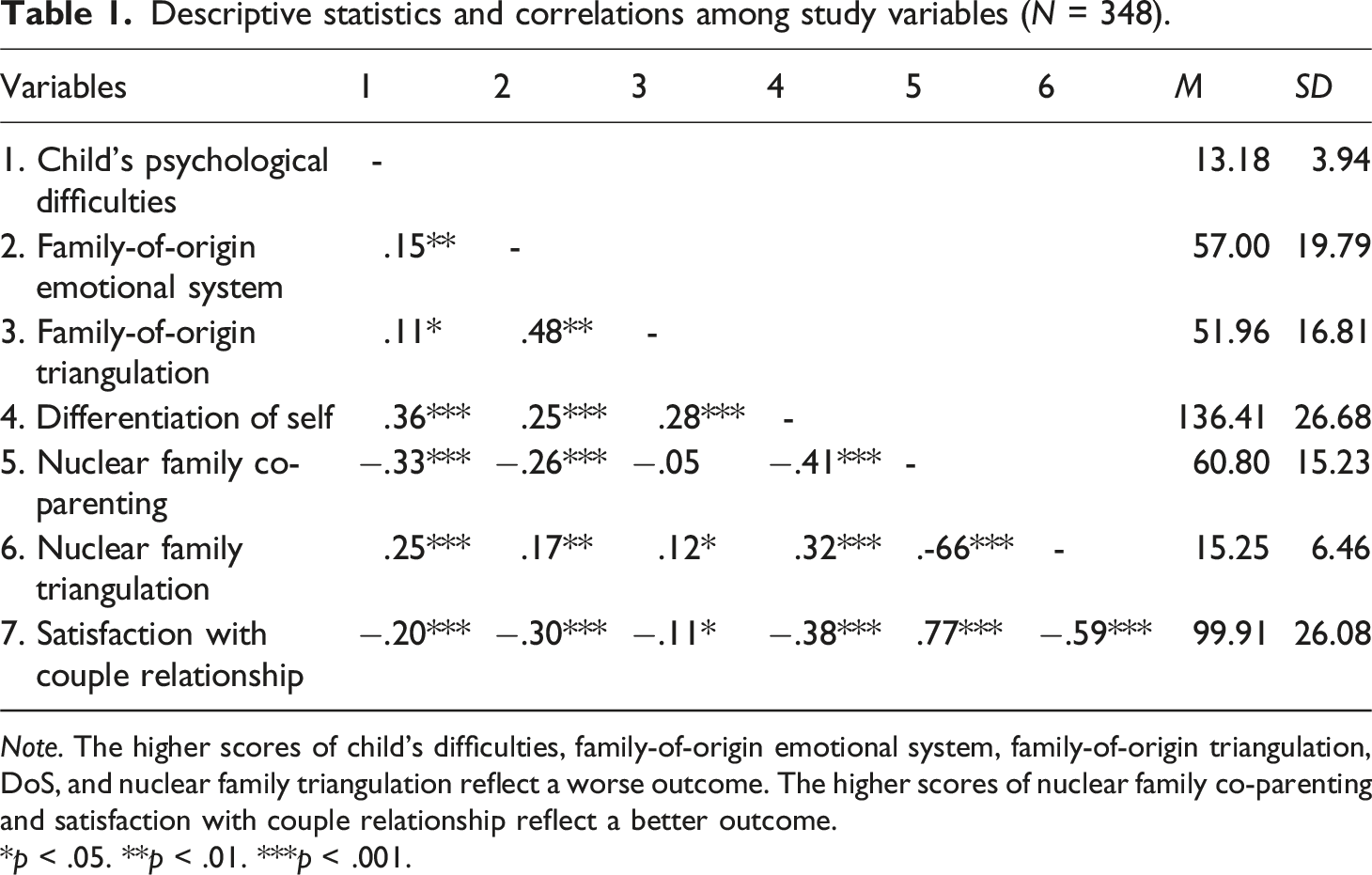
Note. The higher scores of child’s difficulties, family-of-origin emotional system, family-of-origin triangulation, DoS, and nuclear family triangulation reflect a worse outcome. The higher scores of nuclear family co-parenting and satisfaction with couple relationship reflect a better outcome.
*p < .05. **p < .01. ***p < .001.
The correlation analyses revealed statistically significant relationships among all variables, except for the correlation between family-of-origin triangulation and nuclear family co-parenting. The observed correlations were consistent with the expected directions.
The distribution of the scales was assessed for skewness and kurtosis with no significant deviations from normal distribution [-1, 1]. To test assumptions of multicollinearity, linearity, and homoscedasticity, we conducted linear regression analyses with children’s psychological difficulties as the dependent variable and all other variables in the model as independent variables. Variance inflation factors (VIF) and tolerance factors for each predictor variable were within acceptable ranges, with VIF values ranging between 1.41 and 3.07 and tolerance values ranging between 0.33 and 0.75, suggesting no multicollinearity among the independent variables. Additionally, analyses of residual plots indicated that the linearity and homoscedasticity assumptions were met. Thus, SEM was employed for further analyses. The analyses involved two steps: evaluating the fit of the proposed complex mediation model and conducting mediation analyses using bootstrapping to examine the hypotheses. The results of the initial step, indicating significant direct effects, are presented in Figure 2. The path mediation model of relationships among the study variables. Note: Only statistically significant standardized regression weights (β) (direct effects) and correlations are presented. *p < .05. ***p < .001.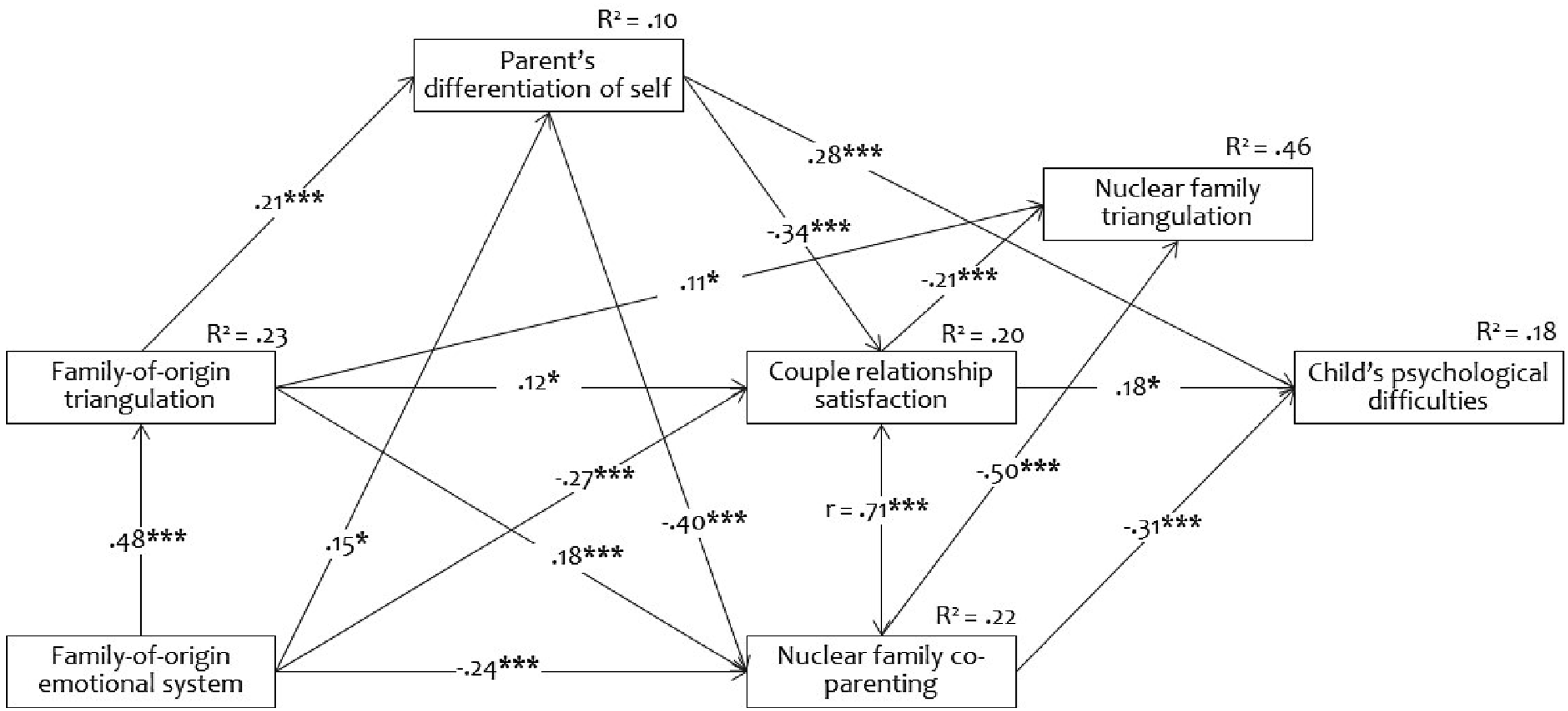
Direct and indirect effects in the mediation models.
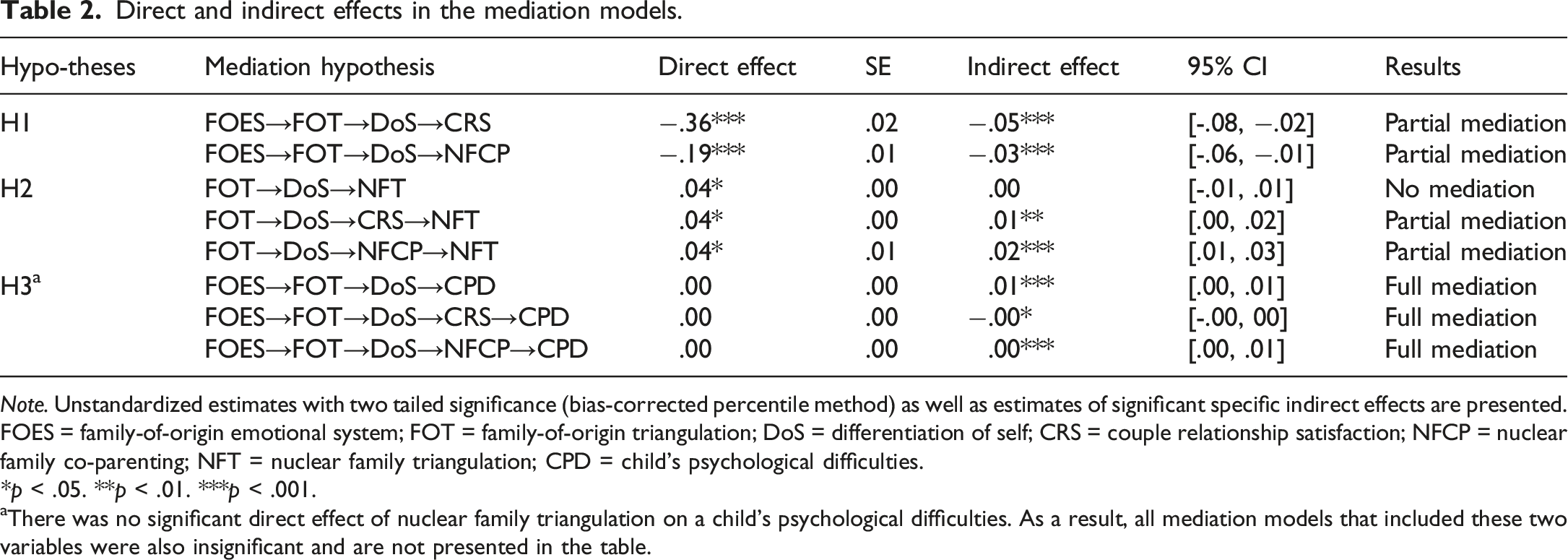
Note. Unstandardized estimates with two tailed significance (bias-corrected percentile method) as well as estimates of significant specific indirect effects are presented. FOES = family-of-origin emotional system; FOT = family-of-origin triangulation; DoS = differentiation of self; CRS = couple relationship satisfaction; NFCP = nuclear family co-parenting; NFT = nuclear family triangulation; CPD = child’s psychological difficulties.
*p < .05. **p < .01. ***p < .001.
aThere was no significant direct effect of nuclear family triangulation on a child’s psychological difficulties. As a result, all mediation models that included these two variables were also insignificant and are not presented in the table.
The examination of the first hypothesis entailed analyzing mediation paths concerning the relationships between family-of-origin experiences, nuclear family dynamics, and adult children’s DoS. Based on bootstrapping confidence intervals, path analyses demonstrated partial mediations implying significant direct and indirect effects. Specifically, the family-of-origin emotional system displayed direct and indirect relationships via the mediators of family-of-origin triangulation and DoS with nuclear family couple relationship satisfaction. Likewise, the family-of-origin emotional system displayed direct and indirect relationships via the mediators of family-of-origin triangulation and DoS with nuclear family co-parenting. The second hypothesis explored the role of adults’ DoS as a mediator between triangulation within the family-of-origin and triangulation within the nuclear family. Findings indicated that DoS did not exhibit a significant direct effect on nuclear family triangulation thus, yielding an insignificant mediation path. However, further exploratory analyses revealed that DoS possessed an indirect effect on nuclear family triangulation through the mediators of co-parenting and couple relationship satisfaction. To further explore this, family-of-origin triangulation was included in the two mediation paths which exhibited partial mediation. The mediation paths suggest that family-of-origin triangulation directly and indirectly impacts nuclear family triangulation through various mediators. Specifically, the results indicate that higher levels of family-of-origin triangulation predict lower DoS in adult children, which may lead to diminished couple relationship satisfaction and adverse co-parenting experiences. In turn, the latter predict an elevated likelihood of involving children in parental conflict.
Finally, the third hypothesis tested the proposition that family-of-origin negative experiences can indirectly influence third-generation offspring’s psychological difficulties through their impact on adult children’s DoS, their relationships with their partners and co-parenting practices, and nuclear family triangulation. Initial findings indicated that nuclear family triangulation did not exert a significant effect on children’s psychological difficulties thus, any respective mediation paths were not analyzed (see Table 2). Nevertheless, three significant full mediation paths substantiated the hypothesis. Specifically, a more negative family-of-origin emotional system predicts higher family-of-origin triangulation, which subsequently predicts lower DoS in adult children. Adult children’s reduced DoS is associated with both diminished couple relationship satisfaction and adverse co-parenting practices, which then predict heightened psychological difficulties in third-generation children. Finally, findings revealed that parental levels of DoS are both directly and indirectly associated with children’s psychological difficulties (see Table 2).
Discussion
Informed by Bowen theory (Bowen, 1993; Kerr & Bowen, 1988), this study transcends individual-level constructs by taking a systemic approach to understanding family functioning. Specifically, we investigate the relational dynamics that govern nuclear family functioning while concurrently investigating the transmission of familial dysfunction across generations. To achieve this, we cross-sectionally examined relational dynamics within the family-of-origin (Generation 1; see Figure 2), namely the family-of-origin emotional system and family-of-origin triangulation. Additionally, we explored systemic attributes and relational dynamics within the nuclear family (Generation 2; see Figure 2), including parental DoS, couple relationship satisfaction, nuclear family co-parenting, and nuclear family triangulation. Lastly, we investigated the potential consequences of the suggested intergenerational transmission from the first to the second and then to the third generation by assessing the latter’s psychological adjustment (see Figure 2). Taken together, our findings provide support to our proposed three-generation complex mediation model, providing further empirical support to Bowen’s (1993; Kerr & Bowen, 1988) systemic premise that familial relationships, alongside individual family members, may function as the means for transmitting dysfunction across generations. Moreover, our findings offer further empirical validation and enhanced insight into specific systemic relational dynamics that govern the functioning of the nuclear family (Bowen, 1993; Kerr & Bowen, 1988).
Regarding the intergenerational transmission process, study’s findings support Bowen theory’s (1993) fundamental premise that family-of-origin pathology may transmit to the nuclear family and, in turn, potentially manifest as psychological dysfunction within third-generation offspring. Consistent with this perspective, our first hypothesis – that a negative emotional system exacerbated by triangulation within the family-of-origin would predict reduced couple relationship satisfaction and poor co-parenting practices within the nuclear family through adult children’s lower DoS – is substantiated by our findings. Specifically, our study affirms these links, establishing empirical associations between families characterized by low emotional functioning and relational dysfunction, and offspring marked by lower DoS. Consequently, as prospective parents, they appear to create nuclear families characterized by similarly impaired emotional and relational functioning. In turn, the second-generation family level dysfunction appears to predict psychological maladjustment in third generation children (a process illustrated across generations in Figure 2). Although research spanning three generations is limited, our findings align with existing literature. For example, Lawson and Brossart (2001) found that the degree of individuation was the most influential predictor of the transmission process from the participant/parent relationship to the participant/spouse relationship, offering “a degree of support for the intergenerational transmission [of family processes] hypothesis” (p. 429). Birditt et al. (2012) showed that “middle-aged respondents who reported more positive and less negative ties with their parents (G1) reported more positive and less negative ties with their own children (G3)” (p. 627), providing support for the intergenerational transmission process. Lastly, Hank et al. (2017) presented empirical evidence regarding the intergenerational transmission of emotional closeness, conflict, and ambivalence.
Bowen (1993; Kerr & Bowen, 1988) complemented his macroscopic intergenerational conceptualization with a nuanced microscopic depiction of the emotional interactions occurring within a nuclear family. Bowen argued theoretically that a collective understanding of these processes (both across and within generations) provides the foundation for clinically predicting the locus of pathology among future nuclear family members. This study aimed at mapping these intergenerational and intrafamilial processes within its proposed three-generation complex mediation model and offers evidence in support. Specifically, findings revealed that a poor-quality family-of-origin emotional system is associated only weakly with adult children’s DoS. In contrast, a poor family-of-origin emotional system is associated comparatively stronger with family-of-origin triangulation, which, in turn, is associated stronger with lower adult children’s DoS. Indeed, it was further found that the relationship between the quality of the family-of-origin emotional system and adult children’s DoS is better explained through the mediating influence of family-of-origin triangulation. In essence, these findings suggest that the familial emotional atmosphere indirectly relates to adult children’s levels of DoS, while concurrently suggesting that the familial emotional atmosphere exerts an impact contingent upon a child’s entrapment within triangulation processes. Put simply, the potential adverse impact of a deleterious nuclear family emotional system varies among siblings, with the most triangulated child being most likely to absorb the family level emotional dysfunction. As the study’s mediation model demonstrates, the more the child is triangulated, the lower DoS levels are expected to manifest, thereby corroborating Bowen’s (1993) assertion that “intense marital conflict and no impairment of children is evidence that marital conflict does not, within itself, cause problems in children” (p. 166). Overall, triangulation seems to emerge as the bridge linking familial emotional dysfunction to offspring’s psychological difficulties.
Collectively, study’s findings suggest that while a family may struggle with a poor-quality emotional system, a child’s DoS is likely to be affected through the process of triangulation. Conversely, children who remain relatively uninvolved in familial triangulation may experience minimal or no impairment in the development of their DoS. As the study’s findings imply, family-of-origin triangulation lays the emotional foundation for low levels of DoS among adult children who, within their own nuclear families, appear to foster dysfunctional subsystems that have an adverse impact on third-generation children. The combination of Bowen’s theoretical explanations with our study’s findings might provide a plausible explanation for the typically modest empirical associations observed between triangulation and children’s psychological maladjustment. Contrary to systemic theoretical expectations, being triangulated within the parental relationship has shown comparatively low correlations, for instance, with anxiety that range from .17 to .28 (e.g., McCauley & Fosco, 2022, p. 28; Mueller et al., 2015, p. 17; van Petegem et al., 2022, p. 25). These relatively modest correlations may arise from studies sampling children indiscriminately, without explicitly targeting the predominantly triangulated sibling within each nuclear family.
Shifting focus to the nuclear family (see Generation 2 in Figure 2), our proposed mediation model portrays an emotional dynamic wherein parental lower DoS predicts lower couple relationship satisfaction and lower levels of family co-parenting. These factors, in turn, predict children’s triangulation within the parental relationship. Given the process of the intergenerational transmission of familial dysfunction, where parents with lower DoS are expected to draw their offspring into their dysfunctional relationship, and considering that third-generation children experience triangulation within their own family, the latter are likely to perpetuate their parental relational dynamics. Specifically, adult children’s triangulation within their family-of-origin was found to predict lower DoS, resulting in lower levels of couple relationship satisfaction and co-parenting. Ultimately, the couple’s relational difficulties are expected to contribute to the third generation’s triangulation.
Our findings concerning the transmission of triangulation from the family-of-origin to the nuclear family through parental lower DoS confirm our second hypothesis, albeit with an important theoretical refinement: this transmission appears to develop via poor levels of couple functioning and co-parenting practices. These findings align with prior research. For instance, Lampis et al. (2019) underscored the significance of DoS in dyadic relationships. Individuals with higher DoS tend to experience enhanced dyadic adjustment, possibly due to their capacity to form functional affective connections and respond empathetically to their partners. Similarly, parental anxiety, reflective of lower DoS (Skowron & Schmitt, 2003), emerged as a pivotal factor in the co-parenting relationship (Dollberg et al., 2021). Notably, parental anxiety was associated with lower perceived co-parenting, suggesting that emotional functioning can influence parental perceptions and engagement in the co-parenting relationship.
Overall, DoS emerges as a pivotal factor influencing both couple adjustment and co-parenting dynamics. In the context of couple adjustment, higher DoS empowers individuals to effectively express their emotions and needs while respecting their partner’s autonomy (Calatrava et al., 2022; Lampis et al., 2019). Conversely, lower DoS may lead to challenges in balancing reason with affect, and autonomy with intimacy, likely resulting in emotional reactivity, anxiety, emotional detachment, or dependence on partner’s validation (Bowen, 1993; Calatrava et al., 2022; Skowron & Schmitt, 2003). Such obstacles impede effective communication, erode trust, and undermine emotional intimacy, thereby impacting dyadic adjustment and overall family functioning.
In the context of co-parenting, higher DoS facilitates effective emotion management and respectful communication, even in the face of parenting challenges and disagreements (Calatrava et al., 2022; Lampis, 2016). Conversely, parents with lower DoS might encounter difficulties in disentangling their emotions from co-parenting interactions. This potential emotional fusion can lead to increased conflicts and challenges in reaching mutual parenting decisions. Co-parenting experiences may become strained and less cooperative as unresolved emotional issues spill over into parenting discussions. Notably, our research revealed a significant correlation between couple relationship satisfaction and co-parenting, aligning with previous studies (e.g., Camisasca et al., 2019b; Kwok et al., 2013). Parents with lower DoS may struggle to provide emotional support and empathy to their co-parent during stressful parenting moments, likely resulting in heightened tension and reduced collaboration, thereby further diminishing the quality of co-parenting (Li et al., 2022).
This dynamic interplay between couple adjustment and co-parenting is often explained by the spill-over phenomenon (e.g., Kwok et al., 2013; Parkes et al., 2019), wherein couple and co-parenting dynamics play a vital interactive role in promoting high quality family-level functioning (Adler-Baeder et al., 2013; Hawkins et al., 2022). However, mixed findings highlight the complex reciprocity between couple adjustment and co-parenting experiences. For example, couple relationship education programs have demonstrated a positive impact on parenting behaviors, suggesting their potential for enhancing co-parenting skills (Adler-Baeder et al., 2013; Hawkins et al., 2022). Conversely, co-parenting satisfaction in relation to greater father involvement has been shown to positively influence overall relationship satisfaction, and vice versa (Kwok et al., 2013; Le et al., 2016). These results emphasize the bidirectional nature of the relationship between couple adjustment and co-parenting experiences. Nonetheless, further to couple dynamics, triangulation has been found to influence family-level functioning and children’s well-being.
Empirical data demonstrate that triangulation (Bowen, 1993) emerges as a critical factor impacting parenting practices and children’s psychological adjustment. For instance, Van Petegem et al. (2022) reported an association between perceived triangulation and overprotective parenting, resulting in heightened anxiety symptoms among adolescents. Fosco and Grych (2008) emphasized that triangulation mediates the impact of parental discord on children, leading to increased excessive involvement or feelings of being caught in the middle during frequent, hostile and unresolved parental conflicts. Similarly, Song et al. (2022) demonstrated that family-of-origin triangulation negatively affected marital stability, co-parenting and parental sense of competence, with co-parenting mediating this relationship.
Whilst considering the nuclear family (Generation 2, Figure 2), it is crucial to highlight the absence of an empirical association between parental DoS and their offspring’s triangulation. To explain this unexpected finding, we consider the following two fully mediated relationships: (i) from parental DoS to nuclear family triangulation mediated by couple relationship satisfaction, and (ii) from parental DoS to nuclear family triangulation mediated by nuclear family co-parenting. These fully mediated relationships collectively reveal the significance of the couple subsystem functioning within the nuclear family emotional system. The findings lend support to an emotional mechanism wherein spouses with lower DoS are anticipated to form less satisfying relationships characterized by deficiencies in co-parenting. These deficiencies, both in spousal relationship functioning and in the shared parental role, are expected to contribute to a child’s morbid triangulation. Put simply, child triangulation appears to be a systemic outcome of an overall poor couple relational and co-parenting functioning, with lower parental DoS acting as a preceding factor.
Lastly, study’s findings offer support to our proposed conceptual model (see Figure 1) of the intergenerational transmission of familial relational dysfunction which extends to the third generation in the form of psychological adjustment difficulties. Essentially, this study affirms the systemic assumption that familial relationships may contain pathology that can be transmitted from the family-of-origin to the nuclear family and then to an individual offspring in the third generation (see Figure 2). Concurrently, study’s findings appear to validate Bowen’s (1993) fundamental assertion that the intergenerational transmission of relational dysfunction manifests through the negative impact on a triangulated child’s DoS. According to Bowen (1993), the triangulated child is expected to develop lower levels of DoS and subsequently, as a parent, is likely to triangulate their own offspring with varying degrees of intensity; with the most intensely triangulated child expected to develop, comparatively to their siblings, the lowest DoS. The triangulation process is then expected to intergenerationally perpetuate through the adult child with the lowest DoS.
In sum, we have insofar discussed findings in support of four fundamental systemic postulates namely that (a) family-of-origin pathology may transmit to the nuclear family and then to a third-generation child, (b) within the family-of-origin, siblings are expected to be affected with varying levels of intensity, with the most triangulated child expected to be affected the most, (c) within the nuclear family, parents with lower DoS are likely to triangulate their child, and (d) nuclear family triangulation is expected to manifest through the emergence of a dysfunctional spousal subsystem. In addition to individual familial systemic functions, our study’s findings should be viewed holistically to account for the dynamic intergenerational process of transmitting relational dysfunction, contingent upon as well as realized through low parental levels of DoS. To further clarify the nature of these processes, we emphasize that the distinction between dysfunction within a relationship and dysfunction within a family member is, within the systemic paradigm, artificial. Bowen (1993; Kerr & Bowen, 1988) considered both intrafamilial relations and individual family members as subsystems of the same nuclear family emotional unit, which are simultaneously susceptible to the influence of family-level emotional dysfunction. Given this clarification, the present study contributes to the family psychology literature by providing findings that support both emotional mechanisms: (i) the transmission of relational dysfunction from the family-of-origin to the nuclear family, and (ii) the association of morbid relational dysfunction within the nuclear family with children’s psychological dysfunction. As proposed by Bowen theory, our study supports the notion that negative patterns of family-of-origin interactions experienced by parents are likely to have direct and indirect morbid effects on their spousal relationship and co-parenting practices, which are then expected to adversely impact their child’s psychological adjustment.
Limitations
The study presents with limitations that simultaneously bear significance to future research. The study’s cross-sectional design does not allow for causal inferences to be drawn as would have been the case with longitudinal research. However, the dynamics reported within the family-of-origin temporally preceded those reported within the nuclear family thus predictions from the family-of-origin to nuclear family functioning could be made with a higher degree of confidence.
The sample was predominantly composed of Lithuanian women, so future studies could aim to recruit more ethnically diverse samples to enhance the generalizability of findings. Likewise, we did not enquire about transgender and other gender identities, thus future research should take into account the full spectrum of gender identities to ensure inclusivity and comprehensive understanding. Our inclusion criteria were limited to participants who grew up with both parents, had children aged six to ten, and were in a relationship at the time of the study. Thus, future research could be extended to other populations such as single parents, families with children of different age groups and particularly adolescents, individuals who grew up without both parents, and families with disabilities. Also, emphasis was placed on the child that parents reported on. While we have directly asked parent participants to report on their child of greatest concern, methodological challenges pertaining to involving the maximally triangulated child (in comparison to siblings if any) in research remain unresolved. We also acknowledge the self-reported nature of data collection including participants reporting their experiences across three generations. This type of data introduces the potential for social desirability and recall, and single-informant biases. Future studies could involve multiple family informants to achieve a multi-perspective account of family functioning. However, it is worth noting recent research findings, such as those by McCauley et al. (2021), which highlight significant disparities in perceptions of family functioning between parents and children. These findings may suggest that while multi-informant studies offer psychometric advantages, they may not fully capture the nuanced differences in viewpoints. From a systemic standpoint, the distinct psychological experiences of fathers, mothers, and children are expected to vary, potentially challenging the validity of aggregating their assessments into a single score. Thus, while multiple respondents indeed strengthen a study, it is essential to consider methodologies that maintain the integrity of each informant’s perspective without oversimplification. Despite these challenges, future studies should include more informants to enhance the contextual richness of their findings. Similarly, future research could supplement self-reports with alternative data collection methods such as observations and physiological measures.
Implications
Despite limitations, we believe that the study carries a diverse range of implications. Study’s insights can inform clinical interventions. Practitioners can strategically focus on emotional familial dynamics within the family-of-origin, the nuclear family, and/or their interaction as a means of disrupting the cycle of intergenerational transmission of familial dysfunction. In a similar vein, our findings appear to validate parenting education programs and strategies that underscore the importance of parental self-development, effective spousal functioning, well-coordinated co-parenting, and the reciprocal interplay of these nuclear family subsystems. Simultaneously, the value of these parenting education programs is further underscored, as they possess the potential to prevent familial dysfunction in subsequent generations. At the policy level, the insights from this study could shape public health initiatives aimed at fostering family resilience and, by extension, the well-being and mental health of youth. Policy-level implications necessitate multidisciplinary collaboration, as the study’s findings appear to intersect various fields including family therapy, social work, psychiatry, and youth studies.
Lastly, and of particular importance to the authors, this study appears to validate Bowen family systems theory (1993; Kerr & Bowen, 1988) thereby reinforcing the importance of contextualizing individual-level approaches within the family systems paradigm. While addressing the complex issue of children’s and adolescents’ well-being and mental health, we advocate for the holistic consideration of both intrafamilial and intergenerational emotional dynamics. Within this frame of mind, study’s further empirical validation of Bowen theory’s universality assertion encourages further refinement and advancement within both Lithuanian and international samples.
Footnotes
Funding
The author(s) received no financial support for the research, authorship, and/or publication of this article.
Open research statement
As part of IARR’s encouragement of open research practices, the authors have provided the following information: This research was not pre-registered. The data used in the research cannot be publicly shared but are available upon request. The materials used in the research cannot be publicly shared but are available upon request. The materials can be obtained by emailing:
