




Abstract
This study examines gender differences in the degree to which men’s and women’s views of their relationship predict eventual dissolution among mixed-gender couples. We analyzed data from a national sample of 314 unmarried mixed-gender couples from the United States that were surveyed across four years to test gender differences in associations between baseline levels of perceived likelihood of breaking up, relationship satisfaction, commitment, and love and relationship dissolution across one, two, three, and four years. Probit regression models revealed women’s greater perceived likelihood of breakup was a stronger predictor of relationship dissolution two years later than their male partner’s reports, but men’s and women’s perceived likelihood of breakup did not differ in the strength of predicting dissolution across one-, three-, and four-year follow-up. Women’s low commitment emerged as a significantly stronger predictor of relationship dissolution across two, three, and four years than their male partner’s commitment (but not at one year). Women’s and men’s relationship satisfaction and love did not differ in predicting dissolution across all time intervals; those less satisfied with their relationship and with less love for their partner were more likely to dissolve their relationship. Although commitment may be an area where women’s reports take primacy in predicting future breakup among adult unmarried mixed-gender couples, the results add to a growing body of literature finding that women’s and men’s views of their partnership are similarly diagnostic of future relationship outcomes.
Despite relatively high rates of relationship dissolution among unmarried and married couples, individuals in relationships are generally optimistic that their relationship will last (e.g., Baker & Emery, 1993; Fowers et al., 2001; MacDonald & Ross, 1999). Of course, people differ in the degree to which they hold these expectations and in the other judgments they make about their relationships, including in their level of satisfaction with and commitment to their partner. This variability has been shown to predict later relationship stability—for example, meta-analyses and literature reviews indicate that higher levels of factors such as commitment, love, and relationship satisfaction significantly predict lower rates of subsequent relationship dissolution (Karney & Bradbury, 1995; Le et al., 2010; Sprecher & Fehr, 1998)—consistent with the idea that long-term relationship outcomes are at least partly rooted in earlier dynamics (e.g., Huston et al., 2001; Lavner et al., 2012).
In considering these patterns, it is important not only to identify specific factors that significantly predict relationship dissolution, but whether specific factors are more or less predictive when reported by specific people. In the present study, we focus on the role of partner gender in these patterns and whether, in mixed-gender relationships, women’s versus men’s relationship perceptions are stronger predictors of relationship dissolution. There is longstanding broad interest and debate about gender differences in mixed-gender relationships, both in the public (e.g., seen in the popularity of books such as Men are from Mars, Women are from Venus; Gray, 1992) and in academic scholarship (e.g., the notion of “his” and “her” marriages; e.g., Bernard, 1982). To date, however, there has been relatively little work testing potential gender differences in the prediction of relationship dissolution and much of the work that has been done has methodological limitations, leaving open questions about these patterns. Accordingly, to further research in this area, we used data from 314 unmarried mixed-gender couples from the United States to examine gender differences in the prediction of relationship dissolution over four years, focusing both on the relative predictive value of women’s and men’s explicit predictions about the future of their relationship (i.e., perceived likelihood of breakup) as well as their commitment and evaluations of their relationship functioning (i.e., relationship satisfaction and love).
Background
In considering this question, there would seem to be good reason to believe that women’s thoughts about their partnership would be uniquely predictive of future stability in mixed-gender couples. There is a widely-held belief in relationship science that women are the “barometers” of relationships (e.g., Floyd & Markman, 1983) and there is evidence that women are more likely than men to recognize relationship problems and initiate couple therapy (Doss et al., 2003), take concrete steps toward separation (e.g., talk about divorce with their spouse; Schoebi et al., 2012), and ultimately initiate relationship dissolution (Hewitt et al., 2006; Sprecher et al., 1998). If women are the partner more likely to end the relationship, it would seem as though their relationship views would be more predictive of future dissolution than would men’s perceptions.
This hypothesis arises from different theoretical perspectives as well. For example, social psychological perspectives emphasize the role of societal expectations and norms in perpetuating sex-differentiated patterns of thought and behavior (Eagly, 1987). Sociocultural expectations dictate that women’s successful performance of gender involves attending to emotional needs of family members and bearing responsibility for maintaining relationships (Duncombe & Marsden, 1993). As such, if women lack the motivation to maintain their partnership (e.g., are dissatisfied with, not committed to, or do not love their partner), the relationship might be at heightened risk of future dissolution.
Alternatively, evolutionary perspectives view biological sex as a basic organizing feature of human psychology stemming from the unique reproductive challenges faced by the sexes in their ancestral past (Buss, 1995). The investment required to successfully produce offspring is far greater for women (e.g., they can carry only one pregnancy at a time, have a nine-month gestation and a prolonged period of care and feeding for the newborn) compared to men (e.g., can produce multiple pregnancies simultaneously for most of their lives, must only fertilize the egg; Trivers, 1972). The divergent minimum obligatory parental investment renders childbearing an especially risky undertaking for women compared to men and resulted in women developing a heightened attunement to the quality of their intimate relationships to ensure a potential partner will remain committed if a pregnancy were to occur (Buss, 1995). Error management theory builds on the principles of evolutionary psychology and argues that women should be especially attuned to “false positives” in their relationships (e.g., men being committed when they are not, the relationship being high quality when it is not) to avoid the serious risk of ending up pregnant with no mate to care for her and the infant (Haselton & Buss, 2000). Thus, women should be especially motivated to end a partnership they believe has little chance of lasting success.
But there is reason to take pause before assuming women’s relationship perceptions will be a stronger predictor of eventual dissolution than men’s views. A number of meta-analyses examining gender differences across a variety of psychological constructs (e.g., sexual attitudes, mathematics performance, self-esteem) have found that most differences between women and men tend to be small or trivial in size (e.g., Carothers & Reis, 2013; Hyde, 2005, 2014). Such findings led Hyde (2005) to propose the gender similarities hypothesis, or the assertion that men and women are more similar than different on most psychological variables (note, however, that this speaks more to mean gender differences in a construct, not whether there are gender differences in the degree to which these constructs predict other constructs). Closer to home in relationship science, Johnson and colleagues (2022) recently conducted the most rigorous test to date of the idea that women are unique barometers of relationships. Drawing from daily diary data provided by 901 mixed-gender couples and five annual waves of longitudinal panel data from 3,405 mixed-gender couples, this study examined whether women’s or men’s relationship satisfaction was a stronger predictor of their own and their partner’s future satisfaction. Analysis of 50,656 total reports of relationship satisfaction revealed that men’s and women’s satisfaction predicted their own and their partner’s future satisfaction across daily and yearly intervals and, critically, there was no difference in the strength of these associations. These results, along with the gender similarities hypothesis, cast doubt on the assertion that women are unique barometers of relationships, but Johnson et al. only examined relationship satisfaction and not dissolution.
Turning to studies that examine gender differences in the predictors of relationship dissolution, we focus our literature review on studies that test variables similar to our focal predictors (perceived likelihood of breaking up, relationship satisfaction, commitment, and love) and provide separate estimates for women and men. Much of the relevant literature we were able to locate was somewhat dated. A recent paper conducted a comprehensive review of the last two decades of relationship dissolution research and found few studies focused on gender differences in predicting relationship dissolution (Machia et al., 2023). Most recent work examined gender differences in demographics and non-relationship factors as predictors of breakup, such as social network approval (Fiori et al., 2018), age differences (England et al., 2016), and work schedules (Kalil et al., 2010). Among the studies we were able to locate, empirical support for the hypothesis that women’s relationship perceptions are more predictive of relationship dissolution than men’s perceptions was quite mixed.
Perhaps the most direct test of this question comes from the few studies that have assessed partners’ expectations about the future of their partnership (i.e., what they think is going to happen in their relationship) in relation to later dissolution. These studies have yielded conflicting findings. In an early study, MacDonald and Ross (1999) found no gender differences in the degree to which college students’ predictions about the likelihood that their romantic relationship would last were significantly associated with relationship dissolution six months or one year later. However, the relatively small sample size (77 students at six months and 75 students at one year) likely provided limited power to detect significant gender differences, and because these were individual-level data, the comparisons were between men and women in different relationships, not between men and women in the same relationship. A different pattern of findings emerged in another study of 325 college students in dating relationships assessing whether their predictions regarding if their relationship would be intact six months later predicted actual dissolution five-to-six months later (Loving, 2006). Results indicated that only predictions from female daters, but not male daters, were significant. Coefficients were not directly compared, however, making it impossible to conclude whether men and women differed from one another (as opposed to showing different patterns). Moreover, as in the previous study, the sample included individuals in relationships, not couples, meaning that the relative predictive power of men and women within a specific relationship could not be compared. Yet a third pattern of results emerged in a study of 2,263 unmarried new parents examining how mothers’ and fathers’ expectations for future marriage were associated with partnership stability 12–18 months later (Waller & McLanahan, 2005). Although having both parents expect to marry was the strongest predictor of future stability, among couples where only one parent expected to marry, it was father expectations for marriage, not mother expectations, that significantly predicted whether the couple was still together (though these coefficients were also not directly compared). Taken together, these studies provide an inconsistent picture of whether men’s or women’s predictions (or neither) about the future of their relationship are more predictive of future relationship dissolution, though methodological limitations make it so that strong conclusions about these patterns are not possible.
There has been more work examining how men’s and women’s motivations to maintain their relationship (i.e., commitment; Stanley et al., 2010) and ratings of relationship quality predict relationship dissolution. As in the work examining direct predictions, studies examining men’s and women’s commitment as a predictor of future relationship stability also do not reveal a consistent pattern of effects. In the study of 325 college students described previously (Loving, 2006), both male and female daters’ reports of commitment significantly predicted relationship dissolution; again, however, these estimates were not directly compared and the individual-level data precluded comparisons within a couple. Nonetheless, a similar pattern was observed in a study using a national sample of 3,627 married couples in which husbands’ and wives’ commitment were equally predictive of remaining married 18 months later (Impett et al., 2001). In contrast, a study predicting divorce across eleven years among 172 newlywed couples showed that neither men’s nor women’s commitment (assessed both in terms of their desire to persist in the relationship and their inclination to maintain the relationship) significantly predicted divorce (Schoebi et al., 2012). Yet another pattern emerged in Stanley et al. (2017), who examined how commitment was associated with relationship stability two years later among couples from the same dataset as the present study. Women’s commitment at baseline was a significant predictor of future stability and men’s commitment was not (unless women’s commitment was left out of the model). This pattern held even after controlling for relationship satisfaction and differences in partner’s commitment levels, though women’s and men’s reports were not directly compared.
Studies examining other relationship variables also reveal an inconsistent pattern of results. The most comprehensive study of potential predictors drew on data from a university sample of 120 dating couples (median relationship length at baseline was 9 months) to examine associations between men’s and women’s reports of thirteen constructs (e.g., trust, love, closeness, satisfaction) with relationship stability six months later (Attridge et al., 1995). Although the predictors were generally associated with stability in the anticipated ways (e.g., higher levels of love were associated with still dating at follow-up), only one gender-specific pattern was observed: men’s lower relationship satisfaction was associated with breakup, but women’s relationship satisfaction was not. The opposite pattern of results emerged in a study of 207 married and cohabiting African American couples, however, which showed that women’s, but not men’s, reports of relationship quality predicted relationship stability five years later (Cutrona et al., 2011). Likewise, in the study by Schoebi and colleagues (2012) described earlier, only wives’ (low) relationship satisfaction (also included in the analysis) predicted an increased likelihood of divorce over 11 years and their reports were a significantly stronger predictor than husbands’ satisfaction. Kurdek (2005) analyzed data from 526 newlywed couples to test whether men’s or women’s marriage appraisals (a composite variable comprised of love, liking, desire to maintain the marriage, and trust) and relationship satisfaction were differentially linked to divorce across four years. That analysis found that lower average levels and more decline over time in marriage appraisals and relationship satisfaction for both husbands and wives were associated with eventual divorce. Direct comparisons of coefficients revealed only one gender difference—wives’ decreasing marriage appraisals were a stronger predictor of divorce than husbands’ decreasing appraisals—leading the author to conclude that “there was no consistent evidence that differences between spouses headed for divorce and spouses from stable marriages were more pronounced for wives as relationship experts than they were for their husbands” (p. 81).
Present study
The current study sought to further this work by testing a number of potential gender differences in the predictive power of partners’ thoughts about their intimate relationships on future relationship stability. Specifically, we drew on data from a national sample of 314 unmarried mixed-gender couples in the United States to examine men’s and women’s reports of perceived likelihood of breakup, relationship satisfaction, commitment, and love as predictors of relationship dissolution across four years. This design has several notable strengths compared to prior work. First, we asked participants directly whether they thought their relationships would persist and also assessed their motivation to continue the relationship (commitment) and their ratings of relationship quality (relationship satisfaction and love), providing a more complete assessment of the predictive power of different types of relationship cognitions. Second, we examined effects at annual intervals for four years, providing a nuanced look at potential differences across shorter- and longer-term time intervals. The need to explore potential differences in the strength of predictors of dissolution across various time intervals has recently been noted as an important research direction (Machia et al., 2023). Third, we included dyadic data, allowing for comparisons between men and women within the same relationship, rather than between men and women in different relationships; doing so provides a more rigorous test of the relative weight of relationship perceptions because it eliminates the possibility of cross-relationship differences contributing to any observed patterns. Fourth, as described in more detail in the sections that follow, we directly compared men’s and women’s coefficients, which is necessary to make any conclusions regarding gender differences (see also Kurdek, 2005; Schoebi et al., 2012). Fifth, we tested these questions in a national sample of couples from the United States who were unmarried at baseline and who subsequently experienced a substantial amount of relationship dissolution across the study (41% of couples reported a breakup), allowing for a more robust examination of this research question compared to prior studies with much less dissolution [e.g., 11% over four years in Kurdek’s (2005) study of newlywed marriages].
Method
Procedures
Data from the Relationship Development Study (RDS; Rhoades et al., 2010; 2012) were used to address our research question. The RDS was a longitudinal study comprised of a national sample of 1,294 unmarried young adults from the United States between the ages of 18–34 years in different-sex partnerships of at least two months duration at baseline. The sample was recruited in 2008 through a targeted-listed telephone sampling strategy (i.e., lists of phone numbers that included cell phones were purchased to form the sampling frame) to call households in the contiguous United States. Random digit dialing of mobile phones was not legal in the United States at the time of data collection. Participants were provided basic information about the study and screened for eligibility by phone. Those willing to participate (n = 2,213) were mailed a paper and pencil questionnaire and roughly half (n = 1,143) were randomly sent a second questionnaire with an invitation for their partner to also participate. A total of 1,294 eligible participants returned the survey (642 received a second survey for their partner to complete) and, among this final sample, 318 partners also returned a questionnaire, forming the couple subsample. Comparisons among those whose partner participated (i.e., the couple subsample) versus those whose partner did not showed that the couple subsample reported higher initial relationship satisfaction and commitment and perceived a lesser likelihood of breaking compared to those whose partner did not return the survey (Barton et al., 2020). Follow-up surveys were sent by mail to all participants at four- to six-month intervals for eleven total waves of data collection spanning 50 months. The research team strove to retain the sample by mailing updates and small incentives ($2 bills) to participants. This study received ethics approval from the REDACTED institutional review board (proposal title: The Relationship Development Study; protocol number: 471794).
Given our research question, the current study drew from the couple subsample (n = 318) of the RDS. At each wave, partners were asked whether they were still in the same partnership as during their last wave of participation in the study. We filtered the sample by including only couples that provided at least one wave of follow-up data on their relationship status, resulting in the final sample of 314 couples analyzed in this study. Of this group, 46.1% of men and 59.6% of women participated in all waves; 81.2% of men and 91.1% of women participated in more than half of the waves.
Sample
Among this sample of 314 couples, average relationship length at the outset of the study was 3.2 years (SD = 2.9 years). At baseline, 41.7% of couples were living together and 22.2% were engaged to be married (none were married). Less than one-third of couples (29.9%) were raising children and 14.0% shared a child (ren) with their current partner. Men were 26.8 years old, on average (SD = 6.3 years, range 18–52 years), and women were 24.9 years old (SD = 5.1 years, range from 18 to 40 years). In terms of race, 82.4% of men reported being White, 10.5% Black, 8.2% reported their ethnicity as Hispanic or Latino, 3.9% selected more than one race, 2.3% Asian, and 0.6% Native American. Eighty-four percent of women were White, 9.6% Black, 10.8% reported their ethnicity as Hispanic or Latino, 2.5% were more than one race, 0.6% Asian, and 1.6% Native American. For education, 58.4% of men and 51.7% of women had a high school diploma or GED as their highest credential, 10.8% of men and 14.9% of women had an associate’s degree, 21.7% of men and 23.6% of women completed their bachelor’s degree, and 9.1% of men and 9.8% of women earned a graduate degree. Regarding income (reported in 2007–2008), 46.4% of men and 64.0% of women earned less than $20,000 per year, 43.1% of men and 30.7% of women earned between $20,000 and $49,999 per year, and 11.5% of men and 5.3% of women earned more than $50,000 annually.
Measures
Descriptive statistics for and correlations among focal study variables (n = 314 mixed-gender couples).
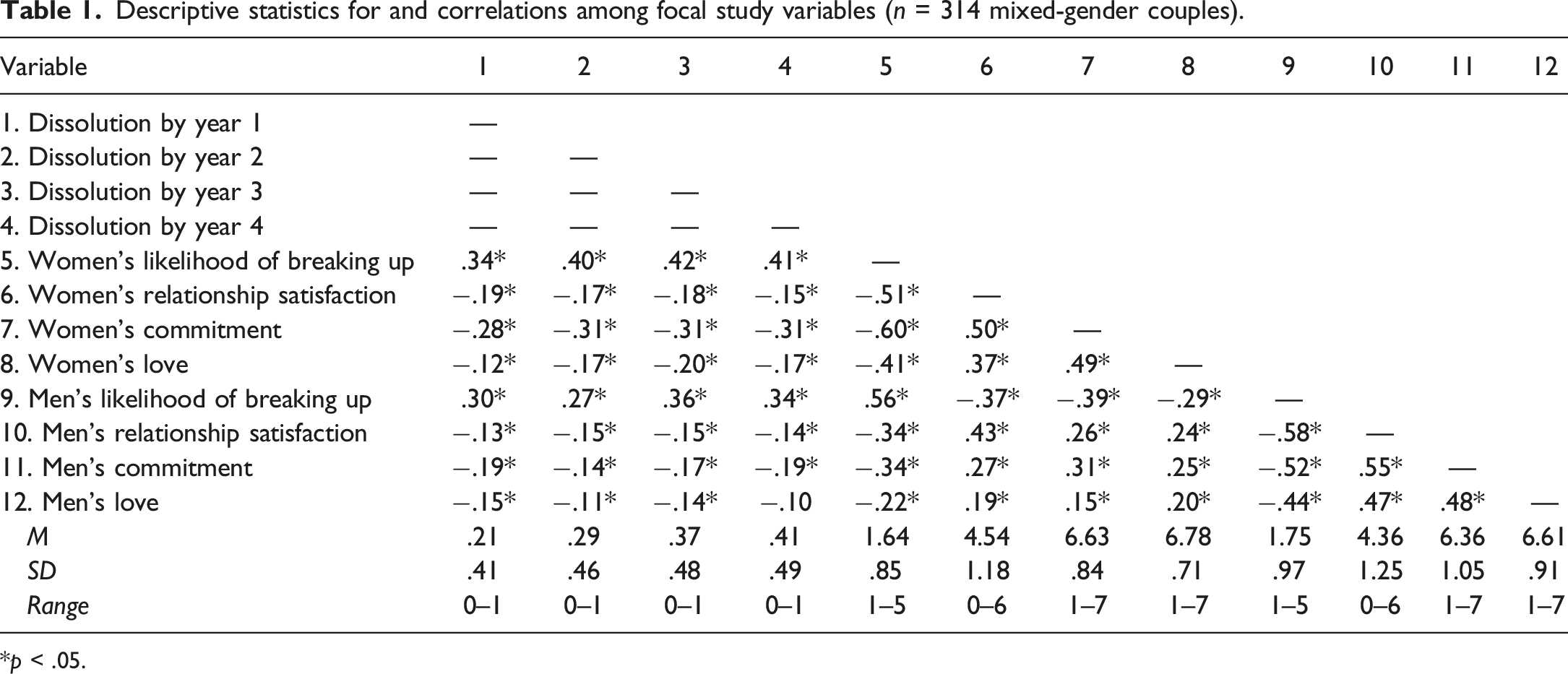
*p < .05.
Relationship dissolution
In Waves 2 through 11, each partner indicated (0 = yes, 1 = no), “Are you together with the same person that you were with the last time you completed a survey for the Relationship Development Study?” A couple was coded as having dissolved their union if either partner responded “no.” Within the first year, 21.3% (n = 67) of couples ended their relationship, increasing to 29.3% (n = 92) by the end of year two, 36.9% (n = 116) by the end of year three, and a total of 41.4% of the sample (n = 130) by the end of year four. Relationship dissolution each year is successively cumulative and includes breakups from earlier years (e.g., year 4 relationship dissolution includes dissolution in years 1, 2, and 3).
Perceived likelihood of breaking up
A single item at Wave 1 1 assessed each partner’s perception of whether their partnership would dissolve: “How likely is it that you are your partner will break up within the next year?” Responses ranged from 1 = very unlikely to 5 = very likely.
Relationship satisfaction
At Wave 1, relationship satisfaction was measured with one item from the Couples Satisfaction Index (Funk & Rogge, 2007): “Please indicate the degree of happiness, all things considered, of your relationship.” Responses ranged from 0 = extremely unhappy to 6 = perfectly happy.
Commitment
One item in Wave 1 assessed global commitment of each partner: “How committed are you to your relationship?” Responses ranged from 1 = not at all committed to 7 = very committed.
Love
A single item at Wave 1 assessed each partner’s love for the other by gauging their agreement with the statement: “I love my partner.” Responses ranged from 1 = strongly disagree to 7 = strongly agree.
Control variables
We included the following control variables assessed at baseline in our analysis: how many children the couple was raising in their home (observed range from 0 to 6), whether the couple had children together (0 = no, 1 = yes), whether they were cohabiting (0 = no, 1 = yes) or engaged (0 = no, 1 = yes), relationship duration (in years), and each partner’s highest education credential, age, income, and race. Highest education credential was assessed with the item: “What was your highest degree?” and responses were 1 = high school diploma/GED, 2 = associate, 3 = bachelors, and 4 = masters, PhD, or other graduate degree. Income was assessed with the item: “What is your annual income (not including your partner’s)?” and responses ranged from 1 = under $4,999, 2 = $10,000-$14,999, 3 = $15,000-$19,999, 4 = $20,000-$29,999, 5 = $30,000-$39,999, and so on until 13 = over $100,000. For race, we included dummy codes for whether each partner self-reported being “White” (0 = no, 1 = yes) and “Black” (0 = no, 1 = yes). Each of these control variables was associated with relationship stability in prior work (Cutrona et al., 2011; Le et al., 2010; Machia et al., 2023; Waller & McLanahan, 2005).
Analytic plan
We first examined correlations among the focal study variables. To address our research question, we used probit regression models computed in Mplus 8.8 (Muthén & Muthén, 1998-2017) with a weighted least squares estimator given that the dependent variable under investigation was dichotomous (relationship dissolution). Separate models were computed for each focal predictor (perceived likelihood of breaking up, relationship satisfaction, commitment, and love) of relationship dissolution for each duration under investigation: across one year (four models), across two years (four models), across 3 years (four models), and across four years (four models). Women’s and men’s reports of each predictor were included in the same model. We entered women’s and men’s reports of our focal predictors in the analysis as a first step, and then added control variables in a second step. We then computed a Wald test of parameter constraints to determine whether the influence of men’s and women’s focal predictors (e.g., perceived likelihood of breaking up) significantly differed.
Results
Preliminary analyses
Correlations among focal study variables for women and men are presented in Table 1. The focal predictor variables were all significantly correlated with each other in the anticipated directions (e.g., those with a higher perceived likelihood of breakup also tended to be less satisfied with their partnerships and their partner was also less satisfied compared to those with a lower perceived likelihood of breakup). Importantly, the predictor variables were also correlated with relationship dissolution by one, two, three, and four years later for women and men in the anticipated directions (e.g., perceiving a higher likelihood of breaking up was associated with breaking up across the study).
Testing gender differences in the prediction of relationship dissolution
Probit Regression Model Results for Women’s and Men’s Relationship Cognitions Predicting Relationship Dissolution Over One, Two, Three, and Four Years (n = 314 mixed-gender couples).
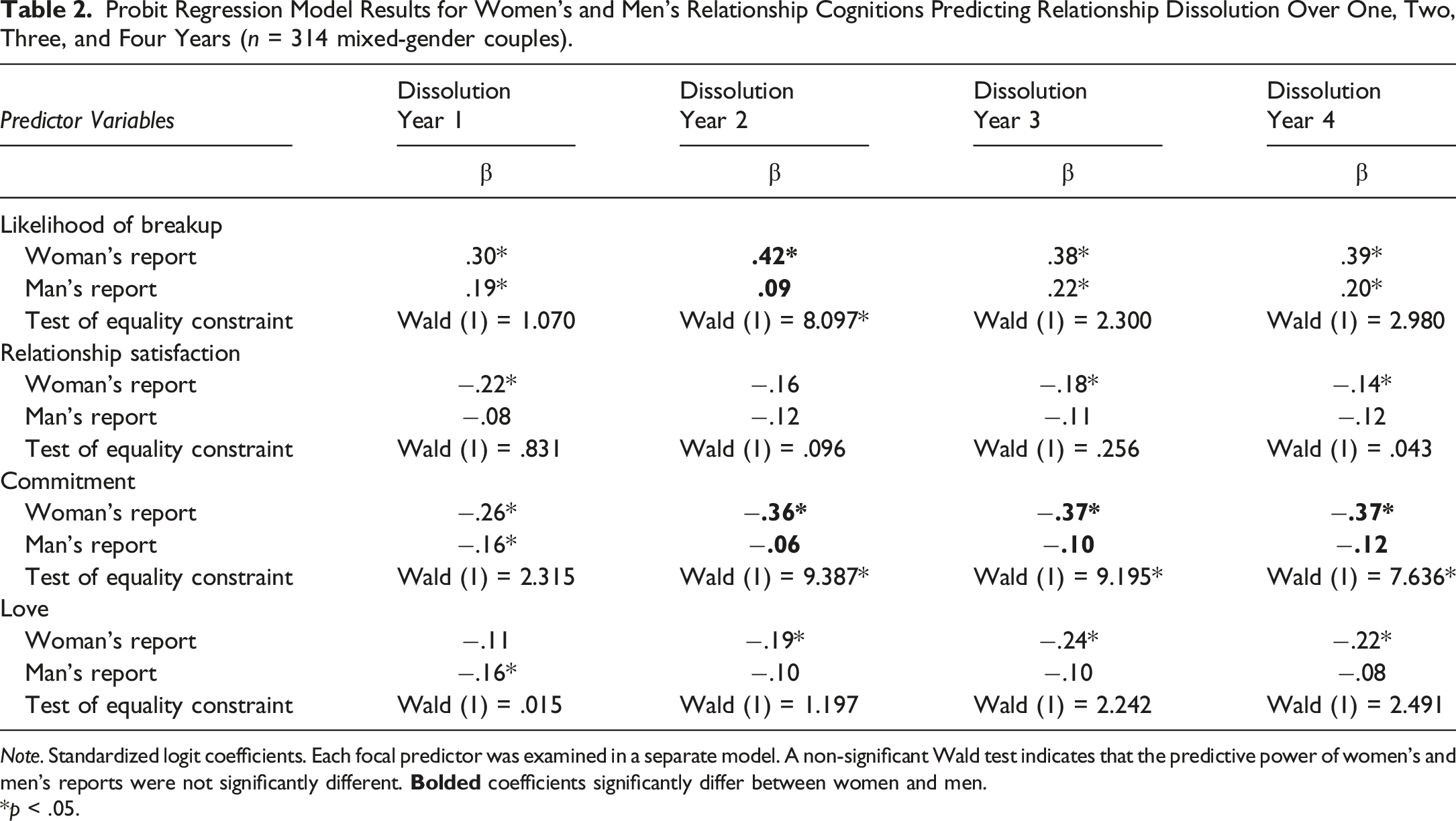
Note. Standardized logit coefficients. Each focal predictor was examined in a separate model. A non-significant Wald test indicates that the predictive power of women’s and men’s reports were not significantly different.
*p < .05.
We then computed the Wald test of parameter constraint (see Table 2) to determine whether the strength of men’s and women’s focal predictors significantly differed. For perceived likelihood of breakup, one significant gender difference emerged: women perceiving a higher likelihood of breaking up was a significantly stronger predictor of relationship dissolution by the two-year follow-up than was men’s perceived breakup likelihood. However, women’s and men’s perceived likelihood of breaking up did not differ in predicting relationship dissolution across years one, three, and four. The most consistent gender difference emerged for commitment. Although the strength of women’s and men’s commitment coefficients did not differ in predicting the likelihood of relationship dissolution in the first year, women’s commitment was a stronger predictor of relationship dissolution by years two, three, and four than was men’s commitment. There were no significant gender differences for relationship satisfaction or love; women’s and men’s higher relationship satisfaction and love were both associated with less likelihood of breaking up over one, two, three, and four years. We also computed Wald tests of parameter constraints in the models that included the control variables (see Supplemental Tables S1 to S4). The pattern of results was consistent to those shown in Table 1 with one exception: women’s reports of love were a stronger predictor of relationship dissolution by Year 3 than were men’s reports of love (Wald [1] = 3.951, p < .047).
Sensitivity analyses
As a sensitivity analysis, we accounted for family-wise error arising from computing sixteen Wald tests of parameter constraints to answer our focal research question. When applying a Bonferroni correction (p < .003 is required to achieve statistical significance) to the models without control variables, two of the four differences between women and men were no longer significant. Specifically, women’s perceived likelihood of breaking up no longer predicted relationship dissolution more strongly than men’s perceptions up to two years later (p = .004) and women’s commitment was no longer a stronger predictor of relationship dissolution than men’s commitment across four years (p = .006). Women’s commitment remained a significantly stronger predictor of relationship dissolution than men’s commitment across two- and three-year time intervals (ps = .002).
When applying a similar Bonferonni correction to the models with control variables, women’s love no longer predicted relationship dissolution across three years more strongly than men’s love (p = .047) and women’s commitment was no longer a stronger predictor of relationship dissolution across four years than men’s commitment (p = .008). Women’s perceived likelihood of breakup remained a significantly stronger predictor of relationship dissolution across two years compared to men’s perceptions (p = .001) and women’s commitment across two- and three-years (ps = .001) remained a stronger predictor of relationship dissolution compared to men’s commitment.
Discussion
Are women’s perceptions about their mixed-gender partnership significantly more predictive of later relationship dissolution than men’s perceptions across one-, two-, three-, and four-year time intervals in this national sample of unmarried mixed-gender couples from the United States? In some respects, yes: Women’s commitment was significantly more predictive of future relationship dissolution than men’s two, three, and four years later; women’s perceived likelihood of breakup was a stronger predictor of future relationship dissolution than men’s at the two-year follow-up; and women’s love was a stronger predictor of dissolution by year three than men’s love when control variables were included in the model. Even when correcting for the number of statistical tests, women’s commitment remained a stronger predictor of dissolution across two and three years than men’s commitment in models with and without control variables included. There were also no instances where men’s variables were a significantly stronger predictor than the corresponding variable from their female partner. Such findings were anticipated by social psychological (Duncombe & Marsden, 1993; Eagly, 1987) and evolutionary perspectives (Buss, 1995; Haselton & Buss, 2000) that argue women’s views about their partnership would uniquely signal future dissolution, albeit through different mechanisms (i.e., either due to their societally ascribed responsibility for maintaining relationships or evolved psychology mechanisms that motivate women to minimize their unique risk being pregnant with no partner to care for her or the baby).
Notably, however, there were not significant gender differences in the predictive power of a number of other variables. Specifically, women’s and men’s direct predictions about the future of their relationship did not differ at one-, three-, and four-year follow-up. Additionally, women’s and men’s reports of relationship satisfaction and love did not differ in predicting dissolution across all time intervals (with the exception of women’s love more strongly predicting dissolution across three years than men’s love when control variables were included in the analysis), and their reports of commitment did not differ in predicting dissolution across the first year (when over half of the dissolutions occurred).
Before considering the implications of these results, we acknowledge limitations of this study. First, although the RDS had very low attrition (more than 80% of men and 90% of women participated in more than half the assessments), our analysis likely underestimated the total number of breakups because some couples almost certainly dropped out of the study without reporting the dissolution of their union. Even so, the data at hand revealed that 41.4% of the sample broke up during the study, which is a higher proportion of relationship dissolution compared to studies predicting breakup among university student couples (Attridge et al., 1995) and divorce among newlyweds (e.g., Kurdek, 2005; Schoebi et al., 2012). Second, all predictor variables were assessed with single items. Although the items have remarkable face validity (e.g., “How committed are you to your relationship?”), multi-item measurement would provide more precision. Although not ideal, these single items still proved robust predictors of relationship dissolution (nearly all were significant) and allowed us to examine the comparative influence of women’s and men’s reports.
Additionally, it is important to consider limits to the generalizability of these findings. RDS data were gathered from 2008 to 2012, raising the question as to whether results might still be applicable more than a decade later. From the perspective of evolutionary psychology, we would not anticipate a 10- or 15-year time span to impact the pattern of results. After all, the psychological mechanisms that motivate women’s heightened attunement to their intimate ties (e.g., “Is this partner likely to stay with me?”) compared to men evolved thousands of years ago (Buss, 1995). But social psychological perspectives argue that societal expectations and norms underlie women’s responsibility for attending to and managing their relationships (Duncombe & Marsden, 1993; Eagly, 1987). If such norms have changed since the RDS began, results may not generalize to current partnerships.
There is reason to believe, however, that gender norms have been relatively stable across the past decades in the United States. Pessin (2018) analyzed gender attitudes in the United States General Social Survey from 1977 to 2012 and found egalitarian gender role beliefs increased from 1977 to the early 1990s before stabilizing through 2012 in most regions of the United States. These findings mirror those in the housework literature, which found men’s housework hours in the United States doubled from the 1960s through the 1990s (Bianchi et al., 2000) and then stabilized through the 2000s (Bianchi et al., 2012). Findings such as these led some scholars to hypothesize that the societal movement toward more egalitarian gender roles in the United States has stalled (England, 2010). Collectively, these strands of evidence suggest any underlying tendency for women to serve as relational experts, whether set in motion through evolved psychological mechanisms or societal norms, would still be relevant for current cohorts of unmarried young adult mixed-gender partnerships. Nonetheless, there have been recent changes in the ways that relationships are dissolved (e.g., “ghosting;” Koessler et al., 2019) that might be differentially predicted by women’s and men’s relationship perceptions. As such, additional research with more contemporary cohorts of mixed-gender couples would allow for additional insight into the potential for women’s or men’s relationship views to differentially predict dissolution initiated in different ways (e.g., direct conversation versus nonresponse to electronic communication).
Furthermore, these data were gathered in the United States and the bulk of studies in our literature review were also based on United States samples. We were not able to locate any comparative studies examining predictors of relationship dissolution in Western and non-Western countries, but there is reason to believe the dissolution process may differ in non-Western cultures. For example, in collectivist cultures, mate selection is more likely to involve the input and approval of family compared to more individualistic societies, such as the United States (Myers et al., 2005), and collectivist societies emphasize the importance of sacrificing personal desires for an intimate partner more than seeking personal happiness (Cao et al., 2017). Dissolving a partnership may then be less strongly driven by one’s own views about the relationship, regardless of one’s gender, and more heavily influenced by family member perceptions. Studies based on evolutionary psychology, however, document consistent gender differences in partner preferences (e.g., women’s preferences for partners with resources) cross-culturally (Buss & Schmitt, 2019), suggesting gendered patterns in relationships due to evolved psychological mechanisms may persist in a variety of cultural contexts. Further research in more collectivist cultures is needed to understand potential gender differences in the predictors of relationship dissolution cross-culturally.
With these caveats in mind, we believe these results make several important contributions to the literature. First, the findings show few differences in whether men and women are able to accurately predict whether their partnership will dissolve when asked directly (i.e., “How likely is it that you and your partner will break up in the next year?”), with the only significant difference emerging at year two (but not years one, three, or four). This difference did not hold in the model without control variables, however, when correcting for the number of tests computed in the model. These results add to the few studies examining this type of direct prediction (Loving, 2006; MacDonald & Ross, 1999), which included undergraduate samples studied over a shorter period of time (6 and 12 months) and did not include dyadic data. Our more robust design allows for stronger conclusions regarding gender differences—or, more accurately, the lack thereof—in the accuracy of direct prediction.
Second, men’s and women’s ratings of relationship satisfaction and love generally did not differ in predicting relationship dissolution. The lack of gender differences in the predictive power of these variables might be expected given the mixed findings in the literature: studies have shown that men’s relationship satisfaction more strongly forecasts stability (Attridge et al., 1995), that women’s satisfaction is the stronger predictor (Cutrona et al., 2011; Schoebi et al., 2012), and that both partners’ relationship satisfaction equally predicts persistence versus breakup (Kurdek, 2005). Such findings undercut the potential robustness of arguments regarding the presence of gender differences in these patterns and align with recent research finding women’s and men’s current relationship satisfaction is equally predictive of future relationship satisfaction (Johnson et al., 2022) and also aligns with a broader literature showing more gender similarities than differences (e.g., Carothers & Reis, 2013; Hyde, 2005, 2014).
That said, this study did uncover one area where women’s reports took primacy in predicting future breakup: commitment. This finding is consistent with that of Stanley and colleagues (2017) who also used RDS data in their analysis, but there are important differences between the present study and Stanley et al.’s prior work that suggest these findings are not simply redundant. Stanley et al. operationalized commitment with 14 items from the dedication subscale of the Commitment Inventory (e.g., “I want this relationship to stay strong no matter what rough times we encounter”) (Stanley & Markman, 1992) and the present study drew from a single item tapping global commitment (“How committed are you to your relationship?”). Additionally, Stanley and colleagues tracked partnership stability across two years versus the four-year span of the present investigation; the number of dissolutions increased by approximately 40% over this longer-term timespan (92–130), providing greater power to detect dissolution effects and a longer period over which to observe them. Third, the present study empirically tested the relative strength of women’s and men’s coefficients in predicting breakup. Because this was not done in Stanley et al. (2017), the presence of gender differences (vs. gendered patterns) could not actually be determined. Given these methodological differences and the inclusion of several additional variables in this study (i.e., perceived likelihood of breakup, relationship satisfaction, love), the consistent commitment findings suggest women’s commitment may be a unique predictor of stability in this sample.
The consistency of women’s commitment as a stronger predictor of stability in the RDS does not align with findings from other studies, however. Studies of newlywed and married couples find men’s and women’s commitment either do not predict (Schoebi et al., 2012) or do not differ in predicting future divorce (Impett et al., 2001). A study of dating university couples also found men’s and women’s commitment did not differ in predicting future breakup (Attridge et al., 1995). Keeping this broader set of findings in mind, it is possible that women’s commitment was uniquely important given the nature of the RDS sample: all couples were unmarried at the outset, but were generally in long-term partnerships; more than 40% of couples were living together; and nearly 30% had children (14% had a shared child). In short, this is a sample of couples that tended to be in fairly serious relationships (in contrast to university couples most commonly dating around 9 months; Attridge et al., 1995) who were yet to institutionalize their commitment to one another through marriage (in contrast to Impett et al., 2001; Schoebi et al., 2012). As such, this sample may represent a group of couples with a uniquely high level of uncertainty about where the partnership is heading. In such a context, women’s (low) commitment may prove particularly important given that commitment reflects one’s motivation to maintain a partnership (Stanley et al., 2010) and women are more likely than men to initiate relationship dissolution (Hewitt et al., 2006; Sprecher et al., 1998). Future research could explore this possibility, along with other explanations for this gender difference.
Conclusion
Are women’s views of their partnership uniquely predictive of relationship stability in mixed-gender couples? We consistently found support for this notion when it came to commitment: women’s commitment was a stronger predictor of relationship dissolution across two-, three-, and four-year intervals than men’s commitment. Thus, women’s flagging motivation to continue their union was a more potent signal of future dissolution than men’s in this sample of unmarried mixed-gender couple from the United States, consistent with theory highlighting the role of gendered norms or evolved psychological mechanisms in relationship dynamics (Buss, 1995; Duncombe & Marsden, 1993; Eagly, 1987; Haselton & Buss, 2000). However, we did not find robust evidence supporting the primacy of women’s reports for perceived likelihood of breaking up, relationship satisfaction, and love. Thus, partners’ explicit judgments about the future of their relationship and their evaluations about their relationship do prove predictive of relationship outcomes, but this pattern was not found only or even most strongly for women. Future research with a range of samples is needed to shed more light on these gendered patterns and to advance broader theorizing about gender differences (or the lack thereof) in mixed-gender relationships.
Supplemental Material
Supplemental Material - Gender differences—or the lack thereof—in the prediction of relationship dissolution among unmarried mixed-gender couples from the United States
Supplemental Material for Gender differences—or the lack thereof—in the prediction of relationship dissolution among unmarried mixed-gender couples from the United States by Matthew D. Johnson, Justin A. Lavner, Scott M. Stanley, and Galena K. Rhoades in Journal of Social and Personal Relationships
Footnotes
Author’s note
The content is solely the responsibility of the authors and does not necessarily represent the official views of the Eunice Kennedy Shriver National Institute of Child Health and Human Development nor of the National Institutes of Health.
Declaration of conflicting interests
The author(s) declared no potential conflicts of interest with respect to the research, authorship, and/or publication of this article.
Funding
The author(s) disclosed receipt of the following financial support for the research, authorship, and/or publication of this article: This project was supported by R01HD047564 from the Eunice Kennedy Shriver National Institute of Child Health and Human Development.
Open research statement
As part of IARR’s encouragement of open research practices, the authors have provided the following information: This research was not pre-registered. The data and materials used in this research are not publicly posted, but are available by request.

Supplemental Material
Supplemental material for this article is available online.
Note
References
Supplementary Material
Please find the following supplemental material available below.
For Open Access articles published under a Creative Commons License, all supplemental material carries the same license as the article it is associated with.
For non-Open Access articles published, all supplemental material carries a non-exclusive license, and permission requests for re-use of supplemental material or any part of supplemental material shall be sent directly to the copyright owner as specified in the copyright notice associated with the article.
