




Abstract
In this paper, we investigate the association between evaluating a romantic partner as deviating from relationship ideals (i.e., ideal-partner discrepancy) and a widely studied form of self-regulatory behavior in romantic relationships—accommodation (i.e., inhibiting one’s own destructive relationship behaviors and enacting constructive behaviors). We also consider the moderating role of relationship commitment. Two studies tested these associations using self-reports (Study 1, N = 450 individuals) and by observing accommodation behaviors in couples (Study 2, N = 116 dyads). Across both studies, a negative-ideal partner discrepancy (i.e., a partner is deemed as falling below ideals) was associated with more accommodation when relationship commitment was high than for when it was low. The findings provide novel insights into understanding accommodation behavior in romantic relationships.
Introduction
It is never pleasant to be on the receiving end of a relationship partner’s negativity. This negativity can come in many forms, such as criticism, invalidation, stonewalling, and hostility. The ability to inhibit one’s own destructive tendencies and to respond constructively in the face of a partner’s negative behavior, a phenomenon known as accommodation (Rusbult et al., 1991), is an important form of self-regulation. Accommodation has implications for a variety of relationship outcomes and for how partners may behave in the future (Finkel & Campbell, 2001; Overall & Simpson, 2013). For instance, research has found greater accommodation is associated with higher intimacy, trust, and relationship adjustment over time (e.g., Overall & Sibley, 2008; Rusbult et al., 1998a, 1998b; Wieselquist et al., 1999). But to what extent does a person’s evaluation of his or her partner impact on their ability to engage in accommodation? Is a person more likely to accommodate in response to a partner’s negativity if their evaluation of a partner is positive? Is a person less likely to inhibit destructive behavior in response to a partner’s negativity if the partner is evaluated as falling short of what they desire? Or, can a person respond constructively to their partner’s negativity despite having a partner who falls short on mate ideals, if they are committed to maintaining the relationship in the long-term? The questions posed above identify critical gaps in understanding how partner evaluations contribute to self-regulation behaviors in romantic relationships. Therefore, answering these questions can provide new insights into understanding accommodation behavior in romantic relationships.
In the current paper, we report on two studies that investigate the extent to which positive partner evaluations (i.e., a partner is estimated as above one’s mate standards) and negative partner evaluations (i.e., a partner is estimated as below one’s mate standards) predict accommodation behaviors. Furthermore, we investigate whether relationship commitment (i.e., maintaining a long-term relationship orientation) moderates these associations. We situate the investigation of partner evaluations and their associations with accommodation within the Ideal Standards Model (ISM, Fletcher et al., 1999; Fletcher & Simpson, 2000; Simpson et al., 2001), a widely studied framework of partner evaluations. This is the first study to our knowledge to use the ISM to understand accommodation behavior.
The Ideal Standards Model
The Ideal Standards Model (ISM, Fletcher et al., 1999; Fletcher & Simpson, 2000) has become a widely researched framework for understanding a variety of cognitive, affective, and behavioral processes associated with the evaluation of romantic relationships (e.g., Campbell et al., 2001; Fletcher et al., 1999; Overall et al., 2006, 2009). The ISM suggests that an individual evaluates their romantic partner by comparing a partner’s qualities to a series of characteristics that they ideally desire in a romantic partner (referred to as ideal standards). According to the ISM, individuals evaluate their partners across three ideal standard dimensions that have evolutionary origins related to reproductive fitness (e.g., Gangestad & Simpson, 2000). These include: (1) warmth/trustworthiness (e.g., a partner is loving and understanding), (2) vitality/attractiveness (e.g., a partner is energetic and good-looking), and (3) status/resources (e.g., a partner has a good job and is financially stable; Fletcher et al., 1999). The extent to which a partner is evaluated as exceeding or falling below these ideals is referred to as ideal-partner discrepancies (Fletcher et al., 1999; Simpson et al., 2001).
Ideal-partner discrepancies provide diagnostic information about the state of a person’s relationship and are associated with a variety of relationship outcomes (Fletcher et al., 1999; Lackenbauer & Campbell, 2012; Simpson et al., 2001). For example, research has found that larger ideal-partner discrepancies in which partners are evaluated as falling short of ideals (i.e., negative ideal-partner discrepancies) are associated with increased relationship dissatisfaction, higher rates of relationship dissolution and less positivity during conflict discussion tasks (e.g., Campbell et al., 2001; Campbell et al., 2013; Fletcher et al., 1999).
Given the negative consequences associated with large negative ideal-partner discrepancies, the ISM suggests individuals should respond to such discrepancies by engaging in behaviors to regulate their partner and/or the self. Indeed, Overall et al. (2006) found that greater negative ideal-partner discrepancies are associated with greater attempts to change a partner’s unwanted characteristics. Although these findings emphasize the role that negative ideal-partner discrepancies play in predicting partner regulation strategies, no research has explored the association between ideal-partner discrepancies and self-regulation behaviors within intimate relationships. Furthermore, no research has investigated the extent that positive ideal-partner discrepancies are associated with regulatory processes in relationships. Yet, recent research suggests that over 50% of people hold positive ideal-partner discrepancies (Buyukcan-Tetik et al., 2017). To this end, the current research extends on the existing literature by examining how both negative and positive ideal-partner discrepancies are associated with a widely studied aspect of constructive self-regulatory behavior in romantic relationships – accommodation.
Accommodation
According to Rusbult et al. (1991) accommodation refers to the inhibition of destructive tendencies and the enactment of constructive relationship behaviors in response to a romantic partner’s negative behavior (Rusbult et al., 1991). Accommodation is conceptualized to be underpinned by two dimensions: (1) the constructiveness/destructiveness of a response (i.e., the extent to which a response attempts to minimise conflict and resolve relationship issues or the response harms the relationship by escalating conflict and couple distress), and (2) the activeness/passiveness of a response (i.e., the response directly addresses an issue, or the response is not intended to improve the current situation or issue). The linear combination of these dimensions yields four accommodation responses termed exit, voice, loyalty, and neglect – a typology that is often referred to as the EVLN model (Rusbult et al., 1991).
Exit reflects a destructive and active response that is characterized by behaviors that actively harm or threaten the future of the relationship (e.g., “threatening to leave”, “yelling at one’s partner”, “abusing one’s partner”). Voice reflects active and constructive attempts to improve the current situation and relationship conditions (e.g., “talking to your partner about a problem with sensitivity”, “calmly expressing feelings and thoughts relating to an issue”, “co-operating with a partner based on their proposed solution”). Loyalty reflects passive and constructive attempts to improve the current situation or relationship conditions (e.g., “allowing a particular problem or incident to pass quietly”, “hoping the situation will improve while being optimistic”, “giving the partner the benefit of doubt”). Neglect reflects passive and destructive behavior, in which one allows the relationship to wane, decline or worsen by withdrawing, ignoring or refusing to acknowledge negative partner behavior and/or relationship difficulties (e.g., “ignoring your partner completely”, “dismissing a partner’s suggestions or course of action”, “whining or sulking about relationship problems/issues without providing a constructive response or solution”). Thus, an individual who demonstrates a high degree of accommodation will engage in frequent voice and loyalty behaviors and infrequent exit and neglect behaviors.
From an interdependence theory perspective, people accommodate their partner’s negativity by undergoing a pro-relationship transformation of motivation: A psychological process in which individuals forego their initial impulses based on immediate self-interest and instead focus on broader relationship promotion goals (Kelley, 1979; Yovetich & Rusbult, 1994). Thus, accommodation clearly involves self-regulation. However, the ability to self-regulate by way of accommodation is challenging because enacting accommodation is risky in that it can leave an individual vulnerable to hurt and ‘loss of face’ when a romantic partner continues to engage in negative behaviors (Murray et al., 2006; Overall & Simpson, 2013; Rusbult et al., 1991). Thus, partners may be more likely engage in accommodation behavior if the rewards outweigh the costs (Murray et al., 2006).
From an ISM standpoint, if a partner is evaluated as above a person’s ideal standards (i.e., a positive ideal-partner discrepancy), it is likely that they meet a person’s relationship needs (Simpson et al., 2001), and so, experience their relationship as rewarding and satisfying (e.g., Campbell & Fletcher, 2015) rather than costly and risky. Therefore, a positive ideal-partner discrepancy is expected to be associated with a greater tendency to enact an accommodative response. In contrast, if a partner is evaluated as below a person’s ideal standards (i.e., a negative ideal-partner discrepancy), it is likely that they do not meet an individual’s needs (Fletcher et al., 1999; Simpson et al., 2001), and consequently, experience the relationship as unrewarding and dissatisfying (e.g., Campbell et al., 2001; Fletcher et al., 1999; Overall et al., 2006). Therefore, a negative ideal-partner discrepancy should signal that it is costly and effortful to engage in accommodation; thus, a negative ideal-partner discrepancy is expected to be associated with engaging in less accommodation behavior.
However, research into accommodation acknowledges that some people engage in accommodative responses despite being in a relationship that falls short of their needs (Rusbult et al., 2001a, 2001b). If accommodation only occurred for those whose relationships met or exceeded their needs and wants, then most relationships would be characterized by highly destructive and conflictual interactions as relationships are unlikely to experience a constant state of satisfaction (Rusbult et al., 1991). Rusbult and colleagues (Rusbult et al., 1991, 1998a, 1998b) acknowledge that relationships inherently encompass properties that foster the effort and willingness to accommodate over and above experiences of relationship or partner positivity or negativity. In particular, they suggest that varying levels of relationship commitment as critical for why some people respond with less accommodation when negatively evaluating a partner, and others, are able to engage in accommodation despite holding negative evaluations. In the section that follows, we unpack the rationale for the moderating role of commitment in the association between ideal-partner discrepancies and accommodation.
The moderating role of relationship commitment
As mentioned, accommodation requires a deliberate effort on behalf of the self to regulate behavior which is considered cognitively demanding and difficult to achieve (Overall & Simpson, 2013). According to Rusbult and colleagues (Rusbult et al., 1991, 1998a, 1998b), accommodation therefore requires individuals to engage in a transformation of motivation in which one shifts from behaving destructively in the here and now to enact constructive responses by being future-orientated and focused on relationship maintenance. Indeed, maintaining a long-term relationship orientation in which an individual dedicates time, effort, and resources to maintain the relationship into the future is central to definitions of commitment across both process models (Rusbult et al., 1998a, 1998b) and component models (Owen et al., 2011) of commitment. Moreover, research has found that highly committed individuals are motivated to forego their self-interests and engage in constructive behaviors for the good of the relationship (e.g., Rusbult et al., 2001a, 2001b), and that commitment is positively associated with accommodation (Rusbult et al., 1991; Wieselquist et al., 1999). That is, more committed individuals are more likely to engage in accommodative behaviors because reciprocating destructive behaviors may threaten and endanger the future of their relationship (Arriaga & Rusbult, 1998). These findings highlight commitment as an important predictor of accommodation behavior.
However, when considering the role of commitment in understanding the association between ideal-partner discrepancies and accommodation, we suggest that commitment can function as an important moderator. As already noted, from an ISM perspective, a negative ideal-partner discrepancy should signal that it is costly and effortful to engage in accommodation. Thus, a person is less likely to accommodate a partner’s negative behavior when the partner is evaluated as falling short on ideal standards. However, an individual is more likely to engage in accommodation despite evidence of a negative ideal-partner discrepancy if they are high on commitment. This is because highly committed individuals are willing to put in the effort and contend with the possible costs of accommodating negative partner characteristics and behaviors due to: (a) their motivation to maintain or enhance the relationship in the long-term, and (b) the relationship future benefits afforded by enacting accommodation (including increased satisfaction and relationship stability) (Arriaga & Rusbult, 1998; Rusbult et al., 2001a, 2001b). In contrast, when a positive ideal-partner discrepancy exists, an individual is likely to engage in accommodation irrespective of their levels of commitment, as the partner is evaluated as exceeding a person’s needs and expectations. That is, because the relationship is generally evaluated as rewarding (and not costly), a positive ideal-partner discrepancy should facilitate the enactment of accommodation regardless of relationship commitment levels.
Research aims
The current paper extends previous research on regulatory processes within relationships. Unlike past research that has focused on the association between ideal-partner discrepancies and partner-regulation, the current research is the first to focus on self-regulatory behavior in the form of accommodation. Furthermore, unlike most research into partner ideal-discrepancies, the current research distinguishes between positive and negative ideal-partner discrepancies and examines this distinction within the context of accommodation. Finally, given that prior theory and research into accommodation has highlighted the importance of commitment, this research investigates the extent to which relationship commitment moderates the ideal-partner discrepancy – accommodation association. To this end, the aims of this research were to investigate: (1) the association between positive and negative ideal-partner discrepancies and accommodation, and (2) the role of relationship commitment in moderating this association. These research aims are addressed across two studies – a self-report correlational study (Study 1) and a dyadic observational study (Study 2).
Study 1
Study 1 provides a first investigation into the proposed association between positive and negative ideal-partner discrepancies and accommodation (Research Aim 1) and the moderating role of relationship commitment (Research Aim 2). Given that negative partner evaluations are generally associated with the greater use of destructive relationship behaviors (Campbell et al., 2013), it is hypothesized that the larger the negative ideal-partner discrepancy, the less an individual will engage in accommodation (i.e., less enactment of voice and loyalty behaviors and more enactment of exit and neglect behaviors) (Hypothesis 1). It is also hypothesized that the larger the positive ideal-partner discrepancy, the more an individual will engage in accommodation (Hypothesis 2). Drawing on theory and research regarding the associations between relationship commitment and accommodation (Rusbult et al., 1991; Wieselquist et al., 1999), it is also hypothesized that relationship commitment will moderate the association between a negative ideal-partner discrepancy and accommodation. Specifically, individuals will engage in more accommodation despite having a negative ideal-partner discrepancy when reporting high relationship commitment (Hypothesis 3). Given that we do not expect commitment to moderate the association between a positive ideal-partner discrepancy and accommodation, no further moderation hypotheses were proposed.
Method
Participants
The study included 450 participants (80 cisgender men [M = 27.55 years, SD = 11.39 years] and 370 cisgender women [M = 25.32 years, SD = 7.93 years]) currently involved in a romantic relationship (relationship length M = 5.52 years, SD = 5.12 years). Participants were recruited via Facebook and Reddit (two major social networking sites). Of the sample, 17% were married, 35% were in engaged or in cohabiting relationships, and 48% were dating steadily or casually dating. The majority of participants identified as Australian (71%), the remainder of the sample identified as North American (8%), South East Asian (7%), North Western European (7%), North East Asian, South African, Middle Eastern, Russian, South Eastern European, and South American (1% respectively).
Materials and procedure
Participants completed an online survey which took approximately 20 minutes to complete. Participants responded to a series of demographic questions followed by questionnaires pertaining to ideal standards, relationship commitment, and accommodation. These measures are described below.
Ideal standards
Participants completed the partner subscales of the Ideal Standards Scale-Short Form (ISS-SF; Fletcher et al., 1999) to assess partner ideals. As part of this measure, partner ideals are measured twice, once to assess ideal importance and once to assess perceptions of current partners in relation to the ideal characteristics. To assess the importance of partner ideals, participants rated the importance of 18 romantic partner characteristics (six items for each partner ideal – warmth/trustworthiness (e.g., “understanding”), vitality/attractiveness (e.g., “outgoing”), and status/resources (e.g., “financially secure”) on a 7-point rating scale ranging from 1 (very unimportant) to 7 (very important). The three ideal partner importance subscales were then averaged to yield a global score, with higher scores indicating greater ideal importance (Coefficient H = .94). 1 To assess perceptions of partners in relation to ideal standards, participants responded to the same 18 items used to measure ideal standard importance. However, participants were instructed to rate the extent to which each characteristic described their current romantic partner. Items were rated on a 7-point scale ranging from 1 (not at all like my partner/relationship) to 7 (very much like my partner/relationship). Scores across the three ideal standards were again averaged such that a higher score indicated that partners were perceived to embody the characteristics (Coefficient H = .89). The ideal importance and partner perception ratings were used to calculate the ideal-partner discrepancy (see data analysis for a description of the calculation of the ideal-partner discrepancy).
Commitment
Participants completed a five-item version of Lund’s (1985) Commitment Scale to assess the degree to which they invest in their relationship, are dedicated to their relationship partner, and minimize alternatives. Participants responded on a 5-point scale ranging from 1 (not at all) to 5 (extremely). Items are averaged to derive a total commitment score with higher scores indicative of greater commitment (Coefficient H = .83).
Accommodation
Accommodation was measured using the Accommodation Scale (Rusbult et al., 1991). Participants were asked to read a set of questions concerning the manner in which they would respond to problems in their relationship. Sixteen items (four for each of the accommodation responses – exit, voice, loyalty and neglect) are rated on a 9-point scale ranging from 0 (never) to 8 (constantly). Scores for each of the four accommodation responses are derived by averaging across the four items pertaining to each accommodation response. Higher scores on each subscale reflects greater enactment of a given accommodation response. The four accommodation subscales demonstrate good to excellent internal consistency (Coefficient H = .83-.92).
Data analysis
Prior to conducting the analysis, the scores from the ideal-importance and ideal-partner perception scales were used to derive an index of ideal-partner discrepancy. It is important to note that although research into ideal-partner discrepancies often derives separate discrepancy scores for each ideal dimension (warmth/trustworthiness, status/resources, and attractiveness/vitality) (e.g., Campbell et al., 2001; Fletcher et al., 1999; Overall et al., 2006), research tends to find similar associations across these dimensions. Specifically, greater negative ideal discrepancies, irrespective of dimension, are associated with poorer relationship evaluations (Campbell et al., 2001; Overall et al., 2006). Due to this and given that we had no theoretical rationale for the proposed associations to differ across the different ideal dimensions, we combined across the three ideal domains (warmth/trustworthiness, status/resources, and attractiveness/vitality) to reflect a unitary global assessment of the ideal-partner discrepancy.
We derived the ideal-partner discrepancy score by adopting the method used in past research on ideal-partner discrepancies (e.g., Fletcher et al., 1999; Karantzas et al., 2019) in which residual scores were calculated by regressing ideal-partner perceptions on ideal-partner importance ratings. Thus, the ideal-partner discrepancy score ranges from negative through to positive values. A negative residualized score indicates a negative ideal-partner discrepancy with the partner deemed to be falling short of ideal standards. A positive residualized discrepancy score indicates a positive ideal-partner discrepancy in which the partner is deemed to be above ideal standards. An ideal-partner discrepancy score of zero indicates that a partner perfectly matches a person’s ideal standards.
We analyzed the data using Structural Equation Modelling in which we modelled accommodation as a latent variable comprising of four indicators – the subscale scores of exit (reverse scored), voice, loyalty, and neglect (reverse scored). This latent variable was regressed onto the observed variables of ideal-partner discrepancy, commitment (to control for the main effects of commitment), and the interaction between ideal-partner discrepancy and commitment. We conducted an apriori power analysis using G* Power 3.1 (Faul et al., 2009) and found our study to have high power (1.00) to detect to detect a moderate effect size (r = 0.30).
We undertook an SEM approach for three reasons. Firstly, modelling accommodation as a latent variable provided a more parsimonious approach than estimating separate main effects and moderation effects for each of the accommodation responses. Secondly, the four responses are known to correlate in the accommodation scale (Rusbult et al., 1998a, 1998b). Thus, conducting separate analyses in which each accommodation response is analyzed as a distinct dependent variable that is uncorrelated to the other accommodation responses violates this interdependency (namely the association between the two constructive responses and the association between the two destructive responses). Finally, when accommodation is typically analyzed as an overall construct, the constructive responses (voice and loyalty) are averaged as are the destructive responses (neglect and exit). The averaged constructive responses are then subtracted from the averaged destructive responses (Rusbult et al., 1998a, 1998b). However, this empirical approach emphasizes the constructiveness dimension but de-emphasizes the degree to which a response is active or passive. Modelling accommodation as a latent factor in which each of the four accommodation responses are represented as measured variables, maintains the conceptual fidelity of the construct by determining individual scores for each accommodation response.
Results and discussion
Descriptive statistics for study 1 variables.
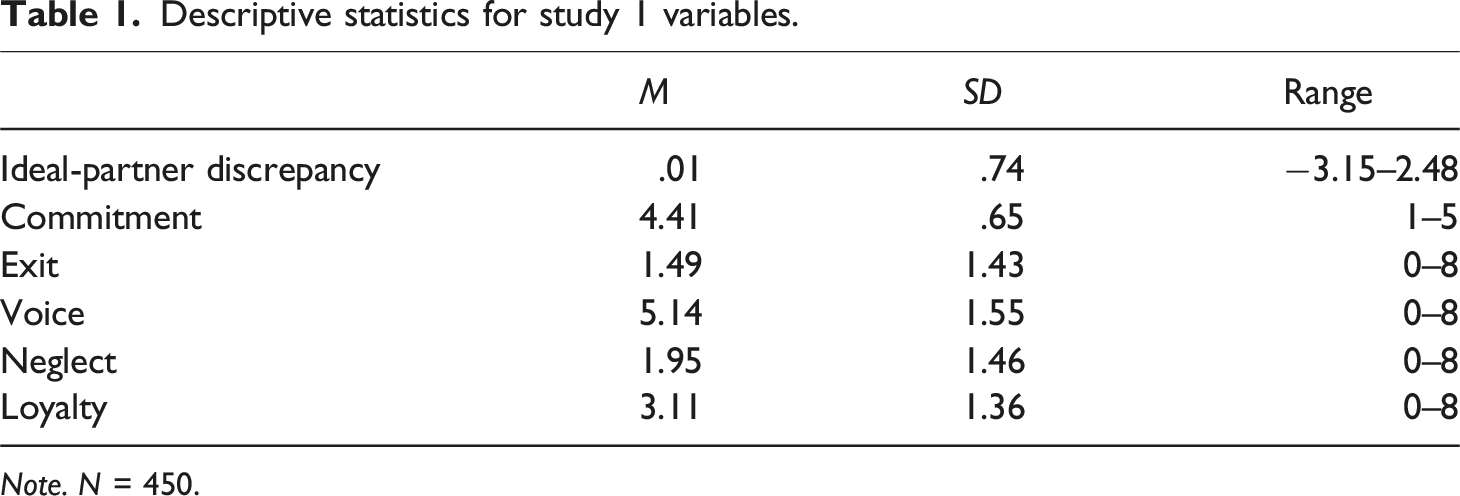
Note. N = 450.
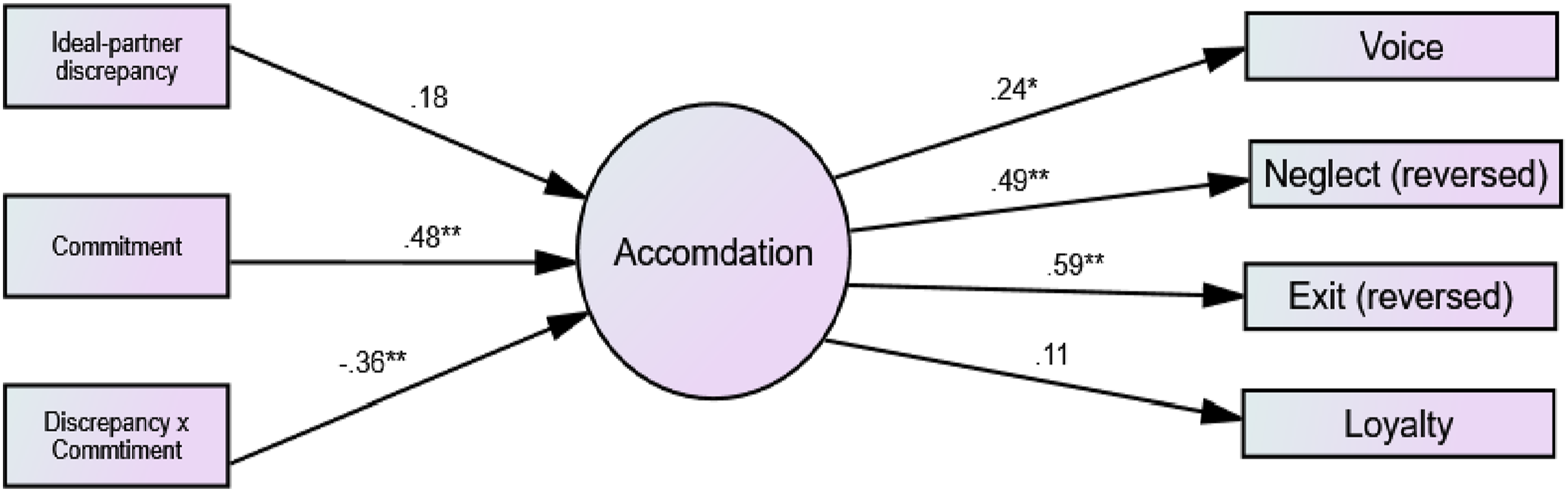
Structural Equation Model predicting accommodation (Study 1). Note. Error covariances are not illustrated for ease of interpretation. Accommodation subscales were moderately correlated with associations ranging from r = .23 (voice with loyalty) to r = .51 (exit with neglect). *p < .05, **p < .01.
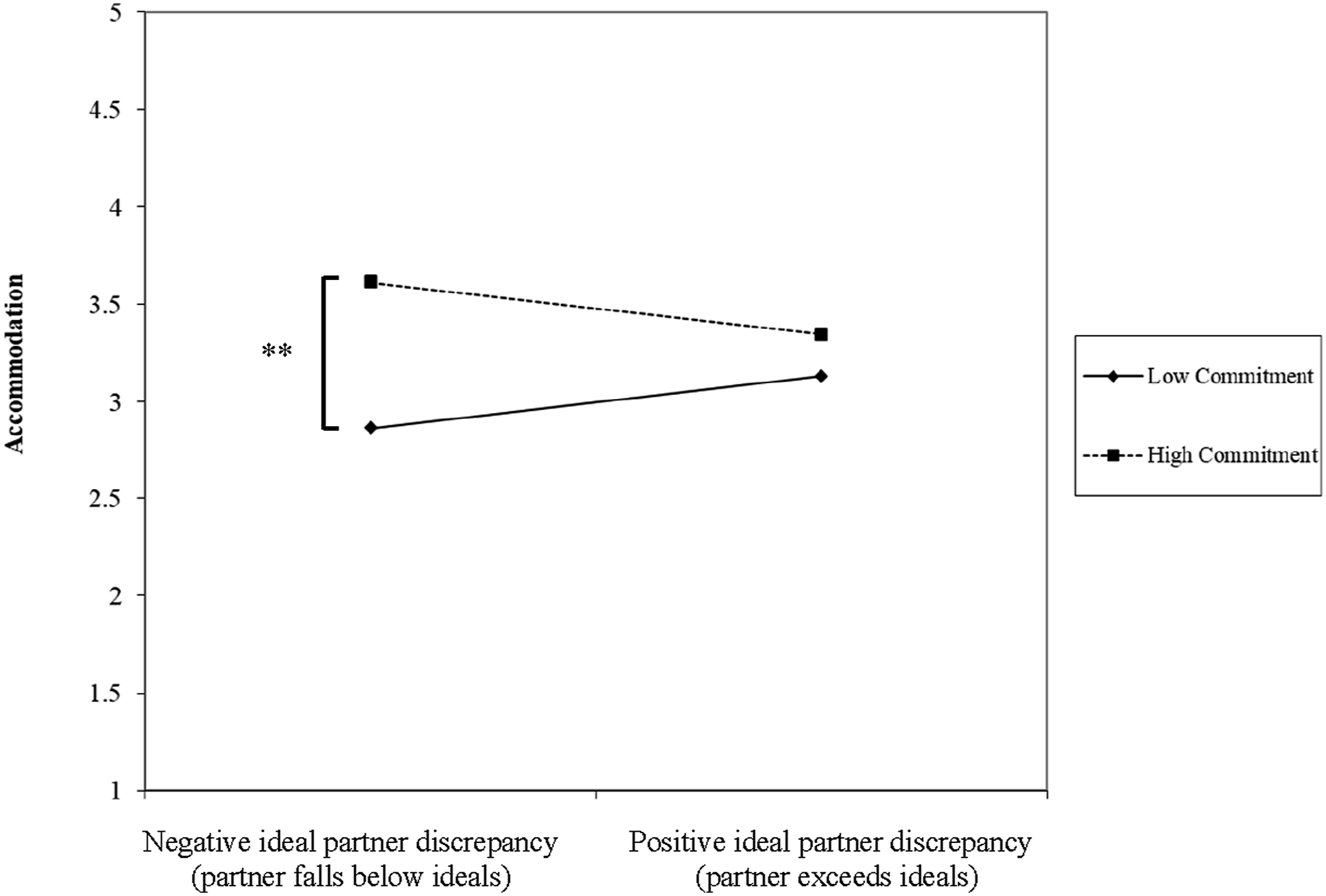
Two-way interaction between ideal-partner discrepancy and commitment (Study 1). **p < .01.
Taken as a whole, the findings offer important insights into the interplay between ideal-partner discrepancy and commitment in predicting accommodative responses within romantic relationships. In contrast to predictions, negative and positive ideal-partner discrepancies were not associated with accommodation (Hypotheses 1 and 2). Rather, the association between an ideal-partner discrepancy and accommodation only emerged when coupled with an individuals’ report of high relationship commitment (Hypothesis 3). Specifically, individuals who are highly committed to their relationships are likely to encompass the regulatory and relationship capacities to respond constructively to a partner’s negative behavior in the face of a negative ideal-partner discrepancy. This moderation finding speaks to the significant pro-relationship benefits of commitment and demonstrates how commitment can offset the costs and risks associated with engaging in accommodation behavior when a partner is deemed to fall short on ideal standards. This is in line with research that has found that high relationship commitment acts as a pro-relationship mechanism by which individuals inhibit destructive responses and instead engage in constructive behaviors to mitigate against endangering a relationship in which they have invested significant time and resources (e.g., Rusbult et al., 2001a, 2001b; Wieselquist et al., 1999). The findings of the current study suggest that when partners do not match one’s ideals, high commitment can increase an individual’s capacity to engage in constructive self-regulatory behaviors. These accommodative behaviors can allow an individual to voice concerns or issues in a way that is considerate and problem-focused and can benefit the relationship long-term, rather than behaviors that are harmful to one’s partner or relationship.
Study 2
Study 2 built on the predictions of Study 1 by taking a dyadic perspective in investigating the association between an ideal-partner discrepancy and accommodation as well as the moderating role of commitment. The dyadic nature of Study 2 afforded us the opportunity to expand our hypotheses such that we could derive predictions for how a person’s own ideal-partner discrepancy (positive or negative) predicts their own accommodation behavior (i.e., known as an actor effect prediction), but also for how a person’s own ideal-partner discrepancy predicts their partner’s accommodation behavior (i.e., known as a partner effect prediction). Dyadic predictions (involving hypotheses regarding actor and partner effects) can be derived by drawing on the ISM as the model inherently assumes that ideal-partner discrepancies have implications for one’s own behavior and that of one’s partner (Campbell & Fletcher, 2015; Fletcher et al., 1999; Simpson et al., 2001). Indeed, in an early dyadic test of the ISM, Campbell and colleagues (2001) found that a person’s own ideal-partner discrepancy was associated with one’s own relationship outcomes and that of their partner. The implication is that evaluation of one’s partner against ideal standards is not only diagnostic in that it informs a person about the quality of one’s relationship and guides their own relationship behaviors, but that a person’s own discrepancies inform a partner’s appraisal of the quality of the relationship as well as their relationship behaviors. Therefore, in extending on the predictions of Study 1 into the dyadic context of Study 2, ideal-partner discrepancies should not only be predictive of a person’s own accommodation behavior, but also the accommodation behavior of their partner. On this basis, it is hypothesized that a negative ideal-partner discrepancy will be associated with less self-accommodation behavior (actor effect) and less partner accommodation behavior (partner effect) (Hypothesis 1). It is also hypothesised that a positive ideal partner discrepancy will be associated with more self (actor effect) and partner accommodation behavior (partner effect) (Hypothesis 2).
The dyadic context also allowed us to extend the predictions outlined in Study 1 regarding the moderating role of commitment. Similar to Study 1, we predicted that relationship commitment would moderate the association between an ideal-partner discrepancy and accommodation behavior, however, we derived predictions in terms of actor and partner effects. This is because each couple member’s long-term relationship orientation is likely to offset any negative evaluations that each person might have of their partner, which we suggest can make accommodation a more risky or effortful endeavor for both couple members. Thus, in terms of commitment moderating the actor effect, we hypothesized that a person would engage in more accommodation despite having a negative ideal-partner discrepancy, but only when own relationship commitment was high (Hypothesis 3). In terms of commitment moderating the partner effect, we hypothesized that a person’s own commitment would moderate the association between their own accommodation and a mate’s ideal-partner discrepancy. That is, a person would engage in more accommodation despite his or her mate having a negative ideal-partner discrepancy, but only when own commitment was high (Hypothesis 4). The rationale for this final hypothesis draws on the idea that a person may be more likely to enact accommodative behaviors as a means to mitigate the negative evaluations haboured by one’s partner and to minimize potential rejection for being less than perfect (Campbell & Fletcher, 2015; Lackenbauer & Campbell, 2012). However, we add that such accommodative behaviors are especially likely to be enacted when the person is highly committed to the long-term viability of the relationship. As with Study 1, we did not expect commitment to moderate the associations (actor or partner) between a positive ideal-partner discrepancy and accommodation, thus, no further moderation hypotheses were proposed.
Method
Participants
The sample consisted of 116 mix-gendered couples (i.e., cisgender men and women; M = 24.48 years, SD = 7.88 years) currently involved in a romantic relationship (relationship length M = 3.36 years, SD = 4.11 years). Couples were recruited through the social networking site Facebook. Of the sample, 1.3% were married, 17.7% were in engaged or cohabiting relationships, and 81% were dating steadily or casually dating. Just over half the couples identified as Australian (52%), the remainder of the sample identified as North-Western European (16%), South East Asian (12%), South-Eastern European (9%), North East Asian (6%), North American (2%), South African (1%), Middle Eastern (1%), and South American (1%). Couples were paid $50 for participating in the study.
Materials and procedure
Couples were recruited through Facebook advertisements which included a hyperlink directing participants to the study overview webpage that included an appointment portal to book a time to undertake the study at the observational laboratory of a large Australian University. Upon arrival, couples were greeted by a research assistant and each member of the couple was escorted into a testing room to independently complete an online survey that included the ideal standards scales used in Study 1. Each member of the couple also completed a modified five-item version of Owen et al.’s (2011) Commitment Scale. Participants responded on a 7-point scale ranging from 1 (not at all) to 5 (extremely). Items are averaged to derive a total commitment score with higher scores indicative of greater commitment (Coefficient H = .92).
After completing the online measures, the couple engaged in a discussion task which was an adapted version of Gottman’s (1979) and Simpson and colleagues (Simpson et al., 1996; Simpson et al., 2007) dyadic interaction procedures. As part of this procedure, each member of the couple was instructed to independently identify three challenging and unresolved issues in their relationship. Both members of the couple were then brought together and asked to work towards selecting one issue that was considered the most challenging and unresolved. The couple was then instructed to engage in a video-taped discussion of their chosen topic for eight minutes
The video recording of each couple’s discussion was then independently assessed by three trained coders for accommodation responses using the Accommodation Coding Scheme (Aloni et al., 2022; Aloni & Karantzas, 2017). The coding scheme directly draws on Rusbult et al.’s (1991) accommodation model as it assesses responses to a partner’s negative behavior along the two dimensions that underpin accommodation responses (i.e., constructive-destructive and active-passive continua). These dimensions, along with the definitions for each of the four accommodation responses, are used to code for verbal (i.e., the statements and remarks) and non-verbal behaviors (i.e., body language [hand gestures, the positioning of one’s body relative to one’s partner], and affective facial expressions). Each of the four accommodation responses to partner negativity are scored along a 7-point scale ranging from 1 (low) to 7 (high). Therefore, each member of the couple is given an overall score of 1 to 7 for each of the four accommodation responses. The coding scheme has been found to exhibit very high inter-rater reliability across all four accommodation responses (exit inter-class correlation [ICC] = .95, voice ICC = .87, loyalty = .90, neglect = .88) (Aloni et al., 2022).
Data analysis
An ideal-partner discrepancy for each member of the dyad was calculated using the same residual score approach used in Study 1. Accommodation was again modelled as a latent variable as in Study 1. Using an Actor Partner Independence Model (APIM) framework, we developed and tested a structural equation model which included the hypothesized actor and partner associations between the ideal-partner discrepancy as well as the interaction between the ideal-partner discrepancy and commitment on accommodation. As part of the model, the hypothesized actor effect was estimated for each member of the couple such that men’s and women’s accommodation was regressed onto one’s own reports of the ideal-partner discrepancy (see Figure 2). We also controlled for the main effect of commitment by regressing men and women’s accommodation onto their own relationship commitment. The hypothesized partner effect was also estimated in which a person’s own ideal-partner discrepancy was modelled onto a partner’s accommodation. Finally, as with Study 1, we computed an ideal-partner discrepancy × commitment interaction. However, given the dyadic nature of the data, we calculated two versions of this interaction: (1) an actor-actor interaction involving a person’s own ideal-partner discrepancy x own commitment predicting a person’s own accommodation behavior, and (2) an actor-partner interaction involving a partner’s ideal-partner discrepancy x a person’s own commitment predicting a person’s own accommodation behavior. To account for the interdependency between dyad members (Kenny et al., 2006), each couple member’s ideal-partner discrepancy, commitment and observed accommodation were correlated with their partner’s scores on the same variables.2,3
Given the dyadic nature of the data, we also conducted an invariance test to determine whether the magnitude of the actor and partner effects significantly differed by gender. The invariance test involved the estimation and comparison of an APIM in which all paths were freely estimated to an APIM in which each actor and partner effect was constrained to equality for both genders. A chi-square difference test is then conducted determine whether the two models (constrained vs. unconstrained) statistically differ. A statistical difference indicates that the genders vary on particular paths. To locate the specific paths that differ for men and women, the equality constraint for a given path is released for both genders and the model is re-estimated to check for a statistical difference. If no difference is found between the unconstrained and constrained models, the genders are considered invariant on all paths (see Kenny et al., 2006).
Apriori APIM power analysis was conducted using the R-based APIMPower application (Ackerman & Kenny, 2016). A total of 108 dyads was estimated as required to detect a small actor or partner effect size (β = .20), with a power of .80.
Results and discussion
Descriptive statistics for study 2 variables.
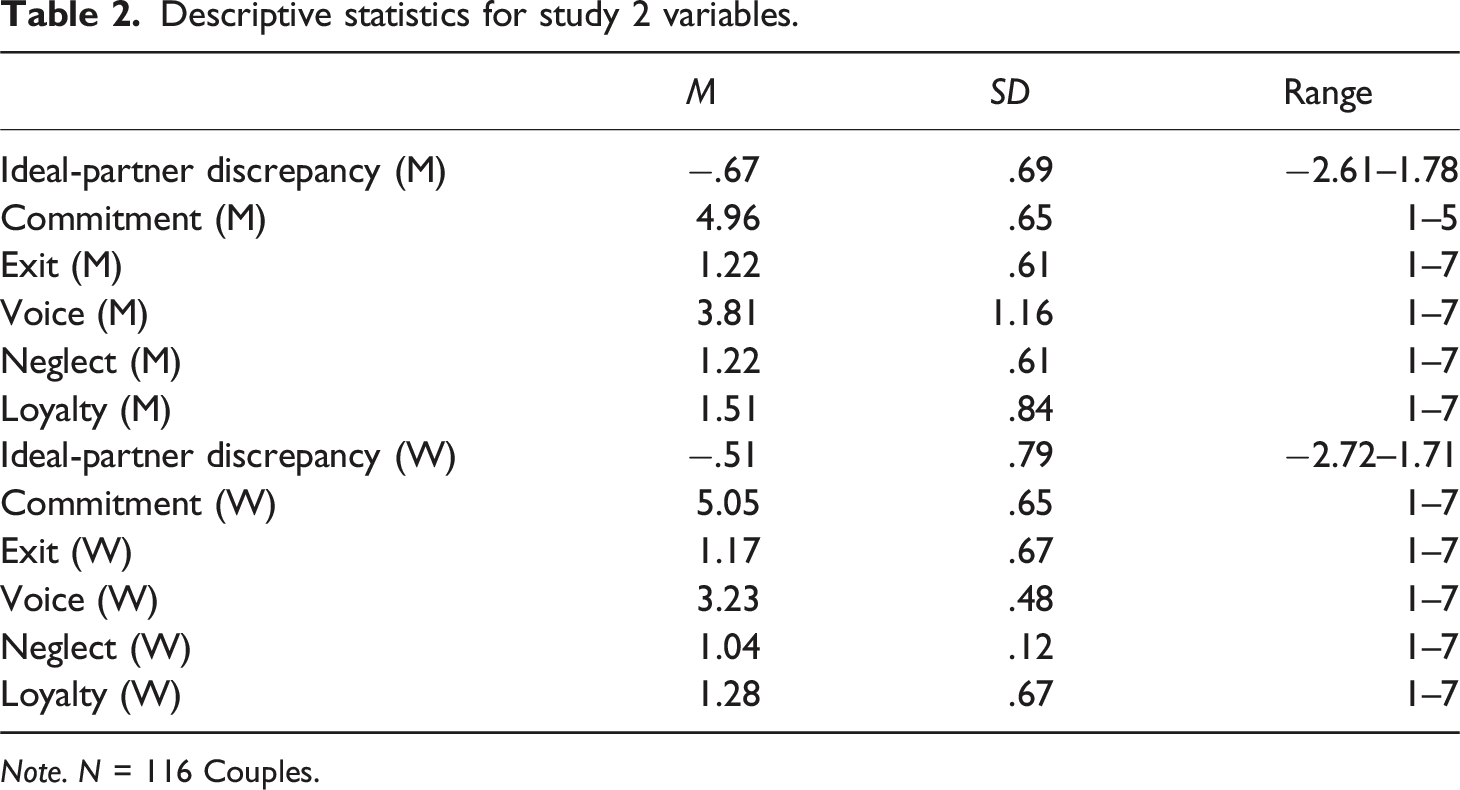
Note. N = 116 Couples.
Gender invariance testing across the actor and partner paths by comparing an APIM in which paths were freely estimated to an APIM in which all paths were constrained to equality for men and women revealed a significant difference between the two models Δχ2 (5) = 16.613, p = .0005. However, nested chi-square difference testing revealed that men and women differed on only one path – the partner path between a person’s own ideal-partner discrepancy and their partner’s observed accommodation. This path was allowed to be freely estimated, while for all other paths, equality constraints were maintained. All actor and partner effects are shown in Figure 3 and the results are are expanded upon in the sections below. Dyadic Structural Equation Model predicting accommodation (Study 2). Note. Error covariances are not illustrated for ease of interpretation. The association between accommodation subscales for men and women were: voice [r = .11]; exit [r = .65]; neglect [r = .03]; loyalty [r = .10]. The associations between men and women’s predictor variables were: ideal-partner discrepancy [r = .10]; commitment [r = .22]. *p < .05, **p < .01.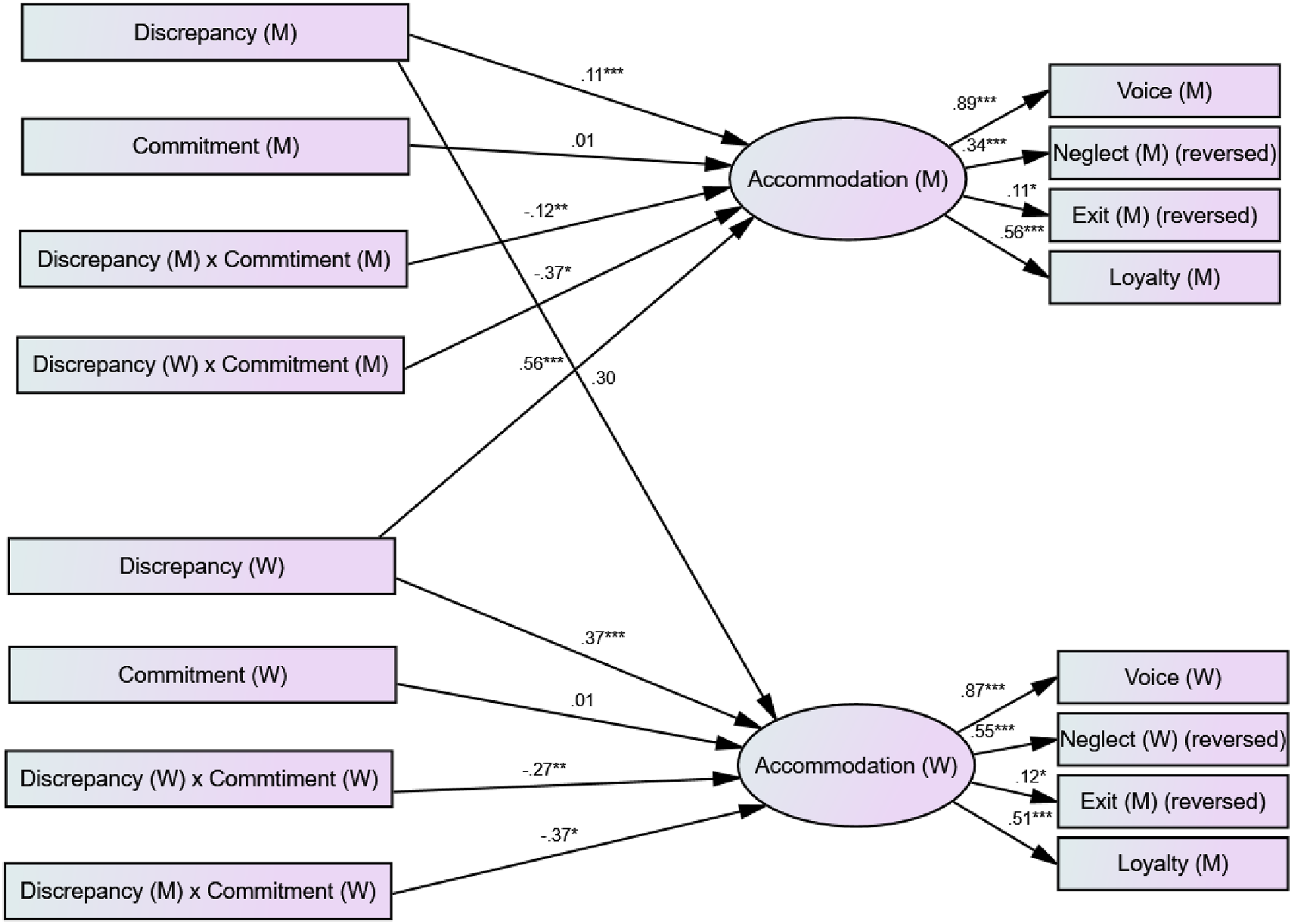
Actor effects
In relation to actor main effects, men and women’s ideal-partner discrepancy was found to be positively associated with one’s own observed accommodation behavior. In support of hypotheses 1, men and women whose ideal-partner discrepancy reflected that their partners fell below one’s ideal standards (i.e., negative ideal-partner discrepancy) engaged in less observed accommodation responses (i.e., greater voice and loyalty and less exit and neglect). In support of hypothesis 2, men and women whose ideal-partner discrepancy exceeded ideals (i.e., positive ideal-partner discrepancy) were found to engage in more observed accommodation behavior.
In line with hypothesis 3, the actor x actor moderated effect involving relationship commitment, was significantly associated with one’s own accommodation responses (see Figure 3). Plotting of the simple slopes for the actor discrepancy x actor commitment interaction revealed that both men and women engaged in greater accommodation when they deemed their mate to fall short on ideals (i.e., negative ideal-partner discrepancy) and own commitment was high (1 SD above the mean) compared to when own commitment was low (1 SD below the mean) (see Figure 4 panels (a) and (b)). Actor-actor interactions predicting men and women’s own accommodation.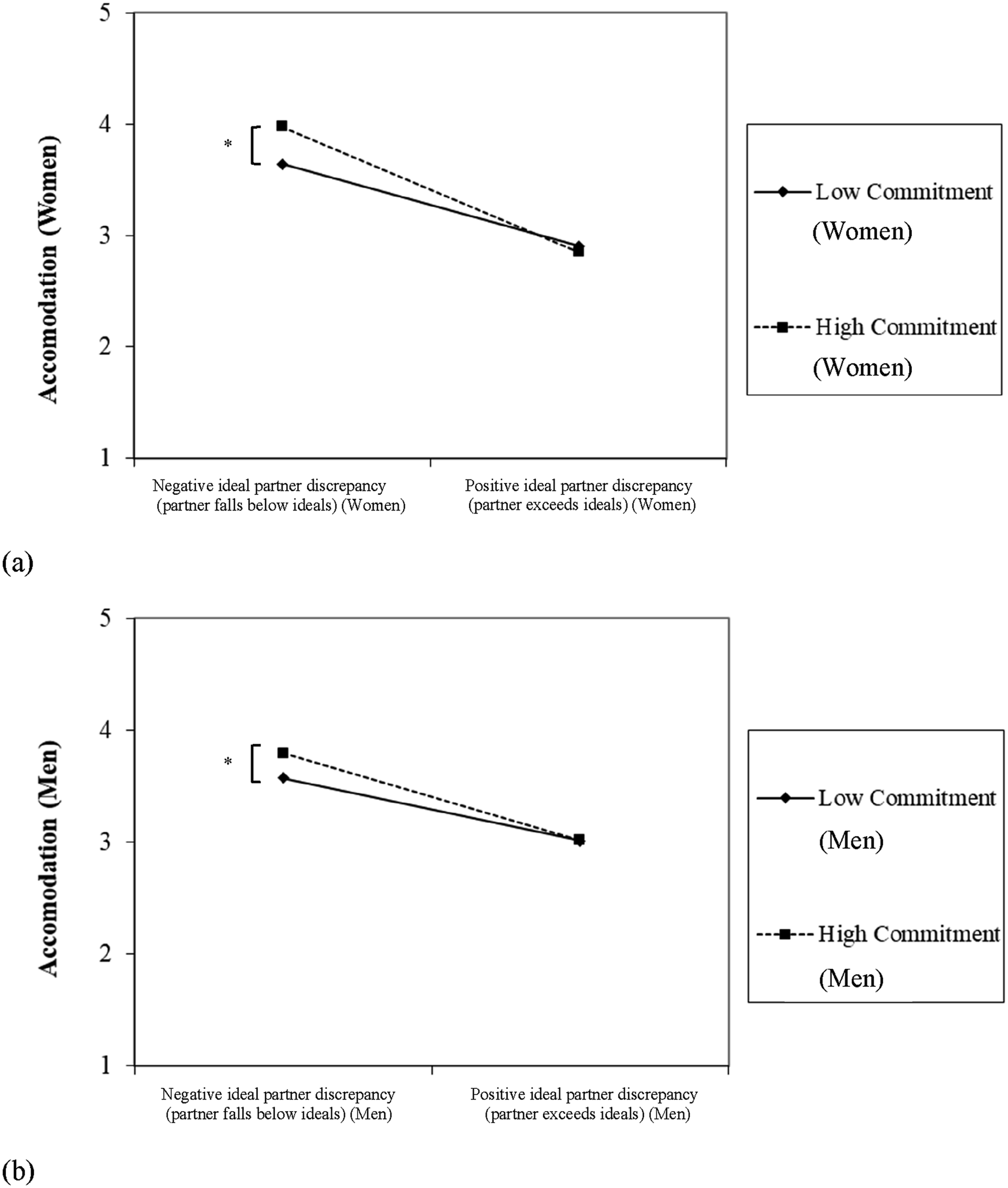
Partner effects
In relation to partner main effects, we found that for women, but not for men, ideal-partner discrepancy was positively associated with a partner’s observed accommodation behavior. This was the only effect that significantly differed between women and men. In partial support of hypothesis 1, women whose ideal-partner discrepancy reflected a partner fell below one’s ideal standard (i.e., negative ideal-partner discrepancy) was associated with partners engaging in less observed accommodation. In contrast, women whose ideal-partner discrepancy exceeded ideals (i.e., positive ideal-partner discrepancy) was associated with partners engaging in more observed accommodation behavior.
Turning to the hypothesized actor-partner moderated effect involving relationship commitment (hypothesis 4), we that for men and women, the interaction was significantly associated with one’s own accommodation responses (see Figure 3). Plotting the simple slopes for the significant actor-partner interaction (i.e., a mate’s ideal partner discrepancy x an actor’s commitment) revealed women engaged in more accommodation when their mate deemed them to fall short of ideals (i.e., negative ideal-partner discrepancy) and women’s own commitment was high (1 SD above the mean) compared to when women’s commitment was low (1 SD below the mean) (see Figure 5 panel (a)). In contrast women engaged in less accommodation when their partner deemed them to exceed ideals (i.e., positive ideal-partner discrepancy) and women’s own commitment was low compared to when women’s commitment was high. An interaction was also found in terms of men’s accommodation. As shown in Figure 5 panel (b), men engaged in more accommodation when their partner deemed them as falling below ideals and men’s own commitment was high compared to when men’s commitment was low. On the other hand, men engaged in more accommodation when their partner deemed them as exceeding ideals and men’s own commitment was low compared to when men’s commitment was high. An important difference in the pattern of the interactions reported across Figure 5 panels (a) and (b), which was not hypothesized, was that women generally engaged in greater accommodation when partners deemed them to fall short of ideals, whereas men generally engaged in greater accommodation when partners deemed them to exceed ideals. Actor-partner interactions predicting men and women’s accommodation.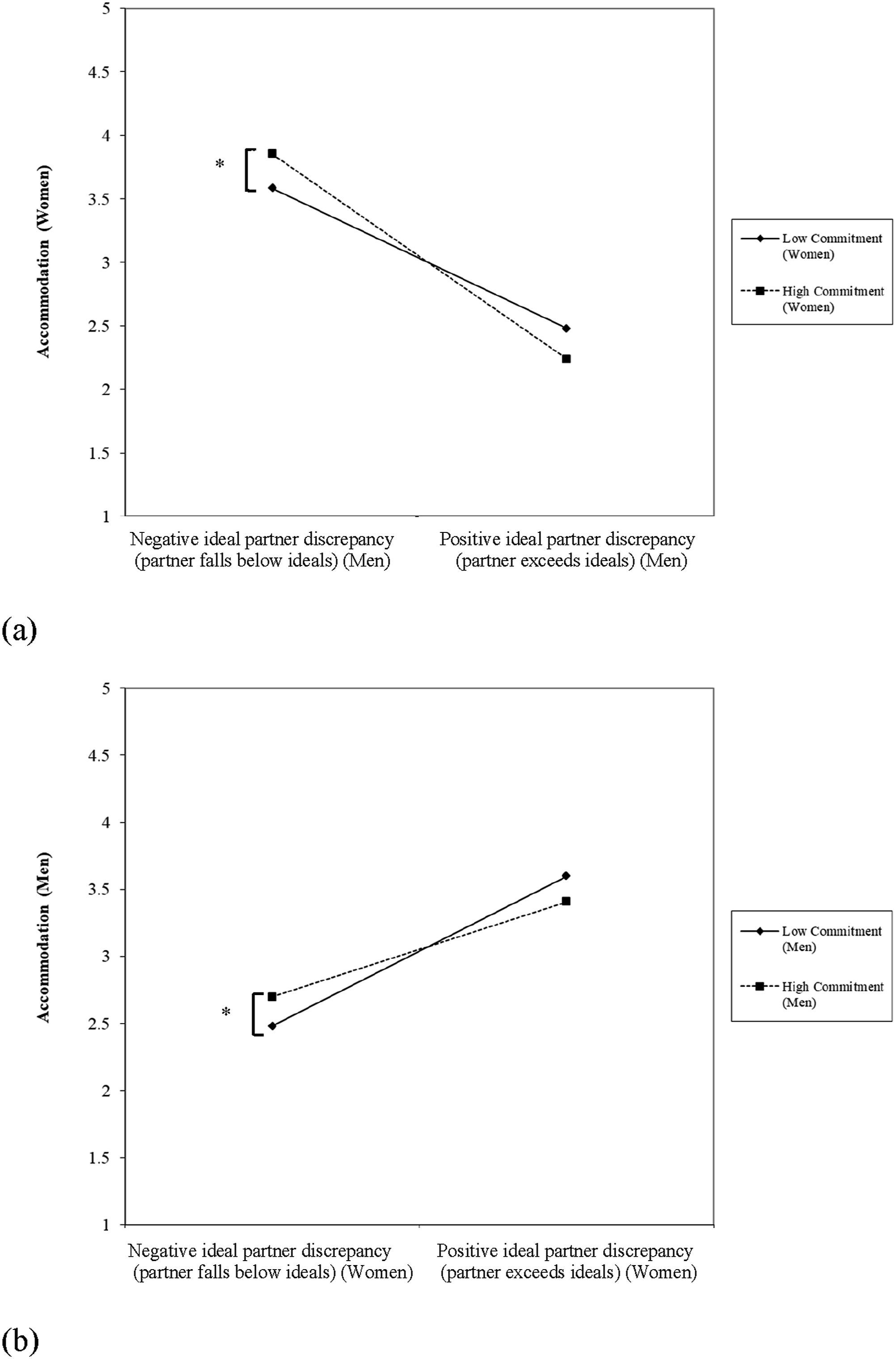
As with Study 1, the findings of Study 2 revealed that the association between ideal-partner discrepancy and accommodation responses was moderated by commitment. However, Study 2 goes beyond the findings of Study 1 by taking a dyadic approach and assessing accommodation responses in terms of observed behaviors.
General discussion
The current paper addresses the significant lack of research investigating partner evaluations and self-regulation within romantic relationships. Drawing on the ISM, we examined the relationship between ideal-partner discrepancy and one of the most documented self-regulatory behaviors in the context of romantic relationships—accommodation. The current research also provides novel insights that commitment plays an important role in moderating the relationship between ideal-partner discrepancy and accommodation.
We found some evidence for our predictions that a person’s own ideal-partner discrepancy would be associated with their own accommodation behavior. Specifically, the predicted associations between a positive and negative ideal-partner discrepancy and accommodation were only found in Study 2. That is, for men and women, evaluating one’s partner as falling below ideals (negative ideal-partner discrepancy) was associated with less accommodation and evaluating a partner as being above ideals (positive ideal-partner discrepancy) was associated with enacting more accommodation. These findings extend theory and research into the ISM to suggest that ideal-partner discrepancies are not only associated with partner regulation, but also self-regulation in the form of accommodation. Again, it is important to emphasize that this finding only relates to Study 2 when ideal-partner discrepancies and accommodation were modelled dyadically rather than modelling individuals. Future studies could focus on cross validating this finding across dyadic and non-dyadic contexts.
A finding that was evidenced across both men and women in Study 2 was that an ideal-partner discrepancy was predictive of the accommodation behavior observed in one’s partner. Thus, it may well be that a person’s ideal-partner discrepancy may reliably predict a partner’s self-regulatory capacity to inhibit destructive behaviors and respond constructively more so than predicting one’s own accommodation behavior. This finding is novel as it provides some of the first evidence to support predictions under the ISM that the diagnostic function of ideal-partner discrepancies can indeed extend to the regulation behaviors of partners (Simpson et al., 2001). Specifically, the finding suggests that a negative ideal-partner discrepancy seems diagnostic in determining the extent to which partners engage in more destructive than constructive behaviors (i.e., less accommodation), whereas a positive ideal discrepancy is diagnostic of partners engaging in less destructive and more constructive behaviors (i.e., more accommodation).
However, the main effects addressed to this point need to be discussed in light of the moderating role of commitment. Using different samples and methods across both studies, we found evidence that a negative ideal-partner discrepancy was associated with more accommodative behaviors when commitment was high compared to when commitment was low. In Study 1 and Study 2, a person’s own ideal-partner discrepancy coupled with their own commitment predicted their accommodation behavior. Further, and in line with predictions for Study 2, we found that for both men and women, a mate’s ideal-partner discrepancy coupled with a person’s own commitment predicted one’s own accommodation behavior. So, what do we make of these moderated effects across the two studies?
It appears that high commitment indeed assists partners to inhibit destructive behaviors and promotes constructive behaviors, thereby increasing accommodation, in the face of: (1) evaluating a partner negatively, and (2) being evaluated negatively by one’s partner. Given that accommodation is both deliberate and effortful, and at times costly (Murray et al., 2006; Rusbult et al., 1991), individuals need to be motivated to shift from enacting destructive behaviors in immediate response to partner negativity and to respond constructively. Furthermore, the ability to self-regulate by way of accommodation requires an individual to assess and manage relationship risk, that is, the extent that the relationship is rewarding versus costly (Murray et al., 2006; Overall & Simpson, 2013; Rusbult et al., 1991). We contend that a negative ideal-partner discrepancy (whether it be an evaluation of one’s partner or by one’s partner) should signal that it is costly to engage in accommodation. In the present set of studies, it appears that high relationship commitment may attenuate this risk such that accommodation is enacted despite the partner or self being evaluated as falling short of ideals. In this respect, our findings further the case for the pro-relationship benefits of relationship commitment. Importantly, however, the current research contends that commitment operates as an important moderator that offsets the cost and effort of engaging in accommodation when either member of a couple holds a negative ideal-partner discrepancy.
Although we could not test for gender differences in Study 1 (due to the sample only comprising of 17% of men), we were able to test for gender differences in Study 2. Overall, the results demonstrated that the effects did not differ according to gender, with one exception; women’s ideal-partner discrepancy was significantly positively associated with men’s accommodation behavior, whereas for men, the association was positive, but not significant. Although we made no predictions regarding gender, it may be that men’s accommodation behavior may be more closely tied to evaluations of one’s partner than is the case for women. Past studies have found that women tend to engage in greater accommodation than men (e.g., Rusbult, 1987), explanations for this finding may reside in women’s gender roles in which there is a greater emphasis on enacting relationship maintenance behaviors than there is for men (e.g., Olgosky & Bowers, 2012). That is, women’s enactment of accommodation may occur as a function of gender roles, and thus, partner evaluations may play less of a role than is the case for men. We do however caution gender-based interpretations given that this was the only gendered finding.
Limitations and future directions
Although the current study provides novel insights into the associations between ideal-partner discrepancy, accommodation and the moderating role of commitment, there are some limitations that need to be considered and addressed as part of future research. As already mentioned, Study 1 comprised of a sample that was largely women (approximately 83%). Thus, we were unable to conduct any subsequent analyses to determine whether the gendered associations found in Study 2 between men’s ideal-partner discrepancy, commitment, and their own accommodation behavior replicated across studies. Future research should therefore attempt to recruit more gender-balanced samples in order to test whether gendered effects indeed exist. Another limitation of the current research is that causation cannot be inferred, although, in Study 2, the partner evaluation occurred prior to when couples undertook the discussion task in which accommodation behavior was coded. Thus, to draw firm conclusions regarding causation, future research should entail diary and other types of longitudinal studies in which there can be an estimation of lagged effects. These designs, coupled with recent advances in casual inference modelling such as the testing of directed acyclic graphs (e.g., Tennant et al., 2021), can help to determine whether ideal-partner discrepancies impact on accommodation behavior or whether accommodation behaviors predict ideal-partner discrepancies.
Conclusion
The findings of the current paper provide a novel integration of the Ideal Standards Model with research on accommodation. In doing so, the research provides much needed insights into how evaluations of partners by way of an ideal-partner discrepancy is associated with self-regulatory behavior aimed at inhibiting destructive responses and promoting constructive responses in light of a relationship partner’s negative behavior. Our findings suggest that enacting accommodation when a partner is deemed to fall short of one’s ideals requires individuals to have high levels of commitment. In this way, the present work highlights that accommodation occurs as part of a complex dynamic between relationship processes tied to partner evaluations and levels of relationship commitment.
Footnotes
Funding
The author(s) received no financial support for the research, authorship, and/or publication of this article.
Open research statement
As part of IARR's encouragement of open research practices, the author(s) have provided the following information: This research was not pre-registered. The data used in the research are available. The data can be obtained via email. The materials used in the research are available. The materials can be obtained via email.
