



Abstract
When faced with an undesirable behavior by one’s partner, theories of relationship maintenance indicate that individuals must undergo a transformation of motivation in order to set aside their initial impulse to respond in a self-centered manner, and instead choose to respond in a pro-relationship manner. However, the cultural psychology literature indicates that a primary focus on one’s own needs and goals is predominantly a feature of individualistic cultures, such as those in the Unites States and Western Europe which have been the setting for the vast majority of close relationships research. Thus, it is possible that people from less individualistic cultural contexts do not experience this same transformation of motivation process when faced with an undesirable behavior by their partner, because their initial impulse is less self-centered and more other- or relationship-centered. To test this hypothesis we conducted pre-registered replications of two classic studies documenting the transformation of motivation process (Yovetich & Rusbult, 1994) using a cross-cultural sample of participants from the U.S. and Thailand. The extent to which people in both cultural settings engaged in the transformation of motivation process was assessed in a correlational study (N = 187) and an experimental study (N = 328) of partnered individuals. Results indicate that participants in both cultural contexts experience a transformation of motivation process, and the magnitude of the transformation did not differ between the two countries. Exploratory analyses indicate that Thai participants engaged in more passive behaviors than U.S. participants, and U.S. participants thought passive behaviors were more harmful than active behaviors. Overall, when faced with an unpleasant behavior by one’s partner, the need to set aside one’s initial impulse in order to respond in a more pro-relationship manner appears universal, but the exact behaviors that are the endpoint of that process differ across cultures.
Keywords
Conflicts of interest, differences of opinion, and arguments over specific issues are common in romantic relationships, even among partners who are satisfied with their relationship. In order to constructively manage these situations and maintain a satisfying relationship, romantic partners must engage in pro-relationship behaviors (Ogolsky et al., 2017). For example, when partners have conflicting interests or desires, one partner can sacrifice by setting aside their own preference in deference to their partner’s preference (Righetti et al., 2022). When one partner has done something hurtful to the other, forgiveness requires overcoming the inclination to retaliate in response to the partner’s transgression in order to preserve the relationship (Fincham, 2010). The process of setting aside one’s initial self-centered impulse, and choosing instead to respond in a pro-relationship manner is known as the transformation of motivation (Kelley & Thibaut, 1978). This process has been well-documented in the literature and is believed to be a basic, universal process which underlies all relationship maintenance behaviors (Agnew & Le, 2015).
Built into the transformation of motivation process is the assumption that all individuals will have an initial impulse that is inherently self-oriented, rather than relationship- or other-oriented, when faced with a transgression or conflict of interest with their partner. Indeed, the prominent theories of relationship maintenance (e.g., the Investment Model, Interdependence Theory) explicitly characterize relationship maintenance behaviors as involving a process in which individuals prioritize the well-being of their partner and the relationship over their own self-centered interests (Agnew & Le, 2015; Arriaga, 2013; Kelley & Thibaut, 1978; Rusbult et al., 2012). However, the vast majority of research on close relationships, including research on specific pro-relationship behaviors, has been conducted on individuals from the United States and Western Europe (Curran et al., 2023; Righetti et al., 2020; Williamson et al., 2022). Thus, the assumption that all individuals have an initial inclination to act in a self-interested manner in response to a conflict with their partner is based on a body of research that vastly overrepresents individuals from individualistic cultural backgrounds (Hofstede, 2001).
Individuals from more interdependent, non-Western cultures are highly underrepresented in the close relationships literature, and there is reason to believe that their “gut reaction” in response to a conflict 1 with their partner may be less self-centered and more other-centered. Interdependent cultures, such as those found in East and Southeast Asian countries, are characterized by a fundamental connectedness of human beings to each other. Individuals from interdependent cultures prioritize maintaining harmony and solidarity in relationships and value group and family happiness above personal happiness (Krys et al., 2023; Markus & Kitayama, 1991). They achieve these goals by taking specific, culturally prescribed behaviors in social interactions, including “taking the perspective of others, reading the expectations of others, adjusting to others, and using others as referents for action” (Markus & Kitayama, 2010, p. 423). Importantly, these patterns of social interaction are particularistic, applying specifically to close others and those with whom community and interests are shared (J. O. Yum, 1988). This explicit cultural orientation toward understanding others’ needs and maintaining harmonious close relationships may have shaped individuals from these cultures toward an automatic response that centers the needs of the other and the relationship over their own needs.
In contrast, independent cultures are characterized by the belief that each person is a unique and distinctive whole, and individualism, autonomy, self-promotion, and high self-esteem are valued (Heine et al., 1999). Accordingly, individuals from more independent cultures, such as those found in the United States, Canada, and Western Europe, typically focus on their own needs, preferences, and goals, and social interactions are therefore guided by culturally prescribed behaviors that satisfy and promote one’s own individual outcomes (Markus & Kitayama, 2010; Triandis, 1995). Thus, it is not surprising that the extant literature has found that individuals from independent cultural backgrounds typically have a self-focused automatic response to relational conflicts.
Although the transformation of motivation process has been understood for decades as a basic process underlying relationship maintenance, the cultural psychology literature calls this assumption into question. Individuals from more interdependent cultural contexts are socialized to prioritize the needs of others over their own desires and therefore their initial impulse in response to a relationship conflict may be less self-centered. Thus, they may be able to engage in pro-relationship behaviors after a smaller, or even non-existent, transformation of motivation, rendering relationship maintenance less effortful for them.
To test this hypothesis, we conduct a pre-registered replication of an early and influential set of studies documenting the transformation of motivation process (Yovetich & Rusbult, 1994), using a cross-cultural sample. These classic studies focused on transformation of motivation in the specific context of accommodative dilemmas in which an individual must determine how to respond after their partner engages in a hurtful or transgressive behavior. Yovetich and Rusbult (1994) conducted two studies: The first was a correlational design in which participants reported behaviors that they considered enacting and that they actually enacted in response to their partner’s most significant transgression. Results indicated that considered responses were significantly more destructive than enacted responses, supporting a transformation of motivation process in which individuals decided to enact more constructive responses than they initially considered. The second study used an experimental design which manipulated the amount of time participants had to consider how they would respond to a hypothetical transgression by their partner. Results indicate that participants who had limited response time (and were therefore unable to complete the transformation of motivation process) chose responses that were significantly more destructive than participants with unlimited response time (who were able to complete the transformation of motivation process).
These two designs are used in the current study to test whether the magnitude of the transformation of motivation process differs across independent versus interdependent cultures. We used data from individuals living in the United States who identified as White and individuals living in Thailand who identified as Thai. The United States and Thailand differ markedly in the extent to which the culture is individualistic, with a very high level of individualism in the U.S. overall, and particularly among individuals of European American background (Hofstede, 2001; Vargas & Kemmelmeier, 2013). In contrast, Thailand has a very low level of individualism, comparable to levels of individualism in China and Korea (Hofstede, 2001; Pornpitakpan, 2000). We first examine whether the results from the original studies can be replicated across the full sample and within each sample, then we compare the results between the two samples to test our hypothesis that the magnitude of the transformation of motivation is smaller in the Thai sample, compared to the U.S. sample, and that this difference is driven by differential initial reactions 2 .
Study 1
Following the procedure of Study 1 from Yovetich and Rusbult (1994) we captured the transformation of motivation process using retrospective self-reports from a major transgression participants experienced in their relationship in the past. Participants identified actions that they considered taking in response to the transgression, and actions that they actually took in response; the transformation of motivation was conceptualized as the difference between the number of destructive actions the individual considered and the number they actually enacted. We hypothesized that the transformation of motivation would be observed in both cultures, in that individuals would consider more destructive responses than they actually enact, but that this would be attenuated in the Thai sample compared to the U.S. sample, such that the difference between the considered and enacted responses is smaller in magnitude.
Method
Participants
The U.S. sample was recruited from a public university in the Southwest using multiple modalities: by word-of-mouth from research assistants who distributed information about the study across campus (e.g., by emailing a student organization that they participate in), asking faculty members to advertise the study in their classes, and through an undergraduate subject pool. The Thai sample was recruited from an urban public university in Thailand using multiple modalities, including asking faculty members to advertise the study in their classes and through social media postings on departmental media outlets (e.g., Facebook). We sampled for undergraduate students in order to provide the most direct test of whether the original results can be replicated.
All participants were required to be at least 18 years old, currently involved in a romantic relationship of at least one month in duration, and self-identify as White (for the U.S. sample) or Thai (for the Thai sample). Individuals who completed the study received credit if they enrolled through the subject pool, or were entered into a raffle to receive a $100 gift card to be given to 1 in 100 participants. Data was collected online through Qualtrics from October 2021 – January 2022.
To ensure data quality, we followed our pre-registered plan for excluding participants who: 1) Did not respond to the open-ended writing task or provided a response that did not make sense for the prompt (n = 24); 2) Had missing data for more than half of the destructive response scale (n = 33); or 3) Failed to correctly answer two attention questions from the Directed Questions Scale (Maniaci & Rogge, 2014) (n = 6).
Power analysis indicated that a sample of 88 participants per group is needed to attain .95 power to observe an effect size of d = 0.5, which was observed in pilot data 3 . Our final analytic sample consisted of N = 187 participants, including n = 90 White Americans and n = 97 Thai, which meets the requirements of the power analysis and is much larger than the sample from the original study (N = 51).
Procedure and materials
These procedures were approved by the Institutional Review Board of the University of Texas at Austin. This study was pre-registered: https://aspredicted.org/by6kb.pdf Materials, data, and analysis code are available at: https://osf.io/y8rn3/?view_only=fb3ba518811141efb2b9b38fd77acb0f
We used the original materials as reported in Study 1 of Yovetich and Rusbult (1994). All materials were translated from English to Thai then back-translated from Thai to English by two individuals who were fluent in English and Thai and trained in social science research. Discrepancies after the back-translation were resolved through discussion between the authors until the measures and instructions had equivalent meanings across both languages.
Transformation of motivation
Participants were first provided with a large open-ended text box and asked to “Please describe the most memorable incident when your partner said or did something that made you feel upset or angry - a time when your partner was rude or irritable, said something unkind, spoke to you in a raised voice, or otherwise showed a lack of consideration for you and your relationship.”
After writing their open-ended description, participants were presented with a list of 16 behaviors in which they could have engaged in response to their partner’s transgression. The response options were drawn from the Exit-Voice-Loyal-Neglect scale (EVLN, Rusbult et al., 1991), and were split evenly between constructive and destructive behaviors. Consistent with the EVLN framework, constructive and destructive responses were also split evenly between passive and active. Participants were first asked to rate the extent to which they considered engaging in each response (e.g., “I considered forgiving my partner and forgetting about it.” and “I considered doing something equally unpleasant in return.“) with options ranging from 1 = did not consider at all to 5 = strongly considered.
On the next page participants were presented with the same 16 behaviors and asked to rate the extent to which they actually responded in that way (e.g., “I forgave my partner and forgot about it.” and “I did something equally unpleasant in return.“), with options ranging from 1 = did not react this way at all to 5 = reacted this way strongly. Values for the eight destructive responses were summed to form the scale scores for considered destructive responses and enacted destructive responses, each with a possible range of 8–40. The transformation of motivation is operationalized as the difference between the considered and enacted destructive responses.
Severity of the incident
After describing the memorable incident, participants were asked “Please rate the severity of the incident you just described” with response options ranging from 1 = not severe at all to 5 = extremely severe.
Relationship satisfaction
Global sentiments about the relationship were assessed with the 16-item version of the Couple Satisfaction Index (Funk & Rogge, 2007). Items were summed to form the scale score, with a possible range of 0 – 81. Two participants had missing values in the relationship satisfaction scale, which were handled by imputing within-person mean values. Higher scores indicate higher levels of relationship satisfaction. Cronbach’s alpha was 0.97 for Thai participants and 0.93 for U.S. participants.
Results
Descriptive statistics
Demographic characteristics of participants in studies 1 and 2.
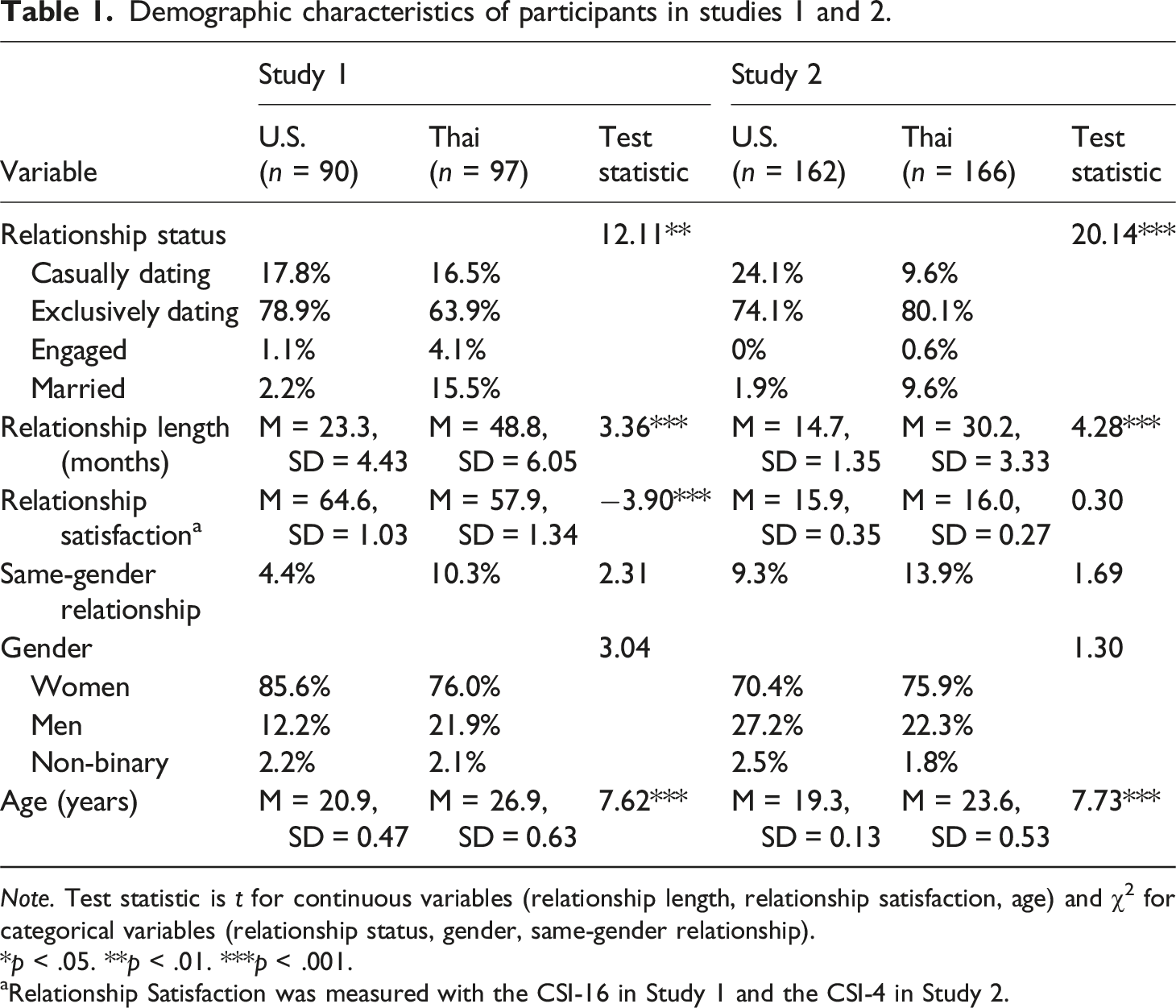
Note. Test statistic is t for continuous variables (relationship length, relationship satisfaction, age) and χ2 for categorical variables (relationship status, gender, same-gender relationship).
*p < .05. **p < .01. ***p < .001.
aRelationship Satisfaction was measured with the CSI-16 in Study 1 and the CSI-4 in Study 2.
The mean rating for severity of the most memorable incident was 3.27 (SD = 0.08) for Thai participants and 3.32 (SD = 0.13) for U.S. participants out of a maximum possible score of 5, indicating that the incidents were moderately severe. Level of severity did not differ between the groups (t (185) = 0.35, p = .727).
Replication of original study
We first sought to replicate the results of the original Yovetich and Rusbult (1994) study by conducting a paired samples t test to compare the considered destructive responses with the enacted destructive responses, using the full combined sample of U.S. and Thai participants. Results were consistent with the original study, such that participants considered significantly more destructive responses than they actually enacted (17.8 vs. 14.3, t (186) = 9.77, p < .001). These results also held when examined separately by country: Thai (17.7 vs. 15.1, t (96) = 5.44, p < .001), U.S. (18.0 vs. 13.4, t (89) = 8.56, p < .001). 4
Cross-cultural differences
Linear regression model testing transformation of motivation for study 1.
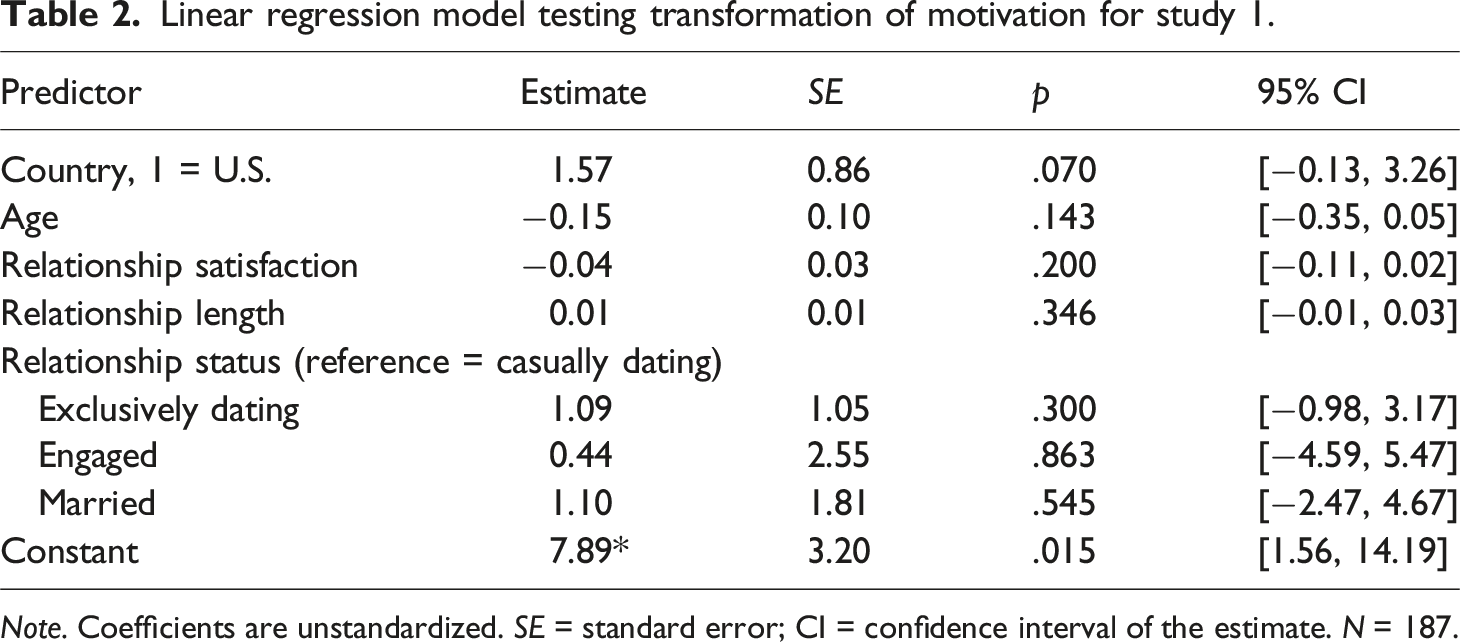
Note. Coefficients are unstandardized. SE = standard error; CI = confidence interval of the estimate. N = 187.
Discussion
Consistent with our first hypothesis, we replicate the results of the original Yovetich and Rusbult (1994) study by documenting the transformation of motivation process across both countries. In contrast, we did not find evidence to support our second hypothesis that the magnitude of the transformation of motivation process would be attenuated in Thai participants.
Study 2
Transformation of motivation is a multi-step process that is most accurately captured as it unfolds, rather than retrospectively. However, an attempt to observe the process behaviorally would reveal only the final chosen behavior, leaving the internal cognitive process that leads to that choice unobserved. Yovetich and Rusbult (1994) developed a clever method for observing the process of the transformation of motivation by leveraging time pressure, which they employed in Study 2. Although it occurs relatively quickly, transformation of motivation still takes some time for individuals to notice their initial impulse for how they want to respond, then elect to set aside that impulse and choose a different pro-relationship response instead. Yovetich and Rusbult theorized that individuals who were pressured to choose how to respond to a partners’ transgression very quickly would not have time to complete the transformation of motivation process, allowing us to tap in to their initial impulse.
Following the procedures of Study 2 from Yovetich and Rusbult (1994), we captured the transformation of motivation process using an experimental design in which the time allotted to respond to a partners’ transgression was manipulated. Responses chosen under time pressure were conceptualized as representing the initial impulse before the transformation of motivation is complete, whereas responses chosen with no time pressure were conceptualized as representing the final response choice after completing the transformation of motivation. We hypothesized that the transformation of motivation would be observed in both cultures, such that individuals would choose more destructive responses in the limited time condition than in the plentiful time condition. We also hypothesized that the transformation of motivation process would be attenuated in the Thai sample compared to the U.S. sample, such that Thai individuals will choose more constructive responses in the limited time condition than U.S. participants.
Method
Participants
The U.S. sample was recruited from a public university in the Southwest through an undergraduate subject pool. The Thai sample was recruited from an urban public university in Thailand, using multiple modalities, including asking faculty members to advertise the study in their classes and through social media postings on the departmental page (e.g., Facebook). We sampled for undergraduate students to provide the most direct test of whether the original results can be replicated.
All participants were required to be at least 18 years old, currently involved in a romantic relationship, and self-identify as White (for the U.S. sample) or Thai (for the Thai sample). Individuals who completed the study received participation credit if they enrolled through the subject pool, or were entered into a raffle to receive a $50 gift card to be given to 1 in 20 participants. Data was collected online via Qualtrics from October 2022 – January 2023 and October 2023 – December 2023.
To ensure data quality, we followed our pre-registered plan to exclude participants who: 1) Had missing data for more than half of the vignettes (n = 36); or 2) Failed to correctly answer two attention questions from the Directed Questions Scale (Maniaci & Rogge, 2014) (n = 46).
Power analysis indicated that a sample of 327 participants is needed to attain .95 power to observe an effect size of f = 0.20 (a small to medium effect), which was observed in pilot data 5 . Our final analytic sample consisted of n = 162 White American and n = 166 Thai participants. Our overall sample of N = 328 is much larger than the sample from the original study (N = 80).
Procedure and materials
These procedures were approved by the Institutional Review Board of the University of Texas at Austin. This study was pre-registered: https://aspredicted.org/s8c8a.pdf Materials, data, and analysis code are available at: https://osf.io/y8rn3/?view_only=fb3ba518811141efb2b9b38fd77acb0f
Materials from the original Study 2 of Yovetich and Rusbult (1994) were not available in full, requiring us to develop new vignettes and response options. This gave us the opportunity to ensure that the scenarios were relevant to the current era (e.g., by introducing references to texting and dating apps) and to ensure that the vignettes and responses were viewed similarly across countries. See the Supplemental Material for a full description of this process, which includes iterative item-generation and pre-testing with samples from both countries.
All materials were translated from English to Thai then back-translated from Thai to English by two individuals who were fluent in English and Thai and trained in social science research. Discrepancies after the back-translation were resolved through discussion between the authors until the measures and instructions had equivalent meanings across both languages.
Transformation of motivation
Participants were randomized to one of two conditions: plentiful response time or limited response time. Participants in the limited response time condition were told that the study is about “how long it physically takes people to read the two items and make a decision,” and given the instruction to “read over the two possible response options and make your selection as quickly as possible,” whereas participants in the plentiful time condition were told simply to select a response option, without reference to timing.
Each participant was then presented with 18 vignettes describing a brief situation with their partner. Because the focus was on responses to transgressions committed by one’s partner, the majority of the vignettes (thirteen) were destructive in nature (e.g., “You are having a disagreement with your partner and they raise their voice at you” and “On a date night, your partner is constantly using their phone and does not pay attention to what you are saying”) while five were constructive in nature (e.g., “Your partner posts a photo of you two and writes something about how they are appreciative of your relationship.”).
Following each vignette, participants were presented with two possible response options, one constructive and one destructive. Participants clicked on the option that they would choose to enact in response to the vignette, and the time it took to make this choice was automatically recorded by the Qualtrics survey software. Response options were drawn from the EVLN Scale (Rusbult et al., 1991), and the constructive and destructive options were presented in random order for each vignette. Consistent with the EVLN framework, constructive and destructive responses were split evenly between passive and active. The number of destructive responses chosen in response to destructive vignettes were summed to form the scale score for each participant (possible range 0–13). The transformation of motivation was operationalized as the discrepancy between the number of destructive responses chosen in the limited time condition and plentiful time condition in response to destructive vignettes.
Severity of the incident
After choosing response options to all of the vignettes, participants were presented with each vignette again and asked “How destructive versus constructive would this behavior be to a relationship?” with response options ranging from 1 = extremely destructive to 9 = extremely constructive.
Relationship satisfaction
Global sentiments about the relationship were assessed with the 4-item version of the Couple Satisfaction Index (Funk & Rogge, 2007). Items were summed to form the scale score, with a possible range of 0–21. Higher scores indicate higher levels of relationship satisfaction. Cronbach’s alpha was 0.90 for Thai participants, and 0.93 for U.S. participants.
Results
Descriptive statistics
Demographic characteristics for participants are presented in Table 1. The most common relationship status was ‘exclusively dating’ (74.1% of U.S. sample, 80.1% of Thai sample), followed by ‘casually dating’ (24.1% of U.S. sample, 9.6% of Thai sample), then ‘married’ (1.9% of U.S. sample, 9.6% of Thai sample). On average, levels of relationship satisfaction were close to the typical level observed in community samples (M = 16; Funk & Rogge, 2007) and did not differ across groups (U.S. M = 15.9, Thai M = 16.0). U.S. participants had been in their relationship for 15 months on average, whereas Thai participants had an average relationship length of 30 months, and this significantly differed between the groups. For gender identity, 70.4% of U.S. sample and 75.9% of Thai sample identified as women; 27.2% of U.S. sample and 22.3% of Thai sample identified as men; and 2.5% of U.S. sample and 1.8% of Thai sample identified as non-binary. U.S. participants were 19 years old on average, whereas Thai participants where 23 years old on average, and this significantly differed between the groups.
The mean rating on the destructiveness-constructiveness scale for the behaviors described in the destructive vignettes was 2.91 (SD = 0.06) for Thai participants and 3.00 (SD = 0.06) for U.S. participants. Lower scores represent more destructiveness, thus the behaviors described in these vignettes were perceived as fairly destructive, as intended. This rating did not differ between groups (t (326) = 1.13, p = .258).
Manipulation check
To assess whether the timing manipulation was successful we conducted a t test comparing the average response times between the limited and plentiful time conditions. Results indicated that participants in the plentiful time condition took significantly longer to choose their response to the vignette than participants in the limited time condition (5.5 seconds vs. 4.2 seconds; t (326) = −4.89, p = < .001), indicating that the time manipulation was effective 6 . There were no other significant between-group differences in participants assigned to the limited time versus plentiful time conditions (see Supplemental Table 1).
Replication of original study
We first sought to replicate the results of the original Yovetich and Rusbult study by conducting an independent samples t test to compare the number of destructive responses chosen by participants in the limited time condition with the number of destructive responses chosen by participants in the plentiful time condition, using the full combined sample of U.S. and Thai participants. Results were consistent with the original study, such that participants chose significantly more destructive responses in the limited time condition than the plentiful time condition (4.7 vs. 3.8, t (326) = 2.85, p = .005). These results also held when examined separately by country (Thai: 4.8 vs. 3.9, t (164) = 1.98, p = .049; U.S.: 4.6 versus 3.7, t (160) = 2.06, p = .041).
Cross-cultural differences
2X2 ANCOVA testing differences in destructive responses for study 2.
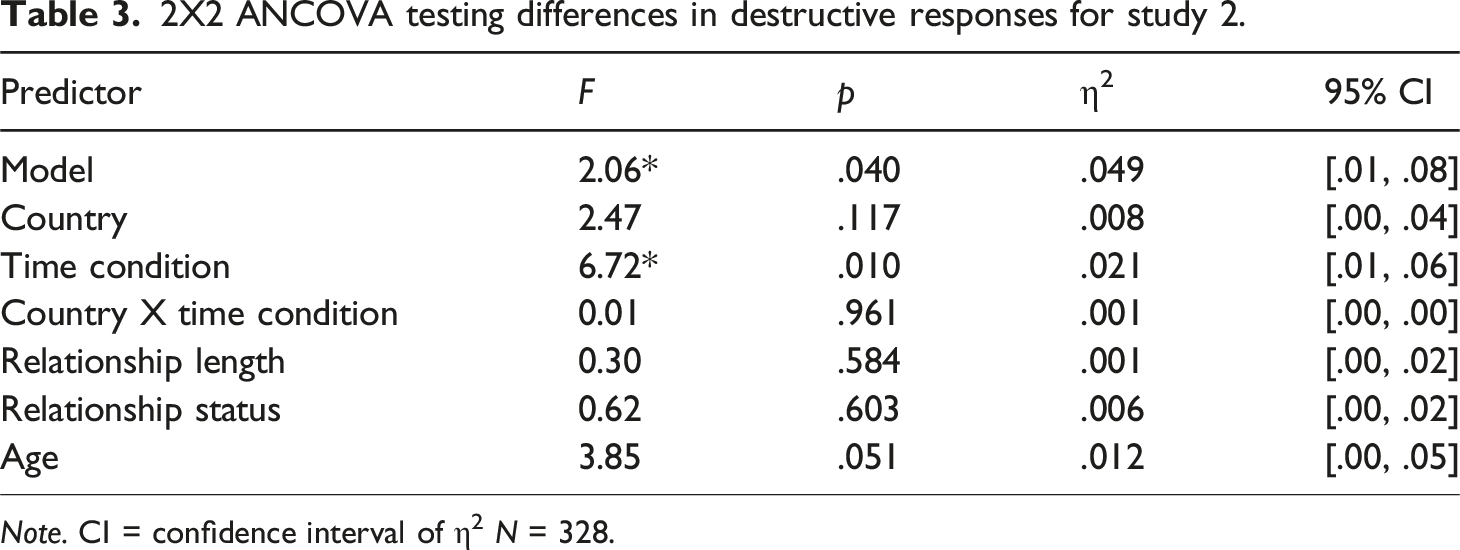
Note. CI = confidence interval of η2 N = 328.
Discussion
Results were consistent with our first hypothesis, replicating the results of the original Yovetich and Rusbult (1994) study and documenting the transformation of motivation process across both countries. However, results were not consistent with our second hypothesis, as we found that the magnitude of the transformation of motivation process did not differ across the two countries and Thai participants did not choose fewer destructive responses in the limited time condition.
Exploratory analyses
Our pre-registered replications of the Yovetich and Rusbult (1994) studies documented a transformation of motivation process that occurred across all participants, regardless of cultural background. These classic studies conceptualized responses that one could take in the face of a relationship conflict using the EVLN framework, which defines behavior by two axes: constructive-destructive and active-passive (Rusbult et al., 1982). The transformation of motivation is defined as the extent to which people enact constructive versus destructive behaviors in response to a conflict, with no consideration for whether the behaviors are active versus passive. However, a large cultural psychology literature has documented cross-cultural differences in the extent to which people use, and prefer, active (i.e., direct) versus passive (i.e., indirect) communication styles (e.g., Ambady et al., 1996; Holtgraves, 1997; Sanchez-Burks et al., 2003).
People in individualistic cultures tend to view outspokenness and direct requests as effective communication strategies, and it is common to view conflict between partners as an opportunity to share and renegotiate individual needs (Kim & Wilson, 1994; Overall & McNulty, 2017). In contrast, people from more collectivistic cultures view direct requests as an ineffective communication strategy, and prefer to communicate more indirectly, such as hinting at their concern by talking to a third person in the presence of the hearer, or using an intermediary to communicate their concern (J. O. Yum, 1988). These communication preferences have been more extensively studied outside of the context of intimate relationships, but studies of couples have supported these differential communication patterns (Ge et al., 2022). In fact, the only previous cross-cultural study to examine responses to partner transgressions using the EVLN framework found that Korean participants were more likely to use passive-destructive behaviors than U.S. mainlanders (Y. Yum, 2004).
Based upon evidence from the cultural psychology literature that the passive versus active nature of communication is an important consideration when examining social behavior across cultures, we conducted additional exploratory analyses with the data from Studies 1 and 2. Specifically, we examined whether there are cross-cultural differences in the extent to which individuals engaged in passive versus active behaviors, and their ratings of how destructive these behaviors are for relationships.
Exploratory analyses and results from study 1
In the original Rusbult and Yovetich (1994) study, active and passive destructive response options were combined for analyses. We separated active-destructive responses (e.g., “I threatened to leave my partner”) from passive-destructive responses (e.g., “I spent less time with my partner”), and active-constructive responses (e.g., “I talked to my partner about what’s going on, trying to work out a solution”) from passive-constructive responses (e.g., “I gave my partner the benefit of the doubt and forgot about it”), to create four new outcome variables. We then conducted ANCOVAs to explore whether there were differences between Thai and U.S. participants in the extent to which they considered and enacted these four types of behaviors in response to the transgression by their partner, while controlling for relationship length, relationship satisfaction, age, and relationships status.
ANCOVA results comparing U.S. and Thai samples on active and passive behaviors in exploratory study 1.
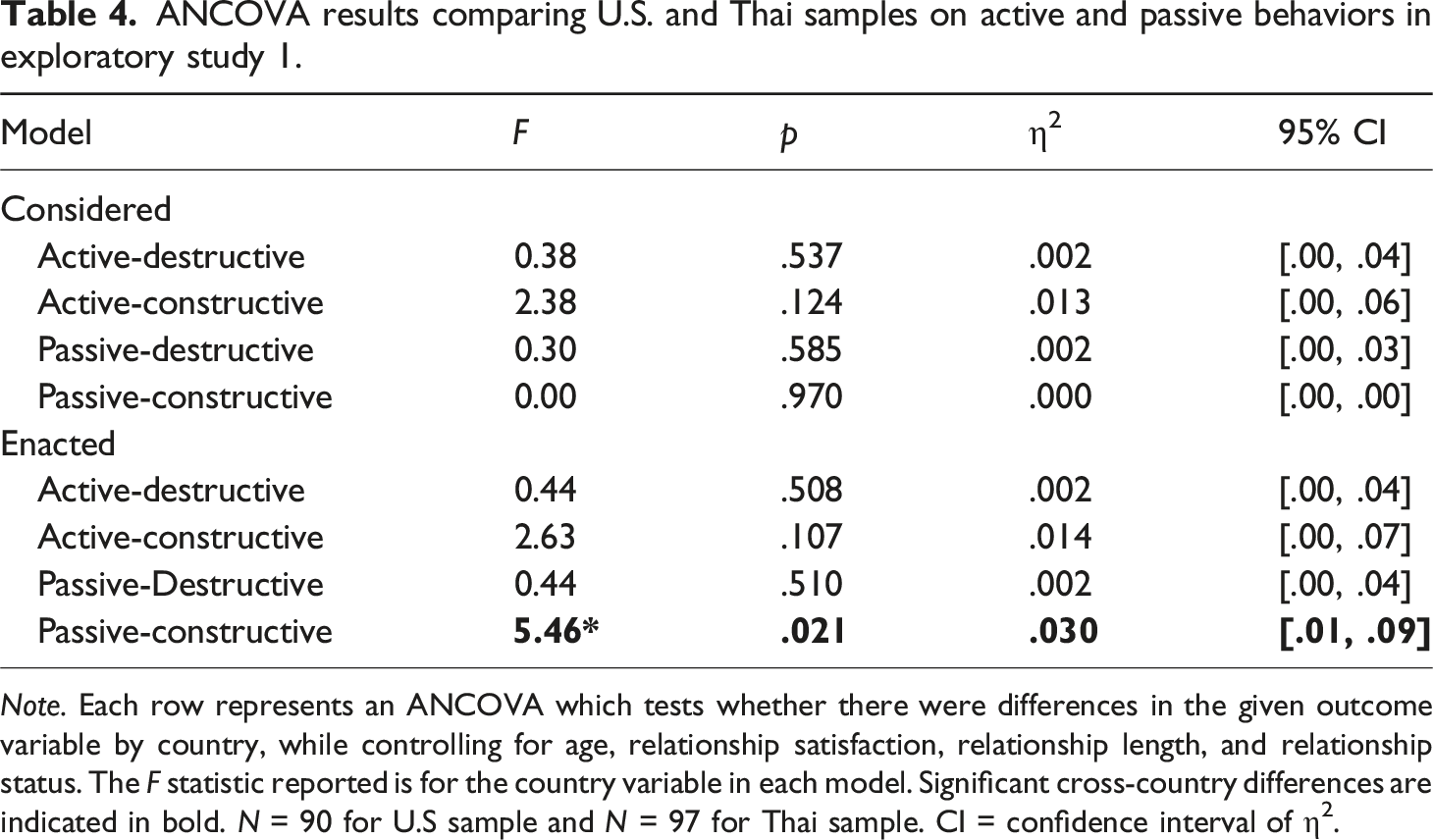
Note. Each row represents an ANCOVA which tests whether there were differences in the given outcome variable by country, while controlling for age, relationship satisfaction, relationship length, and relationship status. The F statistic reported is for the country variable in each model. Significant cross-country differences are indicated in bold. N = 90 for U.S sample and N = 97 for Thai sample. CI = confidence interval of η2.
Exploratory analyses and results from study 2
Participants in Study 2, as well as participants in our pre-testing sample (see Supplemental Materials), were presented with each of the 36 response options and asked to rate “How destructive versus constructive would this behavior be to a relationship?” with response options ranging from 1 = extremely destructive to 9 = extremely constructive.
A 2 (country) x 2 (active/passive behavior) x 2 (constructive/destructive behavior) ANCOVA controlling for age, relationship status, and relationship length was conducted on participants’ ratings.
2 × 2 × 2 ANCOVA comparing ratings of constructiveness for exploratory study 2.
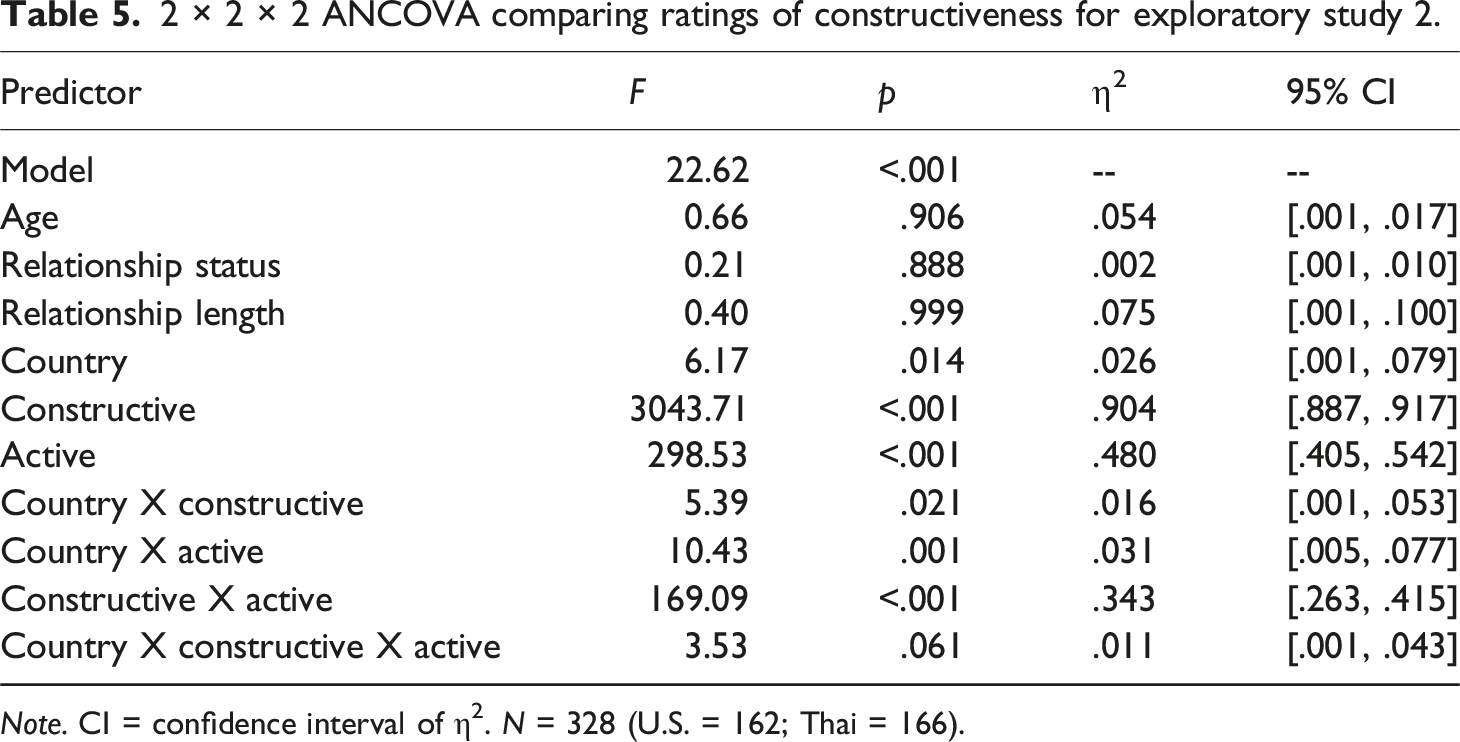
Note. CI = confidence interval of η2. N = 328 (U.S. = 162; Thai = 166).
Decomposed constructiveness ratings for ANCOVA from exploratory study 2.
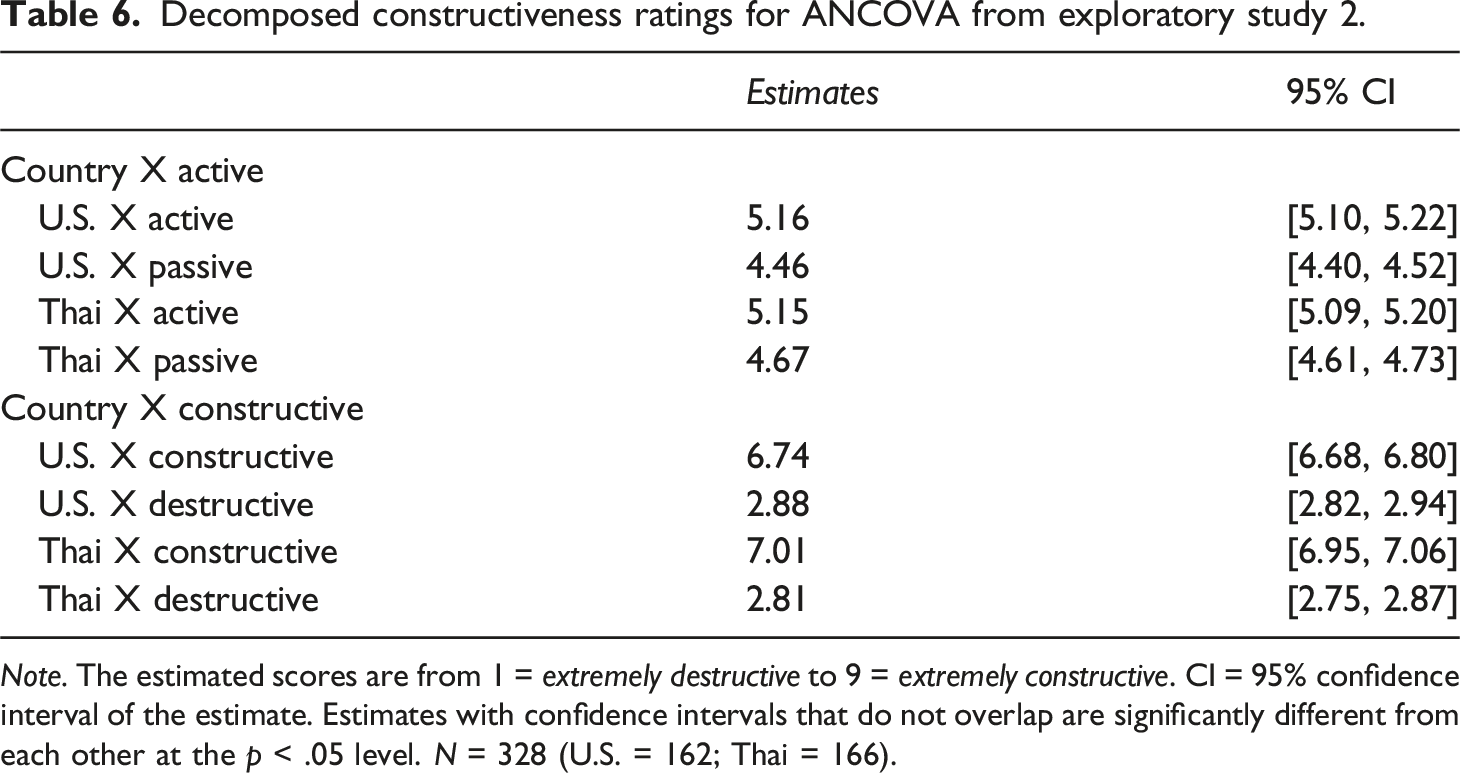
Note. The estimated scores are from 1 = extremely destructive to 9 = extremely constructive. CI = 95% confidence interval of the estimate. Estimates with confidence intervals that do not overlap are significantly different from each other at the p < .05 level. N = 328 (U.S. = 162; Thai = 166).
For the country × active interaction, U.S. and Thai participants rated active responses as equally constructive, but Thai participants rated passive responses as significantly more constructive than U.S. participants. Within-country, Thai and U.S. participants rated active responses as more constructive than passive response.
Discussion
Results of our exploratory analyses were consistent with existing literature describing cross-cultural differences in use of active versus passive communication. We found that Thai participants enacted more passive-constructive behaviors in response to a transgression by their partner than U.S. participants. Additionally, Thai participants rated passive behaviors as being more constructive for a relationship than U.S. participants.
General discussion
The need to engage in a transformation of motivation in order to respond in a pro-relationship manner in the face of conflict has long been conceptualized as a universal process in close relationships. However, the cultural psychology literature calls into question the extent to which this process generalizes to individuals from an interdependent cultural milieu, who may have a less self-focused initial response to a relational conflict. To test this hypothesis we conducted pre-registered replications of two classic studies documenting the transformation of motivation in response to accommodative dilemmas (Yovetich & Rusbult, 1994). Across both studies we find strong evidence that a transformation of motivation process does occur for individuals in independent as well as interdependent cultural contexts.
Although we expected to observe some form of transformation of motivation across both cultures, we also hypothesized that the process would be attenuated for individuals from an interdependent culture, and that this difference would be primarily due to a less self-centered initial response. In contrast to our expectations, we did not find any evidence for this hypothesized cross-country difference. Across both studies we found no differences in the magnitude of the transformation, and no difference in the initial impulses of U.S. and Thai participants, as measured by the responses they reported considering or the response option they chose when under time pressure. Overall, results clearly indicate that the transformation of motivation occurs for people across these two cultural milieus.
Notably, the design of the original studies focused on destructive behaviors that were either active or passive in nature, without distinguishing between the two. An important distinction to make when examining interactions in close relationships across cultures is which behaviors are destructive within the cultural context. In a set of post hoc exploratory analyses we found that Thai participants rated passive behaviors as significantly more constructive than U.S. participants and consistent with their differential perceptions of passive behaviors, Thai participants also reported enacting more passive-constructive behaviors than U.S. participants. These results are consistent with a large body of research indicating that indirect forms of communication are preferred in interdependent cultures, whereas direct communication is preferred in independent cultures (for a review see Boiger, 2019). For example, independent cultures typically conceptualize avoidance or silence as uncooperative, whereas interdependent cultures consider avoidance of direct confrontation as normative (Kim, 2002). Instead of directly stating one’s concerns, individuals in interdependent cultures are more likely to indirectly communicate concerns, or adjust their own behaviors rather than requesting that their partner change for them (Morling et al., 2002).
Overall, there is a need for more integration of the close relationships and cultural psychology literature, and more research focusing on non-Western couples, in order to revise our models of relationship functioning to more accurately reflect the relational experiences of all couples. For example, the EVLN framework (Rusbult et al., 1982), and other more recent models of relational behavior (e.g., Overall & McNulty, 2017), label specific behaviors as being good or bad for the relationship based on their valence in individualistic contexts. However, the results of the current study support perspectives from the cultural psychology literature which indicate that the valence of specific behaviors must evaluated within the context of individuals’ cultural milieu.
The current study has a number of important strengths that bolster its contribution to the literature, including pre-registration of hypotheses and analyses that examine a basic assumption in the close-relationships literature from a cross-cultural lens. This literature has overwhelmingly focused on relationships of White couples from the U.S., and to a lesser extent, couples in other culturally individualistic geographic regions such as Western Europe, Canada, and New Zealand. A recent comprehensive review found that only 3% of samples were drawn from any Asian country, with none coming from Thailand (Williamson et al., 2022). Thus, replicating a seminal study and testing generalizability of basic relationship processes in this understudied population is an important contribution.
There are also limitations to these studies which must be considered. First, the study samples consisted predominantly of women engaged in different-gender close relationships. Second, both studies did not measure disability status, which has been shown to be relevant to the transformation of motivation process of sacrifice (see Curran et al., 2023 for review). Future studies should intentionally include diverse sample to expand the understanding of transformation of motivation across different populations. Also, particularly in light of the fact that the data failed to support the hypothesized cross-cultural differences in transformation of motivation, it should be noted that participants were primarily undergraduate students, which was done to ensure equivalence with the original studies we were replicating, but could impact the extent to which the participants in the Thai sample are a strong representation of cultural interdependence. Receipt of higher education has been shown to encourage a more global perspective and push thoughts and behaviors to be more closely aligned with Western, individualistic values, even among those from traditionally interdependent societies (Scott, 2022; Weakliem, 2002). Thus, the Thai participants in our sample could have a more independent cultural socialization than other Thai individuals. This could be addressed by examining levels of independent and interdependent cultural values endorsed by participants in the two countries, but unfortunately the current study did not have the appropriate measures to do so. However, it is worth noting that in the exploratory analyses we did observe expected cultural differences in passive versus active behaviors, which supports the existence of some underlying level of cultural differences between the two samples.
Another possible explanation for the lack of observed cross-cultural differences is that the current study focuses on responses to a transgression by one’s partner, and it may be the case that a serious relational threat universally evokes a strong response across cultures. However, the transformation of motivation process is also said to underlie other pro-relationship behaviors such as sacrifice and forgiveness, which may be more likely to have cross-cultural differences (Karremans et al., 2011). For example, adapting or changing for the sake of the relationship is a common and expected strategy in interdependent cultures and is associated with better relationship quality (Joo et al., 2022). Thus, sacrificing one’s personal interest for their partner may require less of a transformation of motivation for those from interdependent cultures, even though this was not the case for responding to major transgressions by one’s partner.
In sum, the current study provides support for the idea that the transformation of motivation process is a basic relational experience that is shared by individuals across cultures. When faced with a relational conflict, people generate an initial set of potential responses, then cull that set into a final response that is less destructive than their initial impulse. However, the culture in which one was socialized plays a role in what the final response choice will be, with people from an interdependent culture settling on a final response that is more passive, whereas people from an independent culture preferring to respond in a more active manner. Overall, this study indicates that to fully understand couple relationships, relationship science must make a more concentrated effort to incorporate socioecological context into our research.
Supplemental Material
Supplemental Material - Are there cross-cultural differences in the transformation of motivation process in close relationships?
Supplemental Material for Are there cross-cultural differences in the transformation of motivation process in close relationships? by Po-Heng Chen, Phakkanun Chittam, and Hannah C. Williamson in Journal of Social and Personal Relationships
Footnotes
Funding
The author(s) disclosed receipt of the following financial support for the research, authorship, and/or publication of this article: This work was supported by the International Association for Relationship Research Steve Duck New Scholars Award awarded to Po-Heng Chen.
Open research statement
As part of IARR’s encouragement of open research practices, the authors have provided the following information: This research was pre-registered. The aspects of the research that were pre-registered were research questions, hypotheses, measures, sample size, and analyses. The registration was submitted to aspredicted.org and can be obtained at: Study 1 [https://aspredicted.org/by6kb.pdf], Study 2 [https://aspredicted.org/s8c8a.pdf]. The data and materials can be obtained at:  .
.
Supplemental Material
Supplemental material for this article is available online.
Notes
References
Supplementary Material
Please find the following supplemental material available below.
For Open Access articles published under a Creative Commons License, all supplemental material carries the same license as the article it is associated with.
For non-Open Access articles published, all supplemental material carries a non-exclusive license, and permission requests for re-use of supplemental material or any part of supplemental material shall be sent directly to the copyright owner as specified in the copyright notice associated with the article.
