




Abstract
Keywords
Introduction
Childhood maltreatment (CM) suggests a traumatic interpersonal experience and may have long-lasting consequences for a person’s romantic relationships (Godbout et al., 2009; Nguyen et al., 2017; Zamir, 2022). The current study examines two forms of CM—physical abuse and emotional abuse—and their associations with marital relationship quality. Physical abuse (PA) is “intentional use of physical force or implements against a child that results in or has the potential to result in physical injury” (Gilbert et al., 2009, p. 69). Emotional abuse (EA) is “intentional behavior that conveys to a child that he/she is worthless, flawed, unloved, unwanted, endangered, or valued only in meeting another’s needs” (Gilbert et al., 2009, p. 69). Global estimates of lifetime CM, as determined by self-report measures, are 23.3% for childhood PA and 35% for childhood EA (Stoltenborgh et al., 2012, 2013). Extensive research has documented the long-term adverse effects of CM on adults’ physical and mental health (Gardner et al., 2019; Haj-Yahia et al., 2019; Wegman & Stetler, 2009) and aggression and criminality (Fitton et al., 2020; Malvaso et al., 2018), and across multiple domains of functioning, such as emotion-processing abilities (Young & Widom, 2014), cognitive performance (Lynch & Widom, 2022), and interpersonal relationships (Zamir, 2022).
Positive romantic relationships have been significantly associated with better mental health, physical health, and longevity (Braithwaite & Holt-Lunstad, 2017; Lawrence et al., 2019). Safe and stable relationships may act as protective factors against the adverse effects of CM, interrupting the intergenerational transmission of maltreatment (Schofield et al., 2013). However, adverse experiences in the family of origin may impair a person’s ability to form stable and positive relationships. Previous studies have revealed that adults maltreated as children differed from their non-maltreated counterparts in their intimate relationships. For instance, Colman and Widom (2004) found that married or cohabiting adult survivors of CM were at greater risk of relationship dysfunction than were those in a control group. Furthermore, victims of CM were six times more likely to experience difficulties in intimate relationships than were non-victims of CM (McCarthy & Taylor, 1999). Previous studies have found that adults with maltreatment histories are more likely to report lower levels of satisfaction in their marital relationships (Nguyen et al., 2017), have poorer-quality relationships (Zamir, 2022) and greater relationship instability (Colman & Widom, 2004), and are at a higher risk of perpetrating violence against intimate partners (Li et al., 2020; Sokar et al., 2023b). Through a review of 43 studies, Zamir (2022) found that all forms of CM (neglect, sexual, emotional, or physical abuse) predicted a range of relationship difficulties for both men and women.
Since intimate relationships in adulthood seem to be affected by adverse experiences in the family of origin, it is essential to investigate the mechanisms underlying this association. Conducting such investigations holds significant implications for preventive measures and interventions specifically tailored for adults with a history of CM. Many factors have been proposed as mediators in the relationship between CM and relationship quality, including psychological distress, cognitive and behavioral problems, mental health problems, adult insecure attachment styles, self-dysregulation, and self-perception (Cederbaum et al., 2020; Fitzgerald, 2021; Zamir, 2022). Previous studies have reported data supporting the possible destructive impact of CM on adults’ mental wellbeing and the development of secure attachment within intimate relationships. The association between CM and psychological distress is consistent across studies, with evidence that suggests that different forms of CM may be related to high levels of psychological distress (Gardner et al., 2019; Sokar et al., 2023a). However, the association between CM and romantic attachment styles may vary depending on the type of maltreatment. For example, Oshri et al. (2015) found that, among young adults, childhood EA—but not PA—was significantly and positively related to both anxious and avoidant attachment to romantic partners. Widom et al. (2018) found that childhood PA predicted higher levels of anxious attachment style in adulthood; however, contrary to their initial hypothesis, childhood PA did not predict higher levels of avoidant attachment styles. Therefore, to gain a better understanding of how CM is related to the quality of marital relationships, the current study sought to extend this line of mediational research by examining the mediating roles of romantic attachment styles and psychological distress in the link between CM and the quality of marital relationships. Exploring these factors as mediators may promote practical interventions and therapy aimed at increasing one’s interpersonal resources and mental wellbeing.
The investigation’s focus on the mediating role of romantic attachment styles and psychological distress was informed by two theoretical frameworks: attachment theory (Ainsworth et al., 2015) and the stress-generation model (Davila et al., 1997; Hammen, 1991). Attachment theory centers around the relationship between infants and their primary caregivers, with an emphasis on the role of mothers as primary attachment figures. Previous studies have found that maltreated children may develop insecure attachment styles, and that these early attachment representations may subsequently affect their interpersonal relationships with peers, partners, and their own children (Hazan & Shaver, 1987; Morton & Browne, 1998). The stress-generation model postulates a bidirectional relationship between life stress and depression, wherein stressful life events contribute to the manifestation of depressive symptoms, and individuals experiencing depression may engage in behaviors that elevate the probability of encountering additional stressors. The model additionally posits that individuals experiencing depression may exhibit a deficiency in social skills, potentially engaging in behaviors that impede successful interpersonal relationships.
Romantic attachment styles and psychological distress as mediators
Attachment styles are shaped and developed during early childhood and include an infant’s tendency to create emotional bonds with the infant’s parents or other caregivers. Ainsworth et al. (2015) identified three main patterns of attachment styles: secure, anxious, and avoidant, with the last two being considered insecure styles. Additionally, attachment styles tend to be relatively stable over time and may affect a person’s feelings, thoughts, and behaviors toward intimate partners (Fitzgerald, 2022). Hazan and Shaver (1987) extended attachment to describe attachment patterns in romantic relationships, suggesting that romantic love is a process of attachment through which emotional bonds are formed between adults, similar to how emotional bonds are formed between infants and their parents. Hazan and Shaver found that adults with a secure romantic attachment style described their intimate relations as happy, friendly, and trusting; they were more supportive of their partner, and their relationships lasted longer. In contrast, avoidant adults reported less intimacy in their relationships, increased discomfort with proximity, and the tendency to avoid dependence on others. Anxious adults were occupied with thoughts of abandonment and the unavailability of their partner, which increased their anxiety and led them to be obsessed with their efforts to maintain proximity to their partner.
Existing research suggests that romantic attachment styles are significant mediators in the association between CM and the quality of intimate relationships (Fitzgerald, 2022; Godbout et al., 2017; McCarthy & Taylor, 1999; Shahab et al., 2021). Previous studies suggest that both patterns of insecure adult attachment (i.e., avoidant and anxious) may be predicted by CM, and that these insecure patterns of romantic attachment can subsequently affect the quality of romantic relationships. For instance, among a sample of 2,035 adults aged 18–65, Shahab et al. (2021) found that both patterns of insecure adult attachment mediated the association between CM and the quality of intimate relationships. In a study by Godbout et al. (2017) involving a sample of 1,252 emerging adults aged 15–25, anxious attachment mediated the association between CM and romantic relationship satisfaction. However, avoidant attachment was not predicted by CM; nonetheless, it exhibited a robust association with decreased levels of relationship satisfaction. Since anxious and avoidant attachment affect romantic relationships differently (Li & Chan, 2012), further exploration of these dimensions and their unique association with intimate relationships in adulthood is necessary.
Another potential mediator tested in the current study is psychological distress, measured as symptoms of depression, anxiety, and stress. The link between CM and adult mental health is well established, with robust associations between different forms of CM and psychological distress (Gardner et al., 2019; Sokar et al., 2023a). Several studies have found that psychological distress is a significant mediator in the association between CM and relationship quality (DiLillo et al., 2009; Fitzgerald, 2021; Zamir, 2022) and may affect a person’s ability to form and maintain healthy and stable intimate relationships (Johnson & Galambos, 2014).
In the current study, the stress-generation model (Davila et al., 1997; Hammen, 1991) was applied to examine an explanation of the pathway linking CM to relationship quality via psychological distress. According to the stress-generation model, greater levels of psychological distress generate stressful conditions that contribute to increased marital distress, further exacerbating depressive symptoms. The model also suggests that depressed people lack social skills and may act in ways that hinder successful interpersonal relationships and limit their ability to function effectively within intimate relationships. For example, depressed individuals are characterized by disturbed marital interactions, such as low levels of problem-solving and self-disclosure and high levels of verbal aggression, blame, and withdrawal (Rehman et al., 2008). A depressed individual is also more likely to underestimate their partner’s commitment and overestimate their partner’s negative behavior (Overall & Hammond, 2013).
Gender differences
Gender differences in the link between CM and the quality of intimate relationships have been explored in previous studies (DiLillo et al., 2009; Godbout et al., 2009; Zamir, 2022). However, the results of these studies do not lead to firm conclusions. For example, some studies suggest that CM contributes to lower levels of relationship quality more strongly in men than in women (DiLillo et al., 2009). In contrast, other studies have found either no gender difference or significantly stronger associations in women than in men (Godbout et al., 2009; Zamir, 2022). The current study addresses these discrepancies by examining the associations among CM, romantic attachment, psychological distress, and relationship quality within gender-specific statistical models.
The cultural context and hypotheses of the current study
This study was conducted in the Arab society in Israel, which is essentially a collectivistic and patriarchal society. According to the Central Bureau of Statistics (2021), Arab citizens of Israel are a minority, with Israeli Jewish citizens being the majority. Specifically, Arab citizens account for 21.1% of the country’s population and include several religions—Muslims (82.9%), Christians (7.9%), and Druze (9.2%). Intimate relations in Arab society are acceptable only within the bounds of marriage and in accordance with religious laws (Haj-Yahia, 2019). Traditionally, getting married and establishing a family have been considered essential goals in the lives of young men and women in Arab societies (Lev-Wiesel & Al-Krenawi, 1999). Marriage in Arab culture is also considered an important institution that provides social and economic security, prestige, recognition, and societal approval (Haj-Yahia, 2019). Compared with Europe and North America, where cohabiting has emerged as an alternative to marriage, adults from the Middle East are most likely to be married (Lippman et al., 2014). Given the significant cultural emphasis placed on marriage and family within Arab society, it is essential to examine the potential impact of early familial experiences on the quality of subsequent marital relationships. Further research is also needed on psychological resources, such as secure attachment to partners and improved mental health, which may enhance the strength and level of satisfaction in marital relationships. Despite the great interest among researchers in investigating the effects of CM on the quality of marital relationships, most knowledge on this topic has been derived from populations in Western countries, emphasizing the need for further research among culturally and religiously diverse societies (Zamir, 2022).
Against this background, this study examined the effects of childhood PA and EA on the quality of marital relationships among heterosexual married Arab adults in Israel. In addition, this study explored the mediating role of general psychological distress and the two dimensions of insecure adult attachment (anxiety and avoidance) in this relationship. The statistical models were constructed by gender, allowing for examining gender differences in the associations. The study’s hypotheses were as follows: • Hypothesis 1: Higher PA and EA experiences during childhood correlate with decreased marital relationship quality among both genders. • Hypothesis 2: Insecure adult attachment mediates the association between CM and marital relationship quality; specifically, adults reporting high levels of childhood PA and EA are more likely to report high levels of insecure adult attachment and, in turn, low relationship quality. • Hypothesis 3: Psychological distress mediates the association between CM and marital relationship quality; specifically, adults reporting high levels of childhood PA and EA are more likely to report high levels of psychological distress and, in turn, low relationship quality.
Method
Participants
The study sample (N = 604) consisted of 301 men aged 24–60 years (M = 35.2, SD = 6.5) and 303 women aged 20–55 years (M = 31.8, SD = 6.1), all Arab citizens of Israel. Most participants were Muslims (79.3%), and the rest were Christians (10%) and Druze (10.7%). The mean length of their current marital relationship was 8.25 years (SD = 3.92), on a spectrum of 3–15 years. Most participants (88.6%) had at least one child, with a mean age of 7 years for their firstborn child. Regarding the participants’ occupational status, 51.5%, 12.1%, and 11.6% indicated that they were full-time employees, part-time employees, and business owners, respectively, while 22.5% were unemployed and 2.3% were students. A large proportion of the participants had finished only high school (39.4%); the rest indicated they had completed or were enrolled in a bachelor’s (26.4%), master’s (8.1%), or PhD (0.5%) degree program or had received another type of postsecondary education (16.6%). In comparison, about 9% had undergone less than 12 years of schooling. According to the Central Bureau of Statistics in Israel (2018), Arab households in Israel earn an average before-tax monthly income of 13,831 shekels ($4,300). The distribution of income per household in the sample was as follows: 39.4% reported that their income was lower or much lower than the average, 26.9% reported that their income was close to the average, and 33.6% reported that their income was higher or much higher than the average.
Procedure
A cross-sectional survey was conducted among 604 Arab married adults in Israel between February 21 and March 23, 2021. The sample was selected in two steps. First, 45 Arab localities, as well as localities of mixed Arab and Jewish citizens, were randomly selected from the six main districts of Israel. Second, households within the 45 localities were systematically sampled. The study involved adult participants of Arab ethnicity who had been married for 3–15 years and were presently cohabiting with their spouse. Participants who met these inclusion criteria were invited to consent to participate in the study. The range of 3–15 years of marriage was chosen to focus on the second and third phases of the family life cycle, marked by couples establishing a family and raising young children (McGoldrick et al., 2016). Due to the cultural norms in Arab societies of considering questions on marital satisfaction and intimate relationships as private matters, only one partner in a marital relationship was invited to participate in the study.
Of 1,244 potential participants who were approached, 604 agreed to participate, which translated to a 49% response rate. Data were collected using the Qualtrics survey software (Qualtrics, Provo, UT), which allows for direct and anonymous data collection. The participants completed a self-administered Arabic-language questionnaire at their homes on electronic devices (tablets) provided to them by the research assistants. At the end of the survey, the participants were provided with hotline numbers and the researcher’s contact information in case they experienced discomfort or inconvenience. The questionnaire did not require participants to provide any identifying information, and the participants were allowed to skip any questions they did not wish to answer. The ethics committee at the researcher’s academic institution approved the questionnaire and the study procedures.
Instrument package
Background and sociodemographic information
This study questionnaire included background questions relating to the participant’s gender, age, place of residence, religious affiliation, level of education, employment status, income per household, number of years in the current marital relationship, number of children, and the children’s ages. The participant was also asked about their spouse’s age, level of education, and employment status.
Childhood maltreatment
Two subscales of the Parent–Child Conflict Tactics Scale (CTSPC; Straus et al., 1998) were used to measure childhood PA and EA. The emotional abuse subscale included five items and measured verbal and symbolic acts by parents intended to cause a child psychological pain or fear (e.g., “Mother/Father cursed or swore at me”). The physical abuse subscale (14 items) covers many violent behaviors, ranging from minor corporal punishment (e.g., “Mother/Father spanked me on the bottom with her/his hand) to more severe abusive behavior (e.g., “Mother/Father burned or scalded me on purpose”). Each item is measured twice, once for the mother and once for the father. As recommended by Straus et al. (1996), the researcher did not limit the participants’ recalling of their parents’ behavior to a specific age period; instead, the broader language “during your childhood and adolescence, up until age 18” was used. For each item, the participants were asked to indicate the frequency on a 7-point scale ranging from never to more than 20 times during the referred period. Higher scores indicated a more frequent incidence of each behavior. The scores on each subscale (i.e., EA and PA) are summed to create a total score of paternal and maternal CM. In addition, a collective total score encompassing both parents’ EA and PA, along with an aggregate score for both forms of CM, were computed. The CTSPC has been used in previous studies and has exhibited adequate internal consistency and validity as a reliable measure for retrospectively recalling instances of parental violence (Cotter et al., 2018; Hardt & Rutter, 2004). Cronbach’s alpha values for the items used in this study to measure childhood EA and PA were .90 and .93, respectively.
Romantic attachment styles
A short version of 16 items from the Revised Experience in Close Relationships (ECR-R; Fraley et al., 2000) was used to measure romantic attachment. The items were selected based on the loading rates of the items in the factor analysis carried out by Sibley and Liu (2004). The 16 selected items represent two dimensions of insecure adult attachment (avoidant and anxious), with eight items for each dimension. Sample items included “I often worry that my partner will not want to stay with me” for attachment anxiety and “I am nervous when my partner gets too close to me” for attachment avoidance. Responses were reported on a 7-point scale ranging from 1 (Strongly disagree) to 7 (Strongly agree). The Cronbach’s alpha values for the avoidance and anxiety scales were .91 and .89, respectively.
Psychological distress
The participants completed the Short Depression, Anxiety, and Stress Scale (DASS-21; Lovibond & Lovibond, 1995), designed to measure symptoms of depression, anxiety, and stress. Each subscale included seven items scored on a 4-point scale ranging from 0 (Did not apply to me at all) to 3 (Applied to me very much or most of the time). The participants were requested to indicate the extent to which each item, presented as statements, was applicable to their experiences over the previous month. Sample items included “I felt downhearted and blue” for the depression subscale, “I felt I was close to panic” for the anxiety subscale, and “I found it difficult to relax” for the stress subscale. Higher scores indicate higher symptoms of depression, anxiety, and stress. Cronbach’s alpha values in this study were .91 for depression, .86 for anxiety, and .90 for stress.
Quality of marital relationships
The Revised Dyadic Adjustment Scale (RDAS: Busby et al., 1995) was used to measure the quality of marital relationships. The RDAS is a 14-item scale divided into three subscales: dyadic consensus (six items; e.g., “Agree on making major decisions”), dyadic satisfaction (four items; e.g., “Do you ever regret that you married?”), and dyadic cohesion (four items; e.g., “Do you and your mate calmly discuss something?”). Items on the dyadic-consensus subscale are measured on a 6-point scale ranging from 0 (Always disagree) to 5 (Always agree). The dyadic-satisfaction items are measured on a scale ranging from 0 (All the time) to 5 (Never). The score for Item 11 on the dyadic-cohesion subscale ranges from 0 (Never) to 4 (Every day), while the rest of the items in this subscale are evaluated on a 6-point scale ranging from 0 (Never) to 5 (More often). A total score for the RDAS is computed by adding up the scores on all items, with a possible range of 0–69. Higher scores indicate greater relationship satisfaction. Items on each subscale are also summed, and a total score for each subscale is computed. The construct validity and reliability of the RDAS were evaluated through confirmatory factor analyses (CFA) and Cronbach’s alpha coefficient. In the current study, Cronbach’s alpha values were .92 for the overall scale, .90 for consensus, .87 for satisfaction, and .86 for cohesion. The CFA results demonstrated a good fit, with factor loadings ranging from .71 to .93.
Data analysis
The data analyses were conducted in IBM SPSS Statistics 26 and Amos 26 Graphics (IBM Corp., Armonk, NY, USA). First, descriptive statistics were calculated to report information on the prevalence and mean score of CM for the whole sample and by gender. Following Straus et al. (1998), the prevalence of CM was calculated as a dichotomous variable, in which “1” represents experiencing at least one act of CM and “0” represents no such exposure. Student’s t-tests for independent samples were calculated to check for gender differences in CM mean scores. For each comparison, the effect size was estimated using Cohen’s d (Cohen, 1988). Effect sizes of 0.02, 0.50, and 0.80 are termed small, medium, and large, respectively. Second, means, standard deviations, and Pearson’s correlations were computed for the study’s key variables. Third, missing-data analysis in SPSS showed that less than 3.3% of data were missing across all items. The pattern of the missing data was assessed using Little’s test of missing completely at random (MCAR), and the pattern was missing completely at random, χ2 (24) = 33.82, p = .088. Because the data had an MCAR pattern, the maximum likelihood estimation in Amos 26 Graphics was used to replace the missing data.
Subsequently, structural equation modeling (SEM) analyses with maximum likelihood estimations were conducted by gender. A two-group analysis was performed to examine gender differences in the direct paths linking childhood PA and EA with relationship quality. This analysis constrains each path linking the predictors (i.e., childhood PA and EA) with the outcome variable to be equal across the groups. If a significant chi-square difference (χ2 ≤ .05) is found, it would indicate the presence of a significant difference between the groups. To test for mediation, each indirect path linking the independent variables to the outcome variable via each mediator was tested using the user-defined estimand function in Amos 26. The significance of the direct and indirect effects was tested using bias-corrected bootstrapping procedures (5,000 samples) with 95% confidence intervals (CI). The fit of the theoretical models to the data was assessed with several goodness-of-fit indices: the chi-square per degree of freedom ratio (χ2/df ≤ 3), the comparative fit index (CFI ≥ .95), and the root mean square error of approximation (RMSEA ≤ .08; Iacobucci, 2010).
Results
Descriptive statistics and correlational analysis
Descriptive statistics and t-tests for the parent-child conflict tactics scale.
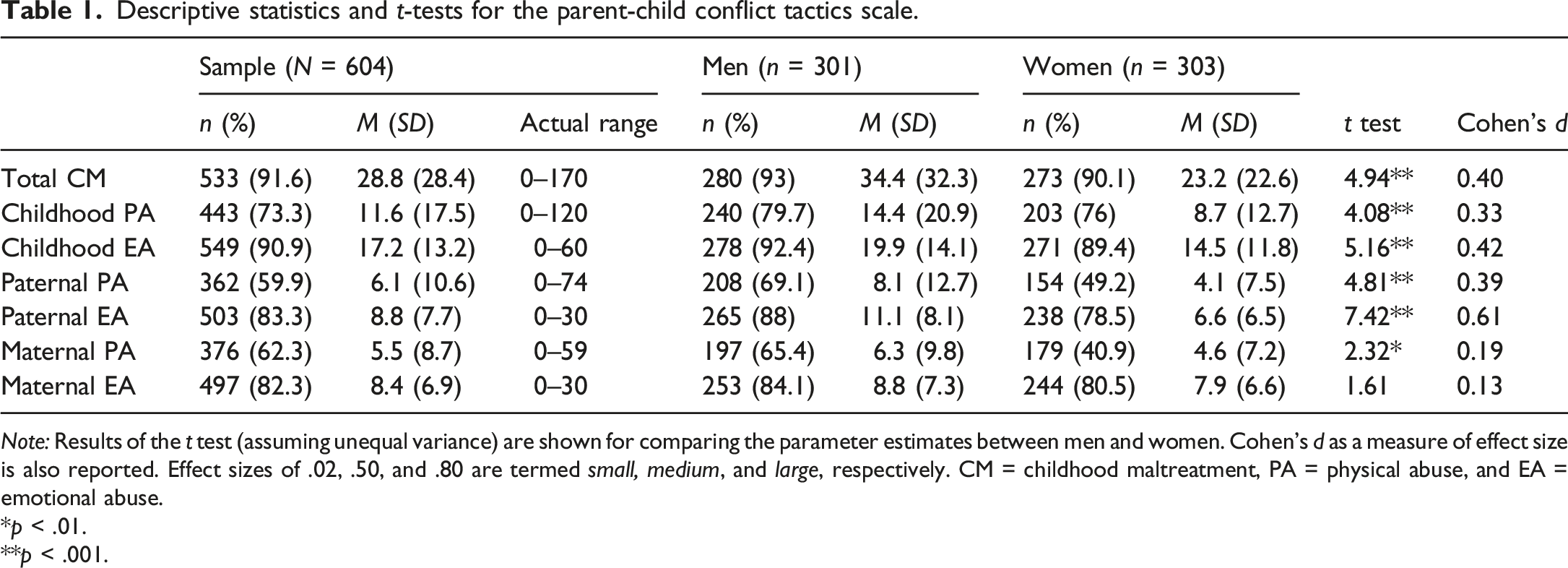
Note: Results of the t test (assuming unequal variance) are shown for comparing the parameter estimates between men and women. Cohen’s d as a measure of effect size is also reported. Effect sizes of .02, .50, and .80 are termed small, medium, and large, respectively. CM = childhood maltreatment, PA = physical abuse, and EA = emotional abuse.
*p < .01.
**p < .001.
Means, standard deviations, and Pearson’s correlations for the study variables.
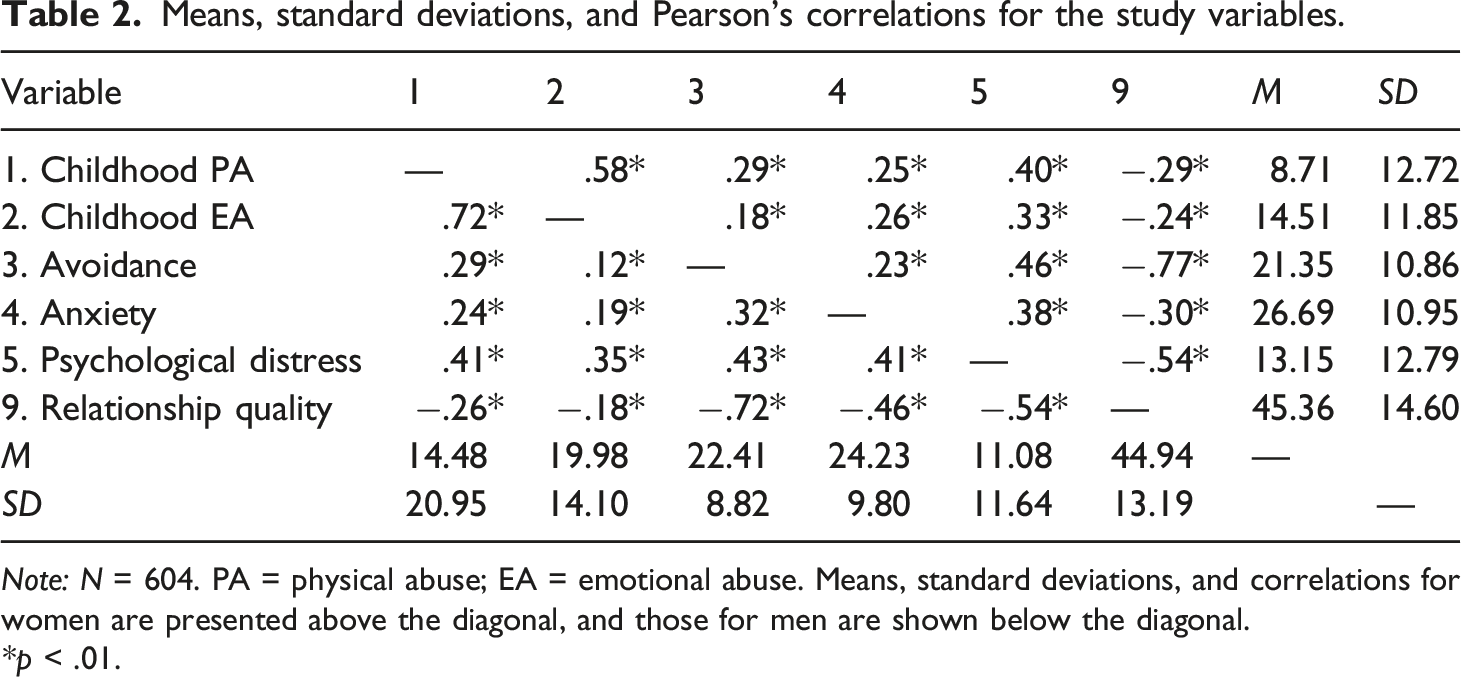
Note: N = 604. PA = physical abuse; EA = emotional abuse. Means, standard deviations, and correlations for women are presented above the diagonal, and those for men are shown below the diagonal.
*p < .01.
The relationship between childhood maltreatment and relationship quality
Structural equation modeling (SEM) analysis was performed to estimate the relationship between retrospective reports on childhood PA and EA and the quality of a current marital relationship. The models were constructed by gender. Fit indices for the unconstrained model showed a good fit with the data: χ2(6) = 14.55; p = .024; χ2/df = 2.42; CFI = .993; RMSEA = .049. Childhood PA and EA explained 8.2% of the variance in relationship quality for men and 10.8% for women.
For both men and women, the results of the path analysis revealed a negative and significant direct effect of childhood PA on relationship quality (β = −.24, p = .014, CI [−.08, −.01]); β = −.21, p = .014, CI [−.16, −.01]), respectively). However, no significant direct effect was found for childhood EA as a predictor of relationship quality (β = −.06, p = .458, CI [−.06, .02]; β = −.14, p = .084, CI [−.14, .01], respectively). The results partially support the first hypothesis and indicate that childhood PA significantly predicts relationship quality for both genders. However, childhood EA does not appear to have a significant direct effect on relationship quality. The results of the multiple-group analysis showed no significant differences between men and women in the direct paths linking childhood PA and EA with relationship quality (χ2(1) = .90, p = .342; χ2(1) = 1.09, p = .295, respectively).
Romantic attachment styles and psychological distress as mediators
Next, the potential mediating roles of avoidant attachment, anxious attachment, and psychological distress were examined. The structural models were constructed by gender and showed a satisfactory fit with the data: χ2(26) = 76.69; p < .001; χ2/df = 3.36; CFI = .981; RMSEA = .063 [.046, .080]. All the variables in the model explained 78.7% of the variance in marital relationship quality for men and 77.3% of the variance for women.
Figure 1 shows the standardized path coefficients and the R2 for men. Results of the path analysis revealed significant positive direct effects of childhood PA on psychological distress (β = .41, p < .001, CI [.25, .55]), anxious attachment (β = .24, p = .002, CI [.11, .35]), and avoidant attachment (β = .24, p = .002, CI [.10, .37]), indicating that higher levels of childhood PA are related to higher levels of psychological distress and insecure adult attachment. Conversely, the paths linking childhood EA with psychological distress, anxious attachment, and avoidant attachment were nonsignificant. The study’s second and third hypotheses regarding positive associations between both forms of CM and the proposed mediators were confirmed for childhood PA but not for childhood EA. Furthermore, all three proposed mediators were negatively correlated with relationship quality, supporting the hypotheses regarding negative associations between the mediators and the outcome variable. Avoidant attachment showed the strongest correlation with relationship quality (β = −.64, p < .001, CI [−.75, −.52]) compared with anxious attachment (β = −.20, p < .001, CI [−.31, −.08]) and psychological distress (β = −.29, p < .001, CI [−.41, −.17]). Additionally, the direct effects of childhood PA and EA on relationship quality were nonsignificant upon inclusion of the mediators. Structural Equation Modeling for Childhood Maltreatment, Psychological Distress, Insecure Adult Attachment, and Relationship Quality Among Men. Note: N = 301. PA = physical abuse; EA = emotional abuse, CON = consensus, SAT = satisfaction, COH = cohesion. Standardized structural paths of the unconstrained model are illustrated. The dashed lines indicate nonsignificant pathways. *p < .05, **p < .01 ***p < .001.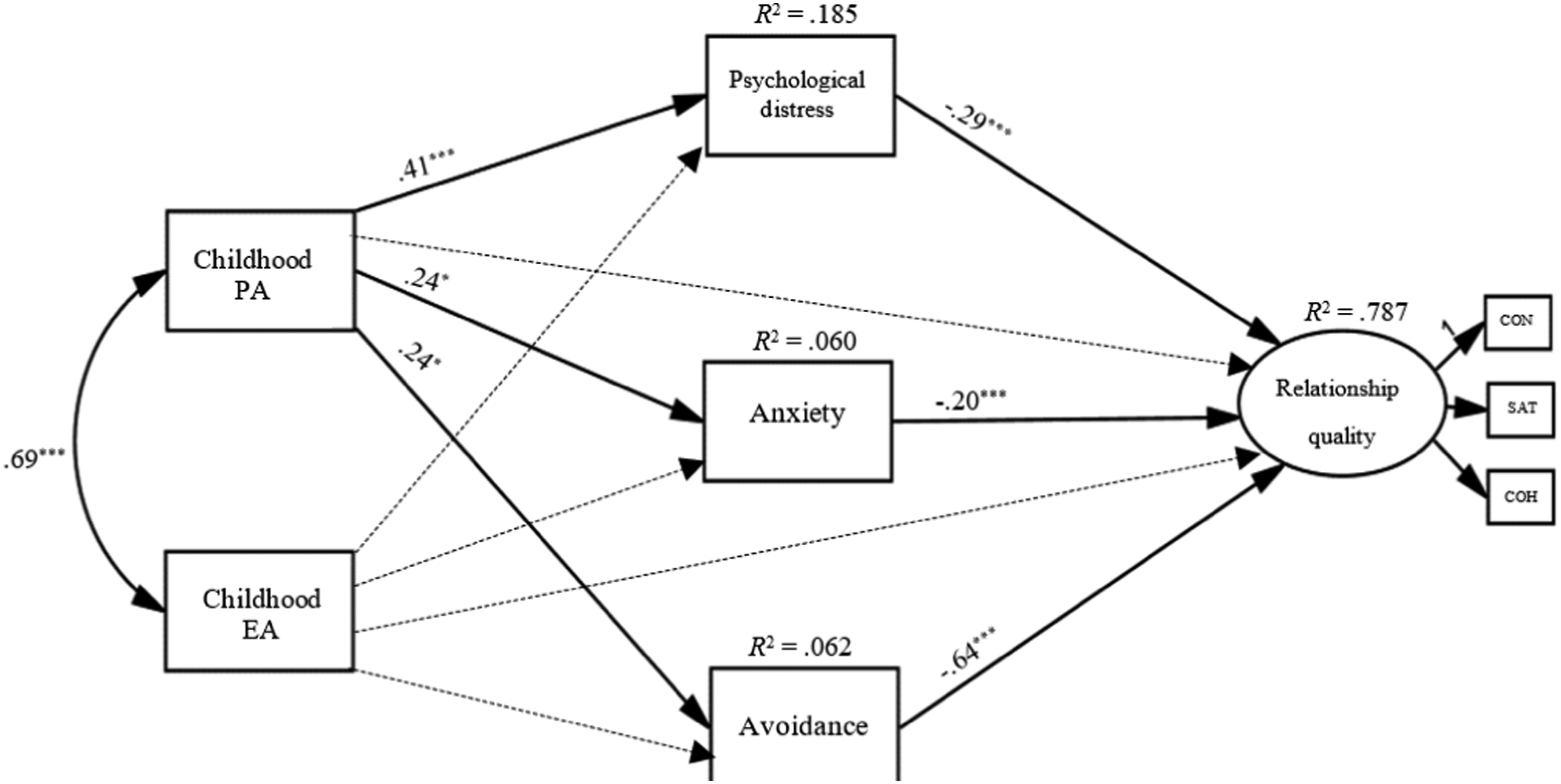
Figure 2 shows the standardized path coefficients and the R2 for women. As with the men, the SEM analysis revealed a significant positive direct effect of childhood PA on psychological distress (β = .46, p < .001, CI [.32, .57]) and avoidant attachment (β = .19, p = .012, CI [.02, .34]). However, no significant association was found between childhood PA and anxious attachment in women. Furthermore, childhood EA significantly and positively correlated with anxious attachment (β = .25, p = .001, CI [.08, .39]), indicating that women who had experienced EA during childhood showed increased levels of anxious attachment. However, as with the men, childhood EA was not associated with psychological distress or avoidant attachment. Thus, the study’s hypotheses regarding positive associations between both forms of CM and the proposed mediators were partially confirmed. Furthermore, psychological distress and attachment avoidance correlated negatively with relationship quality (β = −.26, p < .001, CI [−.36, −.14], and β = −.72, p < .001, CI [−.80, −.60], respectively), with no significant direct effect found for anxious attachment on relationship quality. This outcome partially supports the study’s second and third hypotheses regarding negative associations between the mediators and the outcome variable. Similar to the results found for men, avoidant attachment showed the strongest correlation with relationship quality compared to anxious attachment and psychological distress. Additionally, the direct effects of childhood PA and EA on relationship quality were nonsignificant upon including the mediators. Structural Equation Modeling for Childhood Maltreatment, Psychological Distress, Insecure Adult Attachment, and Relationship Quality Among Women. Note: N = 303. PA = physical abuse; EA = emotional abuse, CON = consensus, SAT = satisfaction, COH = cohesion. Standardized structural paths of the unconstrained model are illustrated. The dashed lines indicate nonsignificant pathways. *p < .05, **p < .01, ***p < .001.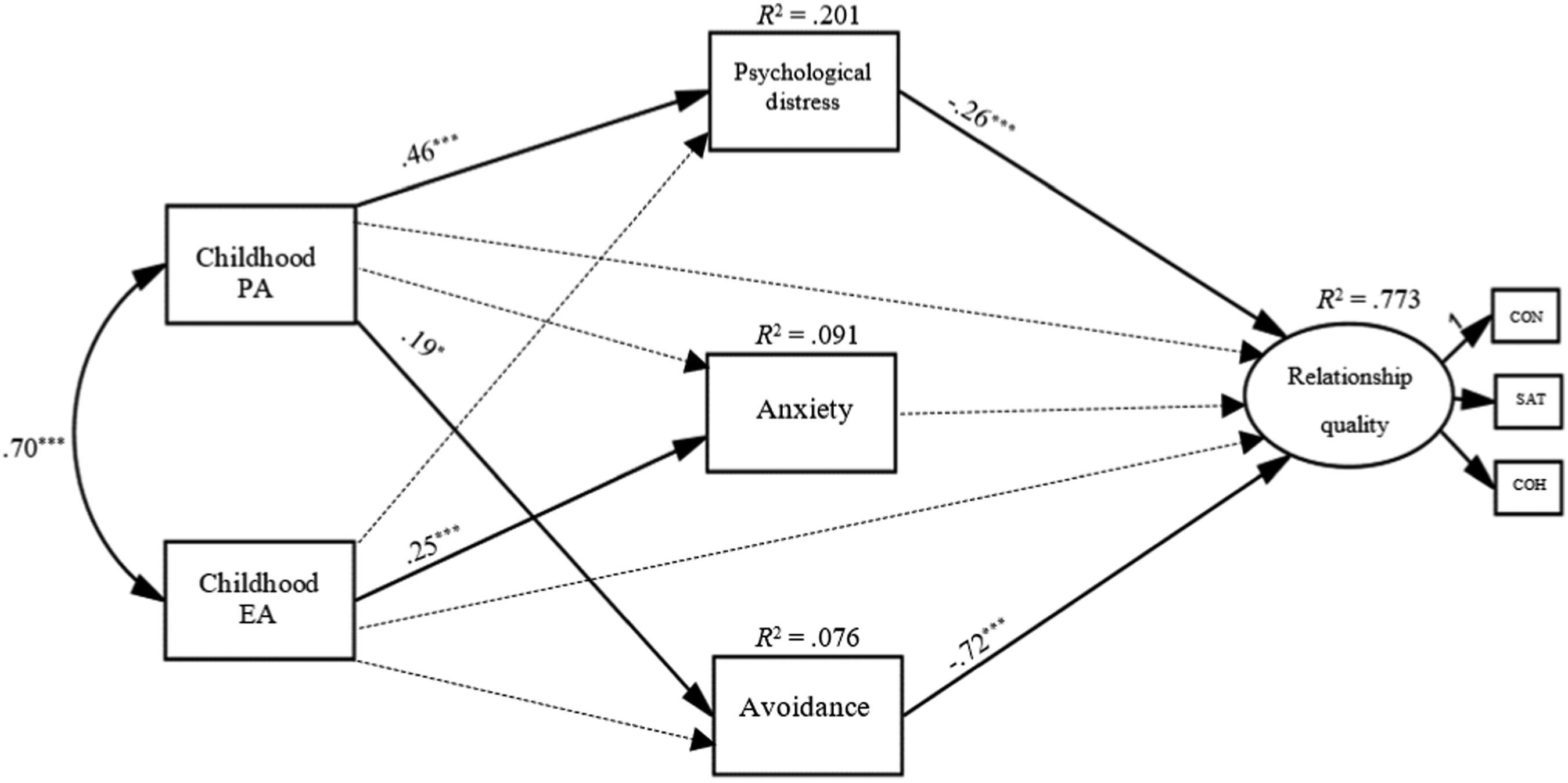
Indirect effects
For men, tests of indirect effects indicated a significant indirect effect from childhood PA to relationship quality via psychological distress (indirect effect = −.028, p < .001, CI [−.04, −.02]), anxious attachment (indirect effect = −.012, p < .001, CI [−.02, −.01]), and avoidant attachment (indirect effect = −.038, p < .001, CI [−.06, −.02]). These results suggest that for men, childhood PA is related to high levels of psychological distress and insecure adult attachment, which in turn correlate with low levels of relationship quality. However, the indirect paths between childhood EA and relationship quality through each mediator were nonsignificant.
For women, significant indirect effects were found for the effect of childhood PA on relationship quality via psychological distress (indirect effect = −.050, p < .001, CI [−.08, −.02]) and avoidant attachment (indirect effect = −.058, p = .028, CI [−.11, −.01]). These results indicate that for women, experiencing PA may be related to high levels of psychological distress and avoidant attachment, which correlate with low levels of relationship quality. The indirect path linking childhood PA and relationship quality via anxious attachment was nonsignificant. Additionally, no significant indirect effects were found for childhood EA on relationship quality through the mediation of psychological distress and insecure adult attachment.
Discussion
This study investigated direct and indirect paths linking CM, insecure adult attachment, psychological distress, and relationship quality within gender-specific models. First, this study examined the direct effect of childhood PA and EA on the quality of a current marital relationship among a representative sample of Arab adults in Israel. It was hypothesized that both types of CM would correlate with low levels of relationship quality. The study also aimed to explore whether these associations differed by gender. Subsequently, the mediating roles of romantic attachment and psychological distress were also examined. It was hypothesized that adults reporting high levels of childhood PA and EA are more likely to report high levels of psychological distress, insecure adult attachment, and, in turn, low relationship quality.
The findings revealed a significant direct effect of childhood PA on decreased relationship quality for both men and women. These findings align with previous research on the adverse effects of types of CM on the ability to form stable and positive intimate relationships in adulthood (Colman & Widom, 2004; Li et al., 2020; McCarthy & Taylor, 1999; Nguyen et al., 2017; Zamir, 2022). However, childhood EA was not related to the levels of marital relationship quality reported by the participants in this study, partially supporting the first hypothesis. When gender differences were explored, this study found no gender differences in the link between CM and relationship quality. Studies examining gender differences in the association between CM and relationship quality by type of abuse revealed inconsistent results (Zamir, 2022). Additional research is required to better understand the association between types of CM and the quality of marital relationships among men and women.
The finding regarding the significant and negative effect of childhood PA on the quality of marital relationships is particularly important in Arab society in Israel. The results of this study revealed high prevalence rates of CM among Arab adults in Israel, with higher rates generally for men. The lifetime prevalence rates for childhood PA and EA were 79.7% and 92.4% among men, and 76% and 89.4% among women, respectively. In comparison to the global estimates of childhood PA and EA (Stoltenborgh et al., 2012, 2013), the rates observed in this study are notably elevated. Domestic violence in Arab society is regarded as a private matter that should be dealt with by the family and could threaten the wholeness of the family unit (Haj-Yahia et al., 2019). Hence, seeking formal help outside the family or disclosing an abusive experience are perceived as offensive to cultural norms and collective values. These collectivistic values may contribute to high levels of reluctance to disclose victimization among Arabs (Lev-Wiesel et al., 2019) and may, in part, explain the high CM prevalences observed in this study. Such abusive experiences in the family of origin, if left untreated by professionals, may have long-term consequences for a person’s intimate relationships (Maxwell et al., 2016). Since marriage and family are considered fundamental pillars of Arab society, it is imperative that efforts be made to address the prevalence of CM within Arab society in Israel. It is also essential to investigate factors that may explain the relationship between CM and the ability to form stable and positive intimate relationships.
Guided by attachment theory (Ainsworth et al., 2015), it was hypothesized that CM would correlate with insecure adult attachment to an intimate partner, which would be related to low levels of marital relationship quality. The premise of this theory suggests that being raised in families where maltreatment has occurred will disrupt the development of a secure attachment (Egeland & Sroufe, 1981), and these early attachment representations may manifest themselves in intimate relationships in adulthood (Hazan & Shaver, 1987). Following Hazan and Shaver (1987), who suggested that a three-dimensional attachment model could be applied to adult relationships, this study focused on two types of insecure adult attachment: avoidant and anxious.
A test of indirect effects showed that the relationship between childhood PA and marital relationship quality was mediated by avoidant attachment in both genders. This finding suggests that having difficulties relying on an intimate partner, dismissing the partner’s emotional needs, avoiding intimacy, or being less trustworthy of the partner may have a destructive impact on the quality of intimate relationships. However, anxious attachment mediated this association only in men. This finding is supported by Li and Chan (2012), who found that avoidant attachment was more negatively associated with general satisfaction in intimate relationships than anxious attachment. Overall, the results regarding the mediating role of insecure adult attachment suggest that the internal working models of attachment formed in childhood based on interactions with the parents may have a long-lasting impact on adults’ romantic relationships. The results also validate those of several studies on the mediating role of insecure adult attachment in the link between CM and adult relationship quality (Fitzgerald, 2022; Godbout et al., 2017; Shahab et al., 2021; Zamir, 2022). Although both anxious and avoidant attachment mediated the association between childhood PA and relationship quality, additional research is needed to examine gender differences in this association.
As predicted by the stress generation model (Davila et al., 1997; Hammen, 1991), psychological distress mediated the association between CM and relationship quality among both genders. The results of the current study suggest that men and women who experienced PA during childhood may develop high levels of psychological distress, which correlates with low levels of marital relationship quality. These findings align with previous research on the mediating role of psychological distress (DiLillo et al., 2009; Fitzgerald, 2021; Zamir, 2022). Given the central role of marital relationships in Arab culture, addressing mental health problems among married adults with a history of CM is essential.
Limitations and recommendations
Several limitations of the current study should be considered. First, the cross-sectional study design limited the ability to establish a causal relationship between the investigated variables. A longitudinal study design could deepen the current understanding of how CM affects relationship quality during adulthood. Second, the study’s sample consisted of individuals, not couples. To fully evaluate relationship quality, data should be gathered from both partners, and dyadic data analysis should be incorporated. Third, only two types of CM (i.e., childhood PA and EA) were explored in this study. Further research on Arab adults is needed to study the effects of different forms of CM, such as neglect, sexual abuse by parents, and exposure to interparental violence. Further, data regarding the participants’ childhood PA and EA were gathered using retrospective self-report measures. Such recollection may be biased because of difficulties in remembering violent incidents over such an extended period, repression, overestimation, distortion of the perception of these events, or the desire to provide socially desirable responses. Hence, future researchers are recommended to prospectively collect data regarding CM. Lastly, attachment theory posits that attachment styles are shaped and developed through early parent–child relationships, with a primary focus on interactions with mothers (Ainsworth et al., 2015). Given this perspective, respective examinations of maternal and paternal CM separately will contribute to a more refined understanding of the nuanced interplay between parent-specific maltreatment experiences and their implications for attachment outcomes.
Clinical implications
Following the results of this study, intervention programs should focus on improving mental health and romantic attachment among individuals with a history of CM. Promoting a secure attachment within intimate relationships is crucial for fostering positive relationships, as insecure adult attachment, particularly avoidant attachment, exerts a significant negative impact on relationship quality. Over the past decade, the link between psychological distress and low relationship quality has been firmly established (DiLillo et al., 2009; Fitzgerald, 2021). The current study supports the association between psychological distress and relationship quality. Both men and women may experience negative impacts on their relationships due to high levels of distress. Thus, it may be beneficial to include Arab adults in couples therapy or intervention programs that target symptoms such as depression, anxiety, and stress to reduce marital distress.
Footnotes
Acknowledgements
This article is part of my doctoral studies under the guidance of esteemed professors Muhammad M. Haj-Yahia and Charles W. Greenbaum. Their expertise and support were invaluable in ensuring the success and rigor of my research project.
Funding
The author(s) received no financial support for the research, authorship, and/or publication of this article.
Open research statement
As part of IARR’s encouragement of open research practices, the author(s) have provided the following information: This research was not pre-registered. The data used in the research cannot be publicly shared but are available upon request/. The materials used in the research can be publicly posted/.
