




Abstract
We examined the influence of romantic relationships on the formation and dissolution of adolescent friendships with a longitudinal network sample (N = 133) from age 14 to 15. Using a dynamic, network statistical model (i.e., STERGM), we found that engagement in a romantic relationship shaped friendship homophily over time, with daters becoming friends with other daters, and singles forming friendships with other singles. Partnered adolescents were not more likely than those who were unattached to dissolve their friendships; however, they were significantly less prone to form new friendships over time. Results broaden our understanding of the role of romantic relationships in youth friendships by showing that romantic involvement deters friendship initiation, but when friendships do form, they tend to be among those who are similarly dating. Our study highlights the significance of adopting a dynamic, social network perspective to examine both the formation and breakup of friendship transitions during this pivotal stage of life.
Keywords
Introduction
Adolescents’ peer relationships are crucial to their development, providing a platform to learn socioemotional skills (Crosnoe, 2000) and influencing multiple behaviors such as academic performance (Vaquera & Kao, 2008) and risky actions (McMillan et al., 2018). The quality of youth friendships relates positively to several outcomes, including self-esteem (Thomas & Daubman, 2001), a sense of school belonging (Fan & Bellmore, 2023), and subjective well-being (Alsarrani et al., 2022). Yet, adolescent friendships, with their fragility (Wiseman, 1986) and lack of constraints (Fehr, 1996), remain easier to end on average than intimate or kinship relationships (Fehr, 1996; Flannery & Smith, 2021), challenging our understanding of their dynamics. Given the central role of friendships in adolescence, one of our goals is to use a state-of-the-art, dynamic, social network model to examine factors that shape friendship dissolution and friendship formation in a sample of adolescents.
Romantic relationships constitute another central aspect of peer relationships, with 50% of youth involved in romantic relationships by age 15 (Carver et al., 2003). Adolescent dating relationships primarily serve as avenues for self-exploration and are significantly influenced by peer interactions (Collins et al., 2009; Furman & Shaffer, 2003). Like adults, early adolescents tend to be drawn to individuals who share similarities with them (Simon et al., 2008). Dating during adolescence does not necessarily follow a linear trajectory, however, but often encompasses various stages from no experience to casual interactions and then on to more committed engagements (Furman & Rose, 2015). Romantic relationships in adolescence also are interlinked with friendship ties (Collins & Laursen, 2004) and embedded in networks of family, friends, and acquaintances (Felmlee, 2001; Sprecher, 2011).
Research examining the interplay between romantic relationships and friendship networks focuses on how social networks shape young adults’ romantic engagements. For example, several studies find that the relationships of those with supportive and approving friendship (and family) network members tend to be more stable over time (Agnew et al., 2001; Felmlee, 2001; Sprecher & Felmlee, 1992). At the same time, the reverse process by which romantic relationships might influence friendship network stability remains underexplored. Among the studies investigating links from romance to friendship, the primary attention has been given to possible effects on friendship quality. For instance, studies report little evidence of negative effects of adolescents’ investment in romantic life on the quality of, or degree of conflict in, friendships (Kuttler & La Greca, 2004; Langheit & Poulin, 2022). In a meta-analysis, Kochendorfer and Kerns (2019) have found associations between friendship quality and romantic relationship quality (but not relationship investment). Yet little work investigates the influence of intimate partnerships on friendship formation or dissolution, particularly within a network context.
The purpose of this study, therefore, is to examine the extent to which involvement in a romantic pairing affects the initiation and ending of adolescent friendships, with the use of friendship network data. It is important to recognize that social networks are shaped by structural characteristics, such as reciprocity (the tendency for friendship nominations to be mutual) and transitivity (the tendency for individuals to nominate friends of their friends). To gain a deeper insight into friendship dynamics, it is imperative to account for these structural factors (Copeland et al., 2023), as they are not only endogenous to the network structure but also important concepts in peer relationships. For example, reciprocity is a structural attribute frequently observed in peer interactions (Laursen & Hartup, 2002), and has a notable impact on adolescents' lives (Bagwell et al., 2021; Vaquera & Kao, 2008). Overlooking these processes may lead to inaccurate estimates (Goodreau et al., 2009). In this study, we extend previous work by utilizing dynamic network models, Separable Temporal Exponential Random Models (STERGMs) to investigate change in friendships. This methodological approach enables an examination of how the development of adolescents’ friendly relations is influenced by romantic ties, while accounting for the effect of network structural features.
Literature review
The Homophily hypothesis
Homophily, the tendency for friendships to emerge among individuals with similar characteristics, represents a key mechanism contributing to peer friendships (McPherson et al., 2001). Individuals often form personal connections with those who share their race (Goodreau et al., 2009), gender (McPherson et al., 2001), and engage in the same extracurricular activities (Schaefer et al., 2011). Homophily arises from both selection, with young individuals’ preference towards peers who share similar attributes, and influence, wherein friends evolve to become more alike over time. This latter phenomenon is amplified during adolescence through the process of peer socialization (Kandel, 1978). While much of the existing homophily literature focuses on factors like race, gender, and behavioral characteristics, little scholarly attention has been extended to the possibility that romantic relationship involvement could represent a key element contributing to friendship homophily.
We argue that involvement in romantic ties is apt to influence homophily in adolescent friendships for multiple reasons. First, dating adolescents are likely to discover opportunities to develop friendships with others who are attached romantically, due to attending events frequented by couples. For example, social gatherings such as parties, double dates, or dances naturally bring together individuals who are in romantic relationships. Such environments not only encourage interaction among dating youth but also foster the development of shared experiences, which can serve as the foundation for new friendships.
Additionally, romantic ties may create openings to connect with a partner’s contacts, which could lead to the creation of new friendships. This form of triad closure, in which a friend becomes a friend of a friend, stems from psychological balance (Heider, 1946) and has been shown to influence adult friendship formation (Stadtfeld & Pentland, 2015). Similarly, those who remain “single” may have more opportunities to make friends with those who are not romantically involved, because of shared activities and interests. They could choose to attend a party with friends who are similarly unattached, for instance, with the goal of meeting a potential love interest. At the same time, adolescents are apt to be constrained in their ability to attend events of their choice, especially those who do not drive, which could limit their ability to form homophilous friendships. Nevertheless, given the preponderance of support for homophily in friendship along numerous dimensions, we develop the following hypothesis:
Homophily in dating status (i.e., both dating or both not dating) will lead to the formation of friendships.
Friendship dissolution
Friendships are also vulnerable to decline, particularly during adolescence (Poulin & Chan, 2010). It is not uncommon to see friendships dissolve at this time of life; in fact, close to two-thirds (66%) of early adolescents report experiencing at least one friendship dissolution (Bowker, 2011). The breakdown of friendships can lead to a myriad of potential adverse outcomes, such as feelings of sadness, loneliness, and even manifest symptoms of depression (Chan & Poulin, 2009). Additionally, young people with unstable friendships often exhibit diminished social functionality and might face challenges in areas such as cooperation and forming close bonds (Bowker, 2011). Given the susceptibility of adolescent friendships to decline, and yet their significance to youth social development, it is vital to better understand the dissolution process.
The reasons behind the decline of a friendship during adolescence can span a range, from interpersonal conflicts (Flannery & Smith, 2021; Khullar et al., 2021) to a natural evolution towards less intimate associations (Bowker, 2011). Events like school transitions, which bring about physical separations, often stand out as prime catalysts for ending friendships during this phase (Felmlee et al., 2018; S. M. Rose, 1984). Notably, the process of friendship dissolution is not always abrupt. More often, friendships naturally wane over time, marked by a gradual distancing and reduced frequency of contact (Khullar et al., 2021). Here, we examine how engagement in romantic relationships may influence the ending of youth friendships.
As adolescents begin a romance, they could prioritize their partner over friends. When romantic relationships grow more intimate, for example, individuals may increasingly distance themselves from their friend networks (Brown, 1999; Furman & Wehner, 1994). This reallocation of emotional energy and time can result in fewer leisure activities with friends (Surra, 1985; Zimmer-Gembeck, 1999) and smaller social support networks for those in a committed relationship as compared to singles (Burton-Chellew & Dunbar, 2015). In other words, romantic involvement can disrupt friendships (S. M. Rose, 1984). Johnson and Leslie (1982) formalized this idea as the dyadic withdrawal hypothesis, predicting that committed, romantically involved couples will gradually withdraw from their friendship networks. As a result, adolescents who have an intimate partnership may find their friendship networks becoming smaller and more overlapping over time (Kalmijn, 2003). Thus, we hypothesize that:
Dating individuals will be more likely than those who are not dating to withdraw from friendships.
Methods
Data
We utilized data from the “Teenage Friends and Lifestyle Study,” a longitudinal survey of adolescent friendships in Glasgow, Scotland from 1995 to 1997 (see Michell & Amos, 1997). We chose this dataset because it enables a deep dive into the social dynamics often absent in more contemporary datasets. Accessible, longitudinal, network datasets, with information on both romantic relationships and friendships, are rare. In addition, previous studies have not used a STERGM analysis to examine the simultaneous processes of friendship beginnings and endings with this dataset. The study consisted of 160 participants, with response rates from 93.75% to 85.63% across waves. 1 Here we focused on the last two waves of data, which represent the two oldest cohorts of students and those most likely to be seriously dating, and excluded those lacking information on gender or dating status (n = 27), with a final sample of 133 students. 2
Measures
Friendship networks
The dependent variable is a binary measure of a friendship tie (1 = friendship; 0 = no friendship) and consists of dyadic ties from the friendship network at time t. To construct a friendship network, participants were asked to name up to six friends.
Romantic relationships
Students were asked whether they had a romantic relationship (with response categories of yes or no). Based on responses to this question, we developed two major predictors, both of which were lagged and measured at time t-1. The first predictor is the same dating status, which indicates whether a pair of students had the same dating status at the prior time point (coded as 1 = both adolescents were either dating or both were not dating, and 0 = the adolescents differed in dating statuses). The similarity in dating status was used to test our homophily hypothesis that adolescents’ romantic involvement would influence peer relationship formation and dissolution. The second predictor is dating status, which is an individual-level indicator of whether each student reported currently being in a romantic relationship (coded as 1) or not (coded as 0). The measure of dating status allows us to explore potential differences between adolescents who are dating versus those who are not dating in the likelihood of friendship initiations and endings.
Network structure parameters
Our models include four structural network variables: edges, reciprocity, transitivity, and brokerage. The edges term represents the number of friendship ties in the network, which functions similarly to an intercept in a logistic regression model. Reciprocity measures the number of mutual friendship ties and aids in shaping friendships (Laursen & Hartup, 2002). Following prior work (e.g., Copeland et al., 2023; Goodreau et al., 2009; Hunter, 2007; Snijders, 2011), we incorporated two geometrically-weighted structural terms with a decay parameter set at .25 to enhance model fit. Transitivity is defined as the directed geometrically weighted edgewise shared partnership, representing the distribution of closed triads, that is, the propensity to befriend a friend's friend. Brokerage is measured using the geometrically weighted dyad-wise shared partnership. This term captures the occurrence of open triads, which facilitates the estimation of closed triads by highlighting available, open triads that could close.
Covariates
We controlled for homophily on key demographic and behavioral characteristics that are typically related to adolescent peer friendships and romantic relationships. The measure same gender indicates if both ego and alter in the friendship dyad share the same gender (1 = same, 0 = different). Male and female adolescents differ in preferences for intimacy, support, and participation in shared activities, often leading them to form friendships with peers of the same gender (A. J. Rose & Rudolph, 2006).
Furthermore, participation in extracurricular activities provides adolescents with essential avenues for peer interaction and friendship development outside of the classroom setting (Giordano, 2003; Mahoney et al., 2005). On the one hand, being part of a team or club introduces young people to a shared identity which often facilitates bonding (Giordano, 2003). On the other, changing activities or interests can lead to shifts in friend groups and the potential dissolution of previous friendships (Poulin & Chan, 2010). As a result, we included several dyadic covariates that were used previously in other research on adolescents (e.g., Eccles & Barber, 1999; Eccles et al., 2003; McMillan et al., 2018; Pearson et al., 2006; Randall & Bohnert, 2009): frequency of tobacco use (1 = never to 3 = regular), frequency of church visiting (1 = never to 4 = very often), and frequency of attending dance clubs (1 = never to 4 = very often). In our STERGMs, we created the following binary covariates (1 = same, 0 = different), the same level of tobacco use, and the same frequency of church visiting and dancing, to measure whether individuals shared a response category.
In analyses not shown here, we also estimated models that included alternative measures of leisure activities and behaviors that were provided in the dataset (i.e., frequency of alcohol consumption, drug use, tobacco use, church visiting, participating in a dance club, reading books, playing sports, attending concerts, looking after pets, and hanging around the street). Upon incorporating these measures of activities into the models, the outcomes related to our principal predictors—namely romantic relationship variables—remained consistent. However, none of the effects of these additional variables reached statistical significance in any model. The inclusion of these extra measures of activities in the analyses also reduced the goodness of fit. Therefore, we limited our final models to those with the best fit, and these models included the above three measures of activities.
Analytical strategy
Social network data violate the independence assumptions of ordinary least squares regression and logistic regression (Borgatti, Everett, & Johnson, 2013), making these methods unsuitable for exploring network ties. To address this issue, we employed a version of Exponential Random Graph Models (i.e., STERGMs) to test our hypotheses. We estimated STERGMs in the R programming language.
The STERGMs are one type of extension to Exponential Random Graph Models (ERGMs) for modeling dynamic networks in discrete time (Krivitsky & Handcock, 2014; Snijders et al., 2006). Similar to ERGMs, STERGMs enable us to incorporate dyadic relations, node-level attributes, and structural-level tendencies in our models (Desmarais & Cranmer, 2012; Krivitsky & Handcock, 2014). For instance, we can model a pattern of relationships in a network by using both individual characteristics (e.g., gender or age) and structural features (e.g., reciprocity). Unlike cross-sectional ERGMs, which only consider a single network at a one-time point, STERGMs include two models—one for relational formation (

The dissolution sub-model is defined as:

STERGMs examine the transition of a network
Results
Descriptive statistics
Descriptive statistics over two time points.
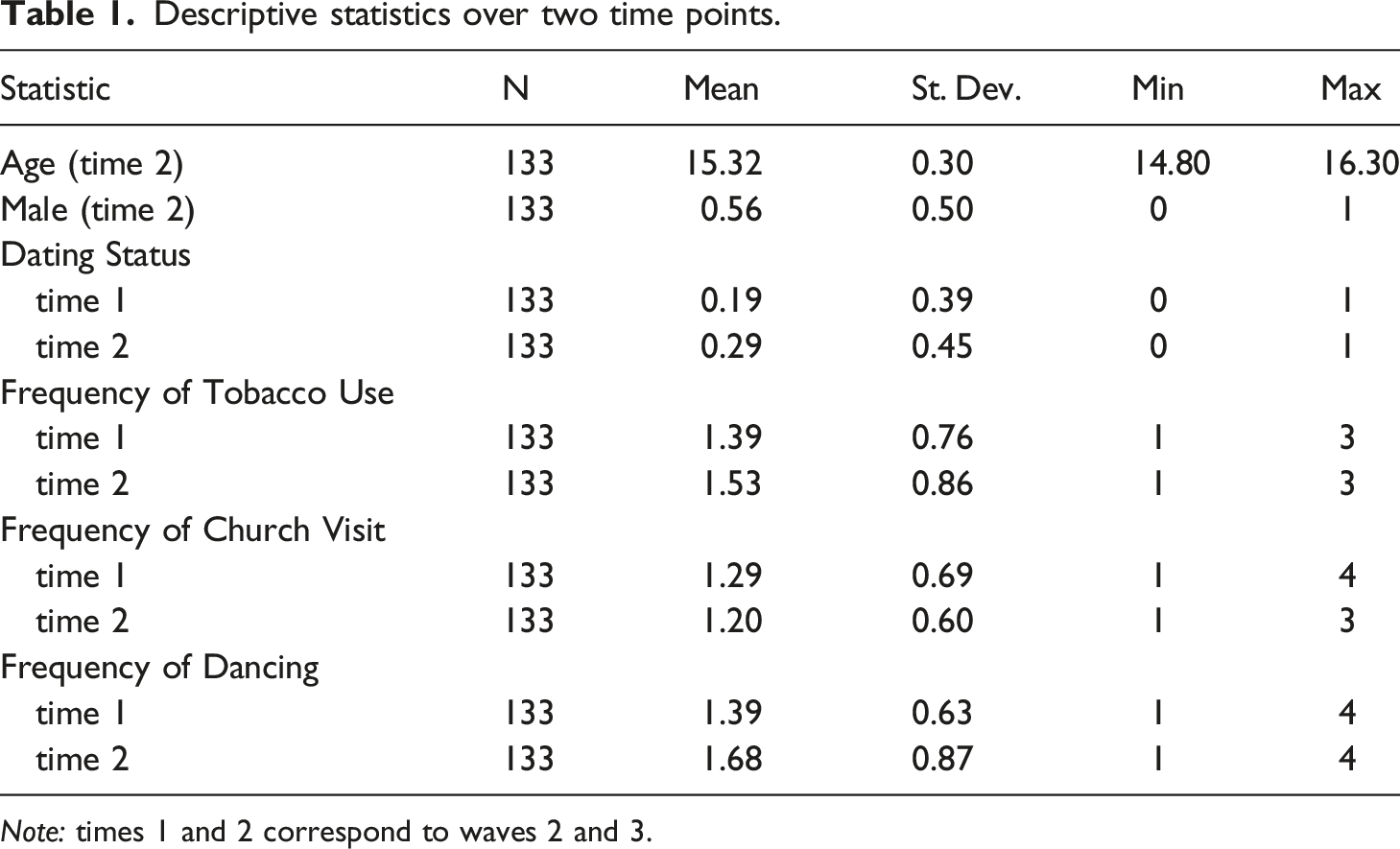
Note: times 1 and 2 correspond to waves 2 and 3.
A graph of the friendship network at the last time period, based on students’ dating status, appears in Figure 1. Students were clustered into subgroups of relatively tight-knit friendships using the Girvan-Newman Algorithm (Girvan & Newman, 2002). Each blue/circle node represents students who were not dating, while pink/triangle nodes were daters. Edges (lines) signify friendship ties. Node size was inflated by the number of friendship nominations; the larger the node, the more nominations the individual received. We observed some evidence of homophily in the graphs, where friendships tended to form between students sharing the same dating status. For example, in Figure 1, a subgroup in the upper right consisted predominantly of singles (blue/circle nodes), while another subgroup in the lower left was composed primarily of daters (pink/triangle nodes). In the following analyses, we investigated the degree to which this apparent homophily by dating status was related significantly to friendship changes. Subgroups of Friendship Networks at the Last Time Point. Note: Node size is inflated by in-degree. A circle/blue node indicates that an actor is not dating, and a triangle/pink node indicates that the actor is dating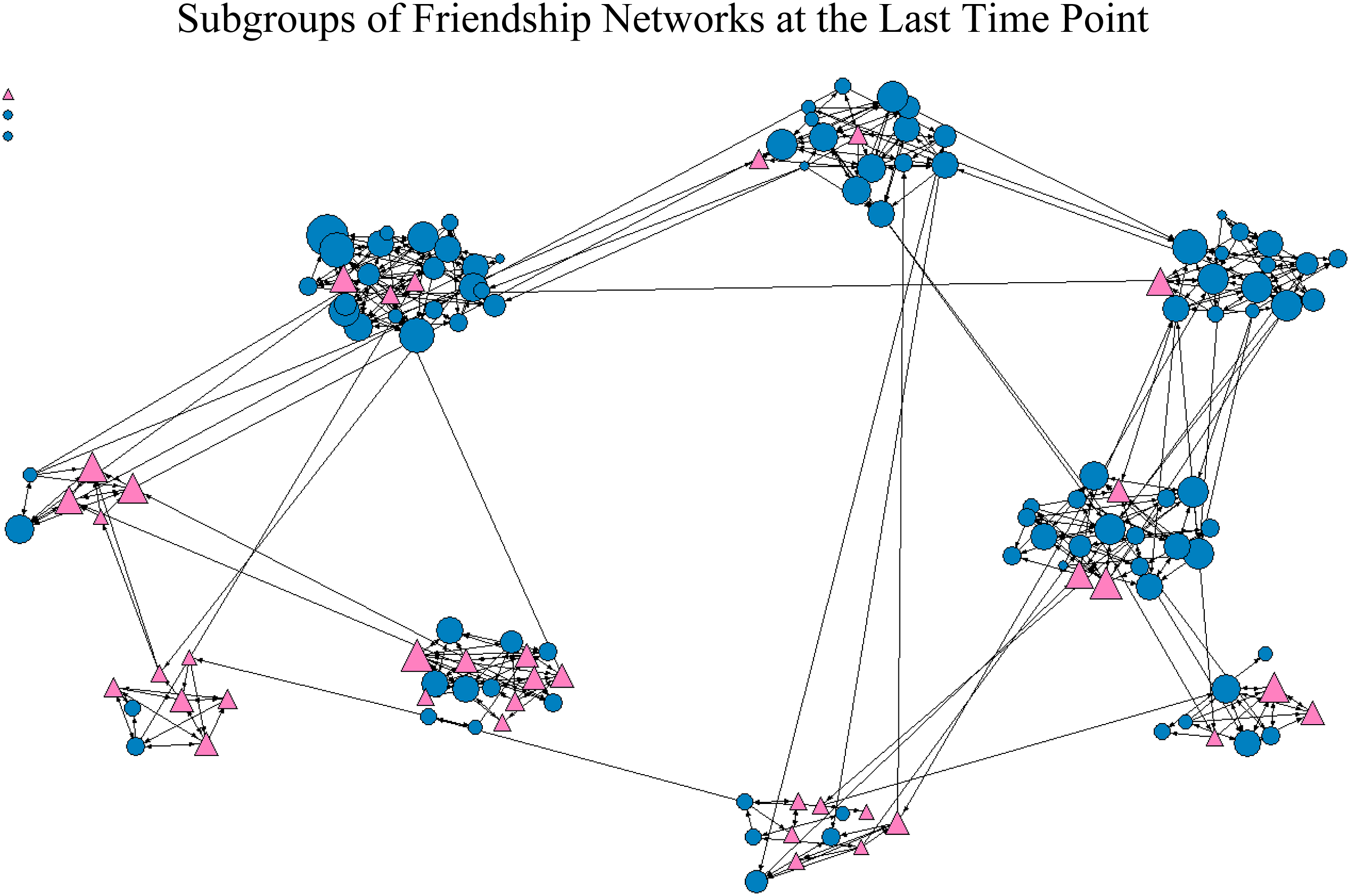
STERGMs analyses
STERGMs of friendship changes over one year: The role of same dating status.
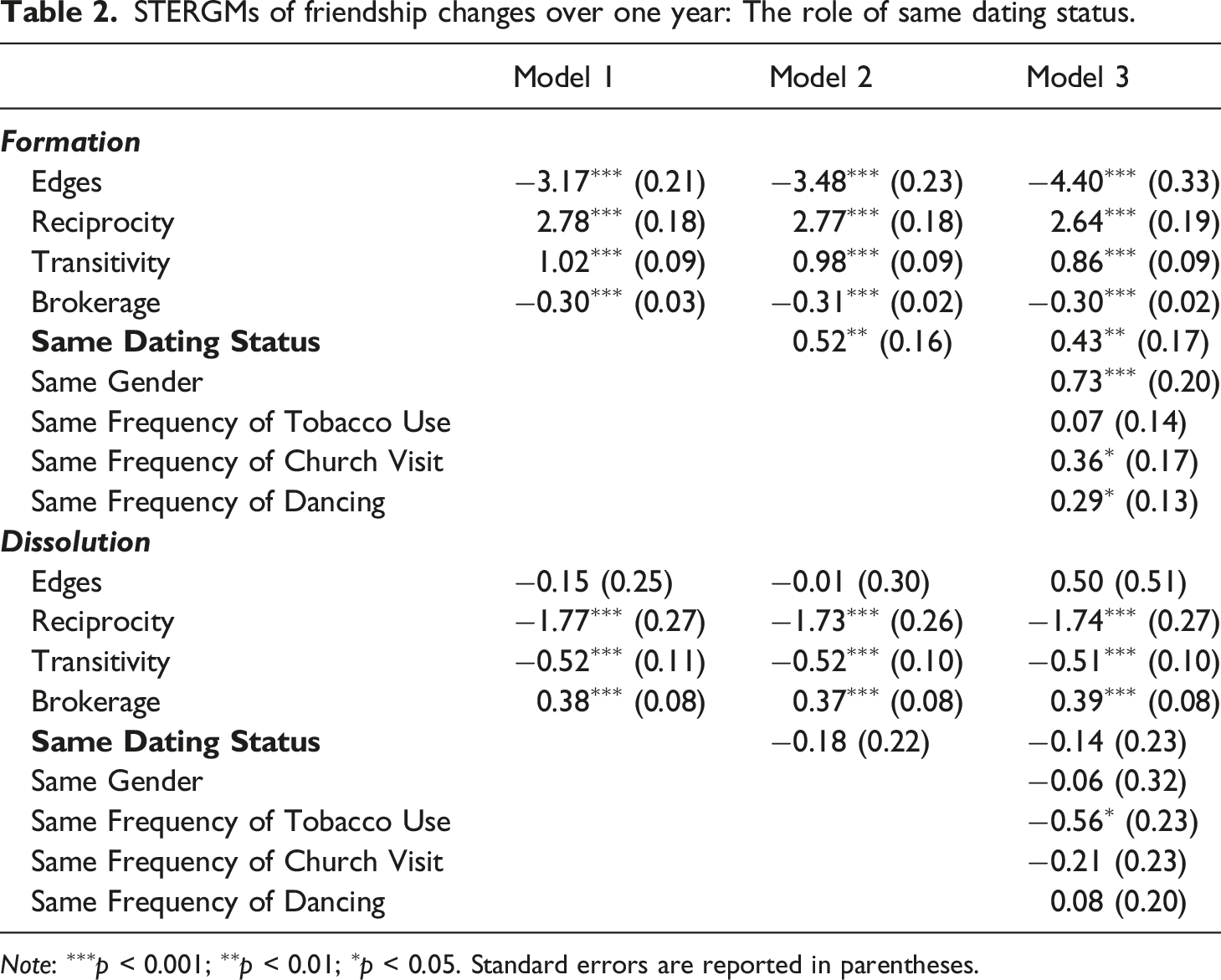
Note: ∗∗∗p < 0.001; ∗∗p < 0.01; ∗p < 0.05. Standard errors are reported in parentheses.
STERGMs of friendship changes over one year: The role of dating status.
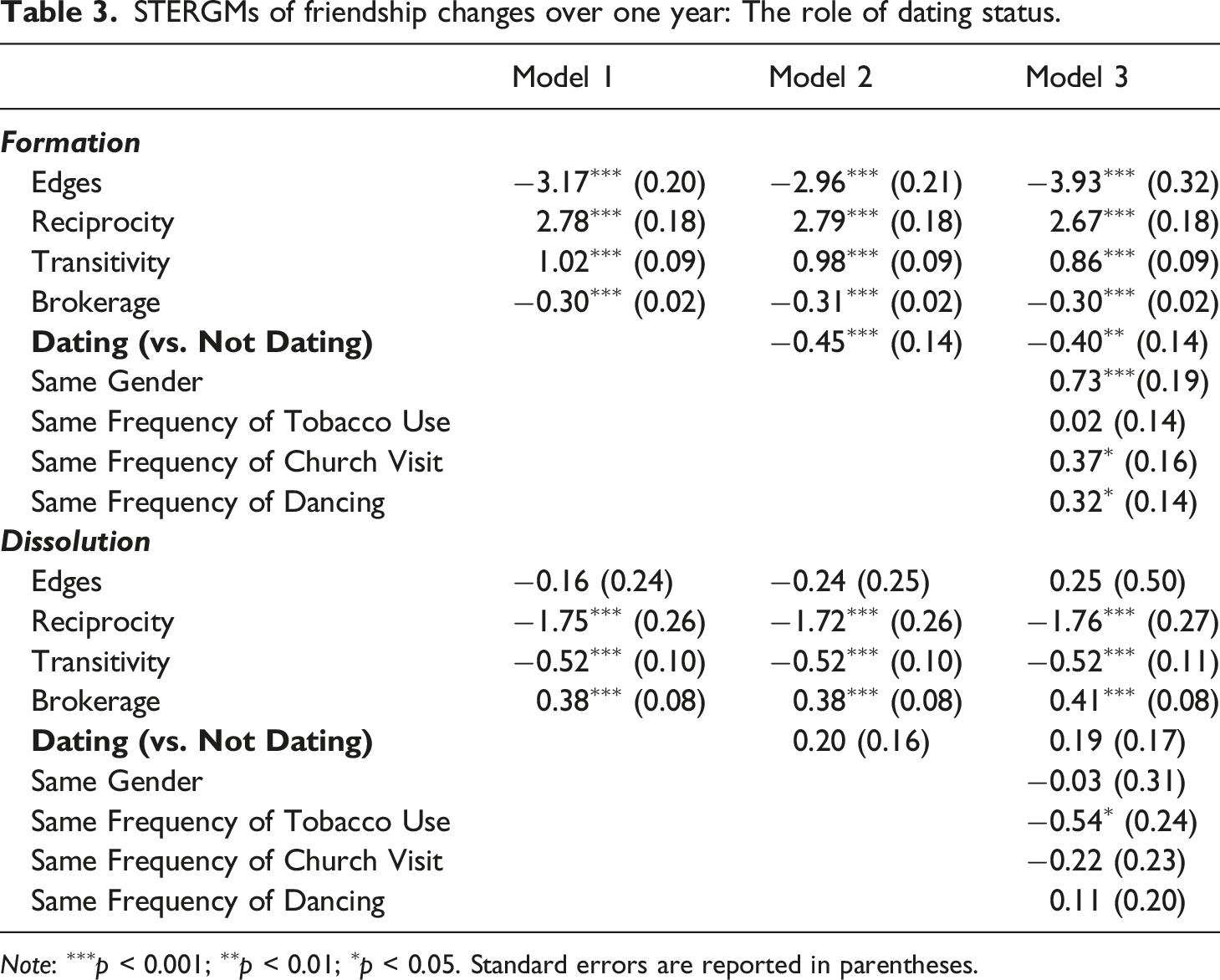
Note: ∗∗∗p < 0.001; ∗∗p < 0.01; ∗p < 0.05. Standard errors are reported in parentheses.
Hypotheses
Our findings uncovered significant evidence of the influence of homophily in relationship status on friendship formation, in support of Hypothesis 1 (Models 2 and 3; the top half of Table 2). Individuals were more likely to develop friendships over time with those who shared their same dating status earlier (β = .52, p < .01), even while controlling for other covariates (β = .43, p < .01). Dating homophily did not, however, have a significant effect on friendship dissolution (Models 2 and 3; the bottom half of Table 2). Next, we found negative and significant coefficients for dating status in both Models 2 and 3 for friendship formation (top half of Table 3), revealing that dating individuals were significantly less likely to begin a new friendship tie over time compared to those who were not dating (β = −.45, p < .001; β = −.40, p < .01). However, dating status did not associate significantly with friendship dissolution over time, failing to support Hypothesis 2.
Control variables
The structural variables behaved similarly in Tables 2 and 3, indicating that social network processes contribute to friendship formation. For example, in friendship formation, the coefficient for edges was negative and significant, suggesting an overall sparse structure with low density. In other words, there was a relatively low level of connectivity between adolescents in the total friendship network. This is consistent with prior research finding adolescent peer networks can be fragmented into smaller clusters rather than one cohesive structure (Haynie, 2001). Reciprocity had a significant, positive effect on friendship formation, but a negative one regarding dissolution, meaning that a friendship was more likely to begin if it created a mutual pair, and that mutual friendships were less likely to dissolve over time. The combination of a positive transitivity coefficient, and a negative brokerage coefficient, revealed that friendship ties were more likely to form, and less likely to dissolve, within closed triangles (i.e., a friend of a friend becomes, and tends to remain, a friend). Overall, these findings for network structural effects align with previous studies demonstrating the importance of reciprocity and transitivity in shaping peer relationship patterns during adolescence (e.g., Bukowski et al., 1994; Copeland et al., 2023).
Additionally, we observed significant homophily effects for same-gender friendships in the analysis of friendship formation. Adolescents demonstrated a strong tendency to form new friendships with peers of the same sex. This finding is consistent with prior research (e.g., McMillan et al., 2018; McPherson et al., 2001; Shrum et al., 1988), suggesting that homophily based on gender shapes the emergence of social ties. Same-church attendance and shared dancing interests also exhibited homophily effects on new friendship creation. In parallel, homophily regarding tobacco use significantly decreased the chances of a friendship breakup, which is unsurprising as smoking tends to occur among friends (Michell & West, 1996; Pearson et al., 2006; Steglich et al., 2010). Taken together, our study confirms that same gender and shared leisure activities increase the opportunities to form and strengthen friendships.
Discussion
Utilizing a lagged, longitudinal network analysis, this study examines the influence of romantic relationship engagement on the formation and dissolution of adolescent friendships, taking into account structural network attributes. While much of the homophily literature emphasizes similarities in demographics, interests, or values (Goodreau et al., 2009; McPherson et al., 2001), our study uniquely centers on the influence of romantic relationship status. We found that adolescents tended to form friendships with others who shared the same dating status, with daters befriending other daters, for instance, and singles affiliating with other singles. These results extend research to highlight an additional, noteworthy source of friendship homophily among adolescents— dating involvement.
In addition, we found that young people in romantic partnerships, compared to those without a partnership, failed to experience a significant reduction in friendships, counter to the predictions of our hypothesis. One potential explanation is that some adolescents may be involved in more casual, less committed romantic relationships that do not yet demand as much time and emotional investment as more established partnerships. This could allow young people to better balance both their friendships and romantic life during this developmental stage. Yet, partnered adolescents were significantly less likely to enter new friendships than their unattached counterparts. Although dating adolescents may not easily end an existing friendship, their commitment to a partner curtails further expansion of their friendship network. Note that findings are robust to controls for other crucial, significant factors shaping friendships that include reciprocity, transitivity, and shared activities, such as same frequency of smoking, church attendance, and dance club participation.
Results also reveal that romantic relationships had constraining consequences for adolescents’ affiliations but for friendship formation rather than dissolution. Some young couples may not sever established friendships as they become involved, therefore, but instead limit their social ties by withdrawing from opportunities to acquire new ones. Future research on the restrictive power of romantic relationships on adult couples’ social connections may benefit from further attention to its effect on the commencement of new friendship ties, given that a hesitancy to initiate friendships could contribute to the relative shrinking of their social network. In this way, our study makes important contributions to the literature on peer relationships by documenting novel effects of romantic relationships on friendship network formation, in addition to extending our understanding of friendship homophily and friendship dissolution.
Our research also fills a gap by using a novel, dynamic, network statistical model that enables us to evaluate friendship development and endings simultaneously, while accounting for endogenous network structures within the network. Past studies of peer relationship patterns have often relied on static models or cross-sectional networks, which can obscure important changes over time (Steglich et al., 2010). By applying this dynamic model, we gain insight into the nuanced effects of adolescents' romantic involvement on their ongoing friendship network evolution. Overall, integrating network data with advanced, dynamic network models provides a deeper understanding of how youth peer relationships develop interdependently across time.
This study has several strengths, but there remain limitations. One drawback is the small sample size, which is further narrowed by being restricted to participants from a single country. This geographic limitation can restrict the generalization of our findings. The time frame for our study, with a lag of one year, may not have been long enough to detect a significant effect of dating on friendship termination, and broadening the year range in future studies might detect a stronger relationship between the two factors. While it is a frequently used dataset (e.g., Block & Grund, 2014; Caimo & Friel, 2014; Pearson et al., 2006; Steglich et al., 2010), the age of the data also raises questions about its relevance in today’s world. A retrospective lens on our findings could be used to highlight enduring and shifting patterns in youth’s social ties, but additional research with rare longitudinal, network data on both friendships and romantic relationships is needed for such a task. Moreover, this study lacks information on relationship length and levels of relationship commitment. These factors could have implications for the way romantic relationships influence friendship evolution and represent topics for future research.
One significant issue that we have yet to explore concerns the underlying mechanisms dictating how relationship status affects friendships. Given that our dataset lacks specific additional, dyadic information about romantic involvements, we are not able to investigate the processes or reasons leading individuals to initiate or terminate friendships based on their dating status. Research is required to offer a more detailed consideration of these mechanisms and provide insight into who begins or terminates a friendship and why.
In conclusion, our study investigates the interplay between romantic relationship involvement and social networks during adolescence, highlighting the significant role of dating involvement in triggering new friendships. Our research contributes to relationship theories of homophily and underscores the utility of a longitudinal, social network study. We also lay the groundwork for future research, emphasizing the need for further exploration of these two key social bonds and the potential long-term effects of their intersection for well-being in adolescence and beyond.
Supplemental Material
Supplemental Material - Romance matters: The role of dating in adolescents’ friendship beginnings and endings
Supplemental Material for Romance matters: The role of dating in adolescents’ friendship beginnings and endings by Haoyang Zhang and Diane Felmlee in Journal of Social and Personal Relationships
Footnotes
Author notes
A version of this article was presented at the 2023 International Association for Relationship Research, Phoenix, AZ. Preliminary results of this manuscript were presented at the 2021 International Network for Social Network Analysis: Joint Sunbelt and NetSci Conference (virtual due to COVID-19).
Declaration of conflicting interests
The author(s) declared no potential conflicts of interest with respect to the research, authorship, and/or publication of this article.
Funding
The author(s) received no financial support for the research, authorship, and/or publication of this article.
Open access statement

Supplemental Material
Supplemental material for this article is available online.
Notes
References
Supplementary Material
Please find the following supplemental material available below.
For Open Access articles published under a Creative Commons License, all supplemental material carries the same license as the article it is associated with.
For non-Open Access articles published, all supplemental material carries a non-exclusive license, and permission requests for re-use of supplemental material or any part of supplemental material shall be sent directly to the copyright owner as specified in the copyright notice associated with the article.
