




Abstract
Perceptions of social support availability may be influenced by internal working models, both of how support figures behave in general, and of how specific support figures behave individually. Participants were 217 first-year college students in the first semester of their involvement with an athletic team or Greek organization. They reported on the support they perceived to be available from three friends in those organizations at four time-points, over the course of 18 months. Regarding generalized working models, participants who had more supportive high school friends perceived more support available from their new college friends, even after controlling for their actual experiences with the college friends. Regarding friend-specific working models, friends who were perceived as more supportive at the beginning of the study were perceived as increasingly supportive over time, even after controlling for actual experiences with that friend. These findings illustrate the influence of relationship history on perceptions of social support. Feeling supported is not determined only by the responses of an individual’s support figures in times of need. Regular investment in relationships is important both for individuals who wish to feel supported and for support figures who wish to best help others.
Introduction
Why do some people believe that support figures will be there to help in times of trouble when others believe that little support will be available when it is needed? Why is it that some support figures are regarded as more likely to be helpful than others? These questions are important because perceptions of support availability have implications for physical health and psychological well-being. Longitudinal studies have shown that people who believe that support is available to them are less vulnerable to major depressive disorder (Kendler et al., 2005), posttraumatic stress disorder (Dinenberg et al., 2014), substance abuse problems (King et al., 2012) and suicide (Kim et al., 2017). They are also less susceptible to heart disease (André-Petersson et al., 2006), infectious diseases (Cohen, et al., 2015), inflammatory processes (Uchino et al., 2018) and overall mortality (Holt-Lunstad et al., 2010). In fact, beliefs about whether support is available are even more strongly related to most psychological and physical health outcomes than the total amount support one has recently received (Kaul &Lakey, 2003; Uchino, 2009).
What influences perceived support availability?
Given the potential benefits of believing that social support is available, considerable research has been invested in learning why some people perceive that more support is available to them than others. People who have received more support recently tend to believe that more support is available (Haber et al., 2007). Individuals with a greater number of social connections (Bean et al., 2009) and who live in collectivistic cultures (Goodwin & Hernandez Plaza, 2000) also tend to perceive a greater availability of support. Women tend to perceive more available support than men, as do people who are more extraverted, more agreeable (Williamson & O’Hara, 2017), and higher in emotional intelligence (Malinauskas & Malinauskiene, 2018).
These current and recent characteristics of individuals and their social experiences explain part of why some people perceive that high amounts of support are available to them while others perceive less. However, the connections between perceived support availability and these factors are moderately strong at most. The purpose of the current study was to investigate how the history of one’s relationships might influence current perceptions of available support. To do this, the study recruited first-year college students and followed them for 18 months. One objective was to learn how the history of the students’ relationships with their parents and high school friends might influence their perceptions of support from new college friends. The second objective was to learn how the early history of experiences with the new friends might influence perceptions of support from those new friends across the duration of the study.
Internal working models of support figures
Attachment theory offers a potentially useful framework for considering how perceptions of support availability might develop over time. Attachment theory proposes that a person’s beliefs about their relationship with a support figure are based on internal working models of themselves and that other person (e.g., Chui & Leung, 2016). These internal working models are developed over time and reflect the individual’s best understanding of themselves and others based on past experiences (Bretherton & Munholland, 2016). As it pertains to attachment, the internal working model of the self consists of the individual’s beliefs about their capacity for intimacy and whether it is okay to accept help from others in times of distress. The internal working model of the support figure concerns whether that person is caring, dependable, and able to help when help is needed. A secure attachment exists when the individual welcomes support and the support figure is perceived as available to provide it.
Perceived support availability is essentially synonymous with half of the attachment construct (Moreira et al., 2003). Although perceived support availability is not directly related to the internal working model of the self, it is defined by the internal working model of the support figure. Given that much of attachment theory is devoted to understanding how internal working models of the support figure develop, persist, and change, the concept of an internal working model may be useful in understanding the origins of perceived social support.
Generalized working models of support figures
Attachment theory proposes that internal working models developed through interactions with primary care providers persist through adulthood and shape perceptions of later relationships (Bartholomew, 1990). This idea has been supported by empirical research. Individuals who were more securely attached to their caregivers in childhood are more likely to be securely attached to support figures in adulthood as well (Doyle & Cicchetti, 2017). These findings are said to reflect an attachment style of relating to close support figures (Sabol & Pianta, 2012) that persists over time and extends across different close relationships.
Parallel findings in the field of social support have shown that young adults who grew up with supportive parents are more likely to perceive their new friends as available for support (Lakey & Dickinson, 1994). Other research has demonstrated that individuals with a secure attachment style tend to perceive standardized statements as more supportive (Collins & Feeney, 2004; Lakey & Cassady, 1990).
Styles of attachment and consistency in perceptions of support across support figures may be related to the individual’s beliefs about themselves. However, they may also reflect an internal working model of how support figures generally behave. In this paper, that type of model will be called a generalized working model of support figures.
Internal working models of individual support providers
Most research on social support and attachment has focused on the impact of parent-child attachment on subsequent relationships through the kind of generalized internal working model described above. However, attachment theory also specifies that separate internal working models may be formed for specific attachment figures (Bretherton & Munholland, 2016). This idea has empirical support. Barry et al. (2007) observed some consistency between their participants’ attachments to their mother, father, and romantic partner. However, for most participants, the differences in these attachments were more pronounced than the similarities. The same was true for perceptions of support from those three potential support providers. If perceptions of support are based in part on internal working models of individual support providers, it would follow that those perceptions are influenced by a history of experiences with that specific provider.
Cognitive processes that shape internal working models
Attachment theorist John Bowlby borrowed the idea of an internal working model from the field of cognitive psychology (Bretherton & Munholland, 2016). Bowlby also connected the internal working model concept to Jean Piaget’s ideas about schemata (Pallini & Barcaccia, 2014). Piaget’s concepts of assimilation and accommodation and the cognitive process of primacy effects (Digirolamo & Hintzman, 1997) offer potentially useful ideas about how relationship history could shape perceptions of social support availability.
Assimilation
One way of understanding the impact of relationship history on current perceptions of support availability is through the concept of assimilation. Assimilation is when the interpretation of a new experience is processed through an existing schema (i.e., internal working model) of similar experiences (Hanfstingl et al., 2021). When attempting to understand new close relationships, individuals may draw upon their general sense of how close relationships usually work. This idea is central to the generalized working model of support figures. Expectations of support from new close relationships are guided by experiences of support from previous close relationships (e.g., Lakey & Dickinson, 1994).
Primacy effects
As noted above, existing evidence suggests that perceptions of support figures are shaped by both generalized working models and working models of each specific support figure (Barry et al., 2007). If current close relationships are particularly influenced by early close relationships, it may be that current perceptions of a support figure are particularly influenced by early perceptions of that support provider. When initial experiences with a stimulus are remembered better than most latter experiences, cognitive psychologists call that phenomenon a primacy effect (Atkinson & Shiffrin, 1968).
Primacy effects have been observed in a number of social phenomena. For example, experiments manipulating the order in which a participant is exposed to the traits of someone else have shown that traits presented first have the greatest impact on how much the participant likes the other person (Sullivan, 2018). Additionally, first impressions have been shown to have lasting effects on ratings of desirability of romantic partners (Snyder et al., 1977), student ratings of college professors (Buchert et al., 2008) and job performance of employees (Wayne & Liden, 1995). These early experiences appear to shape both interpretation of (McLeod et al., 2019) and memory for (Zhai et al., 2015) later experiences.
If perceptions of support availability are influenced by internal working models of individual support providers, primacy effects would likely cause initial experiences with a provider to have an especially significant impact on those perceptions. These primacy effects could be considered a special case of assimilation. Internal working models of individual support figures are founded on early experiences. Later experiences then get assimilated into those models.
Accommodation
Although attachment theory emphasizes the stability of internal working models, it does acknowledge that those models are sometimes updated based on new experiences with the attachment figure (Bretherton & Munholland, 2016). When an internal working model is revised based on new experiences, cognitive psychologists call that process accommodation (Hanfstingl et al., 2021). With regard to perceptions of support availability, receiving more support from one’s social network as a whole appears to lead to increases in overall perceived support (Tyler, 2006). However, little is known about why perceived support changes in individual relationships. Findings in the attachment literature show that individuals are more likely to seek support from the other people that they feel closest to and interact with the most frequently (Kammrath et al., 2020). It may be that having an increasing number of positive experiences with someone will lead to an increase in the amount of support perceived to be available from that person.
The current study
Attachment theory provides the concept of an internal working model through which the history of one’s relationships may influence current perceptions of support availability. This study was conducted to examine whether support perceptions are influenced by both a generalized working model of support figures and by specific working models of individual support providers. The study also sought to examine whether both types of working models are influenced by the cognitive processes of assimilation, primacy effects, and accommodation.
The participants in this study were first-year college students in the first semester of joining an athletic team or Greek organization (i.e., fraternity or sorority). First-year college students were chosen for two reasons. First, this sample provided the opportunity to measure the influence of previous relationships on newly formed friendships. Second, the sample provided the opportunity to evaluate the effects of early relationship characteristics on the trajectory of that relationship. Students in athletic teams and Greek organizations were recruited specifically to increase the likelihood that the participants would continue to have contact with the friends they identified at the beginning of the study. For that same reason, participants were asked to report specifically on friends within their athletic team or Greek organization.
The participants reported on the support they perceived from three friends on four occasions over the course of 18 months. Asking participants to report on their relationships with three friends allowed for the examination of both generalized working models, presumed to influence perceptions of all three friends, and working models for each friend individually. Participants were recruited during the first semester of their involvement with their group and then followed for 18 months in order to study assimilation, primacy effects, and accommodation.
Assimilation of new experiences into generalized working models
In addition to describing the support they perceived available from their current friends, participants also reported on formative relationships from earlier in life. Based on prior research on generalized working models, the first hypothesis in this study was that individuals who had more supportive relationships with their parents growing up would perceive more support available from their new college friends.
An extension of this research, the second hypothesis was that individuals who had more supportive high school friendships would also perceive more support available from their new college friends. The third hypothesis was another extension of the research in this field. It was predicted that individuals who perceived more support from their friends collectively, when first joining their organization, would perceive increasingly more support as those friendships progressed. By contrast, individuals who perceived relatively less support from their friends overall, were expected to perceive less and less from those friends over time.
This study also took a novel step to isolate the cognitive processes believed to be responsible for these primacy effects. The analyses for these three hypotheses controlled for actual positive experiences that individuals had with their friends. This step was taken in an attempt to rule out the possibility that early and later perceptions of support were associated due to the individual’s ability to elicit pleasant and supportive interactions from others (e.g., Loeb et al., 2020). If early and later perceptions of support are associated even after controlling for actual positive experiences with friends, that would support the idea that the association is mediated through an internal working model.
Accommodation of generalized working models
The longitudinal nature of the study also permitted examination of accommodation effects in these generalized working models. Prior research has documented changes in perceptions of support availability, but little is known about why those perceptions change. The fourth hypothesis was that individuals who had more positive experiences with their friends collectively over the course of the study would perceive increasingly more support available from their three-person friend group as a whole.
Primacy effects for friend-specific working models
There is also little research on how working models for specific support providers influence perceptions of support availability. The study’s fifth hypothesis was based on the idea of a primacy effect for individual friendships. It was predicted that friends who were perceived as the most available for support at the beginning of the study would be viewed as increasingly available for support as time passed. Conversely, it was expected that friends who were perceived as less available for support would be viewed as less supportive over time. As with the first three hypotheses, these analyses controlled for changes in actual positive experiences with friends.
Accommodation of friend-specific working models
In parallel to the fourth hypothesis, the sixth hypothesis attempted an explanation for why working models of specific support figures might change. It was predicted that participants would perceive an increase in the amount of support available from a specific friend when the frequency of their positive experiences with the friend increased.
Methods
Participants
Demographic characteristics of the sample.
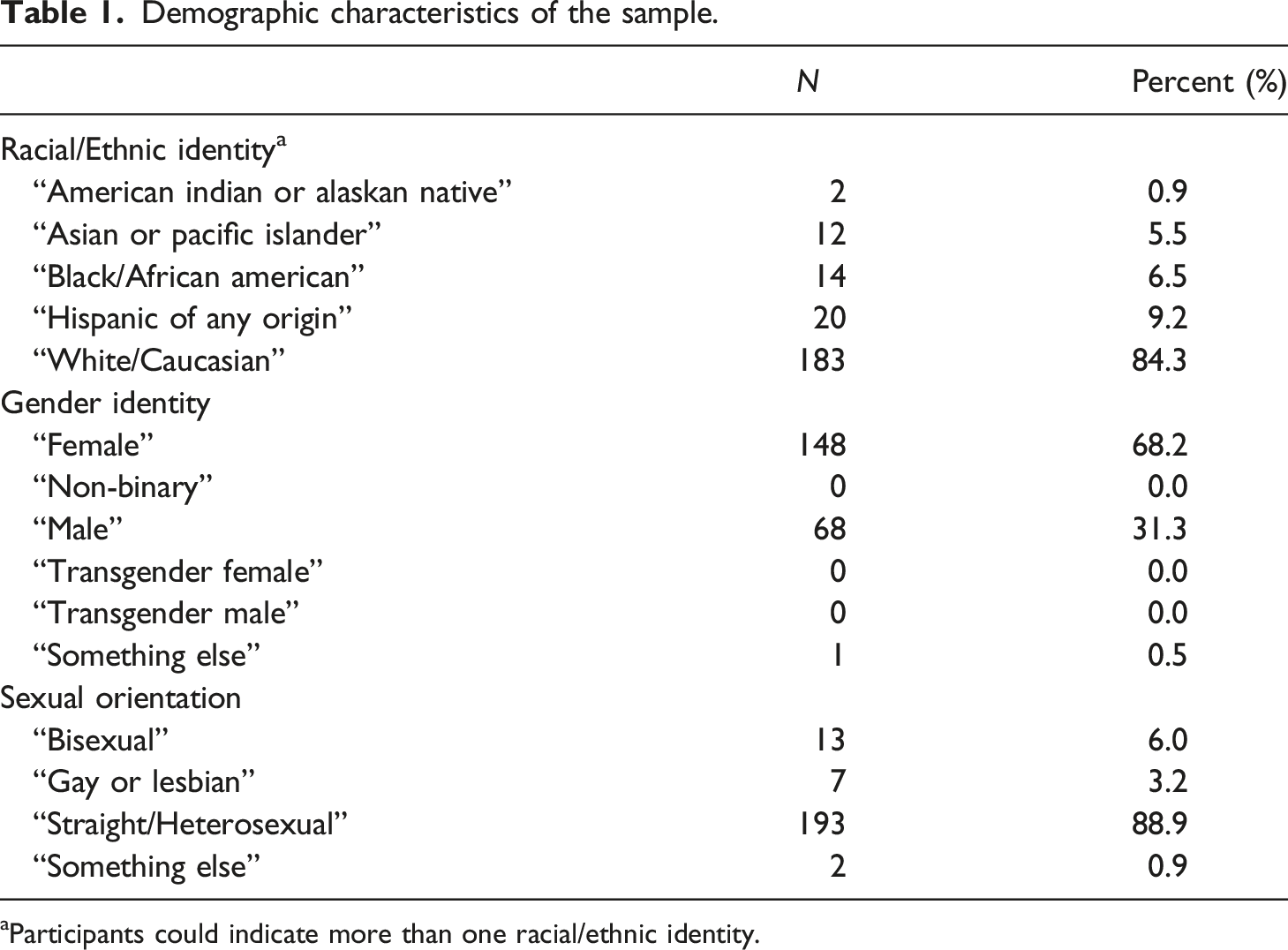
aParticipants could indicate more than one racial/ethnic identity.
Procedures
All study materials and protocols were approved by the author’s institutional review board. Participants completed four online surveys at six-month intervals over the course of 18 months. The first page of each survey comprised informed consent information to allow participants to decide whether to continue with the study. In addition to answering questions about themselves, participants answered questions about relationships with three of their friends in their athletic team or Greek organization. Participants were instructed to identify their three closest friends at the first time point and were asked questions about those same three friends throughout the study. Participants were asked to continue reporting on those friendships even if the participant or a friend left the athletic team or Greek organization. Participants were compensated US$10 for the first and last surveys and US$5 for the second and third surveys (which were shorter).
Measures
Past support from parents
The support participants received from their parents while they were growing up was measured with the 12-item Parental Care subscale of the Parental Bonding Instrument (Parker et al., 1979). Participants identified the two people who took care of them the most while they were growing up and then rated statements such as “Was affectionate to me,” on a four-point scale from “Very Unlike” to “Very Like” about both caregivers. Overall support from parents was calculated as the average of the support from both caregivers. The average internal consistency for the two caregivers was excellent (α = .92).
Past support from high school friends
The support participants had received from their friends while they were in high school was measured with a modified version of the 10-item Close Friends subscale of the Child and Adolescent Social Support Scale (CASSS; Kerres Malecki & Kilpatrick Demaray, 2002). The statements were modified to inquire about support that had been received in the past. For instance, “My close friends helped me when I needed it.” These statements were rated on a six-point scale from “Never” to “Always.” The internal consistency for this scale was excellent (α = .95).
Perceived support from current friends
Perceptions of support available from each friend were measured with the 12-item short form of the Interpersonal Support Evaluation List (ISEL-12; Cohen et al., 1985). Participants rated statements such as, “If I needed suggestions on how to deal with a personal problem, I could turn to [friend’s name inserted] for help,” on a four-point scale from “Definitely False” to “Definitely True.” The average internal consistency reliability across friends and timepoints was excellent (α = .93).
Positive experiences with current friends
Positive experiences with friends were measured with three scales. Received support was measured with a 19-item short form of the Inventory of Socially Supportive Behaviors (ISSB; Barrera & Baca, 1990). Participants reported the frequency with which each friend engaged in supportive behaviors such as “suggested some action you should take,” over the past three months on a five-point scale from “Not at All” to “About Every Day”. The average internal consistency reliability across friends and timepoints was excellent (α = .96).
Shared activities with each friend were measured with a modified version of the Common Cold Project’s (CCP) social participation measure (Alper et al., 2017). Participants rated the frequency with which they shared 12 types of activities such as “Went to a party with [friend’s name inserted],” over the past three months on a five-point scale from “Not at All” to “About Every Day”. This measure was adapted to refer to specific friends and excluded irrelevant items (e.g., “Visited with relatives at their home.“) The average internal consistency reliability across friends and timepoints was good (α = .87).
Enjoyable conversations with each friend were measured with an eight-item scale from Woods et al. (2016). Participants rated statements such as “I enjoy talking with [friend’s name inserted] because we have interesting conversations that last a long time,” on a five-point scale from “Strongly Disagree” to “Strongly Agree.” The average internal consistency reliability across friends and timepoints was excellent (α = .90).
Because these three measures were highly correlated with each other, the variables were converted to z-scores and averaged into a single variable to avoid problems with multicollinearity in the final model. Internal consistency reliability for the positive experiences scale constructed created from these three indicators, averaged across friends and timepoints, was adequate (α = .74).
Data analysis
The study’s hypotheses were tested using two-level latent growth models in Mplus version 8.0 (Muthén & Muthén, 1998-2017). Latent growth models use structural equation modeling to estimate the intercept and slope of a variable measured across a series of timepoints. The intercept is an estimate of participants’ initial score on the variable and the slope is an estimate of linear change over time. In these two-level models (Figure 1), level two comprised differences between participants, averaged across friends. Within the theoretical framework of the study, level two represents a generalized internal working model of support figures for the variable perceived support availability. Level one comprised differences between friends, after controlling for differences between participants. Level one therefore represents the friend-specific working models for support availability. Following Enders (2013), all participants who began the study were included in the analyses with missing data addressed through maximum likelihood estimation. Levels of the multilevel model.
Results
Measurement models
A two-level linear growth model for perceived support availability (Figure 2) fit the data adequately (RMSEA = .08, CFI = .92, TLI = .94). The mean of the intercept at the participants level was M = 3.11 on the ISEL-12’s 1-4 point scale, indicating that participants generally began the study perceiving a moderately high level of support from their friends. The mean of the slope at the participants level was negative (b = −.13, p < .01), indicating that the amount of support perceived as available from these friends tended to decline over the course of the study. Two-level Linear Latent Growth Model for Perceived Support Availability. Note. *p < .05,
ns
p > .05.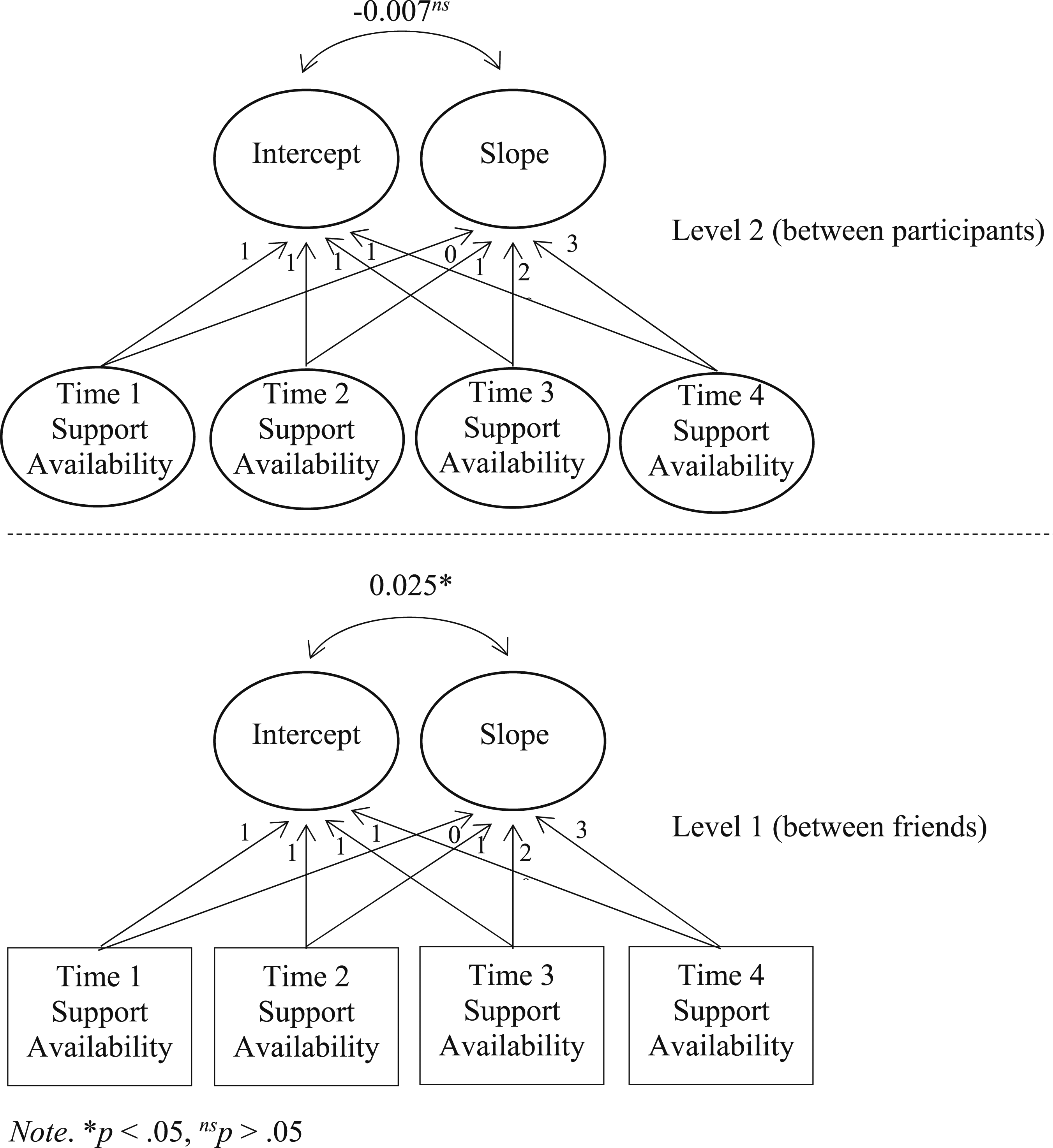
A measurement model specifying a linear change in positive experiences showed a marginal fit to the data. Closer inspection of the averages at each timepoint showed that positive experiences tended to decline over the course of the study, with the largest decreases occurring from time 1 to time 2 and progressively smaller decreases at each subsequent interval. A measurement model in which change was modeled with a square root function showed a good fit (RMSEA = .06, CFI = .96, TLI = .94).
Assimilation and accommodation in generalized working models
Final model predicting perceived availability of social support from friends.
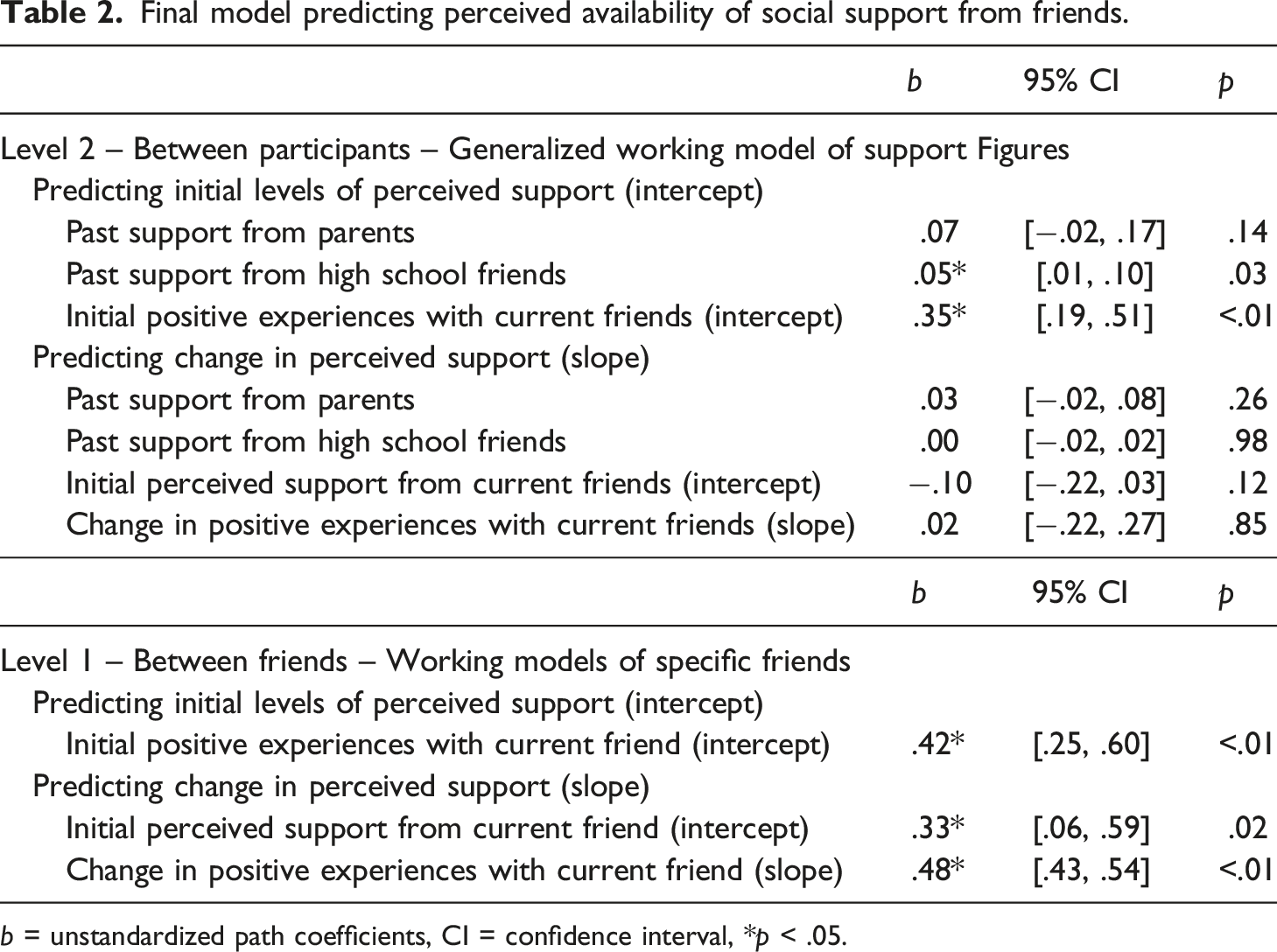
b = unstandardized path coefficients, CI = confidence interval, *p < .05.
The first three hypotheses predicted that experiences with new friends would be assimilated into generalized working models of support figures. Hypothesis one was not supported. Past support from parents was not significantly associated with perceived support from friends. Hypothesis two was supported. Participants who received more support from their high school friends tended to perceive that more support was available from their college friends at the beginning of those friendships (b = .05, p = .03), even when controlling for actual positive experiences with those friends. Hypothesis three was not supported. Initial overall perceived support from friends was not significantly related to the trajectory of overall perceived support. Past support from parents and high school friends was also unrelated to the trajectory of support perceptions.
The fourth hypothesis predicted an accommodation effect influencing general perceptions of support availability. Hypothesis four was not supported. Changes in overall positive experiences with friends were not significantly related to changes in overall perceived support.
Primacy effects and accommodation in friend-specific working models
Hypothesis five predicted primacy effects influencing perceptions of the support available from specific friends. Hypothesis five was supported. Friends who were perceived as the most supportive at the beginning of the friendship were viewed as increasingly supportive over time, even after controlling for the actual positive experiences with that friend (b = .33, p = .02).
Hypothesis six predicted accommodation effects influencing perceptions of support available from specific friends. Hypothesis six was also supported. Participants viewed friends as increasingly supportive when their positive experiences with that friend increased (b = .48, p < .01).
Discussion
The purpose of this study was to learn more about why some people believe that more support is available to them than others and why some support figures are viewed as particularly supportive. It was proposed that support perceptions are based in part on internal working models representing an individual’s beliefs about support figures in general and about each support provider specifically. Those working models were hypothesized to be influenced by the cognitive processes of assimilation, primacy effects, and accommodation. A sample of first-year college students in athletic teams and Greek organizations was collected to observe the beginnings and growth of significant friendships.
The findings showed support for a generalized working model of support figures, or more specifically, a generalized working model of friendships. Participants who felt better supported by their friends in high school tended to believe that more support was available from their college friends at the beginning of those friendships. This association was significant, even after controlling for positive experiences with those friends, such as receiving support, enjoying conversations, and sharing social activities. This finding suggests that the association between support from high school friends and perceived support from new college friends is not due simply to the fact that some individuals are better at selecting good friends or cultivating good friendships. Rather participants appeared to assimilate their experiences with their new friends into working models they had developed based on friendships in the past.
Assimilation was also observed in the working models for individual friends, specifically in the form of primacy effects. When participants perceived higher levels of available support from a friend at the beginning of their friendship, the support they perceived from that friend tended to grow over the course of the study. Conversely, when participants perceived lower levels of available support from a friend at the beginning of a friendship, perceived support tended to decline. Again, that effect remained significant even after controlling for changes in positive experiences in the friendship. Initial perceived support and the trajectory of perceived support were not linked simply because participants were able to predict which friends would be interesting, fun, and supportive. Rather these early beliefs appear to have persisted, at least to some degree, in spite of ups and downs in participants’ experiences with their friends.
Some evidence of accommodation was observed in overall perceptions of perceived support. There was a significant downward trend in overall perceptions of perceived support. Participants were asked to select their three closest friends in their organization in the first semester of joining that organization. It is possible that the participants met other friends in and out their organization as their time in college progressed. Building other, closer friendships may have caused many participants to re-evaluate the potential supportiveness of these three individuals. However, overall decline in perceptions of support availability was not significantly related to overall decline in positive experiences with those three friends. Participants were accommodating their generalized models regarding whether support would come from their friends, but it is not clear why.
Conversely, changes in positive experiences with specific friends were significantly related to changes in support perceived from those friends—a clearer accommodation effect. Participants tended revise, to some degree, their perceptions of a friend’s availability based on whether or not they accumulated positive experiences with that friend.
Implications of the findings
Much of the research conducted on social support has been devoted to understanding how support figures can prevent or reduce psychological distress. Some such studies have shown that receiving support that is skillfully delivered (Girme et al., 2018) and sensitive to the preferences of the recipient (Williamson et al., 2019) can alleviate psychological symptoms. However, the findings of the present study emphasize that the optimal social network is not merely responsive to an individual’s distress. Feeling supported comes both from recent experiences of support and from a history of positive interactions with one’s support figures. Consistent with relational regulation theory (Lakey & Drew, 1997) these findings suggest that friends and loved ones promote wellbeing through months and years of pleasant conversations, shared activities, and expressions of affection and affirmation. Waiting until a crisis to seek or give support may be too late.
However, though these findings emphasize the lasting effects of one’s relationship history on current perceptions of support availability, they also demonstrate potential for changes in spite of that history. For instance, support from high school friends was related to participants’ initial perceptions of support from college friends, but not significantly related to the trajectory of those perceptions. History with other friendships might influence where a new friendship starts, but not necessarily where it goes. Similarly, even though poor first impressions of a friend had negative effects on perceptions of support availability through at least the first 18 months of the friendship, later positive experiences with that friend mattered too. Many friendships may be able to overcome a rocky start.
Another implication of these findings relates to understanding generalized working models of support figures. There was a significant effect of support from high school friends on perceived support from college friends, but the effect of history of parental support was non-significant. Previous research has provided evidence of generalized working models of support figures (Collins & Feeney, 2004; Lakey & Cassady, 1990; Lakey & Dickinson, 1994), but this pattern of results suggests that people may also develop working models for specific types of relationships (e.g., parents, friends, romantic partners). That idea is consistent with findings showing different age-related trajectories in different types of attachment relationships (friends, parents, romantic partners; Hudson et al., 2015). Beliefs about whether a friend or romantic partner is likely to be supportive may be more influenced by previous experiences with those types of relationships specifically than by a generalized working model of all support figures.
Strengths of the present study
This study was unique in several aspects. First, most studies on interpersonal relationships are not able to observe the early stages of a naturally forming relationship. By taking advantage of a population of individuals joining organizations with long-term commitments and high demands of investment, this study was able to examine the effects of early relationship qualities on the trajectory of those relationships.
Second, most research on first impressions and other primacy effects on social outcomes has examined outcomes occurring days or even minutes after the initial information was acquired (Swider et al., 2022). This study, showing the lasting impact of early experiences 18 months later, suggests a durability of social primacy effects not observed in most previous studies.
Third, most studies that have applied the concept of an internal working model to real-world relationships have not attempted to isolate the cognitive influence of formative relationships from the way formative relationships might impact interpersonal interactions. Lakey and Dickinson (1994) showed that family support predicted support perceived from new friendships after controlling for personality and perceived social competence. This study added to their findings by demonstrating that formative experiences shape perceptions of current friendships independent of actual experiences with those friends.
Limitations and areas for future research
The fact that this sample was predominately White, predominantly cisgender female, and drawn from a college significantly limits the confidence with which these findings can be broadly generalized. Different cultures emphasize friend and family relationships differently (Seginer et al., 2007) so individuals in non-White, non-Western cultures may form internal working models differently than the participants in this study. For children with fewer relationships outside the family, support from parents may have a stronger impact on beliefs about the supportiveness of others. For older adults with a more extensive relationship history, there might be considerable variability in what relationships have the most impact on their internal working models.
This study also focused on only three current friendships. No attempt was made to understand the relative importance of those friendships within the participants’ broader social networks. For some participants, the friends about whom they reported in the study may have been some of their closest confidants. Other participants may have been much closer with parents, romantic partners, or friends outside of their Greek or athletic organization. Future research could explore whether assimilation, primacy, and accommodation effects are more or less powerful depending on the relative importance of the relationship.
Additionally, because the participants reported on friends from athletic teams and Greek organizations, they reported only on same-gender friendships. Although previous research has found that same-gender and opposite-gender friendships tend to be more alike than different (Felmlee et al., 2012; Roy et al., 2022), the lack of opposite-gender friendships in this study does limit the generalizability of the findings.
Recruiting from athletic teams and Greek organizations may also have contributed to the lack of transgender individuals in the sample. It is possible that the history of a transgender person’s relationships might have less impact on their current friendships. Transgender individuals are more likely to experience rejection from family members and high school peers and thus seek out adult friends who are quite different from the people in their early life (Kichler, 2021). It is also unknown how well these findings might apply to other types of relationships (e.g., extended family relationships, romantic relationships). The duration of the current study was 18 months, and future research could also explore how long primacy effects might last.
The study also suffered substantial attrition. Only two-thirds of the participants continued the study into the second time point. Only half of the original participants continued all the way from the beginning to the end. Although participants who completed the study did not significantly differ from those who did not on the major study variables, women were more likely to complete the study than men and were already over-represented in the initial sample. Women tend to receive more support, perceive that more support is available, and are perceived as more available for support by both women and men (Williamson & O’Hara, 2017). These considerations suggest that the study’s findings may be more applicable to women and female friendships than to men.
The loss of power resulting from participant attrition may also explain some of the study’s null findings. The effects of parent support on initial levels of friend support and changes in friend support were near but not at statistical significance. The effect of overall changes in positive experiences with friends on overall changes in perceived support was also near but not at statistical significance. Without the loss of power caused by participant attrition, those effects may have been statistically significant.
Another limitation of the study was that social interactions were measured only from the perspective of the participants. Some research has demonstrated that social support that is delivered in subtle ways, unnoticed by the recipient, can have particular benefits (Girme et al., 2018). In this study, the model controlled for changes in positive interactions in order to evaluate the durability of early perceptions of support availability. Controlling for changes in positive interactions was intended to separate the influence of early support perceptions from recent experiences in the relationship. However, it is possible that perceptions of support availability were influenced by positive behaviors enacted by the participants’ friends but not noticed or remembered by the participants. If that were the case, changes in perceptions of support availability might be more strongly determined by recent social experiences than suggested by these findings. Future studies on assimilation and primacy effects in support perceptions would benefit from measuring interactions from the perspectives of both support recipients and support providers.
Given the correlational nature of the study, it is also worth considering potential confounding variables that might fully or partially account for the associations observed in these findings. This study drew the idea of an internal working model of support figures from attachment theory. In attachment theory, attachment is based on both an internal working model of the support figure and an internal working model of the self (Chui & Leung, 2016). This study found support for a persistent, generalized internal working model of friendships. However, it is possible that some of the continuity in support perceptions from high school friends to college friends could be accounted for by the participants internal working models of themselves. For example, individuals who believe that they are worthy of support and socially appealing to other people tend to believe the more support is available to them (Lakey & Scoboria, 2005). Improvements in self-esteem more broadly also predict subsequent increases in perceptions of support availability (Marshall et al., 2014). Future research could seek to disentangle the relative importance of internal working models of the self and generalized models of support figures in understanding consistencies in perceptions of support across relationships.
The accommodation effects in the individual friendships could also be accounted for, wholly or partly, by confounding variables. The findings from this study suggest that positive experiences with a friend may lead to an increased perception that the friend would be available for support in times of need. However, both perceived support and positive experiences are related to the broader aspects of social relationships. For example, both received support and perceived support availability are related to how close the individual feels to their support provider (Mazer & Thompson, 2011) and their satisfaction with the relationship (Lorenzo et al., 2018; Özen et al., 2021). This issue is related to a broader need to establish what aspects of social relationships (e.g., positive experiences, perceived availability of support, perceived closeness) are most important for personal well-being (Holt-Lunstad et al., 2017).
A final limitation of the study’s design was that participants were not explicitly instructed to report only on new friends. The college from which the participants were recruited is small and draws few students from the local community. As a result, few students from any one high school attend the college and it would be quite unusual for first-year students from the same high school to join the same athletic team or Greek organization. However, it is possible that a small number of friends identified by the participants were people the participants knew before coming to college.
Conclusion
This study supported the idea that beliefs about whether social support is available are based in part on internal working models of the social world. These working models are developed over time and formative experiences have lasting effects on perceptions of support availability. This study particularly emphasized the importance of working models for specific types of relationships and for specific support providers. Feeling well-supported comes from a substantial history of positive experiences with multiple support providers.
Footnotes
Declaration of conflicting interests
The author(s) declared no potential conflicts of interest with respect to the research, authorship, and/or publication of this article.
Funding
The author(s) disclosed receipt of the following financial support for the research, authorship, and/or publication of this article: Funding for this project was provided by Augustana College.
Open research statement
As part of IARR’s encouragement of open research practices, the author has provided the following information: This research was not pre-registered. The data and materials used in the research can be publicly posted. The data and materials can also be obtained by emailing
