




Abstract
Although attachment insecurity has been linked to sexual dissatisfaction in cross-sectional research, little is known about the mechanisms by which attachment is associated with sexual satisfaction over time. This study examined the role of attachment insecurities in sexual satisfaction over time using the Interpersonal Exchange Model of Sexual Satisfaction (IEMSS) as a theoretical framework. Participants were 151 Canadian mixed-gender couples in a long-term relationship (M = 9.7 years) who completed questionnaires at two time points. The results demonstrate that sexual exchanges explained the associations between attachment insecurities (anxiety and avoidance) and sexual satisfaction in both men and women in long-term relationships, although the specific pathways differed by gender. These results are discussed in the context of the IEMSS and attachment theory.
Introduction
Positive sexual interactions are powerful means to express love and cultivate relationship happiness over time. As such, sexual satisfaction (i.e., the affective appraisal of one’s sexual relationship with a partner) is a vital component of romantic relationships. Attachment insecurities, which translate into enduring interpersonal patterns (Mikulincer & Shaver, 2016), have been linked to lower sexual satisfaction in individuals and couples in a romantic relationship (for reviews, see Birnbaum & Reis, 2019; Stefanou & McCabe, 2012). However, less is known about the association between attachment and sexual satisfaction over time and explanatory mechanisms for this association, particularly in long-term couples (see Raposo et al., 2020 for an exception). Specifically, the work to date focusing on the attachment-sexual satisfaction link has been primarily cross-sectional (e.g., Brassard et al., 2012; Butzer & Cambell, 2008; Lafortune et al., 2022), conducted among young adults with limited relationship experience (e.g., Davis et al., 2006; Little et al., 2010), and not informed by a conceptual model of sexual satisfaction. The Interpersonal Exchange Model of Sexual Satisfaction (Lawrance & Byers, 1995) delineates theory-driven factors leading to higher sexual satisfaction. Therefore, the goal of this study was to shed light on the role of attachment in the couple sexual relationship over 12 months using the Interpersonal Exchange Model of Sexual Satisfaction (IEMSS) as a theoretical framework.
Attachment and Sexual Satisfaction
Adult attachment theory provides a useful lens for understanding relationships (Mikulincer & Shaver, 2016) and sexuality (Birnbaum & Reis, 2019). There are two dimensions of insecure attachment in adulthood (Brennan et al., 1998). Attachment anxiety involves doubts about one’s lovability and likelihood of being reliably cared for and is often accompanied by a hyperactivation of the attachment system. That is, because they fear rejection by their partner, individuals high in anxiety tend to be hypervigilant about their partner’s availability and make excessive attempts to get their partner to provide love and reassurance about the relationship. Attachment avoidance involves discomfort with closeness, mistrust, and excessive self-reliance, and is often accompanied by a deactivation of the attachment system. That is, individuals with attachment avoidance tend to minimize or deny their attachment needs and vulnerability, and to avoid intimacy to maintain interpersonal distance (Mikulincer & Shaver, 2016). In contrast, securely attached individuals have low levels of anxiety and avoidance, which helps them build more gratifying and stable intimate relationships.
Sexuality is an effective means to meet attachment needs including the need for proximity, validation, and reassurance regarding the availability of the partner and stability of the relationship (Davis et al., 2004). However, an individual’s experience of their sexual relationship with their partner is affected by their attachment representations (for a review, see Mikulincer & Shaver, 2016). That is, individuals with a secure attachment style tend to engage in sexual activity to express love to their partner. They also tend to be comfortable with sexual intimacy because they are not worried about potential rejection from their partner or preoccupied with the state of their relationship (Tracy et al., 2003). As such, these individuals report higher sexual satisfaction (Birnbaum & Reis, 2019; Stefanou & McCabe, 2012). In contrast, attachment insecurities (avoidance and anxiety) tend to negatively affect sexual relationships, leading insecure individuals to experience less positive and more negative emotions during sexual activity (Beaulieu et al., 2022; Birnbaum et al., 2006), greater sexual anxiety (Brassard et al., 2015; Péloquin et al., 2014), more sexual problems (Birnbaum, 2007; Stefanou & McCabe, 2012), and lower sexual satisfaction (Brassard, Péloquin, Dupuy, et al., 2012; Butzer & Campbell, 2008; Lafortune et al., 2022). However, most of the research on attachment and sexual well-being has surveyed adolescents or young adults with short-term partners (for exceptions, see Beaulieu et al., 2022; Brassard, Péloquin, Depuy, et al., 2012), limiting our knowledge of the relational processes involved in the sexual well-being of longer-term couples (Fisher et al., 2015). In newer relationships, there tends to be an overall positive appraisal of the relationship that influences affective responses to sexual exchanges (Byers, 1998). This positive perception, however, tends to fade with time, thus underscoring the need to conduct research with longer-term couples.
Interpersonal Exchange Model of Sexual Satisfaction
The IEMSS states that an individual’s sexual satisfaction is affected by the sexual exchanges (i.e., sexual rewards and costs) in the relationship and the overall relationship climate (Lawrance & Byers, 1995). Sexual rewards are exchanges between partners that are gratifying and pleasing to the individual; sexual costs are exchanges between partners that demand physical or mental effort or cause pain, embarrassment, anxiety, or other negative affect. According to the IEMSS, sexual satisfaction is highest when: (1) individuals experience a more favorable balance of their overall level of sexual rewards to sexual costs (i.e., high sexual rewards and low sexual costs); (2) this balance compares more favorably to their expected level of sexual rewards and costs (i.e., they experience relatively high sexual rewards and relatively low sexual costs); and (3) they perceive greater equality between their own and their partners’ levels of sexual rewards and costs.
There is considerable evidence, in various samples in several countries, for the validity of the IEMSS components in predicting sexual satisfaction across the lifespan (Byers et al., 1998; Byers & MacNeil, 2006; Kisler & Christopher, 2008; Lawrance & Byers, 1995; Sánchez-Fuentes & Santos-Iglesias, 2016). Although Byers and Rehman (2013) argued that it is important to expand the IEMSS to include factors that affect the sexual exchange components of the model (i.e., the balance of sexual rewards to costs, how sexual rewards and costs compare to expectations, equality of sexual rewards and costs), to this date, these factors have rarely been investigated. Moreover, although researchers have shown that attachment insecurities are associated with lower sexual satisfaction (Stefanou & McCabe, 2012), there is limited research on the mechanisms by which attachment affects sexual well-being over time. The aim of this study was therefore to determine which of the IEMSS components are mechanisms explaining the association between attachment insecurities and lower sexual satisfaction over time in longer-term relationships.
Attachment Insecurities, Sexual Exchanges, and Sexual Satisfaction
Based on research that has shown that attachment insecurities are associated with lower sexual satisfaction (Mikulincer & Shaver, 2016; Stefanou & McCabe, 2012), we posited that both types of attachment insecurities would be negatively associated with less favorable IEMSS sexual exchange components, but for different reasons. That is, attachment avoidance and anxiety activate different secondary strategies (i.e., deactivation strategies and hyperactivation strategies, respectively), which in turn will influence individuals’ perceptions of the sexual rewards and costs in their relationship. In terms of individuals high in attachment avoidance, they generally have a negative conception of interpersonal sexual activity (Birnbaum & Reis, 2019; Mikulincer & Shaver, 2016), which might lead them to perceive more sexual costs and less sexual rewards compared to their expectations. In order to avoid displays of vulnerability and minimize intimacy (i.e., deactivation strategies), they often engage in sexual activity for instrumental (e.g., stress reduction, physical pleasure) rather than for relational or affective reasons (Birnbaum et al., 2006; Davis et al., 2004; Impett et al., 2008; Schachner & Shaver, 2004). As such, individuals high in attachment avoidance tend to feel uncomfortable when their partners show tenderness and affection, and with the more emotional aspects of sexuality, which may be perceived as sexual costs (i.e., higher sexual costs than rewards). They are also more likely to engage in sex out of obligation to their partner or to avoid negative relationship consequences, and they even avoid partnered sexuality altogether (Brassard et al., 2007; Hazan & Zeifman, 1994). This could lead them to perceive that their partner is getter more sexual rewards and less sexual costs than they are. For these reasons, we expected that individuals high in attachment avoidance would report less favorable sexual exchanges on all three of the exchange components of the IEMSS—that is, they would report a less favorable balance of sexual rewards and costs, experience relatively low sexual rewards and high costs compared to their expectations, and perceive lower equality between their own and their partner’s levels of sexual rewards and costs.
Individuals high in attachment anxiety tend to have an ambivalent approach to sexuality, with negative feelings about sexual experiences often coexisting with strong passionate feelings, desire, and love (Birnbaum et al., 2006; Mikulincer & Shaver, 2016). That is, sexuality is often used to increase intimacy with the partner and obtain reassurance about the partner’s love and availability (Dewitte, 2012). However, due to their fear of losing their partner and their tendency to judge their sexual experiences as a barometer of the relationship, individuals high in attachment anxiety also tend to be preoccupied and distracted by thoughts about their worthiness of love, sacrifice their own sexual needs, and consent to unwanted sex (Davis et al., 2006; Impett et al., 2008, 2019; Impett & Peplau, 2002; Muise et al., 2013; Tracy et al., 2003). They also tend to overinvest in their sexuality (which they often confound with intimacy) and prioritize their partner’s sexual preferences (Brassard et al., 2007). These tendencies, which are rooted in the secondary strategies they use to confirm their self-worth (i.e., hyperactivation of their attachment system), may lead them to perceive more sexual costs than rewards, to perceive that their partner is reaping more benefits of the sexual relationship than they are, or to perceive higher costs and lower rewards compared to their expectations. As such, we anticipated that attachment anxiety would be negatively associated with all components of the IEMSS.
We also expected that the IEMSS components would explain the associations between attachment insecurities and sexual satisfaction. As shown in previous research (MacNeil & Byers, 2005, 2009; Mark & Jozkowski, 2013; Péloquin et al., 2019), albeit not with respect to attachment specifically, we expected that there would be an instrumental pathway between attachment insecurity and sexual satisfaction, via the sexual exchange components. There is some support for this hypothesis. For instance, in keeping with the instrumental pathway, cross-sectional research has shown that sexual motives and lower sexual communication explain the association between attachment insecurities and lower sexual satisfaction (Bennett et al., 2019; Davis et al., 2006; Gewirtz-Meydan & Finzi-Dottan, 2018; Goldsmith et al., 2016; Khoury & Findlay, 2014; Péloquin et al., 2013). Longitudinal research would allow us to identify possible mechanisms through which couples maintain a satisfying sexual relationship over time.
Byers and Rehman (2013) also called for researchers to extend the IEMSS by including partner or dyadic effects in order to take into account the relational context in which sexual interactions take place. They argued that individuals experience the partner’s sexual exchanges (e.g., the extent to which the partner experiences high rewards and low costs) as sexual rewards and costs for themselves. Only two cross-sectional studies have used a dyadic design to investigate the IEMSS and indeed found that both women and men reported highest sexual satisfaction when both partners experienced high sexual rewards and low sexual costs (Byers & MacNeil, 2006; Sánchez-Fuentes & Santos-Iglesias, 2016). Similarly, an individual’s attachment insecurity is likely to affect both partners’ sexual experiences and thus, in turn, affect both partners’ sexual satisfaction. In keeping with this view, a few, mostly cross-sectional, dyadic studies have revealed partner effects between attachment insecurities and sexual variables including lower sexual self-esteem, higher sexual distress and anxiety, poorer sexual communication skills, and lower sexual satisfaction (Brassard, Péloquin, Dupuy, et al., 2012; Butzer & Campbell, 2008; Byers & MacNeil, 2006; Charbonneau-Lefebvre et al., 2020; Dang et al., 2018). This suggests that attachment insecurities may be associated with both partners’ IEMSS exchange components. Furthermore, beyond examining simple partner effects, attachment-based partner pairings may provide additional insight with regards to couples’ sexual exchanges. Whereas some studies have shown that the interaction between both partners’ attachment insecurities contributes to relationship outcomes (e.g., Bergeron et al., 2019; Callaci et al., 2020; Davila & Bradbury, 2001), very few studies have assessed the interactive nature of partners’ attachment insecurities to understand sexuality (see Brassard et al., 2007 for an exception). Researchers have documented destructive demand-withdrawal communication patterns that are the results of polarized secondary attachment strategies in couples in which one partner is high on anxiety and the other is high on avoidance (Millwood & Waltz, 2008). These couples tend the report higher relationship distress (Kirkpatrick & Davis, 1994). These couples may also be less sexually satisfied because they might experience less favorable sexual exchanges (i.e., more sexual costs, less sexual rewards, lower equity in sexual costs and rewards), but this has never been tested.
The Current Study
The goal of this prospective dyadic study was to examine the links between attachment and long-term couples’ sexual satisfaction 12 months later. We investigated the following hypotheses and research questions: • H1: Past research has shown that attachment insecurity is associated with lower sexual satisfaction in younger couples, cross-sectionally. As such, we examined the extent to which attachment insecurities (anxiety, avoidance) were associated with sexual satisfaction in both partners of long-term couples over time. • H2: We examined whether attachment insecurities were associated with both partners’ IEMSS components. Based on attachment theory and the IEMSS, we hypothesized that an individual’s own higher attachment insecurities would be associated with their less favorable sexual exchanges (i.e., less favorable balance of sexual rewards to sexual costs, less favorable relative balance of sexual rewards and costs compared to their expected levels of sexual rewards and costs, lower perceived equality of sexual rewards and costs with their partner; actor effects). • RQ1: To account for relationship dynamics and the interpersonal nature of sexuality, we also explored partner effects—that is, whether an individual’s attachment insecurities are associated with their partner’s sexual exchanges but did not make a priori predictions due to a lack of previous studies. • RQ2: We also explored whether attachment-based couple pairings were associated with sexual exchanges—that is, whether the association between an individual’s own attachment insecurities and IEMSS components were moderated by their partner’s attachment insecurities. Given the exploratory nature of these analyses, we did not formulate a priori hypotheses. • RQ3: We tested a model in which the IEMSS components would act as intermediary variables explaining the associations between attachment insecurities and both partners’ sexual satisfaction.
We explored potential sex/gender differences in all analyses because previous research has shown sex/gender differences in the associations between attachment insecurities and sexuality (e.g., Brassard et al., 2012; Gewirtz-Meydan & Finzi-Dottan, 2018; Goldsmith et al., 2016), albeit not with respect to the IEMSS components and sexual satisfaction specifically.
Method
Participants
This study was embedded in a larger three-year prospective study on relationship and sexual well-being in long-term couples. A sample of 153 Canadian mixed-gender couples were recruited based on the following criteria: (1) relationship length of at least 5 years; (2) cohabitating for at least 6 months; (3) having engaged in sexual intercourse at least once monthly over the past 6 months; (4) daily internet access (to complete daily diaries not included in the current study); and (5) 18 years or older. Couples reporting a temporary separation in the past 6 months were excluded to ensure that couples were in a stable relationship. The sexual exchanges questionnaire was added in the larger study after it was already in progress and was only administered at one time point for all couples. Because couples were at different points in the study when it was added, it was administered at 12 month follow-up for 60% of the sample and at 24 month follow-up for the other 40% of couples who had not completed it at 12 months. As such, for 60% of couples, the data from the baseline and 12 month follow-up assessments were used in this study. However, for 40% of couples, we used data from the 12 month and 24 month follow-ups. Hence, for all couples included in this study, we used data from two time points, 12 months apart. These two time points were labeled T1 and T2 in Figure 1. Path analyses showing the associations between attachment insecurities and sexual satisfaction through the IEMSS components. Note. All possible paths between variables were tested, but only significant standardized path coefficients are shown here to avoid overcrowding the figure. *p < .05. **p < .01. ***p < .001.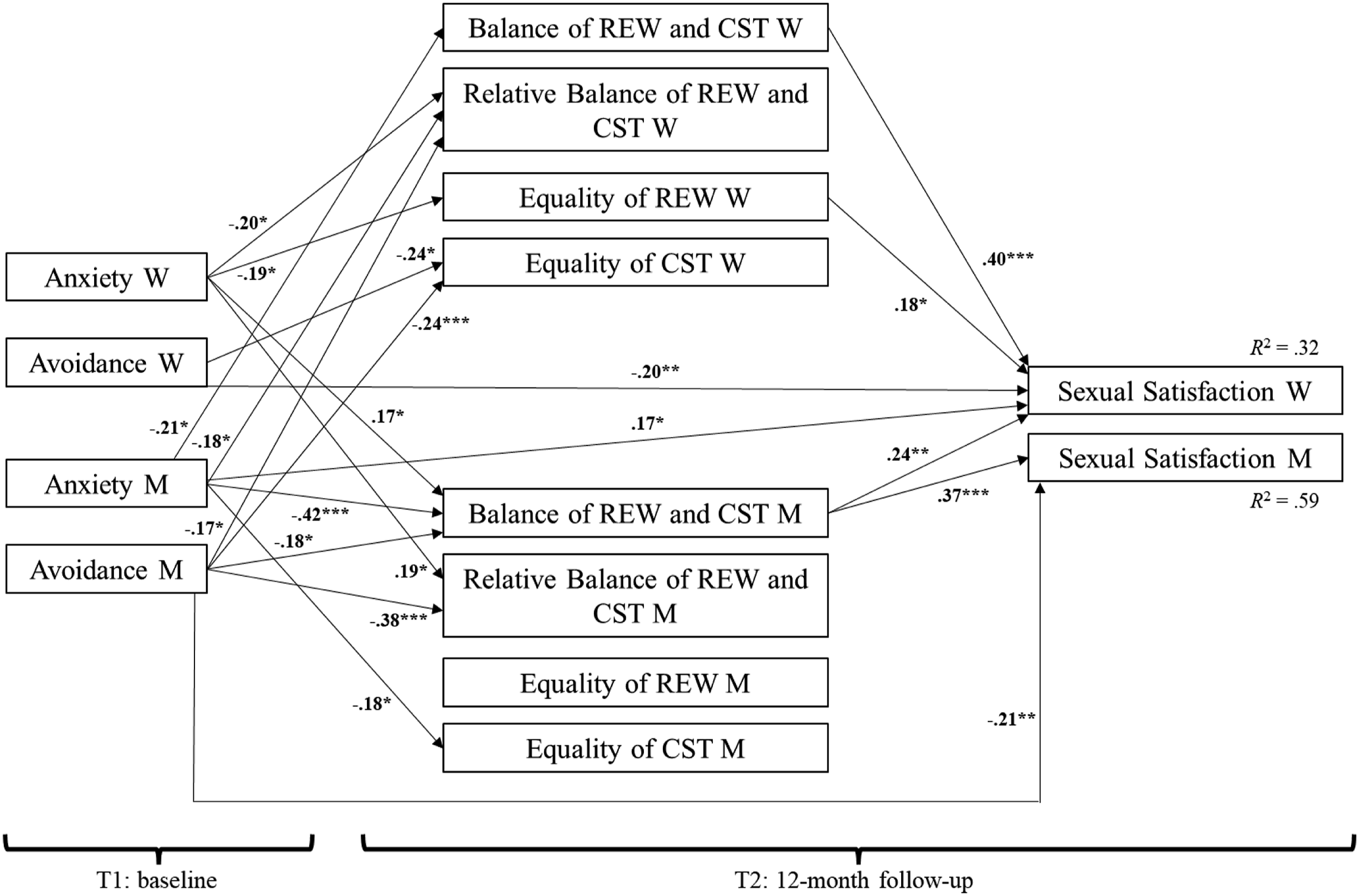
Most couples (97.46%) resided in the province of Québec, Canada. Most participants reported French as their first language (87.59% of men; 89.40% of women) and almost all identified as White (91.50%). Some participants identified as Black (1.63%), Latino (3.59%), Asian (.65%), Middle Eastern (1.31%), or Indigenous (1.31%). On average, men were 32.35 years old (MD = 31.00, SD = 7.42, range: 20–57) and women were 30.90 years of age (MD = 29.00, SD = 6.75, range: 20–50). Couples had been together for an average of 9.56 years (SD = 4.78) and had been cohabitating for 7.33 years (SD = 5.60). About a third of couples was married (28.95%) and 35.53% had children. Nearly one in four participants (23.42%) reported a child from a previous relationship. Regarding education, 37.67% of men and 61.18% of women had a university degree. Moreover, 57.93% of men and 37.50% of women had an income of $40,000 or more.
Measures
Background Questionnaire
A demographic questionnaire was used to assess personal and relationship characteristics (age, relationship status and duration, children, language, race, education, and income).
Attachment (assessed at Time 1)
A brief version of the Experiences in Close Relationships questionnaire (ECR-12; Lafontaine et al., 2016) was used to assess attachment-related anxiety and avoidance. Participants rated the 12 items on a 7-point Likert scale (1 = strongly disagree to 7 = strongly agree). Items were then averaged to form subscale scores, with higher scores suggesting higher attachment anxiety or avoidance, respectively. The ECR-12 has shown adequate internal consistency and research has supported the validity of this measures in several community and clinical samples of couples (Lafontaine et al., 2016). In this sample, internal consistency was adequate for both men (anxiety: α = .845; avoidance: α = .852) and women (anxiety: α = .855; avoidance: α = .828).
Interpersonal Exchange Model of Sexual Satisfaction (assessed at Time 2)
The three sexual exchange IEMSS components were assessed using the 6-item Exchanges Questionnaire (Lawrance et al., 2020). Participants first indicated, on a 9-point scale with endpoints ranging from 1 (not at all rewarding) to 9 (extremely rewarding), how rewarding their sexual relationship was (level of rewards, REW). Second, they indicated how their level of sexual rewards compared to their own expectations about how rewarding their sexual relationship should be (comparison level or relative level of rewards, CLREW) on a 9-point scale ranging from 1 (much less rewarding in comparison) to 9 (much more rewarding in comparison). Third, they rated, on a 9-point scale ranging from 1 (my rewards are much higher) to 9 (my partner’s rewards are much higher), how their level of rewards compared to the level of rewards their partner receives in the sexual relationship (perceived equality of rewards). The three remaining items assessed level of sexual costs (CST), relative level of sexual costs (CLCST), and perceived equality of sexual costs using the same format as for rewards. Perceived equality of sexual rewards and costs were recoded such that the mid-point (5 on the original scale), representing perfect equality, was assigned a score of 4, and both endpoints (i.e., both my rewards are much higher (1) and my partner’s rewards are much higher (9) were assigned scores of 0, representing low equality. Similarly, scores of 2 and 8 were recoded to a score of 1, scores of 3 and 7 were recoded to a score of 2, and scores of 4 and 6 were recoded to a score of 3. Thus, higher scores represent greater equality of sexual rewards and costs between partners. Scores on the two recoded equality scales, (EQREW and EQCST), constitute two of the components of the IEMSS. The other two components (balance of sexual rewards to costs and Relative levels of sexual rewards to costs) are calculated from the remaining four items by subtracting the cost score from the reward score so that the possible range of scores for both of these measures is −8 to +8. A positive balance score indicates a more favourable balance of sexual rewards to sexual costs, whereas a positive relative levels score indicates a more favorable level of sexual rewards and costs compared to one’s expectations. The IEMSS components have shown good test-retest reliabilities between 3 and 18 months and research has supported the validity of the Exchanges Questionnaire to assess the IEMSS components in Canadian, American, and Spanish samples (Kisler & Christopher, 2008; Lawrance et al., 2020; Sánchez-Fuentes et al., 2015).
Sexual Satisfaction (assessed at Time 2)
The Global Measure of Sexual Satisfaction (GMSEX) was used to assess global sexual satisfaction (Lawrance et al., 2020). The GMSEX includes five items rated on a 7-point bipolar scale: good–bad, pleasant–unpleasant, positive–negative, satisfying–unsatisfying, valuable–worthless. Items are summed to obtain the total score (range = 5–35), with higher scores indicating greater sexual satisfaction. This measure has been shown to have high internal consistency and test-retest reliability at three and 18 months (Lawrance et al., 2020). It is significantly correlated with other measures of sexual satisfaction as well as with multiple indicators of sexual functioning (e.g., sexual desire), providing evidence for its construct validity (Lawrance et al., 2020). Internal consistency was high in the current study (Men: α = .917; Women: α = .866).
Procedure
Couples were recruited through social media and websites on relationships and sexuality. A telephone session was arranged with couples to verify eligibility, obtain informed consent, and foster their commitment towards the longitudinal aspects of the study. Partners were then each sent an individual link to their surveys to be completed via the online platform Qualtrics. Partners were instructed to complete their questionnaires independently. At each follow-up assessment, partners were emailed a link to follow-up surveys, which required 45 minutes to complete. Partners each received compensation worth CAN$15 for each assessment via gift cards. Rules of ethics regarding confidentiality, informed consent, and withdrawal from the study were observed and the study was approved by the researchers’ institutional Ethics Board.
Data Analytic Strategy
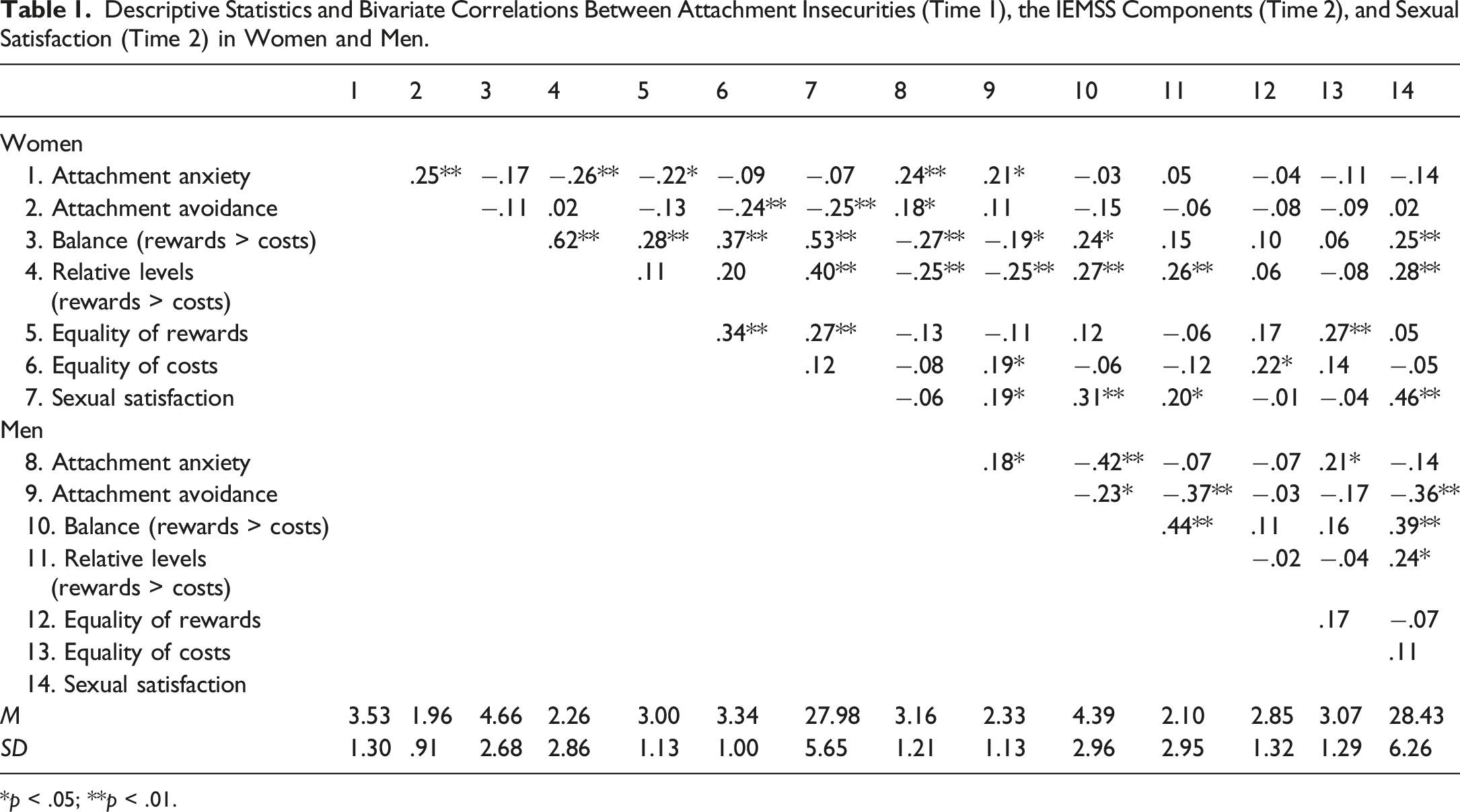
Descriptive Statistics and Bivariate Correlations Between Attachment Insecurities (Time 1), the IEMSS Components (Time 2), and Sexual Satisfaction (Time 2) in Women and Men.
*p < .05; **p < .01.
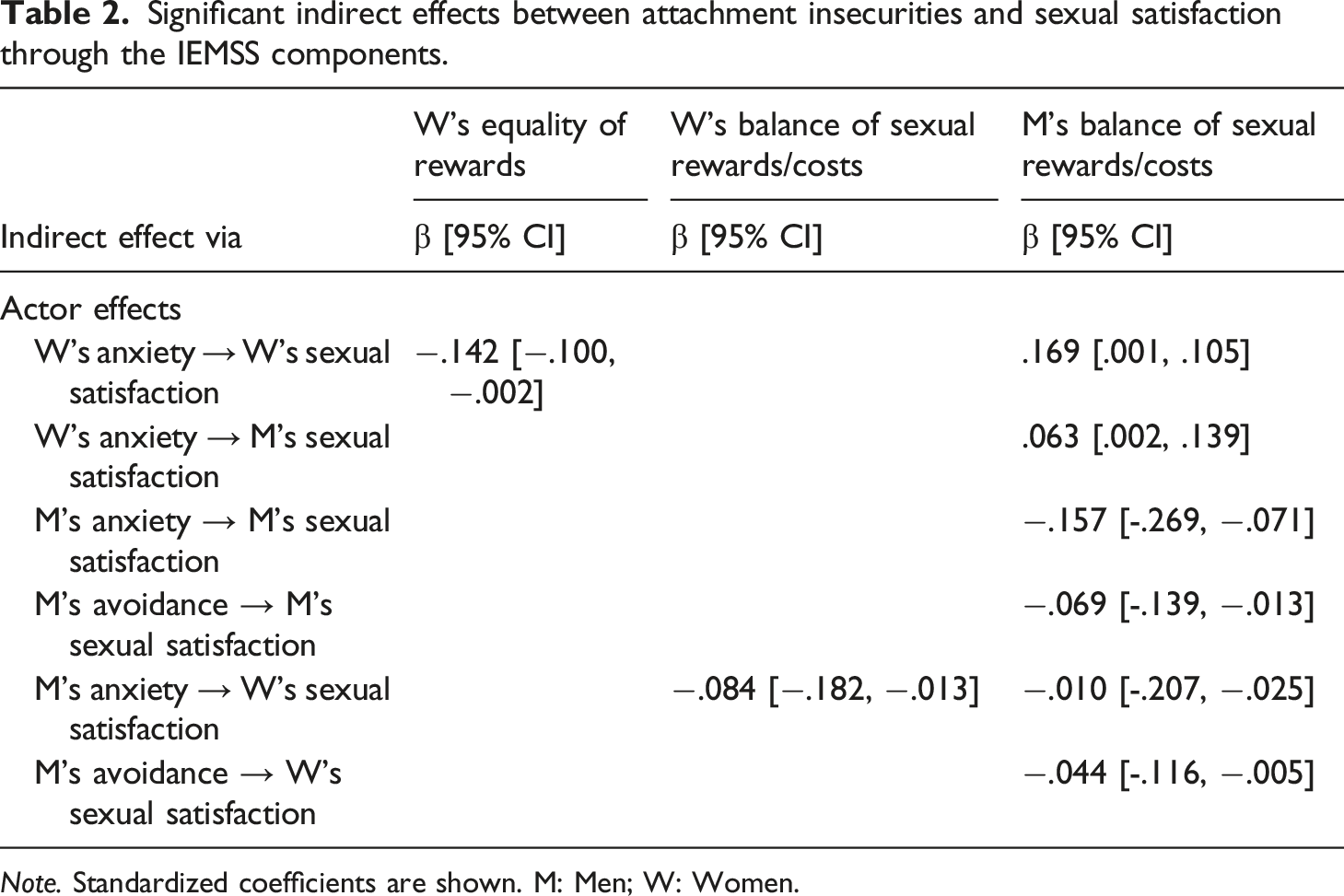
Significant indirect effects between attachment insecurities and sexual satisfaction through the IEMSS components.
Note. Standardized coefficients are shown. M: Men; W: Women.
To verify whether there were sex/gender differences in the actor and partner effects, we conducted a within-dyad test of distinguishability (Kenny et al., 2006). A model in which actor and partner effects were constrained to be equal between men and women was compared to a model in which the effects were freely estimated using the Satorra-Bentler scaled chi-square difference test. The constrained model differed significantly from the freely estimated model (CD = 1.004, Δχ2 (26) = 56.372, p = < .001), suggesting sex/gender differences in actor and partner effects. Thus, we retained a semi-constrained model in which only the effects that significantly differed between men and women were left free to vary.
Results
In terms of attachment, on average, participants reported low levels of avoidance. On average, men also reported low levels of attachment anxiety, but women reported anxiety levels in the clinical range (Brassard, Péloquin, Lussier, et al., 2012). On average, participants reported high sexual satisfaction, a favorable balance of sexual rewards to sexual costs and relative sexual rewards to sexual costs, and that their own and their partner’s sexual rewards and costs were fairly equal. Few variables departed from normality, with all skew indices being below 1.4 and kurtosis indices below 2.7.
Attachment Insecurities, Sexual Exchanges, and Sexual Satisfaction
The final APIM model (χ2 (36) = 46.48, p = .113; CFI = .961; SRMR = .065; RMSEA = .044, 90% CI [.000 −.077]) is presented in Figure 1. This model explained 35% of the variance in women’s sexual satisfaction and 29% of the variance in men’s sexual satisfaction. We first examined whether attachment insecurities were associated with lower sexual satisfaction 12 months later (H1). The findings indicated that for both men and women, attachment avoidance, but not attachment anxiety, was associated with their own lower sexual satisfaction 12 months later (both in the bivariate correlations and in the APIM model).
Second, we examined whether attachment insecurities were associated with the exchange components of the IEMSS (H2). As anticipated, attachment insecurities in both women and men were associated with their less favorable sexual exchanges. More specifically, in women, higher attachment anxiety was associated with their perception of a less favorable relative balance of sexual rewards and costs compared to their expectations. Higher attachment anxiety was also associated with their lower perceived equality of rewards between partners. Similarly, in men, greater attachment anxiety was associated with their perception of a less favorable balance between sexual rewards and costs and their lower perceived equality of costs between partners. Attachment avoidance was associated with women’s own lower perceived equality of sexual costs between partners. In men, avoidance was associated with their lower perceived balance and relative balance of sexual rewards and costs.
Next, we investigated partner effects between attachment insecurities and the IEMSS exchange components (RQ1). Interestingly, whereas attachment insecurities in men were associated with their partner’s less favorable sexual exchanges, attachment insecurities in women (anxiety) were associated were their partner’s more favorable sexual exchanges. More specifically, men’s higher attachment anxiety predicted their partner’s less favorable perceived balance and relative balance of sexual rewards and costs. Men’s higher attachment avoidance predicted their partner’s less favorable perceived relative balance of sexual rewards and costs and lower perceived equality of sexual costs between partners. However, women’s higher attachment anxiety predicted their partner’s more favorable perceived balance and relative balance of sexual rewards and costs.
Upon examining attachment-based partner pairings (RQ2), we found one significant moderation effect. Women’s attachment avoidance moderated the association between men’s attachment anxiety and their perceived equality of rewards with their partner (β = −.22, p = .05). Simple slopes analyses revealed that men who endorsed higher levels of attachment anxiety perceived less equality between their own and their partner’s level of sexual rewards when their partner reported high (+1SD) levels of avoidance (b = −.44, p = .040), but not when their partner reported low (-1SD) levels of avoidance (b = .175, p = .233). This effect is shown in Figure 2. Women’s attachment avoidance moderating the association between men’s attachment anxiety and men’s sexual satisfaction. Note. *p < .05.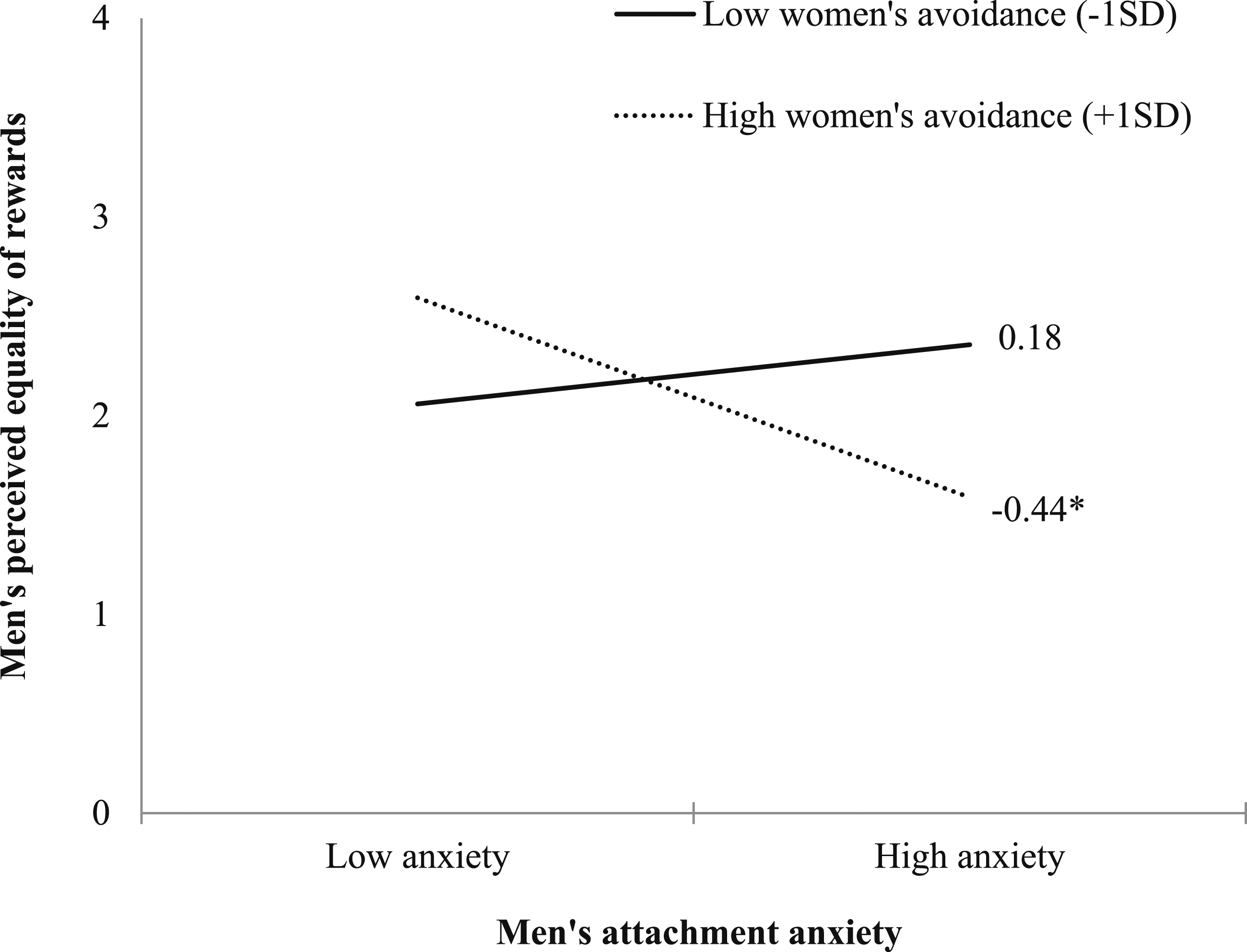
Finally, we investigated the extent to which the IEMSS exchange components explained the association between attachment insecurities and sexual satisfaction over time (RQ3). The findings revealed several significant indirect effects via some of the IEMSS components in both partners, although different mechanisms were observed for men and women (see Table 2). Women’s higher attachment anxiety was associated with their own lower sexual satisfaction through their own lower perceived equality of sexual rewards between partners. Men’s higher attachment anxiety and attachment avoidance were associated with their own lower sexual satisfaction through their own less favorable perceived balance of sexual rewards and costs. The results also suggested partner effects, but these effects also differed for women (four indirect partner effects) and men (one indirect partner effect). Women’s higher attachment anxiety was associated with their partner’s higher sexual satisfaction through men’s higher perceived balance of rewards and costs. Women’s higher attachment anxiety and men’s higher attachment anxiety and avoidance predicted women’s lower sexual satisfaction through men’s lower balance of sexual rewards and costs. Men’s higher attachment anxiety also predicted women’s lower sexual satisfaction through women’s lower balance of sexual rewards and costs.
Discussion
Little research has investigated the mechanisms that link attachment insecurities with lower sexual satisfaction, especially over time and in long-term couples. Yet, it is the understanding of these mechanisms that can lead to possible interventions to enhance the sexual satisfaction of insecurely attached individuals who are in established relationships. Using the IEMSS as a theoretical framework, the findings indicate that sexual exchanges components are a mechanism through which attachment insecurities shape sexual satisfaction in women and men.
Attachment Insecurities Predicting Sexual Satisfaction in Long-Term Couples
Contrary to past cross-sectional research mostly with young people (Birnbaum & Reis, 2019; Stefanou & McCabe, 2012), attachment anxiety was not directly related to participants’ own lower sexual satisfaction 12 months later in our sample of long-term couples as shown by the mediation model and the bivariate correlations. However, there were indirect paths between attachment anxiety and sexual satisfaction in men and women. This may be because attachment anxiety tends to reduce over time in long term couples (Hudson et al., 2015). As such, in comparison to shorter-term couples, the detrimental effects of attachment anxiety on long-term partners’ sexual well-being may be less powerful, as partners gradually evolve into a more secure relationship, are less preoccupied with issues of self-worth and concerns about being rejected by their partner, and develop a mutually pleasurable sexual script. This suggests that attachment anxiety may operate somewhat differently at different stages of the relationship and over time, especially in couples who are highly sexually satisfied, as was the case in our sample.
In contrast, as predicted, attachment avoidance in men and women in a long-term relationship predicted their own lower sexual satisfaction 12 months later, as is the case in short-term couples (Stefanou & McCabe, 2012). This is consistent with avoidant individuals’ more negative perception of partnered sexuality (Birnbaum & Reis, 2019). Because individuals higher in attachment avoidance are less comfortable with the affective aspects of sexuality, their fear of intimacy may be triggered during sexual interactions with their partner due to feelings of emotional vulnerability, which they generally try to avoid. This would lead them to use deactivation secondary strategies (e.g., minimize vulnerability, deny affective needs), which may limit their ability to fully appreciate this intimate moment with their partner and over time, hamper their sexual satisfaction.
The fact that there was a direct effect of sexual satisfaction for attachment avoidance but not for attachment anxiety suggests that it may be the characteristics of attachment avoidance (i.e., deactivation strategies), versus those of attachment anxiety (i.e., hyperactivation strategies), that are more detrimental to the sexual satisfaction of long-term partners. Indeed, in the early stages of the relationship, strong sexual attraction and passionate sexual feelings may explain high sexual satisfaction, even in the absence of emotional intimacy, between partners. Passion, however, tends to diminish over time, and as such the characteristics of individuals higher in attachment avoidance, such as the avoidance of emotional intimacy and display of vulnerability in the context of sexuality, may only later interfere with partners’ sexual satisfaction. Overall, our findings highlight that to fully understand the effects of attachment on sexual satisfaction, researchers need to consider the developmental stage of the relationship.
Sexual Exchanges as Pathways Between Attachment Insecurities and Sexual Satisfaction
We extended the literature by showing that sexual exchanges served as intermediary variables between attachment insecurities and both partners’ sexual satisfaction. An important discovery is the finding that men’s perception of the balance of their sexual rewards and costs was the root of six indirect effects, suggesting that it is a key pathway—that is, men’s more positive appraisal of their balance of sexual rewards and costs was linked to both partners’ higher sexual satisfaction. Another important finding was that attachment insecurities in both partners were a precursor to men’s perception of their balance of sexual rewards and costs, although the direction of these associations differed for men’s and women’s attachment insecurities.
The Role of Men’s Sexual Exchanges
As hypothesized, higher attachment avoidance and anxiety in men were associated with their perception of their less favorable balance of sexual rewards and costs. However, the reasons for these mechanisms likely differ for attachment anxiety and avoidance. Men higher on attachment anxiety tend to be preoccupied with performance and acceptance issues and fear being rejected (Brennan et al., 1998). As a result, they likely overinvest in their sexuality, which they often confound with love and closeness while having trouble being open and free when engaging in sexual activity with their partner (Brassard et al., 2007), leading to a less favorable balance of sexual costs and rewards. This interpretation is consistent with our finding that more anxiously attached men perceived greater inequality between their own and their partner’s sexual costs. In turn, men’s appraisal of their less favorable balance of sexual rewards and costs explained not only their own, but also their partner’s lower sexual satisfaction. This is consistent with Byers and MacNeil’s (2006) findings that partners’ appraisal of their own balance of sexual rewards and costs are associated with both partners’ sexual satisfaction. We also found that the negative association between men’s attachment anxiety and their own less favorable sexual exchanges was exacerbated by women’s attachment insecurity (interaction effect). Specifically, when more anxious men were paired with a more avoidant partner, they perceived that their partner was getting more sexual rewards than they were. This may be because women high in avoidance tend to be more distant, less emotional, and more self-focused during sexual activity, and thus fail to conform to the traditional female (nurturant) sexual script (Byers, 1996). As such, they do not fulfill the anxious man’s high needs for intimacy. Caution nonetheless needs to be taken when interpreting this finding because the interaction term was marginally significant (p = .05). Given that interactions require more statistical power to be detected, a larger sample size would allow confirming this result in future research.
We found that men higher on attachment avoidance perceived a less favorable balance of sexual rewards and costs, a larger discrepancy between their sexual rewards and costs and their expectations, and lower sexual satisfaction. This may be explained by their tendency to engage in sexual activity for avoidance motives (i.e., out of obligation, to avoid negative relationship consequences), rather than for approach motives (e.g., to increase intimacy with the partner), which likely influences avoidant men’s behavior in sexual situations in a negative way (i.e., less kissing and cuddling, less sexual communication and disclosure, less sexual experimentation and efforts to meet their partner’s sexual needs, etc., Khoury & Findlay, 2014). It would also explain our finding that the partners of men who were higher on attachment avoidance had a negative perception of their sexual exchanges, although these paths did not explain sexual satisfaction in either partner. Specifically, the partners of men with higher attachment avoidance reported that their balance of sexual rewards to costs did not meet their expectations, as well as less equality between their own and their partner’s sexual costs (two partner effects). These findings are in line with Raposo et al.’s (2020) finding that individuals high in avoidance are more likely to track and trade sexual benefits to keep things even with their partner and are less motivated to meet their partner’s sexual needs.
The Role of Women’s Sexual Exchanges
As with the men, the findings suggest that attachment insecurities may adversely affect women’s sexual experiences. Specifically, attachment anxiety in women was associated with their perception of their less favorable relative balance of sexual rewards and costs and greater inequality between their own and their partner’s sexual rewards. Given that attachment anxiety was not associated with women’s perceptions of their balance of sexual rewards to costs, this suggests that these women may be more likely to be disappointed in their sexual life. This may be because, to maintain their partner’s approval and avoid rejection, they place more emphasis on their partner’s pleasure than on their own pleasure and, in doing so, silence their own needs (Davis et al., 2004; Tracy et al., 2003). In keeping with this interpretation, these women also perceived a greater inequality between their own and their partner’s sexual rewards. This is consistent with our finding that, contrary to our predictions, attachment anxiety in women was associated with men’s perception of their more favorable balance of sexual rewards and costs as well their more positive perception of the extent to which their sexual rewards and costs met their expectations. Of importance, men’s perceptions of a more favorable balance of sexual rewards and costs explained both partners’ higher sexual satisfaction. This suggests that attachment anxiety in women may have both negative and positive features for both partners. On the one hand, by prioritizing their partner’s needs over their own needs, women may create inequality in the sexual relationship which has a detrimental effect on their own sexual satisfaction. On the other hand, for these women, seeing their partner as being happy in the bedroom may be reassuring because they may perceive it as proof that they are adequate in bed and loved, contributing to their higher sexual satisfaction.
There is other evidence that attachment anxiety operates differently in men and women. Contrary to the positive effect of attachment anxiety in women on men’s sexual exchanges and sexual satisfaction, men’s higher attachment anxiety predicted women’s less favorable balance of sexual rewards to costs, which in turn was associated with women’s lower sexual satisfaction. Women’s balance of sexual rewards and costs also compared less favorably to their expectations when their partner reported higher anxiety. This may be because, in keeping with traditional gender roles for men, men who are higher in attachment anxiety tend to prioritize their own sexual desires over their partner’s desires as a means to meet their attachment needs. In line with this explanation, Brassard et al. (2007) found that men higher in attachment anxiety were more likely to exert pressure on their partner to have sex, presumably as a sign of their need to increase intimacy with their partner and get reassurance about their partner’s love.
Although we found that attachment avoidance in women was associated with their lower sexual satisfaction, we found no evidence that this was due to more negative sexual exchanges. We found that women higher on attachment avoidance perceived lower equality of costs, but this was not linked to their sexual satisfaction. It may be that these women are aware of the additional sexual costs their partner incurs because of their difficulty experiencing closeness and/or avoidance of sexual activity. Alternately, they may feel that their costs are higher than their partner’s costs perhaps related to their lack of comfort with intimacy or engaging in sexual activity for avoidance motives (e.g., to avoid an argument). The measure of equality of costs does not provide information about the direction of the discrepancy.
Strengths and Limitations
This study presents several methodological strengths, in particular the use of a prospective and dyadic design, allowing us to examine how the characteristics of both partners help us understand their sexual exchanges and sexual well-being over time. The inclusion of longer-term couples also contrasts with most studies in sexuality that have focused on younger individuals or dating couples, allowing us to test the IEMSS in established relationships.
Nonetheless, the study presents some limitations that warrant mention. First, the sample was limited in size, which may have reduced our power to find significant effects. Moreover, many observed indirect effects were weak effects. As such, we need to take caution in interpreting them and replication is warranted. Second, this study was correlational and although we used a longitudinal design and posited directionality between variables based on theory, causation between the variables cannot be determined. Third, the sample included mixed-gender couples only and participants were not asked some important information (e.g., sexual orientation, disability, etc.). As such, the results may not generalize to couples from the 2SLGBTQ + community. The couples surveyed also reported high levels of relationship and sexual satisfaction and the findings may not apply to couples who experience relationship distress or significant sexual difficulties.
Implications and Conclusion
The findings show that attachment insecurities are associated with sexual exchanges over time, even in highly satisfied couples. These results extend research on the IEMSS, which has typically not included factors affecting the IEMSS components (Byers & Rehman, 2013), and expand our understanding about the impact of attachment insecurities on the sex lives of long-term couples. The results also suggest that both attachment anxiety and avoidance are associated with participants’ perception of their own less favorable sexual exchanges, although the specific effects do not appear to be the same for women and men. Furthermore, the results extend research that has shown a link between attachment and sexual satisfaction in individuals (Birnbaum & Reis, 2019; Stefanou & McCabe, 2012), by showing that sexual exchanges are a mechanism that explains these associations in both partners. These findings bear clinical implications for sex and couple therapists. Clinicians could educate couples about the impact of their attachment insecurities on their sexual exchanges and sexual well-being. In particular, the results of this study suggest that addressing men’s perception of balance of sexual rewards and costs, which was linked to both partners’ attachment insecurities, might be a key intervention target to enhance both partners’ sexual satisfaction.
In the future, researchers should continue to investigate the role of other factors likely to shape the sexual exchanges of long-term couples. For instance, in their Interpersonal Emotional Regulation Model, Rosen and Bergeron (2019) propose that distal and proximal variables (e.g., childhood interpersonal trauma, attribution style, sexual communication, anxiety and depression symptoms, sexual motivation) influence sexual function. Proximal and distal factors could also influence partners’ sexual exchanges and could contribute to further enhance the IEMSS. Additional research is also needed to know whether similar or different mechanisms account for the associations observed between attachment insecurities and sexual satisfaction in individuals with diverse genders or with a same sex/gender partner. These individuals may hold different expectations regarding their sexual relationships and follow distinct sexual scripts that could impact their sexual exchanges.
Footnotes
Funding
The author(s) disclosed receipt of the following financial support for the research, authorship, and/or publication of this article: This work was supported by the Canadian Social Sciences and Humanities Research Council under Grant [number 435-2016-0314] awarded to Katherine Péloquin, Audrey Brassard, and Sophie Bergeron.
