




Abstract
What makes people feel respected or disrespected in political discussions with contrary-minded others? In two survey studies, participants recalled a situation in which they had engaged in a discussion about a political topic. In Study 1 (n = 126), we used qualitative methods to document a wide array of behaviors and expressions that made people feel (dis)respected in such discussions, and derived a list of nine motives that may have underlain their significance for (dis)respect judgments. Study 2 (n = 523) used network analysis tools to explore how the satisfaction of these candidate motives is associated with felt respect. On the whole, respect was associated with the satisfaction or frustration of motives for esteem, fairness, autonomy, relatedness, and knowledge. In addition, the pattern of associations differed for participants who reported on a discussion with a stranger versus with someone they knew well, suggesting that the meaning of respect is best understood within the respective interaction context. We discuss pathways towards theoretical accounts of respect that are both broadly applicable and situationally specific.
Introduction
What makes discussions about conflicting worldviews difficult?
We examine what makes people feel respected or disrespected in discussions about contentious political topics. Such discussions tend to harden dissent and spur division: Divisive issues make people feel threatened (Simons and Green, 2018), and threat stirs up the use of pre-emptive aggression (De Dreu and Gross, 2019; Böhm et al., 2016). People are increasingly uncooperative the more a political position reflects core moral convictions (Skitka et al., 2015). Indeed, research has shown worldview conflicts to be the primary driver of prejudice (Brandt and Crawford, 2020). People often attribute negative motives to those who disagree with them (Reeder et al., 2005; Sammut et al., 2015), resulting in escalating interaction dynamics (Kennedy and Pronin, 2008). Intergroup contact research suggests that negative experiences in political discussions may be more potent in shaping attitudes towards political outparties than positive experiences (Paolini and McIntyre, 2019). Against this backdrop, it is unsurprising that many prefer to avoid exposure to different opinions (Frimer et al., 2017), or avoid expressing dissent (Matthes et al., 2018). These individual behaviors can produce aggregate patterns of ideological segregation where there is little opportunity to discuss disagreements (Levy and Razin, 2019; Minozzi et al., 2020). Political disagreement can even undermine close relationships, such as those between family members (Chen & Rohla, 2018; Kobayashi & Tse, 2022). These findings are worrying, especially given that political discussion and deliberation between citizens are fundamental elements of democracy (Conover et al., 2002; Mansbridge et al., 2012).
The promise of felt respect
Luckily, discussion partners can communicate in respectful ways that increase the chance of having civil and constructive discussions, even about deep disagreements. Political discussions may be considered what Van Quaquebeke and Felps call “paradoxical situations” for respect – situations in which mutual respect is unlikely but all the more important and impactful (2018, pp. 17-18; see also Warner et al., 2021; Carlson and Settle, 2022).
Recent studies have studied the use of specific discussion behaviors to facilitate respectful and constructive discussions. For instance, Kubin et al. (2021) showed that sharing personal narratives makes people feel more respected than sharing factual information, helping to bridge political divides. Kalla and Broockman (2020) demonstrated in field experiments that a non-judgmental exchange of narratives (vs. mere deployment of arguments) can overcome resistance to persuasion and yield a long-lasting reduction of exclusionary attitudes. Itzchakov et al., 2017; Itzchakov and Reis 2021 demonstrated that high quality listening can reduce attitude extremity and foster people’s tolerance for holding ambivalent attitudes. And Xu and Petty (2021) show that acknowledging the arguments of the other side increases the other side’s openness to one’s own perspective, especially when the other side’s opinion is based in strong moral convictions. Taken together, these studies highlight the importance of emphasizing one’s personal experience rather than factual information, and of closely listening to and acknowledging the partner’s perspective for making other feel respected.
Another line of studies has documented the positive effects of felt respect in political discussions. For instance, Eschert and Simon (2019) showed that people evaluate counterarguments in a less biased fashion when they feel respected by those they disagree with. Survey studies have examined respect dynamics in intergroup relations, where feeling respected by an adversarial outgroup increases respect for that outgroup and reduces prejudice toward them (Reininger et al., 2020; Simon and Grabow, 2014).
A bottom-up approach to understanding felt respect in political discussions
In this article, we pursue a bottom-up approach to understanding felt respect in controversial political discussions. The psychological respect literature defines respect as the social worth that people accord to each other, which we adopt as a minimal working definition (Blader and Yu, 2017; Rogers and Ashforth, 2017; Spears et al., 2005). Respect involves a sender and a recipient, although most psychological respect research (including this article) has focused on the perspective of the recipient, that is, on felt respect (Blader and Yu, 2017). Beyond this minimal consensus, there are different conceptualizations of respect, focusing either on the social motives underlying respect experiences (Huo and Binning, 2008), on the distinction between conditional and unconditional respect (Grover, 2014; Rogers and Ashforth, 2017), or on three types of recognition that have emerged from relationships in three different social spheres – achievement-based esteem, equality-based respect, and need-based care (Renger and Simon, 2011; Simon, 2007; Simon and Grabow, 2014). In addition to these broad, “high-level” accounts of respect, there are attempts to understand respect in a more contextualized way, in specific situations, interactions, or relationships (see, e.g., Frei and Shaver, 2002; Van Quaquebeke and Eckloff, 2010).
We argue that, for understanding respect in policital discussions, existing accounts are not sufficient. First, “high-level” accounts of respect are difficult to contextualize to specific situations. These respect typologies rarely assess the importance of different types of respect in different situations or for different actors (but see Simon et al., 2016; Schaefer et al., 2021). Moreover, they do not specify behavioral cues via which the different respect types are enacted by the sender and gauged by perceivers. 1 More situation-specific accounts of respect do exist for some domains, such as romantic relationships and families (Frei and Shaver, 2002), organizational leadership (Rudolph et al., 2021; Van Quaquebeke and Eckloff, 2010; Van Quaquebeke and Felps, 2018), or in nursing (Koskeniemi et al., 2018). These situation-specific accounts list specific behaviors and perceptions that are closely tied to the specific interaction context in those relationships. Therefore, their insights have difficulty to “travel” to new contexts (Osigweh, 1989): While being error-friendly and maintaining distance matters for respectful leadership (Van Quaquebeke and Eckloff, 2010), we would not assume this to matter when it comes to respect in political discussions. Moreover, what makes people feel respected in political discussions is not self-evident. A study by Kubin et al. (2021) illustrates this point: In their study, participants wrongly intuited that focusing on facts in discussions of political disagreements would make another person feel more respected than focusing on personal experience – the opposite was the case.
Lastly, a more general case can be made for bottom-up conceptualizations of social psychological phenomena. Theories impose constraints on the phenomena that researchers may find. Examining people’s perceptions of and experiences with these phenomena without such apriori constraints may reveal additional or other aspects about them. Some successful examples of such a strategy include research on stereotypes (Koch et al., 2016), envy (Lange et al., 2018), or conversational receptiveness (Yeomans et al., 2020). In the case of respect, such conceptual openness seems especially warranted given the lack of consensus about what respect is, or how it relates to similar constructs such as status or belonging (see Rothers and Cohrs, 2023).
The present studies
In two survey studies (in German language), we asked participants to recall a recent political discussion with a contrary-minded discussion partner. In Study 1, we documented participants’ written descriptions of behaviors and perceptions that had made them feel respected or disrespected in their discussion. In a next step, we examined potential motivational bases of these behaviors – that is, the motives which may have underlain the relevance of the reported behaviors for feelings of respect or disrespect. In Study 2, the associations between feelings of respect and the satisfaction of the nine motives that we identified were tested. Lastly, we explored whether participants’ respect experiences differed systematically with characteristics of their discussions. Study materials for both studies as well as data and analysis scripts for Study 2 can be found in the Online Supplemental Materials.
Study 1
Study design
Study 1 was an online survey with open-ended questions. To elicit the memory a controversial political discussion, participants were asked to recall the last time they had had an argument with another person about a political or societal topic. They were asked to choose a conversation that lasted not less than a couple of minutes, on a topic that was at least somewhat important to them, and where there was clear disagreement between the conversation partners. To facilitate the recall, we provided a collage of images related to political events or persons which occupied a prominent place in public discourse at the time.
People were then asked to briefly summarize the topic, their own and their discussion partner’s points of view, and the course the conversation took. Next, participants were asked to name specific behaviors of the conversation partner that made them feel respected or disrespected. In addition to (dis)respectful behaviors that were actually shown in the given situation, we also asked participants to name behaviors that would have made them feel (dis)respected if they had been shown. Actual and hypothetical (dis)respect behaviors were analyzed together. Additional questions with closed- and open-ended response formats were posed that are not part of the analysis.
Participants and analysis
Invitations to participate in the survey were disseminated via online political discussion forums, social media, and the general (i.e., student and staff) mailing list of Marburg University in Germany. All participants provided informed consent prior to their participation, and were allowed to enter a voucher lottery afterwards. Data was collected between August 2017 and February 2018 and the survey language was German. 127 persons (64 identifying as female, 57 as male, 5 chose not to answer; between 19 and 80 years; Mage = 35.16, SDage = 15.89) provided descriptions of a political discussion. They then described behaviors by their discussion partner that had made them feel respected. In addition, to generate more responses, we asked participants to list behaviors that would have made them feel respected or disrespected, if the partner had shown them. The responses to these two questions were collapsed and analyzed together.
We conducted a thematic analysis (Braun et al., 2016) in two rounds. In the first round, we employed semantic thematic analysis to descriptively summarize behaviors and perceptions that had made participants feel (dis)respected. 38 codes were generated inductively and refined in the initial stages of the coding process through extensive discussion between the authors. They were designed to capture the reported (dis)respect indicators as precisely and with as little overlap as possible. All responses were coded again with the final coding scheme, and synthesized into eight more general themes. Overall, 686 descriptions of (dis)respectful behaviors were coded, yielding an average of 5.4 (dis)respect indicators per person.
In the second round of our analysis, we used latent thematic analysis to identify psychological motives that may have underlain the behaviors and perceptions that were obtained in the first analysis round. Here, the themes were developed abductively, linking codes and broader themes with existing psychological theories of respect and motivation (see Timmermans and Tavory, 2012). Some of the emerging motives closely matched motives identified by existing respect research. Other motives, however, were new and have not yet been discussed in the existing respect literature.
Results
Political topics discussed by participants
Participants reported discussions that involved the following topics: migration and integration (40 times), current political affairs (e.g., elections or particular parties, 25), homosexuality and gay marriage (11), social justice and social politics (10), right-wing populism (9), Islam and other religions (9), international politics (8), environmental and energy politics (6), gender equality (5), political and police violence (5), general political worldviews and frameworks (3), and health and vaccinations (2).
(Dis)Respectful behaviors and perceptions
The analysis of the 686 (dis)respect indicators yielded 38 codes. Each code describes a behavior or expression that made participants feel respected. On a more general level, the 38 codes can be summarized into eight broader themes, which themselves can be grouped as discussion behaviors and more person-oriented behaviors (see Figure 1). Discussion behaviors were much more frequently reported than the person-oriented (dis)respect indicators. We coded 608 discussion behaviors and 78 person-oriented ones.
Note that, due to the survey nature of our data, some descriptions could have been defensibly assigned to more than one code. For instance, some of the behaviors listed under the first three groups of discussion behaviors (such as asking questions) could as well be interpreted in terms of a virtue theme (such as mutual vs. one-way communication), as they exemplify the more abstract virtue represented in the latter categories. However, in order to represent the material as directly as possible, we assigned separate codes to statements that were predominantly descriptions of specific discussion behaviors and statements that predominantly focused on the virtue connotation of the behavior. A table showing all codes including example quotes can be found in the Online Supplemental Materials: ‘Study 1: Coding Scheme and Example Quotes’.
Person-Oriented (Dis)Respect
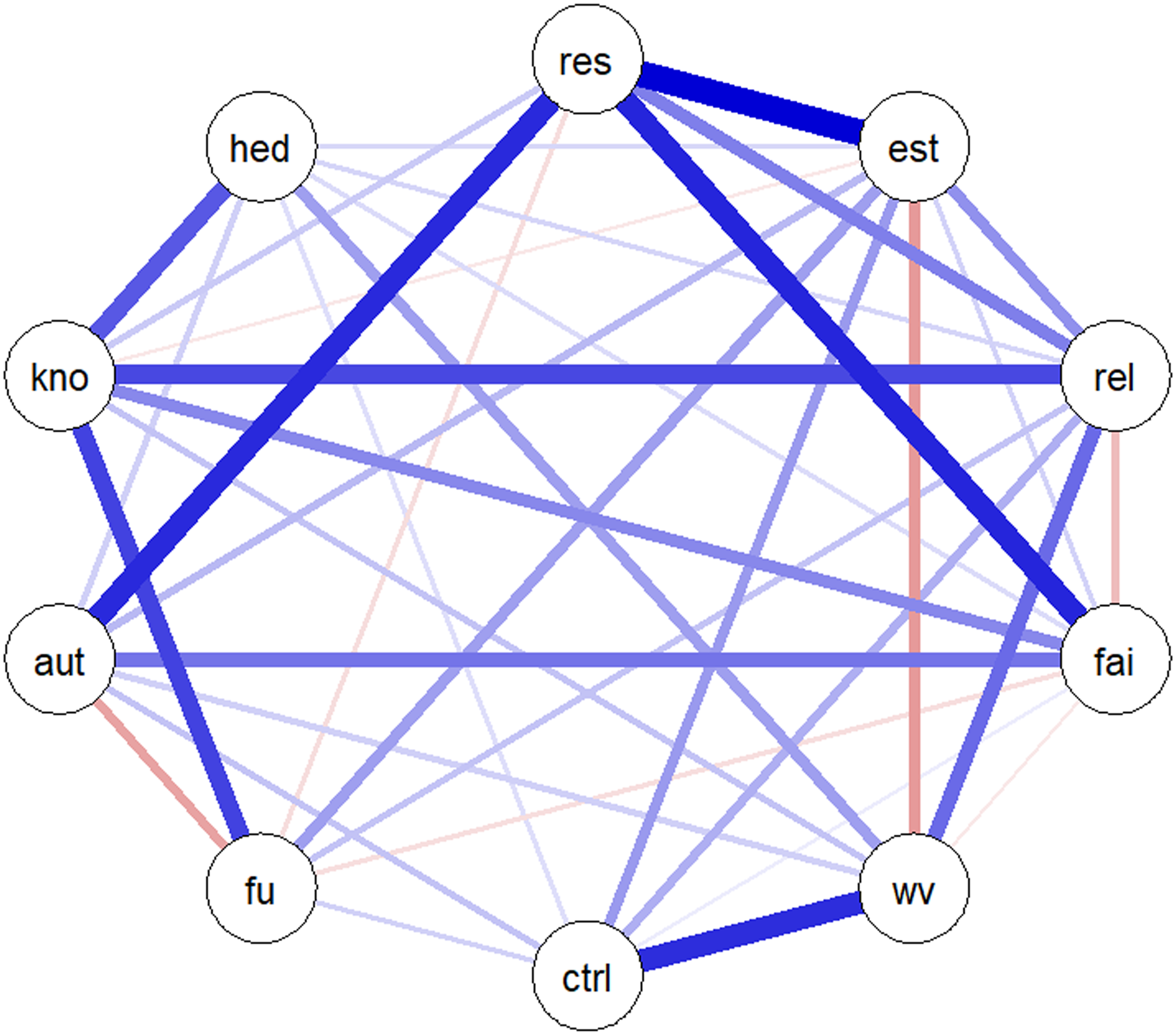
Three of these codes focused on judgments of the participant’s competence. They reported feeling (dis)respected by judgments of their competence in relation to the topic or in general (15 mentions). Moreover, (in)competence judgments were especially indicative of (dis)respect when they were based on the participant’s age (11) or their belonging to social groups (7). Coded indicators of respect and disrespect in discussions about political disagreement. Note. branches and colors of the dendrogram represent the eight themes. node size represents the frequency of the respective code. Motive satisfaction and felt respect in political discussions. Note. Blue edges indicate positive and red edges indicate negative partial correlations between nodes that represent the variables. Res = felt respect, est = esteem, rel = relatedness, fai = fairness, wv = worldview maintenance, ctrl = control, fu = felt understanding, aut = autonomy, kno = knowledge, hed = hedonic.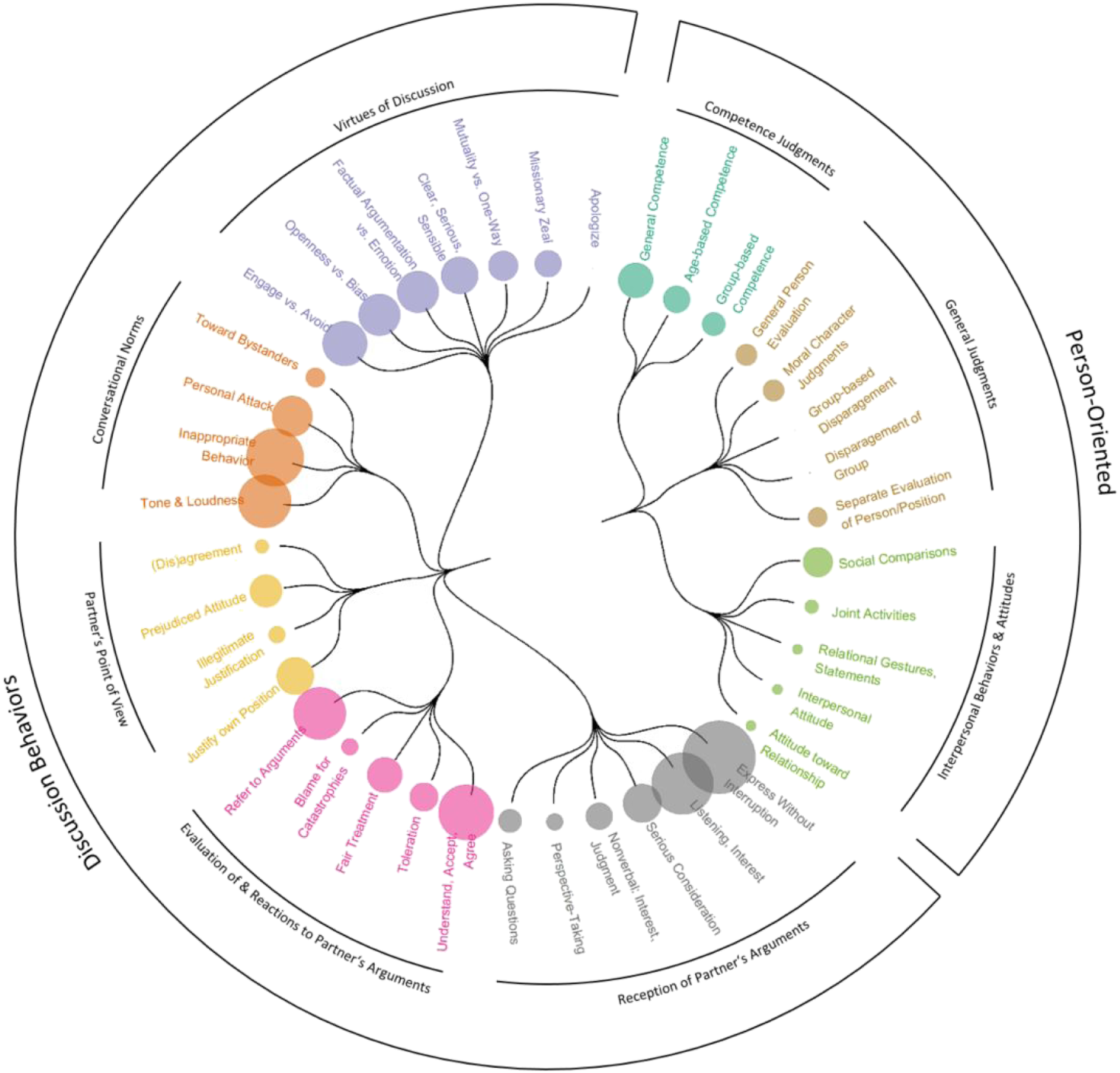
Other perceived judgments were not competence-related but more general in nature: general (lack of) recognition (6), judgments of moral character (6), group-based disparagement (i.e., being personally disparaged because they belong to a certain group) (1), and disparagements of the participant’s group itself (1). In addition, participants reported feeling respected when their evaluation as a person was separated from the evaluation of their issue position (5).
Five codes comprise interpersonal behaviors and attitudes, including, most notably, evaluative comparisons (11), in which participants reported that the partner saw them as inferior (or not). In addition, participants reported joint activities (3), gestures that have a relational connotation (e.g., hugs, (2) and attitudes toward themselves (2) or their relationship (2), as indicators of (dis)respect.
(Dis)Respectful Discussion Behaviors
The first two themes can be mapped directly on the conversation sequence.
The first details how the partner received the arguments that were made by the participant: Whether the partner allowed the participant to express themselves without being interrupted (64), and listened attentively (46); Whether the partner thought deeply about the participant’s arguments, and took them seriously (18), or whether they pretended to support a position that was not their own (4). In addition, non-verbal signals of interest and attentiveness (9) as well as asking questions and inquiring into the participant’s point of view (7) were reported as indicative of respect.
A second theme describes ways in which the partner subsequently evaluated and reacted to the participant’s arguments: Partners that signaled understanding and acceptance of, or even agreement with a participant’s argument or their entire point of view were perceived as respectful. In contrast, partners that withheld such approval even for high-quality arguments were perceived as disrespectful (37). Similarly, participants described partners as respectful who tolerated their position, despite disagreeing with it (10). Moreover, participants reported feeling (dis)respected depending on whether the partner ridiculed their arguments and treated them (un)fairly (15). One repeatedly mentioned example of such unfair treatment is that the partner would catastrophize the potential consequences of the participant’s position, and blaming them for these consequences (4). Lastly, participants felt (dis)respected based on whether the partner, in crafting their own arguments, was responsive to what they had said or not (33).
A third theme contains codes about the partner’s point of view: Whether and how they justified their opinion, either to the participant or to themselves (17); In some cases, participants felt disrespected because the partner had made an argument from authority or majority to (illegitimately) justify their position (4). Participants also mentioned a partner’s prejudiced attitude itself as a source of disrespect (13) – it is unclear, however, whether participants perceived this as disrespect against the respective prejudice target or against themselves. The mere fact of (dis)agreement was also reported as a source of (dis)respect (3).
We labelled the fourth theme conversation norms. It comprises behaviors that represent compliance with or violations of basic behavioral norms for discussions. Participants often reported to have inferred (dis)respect from the partner’s tone and loudness (34), and from instances of (im)politeness, insults, aggression, violence, and other inappropriate behavior (40). Disrespect was perceived when participants felt that partners attacked them on a personal level (20). Five participants reported feeling disrespected based on how the partner behaved toward third parties – bystanders or previously uninvolved persons.
The fifth and last theme was termed virtues of discussion – behaviors that exemplify, or lack, qualities that make a discussion more sophisticated and worthwhile (and excel the minimum standards for civil discussions that are described by the codes under conversation norms). The virtuous behaviors reported include: To take time and engage thoroughly versus superficial engagement or avoidance of the discussion – possibly in order not to be defeated (24); Approach the subject in a spirit of openness versus bias (21); Focusing on facts and argumentation versus being emotional or agitated (21); Clarity, seriousness and sensibility (17); Exchange and mutuality versus one-way communication (11); Accepting differences versus missionary zeal (9); To apologize where appropriate (1).
To conclude, our semantic thematic analysis showed that, in controversial political discussions, (dis)respect is sometimes inferred from more explicit provisions of social worth (such as attributions of competence and status, or expressions of relatedness). More often, however, social worth is inferred more implicitly, from specific discussion behaviors (e.g., in the way that a person’s arguments are received and treated) and interpretations of these behaviors (e.g., those represented in the virtues and norms themes).
Underlying motivations
A catalogue of respect behaviors in interactions about worldview conflicts is interesting in its own right (e.g., for individuals having such discussions, or as an inventory for designing communication-based interventions or experimental manipulations). However, we sought to take it one step further and consider why people saw these behaviors as indicators of respect and disrespect. What are the concerns and motives that fuel the importance of these behaviors for their own social worth? Moreover, specific behaviors may have different meanings in different situations, making it hard to compare and integrate our findings with those on respect in other situations or domains. Focusing on interpersonal motives, in contrast, provides us with a conceptual framework that should enable theoretical integration and, ultimately, progress.
In a second round of our analysis, we therefore interpreted which motivations may have been served or frustrated by the reported behaviors, thereby making participants feel respected or disrespected. The latent thematic analysis in this step was more interpretive (and hence speculative) than the more descriptive analysis in the first step (cf. Braun et al., 2016). As will become evident in this section, it is not possible to unambiguously link a code or a theme to a motivation. Rather, multiple motivations may have simultaneously underlain the importance of the behavior captured by a code. Similarly, a behavior captured by one code may have satisfied different motivations for different participants in different interactions. We therefore tested the relevance of the candidate motivations more strictly in Study 2.
Esteem
Concerns with the partner’s esteem for participants is most apparent in the person-oriented (dis)respect categories (e.g., whether participants felt that their partner saw them as capable and respectworthy). More indirectly, esteem concerns may have been satisfied by specific discussion behaviors, adherence to conversation norms and discussion virtues, to the extent that they signal appreciation of the participant’s perspective and of them as a person. This motive is reminiscent of the status- or esteem-based type of respect in existing taxonomies of respect and recognition (e.g., Huo and Binning, 2008; Rogers and Ashforth, 2017; Simon and Grabow, 2014). Moreover, it has links with psychological theories on basic motives for status and competence (Anderson et al., 2015; Deci and Ryan, 2012) and self-regard (Fiske, 2014; Mahadevan et al., 2016).
Relatedness
Some participants seemed concerned that the disagreement would negatively affect their relationship, especially when the partner was a person they were close with. Consequently, relatedness concerns may have underlain some behaviors’ significance for (dis)respect. The relatedness motive is mirrored most clearly in codes from the interpersonal behaviors category, such as joint activities, interpersonal attitudes, or attitudes toward the relationship between the participant and their partner. This motive is akin to respect-as-belonging and unconditional forms of respect (e.g., Grover, 2014; Huo and Binning, 2008). Moreover, relatedness is, like esteem, often considered as a basic motive (e.g., Baumeister and Leary, 1995; Deci and Ryan, 2012; Fiske, 2014).
Autonomy
Participants seemed to desire autonomy in two ways: Opinion autonomy (e.g., that partners would accept or tolerate divergent viewpoints and show no missionary zeal in convincing the participant) and behavioral autonomy during the discussion (e.g., to be able to speak freely and without interruption; Acceptance when participants wanted to terminate a discussion). Autonomy is considered a basic motive by some authors (Deci and Ryan, 2012). Moreover, threats to viewpoint autonomy, e.g. when a discussion partner attempts too hard to persuade the person, are likely to create aversive reactance that may fuel disrespect perceptions, too (Rosenberg and Siegel, 2018).
Fairness
Fairness concerns can be hypothesized to underlie most of the reported indicators. Participants often mentioned whether their arguments were treated (un)fairly by the partner (e.g., if arguments were ridiculed and not taken seriously, if the partner insinuated personal motives for a particular viewpoint), and how the partner justified their own position (e.g., if they provided transparent and legitimate justification). Fairness also seemed to be a relevant concern in participants’ experiences of being judged by the partner. Illegitimate judgments as comparatively less competent (e.g., competence judgments based on participants’ age or gender) were seen as especially disrespectful. Research on the group value and the group engagement models explains the importance of fair procedures by their significance for social standing and respect (Tyler, 1989; Tyler and Blader, 2003). Psychological research portrays justice as a general motive that varies between persons (Baumert and Schmitt, 2016; Lerner, 2003).
Control
Participants seemed sensitive as to whether the partner would allow their behaviors to reap the desired outcome, i.e., whether the partner would let themselves be convinced by the participant. Partners were perceived as open to influence when they transparently laid out the rationale behind their position, and thus took the risk to have their arguments defeated; when they evaluated viewpoints in an impartial and unbiased way and acknowledged when the participant had the better argument. In contrast, many participants who felt disrespected reported that partners were disproportionately sceptic or willfully misunderstood their arguments. A desire for high contingency between one’s own behavior and its outcomes is posited as a basic motive (e.g., Fiske, 2014) and, as efficacy, in self-determination theory’s need for competence (Vansteenkiste and Ryan, 2013). In addition, Burger and Cooper (1979) discuss the desire for control as a trait variable that is universally important, albeit to a varying extent.
Knowledge
Many respect indicators signal a concern for more knowledge about and a better understanding of the discussion topic. Perceptions that the partner contributed to an informed discussion and a deeper understanding seemed to matter in descriptions of the partner thinking deeply about arguments, being responsive to the participant’s arguments, remaining serious and factual throughout the conversation, and seeking truth rather than trying to “win” the argument. This theme of a desire for knowledge and understanding in order to make sense of the world and reduce uncertainty is prominent, for instance, in basic motive frameworks (Fiske, 2014) or Katz’ functional attitude theory (1960). To the extent that a discussion partner obstructs or jeopardizes the satisfaction of this motive, a person may feel disrespected.
Felt Understanding
A motivation to feel understood by the partner seemed to underlie many discussion behaviors. Participants not only seemed vigilant about the unconstrained expression of their thoughts (as reflected in the autonomy theme) but also about how the partner would receive those thoughts and ideas (e.g., taking their perspective, expressing understanding and accepting convincing arguments). The importance of felt understanding for interpersonal and intergroup relations has been documented in a range of contexts (see, e.g., Oishi et al., 2010; Livingstone et al., 2020; Reis et al., 2017), and links to the emphasis on shared reality in Fiske’s (2014) description of the understanding motive.
Worldview Maintenance
Interestingly, sometimes the position of the partner itself – rather than their behavior toward or judgment of the participant – was mentioned as an indicator of disrespect. Instances of such disrespect were the expression of views that violate values of the participant (e.g., racist or heteronormative views), and the use of negative stereotypes about members of a group. Clarke’s (2011) model of respect in leadership conceptualizes the existence of shared values between leader and follower as a distinct form of respect. In addition, in psychology it is widely assumed that humans are motivated to protect their worldviews (e.g., Kunda, 1990; Mercier and Sperber, 2011). To the extent that a person feels that motivation, they may perceive the expression of views that severely contradict their own worldview as disrespectful.
Hedonic Pleasure
In some instances, the mere (un)pleasantness of the partner’s behavior seemed to be underlying the participant’s feeling of (dis)respect. One participant reported feeling disrespected because the partner had started a discussion although he knew that they would disagree. Other instances include discussions in public situations where the partner’s perceived to deliberately set the participant up for embarassment, e.g., by loudly voicing an offensive viewpoint in front of others. On the positive side, participants reported “nice” behaviors, like smiling or wishing a good day as evidence for respect. Hedonism as a motivating force of human behavior is discussed, for instance, in Sober and Wilson’s seminal book (1999).
Discussion
In a first analytical step, we have documented a wide array of behaviors and expressions that people reported as indicators of respect and disrespect in political discussions with contrary-minded others. In a second step, we identified nine motivations that may have underlain the significance of these behaviors for judgments of respect. Existing respect accounts that focus on respect’s motivational underpinnings have focused on the status or the belonging motive of the respected person (Blader and Yu, 2017; Huo and Binning, 2008; Rogers and Ashforth, 2017). However, once we abandon this narrow focus, a window opens up for a more precise inquiry into what makes people feel respected. In fact, it seems more appropriate to assume that motives are activated and operate in a situation-specific than in a situation-general way (Kay and Jost, 2014; Rusbult and Van Lange, 2008; Van Lange and Rusbult, 2011).
At the same time, our thematic analysis of underlying motives was necessarily speculative. We may have erred in trying to infer people’s reasons for reporting certain behaviors as (dis)respectful. Thus, we sought to test the significance of these candidate motives for respect in a quantitative follow-up study.
Study 2
We again asked participants (N = 523) to recall a controversial discussion they had had on a political or societal topic. We devised a questionnaire to measure felt respect and the satisfaction of each of the nine motivations that we identified in the first study. We conducted a psychological network analysis to gauge which motivations are associated with (dis)respect experiences in disagreements over politics, and how these associations may vary with situational circumstances. Materials, data, analysis scripts, and additional results can be found in the Online Supplemental Materials.
Method
Participants
We tried to maximize the sample size within the budgetary and time constraints of the first author’s dissertation work. We set 500 participants as a minimum sample size in order to be able to accurately estimate latent variable correlations (Kretzschmar and Gignac, 2019). We disseminated invitations to the online survey via social media, via mailing lists of Marburg University and several organizations that promote civil online political discussions, yielding 503 participants. In addition, 20 participants were recruited in the waiting area of a city administration building, and filled out a pen-and-paper version of the questionnaire. The final sample consisted of 523 persons (324 identifying as female, 164 as male, 2 as diverse, 33 chose not to answer; between 18 and 81 years; Mage = 31.11 years, SDage = 13.08 years). No cases were excluded from the analysis. The sample was politically left-leaning, with disproportionate numbers of participants reporting that they intended to vote for the Green or Left party. 2 All participants provided informed consent prior to their participation, and were allowed to enter a voucher lottery afterwards. The survey language was German. Data were collected between April and July 2018.
Measures
After the recall prompt, participants provided descriptions of their discussion and rated the discussion and their conversation partner’s behavior on the questionnaire. Since no existing measures suited the purpose of the present study, new measures had to be developed. They were devised by both authors, tested with eight pilot participants and discussed and refined with the help of student assistants. A full list of items can be found in Online Supplemental Materials ‘Study 2 Questionnaire Items’.
Felt Respect
Felt respect was measured with six “content-free” items – i.e., items that assess felt respect without additional semantic components (such as status, equality, liking, or competence). Participants were asked to rate the extent to which the items applied to their discussion experience, from 1 = completely disagree to 7 = completely agree.
Motive Satisfactions
We devised 45 items for the measurement of the satisfaction of all nine motivations (between three and eight items per motive). The items were designed to capture the satisfaction or frustration of one of the nine motives as a consequence of the partner’s behavior during the discussion. Participants were asked to rate the extent to which the items applied to their discussion experience, from 1 = completely disagree to 7 = completely agree.
As the items were new, we started the analysis with an initial psychometric evaluation of the nine motive satisfaction scales via Exploratory Structural Equation Modeling (ESEM, Asparouhov & Muthén, 2009) in Mplus (Version 8.1, Muthén & Muthén, 1998-2017). In ESEM, each item is assigned to load on one target latent factor. At the same time, cross-loadings on non-target factors – which are to be expected when measuring multiple, conceptually related constructs – do not need to be restricted to zero like in conventional confirmatory factor analysis models (Asparouhov and Muthén, 2009; Marsh et al., 2014). Based on this initial analysis, we selected three items for each latent motive variable that had high target- and low non-target loadings, to create a simple structure measurement that parsimoniously measures the constructs of interest (Brown, 2015). We subjected the remaining items, along with the items measuring felt respect, to an ESEM analysis again, and saved the factor scores of the latent variables for the subsequent main analyses. Two beneficial properties of ESEM for our analysis are the possibility to account for measurement error (which makes ESEM preferable to sum scores), and that ESEM helps to avoid the inflation of factor correlations that are an issue when cross-loadings are suppressed (which makes ESEM preferable to traditional confirmatory factor analysis, see Marsh et al., 2014). The fit of the model to the data was excellent (CFI = .996, TLI = .990, RMSEA = .02, SRMR = .01). For each latent variable, target loadings were satisfactory – except for felt understanding, where target loadings between .18 and .22 were obtained (average std. Target loadings = .61; average std. Non-target loadings = .06). A correlation matrix of all latent variables (i.e., between all motives and felt respect) can be found in the Online Supplemental Materials ‘Study 2 Factor Score Correlation Matrix’.
Situation Characteristics and Demographics
The recall paradigm imposed few constraints on the type of situation that participants were allowed to remember. Therefore, we sought to explore whether respect experiences varied with characteristics of the recalled interaction. We asked participants to rate their discussion situation with regard to how close they were with the other person (two items), the magnitude of the dissent (at the beginning of the conversation), the societal approval of their own and their partner’s positions (in %), whether restrictive communication norms (i.e., norms that sanction the expression of certain political positions) played a role for themselves or their partner, how important the discussion topic was for them, and how important it was for them to convince their partner of their point of view. Lastly, gender, age, and political party preference were recorded.
Data analysis strategy
For our main analysis, we conducted a psychological network analysis to examine the associations between felt respect and the satisfaction of the nine motives. The use of psychological network analysis was motivated by the idea that we can understand responses to survey items through their “relations of implication, entailment, opposition and exclusion” with responses to other items (DiMaggio et al., 2018, p. 155; see also Goldberg, 2011). That is, the meaning of respect in political discussions may be understood from its associations with the satisfaction or frustration of the nine interpersonal motives. We estimated a Gaussian Graphical Model (GGM, Epskamp & Fried, 2018), a regularized partial correlation network, on participants’ factor scores of felt respect and the nine motive variables. In such a network, nodes are variables and the edges connecting the nodes represent the pairwise association between two variables after controlling for all other variables in the network. Partial correlation networks allow to examine the unique pairwise associations of a set of related variables. We use them here to infer meaning of felt respect in participants’ political discussions from its interconnections with the motive satisfactions. To examine the robustness of edge weights against sampling variation we use using non-parametric bootstrapping techniques to construct confidence intervals for all edges in the network (Epskamp et al., 2018). 3
Lastly, to see if situational characteristics of our participants’ discussions shaped what made them feel respected, we used the networktree procedure on one of the respect-motive networks (Jones, Mair, et al., 2020). Networktree inductively partitions the sample along a set of given split variables. It starts with the most impactful split and proceeds, when applicable, with more nuanced splits. This creates a tree-like structure with a network estimated for the respective subsample at the end of each branch. The algorithm aims to identify network models with maximally different parameters in the different branches of the tree, and does not provide significance tests of single parameters. We included all situation variables as potential split variables, including difference scores for the societal approval of their own versus their partner’s position and the extent to which they perceived restrictive communication norms with regard to their own versus their partner’s position. Different network structures for subsets of our sample would indicate that the meaning of respect differs for people depending on more specific circumstances of their discussions.
Results
Motive – respect network analysis
Figure 2 displays the resulting network containing the satisfaction of the nine motive variables and felt respect as nodes, and the partial correlations between all nodes as edges. Reports of felt respect were positively associated with satisfaction of the esteem (weight = .40), fairness (.35) autonomy (.34), relatedness (.20), and knowledge (.08) motives, indicating that people felt respected when these motives had been satisfied – or conversely, felt disrespected when these motives had been frustrated. Edge weights were zero for the worldview maintenance, control, and hedonic motives. For felt understanding, a negative edge weight was obtained (−.05). However, in dense regularized networks, very small edges might often be false and should thus be interpreted very cautiously (Epskamp, 2018).
Next, we checked the stability of the edge weights against sampling variation, using 1000 non-parametric bootstrap samples (Epskamp et al., 2018). Edge weights seemed sufficiently stable (for more detailed information, see Online Supplemental Materials: ‘Study 2 Edge Weight Stability Analysis’.
Heterogeneity in the motive – respect network
The existing respect literature has rarely considered whether and how the specific meaning of respect depends on aspects of the interaction in which people find themselves. If such heterogeneity exists, we should expect to find different patterns of edges between felt respect and the motive satisfactions for different participant subsamples. We used the networktree package to explore whether respect experiences varied systematically along the situational variables listed above.
In the analysis, one split emerged (p = .003), between participants who had a discussion with someone they knew very little (closeness ≤ 2.5 on the scale from 1 – not close at all to 7 – very close; n = 88) and participants who had a discussion with someone they were more acquainted with (closeness > 2.5, n = 435). A comparison of the two resulting networks reveals small but interesting edge differences involving the respect node. The greatest difference in edge strength was found for the edge linking felt respect and the relatedness motive, which was stronger among participants who reported a discussion with someone they were closer with than among participants who had discussed with a less close person (Δweight = .15). In addition, participants with closer discussion partners showed stronger edges between respect and fairness (Δweight = .10) and respect and esteem (Δweight = .08). Among participants with less close discussion partners, on the other hand, felt respect was more strongly associated with the knowledge (Δweight = .10) and autonomy motives (Δweight = .08). Further results and a figure of the different network structures can be found in Online Supplemental Materials: ‘Study 2 Networktree Analysis’.
Discussion
The network analysis showed robust associations between felt respect and the satisfaction of several of the motives, namely the motive to be held in high esteem, treated fairly, granted autonomy, feel related, and the knowledge motive. This suggests that multiple motives are involved in respect experiences in political discussions (rather than just two motives for status and relatedness). Moreover, the networktree analysis revealed that these associations varied between participants who had reported on a discussion with a close partner and those with a less close partner. With less close partners, respect judgments were more strongly associated with the autonomy granted by the partner and the extent to which the partner fostered deeper topic knowledge. With closer partners, however, respect judgments were more strongly associated with motives for relatedness, esteem, and fairness. One could speculate that these motives reflect a more personal kind of appreciation and evaluation than the relatively more impersonal motives for autonomy and knowledge. Thus, although the evidence from the networktree analysis is very tentative, it suggests that different interpersonal motives are afforded when discussing politics in different relationships.
General discussion
Fundamental worldview differences are situations in which mutual respect is unlikely but potentially very beneficial (Eschert & Simon, 2019; Reininger et al., 2020). We have used qualitative and quantitative methods to examine what makes people feel respected and disrespected in these discussions. The behaviors and expressions reported in the first, qualitative study, suggested a diverse range of motivations that people have in these discussions. The second, quantitative study showed that the experience of respect was indeed associated with the satisfaction of motives for esteem, fairness, autonomy, relatedness, and knowledge. In addition, we showed that the pattern of associations between felt respect and the nine motives differed depending on whether participants had reported a discussion with someone they felt close to or not.
For a balanced assessment of our article’s contributions, it is important to point out some limitations of the reported studies. First, self-selection of participants into our online surveys may have created different forms of bias (cf. Participants’ politically skewed voting intentions in Study 2). It is plausible that the people we reached with our survey ads and who chose to participate in this kind of survey endorse unrepresentative standards of what constitutes respectful discussion behavior. For instance, a highly educated participant sample such as ours may place a stronger focus on argumentative virtues than a less educated sample. We have not collected enough demographic information about our participants beyond age and gender information to assess whether respect experiences vary by demographic criteria, such as location, race/ethnicity, sexual orientation, class, or disability status. Second, although we performed psychometric validation checks, the questionnaire items that we used to capture our participants’ respect experiences were new, and, for felt understanding, showed suboptimal factor loadings. Third, the evidence for systematic heterogeneity in respect experiences is limited, as only one split emerged based on different degrees of interpersonal closeness (out of multiple situation variables). These features warrant caution with regard to all-too certain conclusions about what exactly makes people feel respected in political discussions with contrary-minded others (and what does not).
Our findings add to the existing respect literature by showing that the motivational basis of respect experiences is broader than previously theorized. Previous respect accounts that focused on respect’s motivational underpinnings (e.g., Huo and Binning, 2008; Rogers and Ashforth, 2017) have focused solely on motives for status and relatedness. We show that in contentious political discussions, additional motives are at play – which relate meaningfully to the situation of discussing politics with a contrary-minded partner. Future research should examine how the importance of different motives for feelings of respect depends on characteristics of the interaction situation, such as the relationship between discussion partners, or status asymmetries around the topic that is being discussed.
The motives we investigated as part of participants’ respect experiences, such as relatedness (belonging), esteem (status), or autonomy (reactance), are discussed elsewhere as separate constructs in their own right, independent of respect (see e.g., Clarke and Hirsch, 2019; Anderson et al., 2015; Rosenberg and Siegel, 2018). This begs the question of how we ought to think about the relationship between these constructs: Is fairness the same as respect? Is status or relatedness the same as respect? Our view is that these other constructs can contribute to a respect experience – in other words, many different things can make people feel respected if they satisfy the person’s motives in a given interaction (for a more elaborate account of this view, see Rothers and Cohrs, 2023).
We hope that our findings will also inform the research and practice of discussions across political divides. Knowing the concerns that underlie people’s respect experiences in such discussions can help to channel their productive potential, and avert negative outcomes such as spirals of silence and the deterioriation of close relationships. Importantly, our findings underscore that, in order to feel respected, the partner does not need to share or adopt one’s views (see also Niemeyer and Dryzek, 2007; Zitzmann et al., 2022). Critics of more conciliatory, dialogue-oriented approaches to political communication often point out that respect may not always be desirable in political conflicts. For instance, when a discussion partner expresses positions that involve harm or violence, or when the partner is undermining a constructive discussion, showing respect may be futile or even harmful. However, tolerance in the face of deep disagreements is vital for pluralist societies, and respect can contribute to the development of mutual tolerance (Zitzmann et al., 2022).
We conclude with a suggestion on how respect research might be advanced more generally. Respect is (implicitly or explicitly) implied in explanations of a wide range of social phenomena. In our view, theoretical progress in understanding respect has been stymied by either very general or very specific theoretical accounts. General accounts make it hard to extrapolate what makes people feel respected in specific social situations. Specific ones, on the other hand, do not “travel well” to other domains of social life. We therefore suggest that future research focuses on the interpersonal motives that are afforded by different situations and how they shape what makes people feel respected.
Supplemental Material
Supplemental Material - Felt respect in political discussions with contrary-minded others
Supplemental Material for Felt respect in political discussions with contrary-minded others by Adrian Rothers and J. Christopher Cohrs in Journal of Social and Personal Relationships.
The data used in the research are available for study 2. The data can be obtained at https://bit.ly/3axBODu or by emailing:
Footnotes
Declaration of conflicting interests
The author(s) declared no potential conflicts of interest with respect to the research, authorship, and/or publication of this article.
Funding
The author(s) disclosed receipt of the following financial support for the research, authorship, and/or publication of this article: The authors received funding by the Deutsche Forschungsgemeinschaft (DFG, German Research Foundation) – project number 290878970-GRK 2271, Project 13.
Author Note
We used Mplus (Muthén & Muthén, 1998-2017) and R Version 4.0.1 (R Core Team, 2020) via Rstudio (Rstudio RStudio Team, 2020) with bootnet (Epskamp et al., 2018), qgraph (Epskamp et al., 2012), tidyverse (Wickham et al., 2019), networktree (Jones and Simon et al., 2020), for all analyses and figures in this article.
Open research statement
As part of IARR’s encouragement of open research practices, the author(s) have provided the following information: This research was not pre-registered.

Supplemental Material
Supplemental material for this article is available online.
Notes
References
Supplementary Material
Please find the following supplemental material available below.
For Open Access articles published under a Creative Commons License, all supplemental material carries the same license as the article it is associated with.
For non-Open Access articles published, all supplemental material carries a non-exclusive license, and permission requests for re-use of supplemental material or any part of supplemental material shall be sent directly to the copyright owner as specified in the copyright notice associated with the article.
