




Abstract
Background. While there is ample theoretical and empirical interest in overparenting, little is known about how overparenting of adolescents operates in everyday family life. This study describes the development and validation of a novel instrument to assess overparenting with Experience Sampling Methods – The Momentary Overparenting (MOP) scale. Methods. Following 143 (Belgian and Dutch) adolescents for 7 subsequent days, we measured overparenting (i.e., worry, interference, and unnecessary help), autonomy support and psychological control 5 to 6 times per day. Using multilevel structural equation modeling on 1865 parent-adolescent interactions, we investigated the scale’s psychometric properties: within-family and between-family reliability, convergent and divergent validity. Results. Overparenting was characterized by both stable differences between families (46%), as well as dynamic fluctuations within families over time (54% of the variance). The MOP could reliably assess such real-time dynamics in overparenting. Momentary assessments correlated meaningfully with established instruments for overparenting at the between-family level. Within families, adolescents experienced interactions with more overparenting as more psychologically controlling and less autonomy supportive. Between families, overparenting correlated negatively with mothers’ autonomy support and positively with mothers’ psychological control. Conclusion. Worry, interference, and unnecessary help may be important expressions of overparenting in everyday family life – which can now be reliably measured from moment-to-moment as a distinct parenting construct.
Introduction
Parents who use overly protective and supportive parenting (also ‘helicopter parenting’ or ‘curling parenting’, hereafter: overparenting) protect their child against failure and misery, and offer solutions rather than advice, but do so at developmentally inappropriate levels (Luebbe et al., 2018; Padilla-Walker and Nelson, 2012; Rote et al., 2020). However, what distinguishes overparenting from healthy adult guidance is that they do so at developmentally inappropriate levels (Luebbe et al., 2018; Padilla-Walker and Nelson, 2012; Rote et al., 2020). In line with earlier work (Luebbe et al., 2018; Rote et al., 2020), we define overparenting from the Self-Determination perspective (Deci and Ryan, 1980), as parental attempts to protect and support the child while simultaneously frustrating the childs’ autonomy development. Overparenting is a multifaceted concept (Luebbe et al., 2018). Recent empirical work has distinguished concrete parenting behaviors which fall under this umbrella concept, such as overly seeking information from their child, management of personal and academic affairs on behalf of their child, and directly intervening in any problems of their child (Luebbe et al., 2018; Rote et al., 2020).
Often, overparenting is well-intended, and adolescents have expressed that such overparenting may be quite helpful in the immediate moment (Burke et al., 2018; Rote et al., 2020). However, several studies warn against potential backlashes. It may undermine long term adolescent autonomous functioning, coping with daily stressors, and self-efficacy (Parker et al., 1979; Soenens et al., 2017; Van Ingen et al., 2015). Thus, parents who go ‘above and beyond to protect their child and ensure their child’s happiness’ (Luebbe et al., 2018, p. 842), may paradoxically give rise to emotional problems instead of preventing them (Padilla-Walker and Nelson, 2012; Reed et al., 2016). While there is ample theoretical and empirical interest in overparenting (see for a review de Roo, Veenstra & Kretschmer, 2022), it is hardly understood how overparenting may be experienced by adolescents in everyday life (Darling and Steinberg, 1993; Griffith and Hankin, 2021; Janssen et al., 2020). To this end, an instrument for adolescents that reliably and validly assesses overparenting from moment to moment is needed.
Parenting processes take place within families
Parenting can be conceptualized in terms of (1) between-family differences: stable traits and characteristics on which families differ (e.g., parenting style, emotional climate, level of involvement), and in terms of (2) within-family processes: dynamic processes which take place within families over time (Darling and Steinberg, 1993; Keijsers et al., 2022). In parenting research, much of what we know comes from population-wide studies which describe stable differences between families (Boele et al., 2020). For instance, with regard to overparenting, a recent meta-analysis (Roo et al., 2022) shows that when comparing families with each other, families with more overprotective parents have adolescent children who display more maladjustment. Between-family studies have shown to be very valuable to understand how families differ in stable traits and styles, and how such stable difference are associated with stable differences in outcomes. However, between-family-level studies provide none or very little evidence of how changes in overparenting are related to changes in adolescents' well-being within the same family, in other words, how overparenting manifests itself within families over time (Berry and Willoughby, 2017; Curran and Hancock, 2021; Keijsers, 2016).
Yet, such insights are of theoretical importance as it is theorized that parenting practices have their effects upon an adolescent within a given family, above and beyond stable traits (Darling and Steinberg, 1993). Such within-family effects can be studied at multiple timescales (e.g., Boele et al., 2022; Lougheed and Keskin, 2021), and a momentary (hour-to-hour) timescale is increasingly acknowledged as an essential time frame if we aim to understand within-family dynamics (Keijsers et al., 2022; Weeland et al., 2021). Whether overparenting can be seen as a stable trait (i.e., overall parenting characteristic or parenting style; Darling and Steinberg, 1993) or whether it is also situation-specific and varying from one moment to the next is currently unknown. Recently, it was empirically established that parenting practices are not set in stone but vary from hour to hour (Bülow et al., 2022; Griffith and Hankin, 2021; Janssen et al., 2020). Moreover, even though earlier work has established that overparenting is conceptually related to but distinct from other parenting practices (Luebbe et al., 2018) it is still an open question how over-time variability in overparenting relates to over-time variability in other parenting practices, such as autonomy support and psychological control. In absence of daily diary and experience sampling studies on overparenting, insight into how overparenting manifests itself in daily family life can help to unravel the exact nature of and variations in overparenting. Ultimately, this may help to determine the underlying micro-mechanisms which link parenting to adolescent outcomes within families (Keijsers et al., 2022; Keijsers and Van Roekel, 2018).
Assessment of overparenting in adolescents’ everyday life
Experience Sampling Methods (ESM) are valuable to carefully assess constructs that vary from one moment to the next, such as emotions, behaviors or thoughts (Larson, 2019; Repetti et al., 2015). Nowadays often aided with smartphone technology, participants answer micro-questionnaires multiple times per day. Such an approach is currently being applied across disciplines and clinical domains (Hamaker and Wichers, 2017; Myin-Germeys et al., 2018; van Roekel et al., 2019), and is also increasingly popular to assess how adolescents and parents interact in their everyday lives (Keijsers et al., 2022).
Study’s aim and hypotheses
The current study aimed to develop and validate the first instrument to assess momentary overparenting with ESM: the Momentary Overprotection (MOP) Scale. Hypotheses and the analysis plan were preregistered before the data were accessed (see: https://osf.io/567ve/), the codebook with full information on all questionnaires is openly available at https://osf.io/vstrn.
With regard to the scale’s reliability, we hypothesized that the items would yield an internally consistent scale, both at the (H1w) within-family level and (H1b) the between-family level. Furthermore, we hypothesized that the MOP (H2b) would show convergent validity with a validated scale which assesses overall levels of overparenting (Luebbe et al., 2018). Conceptually, overparenting is thought to be positively correlated with, yet distinct from, psychologically controlling parenting where parents pressure the child to behave, think, or feel in certain ways (Soenens et al., 2009), and negatively related to autonomy supportive parenting characterized by parents’ fostering of the child’s volitional functioning (Padilla-Walker and Nelson, 2012). However, this distinctiveness is yet to be assessed at the momentary timescale. In terms of divergent validity, we hypothesized that the MOP would be negatively associated with autonomy support at the within-family (H3w; i.e., momentary within-family fluctuations in overparenting are related to momentary fluctuations in autonomy support) and between-family level (H3b; i.e., parents with higher overparenting averages are also less autonomy supportive than parents with lower overparenting averages). Similarly, it is hypothesized that the MOP would be positively related to psychological control, both at the within-family (H4w) and between-family (H4b) level.
Method
Participants
The sample of 143 adolescents consisted of a Dutch (N = 72) and Belgian (N = 71) subsample. Both samples took part in the Dutch Experience Sampling Study on Parent-Adolescent Interactions (DESPAI; Bülow et al., 2022) and followed the same procedure and data collection protocol at two sites. Of the total sample of 172 adolescents, 29 were excluded as they did not report any interactions with their parents.
Adolescents were on average 15.8 years old (SD = 1.8, range 11–18 years; Dutch sample: 15.8 years, SD = 1.7, Belgian sample: 16.1 years, SD = 1.8), 64% were girls, 33% were boys and 3% did not indicate their gender or did not identify as male nor female (Dutch sample: 56% girls, 44% boys, Belgian sample 72% girls, 25% boys, 3% not indicated). Whereas approximately half of the adolescents followed a higher educational track (pre-university secondary education or university, 51%, Dutch sample 55%, Belgian sample 61%), 31% followed a medium educational track (higher general secondary education or university of applied sciences, Dutch sample 23%, Belgian sample 31%), 12% followed a lower educational track (pre-vocational secondary education and vocational training, Dutch sample 14%, Belgian sample 5%), and for 6% no classification was available (Dutch sample 8%, Belgian sample 3%). Educational levels are an approximation of the distribution of social and intellectual standing of the adolescents, within these groups, developmental ages and stages vary. Most adolescents (92%) had the nationality of the country they were living in (Dutch sample: n = 91 Dutch, all n = 1 for: Nigerian, Turkish, Kenyan, Swiss; Belgian sample: n = 72 Belgian, n = 4 Dutch, n = 1 Moldavian). No information was available on the sexual orientation or disability of the participants.
Procedure
Adolescents were recruited by (under)graduate psychology students, who received detailed oral training and written instructions. After active informed consent was obtained from the adolescent and their parents when the adolescent was under the age of 16, the students visited the participant at home or at school to provide instructions about installing and using the Ethica Data app (Ethica Data Services Inc, 2019). Participants also had the opportunity to ask further questions. Subsequently, participants were sent an online ‘baseline’ questionnaire (ca. 30–45 minutes to complete) through Qualtrics (Qualtrics, n.d.), including questions about demographic information, parenting, and their well-being. After the ESM period, participants received another questionnaire through Qualtrics, asking about their parenting experiences during the ESM period.
Participants received five euro (approx. 5.5) when they completed at least 75% of the micro-questionnaires or three euro (approx. 3.3) if they completed between 65% and 74%. After the study was completed, participants also received a personalized mood profile based on their ESM data. The study was approved by the Ethical Committee of Tilburg University (EC-2017.105a) and Ghent University (2019/113). We followed the guidelines for reporting ESM studies in adolescents (van Roekel et al., 2019).
Sampling scheme and study design
The ESM study applied a signal-contingent sampling scheme. For seven consecutive days, the participants could receive max. 37 micro-questionnaires: five per day from Monday to Friday and six per day during the weekend. The micro-questionnaires were sent at semi-random time intervals, at times adolescents were most likely to interact with their parents, thus excluding school hours on weekdays. During the week, we sent the micro-questionnaire once in the morning (between 07:00 and 07:30), twice in the afternoon (between 15:30 and 16:10, and 17:30-18:10), and twice in the evening (between 19:30 and 20:10, and 21:30-22:00). During the weekend, we adapted the sampling scheme to take into account a later start of the day: One in the late morning (between 11:30 and 12:10), three in the afternoon (between 13:30 and 14:10, 15:30-16:10, and 17:30-18:10), and again two in the evening (between 19:30 and 20:10, and 21:30-22:00). In the Belgian sample adolescents under the age of 13 did not receive the last questionnaire (21:30 – 22:00).
The micro-questionnaires were delivered through a smartphone app and included 21 to 37 items, taking approximately three to 5 minutes to complete. These questionnaires had to be filled out within 30 minutes, where automatic reminders were sent after 20 minutes. When adolescents indicated they have had an interaction with one of their parents/caregivers in the last hour (i.e., saw and talked to the parent) they received follow-up questions about this interaction. These follow-up questions included the overparenting, autonomy support and psychological control scale. If adolescents indicated that they had not seen their parents in the last hour, they received other follow-up questions to balance questionnaire length. When asked about the topic of the interaction, most typically, they talked about ‘school’, ‘sports’ and ‘friends’. Moreover, during the study, participants received regular text messages from the research team to inform them about their compliance rate to keep participants involved and motivated.
Compliance and missing data
Participants completed 3,312 micro-questionnaires of the 4,734 questionnaires they received, which led to an average compliance of 70%, which is comparable to other studies (e.g. Van Roekel et al., 2019). In 1829 cases (55% of completed micro-questionnaires), participants indicated that they had interacted with their parents. Of these, 1327 interactions were with their mother and 529 with their father. Fifty-four observations were with either their stepmother (n = 27) and/or stepfather (n = 27). All available data were included in the analyses (n = 143, t = 36). As stated in the preregistration, with a power of .80, between-person associations of r = .14 or larger can be detected (GPower3.1).
Momentary measures
Momentary overparenting scale
The Momentary Overparenting (MOP) scale was developed for this study using a stepwise approach, in line with contemporary recommendations of how to develop an ESM scale (Myin-Germeys and Kuppens, 2022). First, we made a pool of items, by screening existing validated traditional scales for assessing overparenting, such as Helicopter Parenting (Lemoyne and Buchanan, 2011; Odenweller et al., 2014; Parker et al., 1979; Zong & Hawk, n.d.). In line with our definition of overparenting, ‘parental attempts to protect and support the child while simultaneously frustrating the child’s autonomy development’, items were chosen which targeted different facets of overparenting (e.g., , overly seeking information from the child, and direct intervention in any problems of the child – Luebbe et al., 2018). Items were excluded which targeted very infrequent behavior (e.g., “When I have to go somewhere (e.g., doctor appointments, school meetings, the bank, shopping), my parent accompanies me”). Second, items were reformulated to be suited for ESM studies on everyday interactions. That is, (1) items should be general enough to be applicable to an interaction with one’s parent, (2) items should target behaviors that potentially vary from one interaction to the next and (3) items were formulated briefly to reduce burden when reading the items several times a day. Third, the chosen items were piloted by presenting them to 3 male adolescents (12 – 17 years) to give feedback on the understandability of the items and were slightly reformulated to improve understandability.
The final scale consists of three items: “My parent interfered with my life”; “My parent (unnecessarily) worried about me”, and; “My parent tried to help me even though it wasn’t necessary.“. The items referred to the most recent parent-adolescent interaction and were rated on a Visual Analogue Scale (VAS), in which the participant could slide along a scale of 0–100. The response scale was anchored at 0 (not at all) to 100 (very much). VAS scales were chosen because these are preferred by adolescents (Tucker-Seeley, 2008) and earlier ESM studies which measure parent-adolescent interactions have shown good reliability with VAS scales (Bülow et al., 2022).
Momentary parental autonomy support
The Momentary Parental Autonomy Support Scale (MPASS) was comprised of three items (“My parent took into account how I thought about things”, “I could totally be who I really am”, “I was given the space to say my opinion”). The items were adapted and adjusted from a daily diary instrument (van der Kaap-Deeder et al., 2017). The items were rated on a VAS from 0 (not at all) to 100 (very much). The internal consistency of the MPASS was sufficient at the within-family level, ωwithin = .73, and excellent at the between-family level, ωbetween = .94.
Momentary parental psychological control
The Momentary Parental Psychological Control Scale (MPPCS) consisted of four items (“My parent forced me to think, feel, or behave in a certain way”, “My parent interrupted me”, “I felt pressured to do things” (as a literal translation of this item would have resulted in a loss of meaning, we freely translated this item from Dutch to English), “My parent decided everything”). The items were adapted from a prior daily diary study (Van Der Kaap-Deeder et al., 2017) and were rated on a VAS from 0 (not at all) to 100 (very much). The MPPCS showed a good internal reliability at the within-family level, ωwithin = .79, and excellent reliability at the between-family level, ωbetween = .93.
Retrospective measures
At the end of the ESM week, participants answered questions regarding parenting behaviors (separately for mothers and fathers) as experienced during the last week.
Retrospective overparenting
The Helicopter Parenting Instrument (HPI; Odenweller et al., 2014), which we translated to Dutch, was used to measure overparenting. The HPI consists of 15 items (e.g., “My mother/father tried to make all of my major decisions“) and a response scale was used from 1 (strongly disagree) to 7 (strongly agree). The internal consistency of the HPI was low for mothers, α = .56, and fathers, α = .59.
Retrospective parental autonomy support
The Subscale Autonomy Support of the Perception of Parents Scale (POPS; Grolnick et al., 1991; Soenens et al., 2007) consists of seven items which were completed for each parent seperataly. An example item is: “My mother/father allowed me to decide things for myself”. The items were rated on a scale from 1 (not at all) to 5 (very true). The internal consistency was satisfactory for mothers and fathers, α = .72 and α = .63, respectively.
Retrospective parental psychological control
The Psychological Control scale from the Psychological Control-Disrespect Scale (Barber et al., 2012) consists of eight items (e.g., “My mother/father ridiculed me or put me down) which were rated on a scale from 1 (never) to 5 (always). The scale showed high internal consistency for both mothers and fathers, α = .85 and α = .90, respectively.
Statistical analyses
All of our statistical analyses were preregistered before the data was accessed (https://osf.io/567ve/). The factor structure and internal consistency of the MOP was examined with multilevel confirmatory factor analysis in MPlus8 (Muthén and Muthén, 2020), using a syntax adapted from Geldhof et al. (2014). This analysis allows for assessing reliability of the momentary overparenting construct (MOP) at the within-family (H1w; do the items co-fluctuate within a family in the expected way) and between-family level (H1b; do families’ average scores on the items (co)vary in the expected way). Whereas Cronbach’s alpha, α, is used for between-person reliability, in ESM data both within- and between-person need to be distinguished. For this, omega, ω, is a recommended measure (Brose et al., 2020). Cronbach’s alpha assumes that loadings of observed indicators on the underlying latent factor are the same. If this assumption is violated, which is more often the case when assessing within-person differences, true reliability will be underestimated with Cronbach’s alpha, and omega is a better indicator (Brose et al., 2020). There are currently no clear rules of thumb for cut-off scores for the within-family omega ω (Myin-Germeys and Kuppens, 2022). Whereas recent work (Lodder et al., 2021) suggests treating the items as a scale if the within-family omega ω is
To assess within-family validity of the MOP (H3w, H4w), multilevel Structural Equation Modeling was conducted in MPlus8 using the momentary assessments of overparenting, autonomy support, and psychological control. Overparenting was regressed on autonomy support and psychological control in two separate analyses. In each analysis, associations between overparenting and the predictor variable at the within-family level were distinguished from relations at the between-family level. To assess convergent and divergent between-family validity of the MOP (H2b, H3b, H4b), the momentary assessments were aggregated across measurement occasions, and these aggregated scores (for interactions with mothers and fathers separately) were then correlated with the retrospective assessments of fathers’ and mothers’ overparenting (H2b), autonomy support (H3b), and psychological control (H4b). In addition to our preregistered plan, relations between aggregated momentary overparenting and the other aggregated momentary parenting constructs were tested.
Results
Descriptive analyses
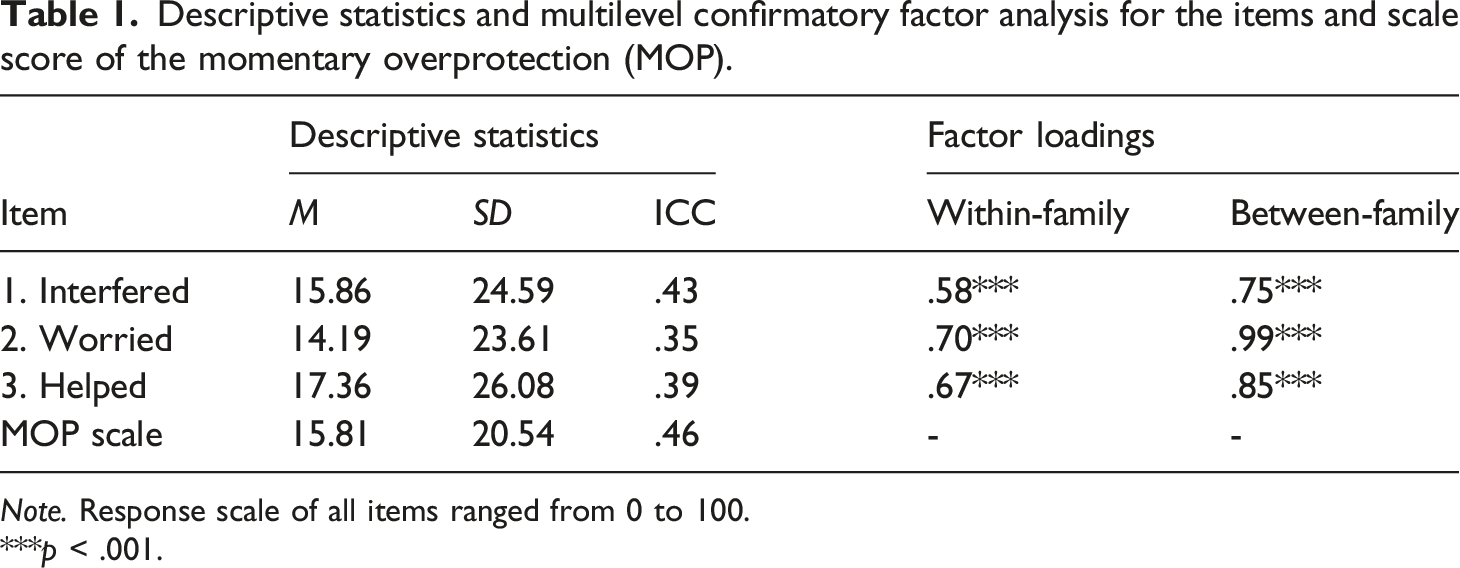
Descriptive statistics and multilevel confirmatory factor analysis for the items and scale score of the momentary overprotection (MOP).
Note. Response scale of all items ranged from 0 to 100.
***p < .001.
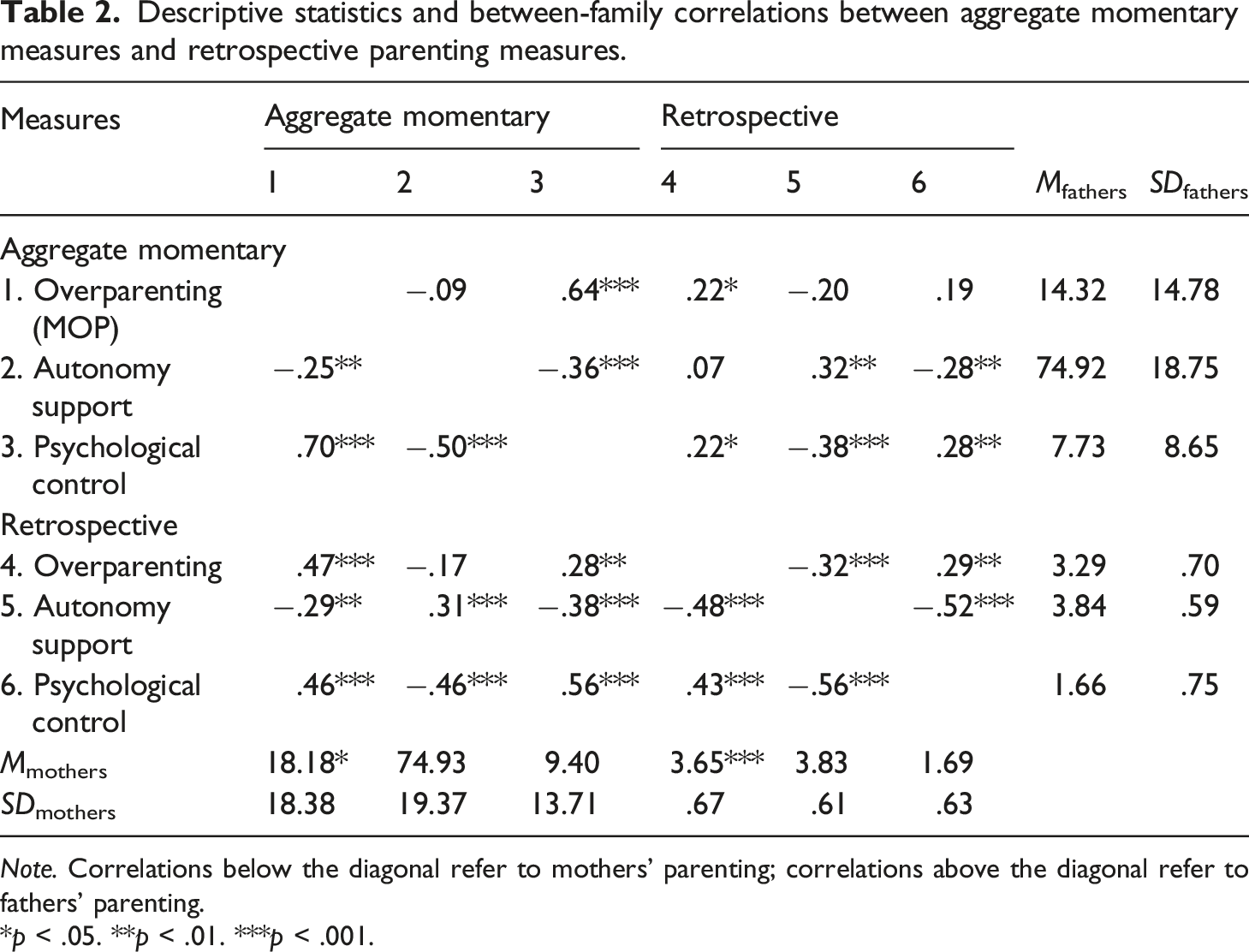
Descriptive statistics and between-family correlations between aggregate momentary measures and retrospective parenting measures.
Note. Correlations below the diagonal refer to mothers’ parenting; correlations above the diagonal refer to fathers’ parenting.
*p < .05. **p < .01. ***p < .001.
Intraclass correlation
Before testing our hypotheses regarding the psychometric properties, we examined the extent to which overparenting is dynamic, by assessing how much variance was due to within-family versus between-family variance (see Table 1). Per item, the ICC was between .39 and .42 which indicates that up to 58% and 61% was due to within-family fluctuations and/or random measurement error over time. At the scale level, the ICC (.46) indicated that 46% of the variance in momentary overparenting was due to between-family variation, while 54% was due to within-family fluctuations over time. We therefore conclude that the scale measures a phenomenon that varies from one interaction to the next.
Within-family and between-family reliability
As expected (H1w, H1b), the multi-level confirmatory factor analysis indicated sufficient within-family (ωwithin = .69) and good between-family (ωbetween = .89) reliability. Factor loadings at the within-family level were all
Convergent validity
In line with our between-family hypothesis regarding convergent validity (H2b), adolescents who experienced on average more overparenting in their everyday lives (as assessed with the MOP) also scored higher on the retrospective measure of overparenting for mothers, r = .47, p < .001 and fathers, r = .22, p = .037 (see Table 2, and Appendix A for an item-by-item overview). Hence, adolescents with higher scores on maternal overparenting across momentary assessments, also had higher scores on the validated retrospective measure of overparenting.
Divergent validity
Consistent with our expectations, within-family estimates from multilevel analyses indicated that a higher score on the MOP was associated with lower momentary autonomy support (H3w; β = −.11 p < .001) and with momentary higher psychological control (H4w; β = .44, p < .001). Hence, at moments when adolescents perceived their parents to be more overprotective, they also perceived them as less autonomy supportive and more psychologically controlling (than typical).
At the between-family level (H3b), adolescents who reported higher average scores for overparenting in daily life, retrospectively reported lower levels of autonomy support from mothers, r = −.29, p = .004 but not from fathers, r = −.20, p = .061. Similarly, average momentary overparenting was associated with higher retrospective psychological control from mothers, r = .46, p < .001, but not from fathers, r = .19, p = .071 (H4b) (see Table 2). The average of momentary experiences of overparenting thus showed divergent validity for mothers, but not significantly for fathers (H3b, H4b).
In addition, results from the multilevel analyses provided information about correlations between aggregated momentary overparenting and aggregated autonomy support and psychological control at the between-family level. These results indicated that adolescents who, on average, experienced their parents as higher in overparenting behavior compared to other adolescents, reported on average more psychological control (β = .71, p < .001) and less autonomy support (β = −.19, p = .034). Although these results were not pre-registered, they provide additional evidence of divergent validity of the MOP, at the between-family level.
Discussion
Overparenting is characterized by parents limiting the adolescent’s autonomy through excessive worry, assistance, and interference. Even though overparenting has been found to hinder adolescents’ emotional development (Luebbe et al., 2018; Roo et al., 2022), little is known about how overparenting behaviors operate in families’ everyday lives. In recent years, there has been a burst of empirical studies that have used ESM design to assess how adolescents think, feel, and behave in the natural habitats of everyday lives (Keijsers et al., 2022; van Roekel et al., 2019). Such momentary assessments would provide a more thorough understanding of the possible dynamic nature and impact of overparenting. Fine-grained, real-time assessments of dynamics within families, however, require a dedicated set of measurement instruments that are short, tap into concrete behaviors, and have adequate within-family psychometric properties (Kirtley et al., 2020; Myin-Germeys and Kuppens, 2022). Up till now, such a measure to assess the everyday dynamics of overparenting was lacking.
The current study described the development and validation of a novel instrument to assess how overparenting may fluctuate substantially from one moment to the next. The novel Momentary Overparenting (MOP) scale could reliably and validly assess real-time fluctuations in overparenting. The MOP showed convergent validity with a validated scale for overall levels of overparenting (Odenweller et al., 2014). With regard to divergent validity at the within-family level, higher scores on the MOP were associated with lower momentary autonomy support and with higher momentary psychological control, indicating that interactions characterized by more overparenting were experienced by adolescents as more psychologically controlling and less autonomy supportive. With regard to divergent validity at the between-family level, correlations with retrospective autonomy support and psychological control were found for mothers. In addition, average levels of momentary overparenting correlated with average levels of momentary autonomy support and psychological control. Taken together, worry, interference and unnecessary help may be important expressions of overparenting in everyday family life, and can be reliably measured from moment-to-moment as a distinct parenting construct.
From stable pattern to dynamic process
Parenting can be (and should be) conceptualized at two distinct levels, namely the between-family and the within-family level (Berry and Willoughby, 2017; Darling and Steinberg, 1993; Keijsers, 2016). At the aggregate level, there are stable differences between families in parent and adolescent functioning, which may be the result of developmental processes in the past. Overall, research now suggests that adolescents who are exposed to more overparenting, on average experience more internalizing and externalizing problems (Roo et al., 2022; Rote et al., 2020). How these stable patterns at the population level come about, and which dynamic mechanisms link parenting to adolescent outcomes, can best be assessed within families (Hamaker et al., 2015; Keijsers, 2016). This level allows to conceptualize and measure parenting as a dynamic phenomenon, for instance, how the day-to-day use of specific parenting practices affects the development of an adolescent in the same family over time. Recent work emphasizes the essential role of assessing parenting processes as a real-time dynamic which takes place under time-varying family contexts (Boele et al., 2022; Bülow et al., 2022; Lougheed and Keskin, 2021).
The ability to distinguish within-family real-time dynamics from long-term (more stabilized) developmental patterns may be particularly relevant for understanding the potentially paradoxical role of overparenting. Whereas between-family stable aspects of overparenting provide indications for detrimental effects on adolescent development (Roo et al., 2022), there are studies that suggest that overparenting may be helpful in the short run (Padilla-Walker and Nelson, 2012; Reed et al., 2016). Yet, no study has assessed how overparenting processes unfold in micro timescales (Boele et al., 2020). The current study shows that overparenting varies from moment to moment. Furthermore, it confirms existing long-term between-family associations of overparenting with other parenting constructs and shows that the within-family real-time associations of overparenting with other parenting constructs follow a similar pattern. These robust observations may give rise to studies linking daily overparenting processes within families to subsequent short-term and long-term adolescent development.
Operationalization and measurement of overparenting
Apart from providing insights into the feasibility of measuring overparenting from moment to moment, this study is also instrumental in better understanding the conceptual hodgepodge of overparenting. Known under varies names, such as helicopter parenting (Odenweller et al., 2014), overparenting (Rousseau and Scharf, 2015) and overprotection (Barber, 1996), there are several ways to describe and conceptualize the involvement of parents in adolescents’ lives at age-inappropriate levels (Luebbe et al., 2018). In this study, we define overparenting as parents limiting autonomy of their child, overly seeking information from their child, and direct intervention in any problems of their child (Luebbe et al., 2018; Padilla-Walker and Nelson, 2012), and have therefore included items on parental interference, worry and unnecessary help. Although our instrument did not tap into every aspect of overparenting, it provides a relevant representation of the most frequent behaviors on a daily basis. Comparisons between families showed that aggregated scores of overparenting during the ESM week were related to retrospective assessments of overparenting at the end of the study, suggesting that worry, interference and unnecessary help cover at least some of the relevant daily expressions of overparenting.
On the between-family level earlier research has established overparenting as a multidimensional construct (Luebbe et al., 2018) of which the overarching factor is distinct from, but conceptually related to, other parenting behaviors that are relevant to adolescent development, including autonomy support (Kouros et al., 2017; Soenens et al., 2009) and psychological control (Padilla-Walker et al., 2021). Our results corroborate these finding at two distinct levels of analyses (Keijsers and Van Roekel, 2018; Kievit et al., 2013). At the between-family level, adolescents who reported lower maternal and paternal autonomy support and higher maternal, but not paternal, psychological control, also had more (intense) experiences of overparenting in everyday lives throughout the study. Within families, in their everyday lives, adolescents experience more overparenting at moments when they perceive their parents lower on autonomy support and higher on psychological control. These perceptions of parenting thus wax and wane in tandem. In sum, momentary overparenting is related to other types of parenting behaviors and also an empirically distinct construct, both when assessing dynamics within families, and when assessing stable differences between families.
Limitations and directions for future research
The current study is the first to assess moment to moment fluctuations in overparenting in a large ESM sample with many observations. However, it is not without limitations. Parenting practices were only assessed when adolescents had seen and spoken to one of their parents within the last hour. Therefore, current findings do not inform us about perceived (over)parenting in the absence of parents. These moments are important to take into account as they could be indicative of autonomy supportive parenting, providing the adolescent space and alone-time, but also of neglectful or low involved parenting (which has been found to relate to lower self-esteem in children; Pinquart and Gerke, 2019), and more problem behavior, Kerr and Stattin, 2000). Furthermore, even in the absence of concrete interactions parents can, for instance, check the child’s social media or email accounts, monitor the child’s activities and provide aid and support by messaging or GPS tracking their adolescent (Beyens et al., 2022). Future research, therefore, could broaden the perspective on overparenting by also assessing perceived parenting in moments without a direct parent-adolescent interaction. Moreover, correlations for father-adolescent interaction were non-significant. Discrepancies between findings in mothers and fathers in the current study may be indicative of the lower number of interactions reported with fathers (i.e, more limited statistical power). Finally, the study focused on only on a subset of relevant variables and only one of the relevant timescales at which adolescents develop, the micro-time of everyday interactions. In future research this newly developed measure may be related to adolescents’ functioning (e.g., their coping or feelings of autonomy) from one moment to the next. Relatedly, integrating this instrument in a measurement burst design, in which long-term follow-ups are combined with in depth bursts of everyday measurements (Nesselroade, 1991) may be needed to understand how overparenting might be helpful in the current moment but harmful in the long run. Lastly, to be able to fully capture participant characteristics, future research should include reports of adolescents’ sexual orientation and disabilities (APA, 2020).
Conclusion
This study on momentary overparenting developed and assessed the Momentary Overprotection (MOP) scale. The novel short instrument, suited for use in Experience Sampling research on parenting (Keijsers et al., 2022) showed good psychometric properties (i.e., reliability, convergent validity, and divergent validity). Demonstrating for the first time that overparenting is not only a stable trait of parents but varies meaningfully from one moment to the next within families, this new measure could contribute to further understanding of the dynamic antecedents and consequences of overparenting in adolescents’ daily life.
The data used in the research are available. The data can be obtained by emailing:
Footnotes
Acknowledgements
We want to thank Nicole Lucassen for her feedback on the manuscript.
Funding
The author(s) disclosed receipt of the following financial support for the research, authorship, and/or publication of this article: The ‘Dutch Experience Sampling Study on Parent-Adolescent Interactions’ (DESPAI) was funded by the Dutch Research Council (NWO-VIDI; ADAPT; Assessing the Dynamics between Adaptation and Parenting in Teens 452-17-011) awarded to Loes Keijsers.
Open practices and data sharing
The preregistered analytical plan (https://osf.io/567ve/) and codebook of the study ( ) are shared on OSF.
Open research statement
As part of IARR’s encouragement of open research practices, the authors have provided the following information: This research was pre-registered. The aspects of the research that were pre-registered were research idea, hypotheses, analytical plan. The registration was submitted to the Open Science Framework at .