




Abstract
Attachment insecurity is characterized by chronic concerns about whether partners can fulfil core relatedness needs, including feeling loved and cared about. In two longitudinal studies, our aim was to extend current evidence that certain relationship conditions buffer attachment insecurity by (1) focusing on the central ingredient—fulfilment of relatedness needs—that likely account for buffering effects, and (2) illustrate the importance of general experiences of relatedness need fulfilment across couples’ lives. Couple members completed initial assessments of attachment insecurity, reported on the fulfilment of relatedness needs every month for 6 months (Study 1) or daily for 3 weeks (Study 2), and then completed re-assessments of attachment insecurity 6-months (Study 1) or 9-months (Study 2) later. Across both studies, greater fulfilment of relatedness needs across monthly and daily relationship life predicted decreases in attachment anxiety and avoidance. General experiences of relatedness across couples’ lives appear to reflect a relationship environment that fulfils core needs for love, care, and regard that cultivate attachment security.
Keywords
The fulfilment of core relatedness needs, including feeling close, loved, and cared about (Ryan & Deci, 2000), are fundamental to the development and maintenance of attachment security. People who have experienced rejection and neglect, and thus experienced thwarted relatedness needs, tend to develop attachment insecurities (Bowlby, 1973). Furthermore, attachment insecurities are perpetuated within relationships because more insecure individuals find it difficult to feel cared for and valued even when their partners do truly care and love them (Rodriguez et al., 2019). These difficulties in experiencing relatedness need fulfilment result in more insecure individuals protecting against expected rejection or neglect in ways that damage their relationships and undermine their partners’ care and regard (Overall et al., 2022). Fortunately, growing evidence indicates that partners who demonstrate their trustworthiness, commitment, and positive regard can “buffer” the damage attachment insecurity can have on relationships, including fostering attachment security across time (Arriaga et al., 2018; Overall et al., 2022).
The recent expansion of work identifying buffering factors has shifted the field from a deficit perspective positioning attachment insecurity as a perpetual relationship vulnerability to a strengths-based perspective recognizing that relationship dynamics can potentially enhance attachment security (Arriaga et al., 2018; Overall et al., 2022). Yet, despite identifying numerous partner behaviors that buffer the detrimental effects of attachment insecurity within threatening interactions, most research has not specified why all of these buffering behaviors reduce insecure reactions and potentially foster attachment security across time. The theoretical rationale presented across studies, however, converge with our proposition that effective buffering behaviors should overcome deficits in relatedness need fulfilment—that is, buffering insecurity occurs by fostering feelings of being loved, cared about, valued, and accepted by partners. Moreover, regardless of the buffering factors that facilitate relatedness needs within specific interactions, general experiences of relatedness need fulfilment across the months and days of couples’ lives is likely to provide the ongoing evidence of love, care and regard needed to reduce attachment insecurity. We draw on two longitudinal dyadic studies to test whether relatedness need fulfillment across daily and monthly life helps to reduce attachment anxiety and avoidance across time.
Buffering insecure reactions and fostering attachment security
Concerns that partners will fail to fulfil relatedness needs now or in the future underlie the destructive reactions of insecure individuals. Individuals high in attachment anxiety are theorized to have experienced inconsistent past caregiving making it difficult for them to feel truly loved and accepted because they fear close others will eventually abandon them (Mikulincer & Shaver, 2016). Accordingly, highly anxious individuals tend to feel that partners do not fulfil their relatedness needs (Hadden et al., 2016), including feeling less accepted, valued, and cared for (Lemay & Clark, 2008; Overall & Sibley, 2009), even when their partners are as accepting, valuing, and caring as partners of secure individuals (Collins & Feeney, 2000; Rodriguez et al., 2019). These negative perceptions occur even though highly anxious individuals crave for their partners to fulfil relatedness needs, which creates hyperemotional responses designed to pull evidence of their partners’ love (Girme et al., 2021; Overall et al., 2014). Unfortunately, chronic concerns about whether and how long partners will meet relatedness needs, and the accompanying destructive reactions, are central to why highly anxious individuals report poorer relationship satisfaction (Hadden et al., 2014).
Unfulfilled relatedness needs also underpin attachment avoidance. Individuals high in attachment avoidance are theorized to have experienced cold and rejecting past caregiving and so develop beliefs that others will not be available, caring, and loving when needed, and thus partners cannot be trusted to fulfil relatedness needs (Mikulincer & Shaver, 2016). Compared to the prioritization of relatedness needs that characterizes attachment anxiety, the defenses arising from avoidant expectations of neglect involve devaluing relatedness needs, including eschewing closeness and intimacy and instead prioritizing self-reliance (Ren et al., 2017). Accordingly, highly avoidant individuals experience low levels of closeness in relationships (Hadden et al., 2016; Pietromonaco & Feldman Barrett, 1997) and disengage from their partners when experiencing relationship problems (Overall et al., 2013; 2015; Simpson et al., 1996). The defenses that arise from distrusting partners are central to why avoidant individuals experience lower satisfaction and commitment (Hadden et al., 2014).
Fortunately, partners can behave in ways that address the relatedness concerns central to attachment-related insecurities (see Overall et al., 2022 for review). Partners who demonstrate high levels of care and commitment can restore highly anxious individuals’ felt-security. When partners express greater care and affection, highly anxious individuals tend to experience less jealousy during relationship-threatening situations (Kim et al., 2018), feel more valued (Lemay & Dudley, 2011), and report greater relationship satisfaction and security across time (Vedelago et al., 2022). Similarly, highly anxious people experience greater satisfaction when they perceive their partner as responsive to their sexual needs, likely because sex provides explicit evidence of partners’ love and care (Raposo & Muise, 2021; also Little et al., 2010). Furthermore, anxious individuals feel more accepted and respond more constructively during conflictual interactions when their partners are highly committed (Tran & Simpson, 2009; also see Cross et al., 2016).
Partners who provide clear evidence of their care and acceptance also can reduce the defensive responses of highly avoidant individuals. Highly avoidant individuals are less likely to withdrawal when their partners provide high levels of support that provide explicit evidence of partners’ availability (Girme et al., 2015; Simpson et al., 2007; also see Vedelago et al., 2022). Similarly, highly avoidant individuals feel more secure and willing to commit when their partners illustrate validation of their personal needs, such as their autonomous personal goal strivings (Arriaga et al., 2014; Girme et al., 2019). Avoidant individuals are also more responsive during relationship-threatening interactions when partners recognize their efforts and communicate acceptance and validation (Farrell et al., 2016; Overall et al., 2013). Finally, avoidant individuals report greater relationship satisfaction and commitment when partners express appreciation for their relationship sacrifices (Park et al., 2019a; Schrage et al., 2022), or partners show they are available through frequent physical intimacy (Little et al., 2010).
Fewer studies have provided evidence that partner behaviors that promote felt relatedness may reduce attachment anxiety or avoidance across time. Repeatedly priming individuals with attachment security (e.g., writing or thinking about an attachment figure that meet their needs for comfort and love) has been linked to reductions in attachment anxiety across several weeks or months (Carnelley & Rowe, 2007; Hudson & Fraley, 2018). Perceptions that partners validate personal goals (Arriaga et al., 2014) or express more gratitude (Park et al., 2019b) also have been associated with lower attachment anxiety over time. Additionally, perceptions that partners can be trusted to be responsive and supportive are associated with reductions in attachment avoidance (Arriaga et al., 2014; Gunaydin et al., 2020; Rholes et al., 2020). Finally, when highly avoidant individuals engage in intimacy-promoting activities with their partner, and thus are able to experience loving and caring relationship interactions, they experience declines in attachment avoidance across 3–4 weeks (Bayraktaroglu et al., 2022; Stanton et al., 2017).
A central ingredient: Fulfilment of core relatedness needs
Research showing that partner behaviors that clearly signal care and regard help reduce insecure reactions and foster greater security aligns with principal theories emphasizing that perceptions of partners’ positive regard (Murray et al., 2006), availability (Feeney & Collins, 2015) and responsiveness (Reis et al., 2004) are central for facilitating secure and satisfying relationships. However, as the array of effective partner buffering behaviors highlight, different strategies may be required to foster such relatedness need fulfilment depending on the specific context (e.g., support, conflict, sacrifice) or the specific concerns that need to be assuaged (i.e., concerns arising from attachment anxiety vs. avoidance). Although the specificity in prior attachment buffering research is important in illustrating that different situations and people require tailored strategies to promote better relationship outcomes, the growing list of different buffering factors highlight that a more global account of the active ingredient that should reduce insecurity across contexts will be beneficial. The current research examined one core component that should underpin many buffering effects—fulfillment of relatedness needs—thereby isolating a key ingredient that should generate greater security across different relationship contexts.
We also aimed to advance prior attachment buffering work by considering the importance of the ongoing fulfillment of relatedness needs across couples’ lives. Extant work has predominately focused on what partners can do to counteract felt insecurity and defensiveness within specific relationship interactions that heighten attachment concerns, such as couples’ support-relevant or conflict discussions (Farrell et al., 2016; Girme et al., 2015; 2019; Overall et al., 2013; Simpson et al., 2007; Tran & Simpson, 2009), intimacy-inducing interactions (Kim et al., 2018; Stanton et al., 2017), or daily interactions (Girme et al., 2015; Park et al., 2019a; Raposo & Muise, 2021). Prior research examining factors that may foster attachment security over time has also typically focused on how relationship conditions assessed at one timepoint are associated with attachment insecurity at a later timepoint (Arriaga et al., 2014; Rholes et al., 2020; Stanton et al., 2017). Yet, such longitudinal effects are unlikely to arise because the specific behavior was present at that single earlier time point, but rather because that earlier assessment reflected how partners likely responded and individuals subsequently felt in similar situations across their ensuing lives. It is most likely the degree to which couples’ ongoing, repeated interactions lead people to generally experience relatedness need fulfilment across daily and monthly life that should promote reductions in attachment insecurity across time.
The proposition that general relatedness need fulfilment across couples’ lives should be key to reducing attachment insecurity aligns with a central tenet of attachment theory: consistent, ongoing evidence of close others’ love and care should foster greater security (Bowlby, 1973). We operationalize this key ingredient as average levels of repeated assessments of relatedness need fulfilment across couples’ lives. Consistent with our operationalization, two recent studies provide evidence that average levels of perceived partner responsiveness and expressed gratitude across couples’ daily life are associated with lower attachment avoidance (but not anxiety) across 3–6 months (Gunaydin et al., 2020; Park et al., 2019a). These initial results support our proposition that assessing the fulfillment of relatedness needs across couples’ daily and monthly lives offers a reflection of the typical relationship environment that is likely required to foster greater attachment security, including lower anxiety as well as avoidance.
Finally, we also assessed an alternative variable that could, independent of average levels of relatedness need fulfillment, hinder attachment security. Attachment scholars have noted that inconsistent caregiving may foster attachment insecurity (Bowlby, 1973; Cassidy & Berlin, 1994). Applying this idea to our aims, inconsistency in relatedness need fulfillment across couples’ lives may make it difficult to trust that these core needs will continue to be fulfilled, even when people feel cared above or loved across many days or months. We operationalized inconsistency of relatedness need fulfillment as the within-person standard deviation of repeated assessments of relatedness need fulfilment (see Eller et al., 2022; Girme et al., 2018; Overall, 2020). Consistent with this operationalization, greater variation in maternal sensitive care in early-to-middle childhood predicted lower secure base script knowledge at age 19 (Eller et al., 2022). Furthermore, greater variability in perceived partner responsiveness across daily life has been linked to greater attachment anxiety (but not avoidance) across 4.5 months (Gunaydin et al., 2020). Accordingly, we also tested whether greater variability in relatedness need fulfilment predicted attachment anxiety or avoidance across time.
Current research
Attachment insecurity thwarts relatedness needs because insecure individuals believe that partners cannot or will not truly value, love, and care about them. We test whether relatedness need fulfillment is a key ingredient required to foster attachment security. In particular, general experiences of relatedness need fulfilment across the days and months of couples’ lives should provide the ongoing evidence of safety and security needed to reduce attachment insecurity. In two longitudinal studies, both members of heterosexual couples completed initial assessments of attachment insecurity, reported on the fulfilment of relatedness needs (feeling close, loved, cared for, accepted) every month for 6 months (Study 1) or daily for 3 weeks (Study 2), and then completed re-assessments of attachment insecurity 6-months (Study 1) or 9-months (Study 2) later. We hypothesized that greater relatedness need fulfilment across monthly and daily relationship life (i.e., greater mean levels) would predict lower attachment anxiety and avoidance across time. We also examined whether greater variation in relatedness needs (i.e., greater within-person standard deviations) predicted greater anxiety and avoidance across time.
Study 1
Methods
Participants
We drew on an existing dataset (see OSM); thus, a priori power analyses for the current study were not conducted. The original target sample size of 100 couples was determined to ensure adequate power to detect the typical size of dyadic effects shown in prior research at the time the study was designed (Kenny et al., 2006). Of the 100 couples who completed the initial research session, 35 did not complete the final longitudinal assessment of attachment insecurity; six couples dissolved, and 29 opted out of participation. 1 A sample of 65 dyads (N = 130 individuals) for the current analyses provides .857 power to detect an actor effect of r = .25 when variables are correlated at typical levels across partners (r = .30) and partner effects are specified as zero (Ackerman et al., 2021). The significant effects were at or above r = .23.
Participants were recruited via paper and electronic announcements posted across a city-based New Zealand university campus. Participants were, on average, 23.64 years old (SD = 7.33) and involved in serious relationships (50.8% married or cohabitating) that averaged 3.67 years in length (SD = 5.06). The study advertising recruited heterosexual couples for other aims related to gender-role beliefs, and 50% of participants identified as women and 50% as men.
Participants identified their primary ethnic identity as NZ European (N = 79), Maori (N = 6), Pacific Islander (N = 2), Asian (N = 11), Indian (N = 4), non-NZ European(N = 12), Other (N = 15) or Did Not Report (N = 1). Seventeen participants reported additional bi- or multi-ethnic identities. Participants reported their employment status as full-time student (N = 83), part-time student (N = 9), employed part-time (N = 10), employed full-time (N = 20), or unemployed (N = 8). Participants reported their highest education level attained as NCEA level 2/school certificate (N = 18), NCEA level 3/bursary (N = 49), tertiary qualification (N = 36), postgraduate qualification (N = 22), other (N = 4), or missing (N = 1). The study received approval from the University of Auckland ethics committee. Couples were reimbursed NZD$210 for the full study.
Materials and procedure
At an initial lab-based session, participants completed measures of attachment insecurity and relatedness need fulfilment, and then completed repeated assessments of relatedness need fulfilment each month for the following 6 months (average completion of 6.72 of the requested seven monthly assessments). At the final 6-month follow-up, participants completed a reassessment of their attachment insecurity.
Summary of definitions and assessment of attachment anxiety, attachment avoidance and relatedness need fulfillment.
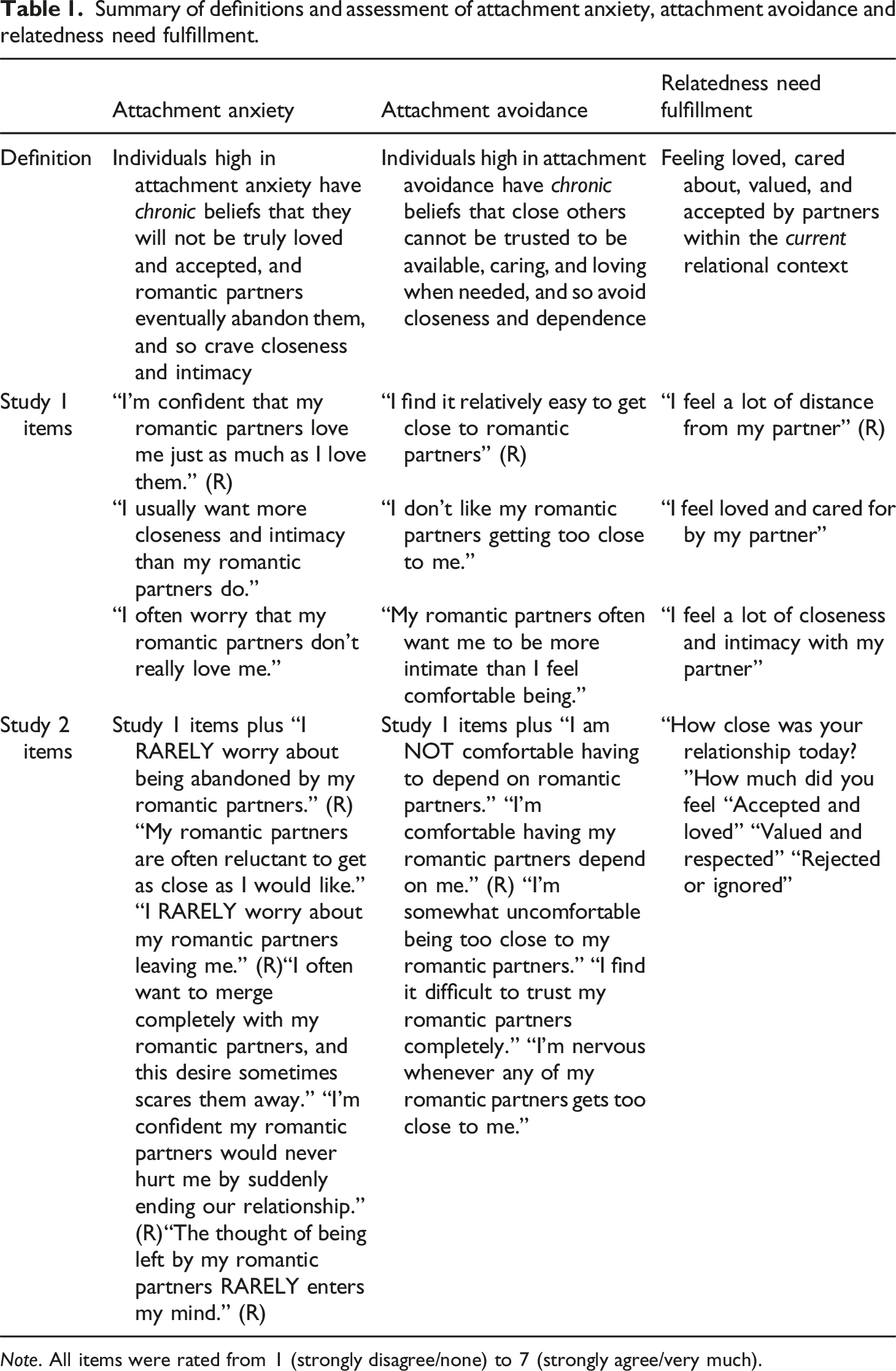
Note. All items were rated from 1 (strongly disagree/none) to 7 (strongly agree/very much).
Some readers may wonder whether attachment security and relatedness need fulfillment capture the same underlying construct. These well-validated measures of attachment security (Simpson, et al., 1996) and relatedness need fulfillment (La Guardia et al., 2000) have been used extensively in the close relationships and self-determination literatures. This body of work has conceptualized, analyzed, and provided evidence that these constructs are distinct (e.g., Hadden et al., 2016; Girme et al., 2019; La Guardia et al., 2000; Reis et al., 2000; also see Gunaydin et al., 2020). As outlined in Table 1, attachment insecurities reflect chronic concerns, expectations, and motivations about romantic relationships in general. In contrast, relatedness need fulfillment reflect whether people feel loved, cared for, and positively regarded within the current relational context. Furthermore, current feelings of being loved and cared for (relatedness needs) may appear to overlap with chronic concerns about feeling truly loved and craving closeness (attachment anxiety), but the inverse is true for chronic distrust of others and avoiding closeness and dependence (attachment avoidance). Yet, as we have discussed, relatedness needs should be central to reducing both attachment anxiety and avoidance. Finally, factor analyses using the dySEM package in R (Sakaluk et al., 2021) supported that these constructs are distinct. A two-factor structure yielded a better fitting model than a one-factor structure when distinguishing between relatedness need fulfillment and (1) attachment anxiety (χ2diff = 44.87, p < .001) and (2) attachment avoidance (χ2diff = 158.38, p < .001).
Results
Descriptive statistics across measures (Studies 1 and 2).
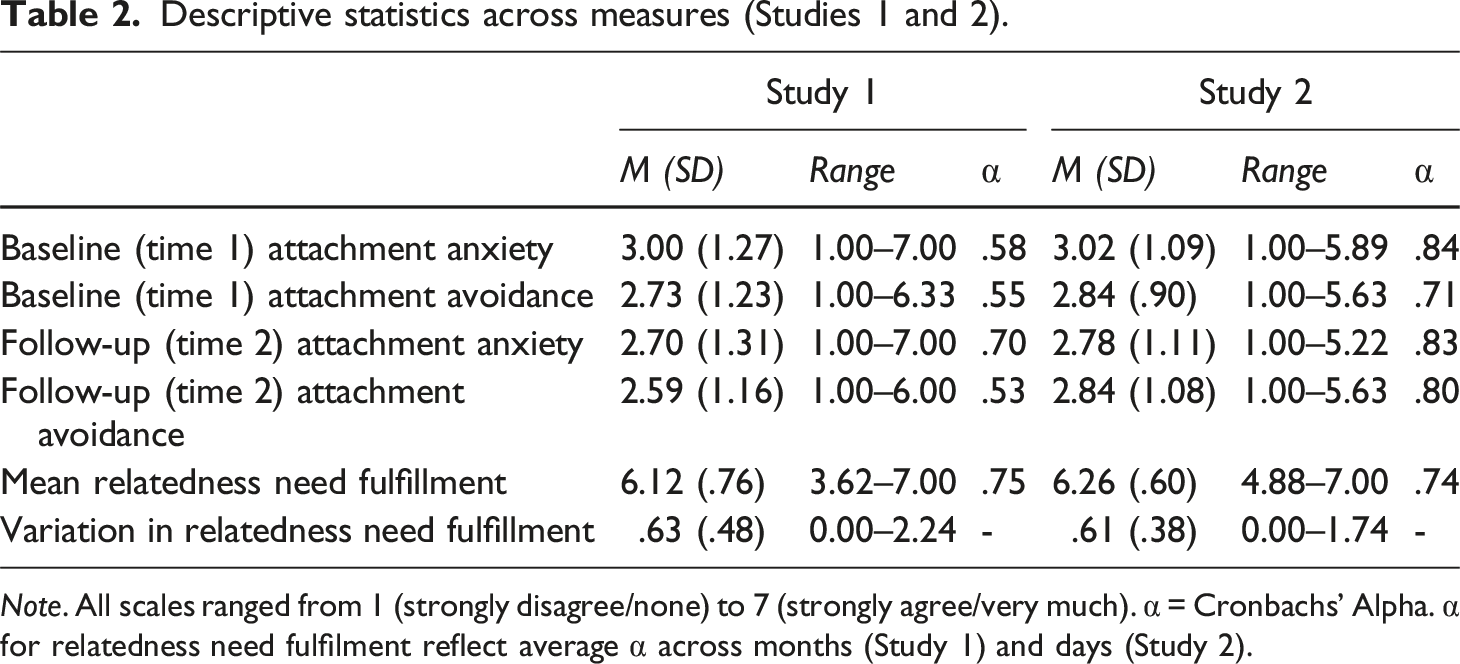
Note. All scales ranged from 1 (strongly disagree/none) to 7 (strongly agree/very much). α = Cronbachs’ Alpha. α for relatedness need fulfilment reflect average α across months (Study 1) and days (Study 2).
The effect of relatedness need fulfillment on attachment anxiety and avoidance across 6-months (Study 1).
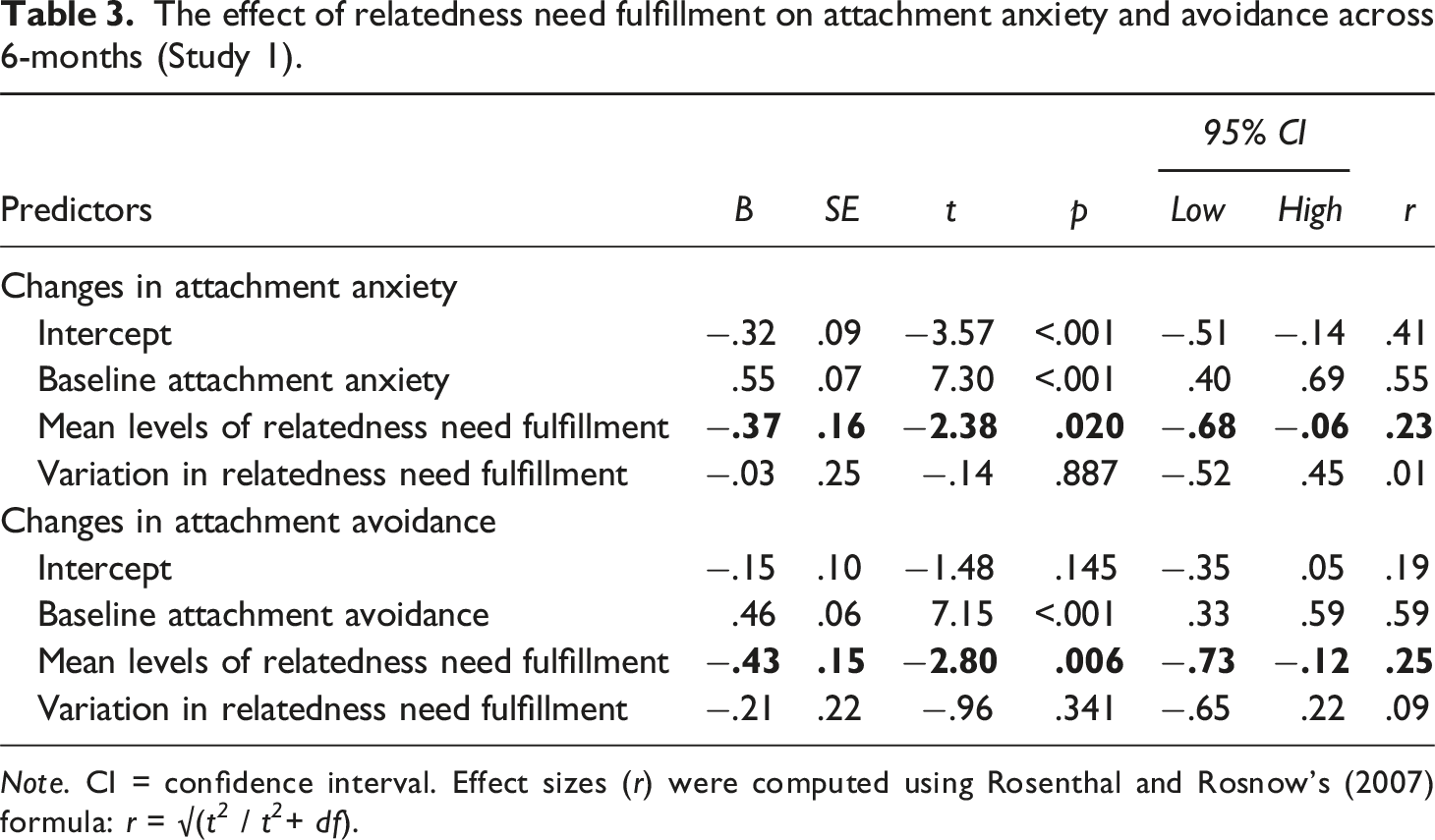
Note. CI = confidence interval. Effect sizes (r) were computed using Rosenthal and Rosnow’s (2007) formula: r = √(t2 / t2+ df).
First, focusing on attachment anxiety, the negative and significant intercept illustrated that, on average, attachment anxiety significantly reduced across the 6-month period (see Fraley et al., 2021 for consistent average declines). Nonetheless, mean relatedness need fulfilment was significantly associated with the level of reductions in attachment anxiety. To illustrate the effect of relatedness need fulfilment, we calculated the predicted value, significance, and r effect size, of change in attachment anxiety at low (−1 SD), average, and high (+1SD) levels of relatedness need fulfillment. As shown in Panel A of Figure 1, attachment anxiety significantly declined over time at average levels of relatedness need, but these declines were greater when participants experienced high levels of relatedness needs. By contrast, levels of attachment anxiety were sustained (no significant change) when participants experienced low levels of relatedness fulfilment. The effect of low (−1 SD), mean, and high (+1 SD) relatedness need fulfillment on change in attachment anxiety (Panel A) and attachment avoidance (Panel B) across 6 months (Study 1). r = r effect size which were computed using Rosenthal and Rosnow’s (2007) formula: r = √(t2 / t2+ df). *p < .05.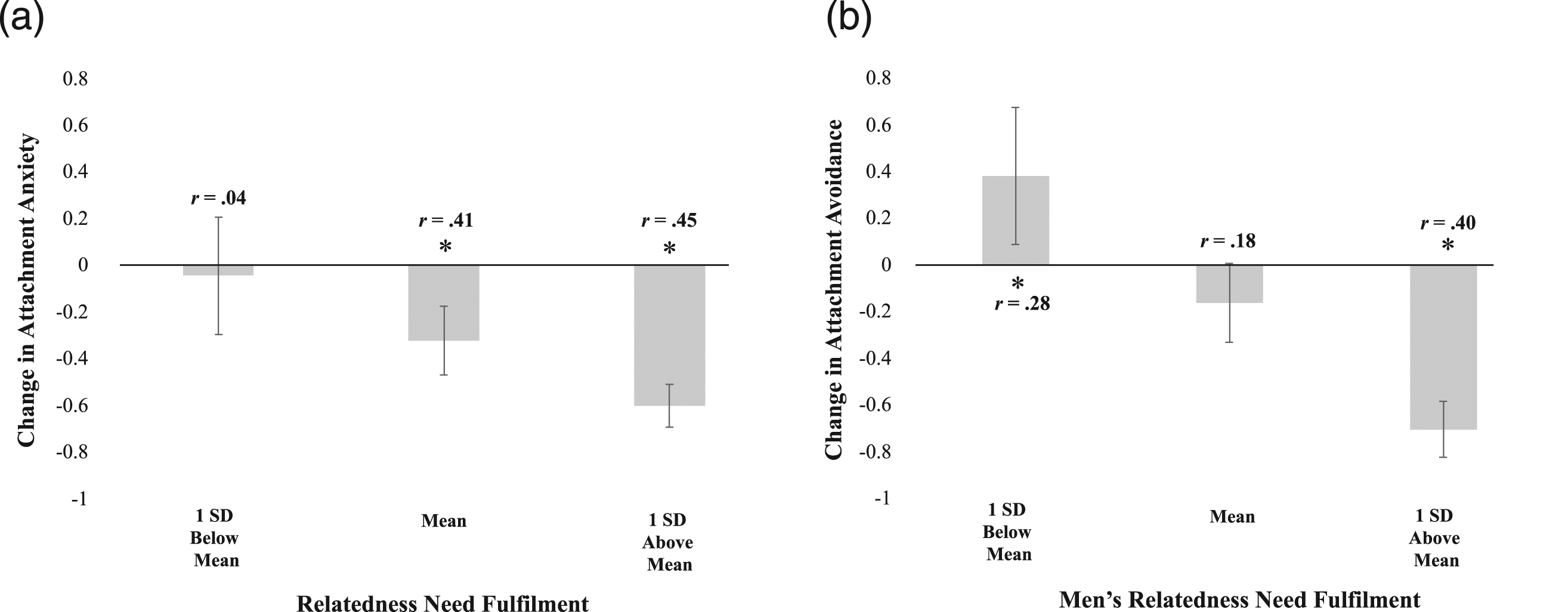
Next, the non-significant intercept for the attachment avoidance model revealed that, on average, avoidance was stable across time. Again, however, mean relatedness need fulfilment was a significant predictor, although significant gender differences in this effect (B = −31, t = −2.42, p = .018) revealed that relatedness need fulfilment was only a significant predictor for men (B = −.74, t = −3.69, p < .001) and not women (B = −.12, t = −.59, p = .555). The significant effect for men is illustrated in Panel B of Figure 1. At mean relatedness need fulfilment, there was no change in men’s attachment avoidance, but high mean levels of need fulfilment predicted significant declines in men’s attachment avoidance whereas low levels predicted significant increases in men’s attachment avoidance. Finally, variability in relatedness need fulfillment did not have any significant effects on changes in anxiety or avoidance.
Finally, providing some evidence of the centrality of relatedness needs compared to other fundamental needs (autonomy, competence), additional analyses illustrated that autonomy and competence need fulfilment regarding personal goal pursuit did not have the same effect (see OSM). Mean levels of or variation in goal-related autonomy and competence need fulfillment did not predict changes in attachment anxiety or attachment avoidance (ts < −1.64, ps > .10), with one exception: greater variability in goal-related competence need fulfillment was associated with increases in attachment avoidance over time (B = .61, t = 2.93, p = .004).
Study 2
Methods
Participants
We drew on an existing dataset (see OSM). A priori power analyses were not conducted. Based on prior research, the target sample size was at least 80 couples. Of 86 recruited couples, only 73 fully completed the daily sampling procedure. Additionally, 1 couple did not complete baseline attachment insecurity, and 16 couples did not complete the 9-month follow-up due to dissolution (N = 8) or opting out of participation (N = 8). This left a sample of 56 couples (112 individuals) for the current analyses, which provides .800 power to detect an actor effect of r = .25 (Ackerman et al., 2021). The significant effects were above r = .21.
Couples responded to advertisement posted across university-based organizations (e.g., health centers, newsletters, childcare services). Participants were 23.79 years on average (SD = 6.70) and involved in serious relationships (42% married or cohabitating) that averaged 3.40 years in length (SD = 3.97). All participants were involved in mixed-sex relationships; 50% of participants identified as women and 50% as men. Participants identified their primary ethnic identity as NZ European (N = 91), non-NZ European (N = 11), Other (N = 6), Asian (N = 2), Pacific (N = 1), and missing (N = 1). Participants reported their employment status as full-time student (N = 83), part-time student (N = 6), employed part-time (N = 6), employed full-time (N = 16), or unemployed (N = 1). Participants reported their highest education level attained as school certificate (N = 20), higher school certificate/bursary (N = 37), tertiary qualification (N = 38), postgraduate qualification (N = 7), or other (N = 10). The study received approval from the Victoria University of Wellington ethics committee. Couples were reimbursed $100NZD.
Materials and procedure
During an initial session, couples completed scales assessing attachment insecurity and received instructions for completing an end-of-day survey for the subsequent 21 days. Participants completed an average of 19.6 daily surveys (2191 daily observations). Nine months later, participants completed scales assessing attachment insecurity online.
Factor analyses using the dySEM analyses (Sakaluk et al., 2021) again supported that attachment security and relatedness need fulfillment are distinct constructs. A two-factor structure yielded a better fitting model than a one-factor structure when distinguishing between relatedness need fulfillment and (1) attachment anxiety (χ2diff = 194.97, p < .001) and (2) attachment avoidance (χ2diff = 158.38, p < .001).
Results
The effect of relatedness need fulfillment on attachment anxiety and avoidance across 9-months (Study 2).
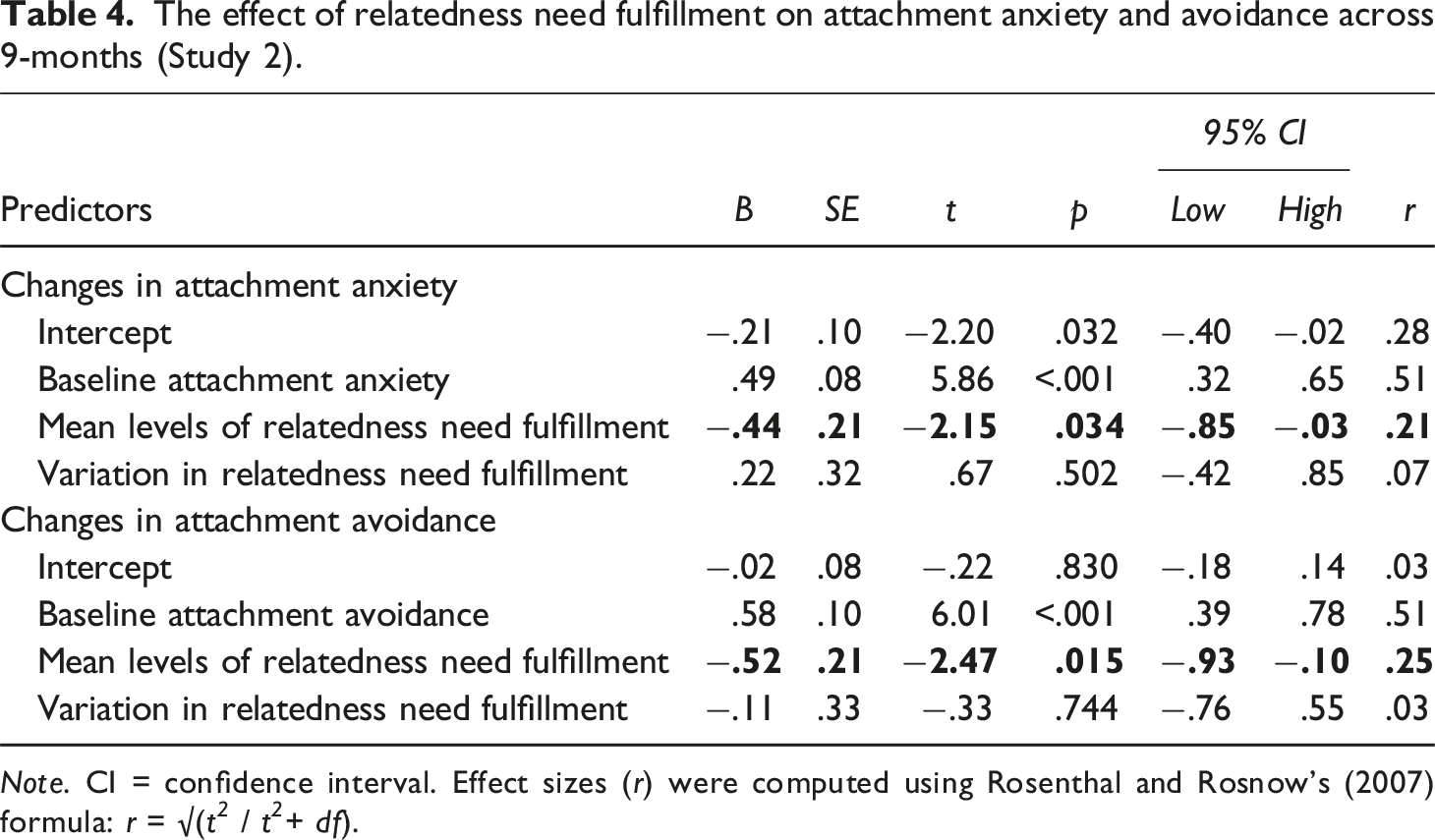
Note. CI = confidence interval. Effect sizes (r) were computed using Rosenthal and Rosnow’s (2007) formula: r = √(t2 / t2+ df).
On average, attachment anxiety significantly reduced across the 9-month period, but greater relatedness need fulfilment predicted the level of reductions in anxiety. Replicating the results in Study 1, declines in attachment anxiety were greater when participants experienced high levels of relatedness needs, whereas levels of attachment anxiety were sustained when participants experienced low levels of relatedness fulfilment (Figure 2, Panel A). The effect of low (−1 SD), mean, and high (+1 SD) relatedness need fulfillment on change in attachment anxiety (Panel A) and attachment avoidance (Panel B) across 9 months (Study 2). r = r effect size3. *p < .05. †p = .055.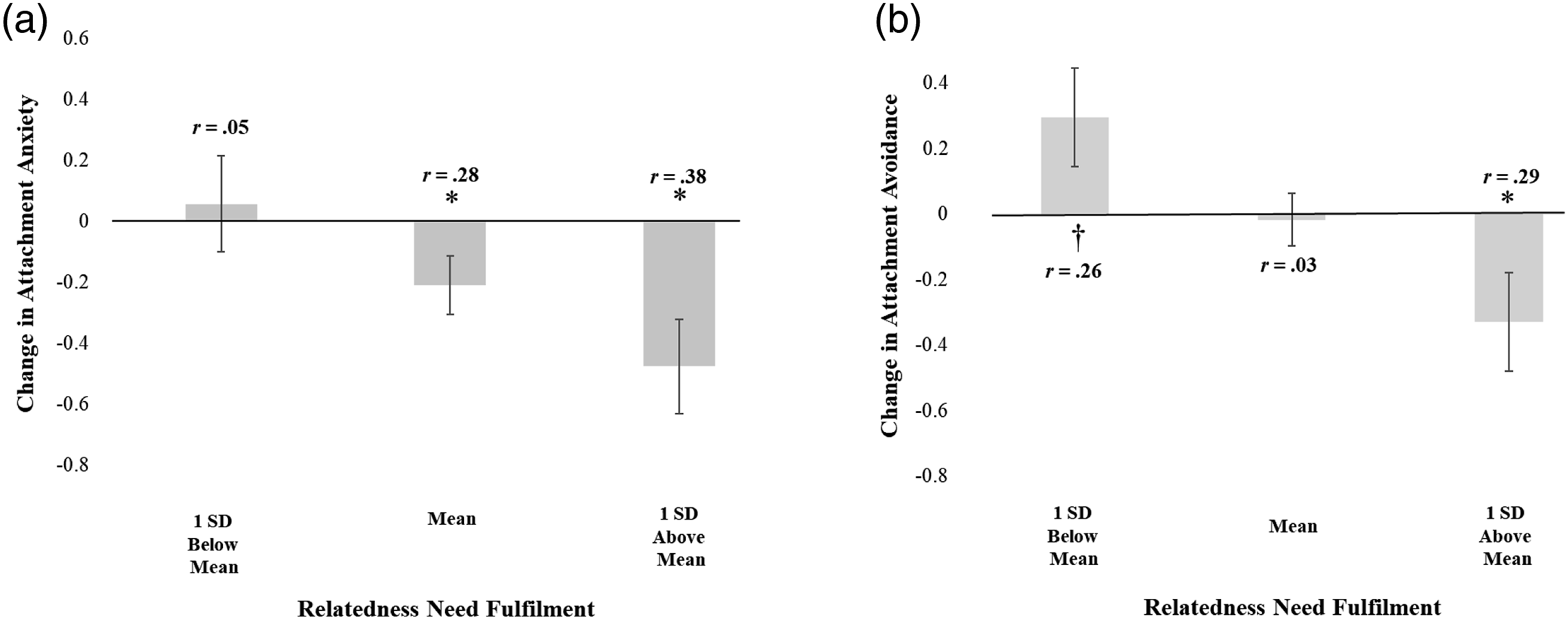
Also replicating Study 1, at mean relatedness need fulfilment, there was no change in attachment avoidance, but high mean levels of need fulfilment predicted significant declines in attachment avoidance whereas low levels predicted increases in attachment avoidance (p = .055; Figure 2, Panel B). None of the effects differed across gender (ts = .12 to 1.78, ps > .08). Variation in relatedness need fulfillment did not predict changes in anxiety or avoidance.
General discussion
Attachment insecurity is not inevitably perpetuating. Rather, growing evidence indicates that partners can buffer the damage of attachment insecurity. Yet, this buffering work has (1) primarily focused on different types of partner buffering behavior rather than the core need fulfilment that likely underpins buffering effects, and (2) overlooked the possible importance of general experiences across life in fostering attachment security. The current research extends the attachment literature by showing that the fulfillment of core relatedness needs across days and months in couples’ lives helped reduce attachment insecurity. Greater mean relatedness need fulfillment experienced across monthly and daily life predicted decreases in attachment anxiety and avoidance across 6-months (Study 1) and 9-months (Study 2). Within-person variation in relatedness need fulfillment did not predict changes in attachment anxiety or avoidance.
General experiences of relatedness needs fulfillment foster attachment security
The current results offer a more global perspective to the primary approach within the attachment buffering literature. Fulfillment of core relatedness needs should be a key ingredient in fostering security across time. Our results provide support for this proposition: low fulfillment of relatedness needs across daily and monthly life predicted sustained attachment anxiety and increased avoidance, whereas high fulfilment of these core needs predicted reductions in both anxiety and avoidance. Capturing these processes across daily and monthly life advance the predominant prior focus on examining buffering insecure reactions during specific situations. Any partner behavior or relationship process that helps anxious and avoidant individuals feel loved and cared about will likely help to address the need deficits that generate and sustain attachment insecurity.
The effect sizes of relatedness need fulfillment (rs = .21 to .25) exceed those reported in prior studies examining the effects of perceptions of partners’ trustworthiness, responsiveness, and social support on attachment change (rs = .06 to .20; Arriaga et al., 2014; Rholes et al., 2020). In studies that provide insufficient information to calculate effect sizes, the unstandardized beta-coefficients of relatedness need fulfillment (Bs = −.37 to −.52) doubled those reported in other papers examining change in attachment security (Bs = −.17 to −.24; Bayraktaroglu et al., 2022; Gunaydin et al., 2020; Stanton et al., 2017). Furthermore, extending previous studies, our analytic technique revealed the actual (predicted) level of change in attachment insecurity scores across levels of relatedness fulfilment. Higher levels of relatedness need fulfillment (+1 SD) predicted on average .53 unit (.46 SDs) declines in attachment anxiety and avoidance (rs = .29 to .45; Figures 1 and 2) compared to stability in attachment anxiety or .34 unit (.32 SDs) increases in attachment avoidance at low levels of need fulfilment (−1 SD). Given that higher versus lower attachment avoidance and anxiety is one of the most robust predictors damaging relationship behaviors and poorer long-term relationship outcomes (Joel et al., 2020; Overall et al., 2022), we believe this level of reduction is of practical significance.
Our theoretical and methodological approach suggests that generally experiencing relatedness need fulfilment across ongoing life may be an important way to understand the relationship conditions that improve attachment insecurity. Assessing general (average) experiences across couples’ lives may best tap the kind of consistent, ongoing experience of feeling loved and cared for that should foster greater security. This perspective adds to the bulk of work examining how partner buffering behavior assessed at one time-point can mitigate defensive reactions and insecurity during couples’ discussions (Farrell et al., 2016; Girme et al., 2015; 2019; Overall et al., 2013; Simpson et al., 2007), daily life (Park et al., 2019a; Raposo & Muise, 2021), or across time (Arriaga et al., 2014; Rholes et al., 2020; Stanton et al., 2017). The current study also extends two prior studies showing that average perception of partners’ behavior across daily life predict lower attachment avoidance (Gunaydin et al., 2020; Park et al., 2019a) by demonstrating that relatedness need fulfilment (rather than specific partner behaviors or expressions) across monthly and daily life plays an important role in reducing insecurity broadly—that is, reducing both attachment avoidance and anxiety.
By focusing on relatedness needs generally during relationship life our findings balance the emphasis on partners enacting distinct types of buffering behaviors within specific contexts (conflict vs. support discussions) for specific types of people (attachment anxiety vs. avoidance). To be clear, we are not suggesting that identifying distinct buffering behaviors is not important given that targeted buffering can address attachment concerns in ways that meet the specific demands of the context. Yet, in detailing the specifics, these benefits may occlude the general ingredient that is likely critical to successfully cultivate attachment security. For example, it is likely taxing for partners to be constantly strategic in identifying and enacting the ‘right’ buffering behaviors within any given interaction (Finkel et al., 2006; Gosnell & Gable, 2017). By contrast, it may be easier for partners to focus on the central ingredient of facilitating relatedness needs, which could prompt partners to enact what is needed in a way that emerges naturally in the idiosyncratic ecology of their relationships. Moreover, focusing on relatedness need fulfilment, rather than buffering specific threats, may prompt a global approach across relationship interactions that continually promotes the fulfillment of relatedness needs and most powerfully foster attachment security. Our approach thus has important practical implications for helping enhance security in relationships.
Variation in relatedness needs unassociated with attachment security
Variation in relatedness need fulfillment was not associated with change in attachment anxiety or avoidance. These null effects run counter to a key proposition that inconsistent caregiving contributes to the development of attachment insecurities (Bowlby, 1973; Cassidy & Berlin, 1994), and with prior studies showing that within-person variation in maternal sensitive care and perceived partner responsiveness were associated with later insecurity (Eller et al., 2022; Gunaydin et al., 2020). However, it is possible that variation in relatedness need fulfilment are more problematic early in relationships (as examined by Gunaydin et al., 2020) rather than among established committed couples (as in the current samples). Prior research has illustrated that couples who experienced greater variation or fluctuations in relationship satisfaction and commitment early in their relationships were at greater risk for relationship dissolution (Arriaga, 2001; Joel et al., 2021). Perhaps, then, variation and instability in the early stages fuel feelings of doubt and uncertainty (Solomon & Knobloch, 2004), but are less problematic for couples with longer histories.
Additionally, it may be that specific combinations of mean levels of and variation in relatedness need fulfillment index relational environments that undermine versus strengthen attachment security (Girme et al., 2018; Overall, 2020). In particular, greater mean levels of relatedness needs may generate attachment security particularly when variability is low (high and stable need fulfillment), whereas other combinations—average and highly variable need fulfilment, or very stable and low levels of need fulfilment—may be more predictive of insecurity. In additional analyses, we only found one significant interaction between mean levels of and variation in relatedness need fulfillment that supported our argument that greater variation stifled the benefits of greater mean levels of relatedness need fulfillment on changes in attachment anxiety, but our samples were surely under-powered for moderation tests. Although recruiting and retaining dyads in longitudinal studies is difficult, future studies will benefit from larger samples in order to test and compare various theoretically-relevant combinations. The reliable effects of average relatedness needs in the current studies, however, suggest that variability may strengthen or weaken the effects of mean levels rather than play an independent or determining role in the way relatedness need fulfilment contributes to attachment insecurity across time.
Caveats and future directions
One potential concern is that attachment insecurity and relatedness need fulfillment may both capture (chronic vs. current) feelings of being loved and cared for. Prior research and additional analyses presented here provide reliable evidence that relatedness need fulfillment and attachment security are theoretically and methodologically distinct constructs (see Table 1 and Study 1 methods section). Furthermore, across both our studies, relatedness need fulfillment was associated with declines in attachment anxiety and attachment avoidance highlighting the centrality of relatedness need fulfillment to both forms of insecurity that are distinct in their expectation, concerns, and motivations (i.e., highly anxious people who crave love and closeness vs. highly avoidant people who avoid closeness and dependence). Moreover, if the findings were driven by construct overlap, then variability in relatedness need fulfillment should also have been more strongly related to change in attachment security as was shown for mean levels of relatedness fulfilment. Nonetheless, future research that incorporates larger samples and a greater number of repeated assessments could test whether within-person changes in relatedness need fulfillment are associated with changes in attachment insecurity. Additionally, whether relatedness need fulfillment mediates the benefits of specific partner buffering behaviors is an important next step to test our proposition that fulfilling relatedness needs is likely a central ingredient in the various behaviors shown to mitigate the effects of attachment insecurity.
Our samples included established couples that were relatively secure, which may raise questions about why we would see relatedness need fulfillment predict changes in attachment security. The levels of attachment insecurity are fairly typical and comparable to the prior studies referenced across this paper, which provide robust evidence that variation at these levels are reliably associated with differential outcomes. The security-enhancing effects of relatedness need fulfilment was not moderated by baseline levels of attachment insecurity, suggesting that relatedness need fulfillment is a basic psychological need and important foundation for security for all people. Of course, the restricted range of insecurity and sample size may have limited power to detect any differences, and so it remains unclear whether shifts in need fulfilment are possible for people particularly high in insecurity or distress. Nonetheless, our findings highlight that rather than needing to intervene via therapeutic programs, regularly interacting in ways that bolster relatedness need fulfillment (e.g., spending time together, meaningful discussions; Reis et al., 2000) may be critical to fostering attachment security for most couples.
Conclusions
The current research offers two key advances. First, relatedness need fulfillment is an important ingredient in reducing attachment insecurity over time. Second, general experiences of relatedness across couples’ lives appear to reflect a relationship environment that fulfils core needs for love, care, and regard that cultivate attachment security. By illustrating the security-enhancing effects of core experiences across couples’ daily and monthly life, we hope to highlight that building a close and caring relationship environment—rather than only enacting targeted buffering processes within specific situations—is important in fostering more secure and satisfying relationships.
Footnotes
Acknowledgements
This research was supported by University of Auckland doctoral research funds awarded to Yuthika U. Girme (Study 1) and a Victoria University of Wellington research Grant (200759) awarded to Garth J. O. Fletcher (Study 2). We thank Matthew Hammond and Phoebe Molloy for their contribution to data collection.
Declaration of conflicting interests
The author(s) declared no potential conflicts of interest with respect to the research, authorship, and/or publication of this article.
Funding
The author(s) disclosed receipt of the following financial support for the research, authorship, and/or publication of this article: This research was supported by University of Auckland doctoral research funds awarded to Yuthika U. Girme (Study 1) and a Victoria University of Wellington research Grant (200759) awarded to Garth J. O. Fletcher (Study 2).
Open research statement
As part of IARR’s encouragement of open research practices, the authors have provided the following information: This research was not pre-registered. The data and materials used in the research cannot be publicly shared but are available upon request by emailing Dr Yuthika Girme at
