




Abstract
Social interaction is a fundamental component of relationships; however, the key features of Autism Spectrum Disorder (ASD) include marked and lifelong impairments in social interaction that adversely affects abilities to fulfil this essential relationship requirement. Despite the momentum of worldwide research on ASD, there is insufficient empirical study on adults with ASD and their relationships. This research examined the reported social interaction needs of adults when involved in neurodiverse relationships (relationships that include adults with ASD and neurotypical (NT) adults). The use of an advocacy/participatory approach allowed for a detailed investigation of the characteristics of participants’ interpersonal communication. It was identified that a pairing of incompatible social interaction needs caused a sequence of distinctive, competing, and intertwined interactions that formed into interwoven communication cycles. These cycles included compensatory and competing behaviours, which were specific to each group of participants. Prompting, prompt dependency and/or prompt avoidance occurred within a dynamic system.
Keywords
Introduction
Over the past two decades there has been increased research interest in autism, however, the central focus often remains on children and on the biomedical aspects of autism (Lorant, 2011; Pellicano et al., 2014; Wainer et al., 2017). Very little consideration has been given to practical applications for adults on the autism spectrum, family members, or those who provide support services. Additionally, while it is well established that adults with autism usually have similar levels of interest in close relationships as do NT adults (Bostock-Ling, 2017; Hancock et al., 2019; Millar-Powell & Warburton, 2020; Wilson et al., 2017), it is unknown “what proportion of individuals manage to attain adequate levels of social integration as adults or how many experiences (sic) a good psychological and physical quality of life” (Howlin & Magiati, 2017, p. 74). Millar-Powell and Warburton (2020) confirm that some adults with autism “are unable to live independent lives, [but] others can, and they often develop romantic relationships”, (p. 1). Yet it is unknown what proportion of individuals accomplish long term relationships, and whether these relationships achieve effective levels of functioning.
Cardinal et al. (2021) states that “the rate of autism prevalence … has increased dramatically over the past 15–17 years … by 684% over the 17 years, or 43% per year, on average” (p. 134). When taking into consideration these prevalence rates (1:44; Maenner et al., 2021), and mounting evidence that autistic adults have the capacity to establish romantic relationships with NT partners (Aston, 2014; Attwood, 2015; Bostock-Ling, 2017; Grigg, 2012; Millar-Powell & Warburton, 2020), there is a high probability of considerable numbers of relationships that involve people with autism and people who are neurotypical or NT (neurologically typical). Often described as neurodiverse (Attwood, 2019; Parker & Mosley, 2021; Smith et al., 2020), these relationships may encounter specific obstacles. Expressions of autism can present unique challenges to abilities required for the maintenance of mutually satisfying relationships. Yet only a small body of peer-reviewed literature has explored the features of neurodiverse relationships; therefore, the prevalence of neurodiverse relationships, or indeed whether any relationship issues exist in such relationships, has not been established (Millar-Powell & Warburton, 2020). This persistent lack of research has hindered community recognition and understanding of adults in neurodiverse relationships and their needs.
Although autism refers to a single syndrome, it can be understood as many different conditions, with the common factors being biological, rather than behavioural (Casanova & Casanova, 2018). Autism Spectrum Disorder is characterised by early-onset and persistent impairments in reciprocal social communication and interactions, and is also manifested by restricted, repetitive patterns of behaviour, interests, or activities (Lai & Baron-Cohen, 2015). Existing from very early life, an unusual pattern of development generally appears in the infant and toddler years (Joon et al., 2021), which has life-long effects and influences how the brain processes information (Akshoomoff et al., 2002; Braden et al., 2017). In addition, a study by Sato et al. (2017) showed that grey matter volume was lower in the regions of the brain that process social signals, when compared to neurotypical participants. They asserted that this difference was partly responsible for the widespread ‘social brain’ network differences found in ASD.
The classical clinical signs for a diagnosis of ASD occur in two major domains; the ‘social domain’ and the ‘behavioural domain’ (Joon et al., 2021). While all people with ASD will experience some level of difference in these domains, ASD is a condition in which there is no sharp distinction between normality and pathology with a range of functional ability that varies in combination and severity, between and within individuals (Akshoomoff et al., 2002; Tantam, 2012). Regardless of individual variations, atypical reciprocal interaction abilities are experienced by all those on the spectrum. These differences can affect each person’s capacity to respond to the thoughts and feelings of others (Schneider et al., 2015), hamper efforts to relate to others (Gillespie-Smith et al., 2018), impede emotional self-regulation (Cai et al., 2018; McKenzie et al., 2018) and disrupt factors of reciprocal cooperation and compromise, all of which are required for personal relating (Attwood, 2015; Wubben et al., 2009). Together with encountering elevated levels of social anxiety (Kimura et al., 2020), these combined difficulties may result in adults with ASD being unresponsiveness to, and often avoiding, social interaction in their relationships.
In comparison, research suggests that people who are neurotypical (NT) can differ considerably from people on the autism spectrum (Novacek et al., 2016) with regard to patterns of thought, communication, or behaviour. The term neurotypical was first used in the autistic community as a label for people without a neurodevelopmental disability. The concept was later adopted by both the neurodiversity movement and the scientific community “to describe the majority brain” (Baron-Cohen, 2017, p. 4). Subsequently, the term has grown to be widely accepted. Generally, people who are NT do not experience the same social and emotional reciprocal interaction difficulties faced by those with autism, nor do they experience the same difficulties with processing their own and other people’s emotions. Typically, they need reciprocal social interaction in their relationships to communicate, connect, express love, and give and receive emotional support (Butler & Randall, 2013; Keysar et al., 2008; Rearn, 2010). When relationships include both autistic and NT individuals, their collective variances can create a different interaction experience to what is expected for conventional relationships.
Communication in Relationships
To maintain relationships, high proficiency with interpersonal communication is a critical factor to the capacity to negotiate the assortment of differences derived from individual personalities, principles, upbringing, and experiences (Harvey & Wenzel, 2002; Schwartz Gottman & Gottman, 2015; Witting & Busby, 2019). However, while effective and meaningful interaction is a complicated multilayered endeavour for all people, the complexity can be increased when neurological differences exist.
While the core problem for people on the autism spectrum is difficulty with interpersonal communication, these individuals often possess proficient levels of language that can operate alongside a failure to process others’ language (Edwards, 2008). Edwards (2008) specifies that “the more sophisticated the person’s language is, the greater the problem may be” since those on the spectrum frequently give “a false impression of their comprehension…leading to much misunderstanding, confusion and stress” (p. 52). A lack of understanding of the diversity that occurs across the autism spectrum has meant that many people with autism have been overlooked throughout their school life and into adulthood, since they look and talk “normally”, even if not quite “fitting in” (Atherton et al., 2021; Portway & Johnson, 2003). Unless diagnosed, their “appearance of normal” means that, even though they and others have a vague understanding that there is some difference, they often lack an understanding of why they feel different and are treated differently (Portway & Johnson, 2005).
Given that many of these individuals are often highly intellectual, analytical and quite articulate, especially when talking about work or interests, initial impressions of the communication abilities of those with ASD can often be inaccurate (Aston, 2003). Additionally, many adults tend not to disclose difficulties and communication impairments. They become quite resourceful at masking their inherent differences (Pearson & Rose, 2021), often giving an appearance of being socially skilled (Lingsom, 2008; Livingston et al., 2020; Mandy, 2019). When combined with various attractive qualities, such as kindness and an initial attentiveness (Attwood, 2015), these features can make adults with ASD appealing partners. As such, the courtship stage may not provide an indication of actual communication problems and, in the initial stages, can seem somewhat typical (Attwood, 2015).
Once a relationship has moved to a deeper level, whereby compensatory strategies cannot be maintained (Lingsom, 2008), over time adults with ASD may exhibit more of their characteristics in private. The conditions required to build a healthy relationship, such as mutual disclosure of thoughts and feelings and reciprocal responsiveness based on an understanding of another’s needs, may be limited (Millar-Powell & Warburton, 2020). Difficulties relating, or choosing not to relate, may also lead those with ASD to “withdraw into solitude to find a sense of calm and peace” (Birt, 2015, p. 150). Alternatively, most people who are NT experience a sense of well-being and enhanced functioning when their need to belong is fulfilled by frequent, productive, and deep social encounters (Brown et al., 2007; Webster et al., 2009). Within their relationships, NT individuals expect plentiful opportunities to communicate, connect, express love, and give and receive emotional support through reciprocity (Butler & Randall, 2013; Keysar et al., 2008; Rearn, 2010). Discussing issues, finding solutions to problems, and dealing with conflicts through reciprocity are essential factors to healthy relating for NT individuals (Bostock-Ling et al., 2012; Grigg, 2012; Simone, 2009).
The Prompt Dependency Cycle
Within the relationships investigated in a previous study by the first author, these communication differences created affection and connection incongruities requiring significant support from the NT partner to compensate for, and to manage any resulting communication misunderstandings (Wilson et al., 2014, 2017). The NT partners reported providing step-by-step instruction and prompting to manage these communication differences and create intimacy and connection in their relationships. A prompt is a stimulus used to produce behaviour (e.g., instructions, explanations and nonverbal gestures) that may not spontaneously occur (Domire & Wolfe, 2014; Milley & Machalicek, 2012). Prompting strategies are used to support students who have ASD to assist with their learning; however, when students become reliant on prompts, independent behaviour can become challenging to teach (Domire & Wolfe, 2014; Milley & Machalicek, 2012). Wilson et al. (2014) supported that adults with ASD can also exhibit prompt-dependent behaviour. Whereas prompts conveyed by NT partners were intended to sustain intimate interaction, and at the same time increase unprompted responses, they reported that the desired outcomes were often hindered by a chain of behaviours exhibited by their partners with ASD that prevented communication.
Current Study
The broad purpose of the current study was to further investigate the nature of prompt dependency in adults with ASD and examine its effects at both the individual and relational levels since prompting and prompt dependency were discovered to be major contributing factors to communication incompatibilities within neurodiverse relationships (Wilson et al., 2017). Given that prompting and prompt dependency were found to form into a communication cycle (Wilson et al., 2017), the reasons prompting and prompt dependency may or may not develop into a cycle were also investigated; along with the role that the cycle plays in neurodiverse relationships; and the impact the cycle has on those within neurodiverse relationships. The prevalence study of the Centres for Disease Control confirmed that the majority (59%) of autistic individuals do not have an intellectual disability (Maenner et al., 2021). This study was directed toward those who do not have an accompanying intellectual disability, or complex communication challenges that may or may not be related to intellect, since individuals who require more significant supports are beyond the scope of the study. The data reported in this paper is from the interview stage of a larger study and consists of 53 hours and 18 minutes of phone and Skype interviews and eight email interviews.
Data Collection
Potential participants were contacted through 37 national and international support groups and websites for English-speaking autistic people and people who were in a relationship with an autistic person. The primary selection criteria were that participants were at least 18 years old and identified as being part of one of two following groups: • People who had identified as having ASD through accessing support services specifically for individuals with ASD. • People considered to be neurotypical (i.e., not on the autism spectrum) and who were in a close relationship (i.e., partner/parent/sibling/offspring) with a person with ASD.
Participants were asked to provide the following information about their relationship: • Each participant selected one relevant relationship (i.e., partner, parent, sibling, adult offspring) with the selected relationship identified as ASD if the participant was NT or NT if the participant was ASD. • Each participant selected whether they were living together or apart from the person in the selected relationship. • Each participant selected the length of the relationship.
Interviews
Participants indicated their willingness to participate in an interview by entering their contact details via a link provided in material distributed through support organisations for people on the autism spectrum and/or people in relationships with people on the autism spectrum. Once a signed consent form was returned, further contact was made to schedule a convenient interview time and method. To accommodate geographically dispersed participants, internet-mediated interviews through Skype and email, together with telephone calls, were included.
Demographic Data
Interview participant country/region.
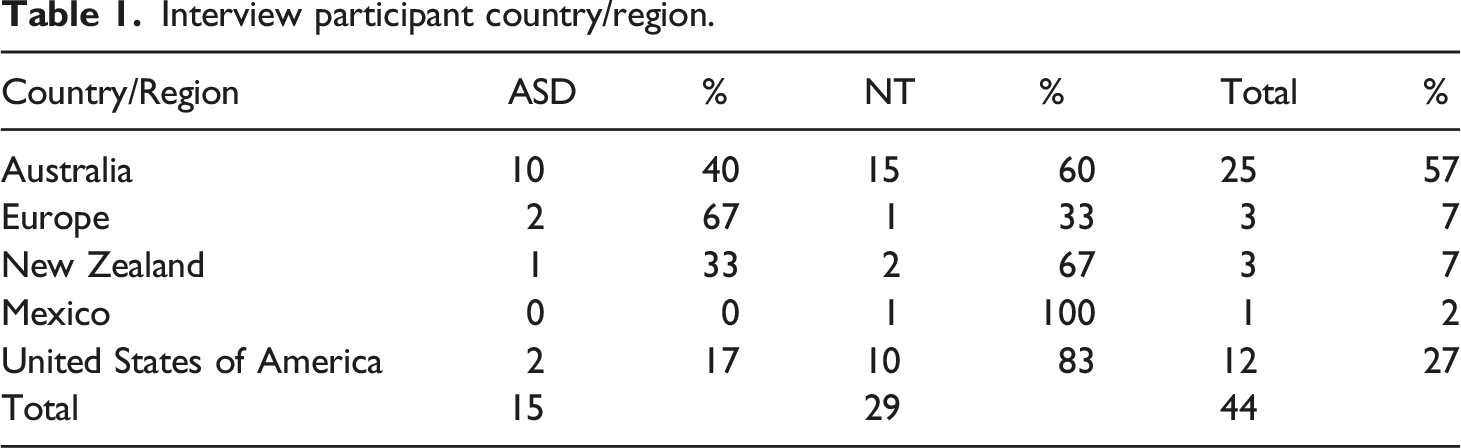
Interview Development
Interview questions were developed after exploring 12 on-line questionnaires concerning relationships (Argyle & Hills, n.d.; Boyd & Roach, 1977; Cobb, 2007; Diener et al., 1985; Gething, 1994; Gottman, nd-a, nd-b; Gottman & Gottman, 2017; Griffin & Bartholomew, 1994; Joseph et al., 2004; Lyubomirsky, 1999; University of Louisville, n.d.) together with a refinement of questions used in previous prompt dependency research (Wilson et al., 2014, 2017). Questions were based on aspects of expressing affection, connectedness, challenges, difficulties within conversations, and relating differences.
Interview Materials
The 36 open-ended interview questions used by the researcher to guide the discussion, were the same for all participants. However, not all questions were asked within each interview as they were used as a means of interview guidance, to probe and generate conversation that flowed throughout the interviews. Interviews were conducted in a relaxed and informal manner that frequently continued over several hours. This interview approach suited the purposes of the study as it enabled the researcher to gain detailed and descriptive information from participants (Creswell, 2008; Silverman, 2004), while also gathering the story behind each participant’s experiences. Interviews were transcribed verbatim and emailed to the respective interviewee for member checking. All interview participants were assigned a pseudonym.
Data Analysis
Interview transcripts were imported into NVivo 11, which was used to support the analytical coding processes in order to establish meaning (Anfara et al., 2002). NVivo is a qualitative data analysis (QDA) computer software package designed to provide a workspace for all text-based project data. NVivo enabled the researcher to perform a deep level of analysis of the relationships held within the data and supported the coding processes to identify the themes it contained (Bazeley, 2007; 2013; Richards, 2009). Based on six categories: reciprocity, unresponsiveness, prompts, obstructions, responsibilities and burden found in the initial study on prompt dependency, and through the analytic coding processes used in this study, the emerging themes were refined until conceptual saturation was reached, no new themes were generated and the remaining gaps in the emerging conceptual scheme were filled (Kendall, 1999). The researcher’s supervisors assumed the role of advisors who evaluated the process, examined the codes identified and provided guidance and feedback throughout. Consensus was reached through collaborative discussion.
Results
Data coding identified one core element, contrasting needs for emotional and personal interaction, that was underpinned by three themes and sub-themes, which supported the development of the larger story around the formation, and continuation, of the prompt dependency cycle (see Figure 1). The three themes underpinning this core element were: affection and connection incompatibilities; prompting, prompt dependency and prompt avoidance; and a prompt dependency cyclic communication system. Quotes were positioned throughout the results sections based on the themes; the individuals quoted were not necessarily in relationships together. Revised prompt dependency cycle with interwoven self-protective cycle.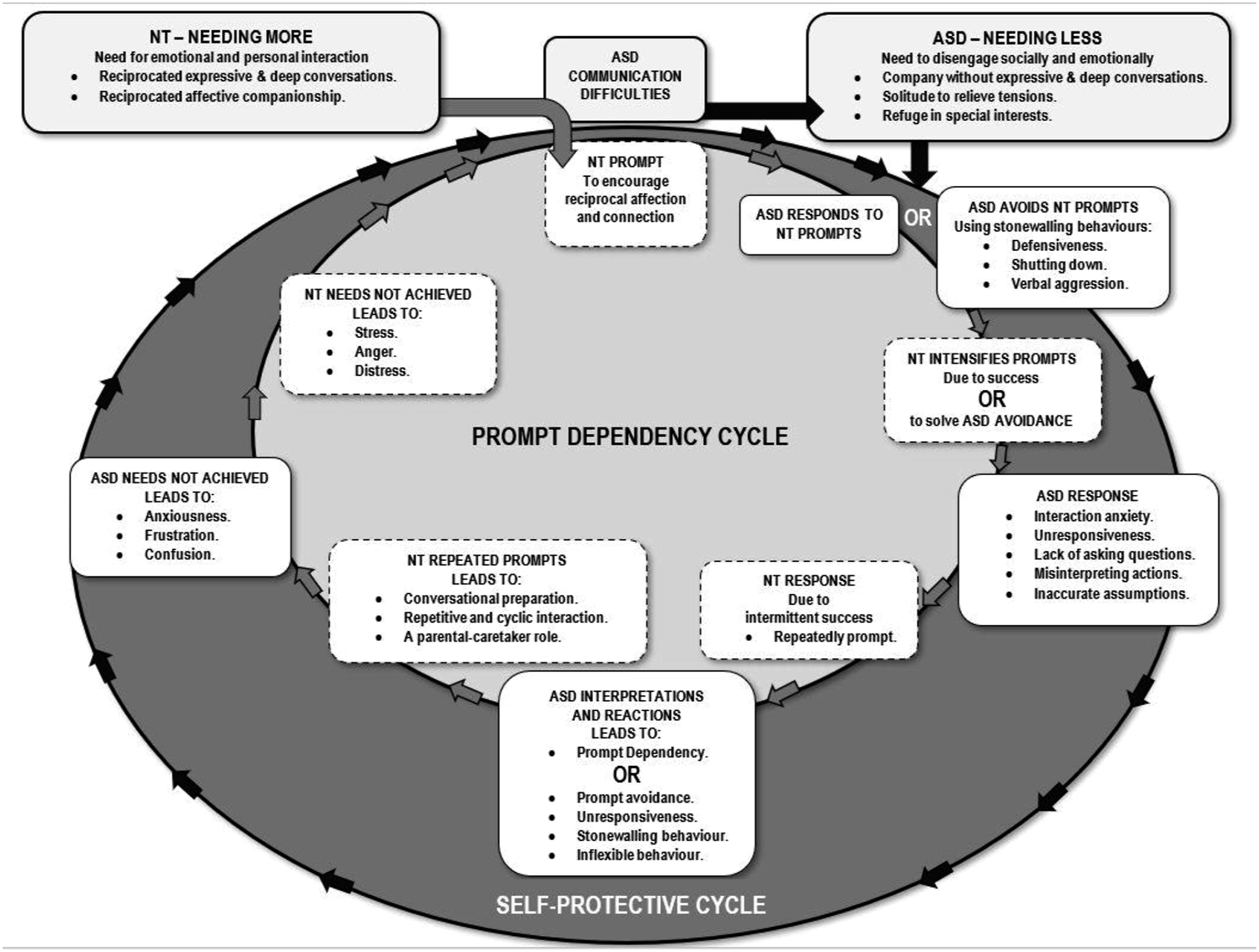
Theme 1 – Affection and Connection Incompatibilities
The theme affection and connection incompatibilities describe the circumstances that can lead to different emotional connectedness needs and resulting incompatibilities between the two groups of participants. Disparity in the emotional needs of NT and ASD participants are encapsulated in the overarching headings of needing more and needing less (Figure 1). Differences with expressing feelings, emotions and conversing about personal matters were found to contribute to the social interaction patterns found in each theme. Similarly, the incompatibilities in the need for reciprocity, affectionate conversations, deep and meaningful conversations, connectedness, and time in solitude was seen to be the catalyst for each group of participants to experience and assess their relationship in very different ways.
Expressing Feelings and Emotions
Interview data revealed that expressing feelings and emotions was a very different experience for ASD participants compared to NT participants. Since expressing feelings and emotions were challenging for most ASD participants, they tended to avoid these types of conversations, preferring to talk about less emotional topics. Whereas, for NT participants, expressing feelings and emotions was a process that resulted in closeness, and the lack of these types of conversations meant feelings of dissatisfaction: Nora (NT romantic relationship 11–20 years) Obviously, I’d prefer to have more…of my intimate relational needs satisfied by him…but his capacity is not at my capacity. Wally (ASD romantic relationship 21–30 years) I express it by saying I don’t want to talk about this because I'll get upset. Trying to identify what the feeling is and how to deal with it is really hard and it gets in the way of rationality.
Conversing About Personal Matters
The difficulties participants with ASD had in expressing feelings and emotions and a desire to avoid emotional conversation produced considerable distance between the NT and ASD people in these relationships and conversations often became superficial as a result: Susan (ASD romantic relationship 6–10 years) We often spend evenings with our books/computers, without talking…I would be happiest to spend my days reading and listening to music, without him and our child, and that doesn't improve relationships…Sometimes I just need to be left alone and it would be the greatest way of showing he cares. Wilhelmina (NT romantic relationship 11–20 years) Our day-to-day conversations are superficial. They revolve around chores and how your day has been…so there's no exploration of in-relationship interaction.
Reciprocity
The different desire for social interaction was found to compel participants with ASD toward avoidance of opportunities to communicate, connect, and express love through reciprocity with their significant others: Tracy (NT romantic relationship 21–30 years) Reactions and lack of reaction set up barriers which kill emotional reciprocity. If, when you speak to someone, the person does and says nothing, one gradually stops speaking to that person; so, no emotional connection. Samuel (ASD romantic relationship 6–10 years) We would tend to get overly emotional and not know when to stop and things would rapidly spiral out of hand into a fight…Sally would insist on continuing the conversation until it drove me nuts.
Affectionate Conversations
Many participants with ASD mentioned that they did not perform well in conveying affection and/or want to have these types of conversations. However, NT participants discussed that their commitment to the relationship was affected by the absence of affectionate conversation: Sandra (ASD romantic relationship 11–20 years) I do know that he wishes that we would be more affectionate with each other and…I guess I don't have that feeling as much. Maggie (NT romantic relationship 31–40 years) There was no affection, there was no encouragement, there was no hugs, unless you know you've just been chastised…then you start to say, “well am I really worth anything”, and living with that is really hard to find an identity for yourself, and self-esteem, yeah and self-confidence, that's what I battle with all the time.
Deep and Meaningful Conversations
The interview data indicated that the differences in need for emotional interaction resulted in a distinct lack of deep, meaningful conversations, furthering disconnectedness within the relationship. The NT group of participants reported feeling unheard, whereas the ASD group were content with low levels of affectionate or meaningful conversations: Sally (NT romantic relationship 6–10 years) I can't tell him what I'm trying to tell him, because he won't listen and…it's really hard to get him to focus on what I'm actually trying to say, and what's important to me…what I am actually trying to get across and trying to explain tends to get completely lost in all the words…He interrupts me all the time…so I don't feel heard. Rachelle (ASD romantic relationship 11–20 years) If I wanted to have fixed it, I would have increased the level of conversation or intimacy…this is the level I'm happy with…No I don't think he is happy at all…I don't answer the way he wants me to answer from an emotional point of view…I don't really know how to.
Connectedness
The amount of connectedness and method of connection desired by NT participants was in direct opposition to the variety, and level, of companionship desired by ASD participants: Rachelle (ASD romantic relationship 11–20 years) Well, it meets my needs, I'm happy just to have…even just a 10-minute conversation a day and that forms for me a good marriage, but he wants more constant connection throughout the day. He doesn't feel satisfied. Quinn (NT romantic relationship 21–30 years) It's kind of hard for my husband to connect with me emotionally so I think whatever I do…like hugging him or telling him I love him is enough for him. He can't do the same for me.
Solitude
The interview data confirmed a discrepancy between the affectionate conversations desired by NT participants and a preference that ASD participants had to spend time alone. This desire for solitude met various needs including relaxation, recovery from tense conversations or interaction difficulties, or to gain relief from resulting social interaction anxieties. Laura (NT romantic relationship 2–5 years) [He] spends long hours at work…or internet surfing, all in the name of special interests in news/health. Wally (ASD romantic relationship 21–30 years) I don't feel like we have to be conversing, interacting, whatever, all the time. I just want to be in the same house…not feel like we had to have frivolous conversation.
The considerable inequalities each group of participants had for quantities and qualities of social and emotional interaction, needing more contrasted with needing less, were consistent across the data. These incompatibilities were seen to be the cause of a sequence of events that contributed to the formation of prompting, prompt dependency and prompt avoidance within neurodiverse relationships.
Theme 2 – Prompting, Prompt Dependency and Prompt Avoidance
The theme prompting, prompt avoidance and prompt dependency describes the circumstances that produced specific behaviours that participants use to increase the likelihood of getting individual needs met. It was identified in the research data that it was the incompatibilities of needs between those in neurodiverse relationships that activated the avoidance tactics of adults with ASD and triggered the prompting practices of the NT participants. Prompting was met with differing levels of success and response from the ASD partner/family member.
Prompting
For all NT participants, prompting became the means to achieve emotional and social outcomes. However, NT participants recounted that their use of instructions, explanations, demonstrations, and questions were intermittently successful. Intermittent schedules of reinforcement are very resistant to extinction (Kinyanjui et al., 2015) consequently, NT participants persisted with prompting and would intensify prompting practices in order to achieve the desired response: Dawn (NT romantic relationship 11–20 years) I've learnt not to expect normal communication about information. I have to ask, and I have learnt to accept that I may sound like a ‘nosy nag’ but if I don't ask, I won't get told. Sandra (ASD romantic relationship 11–20 years) He definitely tries to prompt [affection]. He says he doesn't do it as much anymore because I'm not always positively responding back. Tracy (NT romantic relationship 21–30 years) I have tried time and time again…Like, I would tell him something and he would do it for two days. Then it was back to the old routine. Dana (NT parent-child relationship 21–30 years) When I see whether or not he's doing well. I taught him…and so using words like…Lets define how we feel. Do we really feel depressed, or is it more a frustration? Lilly (NT parent-child relationship 21–30 years) I try to slow my voice down. I try to give one instruction at a time. I try to wait for his responses.
Prompt Dependency
In general, dependency on prompts arose due to difficulties with self-reliant behaviour and self-initiation skills, which precedes the necessity for ongoing and explicit step-by-step instruction each time any particular behaviour is required that is not inherently motivated. Although NT participants commenced prompting to achieve the affection and connection that were lacking in their relationships, the belief was that the necessity to prompt would ultimately cease. However, it was found that this strategy, in addition to being only partially successful in the attainment of the intended outcomes, continued to be a requirement, rather than coming to an end: Murray (ASD romantic relationship 21–30 years) To be honest it's probably usually reactive, so she'll display affection towards me, so I'll try to display affection back. I'm not usually proactive in displaying affection. Ruth (NT romantic relationship 6–10 years) With prompting, my husband tries to put forth the effort to connect with me, not just share information. I am the one who has to ask him questions in an effort to connect. He doesn’t go out of his way to connect with me. I wish I didn’t have to prompt him and ask for warmth, affection, attention, but I realize that is the reality of my life.
Prompt Avoidance
Prompt avoidance was a frequent self-protective behaviour that ASD participants used to avoid unwanted conversations. However, avoidance only served to intensify the level of prompting. Stonewalling behaviours, such as becoming defensive, shutting down and becoming verbally aggressive were regular behaviours of ASD participants reported by both groups of participants: Sabrina (NT romantic relationship 6–10 years) I would say about 50% of the time he'll engage and the other 50% of the time, particularly when he's irritated and we're talking about something that is uncomfortable, he'll just give you the silent treatment. Sandra (ASD romantic relationship 11–20 years) I start to walk out of the room, or I just turn over in bed and want to go to sleep…He's told me it really bothers him…I just want to go do something else and end that situation. Samuel (ASD romantic relationship 6–10 years) I would find the prompting about that sort of thing would be annoying…I don't find it necessary to continue on because her conversations go into what I consider unnecessary detail and repetitiveness.
Several difficulties emerged as a consequence of unsuccessful communication. These were: interaction anxieties, un-resolvability of communication problems, unresponsiveness, an absence of questions, misinterpreting actions and forming inaccurate assumptions and satisfaction in the status quo. However, while prompts were intended to alleviate these difficulties, often prompt avoidance invalidated progress. The response to these difficulties differed for NT and ASD participants, but ultimately led to additional prompting from the NT partner/family member.
Interaction Anxieties
Anxiety and stress involved in attempting to relate, or endeavouring to avoid relating, played a substantial role in the avoidance tactics used by those with ASD. The interview data confirmed that both groups of participants experienced similar feelings of anxiety when speaking with each other; however, explanations for the feelings were very different. For those with ASD, anxiety in the complexities of emotional conversation, a fear of failure (and the resultant stress from multiple experiences of malfunctioned communications) were frequent triggers to become unresponsive and avoid interaction. While NT participants reported similar feelings, it was the excessive amounts of resistance and the self-protective behaviours exhibited by their partner/family members, together with an inability to progress through conversations, that were the cause of their feelings: Rachelle (ASD romantic relationship 11–20 years) Talking to others definitely brings on a level of anxiety and stress and it’s just incredibly uncomfortable. I only want to talk to people when I need something out of them. Robert (NT romantic relationship 11–20 years) It makes it very…fraught in terms of broaching subjects, knowing that it is most likely going to be an ugly outcome from it…I feel my tension levels rising walking through the door at home whereas at work I was calm and happy and, and it should be the opposite way around, but often it is not.
Un-Resolvability of Communication Problems
Most ASD participants appeared to find their partner/family members attempts to initiate conversation and connection a hindrance. Most NT participants also expressed frustration, but this was a consequence of the additional communicational effort involved in prompting: Renee (NT romantic relationship 31–40 years) I’ve learnt that problems don’t get solved in our relationship by talking about them, they get solved by me thinking about them…and then going with him “right this is what we need to do,” which takes me back to being the boss. Sandra (ASD romantic relationship 11–20 years) I've always just been able to sleep on it, I find if I just do something else or if I just go to sleep or if I work on something else. I can get over it pretty quickly so to me I'm like let's just let it go and move on to something else. Terry (ASD romantic relationship 6–10 years) I have one point of view and she has another one. Whether it's one person is right or wrong or whether it's a communication misunderstanding again we get this sort of ‘ratcheting up’ scenario that seems to happen.
Unresponsiveness
Interviews confirmed that most ASD participants coped with the relational demands placed on them by becoming unresponsive. While many ASD participants openly discussed their unresponsive, withdrawal and avoidant behaviours, they appeared to be unaware that these behaviours not only prevented their partner/family members’ efforts to connect and collaborate with them, but often resulted in increased prompting: Rachelle (ASD romantic relationship 11–20 years) He's the one who's pushing the conversation asking me questions and just talking and hoping I respond. Quinn (NT romantic relationship 21–30 years) I would ask something…and he would never respond…I would go to bed crying…he never came and held me; he never came to ask what was wrong…I can't get over the hurt.
Lack of Questions
Whereas ASD participants expressed frustration with questioning from their NT partner/family member, NT participants reported that an absence of questions within their day-to-day interaction triggered them to further prompting: Renee (NT romantic relationship 31–40 years) He just kind of leaves [the relationship] to me, I think basically because it doesn't occur to him…to ask about stuff like that. Richard (ASD romantic relationship 21–30 years) But if I can sort of see something is wrong, I don't ask questions…She requires an answer…pushing and pushing...It gets too annoying.
Misinterpreting Actions and Forming Inaccurate Assumptions
The absence of asking questions, together with misinterpreting actions and forming inaccurate assumptions, became a common occurrence for those with ASD. Consequently, in conjunction with a need to find ways to solve problems alone, or prompt through asking questions, NT participants reported that the regular occurrence of erroneous assumptions compounded the distance that grew between them. It appeared that this chain of behaviours negatively impacted on interaction, regardless of the efforts made by either person, triggering more prompting: Maggie (NT romantic relationship 31–40 years and daughter) He'll say, “but you said this” and I say “no. You have conversations with me in your head. I would remember if I had that conversation. That's one of those you've had in your head. You did not talk to me about that”. And I won't engage in that anymore, especially with [my partner], no but for [my daughter]…I have to have things written down…because if she's said something that is, if she says one thing and then she says another, I can turn round and say “no you said this. See check the text message that you said it”, and she'll check it and go “oh”. See that kind of thing. Barry (ASD romantic relationship 21–30 years) I suppose there's times…for instance she says something, I'm inclined to listen to the first part and then go off on a tangent, analysing that and then not hearing what she is saying after that, and she might take that as meaning that I am not interested but I am, or I am trying to do two things at once. Dawn (NT romantic relationship 11–20 years) If and when I talk [with] him…he takes away what can be a completely different perception of what I have said and…he doesn't ask me anything, my feelings or thoughts on things and then makes sweeping assumptions.
Satisfaction Levels
Participants with ASD acknowledged that they were not good at giving emotional support, or recognising the necessity, and frequently chose not to increase their efforts. Dissatisfied with the lower levels of emotional connection, NT participants were further displeased by an appearance of satisfaction that their partner/family member with ASD demonstrated. Participants with ASD confirmed these assumptions, while illustrating their lower need for emotional interaction and inflexibility toward changing emotional interaction quantities in their relationships: Sabrina (NT romantic relationship 6–10 years) I'm the one who's dissatisfied. He's kind of okay because he's getting whatever limited needs that he has met. Tom (ASD romantic relationship 6–10 years) I feel comfortable when I am with [my partner] and I do not feel lonely. To me that is a satisfactory emotional connection. I don’t know how to make warm affectionate conversations, but I don’t feel anything [is] lacking.
The spasmodic success of prompting caused it to be the main strategy that NT participants used to gain their intended outcomes within the relationship. Largely, however, problems remained due to the permanency of the distinct and differing needs. Most ASD participants reported that they preferred not to discuss problems, rather to drop them and move on, suggesting that resolution was not required by them. In contrast, NT participants preferred to face problems and resolve them by talking them through until a resolution was reached. Consequently, a communication pattern formed between prompting for actions, dependency on the instructions to carry out the actions prompted (prompt dependency) and/or avoidance of the actions prompted (prompt avoidance).
Theme 3 – A Prompt Dependency Cyclic Communication System
The theme, a prompt dependency cyclic communication system, was evident in the data that revealed how the prompt dependency cycle becomes an entrenched communication system of two intertwined communication cycles: the prompt dependency cycle and the self-protective cycle. This communication system evolved from the unresolvable circular conversations and communication difficulties, together with avoidant and self-protective behaviours on the part of ASD participants and prompting behaviours on the part of NT participants. It appears to emerge as natural by-products of the on-going endeavours, by each, to meet their social and emotional needs. The data confirmed that where there was an incapacity between people involved in neurodiverse relationships to bring this prolonged communication system to an end it created insurmountable disharmony between them: Sandra (ASD romantic relationship 11–20 years) I'm saying the same thing over and over because I don't have anything more to maybe say in this [sic] so it’s kind of a bit redundant to me. Haley (NT romantic relationship 11–20 years) [We] couldn't get off the merry-go-round and ended up…in a screaming match…I used to try and reason, like as a normal person would…I would listen to what he was saying, and he would just get angrier and angrier because…in his eyes, I wasn't listening to him. Ronda (NT romantic relationship 31–40 years) There was never any resolution, they just went around in circles because he was never addressing the actual topic…probably didn't understand where I was trying to go…Just going around in these ridiculous crazy circles all evening.
Conversation Preparation
Most NT participants reported that they needed to prepare for most of their important, emotional, problem solving, and decision-making discussions and counter the self-protective behaviours employed by their partner/family members with ASD. The NT participants described using strategies such as conversational scene setting, forewarning (giving plenty of notification of up-and-coming important conversations), careful and deliberate censorship of language and expressions, and using procedures, such as conveying information gradually step by step. Frequently, ASD participants appeared to miss the point: Georgia (NT romantic relationship 21–30 years) I have to precede…“I'm not criticising,” and learning how to say your sentences in a way that's not threatening to them, and then if you were to get it wrong then the shit hit’s the fan, because you've said it in the wrong way, or with the wrong tone of voice, and they feel threatened, or they feel you're criticising them or you're undermining, and it’s like ‘Oh my God! You're worse than a teenager’. Samuel (ASD romantic relationship 6–10 years) I would take our previous discussion as an agreement whereas she would take it as a discussion and…we still hadn't actually come to a conclusion, according to her…I thought we'd agreed on something and she’s saying no we hadn't.
Repetitive and Cyclic Interaction
Interview data confirmed that prompting and conversation preparation were used by NT participants to overcome several behaviours exhibited by adults with ASD that prevented communication. Repetitive and cyclic interaction often resulted. Susan (ASD romantic relationship 6–10 years) We raise the same topics over and over again – child rearing, money and chores and it seems that we never reach a final conclusion. Ruth (NT romantic relationship 6–10 years)
We have the same conversations over and over, and I think he understands what I am saying and where I am coming from. We agree to take some course of action on a particular issue, and then it’s like he “forgets” and just goes and does it the way he is comfortable with or the way he has “always done it”, which often looks selfish to me, like he isn’t taking my thoughts and feelings into consideration.
A Parental/Caretaker Role
The effort described by NT participants to attempt to accomplish their communication needs was beyond what is customary within close relationships. They reported that the necessity to prompt most conversations positioned them in a parental/caretaker role. They felt an obligation to manage their relationship, to take care of their partner/family members and to be responsible for holding their relationship together, rather than being able to enjoy the rapport, attachment and connection expected within close relationships. Most of the NT participants, both male and female, relayed the notion that they felt like they did not really have a relationship at all. They felt that they had no one to rely on or help them when they needed support and had to manage everything within their relationship on their own: Lucy (NT romantic relationship 11–20 years) I guess it’s almost like training a child…You don't expect to be doing that when they're in their 50's and 60's…I believe that yes, I am the major caretaker…being the caretaker of the emotional side…but I seem to be the one working at it all the time. Robert (NT romantic relationship 11–20 years) Inside the family unit, I feel very much that it is team Rachelle and not team [us] so…it is really very much about what she wants, and wants to do, and wants to achieve, and not really much about what I want… I’m very quick to make a sacrifice…for the rest of my family…I’m trying to manage a relationship that all works…Yes thinking about others.
Needs Deprivation
The continual communicational struggles were identified as a contributing factor to a propensity for NT participants to become overburdened within the relationship. Consequently, most NT participants reported experiences of psychological stress and anger toward their partner/family members with ASD, which was very distressing for them. The majority also reported feeling defeated, drained and depleted, from the stress of the relationship. Experiences for ASD participants were also similarly adverse. Most ASD participants became frustrated, anxious, and confused as a result of their partner/family members’ struggles to connect with them. Many felt that much of the exchanges that their partner/family members wanted with them were “much ado about nothing”. They simply wanted a happy peaceful life with their partner/family members and felt frustrated with the presence of persistent disharmony within communications: Wanda (NT romantic relationship 21–30 years) I've kind of given up…I think I've kind of worn myself out…I've sort of reached that point of not being hurt anymore and trying not to expect anything and I don't have the answers. Rachelle (ASD romantic relationship 11–20 years) I don't want the conversation to occur…Sometimes I tell him I don't understand why it is so much of a big issue…He does [explain] but I still don't really get it. Samuel (ASD romantic relationship 6–10 years) After the diagnosis I became more stand-offish…in knowing that I'm wired differently and in order to act normally is a real strain, I'd rather just save my energy and enjoy myself doing what I want.
Discussion
Predominantly, communication is the single most important thing in a relationship. Gottman and Notarius (2002) found that not only does interactive behaviour matter greatly to relationship quality, but also the social interaction that one has with significant others was the most significant determinant of a person’s physical and psychological wellbeing. However, analysis of the interview data in this study revealed that there were substantial differences in need for interaction and emotional connection between autistic and neurotypical people. These differences, the need for less as opposed to the need for more interaction, was the catalyst to the development of an interlinked prompt dependency and self-protective cycle.
The relationships, progressions and escalations of themes revealed in the data are represented diagrammatically in figure one. Illustrated in the model is the struggle between individual needs and striving to get these needs met that were the triggers for contradictory behaviours of prompting and self-protection between ASD and NT adults. In addition, the prompting and self-protection behaviours were perpetuated by a set of behaviours that developed in order to compensate for these individual struggles.
Findings from the current study confirmed those of a previous study (Wilson et al., 2014, 2017) that the intensification of the intertwined behaviours that result from prompting and prompt dependency and/or prompt avoidance were the main contributing factors to the formation of the prompt dependency cycle, to its continuation, and to shaping distinctive roles for each person within neurodiverse relationships. An inability to find a solution appropriate for each group of participants underpinned the formation, and continuation of the communication system that integrated prompt dependency, within neurodiverse relationships. When locked in this cycle, neither ASD participants nor NT participants succeeded in attainment of their needs that continued due to the persistent communication differences and difficulties. Predominately, the prompt dependency cycle was found to have negative impacts on both groups of participants while lower degrees of prompt dependency contributed to better outcomes within the relationship (Wilson et al., 2014; 2017).
Thus, while most consider relationships are central to happiness, they are also sources of frustration and challenge (Bodie et al., 2011; Carr et al., 2019; Duck & Wood, 1995). This study identified high levels of frustration and challenge triggered by the different needs for emotional connectedness and the chronic turmoil from communication difficulties. Additionally, the model depicts the psychological stress that participants in the study experienced, in part, attributable to their powerlessness to change the circumstances that they have found themselves in.
Nevertheless, the prolonged limited research attention on adults with ASD (Howlin & Magiati, 2017; Pellicano, 2014; Pellicano et al., 2014) and their relationships has meant that the needs of autistic adults, their significant others, and their family needs, have largely been overlooked by the public, healthcare providers, researchers, academics, and policy makers. Findings from this study suggest that, in general, ASD and NT participants felt powerless to change their situation unassisted, and yet the lack of understanding from many professionals meant that clinical interventions were mainly ineffective for this group of people. Participants also reported that inadequate community knowledge and awareness led to feeling invisible and disbelieved. Likewise, unsatisfactory treatment in counselling and therapy programs often exacerbated their distress regarding their particular difficulties, while leaving them with little option for other appropriate assistance. As a consequence, people in neurodiverse relationships often become isolated by the lack of understanding of their particular predicament, with many reporting that they face a lack of belief, a lack of acceptance and sometimes ridicule. Despite their struggles, most participants indicated a desire to maintain their relationship if they could find solutions to their dilemma. Professionals, therefore, need to be better equipped in their approach toward these families and couples.
To this end, the study points to increasing awareness from the perspective of the families and couples. The updated prompt dependency cycle model resulting from this research has the potential to become a useful and important educational tool for counsellors and therapists. Finally, while typically the research focus has been on children, it is critical to adopt a life-course approach to ASD and other developmental disabilities to support adults on the autism spectrum, and those that live with, work with, and love them.
Limitations
The study had several limitations that must be noted. First was the use of self-reported data. While the main strength of self-report methods is the ability to allow participants to describe their own experiences (Ganellen, 2007), there is a possibility of unintentional bias. Secondly, participants were recruited through support networks for individuals with ASD, as well as partners and family members of individuals with ASD; therefore, the findings reported are representative of help-seeking individuals and may not reflect the experience of all people in neurodiverse relationships. In addition, since verifying a clinical diagnosis was not possible within the confines of this research, the assumption was made that people accessing these support services would not be doing so unless they or their partner/family member was autistic. It was also beyond the scope of the study to explore the range of ways that autistic participants arrived at this point. Individuals who are diagnosed with autism at an early age and/or received support services may have different needs in a neurodiverse relationship than those who did not have a formal diagnosis and/or did not receive support services. Further, certain demographic data, including race/ethnicity and sexual orientation, were not collected in this study. As such, the findings of this study may not be reflective of the whole autism community. Individuals who require more significant supports were also beyond the scope of this study. Future studies may aim to explore whether these findings can be extended to autistic individuals who have complex communication needs and what implications it may have for those individuals who require more significant supports. Lastly, the higher proportion of females in both participant groups may bias toward a female perspective and needs to be considered in future research.
Conclusion
The findings of this study highlight participants’ perspectives concerning the communicational difficulties that adults in neurodiverse relationships experience. The aim of this paper was to present the findings of a broadened investigation into prompt dependency in adults with ASD and to unravel why a prompt dependency cycle forms in the communication of people in neurodiverse relationships. Although the ratio of NT to ASD and females to males presents limitations to the generalisations that can be made from the themes presented, listening to the voices of those in neurodiverse relationships contributes valuable insights into their lived experience.
While it is acknowledged that for professional services working with individuals in NT/ASD relationships finding clear cut solutions is challenging, the unique experiences of the individuals presented herein, provides the opportunity for deeper thought around the support requirements to overcome the effects of the prompt dependency cycle. In closing Sabrina (NT), shared a viewpoint acknowledged by many of the ASD and NT participants: Since so many of these relationship issues naturally end up in marriage counselling…there needs to be a better job done in the education of psychologists, social workers…so that they don't inflict the traditional counselling on [them]…It’s never going to work, and it's just going to cause more harm than good.
Footnotes
Declaration of conflicting interests
The author(s) declared no potential conflicts of interest with respect to the research, authorship, and/or publication of this article.
Funding
The author(s) received no financial support for the research, authorship, and/or publication of this article.
Open research statement
As part of IARR’s encouragement of open research practices, the authors have provided the following information: This research was not pre-registered. The data used in the research are not available. The materials used in the research are not available.
